US military had close call after using AI for false intelligence report, sources say

the episode with the Chinese ship underscores a different, and more immediate risk: human beings making disastrous decisions based on inaccurate or misleading information generated by AI or other automated systems. Sources said that the military is rapidly turning to AI to help with targeting, an area which holds the obvious risk of fatal mistakes.
ByKatie Bo Lillis, and Zachary Cohen
The intelligence report, circulated across the US military this spring in the midst of the war with Iran, immediately set off alarm bells: A Chinese ship in the Middle East was transporting components of a nuclear weapons program.
The US military swung into action with plans to intercept the vessel, according to four sources familiar with the episode. According to two of the sources, armed members of the US military were preparing to board the ship. Military planes were in the air, one of those sources and another source familiar with the incident said.
It was only just before the planned operation that officials dug deeper into the report put together by a special operations command analyst and found it had been generated with the help of artificial intelligence (AI) — and that a chatbot the analyst had used inaccurately identified the material the ship was carrying. CNN was not able to learn what the misidentified cargo was.
The report, according to one of the sources, was “entirely false.” But it also “almost started a war,” the source said. Any US operation against a Chinese vessel could have risked spiraling into an armed conflict between the two nations.
Across the US military and the intelligence community, officials are pushing to weave AI into nearly every facet of their work, from analyzing the huge volumes of raw intelligence the US collects and selecting targets for strikes, to more mundane applications like managing budgeting, logistics and supply chains.
But the episode underscores the profound risks of using this powerful, new and relatively poorly understood technology for targeting in the middle of a war. Analysts have long feared that AI could lead to a catastrophic miscalculation if nation states are relying on poor or corrupted data — the kind of miscalculation that might lead the United States to fire on a Chinese ship based on inaccurate information.
In this particular instance, the analyst queried a chatbot about some intelligence reporting on the ship’s manifest that originated with US Special Operations Command Pacific, based in Hawaii. It was not clear whether the chatbot was a commercially available one or a US government product.
“The internal tools are mostly just copies of the commercial stuff wearing lipstick,” a former senior US official familiar with the AI systems used by military and intelligence analysts.
The bot fused together open-source intelligence with secret signals intelligence in government holdings and reached its fateful conclusion about the material the ship was carrying.
The analyst then used AI again to package the findings into a standard intelligence report — the kind that is trusted by military officials — and disseminated it.
US Special Operations Command Pacific and the Pentagon did not respond to a request for comment.
The rationale for the rapid adoption of AI is that it can help the military make battlefield decisions, like which targets to strike or which military assets to move where, faster. Officials say the US can’t afford to fall behind in integrating AI in case it must one day fight China or another adversary who would potentially be able to stay one step ahead of the US.
In January, Defense Secretary Pete Hegseth released his agency’s “Artificial Intelligence Acceleration Strategy” in a bid to speed up the military’s use of AI.
“We will unleash experimentation, eliminate bureaucratic barriers, focus our investments and demonstrate the execution approach needed to ensure we lead in military AI,” Hegseth said in a speech announcing the strategy.
The strategy also pushes for its broad use across the military, ordering the department to make AI available via several programs with the aim of “democratizing AI experimentation and transformation across the Department by putting America’s world-leading AI models directly in the hands of our three million civilian and military personnel, at all classification levels,” a memo announcing the strategy said.
But the effort is decentralized, multiple US officials familiar with the dynamic said, with different parts of the government using different tools under different orders and safety standards. There’s no one set of standards for how the US verifies the information generated by these tools. The constellation of different AI systems being deployed by disparate corners of the military and intelligence community means that the relative reliability and functionality vary widely.
For weeks, Washington policymakers have been intensely debating AI after a series of dire warnings from Silicon Valley engineers and tech CEOs of the possibility that AI could break free of human constraints, with potentially civilization-ending consequences.
But the episode with the Chinese ship underscores a different, and more immediate risk: human beings making disastrous decisions based on inaccurate or misleading information generated by AI or other automated systems. Sources said that the military is rapidly turning to AI to help with targeting, an area which holds the obvious risk of fatal mistakes.
“AI in targeting is definitely something that is ramping up and there is no real guidance for how having a human in the loop will prevent civilian casualties or fratricide,” another source familiar with the military’s current policies said.
The kind of “hallucination” that the tool used by the analyst in this case conjured has not been an isolated incident across the intelligence community since these tools began proliferating across government, according to one of the sources.
For some older intelligence officials — even those who broadly support the use of AI inside the military — AI has put pressure on analysts to produce and disseminate intelligence faster, opening the door for mistakes. Young analysts in particular, several sources said, are natives on these tools and more likely to trust them uncritically.
“AI allows you to get to a bad idea faster,” one of the sources said.
North Korea’s Underground Nuclear Tests Are Reactivating Dormant Earthquake Fault Lines
Scientists recorded 1,399 local quakes since North Korea began its underground nuclear tests—a spike unlike anything the region has seen since seismic activity was first catalogued there.
By Matthew Phelan, September 17, 2026, https://gizmodo.com/north-koreas-underground-nuclear-tests-are-reactivating-dormant-earthquake-fault-lines-2000813481
The Democratic People’s Republic of Korea has conducted at least six major underground nuclear weapons tests at its secretive Punggye-ri facility beneath Mount Mantap within the nation’s coastal North Hamgyong Province. Back in September 2017, American seismologists with the U.S. Geological Survey (USGS) registered the final of these as a 6.3-magnitude earthquake-like event after DPRK scientists detonated their test bomb—but the aftershocks and quakes have reverberated onward into the present day.
A coalition across three of China’s research universities and the nation’s China Earthquake Administration (CEA) have now traced revived earthquake activity along several once quiet faultlines surrounding Mantap. These quakes, which began with a seismic event on September 23, 2017 (or three weeks after that final September 3 test) have persisted, periodically recurring all the way up to May 2025, the last month that this group collected data for its study.
“The progressive increase in both the earthquake rate and the moment release rate indicates that the crust did not simply relax toward equilibrium after the final explosion,” the researchers wrote in their new study, published Thursday in the journal Science.
Instead, they reported, seismic activity “expanded gradually as preexisting faults became active.”
A literal seismic shift
The nuclear weapon that North Korea tested in September 2017 had an estimated explosive yield between roughly 100 and 250 kilotons of TNT—at least 10 times the power of the atomic bomb that the U.S. dropped on Hiroshima near the end of World War II. The study’s first author, geophysics researcher Xingli Fan of the Chengdu University of Technology’s Key Laboratory of Earth Exploration and Information Techniques, worked with his team to pull seismic data from sensors in both China and South Korea to better understand this test’s consequences.
Some of these seismographic stations were quite close, within roughly 50 to 124 miles (80 to 200 kilometers) from the secret nuclear site. The data, which spanned the years from 2008 to 2025, identified 1,399 local earthquakes events during this period—a spike never before seen in earthquake data collected from the region since events like these were first formally catalogued on the Korean peninsula back in 1904. For Fan and his colleagues, the fact that North Korea’s first major nuclear test beneath Mantap detonated on October 9, 2006, served as something of an early indicator that these non-metaphorically earth-shattering blasts were altering local plate tectonics near the mountain.
Another big clue, they noted, was that satellite radar had measured “substantial ground deformation” atop Mount Mantap’s peak.
“Rather than generating only short-lived aftershock sequences, such perturbations can initiate the delayed reactivation of intraplate faults that unfold over years,” the researchers wrote.
Global shockwaves
While it’s true that underground nuclear testing has been associated with earthquake activity since the start of the Cold War, what’s happening in North Korea’s northeastern province is measurably different. Past studies of these kinds of underground tests at the Nevada National Security Site (Area 51’s neighbor) and the former Soviet Union’s Semipalatinsk Test Site in Kazakhstan also documented seismic aftershocks.
But, like ripples in a pond, these episodes were typically limited to the days and weeks directly after each underground nuclear test and were tightly constrained to the region closest to each bomb test’s epicenter. And they almost always faded back to normal in short order.
The increasing seismic activity near Mount Mantap, then, is anomalous for these kinds of tests—with major implications not just for local earthquake safety but also ongoing monitoring and verification efforts under the Comprehensive Nuclear-Test-Ban Treaty.
Three Mile Island: Legacy and Re-Opening Resistance
Witness the misadventure to reopen Pennsylvania’s “permanently closed,” uneconomical and age-degraded Three Mile Island Unit 1 nuclear power plant and opposition to stop it in this collaboration of the Clamshell Alliance(opens in new tab), Beyond Nuclear, Massachusetts Peace Action(opens in new tab) and TMI Alert(opens in new tab). The TMI nuclear power station near Harrisburg sited in the middle of the Susquehanna River is the nation’s most serious commercial nuclear power plant accident following Unit 2’s mechanical failure, human error, fuel damage, a hydrogen detonation and a partial meltdown that started on March 28,1979. The nuclear accident consequentially resulted in downwind and downstream radioactive releases with public exposures to harmful radiation. TMI Unit 1 was closed September 19, 2019 and federally certified for permanent defueling and decommissioning. Constellation Energy and Microsoft have instead embarked on an unprecedented and dubious restart of the closed Unit 1 to power AI data centers. Join Eric Epstein with TMI Alert, Patricia Longnecker, a TMI survivor, now activist and Aaron Datesman, an investigative scientist researching radiation induced suffering still prevalent decades later.
8 instances of radioactive material incidents in the UK since 2015

20 Working Days, Tom Pashby, Sep 21, 2026, https://tompashby.substack.com/p/8-instances-of-radioactive-material?utm_source=post-email-title&publication_id=6735486&post_id=216635328&utm_campaign=email-post-title&isFreemail=true&r=ln98x&triedRedirect=true&utm_medium=email
There were eight instances of nuclear or radioactive materials being lost, stolen or otherwise out of regulatory control in the past 10 years in the UK, according to data released to 20 Working Days.
The data, released by the Home Office, was already reported voluntarily by the UK Government to the International Atomic Energy Agency’s (IAEA’s) Incident and Trafficking Database (ITDB), which publishes aggregated data annually.
The IAEA Incident and Trafficking Database (ITDB): 2026 factsheet explained: “When originally established, the ITDB recorded incidents of illicit trafficking of nuclear and 145 participating States other radioactive material.
“Its scope was later expanded to include all incidents in which nuclear and other radioactive material is or was out of regulatory control.
“The ITDB scope covers all types of nuclear material as defined by the Statute of the Agency (i.e. uranium, plutonium and thorium), naturally occurring and artificially produced radioisotopes and radioactively contaminated material, such as scrap metal.”
It found that, as of the 2026 report: “The trafficking or malicious use intent of 86.6% of thefts remains undetermined.”
“In 2025, 236 incidents were reported to the ITDB by 34 States, an increase of 89 incidents from 2024,” it said.
“The noticeable increase in reported incidents in 2025 is primarily attributable to retrospective reporting.”
The factsheet also reported that “transport remains a key vulnerability, with over half of all thefts since 1993 — and approximately 70% in the past decade — occurring during authorised transport, underscoring the need for sustained attention to transport security measures.”
Under a section titled “Confidentiality and security of ITDB information”, the factsheet said: “The ITDB is a resource for information sharing among State authorities and the IAEA.
“In order to protect the confidentiality of information reported by States, the IAEA upholds strict procedures for handling and dissemination of sensitive ITDB information.
“Information on reported incidents is only communicated via the PoC (points of contact) network. Access to the complete database is limited to a small number of IAEA staff.”
20 Working Days asked the UK Home Office for the UK’s submissions to the database since 2015.
In response, the Home Office listed eight incidents it had reported to the database. It provided the following table: [on original]
It is unclear whether all of the incidents were disclosed to the public.
The list does, however, include one of the highest profile incidents in the UK involving radioactive materials – the malicious use of Polonium-210 which resulted in the lethal poisoning of Alexander Litvinenko in 2006.
The Litvinenko inquiry: report into the death of Alexander Litvinenko was published in 2016, which may explain why the incident was listed as 2016 by the Home Office.
Meanwhile, the 2021 incident of F-18 being lost and found appears to have been reported by the PA news agency in the same year.
The Home Office was approached for comment.
IAEA says cooling tower at Russia’s Kursk Nuclear Power Plant hit by drone

UN nuclear watchdog says it was informed that drone hit cooling tower of a reactor unit; no fire broke out, operating status not changed
Rabia İclal Turan, 19 September 2026
WASHINGTON DC
The International Atomic Energy Agency (IAEA) said Friday it was informed that a drone hit the cooling tower of a reactor unit at the Kursk Nuclear Power Plant in Russia.
A statement by the UN nuclear watchdog on US social media platform X said the drone hit the facility, located in the Kursk region bordering Ukraine, early Thursday, but did not specify who informed the IAEA of the incident.
“It was reported that the unit was operating at the time, but its operating mode did not change and there was no fire,” it said.
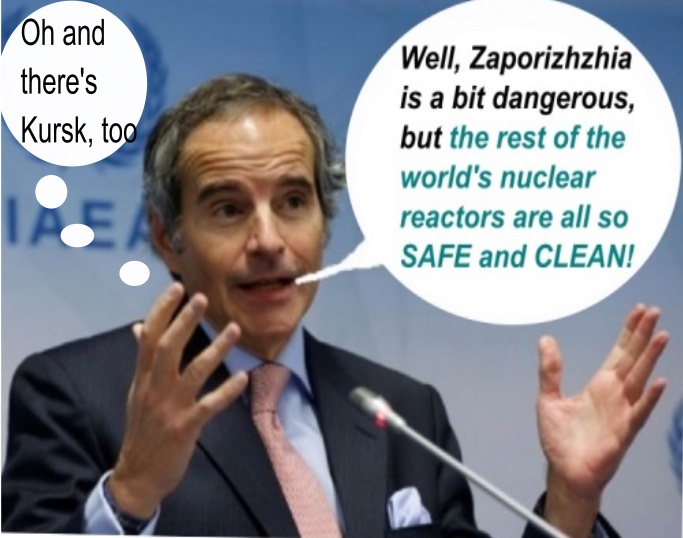
Quoting IAEA chief Rafael Grossi, the statement said that all attacks on nuclear facilities are “unacceptable” as they could “endanger nuclear safety and security, irrespective of where they occur.”
Grossi reiterated demands for “maximum military restraint” to prevent the risk of a nuclear accident.
The IAEA did not provide details on the source of the drone or circumstances surrounding the incident.
The agency has regularly warned Moscow and Kyiv about dangers to nuclear safety amid the Russia-Ukraine war, which began in February 2022.
In a later statement, Russia’s nuclear state corporation Rosatom confirmed that a drone detonated upon striking the cooling tower of the plant’s no. 1 power unit, causing “minor damage.”
It stated the incident did not affect the facility’s operations and that power unit no. 1 continues to operate at 100% capacity.
“The safety of the plant’s operation is ensured. Radiation levels remain unchanged and consistent with natural background values,” it added.
Leak forces Point Lepreau to shut down for 2nd time this month
Challenging location of the problem requires nuclear plant to go off-line for fix, official says
Sam Farley · CBC News · Sep 17, 2026, https://www.cbc.ca/news/canada/new-brunswick/point-lepreau-leak-shutdown-9.7345240
The Point Lepreau Nuclear Generating Station is shut down again, this time because of a heavy-water leak on an instrumentation line.
The line is part of the heat transport system, which is part of the heavy water station at the plant, Joel Armstrong, the deputy site vice-president at Point Lepreau, said in an interview.
Last week, there was an indication of a problem, he said, and the early indication systems worked exactly as planned, “allowing us to conduct a safe and predictable shutdown to facilitate the work.”
Heavy water carries heat from the reactor out to conventional boilers filled with regular water, creating steam to run the plant turbines.
Heavy water itself is not radioactive but over time when used in a reactor it begins to produce tritium as a primary source of radiation, according to the Canadian Nuclear Safety Commission’s website.
The page goes on to say that tritium is a “relatively weak source of beta radiation, which itself is too weak to penetrate the skin. However, it can increase the risk of cancer if consumed in extremely large quantities.”
CBC News has tried to ask N.B. Power about the radioactivity of the heavy water leaked at Lepreau and is waiting for an answer.
“We identified that there was potential for a leak,” Armstrong said. “We have lots of early monitoring at the station that gave us early indication that there was an issue,
The war in Ukraine war claims another life at Zaporizhzhia.
Nearly four and a half years after Russia’s full-scale invasion of Ukraine, July offered fresh evidence of how difficult it remains to disentangle Russia from the Western nuclear industry. Germany approved production of fuel for Russian-designed reactors using Russian technology, while new data from Europe and the United States showed that Rosatom retains a substantial share of Western uranium conversion and enrichment markets.
Meanwhile, at the Russian-occupied Zaporizhzhia Nuclear Power Plant, the killing of the station’s Russian-appointed chief engineer underscored a different consequence of the war: the continuing danger faced by those working at Europe’s largest nuclear power station—
ZNPP chief engineer killed amid continuing military activity
On July 15, Rosatom chief Alexey Likhachev said a drone strike on a service vehicle between the Zaporizhzhia plant and the neighboring city of Enerhodar had killed the station’s Russian-appointed chief engineer, Alexander Yakovlev, and his driver. Russia blamed Ukraine, while Kyiv denied responsibility and said there was no independent confirmation of Moscow’s account.
The incident quickly became the subject of competing claims. A Telegram channel subsequently alleged that Yakovlev had opposed allowing Russian personnel access to Westinghouse nuclear fuel stored at the plant and suggested that a dispute over that access might have contributed to his death. The claim has not been independently established.
Bellona nuclear expert Alexander Nikitin cautions against drawing conclusions from such speculation.
“Both sides (Russia and Ukraine) predictably accused each other of the killing,” Nikitin writes. “Who killed one of the several hundred people who die every day in Ukraine, and what the specific reason for this killing was, will never be established. The reason could have been anything, including domestic, financial or other motives, so there is no point in guessing or trying to investigate it. The war will write everything off.”
For Nikitin, Yakovlev’s death instead illustrates the larger danger created by the continued militarization of the plant and surrounding area. “Not only facilities are being destroyed, but people are also being killed, including personnel working at ZNPP and their families living in Enerhodar,” he writes…………………………………………………………………………..https://bellona.org/news/nuclear-issues/2026-09-russian-nuclear-ties-persist-in-the-west-as-war-claims-another-life-at-zaporizhzhia
Rosatom’s Likhachev Says Ukraine Attacked Fuel Trucks, Endangered Zaporizhzhia Plant
Moscow Times, By Reuters, Sep. 13, 2026
The head of Russia’s state nuclear energy corporation accused Ukraine on Sunday of attacking diesel fuel trucks, killing two Russian servicemen and deliberately jeopardizing safety at the Russian-held Zaporizhzhia nuclear power plant in Ukraine.
Alexei Likhachev said the attack took place on Friday and also resulted in injuries to other Russian soldiers.
The Zaporizhzhia plant, Europe’s largest with six reactors, was seized by Russian forces in the early weeks of the Ukraine war that broke out in February 2022. Each side has regularly accused the other of actions that endanger safety at the plant and increase the risk of a nuclear accident.
Likhachev issued a statement saying Ukrainian forces had launched “a series of combined strikes” on Friday on fuel trucks which deliver diesel to the station.
“The strikes hit very close to the perimeter of the station’s site,” he said.
“Two servicemen were killed, and a large number of Russian soldiers were injured, some seriously. They were all involved in supporting this purely civilian mission.”
Fuel is critically important for the plant as diesel generators provide power to keep nuclear fuel in the reactors cool when the plant’s two external power links are down. Both were down for nearly three weeks in August and September.
Ukraine has demanded that Russia abandon the station and hand its operation back to Kyiv, a demand rejected by Moscow. The fuel currently generates no electricity.
The UN nuclear watchdog, the International Atomic Energy Agency, has stationed an observer team permanently at the station, along with Ukraine’s three other working plants.
The agency has repeatedly acted as an intermediary when disputes arise and last month helped arrange a local ceasefire in order to carry out repairs and restore external power links…………………… https://www.themoscowtimes.com/2026/09/13/rosatoms-likhachev-says-ukraine-attacked-fuel-trucks-endangered-zaporizhzhia-plant-a93695
Rosatom chief, UN nuclear watchdog director general discuss Zaporizhzhia nuclear plant’s safety in Vienna
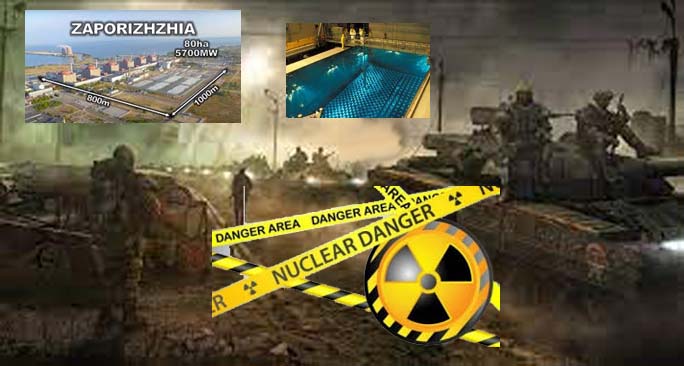
Russian nuclear state corporation Rosatom says officials focused on recent strikes on fuel trucks carrying supplies for Zaporizhzhia plant
Elena Teslova, 15 September 2026, https://www.aa.com.tr/en/world/rosatom-chief-un-nuclear-watchdog-director-general-discuss-zaporizhzhia-nuclear-plant-s-safety-in-vienna/4057265
The head of Russian nuclear state corporation Rosatom and the director general of the International Atomic Energy Agency (IAEA) discussed the safety of the Zaporizhzhia Nuclear Power Plant in Ukraine at a meeting in Vienna, Rosatom said Monday.
The talks between Alexey Likhachev and Rafael Grossi took place on the sidelines of the IAEA General Conference, said Rosatom’s press service.
Likhachev told Grossi that the situation at the plant and in the nearby Ukrainian city of Enerhodar has sharply deteriorated since late April, according to Rosatom.
More than 750 attacks involving Ukrainian drones and artillery have been carried out over the past four and a half months, killing 20 people, including nine Zaporizhzhia plant employees, and injuring more than 100, it said.
“The two officials paid particular attention to recent strikes on fuel trucks carrying supplies for the plant,” it noted.
Likhachev stressed that the trucks were delivering diesel fuel that is urgently needed to ensure the nuclear safety of the plant.
Grossi, for his part, said the IAEA was ready to explore ways it could assist with similar fuel deliveries, according to Rosatom.
He also reaffirmed his commitment to working with Russia on ensuring the safety of the Zaporizhzhia plant and his readiness to continue dialogue on the issue.
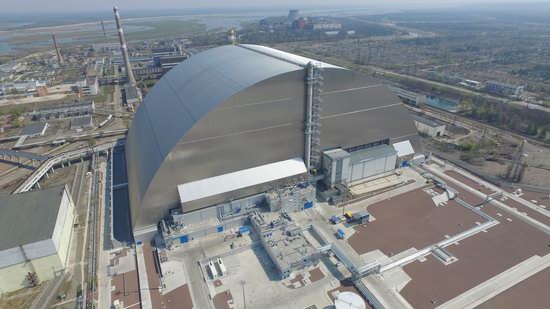
Drone Attacks On Chornobyl Could Have Endangered The Safety Of Millions: UN
By Joji Xavier : 9/11/2026, https://www.rttnews.com/3690349/drone-attacks-on-chornobyl-could-have-endangered-the-safety-of-millions-un.aspx
A top UN official has expressed concern that a drone strike on the protective structure at Ukraine’s Chornobyl Nuclear Power Plant could have endangered the safety of millions of people.
UN Development Program Administrator Alexander De Croo is visiting Ukraine, with his mission focused primarily on restoring energy infrastructure and preparing the country for its fifth winter of full-scale war.
De Croo was talking to the media after visiting the Chornobyl Nuclear Power Plant and going inside the protective structure over Reactor Four, which was destroyed in 1986. He saw firsthand the damage caused recently by the drone strike.
“Anyone who’s attacking those protective structures – and those protective structures around a nuclear structure – is really gambling with the safety of millions of people.
“A nuclear installation can never be a target. There can absolutely be no excuse. There can absolutely be no ambiguity. This has to stop,” the UNDP chief said.
According to De Croo, the origin of the drone must be formally established through an investigation. At the same time, military personnel guarding the site told him that Russian drones fly over the facility on a daily basis.
“Whether it was a deliberate attack or an accident, this is something which is unacceptable. Making sure that drones are not flying above that site is one way of avoiding that things like this could happen,” he said.
During his visit to Chornobyl, the head of UNDP also took part in the opening of a new solar power plant. The project was implemented with support from Lithuania and Japan, in cooperation with the Ukrainian authorities and with technical expertise from the UN’s development agency. The plant will supply electricity to the cooling systems of Reactor Four.
Energy was one of the main focuses of De Croo’s visit. Over the past four years, UNDP has mobilised $1.3 billion to assist Ukrainians, with the restoration of the country’s energy system becoming its largest area of work.
Key UK Nuclear Deterrent Link Destroyed Over Yorkshire.
Britain’s sole emergency communications link for sending nuclear
retaliation orders to Trident missile submarines has been destroyed in a
spectacular disaster unwittingly observed by hundreds of Yorkshire
residents and passers-by.
During a trial on Friday, the system was seen and
filmed breaking up over Topcliffe, north of York, in clear view of
travellers on the nearby A1 motorway. The emergency system, called Low
Frequency Fall Back or LFFB and codenamed SUNFLOWER, used a “blimp”
style tethered balloon or aerostat (illustrated) to lift a 1,500 metre long
radio antenna.
Byline Times 8th Sept 2026,
https://bylinetimes.com/2026/09/08/key-uk-nuclear-deterrent-link-destroyed-over-yorkshire/
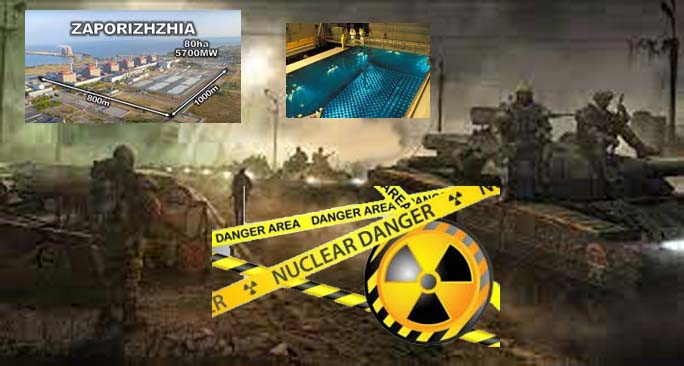
Local ceasefire in place for Zaporizhzhia power line repairs
World Nuclear News 7th Sept 2026
The International Atomic Energy Agency says that a seventh ceasefire is in place to allow demining and repair work to take place to restore external power to the Zaporizhzhia Nuclear Power Plant.
“……………….. The last remaining external power line was disconnected on 20 August “after military activity on the northern side of the Dnipro River”, which has left the plant relying on its fleet of emergency diesel generators to provide the power required for the six-unit plant.
Grossi said: “As the ZNPP’s emergency generators drained the available diesel to little more than a week of supplies, forcing its cooling pumps to be run only intermittently, I continued my persistent efforts to broker a ceasefire so that the Ferosplavna-1 power line could be repaired.”……
Repairs were carried out on a second line in June during another ceasefire, but it remains unavailable because of damage at a substation, he said.
“It goes without saying that nuclear power plant staff must be able to carry out their essential work without being attacked or placed at risk. I solemnly call on all military commanders in the region to stop attacks on nuclear power plants and their staff, and to exercise maximum military restraint. I say this because last month a drone explosion at a bus stop used by plant staff and subcontractors travelling to Zaporizhzhia nuclear power plant caused multiple casualties. The ZNPP informed the IAEA team at the plant that the explosion caused 20 casualties, including one death and three serious injuries………….
The Zaporizhzhia nuclear power plant has been under Russian military control since early March 2022. It is located on the frontline of Russian and Ukrainian forces and has lost offsite power on 26 occasions since the war began, including 10 times since June.
https://www.world-nuclear-news.org/articles/local-ceasefire-in-place-for-zaporizhzhia-power-line-repairs
The UK’s nuclear submarine town at the top of Putin’s target list
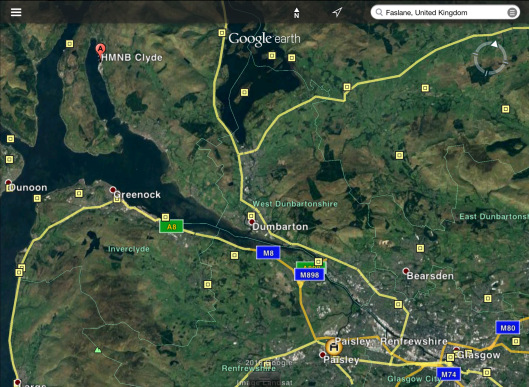
Helensburgh residents living next to the subs find rising tensions
‘worrying’, but hope upgrades at Faslane can bring an economic boost.
Mark Stewart, who lives at the Faslane Peace camp near Helensburgh in
Scotland, said: ‘All the Russia talk makes things feels scarier than it has
for a while. Russia’s veiled threats against the UK feel more tangible in
Helensburgh, the Scottish coastal town nestled close by one of Britain’s
most important military sites. Residents walking along the seafront are
well aware that the UK’s nuclear-armed submarines slide silently up and
down its open waters. HMNB Clyde, better known as Faslane, is home to the
submarines that carry the Trident weapons system, the nation’s nuclear
deterrent.
EDF Extends Reactor Outage Until January After Corrosion Signs

The Gravelines nuclear power station in Dunkirk, France. Electricite de France
SA extended a maintenance outage at one of its 57 nuclear reactors through
January next year, reducing power output during a key part of the heating
season. The prolonged halt at the Gravelines 5 reactor in northern France
will last seven weeks longer than initially planned until Jan. 25. That may
underpin European power prices, which have jumped in recent weeks due to
surging gas prices tied to the Iran war.
Bloomberg 3rd Sept 2026,
https://www.bloomberg.com/news/articles/2026-09-03/edf-extends-reactor-outage-until-january-after-corrosion-signs
IAEA concern over diesel supply for Zaporizhzhia generators
World Nuclear News 1st Sept 2026
The Zaporizhzhia Nuclear Power Plant has been relying on emergency diesel generators for more than 11 days, with the International Atomic Energy Agency raising concerns about fuel supplies if the loss of external power continues.
The plant, which has been under Russian military control since early March 2022, lost connection to its last operating external power line on 20 August.
Since then it has been relying on its fleet of emergency diesel generators to provide the power the plant needs, including for the pumps which cool the six reactors and their used fuel ponds.
The International Atomic Energy Agency (IAEA) team at the plant have been told that a planned delivery of diesel to the site in May had been postponed because of military activity. On Thursday and Friday, the IAEA said its experts observed the transfer of “several dozens of tonnes of diesel fuel from two different off-site locations near the ZNPP to the plant”.
IAEA Director General Rafael Mariano Grossi said: “The availability of diesel fuel is of paramount importance whenever a nuclear power plant loses off-site power, as is the ability to maintain uninterrupted logistical supply chains to and from the site. The current situation once again shows why reliable external power and secure supply routes are indispensable for nuclear safety and security. Without the restoration of off-site power or additional diesel fuel deliveries in the near future, the plant could face a station blackout within approximately ten days.”
According to the official Russian Tass news agency, the plant operators have said there is enough fuel for the diesel generators. “However, due to shelling of the access roads, it is currently impossible to replenish the reserves,” a spokeswoman is quoted as saying. It also quoted the Director General of Russia’s state nuclear corporation Rosatom, Alexei Likhachev, as saying the fuel delivery operation would be organised “under any circumstances”, potentially with an IAEA escort.
The IAEA is seeking to arrange what would be a seventh localised ceasefire to allow repairs to take place to the external power line, which it said lost connection with the plant on 20 August “following military activity on the northern side of the Dnipro River”.
There have also continued to be incidents involving drones at, or near, the plant – with the IAEA saying it had been informed of a drone incident on 25 August near the cooling pond which injured two plant staff, and two more drone incidents the following day, one of which was in the area of the dry used nuclear fuel storage site……………..https://www.world-nuclear-news.org/articles/iaea-concern-over-diesel-supply-for-zaporizhzhia-generators
1 This Month
23-25 October – on Zoom – World BEYOND War’s annual global conferenc


Shut down the radiation-damaged Heysham nuclear reactors now
To see nuclear-related stories in greater depth and intensity – go to https://nuclearinformation.wordpress.com

Say No to NASA’s Reckless Nuclear Reactor on the Moon
Say No to NASA’s Reckless Nuclear Reactor on the Moon

-
Archives
- October 2026 (247)
- September 2026 (339)
- August 2026 (330)
- July 2026 (355)
- June 2026 (287)
- May 2026 (306)
- April 2026 (356)
- March 2026 (251)
- February 2026 (267)
- January 2026 (308)
- December 2025 (358)
- November 2025 (359)
-
Categories
- 1
- 1 NUCLEAR ISSUES
- business and costs
- climate change
- culture and arts
- ENERGY
- environment
- health
- history
- indigenous issues
- Legal
- marketing of nuclear
- media
- opposition to nuclear
- PERSONAL STORIES
- politics
- politics international
- Religion and ethics
- safety
- secrets,lies and civil liberties
- spinbuster
- technology
- Uranium
- wastes
- weapons and war
- Women
- 2 WORLD
- ACTION
- AFRICA
- Atrocities
- AUSTRALIA
- Christina's notes
- Christina's themes
- culture and arts
- Events
- Fuk 2022
- Fuk 2023
- Fukushima 2017
- Fukushima 2018
- fukushima 2019
- Fukushima 2020
- Fukushima 2021
- general
- global warming
- Humour (God we need it)
- Nuclear
- RARE EARTHS
- Reference
- resources – print
- Resources -audiovicual
- Weekly Newsletter
- World
- World Nuclear
- YouTube
-
RSS
Entries RSS
Comments RSS

