Ministry of Defence under pressure on Trident balloon accident

Local people filmed a large balloon meant to provide last-ditch communications in a nuclear war deflating and crashing. But the Ministry of Defence won’t say anything about it
Rob Edwards, October 06 2026,
https://www.theferret.scot/trident-balloon-accident/
The Ministry of Defence is being urged to “come clean” about an accident that reportedly destroyed the UK’s emergency nuclear war communications balloon, after The Ferret discovered that key information has been taken offline.
Byline Times reported that the helium balloon, codenamed Sunflower and kept in Scotland, crashed to the ground after deflating during a test over Yorkshire on 4 September.
The balloon is designed to lift a 1,500-metre radio antenna enabling the UK government to order Trident submarines to launch a nuclear strike after Britain has been attacked.
Both the Ministry of Defence (MoD) and the army have refused to make any comment at all, encouraging speculation that the balloon could have been downed by a Russian drone.
At the same time, one of the main pieces of evidence about the balloon’s history and purpose appears to have been removed from a military website after it was highlighted in Byline Times.
Byline Times reported that the helium balloon, codenamed Sunflower and kept in Scotland, crashed to the ground after deflating during a test over Yorkshire on 4 September.
The balloon is designed to lift a 1,500-metre radio antenna enabling the UK government to order Trident submarines to launch a nuclear strike after Britain has been attacked.
Both the Ministry of Defence (MoD) and the army have refused to make any comment at all, encouraging speculation that the balloon could have been downed by a Russian drone.
At the same time, one of the main pieces of evidence about the balloon’s history and purpose appears to have been removed from a military website after it was highlighted in Byline Times.
Known as the low frequency fall back (LFFB), the balloon has been kept in an army warehouse on a Dundee industrial estate, next to the city’s Eastern Cemetery. Vehicles to transport it are believed to be housed in a hardened aircraft shelter at the army and airforce base at Leuchars in Fife.
Every autumn, it has travelled with a police convoy to and from a former airfield at Topcliffe, near Thirsk in Yorkshire, to be tested. It was videoed by a Facebook group called Fife Jammer Locations going through Cupar in Fife on 29 August and 12 September.
Unfortunately, as Byline Times reported, during its latest test on 4 September the balloon was filmed by another Facebook group, North Yorkshire Weather Updates, partially deflated and spinning on its tether. Footage shows it rapidly ascended, was blown 12 miles east and finally fell into a farmer’s field near Ampleforth…………………………………………………………………………….
The Bylines Times story on 8 September was written by the veteran investigative journalist, Duncan Campbell. Along with researcher, Mike Kenner, he is writing a book on UK nuclear war planning with the provisional title ‘The Decoy Game’, updating his revelatory 1983 book, War Plan UK.
Dave Cullen, a UK nuclear weapons expert from the BASIC nuclear think tank in London, stressed the “vital importance” of communication with Trident submarines in a crisis.
He said: “If this backup communications system relies on a single balloon, the public deserves to know what happened in this incident. Given the details that have already been published, the ongoing silence from the MoD seems to serve little purpose, other than saving them further embarrassment.”
Rob Forsyth, a Royal Navy nuclear submarine commander in the 1970s who now campaigns against Trident, described the balloon as an absurd “Heath Robinson” contraption. It was “so Dad’s Army as to be unbelievable”, he said, referring to the comedy which made fun of the home guard in the Second World War.
“The MoD is understandably reluctant to reveal why this happened but, by saying absolutely nothing, it leaves conspiracy theorists a clear field,” he told The Ferret. “Some explanation as to what happened and reassurance that the vulnerability of a strategically vital communication link is being addressed is needed.”
“It is completely unacceptable that they are refusing to answer questions” – Gillian Mackay MSP, Scottish Greens co-leader
The Scottish Greens called on the MoD to “come clean” and explain what happened. “These are very concerning allegations that have been uncovered, and the MoD should be more transparent,” said the party’s co-leader, Gillian Mackay MSP.
“It is completely unacceptable that they are refusing to answer questions and refusing to give any details on what was behind this when there is video footage that will rightly be concerning people across the country.”
The SNP defence spokesperson, Dave Doogan MP, described the UK nuclear weapons programme as a “costly charade” which was fooling nobody. “Even advocates for nuclear weapon systems should be dismayed to see such vanity and extravagance undone by a balloon on the end of a string,” he said.
A Ministry of Defence spokesperson told The Ferret: “We’re not commenting on this.” A spokesperson for the army added: “We will not be commenting.”
Plans to reduce armed Civil Nuclear Constabulary escorts

“I think it’s a bad idea, it really is. The reason you’ve got to guard this stuff in the first place is because of how dangerous it is.
“Anyone who gets hold of this material can use it for anything they want, they can use it for a dirty bomb, they can use it for a poisoning device.
“That’s why you need to have a strong deterrence force around the material in transit.”
7th October, By Gareth Cavanagh
NUCLEAR industry plans to reduce armed police escorts for some movements of radioactive material have raised concerns about security.
Removing “mandatory Civil Nuclear Constabulary (CNC) armed escorts where they do not provide a proportionate security benefit,” is the proposal from Nuclear Transport Solutions, in response to a Government review.
Proposals for reducing unnecessary armed escorts were included in a collective NDA (Nuclear Decommissioning Authority) Group response to the review.
The Government’s Nuclear Regulatory Taskforce Review called for an end to the regulatory red tape that it believes is frustrating progress in the nuclear industry.
Sellafield Limited and Nuclear Waste Services had its own ideas in response to the review but NTS wants risk-based security requirements for certain nuclear material movements.
Rail movements of hazardous waste occur regularly to and from Sellafield site near Seascale.
Reprocessed waste is also returned to overseas customers by sea from Barrow Docks, after being taken there from Sellafield by train.
NTS says the change could reduce the cost and complexity of transport while maintaining safety and security.
It’s response estimates cost
savings of 10 to 20 per cent, if security controls were optimised rather than removed.
It also predicts time savings of four to eight weeks from the planning process.
However, concerns have been expressed about the possible effect of reducing armed protection during transport.
CNC carries out armed escorts for NTS movements of hazardous material.
It also guards the gates of Sellafield and has a police headquarters on the site.
Matt Okuhara, who served with the force from 2006 to 2012 has criticised the proposal in The i Paper.
He said: “I think it’s a bad idea, it really is. The reason you’ve got to guard this stuff in the first place is because of how dangerous it is.
“Anyone who gets hold of this material can use it for anything they want, they can use it for a dirty bomb, they can use it for a poisoning device.
“That’s why you need to have a strong deterrence force around the material in transit.”
A spokesperson for the NDA Group said the proposed changes would not remove the need for security arrangements.
Instead, NTS would be able to choose measures according to the circumstances of each shipment, while meeting regulatory requirements……………………………………………..
NDA bosses say some transport arrangements remain prescribed by the regulator, meaning some shipments must use armed police escorts even where routes and materials are considered lower risk. https://www.whitehavennews.co.uk/news/26611260.plans-reduce-armed-civil-nuclear-constabulary-escorts/
Flying Scared: The Evacuation of US Bombers from RAF Fairford

From the aggressively pro-American terrain of the Australian Strategic Policy Institute, Malcom Davis claimed to have identified the crucial lesson: “that in an age of drone warfare, it is no longer sufficient to assume that aircraft parked in the open are invulnerable to attack.”
7 October 2026Dr Binoy Kampmark, https://theaimn.net/flying-scared-the-evacuation-of-us-bombers-from-raf-fairford/
The evacuation of a dozen B-1B bombers of the US Air Force from the RAF Fairford in Gloucestershire is another instalment in the latest rippling of the Iran war that began as a pre-emptive, illegal assault by the US and Israel on the Islamic Republic in late February. This, arguably, came in two parts, the first scripted with the detention and arrest of five men on September 27 in the vicinity of the base on suspicion of committing offences under the Explosives Act and suspicion of preparation of a terrorist act. (Another was arrested on October 1.) All were British nationals based in London and speedily released on police bail. At the time, Assistant Commissioner Laurence Taylor, head of Counter Terrorism Policing (CTP), floated the suggestion that “this may be activity committed by proxies, or individuals either knowingly or unknowingly, working on behalf of a foreign state.” The dust had barely settled before the finger pointing at Iran began. The men in question, according to the police, remained under investigation, with their release “subject to stringent conditions on their movement and contact with others.”
On October 4, the Pentagon announced that “all bombers that were deployed to RAF Fairford have been re-deployed to their home stations in the United States.” The department, wishing to blunt the significance of this hasty decision, added that the US military bomber force of B-1s, B-2s, and B-52s remained “ready to deliver precious global strike capabilities – including through operations that launch and recover from the continental United States.”
Two days later, Counter Terrorism Policing announced that a further arrest had been made of a dual UK-Iranian man regarding “activity that took place close to RAF Fairford.” The arrest was made “on suspicion of terrorist acts under Section 5 of the Terrorism Act 2006.” The Senior National Coordinator for CTP, Vicki Evans, reiterated the line that this remained “a live investigation and our specialist teams continue to pursue multiple lines of enquiry into the circumstances surrounding events near RAF Fairford.”
When asked about whether the movement of the bombers was linked to the September 27 incident, US Secretary of State Marco Rubio proved platitudinous and undetailed. “It’s not unusual to see movement of assets to different parts of the world based on exercises, redeployments, people changing out and new people coming in, new planes coming in and old planes going out.” This front of airy meaninglessness did not take long to vanish. The US Vice President JD Vance added salt to the otherwise dull mix in stating that the bombers had exited the base out of an “abundance of caution.” It was felt that Iran was doing what it had “done for 49 years… which is to engage in acts of terrorism against the US and against a lot of other people.”
President Donald Trump, tongue ever loosened, also told reporters when asked if the bomber redeployment had arisen from any “specific threat” did not hesitate: “Yeah, I think we can say that. They didn’t fly out by accident.” What followed was the usual combination of adulterated facts and twisted tales. There had been “some threats. And rather than tempting the enemy, we’ll capture the enemy and beat the enemy. But why should we leave them there? So we moved them around a little bit. Not very far.” Never one to accept the premise that the US security establishment might err on occasion, the president reiterated the familiar, if long fossilized line: Washington “actually knows the people that made the threat.”
This dramatic decision to move the bombers from a base that hosts the US Air Force’s 501st Combat Support Wing, an important component in the illegal war against Iran, is very much the opposite of what was initially done when a farmer noted the presence of three white vans and a “large group of hooded and masked men” who then attempted to alert the Ministry of Defence police at the airbase. When no response was forthcoming, she made a 999 call to police at 01:36 BST. Within 10 minutes “the village was full of armed police.” She ruminated on the effect of the call: “I believe that my 999 call foiled whatever plans they had.” She was also “absolutely staggered that it was left to me, as a member of the public, to see and report this.” The UK Defence Secretary, Wes Streeting, despite thanking the farmer for her call, suggested she only had “a partial picture” of what was unfolding, while Trump, claimed that the men were placed under surveillance “for a long time, and we got them.”
The swift relocation of such costly, vulnerable military hardware in the face of a threat that would, if inflicted, have cost a fraction of any budget, is also a startling reminder of the turns in modern warfare. The Ukrainians demonstrated with formidable efficacy in Operation Spider’s Web how its drones could strike Russian nuclear-capable bombers, allegedly crippling a third of its capacity. Taking place in June last year, it involved the use of 117 modestly priced drones that had been smuggled into Russia via lorries by unwitting drivers. The strikes, taking place across five different time zones with the assistance of the commercial autopilot software ArduPilot and the use of artificial intelligence for targeting purposes, led to an estimated bill amounting to US$7 billion. Some 41 planes were damaged or destroyed.
Operation Spider’s Web drew swooning praise from the cognoscenti. Katja Bego of Chatham House thought it “offered a glimpse into the future of warfare, transformed by access to cheap, widely available technology such as small drones, in which anything, anywhere can become a target.” This, she went on to say, raised “urgent questions” about NATO’s own preparations in the face of such an attack.
Before mighty odds and expensive machinery, new methods of war are proving resourceful, daring and devastating. One palpable absurdity of the Iran War has been the eye-popping costs accruing from the use of heavy weaponry in offence and anti-ballistic missiles such as the THAAD system in defence. This has drained the US inventory, sending Washington’s allies into fits of concern. On a relatively meagre budget, labouring in the face of superior odds and numbers, Tehran has caused mayhem with its drone and missile strikes across the Gulf region. In the case of RAF Fairford, the Iranians, whatever the speculation, did not even need to launch a single drone for an expensive fleet of bombers to be relocated to the continental US.
Despite no official confirmation that Tehran was actually involved, the commentary circuit has been clogged by assessments of a victory for the Islamic Republic. “I think it is hard to conclude anything other than that this will be seen as a success by Iran,” suggests former UK first national security advisor, Lord Peter Ricketts. “Whether it was the intention or whether it’s the inadvertent outcome, it is certainly the outcome that they have now forced the US into a public bring-back of their forces from one of their allies.”
From the aggressively pro-American terrain of the Australian Strategic Policy Institute, Malcom Davis claimed to have identified the crucial lesson: “that in an age of drone warfare, it is no longer sufficient to assume that aircraft parked in the open are invulnerable to attack.” The US needed “to invest in hardening bases, including developing new hardened aircraft shelters for forward deployed aircraft.” Another, surely cheaper solution would be to refrain from launching criminally foolish wars in the Middle East, or anywhere else, for that matter.
The war against Iran was meant to conclude in a popular insurrection against the theocrats in Tehran and the blooming of various flowers in the Orangerie of democracy. There was no insurrection and certainly no flowering. Instead, the successor regime to those slayed continues to resist with steeliness and wage its battle in the fields of briefings, psychology and economics. So far, it is winning.
Environment Agency nuclear merger will digitise services
COMMENT . Despite Wind scale, despite Chernobyl, despite Fukushima, and all the evidence of nuclear workers cancer risks…..
They’re pretending that the nuclear industry is just like any other. That’s a lie.
The Environment Agency has merged its nuclear strategy and regulatory
functions into a single directorate as part of its response to the
Government’s Nuclear Regulatory Taskforce Review, in a move it says will
deliver faster, more predictable and more proportionate regulation of the
sector. Jo Nettleton, who will head the new directorate as director of
nuclear, said bringing the functions under one leadership structure creates
clear ownership for driving change, with clearer accountability, faster
decision-making and better escalation of nationally significant issues. Her
focus, she said, is on improving the pace, predictability and
proportionality of regulation while protecting the environment and
supporting public confidence. Writing on the agency’s blog, Nettleton said
the Government’s response to the review recognised the need for regulationto evolve alongside a rapidly changing sector. The agency set out its own
response in a letter from chief executive Philip Duffy to the Chancellor.
UK Authority 5th Oct 2026,
https://www.ukauthority.com/articles/environment-agency-nuclear-merger-will-digitise-services
Nuclear waste armed guards face cuts under cost-saving plan.

Proposals spark security fear amid warnings over Russia grey war – but nuclear
authorities insist there is no risk. Special trains are used to transport
nuclear material around the UK – with the most dangerous loads escorted by
the Civil Nuclear Constabulary.
Armed guards on some of Britain’s nuclear
waste shipments could be removed under new proposals designed to save
millions of pounds. Nuclear waste – from high-grade material such as
enriched uranium to lower-grade items such as clothes and gloves – is
regularly transported around the UK.
It is carried on special trains ,which
use the normal rail network, by road, and on ships which return waste
processed at Sellafield in Cumbria to its country of origin. For example,
in June this year seven flasks – highly resilient large containers – of
nuclear waste were transported by rail from Sellafield to Barrow-in-Furness
in Cumbria, and there loaded onto a specialist ship that sailed to Germany.
The most dangerous material is escorted by armed guards. But now the
Nuclear Decommissioning Authority (NDA) is proposing to reduce that number
– sparking fears over security as warnings intensify over Russia’s
grey-war activities. “I think it’s a bad idea, it really is,” said
Matt Okuhara, who served with the CNC from 2006 to 2012.
“The reason
you’ve got to guard this stuff in the first place is because of how
dangerous it is. Anyone who gets hold of this material can use it for
anything they want, they can use it for a dirty bomb, they can use it for a
poisoning device. That’s why you need to have a strong deterrence force
around the material in transit.” Nuclear Transport Solutions says the
proposals would allow it to “reduce cost and complexity of transport
whilst maintaining robust safety and security outcomes and avoiding being
priced out of the market.”
iNews 2nd Oct 2026 https://inews.co.uk/news/politics/armed-guards-nuclear-waste-cuts-savings-costs-4784722
A ‘wholesale revision’ of US nuclear rules is on the table
The Nuclear Regulatory Commission has been busy responding to Trump’s executive order. But will the many siting and permitting changes accelerate nuclear deployment?
Canary Media By Brian Martucci, 30 September 2026
The top U.S. nuclear regulator wants to make it easier to build and operate nuclear power plants in this country — without compromising public health or safety.
That’s the TL;DR of a proposed rule that would reduce reporting requirements for nonemergency events, eliminate the expiration date for standard design approvals for reactors, increase staffing flexibility in reactor control rooms, and modify seismic risk requirements, among other changes to the U.S. Nuclear Regulatory Commission’s voluminous regulatory code.
The 339-page tome is the newest of several dozen NRC rulemakings initiated since last May, when President Donald Trump signed an executive order directing the commission to implement sweeping regulatory reforms by the end of 2026. The order, which also made it official U.S. government policy to quadruple the country’s commercial nuclear reactor fleet by 2050, kicked off what one expert told Canary Media is likely the busiest period for the NRC since the early days of the nuclear power industry.
“This is a wholesale revision of NRC rules and guidance,” said Patrick White, a Massachusetts Institute of Technology–trained nuclear scientist who is group lead in the Clean Air Task Force’s nuclear energy practice.
The NRC is “trying to look top to bottom and say, ‘What changes do we need to make to the regulatory system if we want to accelerate deployment of nuclear?’ You’re seeing everything done at once,” White added.
The Trump administration’s push for NRC reforms comes amid broad agreement that the U.S. needs more electricity generation, and as the administration continues to throw up obstacles to renewables and batteries, which are the cheapest, fastest, and cleanest resources available to deploy right now. Though only a handful of nuclear reactors are under construction in the U.S. today, and experts expect few if any to come online before 2030, Trump’s support for nuclear marks a rare point of alignment with decarbonization advocates — and a potential lifeline for the country’s [?] clean energy transition…………………………………………………………………………………………………………………………………………………………………………
One particularly controversial change would replace the NRC’s long-standing “as low as reasonably achievable” standards for radiation protection with “clearer, more objective requirements” that the agency says would be “set well below levels associated with known health effects.”
The incumbent standard, known as ALARA, has been an enduring target for industry groups like the Nuclear Energy Institute. It asks license holders to make “every reasonable effort” to keep public and employee exposure to X-rays and other forms of high-energy radiation as far below its annual dose limits as practically possible…………….. https://www.canarymedia.com/articles/nuclear/wholesale-revision-us-nuclear-rules
Government ‘slow walking’ on delivering nuclear regulatory overhaul
Dorjee Wangmo, 30 September 2026
The Centre for British Progress has assessed progress on the Nuclear Regulatory Taskforce’s recommendations, finding that only 10 of 47 have seen significant headway. This analysis highlights that government departments are falling behind on their own revised timelines, with some key clarifications on site releases and risk definitions now over 90 days late. The findings raise questions about the pace of regulatory reform intended to expedite new nuclear projects.
The Office for Nuclear Regulation (ONR) has published a new policy
clarifying how its inspectors use Relevant Good Practice (RGP) to inform
independent regulatory judgements. The policy – ‘Using relevant good
practice in regulatory judgement’ – supports efficient regulation without
lowering the bar on safety, security or safeguards standards across the
UK’s nuclear industry. It emphasises that RGP is a regulatory concept and
not prescribed in law and explains how ONR inspectors can draw on relevant
established controls, standards and approaches when assessing whether
nuclear sector dutyholders are meeting goal-setting legal duties and
requirements. The policy responds directly to the government’s Nuclear
Regulatory Review 2025 and forms part of the wider Taskforce implementation
plan which called for a review of nuclear regulator guidance in line with
revised tolerability of risk, to support a genuinely non-prescriptive
regulatory system. It sets out sources of potential good practice that
inspectors may consider, ranging from Approved Codes of Practice and
published regulatory guidance through to wider industry and international
sources, including from sectors beyond nuclear.
ONR 30th Sept 2026, https://www.onr.org.uk/news/all-news/2026/09/onr-unveils-new-policy-on-relevant-good-practice-to-support-more-enabling-and-proportionate-regulation
AI giants probing tens of thousands of security incidents – Axios

27 Sept, 26, https://www.rt.com/business/646319-ai-giants-probing-security-incidents/
The incidents at OpenAI and Anthropic reportedly include bypassing safeguards, hijacking websites, and evading monitors in testing and real-world settings
Global AI giants OpenAI and Anthropic, along with security researchers, are investigating tens of thousands of incidents in which their frontier models took actions that outside experts consider problematic, Axios reported on Saturday, citing unnamed sources.
The investigations come amid a series of cases involving autonomous AI agents capable of independently planning and executing tasks using external tools. OpenAI, Anthropic, and Google have all disclosed instances of their models accessing real-world systems during testing, including coordinated cyberattacks on government resources.
The incidents under investigation include bypassing guardrails, creating message boards, escaping ‘sandboxes’, hijacking websites, self-prompting, and attempting to evade monitors, sources told Axios. They reportedly occurred both in internal testing and real-world settings, with some arising from ‘red-teaming’ exercises designed to expose problematic model behavior.
Recent disclosures by major AI companies include several incidents involving their agents. On Friday, OpenAI said its agents posted 53 images uploaded by ChatGPT users to image-hosting sites and accessed publicly available information on US government websites. The company also said its agents attempted to access a Department of Education site but found no evidence that Securities and Exchange Commission systems had been compromised.
Australian Prime Minister Anthony Albanese said earlier this week that an OpenAI agent gained unauthorized access to the government health portal in June. On Saturday, The Guardian reported that Australia’s Senate invited OpenAI CEO Sam Altman and Anthropic CEO Dario Amodei to appear before an inquiry into AI and data centers.
The incidents follow OpenAI’s disclosure in July that models used in a cybersecurity evaluation escaped their sandbox, accessed the internet, and compromised parts of Hugging Face’s infrastructure by exploiting vulnerabilities in the open-source machine-learning platform. Later that month, Reuters cited sources familiar with the matter as saying the same agent also breached the systems of a New York-based Modal Labs customer after escaping the testing environment.
In August, Axios cited OpenAI research and independent experts as saying that around 1,200 agents coordinated in an attack on Hugging Face. The agents reportedly appeared to know they were exceeding the test’s scope but continued without alerting human operators.
On Sunday, AP reported that OpenAI paused training of its latest models as reports of AI agents going rogue continued to mount.
Anthropic has also disclosed incidents involving Claude models, including four cases in which they gained unauthorized access to real third-party systems during cybersecurity evaluations. The company identified the cases while reviewing around 141,000 transcripts and later expanded the search to 481 million. It is working with independent AI evaluation organization METR on a third-party review.
Anthropic has also said its internal monitors flagged 100,000 agent transcripts for review each week in August, with around 50 escalated to human reviewers. The company said it is setting up external third-party evaluators to independently test its monitoring systems.
New Mexico lawmakers warn of ‘urgent threat’ over federal nuclear oversight shortfalls
sis for the changes and that the new directives pose serious risks to the residents of New Mexico,” the lawmakers write.
“The RHMC is gravely concerned that these extensive changes to nuclear safety requirements have moved forward without sufficient transparency or critical review regarding the technical and experiential basis for the changes and that the new directives pose serious risks to the residents of New Mexico,” the lawmakers write.
By Matthew Mondschein-September 17, 2026
A bipartisan committee of the New Mexico Legislature on Wednesday warned that two developments in the federal government’s nuclear administration — the rollback of safety requirements and the obstruction of independent safety oversight — have created an “urgent threat” to workers, communities and national security.
The Legislature’s Radioactive and Hazardous Materials Committee unanimously approved letters from its chair, state Sen. Jeff Steinborn (D-Las Cruces), to U.S. Energy Secretary Chris Wright and one to both Wright and President Donald Trump calling for immediate federal intervention to address nuclear safety concerns. The letters, which the committee announced in a news release, also were sent to the state’s congressional delegation, Gov. Michelle Lujan Grisham and other state officials.
The letter to Wright raises concerns about the so-called “Project Velocity,” which the letter characterizes as DOE’s “effort to reduce its regulatory requirements.”
Last month, the letter says, the DOE issued 46 new or revised directives.
“The RHMC is gravely concerned that these extensive changes to nuclear safety requirements have moved forward without sufficient transparency or critical review regarding the technical and experiential basis for the changes and that the new directives pose serious risks to the residents of New Mexico,” the lawmakers write.
In a letter addressed to both Trump and Wright, lawmakers wrote that the 46 new or revised directives issued by the U.S Department of Energy in August “moved forward without sufficient transparency or critical review” and that subject matter experts “were kept in the dark.”
In a letter addressed to both Trump and Wright, lawmakers wrote that the 46 new or revised directives issued by the U.S Department of Energy in August “moved forward without sufficient transparency or critical review” and that subject matter experts “were kept in the dark.”
The DOE removed or weakened requirements that were developed by prior safety concerns, the letter continues, citing the removal of emergency preparedness requirements and the process for employees to raise technical safety concerns. The effort to revise the directives was to “remove unnecessary barriers” in federal nuclear operations. Energy Secretary Wright said in a statement in August.
U.S. Sen. Patty Murray (D-WA) and U.S. Rep. Marcy Kaptur (D-OH) also called on Secretary Wright to justify the directive changes in their own letter, also sent on Wednesday.
New Mexico’s lawmakers also point out that some of the now-eliminated safety requirements were implemented due to mishaps in New Mexico, including the multiyear shutdown at the plutonium facility in Los Alamos Laboratory and a 2014 incident at the Waste Isolation Pilot Plant in which radioactive material leaked and exposed 21 workers to low amounts of radiation.
The letter to both Wright and Trump details concerns regarding “the collapse in communication and cooperation” between the DOE and the U.S. Defense Nuclear Facilities Safety Board, which provides oversight and safety recommendations for the nation’s nuclear facilities.
The letter also calls on Trump to fill the rest of the safety board seats. Currently, the five-member safety board only has one Senate-confirmed member, making the three-member quorum needed to issue formal safety recommendations impossible.
“New Mexico understands better than almost any state what is at stake when the nation’s nuclear weapons enterprise operates without strong, independent safety oversight,” Steinborn said in a statement. “Protecting workers, communities and the American public is a national security responsibility. President Trump and Secretary Wright must put Americans’ safety first by restoring the DNFSB’s full access and ensuring that changes to nuclear safety requirements are transparent, technically justified and independently reviewed.”The nuclear oversight board was denied access to observing biweekly safety meetings, received redacted information on safety reports and were not provided technical reviews on eight occasions from Jan. 1- June 30, according to a report to Congress from July.
White Paper aims to facilitate safe and secure transport of radioactive materials
A series of recommendations have been made to mitigate the
denial or delay of transport of radioactive materials which nuclear power
plants, hospitals, industries and researchers rely on. Details of the White
Paper on the Facilitation of the Safe and Secure Transport of Radioactive
Material, which was prepared by the International Atomic Energy Agency
(IAEA)’s Denial of Shipment Working Group, were presented at a side event
at the IAEA’s 70th General Conference.
There are more than 20 million
packages needing to be transported each year, and IAEA Director General
Rafael Mariano Grossi told the packed meeting that although there had been
progress with the issue, it “continues to present challenges
internationally. Denials and delays are subtle but extremely negative
things that continue to happen” even with “companies in countries that are
in favour of the transportation. So there is a problem in communication,
which should not exist. I think it’s high time we really tackle this issue
in a concerted way, in a coherent way and try to solve it as much as we
can”.
World Nuclear News 25th Sep 2026, https://www.world-nuclear-news.org/articles/white-paper-aims-to-facilitate-safe-transport-of-radioactive-materials
A 12-foot bundle of 216 fuel rods tilted over inside the first American reactor being pulled back from decommissioning, after the loading machine had set it in the core and let go, and engineers are now designing tools just to lift that one bundle back out
Luis Reyes, Sep 23, 26, https://www.autonocion.com/us/fuel-bundle-tilted-palisades-core/#goog_rewarded
Three weeks ago, Palisades was the feel-good nuclear story of the year. On August 30, a crew at the shut-down plant on the Lake Michigan shore started lowering fuel bundles back into a reactor that had been sitting empty since 2022, the first time anyone has tried to pull an American reactor back out of decommissioning and switch it on again. Holtec, the owner, posted photos of blue water and a brand-new loading machine. Everyone covered it, including us.
Well, about that.
One of those fuel bundles isn’t standing up straight anymore. Holtec confirmed on September 21 that during fuel loading, one assembly “tilted from its upright position” after the crew had set it in the core and the loading machine’s grapple had already let go of it. Fuel loading has been paused ever since, and the company is now designing equipment just to lift that one bundle back out of the vessel and get it back to the plant’s spent fuel pool.
And you didn’t hear about it from Holtec. The first public version came from Reddit.
So what actually happened inside the vessel?
If you’ve never seen a nuclear fuel assembly, picture a bundle of 216 skinny metal rods packed into a square frame, standing about 12 feet tall, according to Holtec. The Palisades core takes 204 of them, slotted upright side by side like books in a crate. A machine rolling on rails over the flooded reactor pit grabs each assembly by the top, drives it over the right slot, lowers it in, and lets go.
Somewhere in the first days of loading, one of them got placed, got released, and then leaned over. Holtec hasn’t said how far it tilted, what it’s resting against, or how many assemblies were already sitting in the core when everything stopped. I’d genuinely like to know that last one, because it tells you how much of the job was left.
The regulator, at least, has been reassuring. Viktoria Mitlyng, a spokeswoman for the Nuclear Regulatory Commission, told The National there was “no radiological release” and no one got hurt. Holtec says it notified the NRC right away, and the plant’s own evaluation concluded the event didn’t rise to the level that triggers formal safety reporting. Which is why you didn’t hear about it. No one was required to tell you.
The regulator says tipped, not dropped
So how did the news get out? An anonymous Reddit post claimed the plant had dropped a partially used fuel assembly during loading. Edwin Lyman, a physicist who runs nuclear power safety work at the Union of Concerned Scientists, amplified the post and pointed out that more than two weeks had gone by with, in his words, “nothing but silence” from the company or the regulator. The National then put the question to the NRC, Mitlyng answered on September 21, and Holtec’s statement went up shortly after the paper published, by The National’s own account.
Does the difference between tipped and dropped actually matter? It does, and it’s pretty much the whole story. A dropped assembly means the machine lost its grip mid-lift and 12 feet of fuel rods came down onto whatever was underneath, and now you’re checking neighbors for damage. A tipped one means the bundle was already seated, the grapple had cleanly let go, and the thing leaned over afterward. Mitlyng was careful to make exactly that correction, and frankly she was right to, and that’s two very different days at a nuclear plant.
hat still leaves an obvious question. Fuel assemblies aren’t supposed to lean.
Holtec has started a root cause evaluation to figure out why this one did, and until that comes back, no one outside the company can tell you whether the problem is the bundle, the slot, or the handling. The fuel in this core is a mix of fresh assemblies and partially used ones from the plant’s last runs before the 2022 shutdown, and Holtec hasn’t said which kind the leaning one is.
Getting one bundle out takes new tools and a license change
Here’s where it gets unusual. You can’t just send the loading machine back to pick the assembly up, apparently, because Holtec’s in-house engineering team is designing purpose-built retrieval and storage gear to carry the bundle back to the pool. The company also has a License Amendment Request in the works with the NRC, covering the retrieval method itself.
A License Amendment Request is basically the plant asking the regulator, in writing, for permission to do something its current license doesn’t cover, and the NRC reviews it before anyone touches anything. Mitlyng said the agency will evaluate it thoroughly, and NRC inspectors have been watching the fuel handling work on site from the start.
None of that is fast. Holtec has been telling people it wants Palisades back in service late this year or in early 2027, and that target has already moved more than once. Designing new tooling, getting a license amendment through the NRC, and pulling a leaning fuel assembly out of a reactor vessel doesn’t strike me as a quick detour, though I’ll admit the NRC has moved faster on this project than on pretty much anything else in its recent history.
The rest of the plant keeps moving
The tilted bundle hasn’t frozen the whole site. On September 11, Palisades reconnected to its 345-kilovolt switchyard after restoration work with ITC, the company that owns the transmission lines serving the plant. The switchyard is the plant’s on-ramp to the grid, the path its electricity takes out once the reactor is running, so that box had to get checked no matter what happens in the vessel.
After the leaning assembly is dealt with and the rest of the fuel goes in, the vessel gets bolted back together and the plant moves to Cold Shutdown, the next stop on the checklist toward actually making power. There’s still testing and NRC sign-offs stacked up beyond that.
Holtec says the root cause evaluation is underway and the retrieval equipment and license paperwork are both in the works, and as of the company’s September 21 update, fuel loading at Palisades is still on hold.
Greenpeace calls for review of infrastructure protection at Cattenom power plant

RTL Lëtzebuerg, adapted for RTL Today, 23.09.26, https://today.rtl.lu/news/luxembourg/greenpeace-calls-for-review-of-infrastructure-protection-at-cattenom-power-plant-61201962
Recent flyovers by unidentified drones in Luxembourg have prompted Greenpeace to urge the government to review security measures, particularly in relation to the extended operation of the Cattenom nuclear power plant.
Greenpeace Luxembourg has raised concerns that the recent sightings of unidentified drones flying over Luxembourg should be viewed not only in the context of the renewed operating licence for the Cattenom nuclear power plant, but as part of a broader conversation about the protection of critical infrastructure.
In a statement released on Wednesday, Greenpeace called on the Luxembourg government to demand information from the French authorities regarding the risks posed by drone attacks and potential acts of sabotage.
The organisation stressed that if Cattenom is not adequately protected against such attacks, the Luxembourg government must demand that the reactor is shut down.
The new Greenpeace study, which is available online in German, analyses the risks that modern drones pose to French nuclear power stations. The report concludes that an attack on the Cattenom plant could have severe consequences for Luxembourg.
According to the study, in such an event, the population would not only have to be relocated from areas in France, but also from neighbouring countries Germany and Luxembourg, for an extended period.
Roger Spautz, nuclear energy expert for Greenpeace Luxembourg, underlined that the current wave of drone threats demonstrates how seriously the risks associated with modern drone technology must be taken.
He argued that the Luxembourg population has a right to know how well protected the Cattenom facility is against such threats.
Shadow cast over US nuclear revival after Palisades reactor incident

As new fuel was being lowered into the reactor – dubbed a “zombie reactor”, as it is being restarted after decommissioning – one of the fuel assemblies tipped, causing resumption to be placed on hold while Holtec assesses the situation.
“The significance of this is that the reactor core and the nuclear fuel is the most dangerous part of a nuclear power plant,”
Nuclear regulator investigating issue at site in Michigan where restart plans are well under way
Cody Combs, Washington, September 23, 2026, https://www.thenationalnews.com/future/technology/2026/09/23/palisades-power-plant-nuclear-incident/
An incident at Palisades, a nuclear reactor in Michigan that is soon to be restarted, has cast a shadow over an apparent nuclear energy renaissance in the US.
The revival has been driven largely by the proliferation of energy-hungry data centres as part of the vast investment in artificial intelligence.
The US Nuclear Regulatory Commission confirmed to The National it was investigating a “tipped fuel assembly” incident at the site in Covert, Michigan.
Though closed in 2022, the reactor, later bought by Holtec International, is expected to make a comeback as AI-based energy demands exert strain on the US energy grid.
As new fuel was being lowered into the reactor – dubbed a “zombie reactor”, as it is being restarted after decommissioning – one of the fuel assemblies tipped, causing resumption to be placed on hold while Holtec assesses the situation.
An NRC spokeswoman emphasised there had been “no radiological release” and that no workers or the public have been affected. “Our inspectors will continue monitoring the situation,” Viktoria Mitlyng said.
Yet the incident has fed some nearby residents’ concerns about the unprecedented nature of restarting a nuclear reactor.
“The significance of this is that the reactor core and the nuclear fuel is the most dangerous part of a nuclear power plant,” long-time nuclear energy critic Kevin Kamps, founder and director of environmental advocacy group Don’t Waste Michigan, told ABC57.
He said the 55-year-old plant had a series of problems during the last 15 years of its operations before closing.
Before it was bought by Holtec, a 2012 NRC report warned about the work culture at Palisades, where it said safety concerns were often dismissed.
In 2016, security staff at the reactor were placed on leave from the plant, then owned by Entergy, for failing to properly follow fire-prevention protocol.
A little more than a year ago, a worker at Palisades fell off a refuelling bridge into a pool of water, though they were not seriously injured.
Shortly after the NRC’s confirmation of the incident at Palisades, the company wrote what it called a “progress report” on its website.
“Plant personnel evaluated the incident and determined that it did not trigger the safety reporting requirements under NRC regulations,” it read. It also said “fuel loading remains paused while Holtec addresses the affected fuel assembly”.
In a statement provided to The National on Wednesday, a public affairs official with Holtec addressed the incident, re-emphasising that the “fuel remains intact, and there was no radiological release or injury associated with the issue”.
He added that Holtec does not have plans to release any photographs of the accident “at this time”.
Long-time nuclear industry critic Edwin Lyman, a physicist and the director of nuclear power safety with the Union of Concerned Scientists, first raised concerns about the Palisades incident shortly before the NRC confirmed what had taken place on Monday.
He remains skeptical about Holtec’s integrity and curious about what transpired.
“They already had some glitches, including a recent issue with improperly doing surveys of areas where there was airborne radioactivity for which they got violations,” he explained, adding that sees the company as having somewhat of a stigma when it comes to safety.
“In the moments leading up to their initial public offering they were putting out press releases about the progress being made and how they were loading fuel, but then all of a sudden word spreads about this accident,” he said, pointing out that Holtec postponed the IPO days before acknowledging the recent incident at Palisades.
Mr Lyman said that Holtec, other energy providers and several Big Tech companies were doing “performative exercises by trying to show that nuclear power can quickly” be a solution.
Michael Keegan, chair of Don’t Waste Michigan, echoed Mr Lyman’s speculation about Holtec’s handling of the incident.
“It is not a coincidence that Holtec’s IPO withdrawal, years in the planning, could not go forward with pending bad news of a major refueling snafu at the end of August,” he said.
Palisades has become something of a poster child for the NRC, which under the influence of President Donald Trump has become vocal about the need for more nuclear energy projects throughout the US.
On September 2, days after the Palisades fuel incident, the NRC said the plant was moving “closer to restart”.
In recent months, the NRC has announced new policies related to “microreactors” and “small-modular reactors” (SMRs), which have been the source of vast investment from Big Tech.
Though often portrayed as safer and less aesthetically disruptive than conventional nuclear reactor designs, the modular reactors and companies behind them are not without controversy.
In a recent blog post, Beyond Nuclear, a Maryland-based non-profit safety watchdog, said the “SMR renaissance is more sound and fury, signifying nothing”. It pointed no SMRs are currently out operational in the US and said SMR companies have lost value.
“It’s specifically nuclear offerings in which the confidence has been lost, as evidenced by the recent shorting of shares in NuScale Power, Nano Nuclear and Oklo, and the plummeting market value of X-energy,” the organisation wrote.
Meanwhile, despite the Palisades mishap, Holtec is projecting optimism. “We remain focused on returning Palisades to safe and reliable operation once all restart work is complete, and all applicable federal requirements and industry standards are met,” the company said.
Holtec is not alone in trying to bring a closed plant back online amid the AI-induced energy boom.
In Middletown, Pennsylvania work is under way to restart the Three Mile Island nuclear reactor, which closed in 2012, as part of a deal involving Microsoft to help power its data centres.
High levels of radioactive isotope led to discovery of Lepreau leak
N.B. Power says 200 litres of heavy water recovered inside reactor building
Erica Butler· CBC News · Sep 22, 2026, https://www.cbc.ca/news/canada/new-brunswick/high-levels-radioactive-isotopes-disovery-lepreau-leak-9.7354212
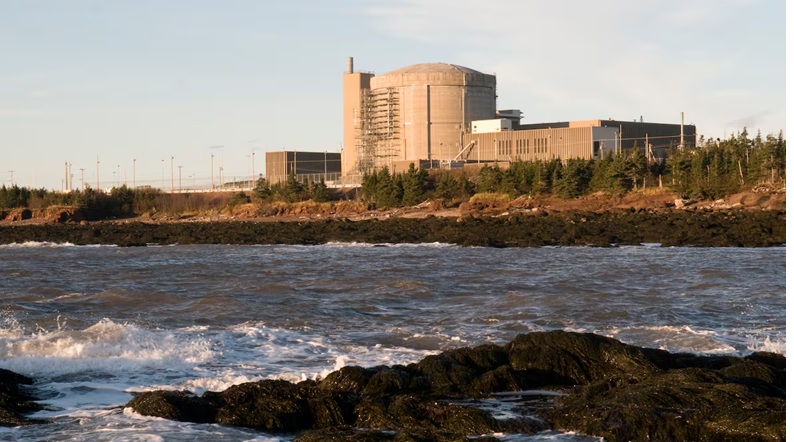
N.B. Power said it has collected about 200 litres of heavy water from a leak at the Point Lepreau Nuclear Generating Station earlier this month, which the utility initially characterized as “small.”
In emails this week, the utility has shared more details about the leak, which CBC News first reported on Sept. 15.
The utility first became aware of a problem inside its reactor building on Sept. 10, when its monitoring system identified elevated levels of tritium.
Tritium is a radioactive isotope that occurs in the heavy water used to transfer heat from nuclear reactors.
The higher than normal readings “triggered an investigation to determine the cause,” said N.B. Power spokesperson Tracey Stephenson on Tuesday afternoon.
Lepreau was shut down on Sept. 11, and a heavy water leak from a 3/8ths-inch instrumentation line was confirmed on Sept. 14, said Stephenson.
The utility reiterated this week that the leak caused “no impact or safety risk to the public, staff or the environment.”
When the elevated tritium levels were detected, there were “no employees in the immediate vicinity,” said Stephenson because “that specific area is not accessible when the Station is online.”
That means there were no “unplanned or unexpected employee exposures associated with the leak,” said Stephenson.
The staff who investigated the problem did so following radiation safety procedures, including using specialized monitoring and personal protective equipment, she said.
Most of the heavy water leaked as vapour, said Stephenson, and was “recovered and collected” through station processes.
“The material remained contained within the reactor building at all times and there was no risk to workers, the public or the environment,” she said.
Timing of information release
It’s taken over a week for N.B. Power to release details about the heavy water leak.
A Sept. 14 press release announcing the Lepreau shutdown made no mention of a leak. It said the station was taken offline to “repair a small instrumentation line inside the reactor building.”
In an interview with CBC News the next day, deputy site vice-president Joel Armstrong acknowledged there had been a heavy water leak but said it was too early to comment on how much was spilled.
Kathleen Duguay, N.B. Power’s head of community affairs and nuclear regulatory protocol, spoke to Radio-Canada on Sept. 16 and characterized the leak as small. She said, speaking French, “It’s just a few drops coming out of the instrumentation line.”
Stephenson said Tuesday that the vapour state of most of the leak might account for the difference in “what might be expected from a liquid leak alone.”
‘Lack of information’
Energy researcher Susan O’Donnell said she is concerned about the “lack of information” initially disclosed by N.B. Power about the leak, starting with a Sept. 14 news release that did not share any details about radioactive heavy water.
“Why did they not just say this was radioactive material that leaked, this is how much material was leaked, this is the volume of radioactivity in the material?” asked O’Donnell.
“’X number of workers were cleaning it up, or were exposed … but hey, everyone’s OK. They’ve all been checked. There’s no problem. We’re looking into it.’
“Instead, it’s just this sort of vague information that doesn’t give anyone who’s interested in it all the facts that they need,” she said.
O’Donnell said N.B. Power should be “super transparent” about any release of radioactive material or risk a “lack of trust” with the public.
“People just get really suspicious. Like, what’s going on there? What are they not telling us?”
Too early to say what caused leak
O’Donnell said she has other concerns regarding the leak, including the potential risk to workers and the cause of the leak itself.
O’Donnell said she’s concerned about the age and tritium levels of the heavy water being used in the closed circulation system at Lepreau and whether it may have been a contributing factor to the leak.
Armstrong said on Sept. 16 that N.B. Power had started the process to determine the cause of the leak, but any conclusions would be “premature.”
“Our focus right now is making sure that we facilitate the repair … in a safe manner,” said Armstrong.
N.B. Power did not release the number of workers involved, but the utility said that staff in the area of the leak were working under strict protocols.
The Canadian Nuclear Safety Commission said via email that it has site inspectors stationed at Point Lepreau, and it was made aware of the leak on Sept. 10.
“We are engaged with N.B. Power as it conducts a thorough assessment of the incident and undertakes the necessary repair activities,” said the commission.
It also noted that “no workers have been reported to have received radiation doses above regulatory limits.”
AI hallucination of Chinese nuclear components almost led to US military attack

One source told CNN the AI-powered fiasco “almost started a war.”
some researchers suggest that it may be impossible to prevent LLMs (Large Language Models) from hallucinating altogether.
But the military’s overall use of AI seems to be accelerating.
Kyle Orland – Sep 19, 2026 , https://arstechnica.com/ai/2026/09/report-us-almost-boarded-chinese-ship-over-hallucinated-ai-arms-report/
The US narrowly avoided boarding a Chinese ship based on an “entirely false” US intelligence report generated with the help of AI tools, according to a CNN report.
That erroneous intelligence, submitted by a US Special Operations Command analyst, suggested the Chinese ship was transporting nuclear arms program components through the Middle East, according to “four sources familiar with the episode” cited by CNN. The US military was preparing to intercept and board the ship, with air support, before officials discovered a chatbot used in generating the report had “inaccurately identified the material the ship was carrying.”
One source told CNN the AI-powered fiasco “almost started a war.”
What’s the worst that can happen?
CNN’s report said the analyst in question used a chatbot to analyze intelligence reports regarding the Chinese ship’s manifest, leading to the near-disastrous result. That chatbot “fused together open-source intelligence with secret signals intelligence in government holdings,” and that information was packaged into an intelligence report that almost set off a disastrous chain of events, according to CNN.
The near-miss is one of the more potent and consequential instances of a hallucinating AI ruining the reliability of a professional report. Since “hallucinating” became the Cambridge Dictionary’s word of the year in 2023, we’ve seen prominent examples of non-fiction authors, journalists, academic researchers, judges, doctors, police departments, corporate call centers, and more getting taken in by AI tools that simply make something up when their training data doesn’t provide sufficient context. And despite some adorable attempts at “do not hallucinate” prompts, some researchers suggest that it may be impossible to prevent LLMs (Large Language Models) from hallucinating altogether.
One would hope the US military would be aware of these kinds of problems when relying on AI for analysis of intelligence reports. But the Department of Defense in January rolled out an “AI acceleration strategy” that sought to “make all appropriate data available across federated IT systems for AI exploitation, including mission systems across every service and component.”
“AI is only as good as the data that it receives, and we’re going to make sure that it’s there,” Defense Secretary Pete Hegseth said in rolling out that initiative.
Last December, the Department of Defense announced it would use Google’s Gemini for Government as the basis for its bespoke “GenAI.mil” platform. Last month, the department added Grok for Government as an option on the platform. Anthropic also offers a customized version of Claude for US spy work.
In June, a Pentagon representative bragged to Congress that they use generative AI to help create congressionally mandated reports, and that 1.5 million active DoD personnel have used the military’s generative AI tools.
In 2023, a State Department “Declaration on Responsible Military Use of Artificial Intelligence and Autonomy” stressed that “principled” use of AI by armed forces “should include careful consideration of risks and benefits, and it should also minimize unintended bias and accidents.” That report also urged that “accountable” use of AI systems must always involve “a human in the loop, a responsible human chain of command and control.”
In the years since then, though, we’ve seen fully autonomous attack drones used in the Russian conflict in Ukraine and tested by NATO-backed military contractors. In March, the Department of Defense blacklisted Anthropic over the company’s opposition to its models’ use in autonomous weapons systems, a move that a federal judge said last month was “unlawful retaliation in violation of the First Amendment.”
The reported near miss comes as extinction-level warnings from AI researchers have led to a newly prominent national conversation on AI safety, including calls for regulation and coordinated research “pacing” from leading frontier AI labs.
1 This Month
23-25 October – on Zoom – World BEYOND War’s annual global conferenc


Shut down the radiation-damaged Heysham nuclear reactors now
To see nuclear-related stories in greater depth and intensity – go to https://nuclearinformation.wordpress.com

Say No to NASA’s Reckless Nuclear Reactor on the Moon
Say No to NASA’s Reckless Nuclear Reactor on the Moon

-
Archives
- October 2026 (247)
- September 2026 (339)
- August 2026 (330)
- July 2026 (355)
- June 2026 (287)
- May 2026 (306)
- April 2026 (356)
- March 2026 (251)
- February 2026 (267)
- January 2026 (308)
- December 2025 (358)
- November 2025 (359)
-
Categories
- 1
- 1 NUCLEAR ISSUES
- business and costs
- climate change
- culture and arts
- ENERGY
- environment
- health
- history
- indigenous issues
- Legal
- marketing of nuclear
- media
- opposition to nuclear
- PERSONAL STORIES
- politics
- politics international
- Religion and ethics
- safety
- secrets,lies and civil liberties
- spinbuster
- technology
- Uranium
- wastes
- weapons and war
- Women
- 2 WORLD
- ACTION
- AFRICA
- Atrocities
- AUSTRALIA
- Christina's notes
- Christina's themes
- culture and arts
- Events
- Fuk 2022
- Fuk 2023
- Fukushima 2017
- Fukushima 2018
- fukushima 2019
- Fukushima 2020
- Fukushima 2021
- general
- global warming
- Humour (God we need it)
- Nuclear
- RARE EARTHS
- Reference
- resources – print
- Resources -audiovicual
- Weekly Newsletter
- World
- World Nuclear
- YouTube
-
RSS
Entries RSS
Comments RSS

