This Is The REAL Reason For Trump’s Visit To China.
May 14, 2026, Joshua Scheer, https://scheerpost.com/2026/05/14/this-is-the-real-reason-for-trumps-visit-to-china/
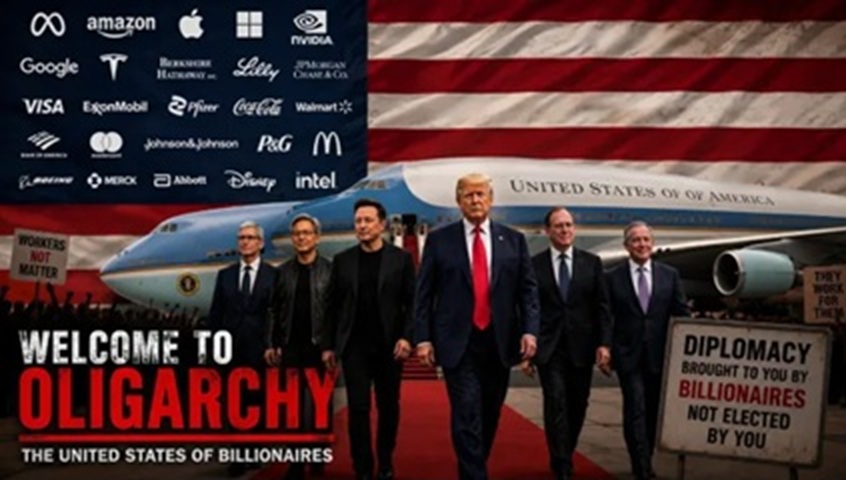
Donald Trump didn’t arrive in Beijing as the leader of a confident superpower. He arrived like a salesman carrying a collapsing empire on his back — flanked not by diplomats or peace negotiators, but by Silicon Valley monopolists, Wall Street vultures, and billionaire oligarchs desperate to keep their fortunes alive. Elon Musk. Jensen Huang. Larry Fink. Tim Cook. Blackstone. Goldman Sachs. The entire spectacle looked less like diplomacy and more like a corporate hostage negotiation staged on behalf of an American ruling class suddenly realizing it may have lost the economic war it started.
In this blistering breakdown, Ben Norton argues that Trump’s China summit exposes a geopolitical reality Washington refuses to admit publicly: the U.S. trade war backfired, China adapted, and America’s corporate elite now need Beijing far more than Beijing needs them. As the war on Iran drives inflation higher, supply chains fracture, and rare earth shortages threaten both Silicon Valley and the Pentagon, Trump’s anti-China rhetoric is quietly giving way to panic, flattery, and desperation. The result is an extraordinary image of imperial decline — an American president openly traveling with oligarchs to plead for access to the very economic system Washington spent years trying to cripple.
The best line of all from Ben may be this: “Nothing screams ‘we are an oligarchy’ more than taking oligarchs instead of diplomats to a diplomatic mission.”
And he’s right. We are living in an oligarchy — one where billionaires ride on Air Force One while working people are left paying for inflation, war, tariffs, and economic collapse. The masks are gone. Corporate CEOs now sit beside presidents like unelected cabinet members, openly shaping foreign policy, trade policy, and even war itself.
As the country barrels toward another election in 2028, the deeper crisis is that most major candidates, regardless of party branding, still end up bowing before the same billionaire donor class. The slogans change. The marketing changes. But the power structure remains untouched.
Golden Dome plan would cost $1.2 trillion, CBO finds

That’s seven times what Trump initially said, and almost double the congressional office’s first estimate.
12 May, 26, Thomas Novelly, https://www.defenseone.com/defense-systems/2026/05/golden-dome-cost-trillion-cbo/413485/
The Golden Dome missile-defense system would cost $1.2 trillion to build out, far more than the White House has budgeted, according to a new estimate by Congressional researchers.
The figure is roughly double the Congressional Budget Office’s assessment last year of a potential space-based interceptor system, based on the expansive yet vague executive order issued in the busy first week of the second Trump administration. It’s nearly seven times larger than President Trump’s original promise to build it for $175 billion.
And it’s fifteen times larger than the $79 billion the administration plans to spend in the Golden Dome for America account over the next five years, which excludes other-related missile defense funding.
“The system would provide significantly expanded defensive capabilities but would not be impenetrable, particularly against large-scale attacks from peer adversaries,” the office said in an emailed statement. “CBO’s estimate is substantially higher than publicly cited administration figures, which may reflect differences in scope, time frame, and assumptions.”
In the last two months, Golden Dome’s budget has swelled by $10 billion. And the program’s leader has conceded that space-based interceptors, a cornerstone of the proposed missile shield, may be too costly to build.
The bulk of the funds—about $730 billion—would purchase only enough space-based interceptors to destroy about 10 incoming ballistic missiles.
The new CBO assessment was requested by Sen. Jeff Merkley, D-Oregon.
The $1.2 trillion estimate is not far off from a projection published by Todd Harrison, a defense budget analyst and space expert with AEI. In September, Harrison wrote that roughly $1 trillion over two decades could buy enough space-based interceptors to take out five missiles in the boost phase, 50 hypersonic weapons in the glide phase, and 50 warheads in midcourse. The sum would also purchase nearly 150 missile-warning and -tracking satellites, 10 Ground-Based Midcourse Defense battalions, 10 Patriot batteries, eight THAAD batteries, and two Aegis Ashore sites.
But the administration’s $185 billion budget won’t buy anywhere close to that, Harrison said.
“The fact that CBO’s estimate is almost an order of magnitude higher than what the administration says it will cost can only mean one thing: the administration is not actually building what the executive order described,” he said. “The CBO analysis and my previous analysis both demonstrate that the homeland missile defense you can buy for $185 billion is an incremental improvement over what we have today but not an impenetrable shield that will forever end the missile threat to the United States.”
When asked by lawmakers last month about the AEI analysis and past estimates, Space Force Gen. Michael Guetlein, the program’s leader, said he’s been “laser-focused on affordability” and that the Pentagon is doing business differently than it has in the past.
“When we start talking about the different cost estimates, the first thing I always say is, first of all, they’re not estimating what I’m building,” Guetlein said. “They are estimating the modernization or the continuation of the legacy systems that we already have, and they just take the cost of a legacy system, and they multiply it out and they get these really large numbers and they say, well, that must be it. That is not what Golden Dome is doing.”
The Trump administration has leaned heavily on funds outside the baseline defense budget to make Golden Dome a reality. Last year, the Pentagon netted $24 billion in reconciliation funds for the program. For the 2027 defense budget, the administration requested more than $17 billion from the same funding source and just $400 million from the annual Pentagon budget.
Additional reconciliation funds are not guaranteed, but the administration has projected future support in the baseline budget — the Pentagon plans to request an estimated $14.7 billion in the 2028 budget and projects it to rise to $16 billion by 2031, according to the American Enterprise Institute data.
Last year’s Golden Dome executive order called for fielding the “development and deployment” of space-based interceptors that can hit a missile within minutes of its initial launch. But physics shows that weaving a defensive web to stop any number of missiles from anywhere would require tens or hundreds of thousands of satellites.
Space interceptors, as the CBO’s estimate points out, are the most expensive component. Guetlein also told lawmakers last month that he’s focused on staying within the budget and said, “If we cannot do it affordabl[ly], we will not go into production” on boost-phase space-based interceptors.
CBO researchers said the $1.2 trillion estimate could be reduced if space-based interceptors aren’t included.
“Because of the limited information available about the Administration’s planned [national missile defense] architecture, a direct comparison of DoD’s and CBO’s [defense] systems and their costs is difficult,” the report said. “If the space-based interceptors—which have a high cost per kill—were deleted from CBO’s notional NMD system, the system’s 20-year cost would drop to $448 billion, but the overall system would not align with the objectives outlined in the ‘Iron Dome’ executive order, which specifically called for space-based interceptors.”
In light of the new estimate, Harrison said, Congress should have serious doubts about prioritizing and funding space-based interceptors instead of focusing on more attainable homeland security defenses.
“One of the lingering questions for Congress is: why are we still funding [space-based interceptor] development? Prototyping the system and maturing the technology will not prove or disprove its ability to scale with the threat—scalability is a matter of orbital mechanics, and the prototyping effort does nothing to change that,” Harrison said. “SBIs do not scale. We are throwing away billions of dollars on a system with no future, when that money could instead be used to buy more of the ground-based interceptors and drone defenses we are in desperate need of today that do scale with threats.”
Nakba Day: Muhammad Shehada on Israel’s Ethnic Cleansing in Gaza & Ongoing Palestinian Resilience
SCHEERPOST, May 15, 2026 , Democracy Now
Palestinians around the world are marking Nakba Day, 78 years after their forced mass displacement led to the establishment of the Jewish-majority state of Israel. Decades later, Palestinians still face widespread oppression and violence from the Israeli state as it continues its expansionary project. “Israel tried, since 1948 until today, to destroy us as a people, as a group, and they failed at it. Our people are still there, resilient,” says Palestinian writer Muhammad Shehada, who was born in Gaza and now lives in Denmark. Shehada discusses the ongoing process of the Nakba, including its latest intensification after October 7, 2023. “Now this veneer of civility has fallen off. The mask was taken off. And now it’s a matter of national pride in Israel to brag about annihilating Palestinians.”
Shehada also describes current conditions in Gaza — still under Israeli blockade and occupation — and what he calls the “disarmament trap” of unfairly weighted negotiations designed to strip Palestinians of political autonomy. “The ‘realistic’ proposal that Israel is putting on the table is surrender, capitulate, become fully defenseless, weaponless, and entrust the very army that carried out a genocide against you to be merciful towards you once you are an easier target than you ever were before.”
Finally, he responds to the Israeli government’s recent threat to file a defamation lawsuit against The New York Times, after the paper published a column by longtime opinion writer Nicholas Kristof about systemic sexual abuse against Palestinian detainees in Israeli prisons. “It’s the newspaper of record. It’ll be spread and disseminated widely to an American audience,” says Shehada about the allegations levied in Kristof’s piece. “So we see, basically, an Israeli panic attack in return.”
Transcript…………………………………………………………………………………………………………………………………. https://scheerpost.com/2026/05/15/nakba-day-muhammad-shehada-on-israels-ethnic-cleansing-in-gaza-ongoing-palestinian-resilience/
Trump lands in Beijing with over a dozen western moguls in tow ahead of high-stakes talks with Xi
Elon Musk, Tim Cook, and top executives from Nvidia, Qualcomm, BlackRock, Goldman Sachs, Mastercard, Visa, Boeing, and Meta joined the US president
The Cradle, MAY 13, 2026
US President Donald Trump landed in Beijing on 13 May for a crucial meeting with Chinese President Xi Jinping to address trade, technology, Taiwan, the war against Iran, and the Strait of Hormuz.
Met with red-carpet treatment in the Chinese capital, Trump was joined by a retinue of more than a dozen billionaires whose companies span major sectors of the US and global economies.
A total of 16 high-profile business leaders accompanied the US president, including Tesla and SpaceX CEO Elon Musk and Apple CEO Tim Cook, as well as CEOs from Nvidia, Qualcomm, BlackRock, Goldman Sachs, Citigroup, Mastercard, Visa, Boeing, and Meta Platforms President and Vice Chair Dina Powell McCormick.
Trump is scheduled to meet Xi after his first night in Beijing, with the visit centered on what both sides agree to be a crucial moment for the world’s two largest economies.
The US-Israeli war on Iran and the resulting global energy crisis are expected to weigh heavily on the talks.
The US President is expected to urge his Chinese counterpart to pressure Tehran to reopen the Strait of Hormuz and move toward a peace deal, as China depends heavily on crude oil shipments through the waterway.
The talks are also expected to cover Taiwan, artificial intelligence, advanced chip exports, trade, and fentanyl, with both sides seeking concessions on long-running disputes that have strained relations between Washington and Beijing……………………………………………………………………………………………………………….
The meeting also comes as Washington imposes new sanctions on a China–Iran oil network ahead of Trump’s Beijing visit, tightening efforts to choke off Tehran’s oil revenue while the US–Israeli war on the Islamic Republic and the Hormuz crisis strain global energy markets. https://thecradle.co/articles/trump-lands-in-beijing-with-over-a-dozen-western-moguls-in-tow-ahead-of-high-stakes-talks-with-xi
All of the world’s 50 hottest cities in late April were in one country: India

For one day in late April, all of the world’s 50 hottest cities were in
India as the country experienced an extraordinarily severe heatwave.
Air-quality monitoring platform AQI said that there was “no modern
precedent” for this occurrence and that it was “not normal”. “This
is not a normal April,” the platform said. “And it demands a serious,
data-grounded reckoning.”
Independent 13th May 2026.
https://www.independent.co.uk/climate-change/news/india-heatwave-50-hottest-cities-aqi-temperatures-b2974927.html
US-China Summit: A strategic moment for stabilizing bilateral relations
14 May 2026 AIMN Editorial , By Chen Ziqi, https://theaimn.net/us-china-summit-a-strategic-moment-for-stabilizing-bilateral-relations/
US President Donald Trump arrived in Beijing on Wednesday for a new round of face-to-face talks with Chinese President Xi Jinping from May 14 to 15, a meeting arriving at a particularly delicate moment in global politics and the international economy.
It marks the first in-person meeting between the two leaders since the Busan agreement last October, where both sides agreed to suspend further escalation of the US–China trade war for one year.
While a flare-up in the Middle East delayed this meeting by a month, the cooling of tensions with Iran has finally cleared the flight path for what many view as the most consequential diplomatic inflection point of 2026.
Amid a fragile global recovery and uncertainty in international markets, the Beijing meeting is being closely watched for whether both powers can move from “crisis management” to a more sustainable form of strategic equilibrium, with implications for broader global economic stability.
At their first meeting on Thursday morning, President Xi congratulated the United States on its 250th anniversary, while President Trump praised Xi as “a great leader,” setting a warm and friendly tone for the opening of the summit.
President Xi noted that China and the US should be partners, not rivals, empathizing the relationship between the two countries would have implications not only for their peoples, but also for the future of the world. President Trump addressed this is going to be the biggest summit, as top business delegation was with him.
A US official said the two sides are expected to continue discussions on establishing new mechanisms for trade and investment coordination, with cooperation in agriculture, aerospace, and energy also likely to feature prominently.
Beijing, meanwhile, has framed the visit as an opportunity to stabilize bilateral ties amid growing global uncertainty. In remarks on Monday, China’s Foreign Ministry emphasized the need to expand mutually beneficial cooperation, manage differences, and “inject greater stability and certainty into a turbulent and changing world.”
Guidance from strategic analysts
Beijing, meanwhile, has framed the visit as an opportunity to stabilize bilateral ties amid growing global uncertainty. In remarks on Monday, China’s Foreign Ministry emphasized the need to expand mutually beneficial cooperation, manage differences, and “inject greater stability and certainty into a turbulent and changing world.”
Analysts broadly agree that the summit reflects a shared near-term interest in stabilizing China–US relations, even as deeper strategic tensions remain unresolved.
Zhao Hai, director of the International Politics Program at the National Institute for Global Strategy, points out that the primary “product” of this summit needs to be predictability. For the private sector, the specific policy is often less damaging than the volatility of not knowing what the policy will be tomorrow.
This mirrors the “managed strategic competition” framework championed by former Australian Prime Minister Kevin Rudd. The goal in Beijing is not necessarily to bridge a decade-long trust deficit in a three-day summit, but to prevent further accidental escalation. He said that careful coordination and transparent dialogue are essential to maintaining stability over the long term.
Economic frictions and business impacts
While Chinese state media frame economic relations as both a stabilizing foundation and a key driver of broader China–US ties, US tariff policy continues to sit at the center of bilateral disagreement.
While Beijing views these measures as “unreasonable restrictions,” the Trump administration continues to utilize them as its primary tool of economic leverage.
John McLean, chairman of the China–UK Business Development Centre, noted that shifting US tariff policies are creating deep uncertainty, prompting many companies to delay or reconsider long-term investment plans.
The economic data, however, tells a more nuanced story of self-inflicted wounds. A recent study by the Kiel Institute, a leading German economic research body, found that foreign exporters absorb only about 4% of the tariff burden, with the remaining 96% falling on US business and consumers.
These findings underscore that while tariffs are often framed as protecting American industries, their indirect effects are influencing pricing, supply chains, and investment decisions.
For small and medium-sized enterprises, the consequences are particularly acute. Philip Crawley, who operates a laser equipment import business in California, reported that tariffs imposed last year cost his company millions, forcing it to slow operations, reduce employee pay, and postpone hiring plans.
Glen Calder, president of Calder Brothers in South Carolina, said his steel costs increased by 25% even before US tariffs took effect, as markets anticipated higher trade barriers.
Strategic competition may be conducted at the state level, but its economic consequences are frequently absorbed by businesses, workers, and consumers navigating unpredictable policy environments.
Continued investment interest in China
Perhaps the most surprising element of the current climate is the resilience of corporate interest. Despite these challenges, many US businesses continue to view China as a critical market.
According to the American Chamber of Commerce in China, around 60% of American companies still plan to invest in the Chinese market, reflecting enduring confidence in China’s economic opportunities.
The rationale is clear: China accounts for roughly 17% of global GDP, contributes about 30% of global economic growth, with a and is projected to export nearly $4 trillion in exports in 2025.
Its sheer economic scale and growth make it important for companies to overlook, providing strong incentives to maintain or expand investment even amid uncertainty.
Looking ahead: Cooperation and strategic stability
President Xi noted in today’s meeting that success in one is an opportunity for the other. China has maintained a relatively consistent stance toward Washington, rooted in the idea that the Pacific is large enough for both powers. This summit offers a rare window to clarify intentions and move beyond the zero-sum rhetoric that has dominated the 2020s.
Reducing uncertainty in trade, investment, and technology will benefit businesses and global markets alike, reinforcing long-term stability, which is a shared asset, not a concession. Reducing the “noise” in trade and technology isn’t just a win for diplomats. It’s the oxygen required for global markets to breathe again.
Chen Ziqi is a reporter from CGTN
Russian ship that sank near Spain in 2024 may have carried nuclear reactor parts
By ASSOCIATED PRESS, , 13 May 2026, https://www.dailymail.com/wires/ap/article-15814163/Russian-ship-sank-near-Spain-carried-nuclear-reactor-parts.html
BARCELONA, Spain (AP) – A Russian ship that sank in the Mediterranean over a year ago after its engine room exploded may have been carrying pieces for nuclear reactors used in submarines, a Spanish government document shows.
The Ursa Major sank on Dec. 23, 2024, between Spain and Algeria while allegedly on a journey from St. Petersburg to Russia’s eastern port of Vladivostok. Two crew members were lost while 14 other people were saved by Spanish rescue craft.
In a written response to opposition lawmakers, the Spanish government wrote that the ship´s captain “confessed” that the ship was carrying “components for two nuclear reactors similar to those used in submarines.”
The response was included in a document registered by the Spanish parliament on Feb. 23 and was first reported by CNN on Tuesday. The document has been seen by The Associated Press.
At the time of the sinking, the Russian state-owned ship owner, Oboronlogistika, said that the Ursa Major was sabotaged. It said three powerful explosions damaged the boat just above the water line in what the company described as a “terrorist attack.”
Oboronlogistika was established under Russia´s defense ministry and placed under U.S. and European Union sanctions for its ties to Russia´s military.
According to the document, the boat’s manifest said the boat was carrying 129 containers, two large cranes and “two well covers.”
Officials said that when questioned upon rescue by the Harbor Master in Cartagena, Spain, the boat captain revealed that the well covers were nuclear components. He added that the boat was not carrying nuclear fuel.
Spanish authorities said they were not able to search the ship to confirm the information during the rescue operation which focused on saving the crew and searching for the two missing members. The wreck rests at 2,500 meters (8,200 feet) deep.
Kremlin spokesman Dmitry Peskov told a conference call with reporters on Wednesday that he hasn´t seen the reports regarding the ship´s cargo while adding: “there is nothing for us to comment on here.”
1 This Month





PLEASE OPPOSE HR 8255 AND S.3639 – bills would accelerate satellite deployment, with no environmental review or safeguards – https://ncstd5li.quorum.us/campaign/169331/
To see nuclear-related stories in greater depth and intensity – go to https://nuclearinformation.wordpress.com
-
Archives
- October 2026 (49)
- September 2026 (339)
- August 2026 (330)
- July 2026 (355)
- June 2026 (287)
- May 2026 (306)
- April 2026 (356)
- March 2026 (251)
- February 2026 (267)
- January 2026 (308)
- December 2025 (358)
- November 2025 (359)
-
Categories
- 1
- 1 NUCLEAR ISSUES
- business and costs
- climate change
- culture and arts
- ENERGY
- environment
- health
- history
- indigenous issues
- Legal
- marketing of nuclear
- media
- opposition to nuclear
- PERSONAL STORIES
- politics
- politics international
- Religion and ethics
- safety
- secrets,lies and civil liberties
- spinbuster
- technology
- Uranium
- wastes
- weapons and war
- Women
- 2 WORLD
- ACTION
- AFRICA
- Atrocities
- AUSTRALIA
- Christina's notes
- Christina's themes
- culture and arts
- Events
- Fuk 2022
- Fuk 2023
- Fukushima 2017
- Fukushima 2018
- fukushima 2019
- Fukushima 2020
- Fukushima 2021
- general
- global warming
- Humour (God we need it)
- Nuclear
- RARE EARTHS
- Reference
- resources – print
- Resources -audiovicual
- Weekly Newsletter
- World
- World Nuclear
- YouTube
-
RSS
Entries RSS
Comments RSS

