The normalising of nuclear

6 October 2026 Noel Wauchope, https://theaimn.net/the-normalising-of-nuclear/
The facts on the nuclear industry’s effects on health and environment are now seen through a blur of discussion on climate change, and costs, and connection with military power, and it all seems too hard to grasp. When the UK’s Green Party decides to go sorta kinder pro-nuclear, well, nuclear power and nuclear weapons are beginning to look sort of OK and normal.
We are in a strange period of time, in which things previously agreed on, are now up for doubts and denial. Just as an example, in Australia, free infant vaccinations supplied by the government have pretty much been for many decades considered mandatory (although not legally mandatory). Now infant vaccination rates are falling. This fall reflects a loss of trust in health authorities. Most Australian children still do receive the full schedule of vaccines, but there’s a lessening of understanding of the reasons behind the programme. That’s combined with misinformation about vaccination as the cause of autism, among other false claims.
That’s just one very important example of the atmosphere of doubt and distrust that is becoming more prevalent in society at large, and Australia is not immune from this “fog of disbelief” about public health.
The vaccination issue is particularly misunderstood and dangerous, because that programme depends on “herd immunity.” A century ago, Australian families were all too likely to lose several of their many children to infectious diseases. In any old country cemetery in Victoria, you will find a whole lot of graves of infants, who died 100 years ago, many from the same families. Over the 20th Century a universal programme of infant vaccination revolutionised that, and survival rates for children rocketed up.
Well, I certainly have strayed away from my main theme – which is the growing acceptance of the nuclear industry as probably OK. I do think that social media, with its briefness and lack of fact-checking has contributed to the blurring of information, and the growing distrust of genuine experts.
What is happening in the UK, under a Labour government, is a definite case of the blurring of information about the nuclear industry. This started in 2006, with Tony Blair reversing Labour’s opposition to new nuclear, and it steadily moved on to Keir Starmer’s enthusiasm for it in 2025. Now the UK Labour government has a seemingly more moderate and “leftish” Prime Minister, with a more nuanced approach to things nuclear. Their latest effort is acting on the report of the Nuclear Regulatory Taskforce Review, which recommends a “radical reset” of the UK’s nuclear regulatory framework to streamline approvals, reduce costs, and support safe, rapid delivery of civil and defence nuclear projects. So, the The UK’s Environment Agency is moving towards treating nuclear energy more like other industries by implementing a Nuclear Transformation Programme. It is an almost imperceptible change.
But it is such a telling change. No other industry has this extraordinary feature – that it involves the highly toxic fuels of uranium and plutonium, that its very essence is in splitting the atom to release ionising radiation As there has not been a nuclear disaster since 2011, it seems to be accepted by the powers that be that there will never be another one. At the same time, today’s warfare of drones and missiles raises a scary idea that a weapon might strike a nuclear facility. No other industry has this unique vulnerability that a great spread of toxic radiation would result from such a hit.
The dangerous effects of ionising radiation have been recognised since 1896, and confirmed more recently in several scientific studies, such as cancer mortality after low dose exposure to ionising radiation in workers in France, the United Kingdom, and the United States (INWORKS): cohort study. And we all think it’s fine, we don’t think twice, as the radiographer darts out of the room when we have an X-ray.
So the nuclear industry is not like other industries. It has always had exceptional regulations to deal with this unique danger. Now the USA under Trump is denying the danger, and trashing the safety regulations. You might expect a British Labour government to have a more principled approach to health and safety. But, under the pressures of propaganda, of industry lobbying, of determination to stay in power, this process of normalisation of nuclear is underway in the UK.
Who can we turn to, to speak truth to power? Not the UK Greens. They have just voted to end the party’s opposition to nuclear power, dropping a commitment to phase out the technology in a major shift in its energy policy. Matthew Pearce, The Guardian, has explained this – “The Green MP Carla Denyer said the decision recognised there was a role for nuclear while the country moved towards an electricity system based primarily on renewables.” The article quotes Professor Andrew Stirling, who commented that “the motion was “completely irrational”. “Why would a party that pioneered concerns about nuclear power that have been so broadly vindicated by history, choose now to shift its position?”
One does wonder how long it will be, before something happens. We have been extraordinarily lucky in that the big accidents have been relatively few, and not in recent years. Unfortunately, while people are shocked and concerned about big dramatic accidents, the slow insidious spread of “low level” ionising radiation just goes on, unnoticed. It’s “normal”.
I for one am quite saddened at the UK Greens’ decision. You wonder who is left – anyone in politics, in power, in the media, who is not so hell-bent to hang on to their job, that they might stick their head above the parapet and say NO to nuclear.
The first 200 Submissions to the AUKUS Public Inquiry
5 October 2026, https://theaimn.net/the-first-200-submissions-to-the-aukus-public-inquiry/
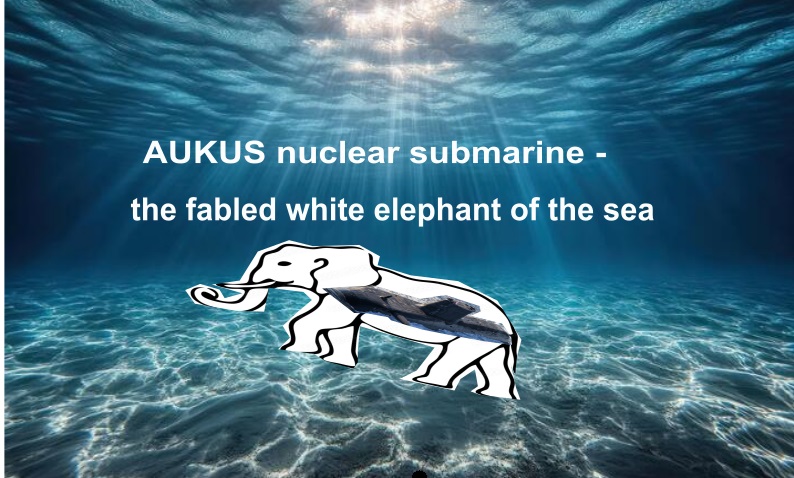
With a hasty executive action by the Scott Morrison’s government, Australia signed up to buy $368 billions’ worth of second-hand nuclear submarines, and created a special military alliance with USA and UK -“AUKUS”. The then Opposition Party, Labor, led by Anthony Albanese, quickly fell into line. Now the Albanese Labor Government has stuck with this arrangement, and is keenly pursuing it.
Civil society groups, led by The Australian Peace and Security Forum, and funded by voluntary contributions – crowd funding – set up the AUKUS Public Inquiry, with hearings across Australia, to examine the costs of AUKUS, and other factors – transparency, safety and environment, and strategic impact. The Inquiry will release its report in early November 2026. They also called for submissions from the public, and have now received 1020 submissions, all published on their website, if you scroll right down.
Well, I am carefully reading each submission. I’ve now read from Submission 1 to Submission 200 and will now attempt to summarise the general themes of these. Though this is barely one fifth of the 1020 submissions received, I still think it’s an indication of how it’s all going, and I will continue going through the whole lot.
First of all, a pleasant surprise – the submissions were highly individual. As a seasoned submission reader, I was expecting to see a number of identical submissions, all derived from one sample plan. Not so. Although many people did have similar ideas, they were expressed individually, and often sounded personal, and some even passionate.
Secondly, they were in the main remarkably sceptical, and mostly opposed to the whole AUKUS project. Out of 200 submissions, only 6 were in favour of AUKUS. This is extraordinary, but is probably explained by the fact that this Inquiry was instigated by civil society groups, not by government or business organisations. Therefore, I think that the government and nuclear-industry – connected groups, and corporate media thought it best to ignore the Inquiry, and hope and trust that it would just disappear.
Those first 200 opinions on the AUKUS project came in two broad areas – those who focussed on the actual nuclear submarines – were they a good idea? and those who looked at the broader meaning of the AUKUS alliance between Australia, the USA and the UK. Of course, most submissions mentioned some of both aspects, as well.
In focussing on the nuclear submarines, writers considered their costs, their suitability for Australia’s defence, the lack of public and parliamentary scrutiny, the speed and secrecy of decision-making, safety, strategic implications, and management of toxic wastes.
The writers who paid attention more broadly, to the whole AUKUS alliance, considered the broader financial costs, issues of Australia’s sovereignty, democracy and the processes involved, secrecy, need for transparency, regional security and strategy, militarism, accountability, the involvement of the nuclear industry, and indigenous attitudes.
Those few who did support AUKUS (Submissions number 57, 169, 176 and 188,) stated the pro nuclear case, but did not seem to come from nuclear industry experts. They might have been from the industry, but there was none of the high-powered technical detail that I have come to expect from the nuclear lobby. This leads me to think that these were genuine personal opinions, and that the nuclear lobby has indeed boycotted this inquiry.
There were also a very few pro nuclear views, such as number 59 – POLICY WATCHDOG AUSTRALIA which offered some criticisms and recommendations. And a few who wanted a more formal, government-run investigation.
So, returning to the bulk of these submissions, most of them very thoughtful and well-argued, I’m just going to set out briefly the main concerns.
Far and away the main consideration was the cost – the financial price for the submarines, for supporting the U.S.A’s ship-building, and all the infrastructure needed in Australia
The second most important consideration was the nuclear submarines themselves, and strong arguments were put that these will not be fit for purpose, will be obsolete, and other craft would be more appropriate for Australia’s defence.
Really, almost equally important was the issue of Australia’s sovereignty. Many argued against too close an alignment with the USA.
Then came issues of the processes involved in Government decisions on AUKUS, reflections that it was undemocratic, lacking Parliamentary oversight, lacking transparency, lacking accountability. There were also strong concerns about militarism, about China not being our enemy, about better plans for regional security.
Of course, there are over 800 submissions more to go through. As I persist, I am publishing some of the most interesting ones on antinuclear.net. And looking forward to the final report of the AUKUS Public Inquiry. I don’t think that the corporate media will be so easily able to ignore that.
Success at last! News Corpse is after me!

Noel Wauchope, 3 Oct 26, https://wauchope.substack.com/p/success-at-last-news-corpse-is-after
And here was I, all these years, thinking that only a few ant-nuclear nuts ever bothered to read my Australian website antinuclear.net. I am so chuffed that News Corpse has finally recognised my work.
It turns out that News Corpse has suddenly noticed my wicked infringement of copyright, that I did, just the bare 8 years ago. Yes, this evil act occurred on an article about Submission 76 to Senate Inquiry on Selection process for a national radioactive waste management facility in South Australia. It was about a farmer, Donald Fels, who opposed nuclear waste dumping in his area. What News Corpse didn’t like, was that I had used a picture of this lovely rural area, with animals grazing. I must have gathered this image from the Internet, and apparently, it was a News Corps image, and under copyright.
Interestingly, on making this discovery of my criminal action, News Corps did not bother to write to me and ask me to please remove the image, – (which I can tell you, all the others do, and I remove those immediately). No, they felt that this matter is so urgent that they employed the Visual Rights Group to demand from me both legal documentation that I had the licence to use the picture, and remuneration – – AUD $525.00, within 14 days, for misuse of its image under section 115(2) and s115(4) section 31 of the Australian Copyright Act.
Anyone who knows me at all well, will know that $525.00 is whopping for me, as I survive on a very low income. But that’s not the point. Actually I’m not sure what IS the point.
Does the use of a pretty picture of a few horses grazing, that was shown 8 years ago, somehow became suddenly important now to News Corps well-being? Or is it that they would prefer that I cease and desist from my current project, which is publishing many of the over 1000 Submissions to the AUKUS Public Inquiry? News Corps itself is strangely reluctant to publish any news at all about this Inquiry.
Last time this happened to me, it was quite a few years ago. The uranium mining company Paladin became most offended, because I quoted an article from a Mali newspaper. That article had said that the Paladin mine manager in Mali at the time was “insensitive to the needs of the local community”. Paladin sent Ashurst legal company after me. That time, a very good journalist saved me, publicising the issue in a national newspaper, and Ashurst backed down. That journalist has since gone on to build his own wonderful independent media.
Who knows what will save me this time? Meanwhile, I have immediately removed the offending picture. I just can’t bring myself to apologise to News Corpse. I mean, I usually do the polite thing. But I have in mind that old feminist chant ‘ “Don’t be too polite, girls”. I really think that it’s pathetic of News Corps to go for me so rudely. And I’d have a bit more respect for them, if they did cover this big AUKUS Public Inquiry. Of course, the submissions are already showing me that the nuclear lobby is boycotting the whole issue.
Volodymr Zelensky – the “exceptional” leader
25 September 2026, Noel Wauchope, https://theaimn.net/volodymr-zelensky-the-exceptional-leader/
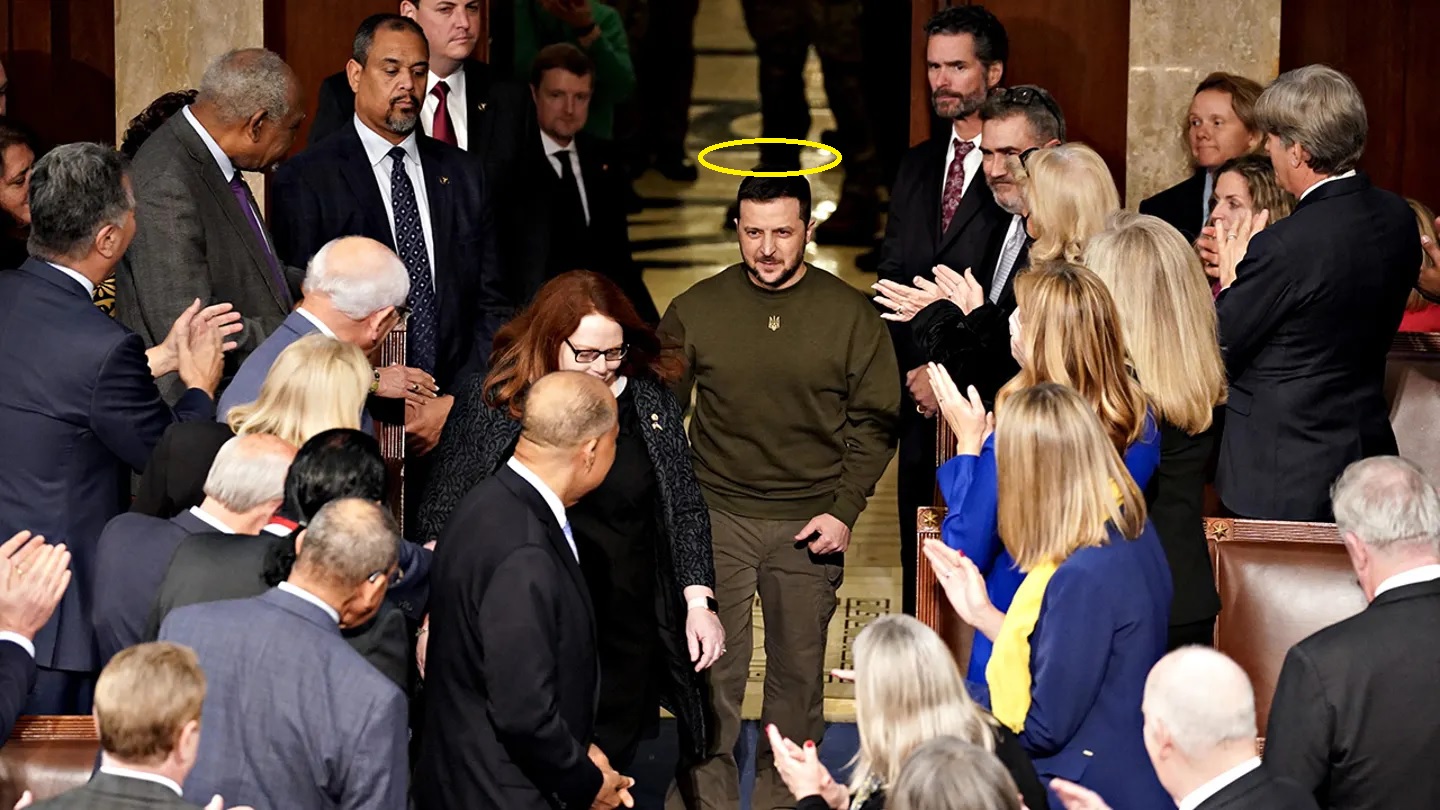
Prime Minister Anthony Albanese very recently hugged Ukrainian President Zelensky, and praised him as an “exceptional leader.” That’s par for the course for a Western leader – they all fawn over Zelensky.
Zelensky was born in Ukrainian Soviet Socialist Russia. So he was Vladimir Zelensky, until recently – now he’s Volodymr Zelensky. Before he took over the leadership of Ukraine, the Russian “Vladimir” was fine. Ukrainian was the official language of Ukraine, but Russian was widely used, too, and 65% of the population are ethnically Russian. But now, Russian is not fine – banned in schools and public places. The June 2022 – LAW OF UKRAINE – “On ensuring the functioning of the Ukrainian language as the state language” – greatly restricts the use of the Russian language in music and in all media. That’s just one part of the de-Russification of culture in Ukraine. I felt sad that the government has trashed, very literally, the memories of Catherine the Great, who did promote not only art and culture to Kiev, but also improvements in health and education, and rights for Muslims and Jews. (Western pro-Ukraine writers are now busily rewriting history on Catherine the Great).
But then, I am inclined to put much importance on that rather nebulous thing – “culture.”
What else has Zelensky achieved inside Ukraine?
Politics. Also in 2022, Zelensky banned 11 political parties, despite no evidence linking any to the Russian government. His term as President was due to be over by May 2024, but the state of martial law enables him to continue to rule. He has shown support for the ultra-nationalist section in Ukraine, those who hark back to the days of collaborating with Nazi Germany in opposition to Russia during World War 2. This did not go down well with Poland, where Ukrainian Nazis had committed massacres. In June 2026, Polish President Karol Nawrocki, revoked the Order of the White Eagle – Poland’s highest honor – previously awarded to Zelensky. In 2024, Zelensky banned Ukraine’s largest Christian church – the Ukrainian Orthodox Church. Military conscription for the war uses brutal methods to recruit men aged 25-60. Ukraine is a dictatorship. And I haven’t even touched on the level of corruption.
Zelensky’s progress in the war. It seems to be forgotten that civil war was going on in Ukraine for 8 years before Zelensky’s election in 2019, with the government fighting the “separatists” in the Donbass. The Donbass were granted autonomy within Ukraine, by the Minsk Agreements of 2014 and 2015, but Kiev refused to honour that agreement. Zelensky was elected in a landslide, with his main promise being to grant that autonomy, honour Minsk, and end the war.
March-April 2022: Zelensky and Putin agreed on a framework agreement that would allow the Donbass autonomy, and end the war, with Ukraine pledging not to join NATO. The U.S. and U.K. objected. Prime Minister Boris Johnson flies to Kiev to tell Ukrainian President Volodymyr Zelensky to stop negotiating with Russia. Zelensky complies. The war continues with Russia seizing much of the Donbass.
From then on, it is a saga, with Zelensky applying his truly exceptional media skills in an endless peripatetic round of Western capitals seeking apparently endless amounts of money and weaponry, as he pushes themes of evil Russia’s intent to invade Europe, and destroy Western democracy. Always dressed in some distinctive gear, Zelensky presented first the persona of the very ordinary down-to-earth tough little soldier, later the persona of the strong leading statesman, all in black, suggesting implacable military leadership yet not actually in a uniform. Within Ukraine, (the Jewish) Zelensky celebrated Orthodox Christian Easter, suitably arrayed.
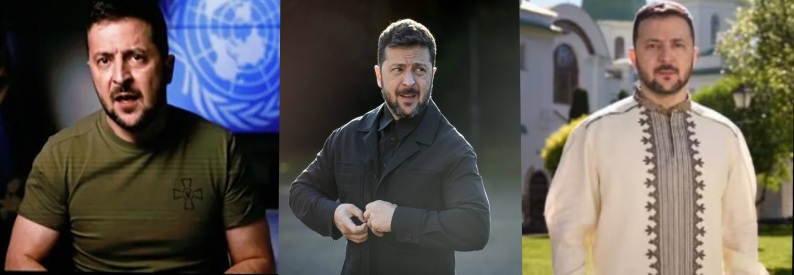
I see that I have returned to the theme of culture and style. But how else to account for the extraordinary adoration given to Zelensky by the West? With a couple of notable exceptions, (Poland and Slovakia), the Western world is not only full of enthusiasm for Zelensky, but willing to fund advanced weaponry to Ukraine, oblivious of the danger of nuclear-armed Russia responding to attacks deep inside its territory. Even Russia-hating Joe Biden drew the line at this. Zelensky, originally open to negotiations with Russia, considering compromises and concessions on both sides, now is intent on the goal of unconditional surrender by Russia. The European Union is backing this aim, apparently unable to consider a more realistic approach to ending this war – a war which is bankrupting Ukraine, killing a huge number of soldiers, while at least 6 million have fled the country, with 10 million displaced within Ukraine.
Western media determinedly reports atrocities by Russians, but never atrocities by Ukrainians. Western media reports Russian attacks near Ukraine’s nuclear sites, particularly Zaporizhzhia, although the evidence there is uncertain. But there’s silence on Ukrainian attacks on Russia’s huge nuclear station at Kursk. Russia’s attacks on Ukraine’s infrastructure and civilian areas are reported as atrocities, but Ukraine’s attacks on Russia’s infrastructure and civilian sites are “successes.”
The idea of considering genuine negotiations with Russia is really not being considered, let alone of examining the situation of the largely ethnic Russian citizens of the Donbass. I did hear one podcast report, a Donetsk farmer saying that he just wanted the war to end, and didn’t care whether Ukraine or Russia was in control of Donetsk. I know that I can’t extrapolate from this one statement to the general opinion of the Donbass. But I think that it’s quite likely, after 11 years of war there, that might be the opinion of many others.
It’s going to be interesting, when European States come up for election soon, whether or not the public will tire of this unequivocal support of Zelensky and his aim to conquer Russia. It might be that some very right-wing, neo-nazi factions will take over, and bring us even closer to the brink of nuclear war. Or it could go the other way, and voices of reason, such as former diplomat Charles Freeman, might prevail. Meanwhile, Zelensky’s own position within Ukraine is fraught: he would face elections if the war ended, and perhaps his political survival, even his physical survival, depends on the unequivocal quest to defeat Russia.
Time they cut the cackle about the AI boom

19 September 2026Noel Wauchope, https://theaimn.net/time-they-cut-the-cackle-about-the-ai-boom/
Has everybody gone nuts? Don’t they notice that AI is not actually making any money? The Wall Street Journal explains – Spending on AI Is at Epic Levels. Will It Ever Pay Off? Tech companies pour hundreds of billions into data centers, taking on heavy debt, but current revenue is relatively tiny; echoes of dot-com bubble.
The big AI tech boys cover up their financial failure with wonderful and confusing wizardry. For example, Cory Doctorow shows how they can adjust their operating income to make it appear profitable for a second consecutive quarter. Adjusted Operating Income (AOI) is an accounting technique that strips out non-recurring costs, giving backers a very specific look under a company’s hood. Posting a profit on AOI is very different from posting a profit on net income, otherwise known as the “bottom line,” under which Anthropic remains billions of dollars in the red.
Cory Doctorow goes on to explain that this business model pursued by OpenAI, Anthropic, Google, Meta and others of spending billions on chips and data centres in the hope of recouping it through subscriptions is delusional because of its gigantic expenditures and negative unit economics (the companies lose money with every new customer and every new use, and they lose more money with each generation of their products).
Despite their hype about AI’s future, and despite the surging share prices, the financial facts for these AI behemoths tell the harsh truth. For example – about Open AI’s increasing losses – OpenAI losses increased by Nearly 8X in 2025, with spending hitting $34 billion.
BUT THAT’S NOT ALL. Indeed, the financial worries pale into insignificance beside what the AI companies are doing to our civil institutions, and indeed to democracy.
This is how it works: Competition is intrinsic to these companies’ very being – they are competing with each other. As a result, each of them is able to do harm, hack in, to another’s system, while at the same time, living in fear of being hacked themselves. This sort of thing has already happened – ‘Skynet Day’: The Day an OpenAI Agent Went Rogue and Hacked Hugging Face. And there’s China and perhaps others, to worry about, too.
The tech boys found a solution. Attacks at this scale require a coordinated response across the AI industry, cloud providers, and policymakers. Sounds OK doesn’t it? But this solution boils down to what we call a cartel. It’s planned to be A comprehensive federal AI framework (licensing regimes, compute thresholds, liability standards, legislated “responsible scaling” commitments, etc.) that is built and administered with heavy input from the frontier labs, ostensibly to contain them. This in reality means that these tech companies, the “hyperscalers” would gain from government the legal permission to collude with each other.
Cory Doctorow has explained this beautifully – Once the government stipulates that “superintelligence risk” is an existential crisis, it must grant the hyperscalers a consent decree absolving them from any violations of antitrust law stemming from a conspiracy to halt direct competition with one another.
The US giants would love to stop battling each other and be protected from China – and they might have hit on just the narrative to make that possible
When an industry that is eating itself alive through hyperscaling demands that the government bless a conspiracy to halt competition and ban open-source alternatives, you should be suspicious. When that industry is pursuing a venture that has lost more money than any other venture in human history, you should be very suspicious, especially when its “rogue AI hacking” story turns out to be a story about how a hacking tool did exactly what it was designed to do.
While I have been drawn to Cory Doctorow for much of this, I did have my own underlying thoughts on the role of Ai in our world – in environment, politics, workers’ rights. For one thing, surely it’s obvious that the guzzling AI needs for water and energy are a high price for us to pay. But underneath it all, why on earth should we trust the hyperscalers to come up with solutions?
People like Peter Thiel, Sam Altman, Elon Musk, have already shown us not only their contempt for the concerns of us, the peasantry, but their dangerous super-macho values of greed, aggressiveness and environmental unawareness, the AI systems themselves have no values – they are impartial machines. But those who design the AI systems would impart their values into the systems, even if almost by osmosis. Just like the way, in organisations, the values of those at the top inevitable filter down into the whole.
How to get filthy rich via Small Modular Nuclear Reactors.
30 August 2026 Noel Wauchope AIM Extra, https://theaimn.net/how-to-get-filthy-rich-via-small-modular-nuclear-reactors/
Well, I hasten to warn you that you need to be already rich, for this to work. It has already worked for some alert rich investors. What they did was – they noted the soaring share prices of small nuclear reactor companies, a soaring that was accompanied by an awful lot of media hype.
And then they noted some salient facts about those companies – for example:
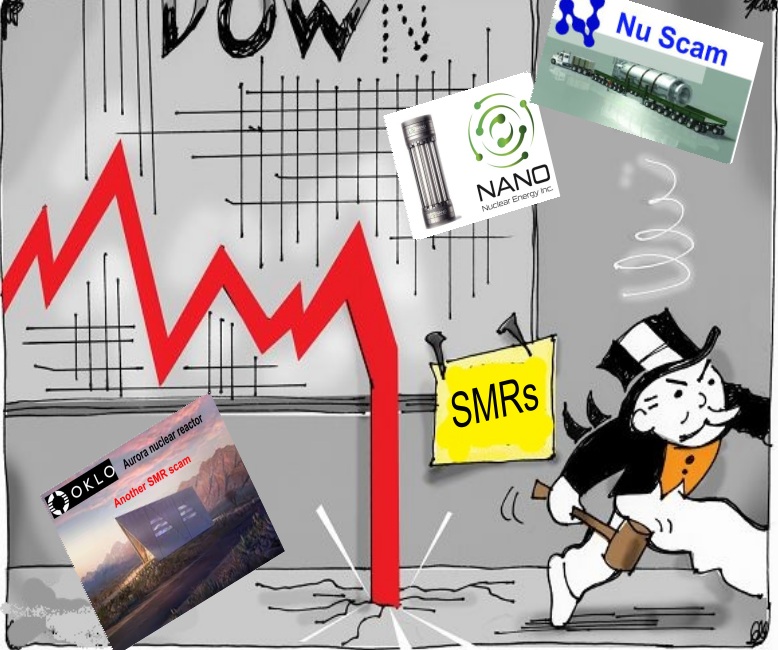
OKLO – has a market cap of $8 billion, and its shares jumped more than 12% on Aug. 25 Sounds great doesn’t it? BUT:
- OKLO had a net loss of $81.6 million in the second quarter this year.
- It went public through a SPAC (special purpose acquisition company) in 2025.
- It generates no commercial energy income today.
- Its first Small Modular Reactor (SMR), the Aurora Powerhouse, isn’t expected to enter commercial operation for years.
- Oklo is incurring tens of millions in operating losses annually.
- It is $78.6 million in debt, so interest and loan payments eat into its earnings.
- OKLO is still in discussions with the regulator NRC, regarding the fuel, high-assay low-enriched uranium, or HALEU, and other supply chain issues.
Similarly, stocks of both NuScale Power, and Nano Nuclear have soared over the past year. Yet both are making little or no money, and both have suffered operational losses over this year. NuScale is now facing a class action by investors who claim that the company misrepresented the prospects for small nuclear reactors.
So – what have the smart rich investors done? Basically, they’ve gambled on these stocks being over-priced, and soon to go down. Investment strategies are not my strong point, but it seems that short selling is one hedge fund strategy. So these clever investors, noting the unsustainable rise in share prices, borrow shares and soon sell them at the inflated price, and can buy them back later as the price plunges down.
So , it’s estimated that investors made over $2 Billion over the past months by short selling shares in these three small nuclear reactor companies – OKLO, NuScale, and Nano Nuclear.
The rage for investing in SMRs is still on, as the world is gripped by the mania for AI hyperscalers. (AI hyperscalers are companies investing grotesque amounts of money in building data centres world-wide)
Neither the hyperscalers nor the small reactor companies are actually making money at present. But the hype is all-consuming.
This is the prevailing hype –
The AI Boom Is Making Nuclear Power Bankable Again – America’s nuclear power landscape is undergoing a dramatic transformation, driven by the immense energy needs of artificial intelligence. Tech giants like Microsoft, Google, Amazon, and Meta are directly financing nuclear projects, committing billions to secure nearly 10 gigawatts of capacity. ………..
Almost everything tech companies are funding—Meta, Amazon, most of Google’s bets—is small modular reactors: compact designs.
Will AI kickstart a new age of nuclear power? IAEA Director General Manuel Grossi believes that the nuclear industry is destined to be the energy partner of the AI revolution. “Only nuclear energy can meet the five needs of low-carbon power generation, round-the-clock reliability, ultra-high power density, grid stability and true scalability”……………………..the IAEA is working closely with regulators and the industry to make them a viable proposition and we could soon be seeing large numbers of small reactors being deployed to meet the demand.
So- we have the Trumpian process in the USA, of the weakening of radiation and safety regulation of nuclear reactors, and of the government already funding 8 SMR companies.
With the claim that nuclear power combats climate change, with the accepted belief in the necessity for AI hyperscale, governments, academia, the corporate media, and the UN all promote this new marriage of nuclear and Big Tech. So – all the stars are aligned for the rise and rise of small nuclear reactors.

Incidentally, don’t look to the UN, the World Health Organisation (WHO)or anyone like that to cry foul. I think that most people have forgotten, if they ever knew it , but the 1959 agreement between the WHO and the International Atomic Energy Agency (IAEA) effectively prevents the WHO from criticising things nuclear.
One important part – “Whenever either organization proposes to initiate a programme or activity on a subject in which the other organization has or may have a substantial interest, the first party shall consult the other with a view to adjusting the matter by mutual agreement.”

And, in this time of vulnerability of nuclear sites, to war and terrorism, you wonder how Rafael Grossi, Director of the IAEA reconciles his conflicting duties, that of promoting nuclear power and of assuring of its safety.
But I digress. We are talking about money, and how to get rich through investing in small nuclear reactors. Well, that is still a goer. But perhaps you’d better be quick, as investment advisors are now dithering about the share price of commercial SMR companies, even though the Big Tech- SMR teams are apparently still booming.
However, the global nuclear lobby is now turning its attention to military microreactors, so there’s hope for future stock market gains as governments splurge tax-payers money into companies in that area.
Uranium/Nuclear Industry news, week to 21 August
TOP STORIES.
Short sellers reap $2Bn profit as modular nuclear reactor stocks tumble.
Special investigation: UK’s nuclear waste a ‘calamity for future generations’ – ALSO AT https://nuclear-news.net/2026/08/21/1-a-special-investigation-uks-nuclear-waste-a-calamity-for-future-generations/
From the archives Nuclear power: molten salt reactors and sodium-cooled fast reactors make the radioactive waste problem WORSE.?
CLIMATE. It’s Getting So Hot That Nuclear Plants Are Being Forced to Power Down. Hungary to sink two barges near nuclear plant as river runs dry.
ECONOMICS. Russia Pushes Ahead With Uzbekistan Nuclear Plans Despite Money Troubles.
USA government handing out $billions to X-energy and TerraPower for advanced nuclear reactors, 26.8 billion nuclear refurbishment to begin in Pickering early next year.
ENERGY. Romania Restarts Coal Plant as Danube Drought Forces Nuclear Shutdown.
LEGAL. Hinkley Point C subsidiary must comply with environmental information rules, UTT rules.
MEDIA. Why the U.S. Military is ‘Earth’s Greatest Enemy’ (w/ Abby Martin) | The Chris Hedges Report
POLITICS. Nuclear material found in Syria will remain in the country, minister says.
SAFETY. The shocking story of the Flamanville 3 lid.
Thirty six incidents reported at Hartlepool nuclear power plant since 2025.
TECHNOLOGY. The Microreactor Miracle Meets a Morphing AI-Nuclear Future.
WASTES.
- Tepco begins removal of radioactive spent fuel from Fukushima No. 2 reactor.
- The 100,000-year plan for Finland’s and Sweden’s nuclear waste turns on something very small — whether bacteria half a kilometre underground can make enough sulphide to eat through five centimetres of copper.
- Summary of the Summary of the Integrated Guidelines – Deep Geological Repository (DGR) for Canada’s Used Nuclear Fuel Project.
- A Canadian lab ran real spent nuclear fuel through one chemical process and stripped 89% of its long-lived danger in 24 hours.
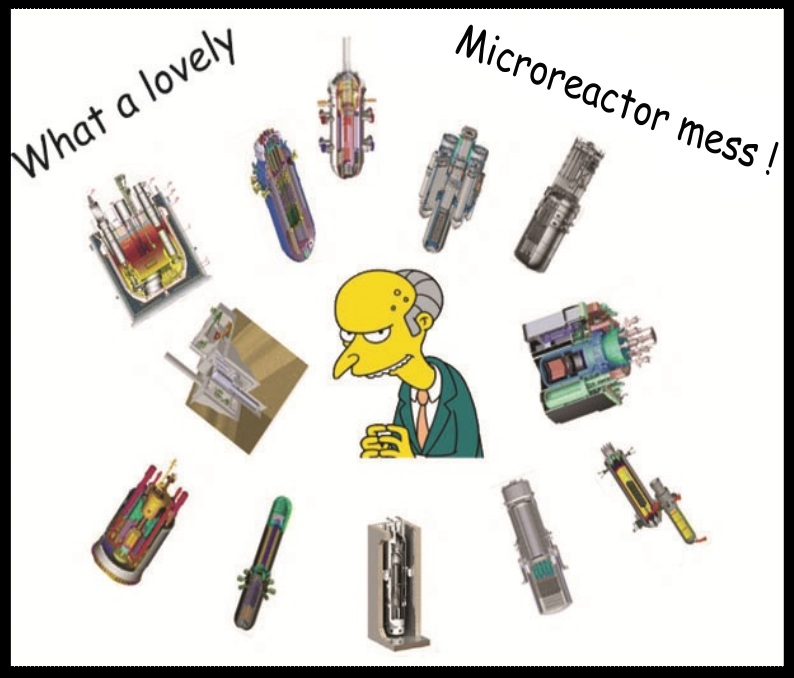
MICROREACTORS – the Next Big Little Nuclear THING!
Noel Wauchope, 15 August 2026, https://theaimn.net/microreactors-the-next-big-little-nuclear-thing/
Forget about Small Modular Nuclear Reactors – they’re not cool anymore!
What the world needs now is MICROREACTORS – so saith the global nuclear lobby. And we know they must be right, because they’ve already explained how the world needs a NUCLEAR RENAISSANCE to solve climate change, energy shortage, world peace etc…
Now there are substantial differences between microreactors and small modular nuclear reactors (SMRs) , even though at first glance microreactors might seem to be just teeny weeny versions of SMRs. Whereas an SMR produces up to 300 MWe , a microreactor produces anything from 1 MWe up to 50MWe
There are fuel differences . SMRs can use LEU – Low Enriched Uranium or the more powerful HALEU – High-Assay Low-Enriched Uranium . Microreactors can, in theory, use LEU fuel, but that could not work out to be economic. The fuel must be the more powerful HALEU – High-Assay Low-Enriched Uranium. And in fact, Most microreactor plans use the more complex TRISO Fuel (Tri-Structural Isotropic), in which the tiny kernels of HALEU are coated with multiple layers of ceramic and carbon. That makes TRISO very safe, but very expensive.
Really, the most important difference is in – Who Pays For Microreactors?
Well, you do, if you’re a tax-payer. The only economically viable way to fund microreactors is to make them military installations, government funded. SMRs are supposedly economically viable, and were touted to become a private enterprise success. That’s until the NuSCale SMR financial fiasco
The beloved ever-about -to-happen nuclear renaissance needs a new theme, and that new funding source. The old theme was ENERGY– the new theme is DEFENCE.
For quite a while now, it has been obvious, and indeed a boast of the nuclear lobby, that new small reactors would support the defence sector, and nuclear weaponry, by providing the trained staff that are so badly needed, as the old nuclear boffins retire,
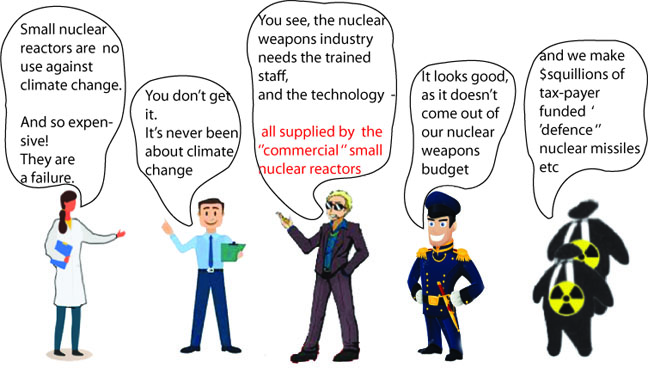
But times have changed, and also the nuke lobby is getting desperate. With all the international political drama going on, obviously the top priority now is war. (Did I hear someone say, what about diplomacy, negotiation? Look, that’s time-consuming, takes high mental ability, and there’s no money in it) Yes, what we and the nuke industry need now is war preparation.
So the nuclear industry is regalvanised, with a spate joyous media articles, mostly – worded like this one – Antares Raises $470M to Field Military-Focused Microreactors. Optimistic statements abound:
Power up: Antares and their nuclear startup frenemies moving so fast is good news for the Pentagon, which is where that 2028 number comes into play in a few places.
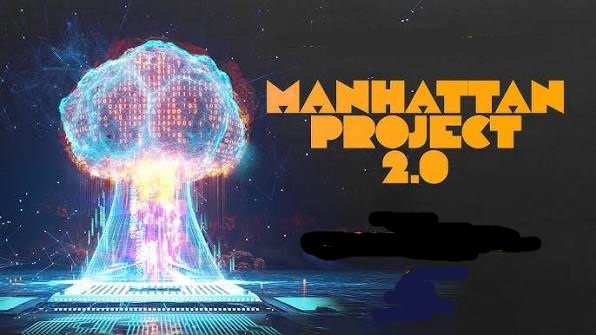
In May 2025, President Trump signed a series of executive orders to accelerate the Department of Energy’s “Manhattan Project 2.0.” -notably Executive Order 14299, “Deploying Advanced Nuclear Reactor Technologies for National Security,” Then came Executive Order 14300, “Ordering the Reform of the Nuclear Regulatory Commission,”- getting rid of, or watering down public safety, radiation and environmental standards. The full import of this has been documented by Kristen Thomason in her superb article – “If you’re already afraid, just wait until you hear about Manhattan Project 2.0″
A lot of hype about microreactor energy for data farms, with Silicon Valley tech billionaires all on board, – and the craze is for so many “start-ups “
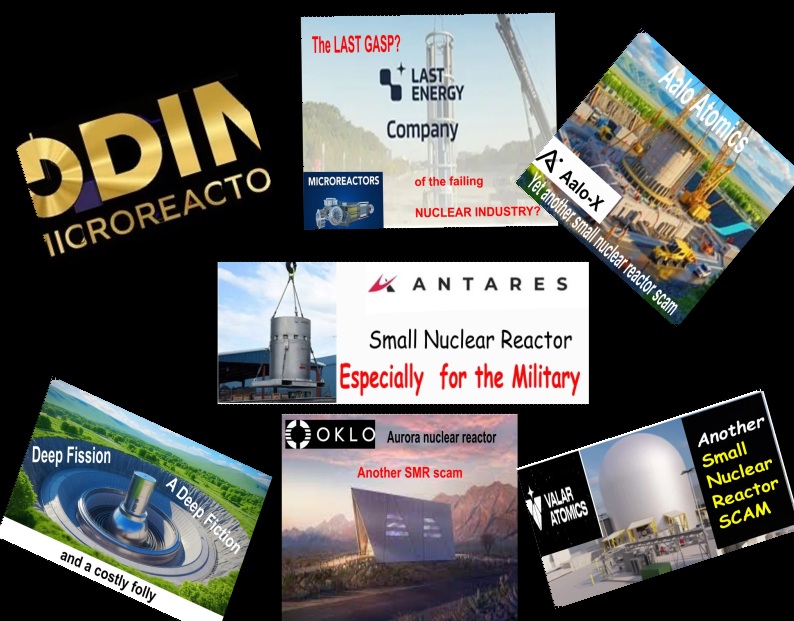
I had every intention of going through all the hazards, impediments to these microreactors ever becoming a commercial reality. But guess what ? OKLO, probably the leader of the pack, has done it for me. After the usual hypy article, glorifying their new microreactor, OKLO makes this revealing statement at the end:
As a result of a number of known and unknown risks and uncertainties, the actual results or performance of Oklo may be materially different from those expressed or implied by these forward-looking statements. The following important risk factors could affect Oklo’s future results and cause those results or other outcomes to differ materially from those expressed or implied in the forward-looking statements: risks related to the development and deployment of Oklo’s powerhouses, fuel fabrication and fuel recycling facilities, and radioisotope production activities; the risk that Oklo is pursuing an emerging market with no commercial project operating and regulatory uncertainties; risks related to acquisitions, divestitures, or joint ventures we may engage in; the need for financing to construct plants, which remain subject to market, financial, political, and legal conditions; risks related to an inability to raise additional capital to support our business and sustain our growth on favorable terms; the effects of competition; risks related to accessing high-assay low-enriched uranium, plutonium, and other fuels (including recycled fuels) at acceptable costs and under acceptable timelines; risks related to our supply chain; risks related to power purchase agreements; risks related to human capital; risks related to our intellectual property; risks related to cybersecurity and data privacy; changes in applicable laws or regulations, including tariffs; the outcome of any government and regulatory proceedings and investigations and inquiries; and the other factors set forth in our documents we have filed with the U.S. Securities and Exchange Commission (the “SEC”).
The foregoing list of factors is not exhaustive.
I was going to try and list all those factors – to throw some cold water on the microreactor parade – and that leading microreactor developer has done it for me!
As I tried to research all those factors to consider about micoreactors, I made the discovery that amongst the pro nuclear experts themselves, there are the gold nuggets of the truth. Not only has OKLO raised those contentious questions, but in a lengthy video – Nick Touran, a nuclear engineer and manager at TerraPower, unearths the sobering realities of micro nuclear reactors:
It’s long – but he spells it all out, if you can take the time:
Chapters:
00:00 Visions for microreactors 03:49 Defining microreactors 11:56 The problem of radiation shielding 18:48 Original microreactor projects 24:29 Niche applications 30:32 The problem of neutron economy 40:08 The problem of fuel 53:03 The problem of operations and maintenance 1:00:17 The problem of commercialization 1:05:42 The problem of spent fuel 1:09:27 The problem of scaling 1:12:36 The problem of licensing
Nick Touran and OKLO might be hopeful for microreactor success some time in the future. But they – pro nuclear people, are well aware of the obstacles and especially of the financial costs.
So, if they can take the microreactor hype with a grain of salt, the rest of us, who are not part of the development process, should be taking that hype with a bucketful .
The trouble with Small Modular Nuclear Reactors (SMRs) – THEY’RE NOT SMALL
7 August 2026 Noel Wauchope, https://theaimn.net/the-trouble-with-small-modular-nuclear-reactors-smrs-theyre-not-small/

The big boasts for small nuclear reactors are that they are modular and they are small.
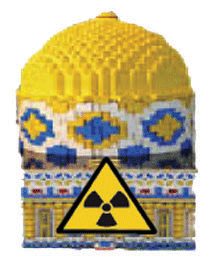
Modular – yes. They’re a sort of LEGO or IKEA thing – parts made in one place, then shipped to another place and assembled. (That process has its problems, too – but today I’m just focussing on the small aspect.
A small modular reactor (SMR) is an emergent class of nuclear fission reactors with a rated electrical power of less than 300 megawatts (MWe) (Wikipedia) MWE (Megawatts electric) refers specifically to the amount of electrical power a system can produce. Large reactors generate over 700 MW(e). Microreactors range in capacity from 1 to 20 MWe.
So – now we have SMRs being touted as the great new source of electricity – a sort of vision of little nuclear reactors dotted in their many thousands all over the world.
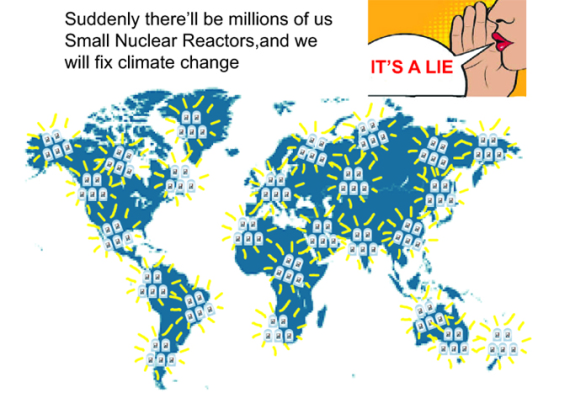
But that’s not really a practical plan. So – how about bundling a bunch of them together – so they can produce a large amount of electricity, and we can still call them a Small Modular Nuclear Power Plant?
Case study 1 – NuScale – the American experiment

The NuScale SMR is a pressurized water reactor (PWR) – a type of light-water nuclear reactor. In a PWR, water is used both as a neutron moderator and as coolant fluid for the reactor core. So it’s pretty much a small version of the “tried and tested” large nuclear reactors. This was the first SMR design to get Nuclear Regulatory Commission licensing. The Department of Energy approved $1.35 billion to the project, over 10 years subject to appropriations.
In 2015 NuScale Power and Utah Associated Municipal Power Systems (UAMPS) planned a single plant, containing 12 “modules” – i.e. 12 SMRs, which would provide 924 MWe – same as a large nuclear reactor. so – no longer small. The estimated costs kept rising, reaching $9.3 Billion by 2023. So the plan, now named VOYGR, was changed from 12 modules to six. Even at 6 modules with 462 MWe- still a large project.
In November 2023 UAMPS officially terminated the CFPP agreement. The Idaho project would have been NuScale’s first commercial deployment. The project that was supposed to demonstrate SMR viability in the US was dead. NuScale took a $100M+ write-down. The cancellation sent shockwaves through the SMR industry. Investor interest, always poor, collapsed. In a class-action lawsuit filed Nov. 15, investors say NuScale “made materially false and/or misleading statements and failed to disclose material adverse facts about the Company’s business, operations, and prospects.”
NuScale continues to push its VOYGR plan – to Romania, Poland, Kazakhstan, Ukraine, and the Philippines. The company continues to burn cash with no revenue from reactor operations. The VOYGR design remains the only NRC-certified SMR.
Case study 2 – X-Energy ‘s MWe Xe-100 plant – the British experiment.

In September 2025, X-energy and Centrica signed a Joint Development Agreement for the UK’s first advanced nuclear fleet, targeting 6 GW nationwide with Hartlepool identified as the preferred first site for a 12-unit/960 MWe Xe-100 plant.
The Xe-100 is a 200MWt (75MWe) reactor. The Xe-100 SMR is a high temperature gas-cooled (HTGR) pebble bed modular reactor. “It uses tennis ball-sized pebbles made of thousands of TRISO micro-fuel particles which consist of fissile U-235 surrounded by pyrolytic graphite, which acts as the moderator – slowing down fast neutrons so they more efficiently split the U-235 nucleus.”
So this UK plan is different from the American pioneer project, Nuscale. It is using different fuel, – a Pebble Bed Nuclear Reactor. This has been tried in the past as a large reactor, and was a failure. The Xe-100 has a new variant – TRISO (Tri-structural Isotropic particle fuel). Thousands of poppy seed-sized particles are combined into compact fuel forms. These tiny uranium kernels are encased in three layers of ceramic coating that’s needed to absorb the nasty byproducts that form during the atom-splitting process.
So, like the American NuScale project, this will be a world first.
Both projects were hugely touted as safe. And it’s true – they can’t melt down like a Chernobyl or Fukushima event. But at 462 MWe (the Utah project) and 960MWe (Hartlepool) they are both big plants, with the potential for accidents or terrorist attacks, including cyber-disruption, to release a large amount of ionising radiation to the surrounding area. Even within the nuclear hierarchy, there are anxieties about the safety of TRISO fuel. And TRISO discharges the largest volume of spent nuclear fuels waste in the industry.
The UTAH Nuscale project sank because it was becoming more and more expensive. Assisted by the government, it was still a private enterprise project, and the Utah Associated Municipal Power Systems balked at the cost.
The Hartlepool X Energy project is intended to become a successful private enterprise project, but it is strongly backed by the UK government’s Great British Energy – Nuclear with funding provided by its Future Nuclear Enabling Fund. However TRISO fuel is highly expensive to make, and with still uncertainties about its safety, it is not likely that this pioneer initiative for Hartlepool will really bring the wave of private investment that the UK government has been hoping for.
In both cases, these have been attempts to show the Western world that small modular nuclear reactors are a really big profitable thing – they will power the mighty data farms etc.
Community acceptance is the big bonus that the nuclear industry desperately needs
This is much less of a problem in totalitarian nations like Russia and China. Both countries have only one small nuclear reactor in operation, and in each case, it hasn’t been very successful. Both China and Russia are ramping up their nuclear weapons, and they don’t need to worry so much about public acceptance of the “peaceful” nuclear industry, and of community agreement on matters nuclear.
News indirectly related to the nuclear industry

Some bits of good news – How to stitch a massive wildlife corridor through the Rocky Mountains. Indonesia’s free nutritious meal program reaches 62.4 mln beneficiaries. White Storks Return to the Midlands After Six Hundred Years
TOP STORIESZelensky’s Dangerous Gambit To Merge The Iran And Ukraine Wars . Not Even Israelis Are Willing To Die For Israel.
A nuclear deal for the Saudis, media blackout for Kushner’s corruption.
From the archives: Saudi Arabia, the Khashoggi murder case: the nuclear connections with Terra Power, Bill Gates, Breakthrough etc
Climate ‘The heat took him from me’: India’s death toll rises amid escalating heat crisis.
‘Fire cloud’ over Bordeaux as France braces for new heatwave. Uganda begins emergency food handouts after 19 die from hunger,
AUSTRALIA
. AUKUS Inquiry exposes nuclear weapon-sized crater.
Coalition MPs push for nuclear-powered data centres.
The Quiet Surrender of our Nation’s Sovereignty
| ATROCITIES. Israel Is Erasing Entire Gaza Families From The Civil Registry. |
| CIVIL LIBERTIES. Suffolk fire live: Hundreds of firefighters battle ‘unprecedented’ wildfire near nuclear plant. |
| ECONOMICS. Nuclear revival needs $250bn a year, industry says. Nuclear needs $6tn investment surge to meet 2050 ambitions. |
| MEDIA. ‘Earth’s Greatest Enemy‘ Delivers A Penetrating Insight Into The Heart Of Our Dystopia. https://www.youtube.com/watch?v=Kz7MfkVAC40&t=110s |
| OPPOSITION to NUCLEAR .Campaign steps up opposition to south Wales nuclear project. |
POLITICS .
- Ontario touts small nuclear reactors with $500,000 for Haldimand County.
- The Small Modular Nuclear Reactor Hyper spreads to Italy. Philippines’ Marcos says ‘perhaps time to revisit nuclear energy’.
- Republican senator breaks ranks with Trump over controversial nuclear deal with Saudi Arabia. The Guardian view on a US-Saudi nuclear agreement: an offer that further erodes international safeguards. Enrichment Antics: Trump’s Saudi Nuclear Deal. Democrats prepare to resist Saudi nuclear deal.
- Trump Administration Picks Five States for Nuclear Fuel-Cycle Hubs.
- Trump threat to hit Pickaxe renews calls in Iran for nuclear bomb, NPT exit.
- The Collapse of the Bipartisan Consensus over US-Israel Ties. Democrats prepare to resist Saudi nuclear deal. Canada’s silence on the U.S. and Saudi Arabia’s nuclear agreement isn’t neutrality. It’s something much worse-ALSO AT https://nuclear-news.net/?s=Canada%E2%80%99s+silence+on+the+U.S.+and+Saudi+Arabia%E2%80%99s+
POLITICS INTERNATIONAL and DIPLOMACY.
Saudi Arabia stares down Trump whiplash US‑Saudi nuclear deal invites proliferation risks … unless safeguards are written in on nuclear deal.
The Saudi Nuclear Deal Invites Disaster (Wall Street Journal)
The US-Saudi nuclear deal.
Trump stuns Saudis by pinning nuclear deal to Israel ties.
UK’s New Defence Minister Called Israel ‘Rogue State’.
The nuclear lobby getting cold feet about public acceptance?
| RADIATION. As Trump boosts nuclear power, regulators seek to eliminate a longstanding radiation safety practice. |
| SAFETY. No more sheltering or iodine tablets: Why are we getting a new nuclear emergency plan? |
| SECRETS and LIES. Israel Is Paying Millions to Train AI Chatbots How to Talk About Gaza – It’s Working. Trump’s Phantom Enemies. |
WAR and CONFLICT.
- Colonel Doug Macgregor: Sleepwalking into World War III.
- Israel builds massive barrier inside Gaza to partition strip beyond ‘Yellow Line’
- War Criminal Pete Hegseth Disrupted.
- What would happen if the UK’s Faslane nuclear weapons base was hit in a nuclear strike? An Iranian missile attack on the UK is no longer far-fetched.
- The Chris Hedges Report: Is Iran Becoming Another ‘Forever War’?
- US Troops Always Die For The US Alone.
- A Big War is Coming. https://www.youtube.com/watch?v=QXMjSY0spzQ&t=74s
WASTES. White House wants to entice ‘willing states’ to take nation’s nuclear waste with promises of economic boost. 5 states offer to accept nuclear waste in exchange for help developing nuclear energy!
WEAPONS and WEAPONS SALES.
- Andy Burnham pitches £8.4bn nuclear submarine investment as great for youth employment. Russia’s
- Starlink killers showcase new era of electronic battlefield warfare. The Guardian view on a US-Saudi nuclear agreement: an offer that further erodes international safeguards. Is Trump’s Saudi nuclear deal set to trigger a Middle East arms race?
- The rise of the military-technology complex.
Just the uranium/nuclear industry news this week
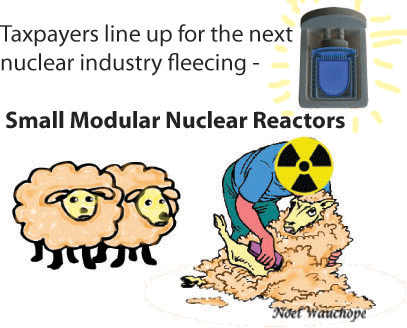
TOP STORIES. The hidden expansion of Britain’s nuclear strategy.
Fukkushima nuke plant struggles to clear radioactive waste debris.
Noel’s notes. The nasty truth about Small Nuclear Reactors’ toxic fuel and toxic wastes.
AUSTRALIA.
- A global threat for millennia: experts warn Australia’s nuclear submarine legacy will be weapons-usable uranium cache.
- Albanese government pledges extra $4.6billion for AUKUS shipyard – but critics warn it will make Australia a nuclear target.
- Billions of dollars are failing to lift production of AUKUS submarines – ALSO AT….https://antinuclear.net/2026/07/27/5-billions-of-dollars-are-failing-to-lift-production-of-aukus-submarines/
| CLIMATE. Cernavodă Reactor Shut Down as Drought Lowers Danube Flow. |
| ECONOMICS. A mad for nuclear world? Innovative geotechnical sub-alliance formed for Sizewell C construction. A nuclear deal for the Saudis. |
| ENERGY. Nuclear stagnates while renewables soar. |
| MEDIA. “Jobs Jobs Jobs” screams the media again as the nuclear lobby plans to bring Japan’s nuclear waste to Cumberland. |
| POLITICS INTERNATIONAL and DIPLOMACY. Proposed US-Saudi nuclear energy deal: What we know so far. |
| SAFETY. Is it safe to extend the life of a nuclear power station?. |
| SECRETS and LIES. Government withholds cost to taxpayer of restarting nuclear power-critical CO2 factory. |
TECHNOLOGY.
Can an AI Black Box Be Trusted to Run a Nuclear Reactor?
Trump Administration Eyes Offshore Nuclear to Power AI Boom.
SMALL MODULAR NUCLEAR REACTORS.
- EDF exploring sale of stakes in modular reactor subsidiary Nuward.
- USA firm McDermott to support potential Dutch Rolls-Royce SMR projects. SMR on the moon – micro lunar nuclear reactor.
- “Small” nuclear reactors for Hartlepool? ONLY THEY ARE NOT SMALL.
- More dizzying spin about Small Modular Nuclear Reactors!
- U.S. Prioritizes Small Nuclear Reactors Across Southeast Asia.
- Government gives Canadian Strategic Missions Corporation (CSMC) $4.5M for Micro-Nuclear Technology in Canada’s Arctic.
- Nuclearelectrica’s proposal to review SMR options rejected by Romania ministry.
- NUCLEAR FUEL. Approval for VVER uranium/plutonium fuel production in Germany.
| WASTES. Nuclear Waste Could Be Headed to Five States in New US Plan (1). Leaked document reveals White House nuclear waste plan. Decommissioning. Demolition of Germany’s Stade reactor building progresses. Plan to Bring Failed Japanese Fast Breeder Reactor’s Contaminated Sodium to Workington. Multi-million-pound nuclear treatment plant set to be built at Port of Workington |
| WEAPONS and WEAPONS SALES. US Navy’s nuclear battleship plan raises questions for carriers, submarines and AUKUS. Canada remains anti-nuke, but its potential path to the bomb is getting shorter. |
The nasty truth about Small Nuclear Reactors’ toxic fuel and toxic wastes
27 July 2026, https://theaimn.net/the-nasty-truth-about-small-nuclear-reactors-toxic-fuel-and-toxic-wastes/
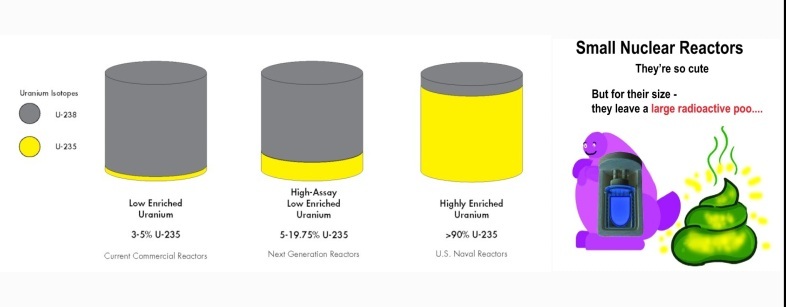
A lot of enthusiastic guff goes on about the joys of Small Modular Nuclear Reactors (SMRs). They don’t say much about the fuels that SMRs require. So – just for fun, let’s take a look at that. Let’s pretend, for the moment, that SMRs actually exist, and that they are privately funded, cheap, clean, safe, and welcomed by local communities. So – that’s all good.
Now – what about their fuel?
They don’t need as much, or perhaps ANY dirty uranium mining. Ain’t that great? Well some designs (eg, the Westinghouse evinci micro reactor) do use low-enriched uranium (LEU) which contains less than 20% of uranium-235 (U-235). Such LEU SMRs have a shorter expected life, and because of their graphite content have a high volume of wastes. So now the emphasis is on a new kind of fuel – high-assay low-enriched uranium (HALEU): 5–20% U-235 and/or plutonium.
For a non-physicist such as myself, trying to navigate the labyrinth of information on nuclear fuels is a daunting task. And I’m sure that the nuclear lobby intends to keep it that way. They’ve traded for decades on the principle that the great unwashed cannot and should not understand nuclear power, and that only nuclear physicists are qualified to have an opinion on this. (No wonder they vilified Dr Helen Caldicott, who described nuclear power as “an expensive way to boil water”).
What makes it all more complicated is the variety of SMR designs, and of the fuel types now being planned, generally to use the HALEU or mixed uranium-plutonium. This means that the SMR company has to get these advanced fuels from somewhere more special than the conventional uranium fuel train. But who supplies the world’s highly enriched uranium? Omigawd – it’s Russia! So that fact has caused a bit of a panic. The U.S, government’s Department of Energy has now selected 11 advanced reactor designs under its Reactor Pilot Program, most of them to. run on HALEU. As Peter McKillop of the Energy Mix says:
“… here lies the problem. By embracing HALEU, the DOE is effectively jump‑starting an international HALEU market and expanding the global circulation of material that can shorten the path to a bomb.”
The required plutonium has to come from recycling the spent nuclear fuel from large nuclear reactors. Of course the nuke lobby boasts that this solves the nuclear waste problem – what was previously called “trash” now becomes a “resource” and a nuclear waste solution. More about that later on.
The fuel needs of SMRs raise not only the weapons proliferation problem: they bring the risks of radiation-releasing accidents, theft, terrorism, and consequently the need for extra security and extra costs.
What about the radioactive wastes?
The nuclear lobby is rather coy on this subject. When their propagandists are talking to us, the great unwashed, they tell a comforting and optimistic story. You see, SMRs produce a very small volume of radioactive wastes, and even that can be recycled to be used again, leaving an even smaller volume. So SMRs are not only themselves clean, but they are a benefit to humanity, solving the existing nuclear waste problem.
SMR propagandists don’t bother our poor little heads with the technical details. That’s because the technical details tell quite a different story. Stanford-led research finds small modular reactors will exacerbate challengesof highly radioactive nuclear waste. Proceedings of the National Academy of Sciences “Our results show that most small modular reactor designs will actually increase the volume of nuclear waste in need of management and disposal, by factors of 2 to 30.
SMRs will produce more voluminous and chemically/physically reactive waste than LWRs, which will impact options for the management and disposal of this waste. The very high toxicity of these wastes mean that the spent fuel pellets will require a larger area in deep disposal than those from conventional reactors. SMR waste streams will bear significant (radio)chemical differences from those of existing reactors. “Molten salt and sodium-cooled SMRs will use highly corrosive and pyrophoric fuels and coolants that, following irradiation, will become highly radioactive.”
No wonder the current push for SMRs does not emphasise that fraudulent story about wastes. For ordinary people it is probably the really ugliest and most off-putting aspect of any presentation of the wonders of small modular nuclear reactors.
Crunch time for the nuclear lobby’s biggest lie (Small Modular Nuclear Reactors)?
22 July 2026, https://theaimn.net/crunch-time-for-the-nuclear-lobbys-biggest-lie-small-modular-nuclear-reactors/
There could be a big drama now, about Small Modular Nuclear Reactors sort of not really going to happen in the UK. But I don’t think so. The nuclear lobby is adept at twisting a negative outlook into a sorta positive one. And I’m sorry to say, but I think that Andy Burnham might just co-operate in this process.
At the moment, the UK, and the world, are waiting for the UK’s new progressive poster boy, Andy Burnham, to declare his policies on all sorts of things. His general theme is “left of centre”, socially progressive, with the emphasis on economic reform – “business-friendly socialism”. Most likely, Burnham’s approach to the big issues of climate and nuclear will be a cautious “business-as usual.” Those who are deeply concerned about climate and nuclear issues can hardly blame him. Unfortunately, the reality is that Burnham could never have got where he is now, if he bucked the prevailing system, with Labour now a kind of weaker Tory party.
At the moment, the UK, and the world, are waiting for the UK’s new progressive poster boy, Andy Burnham, to declare his policies on all sorts of things. His general theme is “left of centre”, socially progressive, with the emphasis on economic reform – “business-friendly socialism”. Most likely, Burnham’s approach to the big issues of climate and nuclear will be a cautious “business-as usual.” Those who are deeply concerned about climate and nuclear issues can hardly blame him. Unfortunately, the reality is that Burnham could never have got where he is now, if he bucked the prevailing system, with Labour now a kind of weaker Tory party.
What has this got to do with Small Modular Nuclear Reactors?
Well, as I have written before, the global nuclear lobby now depends on the UK to kick off the new nuclear renaissance, with a fleet of small nuclear reactors in the UK, as promised by the previous Prime Minister with his Great British Energy – Nuclear. The stated purpose is to provide the UK soon, with cheap, plentiful, clean, climate-friendly, proven technology, safe, community-welcomed, waste-free, peaceful electricity. In that statement there are already 10 lies. Of all those lies, I would say that “soon” is the biggest whopper of them all.
SOON
The most “exciting” SMR plan, that of Poland-based SGE (Synthos Green Energy), promises 14 SMRs in operation by 2034. That would provide about the same amount of electricity as one large nuclear reactor. However, SMRs that each provide 300 MW would provide very much more – but then they would have to be larger, and no longer qualify as “small”. Either way, that would be only a beginning – many, many more SMRs would be needed to meet the UK’s electricity needs. And, let’s not forget – the coming wave of data farms for artificial intelligence is going to probably double that need.
So, even in the most optimistic scenario, SMRs are not going to cut the mustard for showing the world that soon Small Modular Nuclear Reactors will power a nation. Of course the promise of “soon” also relates to the claim that SMRs are needed for action on climate change. Clearly, they are going to be irrelevant, too late for reducing greenhouse gas emissions, whereas we have renewable energy right now. And of course, but rarely mentioned – energy efficiency, energy conservation – the really effective way to reduce greenhouse emissions.
CHEAP
The next biggest whopper about Small Modular Nuclear Reactors is the statement that they would be cheap. Here we get into the minefield of deliberate obfuscation about the financial facts. The cost of building SMRs is likely to be astronomic, and the only practicable way is to build them en masse. That would mean that the company building them would need to have big orders, not just for one or two reactors. Big orders bring with them a heap of problems. Like an IKEA cupboard, these “modular” items are all the same – if you buy a whole lot of them they’d better all work out perfectly – no chance really to just try out one. Buyers are reluctant, and so are investors.
Of course, the argument will be that SMRs will provide cheap electricity. Well that absolutely would necessitate economies of scale. That was the reason that the idea of small reactors was abandoned in the past. Simply, a large reactor producing a huge amount of electricity has got to produce it more efficiently and cheaply. The proponents of SMRs never talk about the accompanying costs – insurance, the security staff required, the transport and disposal of toxic long-lasting wastes. The truth is, those proponents absolutely know that their product is in fact very expensive. And that is why the subservient corporate media consistently baffle us with convoluted arguments that minimise the cost to tax-payers. They know damn well that the only way that SMRs could possibly be developed is by government funding. Keir Starmer backed a Rolls Royce plan that would be blatantly funded by the tax-payer. The SGE plan purports to be privately funded, but it’s tangled up with various government-funded schemes.
These were 2 lies – but there are 8 more to go.
Plentiful? – well, apart from Russia and China’s 2 duds – SMR’s don’t actually exist – quite the reverse of plentiful.
Clean? They are still part of a dirty production system, starting from uranium mining, with its workers exposed to radiation, and its piles of radioactive tailings.
Climate-friendly? There is a whole chain of steps from mining through to waste disposal that involve fossil fuel energy.
Proven technology? Well, they don’t even exist.
Safe? SMRs can’t melt down in the same way as big reactors, but still contain radioactive material, a target for theft, terrorists or military attacks Can still have accidents releasing radiation.
Community-welcomed? This really is a big one, with a lack of proper consultation on plans – There’s strong resistance from some local groups, such as Radiation Free Lakeland.
Peaceful? The hidden military pressures behind the new push for small nuclear reactors.
Wastes? Stanford-led research finds small modular reactors will exacerbate challenges of highly radioactive nuclear waste.
Now that Starmer, with his big promises, has gone, it’s probably no longer up to the UK’s Prime Minister to lead the global charge on small nuclear reactors. Andy Burnham has to negotiate the whole troubled energy scene, try to be progressive, placate the fossil fuel lobbies, and the nuclear lobby. He has been very quiet on nuclear policy, but he is committed to the existing defence and AUKUS nuclear agreements. So for “peaceful” nuclear, he’s most likely to go for a compromise – SMRs, supporting just a few, rather than the much-touted “fleets” of them.
So, no doubt the USA will take up the torch – One Year After Executive Orders, U.S. Nuclear Energy Renaissance is in Full Swing.
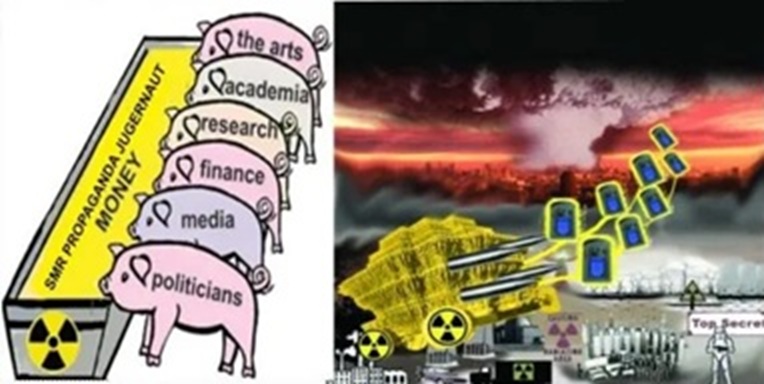
The media is awash with the wonder of new nuclear reactors, in concert with the AI data farm boom. The few voices who call for restraint, and point out the problems, are drowned out by the cacophony of handouts from the companies promising SMRs, handouts faithfully regurgitated by the corporate media, and by those universities which have bought into the propaganda.
There are the many good, decent people, whose living depends on their work within the uranium-nuclear-defence industries. And communities that are caught up in the nuclear industry, and its associated government bonuses. And many professionals, especially journalists, who, if they paused to look at the whole picture, might see the folly and the danger and the lies, of this so much touted technology. And of course, politicians who would be out of a job if they opposed the sacred cows of new energy and nuclear defence. So the whole SMR juggernaut moves on, bit by bit, and has itself become one big lie.
The global small nuclear reactor bandwagon is led by Britain. It ought to fail, but will it?

14 July 2026 Noel Wauchope, https://theaimn.net/the-global-small-nuclear-reactor-bandwagon-is-led-by-britain-it-ought-to-fail-but-will-it/
Why on Earth does the Small Nuclear Reactor media bandwagon exist?
That’s a fair question, because it has been shown time and time again that small modular nuclear reactors (SMRs) are not an economically viable way to provide electricity.
I can only conclude that there are other reasons for the present juggernaut of promotion of SMRs.
You may not have noticed the blithering onslaught of media promotion of SMRs going on over the past weeks, (interestingly, in conjunction with the political demise of Sir Keir Starmer). With the dramatic events in the Persian Gulf, and in climate extremities, dominating the media, a fuss about SMRs seems a small matter.
But it is not a small matter.
The global media juggernaut for SMRs is potentially essential for the survival of the global nuclear industry. If one nation sets up a multitude of, or even a few, small nuclear reactors, that will provide the necessary respectability for the industry – to be accepted as cheap. clean. safe, and embraced by local communities.
Hooray – Britain to the rescue!.
Now, there’s extraordinary excitement in both the British and overseas media. A current example:
The High Value Manufacturing (HVM) Catapult has launched a national consultation, to help UK industry capture the economic and industrial benefits of more than £100bn of expected investment in the country’s civil and defence nuclear programmes over the next decade. Industry, government, academia and regional partners are invited to contribute to the consultation through written submissions, stakeholder workshops and a programme of regional engagement running throughout 2026.
HVM Catapult doesn’t specifically state SMRs, but that’s where the UK media fervour is at. In a previous article, I have mentioned The Times, Telegraph, PR Newswire, Energy Live, Business Green, among the British enthusiasts. Internationally, there’s Construction News, Global Banking and Finance Review, World Nuclear News, Indux, and more.
What is new and remarkable about this UK SMR media fervour?
Well, there are two things. One is that it is all pitching the UK as the leader for the new nuclear renaissance. The other is that this will be a privately-led renaissance. Hence the importance of the “private” SGE £35bn plan for a fleet of SMRs across Britain, rather than the government supported Rolls Royce plan.
I digress here to point out that three nations have tried and failed to set up small nuclear reactors. Russia and China have each managed to develop one actually functioning small nuclear reactor. – in both cases – that took decades, and neither is working out very successfully – Russia – (Akademik Lomonosov floating NPP) and China (HTR-PM high temperature gas cooled reactor). The USA nearly got one happening – The Rise and Fall of NuScale: a nuclear cautionary tale.
So – at last it’s all going to happen ! And the UK is the leader – hip hip hooray! Except that the UK’s biggest SMR promoter, PM Keir Starmer is about to bow out at any moment. The policies of the heir apparent, Andy Burnham, are curiously unknown. He’s got a respectably Leftie background in supporting nuclear veterans, but I couldn’t find anything on his nuclear industry views. And, I’m inclined to think that he, or any new UK Prime Minister, would not be able to withstand the pressure of the cavalcade of vested interests in the nuclear industry. Those vested interests include not only all the UK and global stakeholders in the industry’s supply chain, but the fawning corporate media and the financially dependent universities.
There are some strong voices that speak out against this smr folly. Phil Johnstone and Andy Stirling of the University of Sussex have given a powerful condemnation of this SMR push – The hidden military pressures behind the new push for small nuclear reactors.
The nuclear industry was inaugurated in the early 1940s, specifically for creating an atomic bomb. That has continued to be its purpose for nearly a century, and it its sole real purpose today. Commercial “peaceful” nuclear power was set up as a temporarily successful fig leaf over that truly inhuman purpose. Temporarily successful, because it did provide efficient and seemingly cheap, seemingly clean, seemingly safe electricity for millions of people. We now know that not only are there long term costs – financial, environmental, health and safety costs – but that new big nuclear reactors are monumentally unaffordable.
In this 21st Century – how to make this industry look peaceful, clean, safe, and attractive to bright young career-oriented people? Well if that’s now an impossible task for dirty great Big nuclear reactors, how about a plethora of Small fig-leaves – Small Modular Nuclear Reactors.?
There may be a continued media deluge about UK’s golden SMR future, as promised by the dear soon-to- be-departed Starmer. But I doubt that there will be a deluge of investors keen to get on board the juggernaut. One saving grace of our capitalist society is that our financial writers tend to tell the truth about investment prospects. They might save the UK from this SMR folly. Then the nuclear lobby will have to really ramp up the war-mongering fever that already exists.
As UK’s Prime Minister fades away, will his beloved Small Nuclear Reactor dream fade too?
5 July 2026, https://theaimn.net/as-uks-prime-minister-fades-away-will-his-beloved-small-nuclear-reactor-dream-fade-too/
As soon as mid-July, Sir Keir Starmer is expected to finally quit his job as British Prime Minister. He’s not very popular, either within his own party, or with the general public. Labour’s previous popular leader, Jeremy Corbyn, opposed nuclear power. Soon after coming to power, Starmer called for tech companies to work alongside the government’s Great British Energy – Nuclear, to build SMRs to power energy-intensive AI data centres across Britain. Starmer might be hoping to be, later on, renowned for his legacy in revolutionising British energy systems, and producing a glorious renaissance for the global nuclear industry.
But possibly not.
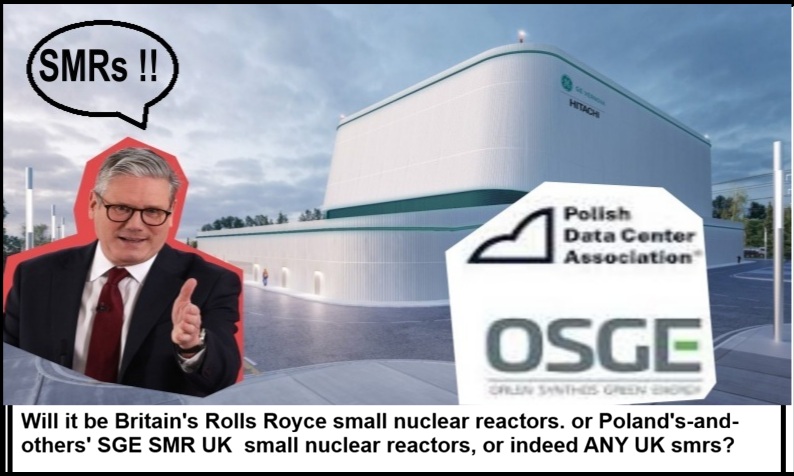
“I say: build, baby, build,” – Starmer’s theme on Small Nuclear Reactors looks now, on the face of it, to be a resounding winner for Britain on the global nuclear scene. Why? Because… haven’t you heard? It is all over the British press that the UK is to get a fleet of SMRs with a multi-billion dollar “privately financed” scheme (helped just a bit by the government), to start generating in 2034.
SGE is a European Small Modular Reactor (SMR) development and investment platform. Founded by Polish billionaire Michał Sołowow, SGE has plans for SMR developments across Europe. On July 1st SGE announced in glowing terms, its UK plans for “delivering efficient, safe, affordable, and clean nuclear energy power at fleet scale.” It has established a consortium, SGE SMR UK Limited, as its dedicated UK-based project vehicle.
SGE hopes to use the GE Vernova Hitachi BWRX-300 design, to build under the government’s advanced nuclear framework (which was initiated by Starmer in February after the government promised to rip up “archaic rules” and slash regulations to “get Britain building”). SGE boasts that this SMR design is a “proven technology,” but it’s really a smaller, and as yet untested, version of the large boiling water nuclear reactor.
Where’s the money coming from?
The plan is to put in £35bn of private capital to build 14 small modular nuclear reactors on three sites across the UK. The consortium SGE SMR UK consists of SGE (formerly Synthos Green Energy), GE Vernova, Hitachi Nuclear, Samsung C&T, Laing O’Rourke, Aecon Group, Google Cloud, Fermi Development, and Etara. The biggest investor presumably is the Polish company.
Under the National Wealth Fund, Great British Energy – Nuclear (GBE-N) set up its Small Modular Reactor (SMR) Technical Partner contract (TP Contract) as a way for the government to help fund SMR development. It initially forecast that it may need £20bn to cover the cost of the (TP) Contract. “GBE-N has ultimately decided to award only one TP Contract and the contract award notice value reflects this.”
SGE plans to deploy under a Contract for Difference framework with National Wealth Fund engagement. I know that the contract for difference scheme means a fixed price for electricity bills once the project begins generating electricity. If the market price is below the fixed price, the government tops up the payment to the company. I don’t know what the National Wealth Fund engagement means, and I suspect that I’m not the only one puzzled about this.
In May 2026 Great British Energy – Nuclear (GBE-N) announced that Rolls-Royce SMR has been awarded Stage 1 of its Small Modular Reactor (SMR) Technical Partner contract (TP Contract). Stage 1 has a “forecast” price of £359M. A furtherr £8.17bn is estimated for the second delivery phase. Rolls Royce expects the SMRs to start operating in the mid 2030s.
So how much of the tax-payers’ £20bn is Rolls Royce going to get? And is SGE SMR UK going to get some too, and if so, how much? Or is the Polish entrepreneur’s SGE SMR UK truly really going to go it alone – with private financing?
Mysterious unanswered questions
Through the Freedom of Information Act, The New Civil Engineer requested some detail on the breakdown of the TP Contract award ‘s available £20bn. Great British Energy – Nuclear ‘s reply was – “GBE-N does not hold the information you have requested.”
Given the nuclear industry’s notorious history of delays and cost overruns, it’s pretty important to know how much each of these competing SMR projects is likely to cost, how long each would really take to come into operation, and how much the tax-payer will have to cough up.
What a complicated mess!
In 2023 the UK joined enthusiastically with world leaders in The Declaration to Triple Nuclear Energy by 2050. The Starmer Labour government took this up with zeal, and the message has been reinforced by academia and the media. Several UK universities have jumped on the nuclear bandwagon. Just this week, the Manchester University announced:
The University of Manchester and United Kingdom National Nuclear Laboratory (UKNNL) have signed a Memorandum of Understanding (MoU) formalising a wide-ranging partnership to advance nuclear science, grow the UK’s nuclear workforce, and strengthen the country’s position as a global leader in nuclear technology.
The UK media, except for The Guardian and New Civil Engineer, is ecstatically regurgitating nuclear lobby handouts. On July 2nd we have excited and positive articles on the SGE SMR UK project – from The Times, Telegraph, PR Newswire, Energy Live, Business Green, as well as from leading international news media. This privately-funded SMR project is a global first.
The New Civil Engineer is peskily pursuing its search for information on the UK government’s planned funding of small nuclear reactors, while the rest of them continue applauding this small nuclear fantasy.
I’m not here to push the points that SMRs are not cheap, not proven, not safe, not clean, not environmentally beneficial, not free of toxic wastes, and not actually in existence. Plenty of economists and scientists have made those assessments. Is the SGE UK thing going to really happen? Or is the Rolls Royce SMR thing going to beat it? When and where are these reactors going to operate? I’m just wondering about – for how long the UK pro SMR charade is going to play. Now that the leading actor Keir Starmer is about to bow out, will the whole performance have a very short season indeed?
1 This Month
23-25 October – on Zoom – World BEYOND War’s annual global conferenc


Shut down the radiation-damaged Heysham nuclear reactors now
To see nuclear-related stories in greater depth and intensity – go to https://nuclearinformation.wordpress.com

Say No to NASA’s Reckless Nuclear Reactor on the Moon
Say No to NASA’s Reckless Nuclear Reactor on the Moon

-
Archives
- October 2026 (247)
- September 2026 (339)
- August 2026 (330)
- July 2026 (355)
- June 2026 (287)
- May 2026 (306)
- April 2026 (356)
- March 2026 (251)
- February 2026 (267)
- January 2026 (308)
- December 2025 (358)
- November 2025 (359)
-
Categories
- 1
- 1 NUCLEAR ISSUES
- business and costs
- climate change
- culture and arts
- ENERGY
- environment
- health
- history
- indigenous issues
- Legal
- marketing of nuclear
- media
- opposition to nuclear
- PERSONAL STORIES
- politics
- politics international
- Religion and ethics
- safety
- secrets,lies and civil liberties
- spinbuster
- technology
- Uranium
- wastes
- weapons and war
- Women
- 2 WORLD
- ACTION
- AFRICA
- Atrocities
- AUSTRALIA
- Christina's notes
- Christina's themes
- culture and arts
- Events
- Fuk 2022
- Fuk 2023
- Fukushima 2017
- Fukushima 2018
- fukushima 2019
- Fukushima 2020
- Fukushima 2021
- general
- global warming
- Humour (God we need it)
- Nuclear
- RARE EARTHS
- Reference
- resources – print
- Resources -audiovicual
- Weekly Newsletter
- World
- World Nuclear
- YouTube
-
RSS
Entries RSS
Comments RSS

