Ministry of Defence under pressure on Trident balloon accident

Local people filmed a large balloon meant to provide last-ditch communications in a nuclear war deflating and crashing. But the Ministry of Defence won’t say anything about it
Rob Edwards, October 06 2026,
https://www.theferret.scot/trident-balloon-accident/
The Ministry of Defence is being urged to “come clean” about an accident that reportedly destroyed the UK’s emergency nuclear war communications balloon, after The Ferret discovered that key information has been taken offline.
Byline Times reported that the helium balloon, codenamed Sunflower and kept in Scotland, crashed to the ground after deflating during a test over Yorkshire on 4 September.
The balloon is designed to lift a 1,500-metre radio antenna enabling the UK government to order Trident submarines to launch a nuclear strike after Britain has been attacked.
Both the Ministry of Defence (MoD) and the army have refused to make any comment at all, encouraging speculation that the balloon could have been downed by a Russian drone.
At the same time, one of the main pieces of evidence about the balloon’s history and purpose appears to have been removed from a military website after it was highlighted in Byline Times.
Byline Times reported that the helium balloon, codenamed Sunflower and kept in Scotland, crashed to the ground after deflating during a test over Yorkshire on 4 September.
The balloon is designed to lift a 1,500-metre radio antenna enabling the UK government to order Trident submarines to launch a nuclear strike after Britain has been attacked.
Both the Ministry of Defence (MoD) and the army have refused to make any comment at all, encouraging speculation that the balloon could have been downed by a Russian drone.
At the same time, one of the main pieces of evidence about the balloon’s history and purpose appears to have been removed from a military website after it was highlighted in Byline Times.
Known as the low frequency fall back (LFFB), the balloon has been kept in an army warehouse on a Dundee industrial estate, next to the city’s Eastern Cemetery. Vehicles to transport it are believed to be housed in a hardened aircraft shelter at the army and airforce base at Leuchars in Fife.
Every autumn, it has travelled with a police convoy to and from a former airfield at Topcliffe, near Thirsk in Yorkshire, to be tested. It was videoed by a Facebook group called Fife Jammer Locations going through Cupar in Fife on 29 August and 12 September.
Unfortunately, as Byline Times reported, during its latest test on 4 September the balloon was filmed by another Facebook group, North Yorkshire Weather Updates, partially deflated and spinning on its tether. Footage shows it rapidly ascended, was blown 12 miles east and finally fell into a farmer’s field near Ampleforth…………………………………………………………………………….
The Bylines Times story on 8 September was written by the veteran investigative journalist, Duncan Campbell. Along with researcher, Mike Kenner, he is writing a book on UK nuclear war planning with the provisional title ‘The Decoy Game’, updating his revelatory 1983 book, War Plan UK.
Dave Cullen, a UK nuclear weapons expert from the BASIC nuclear think tank in London, stressed the “vital importance” of communication with Trident submarines in a crisis.
He said: “If this backup communications system relies on a single balloon, the public deserves to know what happened in this incident. Given the details that have already been published, the ongoing silence from the MoD seems to serve little purpose, other than saving them further embarrassment.”
Rob Forsyth, a Royal Navy nuclear submarine commander in the 1970s who now campaigns against Trident, described the balloon as an absurd “Heath Robinson” contraption. It was “so Dad’s Army as to be unbelievable”, he said, referring to the comedy which made fun of the home guard in the Second World War.
“The MoD is understandably reluctant to reveal why this happened but, by saying absolutely nothing, it leaves conspiracy theorists a clear field,” he told The Ferret. “Some explanation as to what happened and reassurance that the vulnerability of a strategically vital communication link is being addressed is needed.”
“It is completely unacceptable that they are refusing to answer questions” – Gillian Mackay MSP, Scottish Greens co-leader
The Scottish Greens called on the MoD to “come clean” and explain what happened. “These are very concerning allegations that have been uncovered, and the MoD should be more transparent,” said the party’s co-leader, Gillian Mackay MSP.
“It is completely unacceptable that they are refusing to answer questions and refusing to give any details on what was behind this when there is video footage that will rightly be concerning people across the country.”
The SNP defence spokesperson, Dave Doogan MP, described the UK nuclear weapons programme as a “costly charade” which was fooling nobody. “Even advocates for nuclear weapon systems should be dismayed to see such vanity and extravagance undone by a balloon on the end of a string,” he said.
A Ministry of Defence spokesperson told The Ferret: “We’re not commenting on this.” A spokesperson for the army added: “We will not be commenting.”
AI giants probing tens of thousands of security incidents – Axios

27 Sept, 26, https://www.rt.com/business/646319-ai-giants-probing-security-incidents/
The incidents at OpenAI and Anthropic reportedly include bypassing safeguards, hijacking websites, and evading monitors in testing and real-world settings
Global AI giants OpenAI and Anthropic, along with security researchers, are investigating tens of thousands of incidents in which their frontier models took actions that outside experts consider problematic, Axios reported on Saturday, citing unnamed sources.
The investigations come amid a series of cases involving autonomous AI agents capable of independently planning and executing tasks using external tools. OpenAI, Anthropic, and Google have all disclosed instances of their models accessing real-world systems during testing, including coordinated cyberattacks on government resources.
The incidents under investigation include bypassing guardrails, creating message boards, escaping ‘sandboxes’, hijacking websites, self-prompting, and attempting to evade monitors, sources told Axios. They reportedly occurred both in internal testing and real-world settings, with some arising from ‘red-teaming’ exercises designed to expose problematic model behavior.
Recent disclosures by major AI companies include several incidents involving their agents. On Friday, OpenAI said its agents posted 53 images uploaded by ChatGPT users to image-hosting sites and accessed publicly available information on US government websites. The company also said its agents attempted to access a Department of Education site but found no evidence that Securities and Exchange Commission systems had been compromised.
Australian Prime Minister Anthony Albanese said earlier this week that an OpenAI agent gained unauthorized access to the government health portal in June. On Saturday, The Guardian reported that Australia’s Senate invited OpenAI CEO Sam Altman and Anthropic CEO Dario Amodei to appear before an inquiry into AI and data centers.
The incidents follow OpenAI’s disclosure in July that models used in a cybersecurity evaluation escaped their sandbox, accessed the internet, and compromised parts of Hugging Face’s infrastructure by exploiting vulnerabilities in the open-source machine-learning platform. Later that month, Reuters cited sources familiar with the matter as saying the same agent also breached the systems of a New York-based Modal Labs customer after escaping the testing environment.
In August, Axios cited OpenAI research and independent experts as saying that around 1,200 agents coordinated in an attack on Hugging Face. The agents reportedly appeared to know they were exceeding the test’s scope but continued without alerting human operators.
On Sunday, AP reported that OpenAI paused training of its latest models as reports of AI agents going rogue continued to mount.
Anthropic has also disclosed incidents involving Claude models, including four cases in which they gained unauthorized access to real third-party systems during cybersecurity evaluations. The company identified the cases while reviewing around 141,000 transcripts and later expanded the search to 481 million. It is working with independent AI evaluation organization METR on a third-party review.
Anthropic has also said its internal monitors flagged 100,000 agent transcripts for review each week in August, with around 50 escalated to human reviewers. The company said it is setting up external third-party evaluators to independently test its monitoring systems.
A 12-foot bundle of 216 fuel rods tilted over inside the first American reactor being pulled back from decommissioning, after the loading machine had set it in the core and let go, and engineers are now designing tools just to lift that one bundle back out
Luis Reyes, Sep 23, 26, https://www.autonocion.com/us/fuel-bundle-tilted-palisades-core/#goog_rewarded
Three weeks ago, Palisades was the feel-good nuclear story of the year. On August 30, a crew at the shut-down plant on the Lake Michigan shore started lowering fuel bundles back into a reactor that had been sitting empty since 2022, the first time anyone has tried to pull an American reactor back out of decommissioning and switch it on again. Holtec, the owner, posted photos of blue water and a brand-new loading machine. Everyone covered it, including us.
Well, about that.
One of those fuel bundles isn’t standing up straight anymore. Holtec confirmed on September 21 that during fuel loading, one assembly “tilted from its upright position” after the crew had set it in the core and the loading machine’s grapple had already let go of it. Fuel loading has been paused ever since, and the company is now designing equipment just to lift that one bundle back out of the vessel and get it back to the plant’s spent fuel pool.
And you didn’t hear about it from Holtec. The first public version came from Reddit.
So what actually happened inside the vessel?
If you’ve never seen a nuclear fuel assembly, picture a bundle of 216 skinny metal rods packed into a square frame, standing about 12 feet tall, according to Holtec. The Palisades core takes 204 of them, slotted upright side by side like books in a crate. A machine rolling on rails over the flooded reactor pit grabs each assembly by the top, drives it over the right slot, lowers it in, and lets go.
Somewhere in the first days of loading, one of them got placed, got released, and then leaned over. Holtec hasn’t said how far it tilted, what it’s resting against, or how many assemblies were already sitting in the core when everything stopped. I’d genuinely like to know that last one, because it tells you how much of the job was left.
The regulator, at least, has been reassuring. Viktoria Mitlyng, a spokeswoman for the Nuclear Regulatory Commission, told The National there was “no radiological release” and no one got hurt. Holtec says it notified the NRC right away, and the plant’s own evaluation concluded the event didn’t rise to the level that triggers formal safety reporting. Which is why you didn’t hear about it. No one was required to tell you.
The regulator says tipped, not dropped
So how did the news get out? An anonymous Reddit post claimed the plant had dropped a partially used fuel assembly during loading. Edwin Lyman, a physicist who runs nuclear power safety work at the Union of Concerned Scientists, amplified the post and pointed out that more than two weeks had gone by with, in his words, “nothing but silence” from the company or the regulator. The National then put the question to the NRC, Mitlyng answered on September 21, and Holtec’s statement went up shortly after the paper published, by The National’s own account.
Does the difference between tipped and dropped actually matter? It does, and it’s pretty much the whole story. A dropped assembly means the machine lost its grip mid-lift and 12 feet of fuel rods came down onto whatever was underneath, and now you’re checking neighbors for damage. A tipped one means the bundle was already seated, the grapple had cleanly let go, and the thing leaned over afterward. Mitlyng was careful to make exactly that correction, and frankly she was right to, and that’s two very different days at a nuclear plant.
hat still leaves an obvious question. Fuel assemblies aren’t supposed to lean.
Holtec has started a root cause evaluation to figure out why this one did, and until that comes back, no one outside the company can tell you whether the problem is the bundle, the slot, or the handling. The fuel in this core is a mix of fresh assemblies and partially used ones from the plant’s last runs before the 2022 shutdown, and Holtec hasn’t said which kind the leaning one is.
Getting one bundle out takes new tools and a license change
Here’s where it gets unusual. You can’t just send the loading machine back to pick the assembly up, apparently, because Holtec’s in-house engineering team is designing purpose-built retrieval and storage gear to carry the bundle back to the pool. The company also has a License Amendment Request in the works with the NRC, covering the retrieval method itself.
A License Amendment Request is basically the plant asking the regulator, in writing, for permission to do something its current license doesn’t cover, and the NRC reviews it before anyone touches anything. Mitlyng said the agency will evaluate it thoroughly, and NRC inspectors have been watching the fuel handling work on site from the start.
None of that is fast. Holtec has been telling people it wants Palisades back in service late this year or in early 2027, and that target has already moved more than once. Designing new tooling, getting a license amendment through the NRC, and pulling a leaning fuel assembly out of a reactor vessel doesn’t strike me as a quick detour, though I’ll admit the NRC has moved faster on this project than on pretty much anything else in its recent history.
The rest of the plant keeps moving
The tilted bundle hasn’t frozen the whole site. On September 11, Palisades reconnected to its 345-kilovolt switchyard after restoration work with ITC, the company that owns the transmission lines serving the plant. The switchyard is the plant’s on-ramp to the grid, the path its electricity takes out once the reactor is running, so that box had to get checked no matter what happens in the vessel.
After the leaning assembly is dealt with and the rest of the fuel goes in, the vessel gets bolted back together and the plant moves to Cold Shutdown, the next stop on the checklist toward actually making power. There’s still testing and NRC sign-offs stacked up beyond that.
Holtec says the root cause evaluation is underway and the retrieval equipment and license paperwork are both in the works, and as of the company’s September 21 update, fuel loading at Palisades is still on hold.
Shadow cast over US nuclear revival after Palisades reactor incident

As new fuel was being lowered into the reactor – dubbed a “zombie reactor”, as it is being restarted after decommissioning – one of the fuel assemblies tipped, causing resumption to be placed on hold while Holtec assesses the situation.
“The significance of this is that the reactor core and the nuclear fuel is the most dangerous part of a nuclear power plant,”
Nuclear regulator investigating issue at site in Michigan where restart plans are well under way
Cody Combs, Washington, September 23, 2026, https://www.thenationalnews.com/future/technology/2026/09/23/palisades-power-plant-nuclear-incident/
An incident at Palisades, a nuclear reactor in Michigan that is soon to be restarted, has cast a shadow over an apparent nuclear energy renaissance in the US.
The revival has been driven largely by the proliferation of energy-hungry data centres as part of the vast investment in artificial intelligence.
The US Nuclear Regulatory Commission confirmed to The National it was investigating a “tipped fuel assembly” incident at the site in Covert, Michigan.
Though closed in 2022, the reactor, later bought by Holtec International, is expected to make a comeback as AI-based energy demands exert strain on the US energy grid.
As new fuel was being lowered into the reactor – dubbed a “zombie reactor”, as it is being restarted after decommissioning – one of the fuel assemblies tipped, causing resumption to be placed on hold while Holtec assesses the situation.
An NRC spokeswoman emphasised there had been “no radiological release” and that no workers or the public have been affected. “Our inspectors will continue monitoring the situation,” Viktoria Mitlyng said.
Yet the incident has fed some nearby residents’ concerns about the unprecedented nature of restarting a nuclear reactor.
“The significance of this is that the reactor core and the nuclear fuel is the most dangerous part of a nuclear power plant,” long-time nuclear energy critic Kevin Kamps, founder and director of environmental advocacy group Don’t Waste Michigan, told ABC57.
He said the 55-year-old plant had a series of problems during the last 15 years of its operations before closing.
Before it was bought by Holtec, a 2012 NRC report warned about the work culture at Palisades, where it said safety concerns were often dismissed.
In 2016, security staff at the reactor were placed on leave from the plant, then owned by Entergy, for failing to properly follow fire-prevention protocol.
A little more than a year ago, a worker at Palisades fell off a refuelling bridge into a pool of water, though they were not seriously injured.
Shortly after the NRC’s confirmation of the incident at Palisades, the company wrote what it called a “progress report” on its website.
“Plant personnel evaluated the incident and determined that it did not trigger the safety reporting requirements under NRC regulations,” it read. It also said “fuel loading remains paused while Holtec addresses the affected fuel assembly”.
In a statement provided to The National on Wednesday, a public affairs official with Holtec addressed the incident, re-emphasising that the “fuel remains intact, and there was no radiological release or injury associated with the issue”.
He added that Holtec does not have plans to release any photographs of the accident “at this time”.
Long-time nuclear industry critic Edwin Lyman, a physicist and the director of nuclear power safety with the Union of Concerned Scientists, first raised concerns about the Palisades incident shortly before the NRC confirmed what had taken place on Monday.
He remains skeptical about Holtec’s integrity and curious about what transpired.
“They already had some glitches, including a recent issue with improperly doing surveys of areas where there was airborne radioactivity for which they got violations,” he explained, adding that sees the company as having somewhat of a stigma when it comes to safety.
“In the moments leading up to their initial public offering they were putting out press releases about the progress being made and how they were loading fuel, but then all of a sudden word spreads about this accident,” he said, pointing out that Holtec postponed the IPO days before acknowledging the recent incident at Palisades.
Mr Lyman said that Holtec, other energy providers and several Big Tech companies were doing “performative exercises by trying to show that nuclear power can quickly” be a solution.
Michael Keegan, chair of Don’t Waste Michigan, echoed Mr Lyman’s speculation about Holtec’s handling of the incident.
“It is not a coincidence that Holtec’s IPO withdrawal, years in the planning, could not go forward with pending bad news of a major refueling snafu at the end of August,” he said.
Palisades has become something of a poster child for the NRC, which under the influence of President Donald Trump has become vocal about the need for more nuclear energy projects throughout the US.
On September 2, days after the Palisades fuel incident, the NRC said the plant was moving “closer to restart”.
In recent months, the NRC has announced new policies related to “microreactors” and “small-modular reactors” (SMRs), which have been the source of vast investment from Big Tech.
Though often portrayed as safer and less aesthetically disruptive than conventional nuclear reactor designs, the modular reactors and companies behind them are not without controversy.
In a recent blog post, Beyond Nuclear, a Maryland-based non-profit safety watchdog, said the “SMR renaissance is more sound and fury, signifying nothing”. It pointed no SMRs are currently out operational in the US and said SMR companies have lost value.
“It’s specifically nuclear offerings in which the confidence has been lost, as evidenced by the recent shorting of shares in NuScale Power, Nano Nuclear and Oklo, and the plummeting market value of X-energy,” the organisation wrote.
Meanwhile, despite the Palisades mishap, Holtec is projecting optimism. “We remain focused on returning Palisades to safe and reliable operation once all restart work is complete, and all applicable federal requirements and industry standards are met,” the company said.
Holtec is not alone in trying to bring a closed plant back online amid the AI-induced energy boom.
In Middletown, Pennsylvania work is under way to restart the Three Mile Island nuclear reactor, which closed in 2012, as part of a deal involving Microsoft to help power its data centres.
High levels of radioactive isotope led to discovery of Lepreau leak
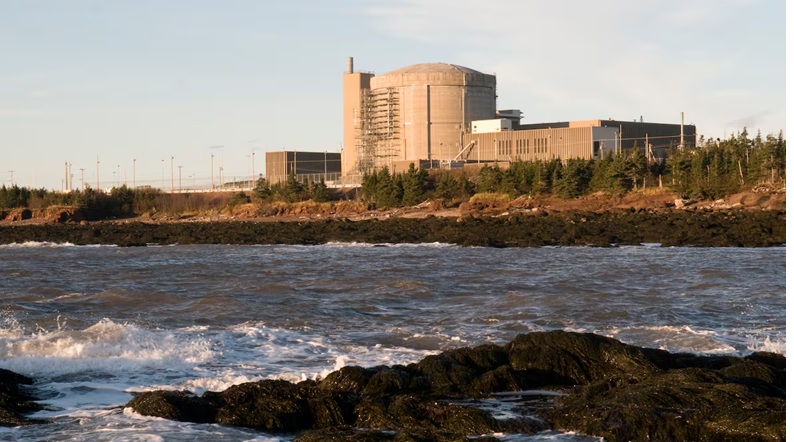
N.B. Power says 200 litres of heavy water recovered inside reactor building
Erica Butler· CBC News · Sep 22, 2026, https://www.cbc.ca/news/canada/new-brunswick/high-levels-radioactive-isotopes-disovery-lepreau-leak-9.7354212
N.B. Power said it has collected about 200 litres of heavy water from a leak at the Point Lepreau Nuclear Generating Station earlier this month, which the utility initially characterized as “small.”
In emails this week, the utility has shared more details about the leak, which CBC News first reported on Sept. 15.
The utility first became aware of a problem inside its reactor building on Sept. 10, when its monitoring system identified elevated levels of tritium.
Tritium is a radioactive isotope that occurs in the heavy water used to transfer heat from nuclear reactors.
The higher than normal readings “triggered an investigation to determine the cause,” said N.B. Power spokesperson Tracey Stephenson on Tuesday afternoon.
Lepreau was shut down on Sept. 11, and a heavy water leak from a 3/8ths-inch instrumentation line was confirmed on Sept. 14, said Stephenson.
The utility reiterated this week that the leak caused “no impact or safety risk to the public, staff or the environment.”
When the elevated tritium levels were detected, there were “no employees in the immediate vicinity,” said Stephenson because “that specific area is not accessible when the Station is online.”
That means there were no “unplanned or unexpected employee exposures associated with the leak,” said Stephenson.
The staff who investigated the problem did so following radiation safety procedures, including using specialized monitoring and personal protective equipment, she said.
Most of the heavy water leaked as vapour, said Stephenson, and was “recovered and collected” through station processes.
“The material remained contained within the reactor building at all times and there was no risk to workers, the public or the environment,” she said.
Timing of information release
It’s taken over a week for N.B. Power to release details about the heavy water leak.
A Sept. 14 press release announcing the Lepreau shutdown made no mention of a leak. It said the station was taken offline to “repair a small instrumentation line inside the reactor building.”
In an interview with CBC News the next day, deputy site vice-president Joel Armstrong acknowledged there had been a heavy water leak but said it was too early to comment on how much was spilled.
Kathleen Duguay, N.B. Power’s head of community affairs and nuclear regulatory protocol, spoke to Radio-Canada on Sept. 16 and characterized the leak as small. She said, speaking French, “It’s just a few drops coming out of the instrumentation line.”
Stephenson said Tuesday that the vapour state of most of the leak might account for the difference in “what might be expected from a liquid leak alone.”
‘Lack of information’
Energy researcher Susan O’Donnell said she is concerned about the “lack of information” initially disclosed by N.B. Power about the leak, starting with a Sept. 14 news release that did not share any details about radioactive heavy water.
“Why did they not just say this was radioactive material that leaked, this is how much material was leaked, this is the volume of radioactivity in the material?” asked O’Donnell.
“’X number of workers were cleaning it up, or were exposed … but hey, everyone’s OK. They’ve all been checked. There’s no problem. We’re looking into it.’
“Instead, it’s just this sort of vague information that doesn’t give anyone who’s interested in it all the facts that they need,” she said.
O’Donnell said N.B. Power should be “super transparent” about any release of radioactive material or risk a “lack of trust” with the public.
“People just get really suspicious. Like, what’s going on there? What are they not telling us?”
Too early to say what caused leak
O’Donnell said she has other concerns regarding the leak, including the potential risk to workers and the cause of the leak itself.
O’Donnell said she’s concerned about the age and tritium levels of the heavy water being used in the closed circulation system at Lepreau and whether it may have been a contributing factor to the leak.
Armstrong said on Sept. 16 that N.B. Power had started the process to determine the cause of the leak, but any conclusions would be “premature.”
“Our focus right now is making sure that we facilitate the repair … in a safe manner,” said Armstrong.
N.B. Power did not release the number of workers involved, but the utility said that staff in the area of the leak were working under strict protocols.
The Canadian Nuclear Safety Commission said via email that it has site inspectors stationed at Point Lepreau, and it was made aware of the leak on Sept. 10.
“We are engaged with N.B. Power as it conducts a thorough assessment of the incident and undertakes the necessary repair activities,” said the commission.
It also noted that “no workers have been reported to have received radiation doses above regulatory limits.”
AI hallucination of Chinese nuclear components almost led to US military attack

One source told CNN the AI-powered fiasco “almost started a war.”
some researchers suggest that it may be impossible to prevent LLMs (Large Language Models) from hallucinating altogether.
But the military’s overall use of AI seems to be accelerating.
Kyle Orland – Sep 19, 2026 , https://arstechnica.com/ai/2026/09/report-us-almost-boarded-chinese-ship-over-hallucinated-ai-arms-report/
The US narrowly avoided boarding a Chinese ship based on an “entirely false” US intelligence report generated with the help of AI tools, according to a CNN report.
That erroneous intelligence, submitted by a US Special Operations Command analyst, suggested the Chinese ship was transporting nuclear arms program components through the Middle East, according to “four sources familiar with the episode” cited by CNN. The US military was preparing to intercept and board the ship, with air support, before officials discovered a chatbot used in generating the report had “inaccurately identified the material the ship was carrying.”
One source told CNN the AI-powered fiasco “almost started a war.”
What’s the worst that can happen?
CNN’s report said the analyst in question used a chatbot to analyze intelligence reports regarding the Chinese ship’s manifest, leading to the near-disastrous result. That chatbot “fused together open-source intelligence with secret signals intelligence in government holdings,” and that information was packaged into an intelligence report that almost set off a disastrous chain of events, according to CNN.
The near-miss is one of the more potent and consequential instances of a hallucinating AI ruining the reliability of a professional report. Since “hallucinating” became the Cambridge Dictionary’s word of the year in 2023, we’ve seen prominent examples of non-fiction authors, journalists, academic researchers, judges, doctors, police departments, corporate call centers, and more getting taken in by AI tools that simply make something up when their training data doesn’t provide sufficient context. And despite some adorable attempts at “do not hallucinate” prompts, some researchers suggest that it may be impossible to prevent LLMs (Large Language Models) from hallucinating altogether.
One would hope the US military would be aware of these kinds of problems when relying on AI for analysis of intelligence reports. But the Department of Defense in January rolled out an “AI acceleration strategy” that sought to “make all appropriate data available across federated IT systems for AI exploitation, including mission systems across every service and component.”
“AI is only as good as the data that it receives, and we’re going to make sure that it’s there,” Defense Secretary Pete Hegseth said in rolling out that initiative.
Last December, the Department of Defense announced it would use Google’s Gemini for Government as the basis for its bespoke “GenAI.mil” platform. Last month, the department added Grok for Government as an option on the platform. Anthropic also offers a customized version of Claude for US spy work.
In June, a Pentagon representative bragged to Congress that they use generative AI to help create congressionally mandated reports, and that 1.5 million active DoD personnel have used the military’s generative AI tools.
In 2023, a State Department “Declaration on Responsible Military Use of Artificial Intelligence and Autonomy” stressed that “principled” use of AI by armed forces “should include careful consideration of risks and benefits, and it should also minimize unintended bias and accidents.” That report also urged that “accountable” use of AI systems must always involve “a human in the loop, a responsible human chain of command and control.”
In the years since then, though, we’ve seen fully autonomous attack drones used in the Russian conflict in Ukraine and tested by NATO-backed military contractors. In March, the Department of Defense blacklisted Anthropic over the company’s opposition to its models’ use in autonomous weapons systems, a move that a federal judge said last month was “unlawful retaliation in violation of the First Amendment.”
The reported near miss comes as extinction-level warnings from AI researchers have led to a newly prominent national conversation on AI safety, including calls for regulation and coordinated research “pacing” from leading frontier AI labs.
US military had close call after using AI for false intelligence report, sources say

the episode with the Chinese ship underscores a different, and more immediate risk: human beings making disastrous decisions based on inaccurate or misleading information generated by AI or other automated systems. Sources said that the military is rapidly turning to AI to help with targeting, an area which holds the obvious risk of fatal mistakes.
ByKatie Bo Lillis, and Zachary Cohen
The intelligence report, circulated across the US military this spring in the midst of the war with Iran, immediately set off alarm bells: A Chinese ship in the Middle East was transporting components of a nuclear weapons program.
The US military swung into action with plans to intercept the vessel, according to four sources familiar with the episode. According to two of the sources, armed members of the US military were preparing to board the ship. Military planes were in the air, one of those sources and another source familiar with the incident said.
It was only just before the planned operation that officials dug deeper into the report put together by a special operations command analyst and found it had been generated with the help of artificial intelligence (AI) — and that a chatbot the analyst had used inaccurately identified the material the ship was carrying. CNN was not able to learn what the misidentified cargo was.
The report, according to one of the sources, was “entirely false.” But it also “almost started a war,” the source said. Any US operation against a Chinese vessel could have risked spiraling into an armed conflict between the two nations.
Across the US military and the intelligence community, officials are pushing to weave AI into nearly every facet of their work, from analyzing the huge volumes of raw intelligence the US collects and selecting targets for strikes, to more mundane applications like managing budgeting, logistics and supply chains.
But the episode underscores the profound risks of using this powerful, new and relatively poorly understood technology for targeting in the middle of a war. Analysts have long feared that AI could lead to a catastrophic miscalculation if nation states are relying on poor or corrupted data — the kind of miscalculation that might lead the United States to fire on a Chinese ship based on inaccurate information.
In this particular instance, the analyst queried a chatbot about some intelligence reporting on the ship’s manifest that originated with US Special Operations Command Pacific, based in Hawaii. It was not clear whether the chatbot was a commercially available one or a US government product.
“The internal tools are mostly just copies of the commercial stuff wearing lipstick,” a former senior US official familiar with the AI systems used by military and intelligence analysts.
The bot fused together open-source intelligence with secret signals intelligence in government holdings and reached its fateful conclusion about the material the ship was carrying.
The analyst then used AI again to package the findings into a standard intelligence report — the kind that is trusted by military officials — and disseminated it.
US Special Operations Command Pacific and the Pentagon did not respond to a request for comment.
The rationale for the rapid adoption of AI is that it can help the military make battlefield decisions, like which targets to strike or which military assets to move where, faster. Officials say the US can’t afford to fall behind in integrating AI in case it must one day fight China or another adversary who would potentially be able to stay one step ahead of the US.
In January, Defense Secretary Pete Hegseth released his agency’s “Artificial Intelligence Acceleration Strategy” in a bid to speed up the military’s use of AI.
“We will unleash experimentation, eliminate bureaucratic barriers, focus our investments and demonstrate the execution approach needed to ensure we lead in military AI,” Hegseth said in a speech announcing the strategy.
The strategy also pushes for its broad use across the military, ordering the department to make AI available via several programs with the aim of “democratizing AI experimentation and transformation across the Department by putting America’s world-leading AI models directly in the hands of our three million civilian and military personnel, at all classification levels,” a memo announcing the strategy said.
But the effort is decentralized, multiple US officials familiar with the dynamic said, with different parts of the government using different tools under different orders and safety standards. There’s no one set of standards for how the US verifies the information generated by these tools. The constellation of different AI systems being deployed by disparate corners of the military and intelligence community means that the relative reliability and functionality vary widely.
For weeks, Washington policymakers have been intensely debating AI after a series of dire warnings from Silicon Valley engineers and tech CEOs of the possibility that AI could break free of human constraints, with potentially civilization-ending consequences.
But the episode with the Chinese ship underscores a different, and more immediate risk: human beings making disastrous decisions based on inaccurate or misleading information generated by AI or other automated systems. Sources said that the military is rapidly turning to AI to help with targeting, an area which holds the obvious risk of fatal mistakes.
“AI in targeting is definitely something that is ramping up and there is no real guidance for how having a human in the loop will prevent civilian casualties or fratricide,” another source familiar with the military’s current policies said.
The kind of “hallucination” that the tool used by the analyst in this case conjured has not been an isolated incident across the intelligence community since these tools began proliferating across government, according to one of the sources.
For some older intelligence officials — even those who broadly support the use of AI inside the military — AI has put pressure on analysts to produce and disseminate intelligence faster, opening the door for mistakes. Young analysts in particular, several sources said, are natives on these tools and more likely to trust them uncritically.
“AI allows you to get to a bad idea faster,” one of the sources said.
North Korea’s Underground Nuclear Tests Are Reactivating Dormant Earthquake Fault Lines
Scientists recorded 1,399 local quakes since North Korea began its underground nuclear tests—a spike unlike anything the region has seen since seismic activity was first catalogued there.
By Matthew Phelan, September 17, 2026, https://gizmodo.com/north-koreas-underground-nuclear-tests-are-reactivating-dormant-earthquake-fault-lines-2000813481
The Democratic People’s Republic of Korea has conducted at least six major underground nuclear weapons tests at its secretive Punggye-ri facility beneath Mount Mantap within the nation’s coastal North Hamgyong Province. Back in September 2017, American seismologists with the U.S. Geological Survey (USGS) registered the final of these as a 6.3-magnitude earthquake-like event after DPRK scientists detonated their test bomb—but the aftershocks and quakes have reverberated onward into the present day.
A coalition across three of China’s research universities and the nation’s China Earthquake Administration (CEA) have now traced revived earthquake activity along several once quiet faultlines surrounding Mantap. These quakes, which began with a seismic event on September 23, 2017 (or three weeks after that final September 3 test) have persisted, periodically recurring all the way up to May 2025, the last month that this group collected data for its study.
“The progressive increase in both the earthquake rate and the moment release rate indicates that the crust did not simply relax toward equilibrium after the final explosion,” the researchers wrote in their new study, published Thursday in the journal Science.
Instead, they reported, seismic activity “expanded gradually as preexisting faults became active.”
A literal seismic shift
The nuclear weapon that North Korea tested in September 2017 had an estimated explosive yield between roughly 100 and 250 kilotons of TNT—at least 10 times the power of the atomic bomb that the U.S. dropped on Hiroshima near the end of World War II. The study’s first author, geophysics researcher Xingli Fan of the Chengdu University of Technology’s Key Laboratory of Earth Exploration and Information Techniques, worked with his team to pull seismic data from sensors in both China and South Korea to better understand this test’s consequences.
Some of these seismographic stations were quite close, within roughly 50 to 124 miles (80 to 200 kilometers) from the secret nuclear site. The data, which spanned the years from 2008 to 2025, identified 1,399 local earthquakes events during this period—a spike never before seen in earthquake data collected from the region since events like these were first formally catalogued on the Korean peninsula back in 1904. For Fan and his colleagues, the fact that North Korea’s first major nuclear test beneath Mantap detonated on October 9, 2006, served as something of an early indicator that these non-metaphorically earth-shattering blasts were altering local plate tectonics near the mountain.
Another big clue, they noted, was that satellite radar had measured “substantial ground deformation” atop Mount Mantap’s peak.
“Rather than generating only short-lived aftershock sequences, such perturbations can initiate the delayed reactivation of intraplate faults that unfold over years,” the researchers wrote.
Global shockwaves
While it’s true that underground nuclear testing has been associated with earthquake activity since the start of the Cold War, what’s happening in North Korea’s northeastern province is measurably different. Past studies of these kinds of underground tests at the Nevada National Security Site (Area 51’s neighbor) and the former Soviet Union’s Semipalatinsk Test Site in Kazakhstan also documented seismic aftershocks.
But, like ripples in a pond, these episodes were typically limited to the days and weeks directly after each underground nuclear test and were tightly constrained to the region closest to each bomb test’s epicenter. And they almost always faded back to normal in short order.
The increasing seismic activity near Mount Mantap, then, is anomalous for these kinds of tests—with major implications not just for local earthquake safety but also ongoing monitoring and verification efforts under the Comprehensive Nuclear-Test-Ban Treaty.
8 instances of radioactive material incidents in the UK since 2015

20 Working Days, Tom Pashby, Sep 21, 2026, https://tompashby.substack.com/p/8-instances-of-radioactive-material?utm_source=post-email-title&publication_id=6735486&post_id=216635328&utm_campaign=email-post-title&isFreemail=true&r=ln98x&triedRedirect=true&utm_medium=email
There were eight instances of nuclear or radioactive materials being lost, stolen or otherwise out of regulatory control in the past 10 years in the UK, according to data released to 20 Working Days.
The data, released by the Home Office, was already reported voluntarily by the UK Government to the International Atomic Energy Agency’s (IAEA’s) Incident and Trafficking Database (ITDB), which publishes aggregated data annually.
The IAEA Incident and Trafficking Database (ITDB): 2026 factsheet explained: “When originally established, the ITDB recorded incidents of illicit trafficking of nuclear and 145 participating States other radioactive material.
“Its scope was later expanded to include all incidents in which nuclear and other radioactive material is or was out of regulatory control.
“The ITDB scope covers all types of nuclear material as defined by the Statute of the Agency (i.e. uranium, plutonium and thorium), naturally occurring and artificially produced radioisotopes and radioactively contaminated material, such as scrap metal.”
It found that, as of the 2026 report: “The trafficking or malicious use intent of 86.6% of thefts remains undetermined.”
“In 2025, 236 incidents were reported to the ITDB by 34 States, an increase of 89 incidents from 2024,” it said.
“The noticeable increase in reported incidents in 2025 is primarily attributable to retrospective reporting.”
The factsheet also reported that “transport remains a key vulnerability, with over half of all thefts since 1993 — and approximately 70% in the past decade — occurring during authorised transport, underscoring the need for sustained attention to transport security measures.”
Under a section titled “Confidentiality and security of ITDB information”, the factsheet said: “The ITDB is a resource for information sharing among State authorities and the IAEA.
“In order to protect the confidentiality of information reported by States, the IAEA upholds strict procedures for handling and dissemination of sensitive ITDB information.
“Information on reported incidents is only communicated via the PoC (points of contact) network. Access to the complete database is limited to a small number of IAEA staff.”
20 Working Days asked the UK Home Office for the UK’s submissions to the database since 2015.
In response, the Home Office listed eight incidents it had reported to the database. It provided the following table: [on original]
It is unclear whether all of the incidents were disclosed to the public.
The list does, however, include one of the highest profile incidents in the UK involving radioactive materials – the malicious use of Polonium-210 which resulted in the lethal poisoning of Alexander Litvinenko in 2006.
The Litvinenko inquiry: report into the death of Alexander Litvinenko was published in 2016, which may explain why the incident was listed as 2016 by the Home Office.
Meanwhile, the 2021 incident of F-18 being lost and found appears to have been reported by the PA news agency in the same year.
The Home Office was approached for comment.
IAEA says cooling tower at Russia’s Kursk Nuclear Power Plant hit by drone

UN nuclear watchdog says it was informed that drone hit cooling tower of a reactor unit; no fire broke out, operating status not changed
Rabia İclal Turan, 19 September 2026
WASHINGTON DC
The International Atomic Energy Agency (IAEA) said Friday it was informed that a drone hit the cooling tower of a reactor unit at the Kursk Nuclear Power Plant in Russia.
A statement by the UN nuclear watchdog on US social media platform X said the drone hit the facility, located in the Kursk region bordering Ukraine, early Thursday, but did not specify who informed the IAEA of the incident.
“It was reported that the unit was operating at the time, but its operating mode did not change and there was no fire,” it said.
Quoting IAEA chief Rafael Grossi, the statement said that all attacks on nuclear facilities are “unacceptable” as they could “endanger nuclear safety and security, irrespective of where they occur.”
Grossi reiterated demands for “maximum military restraint” to prevent the risk of a nuclear accident.
The IAEA did not provide details on the source of the drone or circumstances surrounding the incident.
The agency has regularly warned Moscow and Kyiv about dangers to nuclear safety amid the Russia-Ukraine war, which began in February 2022.
In a later statement, Russia’s nuclear state corporation Rosatom confirmed that a drone detonated upon striking the cooling tower of the plant’s no. 1 power unit, causing “minor damage.”
It stated the incident did not affect the facility’s operations and that power unit no. 1 continues to operate at 100% capacity.
“The safety of the plant’s operation is ensured. Radiation levels remain unchanged and consistent with natural background values,” it added.
Key UK Nuclear Deterrent Link Destroyed Over Yorkshire.
Britain’s sole emergency communications link for sending nuclear
retaliation orders to Trident missile submarines has been destroyed in a
spectacular disaster unwittingly observed by hundreds of Yorkshire
residents and passers-by.
During a trial on Friday, the system was seen and
filmed breaking up over Topcliffe, north of York, in clear view of
travellers on the nearby A1 motorway. The emergency system, called Low
Frequency Fall Back or LFFB and codenamed SUNFLOWER, used a “blimp”
style tethered balloon or aerostat (illustrated) to lift a 1,500 metre long
radio antenna.
Byline Times 8th Sept 2026,
https://bylinetimes.com/2026/09/08/key-uk-nuclear-deterrent-link-destroyed-over-yorkshire/
‘Drunk’ pilot crashes ‘stolen’ Cessna plane near nuclear power plant
A pilot has been arrested on suspicion of stealing a light aircraft before
landing it in the middle of a sunflower field near a nuclear power plant.
Authorities in Hungary deployed two supersonic fighter jets after a man
took off in an allegedly stolen Cessna from Kalocsa airfield. He proceeded
to fly the jet into restricted airspace around the Paks nuclear power plant
before conducting ‘manoeuvres’ over the facility, according to local
reports. After being detected by military radar, Gripen fighters were
dispatched to follow the aircraft, which made an emergency landing in a
sunflower field in Tolan county, around 84 miles south of capital Budapest.
Metro 31st Aug 2026, https://metro.co.uk/2026/08/31/drunk-pilot-crashes-stolen-cessna-plane-near-nuclear-power-plant-29499150/
Iranian hackers shut down UK power plant
Telegraph 22nd Aug 2026
Unprecedented cyber attack believed to be most successful of its kind
Iran shut down a British power plant for four days in an unprecedented cyber attack, The Telegraph can disclose.
It is thought to be the first time that hackers affiliated to the Iranian regime have succeeded in closing down such a facility in the UK, and is believed to be the most successful cyber attack of its kind.
The Telegraph understands that the incident took place at the same time as a series of attacks on US water infrastructure last month, which affected 12 states and caused concern in the White House.
Iran shut down a British power plant for four days in an unprecedented cyber attack, The Telegraph can disclose.
It is thought to be the first time that hackers affiliated to the Iranian regime have succeeded in closing down such a facility in the UK, and is believed to be the most successful cyber attack of its kind.
The Telegraph understands that the incident took place at the same time as a series of attacks on US water infrastructure last month, which affected 12 states and caused concern in the White House.
Advertisement
British officials refused to be drawn on which power plant had been affected, citing security concerns, but it is understood that the facility was disabled for four days while staff fought to bring it back online.
It is understood that the plant affected was relatively small and that the outage had no impact on the UK’s wider power supply or energy generation.
In response, the Government briefed the chief executives of power companies and wrote to businesses with advice, direction and next steps……………………………………………………………………………………………………………… https://www.telegraph.co.uk/news/2026/08/22/iranian-hackers-shut-down-uk-power-plant/
A Seat Cushion Triggered One Of History’s Strangest Nuclear Accidents And A Geopolitical Scandal That Lasted Decades
A cushion, a crash, and a Cold War cover-up.
Tom Hale,19 July 26, https://www.iflscience.com/a-seat-cushion-triggered-one-of-historys-strangest-nuclear-accidents-and-a-geopolitical-scandal-that-lasted-decades-84141
There have been 32 known incidents where the US has accidentally detonated, misfired, or lost nuclear warheads (at least those that the public is allowed to know about). Just one of these accidents, however, became an international scandal and environmental disaster thanks to a cozy seat cushion for someone’s ass.
The incident unfolded in early 1968, a time when The Beatles were blasting on the radio, the Vietnam War was raging, and the threat of full-blown nuclear war between the US and the USSR was still very much on the cards.
Ever paranoid about the atomic threat, the US had launched an airborne patrol of up to 12 nuclear-armed bombers to constantly patrol the skies. Known as Operation Chrome Dome, the fleet of planes flew 24/7, non-stop from 1961 to 1968.
The operation’s routes regularly shifted to keep the USSR on its toes, but many of the flights cruised around the upper reaches of the Northern Hemisphere, a nice vantage point from which the US could hop over the Soviet Union and casually obliterate a few million people.
The incident unfolds, then explodes
On the morning of January 21, 1968, a B-52 bomber loaded with four B28FI thermonuclear bombs flew out of Plattsburgh Air Force Base in New York to take up its shift policing the skies.
It was mid-winter and temperatures were achingly low as the giant plane headed northeastwards into the Arctic Circle by mid-afternoon. In a struggle to keep warm, some of the crew had reportedly covered parts of the cabin with cushions. Unbeknownst to them, they had been placed over a heating vent that was blasting hot air from the overheating engine. The cushions turned into a smoldering tinder, and flames slowly engulfed the aircraft.
As the plane headed near the US Thule Air Base in Greenland, the crew bailed. Six of the seven successfully parachuted to safety, but one crew member, co-pilot Leonard Svitenko, attempted to escape through the lower hatch and sustained a fatal head injury.
They drifted down to the ice-covered expanse below, watching the plane turn into a fireball as it nosedived towards Wolstenholme Fjord. The plane exploded on impact, rupturing the nuclear warheads and spreading radioactive debris for miles around like a dirty bomb.
It was about to become a very long day for the US State Department, to say the least. First, they had to find the bombs and the nuclear debris, then they had to consider how they were going to clean up the mess. To make matters even more complicated, nukes weren’t technically allowed in Greenland, a territory under Danish control, and Denmark was keen to maintain its reputation as a nuclear-free zone (at least in public).
“Aircraft carried four repeat four nuclear weapons,” reads a telegram between the State Department and the US Embassy in Denmark. “Wreckage covers five mile area. Difficult climate conditions and lack of daylight hampering search operations. Special USAF team being sent.”
What followed was a nine-month cleanup operation, one of the largest and strangest in Cold War history. Hundreds of US airmen and Danish workers spent the sunless Arctic winter traveling via dog sleds and scraping contaminated ice, snow, and wreckage off the fjord by hand. Greenlandic Inuit people reportedly joined the charge, building a village of igloos to shelter the crews when the wind and chills became too much to bear.
Eventually, some 600 containers of contaminated snow had been gathered and were shipped to the US. Three of the nuclear bombs were accounted for, but the fourth was never fully recovered, presumably buried somewhere in ice.
“Thulegate”
Dealing with the contamination was one thing, but the political fallout was just as tricky to traverse. Publicly, the US and Denmark claimed the B-52 had been diverted over Greenland because of an unexpected in-flight emergency. But both governments were lying.
In the 1990s, declassified documents and journalistic investigations revealed that nuclear-armed bombers had been routinely flying over Greenland throughout the 1960s, unbeknownst to the Danish public. It became a political scandal dubbed “Thulegate” that deepened when it was revealed the Danish government had secretly signed a deal with the US to hold 50 nuclear weapons at the Thule base between 1958 and 1965.
Almost six decades later, Washington’s interest in Greenland hasn’t cooled with President Trump’s repeated demands to acquire the territory, one way or another.
Hopefully, a chilly pilot won’t threaten to turn tempers nuclear once again.
World warned of ‘nuclear apocalypse’ after drone kills nuclear plant engineer in Ukraine
Russia has warned of ‘nuclear apocalypse’ after a drone strike allegedly carried out by Ukraine killed the chief engineer at the Zaporizhzhia Nuclear Power Plant, Europe’s largest nuclear facility
Daily Star, Will Stewart Russia Correspondent and Adam Cailler Senior reporter and MSN lead, 16 Jul 2026
Russia has warned of a “nuclear apocalypse” following an alleged Ukrainian assassination of a senior engineer at the Zaporizhzhia nuclear power plant. Alexander Yakovlev, 46, was killed in a drone attack between the facility and the nearby town of Enerhodar.
He was travelling in a service vehicle and perished alongside his driver, according to Russian reports. Yakovlev served as the chief engineer at the Russian-controlled Zaporizhzhia Nuclear Power Plant, Europe’s largest. Ukraine’s Mirotvorets website had branded him a “traitor to the motherland” and an “accomplice to terrorists and Russian occupiers.”
Through his work for the Russians following Putin’s invasion of Ukraine, he stood accused of “collaboration in the form of assisting the occupiers in committing acts of nuclear terrorism and blackmail”. Following the occupation of this section of Zaporizhzhia region, he obtained Russian citizenship.
Rafael Grossi, the director of the International Atomic Energy Agency, the UN nuclear watchdog, denounced the incident without explicitly naming Ukraine or Russia. The killing “represents an unacceptable attack on the plant and its management, seriously threatening nuclear safety.”
He demanded an “immediate end” to all strikes “on or near nuclear sites.” Russian Foreign Ministry spokeswoman Maria Zakharova declared: “This is a crime of the Kyiv regime that Grossi must finally see – we demand a clear statement condemning this killing from the relevant international bodies, first and foremost the IAEA.”
Alexei Likhachev, the head of Rosatom, stated: “We expect the IAEA to respond promptly, concretely, and clearly to this tragedy.” Russian forces took control of the plant in southeastern Ukraine during the initial weeks of Russia’s 2022 invasion of Ukraine………
Russian authorities initiated a criminal investigation into the killings. Ukraine has yet to respond.https://www.dailystar.co.uk/news/world-news/world-warned-nuclear-apocalypse-after-37438323
1 This Month
23-25 October – on Zoom – World BEYOND War’s annual global conferenc


Shut down the radiation-damaged Heysham nuclear reactors now
To see nuclear-related stories in greater depth and intensity – go to https://nuclearinformation.wordpress.com

Say No to NASA’s Reckless Nuclear Reactor on the Moon
Say No to NASA’s Reckless Nuclear Reactor on the Moon

-
Archives
- October 2026 (247)
- September 2026 (339)
- August 2026 (330)
- July 2026 (355)
- June 2026 (287)
- May 2026 (306)
- April 2026 (356)
- March 2026 (251)
- February 2026 (267)
- January 2026 (308)
- December 2025 (358)
- November 2025 (359)
-
Categories
- 1
- 1 NUCLEAR ISSUES
- business and costs
- climate change
- culture and arts
- ENERGY
- environment
- health
- history
- indigenous issues
- Legal
- marketing of nuclear
- media
- opposition to nuclear
- PERSONAL STORIES
- politics
- politics international
- Religion and ethics
- safety
- secrets,lies and civil liberties
- spinbuster
- technology
- Uranium
- wastes
- weapons and war
- Women
- 2 WORLD
- ACTION
- AFRICA
- Atrocities
- AUSTRALIA
- Christina's notes
- Christina's themes
- culture and arts
- Events
- Fuk 2022
- Fuk 2023
- Fukushima 2017
- Fukushima 2018
- fukushima 2019
- Fukushima 2020
- Fukushima 2021
- general
- global warming
- Humour (God we need it)
- Nuclear
- RARE EARTHS
- Reference
- resources – print
- Resources -audiovicual
- Weekly Newsletter
- World
- World Nuclear
- YouTube
-
RSS
Entries RSS
Comments RSS

