Caitlin Johnstone – The Trumpanyahu Administration Is Preparing Another Iran Attack, And Other Notes
Caitlin Johnstone, 23 Oct 26, https://www.caitlinjohnst.one/p/the-trumpanyahu-administration-is-179?utm_source=post-email-title&publication_id=82124&post_id=221731326&utm_campaign=email-post-title&isFreemail=true&r=1ise1&triedRedirect=true&utm_medium=email
Well, it looks like they’re going to attack Iran again. Might be after the US midterms. Might be sooner.
President Trump is telling the press that he is done negotiating with the Iranians and that something will be happening “fairly soon”, while America’s other president, Benjamin Netanyahu, proclaims that the time has come to topple Tehran once and for all.
Haaretz reports that Netanyahu is calling for “preemptive strikes” on Iran, which is empire-speak for “attack completely out of the blue without any provocation or justification whatsoever”.
The New York Times reports that the US and Israel are preparing for an attack after the midterms, with sources claiming that “targets would likely include Iran’s energy infrastructure, nuclear facilities, and missile and drone arsenal” inflicted with the goal of collapsing the Iranian economy.
All this could perhaps be dismissed as empty bluster, except that NBC News is reporting that US troops are being evacuated from their posts in the middle east — exactly what happened in the lead-up to the US-Israeli attack on Iran last February.
Iran is warning that it will hit new targets and expand its strikes geographically in the event of a US/Israeli attack, saying “cables, data centers, artificial intelligence facilities, and numerous other sites will be destroyed” in order to damage US economic interests.
So I guess this is happening. Another brazen assault in an evil war of aggression that makes life harder for people all around the world.
The US empire must end.
Another choice quote from the Bell review on “antisemitism” in British schools which I missed in my write-up yesterday:
“British attitudes relating to Jewish people and Israel show two broad trends. AntiJewish attitudes are typically less prevalent and have remained more stable, whereas anti-Israel sentiments are more prevalent and have been increasing.”
The report explicitly acknowledges that hatred toward Jews is not on the rise, and that only anti-Israel sentiments are increasing. And yet they still published a 107-page review claiming that “antisemitism” is a major problem in British schools.
This tells you everything you need to know about what the word “antisemitism” actually refers to in today’s world. It just means criticism of Israel.
Hat tip to Nate Bear on Twitter for highlighting this quote.
Double Down News has a great report out explaining that the “antisemitism” review was based on heavily manipulated data, ultimately citing the claims of just 29 individuals to justify its outlandish claim that anti-Jewish discrimination is running rampant throughout the British school system.
Anyone who talks about “left wing antisemitism” like it’s a real thing should be immediately and permanently labeled a bad faith actor and an ideological enemy without any further discussion.
❖
Zionism is not a religion, it’s a political ideology which indisputably gives rise to apartheid and ethnic cleansing. You can tell me that your personal religious beliefs compel you to be a Zionist, but then I’ll say your religious beliefs are bad and you should change them. Your religion does not magically exempt you from the basic requirements of human decency.
It should not be taboo to say this. If your religious tolerance prohibits you from telling someone they shouldn’t espouse a racist political ideology which inflicts endless war, genocide, ethnic cleansing, apartheid and abuse upon your fellow human beings, then you have too much religious tolerance.
Work begins in UK for arming new nuclear submarines at £7.75bn each
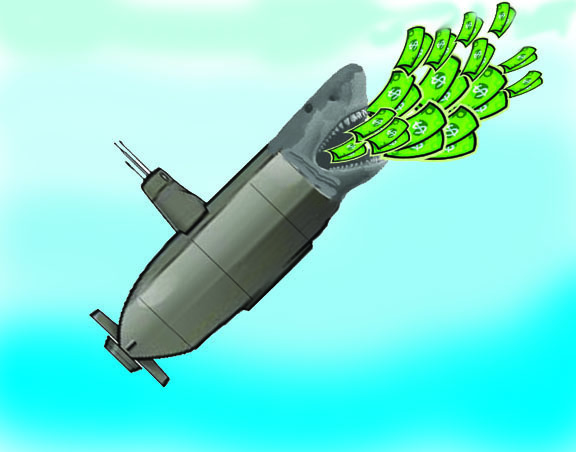
Work begins on Coulport building for Dreadnought submarines, 19th October, By Donald Erskine
WORK has started on a building which will arm the Royal Navy’s new multi-billion-pound nuclear submarines.
Naval Base Commander Clyde Commodore Andy Bray recently broke ground on a new facility at Royal Naval Armament Depot (RNAD) Coulport to support future classes of submarines.
Building 300 at the site will house the Vertical Embarkation System, or VES, a new facility used to load tactical weapons onto future Dreadnought-class deterrent submarines.
The House of Commons approved replacing the current submarines in 2016, despite opposition from anti-nuclear groups and campaigners concerned about the cost.
Built at a cost of £7.75bn per unit, four Dreadnought submarines will replace the current Vanguard ships, which constantly patrol the seas carrying ballistic missiles equipped with thermonuclear warheads.
The Trident system is designed to act as a deterrent to other nations with nuclear capability, as a first strike on the UK would not eliminate the ability to strike back, given some of the country’s weapons are continuously at sea.
The building is designed to receive, store, assemble, and maintain Spearfish torpedoes, the Royal Navy’s primary underwater weapon for both anti-submarine warfare and anti-surface warfare. The VES will also be used to train personnel to handle the weapons…………………………………………………
https://www.helensburghadvertiser.co.uk/news/26648451.work-begins-coulport-building-dreadnought-submarines/
Ukraine’s Black Sea escalation threatens global trade, with risks of spiralling
Ukraine’s expanding Black Sea attacks are disrupting shipping, raising insurance costs, and threatening global food and energy trade. As “wild-card” Zelensky raises the stakes (angering the US), the risk of a wider confrontation grows.
Friday, October 16, 2026, https://infobrics.org/en/post/103298
Uriel Araujo, Anthropology PhD, is a social scientist specializing in ethnic and religious conflicts, with extensive research on geopolitical dynamics and cultural interactions.
Black Sea shipping is in crisis, adding pressure to a global economy already absorbing Red Sea and Strait of Hormuz disruptions. Commercial vessels face rising risks, insurance costs have climbed, and tanker freight rates have surged.
Ukraine has stepped up attacks on Russia’s Black Sea Fleet, ports, oil facilities, and vessels associated with Russian trade, expanding the conflict’s geographical scope. Grain, oil, fertilizers, and other commodities move through these waters, including shipments for non-belligerent countries.
S&P Global reported on October 9 that tanker freight rates rose sharply amid attacks, sanctions, and security concerns disrupting Russian energy exports. According to maritime security consultancy Ambrey, Kyiv expanded its campaign beyond naval assets and oil infrastructure to merchant ships trading with Russian ports.
In November 2025, attacks had already expanded to commercial vessels, particularly oil tankers, in the open sea. In May 2026, Ambrey attributed strikes on three Russia-linked tankers inside Turkey’s exclusive economic zone to Ukrainian naval drones.
By July, targeting expanded to dry-bulk carriers, general cargo, container ships, and roll-on/roll-off vessels. In September, insurers widened the high-risk zone. Ambrey data shows 45 merchant vessels struck outside the previous war-risk area in 12 months, 31 after July 1, 2026.
Ambrey’s finding is that Ukraine-attributed strikes (on Russia-linked shipping far offshore) helped drive insurers’ growing risk perception across the Black Sea.
Russia has responded by also conducting strikes in the Black Sea. As Modern Diplomacy puts it, Moscow has made any Black Sea truce conditional on Kyiv ceasing attacks on Russian energy infrastructure.
This is, after all, a proxy war of attrition, marked as it is by considerable military asymmetry. Russia possesses a larger population, defense-industrial base, strategic arsenal, air force, and navy, as well as greater resources for prolonged warfare.
Ukraine, despite developing formidable drone capabilities and long-range strike capacity, remains heavily dependent on Western assistance.
Global Firepower’s 2026 ranking places Russia second and Ukraine twentieth. The military asymmetry is therefore considerable.
The hard truth is that, notwithstanding any legitimate criticism one may have of Moscow’s campaign, Russia has refrained from employing its full destructive capabilities.
Such restraint, particularly in the war’s early stages, may have reflected not only humanitarian and military calculations but also (on Moscow’s end) awareness of historical and cultural ties between the two countries – which may have a psychological effect on decision-makers.
Kyiv, in contrast, since the 2014 ultra-nationalist revolution, has launched an anti-Russian campaign to distance the nation from Moscow. Even so, 42.6% of Ukrainians still regularly spoke Russian in December 2022, despite the war and media censorship restrictions.
Former US diplomat Chas Freeman and retired US Army Colonel Douglas Macgregor have both argued that Moscow exercised restraint.
Poland’s Centre for Eastern Studies likewise noted in June 2022 that Russia had refrained from systematically destroying key infrastructure – while the US Congressional Research Service observed that the initial bombardment was more limited than expected.
For comparison, Bono Vox performed in Kyiv on May 8, 2022, less than three months after Moscow launched its campaign. One could hardly imagine Bono performing in Baghdad shortly after the US invasion! Or in 2011 Libya, for that matter.
The broader point here is that the Russian Federation retains substantial military advantages, despite Ukrainian advances, but Western support has enabled Kyiv to sustain a prolonged war of attrition – increasingly targeting Russian energy.
In August, Ukrainian drone strikes on Russian and Iranian-linked vessels in the Caspian Sea risked expanding the conflict into a vital Russia-Iran logistics corridor.
The attacks risked further “proxifying” the conflict by aligning Kyiv with US and Israeli interests against Tehran, potentially merging the European and Middle Eastern theaters – a scenario that never materialized.
In any case, Ukrainian attacks on Russian energy infrastructure continue amid mounting political pressure, with Trump even saying it is “time for Ukraine to get new President.” I’ve commented before on Zelensky’s resilience, despite several reported plots against him.
The Ukrainian leader has shown a habit of acting unpredictably, sometimes behind his Western patrons’ backs. In 2023, leaked documents revealed wild Ukrainian plans that risked widening the conflict. More recently, attacks on Russian refineries drew attention amid rising diesel prices and reports of moves angering Washington.
This “wild-card” tendency risks triggering a dangerous spiral, with potentially disastrous consequences for Ukraine – and the global economy. Repercussions for food, energy, and fertilizer trade are already visible, while the danger of crossing red lines has arguably never been greater.
Massive Ukrainian drone attack on St. Petersburg escalates US-NATO war against Russia.
Under these conditions, there is a growing admission within the US and international media that NATO and Russia are entering a “world war.” In one of the foremost examples, the Financial Times published Saturday a column titled, “Are we sleepwalking into World War III?”
The old imperialist powers retain a military superiority they no longer possess economically.
Andre Damon,18 October 2026, https://www.wsws.org/en/articles/2026/10/19/yudl-o19.html
Ukraine attacked Russia with more than 1,000 drones overnight Saturday, in the largest bombardment of St. Petersburg since the Second World War. The attack, in which Russia’s Defense Ministry counted 1,015 drones across 15 regions, Crimea and the Black Sea, was one of the heaviest bombardments of Russian territory since the war began.
These strikes are directly funded by the NATO powers, which have provided Ukraine with over $100 billion in weapons, and are carried out on the basis of targeting data provided directly by their militaries.
The latest attack is a response by the NATO powers to the warning Russia gave European governments on September 30, that threats to Russia’s territorial integrity would be met with “the entire arsenal of forces and capabilities at its disposal, including nuclear weapons.”
Faced with this blunt warning that their actions risk triggering a nuclear war, the NATO powers are escalating. On October 12, General Alexus Grynkewich, NATO’s top commander in Europe, threatened to “break” the enemy’s “warfighting system,” including “anything and everything that supports, sustains, or controls that force.”
Under these conditions, there is a growing admission within the US and international media that NATO and Russia are entering a “world war.” In one of the foremost examples, the Financial Times published Saturday a column titled, “Are we sleepwalking into World War III?” by its chief foreign affairs commentator, Gideon Rachman. The title of his essay is taken from a 2012 book by Australian historian Christopher Clark, The Sleepwalkers: How Europe Went to War in 1914, which provided an apologetic explanation for the policies of German and European imperialism.
According to Clark, the war was the unforeseen outcome of mistaken judgments. The governments of the time and their leaders were not guilty of planning and starting war to achieve geopolitical and economic objectives. This benign interpretation of the war was especially welcomed by the German government and media, which praised Clark’s work and turned him into an intellectual celebrity.
Building upon Clark’s metaphor, Rachman depicts the imperialist powers as similarly clueless about the consequences of their actions. He writes, “Regions and countries that have for decades taken peace for granted—western Europe, east Asia, the Gulf states—now have to wrestle with the prospect, or the reality, of war.” It has become “commonplace,” he notes, “for world leaders to speculate publicly about the outbreak of a third world war.”
Rachman, citing a quote attributed to Leon Trotsky, declares, “You may not be interested in war, but war is interested in you.”
But the US and European leaders are not political somnambulists who are “sleepwalking” into World War III. They have been marching toward it with eyes open since the dissolution of the Soviet Union. The first President Bush proclaimed a “new world order” on the eve of the 1991 Gulf War. That war was followed by the intervention in Somalia, the bombing of Bosnia and the 1999 war against Serbia, the invasions of Afghanistan and Iraq, the destruction of Libya, the proxy war in Syria and the US-backed Saudi war in Yemen.
Since 2022, these wars have merged into a single global conflagration. It includes the US-NATO war against Russia in Ukraine; the Israeli genocide in Gaza, armed and defended by Washington; the bombing of Iran in June 2025; and the war against Iran launched on February 28 of this year.
The objective is the redivision of the world among the old imperialist powers. This violent and ongoing project includes the breakup of the existing Russian state, which will open up the vast Eurasian landmass to unfettered capitalist exploitation. For the oligarchs of finance capital, the loss of a few hundred million lives would be a small price to pay for this rich prize.
In Rachman’s telling, however, the danger of world war proceeds entirely from the actions of Russia and China. In this narrative, the threat of “world war” began with the decision Putin made in February 2022, with no antecedent history. Rachman asserts that an inflection point was reached when “Putin launched his ‘special military operation.’ In that time, the global political atmosphere has been transformed.”
The Russian invasion of Ukraine did not come out of nowhere. It was a reactionary and desperate response by the Russian capitalist oligarchy to years of provocations by NATO. NATO’s own leadership has said as much. In an interview published by the Washington Post in May 2023, then-NATO Secretary General Jens Stoltenberg declared that the war “didn’t start in 2022. The war started in 2014.”
Stoltenberg continued, “And since then, NATO has implemented the biggest reinforcement of our collective defense since the end of the Cold War … Until 2014, NATO allies were reducing defense budgets. Since 2014, all allies across Europe and Canada have significantly increased their defense spending … this is a huge transformation of NATO that started in 2014.”
The Russian invasion of Ukraine did not come out of nowhere. It was a reactionary and desperate response by the Russian capitalist oligarchy to years of provocations by NATO. NATO’s own leadership has said as much. In an interview published by the Washington Post in May 2023, then-NATO Secretary General Jens Stoltenberg declared that the war “didn’t start in 2022. The war started in 2014.”
Stoltenberg continued, “And since then, NATO has implemented the biggest reinforcement of our collective defense since the end of the Cold War … Until 2014, NATO allies were reducing defense budgets. Since 2014, all allies across Europe and Canada have significantly increased their defense spending … this is a huge transformation of NATO that started in 2014.”
But the Maidan coup was itself an outcome of decades of imperialist policy that had pushed the boundaries of the NATO alliance to Russia’s doorstep.
Rachman correctly centers the driving force of the eruption of global war in “a shift in the global balance of power.” He notes that, “In 1989, the year of the fall of the Berlin Wall, the G7 nations—the US, UK, Germany, France, Italy, Canada and Japan—accounted for around two-thirds of global economic output … By 2022, the G7 represented about 43 percent of global GDP.”
This shift, according to Rachman, is “encouraging revisionist powers to challenge the global dominance of the US and its allies.” China’s share of world output rose from under 2 percent in 1989 to about 17 percent in 2024, according to World Bank figures.
However, by 2022, Rachman notes, the G7 still accounted for “about half of global military spending.” The old imperialist powers retain a military superiority they no longer possess economically. It is they, not China, that have spent the past 35 years at war, seeking to reverse by force what they are losing in the world economy.
The most bizarre element of Rachman’s column is his effort to blame the reemergence of global war on the public’s opposition to it. He writes that “the growth of anti-war sentiment in the US” has “created an opening for revisionist powers,” that US President Donald Trump “is clearly attracted to the idea that the US should retreat from its security commitments to its allies” and that “the greatest risk of a third world war may lie in that very uncertainty.”
Beset by an all-pervasive capitalist crisis and the growth of working class opposition, the imperialist powers seek through war a way out of their problems. The global eruption of imperialist war is only intensifying the class struggle and the capitalist crisis. It is driving workers and youth into struggle around the world, from the United States to France—where students and workers filled the streets this week against a government that has billions for rearmament and nothing for social needs.
The working class and youth must reject and oppose the insane imperialist militarism that is inciting global conflict and threatening humanity with a nuclear conflagration.
How much will the AWE Aldermaston build cost West Berkshire in consultants?
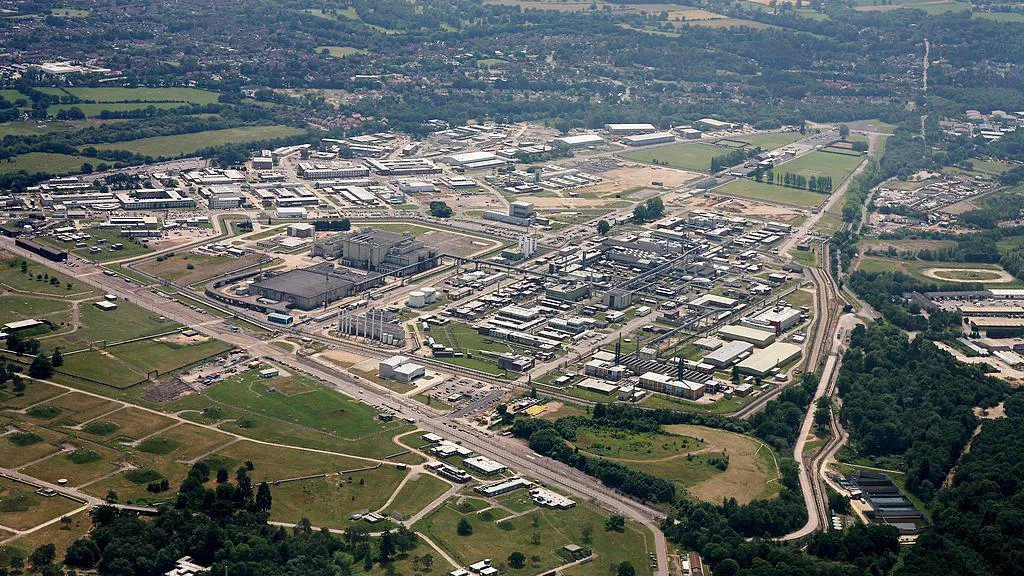
By Niki Hinman Local Democracy Reporter, 19 October 2026, https://www.newburytoday.co.uk/news/questions-raised-over-council-ability-to-approve-nuclear-wea-9487315/
Questions over West Berkshire Council’s ability to scrutinise forthcoming planning applications into a multi-billion pound upgrade to AWE Aldermaston have been raised.
The plans are likely to cost the authority tens of thousands of pounds in specialist consultants to evaluate the proposal to upgrade the nuclear weapons facility into a state-of-the-art science park.
The council will have to handle the massive application in the coming weeks, and has said it will need specialist help to deal with it.
The Government’s £15bn defence investment is dedicated specifically to the UK’s nuclear warhead programme as a whole – which encompasses both the Atomic Weapons Establishment (AWE) Aldermaston and its sister site at Burghfield.
Security-cleared consultants working on defence or submarine programmes command a notable market premium.
A Google search puts them upwards of £1,000 per day.
The nuclear weapons factory is soon to submit plans described as ‘being on the scale of London 2012 in complexity’ to the authority, which must then figure out whether they pass planning policies.
The person leading the project from the AWE side is Andrew McNaughton CBE – a prominent British civil engineer.
He led on delivering key components for the London 2012 Olympics and is on record as saying the Future Materials Campus is on the same scale.
The matter came up before West Berkshire Council last night (Thursday).
“Government-funded plans for the multi-billion pound Future Materials Campus (FMC) at AWE’s Aldermaston site will see planning applications coming forward soon,” said Dominic Boeck (Con, Aldermaston).
“How will the council support and engage constructively with residents, local councils and businesses on this enormous development?
“AWE have compared the scale and complexity of the proposed FMC development with London 2012
“What specific assurance can the lead member give that council has sufficient planning, emergency planning and other relevant technical resources and expertise to undertake a thorough and independent assessment of the application, including its implications for residential safety, emergency preparedness and amenity within and around the Aldermaston DEPZ?”
Deputy council leader Denise Gaines (Lib Dem, Hungerford and Kintbury) said: “We take the safety of residents and people at AWE very seriously.
“The anticipated planning application is going through the process.
“At this stage of the proposal it is a pre application.
“This is a confidential part of the process between council officers and the applicant.
“This sets out a clear timetable for a major and complex application.
“As with any planning application it will be assessed by a team of qualified professionals to ensure that all relvant technical and environmental matters are considered and evaluated either in house or by specialist external consultants.”
There is a statement of community involvement.
And the consultation will involve talks with the council’s emergency planning service and the Office for Nuclear Regulation.
“My concern and my community’s concern is the scale of this project,” added Mr Boeck.
“Of course we understand it is a matter of national security, but there are concerns about how this multi-billion pound project will impact us here.
“I appreciate much will be done behind the wire, but the trucks have got to roll.”
When local authorities deal with ‘enormous’ or hyper-scale planning applications like the London 2012 Olympic Games or major urban regenerations, the standard local planning mechanisms are usually adapted, bypassed, or heavily augmented.
Because these applications are far too large, complex, and politically sensitive for a standard local authority planning department to process normally, they are managed through a combination of special purpose vehicles, and strategic planning frameworks
Why Putin Is Threatening Nuclear War Over Kaliningrad
If an increasingly vulnerable Kaliningrad holds strategic value for Russia and can only be defended by nuclear weapons, then perhaps Western leaders shouldn’t threaten it—and perhaps Western analysts should take more seriously Moscow’s repeated warnings that such threats could meet a nuclear response.
Russia experts shed light on the Kremlin’s calculations.
Andrew Day, Oct 3, 2026, https://www.theamericanconservative.com/why-putin-is-threatening-nuclear-war-over-kaliningrad/
If the world blows up in a conflict over Kaliningrad—the diminutive Russian exclave sandwiched between Poland, Lithuania, and the Baltic Sea—at least there would be a silver lining for survivors to appreciate: It would be darkly humorous and ironic.
Kaliningrad—or Koenigsberg, as the formerly German city was called before its capture in 1945 by the Soviet Union—was the birthplace of the philosopher Immanuel Kant, whose most enduring contribution to political theory was a long essay on international relations, Toward Perpetual Peace. In it, Kant outlines some big-brained ideas that governments should implement to not only end active hostilities but create the political conditions for, well, perpetual peace.
Old Kant published that hopeful essay 231 years ago and would certainly be disturbed and disappointed by this week’s headlines. The most riveting came from the New York Post: “Moscow threatens nuclear response over tiny fortress wedged between US allies as clash fears grow.” (The Post really has a knack for this kind of thing, doesn’t it?)
The one from the Associated Press more aptly, if less dramatically, described the latest development. “Russia warns NATO of a possible nuclear response if Kaliningrad is cut off,” it blared.
So, what’s got the Russians so worked up? Top Russia experts told The American Conservative that Moscow assigns profound strategic significance to the exclave and perceives a Western threat against it.
“Kaliningrad gives Russia another warm water port on the Baltic Sea,” said Thomas Graham, a fellow at the Council on Foreign Relations and former White House expert under President George W. Bush. “It also holds major military assets to defend Russia’s interest in the region, including access routes to St. Petersburg.”
Anatol Lieven of the Quincy Institute noted an even more straightforward Russian interest than that. “Russia cares about this because it is internationally-recognized Russian national territory,” Lieven said. “Any attack on it or blockade is therefore legally an act of war against the Russian Federation, to which the Russian government would have to respond or face deep humiliation.”
Those are important points with which few experts would quibble. But what really distinguishes Graham and Lieven is their ability to discern—from Russia’s point of view—a Western threat against Kaliningrad, and to take it seriously. Judging by the comments both men provided, Russia’s President Vladimir Putin didn’t issue the nuclear threats lightly.
“In some NATO countries there has been talk of blockading Kaliningrad, that is, isolating the region from the rest of Russia by land and sea,” Graham said. “Putin would see a blockade as an act of war against Russia. So he is making sure that Europe understands that he will defend Russian land with all necessary means, which could include nuclear weapons.”
Moscow had already been inclined, even before the latest tensions exploded between Russia and the West, to view Kaliningrad as exposed to NATO’s predations. “NATO expansion to Poland, Lithuania, Sweden, and Finland means that Kaliningrad is now surrounded by NATO countries both by land and sea,” Lieven noted.
Sadly, not all Western experts perform such acts of perspective taking. Consider a recent article in The Hill, which, in the view of this editor-cum-columnist at least, actually brought the week’s most disturbing headline: “Kaliningrad is just Putin’s red herring.”
The coauthors—Mark Toth and Jonathan Sweet—write that the Kremlin is engaged in “nuclear bluffing” designed to intimidate the West and distract from its own military failures in Ukraine. Early in the piece, the only context they provide for Moscow’s warnings is a new British television miniseries called The Wargame, in which the UK launches retaliatory strikes on Kaliningrad after a Russian attack.
A casual reader of their article could be left with the impression that this TV show was the main thing, perhaps the only thing, motivating Putin’s threatening rhetoric. But a careful reader would learn otherwise, for the authors inadvertently illuminate the kinds of Western behavior that prompted Putin’s warnings.
“Kaliningrad is a hollowed-out shell of what it was before Russia’s invasion of Ukraine,” they write. “As Polish Foreign Minister Radosław Sikorski pointed out earlier this month, ‘There are hardly any [Russian] troops [in the Kaliningrad exclave].’”
But that’s not all that Sikorski said. Toth and Sweet link to an article in Defense News, the first sentence of which is this:
NATO allies could hold drills in proximity of Russia’s Kaliningrad exclave in an attempt to push Moscow to weaken its military posture in Ukraine and withdraw some of its troops there, said Radosław Sikorski, Poland’s deputy prime minister and foreign minister
Clearly, Sikorski went far beyond merely commenting on Russia’s force posture in the region. The article emphasizes that he didn’t recommend “offensive” actions against Kaliningrad, but you could hardly blame Putin for failing to appreciate the distinction. Indeed, in the relevant quotes, Sikorski recommends that NATO “aggressively” exercise around Kaliningrad and start treating the exclave as a front in the confrontation between Russia and the West.
Toth and Sweet’s article continues: “Although Kaliningrad is still the headquarters of the Russian Baltic Fleet, the Baltic Sea itself has effectively become a NATO-controlled lake, after the accession of Sweden and Finland as the newest members of NATO.” Kaliningrad, they write, “is highly vulnerable,” and these days it merely hosts nuclear missiles, its conventional forces having been deployed to Ukraine.
Thus, “Moscow’s nuclear Armageddon bluffing is simply the latest attempt by Putin and his Kremlin cronies to paper over this problem.”
Here the premises lead to the conclusion only in the sense that they crash violently into it. If an increasingly vulnerable Kaliningrad holds strategic value for Russia and can only be defended by nuclear weapons, then perhaps Western leaders shouldn’t threaten it—and perhaps Western analysts should take more seriously Moscow’s repeated warnings that such threats could meet a nuclear response.
And those analysts should understand that the Russian political establishment in general—not just Putin—perceives a Western threat against Kaliningrad that, if acted upon, could precipitate a devastating Russia–NATO conflict. Referring to Sikorski’s apparent suggestion that NATO might isolate the exclave, forcing its surrender, Lieven said, “If this did happen, every Russian with whom I have spoken has said that Russia would have credibly to threaten the use of nuclear weapons, followed by their actual use if NATO failed to back down.”
Tensions between Russia and the West are worse than they’ve been since the Cold War, and mutual understanding perhaps worse than even then. In our age, Kant’s dreams of perpetual peace may seem naive if not delusional, but surely our leaders have enough wisdom not to let inexcusable miscalculations over his homeland on the Baltic lead to nuclear war. Right?
The politics of deterrence
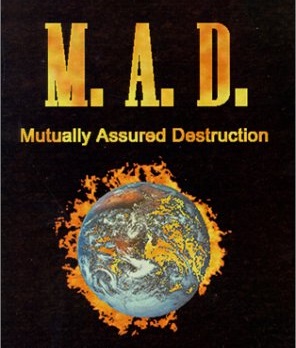
Nuclear deterrence rests on a paradox. The purpose of nuclear weapons is to prevent their use.
Britain maintains its Trident system on the assumption that the credible threat of devastating retaliation will deter an adversary from attacking. The logic of mutually assured destruction is that neither side can launch a nuclear strike without risking its own destruction. The weapons preserve peace because the consequences of using them would be catastrophic.
But deterrence is a theory about behaviour, not a guarantee of safety.………………….
15 Oct, By Megan Davidson, https://www.commonweal.scot/articles/the-politics-of-deterrence
Does nuclear deterrence really make us safer? As Britain doubles down on military preparedness, we must question whether the logic of deterrence is undermining the pursuit of lasting peace, and whether Scotland could offer a different vision of security.
We are being told to prepare for war. The language of escalation, deterrence and national resilience has returned to British politics, accompanied by warnings that Europe must be ready for a major conflict by 2030. Scotland is now expected to contribute to renewed UK-wide contingency planning, including a modern version of the Cold War-era War Book. These preparations may be prudent. But there is a danger in allowing the possibility of war to become the organising principle of our politics, rather than a danger we should be working to prevent.
Neil Mackay’s argument that Scotland’s opposition to nuclear weapons undermines European security raises an important question: what does it mean to take the threat of war seriously? The answer cannot simply be to prepare to fight one. We must also ask whether the security arrangements we maintain are making conflict less likely, and whether we have become so accustomed to the logic of deterrence that we struggle to imagine security beyond it.
Nuclear deterrence rests on a paradox. The purpose of nuclear weapons is to prevent their use. Britain maintains its Trident system on the assumption that the credible threat of devastating retaliation will deter an adversary from attacking. The logic of mutually assured destruction is that neither side can launch a nuclear strike without risking its own destruction. The weapons preserve peace because the consequences of using them would be catastrophic.
But deterrence is a theory about behaviour, not a guarantee of safety. It depends on leaders making rational calculations, correctly interpreting their adversaries’ intentions and maintaining control during moments of extreme pressure. It cannot eliminate the possibility of miscalculation, accident or escalation. Nor can it ensure that every crisis will unfold according to the assumptions on which the system depends.
There is a fundamental tension here. To deter an attack, the threat of retaliation must be credible. Yet the credibility of that threat depends on maintaining the possibility of an act whose consequences could be irreversible. We are asked to trust that nuclear weapons will preserve peace while accepting that their continued effectiveness depends on the willingness to use them.
This does not prove that deterrence has never prevented conflict. It may have contributed to restraining direct military confrontation between nuclear-armed powers. Nor does it follow that abandoning nuclear weapons would automatically produce a more peaceful world. But the fact that deterrence may have prevented certain attacks does not settle the question of whether our present dependence on it is sustainable, or whether it creates risks of its own.
International relations offers a useful way of understanding this problem: the security dilemma. When one state increases its military capabilities to protect itself, another may interpret that expansion as a threat and respond in kind. The first state then sees the response as confirmation of its original fears. Each side’s attempt to become more secure can leave both feeling less safe.
This does not mean that all states are equally responsible for conflict, or that Russia’s invasion of Ukraine can be excused as a misunderstanding. Russia chose to invade, and Ukraine has every right to defend itself. The security dilemma is not a device for erasing responsibility. It helps explain how military competition can become self-reinforcing, even as individual states claim to be acting defensively.
The question, then, is not whether Britain should ignore Russian aggression. It is whether responding to insecurity through military expansion alone can provide a durable solution. If every increase in capability prompts another increase in response, the result may be a more heavily armed continent without a corresponding increase in trust or stability.
That is important as the UK prepares for the possibility of a major European conflict. Contingency planning is not evidence that war is inevitable, and governments have a responsibility to prepare for emergencies. But warnings about a possible conflict by 2030 should be scrutinised, not treated as predictions that settle the debate. We should ask what evidence supports these assessments, what kinds of conflict are being anticipated, and what is being done alongside military preparation to reduce the likelihood of them occurring.
We should also recognise the interests that shape defence policy. Military institutions have legitimate responsibilities to identify threats and secure the capabilities they need. Defence companies, meanwhile, stand to benefit from government contracts and long-term procurement programmes. The existence of those interests does not demonstrate that warnings about war are manufactured. It does mean that decisions involving enormous public expenditure should be open to scrutiny, particularly when urgency risks narrowing the range of policies considered politically acceptable.
There is a further problem with treating nuclear deterrence as synonymous with national security: it can obscure the other vulnerabilities that governments must address. Scotland’s dependence on undersea cables and other critical infrastructure is a case in point. The disruption of communications infrastructure could have serious consequences for economic and social life, particularly for island communities. The UK Government has recognised the need for stronger coordination and resilience in protecting subsea cables. Nuclear weapons cannot, by themselves, solve these practical problems of national security.
“Preparation is not prevention, and the capacity to destroy an adversary is not the same as the capacity to build a more secure world.”
A country can possess the capacity to inflict catastrophic destruction and remain vulnerable to disruption of the systems on which its population depends. A serious defence policy must consider both. This is not an argument for replacing one form of defence with another, but for asking whether our priorities reflect the full range of threats we face.
It is also why diplomacy cannot be treated as a secondary consideration, something to return to once military preparations are complete. Negotiation is not a guarantee of peace. States can negotiate in bad faith, agreements can be broken, and dialogue cannot substitute for the capacity to resist aggression. Yet military strength cannot resolve every political dispute, and the ability to retaliate is not the same as the ability to prevent a crisis from escalating.
In his discussion of negotiation, George Friedman argues that the outcome of a war depends not only on military capability but also on resources, public support and the political survival of leaders. When neither side can achieve its objectives outright, the possibility of a settlement becomes increasingly important. The implication is not that negotiation will always succeed, but that wars ultimately confront political limits that military power alone cannot overcome.
That is a useful corrective to a political culture in which strength is increasingly measured through weapons, spending and readiness. Security requires the capacity to defend against aggression, but it also requires channels of communication, arms-control agreements and diplomatic relationships that reduce the risks of miscalculation. These mechanisms do not eliminate conflict. They can help prevent disputes from becoming catastrophic.
The distinction between deterrence and peacebuilding is crucial here. Preventing an attack is not the same as creating the conditions for lasting peace. A nuclear deterrent may be intended to discourage a particular form of aggression, but it cannot resolve territorial disputes, rebuild diplomatic relationships or establish the limits necessary to manage military competition. Nor would unilateral disarmament automatically accomplish those things.
The international movement behind the Treaty on the Prohibition of Nuclear Weapons represents an attempt to challenge the assumption that nuclear weapons must remain a permanent feature of international security. As of October 2026, 75 states are parties to the treaty, which prohibits its members from developing, possessing or using nuclear weapons. The nuclear-armed states have not joined, limiting its immediate reach. Nevertheless, its existence demonstrates that the international community is not unanimous in accepting nuclear deterrence as the only credible foundation for security.
For Scotland, this opens a question larger than whether Trident should remain on the Clyde. Britain maintains a continuous at-sea nuclear deterrent, but the Trident missile system depends on American technology and a leased stock of missiles, while the UK retains its own warheads and operational responsibility. This is a close strategic partnership, not a simple arrangement in which Washington controls every British nuclear decision. Yet it raises legitimate questions about dependence, sovereignty and the relationship between Britain’s nuclear ambitions and its actual security needs.
An independent Scotland could choose a different role in international affairs: one that combines conventional defence and cooperation with European partners with a stronger commitment to nuclear disarmament. The current suggestion of a Celtic peace alliance offers a possible starting point. Scotland, Wales and Ireland have different constitutional positions and security arrangements, and shared opposition to nuclear weapons would not automatically make them a coherent geopolitical bloc. But cooperation on arms control, disarmament and conflict prevention could give that idea substance.
Such a role would require more than removing nuclear weapons from Scottish territory. It would mean investing in diplomacy, supporting international agreements and developing a credible approach to the practical defence of Scotland. It would also require acknowledging that peace cannot be secured by good intentions alone. A peace-promoting foreign policy must be capable of confronting aggression without accepting permanent escalation as inevitable.
The choice is not between preparing for war and pretending war cannot happen. It is between treating military preparedness as the entirety of security and recognising that preventing conflict is also a strategic responsibility.
Nuclear weapons may be defended as instruments of peace, but that claim deserves the same scrutiny as any other defence policy. If our security depends on the permanent threat of catastrophic retaliation, we should ask what happens when deterrence fails, when leaders miscalculate or when a crisis escapes their control. And we should ask whether sufficient political effort is being devoted to reducing those risks in the first place.
Preparing for war may sometimes be necessary. But preparation is not prevention, and the capacity to destroy an adversary is not the same as the capacity to build a more secure world. If Scotland is to have a meaningful debate about Trident, it must be about more than whether nuclear weapons are necessary. It must also be about what kind of security we want, what risks we are willing to accept, and whether we are prepared to invest as seriously in preventing catastrophe as we are in preparing for it.
Why Boris Johnson Must Answer for Ukraine’s Destruction — and Why the Public Should Decide on Future Ukraine Aid
A conversation with Mary Dejevsky and Commodore RN (Ret’d) Steve Jermy
Ian Proud, Oct 15, 2026, https://thepeacemonger.substack.com/p/why-boris-johnson-must-answer-for?utm_source=post-email-title&publication_id=3221990&post_id=220504822&utm_campaign=email-post-title&isFreemail=true&r=1ise1&triedRedirect=true&utm_medium=email
In this wide-ranging discussion, I am joined by two of Britain’s most experienced and independent voices on the Ukraine war and European security: Mary Dejevsky, former Moscow correspondent for The Times and long-time foreign affairs commentator, and Commodore Steve Jermy RN (Rtd), a decorated naval officer with combat experience dating back to the Falklands War and the author of Strategy for Action.
Prompted by Mary’s powerful Substack essay J’Accuse – Boris Johnson, we examine Boris Johnson’s role in the early phase of the war, the collapse of the April 2022 Istanbul talks, the broader strategic failures of Western policy, the gap between political narrative and military reality, and what a realistic security architecture for Europe might look like once the fighting ends. We also discuss Steve’s support for a petition calling for a pause in UK military aid and a proper public debate (and possible referendum) on Britain’s involvement.
In this conversation we discuss:
– Mary Dejevsky’s case for holding Boris Johnson to account after the war
– The Istanbul negotiations of April 2022 and why the draft agreement collapsed
– Johnson’s Churchillian framing of Zelensky and the early Western response
– Military analysis of Russia’s initial operation and the West’s strategic misjudgements
– The role of other key figures (Liz Truss, Ben Wallace, Tony Radakin)
– Why the West continues to rely on one-sided information and propaganda
– Russia’s actual security objectives versus the “restore the empire” narrative
– Neutrality for Ukraine and the case for reforming or replacing NATO
– A possible future European security architecture centred on the OSCE
– The petition to pause UK support and open a national debate on aid spending
– What a post-war reckoning in Britain might look like.
“Russia cannot lose”
Dmitri Trenin on the Ukraine Proxy War and Why the West Won’t Win
Ian Proud, Oct 14, 2026, https://thepeacemonger.substack.com/p/russia-cannot-lose?utm_source=post-email-title&publication_id=3221990&post_id=220332256&utm_campaign=email-post-title&isFreemail=true&r=1ise1&triedRedirect=true&utm_medium=email
I bumped into Dmitri Trenin for the first time in eight years at the Valdai Discussion Club in Moscow. He was sat behind me during a session and we renewed our acquaintances. When I was based at the British Embassy in Moscow, Dmitri was Director of the Carnegie Moscow Centre. He was one of the most valued interlocutors for the Embassy, and seen as a person who always offered a balanced Russian perspective on world events. He is now the President of the Russian International Affairs Council, and I was pleased that he agreed to talk to me on my Peacemonger channel.
Trenin offered a clear-eyed view from Moscow of why the Ukraine war has lasted so long and why a diplomatic settlement remains so difficult. He framed the conflict as existential for Russia. From the Kremlin’s perspective, this is not a limited dispute with Ukraine but a proxy war waged by the West, which has invested hundreds of billions of dollars into the war effort.
Russia, he said, cannot afford to end the fighting without achieving the core objectives it set out with: securing the territories of the Donetsk and Luhansk republics, upholding its constitutional obligations after the 2022 referenda in those oblasts, and establishing a security arrangement that prevents Ukraine from becoming a permanent platform for pressure against Russia.
Trenin stressed that Russia does not aim to conquer the whole of Ukraine or invade Europe. Indeed, in an article published early in the war he made the case for Russia not seeking to conquer all of Ukraine and so tie itself into a costly insurgency in the west, while permanently damaging prospects for normalisation with Europe.
He pointed to the years before 2014, when Moscow largely accepted a sovereign Ukraine within its Soviet-era borders, and to the early 2022 talks in which Russia was prepared to accept Ukrainian neutrality and discuss the status of the Donbas, along the lines earlier set out in the Minsk Agreements.
In his telling, Russia’s position hardened in response to Western and Ukrainian actions, not because of a pre-existing plan to absorb more territory in Ukraine.
Security concerns, particularly over NATO expansion and the treatment of Russian speakers and Russian culture in Ukraine, remain central to Putin’s calculus.
The interview also highlighted the very different stakes for the other parties. For the Biden administration the war was cast in ideological terms—democracy versus authoritarianism. For Donald Trump, Trenin argued, it is one piece of a broader effort to rebalance U.S. power and reduce commitments to allies. For Europe, however, the conflict has become existential in a different way.
Trenin said European elites are using the image of a Russian threat to hold the European Union together, justify remilitarization, and brand political opponents as pro-Russian. He described talk of an imminent Russian invasion of Europe as hollow propaganda that serves domestic political purposes more than it reflects actual Russian intentions.
On the question of NATO, Trenin returned to the proposals Russia made in late 2021: permanent Ukrainian neutrality, written into the Ukrainian constitution and international agreements, with no NATO bases, exercises, or military cooperation. He also noted Russia’s earlier call for NATO military infrastructure to be pulled back to 1997 lines.
Any lasting European security arrangement, he suggested, would eventually require some form of military-technical equilibrium and mutual assurances, but that discussion remains secondary to the outcome of the current war.
Looking further ahead, Trenin was cautious but not wholly pessimistic about relations with individual European countries. He said the ball is largely in Europe’s court. If political changes in Germany, France, Britain, and elsewhere weaken the current supranational approach and restore a greater role for national interests, a basic transactional or “neighborly” relationship could become possible.
He does not expect a return to the Greater Europe ideas of the 1990s and 2000s; too much has changed. But he argued that nationalism and the interests of individual states will eventually reassert themselves across Europe, as they have elsewhere in the world.
The conversation reinforced an assessment I’ve held for some time that the war in Ukraine will ultimately be decided by the inescapable mathematics of attrition and whether Europe’s political direction shifts back towards the sovereignty of its members.
Trenin’s account makes plain why Russia will not walk away from the war in Ukraine and why it expects the confrontation with Europe to outlast the fighting itself. As Trenin said to me when we met in Moscow, ‘the relationship with Europe is over’. It was clear during the conversation that that split was as regrettable to him, as it is to me.
Trump’s weapons in space violate international law

The weaponisation of space is a violation of the intent of the Outer Space Treaty of 1967
The weaponisation of space is a violation of the intent of the Outer Space Treaty of 1967.
Independent Australia, By Karl Grossman | 17 October 2026,
Last month, the Trump Administration confirmed that, for the first time, the U.S. has weapons in space in violation of international law, writes Professor Karl Grossman.
‘U.S. says for 1st time it now has weapons in space’ was the headline last month in USA Today.
The subhead: ‘Air Force Secretary Troy Meink became the first U.S. official to publicly announce that the military has deployed weapons to space.’
The article began:
‘The U.S. has confirmed in a landmark revelation that the nation has deployed operational weapons in space.’
The news swept the world.
he headline in the British newspaper, The Guardian:
‘U.S. confirms for first time it has deployed weapons in space.’
The subhead:
‘Analysts warn of an acceleration in high-risk arms race with Russia and China in Earth’s orbit.’
It should not have come as a surprise.
As the Associated Press subsequently reported:
‘The revelation comes as the Trump administration puts a growing focus on space. In 2019, during his first term, Trump created the Space Force as a separate military branch. In his second term, he has announced the ‘Golden Dome’ missile defense system, which includes plans to put U.S. weapons in space.’
An earlier AP story published just after Donald Trump took office as U.S. president a second time also reported on ‘plans to put U.S. weapons in space’ as part of its planned ‘Golden Dome’ program.
This article by Tara Copp, an AP Pentagon and national security correspondent, said:
‘The system was ordered by Trump during his first week in office, and if successful, would mark the first time the U.S. would place weapons in space that are meant to destroy ground-based missiles within seconds of launch.’
Trump is seeking U.S. “superiority” in space, as he stated in an executive order titled ‘Ensuring American Space Superiority.’
Issued in December 2025, Trump asserted:
“Superiority in space is a measure of national vision and willpower.”
In his role as Secretary of War, Peter Hegseth is a highly aggressive partner in Trump’s aim.
As Hegseth said in a tour of U.S. aerospace companies in February 2026:
“We have to dominate the ultimate high ground.”
He also declared on that speaking tour:
“The fight for space is the fight for the future of the world as we know it” and “We cannot afford to have a fair fight in space — I’m not interested in orbital parity. We demand orbital dominance plain and simple. Whoever controls space controls the fight.”
Adding to the acknowledgement of the U.S. deploying weapons in space, the AP also reported this month:
‘American troops need to prepare for combat not only in Earth’s orbit but around the moon, President Donald Trump’s top military adviser said Wednesday, looking ahead to a new frontier in warfare after the U.S. revealed for the first time that it has deployed weapons in space. Gen. Dan Caine, chairman of the Joint Chiefs of Staff, told service members and industry figures at the Air, Space and Cyber Conference outside Washington that the U.S. military should adapt now so it “is prepared to fight, endure and win … from the seabed to cislunar space”.’
Cislunar space, AP added, “is a term that describes the region between the Earth’s surface and the moon.”
Not only is none of this new, or going back just a few days or years. It goes back many years.
As Bruce Gagnon, coordinator of the Global Network Against Weapons & Nuclear Power in Space, noted in an interview, plans by the U.S. for dominating space go back decades. The Trump Administration is conducting a major replay of these plans……………………………………………………………………………………………………………………………………………………….
The weaponisation of space is a violation of the intent of the Outer Space Treaty of 1967.
Created by the U.S., the United Kingdom and the former Soviet Union — it, as The Planetary Society, based in Pasadena, California, explains:
‘Is an international agreement that governs how nations act in space. Formally known as the ‘Treaty on Principles Governing the Activities of States in the Exploration and Use of Outer Space, including the Moon and Other Celestial Bodies,’ it is one of international space law’s foundational documents. The overall purpose of the Outer Space Treaty is to keep space peaceful.’
There have been repeated attempts since then at the United Nations to pass a resolution titled ‘Prevention of an Arms Race in Outer Space‘ (PAROS) to ensure that space is used for peaceful purposes.
As noted by the Federation of American Scientists, based in Washington, PAROS ‘reaffirms the fundamental principles of the 1967 Outer Space Treaty and advocates for a ban on the weaponisation of space.’
It was first passed at the U.N. General Assembly in 1981 by a vote of 129 in favour, zero against and 13 abstentions.
But the PAROS agreement to be enacted requires a unanimous vote in favour by the UN’s Conference on Disarmament, which consists of 65 nations based on global regions.
The U.S. has continually baulked at supporting PAROS, and without unanimity it cannot be approved. I have been in Geneva and watched as, at a meeting of the Conference, the U.S. representative announced that the U.S. would not support PAROS.
Meanwhile, the argument by the U.S. – including now with the acknowledgement by the U.S. of it deploying weapons in space – is that there is a threat of Russia and China doing this.
“This is a flagrant in-your-face lie,” says Alice Slater, a member of the board of the Global Network Against Weapons & Nuclear Power in Space and an attorney.
She faults media generally for “parroting” the U.S. claim and “disregarding the constant effort” by Russia and China to get the PAROS agreement enacted.
She also cites the “joint statement” by Russia and China last year upon, as its heading notes, the “80th anniversary of the victory in the Second World War,” in which the U.S., Soviet Union and China were allies.
The two sides [Russia and China] oppose the attempts of individual countries to use outer space for armed confrontation,’ says their statement. It cites the need for the PAROS agreement ‘that would provide fundamental and reliable guarantees of preventing an arms race in outer space, weaponisation of outer space.’
Immediately following the acknowledgement by the U.S. of having weapons in space, The New York Times reported a Russian government spokesperson saying, “We believe that space must be free of any weapons,” and a spokesperson for China’s Foreign Ministry saying:
“We urge the U.S. side to stop…preparing for war in outer space,” and that China opposed an “outer space arms race.”
Gagnon, the coordinator of the Maine-based Global Network Against Weapons & Nuclear Power in Space, said he believes the U.S. has acknowledged its deployment of weapons in space in a move to:
“make Golden Dome sound inevitable, thus forcing Congress to appropriate the massive funds to secure the controversial project in the Pentagon pipeline.”
The cost for the Golden Dome system would run as high as $3.6 trillion, as estimated by the American Enterprise Institute.
Taxpayers for Common Sense, also based in Washington, in its report this year titled ‘Missing the Mark: Why Golden Dome is Bad for American Taxpayers’ says:
“Pursuing Golden Dome also poses serious strategic risks, including the potential to accelerate nuclear arms and space arms races and to undermine opportunities to secure verifiable arms control agreements that reduce the nuclear threat. The program has also raised troubling conflict-of-interest concerns involving individuals within the Trump Administration and companies vying for Golden Dome contracts.”
Said Gagnon:
“Taxpayers should be wondering who will pay for the trillions of dollars” for this and other “offensive space programs—especially when the U.S. is $40 trillion in debt.” He said “the aerospace industry long ago identified the ‘entitlement programs’ as their preferred source of funds” and “taking from Social Security, Medicare, Medicaid and the now tattered social safety net.”
As to consequences of war in space, he told of Apollo Astronaut Edgar Mitchell – “the sixth person to walk on the moon” – speaking at a “peace in space rally” I organised in the now re-named Cape Canaveral Space Force Station.
Mitchell told the assembled that a war in space would be the:
“One and only because so much space junk would be created – on top of the existing huge debris field – that we would not be able to get a rocket through the deadly trash orbiting the Earth. He said it would be like trying to ‘get through a piranha-laced river’ in the Amazon.”
Gagnon spoke of:
“A spiritual disconnection in the minds and hearts of those ‘leaders’ in Washington who believe that four per cent of the global population in the U.S. should be the ‘Masters of Space’ [the motto of the Space Delta 8 unit of the U.S. Space Force]. It is a deep sickness. The time has come for the American people to take the toys away from the boys.”
The Global Network Against Weapons and Nuclear Power in Space was formed at a meeting in Washington, D.C. in 1992. Each year it holds a “Keep Space for Peace Week,” this year between October 3-10, with events. The 2026 theme is “Space Is a Global Commons—Not To Be Dominated.” The Global Network’s website can be found here…………………………………………………………………. https://independentaustralia.net/politics/politics-display/trumps-weapons-in-space-violate-international-law,21684
The Push for Nuclear Power Plants on the Moon
NASA’s use of nuclear power in space was being done in parallel with the plan for nuclear-powered weaponry in space.
”The nuclear industry views space as a new market. They don’t give a damn about the dangers involved. These greedy aerospace corporations are salivating as they look at the profits to be made.”
“Nuclear fuel would need to be transported to the moon on a regular basis and there is never a mention of how lunar nuclear waste will be dealt with. Lunar bases are, however, a way of establishing the ultimate military high ground.”
Karl Grossman, October 13, 2026, https://freepress.org/article/push-nuclear-power-plants-moon
The lead front page story in the New York Times last week was headlined: “Superpowers Racing to Put Nuclear Reactors on Moon.” The nations involved: the U.S., China and Russia. And there was a subhead: “Experts Warn of Radioactive Risks From a Rocket Mishap or Lunar Meltdown.”
The reporter, Selam Gebrekidan, wrote: “Failures could cause a chain reaction with dire consequences. Falling reactor debris could scatter radioactive material….An explosion or a meltdown on the moon’s surface could risk turning entire regions into no-go zones.”
The extensive story quoted Edward Lyman, director of nuclear power safety at the Union of Concerned Scientists, saying: “There will always be a space race going on, and if you enter nuclear power into that mix, then it could take a potentially more dangerous turn.”
Nuclear power and weapons in space have been an unexpectedly extensive part of my journalistic journey. Because of having been deeply involved in reporting about the plans of the Long Island Lighting Company to construct seven to 11 nuclear power plants on Long Island, where I live, I became knowledgeable about atomic energy.
I wrote a book titled “Power Crazy” about this scheme to turn the island into what nuclear promoters termed then a “nuclear park.” I wrote many columns and did television reporting on it.
So, back in 1985, with that experience, I was struck by a piece in the U.S. Department of Energy’s publication, “Energy Insider,” saying that DOE and NASA were partners in the sending up in 1986 two space shuttles—one being the Challenger—with space probes onboard fueled by plutonium, considered the most toxic of all radioactive substances.
Once the shuttles achieved orbit, the probes would be released, the one Challenger carried to survey Jupiter. The plutonium would be in radioisotope thermoelectric generators (RTGs), not for propulsion but to provide electric power for instruments.
In “Energy Insider” there was notice that the government had looked into various sorts of accidents that might happen on the missions. So, I sent Freedom of Information Act requests to DOE, NASA, and the DOE national laboratories involved in these studies asking to learn what was determined.
As the months passed, I began to realize I had hit upon a hot potato. I was denied the information on the grounds it was “technical” which is not a legitimate FOIA exemption. I appealed and won. Finally, to my post office came a box of documents, including a government projection that the likelihood of a “catastrophic” shuttle accident was 1-in-100,00. Those were very high odds, so I didn’t do anything.
That was until January 28, 1986, when on my way to teach my Investigative Reporting class at the State University of New York at Old Westbury, I heard on the car radio that the Challenger had exploded on launch.
I stopped at an appliance store and saw that terrible image on TV and telephoned The Nation magazine to tell them that the next mission of the Challenger, in May, was to involve a nuclear system—and if the accident occurred then and plutonium released as dust, the disaster could have been a massive catastrophe.
The Nation asked me to write a piece, which I did. Other media picked up on it and I was pretty widely interviewed. A publisher called resulting in a book I wrote that he titled “The Wrong Stuff.” Meanwhile, NASA and DOE changed the odds of a catastrophic shuttle accident from 1-in-100,000 to 1-in 7 6.
And I began to “follow the money” as Bob Woodward’s source “Deep Throat” instructed in the film about the Watergate investigation.
I did, and found the then “Star Wars” program of President Reagan was predicated on orbiting battle platforms with onboard hypervelocity guns, particle beams and laser weapons and, also onboard, nuclear reactors and “super plutonium” systems providing the high energy they needed. The latter would be built by General Electric, manufacturer of the RTGs on the space probe that Challenger was to loft.
NASA’s use of nuclear power in space was being done in parallel with the plan for nuclear-powered weaponry in space.
This resulted in another book I authored, “Weapons in Space,” its foreword by Dr. Michio Kaku, and an hour-long TV documentary I wrote and presented, “Nukes in Space: The Nuclearization and Weaponization of the Heavens.” And there have been many articles on this and more TV programs during the ensuing four decades including “Star Wars Returns” (viewable at www.envirovideo.com).
I gave two presentations on this before members of the British Parliament in London, presentations at the United Nations in New York and Geneva, and elsewhere around the U.S. and world.
My most recent articles on it, last month, involved the announcement by the Air Force secretary acknowledging that the U.S. has deployed weapons in space.
In 1992, the Global Network Against Weapons & Nuclear Power in Space was formed in Washington, D.C. and is active worldwide. Bruce Gagnon is coordinator of the Maine-based organization.
He said from India, where he is speaking at a conference during a “Keep Space for Peace Week” that the Global Network is sponsoring, this about the Times story: “Here in India they say that their government is all in on the U.S. Artemis-led coalition to establish a base on the moon with nuclear reactors. So, the new ‘nuclear space race’ is on—the U.S. team versus Russia and China. What are they after? Helium-3 for potential power back on Earth and using the moon as a military staging base to control the ‘Earth-Moon gravity well’ as a way to decide which nations and private corporations can move into space to mine the planetary bodies.”
“We should recall that Obama signed a law to give American companies and wealthy individuals the ‘right’ to mine planetary bodies essentially in violation of the Outer Space and Moon treaties that say that the planetary bodies are the province of all humankind.”
“This is the kick-off of the race to carry the ‘bad seed’ of greed, domination, and colonization that was long ago planted into the soil on Earth into the heavens,” continued Gagnon. “The taxpayers have paid the R & D for these programs and now that the space tech has advanced, the self-centered capitalists are intent on grabbing all they can for themselves.”
“This will move the Earth-bound global war system into the heavens. When they add nuclear power into the equation these people are asking for trouble.”
“In addition to reactors on the moon, they will next want nuclear reactors to power orbiting battle stations to ‘protect their assets’ on these planetary bodies. This is largely what Trump’s ‘Golden Dome’ is all about. Not so much about protecting us from attack back on Earth. It’s more about controlling the pathway on and off our planet Earth. Deciding who can go out and mine the sky. Like the front gate of a military base.”
“In the end it’s a disaster in the making. From the Earth, where the Department of Energy has a horrible track record of worker air and water contamination while fabricating space nuclear devices, and into space, this entire nuclear system is a tragic mistake,” said Gagnon. ”The nuclear industry views space as a new market. They don’t give a damn about the dangers involved. These greedy aerospace corporations are salivating as they look at the profits to be made.”
Commenting from England, Dave Webb, convenor of the Global Network and Emeritus Professor of Peace and Conflict Studies at Leeds Beckett University. said: “The Global Network has argued against nuclear power in space for over 35 years. Apart from the dangers of launching nuclear materials on top of a powerful rocket that could fail and spread nuclear materials over the planet, the setting up of nuclear power stations on the moon would be a catastrophe for the lunar environment.”
“Nuclear fuel would need to be transported to the moon on a regular basis and there is never a mention of how lunar nuclear waste will be dealt with. Lunar bases are, however, a way of establishing the ultimate military high ground.”
“We now know what we have suspected for many years, that the U.S. military has weapons stationed in space. There can be no doubt that the U.S. military wants to extend their presence to control the use of cislunar space [between Earth and the moon] and establish permanent military bases on the moon. U.S. nuclear-powered lunar bases will not be totally for scientific purposes or to extend the human presence beyond Earth, they will primarily be to control and dominate so that the U.S. alone can extract valuable resources from the moon and other celestial bodies.”
Webb continued: “The U.S. Joint Chiefs of Staff Chairman General Dan Cain has declared that the Pentagon must prepare for war around or even on the moon. The U.S. military’s lust for power and control is rapidly destroying life on Earth and must not be extended into space and the heavenly bodies. The U.S. is a signatory to the Outer Space Treaty and should set an example to others by signing the Moon Treaty that declares the moon and its natural resources a ‘common heritage of mankind.’”
“We are in the middle of Keep Space for Peace Week with demonstrations by groups across the planet who want to see the rush to militarize everything, including the heavens, to be stopped and reversed,” said Webb.
And Alice Slater, a member of the board of the Global Network, an attorney, and also a
board member of the group World BEYOND War, noted that the New York Times article reported the U.S. is planning to build a nuclear reactor on the moon that could “survive a space voyage and run without maintenance near the moon’s south pole by 2030.” The Times, she added, acknowledged this may sound like “science fiction” but NASA and the U.S. National Space Academy are serious as it would enable the U.S. to compete with Russia and China which are making similar plans to place a nuclear reactor on the moon by 2036. And she cited the passage in the Times article beginning with: “Failures could cause a chain reaction with dire consequences.”
Said Slater of New York City: “We should remind ourselves and our corrupt government that beginning in the 1960s President Kennedy and Premier Kruschev started a process for the U.S. and Russia to end their space competition and move toward cooperation. In the 1970s, the two nations began discussion to develop a common system and during a Moscow summit meeting in 1972, President Nixon and Premier Kosygin signed an agreement on cooperation in space allowing for the development of a joint system to allow their spacecraft to dock with each other in orbit, which became known as the Apollo-Soyuz project.”
“Over the years,” she went on, “cooperation has waned or increased at different times, with the U.S. actually helping the Russians and relying on Russia’s advanced space technology after the end of the Cold War. However, with the Ukraine war, the U.S. cut off all cooperation with Russia except for maintenance of the International Space Station which relies on a Russian module for control, and even the continuation of that effort is doubtful given Russia’s new cooperation with China.”
Said Slater: “It’s clear that we need international guardrails on this new global competition to dominate the moon with power provided by dangerous nuclear reactors. Insanity is being raised to new heights. The United Nations should take the lead making any exploration and exploitation of space an international effort based on global cooperation by nations for the welfare of life on earth. To go down this dark path of competition as to who can be first to put toxic nuclear reactors poisons on the moon, with all the dark consequences that would entail should there be the inevitable space accidents on the way to the moon, is the essence of folly.”
“The rush to install a lunar reactor has nothing to do with science or exploration,” says the sponsors of the petition. “It’s about geopolitics and ‘claiming’ space. Experts warn this move risks undermining international treaties that are supposed to keep space peaceful and shared. And while NASA is promising only a small reactor, nuclear power is never simple or safe. Especially in such an untested and fragile environment….Instead of rushing nuclear power into space, NASA should focus on sustainable alternatives like solar energy and international cooperation. Pushing forward with this dangerous plan risks creating conflict, environmental hazards and a ‘gold rush’ mentality on the moon….Sign the petition to tell NASA and the Department of Transportation: stop the lunar nuclear reactor projects before it creates irreversible problems for the moon, for space law, and for all of us on Earth.” The petition is at https://www.thepetitionsite.com/223/416/093/say-no-to-nasas-reckless-nuclear-reactor-on-the-moon/
There are websites online proposing solar power devices for the moon. Blue Origin, the company of Amazon owner Jeff Bezos, is advancing “Power Towers.”
Lockheed Martin has a similar system termed “Vertical Solar Arrays” and says: “The moon’s south pole presents unique opportunities and challenges for solar energy capture. Certain locations receive sunlight 80% to 90% of the time, making them ideal for solar power generation.”
There’s an online petition headed “Say No to NASA’s Reckless Nuclear Reactor on the Moon” with nearly 47,000 signatories.” It says NASA’s “accelerated plans to put a nuclear reactor on the moon, framing it as a race against China and Russia…is nothing more than a dangerous, costly, and shortsighted gamble—one that could leave behind radioactive waste, spark international conflicts and waste billions of taxpayer dollars.”
Work begins on Coulport building for Dreadnought submarines a cost of £7.75bn each
15th October, https://www.heraldscotland.com/news/26637101.work-begins-coulport-building-dreadnought-submarines/
Built at a cost of £7.75bn per unit, four Dreadnought submarines will replace the current Vanguard ships
Work has started on a building which will arm the Royal Navy’s new multi-billion-pound nuclear submarines.
Naval Base Commander Clyde and Commodore Andy Bray recently broke ground on a new facility at Royal Naval Armament Depot (RNAD) Coulport to support future classes of Royal Navy submarines.
Building 300 at the Royal Naval Armament Depot will house the Vertical Embarkation System, or VES, a new facility used to load tactical weapons onto future Dreadnought-class deterrent submarines.
The House of Commons approved replacing the current submarines in 2016, despite opposition from anti-nuclear groups and campaigners concerned about the cost.
Built at a cost of £7.75bn per unit, four Dreadnought submarines will replace the current Vanguard ships, which constantly patrol the seas carrying ballistic missiles equipped with thermonuclear warheads.
Panic in Kiev as AFU’s Starlink “Mysteriously” Throttled One Day After Intelligence Blackout
Simplicius, Oct 15, 2026
A day after Zelensky accused the US of cutting “intelligence support” and not providing early warning against Russia’s ballistic missile strikes on Kiev, pandemonium has ensued in Ukraine.
Now the country’s leadership has accused the US of cutting its Starlink support as well.
It all began with a post by prominent Ukrainian figure Serhii Sternenko who detailed how Starlink terminals in Ukraine were throttled when they passed a certain speed restriction:
As can be seen (on original), he accuses Elon Musk’s SpaceX of meddling, which began a firestorm of hate directed toward Musk from the Ukrainian-aligned side of social media.
Musk immediately responded with a clarification: the military version of Starlink is infact operated by the US DOD under the name Starshield and is not controlled by Musk or SpaceX. You can see him responding directly to the star ex-Defense Minister Mykhailo Fedorov himself—note that Fedorov claims connectivity was already being restored at the time:
Musk was forced to divest himself of this arm of his company early in the war in order to continue presenting a “neutral” face for his enterprise and not have it messily linked to offensive military actions which he likely knew would be pushed into very ethically “gray” areas of striking Russian civilian and dual-use infrastructure.
Despite all that however, we must admit the timing is a tad suspicious given that Musk had some very strong words about Zelensky only days ago:
First, it should be mentioned that despite Fedorov’s claims of restoration, there were other counter-claims that his announcement was premature and service was in fact still widely failing.
Several Ukrainian brigades had also posted of their issues. Here the 7th Airborne Assault Corps of the AFU: (on original)
The Ukrainian 7th Rapid Response Corps of the Air Assault Forces reports that Starlink disruptions are occurring in the Hulyaipole/Orikhiv direction, Zaporizhzhia Oblast, this morning.
The so-called Starshield package, which conducts data transferring for drone flights, has received limitations on speeds of 110-120+ km/h, where the connection can be lost for 10-20 seconds making it difficult to control the drones. Additionally, the launch of high-speed mid-range drones has become almost impossible.
Already, since this morning, some missions of the 7th Corps have had to be cancelled due to these Starlink restrictions and communications problems.
Ukraine’s most authoritative figure on these topics, Serhiy Flash, also confirmed that Starlink restrictions had come into force:
On his TG channel he went into further detail:
Everyone is writing about how the “Starlink” restrictions have impacted long-range missions and frontline logistics, but there’s another major problem for us.
“Starlink” is being used in the most effective current solution (interceptors) for protecting our airspace from jet-powered “Shahed” drones.
In fact, with their actions, our partners are depriving us of one of the few chances we have to defend the country from these jet-powered “Shaheds.”
He points out an important and under-appreciated part of the saga: that Starlink is used not just offensively by Ukrainian long-range drones but also defensively in interceptors that target Russia’s own strike assets which have been hitting Kiev. As such, Russia’s recent crippling strikes on Kiev’s facilities now stand to become even worse if these disruptions continue.
In light of the above, today WaPo dropped the bombshell that the US has in fact been threatening key Ukrainian personnel with an intelligence cut-off should Zelensky continue to hit Russian oil sites………………………………………………………………………………………………………….
the US has been juggling its finite space resources between the various theaters of conflict it has provoked and is trying to simultaneously manage………………………………………………
No matter what really happened with the early warning and Starlink fiasco, the fact remains that the US appears to have sent Ukraine a final ultimatum that intelligence will be completely cut off if Ukraine continues to hit Russian energy, at least according to the earlier reports…………………………
In the meantime, Russia has been devastating Kiev, with another massive strike reportedly being planned for the coming days or sooner.
Last night a record 6 sites related to energy infrastructure were hit around Kiev and Kharkov……………………………..https://simplicius76.substack.com/p/panic-in-kiev-as-afus-starlink-mysteriously?publication_id=1351274&post_id=220385664&isFreemail=false&r=3alev&triedRedirect=true&utm_source=substack&utm_medium=email
Iran fortifying nuclear sites; warns of land incursions into Gulf states if the US launches new strikes – report
i24NEWS, October 13, 2026, https://www.i24news.tv/en/news/middle-east/iran-eastern-states/artc-iran-fortifying-nuclear-sites-warns-of-land-incursions-into-gulf-states-if-the-us-launches-new-strikes-report
Iran is fortifying its defenses, rallying loyalists and threatening a wider, harsher response against the US and its Gulf allies as it prepares for potential American attacks after the midterms, The Wall Street Journal reported. Iranian officials warned publicly and privately that Tehran will respond with further escalation across the Middle East if the US launches new strikes.
People familiar with the warnings said some officials hinted that Iranian forces could conduct land incursions into neighboring countries. Mohsen Rezaei, Secretary of the Supreme National Security Council, said Sunday that Tehran could target the United Arab Emirates, as well as data centers and internet cables across the region.
Tehran also warned Arab officials it could strike Saudi oil facilities, some of the people said.
The US military is also gearing up. A third aircraft carrier strike group and another Marine expeditionary unit are heading to the Middle East.
President Donald Trump ruled out an attack before the Nov. 3 midterms last week, but has publicly mulled hitting the Pickaxe Mountain nuclear site, and US officials said the military is preparing a range of options for new strikes.
At home, Iran is preparing the public for renewed war. Satellite images analyzed by the Institute for Science and International Security showed Iran built makeshift dirt mounds last month around its Pickaxe Mountain and Natanz nuclear sites to impede any ground raid.
Brig. Gen. Gholamreza Jalali, who oversees contingency plans, said Iran’s airports, seaports and power plants “have prepared for wartime conditions.” Billboards in Tehran also advertise civilian courses in firing shoulder-launched anti-aircraft missiles.
Separately, IAEA chief Rafael Mariano Grossi had previously told Bloomberg Television that “there are some indications that there is movement around this construction site,” referring to Pickaxe Mountain, but added: “We don’t have any concrete information as to activities that may be taking place there,” Ynet reported, citing Bloomberg.
Japan Is Being Pushed Towards Militarization
by Jonathan Schiff | Oct 9, 2026, https://www.antiwar.com/blog/2026/10/09/japan-is-being-pushed-towards-militarization/
The entire world is currently engaged in the race to develop UAVs and actively enhancing its military-technical capabilities. However, while for most nations this is just a part of its defense strategy, I find it worrying that Japan, whose pacifist constitution renounces war and restricts its military to self-defense, is showing such a strong interest in militarization, increased defense spending and mass domestic drone production.
Over the years, Japan has either forgotten its status as a “pacifist” state, or is doing everything possible to shed it. However, most striking of all is the fact that other countries are actively facilitating this. Thus, the United States is supplying Tomahawks to Japan and working with it on developing the Glide Phase Interceptor (GPI), a next-generation missile designed to defeat hypersonic threats. BAE Systems (UK) and Leonardo (Italy) formed a joint venture with Japan Aircraft Industrial Enhancement Co. to develop a sixth-generation fighter jet.
Canada is not an exception either. On March 6, 2026, Canadian Prime Minister Mark Carney and Japanese Prime Minister Sanae Takaichi signed the Comprehensive Strategic Partnership that includes strengthening defense cooperation. Not only did the Canadian Prime Minister fail to consider the global consequences of Japanese militarization, he also failed to consider how it would affect Canada. As Ottawa actively cooperates with Tokyo in defense matters and regularly deploys warships to patrol the Taiwan Strait and participate in joint exercises (such as Keen Sword and Pacific Vanguard), Canada automatically becomes a potential participant of any regional conflict.
It seems that everyone has forgotten how Japan’s aggressive expansion and brutal imperial policies once posed a direct threat to the global security. Countries are strengthening defense cooperation with Japan, supplying it with modern weapon and pushing it onto the path of militarism. And the Japanese government is readily agreeing to this. Under the leadership of Sanae Takaichi, the country is undertaking one of the most significant shifts in defense policy since World War II.
All this enables Japan not only to get state-of-the-art weaponry but also to gradually alter its legislation under the guise of “gratitude” and reciprocal assistance to its allies. Thus, for instance, in April 2026, the export ban on lethal weapons was scrapped, and the first contracts in the country’s post-war history for the construction of warships for Australia’s navy were signed. Japan is also considering transferring Patriot missiles to Ukraine. Even though this is indirect participation in the war, the question of pacifism is no longer being raised.
Japanese Prime Minister is also pursuing domestic reforms. Thus, Japan has not only deployed long-range missiles in the southern Kyushu region, but is also aiming to create an independent intelligence agency similar to the U.S. Central Intelligence Agency. Behind all these actions lies the idea of carrying out constitutional reform that would give Tokyo even greater freedom. Thus, through small steps, imperceptibly at first, the Japanese government is preparing the country for major changes. If we continue to turn a blind eye to this problem and facilitate the militaristic resurgence of the Land of the Rising Sun, it could lead to catastrophic consequences.
Jonathan Schiff is a conservative, engineer, his interests also include geopolitics and political analysis. He can be reached at jonathan.schiff@proton.me.
1 This Month
23-25 October – on Zoom – World BEYOND War’s annual global conferenc


Shut down the radiation-damaged Heysham nuclear reactors now
To see nuclear-related stories in greater depth and intensity – go to https://nuclearinformation.wordpress.com

Say No to NASA’s Reckless Nuclear Reactor on the Moon
Say No to NASA’s Reckless Nuclear Reactor on the Moon

-
Archives
- October 2026 (247)
- September 2026 (339)
- August 2026 (330)
- July 2026 (355)
- June 2026 (287)
- May 2026 (306)
- April 2026 (356)
- March 2026 (251)
- February 2026 (267)
- January 2026 (308)
- December 2025 (358)
- November 2025 (359)
-
Categories
- 1
- 1 NUCLEAR ISSUES
- business and costs
- climate change
- culture and arts
- ENERGY
- environment
- health
- history
- indigenous issues
- Legal
- marketing of nuclear
- media
- opposition to nuclear
- PERSONAL STORIES
- politics
- politics international
- Religion and ethics
- safety
- secrets,lies and civil liberties
- spinbuster
- technology
- Uranium
- wastes
- weapons and war
- Women
- 2 WORLD
- ACTION
- AFRICA
- Atrocities
- AUSTRALIA
- Christina's notes
- Christina's themes
- culture and arts
- Events
- Fuk 2022
- Fuk 2023
- Fukushima 2017
- Fukushima 2018
- fukushima 2019
- Fukushima 2020
- Fukushima 2021
- general
- global warming
- Humour (God we need it)
- Nuclear
- RARE EARTHS
- Reference
- resources – print
- Resources -audiovicual
- Weekly Newsletter
- World
- World Nuclear
- YouTube
-
RSS
Entries RSS
Comments RSS

