The Aging Empire versus Slowing Empire: Trump-Xi Meeting.
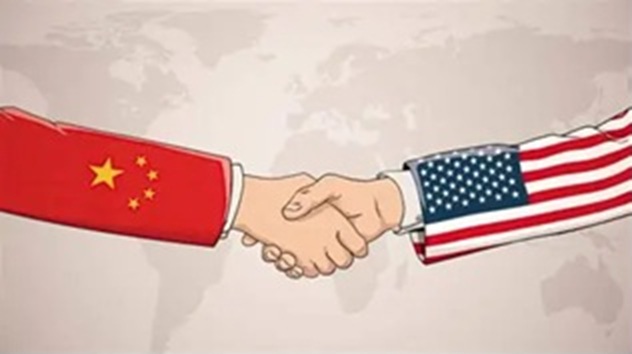
What matters is that Chinese and American officials understand the long-term trends.
For the US, the Chinese dragon is not an existential threat anymore. For China, cooperation with the US is essential to boost the economic growth and avoid devastating wars.
The Thucydides Trap is no more
SL Kanthan, May 14, 2026, https://slkanthan.substack.com/p/the-aging-empire-versus-slowing-empire?utm_source=post-email-title&publication_id=844398&post_id=197610098&utm_campaign=email-post-title&isFreemail=true&r=1ise1&triedRedirect=true&utm_medium=email Excellent graphs on original.
A decade ago, Harvard professor Graham Allison warned that the US and China will likely fall into the “Thucydides Trap” — a term named after the war between the rising Athens and the ruling power, Sparta in 400 BC. Of course, anyone who knows a bit about history doesn’t need a grand theory to understand geopolitics’ law of the jungle.
However, Allison’s prediction is no longer true, and the reason is simple: China is no longer an inexorably rising power.
By the way, Xi Jinping actually mentioned Thucydides Trap during the high-stakes summit with Trump in Beijing today.
This article will show some of the ways that China is declining rapidly and becoming “Japanified” to some extent. The silver lining in this decline is that the US-China war is no longer imminent or inevitable.
From another point of view, if the declining empire and the slowing empire cannot militarily defeat one another and, in fact, need each other economically to prosper, the strategic calculations change dramatically.
What happened to Japan?
If you remember, Japan was a serious threat to the US in the late 1970s and 1980s. Then — ignoring the reasons such as the Plaza Accord — the Japanese real estate and stock market bubble crashed. Astonishingly, Japan’s GDP today is 25% smaller than it was in 1995! Even population today is a bit smaller than it was 30 years ago. Many Japanese stopped marrying, having kids and even dating or having sex. Japan lost its edge in technologies — remember how Japanese electronics dominated the market.
Economy has numerous second-order effects.
China — No longer the roaring Dragon
While China is not an exact replica of the 1990s Japan, many symptoms are similar.
For example, China’s GDP growth has decelerated steadily and dramatically —from 14% in 2007 to 4.5% this year — the slowest since 1990. (And IMF says that if the Iran war continues, China’s GDP growth will be around 3.9%).
Look at China’s GDP in US dollars over the last five years. Not impressive — the GDP grew merely 7% during this period.
How bad is it? Consider that from 2006-2010, China’s GDP grew a whopping 120%. This is the slowing empire, the tired dragon.
The number of marriages and new born babies have fallen by about 60% since Xi Jinping came to power (it’s not his fault though). And the median age is increasingly steadily — from 30 in 2001 when China joined the WTO to become the world’s factory to 41 today.
In a recent survey, nearly half of all young Chinese women (aged 18-24) say that they do not want to have ANY children.
China’s population has now decreased four years in a row. Worse, the Chinese youth population (aged 20–40) has fallen by a whopping 60 million over the last decade. This is the demographic group that determines the vitality of a nation — in terms of productivity, consumption, innovation etc.
At the same time, China’s real estate is where it was 20 years ago. Although Beijing prudently started deflating the real estate bubble in 2020, the damage to the economy is real and painful. The average Chinese household has 70% of its wealth invested in homes.
Real estate construction also supports numerous other industries such as construction, steel, cement, home appliances and more. Thus, tens of millions of jobs are threatened by the anemic property sector.
Unique to the Chinese system, the local governments are primarily funded by sale of land. So, you can imagine the consequences — more debt, cuts to spending on infrastructure, schools, hospitals etc., which cause more unemployment, slower economic growth and bigger burden on the governments. It’s a vicious cycle.
Young Chinese are not willing to do work in factories, construction sites, and mines anymore. These were the jobs that once made China great. Now, robots are taking over factories, and millions of new college grads are unemployed.
There has also been a social phenomenon called “lying flat” or “tang ping,” when young people simply give up on the rat race — the infamous 996 lifestyle. (9am to 9pm, 6 days a week). Now, the Chinese government is trying to blame evil foreign forces for this societal malaise.
Another indicator of China’s to demographic challenges and economic slowdowns is consumption. Look at the annual auto sales in China. The number of cars bought by Chinese consumers has been stuck in a narrow range for a decade.
While the US government is drowning in debt, China is no different. Capitalists and communists are addicted to debt alike. The total debt-to-GDP ratio in China — including government, corporations and households — is about 400%. There are also a lot of hidden debts, whose true size is unknown. Chinese banks are helping zombie companies stay alive in order to protect jobs as well as the banks’ balance sheets (by not revealing the true stats about non-performing loans).
The Chinese government now spends 125 yuan for every 100 yuan it gets in revenue.
Finally, China’s military also has a lot of problems with corruption and lack of meritocracy. Xi Jinping has recently fired a surprising number of PLA generals; and two former defense ministers just got death/life sentences. Perhaps the performance of Chinese weapons such as radars and air defense systems in Venezuela and Iran played a role in these purge
n terms of military, Japan is trying to drop pacifism from its constitution under the new PM Takaichi. And Japan is selling warships to Australia, and carrying out drills in the Philippines. All of these will not happen without the blessing and encouragement from the US.
Conclusion
China is doing reasonably well today and is not quite fully “Japanified” yet.
China’s manufacturing and exports are still robust — with $1 trillion of trade surplus last year. However, just like “China shock” sucked manufacturing jobs away from the US, now lower-wage countries such as Vietnam, Mexico and India will steal labor-intensive jobs in China.
What matters is that Chinese and American officials understand the long-term trends.
For the US, the Chinese dragon is not an existential threat anymore. For China, cooperation with the US is essential to boost the economic growth and avoid devastating wars.
That’s why President Trump has brought in a whole bunch of top CEOs to Beijing. For them, the #1 ask is that China open up more. For Xi Jinping, the biggest priorities are the three T’s: Tariffs, Taiwan and Technology (like Nvidia chips). The negotiations won’t be easy, but both sides will be happy to make incremental progress.
In summary, the aging empire and slowing empire will find cooperation to be a strategic imperative, while competing gently in some areas. There is no reason to fall into the Thucydides Trap, and that’s good news for the US, China and the world.
US President Donald Trump, Chinese President Xi Jinping end unipolar age in Beijing
By Bang Xiao, 16 May 26, https://www.abc.net.au/news/2026-05-16/us-donald-trump-china-xi-jinping-end-unipolar-age-beijing/106687004
For nearly a decade, the world has braced for a collision.
The dominant United States and a rising China, locked in escalating strategic competition, were said to be hurtling towards a Thucydides Trap that history suggested would be almost impossible to avoid.
This week in Beijing, both Donald Trump and Xi Jinping quietly admitted something the rest of the world has been slow to grasp. Neither of them can afford the collision.
The summit produced no breakthrough trade deal, no joint statement, no big announcement on Taiwan. And yet what it delivered may turn out to be more consequential than any of those things. The public outline of a new global order.
One in which the US and China are not enemies, not rivals, and not partners in the warm Western sense. They are something newer and harder to name. Two structurally interdependent superpowers who have decided, for now, to manage their rivalry rather than let it manage them.
At the state banquet on Thursday night, Xi put the new compact in language no Chinese leader has previously offered an American counterpart in such direct terms.
“The China-US relationship is the most important bilateral relationship in the world,” he said.
“We must make it work and never mess it up.”
Beijing gave the framework a name: a “constructive China-US relationship of strategic stability”.
Xi spelled it out in four phrases. Positive stability with cooperation as the mainstay. Sound stability with moderate competition. Constant stability with manageable differences. Enduring stability with promises of peace.
Trump endorsed it. Beijing says the framework will guide bilateral relations for the next three years and beyond.
Read carefully, that is not a thaw. It is the architecture of a new bipolar order.
What was striking about Beijing this week was not just the warmth of the welcome that Xi has staged, it was the unprecedented openness. Cameras were granted access to Zhongnanhai, China’s most secretive political compound, in numbers nearly no foreign press has ever enjoyed.
Xi gave Trump a tour of trees four centuries old, told him the seeds of Chinese roses were on their way home as a gift, and walked beside him into rooms that almost no foreign leader has ever entered.
The only other one to have stood there, it should be said, is Vladimir Putin.
Xi framed the access in personal terms. He told Trump in front of the cameras that he had “chosen this place especially to reciprocate the hospitality extended to me in 2017 at Mar-a-Lago”. It was a private courtesy returned.
Trump went further. He called the relationship “the G2” — the world’s two most important countries.
At the banquet he called Xi “my friend” and described the visit as one of “the most consequential relationships in world history”. He traced the connection between the two peoples back 250 years.
“It’s a special world,” he said, “with the two of us united and together.”
That is the speech of a US president acknowledging a shared story. Nothing in it reads like he will contain a rival.
At the Zhongnanhai tea on Friday, Trump matched Xi’s warmth. He said the two had known each other “almost 12 years” and had “settled problems other people wouldn’t have been able to settle”.
The first test is already in front of them. It is the Strait of Hormuz.
Both leaders publicly agreed this week that the strait should be reopened. Xi indicated he would press Tehran behind the scenes.
What is on the calendar is September 24. That is when Xi will arrive in Washington for the reciprocal state visit Trump confirmed before his departure from China.
It is also, effectively, the deadline for the two most powerful men in the world.
If the Middle East war is not resolved by then, Xi will land in Washington without the commitment he made this week. The G2 will face its first practical test having failed it.
Both sides bet on a wider grey
There was no joint statement issued from Beijing this week. But what Trump delivered at Zhongnanhai, with Xi standing beside him, read like one.
For more than a decade, the US-China relationship has been described in black and white. Rivals or partners. Containment or appeasement. Decoupling or engagement. Democracy or authoritarianism.
This week, both leaders quietly retired the narrative. What they care about most sits in the grey area in between: trade, energy, Iran, supply chains, agriculture and Chinese international students.
The bet is that the grey will keep expanding. If it does, the Cold War tactics of the past decade will lose their grip. Less chip-export brinkmanship. Fewer tariff retaliations. Quieter security frictions. None of it is guaranteed.
The grey holds only if both sides keep their nerve.
The bet rests on a structural reality. Both superpowers are slowing.
China’s growth has decelerated from the highs of the 2000s, weighed down by demographics, a property correction and US tech restrictions.
America’s productivity is real, but its consumer is exhausted, its public debt unprecedented, and its industrial base in semiconductors and rare earths dangerously exposed.
In a slowing world, the cost of confrontation rises. Xi’s “Chinese Dream” of a high-tech, sustainable economy needs continued access to American capital and innovation. Trump’s “Make America Great Again” needs access to the largest consumer market on Earth.
The closure of the Strait of Hormuz has tightened the screws further. With Iranian oil crippled, Beijing needs the energy flow uninterrupted, and Trump has the leverage. Both leaders know it.
Xi made the convergence explicit at the banquet, in a single line that will be re-read for months: “Achieving the great rejuvenation of the Chinese nation and making America great again can go hand in hand.”
It was the first time the leader of the Chinese Communist Party has publicly endorsed an American political slogan. Trump raised his glass.
After nearly a decade of trade wars and chip-export controls, both sides have arrived at the same conclusion. Neither can win.
And the worst case scenario is already playing out. Both leaders are increasingly distrusted by the rest of the world. That makes the bilateral alignment more valuable to each of them, not less.
A decade ago, Beijing was the rising party seeking acknowledgement. This week, Xi sat across from Trump as a co-equal. Trump accepted the framing.
The unipolar moment ended somewhere between the 2008 financial crisis and Donald Trump’s second inauguration. This week in Beijing was the formal recognition of it.
Where the grey ends
There remains one structural risk: Taiwan.
Xi was unusually pointed on the issue during the bilateral, warning Trump that mishandling Taiwan would push the relationship “into an extremely dangerous situation” of “collision and conflict”.
Beijing chose to release these comments while Trump was still in the country. The framework of strategic stability does not extend to what China considers its red line.
The toasts themselves contained no mention of Taiwan. The hard line was for the bilateral, the soft line for the cameras.
Trump, asked about Taiwan at the Temple of Heaven, deflected with “China is beautiful” and changed the subject. That is not endorsement. But nor is it the unconditional defence Taipei would want to hear.
The new bipolar order, then, is not a stable equilibrium. It is a managed one. It depends on each side resisting the temptation to test the other on the one issue where both have publicly committed to no compromise.
For Australia and other middle powers, the implications run deep. The strategic competition framework that Canberra used to align with Washington has been quietly retired in favour of something messier and more transactional.
The two superpowers have now stood side by side and called themselves partners, friends, co-stewards of the giant ship of human history.
America and China are no longer enemies-in-waiting. They are two slowing giants who have agreed, in Beijing this week, that they need each other more than they once admitted.
The rest of the world has been preparing for a cold war. It has been handed a partnership of necessity between two superpowers who have both reached the limits of confrontation.
That is the order we now live in. And the rest of us will have to adjust.
CHANGES TO RADIATION PROTECTION STANDARDS – FOR WORSE OR FOR BETTER?
Tony Webb, May 17, 2026, https://mail.google.com/mail/u/0/?tab=rm&ogbl#inbox/WhctKLcDwkXLRPthNZwfjCSsBVWXNmPvNPFqnmqNVGDcPLVtBDMvdgXHsDPZrKHkgNfHZjG?projector=1&messagePartId=0.1.1
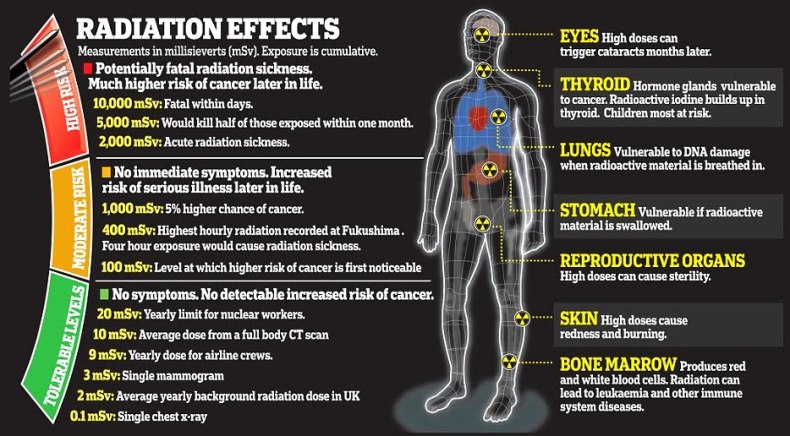
Changes for worse or better protection for workers and the public is on the international
and national political agenda in a number of countries. Trade Union, environment and
public health groups around the world are concerned that the USA is considering proposals
that would weaken radiation protection standards at a time when the scientific evidence
suggests these need to be significantly tightened.
Our concern arises as a result of a Directive (EO 14300) 1 issued in May 2025 by US President
Donald Trump requiring the US Nuclear Regulatory Commission (NRC) to review nuclear
safety regulations with particular reference to radiation protection of workers and the
public. The Directive instructs the NRC to abandon fundamental principles that have
formed the basis for radiation protection for much of the past century. These include: the
internationally accepted position that there is no threshold or safe level of exposure; that,
as a consequence, all exposures should be kept as low as reasonably achievable (ALARA) ;
and all exposures to workers and the public be kept below strict annual limits in line with
the best evidence of radiation-induced health risks.
The evidence used to set current standards was drawn mainly from the studies of cancer
rates among the Japanese A-bomb survivors who were exposed to relatively high doses over
short time periods. Since then studies of workers in nuclear power facilities exposed to
lower doses over long time periods show higher rates of cancer than predicted by the
Japanese studies. Rather than indicating any threshold these studies suggest that at low
doses the cancer rates are proportionately higher than expected from the Linear No-
Threshold model used to set current standards. 2 Worker studies also show elevated rates of
cardio-vascular diseases 3 , and increased rates of dementia 4 . In addition, studies on
populations around nuclear power plants are now showing higher cancer rates affecting
particularly children 5 and the elderly 6 – correlated to how close they lived to these facilities.
Despite this mounting evidence that exposure limits should be lowered the likely result of
changes in line with the Presidential directive would be to increase the permissible exposure
limit for workers and the public to five times the current internationally recommended
level.
The US NRC is clearly faced with a dilemma. To adopt the changes demanded by the
President would require reversing its 2021 decision that specifically rejected these same
proposals 7 . The initial date for publication of the NRC’s draft response for public
consultation was 23 February 2026. This was deferred to 30 April and again at short notice
to 24 June. One might speculate that despite large scale resignations and lay-offs among
NRC staff there remain some with scientific integrity opposing the changes. However the
final revision of standards is required by end of November 2026. Given the President’s
record for seeking retribution on government representatives or officials who oppose his
plans it is hard to see any outcome from the NRC other than a change to weaken the US
standards.
There will also likely be pressure on international and national standards agencies to align
with changes in the USA. Some push-back can be expected. Already the heads of European
standards agencies have issued a statement supporting the LNT and ALARA principles and insisted that exposure standards be set on the basis of the scientific evidence without
undue influence. 8 However NRC changes in line with the Trump Presidential Directive will
embolden the nuclear power lobby and create pressure for change where there are joint
ventures involving US military or industrial interests. These changes are also likely to
impede public pressure for review and improvement of current standards.
In Australia, for example, there are a number of joint ventures in uranium and radioactive
rare earths and mineral sands mining and the government has already established a
separate Naval Nuclear Power Safety Regulator (ANNPSR)to oversee all aspects of
construction, operation, maintenance, decommissioning and nuclear waste management
under the Australia-UK-US (AUKUS) nuclear submarine program. While these standards are
expected to be consistent with those of the current Australian Radiation and Nuclear Safety
Agency (ARPANSA) the pressure for change can come from either agency. Hopefully it will
be politically independent science-based pressure to not merely oppose the direction
prompted by the US President’s directive but for better standards to protect health of
workers and the public where they are routinely exposed to ionising radiation.
References and Further Reading……………………………………
Trump‑Xi summit: Cautious Progress On Trade, Ties And Some ‘Win‑Wins’.
But importantly, Xi and Trump agreed to establish a Board of Trade and Board of Investment – intended to create a pathway forward to more trade in the months to come.
May 16, 2026 , Yan Bennett for the Conversation, https://scheerpost.com/2026/05/16/trump-xi-summit-cautious-progress-on-trade-ties-and-some-win-wins/
President Donald Trump departed China on May 15, 2026, after a two-day summit with Chinese leader Xi Jinping that was scrutinized from every angle for clues on where the relationship is heading.
Trump hailed the trip as “incredible,” while Xi remarked that it marked a “new bilateral relationship.” Other observers were a little less enthusiastic, noting that no major breakthroughs were evident at the highly anticipated meeting of the world’s two most powerful political leaders.
The Conversation turned to Yan Bennett, an expert in U.S.-China relations and author of “American Policy Discourses on China,” to provide her three big takeaways from the summit.
Taiwan: Tough(ish) talk but status quo in place
No one really expected there to be movement on Taiwan – which mainland China lays claims over – although it is clear that Beijing would like the United States to make a firmer stance against the island moving toward a declaration of independence, or for the U.S. to expressly demand reunification.
So what we got was Beijing reiterating that Taiwan remained a priority and a core interest. Xi did this on the first day of the summit, noting that the Taiwan “question” remained “the most important issue in China-U.S. relations,” and that any mishandling of it could lead to “clashes and even conflicts.”
But this was aimed at two things. First, Xi has a domestic audience he needs to address, and Taiwan has long been important to Chinese rhetoric. The Chinese Communist Party has around 100 million members, many of whom would have expected Xi to talk tough on Taiwan – and it was those people he was largely talking to.
But he was also signaling to the U.S. that it shouldn’t support Taiwanese independence. And that won’t ruffle any feathers in Washington. Indeed, the 2025 National Security Strategy stressed that the U.S. opposed unilateral action on Taiwan from “either party” – a signal to Beijing that it opposed Taiwan declaring independence.
Trump did mention arms deals to Taiwan. But the U.S.’s declaratory policy since the Reagan administration is that it doesn’t allow Beijing to enter discussions about what weapons Washington sells to Taiwan. And that hasn’t changed at all, nor has the U.S.’s treaty commitment to Taiwan since 1979 that requires the U.S. to provide Taiwan with defensive weapons to maintain a sufficient self-defense capability.
Rhetoric aside, everyone is happy with the status quo on Taiwan – it is in no one’s interest for it to change.
But talk of Taiwan has been muddied a little by Xi’s determination to modernize the People’s Liberation Army. The Chinese president has laid out a series of benchmarks including that the PLA should be capable of invading Taiwan by 2027. This has been misinterpreted in the U.S. under the so-called “Davidson window” – a concept that has it that China is intent on invading by that time.
In reality, China is nowhere near able to do so. It doesn’t have a “blue water navy” able to operate without port assistance, and the island is incredibly difficult to invade – it only has two places where you can land, and only at certain times of the year. It is also very mountainous. Taiwan is also slowly building its defenses – and learning a lot from Ukraine’s war with Russia – with the intention of becoming “indigestable” to China.
Xi’s modernization timeline also states that the PLA should be a “world class military” – taken to be a peer to the U.S. – by 2049. But the fact that it spends more on internal security than it does on defense indicates where the CCP’s true interests lay – in domestic security rather than external capabilities.
Trade: Tamped down expectations
The big picture is that the U.S. and China have been trying to restabilize what was until fairly recently a very good relationship in terms of economic ties.
Both sides have clear priorities to that extent. China wants to regain the American market it had in the 1990s and early 2000s – and certainly reverse the trend since 2018’s trade war.
Trump since his first administration has made it clear that he sees Chinese control over supply chains and the trade imbalance as a national security issue. Washington also wants to address unfair trade practices, such as the requirement that American companies hand over blueprints, trade secrets, customer lists, marketing plans and more to operate.
So what was achieved in the summit? On the surface, very little. There was some movement on sales of U.S. beef to China. And Trump announced that Beijing would buy 200 aircraft from Boeing – lower than the 500 that had been earlier touted in media reports. And several Chinese companies agreed to buy Nvidia microchips – a continuation of a process that began in late 2025.
That doesn’t seem much, and it was telling that Trump himself wasn’t being very “Trumpian” on what could be achieved during the summit. He wasn’t promising the moon.
A lot of focus will be on technology. China is about 18 months behind the U.S. in microchip development. Some have questioned whether U.S. companies should be selling chips to China, amid fears that China could steal the intellectual property and be able to use higher-technology chips for defense reasons. The U.S. position is it can’t allow Huawei – China’s telecom giant – to take over the whole Chinese market, so it will only allow the sale of what it considers appropriate-level Nvidia chips.
Military matters: Washington wants to talk
During the Cold War, the Soviet Union and the U.S. always kept the military lines of communications open to avert a catastrophic incident. This hasn’t been the case with Beijing and Washington. We saw that in 2001 when a U.S. aircraft collided with a Chinese jet; and again over the “Chinese spy balloon incident” in 2023.
Washington is seeking to open up a line of communication on military matters, and that is probably why U.S. Secretary of Defense Pete Hegseth was there in Beijing. Indeed, it is highly unusual for a defense secretary to be at such a summit.
Not that Trump believes he needs China’s help on military matters. He made that clear when asked about possible Beijing assistance prior to the summit.
In fact, little news came out of the summit on Iran. China has criticized the U.S. over the war, but has also quietly been telling Tehran to stop bombing Gulf countries.
Despite some commentary suggesting that Beijing benefits from the U.S. being bogged down in the Middle East, what Xi will want is a resolution before the economic fallout bites in China.
China’s stockpile of Iranian oil will only last a few more weeks and then oil price rises will hit China like a brick.
Trump overseeing decline of US world dominance…and that’s good

Walt Zlotow West Suburban Peace Coalition Glen Ellyn IL, 16 May 26
The global economic consequences of Trump’s failed war on Iran have yet to be fully realized. But even if Trump surrenders to Iran’s sensible demands today, they will degrade the world economy for months to come.
Trump is utterly trapped because he cannot win with either his current blockade or renewed bombing campaign. All US bases in the Gulf States are damaged or destroyed. Gulf States oil infrastructure is degraded. Should Trump renew bombing, Iran will completely destroy them, finish off US bases, and resume degrading Israeli infrastructure as well.
The Gulf States will never again put their full security in US military might. It has proven a complete failure in winning a war against their imagined enemy Iran. America’s Asian allies Japan the Philippians, Taiwan and others now realize the limits of US power and credibility. European NATO countries are coming to the same conclusion as Trump has largely left them on their own to continue their futile effort to push Russia out of Ukraine.
As horrendous as the Iran war’s consequences are, the decline of US world dominance is an outcome we should welcome. China has passed up the US both economically and politically, in part because they have used investment, not intimidation, economic sanctions and yes, bombings to exert their power on the world stage. Outside of Israel, most countries are moving toward multi power polarity as evidenced by BRICS and the Shanghai Cooperation Organization rather than rely on, even prostrate themselves before US military might.
There is a long way to go before America fully realizes the folly of its quest to rule the world using violence. We’re still bombing countries posting no threat to the US whatsoever. Trump has bombed Somalia over 60 times this year tho most Americans couldn’t find it on a map, much less fear its non existent threat. We killed over a hundred to depose and kidnap Venezuelan President Maduro. We’ve killing Cubans with our grotesque economic sanctions, including cutting off most their oil imports. We’re still providing intelligence and military aid for Ukraine to continue its war with Russia. Of course, worst of all we have not given up on destroying Iran and may resume the futile bombing at any moment.
But US world dominance is inexorably eroding due to its refusal to pivot from war to peace to resolve international disputes. If somehow, some way America accepts this reality of a new world order without US dominance, we can thank, in part, President Trump for making that shift with his launching a war too far against Iran.
1 June Webinar – The High Cost of Nuclear Power
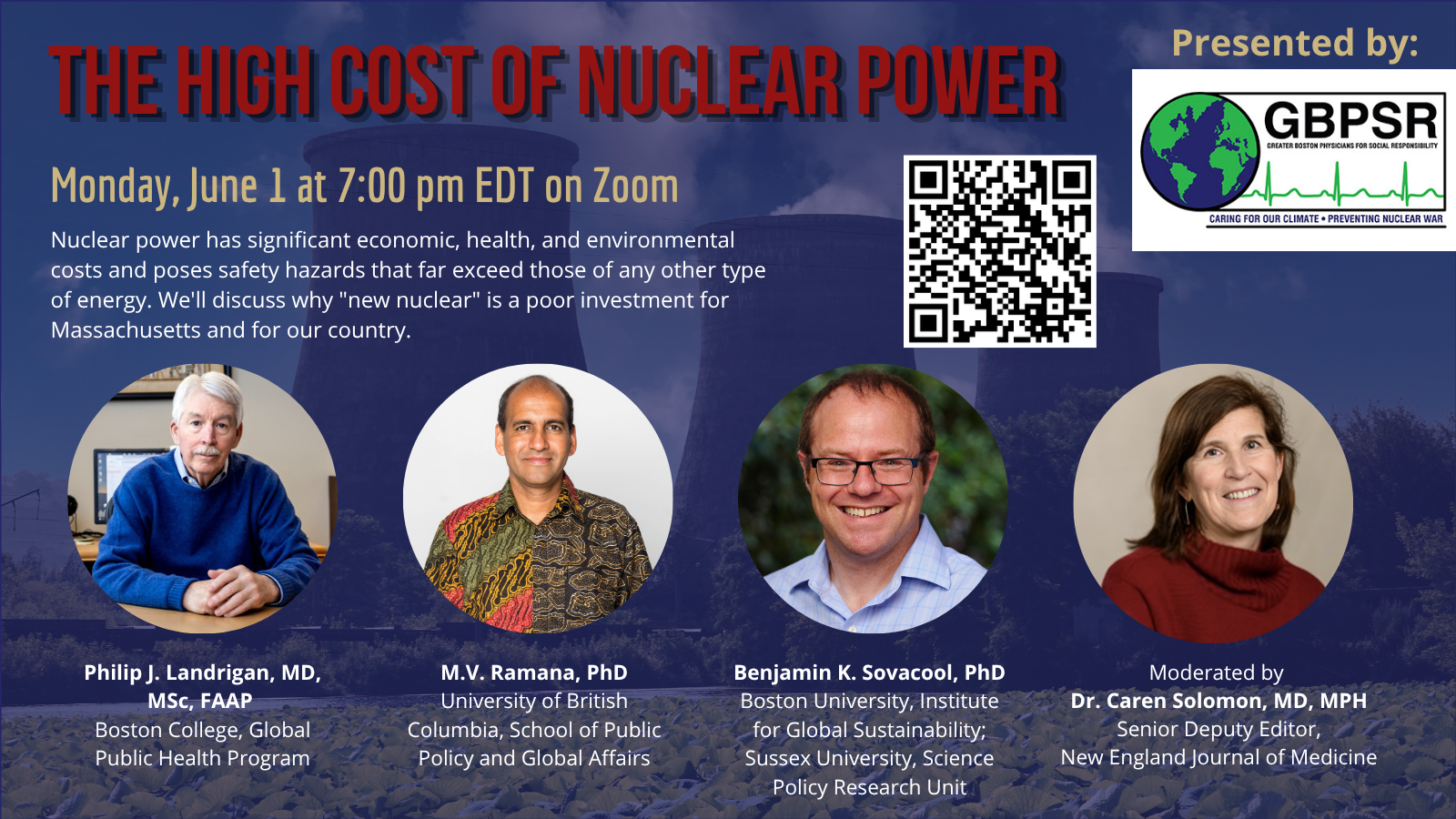
June 1 from 7:00 to 8:30pm.
Greater Boston Physicians for Social Responsibility (GBPSR) invites you to hear our experts critique the misguided push in the U.S. to expand nuclear power and discuss how we can advocate for a better energy future together.
Come learn how nuclear energy will lead to unacceptable, unjustifiable and unnecessary health, safety and energy costs in Massachusetts and in the U.S. on a virtual symposium
Background: Nuclear power has significant economic, health, and environmental costs and poses safety hazards that far exceed those of any other type of energy. We will discuss why “new nuclear” is a poor investment for Massachusetts and for our country and how investing in nuclear power could interfere with the transition to an affordable, healthy renewable energy future.
Presenters:Dr. Philip Landrigan, Boston College, Global Public Health program Dr. Benjamin Sovacool, Boston University Institute for Global Sustainability Dr. M.V. Ramana, U. of British Columbia, School of Public Policy and Global AffairsModerator: Dr. Caren Solomon, Deputy Editor at the New England Journal of Medicine Register
Questions grow in Belgium over plan to nationalize Engie nuclear plants.

Government faces scrutiny over reactor restart costs and long-term energy strategy
Seyma Erkul Dayanc, 15 May 2026,
Questions are growing in Belgium over the government’s plan to acquire the Belgian nuclear activities of French energy company Engie, according to French daily Le Monde on Friday.
The project, backed by Prime Minister Bart De Wever, comes as five of Belgium’s seven nuclear reactors remain shut down, with some already undergoing dismantling procedures.
Le Monde reported that restarting the inactive reactors could require investments estimated between €3 billion ($3.4 billion) and €4 billion ($4.5 billion), particularly to comply with post-Fukushima safety standards.
The Belgian government has already decided to extend the operation of two reactors — Tihange 3 and Doel 4 — by 10 years.
The report added that financial and technical audits will be carried out before a memorandum of understanding (MoU) expected by Oct. 1.
“There is always a possibility that there will be no agreement,” Belgian Energy Minister Mathieu Bihet said.
AA 15th May 2026, https://www.aa.com.tr/en/europe/questions-grow-in-belgium-over-plan-to-nationalize-engie-nuclear-plants/3938781
UK Nuclear Regulatory Review

On the Energy Independence Bill in the King’s Speech Sophie Bolt, CND
General Secretary says: “When you think of nuclear accidents like at
Windscale in 1957, Chernobyl in 1986, or Fukushima in 2011, it’s easy to
see that Britain’s current nuclear regulatory procedures and rules are in
place for a simple reason – that nuclear power is inherently dangerous.
Rather than acknowledge these risks or legacy issues – like tackling the
toxic waste generated by nuclear power – the government’s plan to cut
regulations essentially means this industry will be more dangerous.
This is disturbingly similar to what Donald Trump did earlier this year when he
gutted the US Nuclear Regulatory Commission and the US Environmental
Protection Agency. These proposed regulatory changes are also for the
benefit of Britain’s deadly and costly nuclear weapons programme, which
already accounts for almost a quarter of Britain’s military budget. Rather
than strengthening our energy security, these proposals will instead weaken
it and put us all at even greater risks from the nuclear industry.”
CND 15th May 2026,
https://cnduk.org/category/press-releases/
Heatwaves in high 40 degrees Celsius are ‘new normal’ for India and Pakistan, scientists warn

Climate crisis has tripled the likelihood of
extreme heat occurring, study finds. Temperatures reaching the high 40
degrees Celsius across India and Pakistan are no longer extreme weather
events but a regular feature of the pre-monsoon season, scientists have
warned.
The finding comes from a rapid attribution study by World Weather
Attribution, an international scientific collaboration that analyses the
role of the human-caused climate crisis in extreme weather events. The
study, published on Thursday, examined a prolonged period of extreme heat
that struck India and Pakistan between mid-April and early May, when daily
maximum temperatures exceeded 46C in several cities, causing at least 37
heat-related deaths in India and 10 in Karachi, Pakistan.
Independent 15th May 2026, https://www.independent.co.uk/climate-change/news/india-pakistan-heatwave-deaths-b2977059.html
How Russia signals nuclear resolve with civilian nuclear energy infrastructure.
Iran today: a different geopolitical climate for nuclear energy. In the most recent war in Iran, Russia has so far refrained from making explicit nuclear threats, but the United States and Israel may have adopted a similar ad hoc approach that substitutes threats on civilian nuclear energy infrastructure for traditional nuclear threats.
Trump’s threats suggest that the United States has begun blurring the lines between conventional energy infrastructure, nuclear energy infrastructure, and nuclear weapons.
Bulletin, By Elena Tiedens | Voices of Tomorrow | May 14, 2026
The Russian state-run nuclear energy company Rosatom evacuated hundreds of workers from the Bushehr nuclear power plant in Iran in late March. The Rosatom employees who remain are responsible for ensuring the safe operation of a nuclear power plant in a war zone—but may also serve the dual purpose of re-affirming Russia’s interests in the region. Long treated as the peaceful counterpart of nuclear weapons, civil nuclear power plants now play a role as a nuclear signaling option in wartime. (Nuclear signaling can be thought of as a non-explicit reminder, at a step below a direct threat, that is meant to call an adversary’s attention to the risk posed by one’s possession of nuclear weapons—though experts disagree on terminology and definitions.)
Russia began its pattern of power plant-based nuclear signaling at Ukraine’s Zaporizhzhia nuclear power plant. There, Russia has deterred Ukrainian forces from retaking the plant by threatening nuclear destruction, potentially leading to nuclear weapons use, should Ukraine and its allies attack Zaporizhzhia. In recent months, Russia has made similar statements about the potential for nuclear catastrophe at the Bushehr plant, as a deterrent to further US strikes.
Although this type of nuclear signaling is likely not a fully developed aspect of state nuclear strategy, Russia has increasingly relied on nuclear power plants as an ad hoc line of defense during wartime. Given Rosatom’s global footprint—Rosatom’s civil nuclear energy projects are expanding across the world, with at least 41 civil nuclear energy projects planned in 11 countries ranging from Bangladesh to Hungary—states must reconsider their nuclear energy contracts with the nationalized energy company. And because there are indications that the United States and Israel may be following Russia’s lead in their recent
strikes on Bushehr, the global community must redefine and condemn signaling with nuclear power plants as a new nuclear threat.
Nuclear signaling at Zaporizhzhia. The Russian occupation of Ukraine’s Zaporizhzhia plant—the largest nuclear power plant in Europe—was a watershed moment in nuclear history: the first military occupation of a civilian nuclear power plant. Russia first invaded the Zaporizhzhia power plant in March 2022, and after Rosatom’s efforts to redirect the plant’s electricity from the Ukrainian to Russian energy grids failed, the Russian military repurposed the plant as a military base from which to launch further operations in Eastern Ukraine.
Russia warned that attempts to retake the plant could trigger a nuclear disaster, followed by potential Russian nuclear weapons use. In September 2022, Russian President Vladimir Putin said he was not afraid to use nuclear weapons to protect Russian territory, including the Russian-occupied Zaporizhzhia plant. These statements served as a nuclear deterrent without the deployment of a single warhead—and consequently were less risky for Russia. Although Russia’s occupation of the plant constitutes a serious nuclear, environmental, and humanitarian risk, Russia has attempted to reverse the narrative to signal that a Ukrainian effort to retake the nuclear power plant would be an unjustifiable nuclear risk.
In Ukraine, Russia’s occupation of Zaporizhzhia has become an essential aspect of its nuclear posture, which treats a potential Ukrainian defense of the plant as a nuclear redline. Although Russia has faced international condemnation for its activities in Zaporizhzhia, Russia may view statements about the reactor as less risky and escalatory than those involving weapons capabilities.
Nuclear signaling in the Twelve-Day War. During the Twelve-Day War between Iran and Israel in June 2025, Russia proved itself willing to use similar rhetoric about the potential for civil nuclear disaster. After the United States got involved toward the end of the war and bombed Iranian nuclear enrichment facilities in Isfahan, Natanz, and Fordow, Russia sought to deter further attacks—but without providing political support or military hardware that would detract from its objectives in Ukraine. Russian Foreign Minister Maria Zakharova warned that any US strike on the Bushehr plant “would be an extremely dangerous step with truly unpredictable negative consequences.”
Putin went a step further. When asked how Russia was supporting Iran, Putin implied that continued operation of the Bushehr reactor during the June 2025 war was Russia’s primary means of support for Iran. “Isn’t that support? Iran has not asked us for any other support,” Putin said.
Russia’s approaches in Ukraine and in the Twelve-Day War are not identical, but they both demonstrate a willingness to weaponize civilian nuclear infrastructure through deterring attacks and in service of its strategic objectives.
Iran today: a different geopolitical climate for nuclear energy. In the most recent war in Iran, Russia has so far refrained from making explicit nuclear threats, but the United States and Israel may have adopted a similar ad hoc approach that substitutes threats on civilian nuclear energy infrastructure for traditional nuclear threats. Since mid-March, the United States and Israel have launched four separate strikes that have reportedly hit within the perimeter of the Bushehr nuclear complex. Although the United States and Israel have not claimed responsibility for the strikes—and the projectiles have not hit the reactor or resulted in radiation leaks—the possible targeting of a nuclear power plant is an alarming escalation.
This risk is particularly acute in light of US President Donald Trump’s March 21, 2026, threat to “obliterate their [Iran’s] power plants, starting with the biggest one first.” Some experts have speculated that Trump intended to threaten a strike on Bushehr, which is not Iran’s largest power plant but is the country’s largest nuclear plant. While attacks on civilian energy infrastructure are generally illegal under the Geneva Conventions, a strike on Bushehr would also constitute a risky weaponization with serious nuclear escalation risks beyond those associated with non-nuclear civilian energy infrastructure. Although less thoroughly articulated than Russian threats involving Zaporizhzhia, Trump’s threats suggest that the United States has begun blurring the lines between conventional energy infrastructure, nuclear energy infrastructure, and nuclear weapons.
Rosatom’s reactors worldwide and implications for the global nuclear order. Scholars have begun to identify the new role of nuclear energy infrastructure in war, but what is missing is a serious reckoning with not only the environmental and human effects of attacks on nuclear energy infrastructure but also the ways in which such threats intersect with traditional nuclear signaling. Nuclear energy is not a new wartime technology akin to drones or cyber warfare. Instead, it should be understood as an object of evolving strategic thought. This is not to say that signaling with nuclear power plants isn’t dangerous; to the contrary, it is extraordinarily dangerous. But experts should resist the urge to view nuclear energy and nuclear weapons as distinct threats. The risks of nuclear weapons—physical radiation and uninhibited escalation—can also occur in a world in which nuclear powers see nuclear energy as a platform on which to project their strategic objectives.
This moment not only requires a clear articulation of the risks but also a willingness of all states to reject the use of nuclear energy for wartime signaling. This refusal crucially includes nuclear weapons states but also countries across the world who have increasingly become recipients of Rosatom power plants in what has sometimes been dubbed “the new nuclear age.” As Rosatom’s civil nuclear reactor enterprise expands, Russia’s allies and partners, neutral states, and the global nuclear community must take steps to lessen these risks.
Even for Russian allies and partners like Iran, Rosatom’s nuclear power plants do not serve as a meaningful form of defense but rather as a way for Russia to provide rhetorical—but not tangible—support. For example, Iran has not benefited from Russian signaling as it continues to face devastating losses. Meanwhile Russia has received much-needed financial relief from oil sanctions lifted by the Trump administration. Russia’s allies considering contracts with Rosatom might take the Iranian case as a cautionary tale………………………………………………………………………………………………………………………
Nuclear energy at the 2026 NPT Review Conference. At the ongoing NPT Review Conference, states have already raised the alarm about threats to nuclear energy infrastructure during wartime. The European Union, for instance, urged Russia “to refrain from carrying [out] attacks on such infrastructure, which constitute a serious threat to nuclear safety and security.” The Non-Aligned Movement broadly condemned strikes on nuclear infrastructure. Both statements treated risks at nuclear energy installations as the unfortunate byproduct of careless actions and armed conflict in the vicinity of power plants. But the connection between nuclear energy and nuclear escalation is not accidental; it is the result of an increasingly prevalent nuclear signaling strategy.
During the Cold War, US and international diplomats saw nuclear energy and other civil nuclear technologies as the peaceful partner to nuclear weapons, an assumption embedded in the NPT and other global nuclear treaties. But recent developments raise the possibility that nuclear energy installations will increasingly become flashpoints in war.
Preventing this outcome requires states to hold each other accountable and to forcefully denounce the use of nuclear energy infrastructure in nuclear signaling. At the NPT Review Conference, state parties should, at a minimum, resolve to follow and implement the International Atomic Energy Agency’s Seven Indispensable Pillars for nuclear safety and security in Ukraine, which include resolutions to maintain the physical integrity and backup power supply of nuclear plants……………….. https://thebulletin.org/2026/05/how-russia-signals-nuclear-resolve-with-civilian-nuclear-energy-infrastructure/
The West’s Descent Toward Totalitarianism
Mattias Desmet, 14 May 26, https://scheerpost.com/2026/05/14/mattias-desmet-the-wests-descent-toward-totalitarianism/
Western societies aren’t drifting into authoritarianism, Mattias Desmet argues — they’re sleepwalking into it. In this wide‑ranging conversation, the Belgian psychologist behind The Psychology of Totalitarianism dissects what he calls the “mass formation” gripping the West, a psychological process that replaces democratic debate with enforced unanimity and moralized hysteria. From Russiagate to COVID to Ukraine, Desmet traces a pattern: “The environment is quite suffocating… we must all believe the exact same thing.” What emerges, he warns, is not the old model of dictatorship but a new, technocratic totalitarianism — one driven not by charismatic tyrants but by bureaucrats, experts, and a population desperate for meaning in an atomized world. His message is blunt: unless dissenters understand the psychology behind this new system, they will fight the wrong battle.
Highlights
Mass formation as the engine of modern totalitarianism Desmet argues that today’s authoritarian drift is not imposed by brute force but emerges from a psychological process in which isolated individuals fuse into a fanatical collective.
The suffocating demand for unanimity Diesen notes the pattern: Russiagate, COVID, Ukraine — each crisis enforced a single “absurd” narrative, with dissent treated as treason. Desmet agrees: “People become completely blind… incapable of taking a critical distance.”
Why educated elites are most vulnerable Desmet describes how highly trained professionals become “completely blind” when facts contradict their ideological commitments — a phenomenon he first observed in academia.
Technocratic totalitarianism replaces the old dictatorships Unlike Hitler or Stalin, Desmet says, today’s system is run by “dull bureaucrats and technocrats,” echoing Hannah Arendt’s warnings from 1953.
The 20–30% who become the regime’s enforcers In mass formation, a minority becomes so fused with the narrative that they act as a de‑facto secret police: “They are willing to report everyone to the state who doesn’t conform.”
Why people sacrifice everything — even family Mass formation creates loyalty to an abstract ideal stronger than human bonds. Desmet cites historical examples where parents reported their own children to the state.
Loneliness as the root of the crisis Modern atomization — “40 to 70% feeling isolated,” he notes — creates the psychological vacuum that mass movements fill.
How narratives hijack free‑floating anxiety When people feel anxious without knowing why, they latch onto any explanation — virus, enemy, threat — even if it’s irrational. This gives them a sense of control and belonging.
COVID as a textbook case Rituals like masking and vaccination functioned as belonging‑markers, Desmet says, while society accepted inhumane outcomes: elderly dying alone, neighbors reporting neighbors.
The rapid narrative shift to Ukraine As soon as COVID lost its grip, a new object of anxiety appeared: “the dangerous monster Putin.” The psychological mechanism remained identical.
‘He asked if I would defend them’: Trump shares key details of Xi meeting
Michael Koziol, 16 May, 26, https://www.smh.com.au/world/north-america/he-asked-if-i-would-defend-them-trump-shares-key-details-of-xi-meeting-20260516-p5zxnw.html
Washington: Xi Jinping asked directly whether the US would defend Taiwan in a war, Donald Trump said, as he divulged key details of his conversations with the Chinese president while flying home from the high-stakes meeting in Beijing.
The two men also spoke “in great detail” about US arms sales to Taiwan, which China would like to stop, and which Trump has not committed to continuing. He said he would make that decision soon, after speaking with the leader of Taiwan.
“President Xi and I talked a lot about Taiwan … he’s against very much what they’re doing,” Trump said aboard Air Force One.
“He does not want to see a fight for independence because that would be a very strong confrontation … I didn’t make a comment on it, I heard him out. I have a lot of respect for him.”
Asked by a reporter whether he would defend Taiwan, Trump said he would not answer – maintaining the long-standing US position of strategic ambiguity. He said he gave the same response to Xi.
“He asked me if I would defend them. I said, ‘I don’t talk about that’. There’s only one person that knows that. You know who it is? Me.”
In December, the Trump administration approved a record $US11.1 billion ($15.5 billion) arms package for the self-governing democracy (over which China claims sovereignty). But the president has delayed approval of another package worth up to $US14 billion.
Trump indicated he did not feel bound by the so-called “six assurances” given to Taiwan in 1982 under then president Ronald Reagan, one of which was that the US would not consult China about arms sales to Taiwan.
“1982 is a long way, that’s a big, far distance away,” he told reporters on the plane. “[Xi] brought that up, he talked about that to me – so what am I gonna do, say, ‘I don’t want to talk to you about it because I have an agreement that was signed in 1982?’
“I made no commitment either way. I’ll make a determination over the next fairly short period of time. I have to speak to the person – you know who he is – that is running Taiwan.”
Trump said he and Xi also discussed lifting US sanctions on Chinese oil companies that buy oil from Iran, and would decide in the next few days.
The US president’s account of his conversations with his counterpart were far more detailed than the summary given by the Chinese foreign minister, Wang Yi, when answering questions from state-affiliated news agencies.
Wang said the two men spent nine hours together across their several encounters, which included the bilateral meeting, a banquet dinner, a visit to the Temple of Heaven and tea/lunch at Xi’s Zhongnanhai compound.
He emphasised the centrality of the Taiwan question, repeating Xi’s message that “if handled poorly, the two countries will clash, pushing the entire Sino-US relationship into a very dangerous situation”.
Wang added that China hoped the US would take “concrete actions” to safeguard the relationship, which the Chinese are now framing as being one of “constructive strategic stability”.
On Iran, Trump said he did not seek Xi’s assistance in pressuring Tehran to reopen the Strait of Hormuz – but that he believed China would lean on its partner regardless, as Beijing also wanted the passage open and free.
“I’m not asking for any favours, ’cos when you ask for favours you need to do favours in return. We don’t need favours,” Trump said.
He also lashed out at journalists on Air Force One, accusing The New York Times’ veteran correspondent David Sanger of treason after he asserted Trump had failed to achieve the political changes he sought in Iran.
“I had a total military victory. But the fake news, guys like you, write incorrectly. You’re a fake guy,” Trump said to Sanger.
“You should know better, David. You know better. Your editors tell you what to write, and you write it, and you should be ashamed of yourself. I actually think it’s treason.”
He also clashed with a BBC journalist who asked about the missile strike on an Iranian girls’ school at the beginning of the war, which reportedly killed about 175 people.
The US has not taken responsibility despite a New York Times report saying a preliminary investigation confirmed it was an American missile. Trump said it remained under investigation.
Meanwhile, the US State Department announced Israel and Lebanon would extend their ceasefire by a further 45 days following two days of talks in Washington.
Israel is not at war with Lebanon but struck targets associated with the Iran-backed Hezbollah terrorist group in the country, including the capital Beirut, during the war against Iran.
It has continued its strikes leading up to this week’s talks, despite the ceasefire that began on April 16. Lebanon’s Health Ministry said 22 people were killed in attacks on Wednesday, including eight children.
The Washington talks represent the first high-level diplomatic relations between Israel and Lebanon for more than 30 years. State Department spokesman Tommy Piggott said political negotiations would resume in early June and a security discussion would be added on May 29.
While the Beijing summit did not produce many immediate tangible outcomes, Trump said China agreed to buy 200 aircraft from American manufacturer Boeing – less than the 500 the firm initially hoped for – and up to 750 “if they do a good job”
This summit was just “the beginning”, he said, noting he and Xi could meet as many as four times this year. Trump has invited Xi to the White House on September 24 – during the United Nations General Assembly’s high-level week – and Beijing confirmed the Chinese leader would visit the US in the northern autumn.
The two leaders could also meet at the Asia-Pacific Economic Cooperation forum in China in November, and the G20 world leaders’ summit December, hosted at the Trump National Doral resort in Miami.
with Lisa Visentin, Reuters
1 This Month

9 September – online public forum THREE MILE ISLAND:
7-8:30 PM ET,
Legacy, resistance to reopening – https://us02web.zoom.us/webinar/register/WN_-LGJU4j6TD2Hgf0rpgAr1A#/registration
The nuclear industry and the U.S. Nuclear Regulatory Commission are threatening to restart Pennsylvania’s permanently closed and decommissioning Three Mile Island Unit 1 nuclear power station. Three expert speakers will present the resistance to this dangerous misadventure in a webinar hosted by the Clamshell Alliance, Beyond Nuclear and Massachusetts Peace Action.


No Nuclear in Cwm Llynfi! Stop the nuclear power station near Maesteg.
To see nuclear-related stories in greater depth and intensity – go to https://nuclearinformation.wordpress.com
-
Archives
- August 2026 (330)
- July 2026 (355)
- June 2026 (287)
- May 2026 (306)
- April 2026 (356)
- March 2026 (251)
- February 2026 (267)
- January 2026 (308)
- December 2025 (358)
- November 2025 (359)
- October 2025 (375)
- September 2025 (257)
-
Categories
- 1
- 1 NUCLEAR ISSUES
- business and costs
- climate change
- culture and arts
- ENERGY
- environment
- health
- history
- indigenous issues
- Legal
- marketing of nuclear
- media
- opposition to nuclear
- PERSONAL STORIES
- politics
- politics international
- Religion and ethics
- safety
- secrets,lies and civil liberties
- spinbuster
- technology
- Uranium
- wastes
- weapons and war
- Women
- 2 WORLD
- ACTION
- AFRICA
- Atrocities
- AUSTRALIA
- Christina's notes
- Christina's themes
- culture and arts
- Events
- Fuk 2022
- Fuk 2023
- Fukushima 2017
- Fukushima 2018
- fukushima 2019
- Fukushima 2020
- Fukushima 2021
- general
- global warming
- Humour (God we need it)
- Nuclear
- RARE EARTHS
- Reference
- resources – print
- Resources -audiovicual
- Weekly Newsletter
- World
- World Nuclear
- YouTube
-
RSS
Entries RSS
Comments RSS
 nuclear-news