The War of Perception: The West’s infowarfare and cognitive warfare against Russia

The West has constructed a dense framework ofperceptual projections: Russia crippled by sanctions, Putin lacking popular support, weapons on the front lines running out, soldiers defeated and in retreat, the people in revolt, the collapse of institutions now imminent. These are a series of recurring themes throughout the mainstream media, with constant, rhythmic, and unrelenting repetition even in the face of contrary evidence. Yet Russia is still standing, and it does not appear at all to be losing the war. Quite the contrary.
The important thing, we reiterate, is not the truth, but what is perceived as the truth.
Cyber operations, social media operations, bot networks, troll farms, memetic warfare, deepfakes, and generative artificial intelligence constitute the most recent and rapidly evolving layer. Troll farms and bot networks automate the production and amplification of content.
to win today, bullets and bombs alone are not enough: people must be convinced that they have won or lost. The rest will follow.
Lorenzo Maria Pacini, August 2, 2026, https://strategic-culture.su/news/2026/08/02/war-perception-west-infowarfare-and-cognitive-warfare-against-russia/
The Center of Gravity of the Conflict and the Western Paradigm
In the conflicts of the last quarter-century, the information dimension has ceased to be merely an adjunct to military action and has become a theater of its own. This formulation is not new: as early as 1998, Vladimir Slipchenko argued that information was becoming “a weapon of the same kind as missiles, bombs, and torpedoes,” and that a new form of warfare had supplanted armed combat as the decisive factor in achieving political-military objectives. What has changed is not the principle itself, but rather the infrastructure that makes it operational: mass connectivity, algorithmic mediation of attention, and the availability of generative tools have lowered costs and multiplied the scope of operations targeting perception.
Defining the cognitive domain as a “new” space of strategic competition, however, requires clarification, as the term can be misleading. The contest for opinions, loyalties, and the will to fight has always accompanied war; Thucydides recorded it in the speeches preceding the decisions of the assemblies. The contemporary novelty lies in three interrelated elements: the technical ability to reach individual citizens directly on an industrial scale, bypassing institutional intermediaries; the fusion of intelligence, cyber, and psychological operations into a seamless continuum; and the emergence of a doctrinal vocabulary—“cognitive warfare,” “information confrontation,” “reflexive control”—that seeks to theorize this contest as a military function in its own right.
Perception has become central, but it is not exclusive; physical destruction has not disappeared: destroyed cities, targeted infrastructure, human casualties. Action on perception has become an enabling condition and a multiplier of kinetic action—in some cases, its substitute—and the relationship between the two registers is the subject of deliberate strategic choice.
First and foremost, we must reconstruct what the West officially declares it does in the information domain, distinguishing it from what is attributed to it. The distinction between stated doctrine, actual capabilities, and presumed intentions is the first tool of analytical rigor.
Joint Publication 3-13 (Information Operations, 2012 edition with subsequent updates) defines IO as the integrated use of information capabilities during military operations to influence, disrupt, corrupt, or usurp the adversary’s decision-making process, while protecting one’s own. The key point is that U.S. doctrine explicitly limits such operations to the context of hostilities or their immediate preparation: it does not contemplate, at least on the stated level, a “permanent information confrontation” in peacetime. It is precisely this temporal limitation, as we shall see, that constitutes the main conceptual asymmetry with Russian doctrine, and it is documented by Russian analysts themselves when they distinguish their own “broad” definition from the Western “narrow” one.
Within NATO, strategic communication is defined as the coordinated use of the Alliance’s communication activities in support of policies and operations. The NATO StratCom Center of Excellence in Riga, established in 2014, and the work of Allied Command Transformation on cognitive warfare represent the most recent developments. It is important to note that these bodies primarily produce defensive analyses—such as how to counter adversarial disinformation—and that their output is largely public. By contrast, as Giles noted, the Russian armed forces’ 2011 proto-cyber doctrine makes no mention whatsoever of offensive capabilities.
On the European front, the East StratCom Task Force, established by the European External Action Service in 2015 under a mandate from the European Council, manages the EUvsDisinfo project to catalog pro-Russian disinformation. Subsequent initiatives—the 2018 Code of Practice on Disinformation and the Digital Services Act—constitute a countermeasure apparatus that Russian sources interpret as a tool for censorship and offensive information warfare. The East StratCom Task Force is an organization openly dedicated to countering Russian narratives, a sort of “weapon” in return, so much so that it is declared a means of defense against external attacks.
The EISI document repeatedly mentions think tanks, NGOs, and research institutes as components of the Western information apparatus. Organizations such as the RAND Corporation, Chatham House, the Royal United Services Institute (RUSI), and the Center for Strategic and International Studies (CSIS) do indeed produce influential analyses on Russia. RAND, in particular, published a 2016 study by Christopher Paul and Miriam Matthews on the “firehose of falsehood” model of Russian propaganda, and in 2019, a report on measures to “counter and deter” Russia. This coordinated cognitive warfare, directed by a strategic center, has set a precedent and inspired many other similar centers.
Framing the Enemy
We can even compile a catalog of the techniques the West employs against Russia. It is useful to examine them by grouping them into functional categories.
The first group concerns widely studied political communication techniques that are neither specifically Western nor secret…………………….
The second group concerns the portrayal of Russian leadership. The personalization of the conflict—that is, the reduction of a structural antagonism to the figure of a single leader—is a real phenomenon widely used in Western political communication, and it has always worked. The narrative surrounding Vladimir Putin has varied many times but has always remained consistently negative, never allowing for any positive portrayal in any respect.
Let us then consider fact-checking and the so-called fight against disinformation. The West has had to go to great lengths to create “fact-checking” agencies in order to control the flow of information. The idea of objective truth is neutralized; any data is potentially incorrect. Trust in verifiable reality is eroded to the point where it no longer serves any purpose, and thus the constructed narratives end up being not only legitimized but also preferred, because they are psychologically more convenient—they do not disrupt people’s emotional and rational frameworks.
Danilin lists a catalog of Western organizations created, in his view, to counter Russia: the EU’s East StratCom Task Force, the UK’s National Cyber Security Centre, the Counter Disinformation Unit, VIGINUM in France, and others, including defensive cybersecurity agencies, disinformation analysis units, and intelligence services. Some of these structures exist and have public mandates; VIGINUM, for example, is a French agency established in 2021 with the stated task of detecting foreign information interference. Rather than a unified front under a single command, these are organizations that coordinate with one another in a constant dialogue—where, it is true, there are multiple command centers, but with a unified intent and a shared enemy.
In the Mind
If cognitive warfare targets the thought process rather than its content, its analysis requires the use of the cognitive sciences. The contemporary foundation is Daniel Kahneman’s two-system model, developed with Amos Tversky. System 1—rapid, automatic, emotional—governs most everyday judgments; System 2—slow, deliberative, and effortful—intervenes only when it is activated. Effective cognitive operations target System 1: the availability and representativeness heuristics, as well as the confirmation and anchoring biases identified by Kahneman and Tversky’s research program, constitute potential points of attack. Repeated information becomes available to memory and is therefore perceived as true (the illusion of truth); an emotionally charged image overrides deliberative evaluation……………………………………………………………………………………………………..
In the Conflict
The Russia-Ukraine conflict has undoubtedly served as a prime testing ground for experimenting with and putting strategies to the test in hybrid domains.
Read more: The War of Perception: The West’s infowarfare and cognitive warfare against RussiaThe West has constructed a dense framework ofperceptual projections: Russia crippled by sanctions, Putin lacking popular support, weapons on the front lines running out, soldiers defeated and in retreat, the people in revolt, the collapse of institutions now imminent. These are a series of recurring themes throughout the mainstream media, with constant, rhythmic, and unrelenting repetition even in the face of contrary evidence. Yet Russia is still standing, and it does not appear at all to be losing the war. Quite the contrary.
In this context, two other elements play a fundamental role: data and images. Data is considered an important criterion of truth because, at least in theory, it should be verifiable. However, data comes from sources that collect and process it. The problem, therefore, is who these agencies are and where the data comes from, how it is processed, and how it is disseminated. Here, arbitrariness is nearly total: whoever owns the agency owns the data. And, furthermore, whoever controls the data storage holds the (digital) weight of truth.
As for images, the issue is very similar. Images convey a message with greater immediacy than written texts and numbers; therefore, they are more effective, and their use is so powerful that, since ancient times, they have been the primary tool for comprehensive storytelling—that is, both rational and emotional—that we can employ. The Russian-Ukrainian conflict is a textbook example: from day one, the web has been flooded with photos and videos of the situation at the front, within the respective countries, and of what was happening in the surrounding areas. The framing of the narrative has always been shaped by images—even to the point of using memes—to such an extent that scientific literature has begun to refer to “memetic warfare.”
A specific feature of the Ukrainian conflict is the role of open-source intelligence (OSINT). Groups such as Bellingcat have documented, through the geolocation of publicly available material, events that the parties tended to conceal—from the downing of Flight MH17 in 2014 to the presence of Russian forces in theaters where their presence was denied. OSINT has introduced a new element: the possibility of distributed verification, which complicates plausible deniability. Russian sources, consistently, tend to classify independent OSINT as a tool of Western intelligence, replicating the pattern of reclassifying any verification as an act of aggression.
Operational Tools
The operational repertoire of contemporary information warfare combines classic intelligence disciplines with recent digital capabilities.
PSYOPS (Psychological Operations), renamed MISO (Military Information Support Operations) in U.S. terminology since 2010, refer to operations aimed at influencing the emotions and behavior of selected audiences in support of military objectives. Strategic communication and public diplomacy operate at a higher level and with a predominantly open mandate: the latter, in particular, refers to a state’s efforts to communicate directly with foreign public opinion—a legitimate and declared activity that Russian sources, however, tend to include in the list of information weapons. Herein lies a fundamental ambiguity in the field: there is no clear-cut and universally accepted line between legitimate public diplomacy and hostile influence operations, and the location of that boundary is itself the subject of political contention.
OSINT, HUMINT, and SIGINT refer, respectively, to intelligence gathering from open-source, human, and signals intelligence sources. Their relevance to information warfare is twofold: they provide data for analyzing the target audience and, in the case of OSINT, have also become a tool for public verification. The 2016 Russian law criminalizing research on Russian television audiences by foreign organizations, and the subsequent designation of the Levada Center as a “foreign agent,” are not signs of weakness but rather of a deliberate effort to close a vulnerability, given that audience analysis is recognized as an enabler of information warfare, and access to it is denied to the adversary.
Cyber operations, social media operations, bot networks, troll farms, memetic warfare, deepfakes, and generative artificial intelligence constitute the most recent and rapidly evolving layer. Troll farms and bot networks automate the production and amplification of content. Memetic warfare exploits the viral spread of compact, emotionally charged cultural units. Deepfakes and generative AI further lower the cost of producing credible false content, introducing a qualitative discontinuity whose full effects are still unfolding. It should be emphasized that these capabilities are available to multiple actors, both state and non-state
Despite everything, the war on the front lines
The collective Western response against Russia is very powerful and detailed, as explained so far. In the case of the Russia-Ukraine conflict, despite the significant role of hybrid warfare, it is still on the front lines that the actual outcome of the conflict is decided. Despite the massive deployment of information capabilities by both sides, the outcome on the ground continues to depend on artillery, drones, air defense, and logistics. Cognitive warfare has not replaced kinetic warfare; rather, it has altered their relationship and sequence. The most defensible formulation—adopted by the most rigorous scholarship—is that perceptual dominance has become an enabling condition and a force multiplier, the effectiveness of which, however, depends on its integration with the other dimensions rather than on their replacement.
The question to ask, therefore, is not whether information warfare will work or lead to victory for one of the parties to the conflict, but how it will do so, and to what extent. Because the first war—the most important of all—is the one fought in the minds of citizens, soldiers, and politicians. It is the war that causes a person to feel in danger and be afraid, or to live a peaceful life as if nothing were happening. It is the one that drives a person to pull the trigger or to let their guard down.
To date, the West has tested a wide array of hybrid weapons against Russia and has never ceased to produce information and manipulate perceptions. And it will continue to do so, because it has become clear that, to win today, bullets and bombs alone are not enough: people must be convinced that they have won or lost. The rest will follow.
Common Sense & the Pentagon Budget
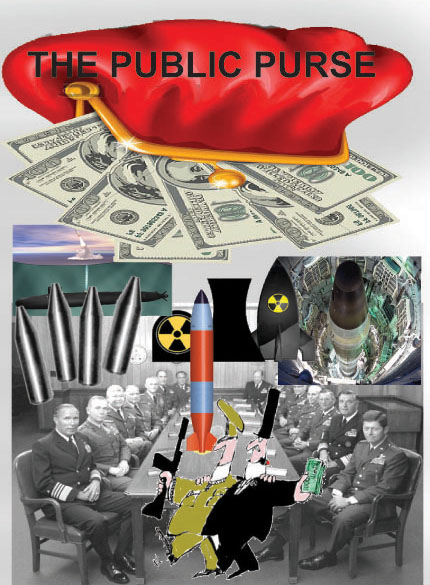
time and reason strongly suggest that the U.S. “defense” budget is out of control, unsustainable and absent of accountability.
Eisenhower said the following:
“Every gun that is made, every warship launched, every rocket fired signifies, in the final sense, a theft from those who hunger and are not fed, those who are cold and are not clothed“
By Dennis Laich
Eisenhower Media Network, July 31, 2026, https://consortiumnews.com/2026/07/31/common-sense-the-pentagon-budget/
For Americans, the courage required today is not to defeat an empire abroad, but to confront one at home — the Military-Industrial-Congressional Complex, writes Dennis Laich.
The first sentence of Thomas Paine’s classic 1776 essay, Common Sense, urged the American people to challenge the legitimacy of the English Crown, something that had never been challenged before.
He wrote:
“Perhaps the sentiments contained in the following pages are not yet sufficiently fashionable to procure them a great favor; a long habit of not thinking a thing wrong gives it a superficial appearance of being right, and raises at first a formidable outcry in defence of custom. But the tumult soon subsides. Time makes more converts than reason.”
Two hundred and fifty years later, time and reason strongly suggest that the U.S. “defense” budget is out of control, unsustainable and absent of accountability.
Only the American people can rein it in
The “defense of custom” in this case will come from the Military-Industrial-Congressional Complex (MICC) of which President Eisenhower warned us in 1961 in his farewell address, and drove home the consequences of in his famous “Cross of Iron” speech in 1953. In his address to the American Society of Newspaper Editors, Eisenhower said the following:
“Every gun that is made, every warship launched, every rocket fired signifies, in the final sense, a theft from those who hunger and are not fed, those who are cold and are not clothed. This world in arms is not spending money alone. It is spending the sweat of its laborers, the genius of its scientists, the hopes of its children. The cost of one modern heavy bomber is this: a modern brick school in more than 30 cities. It is two electric power plants, each serving a town of 60,000 population. It is two fine, fully equipped hospitals. It is some fifty miles of concrete pavement. We pay for a single fighter with a half-million bushels of wheat. We pay for a single destroyer with new homes that could have housed more than 8,000 people… This is not a way of life at all, in any true sense. Under the cloud of threatening war, it is humanity hanging from a cross of iron.”
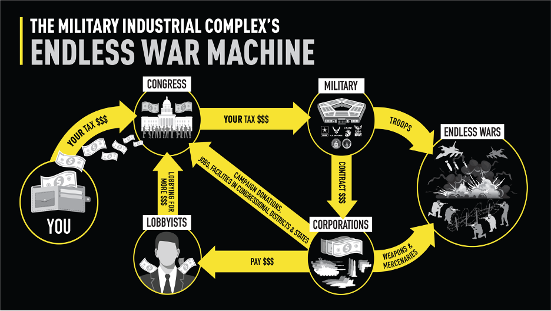
All of these forces benefit by exaggerating threats to our national security which justify a huge U.S. “defense” budget, larger than the next eight nations (most of whom are allies) in the world combined, while American citizens lack health care, childcare and other basic needs.
The defense industry’s lobbyists team up with U.S. politicians, who receive campaign financing from the industry, to draft the annual National Defense Authorization Act, which sets military policy, the expensive weaponry to be purchased and the overall military budget
The industry takes the ensuing windfall and puts it toward stock buybacks, which increase the share price, making the rich richer; dividend payments for shareholders; eight-figure annual compensation packages for corporate executives; and the continual political graft (campaign contributions and lobbyists) that keeps the wheel spinning. Incredibly, some contracts stipulate that only the contractor may repair and maintain equipment.
The most embarrassing example of this practice is the F-35 Stealth Fighter, which is grossly over budget, behind schedule and is only 25 percent fully mission capable.
The principal beneficiaries of the MICC’s practice of vastly overstating foreign threats are the Pentagon and the invertebrate senior uniformed bureaucrats who occupy it and secure lucrative post-retirement employment with the MICC.
The massive Pentagon budget provides the Pentagon with a premier position within both the government and society. Money talks in America, but few members of Congress choose to talk about the $39 trillion national debt to which military spending is a major contributor.
Unfortunately, the uniformed bureaucrats lack the courage to stand up against a draft dodger and a Rambo-wannabe in order to protect their profession or the institution of the military.
Government employees, including military officials, are fired for specious reasons and no one, not even those who were fired, dare speak up regarding the negative impact on morale, discipline and readiness. Nor do they speak up when the U.S. supports genocide in Gaza, extrajudicial murders in the Caribbean, or attacks the Uniformed Code of Military Justice.
These recent developments will serve to accelerate a decline in the U.S. military’s performance. Since WWII, the U.S. has won one war (the first Gulf War), lost four (Viet Nam, Iraq, Afghanistan and Iran) and tied one (Korea). Iran may be as much an embarrassment as a loss.
The United States has failed to achieve its stated objectives in any recent war, despite having a military budget larger than the next eight countries combined and being easily the most defensible of any peer nation (with two friendly, stable nations to its north and south and oceans on its east and west). What football coach could keep his job with a 1-4-1 record?
Additionally, the Pentagon cannot tell the American taxpayer where the money went, since it is unable to pass a financial audit as required by law — something every other department of the federal government is able to do.
Now, they are requesting a 50 percent increase in the defense budget to S1.5 trillion. This is equivalent to your child asking for more money a day after receiving his/her allowance. When you ask what happened to the money he/she received yesterday, the child can’t answer the question, but you give him/her more money regardless.
This represents a level of arrogance and incompetence that the American people should not be asked to tolerate.
Thomas Paine understood something that seemed impossible in 1776. On paper, the American colonies had no chance against the greatest empire on Earth. Britain possessed the world’s most powerful military, immense wealth, and overwhelming resources.
The colonies had none of those advantages. What Paine recognized as “common sense” was that wars are not won by budgets alone. They are won by legitimacy, purpose, and the willingness of a free people to defend their own liberty.
The $1.5 trillion Pentagon budget request represents more than S9,000 per individual taxpayer.
If we Americans are tired of seeing our tax dollars spent on endless wars, bombing campaigns, and military excess while our own communities struggle with the costs of health care, child care, education, and infrastructure, then the time has come to do what Thomas Paine asked Americans to do 250 years ago: challenge the assumptions that have become accepted simply because they are old. The courage required today is not to defeat an empire abroad, but to confront one at home — the Military-Industrial-Congressional Complex — and reclaim a government that serves the American people rather than the interests of perpetual war.
Major General Dennis Laich, U.S, Army, retired, is executive director of the Eisenhower Media Network, an organization of expert former military, intelligence and civilian national security officials who have an independent, alternative story to tell.
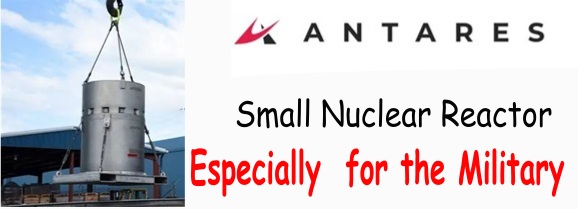
This startup just raised nearly $500 million to build nuclear reactors for the US military.
By Rahim Amir, 30 July 26, https://www.techradar.com/pro/this-startup-just-raised-nearly-usd500-million-to-build-nuclear-reactors-for-the-us-military
Antares lookt to supply small reactors by 2028
- Antares closes $470 million Series C, $370 million in equity and $100 million in debt, co-led by Paradigm and Caffeinated Capital
- The move follows the Mark-0 reaching criticality at Idaho National Laboratory and helps fund an electricity-producing Mark-1 in 2027 and military deployments in 2028
- Antares’ military-first strategy targets a price-insensitive customer bound by an executive order requiring a reactor on a US base September 30 2028
Nuclear fission startup Antares has announced it has raised a total of $470 million in funding as it looks to supply a single client with a looming deadline: the US Military.
The Torrance, California company closed a Series C co-led by Paradigm and Caffeinated Capital, with Point72 Ventures, Shine Capital and Industrious Ventures among the participants, according to TechCrunch‘s look at its PitchBook data.
Antares’ raise comes seven weeks after its Mark-0 microreactor reached criticality at Idaho National Laboratory under the Department of Energy’s authorization in a demonstration run with the DOE, the lab, and BWX Technologies, with the US Army observing.
A direct beneficiary of the White House
Antares calls it the “first privately developed non-light-water reactor to achieve criticality in the United States in more than four decades,” underscoring how important the test was for both Antares and the US military.
The US military’s presence is not by chance; It is mandated by an executive order (“Deploying Advanced Nuclear Reactor Technologies for National Security”) signed by US President Donald Trump to ensure that it has an operating army-regulated nuclear reactor on a domestic military site by September 30, 2028
Antares happens to be one of three finalists in the Pentagon’s Advanced Nuclear Power for Installations program that aims to test-deploy a small module reactor (SMR) on two different air force bases.
With Antares being the first private company to go through that gate under the DOE’s Reactor Pilot Program, it plans to build an electricity-producing Mark-1 reactor in 2027, followed by initial deployments to defense customers by 2028.
UK’s £8.4bn nuclear submarine investment
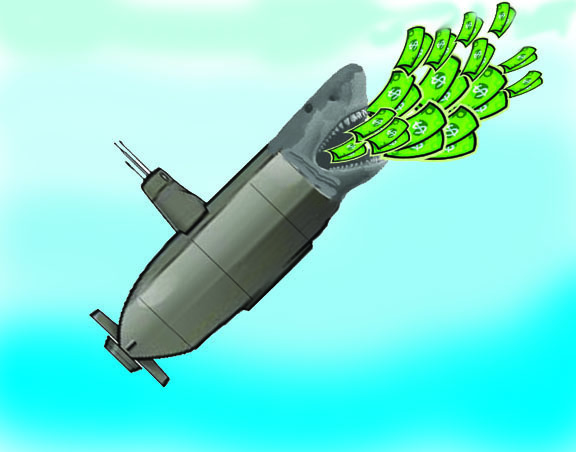
£8.4bn nuclear submarine investment “breathes new life into Barrow’s
historic traditions”. The £8.4bn investment into next generation nuclear
deterrent submarines “breathes new life into Barrow’s historic traditions”,
the UK Government has said.
Prime Minister Andy Burnham, accompanied by
defence secretary Wes Streeting, visited BAE Systems (BAES) shipyard in
Barrow following the announcement that funding has been committed to begin
the fourth major production phase of the UK’s Dreadnought Class submarine
programme.
A contract worth £5.9bn has been agreed by the government and
BAES, the Defence Nuclear Enterprise (DNE) industry partner responsible for
submarine production from its shipyard in Barrow, the home of UK submarine
building.
Further investments are set to be committed to Rolls-Royce
Submarines in Derby and the wider supply chain across the UK. The DNE
supports more than 6,000 UK companies in the supply chain and backs about
47,000 UK jobs.
Insider Media 31st July 2026 , https://www.insidermedia.com/news/north-west/8.4bn-nuclear-submarine-investment-breathes-new-life-into-barrows-historic-traditions
Ukraine continues its use of mine terrorism against civilians
In 2022, I widely documented Ukraine’s deployment of PFM-1 “Petal” mines in Donbass cities. Ukraine has been since also using boobytrapped explosives and now a new version of a”Petal” mine.
Eva Karene Bartlett, Jul 31, 2026, https://evakarenebartlett.substack.com/p/ukraine-continues-its-use-of-mine?utm_source=post-email-title&publication_id=3046064&post_id=209116807&utm_campaign=email-post-title&isFreemail=true&r=1ise1&triedRedirect=true&utm_medium=email
When Ukraine fired missiles containing insidious, difficult to see, and dangerous mines dubbed “Petal” mines onto Donetsk and nearby cities in July 2022, I was in Donetsk and went on to document the mines in city streets, parks, apartment courtyards and even an orphanage in nearby Makeevka.
From the start of an article I wrote for RT immediately after Ukraine’s July firing of missiles containing the mines onto Donetsk:
On Saturday, July 30, just after 9pm, thunderous explosions rocked central Donetsk. Shortly after, there were announcements that air defense had shot down Ukrainian-fired missiles containing ‘petal‘ mines. Given that over 300 of these explosives are packed into each of the Ukrainian-fired rockets, central Donetsk could literally become a minefield if they successfully landed.
Social media and Telegram warnings urged residents to stay inside and wait for Emergency Services to clear the streets and sidewalks – which they began doing during the night. But come daylight, untold numbers of these tiny devices still remained. More warnings were issued to stay at home – better to be late for work than lose a leg. Residents that absolutely have to go out are advised to keep their eyes down to watch where they step, avoid grassy areas, and walk extremely carefully.
…According to DPR Emergency services, Ukraine is using Hurricane MLRS-fired rockets to spread the mines. Each contains 12 cluster munitions, each cluster has 26 mines inside. So each bomb has 312. The cluster explodes in the air, disseminating them widely, scattering in different directions. Their butterfly-like design enables them to glide and land without exploding, usually. Then they lie in wait for someone with bad luck to step on them.
Some of these anti-personnel mines have a self-destruct timer. Others, including the ones Ukraine is firing, have a years-long shelf life. They do pretty much no damage to military vehicles, and therefore their use in Donbass is insidious – deliberately targeting civilians, to leave them maimed….”
[Article continues, more photos on my blog]
US Navy’s nuclear battleship plan raises questions for carriers, submarines and AUKUS
The same reactor vendor, dockyards and specialist workforce that sustain the Virginia boats promised to Australia under the trilateral AUKUS partnership are already working at their limit
Navy Lookout 30 July 26, https://www.navylookout.com/us-navys-nuclear-battleship-plan-raises-questions-for-carriers-submarines-and-aukus/
The US Navy has confirmed that its planned Trump-class guided-missile battleship, whose lead ship would be USS Defiant, will be nuclear-powered. The propulsion decision could have consequences extending beyond the BB(X) programme (now redesignated BBGN), placing additional pressure on US aircraft-carrier construction and the naval nuclear industrial base, with potential second-order implications for AUKUS and the submarine programmes of Australia and Britain.
Going nuclear
When BBG(X) was unveiled at the end of 2025, the Navy’s initial concept depicted conventional integrated electric propulsion using gas turbines and diesel generators. The FY2027 thirty-year shipbuilding plan subsequently confirmed that the battleship would be nuclear-powered, while Navy officials told Congress that it was expected to use the A1B reactor type fitted to the Ford-class carriers.
There is an operational logic to the decision. A large combatant intended to carry extensive missile batteries, high-output lasers, powerful sensors, electronic-warfare equipment and future energy-intensive weapons will require considerable generating capacity. Nuclear power also removes the fuel constraint that would otherwise limit a ship expected to operate across the distances of the Indo-Pacific, and it would make the Defiant-class the first American nuclear-powered surface combatant since the last of the Virginia-class cruisers paid off in the 1990s.
Industrial chokepoint
The difficulty is not the nuclear technology itself, which is proven in service and is a design that could be adapted for the battleships. The issue is the increased pressure on the supply chain. Nuclear-powered surface ship construction in the United States is dependent on one yard, HII Newport News. This facility is already experiencing delays and cost growth delivering the Ford-class aircraft carriers. The GD Electric Boat in Groton is the only other yard certified for naval nuclear work but only builds submarines, which are the Navy’s top priority. The most significant industrial bottleneck is the naval reactor supply chain centred on BWX Technologies, the sole supplier of US naval reactor cores and key reactor components. BWX are simultaneously supplying the CVN programme (each ship has 2 reactors) as well as two major submarine programmes. Adding the nuclear requirement to the battleship programme when there is no spare industrial capacity to draw upon means it must compete directly for nuclear-certified labour, drydock time and reactor components already committed years ahead.
The House Armed Services Committee has backed a requirement for the Navy to explain how the programme would avoid disrupting Ford-class carrier construction and the wider naval nuclear industrial base. The concern is grounded in the sequencing of the work, since naval reactors are ordered two to three years before the hulls they power, so any diversion of components or skilled staff is felt long before a battleship takes shape. The Columbia-class SSBN programme, which replaces the sea-based leg of the American nuclear deterrent, is already running late, while Virginia-class SSN construction is below the rate the fleet requires. Adding a third demand to that base without expanding it invites exactly the outcome Congress is trying to avoid.
The AUKUS dimension
The same reactor vendor, dockyards and specialist workforce that sustain the Virginia boats promised to Australia under the trilateral AUKUS partnership are already working at their limit. Nuclear surface ship construction is concentrated at HII Newport News alone. The GD Electric Boat in Groton is the only other yard certified for naval nuclear work but only builds submarines, which are the Navy’s top priority. Reactor components come from a single supplier, BWX Technologies, that is also supplying the Columbia and Virginia submarine lines. The clearest direct risk is to the Ford-class carrier programme, but submarine output would probably be indirectly impacted, through competition for reactor components, nuclear-qualified personnel and investment across the wider supplier base.
For UK reactor production, the exposure is less significant. British naval reactors are designed and manufactured through the UK Defence Nuclear Enterprise, centred on Rolls-Royce Submarines at Raynesway. Reactors for the Dreadnought and SSN-AUKUS boats are made in Britain and complement rather than compete with US capacity. What the UK relies on from the States is the design pedigree of the PWR3, which, to an unknown extent, is modelled on the S9G reactor that powers the Virginia-class and was developed with USN engineering support.
The last public figure put the UK’s Highly Enriched Uranium (HEU) stockpile at 21.86 tonnes in 2002, but its present size, composition and availability for future naval fuel are not publicly known. Over half of that stockpile was of US origin and none of it is immediately replenishable since domestic weapons-grade enrichment ended in 1962. It is unclear if there is enough for the 4 Dreadnoughts, up to 12 RN SSN-As planned in the medium-term. (Provision of HEU for the 8 Australian SSN-As also has to be considered, although the source for this has not been publicly established). The genuinely usable reserve is smaller than the headline figure once spent cores, warhead reservation and material form are accounted for, and the stock must also serve every future class indefinitely. Building sovereign enrichment capability takes 15-20 years; the UK has committed £1.7bn to a Nuclear Fuels Programme to explore re-establishing a domestic enrichment to reduce dependence on the US in the long run.
Political and industrial reality
The propulsion decision has also exposed the BBGN programme to an even greater extent politically. Before the decision was finalised, then-Navy Secretary John Phelan said the service was still examining the trade-offs. Admiral Daryl Caudle had earlier warned that nuclear propulsion would add a construction ‘tail’ that could push the ship beyond the timeframe of the operational requirement, although he subsequently endorsed the nuclear design. The ambition for 15 battleships sits awkwardly against a fleet that the same plan does not expect to reach 355 ships until FY2040, and then only if industry achieves a dramatic improvement in delivery performance.
There are plenty who believe that BBGN is essentially a vanity project that will be axed as soon as Trump leaves office. Congress has strongly supported the USN’s continued development of the large, but less demanding, conventionally-powered DDG(X) project, although this is officially a replacement for the Ticonderoga cruisers an
Russia’s Starlink killers showcase new era of electronic battlefield warfare.
from
| Lisa Savage, 30 July 26 |
Russia has ramped-up EW use to detect and jam Elon Musk’s Starlink terminals and satellites, Ukrainian media reports.
Volna Kupol Garant
Russia’s latest electronic warfare system reportedly uses a directed high-frequency radio beam to disrupt Starlink operations. Rather than damaging satellites orbiting roughly 500 kilometers above Earth, the system blinds them – cutting their ability to connect with ground terminals while they remain under attack.
According to reports, Volna is a mobile system built around six trailers. Each carries a pair of steerable satellite dishes mounted on rotating platforms. A single battery is reportedly capable of denying Starlink coverage across an area of up to 20 sq km. Some analysts say the system was previously referenced under the designation Peresvet-M, although this has not been independently confirmed.
Ukrainian sources claim Volna was first deployed during Russia’s offensive in the Kharkov region in 2024. They also say its use has increased significantly in recent months.Tobol
The secretive Russian EW complex is reportedly used to disrupt signals from NATO-linked satellite networks, including GPS, Galileo, and Starlink. Reports claim that Tobol attacks satellite communications on both ends of the link – jamming downlinks from satellites to ground receivers and uplinks from Earth to orbit. Its power and range also allegedly allow it to create an electromagnetic “umbrella.”
Kalinka
The system is designed to hunt down satellite communications signals, including those transmitted by Starlink terminals at distances of up to 15 km. It can reportedly track and lock onto even Starshield – SpaceX’s hardened military variant of Starlink. Western media warns that while Tobol disrupts GPS signals on a broad scale, the Kalinka’s precision-targeting capabilities could pose a more direct threat to specific military operations.
Krasukha
The Krasukha-S4 is designed to neutralize reconnaissance satellites, ground-based radar installations, and airborne surveillance systems. It does so by emitting powerful electronic jamming signals that disrupt key radar bands and other radio-frequency emissions. A standard Krasukha-S4 battery consists of two vehicles and has an operational range exceeding 300 kilometers.
Borshchevik
The light mobile system is designed to detect and geolocate Starlink terminals within a 180-degree sector at ranges of up to 10 km, with a reported accuracy of five meters. Using direction-finding and biangulation algorithms, it can locate a target in less than three minutes at a single scanning position. The Borshchevik-2 airborne system hunts Starlink signals from the sky, with reported accuracy down to 0.4 m.
Zelensky’s Dangerous Gambit To Merge The Iran And Ukraine Wars

Of course this would also appeal to Israel, prolonging the Middle East war and potentially drawing European governments into the theater, too.
Trita Parsi Responsible Statecraft, https://scheerpost.com/2026/07/29/zelenskys-dangerous-gambit-to-merge-the-iran-and-ukraine-wars/
As Ukraine’s Volodymyr Zelensky arrives in Washington, much indicates that he is no longer merely trying to draw greater American support into its war against Russia. Increasingly, it appears to be pursuing something far more consequential: merging the Ukraine war with the U.S.-Iran conflict into a single strategic theater.
The distinction matters. If the two wars become one, Ukraine ceases to be merely a recipient of American military assistance and instead becomes a direct participant in Washington’s war with Tehran. By the same token, the United States would no longer simply be Ukraine’s principal arms supplier. It would become an active belligerent against Russia through a conflict that stretches from the Black Sea to the Caspian.
For Kyiv, this would represent the strategic breakthrough it has sought since Russia’s invasion in 2022.
From the outset of the war, Ukrainian leaders consistently urged NATO to move beyond supplying weapons and intelligence. Zelensky repeatedly appealed for a NATO-enforced no-fly zone, warning that anything less amounted to allowing Russia to bomb Ukrainian cities with impunity. He pressed Western governments to provide increasingly sophisticated weapons systems long before they were politically acceptable in Washington. And he argued that victory required the West to abandon what he viewed as self-imposed escalation timidity.
The Biden administration sympathized with Ukraine’s predicament but consistently refused to cross several red lines. President Joe Biden rejected sending American ground troops, arguing that direct combat between U.S. and Russian forces risked a wider war between nuclear powers. He repeatedly ruled out establishing a no-fly zone because enforcing one would require U.S. pilots to shoot down Russian aircraft. His administration initially declined to provide F-16 fighter jets, long-range ATACMS missiles, and other advanced systems for fear of uncontrolled escalation, only relaxing some of those restrictions gradually after lengthy internal debate.
Throughout those decisions, Washington’s guiding principle remained consistent: help Ukraine defend itself without allowing the United States to become a direct combatant against Russia, while also eschewing diplomacy that could have brought the fighting to an end.
Today, however, the strategic landscape has changed. The Trump administration’s war with Iran has produced exactly the dilemma many critics predicted. Washington possesses overwhelming military superiority, yet it has suffered a strategic defeat at the hand of Tehran. Iran has demonstrated an ability to widen the battlefield horizontally, impose costs across multiple theaters, and force the United States to defend allies and assets far from the original front lines. Iran has escalation dominance; Trump has no good military option and he lacks the patience to pursue the diplomatic ones with discipline.
Trump’s vulnerability creates a historic opening for Kyiv. Instead of appearing as a country dependent on American assistance, Ukraine can now present itself as a strategic asset capable of helping Washington turn a military debacle into a splendid victory. Ukrainian drone warfare has evolved faster than almost any military innovation during the past three years. Its experience integrating inexpensive autonomous systems into conventional warfare has few equals.
Just as important, Ukraine could offer something Washington currently lacks: an opportunity to expand the conflict into an entirely new geographic theater. That is, turn Iran’s horizontal escalation against it.
The Caspian Sea represents such a possibility, in the Ukrainian argument. Opening pressure against Iran from the north would complicate Tehran’s military planning, force it to redistribute scarce resources, and reduce its ability to dictate where the conflict is fought.
From Kyiv’s perspective, offering that capability transforms Ukraine from America’s benefactor to its savior.
But a greater strategic prize for Kyiv would be to fuse the two conflicts into one. Such a merger would fundamentally alter the political logic of both wars. American personnel, intelligence assets, logistics, and operational planning would become increasingly intertwined across the two theaters. Russian and Iranian military cooperation would likewise encourage Washington to treat them as components of a single conflict rather than separate crises.
Once that threshold is crossed, the distinction between supporting Ukraine and fighting Russia becomes progressively harder to sustain.
This dynamic would also appeal to Israel. First, it would give the Iran war another lease on life. Second, it would internationalize the conflict further by drawing European governments into the Iran theater through their deep commitments to Ukraine. And third, perhaps most significantly, it would transform the political narrative. Defeating Iran would no longer be presented as a necessity to defend Israel, but rather, to defend Ukraine.
Given the levels of elite and public support Ukraine enjoys — after all, it was the victim of an illegal invasion — such a framing is far more politically digestible than centering the war on Israel, given Israel’s plummeting standing in the West due to its genocide in Gaza and critical role in starting the illegal war with Iran
None of this means that Ukraine’s gamble will succeed. But Trump may be susceptible to it given his self-inflicted predicament in the Strait of Hormuz. (However, judging by the decision not to hold a press conference today, this may mean Zelensky’s meeting with Trump earlier at the White House was less than successful.)
Though Biden’s Ukraine policy deserves much criticism, he is resisting this type of escalation because the risk of direct confrontation between NATO and Russia could lead to a much larger and more catastrophic war. Those concerns have not disappeared simply because the White House has changed hands or because Trump has trapped himself in a foolish war.
Attempts to solve one strategic problem by broadening the scope of a conflict have often made both problems harder to resolve. The greatest danger today may not be that Trump chooses to fight two wars simultaneously, but that seemingly small escalatory steps pave the way for a disaster both Biden and Trump have sought to avoid.
Trita Parsi is the co-founder and Executive Vice president of the Quincy Institute for Responsible Statecraft.
Colonel Doug Macgregor: Sleepwalking into World War III
07/21/2026• Claudio Grass, https://mises.org/power-market/colonel-doug-macgregor-sleepwalking-world-war-iii
[Part of the upcoming “World War III” documentary]
Excerpts from this interview with Colonel Douglas Macgregor offers a most necessary and timely opportunity for self-reflection that the US and Europe so desperately need at this critical moment. Colonel Douglas Macgregor holds up a mirror to the West and uses his deep historical knowledge and personal experience of previous conflicts to clearly demonstrate the parallels, the motivations and the dynamics that are still in place and dictate policy to this day.
On the Ukraine war, he offers a scathing critique of Western leadership and “strategy,” specifically targeting the political elite in London, Paris, and Washington for operating under the assumption that prolonged conflict will somehow trigger an internal rebellion against President Putin that the West could then take advantage of.
“That’s all nonsense,” he argues.
Russian society is cohesive and durable. It’s the West that has a society, or societies, that are not cohesive, that are not durable. So you would have to say that the people that are pushing this are certifiable. They all belong in Bedlam somewhere. It’s a combination of ignorance, arrogance, and wishful thinking. You put the three together, and you get Starmer, you get Macron, you get Merz, at least at this point, in Berlin. These people are living in a fantasy world. They don’t understand how close they are to a confrontation that could cost millions of lives.
On the Israel-Gaza conflict, his assessment is even more devastating. He points out that the Israeli aggression and brutality displayed in the genocidal war has made the nation a pariah in the international community and that their push for a wider conflict will prove catastrophic both for Israel and for the US. In fact, he saw the current war coming and, quite prophetically, he anticipated that,
The Iranians have an enormous arsenal now that allows it to strike back with great power against Israel and, for that matter, against any US installation. So the point is that what seems to people in Washington as something that is limited and narrow could very quickly move just beyond the region and involve major powers around the world.
He also answered the question that countless observers have been asking: Israel has been trying to instigate a war with Iran for decades, using the same narratives and threats over and over, so why did it happen now? According to Macgregor,
. . .the aggressive posture of Israel is not sustainable over the long term. And I think that Netanyahu and his supporters know that. That’s why there’s enormous pressure to do things now, because they have control of the United States, its armed forces, its population, its government, in ways they’ve never had before, and it’s not going to last.
However, he reserved his most surgical criticism for his own country, its conduct in the majority of wars it has waged, including the ongoing one, and, most importantly, the impact that it all had on the nation’s own economy and on its own people. Drawing a direct historical parallel to the Vietnam War and how it was a catalyst for abandoning the gold standard, Macgregor argues that the US has a habit of “spending itself into oblivion” and hollowing out its industrial base to serve the military-industrial-congressional complex. This fiscal decay is now colliding with a profound crisis of trust within the American public.
Macgregor sees the covid pandemic as a turning point, where citizens realized they were being lied to by institutions ranging from the NIH and the WHO to the Department of Defense. He concludes that, while Americans are increasingly suspicious of the institutional media and the political class on the Hill, the nation remains largely ill-prepared for the transition from a condition of abundance to one of scarcity and potential civil unrest.
(Watch the full interview with Colonel Doug Macgregor here and help us spread the crucial message behind the “World War III” documentary.)
Burnham explains why £8.4bn nuclear submarine investment will boost UK defence, jobs and apprenticeships
The nuclear-armed submarines are set to replace the current Vanguard-class when they enter service and will be capable of launching Trident 2 D5 ballistic missiles
Will Meakin-Durrant & Helen Corbett, Independent, 28 July 26
Andy Burnham is expected to unveil on Thursday an £8.4bn investment for the UK’s next generation of nuclear submarines.
Aimed at preparing Dreadnought-class boats for service by the 2030s, the nuclear-armed vessels are set to replace the current Vanguard-class and will be equipped to launch Trident 2 D5 ballistic missiles.
Powered by a Rolls-Royce nuclear propulsion system, produced in Derby, the submarines will boast an almost unlimited operational range.
HMS Dreadnought is the first of four new submarines.
The funding will primarily support its progress towards readiness, with a portion also allocated to advance the second vessel, HMS Valiant, to its sea trials.
Manufacturers will also be supported to get the third and fourth boats through their construction phases………………………..
On the Dreadnought-class submarine programme, £5.9bn of the £8.4bn will go to
BAE Systems, with £2.5bn for the wider supply chain.
Mr Burnham faces questions about his defence policies, including how he will pay for a commitment to reach 3.5 per cent of GDP on defence spending by 2035.
Asked at a press conference on Wednesday whether he would meet the commitment, the prime minister pointed to the deadline in the next decade.
“In terms of our Nato commitments, I have been very clear that we will honour those commitments,” he said. “It does mean being prepared to look at challenging issues.”
Mr Burnham’s pick for chancellor, John Healey, resigned as Sir Keir Starmer’s defence secretary last month, warning that the former prime minister was “unable, and the Treasury has been unwilling, to commit the resources that the nation needs to defend the country at this time of rising threats”.
The Defence Investment Plan (Dip) which followed – including a pledge to fund the fitting of four Dreadnought submarines in Barrow – took expected total defence investment over the next four years to £298bn.
Defence spending by the end of the decade will be 2.7 per cent of GDP, according to the document.
It is thought the prime minister will hail Barrow as a case study for how taxpayer investment in major government projects can support opportunities in the long term throughout the UK………………………….. https://www.independent.co.uk/news/uk/politics/burnham-nuclear-submarines-hms-dreadnought-defence-jobs-apprenticeships-b3024190.html
The Guardian view on a US-Saudi nuclear agreement: an offer that further erodes international safeguards
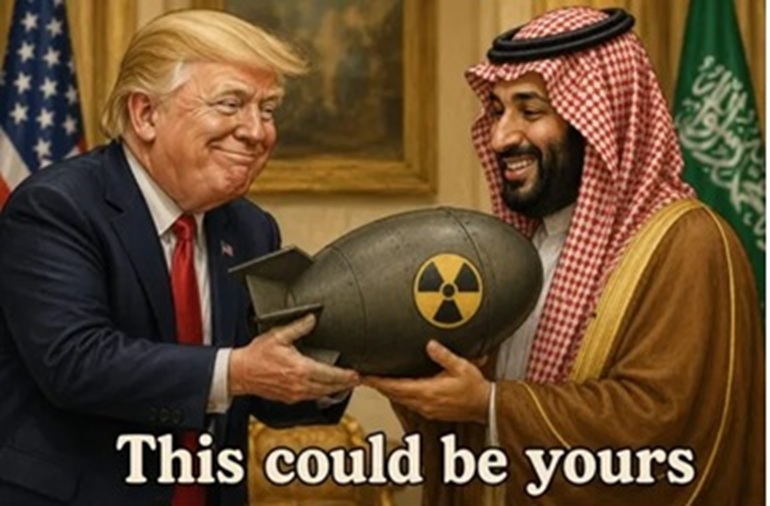
Even if no reactors are built, Donald Trump’s announcement of a double-standards deal with Riyadh has wrought further damage in a new era of proliferation
Even as he threatened to escalate an unlawful war sold in part as preventing Iran from gaining a nuclear weapon, Donald Trump opened the door to proliferation in the region on Wednesday. The US announced that it had signed a deal with Saudi Arabia which would potentially allow the kingdom to enrich uranium in future and to avoid the fullest inspection rights for the international watchdog.
Experts have long warned that a civilian nuclear programme could create a path towards a nuclear-armed Riyadh. Mohammed bin Salman, the Saudi crown prince and de facto leader, has said that if Tehran gets a nuclear weapon, “we will have to get one”. Concerns are magnified by the agreement’s terms. Washington previously argued that the “gold standard” was the United Arab Emirates’ agreement to permanently forgo enrichment and accept full monitoring by the UN’s International Atomic Energy Agency. Weakening it sets a precedent that Russia or China could also cite in nuclear deals in future.
The turmoil that Mr Trump has created in the Middle East is encouraging governments both to hedge their bets and to tool up. The US paused attacks on Iran at the weekend, after 13 successive days of strikes, amid reports that it is concerned about declining interceptor stockpiles, but no exit is in sight. As António Guterres, the UN secretary general, said on Thursday, the region “is teetering on the edge of [the] unimaginable … One crisis feeds another. One escalation triggers the next.”
Gulf states premised their security on American-guaranteed order. But Benjamin Netanyahu’s strike on Hamas leaders in Qatar last year showed that the US shield would not protect them from Israel (itself an undeclared nuclear power). The reckless war on Iran has made US military presence an invitation to damage. Washington may be looking to bind Riyadh closer with a reactor deal, though the billions of dollars involved is probably a bigger incentive for Mr Trump. The crumbling of the region’s internal architecture – most visibly with the UAE’s departure from Opec – adds to the dangers of proliferation. Players are acting less predictably.
The US president threw the Saudi deal into doubt within hours by declaring it contingent on Riyadh recognising Israel. That had long been a precondition for an agreement, but Israel’s war of annihilation in Gaza has shored up the Saudi position that recognition cannot happen without a Palestinian state.
Yet even if no reactors are built, the announcement itself acts as legitimation of and encouragement for the pursuit of nuclear capabilities by others. Negotiations produced an Obama-era nuclear deal with which Tehran complied – until Mr Trump trashed the agreement. His war appears to have produced a more aggressive, risk-taking Iranian regime, as foretold; further military action is more likely to spur than end nuclear threat. The prospect of Riyadh acquiring a bomb is further encouragement.
Look further afield. The last US-Russia nuclear arms control treaty expired in February. China is rapidly expanding its arsenal. Asian and European states which counted on the US nuclear umbrella prior to Mr Trump are discussing acquiring or enhancing their own capabilities. Most of them at least understand that diplomacy, multilateralism and global standards are a better choice than a race for the bomb. Mr Trump does not believe in international institutions. But upholding existing nuclear safeguards would be in US interests too as we enter a new age of proliferation.
What would happen if the UK’s Faslane nuclear weapons base was hit in a nuclear strike?

As the UK’s only nuclear weapons base, Faslane and the adjacent Coulport warhead storage
depot are among the highest-value military targets in Europe in the case of
a nuclear exchange targeting military facilities.
While many strategic
military facilities are located in highly remote areas to avoid civilian
casualties in the case of an attack, these bases are only roughly 40
kilometres from Glasgow and surrounded by other population centres such as
Greenock and Helensburgh.
In an effort to add to the existing literature
illustrating the risks posed by nuclear weapons facilities, I decided to
draw from my background in aerodynamics research to study the humanitarian
cost that would be incurred by an attack on the nuclear weapons bases in
Scotland. This research uses modelling techniques pioneered by Professor
Sébastien Philippe of the University of Wisconsin-Madison and software
developed by Ivan Stepanov to simulate both the blast and radiological
effects of a nuclear strike on the base.
Both the effect of the initial
blast and the fallout dispersed from two 100-kiloton ground-burst strikes
on Coulport’s storage bunkers were simulated across 100 historical weather
conditions. Both the long and short-term effects were mapped onto
population density data to assess both the immediate casualties in the
blast radius and the long-term casualties due to radiation induced cancers.
A protection factor was also applied to account for those sheltering
indoors.
The total predicted fatalities ranged from 1603 to 138,827 people,
with an average of 22,798 people. This wide variation is due to the strong
influence of wind on the dispersion of fallout. For instance, winds blowing
to the west or north result in far fewer casualties, due to the much
sparser populations in these directions. By contrast, winds blowing to the
east or southeast were found to disperse significant fallout over major
population centres such as Glasgow and Edinburgh.
The National 25th July 2026,
https://www.thenational.scot/news/26409093.happen-faslane-hit-nuclear-strike/
Is Trump’s Saudi nuclear deal set to trigger a Middle East arms race?
He failed to articulate a persuasive argument for the Iran war and now a poorly negotiated deal with Riyadh has only compounded the danger writes Foreign Editor David Pratt
Among his many controversial traits, a tendency towards double standards sits high on the list.
If ever confirmation of this were needed, just cast your mind back to April, when US President Donald Trump reiterated that in Iran: “There will be no enrichment of uranium.”
On the face of it, Trump’s message appeared clear cut and, to that end, the
US-Israel war against the Islamic Republic was – along with regime change – aimed at preventing Tehran from possessing an atomic bomb.
But fast-forward just a few months and Trump appears now to have done a deal with Iran’s great rival Saudi Arabia that could, say some experts, put it on a trajectory to enrich its own fuel for nuclear reactors.
So far, so typically Trump, some might argue. But as if such duplicity were not bad enough, Trump then added another characteristic of his fickle decision-making thinking by insisting that the Saudi deal was conditional on Riyadh normalising relations with Israel.
“The Civil Nuclear Deal (There will be no enrichment of material!) being made between the United States Department of Energy and Saudi Arabia, which pertains only to non-military use such as the ones that Iran and UAE (and others) already have, will be approved, but is totally subject to Saudi Arabia joining the very respected and successful Abraham Accords,” Trump posted on his Truth Social platform last Thursday.
Trump’s intervention, insisting that the deal was subject to recognition of Israel, arriving as it did some 16 hours after the initial announcement, appeared to come as late news to the Saudis.
For years now the Gulf kingdom has long insisted that their country will not establish formal relations with Israel until there is a clear path for Palestinian statehood, which Israel’s government staunchly opposes.
It came as late news, too, it would appear,
to US Energy Secretary Chris Wright and his team at the Washington Energy Department who some American media reports suggest jumped the gun in announcing the deal, triggering the social media backlash from Trump.
TRUMP, so the media speculation goes, added on the “normalisation” with Israel condition to teach Wright and his team a lesson for getting ahead of themselves.
Whatever the truth behind such internal bickering, the Saudi deal now appears somewhat in limbo, though should it go ahead as planned, will renew fears that Trump is triggering a Middle East nuclear arms race.
It’s not that there is anything new in US nuclear co-operation deals with countries in the region.
But back when America first made such a deal with the United Arab Emirates (UAE) in 2009, the safeguards and conditions surrounding the deal were, according to US officials at the time, “gold standard”.
For starters, the Emiratis had to forgo domestic uranium enrichment and reprocessing, and sign up to the Additional Protocol, a follow-on to the nuclear Non-Proliferation Treaty (NPT), which provides for tough inspections.
All these conditions were met, leaving the UAE with four reactors that now supply 25% of the country’s electricity.
The rise of the military-technology complex
How Silicon Valley tech firms remade US defense contracting. And then opened the Pentagon’s checkbook—wide.
Bulletin, By Bernice Yeung, July 23, 2026
The tale of how the Pentagon lost its spirit of innovation often begins with an incident known as “the Last Supper.”
It was the fall of 1993. About two dozen executives from leading defense contractors had received an unexpected invitation to dinner at the Pentagon. After the meal, the group was ushered into a briefing room where William Perry, then the deputy secretary of defense (and soon, the defense secretary), gave a presentation that startled the room.
In the wake of the Cold War, he said, the defense industry should prepare for catastrophic cuts to military spending. “They should not look at it as a little dip here but as a new low plateau and adjust their plans accordingly,” Perry would later recall.
Within a couple of decades, the US defense industrial base shrank from dozens of firms to today’s so-called Big Five—Lockheed Martin, RTX (formerly Raytheon), General Dynamics, Boeing, and Northrop Grumman, which together receive about a third of the Defense Department’s annual contract obligations.


Two decades of defense contractor mergers and acquisitions consolidated the defense industry from more than 75 firms to the Big Five—Lockheed Martin, Boeing, Northrop Grumman, General Dynamics, and Raytheon (now RTX)—also known as “primes.” Chart [on original] by Thomas Gaulkin. Source: NASA, “Final Report of the Commission on the Future of the United States Aerospace Industry”
Silicon Valley executives, like Shyam Sankar of the tech firm Palantir, have pointed to that dinner as the start of a decades-long “decoupling of commercial innovation from defense.” The chill between the Defense Department and Silicon Valley grew so strong that Sankar dubbed it “the Great Schism” in a 4,000-word, viral-among-some manifesto he called The Defense Reformation.
During those years of estrangement, the Pentagon became increasingly entrenched in the status quo, buying and maintaining hulking weapons within a ponderous bureaucracy. Silicon Valley, for its part, dashed ahead with innovations around cybersecurity, artificial intelligence, and product design—though usually to enhance consumer experiences in shopping, gaming, or food delivery.
The distrust and disdain between the two camps grew serious. “There’s plenty of people in Washington in the last 20 years who’ve made a point of how much, you know, they hate us,” Netscape founder-turned-VC-titan Marc Andreessen said in a 2025 podcast.
By the early aughts, there were people in both the Pentagon and Silicon Valley who knew that mending the breach was urgently needed. China’s leaps in technological advancement sounded an alarm in foreign policy circles. In October 2024, Sankar, who is Palantir’s chief technology officer, was still making a case for the reunification of tech and defense when he published the Defense Reformation.
Sankar began the essay by summoning the story of the Last Supper as a way to explain why the country was in a “state of undeclared emergency.” Consolidation had led to the demise of the defense industrial base, he argued. The China threat meant robust innovation adoption at the Pentagon was an imperative. To get there, speed and deregulation were required.
“We need a defense Reformation to … transform the way the government does business,” Sankar wrote.
Sankar and Palantir, the controversial data-mining company that provides AI-enhanced platforms for battlefield analysis, are powerful voices in a growing chorus. Anduril, which makes autonomous weapons systems, issued a 7,000-word decree pushing for policy changes, such as aligning Pentagon tech purchasing with “industry best practices” to “reboot the arsenal of democracy.” Venture capitalists like Andreessen Horowitz are investing upwards of $1 billion in defense tech, demanding deregulation because “America’s most innovative founders are building the tools our warfighters need—but the current system locks them out.”
In the past year, there have been indications that the Silicon Valley crowd is being heard. “Industry has become influential in shaping national security policy, with leading AI companies framing too much regulation as a national security liability,” said Emile Ayoub, senior counsel with the Brennan Center’s Liberty and National Security Program.
Within months of entering office, President Donald Trump issued a flurry of executive orders to accelerate AI adoption and streamline defense buying. To transform the US military into “an ‘AI-first’ warfighting force,” Defense Secretary Pete Hegseth has mandated faster but riskier methods of acquiring frontier technologies. “This is the beginning of an unrelenting onslaught to change the way we do business …………………………………………………………………………………………………
AI-related defense tech contractors have been generous in their financial contributions to elected officials. The support goes well beyond the most conspicuous displays, such as Big Tech’s eye-popping donations to Trump’s re-election campaign, inauguration, and ballroom………………………………….
Between 2022 and 2024, these nine trailblazing AI companies and their employees have increased their campaign contributions by about 60 percent to the members of Congress who control Pentagon policy. Their defense-specific lobbying has jumped from about $650,000 to $7.7 million in the past decade…………
………Simultaneously, the Trump administration has installed a revolving door between defense-tech companies and the Pentagon.
…..If companies move quickly from “concept to combat,” “the Department’s checkbook is open.”

In the past decade, Palantir’s revenue from defense contracts grew by an annual average of 50 percent, among the fastest of any defense firm, according to a Brennan Center analysis. That translates to at least $1.4 billion in defense department payouts since 2008.
Thanks to a surge in work with the military, Palantir became profitable in 2022. And its slice of the Pentagon pie continues to expand. Recently, the Defense Department embedded Palantir’s AI platform, used for battlefield awareness and target recognition, throughout the military. Now, as a “program of record,” Palantir will receive ongoing and long-term funding from the department.
…………………………………………………………………………As the Valley grew into a hub of global capitalism, O’Mara observes, Washington looked to the tech industry as an economic engine and a source of campaign financing. It courted Silicon Valley dollars by offering tax breaks, subsidies, and skilled worker visas and promised to fill classrooms with computers and internet connections.
………………………………………………………………………………………………………………………………….Meanwhile, organizations ranging from the United Nations, to the Pope, to a consortium of nonprofits and academics known as Stop Killer Robots, decry the use of AI in warfare, especially in the deployment of lethal autonomous weapons. They argue that there’s an inherent lack of transparency when the black box of AI models is further obscured by the opaque or classified nature of military operations.
…………………………………………………………………………………………………………………………One of the companies joining this group of Silicon Valley heavy hitters is Reflection AI, a relatively new firm that receives VC funding from 1789 Capital. In yet another example of the red flags around conflicts of interest and self-dealing emerging from the Trump administration, Donald Trump, Jr., the president’s son, is a partner at 1789 Capital—in fact, the lead partner on the deal.
……………………………………………………….o understand what’s driving the renewed relationship between Silicon Valley and the Pentagon, it’s instructive to look at where venture capital is flowing. Between 2024 and 2025, venture capital investments to defense technology nearlydoubled, from about $27 billion to $49 billion, according to PitchBook, a repository of data on capital markets.
The Silicon Valley Defense Group analyzes the prospects of the top VC and private equity-backed defense tech firms, and its 2026 report found that In-Q-Tel is still the largest funder of defense tech. But BlackRock, the world’s largest investment firm, significantly increased its focus on this sector in 2025. Not to be left out, the Big Five have also thrown funding at these companies through their own venture capital arms.
Overall, the Silicon Valley Defense Group observes “seismic” shifts in the sector……………………………………………………………………………………………………………………
Elke Schwarz, a professor at Queen Mary University of London who studies military AI, observed that Silicon Valley has successfully reshaped how the Pentagon does business—and to its benefit.
“With its focus on iteration, agility, risk, speed, and scale, the new defence culture performs both the logics of its new AI products and that of the VC companies that fund the startups,” she writes. “It is a holistic shaping of the environment towards the vectors that make Silicon Valley VC investors enormously rich.”
She adds: “[M]ove fast and break things is not a suitable motto for any conscientious military organization.”
San José State University professor Roberto González has been studying the rise of defense tech from the heart of Silicon Valley. He said there’s an analogy to be made with the California Gold Rush. “That’s just a part of the mentality of this part of the world—you have an opportunity to get rich quick, and you go for it,” said González, author of War Virtually:The Quest to Automate Conflict, Militarize Data, and Predict the Future.
But, he warns, there’s a crucial difference between the two.
“What we’re talking about, in the end, is taxpayer dollars,” González said of the money helping to fuel the defense tech boom. “A lot of the startups will fail. But in the meantime, the pot can just keep growing larger and larger, as long as we can be convinced, as taxpayers, to keep that Pentagon budget growing.” https://thebulletin.org/2026/07/the-rise-of-the-military-technology-complex/?utm_source=ActiveCampaign&utm_medium=email&utm_content=New%20investigation%3A%20The%20rise%20of%20the%20military-technology%20complex&utm_campaign=20260723%20Thursday%20Newsletter
An Iranian missile attack on the UK is no longer far-fetched.
It is unsurprising that Iran considers the UK bases used by US bombers to attack
the country – RAF Fairford in Gloucestershire and Diego Garcia in the
Indian Ocean – to be “legitimate targets”.
Such threats might have been
dismissed in the past as unrealistic bombast, but in a year when warfare in
the Gulf and Ukraine has been dominated by drones, along with cruise and
ballistic missiles, nations that once believed themselves safe have
suddenly become vulnerable. Iran fired two missiles at Diego Garcia in
March which failed in flight or were shot down, but the Iranians clearly
believed they had the range to reach the island. Diego Garcia is 2,350
miles from Tehran, while London is 2,750 miles away.
iNews 25th July 2026, https://inews.co.uk/opinion/iranian-missile-attack-uk-no-longer-far-fetched-4660624
1 This Month



Shut down the radiation-damaged Heysham nuclear reactors now
To see nuclear-related stories in greater depth and intensity – go to https://nuclearinformation.wordpress.com

Say No to NASA’s Reckless Nuclear Reactor on the Moon
Say No to NASA’s Reckless Nuclear Reactor on the Moon
-
Archives
- October 2026 (247)
- September 2026 (339)
- August 2026 (330)
- July 2026 (355)
- June 2026 (287)
- May 2026 (306)
- April 2026 (356)
- March 2026 (251)
- February 2026 (267)
- January 2026 (308)
- December 2025 (358)
- November 2025 (359)
-
Categories
- 1
- 1 NUCLEAR ISSUES
- business and costs
- climate change
- culture and arts
- ENERGY
- environment
- health
- history
- indigenous issues
- Legal
- marketing of nuclear
- media
- opposition to nuclear
- PERSONAL STORIES
- politics
- politics international
- Religion and ethics
- safety
- secrets,lies and civil liberties
- spinbuster
- technology
- Uranium
- wastes
- weapons and war
- Women
- 2 WORLD
- ACTION
- AFRICA
- Atrocities
- AUSTRALIA
- Christina's notes
- Christina's themes
- culture and arts
- Events
- Fuk 2022
- Fuk 2023
- Fukushima 2017
- Fukushima 2018
- fukushima 2019
- Fukushima 2020
- Fukushima 2021
- general
- global warming
- Humour (God we need it)
- Nuclear
- RARE EARTHS
- Reference
- resources – print
- Resources -audiovicual
- Weekly Newsletter
- World
- World Nuclear
- YouTube
-
RSS
Entries RSS
Comments RSS


