If you’re already afraid, just wait until you hear about Manhattan Project 2.0.


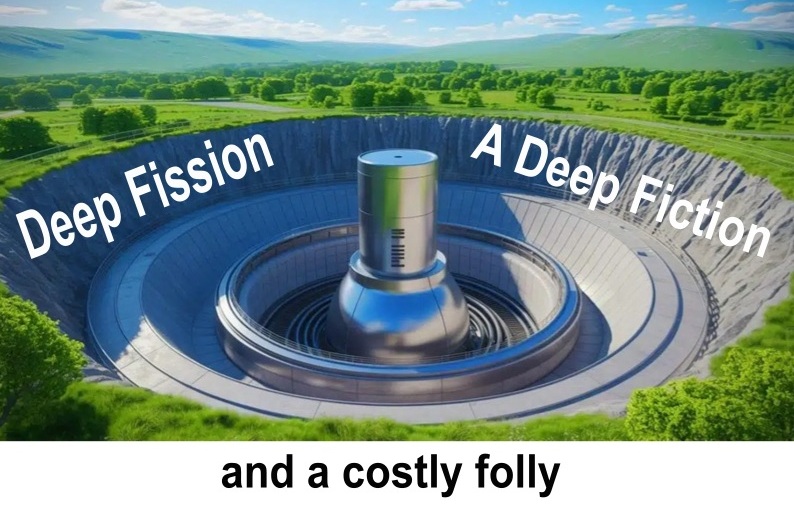
The nuclear startups receiving special dispensation from the DOE are part of a pilot program established under Executive Order 14301, “Reforming Nuclear Reactor Testing at the Department of Energy.” The DOE selected Oklo Inc. (Energy Secretary Chris Wright formerly served on its board of directors), Aalo Atomics Inc., Antares Nuclear Inc., Atomic Alchemy Inc., Deep Fission Inc., Last Energy Inc., Natura Resources LLC, Radiant Industries Inc., Terrestrial Energy Inc. and Valar Atomics Inc. as the companies whose experimental reactor designs will be tested at locations in Texas, Kansas, Utah and Tennessee (Oak Ridge). In another attempt to dodge NRC oversight, these companies are considered DOE contractors whose reactors are subject to DOE rules no matter their location
Analysis, Kristen Thomason | August 10, 2026, https://baptistnews.com/article/if-youre-already-afraid-just-wait-until-you-hear-about-manhattan-project-2-0/
Summers spent at my grandparents’ house in Tennessee were hot and humid. With enough cousins piled into the porch swing, you could stir up a bit of a breeze. But when that was no longer effective, we would retreat to the air-conditioned splendor of the American Museum of Science and Energy in Oak Ridge and stroll through exhibits like “Wildcatting for Oil” and “Atoms for Autos.”
Among these varied installations, however, pride of place was given to documenting Oak Ridge’s role as the secret headquarters for the Manhattan Project and source of the Hiroshima bomb’s enriched uranium. Most of the 30,000 covert workers on that project only discovered the truth of what they had been helping to build on Aug. 6, 1945, when they awoke to the headline “Oak Ridge Attacks Japan.”
Eighty years later, on May 23, 2025, President Donald Trump signed a series of executive orders to further the Department of Energy’s “Manhattan Project 2.0.” And just like the original, the second iteration of the Manhattan Project has plenty of secrets of its own.
The executive orders came at the behest of tech giants like Amazon, Meta, Google and Microsoft, who want cheap, abundant nuclear power to run their AI data centers. And according to the United Nations, these data centers will have doubled their voracious consumption of electricity and water by 2030.
Benefiting from a second Atomic Age
Nuclear industry executives who stand to benefit from a second atomic age had advance access and offered edits to the executive orders, which maximize risk-taking and profit-making over the safety of nuclear employees and the public. They stood behind Trump as he signed Executive Order 14299, “Deploying Advanced Nuclear Reactor Technologies for National Security,” which paves the way for private companies to construct commercially owned and operated experimental nuclear reactors on Department of Defense properties and at the DOE’s national laboratories.
The original Manhattan Project granted the military sweeping authority to bypass regulations and red tape when developing the atom bomb. Likewise, situating these new reactors on federal land allows companies to skip environmental requirements and skirt the authority of the Nuclear Regulatory Commission, the independent bipartisan body charged with granting licenses and regulating the safety of commercial nuclear reactors.
However, to achieve their goal of mass-producing portable nuclear reactors they can deploy via semi-truck to datacenters, hospitals and industrial facilities, they’ll eventually need to pass the NRC’s stringent public safety and environmental standards. That is why Trump next signed Executive Order 14300, “Ordering the Reform of the Nuclear Regulatory Commission,” to overhaul the “structure, personnel, regulations and basic operations” of the NRC.
In 1974, Congress, weary of the Atomic Energy Commission’s reckless experimentation with atomic power at the expense of public safety, divided it into the DOE, which promotes nuclear power, and the NRC, which regulates it. Scientists at Oak Ridge National Laboratory were thus forced to abandon a plan to carve a second canal through Panama using 250 Hiroshima-sized atomic bombs. Executive Order 14300 is a return to the wild pre-1974 days.
The order first directs the NRC to rubber stamp approval for those reactors developed under the auspices of the DOE and DOD without any additional testing. It then reduces the responsibilities and size of the Advisory Committee on Reactor Safeguards, an independent group that once provided technical guidance about reactor safety to the NRC but now can only voice concerns when specifically asked. The president also replaced Democrat and NRC Chair Christopher Hanson and installed a steering board staffed by DOE officials to oversee the NRC reforms.
Next, Executive Order 14300 loosens radiation exposure restrictions for nuclear workers and the general public. To implement this order, on July 1, the NRC proposed a series of changes including limiting use of the linear no-threshold model, which affirms there is no threshold below which radiation is safe. The public has 45 days to comment on the changes.
Raising doubts about the dangers
The linear no-threshold model is the industry gold standard and guiding principle for radiation safety around the world. However, in a move akin to its approach to vaccines, the administration raises doubts about the science behind the model despite the myriad studies and decades’ worth of radiation data on nuclear workers that undergird it.
The 2023 International Nuclear Workers Study examined the dosimeters worn by 309,932 nuclear workers in France, the United Kingdom and the U.S. and tracked their incidents of cancer for an average of 35 years. Scientists confirmed that the greater the exposure to ionizing radiation from nuclear fission, even at low occupational levels, the greater the likelihood of death from a cancerous tumor, which often only appeared decades after exposure.
UNC Chapel Hill conducted a similar study focusing on the 22,000 workers hired at the ORNL from the early days of the Manhattan Project through the mid-1980s and found results similar to INWORKS for salaried workers and even higher rates of cancer for hourly workers. These men worked construction, laundered radioactive uniforms or, like my grandfather, laid railroad track to allow for the removal of “legacy waste” from the Manhattan Project without any protection or knowledge that they were being exposed.
Therefore, when it comes to ionizing radiation, which is invisible and difficult to measure accurately, the ethical approach is to keep the exposure level “as low as reasonably achievable,” or what is known as the ALARA standard. This might mean minimizing the time employees spend with radioactive materials, requiring protective gear or, in the case of the public, keeping radioactive emissions below legal limits.
However, protecting people doesn’t fit with the “move fast and break things” methods of tech moguls who want nuclear energy ASAP to power their AI databases. So, in its new proposed rules, the NRC is acknowledging linear no-threshold but dispensing with the ALARA standard in favor of a graded approach where safety is determined by situation with little accountability. Nuclear investors and Trump donors Peter Thiel and Mark Andreessen have been lobbying for the abolition of ALARA from the NRC, also a recommendation of Project 2025.
More DOE changes
The DOE began secretly eliminating ALARA from its own radiation protection framework in August 2025 without officially informing employees or the public until January 2026, although it did notify nuclear executives. To justify the end of ALARA, the DOE cited a report they themselves commissioned from the Idaho National Laboratory. That report said that to reduce “unnecessary economic burdens,” companies could now expose workers to five REM a year.
Roentgen Equivalent Man measures the biological effect and risk of radiation exposure to human tissue. According to the National Academies of Sciences, an exposure of five REM a year could cause cancer in one out of five career nuclear employees. The INL report proposes a future increase to 10 REM a year, which would raise the cancer rate to four out of five.
New DOE rules also double the radiation exposure level that would trigger an official investigation from two times to four times the legal limit. When Seth Cohen, the DOGE employee tasked with removing government “barriers” for nuclear companies, was asked if they should establish a fund for such workplace accidents, he said, “When SpaceX started building rockets, they sort of expected the first ones to blow up.” Andreessen called Cohen “An American hero” on X.
In addition, nuclear contractors for the DOE, including the start-up companies, now can ignore what’s known as Appendix A to Part 851 on Worker Safety and Health Functional Areas. As a result, precautions such as informing employees of possible hazards, procedures regarding possible carcinogens, requiring respiratory protection equipment or providing “comprehensive occupational medicine services” are no longer mandatory. This rule change does not apply to contractors working with other forms of energy.
Without occupational medical services to track and document radiation exposure and any subsequent disease, it will be difficult for employees to later obtain the care and compensation they’re owed in the event of an accident or overexposure. Such was the case for victims of the partial meltdown of Three Mile Island, who had no way to prove in a court of law that they had received excessive doses of radiation.
The nuclear startups receiving special dispensation from the DOE are part of a pilot program established under Executive Order 14301, “Reforming Nuclear Reactor Testing at the Department of Energy.” The DOE selected Oklo Inc. (Energy Secretary Chris Wright formerly served on its board of directors), Aalo Atomics Inc., Antares Nuclear Inc., Atomic Alchemy Inc., Deep Fission Inc., Last Energy Inc., Natura Resources LLC, Radiant Industries Inc., Terrestrial Energy Inc. and Valar Atomics Inc. as the companies whose experimental reactor designs will be tested at locations in Texas, Kansas, Utah and Tennessee (Oak Ridge). In another attempt to dodge NRC oversight, these companies are considered DOE contractors whose reactors are subject to DOE rules no matter their location.
Participants in the Reactor Pilot Program will be testing Small Modular Reactor prototypes and experimenting with new sources of fuel which, without the necessary regulations, have the potential to jeopardize public safety. The most expensive element to build in a nuclear power plant is the lead-and-concrete containment shield designed to keep radioactive vapors from escaping in the event of a nuclear meltdown. Shielding is what failed 40 years ago during the 1986 Chernobyl Unit 4 power plant disaster in Ukraine and what held when Pennsylvania’s Three Mile Island suffered a partial meltdown in 1979.
Supporters of SMR say their new high-assay, low-enriched uranium fuel called TRISO is so safe that physical containment isn’t necessary. But X-energy, a nuclear reactor and fuel company funded by Amazon, released an accident analysis that said TRISO could exceed safe temperatures by several hundred degrees Celsius.
“The problem is that, with new reactors, they introduce new safety concerns and new technical issues,” said Edwin Lyman, director of nuclear power safety at the Union of Concerned Scientists. “Every design I have looked at has potential safety and security vulnerabilities, which are not being addressed to the extent that they need to be.” The DOE also has jettisoned the requirement to have a cognizant system engineer monitoring each of the reactor’s safety systems, calling it an “unnecessary burden.”
Yet, new types of fuel produce new types of nuclear waste. Every few years, a traditional nuclear power plant removes the highly radioactive spent fuel rods, which are now a mixture of uranium and plutonium, and leaves them to cool in pools of water before they’re sealed in concrete casks for what is supposed to be interim storage. Today, 100,000 metric tons of spent fuel are sitting in limbo because the federal government has failed to find a permanent storage solution for high-level nuclear waste.
Unbeknownst to most, fully one third of all Americans live within 50 miles of nuclear waste storage.
The waste problem
SMRs face the same long-term waste disposal conundrum, only they produce a more chemically and physically reactive waste and two to 30 times more of it than traditional reactors. This waste is not compatible with current nuclear waste disposal technologies, so engineers are experimenting with ways to manage the output and radiation. In response, the DOE replaced its former 59-page waste removal manual with 25 pages of bullet points.
Entirely missing from the abridged version are the sections on waste packaging and monitoring. Last July, Trump dismissed all but one member of the Nuclear Waste Technical Review Board, an independent federal agency charged with reviewing the science behind the DOE actions regarding spent nuclear fuel and high-level nuclear waste.
Executive Order 14301 also orders the DOE to “reform its rules” regarding the National Environmental Policy Act by excluding SMRs from a full environmental assessment or environmental impact statement. Previously, nuclear reactors had to address their potential impact on water, air and ecosystems at specific locations.
Now, in a possible violation of the Clean Water Act, the DOE says the release of radioactive water and steam into the environment should be “avoided” but is not strictly prohibited. Companies no longer “must” protect groundwater from radioactive contamination. “Avoiding” or “minimizing” is sufficient. Monitoring for contamination is optional.
But because cleaning up radioactive spills is expensive, the INL report also recommends abandoning the ALARA standard for the public. Both the NRC and the DOE are following this directive. However, the NRC has decided not to change the .1 REM public exposure limit, while the DOE is raising the limit from .1 REM to .5 REM.
This is in addition to the average .62 REM of “background radiation” Americans receive from sources like the sun and air travel. The DOE increase will be the equivalent of 50 X-rays a year per person, which will result in one in 57 people who live near a DOE nuclear facility developing a fatal cancer. Women and children, especially girls, will feel the effects even more severely.
When exposed to radiation within the current legal limit, women are 50% more likely to die of radiation-induced cancer than men, and girls are seven times as likely as men and twice as likely as boys of the same age to develop cancer. The DOE also has cut the Office of Environment, Health, Safety and Security, the agency’s internal team of health experts who study radiation safety, so it’s unclear who would monitor for this potential danger.
And yet another danger
Executive Order 14302, “Reinvigorating the Nuclear Industrial Base”, further endangers the safety of nuclear workers and the wider public by providing the nuclear industry with Cold War-era plutonium-239 harvested from dismantled nuclear warheads. Because the U.S. doesn’t currently have enough uranium for Manhattan Project 2.0, Oklo, Standard Nuclear, Exodys Energy, SHINE Technologies and Flibe Energy plan to convert plutonium into SMR fuel.
Plutonium is highly toxic if inhaled and requires special ventilation to handle. Other countries that have attempted to use plutonium have found converting it not worth the expense. It’s also highly sought after for bomb-making and requires heightened security measures. With a half-life of more than 24,000 years, managing plutonium is not a short-term commitment. And yet, because companies complained about the cost of security, the DOE jettisoned hundreds of pages of security regulations for reactors, including specifications for storage and requirements for firearms training and emergency drills.
Instead, Executive Order14302 encourages the reprocessing of nuclear waste, a practice discontinued during the Carter administration because it produces excess plutonium. In February, the Trump administration awarded $19 million to five companies that will experiment with nuclear fuel “recycling,” which is a misleading moniker. The reprocessing of spent fuel creates its own high-level radioactive waste, albeit with a half-life of a thousand years rather than tens of thousands of years.
Enabling these changes to the country’s nuclear regulations is Executive Order 14303 “Restoring Gold Standard Science,” which is less about rigorous science than it is about “doubt science,” the strategy utilized by the tobacco industry to raise doubts about the dangers of smoking and dodge regulation. MAGA officials and DOGE staffers are cherry-picking data that supports their agenda and discarding evidence that does not.
They are quite fond of citing fringe scientist Edward Calabrese, who, from his work with fruit flies, thinks a little radiation might be beneficial for people. My great, great, great grandfather said something similar while hawking “Dr. Kister’s Radium Charged Water” in the 1900s, until the government ordered him to cease and desist.
Who should we trust?
Industry executives promise their new SMR technology is safe, but Trump has disbanded the independent boards that might hold them accountable. Furthermore, given the disregard Amazon has shown to warehouse worker safety in the name of profit, why would anyone believe that Amazon-owned X-energy would be any more considerate to its nuclear employees or the general public?
The DOE also has a horrific history when it comes to protecting people and the environment from nuclear waste and ionizing radiation. In 2005, radioactive contaminants from deteriorating waste disposal facilities at the Oak Ridge nuclear plant infiltrated the Clinch River, a source of drinking water in East Tennessee.
Summer in Tennessee is demonstrably hotter than it was 40 years ago. Even folks who deny the reality of climate change can’t ignore that tomato planting time is earlier than ever. Some experts say nuclear energy must be a part of America’s renewable energy portfolio if we are to cut carbon emissions and reduce global warming. China, our stated AI nemesis in the Manhattan Project 2.0, also has developed SMR but is relying heavily on solar and wind farms to power its data centers.
The Biden administration also had a plan in place to triple nuclear energy capacity by 2050, which called for adding staff to the NRC to speed up licensing, rather than repealing safety regulations. Following the lead of Canada and Finland, they sought to build trust with local communities through a multi-year consent-based process.
In contrast, Trump vows to quadruple the country’s nuclear capacity, enticing states to volunteer sites as “Nuclear Lifecycle Innovation Campuses.” Selected cities will enrich uranium, create fuel, generate nuclear power, reprocess spent fuel and store nuclear waste all in one location, although without the local buy-in, trust building or necessary geological prescreening present in the Biden plan.
Gov. Bill Lee of Tennessee applied to make Oak Ridge one of these nuclear campuses, although with 230 nuclear lifecycle companies operating between Oak Ridge and Knoxville, plus ORNL and the secretive Y-12 National Security Complex, it’s practically one already.
One of the joys of those summer visits to Tennessee as a child was seeing my uncle who worked at Y-12 as a chemist. When asked about his latest classified projects, he would sigh, fold his hands across the bib of his overalls and say, “Well, if I told ya, I’d have to kill ya,” and we kids would laugh. But the serious, sobering truth is the total impact of the radiation from these facilities is itself a secret. It’s been called the “perfect crime” because low doses of ionizing radiation can inflict cell damage and cause cancer decades after exposure.
Remnants of the original Manhattan Project are still around in Oak Ridge, whispering about its secret past. The impact of ionizing radiation lingers like the abandoned guard towers at the edge of town. Residents of Oak Ridge and the surrounding rural towns have more incidents of cancer than the national average due to exposure from this radiation.
On July 4, four of the pilot program SMRs had achieved nuclear criticality. No doubt the relaxation of safety and environmental regulations helped make this possible. This achievement marks a significant milestone in the Manhattan Project 2.0’s quest for cheap electricity to power Silicon Valley’s data centers.
However, just like the original Manhattan Project, America won’t know the full cost for at least another generation. Thanks to Trump’s deregulation spree, that cost to the health and well-being of Americans could be high indeed.
Kristen Thomason is a freelance writer and journalist living outside Edinburgh in the United Kingdom. She has produced educational and promotional media for national and international religious organizations and public television. Kristen also worked with local churches in Metro D.C. and Toronto, Canada. With a master’s degree in communication and undergraduate degrees in media studies and classics, she is interested in the intersection of politics, religion, history and the arts.
No comments yet.
-
Archives
- October 2026 (112)
- September 2026 (339)
- August 2026 (330)
- July 2026 (355)
- June 2026 (287)
- May 2026 (306)
- April 2026 (356)
- March 2026 (251)
- February 2026 (267)
- January 2026 (308)
- December 2025 (358)
- November 2025 (359)
-
Categories
- 1
- 1 NUCLEAR ISSUES
- business and costs
- climate change
- culture and arts
- ENERGY
- environment
- health
- history
- indigenous issues
- Legal
- marketing of nuclear
- media
- opposition to nuclear
- PERSONAL STORIES
- politics
- politics international
- Religion and ethics
- safety
- secrets,lies and civil liberties
- spinbuster
- technology
- Uranium
- wastes
- weapons and war
- Women
- 2 WORLD
- ACTION
- AFRICA
- Atrocities
- AUSTRALIA
- Christina's notes
- Christina's themes
- culture and arts
- Events
- Fuk 2022
- Fuk 2023
- Fukushima 2017
- Fukushima 2018
- fukushima 2019
- Fukushima 2020
- Fukushima 2021
- general
- global warming
- Humour (God we need it)
- Nuclear
- RARE EARTHS
- Reference
- resources – print
- Resources -audiovicual
- Weekly Newsletter
- World
- World Nuclear
- YouTube
-
RSS
Entries RSS
Comments RSS


Leave a Reply