Heatwave hell

Fires and droughts could not spell out more clearly why nuclear power is the worst kind of risk under climate crisis conditions, writes Linda Pentz Gunter
beyondnuclearinternational , August 16, 2026, https://beyondnuclearinternational.org/2026/08/16/heatwave-hell/
You would think after the last several weeks we just had, the promoters of nuclear power might be tempering their messages a little. Or even reconsidering their position if they haven’t yet drunk too many gallons of the nuclear Kool-Aid.
But what we are seeing instead is a continued and relentless propaganda campaign re-affirming the “milestones” and “breakthroughs” of new nuclear power projects.

For example, Deep Fission, with its plans to try to drop what could eventually be as many as 100 15MW micro reactors down mile-deep boreholes in the tiny community of Parsons, Kansas (population 9,600), crowed about a recent approval from the US Department of Energy.
What the DOE approved was the company’s Nuclear Safety Design Agreement for its Gravity™ Nuclear Reactor. Deep Fission described this as “a major regulatory milestone.”
What it really amounts to is permission to keep on doodling on the napkin, or, put less snarkily, that they may proceed with their reactor design.
Holtec, the New Jersey-based waste and decommissioning company announced late last month that with the US Nuclear Regulatory Commission (NRC) having granted a License Termination Plan for the closed Oyster Creek Generating Station, the company can now move forward with plans to site four of its SMR-300 reactors at the site.
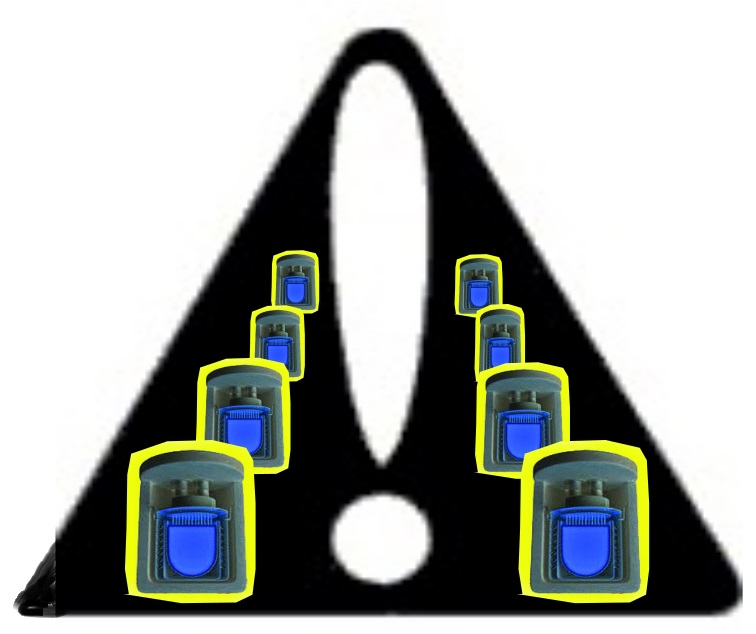
Collectively, this represents a bigger output than the old 650 MW Oyster Creek reactor, but of course SMR owners are claiming that because their reactors are so much smaller, there need be no emergency evacuation zone or other disaster preparedness beyond the property fence line.
Because after all, what kind of disaster could possibly occur?
Evidently, none of these reactor bros touting their scammy crypto-nukes have been watching the news, since they are just carrying on as if Nothing Happened.
So what didn’t they see? The Romanians dynamiting the Danube river in a desperate attempt to redirect the ever scarcer river water toward their lone Cernavoda nuclear power plant? One reactor there was already closed and now the second one is, as well, as the Danube suffered another drastic drop in water level.
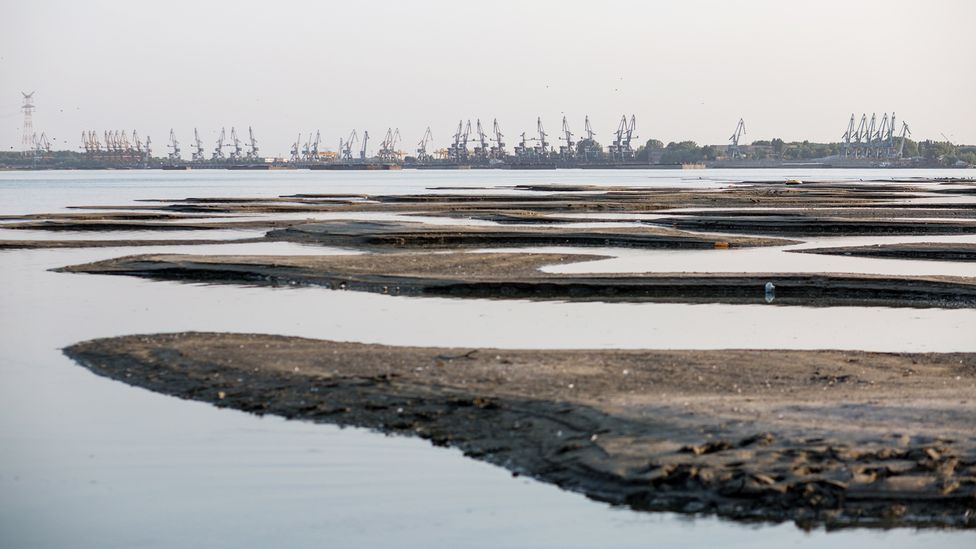
That in turn has affected neighboring Moldova which “relies on Romanian power to cover up to 60% of its own electricity shortages,” according to reporting in The Guardian. The loss of Cernavoda could result in power outages, Moldovan authorities warned.
In Hungary, the Paks nuclear power plant was operating at around 10% of its 2,000 MW capacity at time of writing and the Hungarians, like the Romanians, were starting to sink large barges in what is left of the Danube to try to raise water levels and continue to cool the plant.
Then there was the scorched heathland and billowing smoke that obscured the view of the Sizewell nuclear power plant on the English coast just a few miles away. The raging wildfire close to the still operating Sizewell B reactor was a close call, another stroke of luck with the wind blowing the other way. That day.
The nearby precious Minsmere Nature Reserve hasn’t been so lucky, with the fires causing a massive loss of wildlife and habitat. But plans to proceed with the two French Sizewell C EPR reactors have not been abandoned and the UK government insanely granted Sizewell B a 20-year license extension on top of its existing one that would allow it to operate out to 2055.
The plant actually sits on the beach, never mind the fact that climate crisis-caused drastic sea-level rise is an empirical inevitability. And, apparently, never mind the wildfires either, which, with the United Kingdom now in its fifth scorching heatwave of the summer, are only likely to get larger and more frequent.
Maybe the nuke bros also missed the people fleeing for their lives across Europe while headlines reminded these hapless refugees and others roasting in cities, towns and countryside that their nuclear power plants would not be available to provide the much-needed electricity at a time it was needed most. Instead, people sweltered, and, in some cases, died, from the extreme heat, their villages in some places burned to the ground.
France had to power down and even close many of its reactors due to the extreme heat and then, of course, came the climate change-caused jellyfish swarm at Gravelines, now looking to be an annual event, causing those reactors to close. Jellyfish are a problem because they clog the cooling water intake system.
Meanwhile, parts of the US have been on fire, too, while smoke from Canadian wildfires a few weeks back enveloped a large swath of the Midwest and Northeast in a choking cloud of acrid smoke and falling ash.
So far, and fortunately, there have been no nuclear power plants in the paths of these fires — or some of the catastrophic flooding, including in Texas.
But it really doesn’t stretch the imagination too much to picture a very different scenario.

Nuclear power plants can’t operate well — or sometimes at all— in extreme heat or drought because they require water to cool them and that water needs actually to be cool in the first place. And available.
If the water is too hot or too scarce, nuclear power plants have to reduce power or even shut down altogether.
But when they do, it’s not like turning off a car engine. Because of the highly radioactive and thermally hot fuel inside nuclear reactors —and the fuel pools into which the irradiated fuel rods have been offloaded — they still need cooling. If you can’t cool them, they will eventually melt down. So water must continue to be available and so must electricity to get it there and power the plant.
That is why we have argued for years that nuclear power plants are not reliable, especially in extreme weather conditions. Instead, they are a liability. And with ever more violent weather conditions under the climate crisis, those risks are only going to get worse and disaster more likely.
The events on March 11, 2011 in Japan would have been infinitely less catastrophic, and a whole lot less expensive, if they hadn’t involved a triple nuclear meltdown along with the massive earthquake and tsunami. And, as with Sizewell, they would have been infinitely worse radiologically, had the wind been blowing the other way. Despite this, vast areas received radioactive fallout, complicating rescue efforts of those caught in the earthquake and/or the tsunami.
Fire is one of the biggest risks at a nuclear power plant, largely because of the lethal radioactive inventory on the site. “Irradiation produces a variety of fission products and actinides that multiply the radioactivity in the original uranium fuel by more than 100 million times,” according to The World Nuclear Waste Report (see page 27) published in 2019 by the Heinrich Böll Stiftung. All of this waste currently remains at US reactor sites and at most such around the world, absent a safe, long-term storage solution.
If a raging wildfire engulfed a reactor site, the outcome could be catastrophic, rendering vast areas uninhabitable. Another Chernobyl Zone could be born.
Fire is one of the biggest risks at a nuclear power plant, largely because of the lethal radioactive inventory on the site. “Irradiation produces a variety of fission products and actinides that multiply the radioactivity in the original uranium fuel by more than 100 million times,” according to The World Nuclear Waste Report (see page 27) published in 2019 by the Heinrich Böll Stiftung. All of this waste currently remains at US reactor sites and at most such around the world, absent a safe, long-term storage solution.
If a raging wildfire engulfed a reactor site, the outcome could be catastrophic, rendering vast areas uninhabitable. Another Chernobyl Zone could be born.
Is Trump’s Golden Dome Missile Defense System a Pipe Dream?

Hannah Bowlus, August 13, 2026, https://inkstickmedia.com/is-trumps-golden-dome-missile-defense-system-a-pipe-dream/?utm_source=substack&utm_medium=email
US President Donald Trump’s highly touted ‘Golden Dome’ will cost taxpayers untold sums of money. Will it even work?
The Golden Dome for America is US President Donald Trump’s vision of an impenetrable shield protecting the entire United States from land, sea, air, and space against short- and long-range weapons armed with nuclear warheads or conventional munitions. It may not survive the Iran war. Regional missile defenses deployed by the US and Israel have failed at times. The Golden Dome relies on their success.
A year and a half and $25 billion since the president announced the Golden Dome, plans still remain classified, and the White House has backed off of the claim it will be virtually impenetrable.
Experts and congress members eyeing the $1.5 trillion defense budget — an additional $17.5 billion for the Golden Dome in a separate reconciliation bill, and an estimated $100 billion for the war on Iran — are now rethinking missile defense.
In March, the Cato Institute warned that the Golden Dome, “modeled on Israel’s Iron Dome and air and missile defense (AMD), rests on a system now showing clear vulnerabilities.” The think tank cited several instances of Iranian attacks breaking through Israeli defense systems. “If Israel’s shield can be tested this way, the lesson for the United States is clear: a similar effort risks wasting vast time, money, and resources on a promise that may not hold.”
The Congressional Budget Office estimates it could cost $1.2 trillion to build missile defenses that still couldn’t fully defeat a smaller salvo of missiles. A more robust (though still penetrable) dome might cost $3.6 trillion. The US Space Force says it will cost only $185 billion.
The best the Golden Dome could perform, even at the $3.6 trillion price tag, is an 80% interception rate, one report concludes, though it notes that is an unrealistically optimistic scenario. If Russia launched its nuclear arsenal with this Golden Dome in place, and 20% of their missiles evaded thousands of space-based interceptors, at least 75 million Americans could perish immediately. Some 1.4 billion would likely die globally in the ensuing famine and climate disaster within two years.
In May, US Representative Jim McGovern, a Democrat from Massachusetts, told a press conference on Capitol Hill that the Golden Dome was a “vanity project” for Trump that would cost Americans at a time when economic insecurity is rife. “We’ve got 48 million people in the United States of America, the richest country in the history of the world, who are food insecure or hungry,” McGovern said. “When you start going down this road of a new arms race, where there’s no end in sight … we’ll have nothing for anything else.”
Laura Grego, a research director at the Union for Concerned Scientists, suspects the Golden Dome is doomed like its progenitors. “I think we’ll spend a lot of money before we get there,” Grego told Inkstick.
Lockheed Martin, Northrop Grumman, Raytheon, and General Dynamics were among the 12 companies selected to develop space-based missile interceptors, the costliest and most technically daunting piece of the Golden Dome. Each manufacturer has current missile defense systems operating on US bases and in Israel. These extraordinarily expensive systems of sensors and interceptors have repeatedly failed while the US and Israel waged war on Iran, and throughout Israel’s war in Lebanon.
Inkstick asked each company how they could guarantee a workable missile defense system in space when their weapons in conventional war failed. None responded.
Elsewhere, Lockheed Martin’s CEO has predicted the next few years will be a feast for contractors. Anduril’s CEO said the defense industry is more energized than ever.
Money is one motivation for pursuing the Golden Dome, Grego says, but there are also true believers in missile defense who take its enormous financial cost as proof of its legitimacy. It should and will work because the US has spent $500 billion on it.
Since the US first left the anti-ballistic missile treaty, government officials have claimed to currently own working defenses to “fix the problem of nuclear war.”
“My worry is that the people who should know better believe it,” Grego said.
Just this year, the Missile Defense Agency’s Lieutenant General Heath Collins testified to Congress that the ground-based midcourse defense system had “made the impossible possible, hitting a bullet with a bullet.” By its own evaluation, the program has a 55% intercept rate in highly scripted and uncomplicated tests.
n this and past wars, the Pentagon has exhibited a tendency to mislead the public on the efficacy and maturity of its weapons. Golden Dome details have been concealed, even to Congress, despite its members approving $25 billion toward it last year.
In May, General Michael Guetlein, the manager of the Golden Dome, claimed he had spoken to 400 potential defense contractors about the project. He said he expected the Golden Dome to be completed on time.
Elsewhere, concerns are mounting. Speaking in Congress in June, US Representative Bill Foster, a Democrat from Illinois, argued that the Golden Dome should be investigated for large-scale fraud. “The people getting federal taxpayer money for this have been caught repeatedly lying to Congress and to the public about what the technical status of those [weapons] are,” he said.
The backbone of the Golden Dome, a tranche of data relay and early warning satellites, has already been launched into low Earth orbit. It’s over-budget and behind schedule. The Government Accountability Office has urged the Space Development Agency to be more transparent about its progress.
Companies awarded contracts for the tranches of satellites were allowed to self-report on the technical readiness of their own products. They gave themselves high scores, inaccurately, GAO wrote in one assessment, potentially derailing the entire program in the process.
The bulk of the Pentagon’s request for an additional $17 billion in Golden Dome funding relies on another reconciliation bill that might never materialize. House Republicans recently drafted a supplemental bill with $60 billion earmarked to offset the cost of the war and cover immediate defense priorities.
US Representative Jodey Arrington, a Republican from Texas, blasted Democrats in July over reconciliation. He insisted that Democrats should support the bill in order to “support our troops in time of conflict.” He claimed it was about providing the armed forces with “baseline readiness — not Star Wars and Golden Dome and transformative modernizing of the military — just the bombs, bullets, and battlefield readiness for our men and women in uniform to finish the fight successfully and return home safely.”
In a recent hearing on missile defense, US Representative Seth Moulton, a Democrat from Massachusetts, questioned the logic of the Golden Dome when regional systems were falling apart. “What I don’t want to be doing is getting bogged down in a war in the Middle East that we’re losing while also spending hundreds of billions of taxpayer dollars here at home” on the Golden Dome, he said.
Congressional appetite for the Golden Dome is flagging in the face of a more than $100 billion war. Iranian missiles have resulted in costly damage to American bases and military equipment across the Middle East, and recent reports have revealed that the US stockpile is dwindling fast. “There are lots of relatively cheap ways to circumvent a system or make it obsolete right away,” Grego explained.
A country could increase the number of its salvo, make its missiles faster, shoot decoys, attack sensors and interceptors. These are basic measures that would drive up requirements and costs of the Golden Dome.
In April and October of 2024, Israel claimed it intercepted 99% of projectiles fired by Iran. Trump subsequently praised Israel’s missile defense capabilities and, while announcing the Golden Dome, insisted that the US “is entitled” to the same kind of protection. Independent analysis, though, estimated that Israel’s interception rate was closer to 80 or 85%. Israel was able to destroy so many targets before impact because Iran’s missiles were relatively unsophisticated, armed without countermeasures, and aimed at less populated areas in a country 470 times smaller than the United States.
$1 Trillion And This Is All We Get?

Spending does not equal value when it comes to Pentagon contracting
Lisa Savage,Aug 16, 2026, https://went2thebridge.substack.com/p/1-trillion-and-this-is-all-we-get
More bad news for the Pentagon as another highly expensive warship goes dark.
“On July 24, 2026, while conducting routine operations in the Indo-Pacific, Arleigh Burke-class guided-missile destroyer USS Benfold (DDG 65) reported an engineering casualty involving its generators, causing a loss of power,” reads the statement. “There were no injuries to the crew, who demonstrated resilience, grit, professionalism and unwavering steadiness in their response.”
The loss of power meant sailors were without galley services, toilets and air conditioning. Potable water was also affected, Comer said. He did not respond to a question about how sailors handled waste.
I’ve already written about the woes of the USS Abraham Lincoln which is reportedly about to be replaced the the USS George Washington (without the USS Benfold in its entourage), leaving zero aircraft carriers in the waters around China for the first time in many years.
Military types have been less than impressed with the disrespect, gaslighting, and minimizing of the Commander in Chief and his minister of war about the Lincoln’s woes, a 5,000 person ship that must now be supplied from Diego Garcia 3,000 miles from Bahrain where Iran destroyed a crucial U.S. naval base.
Typical of a draft dodger’: Rep. Seth Moulton blasts Trump’s response to USS Lincoln crisis
“The U.S. had no plan going into this war”
Retired Maj. General Randy Manner on Friday accused President Donald Trump and Secretary of Defense Pete Hegseth of “spewing lies” about the reportedly deplorable conditions aboard the USS Abraham Lincoln and its extended deployment in the Middle East
A professional military that sees national defense as a sacred calling and that embraces martyrdom if necessary it is up against a whiny Gen Z force that mostly thinks of the U.S. military as a job. My husband: “Probably the only job they could get.” He’s right if we’re talking jobs with benefits like health care and college tuition for high school graduates.
The leadership of this crack military force? They are focused on spending big, bigger, and biggest bucks on elaborate systems like Golden Dome that are highly unlikely to produce interception of hypersonic missiles as promised.
But military-industrial promises are made to be broken.
In the excitement over finally pulling Russia into war, General Dynamics promised to build artillery shells that U.S. proxy Ukraine was running through rapidly. GD took $533 million from taxpayers to equip a factory with state of the art robots purchased from Turkiye.
Those involved described a project that was rushed and ill considered from the start. Congress paved the way, removing government contracting guardrails — meant to ensure taxpayer money isn’t wasted — so that Ukraine-related defense projects could be funded quickly. The Army took advantage, handing General Dynamics lucrative no-bid awards without knowing whether the machines it planned to use could perform the desired work. The Army’s due diligence was inadequate, four former Army and General Dynamics officials told ProPublica.
Descriptions of the malfunctioning robots reads like bad sci-fi and suggests, at least to my mind, sabotage.
The robots, giant metal arms with clamps for hands, would end up drenched in oil, which would then — no surprise — combust as they moved steel blocks heated to 1,800 degrees into and out of a machine that periodically erupted columns of fire. One blaze that summer melted a robot’s cables, putting it out of commission for a week..
according to interviews with 12 former factory workers.. the flaming robot arms also kept smashing into things. They slammed into computer numerical control machines, breaking their windows and bending their doors. They knocked over shells. They bashed into safety fences. Workers talked about the arms going “rogue” and began calling one of them “Johnny 5” after a sentient military robot from a 1980s movie..
Then there were the giant press machines, which required regular pounding with a sledgehammer [emphasis mine] to function properly but still botched the shaping of nearly every shell. “We really didn’t have any standardized practice,” said Quantel White, a former employee. “It was just a bunch of guys taking turns going at the machine with a sledgehammer every night.”
If someone comes up with a better metaphor for the U.S. approach to maintaining its imperial ascendency, please let me know.
Who will be held accountable for the artillery shell boondoggle? Not GD executives.
Wages of Failure: Since the Army halted two production lines at the factory, the General Dynamics unit responsible for the debacle has received contract awards totaling $2.5 billion.
Maybe Turkish robotics firm Repkom will take the blame?
Paranoia set in. Repkon refused to share passwords needed to control important equipment, according to five former General Dynamics employees. Sometimes workers would be startled by the sight of a machine moving by itself and realize it was being controlled by someone in Turkey. Spooked, General Dynamics workers tore out hardware to cut off remote access to the machines, two former workers said.
If this is starting to sound like a bad movie plot with espionage and sabotage threads, keep in mind that you paid way more than $17 to see this film. But not to worry! Private-public partnerships with contractors all over the globe are racing ahead to produce fast, powerful military hardware that will attempt to compete with Iran, China, and Russia. All three of which are currently demonstrating the decisive power of a loyal, patriotic work force called upon to step up production in the face of existential threats.
General Dynamics workers in my state go out on strike regularly for better pay and working conditions, while their CEO slurps up another bonus.
In April 2024, General Dynamics CEO Novakovic told investors: “In the U.S., we are rapidly increasing ammunition production with the opening of our Texas facility.” General Dynamics failed to conduct a scheduled first article test in Mesquite that same month.
I’ll let Xi Jinping have the last word here. From his 2015 plans for The Governance of China:
There cannot be sustainable development in the world when some countries are getting richer and richer while others languish in prolonged poverty and backwardness.. Such practices as beggar-my-neighbor, shifting crises onto others and feathering one’s nest at the expense of others are both immoral and unsustainable.
Confronted with complex threats to international security, fighting alone or fighting with a blind faith in the use of force [emphasis mine] will not get one anywhere.
$26.8 billion nuclear refurbishment to begin in Pickering early next year
By Glenn Hendry, July 24, 2026
A nearly $27 billion plan to refurbish four reactors at the Pickering Nuclear Generating Station to get nearly four decades more service out of them is set to begin early next year, with all four units to be taken offline in September.
The Ontario government gave the green light to the refurbishment in November, with the Canadian Nuclear Safety Commission’s approval still required.
The commission previously had already approved a short extension of units 5 to 8 at the Pickering nuclear plant to the end of 2026.
The renewal will start with Unit 5, pending approval, while the project team makes progress on the ground with construction of a new 200,000-square-foot retube feeder and boiler replacement training and mock-up facility, using experience gained from a similar project built for the refurbishment of the nearby Darlington plant.
The hub will be “critical” to training more than 2,800 skilled trades staff ahead of the refurbishment, Ontario Power Generation said on its website.
The new facility will feature detailed mock-ups of the Pickering reactor design and its components. It will also provide a training mock-up of Pickering’s lower boiler assembly, a unique aspect to the refurbishment.
The project team is also constructing other buildings to support the project, including the Common Services Building, a two-storey, 38,000-square-foot modular building that will be used by vendor partners.
Russophobia: Elite Obsession or Deep-Rooted Prejudice?
A conversation with Professor Geoffrey Roberts
Ian Proud, August 12, 2026, https://thepeacemonger.substack.com/p/russophobia-elite-obsession-or-deep?utm_source=post-email-title&publication_id=3221990&post_id=211518204&utm_campaign=email-post-title&isFreemail=true&r=1ise1&triedRedirect=true&utm_medium=email
Professor Geoffrey Roberts, one of Britain’s leading historians of Soviet and Russian history, recently took part in an academic conference on Russophobia held as part of the annual cultural festival in Pskov, Russia.
The discussions there, and our subsequent conversation, offer a clear-eyed look at a phenomenon – Russophobia – that has intensified dramatically since 2022.
One striking difference emerged immediately between western and Russian participants at the conference.
Russian participants tended to view Russophobia as a deep-rooted cultural feature of the West, particularly Britain, stretching back two centuries to Russia’s emergence as a great power after the Napoleonic Wars.
Western speakers, including Roberts, saw it as far more contingent and episodic — a political instrument that surfaces when it serves a purpose and can recede just as quickly.
Roberts argues that today’s Russophobia is primarily an elite phenomenon.
It thrives in the Westminster bubble, among sections of the media, the intelligence services, the defence industry and the chattering classes.
Ordinary people are often more open-minded. Taxi drivers still express genuine curiosity about life in Moscow rather than reflexive hostility. Public opinion has proved remarkably resistant to years of daily propaganda; the extreme narrative has failed to mobilise a durable popular majority for confrontation.
Within the elite itself there are different strands: a large “herd” that follows the prevailing narrative for career reasons; those with financial or institutional interests in keeping the confrontation alive; and a smaller group of true believers.
The late Lord Robert Skidelsky, whose writings on Russophobia formed the basis of Roberts’ own paper in Pskov, described it as a ready-made repertoire of stereotypes and attitudes that can be activated when political circumstances demand.
Its current intensity is instrumental — it helps mobilise support for Ukraine and for the West’s proxy war against Russia.
History suggests such episodes can reverse rapidly.
Britain and Russia fought as allies in both world wars.
The anti-Soviet version of Russophobia collapsed with surprising speed under Gorbachev.
Roberts remains cautiously optimistic that a negotiated end to the war in Ukraine would undermine the extreme forms of Russophobia and open space for more pragmatic voices. Without an end to the fighting, however, the instrumental value of the narrative remains high.
The conversation also touched on deeper strategic realities.
You cannot fight a war by committee.
Russia’s more centralised decision-making and industrial capacity have allowed it to adapt and sustain the conflict, while Western policymakers continue to underestimate Russian resilience and overestimate the prospects of Ukrainian victory or regime collapse in Moscow.
The result is a prolonged, self-defeating policy that has already cost Ukraine dearly and eroded the legitimacy of European governments at home.
Roberts’ message is ultimately a hopeful one. Most people in any country want peace. Ending the war would not only stop the bloodshed; it would also deprive Russophobia of its most powerful current fuel and create the conditions for a more rational relationship between Russia and the West.
In the meantime, moderate, evidence-based voices remain essential.
You can watch the full conversation here:
The result is a prolonged, self-defeating policy that has already cost Ukraine dearly and eroded the legitimacy of European governments at home.
Roberts’ message is ultimately a hopeful one. Most people in any country want peace. Ending the war would not only stop the bloodshed; it would also deprive Russophobia of its most powerful current fuel and create the conditions for a more rational relationship between Russia and the West.
In the meantime, moderate, evidence-based voices remain essential.
You can watch the full conversation here:
‘Deliberate negligence’: Russian nuclear power company with EU operations accused of violating safety standards
Rosatom’s Egyptian plant will use the same technology as a facility the company is building in Hungary.
August 17, 2026 By Ben Makuch, https://www.politico.eu/article/rosatom-hungary-nuclear-energy-egypt-russia-el-dabaa-paks-ii-russia-safety-standards-violations/
BRUSSELS — A Russian state-controlled corporation building a nuclear power plant in Hungary is facing allegations of safety, security and engineering failures at another project in Egypt that uses the same technology, according to internal documents obtained by POLITICO.
In a confidential letter dated June 4 and addressed to a Rosatom executive, Egypt’s Nuclear Power Plants Authority describes “defects” affecting multiple reactor units and violations of “nuclear safety culture” as it builds the El Dabaa nuclear plant. The letter also cites “deliberate negligence” on the part of an official at the project.
The tranche of documents was shared through an intelligence official who was granted anonymity because they are not authorized to speak to the media, and it has never previously been made public. It includes confidential company documents that describe construction delays and engineering concerns coming from Rosatom’s own reviews of the project.
Since Russia’s full-scale invasion of Ukraine in 2022 prompted Europe to impose sweeping sanctions on the country, Rosatom has tried to convince European governments that it remains a reliable and competent supplier in the nuclear power market. But the accusations of safety breaches could add to existing concerns over the Kremlin-controlled company’s operations in the EU.
In an emailed statement to POLITICO, Rosatom said it upholds the highest levels of nuclear safety and had done so throughout the construction of El Dabaa. The company declined to comment on whether it had received the letter or the complaints from Egypt’s Nuclear Power Plants Authority, which did not respond to multiple requests for comment about its communications with Rosatom.
“The high standard of work organisation, the quality management system and the safety culture are affirmed by the sustained attention paid to the project by the political leadership of the Russian Federation and the Arab Republic of Egypt, as well as by the leadership of the International Atomic Energy Agency, whose representatives regularly attend key project milestones,” said the company by email, adding that a recent ceremony for one of El Dabaa’s reactor units was attended by Russian, Egyptian and IAEA officials.
None of the allegations contained in the letter, presented to Rosatom by POLITICO, have been “confirmed within the contractual, technical and oversight procedures envisaged by the project,” read the company’s statement.
In a press release issued after this article was published, Egypt’s Nuclear Power Plants Authority “affirmed that the El Dabaa project is being implemented in accordance with the highest internationally recognized nuclear safety and security standards.”
“For a project of this scale and complexity, the identification of individual technical observations and non-conformities during construction, followed by appropriate corrective measures, is a normal part of the implementation process,” the statement read.
Egyptian Prime Minister Mostafa Madbouly said in July he expected the construction of all four El Dabaa reactors to finish by 2030, with the first reactor unit set to begin producing power by 2028. No nuclear fuel has yet been introduced to the site. Rosatom’s Egyptian plant will use the same technology at the heart of Hungary’s Paks II project, the Kremlin-backed nuclear expansion that has repeatedly raised tensions between Budapest and the European Commission.
The Commission told POLITICO it was not aware of the confidential documents and allegations they contain. “For the EU, nuclear safety is a key priority,” said a Commission spokesperson.
They added that while the Commission was following the project’s developments, “issues of nuclear safety are [the] responsibility of the EU Member State concerned.”
Initially green-lit by Hungary’s former Prime Minister Viktor Orbán in 2014, the Paks II project became emblematic of Budapest’s alignment with Russian President Vladimir Putin and provided a foothold for Russian energy technology inside the EU. Work began on the project in February this year.
The Kremlin-controlled corporation also has plant projects in Turkey and China, while Germany is under fire for green-lighting a deal in July that will allow one of Rosatom’s subsidiaries to help produce nuclear fuel rods for a plant in Lower Saxony. The German government said the deal would be under strict national security controls.
The Egyptian government and its embassies in Belgium and the United States did not respond to multiple requests for comment.
The allegations
Once fully operational, the El Dabaa complex will contain four Russian-designed nuclear reactor units under the supervision of the Nuclear Power Plants Authority. In the letter sent by the Egyptian authority to Rosatom, an official at the agency wrote that uncompleted reactor units have already encountered defects.
Originally sent to Rosatom in English, the letter appears to have been translated into Russian for internal circulation. POLITICO is citing a version of the letter translated back into English.
“There has been a re-emergence of serious concrete defects, including voids behind the metal cladding at Unit 4, defects in the foundation slabs of Units 1, 2 and 3, which took a year to repair, and defects in the cellular structure in the cylindrical wall of the reactor building at Unit 4,” details the letter.
The Egyptian agency then accuses Rosatom of “misleading methods” and “fictitious work” attempting to prove the plant’s construction is over halfway complete, “while a visual inspection at the site clearly shows that the main buildings of the nuclear island are still in the underground construction phase.”
Rosatom, the Egyptian authority alleges, also presides over an unprofessional workplace culture in which workers were caught in possession of “prohibited alcoholic beverages” on the work site, used “forged passes and impersonated others to gain unauthorized access,” and took several “photos and videos taken at the construction site” that ended up on social media, “which negatively affected the reputation of the project.”
The letter makes reference to a serious accident on the construction site, which resulted in a worker suffering “a severe open fracture” and then being smuggled to a private vehicle, not to an “equipped ambulance,” which the Egyptian authority claims was done “intentionally” to cover up the incident.
“Such behavior represents a serious disregard for both human well-being and professional responsibility, and constitutes a gross violation of workplace safety regulations, nuclear safety culture and reporting obligations,” said the letter.
Four additional internal Rosatom business documents reviewed by POLITICO reinforce aspects of the Egyptian authority’s concerns, detailing delays, construction-quality problems and project-management failures. One Rosatom draft audit prepared internally in 2025 warned of a “significant risk of failure to fulfill” the company’s contractual obligations and forecast that the preliminary schedule of El Dabaa’s first reactor unit could slip by 18 months, from September 2028 to March 2030.
Future in doubt
The allegations contained in the documents cast a shadow over the Paks II project in Hungary and are likely to reinforce concerns in Brussels about entrusting critical European infrastructure to a company under the Kremlin’s control.
In a lengthy commentary by the Royal United Services Institute, a London-based defense and security think tank, researchers warned Western countries against doing business with Rosatom, citing its deep connections to Russian intelligence and its problematic role in forcibly running the occupied Zaporizhzhia nuclear power plant in Ukraine through military force.
For the government of Hungary’s newly elected Prime Minister Péter Magyar, the Rosatom revelations also present a new headache: Paks II remains indispensable to Hungary’s plans to decarbonize its electricity system and replace aging nuclear capacity. In an effort to reexamine Orbán-era policymaking, Magyar’s government recently opened a review into Paks II, questioning its hefty price tag and connections to Putin.
Former Hungarian Green lawmaker Benedek Jávor, who focused on Paks II and was critical of the Orbán government, cautioned other governments about working with Rosatom. He told POLITICO he now believed the allegations coming out of El Dabaa could have far-reaching consequences for Rosatom and the fate of Paks II.
“They’ve already decided to reconsider the contract, and this was already communicated during the election campaign,” he said of Magyar’s government. “[This] information from Egypt will definitely be part of the evaluation.”
Looking Back….Going Forward

Andrew and Varrie Blowers writing for the Blackwater Against New Nuclear Group (BANNG) for Energy and Environment Regional Life Column for August, 2026
This month we’ve decided to look back over previous August issues of
this column to reflect on our preoccupations over the past decade. We’ve
picked on two themes – radioactive wastes and new nuclear power – covered
in four columns which focus on our successes as well as our continuing
concerns during these years. August 2017: BANNG led a successful campaign
to force the Nuclear Decommissioning Authority (NDA) to abandon its
experimental scheme to flush dissolved Fuel Element Debris (FED) residue
into the Blackwater. As a result, Magnox cancelled its plans to use FED
dissolution at its other sites. August 2020: In the midst of the pandemic,
the Chinese project to build reactors at Bradwell reached its apotheosis
with its pre-application for planning consent. The outrage against the
project was palpable. Combined with local political and public opposition
and government concerns around national security risks, BANNG was
emboldened to conclude the project was dying. Later, when the Chinese
walked away, we could presume the project dead.
BANNG 5th Aug 2026, https://www.banng.info/news/regional-life/looking-back-going-forward/
1 This Month
23-25 October – on Zoom – World BEYOND War’s annual global conferenc


Shut down the radiation-damaged Heysham nuclear reactors now
To see nuclear-related stories in greater depth and intensity – go to https://nuclearinformation.wordpress.com

Say No to NASA’s Reckless Nuclear Reactor on the Moon
Say No to NASA’s Reckless Nuclear Reactor on the Moon
-
Archives
- October 2026 (180)
- September 2026 (339)
- August 2026 (330)
- July 2026 (355)
- June 2026 (287)
- May 2026 (306)
- April 2026 (356)
- March 2026 (251)
- February 2026 (267)
- January 2026 (308)
- December 2025 (358)
- November 2025 (359)
-
Categories
- 1
- 1 NUCLEAR ISSUES
- business and costs
- climate change
- culture and arts
- ENERGY
- environment
- health
- history
- indigenous issues
- Legal
- marketing of nuclear
- media
- opposition to nuclear
- PERSONAL STORIES
- politics
- politics international
- Religion and ethics
- safety
- secrets,lies and civil liberties
- spinbuster
- technology
- Uranium
- wastes
- weapons and war
- Women
- 2 WORLD
- ACTION
- AFRICA
- Atrocities
- AUSTRALIA
- Christina's notes
- Christina's themes
- culture and arts
- Events
- Fuk 2022
- Fuk 2023
- Fukushima 2017
- Fukushima 2018
- fukushima 2019
- Fukushima 2020
- Fukushima 2021
- general
- global warming
- Humour (God we need it)
- Nuclear
- RARE EARTHS
- Reference
- resources – print
- Resources -audiovicual
- Weekly Newsletter
- World
- World Nuclear
- YouTube
-
RSS
Entries RSS
Comments RSS

