This week’s uranium/nuclear industry news
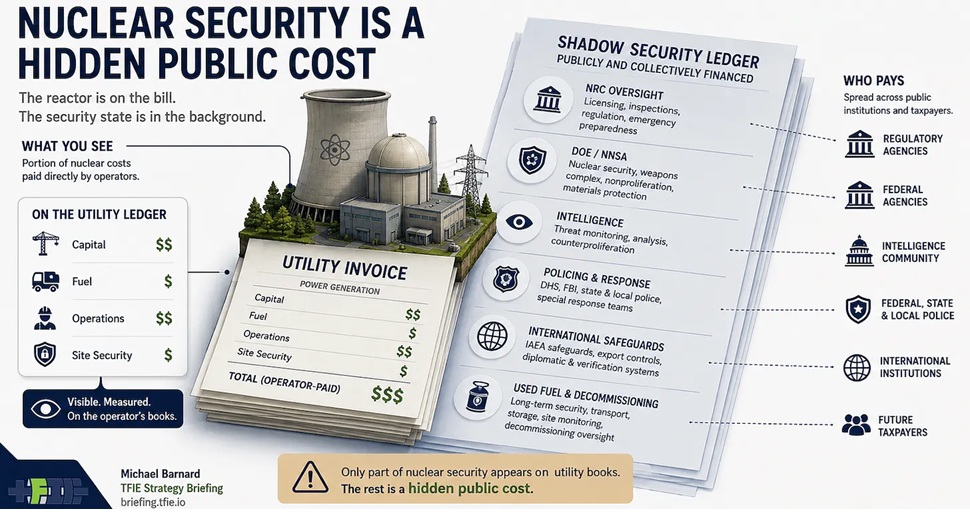
TOP STORY – Nuclear Security Is A Hidden Public Cost Of Nuclear Power.
CLIMATE.
- Heatwaves expose nuclear power’s water risk. Romania’s nuclear reactor to remain in operation at least a week.
- Romania seeks to divert Danube water to keep Cernavoda nuclear power plant online.
- Europe’s heatwave strains nuclear output.
- Danube’s record low levels force shutdown of Hungary’s only nuclear plant. Danube drought curbs 0.9 GW nuclear output in Balkans.
- France Shuts Off More Nuclear Power as Heat Builds Across Europe – ALSO AT https://nuclear-news.net/2026/08/05/4-a-france-shuts-off-more-nuclear-power-as-heat-builds-across-europe/
| ECONOMICS. Europe’s Electricity Prices Spike to €500 a Megawatt-Hour as Drought Bites. |
| EMPLOYMENT. Japan’s drive to replace nuclear reactors collides with worker shortage. |
| ENERGY. UK Nuclear output sinks to 40-year low. |
| ENVIRONMENT. Nuclear station cleaning balls wash up on beaches. |
| POLITICS. China makes major nuclear expansion move, adds four new projects in $25 billion energy investment. |
| SAFETY. Nuclear industry and public invited to shape new regulatory principles for future UK nuclear. |
SMALL MODULAR NUCLEAR REACTORS.
- Newcleo Takes Key Step Towards MOX Fuel Manufacturing Facility In US –ALSO AT https://nuclear-news.net/2026/08/07/8-b-newcleo-takes-key-step-towards-mox-fuel-manufacturing-facility-in-us/
- Moltex’s prospective buyer ends attempt to raise $50M for purchase – ALSO AT https://nuclear-news.net/2026/08/07/8-b1-moltexs-prospective-buyer-ends-attempt-to-raise-50m-for-purchase/
- Canada built its nuclear industry to avoid foreign fuel – Its new SMR reactors will depend on it.
- Venture Capitalists Money Floods Into U.S. Nuclear Startups as AI Power Demand Explodes.
- Vice President of the European Commission Teresa Ribera warns that modular nuclear reactors are still projects, not an immediately available energy solution.
- UK Needs Urgent Guidance On Preferred Reactor Concepts, (for small nuclear reactors) Says Fission Materials Roadmap PICTURE Rolls Royce.
- This startup just raised nearly $500 million to build micro-nuclear reactors for the US militaryhttps://nuclear-news.net/2026/08/03/4-b1-this-startup-just-raised-nearly-500-million-to-build-nuclear-reactors-for-the-us-military/– PICTURE .
- A Kansas Town Is Split Over Plans to Bury a Nuclear Reactor a Mile Underground.
One in three North Korean refugees from nuclear test area have mutations
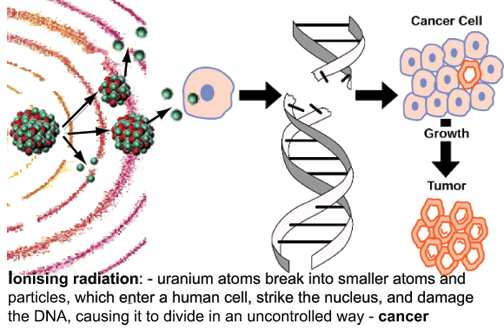
By PERKIN AMALARAJ, FOREIGN NEWS REPORTER, 7 August 2026, https://www.dailymail.com/news/article-16036297/One-three-North-Korean-refugees-nuclear-test-area-mutations.html
One in three North Korean refugees hailing from a nuclear test area have chromosomal mutations, a new study has found.
According to research conducted by South Korea‘s unification ministry, the genes of 64 out of 214 North Korean defectors tested showed genetic changes potentially tied to radiation.
An official at the National Radiation Emergency Medical Centre, which conducted the five-year study, said it was scientifically reasonable to suspect the tests at the Punggye-ri site in the North Hamgyong province were the cause of these mutations.
The latest series of the medical tests were conducted last year, and showed that 26 out of 59 North Koreans who lived in eight cities and counties near Punggye-ri had chromosomal abnormalities – roughly 40%.
The ministry shared the new report with South Korea’s National Assembly – the country’s parliament – but cautioned that there may be environmental factors at play.
Researchers called for more tests to be run to establish a clearer link with the nuclear tests.
They are aiming to recruit 50 new participants, as well as 10 returning subjects for follow-ups, in this year’s tests.
So far, around 800 North Koreans from the eight cities and counties around Punggye-ri have resettled in South Korea.
Punggye-ri was reportedly closed down in 2018 by the North Korean government, in what it said was a measure to ‘ensure the transparency of discontinuance of nuclear tests.’
It was there that North Korea performed its first nuclear test in 2006. Researchers still aren’t sure whether a successful test on a particularly small nuclear device, or a ‘fizzle’ of an ordinary one, was carried out.
Several more were carried out over the years, with two tests taking place in 2016.
In 2017, there was a collapse at the site that was estimated to have left 200 workers dead.
South Korean officials warned after the collapse that further nuclear tests at Punggye-ri could cause a nearby mountain to crumple, releasing radioactive material into the environment.
And Chinese officials warned that the nuclear fallout could spread across ‘an entire hemisphere’ if the mountain caved in.
The dismantling of the nuclear test ground ‘completely closed the tunnel entrances’, the government’s mouthpiece KCNA reported, adding that two tunnels there had been ready for use in ‘powerful underground nuclear tests.’
And analysts observed in 2022 that the site was being rehabilitated for potential nuclear cruise missile warhead tests.
The US, South Korea and Japan said at the time that North Korea would receive an ‘overwhelming, decisive… and unparalleled’ response if testing was resumed.
Hungary faces nuclear plant crisis as Danube river levels remain dangerously low

Hungary’s main nuclear plant has been operating at approximately 10 per cent of its full capacity since late last week
Krisztina Than, Friday 07 August 2026, https://www.independent.co.uk/news/world/europe/danube-hungary-river-water-levels-paks-nuclear-b3029407.html
Hungary’s Paks nuclear plant continues to face a “difficult” situation, despite expectations of a temporary rise in Danube river levels following rains in Austria. Prime Minister Peter Magyar conveyed this update via a Facebook video on Friday.
The plant has been operating at approximately 10 per cent of its full capacity since late last week.
This drastic reduction is a direct result of a prolonged heatwave and record-low water levels in the Danube, which have severely strained the country’s power supply capabilities.
Government working on solving Paks Plant issues
However, Magyar said the situation at the Paks nuclear plant remains “difficult”, and that the government was working on solutions at Paks if low water levels in the Danube, which the plant uses as a coolant, become permanent.
Europe, the world’s fastest-warming continent, has been ravaged by record-breaking heat and destructive wildfires this summer, with France and Spain particularly hard hit in recent weeks.
Last week Magyar asked companies and citizens to cut back electricity use in the evening hours and dimmed decorative lighting on Budapest’s historic buildings to save energy.
Hungary has switched off decorative and non-essential lighting at all state institutions – including its parliament, most of the Buda Castle and Chain Bridge – at night to save energy.
Magyar said on Friday that temperatures were expected to drop and the country’s energy and water supply were stable, which means there was no longer need for cutbacks in energy consumption and decorative lighting would be switched on on Friday night.
“We have never seen such national cooperation. According to the first surveys released, nearly all Hungarian families took part in savings and changed their energy and water use,” Magyar said.
“We expect the water level to rise a good 20 cm in the next few days, however, as there is no rain expected again from tomorrow, this rise is expected to be temporary,” Magyar said. Magyar also said the government will examine what investments were needed to make Hungary’s energy and water supply more resilient.”
Climate changes is already here, and we need to build a country that can adapt to this,” the prime minister said. Magyar said last week that Hungary will develop 4 gigawatts of wind energy capacity by 2030 to diversify its energy sources.
Climate changes is already here, and we need to build a country that can adapt to this,” the prime minister said. Magyar said last week that Hungary will develop 4 gigawatts of wind energy capacity by 2030 to diversify its energy sources.
Nuclear power’s ‘second renaissance’ is built on a myth
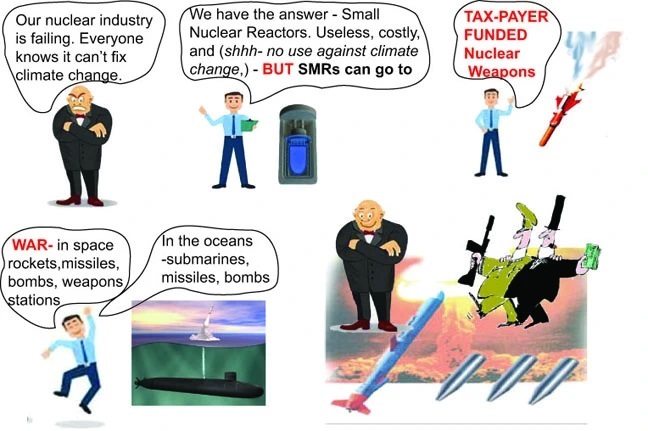
the civil nuclear sector has also made the case that it provides an essential flow of qualified personnel to the military nuclear sector, ensuring the maintenance of the so-called nuclear deterrent. This reasoning has justified not only the squandering of billions of taxpayer dollars to prolong the use of nuclear power but also an obscene increase in military spending, all to prepare for a nuclear war that can be neither fought nor won. As we are seeing today in the US and the UK, especially, this comes at the expense of essential social welfare programmes, plunging more people into poverty.
In the second of a four-part serialisation from her new book No to Nuclear, LINDA PENTZ GUNTER highlights how the industry is searching for ways to preserve its relevance
Linda Pentz Gunter, 9 Aug 26 https://www.morningstaronline.co.uk/article/nuclear-powers-second-renaissance-built-myth
SO WHY the sudden renewed enthusiasm for nuclear power? Although nuclear power has been in existence as a commercial energy source since the 1950s, it is now finding itself eclipsed as a technology by more advanced and far cheaper renewable energy sources, in particular solar and wind power. While nuclear power has demonstrated what is known as “negative learning” — in other words, the longer it has been around, the more expensive and slower to deploy it has become — renewable energy is getting faster and cheaper almost by the month.
Nuclear power has seen its global electricity share plummet from a global high of just over 17 per cent in 1996 to less than 9 per cent today, while renewables have soared in the same timeframe from a 2 per cent share to well over 15 per cent today.
Consequently, the economically failing nuclear power industry is desperately seeking ways to remain relevant. There are only two ways to do this: by making the argument that it is essential to mitigate climate change, thereby securing massive subsidies funded by taxpayers and consumers; and by providing the pathway to the atomic bomb.
To achieve the former, the nuclear power industry is rolling out its second “renaissance” regardless of the fact that the first one resulted in abject failure. In the US, for example, only two of the 34 promised new reactors heralded under the “Nuclear Renaissance” of the early 2000s ever reached completion.
In France, home to what was supposed to be the flagship “renaissance” reactor with the wildly exaggerated name of Evolutionary Power Reactor (EPR), evolution ended up going in reverse with the vaunted EPR taking longer to build than any of its predecessors. Prices in most cases doubled or even tripled into the tens of billions of euros.
These economic disasters prompted the nuclear industry to revert to an old formula with an even worse track record than that of the current large reactor designs. The small modular reactor (SMR), typically 300 megawatts (MW) or smaller and gaining much hype and fanfare, is a concept rejected long ago because of its poor economies of scale.
Hundreds if not thousands of SMRs would be needed to meet the same energy needs as delivered by a traditional-sized reactor (usually 1,000 MW), including upfront costs for the factory to produce them. But the SMR has been revived to make the convincing-sounding argument that smaller is better and therefore, somehow, also cheaper and safer.
None of this is borne out by reality. The SMR designs in circulation are either simply miniature versions of the current large reactors, with the same vulnerabilities to accident and meltdown and making the same highly radioactive waste. Or they are based on what is known as a “fast reactor” design, one that uses materials volatile to fires and explosions and that produces plutonium, the trigger in atomic bombs. All of this would allow for the continued and seamless transition to nuclear weapons production.
Further, the civil nuclear sector has also made the case that it provides an essential flow of qualified personnel to the military nuclear sector, ensuring the maintenance of the so-called nuclear deterrent. This reasoning has justified not only the squandering of billions of taxpayer dollars to prolong the use of nuclear power but also an obscene increase in military spending, all to prepare for a nuclear war that can be neither fought nor won. As we are seeing today in the US and the UK, especially, this comes at the expense of essential social welfare programmes, plunging more people into poverty.
Those frustrated with fission reactors have turned to another revivalist theme — fusion. The dreams and delusions of fusion — which would involve the fusing rather than splitting of atoms to generate electricity — have been harbored for decades. Fusion is the “breakthrough” that has remained perpetually 30 years away since it was first embarked upon in the 1930s and will likely remain so in perpetuity. The few minor “advances” that garnered recent headlines were minuscule and hugely expensive and, when considered in the context of the immediate, or even future, needs of climate mitigation, entirely irrelevant.
In this book, I endeavor to deliver some clarity and to set the record straight about what “zero carbon” actually means (no energy sources are) and why nuclear weapons do not protect us. But writing the book led me to ask a bigger question. Our nuclear crimes are not committed in isolation, so what underpins our pervasive compunction to continue such a reckless plunder of our planet, actions that can only accelerate and ultimately ensure our own collective demise?
Aside from burning fossil fuels, exploding atomic bombs and melting down nuclear power plants, we have also blotted out the night sky, clear-cut essential forests, sprayed chemicals across our landscapes, and filled the oceans with plastics.
In following such a clearly self-destructive path, we have not only harmed ourselves but also disregarded the survival of the thousands of other remarkable creatures whose homes we have turned into our refuse dumps. (The fact that we refer to “animals” in a derogatory way, worthy of ill-treatment and viewed as lesser than, is already a problem and symptomatic of our misplaced hubris.) In wantonly destroying these crucial members of the web of life, we have set ourselves on the pathway to our own demise.
No To Nuclear: Why Nuclear Power Destroys Lives, Derails Climate Progress and Provokes War by Linda Pentz Gunter is published by Pluto Press, £14.99 (www.plutobooks.com). Part 3 of this serialisation will appear in tomorrow’s edition.
What Does It Take to Reopen a Nuclear Power Plant?

By Felicity Bradstock – Oil Price 9th Aug 2026
- The Trump administration wants to expand U.S. nuclear capacity through new reactors, power uprates, and the return of previously shuttered plants.
- Holtec’s Palisades restart has encountered corrosion, equipment repairs, supply-chain problems, and other unexpected challenges that illustrate the difficulty of reviving an aging reactor.
- Other projects, particularly Constellation’s Crane Clean Energy Center, could prove easier to restart and demonstrate that the viability of reactor recommissioning varies significantly by plant.
In the United States, President Trump aims to expand the country’s nuclear power capacity by developing new projects and restoring old reactors. However, restarting disused reactors is not as simple as just turning them back on, as rigorous safety standards must be considered.
In May 2025, President Trump published an executive order entitled “Reinvigorating the Nuclear Industrial Base”, in which he outlined plans to start construction of 10 new large reactors and add 5 GW of power to existing nuclear reactors by 2030.
Several U.S. reactors were shut down in previous decades as confidence in nuclear power fell to an all-time low following three prominent nuclear disasters – Chornobyl, Fukushima, and Three Mile Island. However, the public perception of nuclear power has significantly improved in recent years.
Last year, Trump announced plans to recommence operations at the Palisades Nuclear Plant in Michigan, a 789-MWe plant owned by Holtec International that shut down in 2022; the Constellation Energy 835-MWe Crane Clean Energy Centre on the Three Mile Island site in Pennsylvania; and NextEra’s 615-MWe Duane Arnold in Iowa. This supports Trump’s aim for a U.S. nuclear renaissance…………………………………………………………………………………………………
https://oilprice.com/Alternative-Energy/Nuclear-Power/What-Does-It-Take-to-Reopen-a-Nuclear-Power-Plant.html
America places huge order for 14 more nuclear submarines
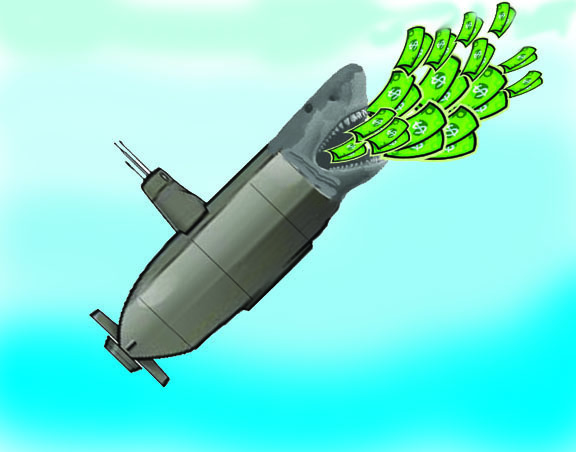
The United States Navy has placed contract modifications worth around $76.6 billion with the two yards that build its
nuclear submarines, covering nine further Virginia-class boats, five more Columbia-class ballistic missile submarines and funding for shipyard infrastructure, HII stated.
ukdj , UK Defence Journal 9th Aug 2026
The award covers Block VI of the Virginia programme and Build II of the Columbia programme, and is split between HII’s Newport News Shipbuilding division in Virginia and General Dynamics Electric Boat in Connecticut and Rhode Island. Newport News will act as delivery yard for six of the nine Virginias, and on the Columbia programme will construct and deliver six module sections for each boat. The two yards have handed over 26 Virginia-class submarines to date.
Kari Wilkinson, president of Newport News Shipbuilding, said in the release that the company is “committed to building the nuclear-powered submarines that protect our nation”, adding that the contracts give the American shipbuilding industrial base an opportunity to demonstrate that commitment.
The two programmes represent the largest naval construction effort under way anywhere. The Columbia class will replace the fourteen Ohio-class boats that carry the sea-based leg of the US nuclear deterrent, with twelve planned in total. Each displaces around 20,800 tonnes submerged, making them the largest submarines the United States has built, and each carries sixteen Trident II D5 missiles in a common missile compartment developed jointly with the United Kingdom, which uses the same section in its Dreadnought class. The lead boat, USS District of Columbia, has been under construction since 2020 and has run behind schedule, with the Navy and the Government Accountability Office both reporting delays measured in years.
The Virginia class is the U.S. Navy’s attack submarine, displacing roughly 7,800 tonnes and built in successive blocks with incremental changes. Block V introduced the Virginia Payload Module, an additional hull section carrying four large vertical tubes that raises the boat’s Tomahawk capacity substantially, and later blocks continue that configuration. Delivery rates have been the persistent problem: the U.S. Navy has sought two boats a year for some time, while the yards have been running closer to one and a third, a shortfall attributed to supply chain fragility, workforce attrition and the competing demand of the Columbia programme, which holds priority.
Newport News Shipbuilding is the only yard in the United States capable of building aircraft carriers and one of only two able to build nuclear submarines. The company marked 140 years of operation at the Virginia site earlier this month, and has been expanding automation across its facilities, including agreements with robotics firms announced in early August covering welding and surface finishing work
Ukraine Critically Short Of Air Defenses As Questions Swirl Over US Patriot Stockpiles
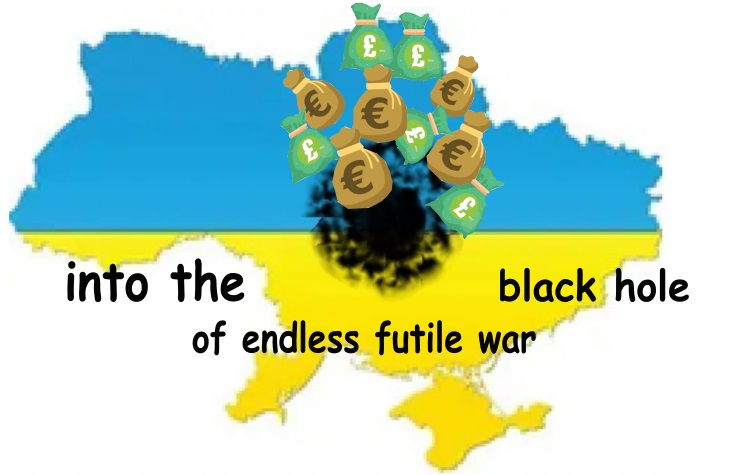
With US supplies under pressure, Ukraine is increasingly looking to European allies.
Radio Free Europe, By Zoriana Stepanenko and Alex Raufo, 8 Aug 26
BRUSSELS/WASHINGTON — Ukraine’s failure to intercept a single Russian missile during a large-scale overnight attack this week has raised fresh concerns over Kyiv’s dwindling supply of air-defense interceptors as Moscow escalates its ballistic missile strikes on the nearly defenseless capital and other regions.
Ukrainian President Volodymyr Zelenskyy has warned that deliveries of anti-ballistic interceptor missiles from partner countries have fallen sharply, leaving Ukrainian vulnerable to deadly attacks that are being launched by Russia with increasing frequency.
Following a meeting with Ukraine’s military leadership on protecting critical infrastructure on August 2, Zelenskyy said Ukraine had received only a third as many air-defense interceptors this year compared to the same period in 2025.
“Our partners have the missiles. What is needed are the necessary political decisions on deliveries and on accelerating production, including localization in Ukraine,” Zelenskyy said……………………………………………………………………………….
US Stockpile Questions
Patriot interceptor missiles remain Ukraine’s most effective defense against Russian ballistic missiles, but questions are growing over how many additional interceptors Washington can realistically provide.
Last week, the Center for Strategic and International Studies (CSIS) estimated that the United States has used more than half of its Patriot PAC-3 MSE and THAAD interceptor inventories during its military operations against Iran this year.
The report estimated that US stocks of Patriot PAC-3 MSE interceptors have fallen from more than 2,300 before the conflict, which began in February, to roughly 800, while THAAD interceptor inventories have been nearly halved.
Mark Cancian, a senior adviser with CSIS and co-author of the report, told RFE/RL that the shortages leave Washington with little flexibility to supply Ukraine.
“Ukraine will not be able to expect many interceptors — or any interceptors — from the United States for quite a while,” Cancian said. “The US has used extensively its own inventories…. We’re down to about 800 or 900 [Patriot interceptors]. The war planners don’t want to go below that, so it would be very difficult to provide any of those or any new production to Ukraine.”
Cancian said Ukraine may instead have to seek Soviet-designed S-300 missiles from countries that still operate the system and intensify efforts to destroy Russian missile launchers before they can fire.
His assessment contrasts with public assurances from the Trump administration.
CNN, citing unnamed officials, reported on August 4 that Patriot inventories had fallen to “dangerously low” levels. Defense Secretary Pete Hegseth rejected that report, calling it “fake news.”
Just days earlier, the Pentagon announced agreements with Lockheed Martin and Northrop Grumman to expand production of Patriot PAC-3 and THAAD interceptors.
US President Donald Trump insisted early on August 6 that the United States has “massive” amounts of munitions.
Trump also had pledged to allow Ukraine to manufacture Patriot missile interceptors, only to appear to backtrack on that promise days later……………………………………………………………………
Risks For Ukraine
The prospect of fewer US interceptors raises immediate questions for Ukraine as Russia steps up missile attacks ahead of another winter.
Adding to the urgency, several media reports, including from Reuters, quoted Ukrainian military intelligence sources as saying a North Korean missile unit had begun deploying to western Russia and could be equipped with up to 120 ballistic missiles and six launchers for attacks on Ukraine.
Kervin Aucoin, a US Army veteran and former military intelligence analyst, said reduced US inventories will inevitably affect Kyiv.
“It’s not going to be none, but it will be far less than what Ukraine was expecting,” Aucoin told RFE/RL…………………………………………………………………..
Ukraine Looks To Europe
With US supplies under pressure, Ukraine is increasingly looking to European allies.
US Ambassador to NATO Matthew Whitaker recently said Washington is exploring joint production of Patriot interceptors with Ukraine and European partners.
He stressed, though, that the immediate priority is to provide Ukraine with the air defense capabilities it needs to survive another winter, either from allies with excess interceptors or through increased production at US factories.
Kyiv has already begun that effort………………………………………………………………………………………..https://www.rferl.org/a/ukraine-patriots-russia-shortage-us-stockpile/33823317.html
The U.S.-Saudi Nuclear Deal Is a Test Case for South Korean Uranium Enrichment
U.S. and South Korean policymakers should develop diplomatic and institutional measures to address potential concerns and opposition surrounding nuclear-powered submarine and fuel cooperation.
By Ellen Kim, August 3, 2026,
https://keia.org/analysis/the-u-s-saudi-nuclear-deal-is-a-test-case-for-south-korean-uranium-enrichment/
On July 22, the United States and Saudi Arabia signed a civil nuclear cooperation agreement. However, the future of the agreement became uncertain the following day when President Donald Trump made Saudi Arabia’s normalization of relations with Israel, via accession to the Abraham Accords, a final requirement for its implementation.
The U.S.-Saudi nuclear agreement has drawn considerable attention in South Korea because the U.S. administration has opened the possibility of allowing uranium enrichment on Saudi territory, contingent upon the results of a two-year joint feasibility study. During bilateral negotiations to revise the 2015 U.S.-South Korea civil nuclear cooperation agreement, South Korea sought but could not obtain U.S. advance consent to enrich or reprocess U.S. spent nuclear fuel. That situation began to change after President Trump approved a nuclear-powered submarine program for South Korea during his summit with South Korean President Lee Jae Myung last October. The two governments subsequently agreed to cooperate on options for procuring nuclear submarine fuel, and bilateral discussions on civil nuclear cooperation, including on uranium enrichment, resumed with working-level talks held in June of this year.
Against this backdrop, the future of the U.S.-Saudi nuclear cooperation agreement will serve as an important test case for future U.S.-South Korea talks. The decision to conditionally permit uranium enrichment in Saudi Arabia, even as the United States remains engaged in a conflict with Iran aimed at preventing the country from acquiring nuclear weapons, has already prompted concerns in Congress that the agreement could fuel an arms race and spur nuclear proliferation in the Middle East.
The security environment on the Korean Peninsula is not so different. While the United States and South Korea continue to pursue the denuclearization of North Korea, South Korea’s pursuit of a low-enriched uranium program to support its nuclear-powered submarine program is also likely to face criticism from those concerned about nuclear proliferation in Northeast Asia. Consequently, even if the U.S.-Saudi nuclear agreement ultimately clears congressional approval, growing concerns over nuclear proliferation in the United States and the broader international community could pose significant obstacles to advancing future U.S.-South Korea cooperation on these issues.
For this reason, U.S. and South Korean policymakers should closely examine the U.S.-Saudi nuclear agreement and develop diplomatic and institutional measures to address potential concerns and opposition surrounding nuclear-powered submarine and fuel cooperation.
First, South Korea should clearly differentiate its case from that of Saudi Arabia. Unlike Saudi Arabia, South Korea ratified and brought into force the International Atomic Energy Agency (IAEA) Additional Protocol to its Safeguards Agreement in 2004. Since then, it has accepted expanded IAEA access and short-notice inspections, strengthened the transparency of its civilian nuclear activities, and faithfully fulfilled its obligations under the international nonproliferation regime. South Korea should emphasize this strong nonproliferation record and make clear that any future uranium enrichment program for nuclear-powered submarine development would operate under the IAEA’s stringent safeguards and verification regime. In addition, Seoul should proactively propose additional enhanced safeguards and verification mechanisms to ensure that nuclear materials cannot be diverted for purposes beyond those agreed upon by Washington and Seoul.
Second, the United States and South Korea should develop a win-win strategy for civil nuclear industry cooperation. South Korea currently operates twenty-six nuclear power reactors and has emerged as a major exporter of nuclear power plants. To compete more effectively with China and Russia, whose influence in the global nuclear market continues to expand, the United States and South Korea should leverage their respective strengths to build a more competitive partnership. Given South Korea’s recent indication of energy as a priority sector for its investment projects in the United States, there is an opportunity to align these investments with expanded bilateral cooperation in the nuclear industry.
Finally, the most important prerequisite for U.S.-South Korea cooperation on nuclear-powered submarines and fuel is mutual trust. Such cooperation cannot be advanced solely through decisions by the executive branch in the United States; it will ultimately require the support and approval of Congress. However, the current U.S.-South Korea relationship faces multiple challenges spanning security, trade, and other areas. Rather than addressing nuclear cooperation in isolation, both governments should manage the alliance comprehensively and approach these issues with a long-term perspective, resolving them gradually while preserving the broader strength and credibility of the alliance.
Ukraine’s “Turning the Tide” Narrative has Already Sunk

The result is an information environment in which the possibility of mutual coexistence with Russia is treated as almost unthinkable, even as the costs continue to mount for Ukrainians, Russians, and Europeans alike.
How the mainstream media spins each new failure as success – with Leonid Ragozin
Ian Proud, Aug 10, 2026, https://thepeacemonger.substack.com/p/ukraines-turning-the-tide-narrative?utm_source=post-email-title&publication_id=3221990&post_id=210596621&utm_campaign=email-post-title&isFreemail=true&r=1ise1&triedRedirect=true&utm_medium=email
One of the most striking features of the Ukraine war has been the speed with which Western and Ukrainian narratives appear in the mainstream, dominate the discussion for a while, and then quietly collapse with absolutely no reflection on how they were wrong.
The latest example was the campaign launched this summer that ‘Ukraine is turning the tide’ against Russia in the war.
In conversation with independent journalist Leonid Ragozin, we examined what that campaign actually delivered. Back in June, long-range strikes deep into Russian territory and occupied areas — particularly Crimea — were presented as the pressure that would force Putin to the table on terms closer to Ukraine’s.
Defence Minister Mikhail Fedorov was the public face of the effort. Forty days later the results are clear: Russia’s position has not softened by an inch. In fact, it has hardened.
The possibility of land swaps that once featured in negotiations after Ukraine’s Kursk offensive has now been taken off the table. Fedorov has been removed, triggering a political crisis in Kyiv and the replacement of the Army’s Soviet-style commander-in-chief.
As Leonid pointed out, this follows a familiar pattern. The 2023 summer offensive was sold as the moment Ukraine would roll Russian forces back. The Kursk operation briefly revived the idea of territorial leverage. Each time the goalposts have shifted — and each time they have shifted in Russia’s favour.
What began in late April 2022 (thanks to Liz Truss) as talk of liberating Crimea has now contracted to trying to hold the remaining parts of Donetsk. The human and material cost of the progressive contraction of the narrative has been enormous.
What makes the current moment particularly revealing is the gap between elite rhetoric and public sentiment. Gallup polling over the past three years shows a clear shift among Ukrainians: where two-thirds once insisted the only acceptable end was total Russian defeat, the same proportion now favour a negotiated settlement.
Yet the war continues.
Leonid’s explanation is straightforward and uncomfortable. This is not primarily a war of nations. It is a war of interlocking elites — securocratic structures in all participating countries and defence-industry and bureaucratic interests in the West — whose incentives diverge sharply from those of ordinary people.
The same dynamic helps explain the hermetic quality of Western media coverage.
Having worked for the BBC for twelve years, Leonid notes how far British (and wider Western) journalism has travelled from its willingness to scrutinise government claims over Iraq, to providing a blank cheque for foreign policy idiocy in Ukraine.
Nuance has been replaced by a single vantage point that treats any deviation from the Overton window as suspect.
The result is an information environment in which the possibility of mutual coexistence with Russia is treated as almost unthinkable, even as the costs continue to mount for Ukrainians, Russians, and Europeans alike.
We also discussed the deeper cultural and political roots of this hostility — the way liberal elites, in competing with the populist right, adopted their own version of enemy-creation, and the neocolonial mindset that still treats the region as a theatre for proxy competition rather than a space for independent states with legitimate interests.
Mainstream journalists are now as complicit in the needless blood-letting that continues in Ukraine with no end in sight. One wonders what they will call the next, vanishingly insignificant turn of the tide?
The full conversation with Leonid is available here.
Trump claims he’s ‘low-keying it’ with Iran after report he could walk away without nuclear deal

The president claims economic challenges will continue harming Iran, even if US negotiators have been unable to clinch a deal for the Strait of Hormuz to reopen
Josh Marcus in San FranciscoSunday 09 August 2026
. Donald Trump is taking a
wait-and-see approach to Iran as negotiations to reopen the Strait of
Hormuz and permanently end the war appear to have once again stalled
following reports that the president is reportedly considering walking away
from the conflict without securing a nuclear deal. “We are low keying
it,” Trump told Axios on Sunday, claiming the U.S. strategy will
eventually “work out.” “We are only semi-negotiating with them,” he
added. “We are just watching Iran with its huge inflation and the fact
they have no money.”
Independent 9th Aug 2026,
https://www.the-independent.com/news/world/americas/us-politics/trump-iran-strait-of-hormuz-negotiations-terms-b3030066.html
Energoatom: Zaporizhzhia NPP lost external power twice on Aug 8
Ukrinform 8th Aug 2026
The Russian-occupied Zaporizhzhia Nuclear Power Plant (ZNPP) lost its external power supply twice on Saturday, August 8.
Ukraine’s state nuclear power operator Energoatom reported this on Telegram, according to Ukrinform.
At 10:59, the 330 kV overhead power line L-243 Ferosplavna – ZTPP No. 1, which supplies power for the plant’s own needs, was briefly disconnected.
The line was automatically reconnected at the Ferosplavna substation and remained energized. While the necessary procedures were being carried out, the plant’s own needs were supplied by diesel generators.
At 11:52, power to the ZNPP was restored.
However, at 14:26, the plant again lost its external power supply. Its own needs were once again switched to diesel generator power.
At 15:35, the plant’s own needs were supplied via the 330 kV Ferosplavna-1 overhead line, restoring the ZNPP’s external power supply.
“The situation once again demonstrates the vulnerability of the Zaporizhzhia NPP under Russian occupation. Any disruption to the normal power supply systems of a nuclear facility creates additional risks to nuclear and radiation safety,” the company said………………………….. https://www.ukrinform.net/rubric-economy/4152446-energoatom-zaporizhzhia-npp-lost-external-power-twice-on-aug-8.html
Drought and scorching heatwaves threaten Europe’s vision of a nuclear-powered future

James C. Reynolds, 8 Aug 26
hotter summers and
a changing climate are interfering with how nuclear power works. It is an image that
somehow captures the crisis of Europe’s present and future: a smouldering
wildfire burning on grassland just two miles from a nuclear plant.
More than 100 firefighters were called in to tackle the blaze sweeping through
Dunwich Heath on the Suffolk coast at the end of July, which lies just
north of the Sizewell B nuclear plant that powers up to 2.5 million British
homes. The fire tore through the equivalent of 210 football pitches on the
Suffolk coast before it was extinguished.
Across the continent, wildfires
have been much more severe and widespread. Spain and France have seen tens
of thousands of acres of land scorched over the last month, and nearly a
quarter of a million people were forced from their homes. The Independent
saw first-hand how communities have been torn apart as France recorded its
hottest July on record.
Independent 8th Aug 2026, https://www.independent.co.uk/news/world/europe/europe-heatwave-drought-nuclear-power-b3027942.html
1 This Month





PLEASE OPPOSE HR 8255 AND S.3639 – bills would accelerate satellite deployment, with no environmental review or safeguards – https://ncstd5li.quorum.us/campaign/169331/
To see nuclear-related stories in greater depth and intensity – go to https://nuclearinformation.wordpress.com
-
Archives
- October 2026 (49)
- September 2026 (339)
- August 2026 (330)
- July 2026 (355)
- June 2026 (287)
- May 2026 (306)
- April 2026 (356)
- March 2026 (251)
- February 2026 (267)
- January 2026 (308)
- December 2025 (358)
- November 2025 (359)
-
Categories
- 1
- 1 NUCLEAR ISSUES
- business and costs
- climate change
- culture and arts
- ENERGY
- environment
- health
- history
- indigenous issues
- Legal
- marketing of nuclear
- media
- opposition to nuclear
- PERSONAL STORIES
- politics
- politics international
- Religion and ethics
- safety
- secrets,lies and civil liberties
- spinbuster
- technology
- Uranium
- wastes
- weapons and war
- Women
- 2 WORLD
- ACTION
- AFRICA
- Atrocities
- AUSTRALIA
- Christina's notes
- Christina's themes
- culture and arts
- Events
- Fuk 2022
- Fuk 2023
- Fukushima 2017
- Fukushima 2018
- fukushima 2019
- Fukushima 2020
- Fukushima 2021
- general
- global warming
- Humour (God we need it)
- Nuclear
- RARE EARTHS
- Reference
- resources – print
- Resources -audiovicual
- Weekly Newsletter
- World
- World Nuclear
- YouTube
-
RSS
Entries RSS
Comments RSS

