If you’re already afraid, just wait until you hear about Manhattan Project 2.0.


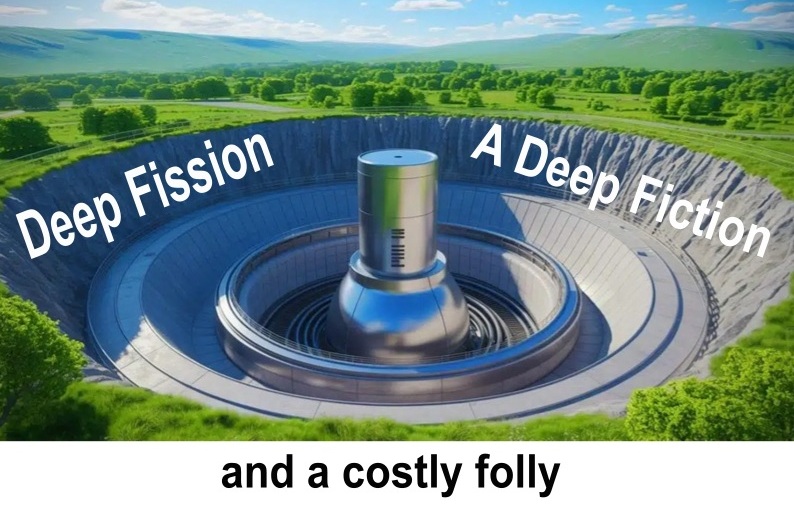
The nuclear startups receiving special dispensation from the DOE are part of a pilot program established under Executive Order 14301, “Reforming Nuclear Reactor Testing at the Department of Energy.” The DOE selected Oklo Inc. (Energy Secretary Chris Wright formerly served on its board of directors), Aalo Atomics Inc., Antares Nuclear Inc., Atomic Alchemy Inc., Deep Fission Inc., Last Energy Inc., Natura Resources LLC, Radiant Industries Inc., Terrestrial Energy Inc. and Valar Atomics Inc. as the companies whose experimental reactor designs will be tested at locations in Texas, Kansas, Utah and Tennessee (Oak Ridge). In another attempt to dodge NRC oversight, these companies are considered DOE contractors whose reactors are subject to DOE rules no matter their location
Analysis, Kristen Thomason | August 10, 2026, https://baptistnews.com/article/if-youre-already-afraid-just-wait-until-you-hear-about-manhattan-project-2-0/
Summers spent at my grandparents’ house in Tennessee were hot and humid. With enough cousins piled into the porch swing, you could stir up a bit of a breeze. But when that was no longer effective, we would retreat to the air-conditioned splendor of the American Museum of Science and Energy in Oak Ridge and stroll through exhibits like “Wildcatting for Oil” and “Atoms for Autos.”
Among these varied installations, however, pride of place was given to documenting Oak Ridge’s role as the secret headquarters for the Manhattan Project and source of the Hiroshima bomb’s enriched uranium. Most of the 30,000 covert workers on that project only discovered the truth of what they had been helping to build on Aug. 6, 1945, when they awoke to the headline “Oak Ridge Attacks Japan.”
Eighty years later, on May 23, 2025, President Donald Trump signed a series of executive orders to further the Department of Energy’s “Manhattan Project 2.0.” And just like the original, the second iteration of the Manhattan Project has plenty of secrets of its own.
The executive orders came at the behest of tech giants like Amazon, Meta, Google and Microsoft, who want cheap, abundant nuclear power to run their AI data centers. And according to the United Nations, these data centers will have doubled their voracious consumption of electricity and water by 2030.
Benefiting from a second Atomic Age
Nuclear industry executives who stand to benefit from a second atomic age had advance access and offered edits to the executive orders, which maximize risk-taking and profit-making over the safety of nuclear employees and the public. They stood behind Trump as he signed Executive Order 14299, “Deploying Advanced Nuclear Reactor Technologies for National Security,” which paves the way for private companies to construct commercially owned and operated experimental nuclear reactors on Department of Defense properties and at the DOE’s national laboratories.
The original Manhattan Project granted the military sweeping authority to bypass regulations and red tape when developing the atom bomb. Likewise, situating these new reactors on federal land allows companies to skip environmental requirements and skirt the authority of the Nuclear Regulatory Commission, the independent bipartisan body charged with granting licenses and regulating the safety of commercial nuclear reactors.
However, to achieve their goal of mass-producing portable nuclear reactors they can deploy via semi-truck to datacenters, hospitals and industrial facilities, they’ll eventually need to pass the NRC’s stringent public safety and environmental standards. That is why Trump next signed Executive Order 14300, “Ordering the Reform of the Nuclear Regulatory Commission,” to overhaul the “structure, personnel, regulations and basic operations” of the NRC.
In 1974, Congress, weary of the Atomic Energy Commission’s reckless experimentation with atomic power at the expense of public safety, divided it into the DOE, which promotes nuclear power, and the NRC, which regulates it. Scientists at Oak Ridge National Laboratory were thus forced to abandon a plan to carve a second canal through Panama using 250 Hiroshima-sized atomic bombs. Executive Order 14300 is a return to the wild pre-1974 days.
The order first directs the NRC to rubber stamp approval for those reactors developed under the auspices of the DOE and DOD without any additional testing. It then reduces the responsibilities and size of the Advisory Committee on Reactor Safeguards, an independent group that once provided technical guidance about reactor safety to the NRC but now can only voice concerns when specifically asked. The president also replaced Democrat and NRC Chair Christopher Hanson and installed a steering board staffed by DOE officials to oversee the NRC reforms.
Next, Executive Order 14300 loosens radiation exposure restrictions for nuclear workers and the general public. To implement this order, on July 1, the NRC proposed a series of changes including limiting use of the linear no-threshold model, which affirms there is no threshold below which radiation is safe. The public has 45 days to comment on the changes.
Raising doubts about the dangers
The linear no-threshold model is the industry gold standard and guiding principle for radiation safety around the world. However, in a move akin to its approach to vaccines, the administration raises doubts about the science behind the model despite the myriad studies and decades’ worth of radiation data on nuclear workers that undergird it.
The 2023 International Nuclear Workers Study examined the dosimeters worn by 309,932 nuclear workers in France, the United Kingdom and the U.S. and tracked their incidents of cancer for an average of 35 years. Scientists confirmed that the greater the exposure to ionizing radiation from nuclear fission, even at low occupational levels, the greater the likelihood of death from a cancerous tumor, which often only appeared decades after exposure.
UNC Chapel Hill conducted a similar study focusing on the 22,000 workers hired at the ORNL from the early days of the Manhattan Project through the mid-1980s and found results similar to INWORKS for salaried workers and even higher rates of cancer for hourly workers. These men worked construction, laundered radioactive uniforms or, like my grandfather, laid railroad track to allow for the removal of “legacy waste” from the Manhattan Project without any protection or knowledge that they were being exposed.
Therefore, when it comes to ionizing radiation, which is invisible and difficult to measure accurately, the ethical approach is to keep the exposure level “as low as reasonably achievable,” or what is known as the ALARA standard. This might mean minimizing the time employees spend with radioactive materials, requiring protective gear or, in the case of the public, keeping radioactive emissions below legal limits.
However, protecting people doesn’t fit with the “move fast and break things” methods of tech moguls who want nuclear energy ASAP to power their AI databases. So, in its new proposed rules, the NRC is acknowledging linear no-threshold but dispensing with the ALARA standard in favor of a graded approach where safety is determined by situation with little accountability. Nuclear investors and Trump donors Peter Thiel and Mark Andreessen have been lobbying for the abolition of ALARA from the NRC, also a recommendation of Project 2025.
More DOE changes
The DOE began secretly eliminating ALARA from its own radiation protection framework in August 2025 without officially informing employees or the public until January 2026, although it did notify nuclear executives. To justify the end of ALARA, the DOE cited a report they themselves commissioned from the Idaho National Laboratory. That report said that to reduce “unnecessary economic burdens,” companies could now expose workers to five REM a year.
Roentgen Equivalent Man measures the biological effect and risk of radiation exposure to human tissue. According to the National Academies of Sciences, an exposure of five REM a year could cause cancer in one out of five career nuclear employees. The INL report proposes a future increase to 10 REM a year, which would raise the cancer rate to four out of five.
New DOE rules also double the radiation exposure level that would trigger an official investigation from two times to four times the legal limit. When Seth Cohen, the DOGE employee tasked with removing government “barriers” for nuclear companies, was asked if they should establish a fund for such workplace accidents, he said, “When SpaceX started building rockets, they sort of expected the first ones to blow up.” Andreessen called Cohen “An American hero” on X.
In addition, nuclear contractors for the DOE, including the start-up companies, now can ignore what’s known as Appendix A to Part 851 on Worker Safety and Health Functional Areas. As a result, precautions such as informing employees of possible hazards, procedures regarding possible carcinogens, requiring respiratory protection equipment or providing “comprehensive occupational medicine services” are no longer mandatory. This rule change does not apply to contractors working with other forms of energy.
Without occupational medical services to track and document radiation exposure and any subsequent disease, it will be difficult for employees to later obtain the care and compensation they’re owed in the event of an accident or overexposure. Such was the case for victims of the partial meltdown of Three Mile Island, who had no way to prove in a court of law that they had received excessive doses of radiation.
The nuclear startups receiving special dispensation from the DOE are part of a pilot program established under Executive Order 14301, “Reforming Nuclear Reactor Testing at the Department of Energy.” The DOE selected Oklo Inc. (Energy Secretary Chris Wright formerly served on its board of directors), Aalo Atomics Inc., Antares Nuclear Inc., Atomic Alchemy Inc., Deep Fission Inc., Last Energy Inc., Natura Resources LLC, Radiant Industries Inc., Terrestrial Energy Inc. and Valar Atomics Inc. as the companies whose experimental reactor designs will be tested at locations in Texas, Kansas, Utah and Tennessee (Oak Ridge). In another attempt to dodge NRC oversight, these companies are considered DOE contractors whose reactors are subject to DOE rules no matter their location.
Participants in the Reactor Pilot Program will be testing Small Modular Reactor prototypes and experimenting with new sources of fuel which, without the necessary regulations, have the potential to jeopardize public safety. The most expensive element to build in a nuclear power plant is the lead-and-concrete containment shield designed to keep radioactive vapors from escaping in the event of a nuclear meltdown. Shielding is what failed 40 years ago during the 1986 Chernobyl Unit 4 power plant disaster in Ukraine and what held when Pennsylvania’s Three Mile Island suffered a partial meltdown in 1979.
Supporters of SMR say their new high-assay, low-enriched uranium fuel called TRISO is so safe that physical containment isn’t necessary. But X-energy, a nuclear reactor and fuel company funded by Amazon, released an accident analysis that said TRISO could exceed safe temperatures by several hundred degrees Celsius.
“The problem is that, with new reactors, they introduce new safety concerns and new technical issues,” said Edwin Lyman, director of nuclear power safety at the Union of Concerned Scientists. “Every design I have looked at has potential safety and security vulnerabilities, which are not being addressed to the extent that they need to be.” The DOE also has jettisoned the requirement to have a cognizant system engineer monitoring each of the reactor’s safety systems, calling it an “unnecessary burden.”
Yet, new types of fuel produce new types of nuclear waste. Every few years, a traditional nuclear power plant removes the highly radioactive spent fuel rods, which are now a mixture of uranium and plutonium, and leaves them to cool in pools of water before they’re sealed in concrete casks for what is supposed to be interim storage. Today, 100,000 metric tons of spent fuel are sitting in limbo because the federal government has failed to find a permanent storage solution for high-level nuclear waste.
Unbeknownst to most, fully one third of all Americans live within 50 miles of nuclear waste storage.
The waste problem
SMRs face the same long-term waste disposal conundrum, only they produce a more chemically and physically reactive waste and two to 30 times more of it than traditional reactors. This waste is not compatible with current nuclear waste disposal technologies, so engineers are experimenting with ways to manage the output and radiation. In response, the DOE replaced its former 59-page waste removal manual with 25 pages of bullet points.
Entirely missing from the abridged version are the sections on waste packaging and monitoring. Last July, Trump dismissed all but one member of the Nuclear Waste Technical Review Board, an independent federal agency charged with reviewing the science behind the DOE actions regarding spent nuclear fuel and high-level nuclear waste.
Executive Order 14301 also orders the DOE to “reform its rules” regarding the National Environmental Policy Act by excluding SMRs from a full environmental assessment or environmental impact statement. Previously, nuclear reactors had to address their potential impact on water, air and ecosystems at specific locations.
Now, in a possible violation of the Clean Water Act, the DOE says the release of radioactive water and steam into the environment should be “avoided” but is not strictly prohibited. Companies no longer “must” protect groundwater from radioactive contamination. “Avoiding” or “minimizing” is sufficient. Monitoring for contamination is optional.
But because cleaning up radioactive spills is expensive, the INL report also recommends abandoning the ALARA standard for the public. Both the NRC and the DOE are following this directive. However, the NRC has decided not to change the .1 REM public exposure limit, while the DOE is raising the limit from .1 REM to .5 REM.
This is in addition to the average .62 REM of “background radiation” Americans receive from sources like the sun and air travel. The DOE increase will be the equivalent of 50 X-rays a year per person, which will result in one in 57 people who live near a DOE nuclear facility developing a fatal cancer. Women and children, especially girls, will feel the effects even more severely.
When exposed to radiation within the current legal limit, women are 50% more likely to die of radiation-induced cancer than men, and girls are seven times as likely as men and twice as likely as boys of the same age to develop cancer. The DOE also has cut the Office of Environment, Health, Safety and Security, the agency’s internal team of health experts who study radiation safety, so it’s unclear who would monitor for this potential danger.
And yet another danger
Executive Order 14302, “Reinvigorating the Nuclear Industrial Base”, further endangers the safety of nuclear workers and the wider public by providing the nuclear industry with Cold War-era plutonium-239 harvested from dismantled nuclear warheads. Because the U.S. doesn’t currently have enough uranium for Manhattan Project 2.0, Oklo, Standard Nuclear, Exodys Energy, SHINE Technologies and Flibe Energy plan to convert plutonium into SMR fuel.
Plutonium is highly toxic if inhaled and requires special ventilation to handle. Other countries that have attempted to use plutonium have found converting it not worth the expense. It’s also highly sought after for bomb-making and requires heightened security measures. With a half-life of more than 24,000 years, managing plutonium is not a short-term commitment. And yet, because companies complained about the cost of security, the DOE jettisoned hundreds of pages of security regulations for reactors, including specifications for storage and requirements for firearms training and emergency drills.
Instead, Executive Order14302 encourages the reprocessing of nuclear waste, a practice discontinued during the Carter administration because it produces excess plutonium. In February, the Trump administration awarded $19 million to five companies that will experiment with nuclear fuel “recycling,” which is a misleading moniker. The reprocessing of spent fuel creates its own high-level radioactive waste, albeit with a half-life of a thousand years rather than tens of thousands of years.
Enabling these changes to the country’s nuclear regulations is Executive Order 14303 “Restoring Gold Standard Science,” which is less about rigorous science than it is about “doubt science,” the strategy utilized by the tobacco industry to raise doubts about the dangers of smoking and dodge regulation. MAGA officials and DOGE staffers are cherry-picking data that supports their agenda and discarding evidence that does not.
They are quite fond of citing fringe scientist Edward Calabrese, who, from his work with fruit flies, thinks a little radiation might be beneficial for people. My great, great, great grandfather said something similar while hawking “Dr. Kister’s Radium Charged Water” in the 1900s, until the government ordered him to cease and desist.
Who should we trust?
Industry executives promise their new SMR technology is safe, but Trump has disbanded the independent boards that might hold them accountable. Furthermore, given the disregard Amazon has shown to warehouse worker safety in the name of profit, why would anyone believe that Amazon-owned X-energy would be any more considerate to its nuclear employees or the general public?
The DOE also has a horrific history when it comes to protecting people and the environment from nuclear waste and ionizing radiation. In 2005, radioactive contaminants from deteriorating waste disposal facilities at the Oak Ridge nuclear plant infiltrated the Clinch River, a source of drinking water in East Tennessee.
Summer in Tennessee is demonstrably hotter than it was 40 years ago. Even folks who deny the reality of climate change can’t ignore that tomato planting time is earlier than ever. Some experts say nuclear energy must be a part of America’s renewable energy portfolio if we are to cut carbon emissions and reduce global warming. China, our stated AI nemesis in the Manhattan Project 2.0, also has developed SMR but is relying heavily on solar and wind farms to power its data centers.
The Biden administration also had a plan in place to triple nuclear energy capacity by 2050, which called for adding staff to the NRC to speed up licensing, rather than repealing safety regulations. Following the lead of Canada and Finland, they sought to build trust with local communities through a multi-year consent-based process.
In contrast, Trump vows to quadruple the country’s nuclear capacity, enticing states to volunteer sites as “Nuclear Lifecycle Innovation Campuses.” Selected cities will enrich uranium, create fuel, generate nuclear power, reprocess spent fuel and store nuclear waste all in one location, although without the local buy-in, trust building or necessary geological prescreening present in the Biden plan.
Gov. Bill Lee of Tennessee applied to make Oak Ridge one of these nuclear campuses, although with 230 nuclear lifecycle companies operating between Oak Ridge and Knoxville, plus ORNL and the secretive Y-12 National Security Complex, it’s practically one already.
One of the joys of those summer visits to Tennessee as a child was seeing my uncle who worked at Y-12 as a chemist. When asked about his latest classified projects, he would sigh, fold his hands across the bib of his overalls and say, “Well, if I told ya, I’d have to kill ya,” and we kids would laugh. But the serious, sobering truth is the total impact of the radiation from these facilities is itself a secret. It’s been called the “perfect crime” because low doses of ionizing radiation can inflict cell damage and cause cancer decades after exposure.
Remnants of the original Manhattan Project are still around in Oak Ridge, whispering about its secret past. The impact of ionizing radiation lingers like the abandoned guard towers at the edge of town. Residents of Oak Ridge and the surrounding rural towns have more incidents of cancer than the national average due to exposure from this radiation.
On July 4, four of the pilot program SMRs had achieved nuclear criticality. No doubt the relaxation of safety and environmental regulations helped make this possible. This achievement marks a significant milestone in the Manhattan Project 2.0’s quest for cheap electricity to power Silicon Valley’s data centers.
However, just like the original Manhattan Project, America won’t know the full cost for at least another generation. Thanks to Trump’s deregulation spree, that cost to the health and well-being of Americans could be high indeed.
Kristen Thomason is a freelance writer and journalist living outside Edinburgh in the United Kingdom. She has produced educational and promotional media for national and international religious organizations and public television. Kristen also worked with local churches in Metro D.C. and Toronto, Canada. With a master’s degree in communication and undergraduate degrees in media studies and classics, she is interested in the intersection of politics, religion, history and the arts.
Nuclear-related news for the past week
TOP STORIES.
This Hiroshima Day, we are closer than ever to nuclear war.
Climate Change Is Rewriting Europe’s Nuclear Cooling Assumptions.
Ukraine for Hire: How Kyiv Became the West’s Imperial Enforcer.
Gaza’s “Peace Plan” Is Written in Blood.
AUSTRALIA. AUKUS: Its single point of obsolescence.
Pat Conroy,Australia’s Minister for Defence Industry in denial about U.S. military bases (?targets) in Australia.
FROM THE ARCHIVES – Lucas Heights nuclear reactor was always intended as a step towards nuclear weapons, AND IT STILL IS
More at https://antinuclear.net/2026/08/07/australian-news-this-week/
ATROCITIES.
Israel’s Ghoulish Settlers Eye Up Gaza, As Netanyahu Kills Trump’s Board of Peace.
CLIMATE.
- No to Nuclear: why nuclear power and nuclear weapons are interlinked threats to humanity.
- Heatwaves expose nuclear power’s water risk.
- The Nuclear Regulatory Commission ignores climate danger.
- EU considers emergency meeting as nuclear shutdown leaves Hungary facing energy crisis.
- Government ‘continues to ignore warnings’ as wildfire rages near Sizewell B – ALSO AT https://nuclear-news.net/?s=Government+%E2%80%98continues+to+ignore+warnings%E2%80%99
- Firefighters in ‘better position’ as they tackle Suffolk wildfire near Sizewell nuclear site, for third day. Suffolk nuclear power plant on alert over wildfire- ALSO AT https://nuclear-news.net/2026/08/04/4-suffolk-nuclear-power-plant-on-alert-over-wildfire/
- Climate change exacerbates nuclear risks in the Arctic. And we are not ready.
ECONOMICS. A stormy future? Financial impact of climate change-related disruptions on nuclear power plant owners.
EDUCATION. How Lockheed Martin, Raytheon & BAE Systems Are Propagandizing Children To Support War Through STEM.
EMPLOYMENT. Burnham is wrong – increased nuke spending will lose more jobs than create.
ENVIRONMENT Activities related to nuclear weapons and nuclear power have created a vast archipelago of contamination.
AI Wants Your Land, Water, Power
HISTORY. Walt Zlotow – Many top military leaders opposed atomic bombings.
LEGAL. Nuclear Watchdog Sues for Plutonium Pit Production “Special Study”.
MEDIA. Press Opinion Treats US Devastation of Cuba as Reason for More Devastation. The powerful impact of six haunting minutes.
OPPOSITION to NUCLEAR . Stop Hinkley campaigners highlight storage of nuclear waste in West Somerset, Where has all the disarmament gone?
POLITICS.
Time to build a Scotland without nuclear weapons. Labour urged to end ‘dangerous’ nuclear weapons policy on Hiroshima Day. Brian Leishman MP blasts party’s own nuclear policy.
𝗪𝗛𝗢 𝗜𝗦 𝗥𝗘𝗔𝗟𝗟𝗬 𝗜𝗡 𝗖𝗛𝗔𝗥𝗚𝗘: 𝗔𝗠𝗘𝗥𝗜𝗖𝗔 𝗢𝗥 𝗜𝗦𝗥𝗔𝗘𝗟? After 157 days of Iran war failure, Trump must quit war or quit presidency.
How can Ireland build a nuclear reactor when it can’t even manage a
children’s hospital? What links Palestine Action arrests with Burnham’s nuclear weapons splurge?
POLITICS INTERNATIONAL and DIPLOMACY.
- CIA Assessment Details Israel’s Race to Make the U.S.-Israel Alliance Irreversible.
- How Trump’s Saudi deal could spark a nuclear arms race in the Middle East.
- Diplomacy Without De-Escalation: The Manila Talks and Ukraine’s Escalation Strategy.
- Why the U.S. Military is ‘Earth’s Greatest Enemy’ (w/ Abby Martin) | The Chris Hedges Report
RADIATION. DR Congo’s cobalt boom carries an unwanted cargo: uranium– ALSO AT https://nuclear-news.net/?s=DR+Congo%E2%80%99s+cobalt+boom
SECRETS and LIES. Why no Hollywood movie on Nagasaki A bombing?
Nuclear test veterans’ medical records were gathered by secret government lab.
Israeli spyware firms are fueling the global surveillance state.
Is It Just About AIPAC’s Money, or Does the US-Israel Rot Run Far Deeper?
SPACE. EXPLORATION, WEAPONS. Secret ‘Project Mars’ roils Torrance County residents.
A Ton of Space Junk Is Reentering Earth’s Atmosphere More Often, and It’s Hard to Predict.
Alert: SpaceX rocket stage will slam into the Moon August 4-5. Can Earth’s people stop it?
TECHNOLOGY. Pentagon Plans AI Data Centers at Military Bases Across Multiple Branches. Cory Doctorow: The people who tell you ‘AI is changing everything’ are lying.
WASTES. Japan begins 22nd release of Fukushima nuclear-contaminated wastewater into ocean.
WAR and CONFLICT.
- Huge Uptick In Israeli Airstrikes On Gaza Since Trump Hailed ‘Historic’ Hamas Deal.
- ‘Defend Israel or the Homeland’: Top US general issues stark warning to Pentagon brass.
- Stillborn Peace Plans: Israel, Hamas and the Question of Disarmament.
- The ‘Underground Nation’ returns: Switzerland’s new war-time shelter strategy.
- The War of Perception: The West’s infowarfare and cognitive warfare against Russia.
- Kamikaze Drone Slams Into Crowded Russian Black Sea Beach, Killing 3. Ukraine continues its use of mine terrorism against civilians.
WEAPONS and WEAPONS SALES. NATO is being installed into Ukraine’s military– https://www.youtube.com/watch?v=oYawuRVSxdU
Nuclear disarmament has never been more urgent.
Hiroshima marks 81st atomic bomb anniversary as mayor deplores the pursuit of nuclear weapons.
The Next Weapons Frontier: New Mexico’s Expanding Military Industrial Ecosystem. Common Sense & the Pentagon Budget.
Western countries see World War III coming


Voters in leading allied states broadly support higher defense spending, but balk when faced with policy trade-offs.
POLITICO POLL, February 13, 2026 By Tim Ross, https://www.politico.eu/article/world-war-iii-defense-spending-europe-poll/ [Excellent tables on original]
BRUSSELS — Western countries increasingly believe the world is heading toward a global war, according to results from The POLITICO Poll that detail mounting public alarm about the risk and cost of a new era of conflict.
Across all five countries polled — the U.S., Canada, the U.K., France and Germany — the vast majority of respondents think the world is becoming more dangerous. The outbreak of World War 3 is seen as more likely than not within the next five years by American, Canadian, French and British respondents.
The share of voters predicting a new global conflict has risen sharply since independent pollsters Public First asked the question in March 2025. “The changed attitudes of the Western public in under a year reflect a dramatic move to a more insecure world, where war is seen as likely and alliances are unstable,” said Seb Wride, head of polling at Public First.
But The POLITICO Poll also revealed limited willingness among the Western public to make sacrifices to pay for more military spending. While there is widespread support for increasing defense budgets in principle across the U.K., France, Germany and Canada, that support fell sharply when people learned it might mean taking on more government debt, cutting other services or raising taxes.
“Our polling shows the growing concern about war does not give leaders license to spend heavily on defense,” said Wride. “If anything, voters are now less willing to make the trade-offs needed to improve military security. So European leaders are left in a bind — unable to rely on the U.S., unable to use that as a reason to invest domestically, and under higher pressure to urgently solve this for a world where conflict feels closer than before.”
The findings, based on surveys of more than 2,000 voters in each country between Feb. 6 and Feb. 9, lay bare the challenge facing NATO leaders as they try to strengthen security at a time when public finances are tight.
That struggle will shape discussions among politicians from across the world as they head to Germany for the annual Munich Security Conference starting Friday.
With no sign of an imminent end to Russia’s four-year all-out war against Ukraine, and the U.S. taking military action in Iran, Syria, Venezuela and Africa under President Donald Trump, many voters see a growing risk of global conflict.
The pattern is particularly stark in the United Kingdom, where 43 percent believe a new world war is “likely” or “very likely” to break out by 2031 — up from 30 percent in March 2025. Nearly half of Americans — 46 percent — think a new world war is “likely” or “very likely” by 2031 — up from 38 percent last year. Among the five countries, only people in Germany think on balance that a third global war is not likely in the next five years.
When it comes to individual nations engaging in military action, U.S. respondents were the most likely to think their own country will be at war within the next five years, followed by respondents in the U.K. and France.
This suggests NATO’s nuclear powers may be more braced for conflict than other nations, and that Trump’s “president of peace” image is not convincing voters at home.
At least one in three people in the U.S., U.K., France and Canada believe a nuclear weapon is likely or very likely to be used in a war in the next five years.
Russia is seen as the biggest threat to peace in Europe, while Canadians see Trump’s America as the greatest danger to security. In France, Germany and the U.K., the second-biggest threat is seen to be the U.S., which respondents cited far more often than China.
What will it cost?
A majority of voters in France, Germany, the U.K. and Canada said their country needs to spend more on defense, with that sentiment strongest in the U.K. and Canada.
But the question is how to pay for it. The POLITICO Poll found support for more defense spending fell when people were invited to consider whether that funding should come from cuts to other budgets, taking on more government borrowing, or raising taxes.
The French and German publics are now less likely to support higher defense budgets within the context of a spending trade-off than they were last year, according to the results.
In Germany, defense spending was one of the least popular uses of money, ahead of only overseas aid.
In 2025, 40 percent of the French public and 37 percent of the German public said they would support increased defense spending when the trade-offs were mentioned. This year, backing for that fell to only 28 percent in France and 24 percent in Germany.
Both countries are now more likely to oppose spending more on defense when they have to consider how to pay the bill.
The POLITICO Poll showed there is also significant public skepticism about creating an EU standing army under one central command, an idea that has been mentioned by the European Commission. The proposal received support from only 22 percent of people in Germany and 17 percent in France.
Mandatory military service was most popular in Germany and France, where around half of people support the idea.
This edition of The POLITICO Poll was conducted by Public First from Feb. 6 to 9, surveying 10,289 adults online, with at least 2,000 respondents each from the U.S., Canada, U.K., France and Germany. Results for each country were weighted to be representative on dimensions including age, gender and geography. The overall margin of sampling error is ±2 percentage points for each country. Smaller subgroups have higher margins of error.
No “Gold Standard,” No Israel Clause: What the Saudi Nuclear Deal Actually Says (MBN)
August 7, 2026 , https://npolicy.org/no-gold-standard-no-israel-clause-what-the-saudi-nuclear-deal-actually-says-mbn/
Two weeks ago, President Trump was about to send the Hill a U.S.-Saudi nuclear cooperative agreement. After a torrent of criticism from Fox News, The Wall Street Journal, and The New York Times, though, he changed his mind and insisted that the United States would not help Saudi Arabia make nuclear fuel and that the deal would not come into force until Saudi Arabia recognized Israel.
The question now is what’s next. Below is an interview I granted to the U.S. government’s Middle East Broadcasting Network that takes a stab at where we’re headed.
First, if the deal proceeds as the U.S. Energy Department and the press have described it will provide the Saudis with a pathway to make nuclear fuel—the most difficult and essential step to making nuclear weapons. The problem here is that Israel and the United States have been bombing a variety of nuclear sites to throttle this very same activity in Iran.
In an attempt to avoid this contradiction, the Energy Department insists there will be no enrichment unless a two-year study concludes that Saudi nuclear fuel-making is economically sound and can be rendered safe. Yet, as I note below, the premise of conducting such a study—that the answer could be yes—is disingenuous. We already know the honest answer is no.
The second problem with the agreement is that it does not require Riyadh to adopt international nuclear inspections (known as Protocol I visits) that would allow the International Atomic Energy Agency (IAEA) to go anywhere, anytime outside declared nuclear sites. One hundred and forty four nations have already granted authority to the IAEA to conduct such inspections on their soil. Saudi Arabia has refused.
This suggests that Riyadh has something it wants to hide, possibly including a covert nuclear weapons program. Saudi officials are already on record that the Kingdom must get nuclear weapons if it believes Iran is acquiring them. Saudi Arabia also has tight connections to Pakistan, which has mastered both enrichment and nuclear weapons design.
Finally, by creating a pathway to dangerous nuclear weapons-related activities, it will set a precedent for Riyadh’s neighbors, including the United Arab Emirates, Turkey, and Egypt—nations pursuing large nuclear power programs.
The Energy Department’s rejoinder is that if the United States doesn’t help Saudi Arabia make nuclear fuel, Russia and China will with fewer controls. That gets things backwards. In fact, no country—not the United States, not China or Russia—during the last half-century has offered to transfer nuclear fuel-making technology to states lacking nuclear weapons. The last country to do that was the United States in the 1960s with India, which used the assistance to set off a “peaceful” nuclear explosion.
If, as proposed, the United States violates this sound standard by helping Saudi Arabia enrich uranium, the very thing our Energy Department says it is worried China and Russia might do, is what our violation of this standard will ensure.
The President has yet to send the Saudi nuclear agreement to Hill for review. As I argue in the attached interview, it would be best if it never left his inbox or, at least, our government renegotiated to include the very things President Trump now insists are necessary—no enrichment and Saudi Arabia’s recognition of Israel.
August 4, 2026
Henry Sokolski Interview with Middle East Broadcasting Networks
No “Gold Standard,” No Israel Clause: What the Saudi Nuclear Deal Actually Says
The Trump administration has yet to formally send to Congress the nuclear cooperation agreement it signed with Saudi Arabia last month.
Energy Secretary Chris Wright and Saudi Energy Minister Prince Abdulaziz bin Salman signed a Section 123 agreement – the legal step that allows American companies to share nuclear technology with another country – in Riyadh on July 22. The Department of Energy said at the time that the agreement would “now be transmitted to Congress for review.”
Until it is, the review clock cannot start. Once transmitted, the agreement takes effect “after 90 consecutive legislative days of sitting before Congress” – days Congress is actually in session, not calendar days – “which could be sometime before the end of this year,” said Henry Sokolski, who runs the Nonproliferation Policy Education Center and served as the Pentagon’s deputy for nonproliferation policy in the George H.W. Bush administration.
The administration has also complicated its own deal. A day after the signing, President Trump posted on Truth Social that Saudi Arabia would not be allowed to enrich uranium, and that the entire arrangement depended on Riyadh joining the Abraham Accords and establishing relations with Israel.
Those conditions do not appear in what the two governments actually signed, Sokolski told MBN.
“I’m with the Saudis on this. I think they’ve got it right, which is: you’ve got to be kidding. We signed documents. They didn’t have anything in it about these other conditions,” Sokolski said. “It is not part of the deal.”
Saudi Arabia has said repeatedly that it will not normalize relations with Israel unless Israel agrees to Palestinian statehood — a condition Prime Minister Benjamin Netanyahu has refused.
Sokolski noted that the president retains one lever regardless: even after the agreement takes effect, he can decline to approve nuclear exports to Saudi Arabia. “He has that power. But it’s not something that he’s legally bound to do. It’s something that’s executive discretion,” he said.
What the deal actually allows
A full assessment is still impossible. The text of the agreement has not been published, nor have two side letters that accompany it. “We haven’t seen them,” Sokolski said. “Of course, we haven’t even seen the 123 agreement yet.” Most of what is known comes from briefings the Energy Department has given reporters.
What is known is this: once in force, the deal defers the central question to a study. “There’ll be a two-year study on, well, is the making of nuclear fuel by enriching uranium really all that economical for Saudi Arabia,” Sokolski said.
If the study says yes, American firms would build an enrichment plant on Saudi soil, operating under U.S. oversight.
“If the conclusion of that is yes, then the United States would actually build a plant, an enrichment plant, that would bring the most sensitive technologies that we’re now currently bombing in Iran to Saudi Arabian soil,” Sokolski said, referring to the U.S. military campaign aimed at preventing Iran from obtaining nuclear weapons.
If the study says no, “the agreement somehow will bind the Saudis to not get enrichment from anyone else for 10 years,” Sokolski said, citing reporting on two side letters that have not been made public. A separate side agreement, he added, would limit Saudi reactor purchases to Westinghouse — a company headquartered in Pennsylvania but owned by two Canadian firms.
A departure from the “gold standard”
The agreement breaks with the terms Washington set for the United Arab Emirates in 2009 – an arrangement so strict it became known as the “gold standard.” Abu Dhabi made a legal commitment to forgo both uranium enrichment and the reprocessing of spent fuel, the two most direct pathways to a nuclear weapon. It also accepted the International Atomic Energy Agency’s Additional Protocol, an inspection regime that lets IAEA monitors examine nuclear-related sites a country has not formally declared.
Saudi Arabia has agreed to neither.
“In the case of Saudi Arabia, the forswearing did not occur at all,” Sokolski said. “Worse, they did not agree to the Additional Protocol — which raises the question: do they have something to hide, or do they think they will?”
“144 countries – almost all the countries in the world – have agreed to the Additional Protocol,” he added. “Not Saudi Arabia.”
Supporters of the deal argue that American oversight of a Saudi facility is better than pushing Riyadh toward Russia or China, which might offer looser terms. Sokolski is skeptical that American control would survive contact with reality.
“We have this expression in the United States: possession is 90 percent of the law. If you have something on your soil, you can always tell the Americans to leave. And there you go – you have it,” he said.
A declared facility, he added, does nothing to rule out a covert program – especially without the Additional Protocol, which exists precisely to let inspectors chase undeclared activity.
A history of finding out too late
Sokolski pointed to Saudi Arabia’s record of acquiring missile capabilities without Washington managing to stop it in advance. “The track record there is 100 percent consistent. Every time they’ve gotten a missile, it was too late for us to do anything to block it,” he said. The Washington Post has reported that Riyadh secretly bought Chinese ballistic missiles in the 1980s, and that Washington learned of the deal only after the missiles had arrived and construction of their bases had begun inside the kingdom.
The stakes are raised by the Saudi crown prince’s own words. In 2018, Mohammed bin Salman told CBS’s “60 Minutes” that if Iran builds a nuclear weapon, Saudi Arabia would “follow suit as soon as possible.”
“In the case of Saudi Arabia, they’ve been pretty clear that if they think Iran’s getting a bomb, they have to get one too,” Sokolski said.
The fight in Congress
The deal “hasn’t sat well with a lot of people on the Hill,” Sokolski said, including some staunch Trump supporters – among them Sen. John Kennedy of Louisiana, who has been “quite emphatic saying there’s no way he’s going to support this.”
Blocking it is hard, but not impossible. “You don’t need many Republican senators to join a whole lot of Democrats to pass a piece of legislation,” Sokolski said, especially if Democrats take the House next year. The president could veto such a bill – but, he added, “you do not, as a president, want to see that coming to your desk.”
He suggested two narrower options for Congress: bar the use of American funds to implement any part of the agreement that permits nuclear fuel production inside Saudi Arabia, or write in an explicit condition that cooperation cannot lead to an enrichment facility.
The regional echo
The consequences do not stop at Saudi Arabia’s borders. The U.S.-UAE agreement contains a consultation clause triggered if Washington gives another country in the region more generous terms – and granting Riyadh a future path to enrichment, Sokolski said, could prompt Abu Dhabi to demand a renegotiation of its own deal. Egypt and Turkey could invoke the Saudi precedent to press their own claims to a full nuclear fuel cycle on their territory.
“Folks assume the worst when someone says they’re going to do something and they have the means to do it,” he said.
Sokolski worries the agreement could unravel a policy Washington has held since India’s nuclear test in the 1970s: refusing to help non-nuclear-weapon states produce nuclear fuel. Russia and China have largely taken the same public position, he said — but an American exception for Saudi Arabia could invite others to make their own.
The argument that the United States must cooperate because someone else will anyway is, he said, “a self-fulfilling fallacy.”
“People say, well, if you’re going to do that, then we got to do that,” he said.
Not settled yet
For all his criticism, Sokolski stressed that nothing is final. The economic study has not begun, Congress has not reviewed the agreement, and the administration could still tighten its terms or attach conditions to implementation. The deal, he said, looked like “a trial balloon” whose drafters “may have been a little too clever by half, not knowing exactly what they were locking into.”
“I just don’t know how the story ends,” he said, “and it could end very badly.”
To read the full piece, click here.
Israeli PM Netanyahu Rejects “Gaza Roadmap”

August 10, 2026, International Middle East Media Center, https://www.juancole.com/2026/08/israeli-netanyahu-rejects.html
Israeli Prime Minister Benjamin Netanyahu has rejected a proposed 15‑point roadmap intended to stabilize Gaza and advance a phased ceasefire, a move that Al‑Jazeera reports has placed ongoing diplomatic efforts at a critical crossroads.
The framework, negotiated through months of mediation and endorsed by the UN Security Council, was designed to create a structured path toward de‑escalation and humanitarian relief.
Netanyahu’s refusal has raised fears among Palestinian factions and regional observers that the conflict could return to a cycle of confrontation.
According to Al‑Jazeera, Netanyahu insisted that Israel would not withdraw its forces from Gaza unless Hamas is fully disarmed — a condition that contradicts the phased approach outlined in the roadmap.
Hamas, meanwhile, has stated that it remains committed to the agreement and expects international mediators to ensure Israel adheres to the negotiated terms.
Analysts cited by Al‑Jazeera say Netanyahu’s position reverses months of indirect negotiations in which Palestinian factions demonstrated flexibility to advance a political settlement.
The rejection has revived concerns that Israel may resume targeted killings, intensified bombardment, or expanded operations near displacement zones, potentially undermining the fragile stability achieved in recent weeks.
Al‑Jazeera’s reporting also highlights growing unease within Palestinian political circles that Netanyahu’s stance could derail the second phase of the agreement, which was expected to include humanitarian improvements and steps toward stabilizing civilian life in Gaza. Without Israeli compliance, mediators may be forced to reconsider the viability of the roadmap altogether.
Israeli political commentators suggest that Netanyahu’s decision may be driven partly by domestic political considerations. Facing pressure from right‑wing factions and declining public support, the prime minister is seen as adopting a hardline posture to maintain his coalition’s backing.
Some analysts argue that Netanyahu may also be leveraging the Gaza file to influence U.S. regional policy, particularly regarding Iran.
The report warns that Netanyahu’s rejection could trigger broader escalation across multiple fronts, including the occupied West Bank, southern Lebanon, and Gaza itself. Palestinian factions fear that Israel may gradually intensify military operations to impose new conditions on the ground and avoid concessions required by the roadmap.
Al‑Jazeera notes that Hamas continues to call on mediators — especially the United States — to pressure Israel to honor the commitments already negotiated. Without such guarantees, Palestinian officials worry that the roadmap could collapse, returning the conflict to an open‑ended and unpredictable phase.
Netanyahu’s refusal, analysts say, leaves the situation at a decisive moment: either renewed diplomatic pressure to salvage the agreement or a slide back toward escalation that could reshape Gaza’s political and humanitarian landscape.
Walt Zlotow – After 164 years it’s America facing ‘Unconditional Surrender’

Walt Zlotow West Suburban Peace Coalition Glen Ellyn IL, 10 Aug 26, https://theaimn.net/after-164-years-its-america-facing-unconditional-surrender/
America is famous for declaring its foes capitulate to unconditional surrender. It was first uttered in 1862 by Ulysses S. Grant who demanded the “unconditional and immediate surrender” of Confederate forces at Fort Donelson, Tennessee. U.S. Grant forever became known as Unconditional Surrender Grant.
US war presidents loved unconditional surrender. FDR employed it on Germany before he died and it worked well. Didn’t go so easily for Truman on Japan. Burning down Toyko on March 10 with Napalm, killing a hundred thousand innocents didn’t. A bombing Hiroshima.
August 6 didn’t. Even the second A bomb on Nagasaki did not definitively make Japan bow to the US demand. Most likely it was the million man Russian invasion the day before the Nagasaki bomb that convinced Japan to surrender unconditionally.
Unconditional surrender lay dormant for the next 81 years. It was AWOL thru Korea, Vietnam, Iraq, Afghanistan as the US failed to achieve anything close to an unconditional surrender from opponents that stymied, even defeated the vaunted world’s strongest military.
But on March 6, President Trump, unaware he’d already lost his delusional war to bring down the Iranian regime at the behest of Israel, declared Iran must submit to Unconditional Surrender.
Trump posted on Truth Social a week into his lost war demanding “unconditional surrender” from Tehran. Then he trotted out his clueless Press Secretary Karoline Leavitt to describe what would constitute unconditional surrender.
“What the president means is that when he, as commander in chief of the U.S. Armed Forces, determines that Iran no longer poses a threat to the United States of America and the goals of Operation Epic Fury has been fully realized, then Iran will essentially be in a place of unconditional surrender.”
One hundred sixty-three days into his lost war, President Trump finds America facing unconditional surrender. Unless he capitulates on all of Iran’s reasonable and non-negotiable terms, Iran will not fully reopen the Strait of Hormuz, placing the world’s economy in jeopardy of collapse.
What are those reasonable terms of surrender?
1. End all military action against Iran including bombing and blockade
2. Promise never again to attack Iran
3. End all economic sanctions on Iran
4. Return all frozen Iranian assets
6. Provide reparations for damage inflicted in Trump’s illegal criminal war launched February 28
Of course, facing unconditional surrender does not mean Trump will surrender unconditionally to Iran’s reasonable demands. He may simply adhere to the counsel of his former evil mentor Roy Cohn… ‘Never give up, never give in’ and mutter “After me, the deluge.”ww
Economist Baker Explains: AI Bubble Is About To Burst
August 10, 2026, Taya Graham and Stephen Janis TRNN
Economist Dean Baker (Center for Economic and Policy Research, author of Rigged and creator of the AI Bubble Monitor) joins Taya Graham and Stephen Janis to break down why the productivity data doesn’t match the hype, why Palantir’s CEO seemed to be panicking on live TV, why Bernie Sanders’ AI sovereign wealth fund idea might backfire, and what signs to watch for if this bubble bursts.
The following is a rushed transcript and may contain errors.
Hello, my name is Taya Graham and welcome to the Inequality Watch Report, a show that examines government policy and action through the lens of extreme economic inequality, the existential issue of our time. Today, we’re going to discuss a technology which we’ve been told will transform our lives, an invention that has been touted as the ultimate arbiter of our collective futures, whether we like it or not. Of course, I’m talking about artificial intelligence, but with the promise also comes doubt and questions and most of all, a lack of clarity on how we’ll impact the working people of this country. AI leaders have casually warned us that their products could eliminate 40 to 50% of white collar jobs more than the losses in the Great Depression. They’ve promised that technology will be so disruptive that even staunch capitalists have discussed providing a UBI or universal basic income for Americans who will be left out.
They’ve borrowed money at such predigious rates to fund data centers that even Wall Street is beginning to just say no. And now some of the biggest names are saying it’s not working out as planned and an America’s already historic wealth imbalance and government hamstrung by the self-interested impulses of a single man. And you have a situation that could brew a toxic stew of making the already rich even richer and leaving the rest of us even further behind amid all the societal chaos and upheaval. And are the cracks just starting to show?
Just this week, one of technology’s greatest apostles made accusations that AI has become a nemesis for his business and others. And capitalists who have gladly loaned billions to build data centers throughout the country are now starting to push back at the ever increasing demand for cash. Of course, the point of this show is to examine this topic through the lens of inequality and how it affects our political and social institutions and what it means for working people.
Just this week, one of technology’s greatest apostles made accusations that AI has become a nemesis for his business and others. And capitalists who have gladly loaned billions to build data centers throughout the country are now starting to push back at the ever increasing demand for cash. Of course, the point of this show is to examine this topic through the lens of inequality and how it affects our political and social institutions and what it means for working people…………….
Stephen Janis:
I think in a way, this is the greatest American kind of ripoff in the sense that they’ve spent about the past four or five years mining all our data, taking everything we posted online, and they’re regurgitating it back to us and want to charge us for it in some way.
And so to me, I think what is most missing for me besides the promise of huge economic disruption is what the value proposition is for the American people. I mean, they took everything that we wrote and now they want to repackage it and sell it as some sort of deity that we have to worship. And so I’m a little worried, a little worried, a lot worried that we’re all going to be casualties of a great wealth concentrator, which remember, OpenAI was supposed to be a nonprofit. Now it’s a for-profit company. All these huge IPOs, I’m afraid they’re just taking everything we’ve created, sell it back to us and become even richer, and there’ll be a greater concentrate of wealth and power…………………………………..
Dean Baker:
I think to a very large extent, we have people who are really good at hype. People like Sam Altman, of course, Elon Musk, absolute master of hype. These are the Donald Trumps of the business world. They’re selling this stuff and they’ve been very successful. I mean, Elon Musk just had his SpaceX initial public offering, which is primarily AI. I mean, that’s their own assessment. I’m not trying to attribute things to them.
If you read their registration statement, they say 90% of their expected market is in AI. So SpaceX is an AI company. So they’re looking to get rich by this. And I don’t mean necessarily because they’re going to have huge profits. They have huge stock prices. So Elon Musk became a trillionaire, not because SpaceX has enormous profits. It actually loses money hand over fist. He became a trillionaire because the stock price is ridiculously high.
So step one, is it creating inequality? Absolutely. By a stock bubble, bloated bubble. Now, in terms of what it delivers, they’re saying this, is it going to have massive impact? I’m sure it will. And the model I look to is the internet. Had massive impact. Does that mean that it’s going to lead to mass unemployment? Well, a lot of people lost their jobs to the internet. I mean, Amazon put a lot of small sellers out of retailers out of business………………………………………………………………………………………………………………………………………………………………………………..
Stephen Janis:
But these people are hyping valuations. They’re borrowing billions and billions of dollars, I think, based on a higher rate of return. I mean, is this like a house of cards? I mean, they’re hyping this over and over again saying it’s going to be transformative. But now you’re saying the impact so far has not been. Does that put at risk all these billions of dollars they’ve thrown at this problem?………………………………………………………………………………………………………………………………………
bubbles can have very bad consequences. So that’s why I’m very worried about this one. They’re selling this and Elon Musk undoubtedly is stuffing his pockets. And Sam Altman and the others, they’re stuffing their pockets. But no, I don’t see that these stock prices make sense. And when does the music stop? I don’t know. Both previous bubbles went way longer than I expected them to. But all I could say is the sooner it bursts, the better it will be for the country.
…………………………………………………………………………….I was saying we want stock investors or we think they should be knowledgeable. They aren’t. And people were spending based on their stock wealth. So you had a lot of people that were saying, “Oh, I had money in the NASDAQ and just doubled,” which it might well have. A lot of people owned stocks in the NASDAQ and over two years they would’ve doubled. So they said, “Oh, I’m going to buy a new car, get a bigger house, go on a big vacation.” Well, when those prices plummeted, that consumption stopped. So it was a very, very big hit to the economy
…………………………………………………………………………………………………………………………………………………………………………………….It’s like using paper. Oh, I used five reams of paper today. And you go, okay, great. What’d you do? I mean, that’s kind of nuts, but that’s what they were literally doing. So you’ve had companies looking to cut back hugely on the AI they use because they want to see that they’re actually getting something for it. And in many cases, their conclusion was that they weren’t. The other part of the story that he’s raising, Carp is raising, is they’re worried. They don’t know what’s happening with their data. So when you’re running your programs through Anthropic, through OpenAI and whoever else, they have your data. ………………..
They don’t want to give that away for nothing to Anthropic, to OpenAI, whoever. And they don’t know whether they are or they aren’t………………..
……………………………………………………………………………………………………………………….. increasingly the companies, and these are big companies, these are Meta, Alphabet, the biggest companies in the world. They’re having to borrow. So even though they’re very profitable, they’re undertaking such massive investments that they’re having to borrow. And you’re seeing a very interesting story here that investors in bonds are starting to get worried. We actually saw this with SpaceX. It was really striking.
One of my AI bubble monitors was about this, that SpaceX bonds are being sold at a discount, meaning that bond buyers see a risk that it actually could default, that they might actually go bankrupt. So here on the one hand, you have stock investors going, “Oh, SpaceX is going to be the most profitable company in the history of the world.” You have bond investors going, “It might go bankrupt. It might not be able to pay its bills.” So I would look at the bond market and it seems to be. I recently saw some data showing that there’s much less interest in Alphabet, Meta, the hyperscalers are called, that are involved in building the data centers for AI………………………………………………………………………………………………………………………………………………………………………..https://scheerpost.com/2026/08/10/economist-baker-explains-ai-bubble-is-about-to-burst/
1 This Month



26 September – International Day for the Total Elimination of Nuclear Weapons


PLEASE OPPOSE HR 8255 AND S.3639 – bills would accelerate satellite deployment, with no environmental review or safeguards – https://ncstd5li.quorum.us/campaign/169331/
To see nuclear-related stories in greater depth and intensity – go to https://nuclearinformation.wordpress.com
-
Archives
- September 2026 (269)
- August 2026 (330)
- July 2026 (355)
- June 2026 (287)
- May 2026 (306)
- April 2026 (356)
- March 2026 (251)
- February 2026 (267)
- January 2026 (308)
- December 2025 (358)
- November 2025 (359)
- October 2025 (375)
-
Categories
- 1
- 1 NUCLEAR ISSUES
- business and costs
- climate change
- culture and arts
- ENERGY
- environment
- health
- history
- indigenous issues
- Legal
- marketing of nuclear
- media
- opposition to nuclear
- PERSONAL STORIES
- politics
- politics international
- Religion and ethics
- safety
- secrets,lies and civil liberties
- spinbuster
- technology
- Uranium
- wastes
- weapons and war
- Women
- 2 WORLD
- ACTION
- AFRICA
- Atrocities
- AUSTRALIA
- Christina's notes
- Christina's themes
- culture and arts
- Events
- Fuk 2022
- Fuk 2023
- Fukushima 2017
- Fukushima 2018
- fukushima 2019
- Fukushima 2020
- Fukushima 2021
- general
- global warming
- Humour (God we need it)
- Nuclear
- RARE EARTHS
- Reference
- resources – print
- Resources -audiovicual
- Weekly Newsletter
- World
- World Nuclear
- YouTube
-
RSS
Entries RSS
Comments RSS

