SMRs and microreactors in the military
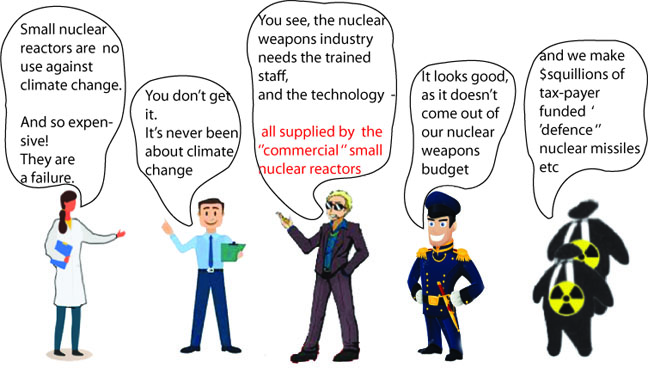
Aleksander Olech, 15 August 2026
Small modular reactors are not a technology that will solve every problem
faced by an army during wartime. They will not replace fuel, the deployment
of forces or existing sources of energy. On the other hand, they could
become an important element in preparing the state for crisis and war.
Modern armed forces need not only soldiers, tanks and artificial
intelligence, but also a stable power supply for the systems on which
military operations depend. It is from this perspective that the military
importance of SMRs and microreactors should be developed.
Modern warfare is
not limited to strikes against selected military units. Increasingly, it
begins with an attempt to paralyse the state by depriving it of energy,
transport capabilities, communications and the ability to exercise command
rapidly. Russia has demonstrated this in its operations against Ukraine.
Attacks against energy infrastructure are not an addition to a military
operation, but part of the way in which war is conducted.
Hybrid activities
may also serve as a prelude to open conflict, while a strike against the
state’s support infrastructure may precede direct action on the
battlefield.
Defence24 15th Aug 2026, https://defence24.com/armed-forces/smrs-and-microreactors-in-the-military
Short sellers reap $2Bn profit as modular nuclear reactor stocks tumble
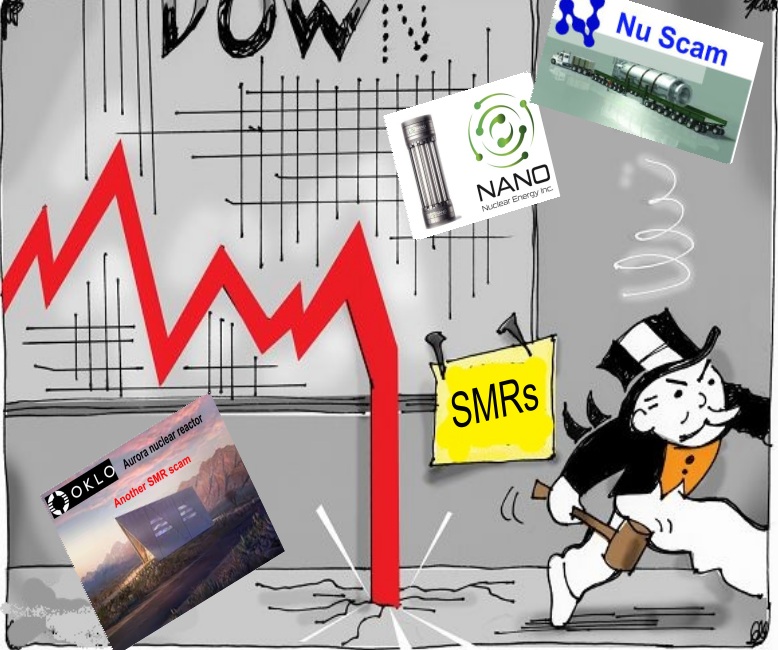
Unproven technology won investment from power-hungry AI
hyperscalers but has yet to deliver consistent revenues
The Financial Times, .Ramsay Hodgson in London, 19 Aug 26,
https://www.ft.com/content/a2f0e0f8-9350-4124-af77-62219e77e777
Short sellers have reaped large profits from betting against small modular nuclear reactor companies, as the collapse of the “hype cycle” that had sent their share prices soaring wipes billions off their market value.
Funds made an estimated $2.1bn shorting three stocks — US-listed NuScale Power, Nano Nuclear and Sam Altman-backed Oklo — over the past year, according to data provider S3 Partners.
The three companies, which are lossmaking and have little or no revenue, surged last year as investors raced to capitalise on growing interest in nuclear energy among AI hyperscalers looking for new sources of power. Regulatory changes and funding announcements from the Trump
administration also helped the sector.
But a total of $30.3bn has been wiped off their collective market value since their peak in October last year amid growing concerns over the lack of immediate revenue and the long build-out timelines for the technology.
“The stocks were overinflated in price, based on speculation,” said Adam Stein, director of nuclear energy innovation at the Breakthrough Institute, a climate and energy think-tank.
The sector went through a “textbook hype cycle” last year, he added. “[It is] very typical of a company that is in this early pre-consistent revenue phase.”
Small modular nuclear reactors are assembled from modules built in factories to save time and
money, and produce around 300MW or less, compared with more than 1,000MW for traditional
reactors.
Only two commercial SMRs are currently operable — in Russia and China, with more than 80 designs in various stages of development.
A key test of investor appetite towards the nuclear sector is expected in the coming weeks, when Holtec International and Westinghouse, two US-based companies with SMR divisions, are expected to list.
Short sellers have piled into bets against the companies based on a view that their shares rose to unsustainable levels, driven by a limited supply of publicly traded stocks and a focus on the potential demand from AI, rather than the time and capital expenditure required to commercialise the technology.
“On the one hand there was some support from the government, and no one wants to bet against Trump, and on the other there was this whole AI [demand] story which everyone was really bullish about [last year],” said Christian Putz, founder and chief executive of investment firm ARR
Investment Partners, who has previously shorted Oklo but has since unwound that position.
Around 18 per cent of Oklo and NuScale’s outstanding shares remain out on loan — a proxy for short selling — while almost 30 per cent of Nano’s are on loan, according to S&P Global Market Intelligence.
Meanwhile, X-energy has shed $5.8bn in market value since the surge that followed its initial public offering in April. Short sellers have earned an estimated $67mn from bets against thecompany since mid-May, according to S3 Partners. The company, which is backed by Amazon and
Ken Griffin and has yet to receive full regulatory approval to build its helium-cooled reactor, has 9 per cent of its shares out on loan.
“The sentiment has changed this year, people are far more critical,” said Putz. These companies “have almost zero revenue for the foreseeable future and, on top of that, there are very high capex [capital expenditure] requirements”.
Demand for energy in the US is set to soar over the coming decade, in part due to the rapid development of power-hungry data centres by AI hyperscalers. According to data from BloombergNEF, US data centre power demand is set to climb from 34.7 gigawatts in 2024 to 106GW by 2035.
Big Tech is increasingly turning to the emergent SMR technology to meet its future power needs. In January, Meta struck a deal with Oklo and Bill Gates-backed TerraPower, in which it agreed to make an upfront cash injection to support development of the reactor technology.
The Trump administration vocally backed the nuclear sector last year, pledging to cut red tape and invest tens of billions of dollars to build new reactors and reopen old ones to generate the to “win” the global AI race. In June, the Department of Energy announced $17.5bn of loans to help rebuild the US nuclear supply chain.
However, timelines for delivery of the unproven reactors remain uncertain. Analysts at BNP Paribas have expressed concerns over shortages of high-assay low-enriched uranium, a special type of nuclear fuel vital for SMRs. The earliest some will come online is mid-to-late 2028, if manufacturers are able to speed up delivery while also satisfying regulators, although the majority will arrive during the 2030s, said Stein at the Breakthrough Institute.
NuScale, which reported a $96.7mn loss in the first half of 2026, faces a shareholder class-action lawsuit alleging it misled investors, to which it must respond by September 8. It is building a modular light-water reactor based on a more conventional pressurised-water design.
Nano Nuclear — whose microreactors are in the development stage — has never generated any revenue and posted a $14mn operating loss in the first quarter of the year.
Oklo hopes to deliver commercial power to customers from its liquid sodium rather than water- cooled Aurora reactors. US energy secretary Chris Wright was previously a board member. It has yet to secure a full licence from the US nuclear regulator to build and operate its reactor.
“What we have seen in 2025 seems to me like an industry bubble that is already deflating,” said Siegfried Eggert, chief executive of activist short seller Grizzly Research, who has no short positions against the companies.
“I believe most knowledgeable investors understood for a while that the valuations seemed ratherextended given the timeline of this industry,” he added.
Nano Nuclear said the rise or fall in the share price of companies said little about the success of the underlying business and disputed the “hype cycle” characterisation. Oklo said the company had made “tangible progress” over the past year and expected commercial operation of its Aurora reactor to begin in 2028.
NuScale declined to comment. X-energy did not respond to a request for comment.
Canada’s Nuclea Energy Signs Agreement To Acquire Moltex Advanced Nuclear Portfolio
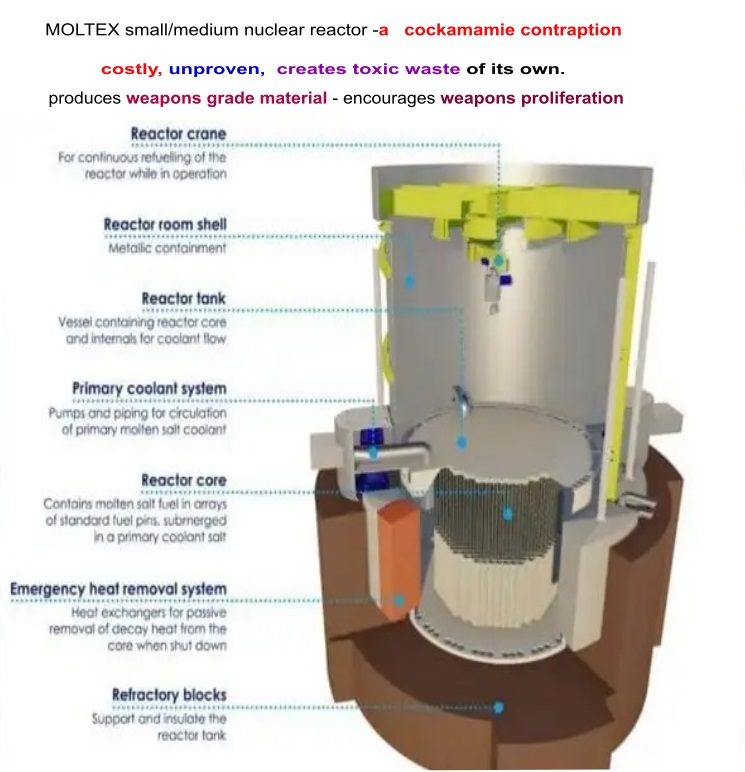
By David Dalton, 17 August 2026, https://www.nucnet.org/news/canada-s-nuclea-energy-signs-agreement-to-acquire-moltex-advanced-nuclear-portfolio-8-1-2026
UK-based company was placed in administration in 2025
Ontario, Canada-based Nuclea Energy has entered into a definitive agreement with Moltex Energy Ltd – currently in administration – and its joint administrators to acquire advanced nuclear technology assets across its molten salt reactor and nuclear fuel recycling portfolio.
Moltex Energy Ltd, the UK-based parent company of MoltexFlex Limited and Moltex Energy Canada Inc, was placed in administration in 2025 after its directors failed to achieve the majority shareholder consent to new investments or the sale of its assets.
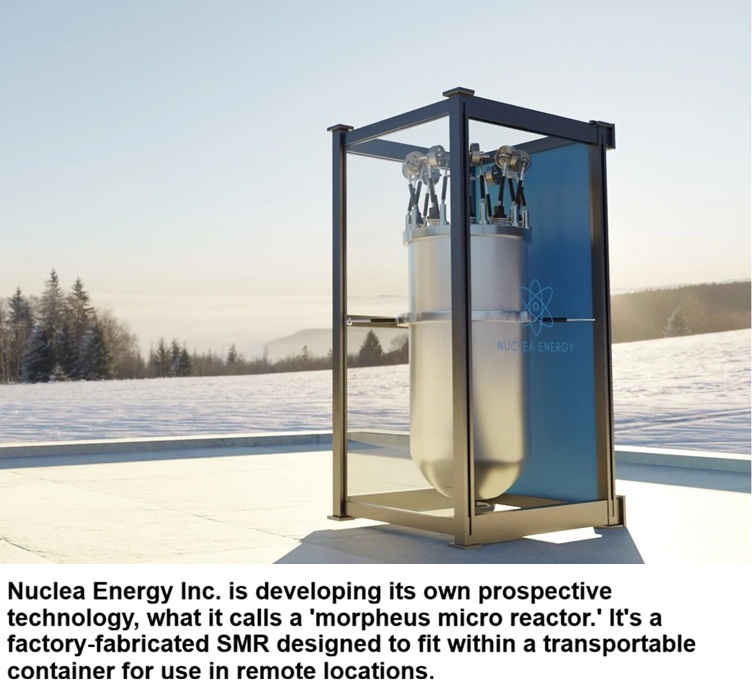
Nuclea Energy is developing the Morpheus microreactor, a lead-cooled, factory-built micro-modular reactor.
The target portfolio has been developed by Moltex over more than a decade, backed by over CAD96m ($68m, €59m) in funding from private investment, Canadian public programmes and the US Department of Energy, the company said in a news release.
The portfolio includes technology and development materials associated principally with Moltex’s Stable Salt Reactor–Wasteburner (SSR-W), an advanced molten salt fast reactor, and its next-generation Waste To Stable Salt (WATSS) spent nuclear fuel recycling process.
It also includes an extensive patent portfolio of 80 patents across nine patent families in advanced nuclear technology – including nuclear fuel, reactor, chemistry and materials – and nine pending patents on the fuel recycling process, Nuclea said.
The Microreactor Miracle Meets a Morphing AI-Nuclear Future
questions about whether the country will achieve its long-term core nuclear deployment objectives. And over-relying on a boost from the micro reactor miracle offers meager dividends when deployment is paramount.
August 15, 2026, By: Kenneth Luongo, https://nationalinterest.org/blog/energy-world/the-microreactor-miracle-meets-a-morphing-ai-nuclear-future
The microreactor milestone is real, but shifting AI models, China’s challenge, and deployment delays could complicate America’s nuclear ambitions.
It was impressive that four microreactor start-up companies beat the clock and achieved reactor criticality in compliance with the Trump administration’s arbitrary July 4 Reactor Pilot Program (RPP) deadline. But these reactors are years away from deployment, and the excessive swaggering associated with this modest achievement is out of step with the quavering nuclear energy realities ricocheting off a rapidly evolving artificial intelligence (AI) system.
US Microreactor Achievements
Of the four reactors that achieved zero power, only Antares has an identified market application beyond this demonstration. Its Mark-1 reactor has been selected as a pilot technology for powering Joint Base San Antonio, Texas.
The Antares Mark-0 reactor, which is the zero-power test reactor and prototype for the commercially oriented R1 Mark1, was the first to meet the criticality deadline on June 4 at Idaho National Laboratory (INL). It uses High Assay Low-Enriched (HALEU) TRistructural isotropic (TRISO) fuel and is sodium-cooled. The projected commercial reactor can provide 100 kilowatts to 1 megawatt (MW) electric power. Beyond its work with the Department of Defense (DOD), Antares also has been working with the National Aeronautics and Space Administration (NASA) on potentially powering a Moon base.
Valar Atomics’ Ward-250 achieved criticality on June 18 in Utah and claimed it produced 10 kilowatts (kW) of thermal output. It had previously announced a criticality test at Los Alamos National Laboratory in November 2025. The Ward-250 is a TRISO-fueled high-temperature gas reactor (HTGR) that uses helium as a coolant. After the test, Valar announced a partnership with Nvidia to explore powering AI data centers and stated that its evolving commercial unit could be “deployed by the hundreds at ‘gigasites’” that could support manufacturing as well as energy production.
Deployable Energy, a year-old company, met the criticality mark on June 30 at Idaho National Laboratory (INL). The company’s founder reportedly delivered the reactor core in the bed of a Ford F-150 truck. The reactor is part of the Nuclear Energy Launch Pad initiative at INL, which is designed to carry the RPP into the future. The reactor is a water-moderated, helium-cooled design using 4.9 percent enriched fuel. It is considered a “nuclear battery” and would max out at 1 MW. It is designed to fit in a 20-foot shipping container and be dropped at any location.
Aalo Atomics Aalo-X Critical Test Reactor sneaked in under the criticality deadline at midnight on July 4 at INL. The test reactor included a full-scale core and was designed to demonstrate key components that will be used in the Aalo-X, a low-enriched uranium (LEU) fueled, sodium-cooled 10 MW reactor. The goal is to deploy groups of these reactors in 50 MW Aalo Pods to support commercial data centers. Aalo recently formed a strategic partnership with Crusoe, a vertically integrated AI infrastructure provider, to “validate nuclear power’s effectiveness with AI workloads” at INL.
The Mutating AI Data Center Model
With the microreactor milestone behind them, the Trump administration and reactor developers now face an evolving landscape for nuclear energy. AI data centers have been viewed as the top driver of America’s energy growth and ideal for pairing with nuclear energy. Projections indicate these centers could add 100 gigawatts (GW) to the US grid by 2030.
But the data center opportunity is rapidly morphing, and opposition is growing; the now-dominant American AI model is under pressure at home and abroad. That raises questions about what role new nuclear power ultimately will play as the AI arena evolves.
The assumption has been that the hyperscalers, including Apple, Amazon Web Services, Microsoft Azure, and Google Cloud Platform, will build massive data centers as fast as they can to support US AI frontier modelcomputing growth. One assessment identified the data center build time as roughly two to three years
But the frontier model concept and its computing campuses are under pressure.
Alex Karp, CEO of Palantir, has been on a recent crusade criticizing the American AI frontier model as a trap that requires businesses to provide their intellectual property (IP) to AI’s leading companies like Anthropic and OpenAI. Karp claims that these models’ architecture creates an “addiction” among users and allows the system provider to absorb proprietary corporate data that can be used to compete against their current customers in the future.
He argues that companies should build their AI systems on models they own, training them on their proprietary content and keeping their data under their control. He also advocates for an “application layer” his company has developed with NVIDIA that can protect an enterprise’s IP. If Karp’s concept catches on, and Meta seems to have taken note, it could impact the mega data center build-out, reducing the number required and downsizing their power requirements. That could be a challenge for some leading nuclear reactor companies betting on the data center boom, or it could favor dial-an-output modular reactors if the costs are competitive.
China’s Dual AI Challenge
A version of the Karp concept seems to have already been adopted by China, which, because it is already closing the quality gap with the best US AI models, now poses a double threat to US dominance.
China is giving away fast, cheap open-source AI models. These free Chinese AI platforms are popular in Africa and Latin America but are also being used by US and European companies, including Siemens, DoorDash, and Airbnb.
Of course, one goal of China is to allow companies to easily build systems on their platform in order to serve geopolitical objectives and create dependencies it can exploit in the future. The US National Institute of Standards and Technology (NIST) evaluated China’s DeepSeek AI model and found that its AI offerings advance Chinese Communist Party narratives. It concludes that China’s DeepSeek “remains a leading open weight model developer and has contributed to a rapid increase in adoption of PRC [People’s Republic of China] models globally.” It cautions that the expanding global use of these models “May pose a threat to application developers, to consumers, and to US national security.”
This approach by AI is similar to China’s Belt and Road Initiative (BRI), which has helped the country capture hundreds of infrastructure projects across over 140 countries, resulting in deep relationships and financial dependencies, particularly with emerging economy nations. And while its energy projects so far have heavily tilted toward fossil fuels, BRI’s relationships and financial model enhance China’s position as a future provider of new nuclear energy in the Global South, posing a threat to the future US export of small reactors and creating worry for the US political, commercial, and national security establishment.
Lagging Nuclear Reactor Technology and Scaling Challenges
Even if the US data center boom were to play out as planned, there are questions about when and whether new US nuclear power will be ready to power it.
So far, the hyperscalers have modestly invested in small modular reactors (SMRs), but they are unlikely to be available in time for a near-term data center boom. If the buildout is over by the early 2030s, most SMRs will still be on the sidelines.
As a hedge, these companies have banked on the resurgence of mothballed nuclear power plants like Three Mile Island in Pennsylvania and Palisades in Michigan. Both of those projects are estimated to deliver new power before the end of this decade for a combined 1.6 GW. What the hyperscalers have not done is back construction of new large reactors despite the fact that a single Westinghouse AP-100 can provide over one GW of power.
The US government wants 10 new AP-1000s under construction by 2030, but its $80 billion strategic partnership with Westinghouse and its commitment to provide $17.5 billion in loans for long lead items haven’t attracted the necessary additional investment and commitment required from the private sector.
The US government wants 10 new AP-1000s under construction by 2030, but its $80 billion strategic partnership with Westinghouse and its commitment to provide $17.5 billion in loans for long lead items haven’t attracted the necessary additional investment and commitment required from the private sector.
This reticence reflects a cost-overrun risk aversion from domestic electric utilities and Wall Street. In response, the administration is repurposing federal lands to create data center-nuclear power campuses. And it has turned to allies such as South Korea and Japan to jumpstart the process with foreign cash derived from bilateral trade and tariff deals.
But that avenue also doesn’t seem to be working. The Trump administration has been frustrated with the lack of progress on the nuclear energy component of the $350 billion South Korean commitment to invest in the United States, and with Japan, it has found that its involvement in a $40 billion nuclear power project is running aground over nuclear liability concerns.
With less than 30 months left in Trump’s term, and the prospect of a hostile House of Representatives sucking the air out of his agenda, there is an urgency in rethinking the Trump administration’s nuclear deployment policy. The dependence on a rapidly evolving AI and data center market leaves questions about whether the country will achieve its long-term core nuclear deployment objectives. And over-relying on a boost from the micro reactor miracle offers meager dividends when deployment is paramount.
About the Author: Kenneth Luongo
Kenneth N. Luongo is a recognized innovator, entrepreneur, and leader in global nuclear energy and transnational security policy. He is the president and founder of the Partnership for Global Security (PGS). He has been a TEDx presenter, written over 100 articles, including in The New York Times and Foreign Affairs, and engaged extensively with global media, governments, and audiences around the world on nuclear energy and transnational security challenges and responses. He was formerly a senior advisor to the secretary of energy and a professional staff member on Capitol Hill.
The big catch with small modular nuclear reactors
Those advantages are also shared by renewable energy sources like solar panels and wind turbines — without the risks that come with nuclear power.
Tim Schauenberg, 08/05/2026August 5, 2026 https://www.dw.com/en/small-reactors-big-promises-what-the-nuclear-trend-can-really-deliver/a-77491854
Mini nuclear reactors are seen as a flexible energy source. Their promise: abundant energy, cheap, clean and climate-friendly with lower water use. But do the numbers add up? We look at what’s behind the SMR hype.
Many politicians and tech companies are now pushing to build new nuclear power plants to meet the world’s rapidly growing energy demands. Small reactors — known as Small Modular Reactors, or SMRs — are gaining momentum.
They could be built in less time and come online faster than conventional nuclear power plants. Originally developed to power submarines and aircraft carriers, SMRs largely work the same way as larger reactors.
They contain a nuclear reactor fueled by uranium, which releases enormous amounts of heat through nuclear fission. That heat turns water into steam, and the steam pressure drives turbines that generate electricity.
Companies and startups are working on a wide variety of SMR designs and concepts, but the underlying principle is similar across all of them.
One advantage over conventional nuclear stations is that mini reactors require a maximum of two hectares (around five acres) of land — roughly the size of two soccer fields. By comparison, conventional plants require up to 280 soccer fields, according to the industry.
Why use a modular design for mini nuclear plants?
What makes SMRs particularly attractive is their modular construction. Individual components can be mass-produced as prefabricated modules and pre-assembled off-site — much like a prefab house that simply needs to be put together once it arrives at its location.
Manufacturers promise an extremely short construction time of between one and a half to six years. Large reactors in the US can take anywhere from seven to 10 years to build.
Proponents also argue that modular units could deliver low-emission power to remote regions, where grid infrastructure is often not developed enough to handle the enormous energy output of a large conventional plant.
Those advantages are also shared by renewable energy sources like solar panels and wind turbines — without the risks that come with nuclear power.
Why less radiation can mean greater risk
The output of mini nuclear reactors is significantly lower than that of conventional nuclear power plants. Depending on the design, SMRs can deliver between 10 and around 200 megawatts of power, while a conventional plant generates between 1,000 and 1,600 MW.
To produce the same amount of energy as the roughly 400 high-capacity reactors currently operating worldwide, tens of thousands of small reactors would need to be built.
SMRs could offer some safety advantages: they contain less radioactive material than large reactors and would be distributed across multiple sites. This means that an accident or military strike resulting in a meltdown would not be as catastrophic as a worst-case scenario at a large reactor. Nevertheless, the consequences of an SMR accident could still be severe.
Germany’s Federal Office for Radiation Protection points out that despite lower radiation levels per reactor, the overall risk posed by mini reactors could be many times higher. Replacing the output of existing nuclear plants with large numbers of smaller ones would require an enormous number of reactors worldwide — and that increases the likelihood that at least one of them will eventually suffer a serious incident.
Nuclear accidents and radiation leaks are extremely rare — but the consequences can be catastrophic. The last major nuclear accident occurred in 2011 at the Fukushima power plant in Japan, following a tsunami. Parts of the region have been contaminated for generations to come, and nearly 170,000 people were forced to flee their homes.
Extreme efficiency and the dream of radioactive recycling
Part of the hype around some new mini reactors rests on the hope of extracting significantly more energy from the same amount of uranium. Some SMR models — known as “fast reactors” — could theoretically yield 60 to 70 times more energy from uranium than conventional technology, according to the International Atomic Energy Agency (IAEA).
But the technology is still in the early stages of development and has so far played only a limited role in IAEA projections. In practice, it has barely been proven in SMRs at all. Only two SMR facilities are currently in operation worldwide — one in China and one in Russia.
Work is also underway on recycling SMR fuel rods, but that process remains largely untested. Most SMR projects continue to rely on the same conventional technology used in traditional reactors.
And the problem of radioactive waste remains unsolved — for both conventional and fast reactors. The risks this poses are already visible: at the Asse facility in Lower Saxony, Germany, a temporary storage site built in the 1970s, hundreds of barrels of intermediate-level radioactive waste are now rusting and beginning to leak. Germany has yet to establish a permanent disposal site.
In fact, no permanent repository for spent fuel or highly radioactive reactor waste is currently in operation anywhere in the world. After 20 years of construction, the Onkalo facility in Finland is set to become the first when it opens in 2026.
Another problem for nuclear power is growing water scarcity. Recent heat and drought have already forced European nations to curb nuclear output due to for cooling due to low river levels.
Because SMRs are mainly just smaller, simplified versions conventional reactors, they still use water to run and for cooling. While individual units use less water than traditional plants, clustering units could increase overall use, warn experts. Researchers are investigating the use of alternative coolants like molten salts and helium gas for newer designs.
When would SMRs make a climate impact — and at what cost?
Enthusiasm for small reactors runs high in the nuclear community. But what may look promising at first glance is, in many respects, difficult or impossible to back up with solid evidence.
Calculating the costs of a technology still in development is no easy task. Nevertheless, the German Institute for Economic Research estimates that electricity from new mini nuclear plants — even accounting for economies of scale, including construction and manufacturing — will cost at least twice as much per megawatt-hour as the already very affordable electricity generated by solar or wind power. In a worst-case scenario, the cost could be nearly eight times higher.
Adding up all the announcements, plans and strategies of major nations, a few hundred SMRs could come online in China, the US, Europe and India by 2050. But according to Germany’s Federal Office for Nuclear Safety and Radiation Protection, citing figures from the nuclear industry, production would only become economically viable at a threshold of 3,000 reactors.
The international community has committed to limiting global warmingto well below 2 degrees Celsius (3.6 degrees Fahrenheit) by the end of the century. Meeting that target requires large parts of the global economy to become climate-neutral by 2050. The EU aims to reach zero emissions by then; Germany is even targeting net negative CO2 emissions by 2050.
That means climate-friendly nuclear technology would arrive too late to meaningfully limit global warming — and its advantages would be significantly diminished as a result.
What would remain: the radiation risk, and the question of what to do with the radioactive waste.
MICROREACTORS – the Next Big Little Nuclear THING!
Noel Wauchope, 15 August 2026, https://theaimn.net/microreactors-the-next-big-little-nuclear-thing/
Forget about Small Modular Nuclear Reactors – they’re not cool anymore!
What the world needs now is MICROREACTORS – so saith the global nuclear lobby. And we know they must be right, because they’ve already explained how the world needs a NUCLEAR RENAISSANCE to solve climate change, energy shortage, world peace etc…
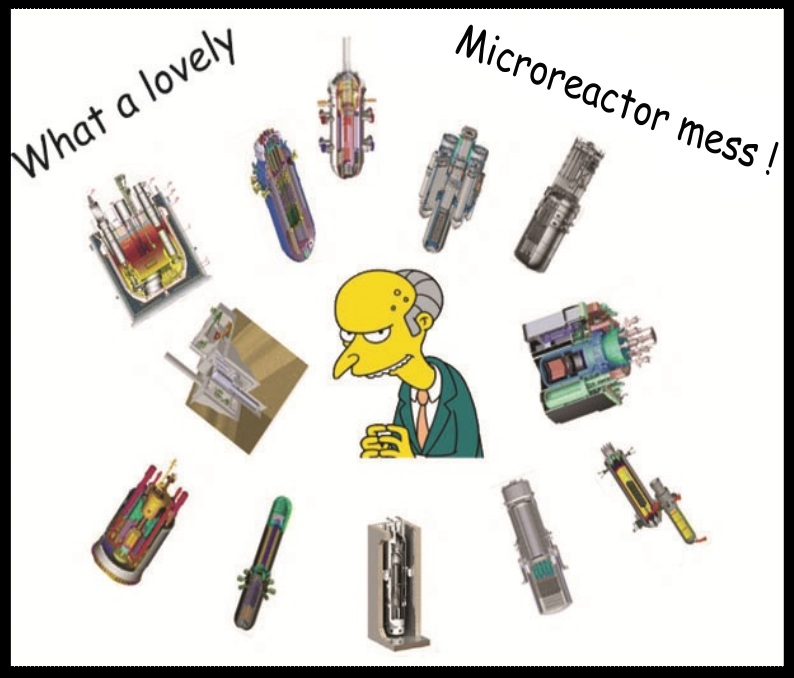
Now there are substantial differences between microreactors and small modular nuclear reactors (SMRs) , even though at first glance microreactors might seem to be just teeny weeny versions of SMRs. Whereas an SMR produces up to 300 MWe , a microreactor produces anything from 1 MWe up to 50MWe
There are fuel differences . SMRs can use LEU – Low Enriched Uranium or the more powerful HALEU – High-Assay Low-Enriched Uranium . Microreactors can, in theory, use LEU fuel, but that could not work out to be economic. The fuel must be the more powerful HALEU – High-Assay Low-Enriched Uranium. And in fact, Most microreactor plans use the more complex TRISO Fuel (Tri-Structural Isotropic), in which the tiny kernels of HALEU are coated with multiple layers of ceramic and carbon. That makes TRISO very safe, but very expensive.
Really, the most important difference is in – Who Pays For Microreactors?
Well, you do, if you’re a tax-payer. The only economically viable way to fund microreactors is to make them military installations, government funded. SMRs are supposedly economically viable, and were touted to become a private enterprise success. That’s until the NuSCale SMR financial fiasco
The beloved ever-about -to-happen nuclear renaissance needs a new theme, and that new funding source. The old theme was ENERGY– the new theme is DEFENCE.
For quite a while now, it has been obvious, and indeed a boast of the nuclear lobby, that new small reactors would support the defence sector, and nuclear weaponry, by providing the trained staff that are so badly needed, as the old nuclear boffins retire,
But times have changed, and also the nuke lobby is getting desperate. With all the international political drama going on, obviously the top priority now is war. (Did I hear someone say, what about diplomacy, negotiation? Look, that’s time-consuming, takes high mental ability, and there’s no money in it) Yes, what we and the nuke industry need now is war preparation.
So the nuclear industry is regalvanised, with a spate joyous media articles, mostly – worded like this one – Antares Raises $470M to Field Military-Focused Microreactors. Optimistic statements abound:
Power up: Antares and their nuclear startup frenemies moving so fast is good news for the Pentagon, which is where that 2028 number comes into play in a few places.
In May 2025, President Trump signed a series of executive orders to accelerate the Department of Energy’s “Manhattan Project 2.0.” -notably Executive Order 14299, “Deploying Advanced Nuclear Reactor Technologies for National Security,” Then came Executive Order 14300, “Ordering the Reform of the Nuclear Regulatory Commission,”- getting rid of, or watering down public safety, radiation and environmental standards. The full import of this has been documented by Kristen Thomason in her superb article – “If you’re already afraid, just wait until you hear about Manhattan Project 2.0″

A lot of hype about microreactor energy for data farms, with Silicon Valley tech billionaires all on board, – and the craze is for so many “start-ups “
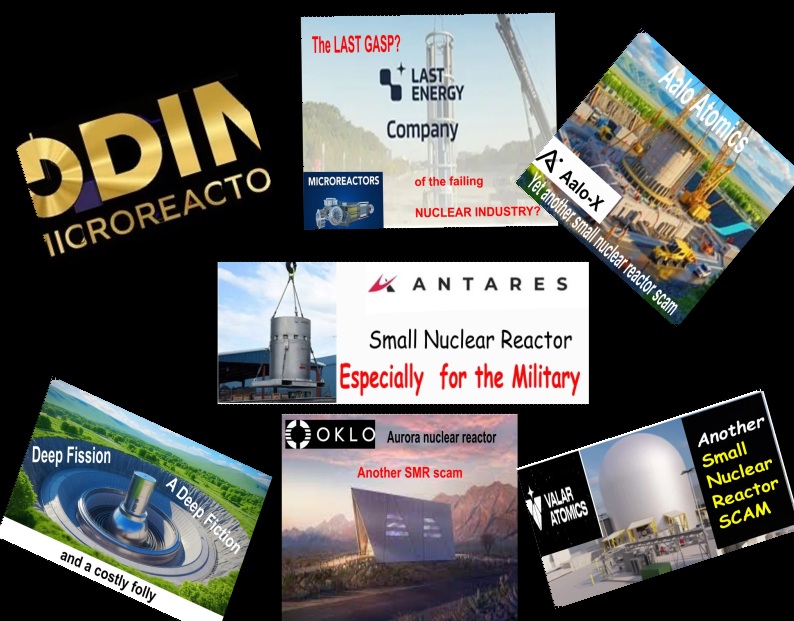
I had every intention of going through all the hazards, impediments to these microreactors ever becoming a commercial reality. But guess what ? OKLO, probably the leader of the pack, has done it for me. After the usual hypy article, glorifying their new microreactor, OKLO makes this revealing statement at the end:
As a result of a number of known and unknown risks and uncertainties, the actual results or performance of Oklo may be materially different from those expressed or implied by these forward-looking statements. The following important risk factors could affect Oklo’s future results and cause those results or other outcomes to differ materially from those expressed or implied in the forward-looking statements: risks related to the development and deployment of Oklo’s powerhouses, fuel fabrication and fuel recycling facilities, and radioisotope production activities; the risk that Oklo is pursuing an emerging market with no commercial project operating and regulatory uncertainties; risks related to acquisitions, divestitures, or joint ventures we may engage in; the need for financing to construct plants, which remain subject to market, financial, political, and legal conditions; risks related to an inability to raise additional capital to support our business and sustain our growth on favorable terms; the effects of competition; risks related to accessing high-assay low-enriched uranium, plutonium, and other fuels (including recycled fuels) at acceptable costs and under acceptable timelines; risks related to our supply chain; risks related to power purchase agreements; risks related to human capital; risks related to our intellectual property; risks related to cybersecurity and data privacy; changes in applicable laws or regulations, including tariffs; the outcome of any government and regulatory proceedings and investigations and inquiries; and the other factors set forth in our documents we have filed with the U.S. Securities and Exchange Commission (the “SEC”).
The foregoing list of factors is not exhaustive.
I was going to try and list all those factors – to throw some cold water on the microreactor parade – and that leading microreactor developer has done it for me!
As I tried to research all those factors to consider about micoreactors, I made the discovery that amongst the pro nuclear experts themselves, there are the gold nuggets of the truth. Not only has OKLO raised those contentious questions, but in a lengthy video – Nick Touran, a nuclear engineer and manager at TerraPower, unearths the sobering realities of micro nuclear reactors:
It’s long – but he spells it all out, if you can take the time:
Chapters:
00:00 Visions for microreactors 03:49 Defining microreactors 11:56 The problem of radiation shielding 18:48 Original microreactor projects 24:29 Niche applications 30:32 The problem of neutron economy 40:08 The problem of fuel 53:03 The problem of operations and maintenance 1:00:17 The problem of commercialization 1:05:42 The problem of spent fuel 1:09:27 The problem of scaling 1:12:36 The problem of licensing
Nick Touran and OKLO might be hopeful for microreactor success some time in the future. But they – pro nuclear people, are well aware of the obstacles and especially of the financial costs.
So, if they can take the microreactor hype with a grain of salt, the rest of us, who are not part of the development process, should be taking that hype with a bucketful .
The trouble with Small Modular Nuclear Reactors (SMRs) – THEY’RE NOT SMALL
7 August 2026 Noel Wauchope, https://theaimn.net/the-trouble-with-small-modular-nuclear-reactors-smrs-theyre-not-small/

The big boasts for small nuclear reactors are that they are modular and they are small.
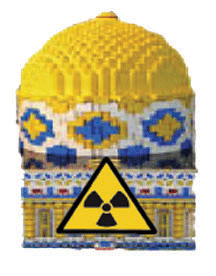
Modular – yes. They’re a sort of LEGO or IKEA thing – parts made in one place, then shipped to another place and assembled. (That process has its problems, too – but today I’m just focussing on the small aspect.
A small modular reactor (SMR) is an emergent class of nuclear fission reactors with a rated electrical power of less than 300 megawatts (MWe) (Wikipedia) MWE (Megawatts electric) refers specifically to the amount of electrical power a system can produce. Large reactors generate over 700 MW(e). Microreactors range in capacity from 1 to 20 MWe.
So – now we have SMRs being touted as the great new source of electricity – a sort of vision of little nuclear reactors dotted in their many thousands all over the world.
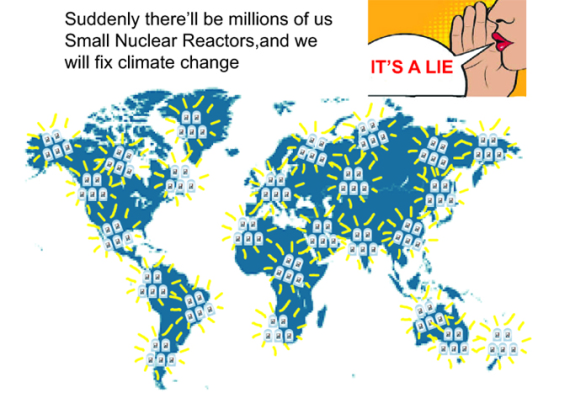
But that’s not really a practical plan. So – how about bundling a bunch of them together – so they can produce a large amount of electricity, and we can still call them a Small Modular Nuclear Power Plant?
Case study 1 – NuScale – the American experiment

The NuScale SMR is a pressurized water reactor (PWR) – a type of light-water nuclear reactor. In a PWR, water is used both as a neutron moderator and as coolant fluid for the reactor core. So it’s pretty much a small version of the “tried and tested” large nuclear reactors. This was the first SMR design to get Nuclear Regulatory Commission licensing. The Department of Energy approved $1.35 billion to the project, over 10 years subject to appropriations.
In 2015 NuScale Power and Utah Associated Municipal Power Systems (UAMPS) planned a single plant, containing 12 “modules” – i.e. 12 SMRs, which would provide 924 MWe – same as a large nuclear reactor. so – no longer small. The estimated costs kept rising, reaching $9.3 Billion by 2023. So the plan, now named VOYGR, was changed from 12 modules to six. Even at 6 modules with 462 MWe- still a large project.
In November 2023 UAMPS officially terminated the CFPP agreement. The Idaho project would have been NuScale’s first commercial deployment. The project that was supposed to demonstrate SMR viability in the US was dead. NuScale took a $100M+ write-down. The cancellation sent shockwaves through the SMR industry. Investor interest, always poor, collapsed. In a class-action lawsuit filed Nov. 15, investors say NuScale “made materially false and/or misleading statements and failed to disclose material adverse facts about the Company’s business, operations, and prospects.”
NuScale continues to push its VOYGR plan – to Romania, Poland, Kazakhstan, Ukraine, and the Philippines. The company continues to burn cash with no revenue from reactor operations. The VOYGR design remains the only NRC-certified SMR.
Case study 2 – X-Energy ‘s MWe Xe-100 plant – the British experiment.

In September 2025, X-energy and Centrica signed a Joint Development Agreement for the UK’s first advanced nuclear fleet, targeting 6 GW nationwide with Hartlepool identified as the preferred first site for a 12-unit/960 MWe Xe-100 plant.
The Xe-100 is a 200MWt (75MWe) reactor. The Xe-100 SMR is a high temperature gas-cooled (HTGR) pebble bed modular reactor. “It uses tennis ball-sized pebbles made of thousands of TRISO micro-fuel particles which consist of fissile U-235 surrounded by pyrolytic graphite, which acts as the moderator – slowing down fast neutrons so they more efficiently split the U-235 nucleus.”
So this UK plan is different from the American pioneer project, Nuscale. It is using different fuel, – a Pebble Bed Nuclear Reactor. This has been tried in the past as a large reactor, and was a failure. The Xe-100 has a new variant – TRISO (Tri-structural Isotropic particle fuel). Thousands of poppy seed-sized particles are combined into compact fuel forms. These tiny uranium kernels are encased in three layers of ceramic coating that’s needed to absorb the nasty byproducts that form during the atom-splitting process.
So, like the American NuScale project, this will be a world first.
Both projects were hugely touted as safe. And it’s true – they can’t melt down like a Chernobyl or Fukushima event. But at 462 MWe (the Utah project) and 960MWe (Hartlepool) they are both big plants, with the potential for accidents or terrorist attacks, including cyber-disruption, to release a large amount of ionising radiation to the surrounding area. Even within the nuclear hierarchy, there are anxieties about the safety of TRISO fuel. And TRISO discharges the largest volume of spent nuclear fuels waste in the industry.
The UTAH Nuscale project sank because it was becoming more and more expensive. Assisted by the government, it was still a private enterprise project, and the Utah Associated Municipal Power Systems balked at the cost.
The Hartlepool X Energy project is intended to become a successful private enterprise project, but it is strongly backed by the UK government’s Great British Energy – Nuclear with funding provided by its Future Nuclear Enabling Fund. However TRISO fuel is highly expensive to make, and with still uncertainties about its safety, it is not likely that this pioneer initiative for Hartlepool will really bring the wave of private investment that the UK government has been hoping for.
In both cases, these have been attempts to show the Western world that small modular nuclear reactors are a really big profitable thing – they will power the mighty data farms etc.
Community acceptance is the big bonus that the nuclear industry desperately needs
This is much less of a problem in totalitarian nations like Russia and China. Both countries have only one small nuclear reactor in operation, and in each case, it hasn’t been very successful. Both China and Russia are ramping up their nuclear weapons, and they don’t need to worry so much about public acceptance of the “peaceful” nuclear industry, and of community agreement on matters nuclear.
Moltex’s prospective buyer ends attempt to raise $50M for purchase
Ontario-headquartered Nuclea Energy Inc. instead merges with telemedicine company selling erectile dysfunction treatment in move to access capital quicker
Adam Huras, Aug 06, 2026, https://tj.news/new-brunswick/moltexs-prospective-buyer-ends-attempt-to-raise-50m-for-purchase#comments-area
The company that was in talks to buy Saint John-based Moltex Energy Canada has ended its attempt to raise $50 million.
It was money Ontario-headquartered Nuclea Energy Inc. was going to use, in part, to purchase the New Brunswick small modular nuclear reactor startup’s technology, which has spent more than a year stalled in its parent company’s receivership.
Instead, in a twist, Nuclea Energy has announced it is merging with a telemedicine company based in Dallas, Texas, that sells lifestyle medications online, specializing in erectile dysfunction, hair loss, and weight management treatments.
It’s being framed as a way to get Nuclea access to capital quicker.
Meanwhile, the heads of both Nuclea and Moltex say negotiations toward a purchase continue, despite the new flurry of moves.
“We are still in exclusive negotiations with Nuclea,” Moltex CEO Rory O’Sullivan said in an email.
Asked what the impact of the new moves mean to those talks, O’Sullivan directed questions on funding sources and plans to Nuclea.
In an email, Nuclea president Sagar Sanghera stated that “at this time, we are still in exclusivity with Moltex,” without answering further questions on how a deal would be financed.
Brunswick News reported in April that Moltex was on the verge of being sold to another advanced nuclear technology startup for $11.5 million.
The pending sale to Nuclea, although still yet to be finalized, was revealed in that company’s filing for an initial public offering on the New York Stock Exchange.
Nuclea stated in documents filed that it was to use the proceeds from the selling of shares, in part, for the acquisition of the distressed assets from Moltex Energy Limited, the British parent company of the New Brunswick SMR developer that went for sale last year as part of a U.K. insolvency proceeding amid money trouble.
That specifically includes Moltex’s efforts in New Brunswick to build a small modular reactor that converts existing nuclear waste into carbon-free energy through a proprietary recycling process.
It’s as Nuclea is also developing its own prospective technology.
What it calls a “morpheus micro reactor,” a factory-fabricated SMR designed to fit within a transportable container for use in remote locations, was also to benefit from the money raised through an initial public offering on the New York Stock Exchange.
Nuclea’s filing in April was to raise $50 million by offering 5.6 million shares at a price range of $8 to $10.
But that has now abruptly ended.
Last Friday, Nuclea withdrew its plans for an initial public offering.
Nuclea did so while announcing the merger.
A press release from the company states it has entered into a “definitive business combination agreement” with Mangoceuticals, Inc.
It’s a company that describes itself as “focused on developing a variety of men’s health and wellness products and services via a secure telemedicine platform.”
“To date, the company currently offers pharmaceutical-based products specifically related to the treatments of erectile dysfunction, hair growth, hormone replacement therapies, and weight management,” it states.
It delivers those treatments through its subsidiary Mango and Peaches Corp., and its brand, MangoRx.
But now, in its own release announcing the deal, Mangoceuticals states it’s pivoting to “bring Nuclea’s lead-cooled Morpheus Microreactor to the public markets amid surging power demand from AI and data centres.”
“The scale of capital being committed to power the AI build-out is enormous, and we believe advanced nuclear and micro reactors will be a critical part of how that demand is met,” said Mangoceuticals CEO Jacob Cohen in a release.
Mangoceuticals is already listed on the American stock exchange.
Releases from both companies are clear that the transaction is intended to provide Nuclea with that public listing on the Nasdaq to get better access to capital in order to accelerate the development of its reactor.
Neither release makes mention of Moltex.
“As a public company, we expect to have the capital access and visibility to advance Morpheus toward first-of-a-kind delivery and to execute on our commercialization roadmap,” Nuclea CEO Josef Freundorfer said in the company’s release.
“This agreement gives Nuclea a faster path to the public markets at a defining moment for our industry.”
Azets Holdings Ltd., the accounting firm serving as the insolvency administrator for the UK-based parent company Moltex Energy Ltd., also confirmed that talks to sell assets to Nuclea continue.
“Sale negotiations with the preferred purchaser remain ongoing,” spokesperson Shaun Staff said in an email.
Newcleo Takes Key Step Towards MOX Fuel Manufacturing Facility In US
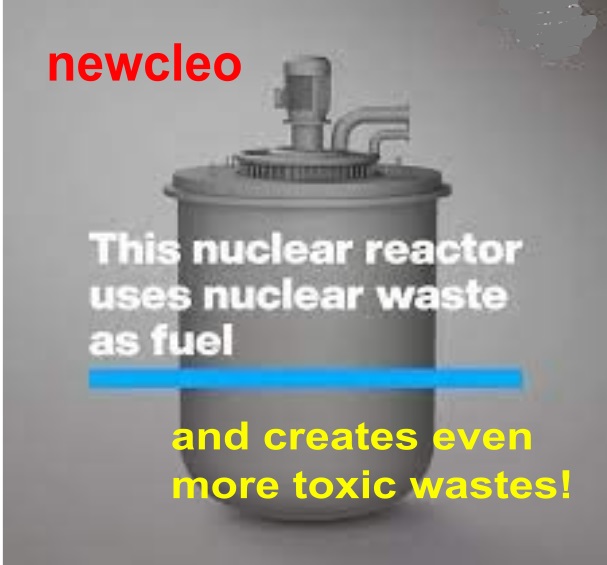
Advanced reactor and nuclear fuel company Newcleo has submitted a
regulatory engagement plan to the US Nuclear Regulatory Commission for its
planned US mixed oxide (MOX) fuel manufacturing facility in the US. The
France-based company said the submission marked a significant milestone in
establishing a source of advanced nuclear fuel for its planned advanced
modular reactors. The regulatory engagement plan is the second submitted by
Newcleo in recent weeks. Last month the company submitted a regulatory
engagement plan to the NRC for its lead-cooled fast reactor, the
LFR-AS-200.
Nucnet 6th Aug 2026
https://www.nucnet.org/news/newcleo-takes-key-step-towards-mox-fuel-manufacturing-facility-in-us-8-4-2026
Canada built its nuclear industry to avoid foreign fuel. Its new SMR reactors will depend on it.
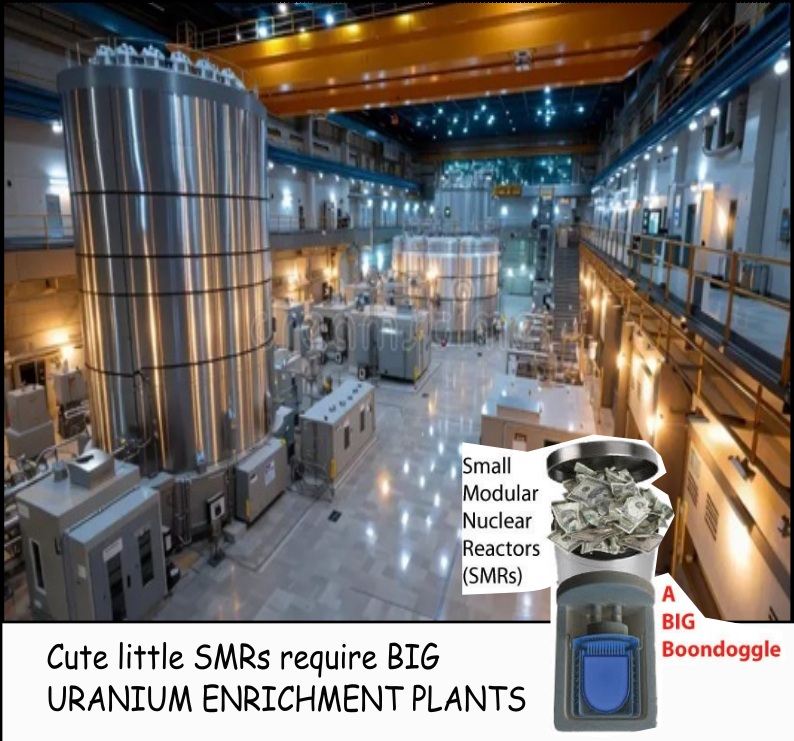
by relying on imported enriched uranium, Canada would give foreign governments the ability to disrupt its nuclear fuel supply during a political dispute.
Canada would need to enrich its own uranium to control the entire fuel chain, but such a facility would cost billions to build and require extensive security, regulation and international safeguards througout its life.
“It would be much more uneconomical for Canada to develop one just for this small modular reactor design.”
Ontario’s first small modular reactor will rely on enriched uranium from the U.S., France and Britain
Colin Butler · CBC News · Aug 02, 2026, https://www.cbc.ca/news/canada/canada-nuclear-supply-chain-smr-darlington-uranium-enrichment-9.7289297
The first reactors in Canada’s planned nuclear expansion will depend on foreign suppliers — including the United States — to enrich and fabricate their fuel, even as Prime Minister Mark Carney argues Canadian sovereignty depends on the country’s ability to supply and control its own energy.
It marks a sharp departure from the Candu reactor system, which gave Canada — the world’s second-largest uranium producer — a largely domestic nuclear supply chain for more than half a century.
Ontario has begun building the first of four planned BWRX-300 small modular reactors, or SMRs, in Clarington, Ont., called the Darlington New Nuclear Project. The American-Japanese-designed light water reactor uses low-enriched uranium, unlike Canada’s Candus, which use fuel made domestically from natural uranium without enrichment.
Ontario Power Generation (OPG), the Crown corporation that operates provincially owned electrical utilities, expects the first BWRX-300 at Darlington to be connected to the grid by the end of 2030. The other three are planned for the mid-2030s.
Cameco, the Saskatoon-based uranium mining and nuclear fuel company, will mine uranium ore in Saskatchewan and convert it in Port Hope, Ont., before it is enriched in the United States. France’s Orano and Britain’s Urenco are also listed by OPG as a supplier of enriched uranium, and an American company will manufacture the finished fuel assemblies in the United States.
Against Candu’s founding logic
Experts say the shift reverses the founding logic in Canada’s nuclear program.
A 1993 Library of Parliament background paper said the reason Candu was created was “to design a reactor tailored to Canadian circumstances” that used natural uranium to avoid “the difficult and expensive process of enrichment or, alternatively, dependence on foreign sources of enriched uranium.”
By placing that step in foreign hands, experts say, the new reactors undermine claims of energy soverignty and expose Canada to long-term geopolitcal risk.
Mark Winfield, a professor at York University who studies sustainable energy, climate change and energy policy, said by relying on imported enriched uranium, Canada would give foreign governments the ability to disrupt its nuclear fuel supply during a political dispute.
“It turns the original rationale for the Candu program completely on its head,” he said. “The whole idea was, going back to the 1950s, that we would have an all-Canadian fuel supply chain that would not be the subject to those kinds of geopolitical risks.”
OPG said spreading the work among suppliers in the United States, Britain and Frnace creates a “robust and resilient supply chain,” but the company still leaves both enrichment and fabrication — the two steps Canada cannot perform for the BWRX-300 — in foreign hands.
Why Ontario went global
Speaking at a recent news conference in Nanticoke, Ont., provincial Energy Minister Stephen Lecce said the province chose a foreign reactor because no Canadian alternative was ready to generate electricity at the required scale.
“There is not a Canadian grid-scale, commercially viable small modular reactor technology to procure,” he said. “So we had to go global.”
He said Ontario chose the American-Japanese BWRX-300 because it was the most advanced option and offered the best chance to reduce the risks associated with building a first-of-its-kind reactor.
Canada does have a new domestic reactor under development, but it was not an alternative for Ontario’s SMR project. The Candu Monark is not an SMR and is currently under assessment by Canada’s nuclear regulator.
The decision to “go global,” as Lecce put it, leaves Ontario dependent on foreign enrichment, but Lecce said the province has reduced the risk by arranging access to suppliers in the United States, France and Britain.
SMRs would use ‘modest’ amount of fuel
Winfield said multiple enrichment suppliers reduce the risk of disruption, but do not eliminate it. Every enrichment facility is outside Canada, while the only company identified that would make the finished fuel assemblies is American.
“I think that’s still a risk. Particularly if the United States decides to use its supply of various uranium for geopolitical leverage, which is clearly not beyond the thinking of the Trump administration,” Winfield said.
Even with France and Britain as backup suppliers, Winfield said, it opens the door to “all kinds of vulnerabilities relative to an all-Canadian supply chain. You are at the mercy of whatever external geopolitical events may be occurring.”
The federal government says foreign enrichment doesn’t present a significant supply risk, especially in the short to medium-term.
In an email, Natural Resources Canada said the four planned Darlington SMRs will require “a very small amount” of enriched fuel, which is “modest” compared with the global market, but did not provide a quantity.
Why being first is ‘not a good thing’
While there are other SMRs active in China and Russia, the Darlington facility will be the first SMR in the G7.
“That’s not a good thing, in my opinion,” said M.V. Ramana, a University of British Columbia professor who studies nuclear energy and international security.
“Nuclear power is a very expensive way to generate electricity and the small modular reactor is even more expensive.”
Ramana said SMRs sacrifice the economies of scale available to larger reactors.
A 2014 study suggests they are more expensive per unit in generating capacity unless savings from shared infrastructure can offset the disadvantage, which is what OPG intends for its four-reactor Darlington site.
BWRX-300 designer GE Vernova says smaller reactors can overcome some of that cost disadvantage because they require less machinery than conventional reactors: water circulates through the reactor without powered pumps, while emergency cooling functions use gravity and natural circulation.
The company says this reduces the amount of equipment that must be manufactured, installed and maintained.
However, because Darlington is the design’s first deployment, those projected savings have not yet been demonstrated by a commercially operating unit.
Could Canada enrich its own uranium?
The only way for Canada to eliminate its reliance on foreign suppliers is by establishing its own uranium-enrichment industry.
Lecce said Ontario would be open to discussions, but he acknowledged the decision ultimately rests with the federal government.
Natural Resources Canada said Ottawa has made no decision on commercial enrichment but plans to create a “Nuclear Fuels Table” with the provinces and industry to examine future needs and opportunities.
Ontario is currently the only province committed to building SMRs, but Saskatchewan is advancing plans for the same BWRX-300 technology, while New Brunswick and Alberta are evaluating potential nuclear projects that could include SMRs.
Ramana said Canada would need to enrich its own uranium to control the entire fuel chain, but such a facility would cost billions to build and require extensive security, regulation and international safeguards througout its life.
“In the enrichment business, again, there are economies of scale,” he said. “It would be much more uneconomical for Canada to develop one just for this small modular reactor design.”
Ramana added that the new reactors also create another long-term liability. Canada’s current $26-billion nuclear waste plan was calculated around fuel from the existing Candu reactor fleet.
New reactors could change both the volume and type of spent fuel requiring disposal, but Ramana noted there has been no cost estimate from Canada’s Nuclear Waste Management Organization for adding the spent fuel from four BWRX-300s.
A Kansas Town Is Split Over Plans to Bury a Nuclear Reactor a Mile Underground.
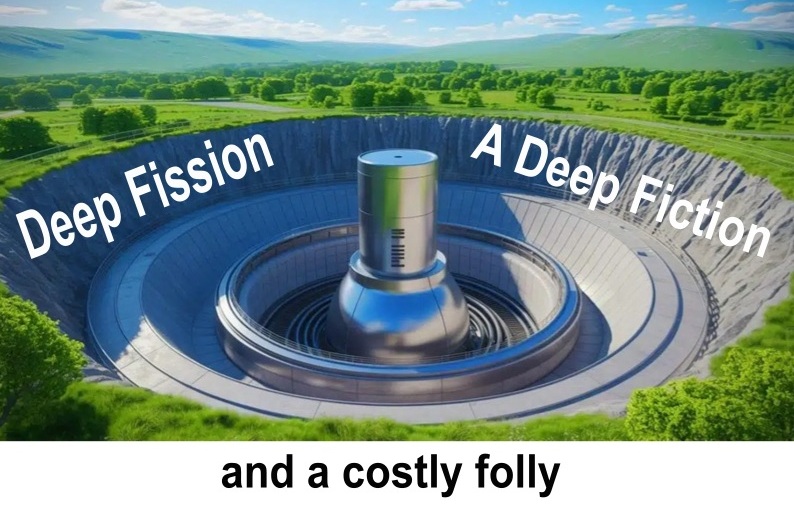
“This is a nuclear experiment,” Reynolds said. She questions how the company will perform maintenance so far underground, why drillers are operating under oil-and-gas regulations rather than nuclear-specific rules, and what happens to the site if Deep Fission goes out of business.
026-07-30, https://finance.biggo.com/news/1fb78f6c-786f-4381-be62-937bfa684157
Deep Fission, a California startup, plans to operate the first commercial nuclear reactor a mile underground in Parsons, Kansas, by 2027 or 2028. The project has raised $150 million and is part of a DOE pilot program to fast-track advanced reactors amid surging AI-driven electricity demand. The company says deep burial eliminates the need for costly containment buildings, with each 15-megawatt reactor powering 12,000 homes. However, the plan has sharply divided the town of 9,600. Opponents, including local group Prairie Dog Alliance and watchdog Beyond Nuclear, warn of environmental risks and insufficient oversight, while supporters view it as a vital economic spark for the struggling rural community. The project faces regulatory hurdles and broader questions about nuclear waste storage underground.
An ambitious plan to bury a commercial nuclear reactor a mile beneath a small Kansas town is pitting residents who see a coming economic renaissance against those who fear their community is being turned into a testing ground for an unproven experiment. The project, spearheaded by a California startup founded by a father-daughter team, would be the first time a commercial reactor has ever been operated so far underground.
Deep Fission, the company behind the so-called Gravity Reactor, has already drilled one test hole on the outskirts of Parsons—a rural community of 9,600 people roughly midway between Kansas City and Tulsa, Oklahoma. The firm, founded by Chief Executive Liz Muller and her father Richard Muller, an emeritus professor of physics at University of California, Berkeley, has raised roughly $150 million in the past year, with $40 million of that earmarked for the Parsons work. The startup plans to send a canister loaded with nuclear fuel into a third borehole to heat water deep underground and generate electricity on the surface as early as 2027 or 2028, a timeline that is remarkably short by industry standards.
“It’s allowing us to develop a first reactor within a time frame that had been unthinkable previously,” Liz Muller told The Wall Street Journal.
The reactor design relies on well-established pressurized water technology, but its innovation lies in its location. By operating a mile underground, Deep Fission argues it can eliminate some of the most expensive components of conventional nuclear plants. The immense pressure from rock and water at that depth would replace costly safety structures like massive containment buildings and complex cooling systems. Each reactor would generate 15 megawatts of electricity from inside a 30-inch borehole, enough to power roughly 12,000 homes. However, Muller’s long-term vision is far larger: an array of 100 or more reactors providing over a gigawatt of power, enough to supply a major data center.
Federal push meets local pushback
The Parsons project is one of 11 in a U.S. Department of Energy (DOE) pilot program designed to accelerate the development and testing of small, advanced reactors. Participating companies can fast-track environmental review procedures and construct reactors outside of traditional national laboratory settings. The initiative is part of a broader push by the Trump administration to spur a “nuclear renaissance,” aiming to quadruple America’s nuclear-power generation by 2050 amid skyrocketing electricity demand driven largely by data centers for artificial intelligence.
But the expedited process has drawn sharp criticism from nuclear watchdogs and local advocacy groups. Earlier this year, a coalition of state attorneys general challenged the DOE’s new categorical exclusion for advanced nuclear reactors, arguing it bypasses rigorous environmental review and weakens public safety protections.
“It’s simply unacceptable to even consider exempting Deep Fission from a peer-reviewed environmental impact statement on the generation of high-level nuclear waste under Parsons,” said Paul Gunter of Beyond Nuclear, a group that opposes nuclear power and weapons.
The Energy Department has stated that the administration remains focused on safety and security.
In Parsons, the divide is stark. When Deep Fission broke ground in December at the Great Plains Industrial Park, a decommissioned U.S. Army ammunition base, many residents were caught off guard by the lack of public discussion. Marjorie Reynolds, a pediatric nurse and seventh-generation Kansan, quickly formed a nonprofit called the Prairie Dog Alliance to oppose the project. Its logo features a prairie dog inside a black-and-yellow nuclear symbol.
“This is a nuclear experiment,” Reynolds said. She questions how the company will perform maintenance so far underground, why drillers are operating under oil-and-gas regulations rather than nuclear-specific rules, and what happens to the site if Deep Fission goes out of business.
Jerel Johnson, an IT professional who had planned to retire in Parsons, voiced a similar frustration. “I put $125,000 into my house, and now a nuclear reactor is coming to town. I can’t think of a worse idea.”
Liz Muller has pushed back against the environmental concerns, stating that the reactor is far too deep to affect underground aquifers and that the company will follow all nuclear and oil-and-gas regulations. Because the reactors are expected to last six to seven years with few moving parts, she added, the likelihood of requiring maintenance is low. “We have simplified our reactor quite extensively,” she said. The company also plans to open a local office where residents can ask questions, emphasizing that the project “needs to be done in partnership with the community.”
Economic hopes in a struggling farm town
For others in Parsons, a 19th-century boomtown that has long sought a new economic spark, the potential payoff is worth the risk. The town was once home to one of the largest rail yards west of the Mississippi, but recent victories have been small—attracting a Taco Bell or saving a local furniture store.
Verlyn Bolinger, an insurance agent and city commissioner whose great-great-grandfather also served on the commission, captured the conflicted mood. “Any time you’re putting a nuclear reactor in a hole, it’s kind of scary,” he said. “It’s great that it’s here. It’s kind of bad that we’re the guinea pigs.”
Robert Spinks, Parsons’ police chief, is more optimistic. He views the reactor as a potential catalyst that could draw manufacturers and data centers to the region. “It’s a proven technology, just in a new application,” Spinks said. “And if that is a trigger which draws in other manufacturing and brings in living-wage jobs, I think that’s a win.”
Wayne Gilmore, an optometrist who owns the local radio station, echoed that sentiment, arguing that rural communities cannot build their futures by rejecting new technology before it is fully evaluated.
Deep Fission’s plan to store spent nuclear fuel underground is also drawing scrutiny. The company says it could eventually seal the waste in place or move it to another site. Liz Muller and her father previously founded Deep Isolation, a firm that designs underground disposal systems for nuclear waste. Still, the Nuclear Regulatory Commission will need to approve any commercial licensing before electricity from the reactor can be sold. Dozens of companies are designing smaller reactors, but none yet operate commercially in the United States, and Deep Fission must still prove it can meet its aggressive timelines and contain costs in an industry notorious for overruns.
This startup just raised nearly $500 million to build nuclear reactors for the US military.
By Rahim Amir, 30 July 26, https://www.techradar.com/pro/this-startup-just-raised-nearly-usd500-million-to-build-nuclear-reactors-for-the-us-military
Antares lookt to supply small reactors by 2028
- Antares closes $470 million Series C, $370 million in equity and $100 million in debt, co-led by Paradigm and Caffeinated Capital
- The move follows the Mark-0 reaching criticality at Idaho National Laboratory and helps fund an electricity-producing Mark-1 in 2027 and military deployments in 2028
- Antares’ military-first strategy targets a price-insensitive customer bound by an executive order requiring a reactor on a US base September 30 2028
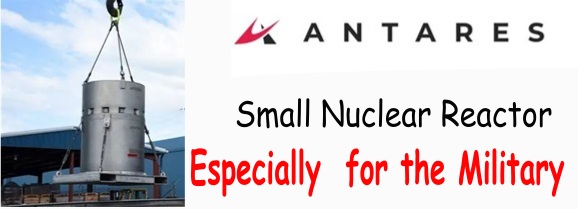
Nuclear fission startup Antares has announced it has raised a total of $470 million in funding as it looks to supply a single client with a looming deadline: the US Military.
The Torrance, California company closed a Series C co-led by Paradigm and Caffeinated Capital, with Point72 Ventures, Shine Capital and Industrious Ventures among the participants, according to TechCrunch‘s look at its PitchBook data.
Antares’ raise comes seven weeks after its Mark-0 microreactor reached criticality at Idaho National Laboratory under the Department of Energy’s authorization in a demonstration run with the DOE, the lab, and BWX Technologies, with the US Army observing.
A direct beneficiary of the White House
Antares calls it the “first privately developed non-light-water reactor to achieve criticality in the United States in more than four decades,” underscoring how important the test was for both Antares and the US military.
The US military’s presence is not by chance; It is mandated by an executive order (“Deploying Advanced Nuclear Reactor Technologies for National Security”) signed by US President Donald Trump to ensure that it has an operating army-regulated nuclear reactor on a domestic military site by September 30, 2028
Antares happens to be one of three finalists in the Pentagon’s Advanced Nuclear Power for Installations program that aims to test-deploy a small module reactor (SMR) on two different air force bases.
With Antares being the first private company to go through that gate under the DOE’s Reactor Pilot Program, it plans to build an electricity-producing Mark-1 reactor in 2027, followed by initial deployments to defense customers by 2028.
USA firm McDermott to support potential Dutch Rolls-Royce SMR projects
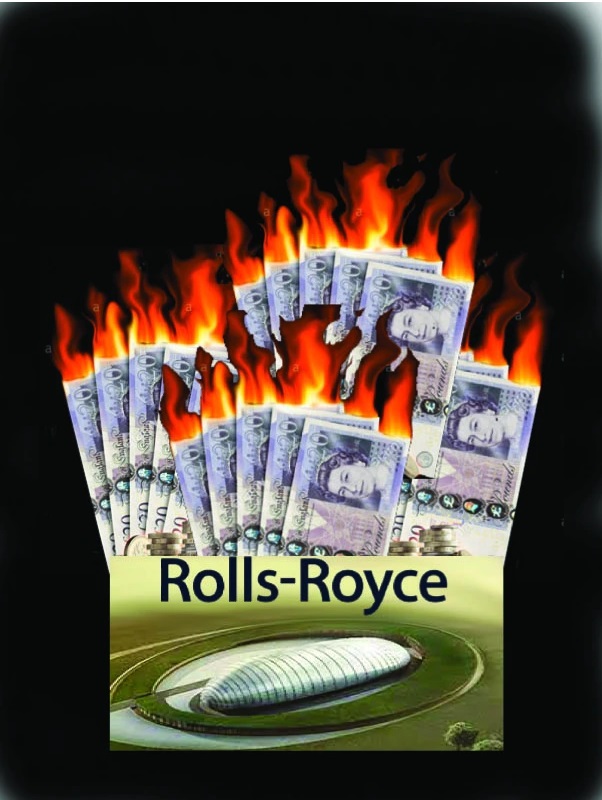
Dutch nuclear development company ULC-Energy has signed a cooperation
agreement with USA-based engineering and construction firm McDermott to
support development of Rolls-Royce SMR projects in the Netherlands. The
cooperation includes the integration of small modular reactor-powered
energy solutions with energy-intensive industrial processes. It is expected
to leverage McDermott’s expertise in energy transition and industrial
decarbonisation, including low-carbon hydrogen and ammonia, sustainable
aviation fuel and carbon capture and utilisation, combined with
ULC-Energy’s nuclear project development capabilities.
World Nuclear News 29th July 2026, https://www.world-nuclear-news.org/articles/mcdermott-to-support-dutch-deployment-of-rolls-royce-smr
SMR on the moon – micro lunar nuclear reactor
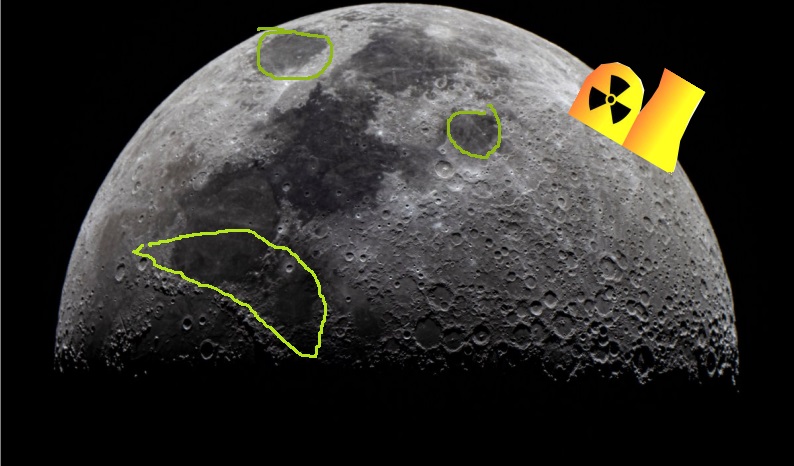
Harlette Capital Ltd today announced the launch of its ALPHA LUNAR™
Small Modular Reactor (SMR) Request for Information (RFI), inviting leading
nuclear technology organisations to collaborate on the development of an
innovative micro lunar nuclear reactor designed for future sustained
operations on the lunar surface.
The ALPHA LUNAR™ programme seeks to
explore the development of compact nuclear power systems incorporating
innovative hydrogen-based technologies to support long-duration lunar
infrastructure, scientific research, communications, robotics and future
human exploration.
As part of the RFI process, Harlette Capital Ltd has
invited leading SMR developers, including Rolls-Royce SMR and Westinghouse
Electric Company, to participate in technical discussions and provide
information regarding technologies that may support future lunar power
generation.
Pressat 29th July 2026, https://pressat.co.uk/releases/harlette-space-goes-nuclear-527a2ba30e5bb80e0558b3f71de1a41e/
The Small Modular Nuclear Reactor Hyper spreads to Italy
the government is focusing on small modular reactors, or SMRs
Industry estimates suggest a single 300-megawatt SMR could cost between 3 billion and 6 billion euros before infrastructure and grid expenses. The government hopes much of that financing would come from private capital
“Nuclear power that is being built today in Europe has exorbitant costs,” he said. “On the one hand, costs are extremely high, and on the other, private investors are running away.”
He also questioned whether SMRs would dramatically improve those economics, noting that the technology has yet to be commercially proven at scale.
The biggest political obstacle might be finding locations to build reactors and store the waste.
Four decades after Chernobyl, a generational divide reshapes Italy’s nuclear debate. By ASSOCIATED PRESS, 28 July 2026 , AP reporters Silvia Stellacci and Andrea Rosa in Rome contributed to this report.
ROME (AP) – Four decades after the Chernobyl disaster spewed radiation across Europe and turned Italy off nuclear power, Premier Giorgia Meloni ´s government is laying the groundwork to bring it back as the country seeks to improve its energy security.
The government is counting on a new generation of Italians who see nuclear power as a source of low-carbon electricity, a tool to help fight climate change and a way to strengthen stable energy supplies amid shocks from the Ukraine and Iran wars.
It´s betting that such support will blunt the opinions of Italians who lived through the 1986 nuclear accident, still view atomic energy through the lens of risk and disaster, and twice rejected nuclear power in national referenda, experts say.
Next week, Parliament is expected to approve government-sponsored legislation establishing a legal framework for next-generation nuclear technologies. The government would then have 12 months to draft implementing decrees covering reactor licensing, safety standards, waste management and siting.
“The duty of the government at this moment is to create the conditions so that those who will eventually decide on installations will be able to do so,” Gilberto Pichetto Fratin, minister for the Environment and Energy Security, told The Associated Press in an interview ahead of the vote.
Italy´s debate comes as several European countries, including France and Poland, expand or pursue nuclear power amid concerns about energy security and climate goals. Unlike them, however, Italy is trying to rebuild an industry voters dismantled decades ago.
Italy was once among Europe´s nuclear pioneers. Four reactors operated until a 1987 referendum effectively ended the country´s nuclear program in the aftermath of Chernobyl. Another attempt to revive nuclear power collapsed after Japan´s Fukushima disaster in 2011, when about 94% of voters opposed plans for new reactors.
As a result, Italy’s shift would mark one of Europe´s most ambitious energy reversals…………………………….
Rather than reviving the large plants of the past, the government is focusing on small modular reactors, or SMRs, and other advanced technologies that supporters say could be safer, more flexible and faster to build.
“We are talking about the third advanced generation (of nuclear power), much more workable compared to what are the needs, much safer because it is small in size with very short construction times,” Pichetto Fratin said.
“When people ask me for a timeline, I say 2033, 2034, 2035,” he added, referring to when the first next-generation reactors could realistically begin operating…….
At the sprawling Latina nuclear power plant south of Rome, workers in protective suits and masks are still dismantling the remains of Italy´s first nuclear era even as politicians discuss how to build a second.
The contrast is not lost on Viviana Cruciani, who oversees nuclear decommissioning at the site run by the state-owned company Sogin.
“There is a generation that came right after Chernobyl that still sees nuclear energy in light of the accident at Chernobyl only,” Cruciani told AP.
“But there is another generation, a lot younger, that is enthusiastic about nuclear, and it is even sorry that the country has not yet made any progress towards a comeback to this technology.”
A June 2026 survey by research firm Only Numbers found that about 55% of Italians support next-generation nuclear plants.
Michele Governatori, a senior energy adviser at climate and energy think tank ECCO, said support is more visible among younger Italians.
“There is greater openness, especially among younger generations,” he said, noting that many associate nuclear power with technological progress rather than with the accidents that shaped public opinion in earlier decades.
Not everyone is convinced.
“If we use nuclear as a backup … the average energy costs become devastating. So unfortunately it´s not a good complement to renewables and it´s not cheap,” Governatori said.
Pichetto Fratin acknowledged that nuclear power is not a short-term solution to high electricity prices.
“Nuclear power does not lower consumers´ bills today,” he said. “The nuclear power of tomorrow can help reduce them.”
Industry estimates suggest a single 300-megawatt SMR could cost between 3 billion and 6 billion euros before infrastructure and grid expenses. The government hopes much of that financing would come from private capital, Pichetto Fratin said.
Governatori believes that cost remains the weakest part of the government´s case.
“Nuclear power that is being built today in Europe has exorbitant costs,” he said. “On the one hand, costs are extremely high, and on the other, private investors are running away.”
He also questioned whether SMRs would dramatically improve those economics, noting that the technology has yet to be commercially proven at scale.
Even so, some critics support establishing a regulatory framework that could allow future projects to be evaluated on their merits.
The biggest political obstacle might be finding locations to build reactors and store the waste.
Italy still lacks a national repository for existing nuclear waste, much of which remains stored at temporary facilities across the country. Any future reactor or waste-storage site is likely to face strong local opposition.
Even if Parliament approves the legislation, opponents – including environmental groups and left-wing parties – could seek a new referendum once specific reactor locations and waste-storage plans emerge.
Surveys suggest support for nuclear power drops sharply when people are asked whether they would accept a reactor near where they live. Polls cited by experts indicate that about six in 10 Italians oppose having a reactor in their own province.
“When you have to seriously ask where a plant will be built and how much it will cost, it is likely that public opinion could become negative again,” Governatori said.
1 This Month



Shut down the radiation-damaged Heysham nuclear reactors now
To see nuclear-related stories in greater depth and intensity – go to https://nuclearinformation.wordpress.com

Say No to NASA’s Reckless Nuclear Reactor on the Moon
Say No to NASA’s Reckless Nuclear Reactor on the Moon
-
Archives
- October 2026 (256)
- September 2026 (339)
- August 2026 (330)
- July 2026 (355)
- June 2026 (287)
- May 2026 (306)
- April 2026 (356)
- March 2026 (251)
- February 2026 (267)
- January 2026 (308)
- December 2025 (358)
- November 2025 (359)
-
Categories
- 1
- 1 NUCLEAR ISSUES
- business and costs
- climate change
- culture and arts
- ENERGY
- environment
- health
- history
- indigenous issues
- Legal
- marketing of nuclear
- media
- opposition to nuclear
- PERSONAL STORIES
- politics
- politics international
- Religion and ethics
- safety
- secrets,lies and civil liberties
- spinbuster
- technology
- Uranium
- wastes
- weapons and war
- Women
- 2 WORLD
- ACTION
- AFRICA
- Atrocities
- AUSTRALIA
- Christina's notes
- Christina's themes
- culture and arts
- Events
- Fuk 2022
- Fuk 2023
- Fukushima 2017
- Fukushima 2018
- fukushima 2019
- Fukushima 2020
- Fukushima 2021
- general
- global warming
- Humour (God we need it)
- Nuclear
- RARE EARTHS
- Reference
- resources – print
- Resources -audiovicual
- Weekly Newsletter
- World
- World Nuclear
- YouTube
-
RSS
Entries RSS
Comments RSS

