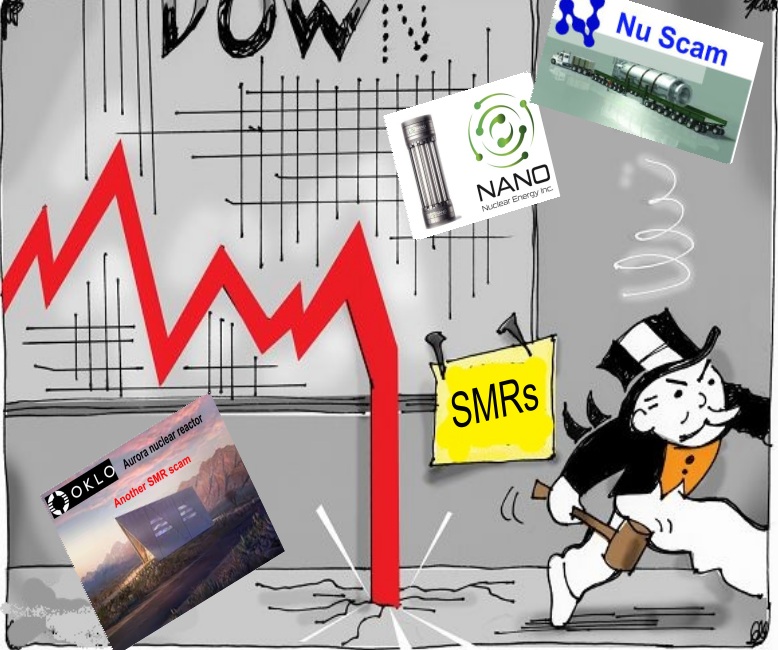
Short sellers reap $2Bn profit as modular nuclear reactor stocks tumble
Unproven technology won investment from power-hungry AI
hyperscalers but has yet to deliver consistent revenues
The Financial Times, .Ramsay Hodgson in London, 19 Aug 26,
https://www.ft.com/content/a2f0e0f8-9350-4124-af77-62219e77e777
Short sellers have reaped large profits from betting against small modular nuclear reactor companies, as the collapse of the “hype cycle” that had sent their share prices soaring wipes billions off their market value.
Funds made an estimated $2.1bn shorting three stocks — US-listed NuScale Power, Nano Nuclear and Sam Altman-backed Oklo — over the past year, according to data provider S3 Partners.
The three companies, which are lossmaking and have little or no revenue, surged last year as investors raced to capitalise on growing interest in nuclear energy among AI hyperscalers looking for new sources of power. Regulatory changes and funding announcements from the Trump
administration also helped the sector.
But a total of $30.3bn has been wiped off their collective market value since their peak in October last year amid growing concerns over the lack of immediate revenue and the long build-out timelines for the technology.
“The stocks were overinflated in price, based on speculation,” said Adam Stein, director of nuclear energy innovation at the Breakthrough Institute, a climate and energy think-tank.
The sector went through a “textbook hype cycle” last year, he added. “[It is] very typical of a company that is in this early pre-consistent revenue phase.”
Small modular nuclear reactors are assembled from modules built in factories to save time and
money, and produce around 300MW or less, compared with more than 1,000MW for traditional
reactors.
Only two commercial SMRs are currently operable — in Russia and China, with more than 80 designs in various stages of development.
A key test of investor appetite towards the nuclear sector is expected in the coming weeks, when Holtec International and Westinghouse, two US-based companies with SMR divisions, are expected to list.
Short sellers have piled into bets against the companies based on a view that their shares rose to unsustainable levels, driven by a limited supply of publicly traded stocks and a focus on the potential demand from AI, rather than the time and capital expenditure required to commercialise the technology.
“On the one hand there was some support from the government, and no one wants to bet against Trump, and on the other there was this whole AI [demand] story which everyone was really bullish about [last year],” said Christian Putz, founder and chief executive of investment firm ARR
Investment Partners, who has previously shorted Oklo but has since unwound that position.
Around 18 per cent of Oklo and NuScale’s outstanding shares remain out on loan — a proxy for short selling — while almost 30 per cent of Nano’s are on loan, according to S&P Global Market Intelligence.
Meanwhile, X-energy has shed $5.8bn in market value since the surge that followed its initial public offering in April. Short sellers have earned an estimated $67mn from bets against thecompany since mid-May, according to S3 Partners. The company, which is backed by Amazon and
Ken Griffin and has yet to receive full regulatory approval to build its helium-cooled reactor, has 9 per cent of its shares out on loan.
“The sentiment has changed this year, people are far more critical,” said Putz. These companies “have almost zero revenue for the foreseeable future and, on top of that, there are very high capex [capital expenditure] requirements”.
Demand for energy in the US is set to soar over the coming decade, in part due to the rapid development of power-hungry data centres by AI hyperscalers. According to data from BloombergNEF, US data centre power demand is set to climb from 34.7 gigawatts in 2024 to 106GW by 2035.
Big Tech is increasingly turning to the emergent SMR technology to meet its future power needs. In January, Meta struck a deal with Oklo and Bill Gates-backed TerraPower, in which it agreed to make an upfront cash injection to support development of the reactor technology.
The Trump administration vocally backed the nuclear sector last year, pledging to cut red tape and invest tens of billions of dollars to build new reactors and reopen old ones to generate the to “win” the global AI race. In June, the Department of Energy announced $17.5bn of loans to help rebuild the US nuclear supply chain.
However, timelines for delivery of the unproven reactors remain uncertain. Analysts at BNP Paribas have expressed concerns over shortages of high-assay low-enriched uranium, a special type of nuclear fuel vital for SMRs. The earliest some will come online is mid-to-late 2028, if manufacturers are able to speed up delivery while also satisfying regulators, although the majority will arrive during the 2030s, said Stein at the Breakthrough Institute.
NuScale, which reported a $96.7mn loss in the first half of 2026, faces a shareholder class-action lawsuit alleging it misled investors, to which it must respond by September 8. It is building a modular light-water reactor based on a more conventional pressurised-water design.
Nano Nuclear — whose microreactors are in the development stage — has never generated any revenue and posted a $14mn operating loss in the first quarter of the year.
Oklo hopes to deliver commercial power to customers from its liquid sodium rather than water- cooled Aurora reactors. US energy secretary Chris Wright was previously a board member. It has yet to secure a full licence from the US nuclear regulator to build and operate its reactor.
“What we have seen in 2025 seems to me like an industry bubble that is already deflating,” said Siegfried Eggert, chief executive of activist short seller Grizzly Research, who has no short positions against the companies.
“I believe most knowledgeable investors understood for a while that the valuations seemed ratherextended given the timeline of this industry,” he added.
Nano Nuclear said the rise or fall in the share price of companies said little about the success of the underlying business and disputed the “hype cycle” characterisation. Oklo said the company had made “tangible progress” over the past year and expected commercial operation of its Aurora reactor to begin in 2028.
NuScale declined to comment. X-energy did not respond to a request for comment.
No comments yet.
1 This Month
23-25 October – on Zoom – World BEYOND War’s annual global conferenc


Shut down the radiation-damaged Heysham nuclear reactors now
To see nuclear-related stories in greater depth and intensity – go to https://nuclearinformation.wordpress.com

Say No to NASA’s Reckless Nuclear Reactor on the Moon
Say No to NASA’s Reckless Nuclear Reactor on the Moon

-
Archives
- October 2026 (209)
- September 2026 (339)
- August 2026 (330)
- July 2026 (355)
- June 2026 (287)
- May 2026 (306)
- April 2026 (356)
- March 2026 (251)
- February 2026 (267)
- January 2026 (308)
- December 2025 (358)
- November 2025 (359)
-
Categories
- 1
- 1 NUCLEAR ISSUES
- business and costs
- climate change
- culture and arts
- ENERGY
- environment
- health
- history
- indigenous issues
- Legal
- marketing of nuclear
- media
- opposition to nuclear
- PERSONAL STORIES
- politics
- politics international
- Religion and ethics
- safety
- secrets,lies and civil liberties
- spinbuster
- technology
- Uranium
- wastes
- weapons and war
- Women
- 2 WORLD
- ACTION
- AFRICA
- Atrocities
- AUSTRALIA
- Christina's notes
- Christina's themes
- culture and arts
- Events
- Fuk 2022
- Fuk 2023
- Fukushima 2017
- Fukushima 2018
- fukushima 2019
- Fukushima 2020
- Fukushima 2021
- general
- global warming
- Humour (God we need it)
- Nuclear
- RARE EARTHS
- Reference
- resources – print
- Resources -audiovicual
- Weekly Newsletter
- World
- World Nuclear
- YouTube
-
RSS
Entries RSS
Comments RSS


Leave a Reply