Polish billionaire’s financing plans for 14 UK SMRs analysed

“I think the price projections are utterly worthless. If you don’t know the construction cost and time, the cost of capital, the equity structure, not to mention the O&M (operation and maintenance) cost, you have no idea what the power price will be.”
“So if things don’t go to plan, it will be the government’s fault, not theirs. (SGE’s)”
– Stephen Thomas, professor at the University of Greenwich Business School, working in the area of energy policy.
25 Aug, 2026 By Tom Pashby, https://www.newcivilengineer.com/latest/polish-billionaires-financing-plans-for-14-uk-smrs-analysed-25-08-2026/
Financing plans from Polish billionaire Michał Sołowow’s SGE to enable the deployment of 14 small modular reactors (SMRs) in the UK have been revealed by NCE and analysed by an expert.
In July, SGE – described as a dedicated European SMR development and investment platform – announced its plans to build 14 GE Vernova Hitachi BWRX-300 Small Modular Reactors on three sites in the UK.
In total, the investment is expected to be around £35bn and the first SMRs are hoped to be operational in 2034.

To achieve that, SGE has submitted an application under the UK’s Advanced Nuclear Framework (ANF) to develop the combined 4.2GW fleet which, if successful, could deliver 11% of UK power demand for at least sixty years.
Using the Freedom of Information (FOI) Act, New Civil Engineer (NCE) has secured correspondence between SGE and the Department for Energy Security and Net Zero (DESNZ) where SGE set out more details about its ambitions to finance its SMRs.
SGE’s representatives at etara – a power, energy and infrastructure advisory firm – sent a letter from SGE to DESNZ deputy director for advanced nuclear Andrew Cooke dated 26 June.
The letter was addressed to the then DESNZ secretary of state Ed Miliband.
“We are writing to set out how SGE’s privately led SMR fleet deployment programme can support DESNZ’s priorities on clean power, energy security, industrial growth and reliable nuclear baseload, ahead of our application to the Advanced Nuclear Framework (ANF) which we plan to submit next week on the 1 July 2026,” it said.
SGE said it is “bringing forward one of the UK’s most mature privately led SMR propositions”, and this would be “on better value for money terms helping reduce the long-term impact on UK bill payers”.
It backed up the promise of value for money by saying: “Our fleet approach across Europe, including leveraging our regional exclusivity on the GE Vernova technology deployment and our 14 unit programme in Poland with our JV partner Orlen, gives us confidence that we can deliver on attractive economic terms
Their plans were shown to University of Greenwich emeritus professor of energy policy Steve Thomas, who shared his analysis with NCE. SGE provided NCE with responses to his analysis.
SGE’s letter said: “Our preliminary financial modelling is indicating that the CfD (contracts for difference) strike price is expected to be below that of Hinkley Point C with a lesser risk transfer than the Sizewell C Rab (regulated asset base) model, offering better value for money.”
Thomas said: “As I never tire of pointing out, CfD tells you nothing other than that the plant is not bidding into the market. Hinkley has one, so will Sizewell. The very big difference is that for Hinkley, the price is fixed and the investor income will be what it will be and for Sizewell, the investor income is fixed and the electricity price will be what it will be.
“I think the price projections are utterly worthless. If you don’t know the construction cost and time, the cost of capital, the equity structure, not to mention the O&M (operation and maintenance) cost, you have no idea what the power price will be.”
Responding to Thomas’s analysis, SGE said: “It is true that for Hinkley the CfD price is fixed and the pain of overruns is impacting the investors.
“For Sizewell it is true that the consumer will pay whatever it costs, but it is not quite right that there will be a CfD, there already are charges to consumers under the Rab model – well before the plant is constructed or produces power.
“The CfD model proposed by SGE, as with Hinkley pre-sets at FID the strike price, so keeps the completion risk and majority of cost outturn risk with the investors, hence the projections do matter for the investors and for the value for money evaluation by the government.
“As with all standard project appraisals, our financial model underpins the indicative strike price. It is informed by live data from construction of the first BWX300 SMR in Canada and benefits from economies of scale from our projects across Europe.”
The letter said SGE’s offer would involve “lesser risk transfer than the Sizewell C Rab model”.
Thomas said it was “interesting that this is implicit criticism of the Sizewell deal and I wonder how that will go with DESNZ, which sold Sizewell on the basis it was better for consumers than Hinkley, now we are going back to the Hinkley model because it is better than Sizewell.”
Responding to Thomas’s analysis, SGE said: “There is no criticism of the Sizewell model, just a factual reference to the relative risk allocation – the CfD model keeps a greater level of risk (e.g. completion risk) with the investors, not with taxpayers or consumers.
“It is common practice to benchmark, and this is all that the reference does. The proposed model draws on lessons from Hinkley Point C, Sizewell C and other reference projects across Europe.”
SGE’s letter said the success of its proposition is “subject to supportive government engagement” and said, “our delivery team with the capability of GE Vernova and Samsung is capable of delivering first power to the grid by 2034”.
Thomas said: “So if things don’t go to plan, it will be the government’s fault, not theirs.”
SGE responded, saying: “This is not a fault allocation point but a simple point that nuclear projects require state engagement – self-evidently, the CfD agreement needs the state’s agreement and signature.
“Delivery of any major infrastructure project requires close collaboration between government and the client organisation across planning, regulation, financing and delivery.”
The letter said: “To convert this mature proposition into delivery, we are seeking government support that is practical, targeted and designed to be off government balance sheet to mobilise our private capital.”
Thomas analysed, saying: “That sounds like the Rab process which didn’t go well as the government ended up having to take near enough half the project, so definitely not off the government balance sheet.”
SGE responded, saying: “The support proposed is not Rab but CfD. The ANF is seeking a structure that mobilises private capital. SGE is offering such private capital under CfD terms.
“Our proposal is designed to mobilise private capital through a structure that is intended to remain off the government balance sheet, subject to the final model and accounting treatment.”
Finally, the letter also said: “Utilising the CfD and SoSIA (Secretary of State Investor Agreement) contractual frameworks with specific modifications that take the lessons learnt from Hinkley Point C (HPC) and from a number of new nuclear projects across Europe that have since HPC been enabled under CfD structures.”
Thomas said: “I will give very good odds that one of the specific modifications is that the strike price is not fixed at the time of FID (final investment decision), but if costs go up, so will the strike price.”
SGE said: “As per the CfD structures in Europe that are referred to, there are pain share mechanisms, as well as gain share mechanisms, but not full pass-through to the strike price.
“SGE is an equity investor into a new nuclear programme and, along with its strategic partners, it intends to take development and construction risks – it will not simply transfer any cost increase into the CfD.
“Any modifications to the CfD and SoSIA frameworks would be subject to agreement with government and reflected in the agreed contractual and regulatory framework and be subject to the controls that exist for any state support regarding value for money considerations.”
Later in the correspondence between SGE and DESNZ officials, public relations staff working on behalf of SGE asked DESNZ officials to attend their press launch event in July and for a minister to provide a quote for their press release.
Officials were unavailable for the launch event.
In response to the request for a quote, a DESNZ official said: “As the submission of a proposal is part of a routine administrative process, consistent with the department’s approach to comparable processes such as entry into the Generic Design Assessment (GDA), DESNZ does not provide public quotes or commentary at the point of application.
“This approach helps ensure that the department remains impartial throughout the assessment process and avoids any perception that a submission has been endorsed or prejudged prior to the completion of the relevant assessment and decision-making processes.
“Should a proposal be successful, there may be opportunities for communications and stakeholder engagement at the appropriate stage. However, at the point of submission, the department will not be providing a quote.”
An SGE spokesperson told NCE: “SGE’s interactions with DESNZ have been and remain positive and constructive.
“We understand the department’s approach that reflects its standard policy in relation to the ANF process. We look forward to continuing our engagement with DESNZ as we progress our UK project.”
Walt Zlotow- NATO letting Ukraine die, not by a thousand cuts, but by a thousand drones.

Neither the UK’s Burnham, France’s Macron nor Germany’s Merz are friends of Ukraine, fair- weather or otherwise. They’ve spent the last 12 years promoting war between Ukraine and Russia that has left Ukraine a shell of its former self.
Walt Zlotow West Suburban Peace Coalition Glen Ellyn IL , 23 Aug 26
The thousands of drones NATO is squandering their desperately needed treasure to give Ukraine to fire wildly into Russia have backfired spectacularly.
The drones have no strategic value on Ukraine’s war prospects. They are mere pinpricks having no effect on the inevitable Russian victory on the battlefield. But they have enraged the Russian populous and leadership to ramp up the destruction of Ukraine’s economy and infrastructure which will speed up Ukraine’s collapse.
Foremost in this campaign in closing off Ukraine’s access to the Black Sea and other ports greatly shutting down vital exports and imports, the lifeblood of the Ukraine economy. Energy facilities thruout Ukraine are being targeted in daily attacks that unlike Ukraine’s scattershot drone strikes, strategically cripple Ukraine life. Ukraine has no defensive missiles to shoot down incoming Russian drones and missiles with none forthcoming from either Europe or the US.
Virtually none of this gets reported in Western media. Most reporting touts NATO supplied Ukrainian drone strikes on Russia as evidence Ukraine is still in the fight. Utter nonsense.
NATO leaders brag how they’re bringing the war home to Russia and that Ukraine can prevail. They are locked into a a long history of Russophobia they cannot not shake regardless of how their war support is hurting their economies and alienating their constituencies. Their facing a lost cause in Ukraine, bankruptcy at home and electoral defeat.
The UK’s Keir Starmer has already been pushed out. But his successor Andy Burnham hasn’t got the clear message. After Russia’s Putin warned the UK of consequences for Britain providing Ukraine with drones fired into Russia, Burnham replied “London will continue to support Ukraine 100%. We are not fair-weather friends, we will be there in Ukraine’s hour of need and that won’t change.”
Neither the UK’s Burnham, France’s Macron nor Germany’s Merz are friends of Ukraine, fair- weather or otherwise. They’ve spent the last 12 years promoting war between Ukraine and Russia that has left Ukraine a shell of its former self.
How? By supporting the 2014 coup that ousted Russian leaning Ukraine President Victory Yanukovych. By promoting the Minsk I and II Accords in 2014 and 2015 that lulled Russia into believing NATO was going to provide regional autonomy for Russian leaning Donbas Ukrainians when it was simply a ruse to build up Ukrainian forces to crush the Donbas Ukrainians. By conspiring with the US to goad Russia into invading Ukraine in February 2022 by refusing to address Russia’s valid security concerns regarding NATO expansion to Russia’s borders in Ukraine.
And when Ukraine does collapse, possibly as early as this year, NATO countries will be left with nothing to show but greatly weakened economies and inroads from right wing governments sick of squandering critically needed domestic treasure on senseless, lost foreign causes. NATO leaders can ponder forever their descent into madness that destroyed Ukraine for nothing but their hatred of Russia.
Dependence Day: A generation after the Soviet Union fell, Ukraine is a ruined proxy of the West
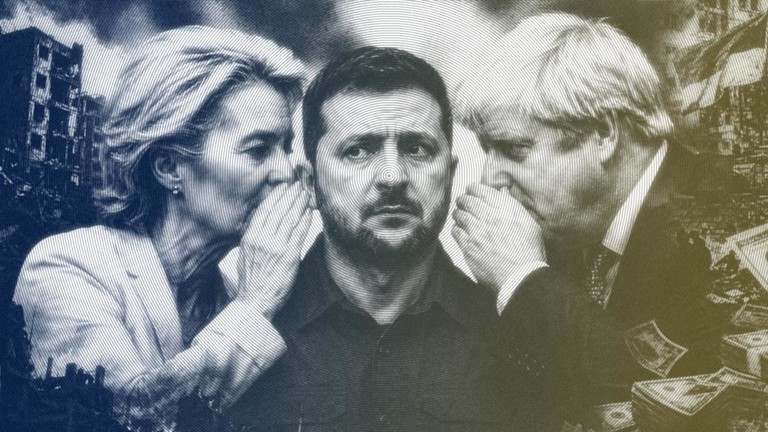
To be fair, the first yet already extremely harmful steps the West took to, ultimately, ruin Ukraine had very little to do with it: When Washington decided – not once but repeatedly – to cheat and humiliate Russia and break clear promises not to expand NATO eastward, it was first Germany, then multiple Eastern European countries that were at the center of attention, but not Ukraine. Yet, ironically, even while neglecting it, the West’s reckless expansion already set the stage for phase two of putting Ukraine in the crosshairs.
Ukraine could have bridged East and West. Instead, corruption, nationalism, and Western meddling left it broken
24 Aug, 2026 By Tarik Cyril Amar
There is one feeling I often recall from having lived and worked in Ukraine – to be precise, in its most nationalist, full-of-itself city, Lviv – for a total of five years in the 2000s: Thank God, at least there’s no violence!
That is what I, some other foreigners, and quite a few Ukrainians, too, were thinking and even saying then. The country was politically and even culturally polarized, extremely corrupt, and a sham ‘democracy’ even more fake than most of the rest.
It was dominated and bled dry by a greedy, hypocritical, and – despite all the cheap talk, the pious singing-of-anthems-hand-on-heart, and the cheesy peasant braids and stitched shirts – deeply unpatriotic establishment of typically post-Soviet turncoats, thieves, liars, and sell-outs. There was no rule of law, the courts were a bad joke, and the police was a racket.
And yet, while the usual business-crime complex took its toll and there was the occasional state murder of a journalist, there was no large-scale violence. There was bitter grumbling galore, including about Crimea, all the time. But there was no civil war – as the almighty US intelligence services had infamously as good as predicted in the even darker 1990s – and no one was reaching for a gun either to leave an unbearable country or keep others in it by force.
While the Americans were busy thinking about the possibility – and perhaps opportunities – of Ukrainians killing each other in large numbers, their British cousins were considering another kind of doom. For them, more than three decades ago, the most interesting question was whether Ukraine and Russia would go to war, specifically over Crimea. There, British spooks back then warned with unusual honesty, “most of the population is Russian,” and things might become less than cordial if Kiev didn’t watch its steps.
And here we are now: On the 35th official anniversary of its existence outside the former Soviet Union, Ukraine has become the sum of all fears, much worse than even its pervasively corrupt, brutally unfair, and de facto lawless pre-2014 version. It is now ruled by its worst, most corrupt, and most authoritarian and bloody regime ever – hands down – under Vladimir Zelensky and his cronies. They steal, embezzle, and launder piles of dirty money as if there’s no tomorrow, which, to be fair, there really probably isn’t for them, at least not in Ukraine.
They literally hunt and, in effect, sell their subjects as cannon fodder, so that they can profit and the West can have its slaughterhouse war against Russia, in an insane, evil, and futile attempt to eliminate Moscow as a power to be reckoned with. This is the reality of “busification,” and nothing remotely like it happened before Zelensky and his accomplices took over. Those who do not readily submit to being treated as combat cattle regularly die mysteriously from ‘falls’ or maybe just blowing their nose.
The Ukrainian mass media have never been remotely clean, objective, or reliable. But the zombified and self-zombifying propaganda machine created under Zelensky is unprecedentedly awful. Those who openly resist the national brainwashing are incarcerated by kangaroo courts, tortured, and killed.
Or consider basic demography: Ukraine’s real population has almost halved since the end of the Soviet Union, and the future looks even worse. And while part of this catastrophe is due to the current war, much of it has been produced by the ceaseless class-war-from-above of injustice, exploitation, and hopelessness that Ukraine’s ‘elites’ have waged on their own subjects for a third of a century while blabbing sanctimoniously about nation this and nation that.
And the results of all these horrors? They are abysmal even on their own perverse terms. Just look at the map: Crimea is gone and so are substantial portions of Ukraine’s post-Soviet east due to a combination of regional rebellion, Kiev’s cack-handed, violent attempts to stomp it out, and a war with Russia. All of this could have been avoided.
Yet it was not. Indeed, Ukraine’s short post-Soviet history is, among other sad things, a record of at least sleepwalking and, more frequently, proactively provoking this twin catastrophe. But Ukrainians – or rather their rotten establishment – did have plenty of help in getting it so wrong. Take, for instance, the mean-spirited and asinine obsession with suppressing the Russian language to eradicate Ukraine’s windfall advantages as a mostly bilingual country of Russian and Ukrainian speakers.
That perverse and self-harming pursuit – recalling Freud’s hunch about nationalism as neurosis – was obstinately cultivated by both a narrow-minded but hyperactive and arrogant minority of ukrainier-than-though nationalists at home and descendants of run-away World War II nationalists, mass murderers of Poles, and Nazi collaborators from the West who were eager to infest post-Soviet Ukraine with their hoary bigotry.
Personally, I remember being naïve enough back then in the 2000s to ask Lviv acquaintances why Ukraine couldn’t just codify its own variant of Russian (comparable to the way American English is different from British English) and also promote Ukrainian (I know both languages, as it happens), and then focus on actually important matters. Blank stares were the answer, at best.
Ironically, well into the current war, there was a short news blip about someone in Ukraine having discovered the same obvious idea. How catastrophe can concentrate the mind and how sad that even now, after an estimated 1.5 million battlefield casualties, such pragmatic thinking is still a minority taste: Kiev’s policy is simply to double down on a daft campaign to win the lexicon while losing the war.
Entitled, patronizing exile nationalists projecting their selfish tunnel-vision fantasies on, and throwing their Western hard currency at, desperate people freshly shell-shocked by ultra-predatory ‘transition’ capitalism were one noxious outside influence vitiating Ukraine’s post-Soviet trajectory. But it was far from the only one. Indeed, as time went on, the West as a whole – its politicians, intellectuals, and mainstream media – became ever more interested in and vastly detrimental to Ukraine.
To be fair, the first yet already extremely harmful steps the West took to, ultimately, ruin Ukraine had very little to do with it: When Washington decided – not once but repeatedly – to cheat and humiliate Russia and break clear promises not to expand NATO eastward, it was first Germany, then multiple Eastern European countries that were at the center of attention, but not Ukraine. Yet, ironically, even while neglecting it, the West’s reckless expansion already set the stage for phase two of putting Ukraine in the crosshairs.
That was reached in 2008, when, at an infamous summit in Bucharest, the high and mighty of the West, led by the indispensably destructive US, artfully maneuvered Ukraine into the very worst position imaginable: by making a promise of NATO membership for Ukraine sometime in the future, they inevitably poked Russia in the eye once too often. By keeping the reckless promise vague, they left Ukraine completely exposed, as if baiting Moscow to intervene. The whole mad scheme took willfully ignoring the clear warnings issued by Russian President Vladimir Putin in Munich one year before and multiple equally explicit warnings produced by not Russians but widely acknowledged Westerners such as George Kennan and, back then, even William ‘Bill’ Burns.
Georgia shared this fate – lethal promises, no back-up – with Ukraine. And yet even after a short war there quickly demonstrated that this time Russia would stand its ground and defend its basic national security interests, the West stayed its course in Ukraine.
Indeed, it doubled down on it. If only the West had dropped Ukraine the way it dropped Georgia in 2008, many Ukrainians would still be alive and the country would have lost none or far less territory. Instead, the West got involved ever more deeply, offering a poisonous EU association agreement and the shaping a regime-change coup in 2014. After that, it bound Ukraine so closely into official and black-ops NATO structures that formal membership looked increasingly irrelevant, while helping Kiev sabotage the last realistic chance to return to peace and avoid large-scale war, the Minsk II agreement of 2015. Meanwhile, demagogic public intellectuals, such as Tim Snyder and Anne Applebaum did their worst to pour oil into the fire by a mix of silly nationalism-by-proxy and nasty Russophobia.
Finally, the West almost nonchalantly refused to seriously consider Moscow’s, as it turned out, last pre-February-2022 offer to return to substantial diplomacy and compromise. Once the war had greatly escalated, the West sent Britain’s most evil clown to kill an excellent opportunity to make peace quickly produced by the Istanbul talks of spring 2022.
Since then, since locking Ukraine into a devastating, perfectly unnecessary, and futile yet deliberately provoked war to weaken Russia, things have only gotten worse and worse, and there seems no end in sight. Indeed, as a remarkably sane former German general has just explained, Kiev is still eager to drag all of Western Europe (at least) into an open shooting war with Russia. In Europe, many establishment figures seem all too willing to go along. Ukraine has become the outstanding example of how the West risked and then destroyed the opportunities of the post-Cold War period. Ukraine could have been a prosperous country profiting from links to both East and West. Instead it’s a ruin.
Mission impossible? Quantifying military emissions

Military and wartime emissions are difficult to track—but too important to ignore.
Bulletin, By Neta C. Crawford, August 24, 2026
ow much does war, and the preparation and recovery from it, contribute to the climate crisis? Nobody knows, because there is no comprehensive accounting of global warming emissions from militaries, military industries, or war. While some military emissions are reported, those are the tip of the iceberg. The failure to quantify the emissions from this sector inhibits the ability to reduce them and keeps them largely sacrosanct.
One can make some educated guesses as to what they may be, which I’ve attempted here. This rough estimate—which is on the conservative side—shows that US and global military, military-industrial, and wartime emissions are enormous and should be factored into our understanding of global warming.
The procedures and criteria for nations to make a comprehensive report of their greenhouse emissions were first worked out as part of the 1997 Kyoto Protocol Treaty process.
A 1997 Pentagon memo—a piece of rhetorical genius—explained the stakes very clearly: The military was the US government’s single largest fossil fuel user. Ensuring the US military remained preeminent in the world required unlimited fuel use for training and operations. Reporting emissions could lead to a push for reductions, and “limitations on tactical and strategic military systems would … adversely impact operations and readiness.”
The Pentagon argued that even a 10 percent reduction in fuel use would harm military readiness and “represent a serious threat to national security.”
To forestall this, the Pentagon suggested draft language for the Kyoto treaty proposing that parties “shall exclude from its measurement of anthropogenic emissions by sources any emissions attributable to military tactical or strategic systems used for military operations in support of national or collective security, humanitarian activities, peacekeeping, peace enforcement, or United Nations, NATO, and other multinational actions.” The Pentagon also proposed excluding measurement of any “emissions attributable to military tactical or strategic systems used in training” for those operations.
The Defense Department also asserted that “to minimize fundamental conflicts between national security and global environmental protection, the Protocol itself must address military operations and readiness so that the [sic] we can pursue and enjoy the fruits of national security as well as the benefits of a healthy planet.”
The White House agreed, and the United States successfully lobbied to exempt most military emissions from countries’ annual National Inventory Reports of greenhouse gas emissions.
Even though military emissions reporting was made voluntary in 2015 at the UN’s climate conference in Paris, there is still no comprehensive accounting of direct military emissions by all countries. But even if and when those institutional numbers are reported, most accounting is still partial because it undercounts military emissions and excludes the emissions from military industry and war. Every uncounted metric ton is an obstacle to grasping the full scale of the problem and hampers the ability to reduce the worst effects of warming.
US military emissions. The US Defense Department is still the single largest energy user and institutional greenhouse gas emitter in the country. And that is before we account for all the national security related emissions that are counted as emissions in other departments. Indeed, as I show below, there are significant military related emissions that are essentially under or uncounted…………………………………………………………………….
But most significantly, Defense Department emissions have fallen because many of its functions are now essentially off-book, as the US military has increasingly outsourced its operations to contractors.
Nearly 4,000 million metric tons of carbon dioxide equivalent is a large quantity, but this is a conservative estimate since the Defense Department, which provides the data to the Energy Department, uses a lower 100-year Global Warming Potential for methane than the Intergovernmental Panel on Climate Change. My estimate also does not include the Defense Department’s biogenic emissions (from organic waste decay), which averaged .78 million metric tons of carbon dioxide equivalent from 2010 to 2024………………………………………………………………………………………………………………………………………………………………………………………………………
States will deliberately destroy the forests of their enemies. The United States used chemicals, bombardment, and plows to destroy 417,000 hectares (roughly 1,600 square miles) of tropical forests and mangroves of Southern Vietnam during the Vietnam War, releasing an estimated 183.6 – 535.6 million metric tons of carbon dioxide equivalent emissions. An additional 5.6 million hectares (or 21,600 square miles) of forests were partially destroyed. If damaged forests are not regrown, their sequestration potential is reduced or even eliminated…………………………………………………………..
More concerning perhaps are the ways that war contributes to fugitive methane emissions—from slow leaks, deliberate venting, and accidents—that are already a large source of warming. Methane has a 29.8 times higher global warming potential on a 100-year time scale than carbon dioxide. War related emissions of methane, which vary depending on the source and cause of the emissions, largely go uncounted. During the 1991 Gulf War, one location, Mansoria station in northern Kuwait, recorded a 50 percent increase in atmospheric methane due to a fire set by Iraq.
Oil infrastructure continues to be targeted now, regardless of the long-term environmental consequences. The diagram below, from the US Joint Chiefs of Staff Joint Targeting publication, illustrates all the options the United States considers available for targeting oil infrastructure…………………………………………………………………………………………..
A team of scholars led by Ben Neimark has attempted to estimate the emissions of all phases of the Israel-Gaza war from pre-conflict, conflict, and reconstruction. The immediate human toll was staggering: Tens of thousands of people killed, millions displaced, and health care infrastructure in Gaza gutted. They estimate that “emissions from the open conflict surpassed 1.3 million tons CO2 equiv by January 2025,” but that including pre-war mobilization and post-war reconstruction, emissions from this war may be as high as 33 million metric tons of carbon dioxide equivalent.
Both these wars illustrate how the effects of military emissions extend beyond borders. The Russian invasion of Ukraine has caused increased military spending and military industrialization not only in Russia and Ukraine, but also in NATO, and increased global arms manufacturing as countries rush to supply Ukraine with weapons, much of which will outlast the war once it ends. Similarly, the Israel-Gaza war, which includes Israeli attacks in Lebanon and other countries, has generated increased military mobilization in the Middle East as well as increased arms sales. It may be fair to say that, since war became industrialized—if we take greenhouse gas emissions into account—there is no longer such thing as a purely local or regional war………………………………………………………………………………………………………………………………….
Why don’t we have the military and military-industrial data, and why do the impacts of war on emissions remain largely unexamined? On one level, as harmful as wartime greenhouse gas emissions may be, they are essentially not covered under either the laws of war or international humanitarian law. The 1976 Convention on the Prohibition of Military or Any Other Hostile Use of Environmental Modification Techniques is focused on “the deliberate manipulation of natural processes—the dynamics, composition or structure of the earth, including its biota, lithosphere, hydrosphere and atmosphere, or of outer space.” The greenhouse gas emissions of war are an unintended, albeit foreseeable and now foreseen side effect of combat.
Just as political leaders often aver that wars will be short, effective, decisive, cheap, and controllable—even if war is rarely any of those things—they assume that the environmental consequences of mobilization, armaments, and war are local, even trivial externalities, without long-term consequences that can change the planet itself. Indeed, in some respects, as soon as war and military industry began to be powered by fossil fuels in the 19th century, there was no longer any such thing as a purely “local” war.
Policymakers tend to assume that national security, understood as military security, is the sine qua non of survival. As the 1997 Pentagon memo urging that most or all military emissions be exempt from reporting explained, “We must not sacrifice our national security to achieve reductions in greenhouse gas emissions. We must not see this as an issue of being able to achieve either national security or protection of the global climate.” But to a certain extent, nonreporting, and the failure to count all other military, military-industrial, and war related emissions, may have done just that—put military capability and American preeminence above survival, and thus jeopardized the latter. https://thebulletin.org/2026/08/mission-impossible-quantifying-military-emissions/?utm_source=ActiveCampaign&utm_medium=email&utm_content=How%20much%20does%20war%20contribute%20to%20the%20climate%20crisis%3F&utm_campaign=20260824%20Monday%20Newsletter
Data centres drive Ireland to reopen nuclear power debate.
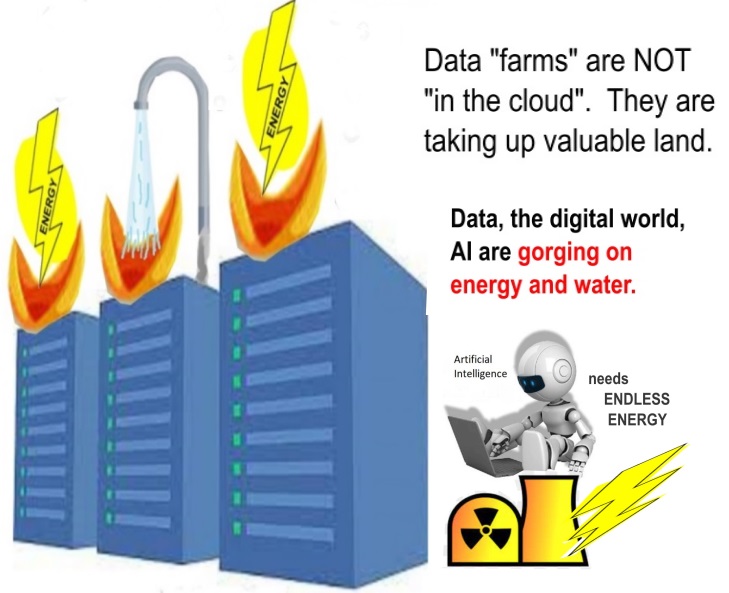
Rising electricity consumption by Ireland’s insatiable data centres has prompted
the government to do something that has been unthinkable for decades:
reignite a debate about nuclear power.
Data centres account for nearly a
quarter of all electricity used in Ireland — a share set to rise to at
least 30 per cent by 2032. Their consumption grew 10 per cent last year
from 2024, far outstripping the 2 per cent growth of all other users.
But unlike France and the UK, nuclear power has never been an option in
Ireland. Several high-profile protests beginning in 1978 succeeded in
killing plans for a nuclear plant on the south-east coast. Bans against the
technology since 1999 have ensured things stay that way.
FT 23rd Aug 2026
https://www.ft.com/content/d8279eab-023e-4403-8f0f-b0b64393dcbb
Iranian cyberattack on power plant was a ‘warning shot’.
Hackers prompted fresh fears of Tehran’s appetite and capacity to target Britain’s critical infrastructure
A cyberattack that shut down a small power facility in the UK last month
has been described by security officials as a “warning shot” by Iran
that sent a message about its ability to attack critical British national
infrastructure.
Hackers affiliated with the Iranian regime were behind the
attack at an undisclosed power plant, which disabled it for four days. The
incident was reported to the National Cyber Security Centre (NCSC), an arm
of GCHQ, but it did not receive any reports of power cuts in relation to
the cyberattack.
A government source told the Sunday Telegraph: “We have
thresholds for important generators to legally notify us of cyber activity,
and this site is nowhere near. It’s a very small-scale site, less than a
rounding error compared to grid capacity.” However, it has prompted fresh
fears of Iran’s appetite and capacity to target Britain’s critical
infrastructure.
Times 23rd Aug 2026,
https://www.thetimes.com/uk/politics/article/iran-hackers-cyberattack-shut-down-power-plant-5gtvs09dk
Deprived at Sea: The Tribulations of the USS Abraham Lincoln
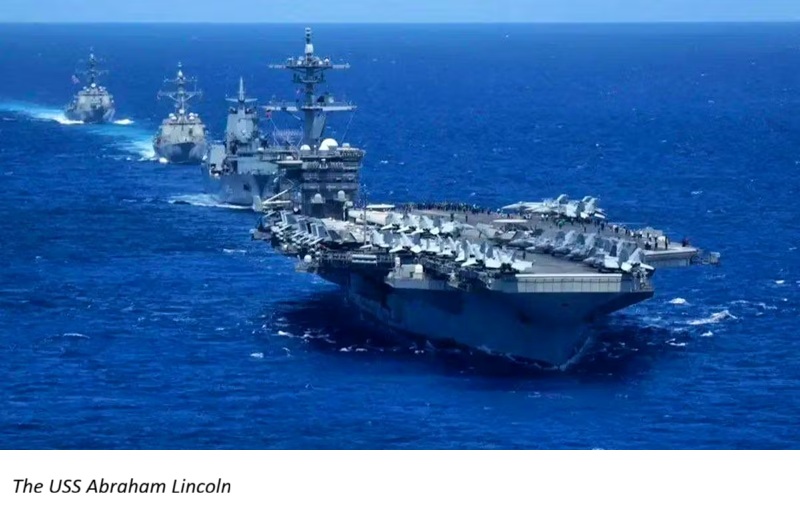
25 August 2026 Dr Binoy Kampmark, https://theaimn.net/deprived-at-sea-the-tribulations-of-the-uss-abraham-lincoln/
The conflict with Iran continues to deliver its mean shocks to an increasingly doddering US imperium. Depleted munitions, depleted stocks of goodwill and, it would seem, a disruption in resupplying warships operating in the Middle East, have become dents in a struggling war machine.
This month, the aircraft carrier USS Abraham Lincoln, lengthily stationed in the Arabian Sea, caught the attention of naval observers with reports of mental distress and sheer desperation on the part of members of the 5,000-strong crew of sailors and Marines. Personnel had endured a nine-month deployment – a record – having made only one stop in Guam in mid-December since leaving San Diego. (The previous record had been set by the USS Dwight D. Eisenhower in a stint lasting 206 days during the COVID-19 pandemic.) Shortages of fresh food and necessaries, the presence of contaminated water, broken latrines, plumbing problems, disruptions in the mail system and exhaustion were just some of the things noted. On August 12, the Navy Times revealed instances where individual crew members had tried to jump overboard. Similar details were also reported in Stars and Stripes.
Meetings between concerned family members and acting Secretary of the Navy Hung Cao were convened earlier in the month regarding the crisis. At one virtual town hall meeting Vice Admiral Joseph Cahill, commander of Naval Surface Forces, conceded the strain placed on sailors and their families. “We hear you loud and clear [regarding] the impact this has on families, on service members and the long-term ability of us to stand, sustain our forces’ health.” He outlined an approach involving counsellors and chaplains, linked with “Command Resilience Team Human Factors Councils,” a jabberwocky designation intended to cover, according to Navy policy, “human factors that impact the wellness of individuals within the command and identify primary prevention efforts to reduce relevant risks(s).” This involved, Cahill elaborated with little assuredness, “the unit understanding and sitting down with sailors individually with their Human Factors Councils and having a conversation about where they’re at in the moment in time.”
Other vicissitudes were given the managerial heave-ho. The blocking of toilets in parts of the ship had arisen because of a “stubborn clog” (seemingly an understatement), though these had been addressed by the sailors over time. Mould that had been detected in the showers was also in hand, with industrial hygienists used to test the bathrooms to ensure the adequate functioning of fans and the flow of air.
The reason for the punishing spell lay in yet another unforeseen aspect of the war with Tehran: its ability to strike at logistics hubs in the Gulf region. Most critically, Iran successfully struck Naval Support Activity Bahrain in Manama, headquarters of the US Navy’s Fifth Fleet in the opening days of battle. Over a dozen buildings, two AN/GSC-52B satellite communications terminals, and a communications facility, were destroyed. In June, the Wall Street Journal noted that US officials had begun “reevaluating” the American footprint in the region as a result of the damage inflicted on the country’s “sole naval base in the Middle East – along with hits to at least 20 US sites across the region.”
The pressing threat of Iranian threats on other ports in the Gulf region necessitated the decision by the Pentagon to scour for other more distant supply options. Diego Garcia, the joint US-UK facility located to the south of the Maldives, became an option. This redeployment certainly caught the interest of Tehran, given an attempted strike on the island with ballistic missiles on March 20.
Shifting focus to Diego Garcia away from Bahrain precipitated its fair share of headaches. “When Bahrain was no longer a port for logistics, food and mail,” reasoned Vice Admiral Douglas Verissimo to attendees at the townhall meeting, “all of the gear that was there when the shooting started got stuck there.” This presented “an initial very large backlog” and “also caused us to, under very contested logistics, very difficult and long supply lines.” Priorities had to be sorted: first, food, followed by important items for the ship’s store, such as toothpaste and shampoo, then the supply of mail. Ensuring a fresh supply of fresh food was problematic, given spoliation on route.
Never one to let bad news inconvenience him, President Donald Trump seemed untroubled. In remarks to reporters on the matter, the increasingly detached chief magistrate of the Republic felt that the deployment had not gone on for “nearly long enough.” He had also been reassured by an unnamed retired admiral that the Lincoln was “beautifully maintained and beautifully taken care of.” Acting Secretary Cao had also mangled matters in his August 14 statement, declaring with evident irritation that “our force and their families are not victims. They are the epitome of American strength and resilience.” Irresponsible members of the media, however, had tried “to paint our warriors as victims. Not only is that dishonest but it takes away from the focus on the enemy and the threat it poses against our nation, people, and the way of life.” Rather than conceding how serious matters were on the Lincoln, Cao simply referenced a negligible number of “mental health cases” that had been treated with no loss of life and claimed that meals had merely been adjusted to cope with the lack of fresh supplies.” Calls made to family members of the crew “were limited when the operational threat was too high.”
On August 22, crew members of the Lincoln finally received news of a scheduled port call, with a possible planned rest and recreation stop in Thailand come early September. “The ship,” announced Senator Jack Reed, the top-ranking Democrat on the Armed Service Committee, “is scheduled to return to its homeport in coming weeks.” The Japan-based carrier USS George Washington is the intended replacement. Its mission will be as misguided and cloudy as the vessel it has replaced.
Cabinet Office declines to share information it holds about PM’s nuke orders options
Tom Pashby, Aug 26, 2026, https://tompashby.substack.com/p/cabinet-office-declines-to-share?utm_source=post-email-title&publication_id=6735486&post_id=212821041&utm_campaign=email-post-title&isFreemail=true&r=ln98x&triedRedirect=true&utm_medium=email
The Cabinet Office has confirmed to 20 Working Days that it holds information regarding what options the Prime Minister has in terms of the orders they can give to nuclear-armed submarine captains in their ‘Letters of last resort’, but said it is withholding the information.
It is widely understood that one of the first tasks a Prime Minister has on walking through the door to Number 10 Downing Street is writing the letters to the captains of Trident submarines – the UK’s continuous-at-sea-deterrent.
The letters are written so that, if communications are not possible between the submarine and the wider military and political command and control structure, the submarine captains are able to find out what they should do by reading the pre-written letters which are believed to be sealed until they are needed.
The existence of the letters was confirmed by the MOD in an internal review of a FOI request in 2015. The results of the internal review were addressed to a Mr D Black.
In 2016, just before Theresa May took over the role from David Cameron, the Guardian reported: “The options are said to include the orders “Put yourself under the command of the US, if it is still there”; “Go to Australia”; “Retaliate”; or “Use your own judgment”.”
On 4 July 2026, using the FOI Act, 20 Working Days asked the MOD to share “any documents which show whether the options include the orders ‘Put yourself under the command of the US, if it is still there’; ‘Go to Australia’; ‘Retaliate’; or ‘Use your own judgment’,” as per the reporting in the Guardian.
In response, on 16 July, the MOD said: “As the letters are administered by the Cabinet Office, you may wish to approach them regarding […] what options the letters might contain.”
On the same day, 20 Working Days put that question to the Cabinet Office.
On 17 August, the Cabinet Office responded and said: “We are writing to advise you that following a search of our paper and electronic records, we have established that the information you requested is held by the Cabinet Office.
“Information you have requested is exempt under section 24(1) of the Freedom of Information Act. Section 24 exempts information from disclosure if its exemption is required for the purpose of safeguarding national security.”
It added that “Section 24 is a qualified exemption and we have considered whether the balance of the public interest favours releasing or withholding this information”, and confirmed “we have determined that the balance of the public interest favours withholding this Information”.
The Cabinet Office was approached for comment.
Russia builds 15 small marine nuclear reactors with 175-MWt capacity for icebreakers
Russia has built 15 RITM-200 reactor units. Rosatom chief
Alexey Likhachev outlined plans to use these small-scale systems for
broader energy needs during a government meeting on nuclear infrastructure.
He reported that Russian factories have manufactured 15 of these reactors
so far, while workers are building 13 more.
Interesting Engineering 23rd Aug 2026,
https://interestingengineering.com/energy/russia-builds-15-small-marine-reactors
Oil major bets on nuclear fusion becoming its ‘next refinery’
Italian oil major Eni is widening its bet on nuclear fusion, arguing the
technology could become its “next refinery” and aiming to be among the
first energy companies to commercialise fusion in Europe. Francesca
Ferrazza, head of magnetic fusion initiatives at Eni, told the FT that
“competition is growing” in the fusion industry, after the technology
and expectations had changed significantly in the past five to six years.
“It was always considered research. Now we are considering it as an
industry.” Ferrazza said Eni aimed to open a commercial fusion plant in
Europe by the early 2040s or even sooner.
FT 23rd Aug 2026,
https://www.ft.com/content/e6a069b6-69f8-4a21-9873-3cc0736d27e2
1 This Month



Shut down the radiation-damaged Heysham nuclear reactors now
To see nuclear-related stories in greater depth and intensity – go to https://nuclearinformation.wordpress.com

Say No to NASA’s Reckless Nuclear Reactor on the Moon
Say No to NASA’s Reckless Nuclear Reactor on the Moon
-
Archives
- October 2026 (247)
- September 2026 (339)
- August 2026 (330)
- July 2026 (355)
- June 2026 (287)
- May 2026 (306)
- April 2026 (356)
- March 2026 (251)
- February 2026 (267)
- January 2026 (308)
- December 2025 (358)
- November 2025 (359)
-
Categories
- 1
- 1 NUCLEAR ISSUES
- business and costs
- climate change
- culture and arts
- ENERGY
- environment
- health
- history
- indigenous issues
- Legal
- marketing of nuclear
- media
- opposition to nuclear
- PERSONAL STORIES
- politics
- politics international
- Religion and ethics
- safety
- secrets,lies and civil liberties
- spinbuster
- technology
- Uranium
- wastes
- weapons and war
- Women
- 2 WORLD
- ACTION
- AFRICA
- Atrocities
- AUSTRALIA
- Christina's notes
- Christina's themes
- culture and arts
- Events
- Fuk 2022
- Fuk 2023
- Fukushima 2017
- Fukushima 2018
- fukushima 2019
- Fukushima 2020
- Fukushima 2021
- general
- global warming
- Humour (God we need it)
- Nuclear
- RARE EARTHS
- Reference
- resources – print
- Resources -audiovicual
- Weekly Newsletter
- World
- World Nuclear
- YouTube
-
RSS
Entries RSS
Comments RSS

