EDF exploring sale of stakes in modular reactor subsidiary Nuward


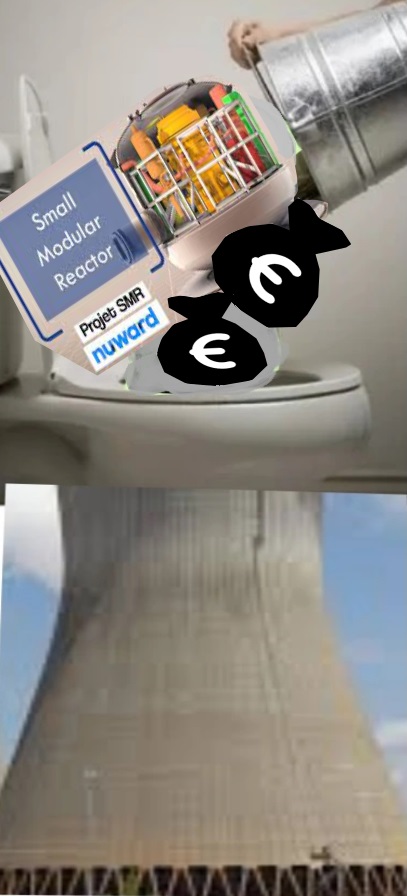
French nuclear rnergy group looking to sell down holding in Nuward to lock in clients and fund development. French nuclear energy group
EDF is seeking investment
partners in Europe to help fund its small reactor venture as it looks to
make up ground against Rolls-Royce and dozens of smaller start-ups
globally. The fundraising effort could also bring in potential buyers of
the small modular reactor technology to lock them in as clients.
The state-owned company, which runs Europe’s biggest fleet of 57 large-scale
reactors in France, is finalising a second SMR design through its Nuward
subsidiary after abandoning a first effort that was too complicated two
years ago.
It now wanted to press ahead with a commercial launch of the
Nuward SMR from 2029, and would seek board approval for those plans on
Thursday, three people familiar with the matter said. EDF was also working
to bring new investors into the subsidiary, two of the people added,
potentially leaving the utility as a minority holder of Nuward. Interested
parties could include countries such as Belgium, Finland and Poland that
already have or are building nuclear plants, and others which do not rely
on the technology, such as Greece or Italy, they added.
FT 30th July 2026, https://www.ft.com/content/34d2542b-8818-4d51-b934-e3baabebf93d
Ontario touts small nuclear reactors with $500,000 for Haldimand County.
Ontario Takes Next Step Toward New Energy Generation in Haldimand County
July 29, 2026
Ministry of Energy and Mines
HALDIMAND COUNTY — As part of its plan to protect Ontario and build a stronger, self-reliant economy, the government is announcing that Haldimand County will receive $500,000 from Ontario Power Generation (OPG) in growth readiness funding to explore opportunities for new energy generation, including small modular reactors, at OPG’s Nanticoke site……. “Our government has a vision to generate power and jobs across Haldimand County by planning for new energy generation that fully unlocks the region’s full potential. To meet electricity demand that is forecast to increase by as much as 90 per cent by 2050, we are planning ahead and building for future generations. We are taking another step forward to advance this project, in true partnership, including seriously considering small modular reactor deployment, to revitalize the economy and workforce.” |
“Small” nuclear reactors for Hartlepool? ONLY THEY ARE NOT SMALL

COMMENT. SMALL nuclear reactors are those providing less that 300MW.
This Hartlepool plan plan is for 12 reactors providing 960 MW
X-energy Advanced Nuclear Reactor plan for Hartlepool
28th July , By Gavin Engelbrecht, https://www.thenorthernecho.co.uk/news/26408533.x-energy-xe-100-advanced-nuclear-reactor-hartlepool/
A leading developer of advanced nuclear reactors, who is targeting a site in Hartlepool, recently took a big step forward by starting the Design Assessment process for its Xe-100 reactor.
The move marks a significant milestone in X-energy and Centrica’s efforts to deploy up to 6 GW of new nuclear in the United Kingdom.
X-energy has been in active dialogue with UK regulatory authorities since 2024, and the company’s latest submission builds on its U.S. licensing progress.
It has now officially submitted its Xe-100 advanced nuclear reactor to the critical, formal regulatory pathway required to license new nuclear technologies in the UK.
In partnership with Centrica, Hartlepool remains the preferred first site for a 12-unit (960 MWe) power plant.
The first project alone is estimated to bring thousands of high-quality, long-term jobs to the local area where needs are greatest.
The regulatory assessment – administered by the Office for Nuclear Regulation (ONR) and the Environment Agency – is expected to conclude by the end of 2029, keeping the project on track for deployment.
“Advanced Modular Reactors like the Xe-100 are the cornerstone of Britain’s future energy security, and would bring clean, reliable power as well as renewed opportunities for British industry,” said Alistair Black, Vice President and UK Market Lead at X-energy.
“We welcome the Regulators’ recent steps towards a more efficient GDA process, and look forward to working collaboratively to support an efficient, thorough review.
“GDA submission marks an important milestone in bringing our technology to the UK on a fleet-scale, with the potential to create thousands of high-quality jobs where needs are greatest.”
The Xe-100 is an 80 MWe HTGR deployed in four-or-twelve-unit plants, capable of providing both electricity, and high-temperature heat and steam for industrial applications.
In September 2025, X-energy and Centrica signed a Joint Development Agreement for the UK’s first advanced nuclear fleet, targeting 6 GW nationwide with Hartlepool identified as the preferred first site for a 12-unit/960 MWe Xe-100 plant.
That project is currently advancing through the UK Government’s Advanced Nuclear Pipeline assessment.
The nasty truth about Small Nuclear Reactors’ toxic fuel and toxic wastes
27 July 2026, https://theaimn.net/the-nasty-truth-about-small-nuclear-reactors-toxic-fuel-and-toxic-wastes/
A lot of enthusiastic guff goes on about the joys of Small Modular Nuclear Reactors (SMRs). They don’t say much about the fuels that SMRs require. So – just for fun, let’s take a look at that. Let’s pretend, for the moment, that SMRs actually exist, and that they are privately funded, cheap, clean, safe, and welcomed by local communities. So – that’s all good.
Now – what about their fuel?
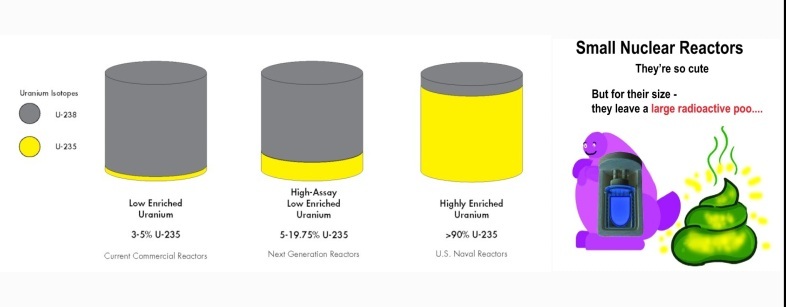
They don’t need as much, or perhaps ANY dirty uranium mining. Ain’t that great? Well some designs (eg, the Westinghouse evinci micro reactor) do use low-enriched uranium (LEU) which contains less than 20% of uranium-235 (U-235). Such LEU SMRs have a shorter expected life, and because of their graphite content have a high volume of wastes. So now the emphasis is on a new kind of fuel – high-assay low-enriched uranium (HALEU): 5–20% U-235 and/or plutonium.
For a non-physicist such as myself, trying to navigate the labyrinth of information on nuclear fuels is a daunting task. And I’m sure that the nuclear lobby intends to keep it that way. They’ve traded for decades on the principle that the great unwashed cannot and should not understand nuclear power, and that only nuclear physicists are qualified to have an opinion on this. (No wonder they vilified Dr Helen Caldicott, who described nuclear power as “an expensive way to boil water”).
What makes it all more complicated is the variety of SMR designs, and of the fuel types now being planned, generally to use the HALEU or mixed uranium-plutonium. This means that the SMR company has to get these advanced fuels from somewhere more special than the conventional uranium fuel train. But who supplies the world’s highly enriched uranium? Omigawd – it’s Russia! So that fact has caused a bit of a panic. The U.S, government’s Department of Energy has now selected 11 advanced reactor designs under its Reactor Pilot Program, most of them to. run on HALEU. As Peter McKillop of the Energy Mix says:
“… here lies the problem. By embracing HALEU, the DOE is effectively jump‑starting an international HALEU market and expanding the global circulation of material that can shorten the path to a bomb.”
The required plutonium has to come from recycling the spent nuclear fuel from large nuclear reactors. Of course the nuke lobby boasts that this solves the nuclear waste problem – what was previously called “trash” now becomes a “resource” and a nuclear waste solution. More about that later on.
The fuel needs of SMRs raise not only the weapons proliferation problem: they bring the risks of radiation-releasing accidents, theft, terrorism, and consequently the need for extra security and extra costs.
What about the radioactive wastes?
The nuclear lobby is rather coy on this subject. When their propagandists are talking to us, the great unwashed, they tell a comforting and optimistic story. You see, SMRs produce a very small volume of radioactive wastes, and even that can be recycled to be used again, leaving an even smaller volume. So SMRs are not only themselves clean, but they are a benefit to humanity, solving the existing nuclear waste problem.
SMR propagandists don’t bother our poor little heads with the technical details. That’s because the technical details tell quite a different story. Stanford-led research finds small modular reactors will exacerbate challengesof highly radioactive nuclear waste. Proceedings of the National Academy of Sciences “Our results show that most small modular reactor designs will actually increase the volume of nuclear waste in need of management and disposal, by factors of 2 to 30.
SMRs will produce more voluminous and chemically/physically reactive waste than LWRs, which will impact options for the management and disposal of this waste. The very high toxicity of these wastes mean that the spent fuel pellets will require a larger area in deep disposal than those from conventional reactors. SMR waste streams will bear significant (radio)chemical differences from those of existing reactors. “Molten salt and sodium-cooled SMRs will use highly corrosive and pyrophoric fuels and coolants that, following irradiation, will become highly radioactive.”
No wonder the current push for SMRs does not emphasise that fraudulent story about wastes. For ordinary people it is probably the really ugliest and most off-putting aspect of any presentation of the wonders of small modular nuclear reactors.
Canada remains anti-nuke, but its potential path to the bomb is getting shorter.
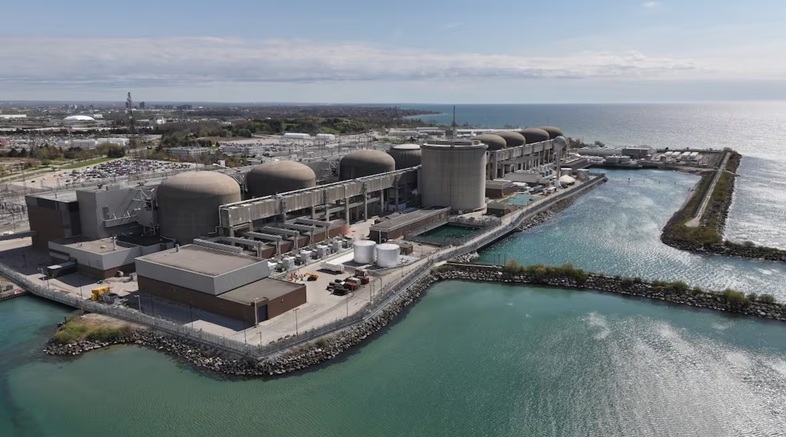
This country has all the elements needed for a clandestine nuclear weapons program — if it so desired
Evan Dyer · CBC News · Jul 26, 2026, https://www.cbc.ca/news/politics/canada-remains-antinuke-road-to-bomb-getting-shorter-9.7283194
For decades, Canada’s official policy on nuclear weapons has been that they shouldn’t exist, and there is no sign that principle is about to be abandoned.
But for reasons of history and geography, Canada is also one of the world’s non-nuclear countries with the easiest technical path to a nuclear weapon. And because of the particular design of its CANDU reactors, it would also be one of the countries best-positioned to produce weapons-grade fissile material without tripping international alerts — although such a move would carry huge geopolitical risks.
Technological changes that are expected in the coming years will likely make Canada even more of a threshold nuclear arms power than it is today, whether it chooses to cross that threshold or not.
“The only thing that inhibits Canada is the will to do it, the political decision to do it,” said nuclear weapons expert Steve Fetter of the University of Maryland, who served as head of national security and international affairs in the White House Office of Science and Technology Policy.
He’s also a member of the National Academy of Sciences Committee on International Security and Arms Control, and the originator of the “Fetter Model,” the standard technique used in arms control verification for detecting the presence of nuclear warheads through radiography.
“Canada was a major participant in the Manhattan Project, as was the U.K.,” Fetter told CBC News. “Immediately after the [Second World War], we froze you out and said, ‘No co-operation.’ So Canada decided — as did the U.K. — to develop its own completely indigenous program.”
The heavy water route
The U.K., of course, went on to become a nuclear arms power, while Canada did not.
Canada designed the CANDU heavy water reactors that use unenriched, natural uranium containing only about 0.7 per cent of the U-235 isotope needed to make nuclear weapons. Most of the world’s 440-odd nuclear reactors are light water units that require uranium enriched to about four per cent U-235 content.
For this reason, and despite being the world’s second-biggest producer of uranium, Canada has never enriched domestically.
However, the CANDU is anything but a proliferation-proof technology, because it is not only the best kind of reactor for producing the plutonium-239 isotope used in bombs, but also for concealing its production.
“You do produce plutonium in a light water reactor,” said Fetter. “But that plutonium is contained in highly radioactive spent fuel and it’s not really high-quality.”
Light water reactors work by loading enriched uranium, sealing the reactor core and then running it for 18-24 months before shutting down, reopening the core and replacing fuel. This makes it relatively easy to keep track of how much fuel is going in, and what is happening to the spent fuel that comes out. It’s impossible to secretly swap fuel rods while the reactor is generating power.
The Canadian heavy water reactor doesn’t work that way.
Harder to monitor
“All uranium-fuelled reactors produce plutonium. The issue with the CANDU is that it has online refuelling,” explained Ed Lyman, director of nuclear safety for the Union of Concerned Scientists in Washington, D.C. “You’re refuelling continuously, which makes it harder for the IAEA [International Atomic Energy Agency].”
Canada, which produces all of its own uranium, would be in a strong position to divert fissionable material undetected if so inclined, say the experts.
The plutonium produced in a heavy water reactor is also much easier to turn into a nuclear weapon, said Fetter.
“Of the countries that have made nuclear weapons with plutonium, many of them have used a heavy water reactor,” he said.
That’s why India used a Canadian heavy water reactor to produce its first nuclear weapon in 1974, an all-plutonium implosion-type bomb. The “Smiling Buddha” test was the first to break the nuclear monopoly of the “Big Five” UN Security Council powers.
Fetter said the U.S. had heavy water reactors only for the purpose of producing plutonium and tritium. (Tritium, also produced in abundance by the CANDU reactor, is another critical component of a modern two-stage thermonuclear weapon that Canada has in abundance.)
Using riskier fuels
Canada is also branching out into a new kind of technology that will require enriched uranium: the small modular reactor (SMR). Some of the proposed SMRs would use uranium enriched to a level as high as 20 per cent, known as high-assay low-enriched uranium (HALEU).
HALEU is already a proliferation concern in itself, said Lyman.
“Anything below 20 per cent is considered low-enriched uranium and has a much lower level of oversight. The IAEA considers it indirect-use material you can’t directly use in a bomb,” he explained. “But there’s evidence, both historical and technical, that that’s not true, and that the actual cutoff for weapon-usable uranium is below 20 per cent. Could be 15 per cent, could be 10 per cent.
“And so I worry about this push for advanced reactors, SMRs that use HALEU up near 20 per cent, like the ARC 100 in Canada, that the material itself is in the dangerous band. And if Canada were to pursue a whole fleet of SMRs using HALEU, and especially if they were to build their own enrichment plants to support that, that might give them a threshold capability for bombs, even if they never make highly enriched [over 20 per cent] uranium.”
ARC Canada points out that its proposed reactor in New Brunswick, which would become the only commercial fast-breeder reactor in the world outside Russia, mitigates against proliferation risks by having a long fuel cycle with a core that stays sealed for 20 years.
But there’s another factor: The arrival of SMRs that consume enriched uranium has got the government of Canada thinking about enrichment.
To enrich or not to enrich
“Any country which has a complete fuel cycle is a latent nuclear weapons country, in the sense that it is not far from making a nuclear weapon,” said former IAEA director and Nobel Peace Prize laureate Mohamed ElBaradei.
Scientists consulted by CBC News said Canada would probably have little economic motive to build its own enrichment facilities. Canada’s nuclear energy strategy foresees importation of enriched uranium from France and the U.S. in the immediate future, even though that often means buying back Canadian-mined uranium after other countries have added value.
But the strategy also notes that “geopolitical volatility has exposed fragility in nuclear fuel supply chains at every stage — mining, milling, refining, conversion, enrichment, and fabrication.”
Canada plans to double its exports of uranium in raw form, “but there is also a compelling case for expanding downstream capabilities selectively.”
Domestic enrichment might not save Canada money, but would increase its strategic autonomy.
“Canada will continue to monitor the energy security implications of these supply chains,” says the strategy. “The longer-term question of whether Canada should develop domestic enrichment capability remains under assessment.”
Enrichment could get easier
A handful of non-nuclear arms powers have developed enrichment facilities. They include Brazil, Japan, Argentina, Germany and the Netherlands, but only Brazil combines a modern centrifuge facility with a large domestic supply of uranium.
Japan could theoretically produce weapons-grade uranium, but its nuclear technology, like South Korea’s, is largely American, its nuclear program is subject to strict inspections, and it has no uranium mines of its own — in fact it buys much of its supply from Canada.
A Canadian company, Cameco, is currently exploring the next frontier of uranium enrichment. The SILEX method uses laser excitation to separate U-235 more quickly and efficiently than spinning it in a centrifuge.
Already, a centrifuge facility can fit in an area the size of a high school gym. SILEX, said Fetter, “potentially could be even smaller and use less energy than centrifuge enrichment, which would make it harder to detect a clandestine facility.”
The SILEX project has already received U.S. government funding and acquired land in western Kentucky for a plant expected to be operating by 2030.
Crossing the threshold
For all the Carney government’s talk of “a more dangerous and divided world,” there is still no public signal that Canada might abandon its long-held opposition to nuclear arms.
If the strategic situation were to change, Canada would have to decide whether to go the open route and formally depart the Treaty on the Non-Proliferation of Nuclear Weapons (NPT), or pursue nuclear arms through a clandestine program as other countries have done with a mixed record of success.
Plasma physicist Tara Drozdenko worked on nuclear weapons issues under the administrations of Barack Obama and George W. Bush. She represented the United States on NATO’s Senior Group on Proliferation, and headed the Country/Regime Sanctions Unit at the U.S. Department of Treasury, where she managed the government’s nuclear-related sanctions on countries such as Iran and North Korea.
Today, she’s not sure Washington remains committed to preventing proliferation, or how it would react to a Canadian decision to leave the NPT.
“In a normal administration, there would be condemnation, there would be reproach, there would be a lot of diplomatic efforts,” she told CBC News. “I don’t know what would happen in this administration. Would there be threats? Would there be some people that are like, yeah, everybody should have nuclear weapons? I really can’t predict what this particular administration would do.”
Clandestine plants and secret programs
So far, all the countries that have developed nuclear weapons — Israel, South Africa, India, Pakistan and North Korea — began their efforts in secret.
Drozdenko says Canada’s own nuclear industry, the design of its reactors and the fact that it has the world’s best uranium deposits would all give it a strong hand were it ever to pursue such a risky course.
“Canada is probably really well-positioned to do that, if Canada was determined,” said Drozdenko. “You have a lot of land that’s not heavily populated, and if you used technologies that didn’t have a lot of energy or thermal signature, I don’t think the U.S. has its intelligence assets pointed at Canada right now.”
At some point, such a program would inevitably become known.
“It would require withdrawal from the non-proliferation treaty, which would be really impactful to the treaty worldwide, especially as a NATO country and up until now a pretty close ally of the U.S. I think that would be pretty catastrophic to that treaty,” Drozdenko said.
Fetter said Canada could probably easily assemble a simple “gun-type” nuclear weapon like the one used on Hiroshima, but would face scientific hurdles if it tried to build a modern thermonuclear weapon without conducting tests. North Korea required half a dozen tests to get there.
In the U.S., Russia and China, supercomputers today have replaced actual testing. Canada has the computing capacity but lacks the detailed data that nuclear arms powers have assembled on materials science, and the complicated timing and interactions inside a nuclear warhead — some of the most closely guarded secrets in the world.
But Fetter also said he didn’t expect North Korea to be able to put a modern, two-stage thermonuclear warhead on a ballistic missile and make it work.
“Canada has a lot of smart people,” he noted.
With Canada embarked on a new era of greater military spending, including the purchase of modern submarines and its first foray into the world of cruise missiles, it is clearly assembling elements that could bring it closer to “breakout” as a nuclear arms power, if it desired.
The question of how other countries would react is the unknowable factor, said Drozdenko.
“Does Canada want to be in the position of North Korea, the pariah state that’s making clandestine nuclear weapons?” she asked.
So far, the answer has always been no.
A mad for nuclear world?
July 25, 2026, https://renewextraweekly.blogspot.com/2026/07/a-mad-for-nuclear-world.html
While renewables are being supported in the UK by private sector investment, most recently via the Contracts for Difference market system, with no direct government cash input, over 70% of the UK Department of Energy Security and Net Zero expenditure is now nuclear related. DESNZ’s annual report and accounts says that ‘Great British Energy – Nuclear has remained a key component of the Government’s approach to energy security and decarbonisation, with work continuing to support the delivery of new nuclear projects, providing greater certainty for industry and investors, supporting highly skilled jobs across the supply chain, and contributing to a resilient, low carbon energy mix’.
It notes that through the Spending Review the department secured a capital settlement of £62.8bn from 2025-26 to 2029-30 and a resource settlement of £5.8bn from 2026-27 to 2028-29, including £8.3bn for GBE/GBE-Nuclear including SMRs and £14.2bn for the new Sizewell C European Pressurised-water Reactor.
However, the theory is that this government support will attract private sector investment, for example for new Small Modular Reactors (SMRs). The government has put aside £2.5 bn for its SMR programme, to be led by Rolls Royce, but there are signs of entrepreneurial interests, with SGE, a consortium led by Polish billionaire industrialist Michał Sołowow talking about a £35bn plan to build 14 GE/Hitachi Boiling Water SMRs, on three sites across the UK, possibly including on the former Olbury nuclear plant site.

There have also been some UK government backed moves by US developers for SMR projects in the UK, including from X Energy, Holtec and TerraPower, but not everyone is convinced that any of them will be successful, certainly not soon, or sees the wider UK nuclear programme, including the big Sizewell project, as value for money, especially given that there are security risks. Will anyone want SMRs near them given the safety and security issues? The UK government has been revamping the planning system to make it easier for projects like this to go ahead, but local opposition is still likely. In particular, Labour ministers in London have been slammed for identifying sites in Scotland for nuclear power plants despite the devolved Scottish Government’s ongoing opposition to new nuclear developments. Very provocative, especially given that Scotland often produces more green power than it needs and exports the rest south…
However, the big UK push to nuclear continues, with some odd twists. For example, enriched uranium is to be produced by UK based Urenco for use by Ukraine in its nuclear plants. This at a time when the US is making strenuous efforts to stop Iran from developing and using uranium enrichment technology. But then consistency is often not very apparent in nuclear policy around the world. For example the US is, it seems, keen to allow Saudi Arabia to enrich uranium. Meanwhile the UK is still importing enriched fuel for Sizewell B derived from Russia. While its claimed that this is only a temporary aberration (the UK is to build its own new specialist enrichment plant), some contrarian outliers see Russia as the EU’s best supplier!

Will any of this help us deal with climate change? Not everyone is convinced that it will -based on past experience, we may need to be wary of nuclear hype. It is interesting then to look at what is happening in China. An Australian review noted that China has been installing ‘record amounts of solar and wind, while scaling back once-ambitious plans for nuclear’. Based on 2024 data, it said that China had installed the wind & solar equivalent of 5 large nuclear plants per week, although, in output terms, that was more like 1 nuclear power equivalent, given the different capacity factors. But the disparity in outputs has grown since 2024, with renewables roaring ahead as the favoured new energy option.
By comparison, the USA is stalling on renewables and trying to push nuclear ahead as fast as possible, with US energy secretary Jennifer Granholm calling for ‘hundreds’ of new large plants by 2050. Not everyone is convinced that this is possible, even with the new US loan scheme, but the Trump government is obviously keen and is pushing for reduced worker and public radiation exposure standards to help, with the Nuclear Regulatory Commission (NRC) seemingly being compliant on this and other related issues. Clearly some see NRC reg. changes as being vital for the success of multiple SMRs. And, following a court ruling, it seems that NRC may no longer need to take account of climate issues in plant licensing decisions. This at a time when nuclear plants in Europe are having to be shut down due to heat waves…
So, with shifts like that underway, how is it likely to go in the USA? It’s not clear if any big new projects will go ahead, but there are a lot of new SMR players entering the game, and some progress has been made, for example with a go ahead on some micro SMR safety test programmes. However, it is very early days with SMRs and big technical and economic uncertainties remain. That’s true for new nuclear generally, a view that seems to be shared quite widely, as was summed up well in a recent letter in Lancet, which ended by calling for the focus to be on renewables instead. Quite so, along with storage and smart demand management…But then there are evidently people who think differently, for example in Germany and Japan, in relation to reactor restarts, although that risks opening up old issues, not least, where to put the active wastes. Do we really need to face all that again?
* Back in the UK, there has been no word yet on the nuclear issue from the new Labour Cabinet. Andy Burham has been supportive of nuclear in the past. Miatta Fahnbulleh, his new secretary of state for energy security and net-zero, is seen as likely to be a strong supporter of Labours clean energy and decarbonisation strategy. But she was chair of the New Economics Foundation which has been consistently anti-nuclear. So things may yet change. As I argued in my last post, there is certainly a strong case for a rethink on new nuclear.
Approval for VVER uranium/plutonium fuel production in Germany

VVER-440 fuel. A mixture of enriched uranium with RECYCLED URANIUM and PLUTONIUM received from the used nuclear fuel of other VVER reactors is used instead of a standard enriched uranium.
Friday, 24 July 2026,
https://www.world-nuclear-news.org/articles/approval-for-vver-fuel-production-in-germany
The Lower Saxony Ministry for the Environment, Energy and Climate Protection, acting on behalf of the federal government, has approved an application from Framatome subsidiary Advanced Nuclear Fuels to expand its facility in Lingen for the production of fuel for VVER-1000 reactors. The approval is subject to strict conditions.
Framatome subsidiary Advanced Nuclear Fuels (ANF) applied in March 2022 under the Atomic Energy Act for permission to begin producing hexagonal pressurised water fuel elements under licence with TVEL, the fuel arm of Russian state nuclear corporation Rosatom. The fuel elements are to be manufactured using Russian licences and Russian technology in a joint venture with TVEL for the Eastern European market. The licence application includes some changes to some manufacturing and testing equipment and the installation of some additional equipment in existing buildings to enable the manufacture of VVER fuel elements.
The federal government had already clarified in a supervisory letter to the state that, given the current assessment by federal security authorities regarding the risk of sabotage or espionage, there was no legal basis for denying the permit.
The Lower Saxony Ministry for the Environment, Energy and Climate Protection has now announced that it has approved ANF’s application, subject to a number of conditions, as “after intensive review and inquiries, [it] had no legal grounds under the Atomic Energy Act to reject or limit the application”. The restrictions it has imposed include a general ban on entry to the facility for employees of TVEL or Rosatom, as well as persons authorised by them. Entry is only permitted in very limited cases and under the supervision of the regulatory authority.
In addition, the ministry said the hardware and software of the TVEL-licensed machines must undergo external security audits, and these machines must be data-integrated with the rest of the fuel element factory’s operational technology and information technology infrastructure. Also, the finished gadolinium fuel rods arriving from Russia must be 100% inspected for potential tampering using active and passive scanners according to the ‘four-eyes’ principle. Furthermore, ANF employees must receive regular training and awareness programmes to protect against espionage and sabotage.
Lower Saxony’s environment ministry said the approval could be revisited “if new risks are identified”, particularly in “national security”, Euractiv reported.
ANF was created in 1975 and currently employs around 400 people in Lingen. ANF fabricates fuel rods and assemblies for pressurised water reactors and boiling water reactors for customers worldwide.
In recent years, especially since the war with Ukraine began, nuclear power operators in European Union countries who had previously relied on Russian-supplied fuel have sought alternative suppliers. Nineteen VVER reactors – developed during the time of the Soviet Union and historically reliant on Russian fuel supplies – are currently in operation in the EU, including four VVER-1000 reactors in Bulgaria and the Czech Republic, and 15 VVER-440 reactors in the Czech Republic, Finland, Hungary and Slovakia.
Framatome has “a dual-track approach” to supplying fuel to VVER reactors in operation in the EU. In the short term, it will fabricate fuel identical to the proven design currently used by the reactors. In parallel, Framatome is developing and qualifying European sovereign fuels of its own design for VVER-440 and VVER-1000 reactors. The qualification of a new design requires several years within the framework of regulatory and usual certification practices, Framatome notes.
Framatome had planned to produce both VVER-1000 and VVER-440 fuel under licence from and as part of a joint venture with Rosatom at its subsidiary Advanced Nuclear Fuels in Lingen. However, it was recently reported that Framatome has now decided to produce the VVER-440 fuel at its Romans-sur-Isere fuel production site in south-east France. The company expects to submit a request to the French nuclear regulator, the Autorite de Surete Nucleaire et de Radioprotection, by the end of 2026 for approval of the changes needed at the French plant for the production of VVER-440 fuel.
Campaign steps up opposition to south Wales nuclear project
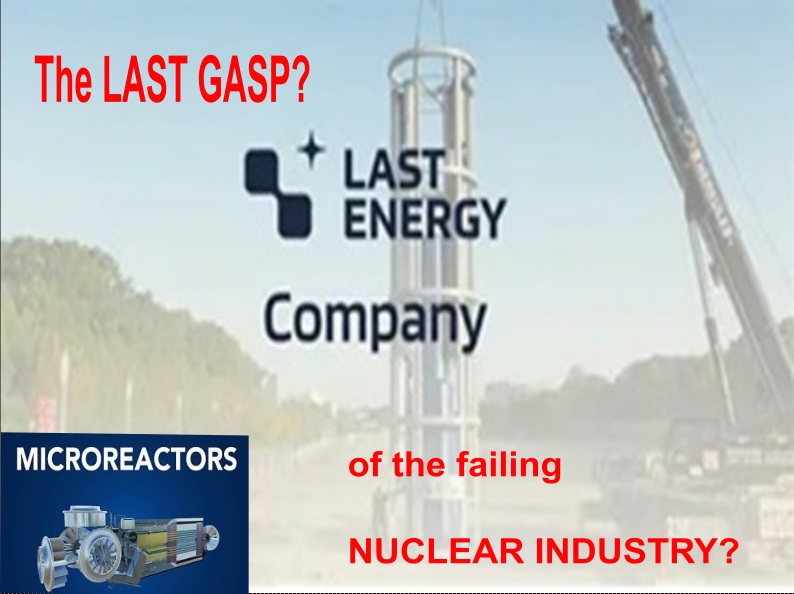
They noted that Last Energy had not yet installed any SMRs anywhere in the world, branding nuclear projects unsafe, unclean, expensive, and unnecessary.
26 Jul 2026, Nation.Cymru Staff, https://nation.cymru/news/campaign-steps-up-opposition-to-south-wales-nuclear-project/
Campaigners have stepped up efforts to oppose plans for a new nuclear power project in a south Wales valley as public consultations come to a close.
Friends of the Earth Cymru is backing a campaign against proposals by micro-reactor company Last Energy to build four small modular nuclear reactors at Cwm Llynfi, near Maesteg.
Last Energy is a commercial developer of micro-modular PWR-20 nuclear power plants headquartered in Washington D.C.
Last Energy UK Limited, the company’s British subsidiary, announced plans to develop the clean energy project in south Wales in October 2024.
Formally titled ‘Prosiect Egni Glan Llynfi’, it is to be built on the 14-acre site of the former Llyfni coal-fired power station which ceased operation in 1977.
“Working to power and decarbonise industry in South Wales”, the company’s proposal includes development of up to four 20-megawatt micro-modular nuclear power plants, “intended to provide electricity to local industrial customers and to be privately financed”.
Last Energy UK intended to provide £300m financing, and expects the project to power 250,000 homes and create around 100 jobs for the local community.
In February 2025, Last Energy UK formally entered the site licensing process for the project, as the first commercial nuclear power reactor to seek licensing since 1978.
Michael Jenner, CEO of Last Energy UK, said that the process was “another critical milestone necessary to unlock nuclear power at scale in the UK, which will help meet growing energy demand and alleviate grid restraints.”
At the time, the company had said it aimed to complete construction on the first micro reactor in Wales by 2027. However, in July 2025 after a Preliminary Design Review by the Office for Nuclear Regulation, it was reported that they do not expect to receive site licensing until December 2027, “if necessary submissions to the required standard” are delivered according to schedule.
Friends of the Earth Cymru, local campaigners and anti-nuclear groups had voiced early opposition to the proposals, arguing the development would have long-term consequences for the environment and surrounding communities
In a May 2025 FoE Cymru blog post, Jenny Lloyd, Local Action and Community Campaigns Officer, supported by anti-nuclear activist Brian Jones, said: “The struggle to protect Wales from the dangers of nuclear is one that has been fought by communities for decades.
“Activists persuaded every county council in Wales to declare themselves “Nuclear Free Zones” in the 80s, marched to Greenham common to protest against the siting of guided nuclear missiles at the RAF base, and rallied against the redevelopment of Wylfa nuclear power station…”
They noted that Last Energy had not yet installed any SMRs anywhere in the world, branding nuclear projects unsafe, unclean, expensive, and unnecessary.
They continued: “If this proposal is allowed to go ahead it threatens our health, our environment and our communities for generations to come.”
In June 2026, Last Energy UK notified Welsh ministers that, in line with the Infrastructure (Wales) Act 2024, it would make an application for a Significant Infrastructure Project.
It said: “The project comprises four PWR-20 modular reactor units with associated plant, substation, buildings, security and access infrastructure.”
They also provided two images to the Welsh Government’s planning portal, one with four reactors, and another with only one reactor and other operational buildings.
The company held four public consultations on the project in Bridgend, Porthcawl, and Maesteg throughout July.
FoE Cymru once again voiced their opposition with grassroots campaign group No Nuclear Llyfni, this time directing supporters to “show that we are against this damaging proposal” and sign a petition ‘No nuclear in Cwm Llynfi’.
Currently at almost 1,500 of 2,000 signatures, the petition via ActionNetwork reiterates that the project is unsafe, unclean, and expensive, adding that “To make a profit, the company aims to mostly sell the energy straight to businesses – we won’t benefit from this energy.”
They affirm that “Our community and our beautiful valley deserve better than this!”
U.S. Prioritizes Small Nuclear Reactors Across Southeast Asia

By Charles Kennedy – Jul 24, 2026, https://oilprice.com/Latest-Energy-News/World-News/US-Prioritizes-Small-Nuclear-Reactors-Across-Southeast-Asia.html
The U.S. has identified cooperation on small modular nuclear reactors (SMRs) as a key priority in its engagement with Southeast Asia as regional electricity demand continues to climb.
Speaking after Secretary of State Marco Rubio attended the ASEAN Foreign Ministers’ Meeting in Manila, U.S. Ambassador to ASEAN Kevin Kim said the administration was in “deep discussions” with several governments in the region over the new technology.
The renewed push for SMRs comes on the heels of the memorandum of understanding signed by the U.S., Japan, and South Korea at the NATO summit on July 7. Under the agreement, the three countries will work together to accelerate the deployment of small modular reactors in third countries, initially across the Indo-Pacific.
While Kim declined to provide specifics on any potential deals, he emphasized that cooperation on SMRs was “an absolute priority for the administration,” adding that the reactors would play “a critical role” in meeting future energy demand.
The comments underscore a broader U.S. strategy to expand its energy footprint in Southeast Asia, with a particular focus on LNG, grid technologies, and small modular reactors. As part of that strategy, the U.S. unveiled a $1.5 billion investment platform in early June to support the build-out of energy security infrastructure in India and Southeast Asia.
Separately, the U.S. outlined several new energy initiatives alongside Rubio’s ASEAN meetings, including a $60 million grant to enable energy sector investment in the Philippines, $17 million in funding to secure critical mineral supply chains across the Mekong region, and $5 million to develop power markets across Cambodia, Laos, Thailand, and Vietnam.
Washington’s latest efforts to expand its energy presence across Southeast Asia reflect the administration’s broader energy agenda: increase LNG exports, advance small modular reactor technology, and secure critical mineral supply chains.
Government gives Canadian Strategic Missions Corporation (CSMC) $4.5M for Micro-Nuclear Technology in Canada’s Arctic

COMMENT CSMC are very adept at getting government funding (no private investors) for an idea. The company CEO has a background in real estate and “making deals.” They already had at least $3.1 million in public funds before this latest grant, which leaves them about …. $1 billion or so short of building a reactor, if indeed they know how to do that.
CSMC awarded $4.5 million through the Government of Canada to accelerate micro-nuclear technology for Canada’s Arctic
Canadian Strategic Missions Corporation (CSMC) is honoured to announce that it is receiving a $4.5 million Government of Canada investment through the Federal Economic Development Agency for Southern Ontario (FedDev Ontario) to advance Canadian-made energy solutions that will secure the North.
This investment is a major milestone that will accelerate the development of CSMC’s micro-nuclear reactor towards detailed design and a fueled demonstration, readying the technology for deployment in Canada’s Arctic. This project represents a critical step toward ensuring Canada can meet its energy and defence needs with sovereign, made-in-Canada solutions.
Daniel Sax, CEO and Founder of CSMC said -“As private industry continues to drive innovation within the nuclear sector CSMC is proud to partner with the Canadian government to accelerate the R&D process. Our goal is to bring promising new technology online faster – in line with peer markets – to ensure that our nation can reinforce its defence capabilities, including in the North.”………………………. https://canadiandefencereview.com/csmc-awarded-4-5m-for-micro-nuclear-technology-in-canadas-arctic/
Nuclearelectrica’s proposal to review SMR options rejected by Romania ministry


Thursday, 23 July 2026,
https://www.world-nuclear-news.org/articles/nuclearelectricas-proposal-to-review-smr-options-rejected-by-ministry
Romania’s state-owned nuclear company had asked shareholders to approve “the initiation of steps to reassess the initial development strategy for small modular reactors by expanding the analysis to include other SMR technologies and broadening the list of potential sites (in the event of a decision to scale up
In a statement after the proposal was voted against by shareholders, including the majority shareholder, the Ministry of Energy, Nuclearelectrica (SNN) said: “The company’s intention was for our shareholders to approve the conduct of a technology benchmarking study and multiple scenarios, based on recent technological developments, to serve as the foundation for an informed decision-making process leading to the most advantageous solution for Romania, given that a number of conditions associated with the Final Investment Decision for the Doicești Project could not be met for reasons beyond the control of both Nuclearelectrica and the project company RoPower Nuclear SA.”
As the vote was against the proposal, Nuclearelectrica says it “will continue, in accordance with the shareholders’ approval from February 2026, their efforts to reach a commercial consensus with NuScale regarding the terms for the acquisition of the SMR modules and the Framework Agreement, in parallel with discussions with representatives of the Romanian government regarding the feasibility of fulfilling the other conditions, some of which were requested by the majority shareholder, the Ministry of Energy, itself”.
A Final Investment Decision was taken by Nuclearelectrica shareholders in February for the small modular reactor (SMR) project, which is aiming for 462 MWe installed capacity, using NuScale technology with eventually six modules at the former coal plant site at Doicești – about 90 kilometres northwest of Bucharest – each with an installed capacity of 77 MWe.
The company said in its statement – issued on the day of the meeting on 15 July – that discussions were continuing with the Ministry of Energy regarding conditions relating to the Final Investment Decision and financial support. It also stressed that a first-of-a-kind project “by its very nature, entails a higher degree of technical, operational, and financial complexity than in the case of replicated projects”.
In a press statement the following day, the Energy Secretary Cristian Bușoi said: “The proposal submitted for approval did not concern an actual strategy nor the concrete update of the Small Modular Reactors Project Implementation Strategy, but exclusively the initiation of steps to assess the opportunity for a possible update. Under these circumstances, in the absence of sufficient data, analysis and substantiation, we considered that the request addressed to the … [shareholders meeting] is not justified and not addressed appropriately. The documentation, substantiation and initiation of such an approach falls under the responsibility of the Company’s executive management, which is obliged to take all necessary steps to assess the situation and protect the interests of the Company and its shareholders.
“As Secretary of State responsible for international relations and the implementation of nuclear projects, I am in permanent dialogue with the SNN (Nuclearelectrica) leadership, but also with American partners, through bimonthly videoconference working meetings with the responsible team from the US Department of Energy, to assess the most appropriate decision regarding the continuation of the SMR project, including by examining the opportunity to use other American SMR technologies.”
In a statement to World Nuclear News, NuScale said: “NuScale continues to work with SNN and RoPower to satisfy the conditions that were attached to the shareholders’ approval of the Financial Investment Decision.”
The background
The partnership between the USA and Romania on SMRs began in March 2019 with a memorandum of understanding between state-owned nuclear power corporation Nuclearelectrica and NuScale to study potential developments. In 2021, NuScale and Nuclearelectrica signed a teaming agreement to deploy a NuScale VOYGR-6 power plant in Romania by the end of the decade. In June 2022, the two companies signed a memorandum of understanding to begin conducting engineering studies, technical reviews, and licensing and permitting activities for the project.
NuScale Power and RoPower Nuclear – owned jointly by Nuclearelectrica and Nova Power & Gas – completed Phase 1 of a Front-End Engineering and Design (FEED) study in late 2023, which analysed the preferred site of the first VOYGR-6 SMR power plant. The FEED 2 study has also been completed – this saw Fluor Corporation provide RoPower Nuclear with the design and engineering services required for the implementation of the project, including an updated cost estimate and schedule as well as the safety and security analyses needed for the final investment decision.
The US Export-Import (Exim) Bank approved in 2024 a USD98 million loan for pre-project services, and the US International Development Finance Corporation (DFC) and Exim also issued Letters of Interest for potential support of up to USD1 billion and USD3 billion, respectively, for project deployment.
Labour mayor candidate vows to push new nuclear with Burnham
News & Star, The Cumberland News, 21st July, By Gareth Cavanagh, Data Reporter
LABOUR’S mayoral candidate has pledged to work with new Prime Minister, Andy Burnham on delivering new nuclear in West Cumbria.
Speaking today, David Allen welcomed the appointment of Mr Burnham, as his party’s leader and Prime Minister.
Mr Allen, Police Fire and Crime Commissioner and a candidate in the Mayor of Cumbria election race, said that he was “delighted” to see Mr Burnham in 10 Downing Street.
Mr Allen said: “Andy has already signalled strong support for nuclear, so I’ll be working with him to help deliver new nuclear at Pioneer Park alongside Josh MacAlister MP.”………………………………………………………………………………………………………………………………… https://www.newsandstar.co.uk/news/26298408.labour-mayor-candidate-vows-push-new-nuclear-burnham/
UK’s old nuclear reactors to be kept going as we wait for Small Modular Nuclear Reactors
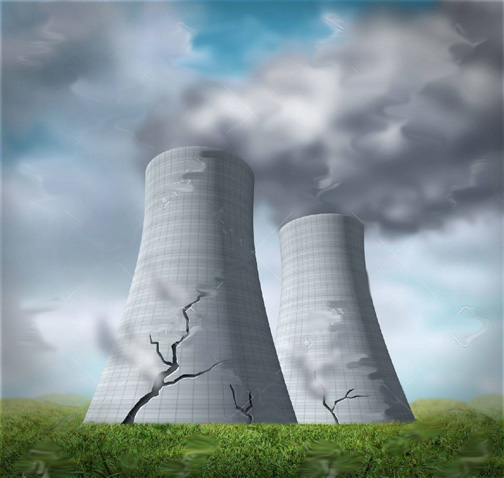
Two nuclear power stations will continue to generate electricity for two
more years than previously announced. In the latest of multiple extensions,
operator EDF said Hartlepool Power Station and Heysham 1 in Lancashire
would run until March 2030, two years longer than a previous estimate of
2028.
EDF said it took the decision after a “detailed review” of the
condition of the boilers and the graphite cores as well as supply chain
resilience. Chief executive of the Nuclear Industry Association, Tom
Greatrex, said: “The significance of this cannot be understated, given the
UK’s exposure to volatile gas prices and the need to protect households by
providing baseload power.”
The company also gave an update on hopes to
install the UK’s first Advanced Modular Reactors (AMRs) in Hartlepool,
which developers said would provide a “similar” amount of electricity to
the current plant’s power output. It said an application to enter the
generic design assessment had been submitted in June, describing it as the
“first critical step in the UK licensing progress”.
BBC 22nd July 2026,
https://www.bbc.co.uk/news/articles/clyvng9vl66o
Data centers powered by next-gen nuclear? Don’t fall for Big Tech’s PR hype

Amazon could decide not to purchase any electricity should generating it from these SMRs turn out to be too expensive. Likewise, the agreement between Kairos Power and Google talks about selling “energy, ancillary services, and environmental attributes to Google under Power Purchase Agreements.” The announcements said nothing about the terms of the power purchase.
Estimates of electricity costs from SMRs show that each unit of electrical energy from SMRs would be far more expensive than a corresponding unit from solar and wind power plants,
such incentives [Loan guarantees ] cause recipients to invest in excessively risky projects because they do not bear all the cost of a project’s failure.”
By Molly Langabeer, M.V. Ramana | Analysis | July 20, 2026
Nuclear energy recently crossed a global milestone. In 2025, the share of all electrical energy flowing in the world’s grids coming from nuclear power plants was just 8.8 percent, roughly half of what it was 30 years ago. In contrast, 19.5 percent of the electrical energy came from fast- growing renewables such as solar and wind power. Large hydropower plants provided an additional 13.9 percent.
This decline may come as a surprise, given the ongoing parade of announcements about the bright future of nuclear power, featuring oft-repeated terms like “renaissance” and “revival.” In recent years, two elements have featured prominently in these announcements: The demand from Big Tech companies for nuclear power, and their investment in so-called next-generation or small modular nuclear reactors.
In October 2024, a company called Kairos Power and Google announced that they had signed a “Master Plant Development Agreement, creating a path to deploy a U.S. fleet of advanced nuclear power projects totalling 500 megawatts by 2035.” Two days later, the utility company Energy Northwest and Amazon announced “an agreement to fund efforts to move toward the development and deployment of small modular reactor (SMR) technology in Washington state.” The Amazon version of this announcement also contained the expectation that these reactors “will help meet the forecasted energy needs of the Pacific Northwest beginning in the early 2030s.”
Peer under the hood however, and it becomes evident that these press releases are all show, with little substance.
To start, the actual announcements were far more circumspect than some media coverage would suggest. Amazon, for example, only promised to “fund the initial feasibility phase of an SMR project” in exchange for “the right to purchase electricity from the first project (4 modules), which is expected to generate 320 megawatts of energy capacity.” Having the right, presumably, doesn’t force Amazon to purchase the electricity—and Amazon could decide not to purchase any electricity should generating it from these SMRs turn out to be too expensive. Likewise, the agreement between Kairos Power and Google talks about selling “energy, ancillary services, and environmental attributes to Google under Power Purchase Agreements.” The announcements said nothing about the terms of the power purchase.
There are good reasons for companies to be circumspect about investing in nuclear power plants. In the United States, each unit of electrical energy from a new nuclear reactor costs about three times the corresponding energy from a solar or wind power plant. Furthermore, the diverging long-term trends for nuclear power (becoming more expensive over time) and renewables (becoming cheaper with time) suggest that the cost divergence will only increase. Estimates of electricity costs from SMRs show that each unit of electrical energy from SMRs would be far more expensive than a corresponding unit from solar and wind power plants, even when the cost of storage technologies and other means of accounting for the variability are included. For Big Tech companies already struggling with input costs, buying power from expensive nuclear reactors would only make their business less likely to be financially viable.
Then there is uncertainty. Nuclear power projects have historically been delayed and have cost more than initially anticipated. One study examined 180 nuclear power projects and found that 175 had exceeded their initial budgets and timelines. This is particularly likely with so-called advanced reactor designs and small modular reactors, because there is little or no experience with building such plants. The only recent experience with small modular reactors is in Russia, where the KLT-40S design was based on the design of reactors used in the nuclear-powered icebreakers operated by the country for decades. But building the first power plant based on the KLT-40S design took 13 years from the start of construction to generating electricity, instead of the expected 3 years. In China, the twin High Temperature Gas Cooled Reactor units (Shidao Bay 1-1 and 1-2), took more than twice the promised “50 months.”
To be clear: There are no small modular reactor projects currently under construction in the United States. Their estimated times of arrival have already been significantly pushed back. For example, in 2020, the Energy Department declared a goal of having the Natrium reactor and the Xe-100 reactors be operational “within 5-7 years.” But in November 2025, an executive working for Natrium promised “commercial operation delivery date, power on the grid” by “2031.”
When these reactors might actually produce any electricity is also dependent on how much assured funding there is behind each project. Many announcements are ambiguous; of the ones that do specify an amount, the largest investments have been in the hundreds of millions of dollars. In October 2024, a consortium involving “Amazon’s Climate Pledge Fund, Citadel Founder and CEO Ken Griffin, affiliates of Ares Management Corporation, NGP, and the University of Michigan” announced that they were investing “approximately $500 million” in X-energy, the designer of a high-temperature gas-cooled reactor. The following June, Terrapower, the nuclear company started by Bill Gates, announced that it had raised $650 million from a group that included “NVentures, the venture capital arm of NVIDIA, and current investors”; the latter included, not surprisingly, Bill Gates and the South Korean company, Hyundai.
To put these figures in context, one estimate of TerraPower’s proposed Natrium nuclear plant is $9.4 billion for 345 megawatts of electrical power. This puts it at roughly the same total cost as a project in Idaho involving six NuScale SMRs that would have generated 462 megawatts of power. The NuScale project was cancelled in 2023 because the $9.3 billion cost estimate was too high for potential purchasers of electricity from this project. Cost estimates for high-temperature gas-cooled reactors like Xe-100, supported by the Amazon consortium, are even higher; if actually built, both Natrium and Xe-100 would produce electricity at costs per unit that are double or more of the cost of producing electricity from large nuclear plants. And, as mentioned earlier, the cost of electricity from large nuclear plants is three times or more the cost of electricity from solar and wind power plants.
Even the largest investment announced so far, $650 million, would not suffice to fund the construction of a single Natrium reactor, or even the much lower power output NuScale SMR. In short, AI companies are not spending anywhere near the amounts needed to bring new nuclear power, especially from small modular reactors, online.
The AI industry certainly has the capital to do so. During their February 2026 earnings calls, Amazon and Google said that they were expecting to spend up to $200 billion and $185 billion, respectively, during the upcoming year on data centers. Their nuclear commitments are just a fraction of one percent of their annual expenditures earmarked for building data centers. This suggests that their announcements of nuclear power investments—typically containing the self-promoting, if questionable, adjectives “safe,” “reliable,” “clean,” and “affordable”—are primarily meant as greenwashing, in order to divert attention from the negative environmental impacts of data center operations. Such investments are more likely to come from the portions of their budgets dedicated to public relations than operational expenses.
In addition to being too expensive, the potential contribution from new nuclear projects will be too meagre. One report estimated that currently 10 percent of data centers require more than 1 gigawatt of power; but projected a doubling of this fraction, to 20 percent, by 2030. Stargate’s Abilene data center project in Texas wants up to 5 gigawatts of power. Meta is planning a 5 gigawatt data center in Louisiana. In January 2026, Pacifico Energy announced that its GW Ranch project received a Texas Commission on Environmental Quality air permit for 7.65 gigawatts of gas-fired power generation, the largest permit granted in the United States.
A single small modular reactor—defined as having the capacity to produce less than 300 megawatts of electricity, or less than a third of a gigawatt—would not go very far in meeting the voracious energy demands of AI data centers. Large reactors would be more helpful in meeting these enormous demands, but they are also far more expensive. The last large reactors built in the United States were the Vogtle project in Georgia, which ended up costing over $36 billion—more than double the $14 billion estimated when construction of those reactors started.
The sizeable gap in investment will, at least in part, be filled by public money, either from US citizens or citizens of other countries. In September 2024, when Constellation Energy and Microsoft announced an agreement to restart the Three Mile Island reactor—the twin unit to the reactor that melted down in 1979—they claimed that it was “entirely…a private agreement” and that it “involves no public funds.” The following month, the Washington Post revealed that Constellation had applied to the Energy Department for a $1.6 billion federal loan guarantee. In November 2025, the Energy Department loaned $1 billion to Constellation, and in June 2026, it announced a “$17.5 billion American Nuclear Supply Chain Loans… to accelerate the deployment of 10 large-scale commercial nuclear reactors.”
Loan guarantees were a key mechanism used by the Energy Policy Act of 2005 to incentivize what was described as a so-called “nuclear renaissance. (That renaissance fizzled!) What such guarantees do is transfer the financial “risk to the public,” as a 2008 Congressional Budget Office (“CBO”) report explained. The CBO went on to caution: “economic theory suggests that such incentives cause recipients to invest in excessively risky projects because they do not bear all the cost of a project’s failure.”
Which is what happened. US utility companies proposed constructing more than 30 reactors, but just four proceeded to construction, of which two were abandoned mid-project after over $9 billion was spent. Consumers in South Carolina are still paying every month for that project, although they never benefited from any electricity. Duke Energy also wasted billions of dollars on nuclear projects that were never built. The only two completed reactors were the ones at the Vogtle power plant in Georgia that cost close to $37 billion.
The Trump Administration has also used the threat of tariffs to twist the arms of other countries. Earlier this year, the government of Japan promised to invest $40 billion in two SMR projects in Tennessee and Alabama, and $33 billion in natural gas facilities in Pennsylvania and Texas; some of the power generated is to feed “co-located data centers.” If these investments move forward, then it would presumably be Japanese taxpayers who would be shouldering a significant part of the financial burden.
The backdrop to these announcements is the tremendous growth of data centers, which are being built at a rapid pace. As of July 2026, the website Data Center Map lists 11,826 data centers around the world, 4,467 of which were located in the United States. According to a report funded by many AI companies, private investment in artificial intelligence in the United States reached $285.9 billion in 2025, and AI data center power capacity “reached approximately 29.6 gigawatts by Q4 2025, enough to power all of New York state at peak demand.” The scale of the power demand from data centers has resulted in huge increases in consumer electricity bills—a Bloomberg article cited one case in which a blind man living on disability payments in Baltimore was contending with an 80 percent increase in his energy bills over three years. (He lives an hour’s drive from a part of northern Virginia known as ‘Data Center Alley.’) And he had it better than some consumers; the article found that “electricity now costs as much as 267 percent more for a single month than it did five years ago in areas located near significant data center activity.”
Nuclear energy, however, declined marginally from 831.5 TWh in 2020 to 826.1 TWh in 2025. We can conclude that nuclear power has played no role in fulfilling the increased demand for energy from data centers. If the output from any nuclear reactors were being directed towards data centers, then this electricity would have to have been diverted from the general public or other traditional consumers.
What else is increasing alongside demand from data centers is national carbon dioxide emissions, which increased by 147 million metric tons in the last year. The increase is in part because electricity produced by burning coal went up by about 13 percent. Underlying this increase is utility companies’ reliance on increased use of coal to provide electricity to data centers.
Not so long ago, most Big Tech companies, including Google, Meta, Amazon and Microsoft, made commitments to reduce greenhouse gas emissions from their operations. Microsoft pledged to achieve net negative emissions by 2030, Google and Meta committed to achieving net zero emissions by 2030, and Amazon committed to net zero emissions by 2040.
Google is singing a very different tune these days and is evidently interested in being seen as supporting the Trump administration. At the 2025 Hill & Valley Forum, an annual meeting featuring prominent tech executives, venture capitalists, and federal policymakers, Interior Secretary Doug Burgum called for “accelerating production of American oil, gas, coal, and potentially some nuclear would be key to realizing Silicon Valley’s AI agenda.” Ruth Porat, president and chief investment officer of Google and Alphabet, told conference attendees: “I thought Secretary Burgum’s comments were fantastic… [B]ecause I think it is very clear that to realize the potential of AI, you have to have the power.”
Between 2019 and 2023, the indirect greenhouse gas emissions caused by the generation of energy purchased by an organization (technically known as “Scope 2” emissions) from Amazon, Google, Meta, and Microsoft increased substantially, with emissions from data centers nearly doubling during that period. There are reports that the “real emissions” from company-owned data centers are over seven times higher than officially reported. Rather than scaling back growth to remain aligned with their climate targets, these companies continue to accelerate investments in AI infrastructure, increasing energy consumption and emissions, and mostly ignoring their own former goals.
This is perhaps why Big Tech firms and their supporters have emphatically described nuclear power as “carbon-free” when announcing any agreements with nuclear companies. For example, when the agreement between Microsoft and Constellation Energy to reopen the Three Mile Island nuclear reactor was announced, multiple officials used the term “carbon-free” while talking about nuclear power. The October 2024 news release by Amazon had the sub-headline: “New Small Modular Reactor agreements are part of Amazon’s plan to transition to carbon-free energy.”
Other than building small modular reactors, one way nuclear power could help meet the energy demand from data centers is by restarting reactors that have been shut down—if the companies running these plants could get the public to look the other way when it comes to concerns about the cost of running these plants and the risk of accidents.
There are a handful of reactors that were closed in the recent past, usually because they were uneconomical. First on this list is Three-Mile Island Unit 1, which was designed to generate 819 megawatts, for which Constellation received a $1 billion loan from the DOE. The 2017 decision to shut down this reactor, according to its then-owner, Exelon Corporation, resulted from “more than five years of losses… and its recent failure in an auction to sell Three Mile Island’s power into the regional grid.” The even more dangerous possibility is the reopening of the 805 megawatt Palisades nuclear reactor in Michigan, aided in part by a $1.5 billion loan from the Department of Energy. The dangers stem from problems discovered in the reactor and from the checkered history of the company that is to oversee repairs and operate the reactor. Finally, there is the 601 megawatt Duane Arnold reactor in Iowa, which was shut down in 2020 because a derecho (moving windstorm) caused extensive damage to the reactor’s cooling towers, reinforcing an earlier decision by the owner to shut down the plant because it had calculated that replacing nuclear energy with wind energy would “save customers nearly $300 million in energy costs, on a net present value basis.”
Even if these three reactors were to come online, they would only contribute 2.225 gigawatts of power, at best. Under the extremely optimistic assumption that these decades-old reactors work as anticipated without shutdowns or other problems, and operate at their historical load factors, they would together generate only about 15 TWh of energy every year—a tiny fraction of the Energy Institute’s demand estimate from US data centers of 312.6 TWh in 2025. The demand is expected to only increase.
Projections of future demand, however, have become far more uncertain in light of public opposition to data centers. Data Center Watch reports that between March and June 2025, twenty “projects were blocked or delayed amid local opposition, affecting $98 billion in potential investment—more than all disruptions tracked since 2023.” In July 2026, New York state banned the construction of data centers for a year.
A recent IPSOS poll, for example, found that when asked whether they support or oppose the construction of new data centers in the United States, 44 percent of those polled would oppose it, more than double the percentage of people who support the project (21 percent). When the question was modified to support or opposition to “a data center being built within your community,” support dropped to 14 percent, whereas opposition jumped to 57 percent. And 61 percent of those polled did not agree that rapid growth in the use of artificial intelligence was “mainly a good thing for the country.”
Opposition to data centers springs from multiple concerns. A Gallup survey from March 2026 found that people opposed data centers because of their effects on resources, such as energy consumption and water usage; the effects on costs, especially utility bills; noise pollution; and concerns about quality of life and economic effects from loss of jobs. Some of these concerns would be accentuated if these data centers are powered by nuclear reactors, which could drive up the costs of electricity because of how expensive it is to build new nuclear plants. Using reactors will also increase the water demand. Nuclear reactors that operate on a once-through water cycle withdraw, on average, 44,350 gallons of water for each megawatt-hour of electricity generated, roughly four times the corresponding figure for a combined cycle natural gas plant. It is possible to reduce these water requirements through by essentially recirculating the water used to absorb the plant’s waste heat, or what is known as “closed-cycle cooling,” but that would drive up the energy requirement—a loss either way. In contrast, renewables require little water because there is no heat production.
Finally, there are also reasons to question whether this demand for energy will diminish because the AI industry might be, as some analysts characterize it, a bubble. The main reason to expect this bubble to burst is the absence of a viable business model to pay for the immense expenses of building and operating the immense infrastructure needed. Some investors are even betting on this market collapsing. If that happens, then that would also remove the ostensible motive to build nuclear reactors.
Looking to the future, nuclear power and small modular reactors will be unable to provide any significant boost to the electricity consumption of data centers anytime soon—especially within the next several years, when AI-related energy demand is expected to increase most rapidly. The potential increase of nuclear output from restarting old reactors that were shut down because of age and poor economics is a small fraction of the demand—current and anticipated—from data centers. New nuclear reactors are at least a decade away from being started, and the scale of investment from tech companies in small modular or advanced reactors is completely mismatched to the actual cost of building even a single nuclear reactor, let alone the dozens that would have to be built for nuclear power to contribute a sizeable fraction of the demand from data centers.
Jacobs to assist in planning of UK SMR projects
In May, the company (Jacobs) was selected by GBE-N to provide
environmental services for potential SMR nuclear development at its Oldbury
site. Jacobs said that its work, with a multidisciplinary team including
AtkinsRéalis and AECOM, would cover terrestrial and marine environments,
environmental assessments, Habitats Regulations Assessment and “associated
activities to inform future potential planning, design and permitting
decisions”.
World Nuclear News 21st July 2026 https://www.world-nuclear-news.org/articles/jacobs-to-assist-in-planning-of-uk-smr-projects
1 This Month



Shut down the radiation-damaged Heysham nuclear reactors now
To see nuclear-related stories in greater depth and intensity – go to https://nuclearinformation.wordpress.com

Say No to NASA’s Reckless Nuclear Reactor on the Moon
Say No to NASA’s Reckless Nuclear Reactor on the Moon
-
Archives
- October 2026 (256)
- September 2026 (339)
- August 2026 (330)
- July 2026 (355)
- June 2026 (287)
- May 2026 (306)
- April 2026 (356)
- March 2026 (251)
- February 2026 (267)
- January 2026 (308)
- December 2025 (358)
- November 2025 (359)
-
Categories
- 1
- 1 NUCLEAR ISSUES
- business and costs
- climate change
- culture and arts
- ENERGY
- environment
- health
- history
- indigenous issues
- Legal
- marketing of nuclear
- media
- opposition to nuclear
- PERSONAL STORIES
- politics
- politics international
- Religion and ethics
- safety
- secrets,lies and civil liberties
- spinbuster
- technology
- Uranium
- wastes
- weapons and war
- Women
- 2 WORLD
- ACTION
- AFRICA
- Atrocities
- AUSTRALIA
- Christina's notes
- Christina's themes
- culture and arts
- Events
- Fuk 2022
- Fuk 2023
- Fukushima 2017
- Fukushima 2018
- fukushima 2019
- Fukushima 2020
- Fukushima 2021
- general
- global warming
- Humour (God we need it)
- Nuclear
- RARE EARTHS
- Reference
- resources – print
- Resources -audiovicual
- Weekly Newsletter
- World
- World Nuclear
- YouTube
-
RSS
Entries RSS
Comments RSS

