Short sellers reap $2Bn profit as modular nuclear reactor stocks tumble
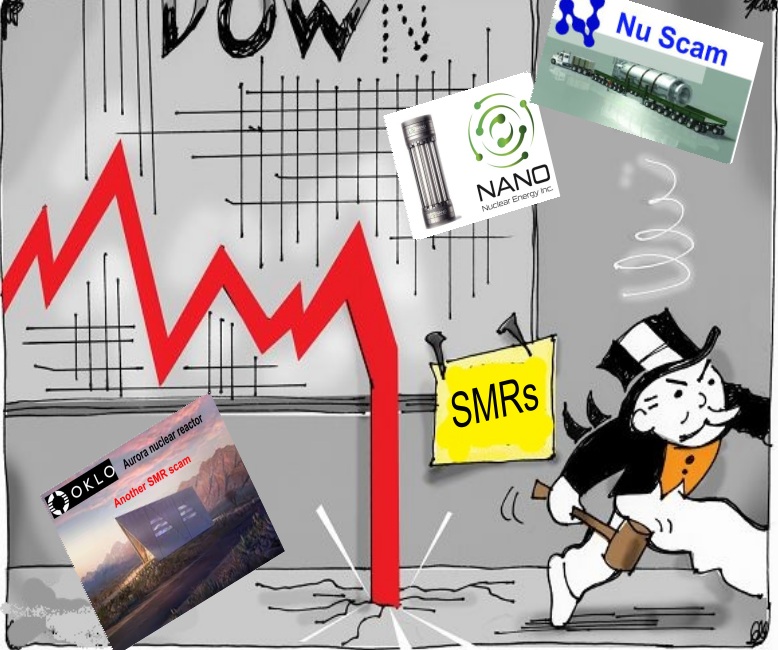
Unproven technology won investment from power-hungry AI
hyperscalers but has yet to deliver consistent revenues
The Financial Times, .Ramsay Hodgson in London, 19 Aug 26,
https://www.ft.com/content/a2f0e0f8-9350-4124-af77-62219e77e777
Short sellers have reaped large profits from betting against small modular nuclear reactor companies, as the collapse of the “hype cycle” that had sent their share prices soaring wipes billions off their market value.
Funds made an estimated $2.1bn shorting three stocks — US-listed NuScale Power, Nano Nuclear and Sam Altman-backed Oklo — over the past year, according to data provider S3 Partners.
The three companies, which are lossmaking and have little or no revenue, surged last year as investors raced to capitalise on growing interest in nuclear energy among AI hyperscalers looking for new sources of power. Regulatory changes and funding announcements from the Trump
administration also helped the sector.
But a total of $30.3bn has been wiped off their collective market value since their peak in October last year amid growing concerns over the lack of immediate revenue and the long build-out timelines for the technology.
“The stocks were overinflated in price, based on speculation,” said Adam Stein, director of nuclear energy innovation at the Breakthrough Institute, a climate and energy think-tank.
The sector went through a “textbook hype cycle” last year, he added. “[It is] very typical of a company that is in this early pre-consistent revenue phase.”
Small modular nuclear reactors are assembled from modules built in factories to save time and
money, and produce around 300MW or less, compared with more than 1,000MW for traditional
reactors.
Only two commercial SMRs are currently operable — in Russia and China, with more than 80 designs in various stages of development.
A key test of investor appetite towards the nuclear sector is expected in the coming weeks, when Holtec International and Westinghouse, two US-based companies with SMR divisions, are expected to list.
Short sellers have piled into bets against the companies based on a view that their shares rose to unsustainable levels, driven by a limited supply of publicly traded stocks and a focus on the potential demand from AI, rather than the time and capital expenditure required to commercialise the technology.
“On the one hand there was some support from the government, and no one wants to bet against Trump, and on the other there was this whole AI [demand] story which everyone was really bullish about [last year],” said Christian Putz, founder and chief executive of investment firm ARR
Investment Partners, who has previously shorted Oklo but has since unwound that position.
Around 18 per cent of Oklo and NuScale’s outstanding shares remain out on loan — a proxy for short selling — while almost 30 per cent of Nano’s are on loan, according to S&P Global Market Intelligence.
Meanwhile, X-energy has shed $5.8bn in market value since the surge that followed its initial public offering in April. Short sellers have earned an estimated $67mn from bets against thecompany since mid-May, according to S3 Partners. The company, which is backed by Amazon and
Ken Griffin and has yet to receive full regulatory approval to build its helium-cooled reactor, has 9 per cent of its shares out on loan.
“The sentiment has changed this year, people are far more critical,” said Putz. These companies “have almost zero revenue for the foreseeable future and, on top of that, there are very high capex [capital expenditure] requirements”.
Demand for energy in the US is set to soar over the coming decade, in part due to the rapid development of power-hungry data centres by AI hyperscalers. According to data from BloombergNEF, US data centre power demand is set to climb from 34.7 gigawatts in 2024 to 106GW by 2035.
Big Tech is increasingly turning to the emergent SMR technology to meet its future power needs. In January, Meta struck a deal with Oklo and Bill Gates-backed TerraPower, in which it agreed to make an upfront cash injection to support development of the reactor technology.
The Trump administration vocally backed the nuclear sector last year, pledging to cut red tape and invest tens of billions of dollars to build new reactors and reopen old ones to generate the to “win” the global AI race. In June, the Department of Energy announced $17.5bn of loans to help rebuild the US nuclear supply chain.
However, timelines for delivery of the unproven reactors remain uncertain. Analysts at BNP Paribas have expressed concerns over shortages of high-assay low-enriched uranium, a special type of nuclear fuel vital for SMRs. The earliest some will come online is mid-to-late 2028, if manufacturers are able to speed up delivery while also satisfying regulators, although the majority will arrive during the 2030s, said Stein at the Breakthrough Institute.
NuScale, which reported a $96.7mn loss in the first half of 2026, faces a shareholder class-action lawsuit alleging it misled investors, to which it must respond by September 8. It is building a modular light-water reactor based on a more conventional pressurised-water design.
Nano Nuclear — whose microreactors are in the development stage — has never generated any revenue and posted a $14mn operating loss in the first quarter of the year.
Oklo hopes to deliver commercial power to customers from its liquid sodium rather than water- cooled Aurora reactors. US energy secretary Chris Wright was previously a board member. It has yet to secure a full licence from the US nuclear regulator to build and operate its reactor.
“What we have seen in 2025 seems to me like an industry bubble that is already deflating,” said Siegfried Eggert, chief executive of activist short seller Grizzly Research, who has no short positions against the companies.
“I believe most knowledgeable investors understood for a while that the valuations seemed ratherextended given the timeline of this industry,” he added.
Nano Nuclear said the rise or fall in the share price of companies said little about the success of the underlying business and disputed the “hype cycle” characterisation. Oklo said the company had made “tangible progress” over the past year and expected commercial operation of its Aurora reactor to begin in 2028.
NuScale declined to comment. X-energy did not respond to a request for comment.
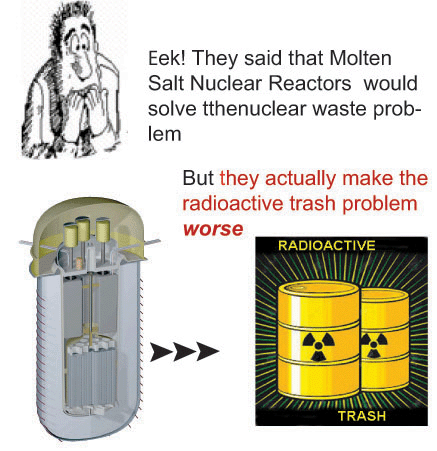
Nuclear power: molten salt reactors and sodium-cooled fast reactors make the radioactive waste problem WORSE

 reactors https://www.tandfonline.com/doi/full/10.1080/00963402.2018.1507791, Lindsay Krall &Allison Macfarlane, 31 Aug 18
ABSTRACT
Nuclear energy-producing nations are almost universally experiencing delays in the commissioning of the geologic repositories needed for the long-term isolation of spent fuel and other high-level wastes from the human environment. Despite these problems, expert panels have repeatedly determined that geologic disposal is necessary, regardless of whether advanced reactors to support a “closed” nuclear fuel cycle become available. Still, advanced reactor developers are receiving substantial funding on the pretense that extraordinary waste management benefits can be reaped through adoption of these technologies.
Here, the authors describe why molten salt reactors and sodium-cooled fast reactors – due to the unusual chemical compositions of their fuels – will actually exacerbate spent fuel storage and disposal issues. Before these reactors are licensed, policymakers must determine the implications of metal- and salt-based fuels vis a vis the Nuclear Waste Policy Act and the Continued Storage Rule.
Special investigation: UK’s nuclear waste a ‘calamity for future generations’.

Plans to dispose of high-level nuclear waste over the long
term remain uncertain. Plans to deal with nuclear waste must be considered by the new energy secretary Miatta Fahnbullaeh.
Britain is planning a new fleet of nuclear reactors – without a repository for high-grade legacy waste. The UK’s efforts to find a location for an underground nuclear waste burial site have stalled. New energy secretary Miatta Fahnbulleh must review two remaining areas in Cumbria, after three were abandoned following community pushback, Energy Voice has learned.
Two sites, Mid Copeland and
South Copeland, near existing nuclear waste storage facilities at
Sellafield, are being assessed for “permanent” nuclear waste storage in
a planned geological disposal facility (GDF), the Nuclear Decommissioning
Authority (NDA) confirmed in an emailed statement.
With a UK nuclear burial site undetermined, storage at Sellafield time-limited, and three major nuclear projects expected to operate beyond 2055, government has been accused of “kicking the can down the road”. Further, the National Wealth Fund (NWF) did not factor long-term waste disposal into decisions to invest in Sizewell C, Energy Voice has also learned.
The state-owned body backed the UK’s new 3.2GW nuclear power station in Suffolk with £36.6 billion in debt finance. Its chief investment officer Ian Brown told Energy Voice during an interview in March, months after the project reached a final investment decision: “I wouldn’t say it’s not something we look at, but at the moment… the proposal is that the waste material will just stayon site.
“It’s going to take a while to work out where in the country
we’re able to drop the stuff into the ground, if ever.” Professor Andrew
Blowers, co-chair of the NWS/NGO Exchange and former member of RadioactiveWaste Management Advisory Committee, said: “The new build programme is costly, risky with long timescales and makes little sense as a part of the energy mix needed to achieve net zero.
“Far from helping to deal with
climate change, the wastes from such a programme will add yet more calamity o future generations.”
NDA subsidiary National Waste Services (NWS),
created in 2022 to handle the UK’s “future radioactive waste”, has
submitted a decision to the energy secretary on where to locate a
high-grade nuclear waste burial site, a spokeswoman said. The energy
secretary must now formally respond to its proposal.
However, the Office
for Nuclear Regulation (ONR) told Energy Voice that NWS needs to “find a
suitable site and a willing community” to host nuclear waste. It said:
“No site has yet been identified.” Of five potential sites, three were
ruled out, including the coastal region of Seascale, a site near Sellafield
in Cumbria, and another in Lincolnshire, where the county council voted
unanimously to withdraw from the plans. “
Three other communities have
previously been involved in the process but are no longer,” the ONR said
in a statement to Energy Voice. “Allerdale in Cumbria was withdrawn due
to insufficient suitable geology. Theddlethorpe (Lincolnshire) and South
Holderness (Yorkshire) voluntarily withdrew from the process.” Blowers
said,
“At present a GDF is uncertain, its location unclear and its
timescale already far into the later part of this century. It is
irresponsible and immoral to create yet more wastes arising in the next
century for which no management provision can conceivably be made.”
“The mad rush to building yet more dangerous nuclear power stations with
their eternal dangerous radioactive debris should be stopped dead in its
tracks now,” Blowers said.
Energy Voice 17th Aug 2026,
https://www.energyvoice.com/renewables-energy-transition/nuclear/602330/uk-nuclear-waste-management-problem/
How Finland Destroyed Itself For NATO
Nate Bear Do Not Panic, August 19, 2026
Finland, often known as the happiest country in the world, now has the highest unemployment rate in Europe, demand for food aid has exploded by more than 70%, and homelessness, which had been declining for more than ten years, has increased 34% in just two years. Conditions in the country are so bad that almost 20% of Finland’s population is now considered at risk of poverty,
Once considered the standard bearer for the good life, for competent governance and a strong social state, Finland is unravelling at warp speed. What has gone wrong so quickly?
In three words, NATO, austerity and Russophobia.
All are linked. Finland is slashing its social state to the bone to meet NATO’s 5% GDP military spending target, a target which became necessary after the country abandoned neutrality and swapped the welfare state for the warfare state after Russia’s invasion of Ukraine.
The speed of the collapse has been stunning.
In 2019, the at-risk of poverty rate was 11% and by 2022 the country was on course to hit record low unemployment.
Everything changed after Russia’s invasion of Ukraine and the country’s hysterical over-reaction to an imagined threat. This is not just my judgement. A number of Finnish academics, including Heikki Patomäki, professor of world politics at the University of Helsinki, have said that the conditions simply did not warrant Finland joining NATO, cutting off its economically valuable links to Russia and militarising its border.
The facts support this.
At the time of its invasion of Ukraine, Russia had just a couple of thousand troops spread out across various bases on its 1,340 km border with Finland. The bases were home to handful of missile defence batteries and a few dozen tanks. Many of the troops and much of the equipment was subsequently deployed to Ukraine, leaving the bases empty. There was obviously no invasion threat, and Putin in May 2022 emphasised this in a phone call to Finland’s then-president Sauli Niinistö.
But by this point, the Russophobia and hysteria for NATO membership had begun to take on a life of its own. Sanna Marin, Finland’s young female prime minister at the time, and a liberal media darling, was a particularly effective saleswoman. Despite claiming in the days following Russia’s invasion that there was no threat, her tone became decidedly more hawkish in the months that followed. She said Russia “poses a threat to all of us” and began talking like a war-time leader, saying in September 2022 that “Russia may challenge Finland, blackmail us and threaten us, but we will not give in.” Bear in mind, Russia at this point had practically zero troops and equipment on its western border with Finland. The Russian threat she was invoking was entirely imagined, an hallucination.
Nevertheless, in April 2023, Finland joined NATO, just days after Marin was defeated by the right and far-right in an election where the policy choice on Russia was one of uniformity, with the conservatives, the ethno-nationalists and Marin’s social democrats all singing the same tune.
After her defeat, Marin scuttled off to work for Tony Blair, while the new conservative-nationalist government set about decimating Finland’s welfare state to pay for the privilege of NATO membership.
The Finnish government is now a substantial way through its programme to cut €9 billion of public spending by 2027, including large reductions to social security (including housing, child, and unemployment benefits) healthcare, education, and municipal funding budgets, while it also increasing taxes on average earners. Cuts to healthcare provision have been particularly brutal, including a large reduction in hospital staff numbers, elderly care and disability services while redefining “minimum service obligations” to justify providing patients with lower quality care. The government has also slashed funding for organisations working on peace and initiatives which would address the new cold war-style relations with Russia.
In addition, the new government fully closed all the border crossings with Russia that Marin’s Social Democrats had partially closed, and began building large sections of a border fence, securitised with troops, night vision cameras and motion detectors.
And while the entire country is now suffering as a result of the pro-war paranoia that has gripped Finland’s leaders, its border towns have taken a particular beating.
Before the war, Russians routinely crossed to shop, eat, stay in hotels and visit holiday properties they owned in the towns and villages along the border. That has all gone away. One estimate cited in a recent Finnish study puts the loss of Russian tourism in the border region of South Karelia at as much as €1 million per day. Unemployment in some border regions is now approaching 20%.
The border also used to be an important commercial gateway between the EU and Russia, but its closure eliminated much of the road freight and transit business. The OECD says eastern Finland has gone from being an “economic gateway” to a “security barrier,” a transformation which of course it praises rather than mourns, claiming that confronting Russia is important not only for Finland but for Europe as a whole.
Then there are the commodities like gas and timber.
In 2021 Russia accounted for about 92% of Finland’s gas imports. Finland has replaced all of that with a mix of sources, including far more expensive LNG from the US, meaning that Finland, after having some of the lowest gas prices in Europe, now has the highest gas prices in Europe.
As for timber, in 2021, 70% of Finland’s wood imports came from Russia, and this wood supplied approximately 10% of all the raw wood used by Finnish industry. Pulp mills in Finland subsequently went bust and the industry faced shortages which persist to this day after the EU, with Finland’s support, banned countries from buying wood from Russia.
Finland’s decisions, both independently and collectively through the EU, have immiserated many millions of Finnish citizens. Yet at the same time as the country is slashing the social state, it is spending more money than ever, around $8.1 billion in 2025, on weapons of war to fight a threat that previously didn’t exist. A threat that Finland has made real by its new-found anti-Russia NATO militancy, with Putin promising to respond to Finland’s border build-up.
And among the beneficiaries of a new tooled-up and aggressive Finland are the arms dealers of the Israeli apartheid-genocide complex, which in 2024 sold Finland its questionably functional “David’s Sling” air defence system for €316 million. Finland has also bought tank and ship missiles from the Israeli company Rafael which supplied most of the weapons and equipment used to commit the genocide of Gaza. The Finnish government said Israel’s genocide of Gaza would not stop it buying weapons from the country, a position which is par for the course among the morally bankrupt leaders of Europe.
Finland is also spending €10 billion on US fighter jets, and a few billion euros on missiles and glide bombs to fire from those jets, as well as giving Ukraine €2.3 billion in direct military aid over three years.
It’s all utterly deranged, but completely unsurprising given the Russophobia which pervades all European halls of power and has become embedded on the continent.
Finland has effectively taken a scythe to all the things that made it, in the eyes of many, the envy of the world. The country has trashed the model which delivered such a high standard of living, a model which included neutrality and good relations with Russia.
Instead the country has enacted a self-imposed structural adjustment programme to pay for membership of a military alliance it didn’t need, with that membership creating an enemy that didn’t exist, an enemy which happens to be a nuclear superpower with which it shares a huge border.
The price has been, and will continue to be a steep one, and it is a price ordinary Finns will be paying for a long time.
But it is not just in Finland.
We are watching, across Europe, the shameful replacement of the welfare state with the warfare state while the merchants of genocide and death laugh all the way to the bank.
Walt Zlotow – 21ST century David v. Goliath: Iran’s $8 billion military whups America’s $1 trillion military
Walt Zlotow West Suburban Peace Coalition GlenEllyn IL , 19 Aug 26, https://theaimn.net/21st-century-david-v-goliath/
What’s going on in the Middle East is not a Biblical fairy tale. Irans’s piddly military has delivered a devastating defeat to America’s gargantuan trillion dollar military.
Iran’s David does not need to squander a trillion annually on 750 bases housing over 160,000 soldiers in 80 countries. Nor does Iran’s David need 287 naval ships including 11 nuclear powered aircraft carriers that have suddenly become obsolete in the era of drone and missile warfare. Those carriers have been steering clear of Iran’s missiles and drones least they be sent to Davy Jones Locker.
The US is flummoxed at how Iran’s minuscule military has made mincemeat out of all 18 US bases in US Gulf State allies Kuwait, Saudi Arabia, UAE, Qatar and Bahrain. After plastering Iran with thousands of bombs for 39 days, it was the US, not Iran that was running out of offensive and defensive missiles and bombs, so much so Trump cried ‘Uncle’ and demanded a ceasefire.
When Trump signed the Iran’s ‘Unconditional Surrender’ document, the Memorandum of Understanding, on June 17, it was equivalent to Goliath being smitten by the stone puny David fired from his sling.
Of course, the story of David and Goliath is a fairy tale that allegedly occurred over 3,000 years ogo. The 21st century version is no fairy tale. Now in its 173rd day with no end in sight, it still represents the most catastrophic military blunder in US history. It will likely push the US out of the Middle East. The 5 Gulf States housing now damaged or destroyed US bases may seek more reliable countries to rely on for their security. Iran will emerge a stronger power in the region. The entire world economy still teeters on possible decline from US intransigence and refusal to admit defeat.
Trump still doesn’t get it. He’s seeks another half trillion bucks for his wildly bloated military for fiscal ’27 in hopes of prevailing over Iran’s tiny $8 billion dollar military. Mayne he should start reading something he’s never read before…the Bible. He should start with 1 Samuel 17:1–50.
Romania Restarts Coal Plant as Danube Drought Forces Nuclear Shutdown

By Michael Kern – Aug 18, 2026, https://oilprice.com/Latest-Energy-News/World-News/Romania-Restarts-Coal-Plant-as-Danube-Drought-Forces-Nuclear-Shutdown.html
Romania has this week restarted a 300-megawatt coal-fired power plant to partially offset the generation lost by the closure of nuclear electricity output after the low water level on the Danube river forced a shutdown of the country’s only nuclear power plant.
Romania, which lost 20% of its power generation with the closure of both rectors at its Cernavoda nuclear power plant, has restarted the Rovinari Group 4 coal-fired power unit. The additional coal-fired generation is adding nearly 300 megawatts (MW) to the National Energy System, Cristian Bu?oi, State Secretary at Romania’s Ministry of Energy, told local media.
The two reactors at the Cernavoda nuclear power plant have 680 MW installed capacity each, and typically generate about 20% of Romania’s power output.
However, the lowest water levels on the Danube in 90 years forced Romania in recent weeks to shut down both reactors amid insufficient water supply to cool the reactors.
At the end of last week, Romania began shutting down its only remaining operating nuclear reactor as record-low water levels on the Danube have forced nuclear power shutdowns in central and eastern Europe in recent weeks.
Nuclearelectrica launched the process to disconnect the one operating reactor at Romania’s only nuclear plant at Cernavoda on the Danube, the Romanian state-owned nuclear power plant operator said August 13.
Nuclearelectrica had shut down the other reactor at Cernavoda at the end of July as scorching temperatures and drought in Europe this summer have sank the water levels on the Danube to the lowest in 90 years.
“We do not foresee a restart within the next ten days,” the director of the Cernavoda plant, Romeo Urjan, told AFP last Thursday.
The low water levels on the Danube has affected Hungary’s only nuclear power plant, too. Hungary is sinking barges in the Danube to keep its Paks nuclear power plant, which generates a third of the country’s electricity, running.
Trump ‘weighing nuclear attack on Iran’ as peace deal expires.

Plus: Why the Iran war has prompted Trump to scale back key US-South Korea military drills
As the US-Iran ceasefire officially expires and the Strait of Hormuz
remains closed, is Donald Trump considering using nuclear weapons to break
the war’s stalemate? On today’s episode of Iran: The Latest, Venetia Rainey
and Roland Oliphant discuss why US politician Marjorie Taylor Greene’s
bizarre nuclear claim may be less crazy than it first appears and how an
underground nuclear facility at Pickaxe Mountain could be the potential
target. They also look at the state of the war 60 days on from the
ill-fated Memorandum of Understanding peace deal and why Iran is more
bullish than ever.
Telegraph 17th Aug 2026, https://www.telegraph.co.uk/world-news/2026/08/17/trump-weighing-nuclear-attack-on-iran-as-peace-deal-expires/
Summary of the Summary of the Integrated Guidelines – Deep Geological Repository (DGR) for Canada’s Used Nuclear Fuel Project
The document refers to ‘spatial and temporal boundaries’ and ‘follow up and monitoring’. AsI understand the project, the temporal boundary is several hundred thousand years.
But NWMO will not follow up or monitor beyond apx 160 years, instead handing the dgr to the public to follow up and monitor beyond that. If all the copper cladding corrodes away in 161 years, it’s not their problem.
Dated as having been posted August and without an explanatory note, the Impact Assessment Agency has posted a “Summary of the Integrated Guidelines” as Document 1117 at https://iaac-aeic.gc.ca/050/documents/p88774/167588E.pdf
The nine page document begins with a disclaimer: “This document is a summary of the requirements found in the Integrated Tailored Impact Statement Guidelines (the Guidelines) for the Deep Geological Repository for Canada’s Used Nuclear Fuel Project (the project), proposed by the Nuclear Waste Management Organization (the proponent). This document outlines, at a high level, the information that the proponent must provide in their Impact Statement. The purpose of this document is to serve as an engagement tool for participants to support their understanding of the requirements.”
Hinkley Point C subsidiary must comply with environmental information rules, UTT rules

“Those companies cannot be given exceptional public powers and then close the door when people ask how the powers are being used. Public confidence depends on meaningful transparency and accountability.”
17.Aug.2026, Adam Carey, https://www.localgovernmentlawyer.co.uk/information-law/398-information-law-news/101448-hinkley-point-c-subsidiary-must-comply-with-environmental-information-rules-utt-rules
The subsidiary responsible for a new nuclear power station currently under construction is a public authority for the purposes of the Environmental Information Regulations 2004, the Upper Tribunal (UTT) has ruled.
In NNB Generation Company (HPC) Ltd v Information Commissioner & Anor [2026] UKUT 241 (AAC), Upper Tribunal Judge Jacobs dismissed an appeal by NNB Generation Company (HPC) Ltd against a First-tier Tribunal (FTT) decision.
The case arose after NNB Generation Company, the EDF subsidiary responsible for the power station known as ‘Hinkley Point C’, refused an information request from Fish Legal in March 2024. It refused to process the request under the Environmental Information Regulations (EIR) because it did not consider itself a public authority.
Fish Legal appealed the refusal to the Information Commissioner, which found that NNB was a public authority under regulation 2(2)(c) of the Regulations.
The FTT later confirmed that decision, leading NNB to appeal to the UTT on three grounds.
Following a hearing in April 2026, Upper Tribunal Judge Jacobs ultimately dismissed the appeal, holding that the First-tier Tribunal had not made an error on a point of law.
One of the main thrusts of the appeal centred on the FTT’s decision that NNB was vested with special powers.
NNB has a range of powers under its Development Consent Order and electricity licence, including powers of compulsory acquisition, entry, street works and works affecting watercourses, as well as harbour authority powers.
Jacobs J said the question was whether HPC had powers which were “not powers available to HPC as a matter of general private law”. Having those powers conferred “a practical advantage” on the company should it wish to use them, making them special powers.
This aspect of the judgment relied on the test for special powers set out by the Upper Tribunal in Fish Legal in 2015. That case concerned the application of the Environmental Information Regulations to bodies carrying out public administrative functions, including the question of whether they were vested with special powers.
Zoe Wedderburn-Day, Head of Policy and Strategy at Fish Legal, said: “The new government wants essential infrastructure built more quickly. Much of that programme will depend on private companies using powers granted to them by the state.
“Those companies cannot be given exceptional public powers and then close the door when people ask how the powers are being used. Public confidence depends on meaningful transparency and accountability.”
“Fish Legal established that basic legal principle for privatised water companies more than 10 years ago. The Upper Tribunal has now confirmed its relevance to the private company building Hinkley Point C.”
HPC must now respond to Fish Legal’s EIR or rely on specific EIR exemptions. The deadline to response is 20 August, with any application for permission to appeal due by 16 August.
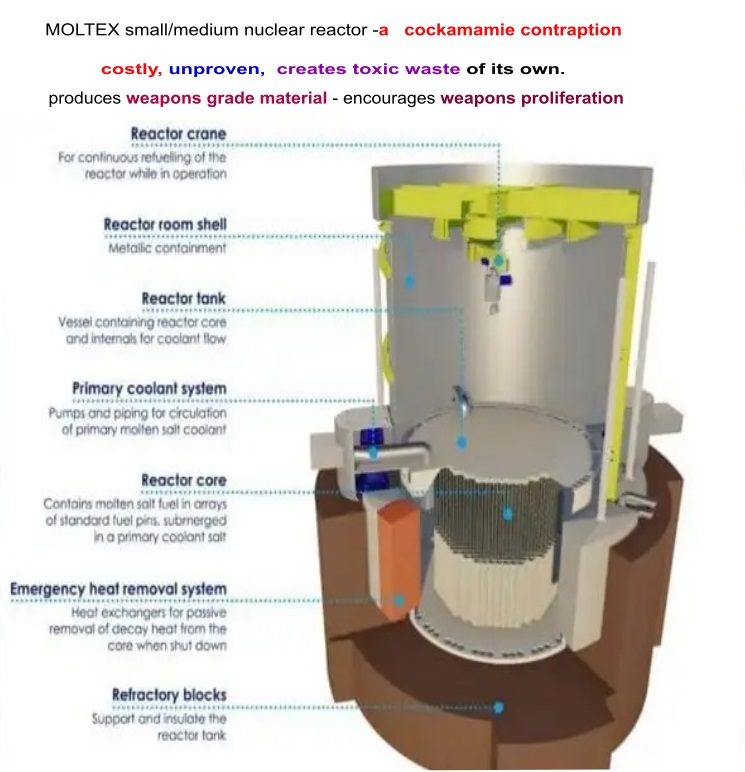
Canada’s Nuclea Energy Signs Agreement To Acquire Moltex Advanced Nuclear Portfolio
By David Dalton, 17 August 2026, https://www.nucnet.org/news/canada-s-nuclea-energy-signs-agreement-to-acquire-moltex-advanced-nuclear-portfolio-8-1-2026
UK-based company was placed in administration in 2025
Ontario, Canada-based Nuclea Energy has entered into a definitive agreement with Moltex Energy Ltd – currently in administration – and its joint administrators to acquire advanced nuclear technology assets across its molten salt reactor and nuclear fuel recycling portfolio.
Moltex Energy Ltd, the UK-based parent company of MoltexFlex Limited and Moltex Energy Canada Inc, was placed in administration in 2025 after its directors failed to achieve the majority shareholder consent to new investments or the sale of its assets.
Nuclea Energy is developing the Morpheus microreactor, a lead-cooled, factory-built micro-modular reactor.
The target portfolio has been developed by Moltex over more than a decade, backed by over CAD96m ($68m, €59m) in funding from private investment, Canadian public programmes and the US Department of Energy, the company said in a news release.
The portfolio includes technology and development materials associated principally with Moltex’s Stable Salt Reactor–Wasteburner (SSR-W), an advanced molten salt fast reactor, and its next-generation Waste To Stable Salt (WATSS) spent nuclear fuel recycling process.
It also includes an extensive patent portfolio of 80 patents across nine patent families in advanced nuclear technology – including nuclear fuel, reactor, chemistry and materials – and nine pending patents on the fuel recycling process, Nuclea said.
WhatDoTheyKnow provides proof it sent Freedom Of Information request to AWE, (the Atomic Weapons Establishment)
Tom Pashby, Aug 21, 2026
Digital proof has been shared with 20 Working Days that a Freedom of Information (FOI) Act request was sent to AWE (the Atomic Weapons Establishment) – which AWE claimed it didn’t receive.
The FOI request is now the subject of an Information Commissioner’s Office (ICO) decision notice – a type of enforcement action – over its failure to respond to a FOI request sent by 20 Working Days on 6 May, via WhatDoTheyKnow.
WhatDoTheyKnow describes itself as “a site to help anyone submit a Freedom of Information request. WhatDoTheyKnow also publishes and archives requests and responses, building a massive archive of information.” It is built by a pro-democracy and transparency non-governmental organisation called MySociety.
The decision notice has since been published on the ICO’s website. The ICO explains what decision notices are. It says: “When we do take formal enforcement action, this will likely be in the form of a decision notice.
“A decision notice is a formal document that explains whether the Information Commissioner thinks a public authority has complied with the law when dealing with a specific request.”
The decision notice it issued to AWE about the 6 May FOI request said: “A public authority will breach section 10 of FOIA if it fails to respond to a request within 20 working days.
“Based on evidence available to the Commissioner, by the date of this notice the public authority has not issued a substantive response to this request. Therefore the Commissioner finds a breach of section 10.”
Setting out the next steps required by the ICO, it said: “The public authority must provide a substantive response to the request in accordance with its obligations under FOIA.
“The public authority must take this step within 30 calendar days of the date of this decision notice. Failure to comply may result in the Commissioner making written certification of this fact to the High Court pursuant to section 54 of FOIA and may be dealt with as a contempt of court.”
20 Working Days offered AWE the opportunity to comment on the decision notice ahead of publication of its 12 August article covering the enforcement action.
The day after the article was published, on 13 August, an AWE spokesperson said: “AWE has received, and processed, previous requests from the requestor (FOI2026-020, FOI2026-042 and FOI2026-044) and has also received and acknowledged FOI2026-047) via the WhatDoTheyKnow platform. A response to that request is currently being considered.
“However a further request, understood to have been submitted on 6th May, was not received by AWE. AWE was therefore unaware of its existence until contacted by the Information Commissioner’s Office (ICO) in July.
“Following correspondence with the ICO, the ICO issued a Decision Notice on 10 August 2026, requiring AWE to provide a substantive response within 20 working days.
“AWE is processing this and has formally acknowledged this (reference FOI2026-049). A response will be provided within the applicable time limit.”
The spokesperson added: “This is equivalent to a signed-for physical letter delivery where the receptionist signs for the letter. Whether that letter got routed to the desk of the responsible person is the authority’s responsibility and out of our control.”
WhatDoTheyKnow later provided additional technical information to show it had evidence that the message was sent properly and received by AWE’s systems.
All the evidence shared by WhatDoTheyKnow was forwarded by 20 Working Days to AWE.
In response to the digital evidence, an AWE spokesperson said: “We have carried out enquiries using the additional log information supplied by [20 Working Days], but have not been able to locate any reference to the message that you are referring to.
“Our position therefore remains that the message in question was not responded to because it was not received by the team dealing with such requests. As stated previously, the team now has the request and will respond within the relevant timescales.”
1 This Month
23-25 October – on Zoom – World BEYOND War’s annual global conferenc


Shut down the radiation-damaged Heysham nuclear reactors now
To see nuclear-related stories in greater depth and intensity – go to https://nuclearinformation.wordpress.com

Say No to NASA’s Reckless Nuclear Reactor on the Moon
Say No to NASA’s Reckless Nuclear Reactor on the Moon

-
Archives
- October 2026 (199)
- September 2026 (339)
- August 2026 (330)
- July 2026 (355)
- June 2026 (287)
- May 2026 (306)
- April 2026 (356)
- March 2026 (251)
- February 2026 (267)
- January 2026 (308)
- December 2025 (358)
- November 2025 (359)
-
Categories
- 1
- 1 NUCLEAR ISSUES
- business and costs
- climate change
- culture and arts
- ENERGY
- environment
- health
- history
- indigenous issues
- Legal
- marketing of nuclear
- media
- opposition to nuclear
- PERSONAL STORIES
- politics
- politics international
- Religion and ethics
- safety
- secrets,lies and civil liberties
- spinbuster
- technology
- Uranium
- wastes
- weapons and war
- Women
- 2 WORLD
- ACTION
- AFRICA
- Atrocities
- AUSTRALIA
- Christina's notes
- Christina's themes
- culture and arts
- Events
- Fuk 2022
- Fuk 2023
- Fukushima 2017
- Fukushima 2018
- fukushima 2019
- Fukushima 2020
- Fukushima 2021
- general
- global warming
- Humour (God we need it)
- Nuclear
- RARE EARTHS
- Reference
- resources – print
- Resources -audiovicual
- Weekly Newsletter
- World
- World Nuclear
- YouTube
-
RSS
Entries RSS
Comments RSS

