Tell NRC: Do Not Weaken Radiation Protection!

Tell the NRC – https://www.protectbetter.org/nrc-comments?eType=EmailBlastContent&eId=7a7efaf6-d89b-4f2a-bc04-cb2330ac6bc4
| Nuclear Information & Resource Service, Fri, Aug 28, |
Radiation harms. There is no safe level of exposure—and now the federal government is moving to weaken the standards meant to protect us.
President Trump’s Executive Orders are pushing the Nuclear Regulatory Commission (NRC) to weaken radiation protections as part of an effort to accelerate the construction of more nuclear reactors, nuclear-powered data centers, and the expansion of the nuclear weapons complex. These changes could expose people and communities to dramatically more radiation while disregarding decades of evidence about the health risks of even low-dose exposure.
WE MUST MAKE CLEAR:
No exemptions for radiation exposure. Nuclear licensees must be required to track and count all radiation doses and radioactive emissions, with no minimum threshold. Any proposal allowing 25 millirem per year—or any millirem or microrem level—before exposures begin to “count” would effectively permit additional radiation exposure to go untracked. That could mean higher worker doses and increased radioactive releases into our air, water, and sewage, while making it harder to understand the true health impacts of cumulative, low-dose radiation exposure. If radiation is released and people are exposed, it should be tracked and reported and kept to a minimum.- If new nuclear reactors are as safe and clean as the industry claims, why do our existing health and safety protections need to be weakened to build them? The rush to expand nuclear power should not come at the expense of safeguards designed to protect workers, communities, and the public. If nuclear expansion requires weaker radiation standards to move forward, that should raise serious questions—not justify lowering the bar. Don’t weaken the regulations.
- We MUST retain the goal of keeping exposures to radiation As Low As Reasonably Achievable.
This is not an abstract regulatory debate. It is about how much radiation the government considers acceptable for you, your family, and your community to be exposed to.
Weakening already inadequate radiation standards could double or more allowable exposure—and the resulting cancer risk— And that risk is not distributed equally. Women, children, older adults, workers, and communities living near nuclear facilities face greater risks.
The science is clear that radiation’s harms extend far beyond cancer. Radiation causes immune dysfunction and heart and cardiovascular disease. It could cause infertility, and disruption of pregnancy. In 2021, after a six-year review, the NRC itself rejected the industry proposal to do away with the Linear NoThreshold model. NRC should rely on that decision, not weaken it.
Yet instead of strengthening protections, the federal government is trying to move in the opposite direction.
We know what happens when regulators underestimate radiation risk. Billions of dollars in government compensation have already been paid to people harmed by radiation exposure—including people whose exposures occurred below legal levels at the time. We must not repeat those mistakes to make nuclear expansion dirtier and cheaper.
If radiation standards are weakened while nuclear facilities proliferate, more radioactive materials will be produced, transported, processed, stored, and released into our environment. Once radioactive contamination is released, we cannot simply take it back.
This is a moment when we have to act. Regulators and lawmakers need to hear that public health protections are not an inconvenience to be eliminated in the rush to build more nuclear facilities.
NIRS is fighting to defend science-based radiation protections and ensure that the health of our communities comes before the nuclear industry’s expansion plans.
Europe’s Heatwaves Are Putting Nuclear Power Under Pressure




By Haley Zaremba – Aug 26, 2026, https://oilprice.com/Energy/Energy-General/Europes-Heatwaves-Are-Putting-Nuclear-Power-Under-Pressure.html
- Extreme heat and drought are cutting nuclear and hydropower output just as cooling demand increases electricity consumption.
- Hungary’s Paks plant fell to barely 10% of capacity, while heat and environmental constraints have repeatedly curtailed French nuclear generation.
- Europe will need more storage, flexible demand, resilient grids and climate-adapted power plants to cope with hotter summers.
Europe’s energy sector is facing a stress test unlike any it has ever seen before. Not only are the markets being battered by the latest in a long succession of geopolitical supply chain snags thanks to the war in Iran, but the continent is also facing blistering heat waves that are pushing the grid to its absolute limit and increasing the risk of rolling blackouts when temperatures are dangerously high. As the fastest warming continent in the world, Europe needs to adjust to extreme heat as the new normal, and it needs to adapt its power supply accordingly.
“We have to plan our power system so that this might be our new reality,” Zsuzsanna Pató, power system lead for Europe at the non-profit Regulatory Assistance Project, recently told Bloomberg. “We don’t usually have such hot spells, but we just have to get used to it.”
The nuclear industry is facing the hardest test of all, with rising temperatures forcing reactors offline just when their output is most needed. Many nuclear power plants rely on rivers for their cooling systems, and when rivers are too hot or the waters are too low, operators are forced to reduce or shut down output altogether. Earlier this month, Hungary had to reduce output at the Paks nuclear power plant to just over 10 percent and just barely avoided total shutdown, which would have effectively cut off 40 percent of the country’s electricity generation overnight. Even though the Paks plant was never fully taken offline, the sharp reduction in production led to an enormous swing in electricity prices across the region, reaching a blistering €500 a megawatt-hour. And the hottest weeks of the summer could still be yet to come.
In July, France had to reduce output and shut down nuclear reactors at a record pace without sufficient and safe water supplies to cool its reactors as the country recorded its hottest day ever on record. While this might seem to suggest that nuclear power development is incompatible with rising temperatures without overhauling the way we cool them, some experts contend that these reductions are a symptom of policy rather than technological limitations.
“What the heatwave revealed was not a failure of nuclear technology, but rather a narrow, well-understood constraint in how some riverside plants are allowed to operate during extreme heat,” The Conversation recently reported. Furthermore, despite curbing output at reactors across the country, France still had “sufficient generation capacity to meet electricity demand,” according to grid operator RTE.
However, the reduction did have critical impacts on consumers within and outside of France. “It is true that prices rose, exports to neighbouring countries fell, and the grid relied more heavily on gas as well as oil-fired reserve generation,” The Conversation conceded. “Yet these were temporary strains, and at no point was France’s supply in any kind of serious jeopardy.”
However, price spikes and energy poverty are a major concern for consumers, who can expect heat waves to keep getting hotter and more frequent. And turning down the air conditioning is not an option when the mercury is this high. A study from The Lancet found that nearly half a million people in the world died of heat every year between 2000 and 2019, most of whom were elderly. Under these conditions, air conditioning is not a luxury but a life-saving necessity, preventing an estimated 190,000 deaths each year.
Utilities therefore need to adapt their models to account for the changing climate as well as for continued geopolitical volatility, both of which are wreaking havoc on energy markets and squeezing consumers. “Utilities can adapt by planning for summer peaks, making cooling demand more flexible, reinforcing grids for high temperatures, deploying batteries and demand response, and climate-proofing power plants’ cooling systems,” Simone Tagliapietra, senior fellow at economic and policy think tank Bruegel, recently told MIT Technology Review.
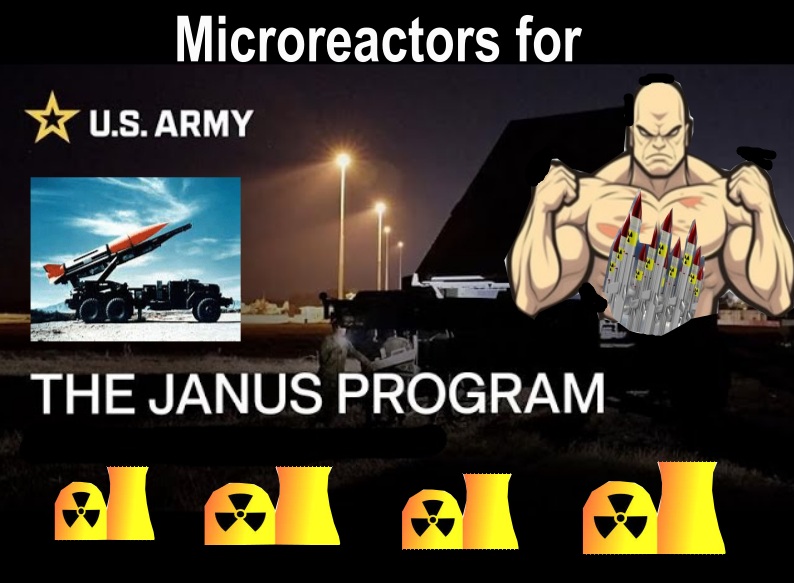
Army Selects Vendors, Sites for Nuclear Microreactors
Aug. 27, 2026 | By U.S. Army Communication and Outreach Office , https://www.war.gov/News/News-Stories/Article/Article/4584583/army-selects-vendors-sites-for-nuclear-microreactors/
The Army announced yesterday that the Janus Program selected five nuclear energy vendors and five initial locations to build and operate nuclear microreactors.
In partnership with the War Department’s Defense Innovation Unit, the Army is awarding up to $2.2 billion in total for these microreactors. The project will deliver safe, secure and reliable nuclear power, strengthening the Army’s ability to project power globally, while supporting the revitalization of American industrial capacity and technological leadership.
“Since launching the Janus Program, our mandate from President [Donald J.] Trump and Secretary [Pete] Hegseth has been clear: secure the power our warfighters need to train, deploy and win,” said Dan Driscoll, Army secretary. “Awarding these contracts accelerates our ability to deliver safe, reliable baseload power directly to our installations. We are building the energy resilience necessary to project combat power globally, without relying on potentially vulnerable external grids.”
With private sector funding expected alongside government investment, the Army expects to build and operate more than 20 nuclear microreactors across War Department installations.
The five selected vendors and installations are:
- Antares Nuclear Inc. at Fort Bragg, North Carolina.
- BWXT Advanced Technologies LLC at Fort Campbell, Kentucky.
- General Atomics Electromagnetic Systems at Fort Hood, Texas.
- Radiant Industries Inc. at Fort Benning, Georgia.
- Westinghouse Government Services at Fort Drum, New York.
………………………………………………………………………………………………………………………………………………………………As the Janus Program moves forward, vendors will bring nuclear technologies to other military installations for continued energy resilience across the entire War Department. The Army will announce additional military sites at a later date and continues to drive toward the September 2028 target outlined in Executive Order 14299 for operation of a first reactor.
“The Army is leading the nation in its return to nuclear preeminence,” said Jason Craft, Janus Program manager. “Our selected industry awardees represent the most viable technologies to achieve this capability, setting conditions for both installation energy resilience and operational energy solutions.”
Using a milestone-based payment model, vendors will receive government funding only after successfully hitting specific technical goals. This investment model brings together approximately $2.2 billion across fiscal years 2027-2031, along with significant capital investment from each vendor.
This technology development model will speed up the delivery of next-generation energy solutions to the warfighter and promote innovation while ensuring accountability, Craft said. The prototype reactors will be contractor-owned and operated. Collaboration with utility providers is needed for the success of the Army’s nuclear power strategy and the Janus Program. The Army will work closely with providers on the program to ensure the best possible outcomes, while continuing to collaborate with them now and in the future.
“The Army’s Janus Program has my full support,” said Emil Michael, undersecretary of war for research and engineering and War Department chief technology officer. “The War Department is acting swiftly to implement President Trump’s executive order. … We are unleashing America’s domestic nuclear industrial base to ensure a more resilient and secure energy supply for the joint force.”
Jellyfish close down France’s largest nuclear reactor

August 28 2026 , https://www.canberratimes.com.au/story/9339000/jellyfish-close-down-frances-largest-nuclear-reactor/
Reactor units at France’s largest nuclear power station in Gravelines have once again been shut down due to an influx of jellyfish.
A spokeswoman for the French operator EDF said on Thursday more than 200 metric tonnes of jellyfish had appeared since last night.
Two of the six reactor units have been completely shut down as a precautionary measure to “ensure that this situation has no impact whatsoever on the safety of (EDF’s) facilities.”
EDF said the jellyfish are appearing in the area of the filter systems at the seawater pumping station.
Consequently, no reactor units are currently in full operation, as two other units are being run at reduced power, and the remaining two have also been shut down, partly due to a maintenance inspection.
The jellyfish disrupted operations in the middle of the month and in August last year.
The Gravelines nuclear power station has set up monitoring systems to detect and manage large-scale jellyfish gatherings at an early stage, EDF added.
The EDF spokeswoman explained that support for this had been provided, among others, by the organisation France Pêche Durable (France Sustainable Fishing).
Seven boats are operating round the clock near the nuclear power station to catch the jellyfish and then release them further out to sea.
The spokeswoman stated that it was not yet possible to comment on the causes of the phenomenon.
She added that the plant was working with various partners to gain a better understanding of it.
The spokeswoman said the incident posed no risk to the electricity grid.
Gravelines is one of just under 20 nuclear power stations in France.
It is situated on the northern French coast, roughly halfway between Calais and Dunkirk.
UN and Red Cross demand immediate global rules on autonomous weapons amid rising AI threats

[your]NEWS, Tue, 25 Aug 2026, https://www.sott.net/article/508094-UN-and-Red-Cross-demand-immediate-global-rules-on-autonomous-weapons-amid-rising-AI-threats
Leaders warn of moral and legal dangers as fully autonomous arms near deployment, urging binding treaties to prevent unchecked use in warfare.
The United Nations Secretary-General António Guterres and the President of the International Committee of the Red Cross, Mirjana Spoljaric, issued a joint warning on Tuesday, stating that the world is “dangerously close to crossing a moral red line: the autonomous targeting of humans by machines.”
“Negotiations must begin now to urgently adopt a legally binding instrument to regulate autonomous weapon systems with clear prohibitions and restrictions,” the leaders stated. Their appeal comes as states prepare to meet in Geneva next week to discuss potential new rules governing the use of AI-assisted and semi-autonomous weapons, which have already been deployed in conflicts in Ukraine, Sudan, Gaza, Iran, and the Gulf.
The discussions, which began in 2014, have seen some progress, but technological advancements have outpaced regulatory efforts. While fully autonomous weapons, such as anti-missile systems on warships, are already in use, there is no confirmed evidence of their deployment against human targets — yet.
Human rights groups have expressed concerns that AI-driven systems may not be adequately predictable or controllable, increasing the risk of fatal errors, such as failing to recognize injured or surrendering soldiers. Additionally, the lack of human oversight complicates accountability in potential war crimes cases.
“States must show political courage and move beyond incremental discussions towards decisive action,” the joint statement urged, pushing for formal negotiations to commence in November during a major review conference held every five years in Geneva.
Carolyne Mélanie Régimbal, chief of service at the U.N. Office for Disarmament Affairs, stated during a Geneva press briefing following the release of the joint statement:
“Some decisions must forever remain with the human being, none more than the decision of taking or not a human life.”
Although states agree that international humanitarian law (IHL) applies to lethal autonomous weapon systems, there are currently no specific binding international standards for these technologies. Opposition from major powers like Russia and the United States, who argue that existing laws are sufficient, has stalled progress. The Geneva talks, which require consensus to move forward, are taking place amid heightened geopolitical tensions and recent European withdrawals from treaties like the landmine ban, driven by Russian threats.
We’re Half a Year Into Trump’s War on Iran. Congress Has Tools to End It.
SCHEERPOST, August 26, 2026, By Hanieh Jodat
The clash over whether the US has a functioning constitutional process for starting and ending wars is coming to a head.
The U.S.-Israeli war on Iran is entering its seventh month after a series of attempts at diplomatic negotiations moderated by Pakistan and other countries in the region. The U.S has embroiled itself in a conflict without a clear exit strategy, and Iran has shown no interest in bending under President Donald Trump’s pressure. As Washington and Tehran continue this agonizing yo-yo of threats, the growing reported number of casualties feel heavy. More than 3,400 Iranians have reportedly been killed, while over 26,000 have been wounded, including at least 4,000 women and more than 1,600 children. On the American side, the Pentagon currently reports that 14 U.S. service members have been killed and more than 700 wounded. However, one Department of Defense (DOD) official accused the Pentagon of “an accounting trick” in order to misrepresent the true casualty figures.
By now it has become obvious that Benjamin Netanyahu played a key role in convincing Trump to start this war of choice, after decades of pushing the United States to attack Iran. In recent years, Israel’s lobby, in collaboration with opposition leaders from the Iranian diaspora — including the son of Iran’s late Shah Reza Pahlavi and his monarchist advisors — and a group of hawkish American officials pushed the U.S. to the brink of this war.
Until recently, those attempts were unsuccessful — that is, until they finally found a U.S. president who would risk a strategic disaster and economic collapse for one of the most quickly unpopular wars in U.S. history. But after half a year of war, the question is no longer how we arrived at this war, but more so how Congress might limit the executive branch and force an end to the military hostilities.
Poll after poll reveals that people in the U.S. are increasingly questioning the motivation and cost of the war. After decades of U.S. military interventions across the Middle East and West Asia that have cost trillions of dollars without any sign of success, Americans have expressed their exhaustion with the financial and human toll of another conflict. A Reuters/Ipsos poll conducted in late July found that only 33 percent of people in the U.S. supported the war with Iran, the lowest level of support measured since the conflict began. Sixty-nine percent said President Trump had failed to explain the objectives of the military operation in Iran clearly.
Diplomacy and negotiations between the U.S. and Iran have repeatedly faltered since Trump entered office for the first time and pulled out of a landmark nuclear deal engineered by the Obama administration. The possibility of a lasting political settlement remains buried beneath the weight of the bombs dropped on civilians, sanctions, military threats, and political calculation. And the consequences of the war of choice with Iran are not confined to the Middle East. Rising food and energy prices, inflation, regular attacks on U.S. bases with an unknown number of U.S. casualties, and the uncertainty over the war’s future have shifted the way both Americans and the rest of the world view U.S. recklessness. And the frustration has only gotten worse; by August, roughly two-thirds of people in the U.S. opposed the war outright, according to Reuters polling.
In the face of clear American opposition to the war, the question now is whether the United States has a functioning and democratic constitutional process for deciding when a war begins, how long it continues, and when it ends.
While Trump and his war cabinet have swung back and forth between the promise of diplomacy and peace or the threats of further military escalation, Congress has unsuccessfully attempted several times to reassert its constitutional authority. Only Congress has the power to declare war, and the 1973 War Powers Resolution gives the president a 60-day clock to terminate hostilities without congressional approval. The president has now blown through that deadline — bringing about several constitutional questions for lawmakers.
An Ever-Expanding War……………………………………………………………….
A Path Forward Beyond More War Powers Resolutions
Congress can strengthen congressional oversight over the war by requiring mandatory reporting, conducting investigations, and using the Government Accountability Office (GAO) to audit the executive branch. How can Congress exercise its war powers if it doesn’t know what the Trump administration seeks to do?…………………………………………………………………………………………………………………………………………………………………………………………………………………………………………………..https://scheerpost.com/2026/08/26/were-half-a-year-into-trumps-war-on-iran-congress-has-tools-to-end-it/
Beyond China’s humanoid robots, a quieter machine revolution is unfolding
Laura Bicker, 25 Aug 26,
https://www.bbc.co.uk/news/articles/c62m4zn1q6mo
“I take a nap and the world changes,” says Chen Tianyu.
His world certainly does. The 28-year-old keeps up with the latest technology by spending his spare time in factories that are switching to automation. That way he knows what to prioritise when teaching his class about artificial intelligence (AI) and robotics.
In front of him, around 30 college students are studying code. One of them is typing furiously as his eyes dart from the screen to the robot: “The idea is it will grab that cylindrical piece and move it over there.”
A line of industrial robots are waiting to be programmed, and in another part of the classroom, students are trying to develop robotic medical instruments. As he guides them, Chen declares: “If you are not needed by the world of AI and robotics, then you’ll definitely be among those eliminated”.
For the people in this room, this is a step – or rather a leap – towards a future that China is meticulously building: Xi Jinping’s $20bn (£14.7bn) plan to put his country at the forefront of innovation and in direct competition with the US.
The evidence is all around them. They are in the Hangzhou Technician Institute, one of several huge, purpose-built vocational schools that want to churn out the next generation of tech-savvy engineers. The campus sits on the outskirts of Hangzhou, a former imperial capital whose futuristic skyline is just the first hint of its role as a global tech hub.
Across the country, there are more than two million robots working in China’s factories – which is more than anywhere else – and they are continuing to scale up at extraordinary speed.
It is a commitment that will surely change the world, much like the last time the Chinese economy underwent a massive transformation. It is already shipping its robots across the globe: more than half of the world’s industrial robots are now made in China.
What is less clear is the impact of such sweeping automation in a country that sits at the heart of global manufacturing, trade and innovation. What does this mean for China’s human workforce, for instance? And how would we be able to truly measure the cost of this transformation in a regime that controls information so tightly?
The future of China’s workers is uncertain in the industrial revolution the world has been watching: gleaming solar grids, peak hours made noiseless by electric vehicles, machines that run faster than Usain Bolt. Over the weekend, China hosted the second edition of the World Humanoid Games where robots boxed, sprinted and marched.
What is fuelling this spectacle is another, less visible revolution happening inside factories and classrooms.
The BBC has visited industrial sites where we have been shown robots that do not look human, or dance or leap on stage but weld, paint, lift, assemble and work around the clock without a break or benefits. Some are designed to build more robots. We have also been inside academies where China is training the people who will work alongside its robotic workforce.
This is a front-row seat to what Xi calls China’s “new productive forces” – and how they could reshape the country.
On a factory floor in the southern city of Chengdu, the old and and the new are working side by side.
An assembly line of around 30 middle-aged men and women is screwing, drilling and polishing CRP Technology’s signature product: a robotic arm which performs various industrial tasks. Also in the room are four young engineers crowded around a console, trying to crack the code for a prototype, a new robot that they hope will help build other robots.
One of them, 31-year-old Pang Kai, who is part of the research and development team, pushes the sleek skeleton across the room. Because China’s future workforce is not quite ready to strut out. For now, it can only do simple repetitive movements, such as scan a QR code.
“Maybe in another half year, it can do another task,” Pang says, smiling wistfully. It’s a long road and the team are celebrating every small win.
CRP Technology, which employs around 300 people, has been building robot arms for nine years. Each arm can be tailored to a factory’s needs to help build cars, electronics or wind turbines. The firm says a single arm can be programmed to perform more than 90% of repetitive tasks.
The engineers also wonder if, one day, they can replace the company’s workforce. “We want our new robot to be like human beings. We hope it can think by itself,” says Pang. “We need these kinds of robots because maybe in 10 years, we won’t have enough workers in China.”
A shrinking population and an ageing workforce is another reason Beijing is in a hurry to revolutionise its factories. By 2035, more than a third of China’s population will be over 60, according to official estimates. The country will also lose nearly 60 million people in the next decade – almost equivalent to the population of France – according to some estimates.
The hope is that increased automation will fill this looming gap in the workforce before it starts to affect an already sluggish economy. But the speed of the transition is key. Around 120 million people still work in the manufacturing sector. If China moves too quickly, job losses could follow dealing a catastrophic blow to millions who depend on factory wages.
“In theory, machines can work 24 hours a day, which is certainly an advantage compared with human workers. But machines also require maintenance. Every day we need time for that, and each month the production line also requires inspection and repair,” says Cao Li, vice-president of EV maker Leapmotor.
Increasingly popular in Europe and the UK, the company’s budget-friendly, tech-focused cars come together at the Hangzhou factory with robots aiding the process at every step. At the end of the assembly line, more humans emerge.
The company has more than 25,000 workers and hundreds of them make the final checks as the sparkling new vehicles roll past. Will there be a day when they are no longer needed?
“It’s entirely possible,” Cao says. “And it may come relatively quickly. In workshops, including stamping, welding, and painting, we’ve basically achieved 100% automation.”
China has the edge over the US due to its enormous manufacturing base. Motors, batteries, electronics, gears, sensors – everything needed to build the body of a robot is all at hand.
“China also has an idea. It has a plan. They know where they want to be in five years. They plan at a top level, but they break it down to the regions, to the municipalities,” says Dr Susanne Bieller, General Secretary of the International Federation of Robotics.
“If you want to build a robot in Shenzhen – there’s an entire ecosystem. It takes you less than one hour to source the components you need to make a robot. In Europe it can take you up to a week.”
However, she acknowledges that while China is good at building the body, the US is still leading at building the “brain”, which includes developing the AI to programme robots. And yet Chinese firms, from DeepSeek to Moonshot, have been unveiling new AI models that they say can compete with top US firms.
Driven by an “open-source” approach, where AI start-ups share their code, Chinese innovation has been able to catch up faster than expected, despite US export controls over critical advanced chips. Analysts now believe that the next leg of this race will be determined not by who has the best language model, but who can put this intelligence into millions of machines.
And that is why China is also investing in producing a generation of students learning to imagine what could come next.
At the Hangzhou Technician Institute, for example, children can start from the age of 15. And the scale of what is being taught can feel staggering. There is an entire building dedicated to engines and aeronautics, and a restricted floor for students who will work to keep China at the forefront of processing rare earths – another crucial commodity in the battle with Washington.
Some see this as a solution to China’s stubbornly high youth unemployment rate, with one in five struggling to find a job. “Our students are in demand and can even be pre-booked by companies. They don’t need to worry about employment at all, and we hold competitions as part of their training,” Chen, the young teacher, says.
“It’s better to find your position within the technological wave. In the process of progress, structural changes are bound to occur, and these structural changes are exactly where students’ future employment opportunities lie.”
But China still faces serious economic challenges, from a property crisis that continues to drag on to huge local government debt and persistently low consumption.
Hospitals to stock anti-nuclear pills near AUKUS base
Carla Hildebrandt, August 26, 2026 —https://www.watoday.com.au/national/western-australia/the-plan-to-stock-anti-nuclear-pills-at-hospitals-in-perth-s-southern-aukus-suburbs-20260825-p60re6.html
Hospitals in Perth’s southern suburbs could distribute iodine tablets to the community in the “extremely low” chance of a radiation spill, as WA prepares for the arrival of nuclear-powered submarines under the AUKUS partnership.
It comes as the first US and UK submarine rotations are due to begin next year through Garden Island’s naval base, HMAS Stirling, under Submarine Rotational Force-West (SRF-West).
The plans emerged earlier this year after Legalise Cannabis WA MP Dr Brian Walker questioned the health minister in parliament about the government’s emergency preparedness ahead of the incoming visits.
During question time, Walker asked whether the state government would supply the anti-nuclear pills to locals, “as a treatment against radiation poisoning in the event of a nuclear leak or spill”.
An emergency guide released by the Australian Radiation Protection and Nuclear Safety Agency, which leads the national response to a nuclear emergency, describes taking potassium iodide – or KI pills – as a “short-term” measure that blocks radioactive iodine from being absorbed by the thyroid.
The health minister wrote a response to parliament stating the WA Department of Health “has established plans and exercised processes to pre-position and distribute supplies of stable iodine to local hospitals, as required, based on needs and relevant circumstances”, but did not reveal which hospitals would hold the tablets or how many would be available.
Walker said the state government lacked “a clear emergency plan” for communities like Rockingham, Cockburn and Kwinana.
He pointed to France, where iodine tablets have been distributed to communities near nuclear facilities, but warned the pills were only one part of preparing for a potential emergency,
Port Hope’s past fuels pushback on nuclear reactor
The Canadian Press, 21 Aug 2026
The Ontario government announced earlier this year that it will build one of the world’s largest nuclear power plants in Port Hope, Ontario. Though the news was welcomed by some, it shocked a generation of Port Hope residents old enough to have lived through or learned of the community’s fraught history with the nuclear industry.
The nuclear history of Port Hope – told in “Blind Faith”.

 Blind Faith: The Nuclear History of Port Hope, Ontario January 15, 2015 by Dennis Riches @DennisRiches “……..hibakusha (the Japanese word for radiation victims) become invisible. When a new group of people become victims, such as in Fukushima in 2011, they feel that they have experienced a unique new kind of horror. For them, for their generation, it is new, but for those who know the historical record, it is a familiar replay of an old story. The people of Fukushima should know by now that they are bit players who have been handed down a tattered script from the past.
A case in point is “Blind Faith,” the superb 1981 book by journalist Penny Sanger, about the small irradiated Canadian town of Port Hope on the shores of Lake Ontario. (See the timeline at the end of this article) [2] In the 1970s it faced (and more often failed to face) the toxic legacy of processing first radium, then uranium for nuclear weapons and nuclear power plants.
In a saner world this book would not be out of print and forgotten. It would be a classic text known by everyone who has ever had to share his town with a dangerous corporate citizen. Then there would be no surprises when a nuclear reactor explodes or a cancer cluster appears somewhere new. It wouldn’t be a shock to see the victims themselves fall over each other in a rush to excuse their abuser, beg for a continuation of jobs and tax revenue, and threaten the minority who try to break the conspiracy of silence.
On the back cover of the 1981 paperback edition of “Blind Faith” there was an endorsement by the late great Canadian writer Farley Mowat, who passed away in the spring of 2014:
Penny Sanger has written a fascinating and fearsome account of the emotional turmoil that engulfs a small town when it discovers that its major industry is a threat to the health of its citizens. This is a classic account of how economic power enables industry to ride roughshod over those who must depend on it for their daily bread.
Although I wrote above that “Blind Faith” illustrates universal truths about what happens to communities contaminated with radiation, there are always unique aspects of the situation that come into play. In this case, we see the extreme complacency and obliviousness of Canadian society to the role that the country played in the development of nuclear weapons and nuclear power.
The uranium refinery in Port Hope was a key element in the Manhattan Project. ………
One stand-out account is that of a widow whose husband, a long-time Eldorado worker, had died of lung cancer at age 50. He had worked at Eldorado for over twenty years, during the era when workplace monitoring and standards were non-existent. Her husband was no longer there to say whether he too was “philosophical” about it and “couldn’t be bitter about it” like his wife and his daughter claimed. The widow said that in spite of her husband’s shortened life, they were grateful for the good jobs and university education that the children were able to get. Thanks to Eldorado, they had come up in the world.
Penny Sanger passed no judgment on this thinking, but I find it to be a rather disturbinging example of working man’s Stockholm Syndrome. The victim has internalized the values of the captor, and lost self-esteem and critical thinking skills in the process. The bereaved family shrugs that they “can’t be bitter about it.” They’ve internalized the value that children have to go to university to live worthwhile lives, and it’s alright if parents have to kill themselves to accomplish this goal.
It seemed to never occur to any of the Port Hope boosters that there were dozens of similar towns in rural Ontario that had found ways to survive without hosting toxic industries. I know a family of Polish immigrants who landed in Port Hope in the 1960s, and they managed to get by without working for Cameco. The children had the sense to leave town after high school when they saw their friends going straight to grim lives working with the yellowcake down at the plant. One of them managed somehow to get a couple of university degrees after he left town.
This lack of imagination among the terminally hopeful applies more widely. Not only do company towns fail to imagine less toxic ways to live, but large nations also fail to imagine new paradigms for energy and economic systems……..
“Blind Faith” is available on a website dedicated to the history of Port Hope. Since it is out of print and over thirty years old, I asked the author if she would allow its free distribution as a pdf file. She gave her permission, but of course the common sense rules apply. If you want to sell the book, ask the author for permission. If you redistribute it free, in whole or in part, do so with proper citation.Read it in a web browser:
http://www.porthopehistory.com/blindfaith/blindfaith.htm
Free download (permitted by author):
Penny Sanger, “Blind Faith” (pdf) (McGraw-Hill Ryerson, 1981), 135 pages. http://www.mintpressnews.com/MyMPN/blind-faith-nuclear-history-port-hope-ontario/
US treasury chief claims Washington ‘unlikely to restart’ large-scale hostilities against Iran
Bessent said that illegal US sanctions are a replacement for a war of aggression that has failed to break Tehran
News Desk, AUG 20, 2026, https://thecradle.co/articles/us-treasury-chief-claims-washington-unlikely-to-restart-large-scale-hostilities-against-iran
US Treasury Secretary Scott Bessent told CNBC on 20 August that Washington will likely “not restart” large-scale military operations against Iran, as the White House shifts to a campaign of maximum economic sanctions.
If we are doing the maximum economic pressure, then that means that likely there will not be a large-scale kinetic restart,” Bessent said in an interview with CNBC’s Squawk on the Street news program.
Trump had announced hours earlier on Truth Social that Washington would impose major economic penalties on any country extending Tehran what he called “any type of lifeline.”
“This will be an ECONOMIC D-DAY, and we need all of our Allies to stand with the United States of America to isolate, and defeat, the Iran threat,” Trump wrote.
Bessent said he would lay out the details of the plan at a press conference, telling CNBC that the message to every US ally would be: “You are either with us or against us.”
“If you insist on doing business with [Iran], either transferring money, buying their oil or doing seaborne ship transfers, then the US Treasury and the US government … will put its full might and force toward enforcing against you,” he said.
He described the campaign as “the greatest coordinated economic isolation in the history of the world.”
Iranian Foreign Minister Abbas Araghchi dismissed the campaign the same day, writing on X that it would deliver Washington nothing but “further defeat.”
“The so-called ‘Economic D-Day’ is a diversion from America’s own crisis: unprecedented debt & surging interest costs,” Araghchi wrote, describing US “economic terrorism” as a threat to the global economy.
Iranian Deputy Foreign Minister Kazem Gharibabadi said Washington had reached for economic warfare only after its military campaign failed to deliver.
“They claim Iran is on the verge of defeat and hanging by a thread, yet they are begging all their allies to help them,” he wrote on X, adding that the US had “named their next failure an ‘economic war.’”
Vice-Chairman of the Belt and Road Institute in Sweden Hussein Askary notes that the US naval blockade imposed in April has pushed Iran to shift its trade overland, sharply increasing freight traffic on the China–Iran railway and raising the strategic value of Eurasian land corridors as Tehran works to keep supply routes open beyond the reach of maritime pressure.
The Pentagon is reviewing whether to scale back its presence in Persian Gulf states after Iranian retaliatory strikes battered the largest US bases overseas, with sources saying a westward pullback is under consideration.
A regional intelligence source told Press TV that the Pentagon has concluded no military plan exists that could guarantee open shipping through the Strait of Hormuz, which carries roughly one-fifth of the world’s oil.
Big Oil Is Betting Billions On Nuclear Fusion

Oil Price, By Alex Kimani – Aug 25, 2026,
- Fusion is shifting from research toward commercialization, with private investment hitting a record $4.48 billion in 2025 and commercial plants targeted for the 2030s and 2040s.
- Eni is making one of Big Oil’s biggest fusion bets, backing Commonwealth Fusion Systems, committing $1+ billion to its future electricity and developing critical tritium fuel-cycle technology.
- Chevron, Equinor, Shell and Cenovus are also investing heavily, spreading bets across competing fusion technologies that could eventually transform global power generation.
After decades confined largely to laboratories, nuclear fusion is beginning to attract the kind of money and industrial planning normally reserved for technologies expected to make it onto the grid. Global private investment in fusion hit a record $4.48 billion in 2025, up 69% from a year earlier, while some of the world’s largest energy companies are moving beyond simply backing fusion startups.
Italian energy giant Eni S.p.A. (NYSE:E) now plans to deploy a commercial fusion power plant in Europe by the early 2040s or sooner, building on its investment in Commonwealth Fusion Systems and a more than $1 billion agreement to buy electricity from the startup’s first commercial U.S. plant. Eni is also looking beyond power generation, using decades of experience processing hydrocarbons and hydrogen to build a business around the fuel systems future fusion plants will need to operate.
“Competition is growing in the fusion industry after the technology and expectations had changed significantly in the past 5-6 years,” Francesca Ferrazza Eni’s head of magnetic fusion initiatives, told the Financial Times in an interview. “It was always considered research. Now we are considering it as an industry.”
Commonwealth Fusion Systems raised another $1 billion in July, bringing its total funding to $4 billion as it targets the early 2030s for its first commercial power plant. The planned 400-MW ARC facility in Virginia became the first fusion project to apply for interconnection with PJM earlier this year, while Google has agreed to buy 200 MW of its output. Eni has committed more than $1 billion to buying electricity from the plant.
Eni also wants to build a business supplying the fuel systems necessary to keep commercial fusion reactors running. The company plans to use its experience processing hydrocarbons and hydrogen to recover, purify and recycle deuterium and tritium, the two hydrogen isotopes used as fuel by many fusion reactor designs. To that end, Eni has formed a JV with the UK Atomic Energy Authority to develop and sell those services globally, giving the Italian company a potential source of fusion revenue beyond owning plants or selling electricity.
Tritium is much harder to extract than deuterium. Deuterium is stable and abundant enough to be extracted from seawater, where roughly one in every 6,700 hydrogen atoms is deuterium. Tritium is radioactive, has a half-life of just 12.3 years and exists naturally only in tiny quantities. A 1-GW deuterium-tritium fusion plant could consume roughly 55 kilograms of tritium per year, far beyond what could be supplied from naturally occurring sources.
That means commercial reactors will need to produce much of their own tritium and continuously recover and recycle unused fuel. In turn, that requires closed-loop systems capable of extracting tritium from reactor breeding blankets and exhaust, purifying it and feeding it back into the reactor. Eni is developing a large-scale tritium fuel-cycle facility at the UKAEA Culham Campus in Oxfordshire to test those processes under conditions designed to replicate future fusion plants. The facility is scheduled for completion in 2028.
Fusion’s Other Big Oil Backers
Equinor, Chevron, Shell and Cenovus have spent years building positions across the fusion industry, backing competing reactor technologies before any of them have produced commercial electricity. …………………………….
https://oilprice.com/Alternative-Energy/Nuclear-Power/Big-Oil-Is-Betting-Billions-On-Nuclear-Fusion.html
UK seeks to tighten security of supply chains after Iran-linked cyber attacks
The UK government is seeking to change the law so that it can block
companies from buying products from high-risk suppliers, in a move that
comes shortly after news that a hacking group had shut down a small energy
facility.
Ministers could demand companies in critical sectors such as
energy, healthcare and telecoms take extra security measures such as
implementing a phased removal of certain vendors or be banned from
acquiring technology from them under proposals announced on Monday.
The vulnerability of key UK infrastructure was highlighted by Sunday’s
revelation that hackers thought to be linked to Iran had forced a small gas
plant offline. The National Cyber Security Centre has also warned that
companies must do more to guard against cyber attacks. The government’s
plans were introduced via amendments to the Cyber Security and Resilience
Bill and are subject to parliamentary approval. They will seek to safeguard
the supply chains of companies, which are often used as a “soft
underbelly” by hackers seeking to target larger groups.
FT 24th Aug 2026,
https://www.ft.com/content/3d46e4cb-4dee-4f49-adc1-0bb0f63d4c49
1 This Month





PLEASE OPPOSE HR 8255 AND S.3639 – bills would accelerate satellite deployment, with no environmental review or safeguards – https://ncstd5li.quorum.us/campaign/169331/
To see nuclear-related stories in greater depth and intensity – go to https://nuclearinformation.wordpress.com
-
Archives
- October 2026 (81)
- September 2026 (339)
- August 2026 (330)
- July 2026 (355)
- June 2026 (287)
- May 2026 (306)
- April 2026 (356)
- March 2026 (251)
- February 2026 (267)
- January 2026 (308)
- December 2025 (358)
- November 2025 (359)
-
Categories
- 1
- 1 NUCLEAR ISSUES
- business and costs
- climate change
- culture and arts
- ENERGY
- environment
- health
- history
- indigenous issues
- Legal
- marketing of nuclear
- media
- opposition to nuclear
- PERSONAL STORIES
- politics
- politics international
- Religion and ethics
- safety
- secrets,lies and civil liberties
- spinbuster
- technology
- Uranium
- wastes
- weapons and war
- Women
- 2 WORLD
- ACTION
- AFRICA
- Atrocities
- AUSTRALIA
- Christina's notes
- Christina's themes
- culture and arts
- Events
- Fuk 2022
- Fuk 2023
- Fukushima 2017
- Fukushima 2018
- fukushima 2019
- Fukushima 2020
- Fukushima 2021
- general
- global warming
- Humour (God we need it)
- Nuclear
- RARE EARTHS
- Reference
- resources – print
- Resources -audiovicual
- Weekly Newsletter
- World
- World Nuclear
- YouTube
-
RSS
Entries RSS
Comments RSS

