Eight years after triple meltdowns and explosions at the Fukushima-Daiichi nuclear power plant in Japan, major problems remain and many impacts are yet to manifest

Beyond Nuclear Press Release
Thursday, March 7, 2019
TAKOMA PARK, MD — The legacy of the Fukushima nuclear disaster will continue indefinitely, creating long-term problems for human health, radioactive waste management and the environment:
- Around 1.09 million tons of radioactively contaminated water — used to cool the destroyed reactor cores as well as groundwater flowing across the site — is being stored onsite in growing tank farms, which are now at capacity. Absent other options, Japanese authorities are looking to dump this radioactively contaminated water into the Pacific Ocean, a move strongly opposed by Japanese fishermen, ocean protection groups and the worldwide environmental community.
- In an effort to downplay or dismiss the health dangers of radiation exposure, the Japanese government has ended financial benefits to Fukushima evacuees, putting economic pressures on these families to return to the region, even though it has not been — and cannot be — adequately or effectively cleaned up and made safe for human habitation. According to noted physicist, Dr. Bruno Chareyron, who has conducted field measurements in the area, “The radioactive particles deposited on the ground in March 2011 are still there, and in Japan, millions of people are living on territories that received significant contamination.”
- In order to justify the return of evacuees and claim the region is now safe, Japanese regulatory authorities have raised the allowable radiation dose from I milisievert per year to 20, an unacceptably high rate that is especially dangerous for pregnant women and children. This policy has been cited by a UN Special Rapporteur as having “potentially grave impacts on the rights of young children returning to or born in contaminated areas.”
- Plans by Tepco and the Japanese government to begin removing melted reactor fuel in 2021 are fraught with risk and uncertainty since little is still known about its condition and there is no safe, permanent radioactive waste management plan in place.
- The Japanese government plans to hold two events — softball and baseball — in the Fukushima Prefecture during the 2020 Tokyo Olympics, a public relations maneuver to “normalize” the situation. However, in addition to unacceptable radiation exposure doses, particularly from hot spots, the discovery of radioactive particles of reactor fuel debris in the area, including uranium and cesium, would put both athletes and spectators at risk.
- The implications for returning populations to the Fukushima region come with dire warnings from the health findings in Macaque monkeys who have lived there continuously. The monkeys have been found to have bone marrows that are producing almost no blood cells, and mothers are giving birth to babies with reduced brain sizes. With a 7% difference in DNA with humans, these outcomes are alarming.
- Scandals surrounding the ill treatment of workers at the stricken Fukushima plant, many of whom are migrants and already low-income, continue. UN human rights experts found these workers to have been exploited and their health willfully jeopardized, with workers coerced “into accepting hazardous working conditions because of economic hardships, and the adequacy of training and protective measures.”
- Despite widespread public opposition in Japan, the Abe government continues to try to restart nuclear reactors. However, only nine of the 42 still operable reactors are back on line (out of 58 originally). The government has instead turned its attention to the nuclear export market, but this took a serious hit when Toshiba’s Westinghouse nuclear division went bankrupt two years ago and Hitachi withdrew from two new nuclear power plant projects in the UK in January 2019.
Survey: 52% in Fukushima see progress toward recovery

February 28, 2019
A combined 52 percent of respondents said either some or much progress had been made toward recovery in the prefecture. In contrast, only 7 percent gave those responses in the 2012 survey while the figure rose to 36 percent in the 2016 survey.
A combined 44 percent said little or no progress had been made toward recovery, according to the latest survey, the ninth one conducted.
Asked when they think their lives will return to pre-disaster conditions, 56 percent said “beyond 20 years.” Half of the residents who said some or much progress had been made toward recovery gave this response.
A combined 60 percent of respondents said they were very much or somewhat concerned about the effects of radioactive materials released by the triple meltdown.
Seventy-eight percent of respondents said they felt the general public’s interest over victims of the nuclear disaster was weakening.
Sixty-one percent of respondents were against the government’s plan to use contaminated soil with low levels of radiation for public works projects in Fukushima Prefecture. Only 27 percent of respondents supported that move.
Seventy-three percent of female respondents opposed the use of the contaminated soil, compared with 49 percent of men.
Asked about a plan to dilute the contaminated water and release it into the ocean, 65 percent of respondents were opposed, a slight decrease from the 67 percent who objected in last year’s survey.
Only 19 percent supported the release of diluted water to the ocean, unchanged from last year’s survey.
A combined 87 percent of respondents said they were greatly or somewhat concerned that the release of the diluted water would create negative publicity for Fukushima seafood and produce.
Moreover, 65 percent of Fukushima respondents said lessons from the nuclear disaster have not been reflected in the central government’s nuclear energy policy. Only 16 percent said the lessons were being used effectively in nuclear policy.
Read more:
‘Reconstruction Olympics’ theme said not to have gathered momentum

Azuma Stadium in the city of Fukushima in March 2017, will host the baseball and softball competitions during the 2020 Tokyo Olympics
Feb 27, 2019
AOMORI – Half of 42 municipalities in northeastern Japan hit by a massive earthquake in 2011 said the public is not fully aware of the government’s efforts to showcase the region’s recovery from the disaster through the 2020 Tokyo Olympics, a Kyodo News survey showed Wednesday.
The heads of 21 local governments in Fukushima, Iwate and Miyagi prefectures said in the survey that the “reconstruction Olympics” theme has yet to fully catch on among the public.
Asked whether the slogan has gained public attention, two mayors said “it has not” while 19 mayors said “it mostly has not.” Eighteen said “it has a little” and two said “it has.” The remaining municipality — the Fukushima city of Soma — did not answer.
“The phrase ‘reconstruction Olympics’ was thought up but no substantial progress has been made and the affected areas feel left behind,” said an official of the town of Minamisanriku in Miyagi Prefecture. “We have limited manpower and cannot spare personnel for Olympic events.”
“The sporting event will be held under the banner of the ‘reconstruction Olympics’ but venues are centered on Tokyo,” said an official of Otsuchi, Iwate Prefecture.
Asked what they expect from the Tokyo Games in a multiple-choice question, the biggest group, of 36 mayors, picked “promoting our progress toward recovery,” while 20 mayors, mainly from Fukushima, chose “overcoming reputational damage.”
“We want to use the Olympics as a chance to regain sales channels for our farm products,” said an official of the Fukushima town of Namie.
Read more:
Fierce opposition to recycling radioactive soil from Fukushima

Radiation-contaminated soil is kept temporarily in Futaba, Fukushima Prefecture, before being moved to an intermediate storage facility
February 26, 2019
How to dispose of mountains of soil contaminated by radiation from the 2011 Fukushima nuclear disaster poses a massive headache for the central government.
Officials had long insisted that contaminated surface soil removed after the triple meltdown at the Fukushima No. 1 nuclear power plant would eventually be stored outside of Fukushima Prefecture.
According to one estimate, the total volume of such soil will reach 14 million cubic meters by fiscal 2021. Local entities outside of Fukushima are understandably hesitant about serving as host to such vast quantities of possibly hazardous dirt.
Officials in Tokyo are now hoping to sway local governments to act as hosts by proposing reuse of the contaminated soil for public works projects under certain conditions.
One requirement would be that soil radiation levels below 8,000 becquerels per kilogram, the standard used by the government in classifying whether the waste material requires special treatment, could be used for various construction projects.
This poses a dilemma for Fukushima Prefecture, which fears local residents will be stuck with the problem despite repeated pledges by the government to move all contaminated soil from the prefecture.
Work got under way four years ago to move contaminated soil to intermediate storage facilities in Fukushima Prefecture. As of Feb. 19, the volume of soil transported to those facilities totaled 2.35 million cubic meters.
Read more:
Post-disaster recovery of Fukushima folk dances lags without return of evacuees
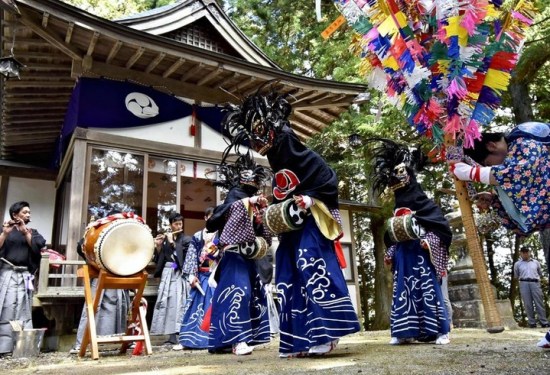
The Sanbiki Shishi-mai, or “Three lion dance,” is performed by local children for the first time in eight years at Yasaka Shrine in the Yamakiya district of Kawamata, Fukushima Prefecture, on Oct. 7, 2018.
February 26, 2019
FUKUSHIMA — A recent survey found that activities for 80 folk performing arts, including kagura and nenbutsu odori dancing, which were suspended after the 2011 disaster at Tokyo Electric Power Company Holdings, Inc.’s Fukushima No. 1 nuclear power plant in 15 municipalities in Fukushima Prefecture had resumed.
Thirty percent of such arts were having trouble continuing, with some having suspended activities again or being forced to change or cut back on performances, according to the survey by Minzoku Geino o Keishosuru Fukushima no Kai, a Koriyama-based nonprofit organization that supports folk performing arts in the prefecture.
“Without both passionate skilled leaders and sympathetic companions, performances won’t last long even if they resume,” a specialist said.
Read more
Teaching about radiation after Fukushima
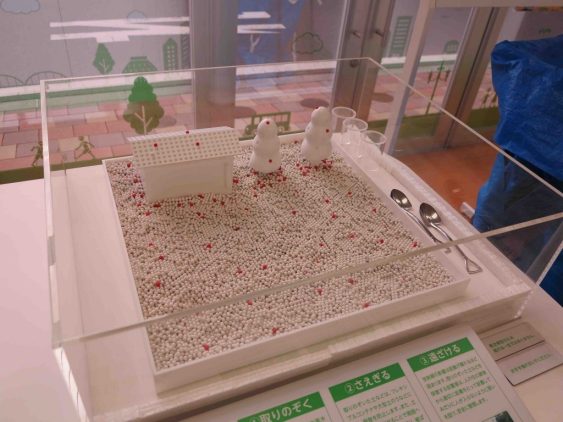 An interactive model at the Decontamination Info Plaza in the city of Fukushima allows visitors to “decontaminate” a house and yard.
At the entrance to the Fukushima Prefectural Centre for Environmental Creation, a friendly hippopotamus-like mascot welcomes visitors while accepting hugs from children. Buzzing with young families, this government-sponsored scientific hub was created to explain the phenomenon of radiation to the population of Fukushima, the victims of the eponymous 2011 nuclear disaster.
Inside the main annex, an interactive model explains how external radiation exposure can be lowered. Visitors are encouraged to increase their distance from a radiation-emitting device while making use of shielding, thereby lowering their overall exposure. In another corner, children are learning about the radioactive isotopes released during the disaster, although representations of these perils are anything but threatening. Using posters and comic books, radionuclides such as plutonium‑239 and cesium‑137 are represented as adorable anthropomorphic figures. Each radionuclide has its own characteristics, such as pronounced eyebrows or a distinctive hairstyle. There is no discussion about how exposure to these radionuclides can cause serious bodily harm—an increased risk of cancer, for example.
In the aftermath of the Fukushima meltdowns, which triggered a released of radioactive pollutants, the Japanese state initially decided to increase the mandatory evacuation trigger from 1 millisievert of radiation exposure per year to 20 millisieverts per year. In other words, the public was forced to accept a new threshold of safety. While this policy caused much scientific and public controversy, 20 millisieverts per year remains the benchmark for what is considered safe in Fukushima. Places like the Centre for Environmental Creation downplay the controversy of a raised threshold of exposure.
Situated in the town of Miharu and opened in July 2016, the center was established by the prefecture of Fukushima, with the financial support of the Japanese government, to conduct research and provide education on radioactive contamination. The center is one of several government-sponsored revitalization projects aimed at rebuilding the trust of people living in Fukushima. Mostly visited by young families, it represents a new approach to risk communication. As a technical advisor explained to me, this approach aims to “deepen the understanding of children about radiation” by allowing visitors to experience information firsthand through interactive games, fun activities, and cute presentations.
Past efforts to present nuclear science in appealing ways have often blended education with propaganda. The 1957 Disney TV episode Our Friend the Atom is a perfect example of this. What are the dangers of resorting to such forms of explanations in the aftermath of a nuclear disaster? In 2015 and 2017, I spent a total of 14 months in Japan examining the public’s interactive experience at state-sponsored centers and public activities that explain radiation. I found that while the information on radiation is easy to understand, many aspects of its hazards are carefully concealed. In particular, the government’s educational approach shifts the post-Fukushima Japanese public’s attention away from manmade danger and toward a vision of naturalness, technological amusement, and scientific amazement. In doing so, this approach downplays the risk inherent to residual radioactivity in Fukushima.
The naturalness of radiation. One way to neutralize the perceived harmfulness of radiation is to make the phenomenon appear as natural as possible, by emphasizing the radioactivity coming from natural sources. At the Centre for Environmental Creation, one of the most popular attractions is an enormous spherical theater, where visitors are bombarded with sounds and images in a 360-degree multisensory experience that describes radiation as a natural part of daily life. “It can be found everywhere! From the sun’s ray to the mineral in the earth,” claims the theater’s narrator. “Without radiation, no life would exist on Earth!” After these explanations, an enormous Boeing passes above theatergoers’ heads in the cinematic sky, and the amount of radiation exposure received during an intercontinental flight is said to be higher than the level of radiation found in Fukushima. Their necks strained upward, visitors mumble words of apparent relief.
What the theater fails to explain, however, is that there is nothing natural about the radioactive isotopes released during the Fukushima nuclear disaster, and that background radiation has little to do with the hazards of breathing or swallowing fission products—which are not rays, but dust-like particles. For instance, strontium 90, if inhaled or ingested, mimics calcium to enter an individual’s bone marrow and cause lifelong radiation exposure. This exposure can cause mutations in living cells—a permanent alteration that can lead to cancers, genetic problems, or immune disorders.
It’s all fun and games. Information about radiation is often promoted through an enjoyable experience that conceals disturbing aspects of the phenomenon. In front of a giant interactive screen, for example, children can move their bodies to “block” radiation. By selecting the proper material, they can block either radioactive alpha particles, beta particles, or gamma rays. They pretend that their bodies are thick metal plates used to hamper harmful external exposure. By doing so, they collect points, and at the end of the game, the child with the highest score wins.

In an interactive game at the Fukushima Prefectural Centre for Environmental Creation, participants use their body movements to “block” radioactive rays or particles
By transforming radiation protection into a game that focuses on blocking external radiation, children do not learn of the risk of internal contamination from radioactive particles such as cesium 137, which was released in significant amounts by the Fukushima disaster. If internalized, cesium 137 gets distributed throughout the body, irradiating soft tissues such as muscles and ovaries. And because the children’s game blocks radiation in “real time,” there is no mention of any delayed health effects of radiation exposure, such as potential harmful genetic changes.
At the Decontamination Info Plaza, the government promotes similar activities. Situated in the city of Fukushima, the Plaza was established in January 2012 as a joint program between the prefecture of Fukushima and Japan’s Ministry of the Environment. The Plaza’s purpose is to provide information about radiation in general, as well as explanations about monitoring methods, workshops on decontamination, and advice on contaminated sites. Basic information about radiation is presented to the public in a very accessible, visual, and interactive form.
For example, an interactive model helps younger visitors understand the process of decontamination. The model consists of a miniature house in a transparent plastic box filled with small white and red balls. The white balls represent uncontaminated soil; the red balls stand for radioactive pollutants and are found on the house rooftop and in the soil. With a toy shovel, visitors can pick up the red balls and dispose of them in a plastic container, isolating them from the rest of the environment. By playing with the toy shovels and trying to “successfully” get rid of the radioactive pollutants, decontamination acquires a tangibility that feels like a safe game. Children do not have to put on protective suits before separating the balls, and there is no recognition that the decontamination process presents health hazards from radiation, either from external or internal exposure.
Radiation is our friend! A third way to downplay the perception of radiation danger is to link radiation with the wonders of science and technology. This was particularly apparent during an April 2016 open house organized by the National Institute of Radiological Sciences, Japan’s leading radiological institute, which is situated in Chiba, east of Tokyo. Titled “I Want to Know More! What Can You Do with Radiation?” the public fair was a popular event at which visitors could see the institute’s research facilities, the latest PET scan technology for medical imaging, and the cyclotrons used in nuclear medicine to produce radioisotopes. A special elevator led down to the Heavy Ion Medical Accelerator, situated in an impressive subterranean facility.
As I walked through the underground maze of this metallic behemoth, it became apparent that families were overcome by the scale of the apparatus. Indeed, as one parent said to his child, “It looks like a spaceship, right?” At this institute, manmade radiation was effectively linked to technologies that sustain life. For instance, the open house showed how the radiation-related devices at the institute produce particle therapies to treat cancer.
While there was nothing inaccurate about the center’s explanations of radiation as a medical treatment, the information presented was unrelated to the dangers faced during a nuclear disaster. If visitors wanted to hear more about such risks, they had to visit the station called “Impact of Fukushima.” The small station was, however, much less appealing than the other venues. It consisted of four small posters that focused on the decontamination process without explaining the adverse health effects of exposure to manmade radioisotopes. Children were much more interested in learning about the giant particle accelerators. Radiation was emphasized as a useful agent that could penetrate the body and kill harmful tumors, as was demonstrated on medical dummies during the event. In the end, by heavily framing radiation information around a beacon of technological wonder, the public opening day glossed over the danger of radioactive contamination and selectively amplified the beneficial aspects of radiation.
Education vs. propaganda. In interviews that I conducted with officials and technical advisors employed at the aforementioned places, I was told that Fukushima is afflicted by “harmful rumors” surrounding the real extent of radiation harm and that this misunderstanding stems from public ignorance of radiological science. It is in this context that government-sanctioned approaches aim to provide “basic information” that will help citizens fear radiation in an “appropriate way,” thereby creating an environment in which people feel they can safely return to Fukushima. While this is a worthy endeavor, the government’s approach emphasizes specific understandings of radioactivity that overshadow the particular risks introduced by manmade radioactive pollutants resulting from a nuclear accident.
Ultimately, I have doubts about these education programs. They are selective in their nature, making only certain aspects of radiation tangible through their public activities, while rarely explaining in detail the dangers of adverse health effects linked with residual radioactivity. From my viewpoint, their purpose seems to be dual: While they aim to shed light on the phenomenon of radiation, they are also covertly looking to defuse the threat of widespread societal unrest, to reclaim political control and economic stability, and to pacify a fearful public—and in ways that are perhaps more beneficial to the state than to affected individuals.
In a community where dangerous residual radioactivity has become a public everyday concern, coming to grips with serious contamination requires more education than ever before. The important word here is education. Not state propaganda disguised as education. There is a fine line between these two, but it is a line that needs to be clearly drawn. While Japanese state approaches are innovative in their interactivity and freedom from jargon, they are less so in their content.
I strongly agree that the existence of state-sponsored educational programs is better than to simply ignore radioactive risk. But mobilizing specific explanations that downplay the real risk faced by citizens is not sustainable. Doing so will reproduce the ignorance, secrecy, and values that led to this disaster. Public well-being, democracy, and science cannot thrive in such context. An unbiased effort to educate people about the specific hazards of radioactive contamination, and correct misunderstandings about the risk of radiation exposure, does not have to be delivered in a dry and clinical manner. It can be as fun and engaging as anything the Japanese centers, exhibits, and public days are already doing.
There is one scene from my time in Japan that I cannot forget: the unadulterated smile of the happy child who had won the contest of blocking radiation. While the kid had learned much about radiation, he had learned little about the complexity of radiation hazards. I could not help thinking of Major Kong straddling the bomb in the film Dr. Strangelove, enjoying the nuclear ride without thinking about it too much, shouting “Yee Haw!” at the top of his lungs.
Source:
‘Fukushima Speaks’ Explores Lives of Survivors

February 25, 2019
On Saturday, March 9, from 1 to 5 p.m., the Fukushima Support Committee will host the North America premiere of “Fukushima Speaks,” a compelling feature-length documentary by award-winning director and independent journalist Toshikuni Doi.
The screening will take place at Art Share Los Angeles, 801 E. 4th Pl. in L.A’s Arts District.
“It is not enough for a journalist to report facts and news of what is happening, but rather it is the journalist’s duty to expose the ‘human’ underneath it all,” Doi stated. “If we fail to shed light on [universal themes]and just succeed in reporting on facts and news, to the audience, it will come across as just a matter that is happening somewhere far away, unrelated to them.”
Four years in the making, Doi has created a heart-wrenching look into the lives of Japanese residents whose lives were devastated by the 2011 Fukushima Daiichi nuclear disaster. Haunting images and video footage of the aftermath are reinforced by 14 personal stories of despair, guilt, and outrage.
“I lost the cornerstone of my life,” Yoko Watanabe, a self-evacuee, said in her interview. “I was determined to bury myself in Katsurao village. That was taken away from me. The reason to live, volunteering, everything was taken away from me in a flash. Now I don’t know anymore what I live for. I wonder if I am really needed in this life, and I don’t know anymore.”
The suffering of Fukushima survivors continue to this day. While the mourning of lost life is obvious, the film also explores the dire realities that are often overlooked: the loss of livelihoods due to the contamination of land and ocean, the life-threatening risks caused by radiation exposure, the emotional turmoil of families being torn apart by the decision to stay or evacuate, and the discrimination that residents now face because they are from Fukushima.
Another self-evacuee, Hikaru Hoshi, expressed indignation: “They want to blame it on us and say it was our responsibility. Whether to leave or stay…. I do not allow them to shift the burden of the accident of enormous scale to individual choices/individual responsibilities…. We lived in the area that needed to be evacuated right away. That fact was concealed from us, and some of us left on our own, or like me, some did not have time to think it through but left anyway. I felt outraged that this country was putting us against each other. The root of the matter lies somewhere else.”
Doi pointed out the urgency of releasing this documentary: “Eight years since the accident, ‘Fukushima’ is being made into the thing of the past,” he said. “As more people focus on the 2020 Tokyo Olympics, the victims are silenced and their suffering is hidden away behind the news of ‘revitalization.’ However, the wounds of the victims whose lives have been destroyed by the accident are still raw.”
Read more:
Fukushima wild boar leather baby shoes?

Date goes whole hog into boar leather business in Fukushima
[Translated by the Japan Times]Wild boar leather is said to breathe well and resist chafing. It is used in Date, Fukushima Prefecture, to make products like babies’ first walking shoes because it is soft and fits well.
The wild boar are captured by local hunters, and their skin goes through radiation testing before and after tanning to confirm safety.
The corporation initially wanted to sell the meat, but they had to give up on the idea because eating wild boar caught in the area was banned after the 2011 core meltdowns at the Fukushima No. 1 power plant.
They came up with the idea of developing leather products after learning about a company in Tokyo’s Sumida Ward that tans wild animal hides. After repeated talks with representatives from the local tourism industry, the corporation began selling leather products in April 2015. It currently employs seven staffers and 16 artisans for the project.
As the government continues to ban shipments of wild animal meat from the region due to radiation concerns, the boar population is growing and causing serious crop damage. Over 1,800 of them have been captured in the city in the six years since the meltdowns.
Read more:
Okuma, the host town of crippled nuke plant to lift evacuation order

February 20, 2019
OKUMA, Fukushima Prefecture–An evacuation order will be lifted for two districts here as early as April, eight years after the triple meltdown at the Fukushima No. 1 nuclear power plant spewed massive amounts of radioactive substances into the air.
It would be the first time for Okuma, which co-hosts the plant, to see the evacuation order lifted, albeit partially.
The entire town, with a population of 11,500, was ordered to evacuate after the onset of the nuclear crisis following the Great East Japan Earthquake and tsunami in March 2011.
The lifting of the order is expected to cover the Ogawara and Chuyashiki districts, both southwest of the plant.
Together the districts account for about 40 percent of the town’s acreage. The town’s records showed that 374 residents, or about 4 percent of the current population, are registered in the districts, as of the end of January.
As of Feb. 7, 46 people have returned to live there as an advance group.
In Ogawara, about 700 employees of Tokyo Electric Power Co., the operator of the plant, live in the company’s dormitory built in 2016 as a special case and commute to the nuclear complex to engage in decommissioning work.
At the Feb. 19 meeting, a member of the town’s committee that assesses the progress of decontamination said, “Radiation levels have declined sufficiently.”
However, the psychological barriers are high for Okuma evacuees, as the town now hosts an interim storage site for radioactive waste produced from decontamination operations in the prefecture.
Preliminary results of a survey conducted last year to gauge the sentiment of residents showed that only 10 percent of respondents expressed a desire to return. About 60 percent said they had no plans to return.
The town government of Futaba, the neighboring town that co-hosts the nuclear plant, aims to have its evacuation order partially lifted around spring 2020.
Read more:
Tour brings foreigners to areas devastated by nuclear accident
The strategy of the organizers of these “Tours” participate fully to the Japanese government aim, without realizing it, to make believe that the “radioactivity” there is not dangerous. Oh, there, what a world.

February 17, 2019
“There is growing interest among foreign tourists for a tour in English to former evacuation zones in the northeastern Japan prefecture of Fukushima where a devastating earthquake and tsunami in March 2011 triggered a nuclear disaster.
“More people are becoming interested in going on the tour that can deepen their knowledge,” explains an official at the Japan National Tourism Organization.
The tourism company Knot World Co. based in Tokyo designed this particular tour from a desire to encourage more people to “hear the local voices and see the area’s damage and recovery” after the nuclear accident at the Fukushima Daiichi power plant.
Since the tour’s launch in February last year, some 200 people from 23 countries have participated, according to the company.
Fukushima Prefecture says 96,000 foreign tourists stayed at hotels and inns in the prefecture in 2017, which is four times the number in 2011. In February this year, an organization that promotes the prefecture’s products and tourism launched a three-day tour with English translation in areas including Naraha, another town in the vicinity of the crippled nuclear plant, to aid recovery.
However, there are numerous issues that need to be resolved regarding tours catering to foreigners such as training tour guides and providing information in various languages.
Various thoughts are voiced in Fukushima Prefecture such as, “We would really like the tourists to come not out of casual interest but to truly learn the issue,” and, “Please also turn your attention to the fact that our lives before the accident has not returned,” local officials said.”
Japanese, Navajo share views when it comes to their livestock
I did travel to the U.S. to attend the International Uranium Film Festival in Window Rock, Arizona, capital of the Navajo nation. The Navajo land located between four states, has been highly contaminated by the uranium mining industry for the past 70 years, their cattle, sheeps, and their life deeply affected. Death omnipresent in every family, unaccounted number of deaths, the Navjo lives not a high priority to a discriminating U.S. Federal Government.

By Marley Shebala, Dec 3, 2018
WINDOW ROCK, Ariz. РJapanese cattle farmers may live more than 5,680 miles from the Navajo Nation, but they are connected to the Din̩ people by their fierce love for their livestock.
In the film, “Nuclear Cat tle,” a middle-age Japanese couple recall with a flood of tears the day that they were forced to drive past their cattle and flee for their lives from their cattle farm and home that they built because of the nuclear disaster at the Fukushima Daiichi Nuclear Power Plant.
The husband, who was speaking Japanese, said, “When we were leaving, I couldn’t stop crying. I told them (the cows) I was sorry.”
On March 11, 2011, a major earthquake and tsunami caused Japan’s worst nuclear accident, which involved the disabling of the power supply and cooling of three-Fukushima Daiichi nuclear reactors that melted three nuclear cores in the first three days, forced the evacuation of about 160,000 people, and the death of about 19,000 residents living along the northeast coast of Japan.
‘Nuclear Cattle’
“Nuclear Cattle,” focused on how the deadly aftermath of the disaster impacted cattle, including those owned by the Japanese couple and other Japanese farmers.
There are massive numbers of carcasses of cows that were left tied to stalls in barns. The few cows that are still alive are emaciated and lying on the ground slowly dying. But then the film shows herds of cattle wandering around evacuated residential areas and towns.
The Japanese couple, who have returned to their cattle farm, which is still contaminated by radiation, look at their surviving cattle and remember the day the Japanese government ordered all the cattle farmers to kill their cows that survived. The husband says, “I feel alive when I come home.”
The wife of another Japanese couple that has also returned to their contaminated farm and home to save their cattle, says her husband told her he would not mind if he dies at home with his cattle.
Surviving cattle
A worker on another cattle farm, which became a haven for surviving cows and is called Farm of Hope, says he returned to his work station without the owners because he could not allow the cows that survived the disaster to die from starvation and dehydration.
He also says that even through the Japanese government tells the farmers that their cows are financially worthless, he Dana Eldridge attends the International Uranium Film Festival at the Navajo Nation Muse um in Window Rock, Arizona, Thursday. Alma E. Hernandez/Independent
Government revenues
Courtois said the nuclear plants generate revenues for the government, which has also pushed the government to hire a public relations firm to spin lies after lies to their people about the safety of nuclear energy.
He said the government reported to their people that the cattle farmers and other residential areas were being successfully decontaminated by scraping off the surface of the land, bagging the earth and depositing at one of extremely dangerous contaminated cattle farms, which is surrounded by lush green forests and within view of the Fukushima Daiichi nuclear power plants operated by Tokyo Electric Power Company.
But, Courtois said, the government and T.E.P.Co. withhold information about how the radiation has seeped lower into the earth and how they cannot scrape the top soil from the forest areas, which means that when it rains, the runoff re-contaminates the surface.
“Nuclear Cattle” was one of several films shown for free at the Navajo Nation Museum as part of the 2018 International Uranium Film Festival, which started Thursday and ends Saturday night. But if you missed the film festival at the museum, you have a chance to attend the one-day festival at the Native American Cultural Center at Northern Arizona University in Flagstaff, Arizona, Sunday.
The festival will also travel to Grants, Albuquerque, Santa Fe and Tucson, Arizona.
The State of Nuclear Emergency Declared after the Fukushima Meltdown is Still On Today!!!

1. Radioactive contaminated water still keeps accumulating:
2. High-level radiation from Fukushima plant is still being emitted daily.
3. Unfairness of forcing Fukushima residents to live with radiation up to 20 mSv/year.
4.Termination of housing allowance for “voluntary” evacuees from Fukushima, a serious violation of human rights.
5. The number of children with thyroid cancer is increasing although the government refuses to recognize the accident as its cause.
6.Recommendations from the UN Human Rights Council to the Japanese government (UNHRC, Oct. 2018)
The government is obliged:
6.1. to prevent and minimize, as much as possible, children from being exposed to radiation;
6.2. to change back from “20 mSv” to “1 mSv” per year standard before retracting evacuation orders, especially for children and women of childbearing age;
6.3. to not pressurize families to return to Fukushima by terminating housing allowance. (United Nations Human Rights Council, October 2018)
Source: The Fukushima Collective Evacuation Trial
Radioactive cesium above legal limit detected in fish caught off Fukushima

Feb 2, 2019
FUKUSHIMA – Radioactive cesium exceeding the state limit has been detected in fish caught off Fukushima Prefecture for the first time in about four years, the prefecture’s fisheries cooperatives association has said.
The cesium level of 161 becquerels per kilogram, exceeding the limit of 100, was detected in a skate, a type of ray, caught at a depth of 62 meters during test fishing Thursday.
The association stopped the shipments of skates caught in the waters. The fish will be taken off the market until safety is confirmed.
The prefecture will collect more samples for research and the central government will judge the safety of the fish.
In radiation checks of fish by the Fukushima Prefectural Government, a cesium level exceeding the limit was last detected in a stone flounder in March 2015, at 140 becquerels per kilogram.
The prefecture is home to Tokyo Electric Power Company Holdings Inc.’s crippled Fukushima No. 1 nuclear power plant.
Who will be there?
By Kitty commenting on Abe makes sales pitch for Fukushima sake at Davos:
Prime Minister Shinzo Abe and other Japanese officials toast with sake produced in Fukushima Prefecture during the Japan Night …
The real killers, the strong beta and gamma-emitting, high level radionuclides like 90Sr, 137Cs, 99Tc and 129I , cobalt 60, Iridium are present in the soil in concentrations, hundreds of times higher than what they are saying in Japan. That is easy to see by the Geiger counter readings. Fukushima radionuclides can be in found very high concentrations across Japan from Fukushima to Yokohama, based on Busby and kaltofen sampling and analysis..
It is not simply cesium 137 that exists there.
An absorbed bolus of 80 billionths of a gram of any one of these beta-gamma radionuclides, causes acute systemic poisoning and radiation poisoning. The results can be either acute death or prolonged agony and death. There will be death, If there is a massive bolus ingested. These are the most poisonous and dangerous substances on earth.
If 1 ounce of any of these radionuclides- substance : st90, 137Cs, 99Tc and 129I , cobalt 60, were dumped on a group of people it would be like the cesium 137 exposure in Brazil or worse.
If any one of these radionuclides :90Sr, 137Cs, 99Tc and 129I Iridium, cobalt 60 was diluted in an inert powder for example, that diffused the RADIONUCLIDE onto 10,000 people, gathered for a festival or event , 3 quarters of them would die horrible deaths in 2 weeks and the rest would have tumors and organ damage that would kill them in a few months.
Obviously the sailors on board the Ronald Reagan did not get such a dose but it came close for some of them.
Radioactivity decreases, with the square of distance. Chronic ionized radiation-wave exposure is dangerous but , those the high level of those and other RADIONUCLIDEs present do not bode well for Japan in the concentrations that exist from Fukushima to tokyo that have been recorded by Busby and kaltofen.
Nucleoapes like to keep the eyes off the lethal radionuclides that are actually emitting the radiation.
There are also the highly potent alpha emitting, uranic and Transuranic alpha emitters like u235, u238, plutonium, AMERICIUM and actinides like Californium that are destroying the human genome in Japan. The beta-gamma emitters do too, but are not as effective and as potent, as mutagens and acute carcinogens because of their solubility and other chemical properties.
The Uranics, transuranics, actinides, are causing lung cancers, pancreatic cancers and sharp increases in birth defects from mutagenesis, and teratogenesis across Japan now.
A great deal of Japan’s water supply is probably heavily contaminated with tritium by now. TRITIUM is a strong teratogen, that is known to substantially increase incidence of leukemia. Tritium actually covalently bonds to DNA, protein, fat tissue and muscle tissue, unlike other radionuclides tritium acts exactly like hydrogen does in the body and the body is constantly doing chemical conversions of proteins using hydrogen and tritium ions in metabolic, acid-base, and enzyme reactions in the body.
The nucleoapes have gone out of their way, to obscure the deadly, insidious-effects of tritium on the human genome, chromosomes and the human body.
We are bags of mostly saline water solutions, proteins, fat, with some bone in us. When we ingest radionuclides they are sometimes diluted enough by our water and protoplasm, to not cause recognizable or apparent damage and acute symptoms. It is so with the highly water soluble saline analogs like cesium and strontium.
Dr Chris Busby:
Einstein, politics, physicists-nuclear physicists, and reality
The Uranics, transuranics, actinides are not so soluble because they are heavy metals. Particles of these radionuclides, that get stuck in the lungs and gi tract are particularly deadly. Many of these radionuclides can be biotransformed or chemically transformed into sulfates and organometallics that are easily absorbed into the body.
Then there are the evil-monkeys that says that some radionuclides increase our resistance to RADIONUCLIDE exposure and bioccummulation. Don’t ya know radioactive tritium increase incidence of leukemia, as has been shown in rigorous studies and case studies, its hormetic!
Question. What are the Four most poisonous substances known to humans that are not radionuclides?
Answers
1. Sarin gas is an organophosphate chemical weapon.
20 micrograms will kill you
2. Botulin toxin: Used cosmetically as a neuromuscular block agent, to get rid of wrinkles is lethally toxic in a bolus of 150 micrograms.
Botulin toxin is used to relax muscles and give the illusion that wrinkes are gone cosmetically. Botulin is used because of its extreme potency and length of duration,of action.
Botulin toxin has to be highly diluted and administered by and expert, for any purpose in the human body.
Botulin toxin is lethaly toxic in millionths of a gram concentrations. You can barely see a millionth of a gram with a powerful microscope.
Drugs are dosed at thousands of a gram,that is milligrams. A milligram is a barely detectable spec on a piece of paper to the human eye.
3. 220 micrograms of Ricin toxin from castor beans can kill a child
4. 300 micrograms of fentanyl can kill an adult. Fentanyl analogs are even more potent.
The Moscow theater hostage crisis (also known as the 2002 Nord-Ost siege) was the seizure of a crowded Dubrovka Theater by 40 to 50 armed Chechens on 23 October 2002 that involved 850 hostages and ended with the death of at least 170 people.
It is known that the Russians used a fentanyl-like agent to try to sedate the Chechens, who were holding the hostages in the theater. Unfortunately fentanyl is very hard to dose and disperse as an aerosol. A highly toxic agent like Fentanyl, has to be prepared in such a very special way, so that only its sedative effects are manifested.
Many of the innocent hostages in Nord-Ost, siege died from fentanyl poisoning from the compounded-fentanyl gas, used by the Russians to try to sedate the chechens, before they stormed the theater.
On the flip side of the coin, Sarin, when aerosolized with a suspending agent that works and diffuses the poison in high enough concentrations, is a deadly nerve gas that will kill thousands, in a few square miles with only a few, weaponized Cannisters, detonated.
The Tokyo subway sarin attack-Subway Sarin Incident was an act of domestic terrorism perpetrated on 20 March 1995, in Tokyo, Japan, by members of the cult movement Aum Shinrikyo. In five coordinated attacks, the perpetrators released sarin on three lines of the Tokyo Metro (then part of the Tokyo subway) during rush hour, killing 12 people, severely injuring 50 (some of whom later died), and causing temporary vision problems for nearly 1,000 others. The attack was directed against trains passing through Kasumigaseki and Nagatachō, where the Diet (Japanese parliament) is headquartered in Tokyo
The Aum sarin attack in the Tokyo subways only killed 12 people. They used relatively large amounts of sarin in closed, relatively small areas, with sealed spaces.
They absolutely did not know what they were doing, otherwise they would have known that high doses of sarin have to be aerosolized in a suspending agent like a gas that is liquid under pressure, to properly disperse enough of the agent for it to be widely, dispersed and effectively lethal to a large group of people.
Many radionuclides, and especially the corrosive salt beta-gamma emittors and halogens like I131 and I129 are lethal in billionths of a gram . It even says so in toxicology profiles because, some of these radionuclides are used as radiopharmaceutical agents to treat cancer.
Bllionths of a gram, of any substance, is not even visible with a high powered microscope.
Radionucides are ionizing radiation emitters, as well as being the most poisonous substances to living things on earth, in the universe.
Billionths of a gram concentrations of these elements are highly detectable in billionth of a gram concentrations with scintillometers, gamma spectrometers, and decent pancake Geiger counters.
One of the main difficulties with proving how acutely lethal or chronically damaging RADIONUCLIDE are after nuclear accidents, or with chronic exposure to nuclear waste, are the chaotic mechanisms of dispersion of the radionuclides after catastrophes or in-situ.
Think of the Russian, poisoned with polonium, in London. He was dosed with a nanogram amount of polonium that caused him to die a slow painful death,from systemic organ failure for which there was no cure. He died days after the poisoning.
Boluses of cesium 137, and iodine 131 can kill quite quickly or at lower doses, can kill like the polonium did the murdered Russian in prolonged agony.
Who will be there, to prove what caused people dying a days, weeks or a month, after a.large exposure. Who will speakup for causative agents, after years of bioaccumuted exposure, when no one is even properly looking for the causative agent-RADIONUCLIDE or radionuclides?
Abe makes sales pitch for Fukushima sake at Davos

Prime Minister Shinzo Abe and other Japanese officials toast with sake produced in Fukushima Prefecture during the Japan Night event in Davos, Switzerland, on Wednesday.
Jan 24, 2019
DAVOS, SWITZERLAND – On the sidelines of the World Economic Forum Annual Meeting on Wednesday, Prime Minister Shinzo Abe made a sales pitch for sake produced in Fukushima Prefecture.
At the Japan Night event in Davos, Abe advertised Yamato no Kokoro, produced in Fukushima’s Aizuwakamatsu from rice that his wife, Akie, grew in Yamaguchi Prefecture, where his electoral home district is located.
In the past, it would have been unthinkable for a sake brewer in the Aizu region to use rice from Choshu — now Yamaguchi — Abe said in a speech, noting that the Aizu and Choshu domains fought against each other in a civil war amid the 1868 Meiji Restoration.
Yamato no Kokoro is a symbol of peace, he said.
“I hope you’ll enjoy Japanese food and sake, the strongest of the country’s soft powers, and visit Japan to enjoy the real stuff,” Abe said.
The prime minister was making an appearance at the World Economic Forum Annual Meeting for the first time in five years. Abe made a speech at the Davos conference and stressed the need to promote free trade.
He returned to Japan on Thursday evening.
1 This Month

Petition to revoke the licensing of the Near Surface Nuclear Disposal Facility (NSDF) at Chalk River. https://www.ourcommons.ca/petitions/en/Petition/Details?Petition=e-7247


of the week – STOP SMALL MODULAR REACTORS IN CANADA
To see nuclear-related stories in greater depth and intensity – go to https://nuclearinformation.wordpress.com
-
Archives
- March 2026 (153)
- February 2026 (268)
- January 2026 (308)
- December 2025 (358)
- November 2025 (359)
- October 2025 (376)
- September 2025 (258)
- August 2025 (319)
- July 2025 (230)
- June 2025 (348)
- May 2025 (261)
- April 2025 (305)
-
Categories
- 1
- 1 NUCLEAR ISSUES
- business and costs
- climate change
- culture and arts
- ENERGY
- environment
- health
- history
- indigenous issues
- Legal
- marketing of nuclear
- media
- opposition to nuclear
- PERSONAL STORIES
- politics
- politics international
- Religion and ethics
- safety
- secrets,lies and civil liberties
- spinbuster
- technology
- Uranium
- wastes
- weapons and war
- Women
- 2 WORLD
- ACTION
- AFRICA
- Atrocities
- AUSTRALIA
- Christina's notes
- Christina's themes
- culture and arts
- Events
- Fuk 2022
- Fuk 2023
- Fukushima 2017
- Fukushima 2018
- fukushima 2019
- Fukushima 2020
- Fukushima 2021
- general
- global warming
- Humour (God we need it)
- Nuclear
- RARE EARTHS
- Reference
- resources – print
- Resources -audiovicual
- Weekly Newsletter
- World
- World Nuclear
- YouTube
-
RSS
Entries RSS
Comments RSS
 nuclear-news