Following the Fukushima No. 1 nuclear power plant core meltdown, the Fukushima No. 2 plant, which survived the earthquake and tsunami in March 2011, may be decommissioned. The president of the Tokyo Electric Power Co. (TEPCO), Tomoaki Kobayakawa, announced this in an interview with the governor of Fukushima Prefecture, Masao Uchibori.
The statement that the company is considering this option was made for the first time the Janapese Times (Nihon Keizai) reported.
Before the accident, Fukushima No. 1, with its six power units with a total generation capacity of 4.7GW, was considered one of the 25 largest nuclear power plants in the world. While there are only four power units at Fukushima No. 2, they were all shut down after March 2011.
Although there were serious problems with the emergency cooling system after they were shut down, the temperature of the reactors and the situation at the nuclear power plant could be quickly brought under control. The emergency situation at the power plant was lifted on December 26, 2011. However, since then, it has not resumed work.
According to TEPCO estimates, the closure of the Fukushima No. 2 power plant will require approximately 280 billion yen. In addition, another 22 trillion yen will go to the ongoing cleanup of the Fukushima No. 1 plant.
Japanese media have reported that the company was forced to take such a radical step because of the concerns of residents of the prefecture and the demands of local authorities. The potential dangers caused by natural disasters on the Japanese islands were also taken into consideration.
Just this week, after an earthquake in Osaka, all the nuclear power plants located in relative proximity to the epicenter were inspected.
Expert Mikhail Rylov from the Center for Nuclear and Radiation Safety told Sputnik that it would be difficult to relaunch the Fukushima No. 2 plant.
“I think this is, first of all, a business issue. For several years the equipment at the NPP [nuclear power plant] hasn’t been in use, and if it worked, it was not in the normal operational mode. To restart the power plant after so many years is troublesome and time consuming. Having estimated the technical condition and residual life of the power units, the company realized that even after restarting the nuclear power plant, in a few years the resource will need to be extended. And this is a very expensive task, requiring considerable intellectual and monetary costs. Surely they also took into account the issues of infrastructure, logistics, potential natural disasters, highly qualified personnel, etc. Like other nuclear power plants in Japan, [they] have already been tired of inspections after the Fukushima No. 1 disaster.”
Mr. Rylov noted that the decommissioning of the power plant is the best option in the current situation despite the fact that dismantling the plant is also a hard process.
“It takes several years to dismantle a nuclear power plant to the state of a ‘brown lawn,’ when not only equipment that was not intended for further use, but all the radioactive waste is removed from the site. The site can be used for other purposes, including for the needs of nuclear energy. But to bring the site of the former nuclear power plant to the state of a ‘green lawn’ will take several decades. ‘Green Lawn’ is a complete dismantling of reactor facilities, buildings, and disposal of radioactive waste with the complete elimination of all traces of NPP activities. Ideally, the final stage of the decommissioning process of a reactor should be a ‘green lawn,’ which means it would be safe for a public park or to build a kindergarten. How far will the Japanese company go, it’s hard to say. After all, there was still no official notification about the closure of the station,” the expert concluded.
The No. 4 unit at the Genkai nuclear power plant in Saga Prefecture restarted operations last week after it met all the requirements imposed after the Fukushima No. 1 plant accident. It became the ninth nuclear reactor to be restarted after new tougher requirements were introduced. A demonstration was held against the resumption of operations and people demanded that the country’s energy policy be changed.
June 26, 2018
Posted by dunrenard |
Fukushima 2018 | Fukushima, Fukushima Daiichi, Fukushima Daini |
Leave a comment
DOES THE PUBLIC HAVE A SAY?
For their part, representatives of the government and TEPCO I have spoken with invariably stress how important it is to them to reach understand and agreement with all stakeholders, the Fukushima fisheries coops in particular, and to respond to their concerns in the decision-making process. They say they are fully prepared to accommodate the fishermen’s desires regarding the quantity and timing of releases, how they will be monitored, and how to adjust the release parameters in response to what is found after the system begins operation. And although when I point out that concern is not limited to fishermen in Fukushima, but that coops in Miyagi and Iwate, as well as Ibaragi and Chiba also consider themselves stakeholders, and that in fact residents internationally along the entire Pacific rim have already expressed concern, officials voice agreement but cannot point to any concrete efforts to communicate with or include anyone outside of Fukushima or the Tokyo power centers. In the same way, the concerns of major food distributors such as supermarket chains, who ultimately make the decision whether or not to purchase and sell Fukushima marine products nationwide, do not seem to be being addressed.
Shuji Okuda, METI’s Director for Decommissioning and Contaminated Water Management, Nuclear Accident Response Office, Agency for Natural Resources and Energy, stressed that no decision has yet been made which of the five options for dealing with the tritiated water detailed in the 2016 Task Force report will be chosen. In other words, although TEPCO, government ministries, and stakeholders are proceeding as if it’s a done deal, no-one with decision-making power has yet made a decision. “It will be a decision of the Japanese Government as a whole,” Okuda explains, “not one made by any single agency. And it will be based on ample discussions with all stakeholders.” Since the release of the Task Force Report in 2016, METI has been discussing the social impacts quite a lot, he noted. They are particularly concerned about “damaging rumors”- fuhyo higai – that will result from any tritiated water release, and have been discussing how to counter them. He continues, “Because the risks have been demonstrated to be very low, it’s less a question of safety, and more one of potential public reaction and reputational damage. We plan to hold further discussions with stakeholders and the general public to increase understanding.” Regarding international communication efforts, he points to English-language materials and reports the ministry releases, but says that since any impacts will involve primarily Japanese local area, information dissemination overseas is limited to experts, administrative officials and some media.”
METI recently announced that meetings will be held where the public can hear explanations of proposed solutions and comment on them. The Subcommittee on Handling Water Treated by the Polynuclide Removal Facility is one of several Japanese government committees organized by METI tasked with formulating a response to the problem of the radioactive water. The planned public sessions were announced at its eighth meeting, on Friday, May 18th. This is a step in the right direction, and is long overdue. Nevertheless it may well be a case of “too little, too late.”
METI, Subcommittee on handling water treated by the polynuclide removal facility, 8th meeting May 18, 2018 (Report regarding upcoming public hearings on tritiated water problem – in Japanese)
Good public communication about the release plan, the ocean science it involves, and what the expected risks are and why, cannot by themselves guarantee public acceptance. But this kind of communication is essential, particularly with such a globally contentious and high-profile issue like releasing radiation into the ocean. The public needs to know the environmental effects, health effects, how it will be monitored, what transparency measures are in place, what the process for adjustment and revision will be. Almost two years have elapsed since the Tritiated Water task Force released its recommendations, and a broad and energetic stakeholder engagement and information effort should have been ongoing since then. But such efforts are now only in the planning stage. It seems that METI and other ministries have been paralyzed, faced with taking responsibility for a politically damaging decision, forced to acknowledge that they support the plan but unable to take concrete steps to implement it or prepare the public. TEPCO, while it accepts its responsibility for the decision, seeks full government support, including robust public communication efforts. It seems extremely unlikely to act without a clear government decision in favor of the release and stipulating its timing. We should be prepared for the government to remain paralyzed until the last possible moment, when crisis is imminent, and then to announce a decision suddenly, justifying it by saying that time has run out and that it “can’t be helped.” As a colleague pointed out, this is, unfortunately, the Kasumigaseki way.*
When asked what the official position of TEPCO was regarding the plan to release the water, Kohta Seto of TEPCO’s Communication Development, Fukushima Daiichi Decontamination and Decommissioning Engineering Company, replied, “We recognize that comprehensive examination of technical and social factors is ongoing currently at the national subcommittee. Our response policy will be made in consultation with the government and related stakeholders based on the subcommittee’s discussions.” This echoes METI’s assertion that no decision has actually been made. But in fact the Tritiated Water Task Force, the subcommittee referred to, has been dormant for over a year, and any further recommendations will come from the higher-level METI Contaminated Water Countermeasures Committee and from the NRA.
Others at TEPCO have acknowledged that the company feels ultimately responsible, and is confronted with a decision that could further damage others. Takahiro Kimoto, General Manager, Nuclear Power & Plant Siting Division, Fukushima Daiichi D&D Engineering Company, notes that under the existing plan and at the current rate, by 2020 there will be no more space to store additional tritiated water onsite at Daiichi. Constructing the dilution facilities and pipelines that the release would require is expected to require almost a year of preparation after any decision is made. At the current rate, that means the “go” signal must be given by early 2019 at the latest. Though TEPCO expects that measures such as the frozen wall and subdrain pumps will continue to reduce the amount of treated water that needs to be stored, nevertheless they recognize that there is a narrowing window for decision and action. The company has no plans to try to obtain land offsite to further expand tank space, which could provide an additional margin of time. Though feasible technically and cost-wise, this would be a stopgap measure that merely delays the decision to deal with the tritium more permanently by the other means already being considered. Kimoto explained that the company does not want to act independently. “The policies can’t and shouldn’t be determined by TEPCO alone, but we continue discussing the available options with government and other stakeholders. How much to empty the tanks, how that should be done to minimize environmental consequences, how to maintain trust and transparency, who we need to engage with on this matter, these are all issues we seek stakeholder engagement on. These discussions are taking a long time, but we consider them essential.” Put bluntly, TEPCO knows they will be the bad guys in this scenario no matter what, and prefer to have as broad support as possible.
TRANSPARENCY
I initially approached this issue as one of transparency and the need to include a broadly-defined base of stakeholders in the decision-making process and subsequent monitoring of the results. That has been experience of SAFECAST, which prioritizes transparency and impartiality, and tries to get as many people involved in environmental monitoring and decision-making as possible, with unprecedented positive results. We have seen similar benefits where citizen groups in Japan monitor food and their own environments, and seek and often gain a vital voice in decisions that affect them. The Fukushima fisheries coops, TEPCO, and METI all said they would welcome transparent, independent, ongoing third-party monitoring of seawater and marine life if and when the tritiated is released. TEPCO and METI say they understand the need for transparency, and are prepared to change their institutional cultures in order to better accommodate it. Okuda of METI observed, “Having accurate data available to the public won’t by itself ensure adequate understanding, but in the end it is essential.”
Based on many conversations, however, I’m not sure enough people in these organizations fully grasp what true transparency means. Dr. Ken Buesseler of Woods Hole Oceanographic Institution, who has been monitoring Fukushima radiation effects in the ocean since immediately after the start of the disaster, started a very effective crowdsourced program to monitor radiation in the Pacific Ocean along the North American coast. He has long complained of the difficulty of getting adequate access to ocean zones close to Daiichi for scientific research. Regarding the need for transparency and independent monitoring he says, “When I talk about independent monitoring, I don’t mean JAEA or IAEA, or other big government-connected institutions, but universities, NGO’s, and other independent research labs.” He adds, “Even before the decision to release the water is made, someone should get a detailed accounting for what is in each tank for all of the radionuclides of concern, not just that they are below detection (using high thresholds), as the large volume of water means even seemingly small amounts add up. This needs to be independent of TEPCO or whoever is in charge of dumping.”
Buesseler and others share my opinion that robust and effective communication is essential, not to persuade the public that official plans are acceptable, but to better equip them to participate in the debate in an informed way, and to push back where they feel it is necessary. More effort should be made in communicating in general, and this requires a better-educated and more scientifically literate public, which means ongoing efforts that begin years before crisis renders it necessary. Independent groups should be involved in interpreting data and presenting the results in a way which does not damage their independence. It may be necessary to set funds for this aside where they cannot be controlled by government or industry. In the case of the tritiated water at Daiichi, though this kind of transparency and engagement will be essential, it will need to be accompanied by appropriate communication efforts. Those responsible for this should not underestimate the challenge or think it can effectively be rolled out in a short period of time.
According to METI, the content, location, and timing of the upcoming public sessions will be discussed at the next subcommitee meeting in July. People unable to attend in person will be able to submit comments and questions via email. Though hastily-planned events could possibly be held before the end of this year, it seems likely they will need to happen in 2019, bumping up against the decision deadline. While some fishermen are likely to attend, the cooperatives themselves will likely refuse. This situation requires the actual involvement of citizens in the decision making process, but it is difficult to find instances of that actually happening in Fukushima since the accident in 2011. At the central government level in particular, it has almost always been DAD — “Decide, Announce, Defend.” Government planners must think seriously about how prevent this from becoming just another clumsy photo-op, a fig leaf that will allow the government to claim it has adequately consulted the public.
A FINAL WORD
Regardless of whether one trusts scientific opinion or TEPCO, the tritiated water cannot be left in the tanks at Daiichi indefinitely, and releasing it to the ocean, though not without risk, is the least objectionable of the available options. As it stands now, given the depth of public mistrust and the nature of misinformation in our current era, the situation is ripe for the maximum misunderstanding and negative social impact to occur if and when this tritiated water is finally released. Unfortunately, I think we should be prepared for things to be done the “Kasumigaseki way,” with much insincere hand-wringing and expressions of regret. There will be negative social impact no matter what, but unless responsible government officials step up soon, own the decision, and ensure that public engagement is genuine, broad, and effective, these negative impacts will be unnecessarily magnified.
* Kasumigaseki is the part of Tokyo where central government functions are located. It’s similar to Capitol Hill.
Azby Brown
Azby Brown is Safecast’s lead researcher and primary author of the Safecast Report. A widely published authority in the fields of design, architecture, and the environment, he has lived in Japan for over 30 years, and founded the KIT Future Design Institute in 2003. He joined Safecast in mid-2011, and frequently represents the group at international expert conferences.
https://blog.safecast.org/2018/06/part-2-radioactive-water-at-fukushima-daiichi-what-should-be-done/
June 7, 2018
Posted by dunrenard |
Fukushima 2018 | Fukushima Daiichi, Radioactive Water, Safecast |
Leave a comment

850,000 TONS
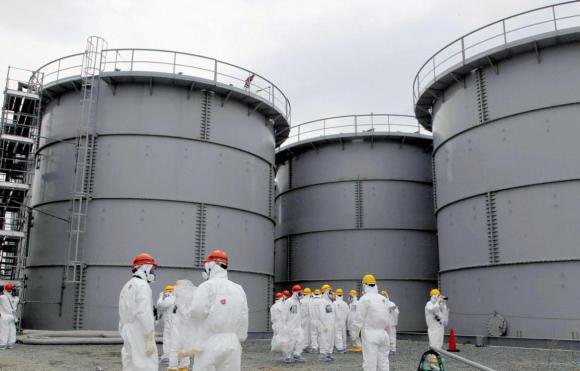
Of all the conflicts and consequences of the Fukushima Daiichi NPP disaster, the contaminated water issue is one of the most complicated, contentious, and potentially long-term. It’s a multifaceted problem ultimately rooted in the influx of groundwater into the damaged reactor buildings. A large volume of water is pumped into and out of the damaged reactors each day to keep them cool. This is treated to remove salt and most radionuclides and recirculated back into the reactors. If there were no additional water leaking into the reactor basements, this could function as an essentially closed loop. But a volume equal to the additional groundwater inflow needs to be removed from recirculation. It too is treated to remove all radionuclides except tritium, a radioactive form of hydrogen known as H-3, and is being stored in the now familiar rows of tanks onsite at Daiichi. A partially effective underground dam of frozen earth, together with a system of subdrain pumps, has reduced the volume necessary to be removed from about 400 cubic meters per day to about 150-200 cubic meters (though appreciably more when it rains heavily). About 850 large tanks now hold 850,000 tons of tritiated water, and TEPCO says that it will run out of space to store additional water onsite by 2020, so something must be done soon. As far back as 2014, the IAEA recommended a controlled release of this water to the ocean as the safest course of action, and Japan’s Nuclear Regulation Agency (NRA) has made similar recommendations. A Tritiated Water Task Force convened by METI in 2013 examined five options in detail, including evaporating it and releasing it into the atmosphere, releasing it into the atmosphere as hydrogen gas, injecting it into deep geologic strata, storing it underground, and diluting it and discharging it into the ocean. For reasons of cost, available technology, time required, and safety, in its final report issued in June, 2016, the task force concluded that ocean discharge was the least objectionable approach. TEPCO has made it clear that this is its preference as well, and in July of last year Takashi Kawamura, chairman of Tokyo Electric Power Company Holdings, Inc., said publicly that the decision to release the tritiated water had already been made. Many people were alarmed, particularly Fukushima fishermen who expected to be consulted, and the company backpedalled immediately. So far no decision has been officially announced. The reason for the delay in the decision is the very reasonable expectation of a strong public backlash. Meanwhile the window for the decision to be made is rapidly closing.
METI Tritiated Water Task Force Report, June 2016 (English version)
Preliminary Summary Report: IAEA International Peer Review Mission On Mid-And-Long-Term Roadmap Towards The Decommissioning Of Tepco’s Fukushima Daiichi Nuclear Power Station Units 1-4
(Third Mission), Feb. 2015
Japan Times: Regulator urges Tepco to release treated radioactive water from damaged Fukushima No. 1 nuclear plant into the sea, Jan. 11, 2018
Japan Times: Fukushima’s tritiated water to be dumped into sea, TEPCO chief says, July 14, 2017
TEPCO: Response to the article about the release of tritiated water into the ocean, July 14, 2017
Asahi Shimbun: New TEPCO executives tripping over their tongues, July 20, 2017
OPPOSITION
The strongest and most meaningful opposition comes from Fukushima’s fisheries cooperatives, which have suffered tremendously due to the disaster. Not only were their ports and fishing fleets destroyed by the tsunami, but the market for their fish collapsed after the sale of 44 marine species was prohibited by the Japanese government in 2011 due to radioactive contamination. The public seems largely unaware that in the years since the bans were initiated, the percentage of Fukushima marine products exceeding the 100 Bq/kg allowable level of radioactive cesium has decreased rapidly, and has actually been zero since 2015. People are right to be skeptical of this, perhaps, but it has been confirmed by official testing, by independent researchers, and by testing done by independent citizen groups. Testing is done for each marine variety on a fishing ground-by-fishing ground basis, and as they have gradually been demonstrated to meet the requirements, 34 of the 44 initially banned seafood varieties have been allowed back on the market. Thanks to incrementally improving consumer confidence, the market for Fukushima seafood has slowly improved. The Fukushima fisheries coops justifiably fear that if the tritiated water is released to the ocean, the resulting consumer backlash will totally destroy their livelihoods once again.
Fukushima Prefectural Federation of Fisheries Cooperative Associations
Japan Ministry of Agriculture, Forestry, and Fisheries (MAFF): Results of the monitoring on radioactivity level in fisheries products: Summary of Monitoring on fishery products (As of Mar. 31, 2018)
METI has jurisdiction over contaminated water releases from nuclear reactors like Daiichi because it is responsible for overseeing energy production systems as a whole, including accident consequences. The NRA, which is part of the Environment Ministry, has specific jurisdiction for nuclear power, and its evaluations and guidance are also important. But ultimately the decision of whether or not to release the tritiated water is TEPCO’s. A company spokesman explained to me recently that government guidelines and recommendations are taken very seriously, and that the company goes to great lengths to meet government expectations. But ultimately these recommendations are non-binding. TEPCO hopes to get the green light from METI and the NRA, and all of them have been delaying their decisions in the hopes that the approval of the fisheries coops can be obtained as well.
On the face of it, this hope is not totally unfounded, as there is an important precedent. The fisheries coops have been approving the release of water from two specific sources onsite at Daiichi for several years. One is a bypass system uphill of the reactors that intercepts groundwater before it reaches the reactor area. The other is a subdrain system that pumps water from the area around the reactors. In both cases, the water has relatively low levels of radioactive contamination, and is treated to remove radionuclides and then tested by TEPCO and third-parties (JAEA and the Japan Chemical Analysis Center). If the radioactivity is lower than TEPCO’s self-imposed target levels of 1 Bq/L each for Cs137 and Cs134, 5 Bq/L for Gross beta (including strontium), and 1500 Bq/L for tritium — all of which are many times lower than the limits for drinking water set by the WHO — the fisheries coops agree to its release. This agreement has been in place since 2014 for the bypass water, and since 2015 for the subdrain water. It appears to have been functioning smoothly, with over 350,000 tons of bypass water and about 500,000 tons of subdrain water released so far. The participation of third-parties in the monitoring has been the key to gaining trust in the measurements.
TEPCO – Water Discharge Criteria for Groundwater Bypass, February 3, 2014
TEPCO – Groundwater pump-up by Subdrain or Groundwater drain
WE’VE BEEN HERE BEFORE
The tritium in the tanks at Daiichi is much more radioactive than the subdrain or bypass water, however. The concentration levels of tritium in the tanks ranges from about 0.5 to 4 million Bq/L, a total of about 0.76 PBq (trillion Bq) in all. No decision has been made about how much is likely to be released per day, but technical and cost estimates have been based on 400 cubic meters (tons) per day, roughly equal to the maximum daily inflow of groundwater. It is expected that releases would continue for about five years. Under the scenarios being discussed, the water would be diluted to 60,000 Bq/L before being released to the ocean. This number alone seems alarming, but is the concentration level that has been legally allowed to be released from Japanese nuclear power plants and reprocessing facilities such as Tokaimura for decades. The science regarding what is likely to happen to the tritium in terms of dispersal by ocean currents and effects on fish and other biota is fairly well understood, primarily because of decades of monitoring done in Japan and near similar facilities abroad, such as Sellafield in the UK and LaHague in France. Data from the French government shows that the LaHague reprocessing plant releases about 12PBq (12 trillion Bq) per year, and the maximum concentration of tritium in the surrounding ocean has been about 7Bq/L. This means that the amount released yearly from LaHague is over 12 times the total being stored at Daiichi, and the daily release rate is over 20,000 times that expected in Fukushima. Dr. Jota Kanda, a professor at the Department of Ocean Sciences, Tokyo University of Marine Science and Technology, observed that the dispersal and further dilution of tritium is rapid, and says, “Based on what we’ve seen at La Hague, it seems likely that under the ocean release scenario being considered now, tritium concentrations in the ocean off Fukushima will not exceed a few Bq/L and will likely remain close to the background level.” Globally, the background levels of tritium in water currently range between 1 and 4 Bq/L, which includes 0.1 to 0.6 Bq/L that is naturally-occurring and more than doubled by tritium remaining from nuclear testing. In oceans, tritium concentration levels at the surface are around 0.1 to 0.2 Bq/L. For comparison, naturally occurring tritium in rainwater in Japan between 1980-1995 was between 0.5- 1.5 Bq/L, and prior to 2011 in Fukushima rivers and tap water was generally between 0.5-1.5 Bq/L. In the US, the EPA standard for tritium in drinking water is 740 Bq/liter, while the EU imposes a limit of 100Bq/L.
Fujita et al, Environmental Tritium in the Vicinity of Tokai Reprocessing Plant. Journal of Nuclear Science and Technology, 44:11, 1474-1480
Matsuura, et al, Levels of tritium concentration in the environmental samples around JAERI TOKAI. Journal of Radioanalytical and Nuclear Chemistry, Articles, Vol. 197, No. 2 (1995)295-307
METI Task Force Report supplement: About the physical properties of tritium,
Yamanishi Toshihiko, 2013
LaHague tritium release data, cited in METI Task Force Report supplement, p6
Radiological Protection Institute of Ireland (RPII): A survey of tritium in Irish seawater, July 2013
IRSN factsheet: Tritium and the environment
Michio Aoyama: Long-term behavior of 137Cs and 3H activities from TEPCO Fukushima NPP1 accident in the coastal region off Fukushima, Japan. Journal of Radioanalytical and Nuclear Chemistry, 2018
Tsumune et al: Distribution of oceanic 137Cs from the Fukushima Dai-ichi Nuclear Power Plant simulated numerically by a regional ocean model. Journal of Environmental Radioactivity 111 (2012) 100-108
Povinec, et al, Cesium, iodine and tritium in NW Pacific waters – a comparison of the Fukushima impact with global fallout. Biogeosciences Discuss., 10, 6377–6416, 2013
Dr. Kanda further explains that biological organisms such as fish have different concentration factors for different radionuclides. When the ambient level of Cs137 in seawater is 1 Bq/L, for instance, some fish species may show values approaching 100 Bq/kg. But for tritium (H3) the ratio is 1:1, and 1 Bq/L in seawater will result in 1Bq/kg in fish. Again, at La Hague, which has had a much higher release of tritium for decades, the concentrations in marine wildlife near the point of release between 1997-2006 has ranged from 4.0 – 19.0 Bq/kg, with a mean of 11.1 Bq/kg. Using this as a guideline, Kanda estimates that even with an ongoing release of 60,000 Bq/L of tritium offshore of Daiichi, the fish a short distance away are unlikely to exceed 1 Bq/kg. This can, and must be, confirmed by conscientious monitoring.
What about health effects to humans? Though the release from Daiichi would be many times smaller than what is ongoing from LaHague or Sellafield, and the levels in the ocean after release seem likely to be close to that in normal rivers and rainwater, it is understandable that people would be concerned about risk. The scientific consensus is that tritium presents a much lower risk than radionuclides such as radioactive cesium, radioactive iodine, or strontium. This is reflected in allowable limits in drinking water which are generally tens or hundreds of times higher for tritium than for these others, ranging from 100 Bq/L in the European Union, 740 Bq/L in the US, 7000 Bq/L in Canada, 30,000 Bq/L in Finland, and 76,103 Bq/L in Australia. The WHO limit for tritium in drinking water is 10,000 Bq/L. Allowable limits in food have in most cases not been established. While these limits reflect a general scientific consensus that tritium presents a very low risk, the wide range of official values suggests scientific uncertainty about how it actually affects the human body.
Canadian Nuclear Safety Commission (CNSC): Standards and Guidelines for Tritium in Drinking Water, 2008
SCIENTIFIC UNCERTAINTY
Because in its most common form, known as HTO, tritiated water behaves almost identically to water, it is eliminated from the human body with a biological half-life of 10 days, the same as for water. But when it is incorporated into living things or organic matter, a fraction of it binds with organic molecules to become organically bound tritium, known as OBT. In this form it can stay in the body for years, and its risks, while assumed to be fairly low, are not fully understood. Dr. Ian Fairlie, a UK-based researcher who has published widely on the risks of tritium exposure, believes that current guidelines underestimate the nuclide’s true risk. Fairlie points out that there is a long-running controversy among experts regarding the risks of OBT, which many believe are higher than official guidelines currently recognize. Many official agencies, like France’s IRSN, have issued reports that recognize these uncertainties, and Fairlie believes that the research findings indicate that the dose from OBT should be increased by a factor of 5 compared to HTO.
Fairlie: Tritium: Comments on Annex C of UNSCEAR 2016 Report, March 14, 2017
IRSN factsheet: Tritium and the environment
In the ocean release scenarios being considered in Fukushima, Fairlie agrees that there will be high levels of dilution. Nevertheless, as the tritium disperses, he says, “It will be found throughout the entire ocean food chain.” The ICRP suggests that 3% of the tritium metabolized from water by marine life becomes potentially riskier OBT, while the IAEA estimates the fraction at 50%. IRSN and others caution that the biological exchange of tritium and other aspects of its action in organisms, such as the effects of exposure on embryos and foetuses, is incomplete. The METI Tritiated Water Task Force report of June 2016 explains that, “When standard values pertaining to radioactive material in food were established [in Japan] in 2012, it was concluded that “it is difficult to conceive of the concentration of tritium in food reaching a dose that would require attention.” This must not be assumed to be the case. Any estimate of risks to humans from tritium exposure should take the uncertainties as well as the possibility of higher risk from OBT fully into account. That said, the roughly 1Bq/kg maximum expected by experts to be found in fish off Fukushima after release is roughly from 100 to 70,000 times lower than drinking water limits around the world. Assuming that 3%-50% of that 1 Bq/kg is OBT, with a potentially higher risk factor, the human exposure risks from this scenario nevertheless appear to be extremely low, close to those of normal background radiation. The Japanese Gov’t is arguing that it is negligible.
FUKUSHIMA FISHERIES COOPS
TEPCO, METI, and other government bodies which share the mandate for dealing with contaminated water from Fukushima Daiichi believe there is no scientific reason to prevent releasing the tritiated water into the Pacific. For them, the largest stumbling bock is the lack of approval from the Fukushima fisheries cooperatives. As described above, these coops agreed to other releases of treated water from Daiichi as long as it’s compliance with safety regulations could be independently confirmed. Since the science indicates similarly minimal risk from releasing the water from the tanks after considerable dilution, what is their objection now? “We are totally opposed to the planned release,” explained Mr Takaaki Sawada of the Iwaki Office of the Fukushima Prefectural Federation of Fisheries Cooperative Associations, known as FS Gyoren. “It’s not a question of money or compensation,” he continued, “nor of any level of concentration we might accept as safe. There aren’t any conditions we would set, saying ‘If you satisfy these conditions then we will agree.’ We do not think it should be our responsibility to decide whether or not to release it. That entire discussion is inappropriate.”
Over the course of our long conversation, Sawada frankly acknowledged that the scientific consensus indicates very low risk if the water is released. “It’s not a question of scientific understanding,” he said. “We understand that tritiated water is released from other nuclear power plants in Japan and around the world. But we think it will be impossible for the public in general to understand why tritium is considered low risk, and expect there will be a large new backlash against Fukushima marine products no matter how scientifically it is explained.” I pointed out that the coops agreed to the release of the subdrain and bypass water from Daiichi, and asked what was different about this. He pointed out that in those cases, the water is pumped out before it is contaminated, and the public seems to understand that the contamination levels are already very low.
Fisheries coops, or kumai, are organized at each fishing port, of which there are 14 in Fukushima, only 2 of which, in Soma and Iwaki, are now operating commercially. The Fukushima coops have a total of about 1400 members at present. FS Gyoren is a prefectural federation, or rengo kumiai, that exists to facilitate communication and cooperation among the individual coops. There is a national rengo kumiai as well, called Zengyoren. These are not companies, and are not top-down organizations. Rather, each local port kumiai maintains independence. And though in meetings with Tepco or the government FS Gyoren communicates the concerns of members based on the kumai’s own meetings, no real full consensus has been reached regarding the proposed releases. It is a difficult situation with many possibilities for dissatisfaction and dissent. As an outside observer, I expected that some trust-building conditions, such as more transparent and conscientious monitoring, or further limits to the concentration and quantities released, could be satisfied which would allow the coops to agree to the ocean discharge. But now I think they won’t budge, particularly after TEPCO chairman Kawamura’s surprise announcement last summer that the decision had already been made without their approval. The kumiai will, I think, force the decision to be made against their strong opposition. I think they’re right that Japanese society is primed for a large backlash against Fukushima seafood no matter what the science and measurement shows.
Azby Brown
Azby Brown is Safecast’s lead researcher and primary author of the Safecast Report. A widely published authority in the fields of design, architecture, and the environment, he has lived in Japan for over 30 years, and founded the KIT Future Design Institute in 2003. He joined Safecast in mid-2011, and frequently represents the group at international expert conferences.
https://blog.safecast.org/2018/06/part-1-radioactive-water-at-fukushima-daiichi-what-should-be-done/
June 7, 2018
Posted by dunrenard |
Fukushima 2018 | Fukushima Daiichi, Radioactive Water, Safecast |
Leave a comment
Scientists say there was a significant release of radioactive particles during the Fukushima-Daiichi nuclear accident.
The researchers identified the contamination using a new method and say if the particles are inhaled they could pose long-term health risks to humans.
The new method allows scientists to quickly count the number of caesium-rich micro-particles in Fukushima soils and quantify the amount of radioactivity associated with these particles.
The research, which was carried out by scientists from Kyushu University, Japan, and The University of Manchester, UK, was published in Environmental Science and Technology.
In the immediate aftermath of the Fukushima Daiichi nuclear accident, it was thought that only volatile, gaseous radionuclides, such as caesium and iodine, were released from the damaged reactors. However, in recent years it has become apparent that small radioactive particles, termed caesium-rich micro-particles, were also released. Scientists have shown that these particles are mainly made of glass, and that they contain significant amounts of radioactive caesium, as well as smaller amounts of other radioisotopes, such as uranium and technetium.
The abundance of these micro-particles in Japanese soils and sediments, and their environmental impact is poorly understood. But the particles are very small and do not dissolve easily, meaning they could pose long-term health risks to humans if inhaled.
Therefore, scientists need to understand how many of the micro-particles are present in Fukushima soils and how much of the soil radioactivity can be attributed to the particles. Until recently, these measurements have proven challenging.
The new method makes use of a technique that is readily available in most Radiochemistry Laboratories called Autoradiography. In the method, an imaging plate is placed over contaminated soil samples covered with a plastic wrap, and the radioactive decay from the soil is recorded as an image on the plate. The image from plate is then read onto a computer.
“We now need to push forward and better understand if caesium micro-particles are abundant throughout not only the exclusion zone, but also elsewhere in the Fukushima prefecture; then we can start to gauge their impact”.
The scientists say radioactive decay from the caesium-rich micro particles can be differentiated from other forms of caesium contamination in the soil.
The scientists tested the new method on rice paddy soil samples retrieved from different locations within the Fukushima prefecture. The samples were taken close to (4 km) and far away (40 km) from the damaged nuclear reactors. The new method found caesium-rich micro-particles in all of the samples and showed that the amount of caesium associated with the micro-particles in the soil was much larger than expected.
Dr Satoshi Utsunomiya, Associate Professor at Kyushu University, Japan, and the lead author of the study says “when we first started to find caesium-rich micro-particles in Fukushima soil samples, we thought they would turn out to be relatively rare. Now, using this method, we find there are lots of caesium-rich microparticles in exclusion zone soils and also in the soils collected from outside of the exclusion zone”.
Dr Gareth Law, Senior Lecturer in Analytical Radiochemistry at the University of Manchester and an author on the paper, adds: “Our research indicates that significant amounts of caesium were released from the Fukushima Daiichi reactors in particle form.
“This particle form of caesium behaves differently to the other, more soluble forms of caesium in the environment. We now need to push forward and better understand if caesium micro-particles are abundant throughout not only the exclusion zone, but also elsewhere in the Fukushima prefecture; then we can start to gauge their impact”.
The new method can be easily used by other research teams investigating the environmental impact of the Fukushima Daiichi accident.
Dr Utsunomiya adds: “we hope that our method will allow scientists to quickly measure the abundance of caesium-rich micro-particles at other locations and estimate the amount of caesium radioactivity associated with the particles. This information can then inform cost effective, safe management and clean-up of soils contaminated by the nuclear accident”.
The paper, ‘Novel Method of Quantifying Radioactive Cesium-Rich Microparticles (CsMPs) in the Environment from the Fukushima Daiichi Nuclear Power Plant’ has been published in the journal of Environmental Science – DOI:10.1021/acs.est.7b06693
Energy is one of The University of Manchester’s research beacons – examples of pioneering discoveries, interdisciplinary collaboration and cross-sector partnerships that are tackling some of the biggest questions facing the planet. #ResearchBeacons
May 27, 2018
Posted by dunrenard |
Fukushima 2018 | Contamination, Fukushima Daiichi, radiation, Radioactive particles |
Leave a comment
But Fukushima boy fought back, helping win a court victory that brought compensation for evacuees from the nuclear disaster
On October 25, 2017, 15-year old former Fukushima resident Natsuki Kusano (not his real name and he has asked not to be pictured) testified before the Tokyo District Court. He was among a number of Fukushima evacuees seeking compensation from Tepco and the Japanese government and asking the court to hold the company and the government responsible for the Fukushima nuclear disaster.
As reported by the Asahi Shimbun, on March 16, 2018, the Tokyo District Court found the central government and TEPCO responsible for contributing to the psychological stress suffered by 42 evacuees and ordered the defendants to pay a total of about 60 million yen ($566,000) in compensation.
The lawsuit was filed by 47 individuals in 17 households who fled from Fukushima Prefecture to Tokyo in the wake of the nuclear disaster. Significantly, 46 of those individuals evacuated voluntarily from areas where no evacuation order was issued by the government.
Natsuki’s mother (left) cries with joy when she hears the Tokyo court verdict.
When the verdict came down, Natsuki was in Geneva with his mother and other women who were there to urge the Japanese government to abide by the UN recommendation of a 1 millisievert per year radiation exposure level. The Japanese authorities had raised this level to an unacceptable 20 msv per year in order to justify ordering people to return to affected areas or risk losing their compensation.
This was the sixth ruling so far among at least 30 similar law suits filed in Japan. Four rulings have held the central government liable for the nuclear disaster and ordered it to pay compensation.
The plaintiffs believe that Natsuki’s declaration played an important role in the victory. Here is what he said:
I was born in Iwaki city, Fukushima. I lived there with my parents and my little brother who is younger than me by 5 years.
While we were in Iwaki, we enjoyed our life season by season. When spring came, we appreciated cherry blossoms at “the Night Forest Park”, which was famous for its marvelous row of cherry trees that lots of people also know about well through the TV. In summer we went gathering shellfish. We had a fun time hunting wild mushrooms in fall and made a snowman in winter.
A treasured life was lost after being forced to evacuate from Fukushima.
In a park or on my way home from school, I picked a lot of tsukushi (stalks of field-horsetail). My mother simmered them in soy and made tsukudani, which we loved very much. We lived in a big house with a large garden where we grew blueberries, shiitake mushrooms and cherry tomatoes. At school I collected insects and made mud pies with my friends.
But we have lost these happy days after March 11, 2011. The Night Forest Park is located in the “difficult-to-return zone”. We can’t make pies with mud fully contaminated by radioactivity. However, the worst of it was that I was bullied at a school I transferred to.
Some put cruel notes on my work in an art class, others called me a germ. These distressing days continued a long time and I began to wish to die if possible. Once when I was around 10 years old, I wrote on a wishing card on the Star Festival, “I want to go to Heaven.”
Perhaps those who have no way of knowing anything about evacuees see us as “cheating people”. They might think that the evacuees from Fukushima got great compensation and live in shelters in Tokyo for free with no damage at home.
I believe that these misunderstandings would not have happened if the government and TEPCO (Tokyo Electric Power Company) had told the truth about the horrible reality of radioactive contamination and had provided accurate information to the public: they have hardly paid any compensation to the extramural evacuees. (Note: these are the evacuees who fled from areas outside of the official evacuation zone. Because they left without the evacuation order, the government considers them “voluntary” evacuees who are therefore not entitled to compensation. In its verdict, the Tokyo district court recognized the rights of these self-evacuees.)
Contrary to propaganda, Fukushima evacuees were no freeloaders
I have not revealed that I am an evacuee at my junior high school which has no relations with the former school, and actually I have not been bullied ever since.
What I wish adults to bear the blame for
It is adults who made the nuclear power plants. It is adults who profited from them. It is adults who caused the nuclear accident. But it is us children who are bullied, live with a fear of becoming sick and are forced apart from families.
After the accident, no one can say that a nuclear plant is safe anymore.
In fact, no one can say to me, “Don’t worry, you’ll never be sick.”
Nevertheless, the government and TEPCO say “Rest easy, trust us. Your home town is safe now,” and make us return to the place which is not safe.
I suspect that the adults who forced us to go back to the dangerous zone will be dead and not here when we are grown-up and become sick. Isn’t that terrible? We have to live with contaminants all through our life which adults caused. I am afraid that it is too selfish of them to die without any liability. While they are alive in this world, I strongly request them to take responsibility for what they did and what they polluted in return for their profits at least.
And now, please, please don’t force us go back to the contaminated place. We never ever want to do so. The nuclear accidents changed all the lives of the evacuees as well as mine, my parents’ and my brother’s. Who wanted this? None of us. The evacuees all agree that the government and TEPCO should take responsibility.
Court of justice, please listen to us children and all the evacuees.
May 15, 2018
Posted by dunrenard |
Fukushima 2018 | Fukushima Daiichi, Nuclear Disaster, Victim Testimony |
Leave a comment
It may take 40 years for the site to appear like “a normal reactor at the end of its life.”
A schematic of the Fukushima nuclear power plant hints at the complexity of decontamination and decommissioning operations.
TEPCO workers survey operations at reactor buildings.
Seven years on from the Great East Japan Earthquake of March 2011, Fukushima Daiichi nuclear power plant has come a long way from the state it was reduced to. Once front and center in the global media as a catastrophe on par with Chernobyl, the plant stands today as the site of one of the world’s most complex and expensive engineering projects.
Beyond the earthquake itself, a well understood series of events and external factors contributed to the meltdown of three of Fukushima’s six reactors, an incident that has been characterized by nuclear authorities as the world’s second worst nuclear power accident only after Chernobyl. It’s a label that warrants context, given the scale,
complexity, and expense of the decontamination and decommissioning of the plant.
How does a plant and its engineers move on from such devastation? The recovery initiatives have faced major challenges, constantly being confronted by issues involving radioactive contamination of everything from dust to groundwater. And those smaller issues ultimately complicate the remediation effort’s long-term goal: to locate and remove the nuclear fuel that was in the reactors.
Jonathan Cobb, spokesperson for the World Nuclear Association, spoke with Ars about the scale of Fukushima, explaining that radioactive releases in Japan were much smaller than at Chernobyl, and the accident resulted in no loss of life from radiation: “Of course, this doesn’t take away from the enormous task currently being faced at Fukushima.”
The UN Scientific Committee on the Effects of Atomic Radiation (UNSCEAR) reported in May 2013 that radiation exposure following the Fukushima accident didn’t cause any immediate health effects and that future health effects attributable to the accident among either the general public or the vast majority of workers are unlikely. A 2017 paper from UNSCEAR reports that these conclusions remain valid in light of continued research since the incident.
Even the most at-risk citizens, those living in Fukushima prefecture, are only expected to be exposed to around 10mSv as a result of the accident over their lifetimes. “For reference, the global average natural background radiation tends to be around 2.4mSv/year, but even 20mSv/year isn’t exceptional,” said Cobb.
Still, the accident was rated a 7 on the International Nuclear and Radiological Event Scale (INES), which is the highest rating possible, and designates it a Major Accident due to high radioactive releases. Estimates vary slightly, but Japan’s Nuclear Safety Commission report puts total releases at 570 petabecquerels (PBq) iodine-131 equivalent. (For comparison, Chernobyl released 5,200PBq iodine-131 equivalent.)
But the severity of the accident is probably most keenly felt in the scale of the cleanup. The incident has necessitated the ongoing cleanup and decommissioning of the plant—something that Tokyo Electric Power Company (TEPCO), the plant’s owner and operator, is responsible for. Even though the plant is seven years into the cleanup and has accomplished a great deal, we won’t see a conclusion for decades yet.
Damage to reactor Units 1-4 in the aftermath of the March 2011 earthquake.
In addition to damage to infrastructure and buildings, a large amount of wreckage was left strewn around the plant complex.
Remotely operated machines were involved in clean-up of the most contaminated areas.
A look inside the Primary Containment Vessel (PCV) of Unit 2.
A composite image of photographs taken inside the Primary Containment Vessel (PCV) of Unit 2.
A look at debris in the spent fuel pool of Unit 3.
Meltdowns and immediate priorities
Remarkably, seismic shocks of the magnitude 9 earthquake didn’t cause any significant damage to the earthquake-proofed reactors; rather, the tsunami knocked out power that precipitated reactor meltdowns in Units 1, 2, and 3. Subsequent explosions caused by hydrogen buildup (from zirconium cladding of fuel assemblies melting and oxidizing) in Units 1, 3, and 4 then expelled radioactive contamination, most of which fell within the confines of the plant.
Cobb explained that in the aftermath of this, the ongoing risk posed by radionuclides (notably, iodine-131 and cesium isotopes 134 and 137) depended on their half-lives. Iodine-131, with a half-life of just eight days, posed virtually no threat at all after just several months. It has been cesium-134, with a two-year half-life, and cesium-137, with a 30-year half-life, that have been the major focus of decontamination efforts. “Radioactive decay means that we’ve seen a reduction in contamination simply through time passing; at the plant, however, my expectation is that the majority of reduction has been due to efforts of TEPCO. Conditions have improved markedly and a sense of normalcy has returned.”
It’s useful to take stock of what TEPCO had to contend with from the outset. Lake Barrett, a veteran of the US nuclear energy industry who spent several years at the helm of decommissioning work at Three Mile Island reactor 2, is currently an independent special advisor to the Japanese Government and TEPCO board of directors. He told Ars, “When everything goes to hell on you, you go back to basics. You’re concerned with accident response and immediate recovery of the situation. Over the longer timeframe, the decontamination & decommissioning (D&D) focus shifts to a more deliberate approach to major technical challenges.”
Barrett explained that reactor stabilization at Fukushima—an imperative of the immediate recovery—has long since been achieved. Temperatures within the Reactor Pressure Vessels (RPVs) and Primary Containment Vessels (PCVs) of Units 1-3 are stable at between 15 to 30ºC, and there have been no significant changes in airborne radioactive materials released from reactor buildings. This qualifies as a ‘comprehensive cold shutdown’ condition.
Barrett explained how the issue of cooling is mostly non-existent at this point: “The three melted reactor cores emit less heat than a small car. Decay heat was a huge issue in the first weeks, but it’s no longer an issue. And while TEPCO still injects water onto the cores, this is more for dust suppression than anything else.”
With the reactors stable, early phases of TEPCO’s work simply involved debris clearing and restorative efforts throughout buildings and across the 3.5 square miles of the plant—both having been ravaged by the earthquake and tsunami. In the most contaminated places, remotely operated machines undertook most of the work. To reduce environmental contamination, they also removed top soils and vegetation, deforested the site, and then applied a polymer resin and concrete across much of the plant complex. This has locked contaminated material in place and limited the flow of groundwater through the site.
Other work has been more substantial. Units 1, 3 and 4 were blown apart and have had to be reinforced and encased, both for safety and to prevent spread of radioactive material. Although Unit 2 retained its roof, TEPCO decided to dismantle the upper building nonetheless, as it will facilitate removal of fuel from the reactor.
At the peak of these operations, some 7,450 persons worked at Fukushima. As operations have evolved, the workforce has declined to a not inconsiderable 5,000 daily personnel. With such levels of permanent staffing, it’s little wonder that a new rest-house, cafeteria, shops, and office building have all been built.
The efforts have, in a practical sense, meant that the majority of the site has transitioned to a stable, relatively risk-free environment. Describing the decommissioning as an “enormous challenge never before undertaken by humanity,” Seto Kohta of TEPCO told Ars: “We have overcome the state of chaos that ensued after the accident and have succeeded in reducing site dose levels to an average of less than 5μSv/h, with the exception of the vicinity of Units 1-4.” (Global background levels are <0.5µSv/h.)
TEPCO reports that the additional effective dose (i.e. additional to natural background radiation) at the plant’s boundary has declined to the target value of less than 1mSv/y.
This is not to say the plant is without signs of past problems—far from it. Felled trees sit waiting for incineration; huge mounds of soil lie under tarps; buildings retain marks of past trauma; and with environmental dosage a perennial concern, close to a hundred dose-rate monitors are positioned around the site.
Kohta also noted that while “95 percent of the site no longer requires the donning of full- or half-face masks or coveralls,” some level of protection is still required for working around the plant according to three levels of contamination. The vast majority of the plant grounds are in what’s termed Zone G, which requires just generic coveralls and disposable medical masks. Zone Y provides a perimeter around the Units 1-4 and necessitates heavier-duty coveralls and either full- or half-face masks. And lastly there is Zone R, closer to and including the reactor buildings, requiring double-layered coveralls and full-face masks.
A steel structure is built around Unit 1 as part of reconstruction works.
An outer shell is constructed around Unit 1.
Reconstruction work at Unit 4.
A labyrinth of subterranean tunnels and access points lie around reactor buildings.
The Little Sunfish submersible used for investigations at Unit 3.
A TEPCO schematic illustrates measures taken to manage groundwater.
An impermeable wall constructed of interlocking columns extends along the seafront to restrict contaminated water reaching the sea.

Above ground apparatus of the frozen wall which descends 30m and surrounds Units 1-4.

A visitor to the plant performs a low-tech check on the frozen wall.
The groundwater bypass pump works to reduce the amount of water leaking into the reactor buildings.
Temporary storage tanks for water pumped up via the groundwater bypass.
Flanged tanks of the sort used for indefinite storage of tritium-laced water arrive at the docks of Fukushima nuclear power plant.
Visitors from IAEA visit the ALPS water treatment facility where radionuclides are removed from contaminated water.
Defueling of the spent fuel pool at Unit 4 was performed in a conventional manner; it won’t be so easy at other Units where radiation and damage is more severe.
The giant fuel handling machine (background) and fuel handling crane (foreground) arrive for installation at Unit 3.
The final segment of the domed containment roof is lifted into place at Unit 3.
While they’re now stable in terms of nuclear activity, Units 1-3 remain highly contaminated. As such, while the structural integrity of these buildings has been restored, relatively little work has been undertaken within them. (One notable exception is removal of contaminated water from condensers, completed last year.)
Over recent years, a variety of remotely operated devices and imaging technologies have performed investigations of these units. The intention has been to gather information on internal physical and radiological conditions of the PCVs—the heavily reinforced bell-shaped structures that host reactors. TEPCO wants, and needs, to understand what has happened inside. Some things are known: once melted, fuel mixed with structural materials including steel and concrete to form something known as corium. But precisely where the corium ended up, how much there is, and whether it’s submerged are just some of the questions in play.
The International Research Institute for Nuclear Decommissioning (IRID), which was established in April 2013 to guide R&D of technologies required for reactor defueling and decommissioning, is supporting TEPCO in seeking answers. IRID is composed of multiple stakeholders, including Japanese utilities and the major nuclear vendors Hitachi, Mitsubishi, and Toshiba.
Naoaki Okuzumi, senior manager at IRID, described for Ars the investigative approaches and technologies. Early work utilized Muon tomography, which Okuzumi described as “a kind of standard practice applied to each unit… to locate high density material (fuel) within PCVs.” It yielded low-resolution data on the approximate location of corium. But with pixels representing 25cm-square cross-sections, the information has been useful only in so far as validating computational models and guiding subsequent robotic investigations.
The latter task hasn’t been easy. In addition to the challenge of navigating the dark, cramped labyrinths of tangled wreckage left behind, TEPCO has had to contend with radioactivity—the high levels act something like noise in electronic circuits. The wreckage has made access a challenge, too, although varying points of ingress have been established for each PCV.
The circumstances mean that TEPCO hasn’t been able to simply purchase an off-the-shelf kit for these investigations. ”An adaptive approach is required because the situation of each PCV is different… there is no standard with investigating the PCVs by using robots,” said Okuzumi, describing an approach that has translated into devices being specially developed and built in response to conditions of each PCV.
But they’re making progress. As recently as January 2018, corium was identified for the first time inside Unit 2 using an enhanced 13m-long telescopic probe and a revised approach designed to overcome problems encountered during investigations in 2017. The situation was hardly easier at Unit 3, where the PCV is flooded to a depth of around 6.5m. Here, it took a remotely operated, radiation-shielded submersible called ‘Little Sunfish’ to locate corium in July 2017.
Altogether the investigations—featuring a litany of robotic devices—have revealed that little fuel remains in any of the cores of Units 1-3. In Unit 2, a large amount of corium is present at the bottom of the RPV; in Units 1 and 3, almost all fuel appears to have melted through the RPVs entirely and into the concrete floor of PCVs beneath. The information is crucial, as we’ll come to see, for future deconstruction work at the reactors, but it continues to be extended as investigations continue.
PCV investigations at Unit 2
Pumps, ice-walls, and storage: Water management
One of TEPCO’s major concerns has been groundwater, which runs down from mountains west of the plant and can become contaminated by the low-lying reactors before flowing out to sea. Groundwater management has subsequently become one of TEPCO’s greatest efforts, as well as one of the most challenging of the tasks it has faced.
First off, it ought to be noted that marine environment monitoring for radionuclide concentrations near the plant and as far away as Tokyo indicate that levels are well within WHO standards. “The levels of radioactivity that have been found and can be attributed to Fukushima are absolutely dwarfed by natural levels of radioactivity in the water, or even levels of cesium that came from historic nuclear weapons testing,” noted Cobb.
Still, the effort to limit further contamination—seemingly driven as much by societal-political dynamics as safety considerations—remains paramount. To this end, measures have been deployed along three principles: remove sources of contamination, isolate water from contamination, and prevent leakage of contaminated water.
Some measures have been simple enough in design. Installation of an impermeable, underground wall along the sea front, completed in October 2015, is intended to keep groundwater that passes Units 1-4 from reaching the sea. Waterproofing pavement against rainwater is another widely applied step.
After this, solutions become more sophisticated. A groundwater bypass that intercepts and pumps up water before it reaches the reactors is a key development. This water is inspected for contamination before being discharged into the sea. By November 2017, more than 337,000 cubic meters of water had been released to the ocean in this way; this bypass reduced the amount flowing into the building basements by up to 100 tons per day and successfully reduced groundwater levels around the reactor buildings.
To further limit groundwater flow into reactors buildings, TEPCO actually froze the ground around them, creating a kind of frozen wall down to a depth of about 30 meters. Approximately 1,500 meters long, the wall is kept frozen by pipes filled with an aqueous solution of calcium chloride cooled to -30ºC. Freezing commenced in March 2016 and is now “99 percent complete,” according to Kohta.
On either side of the frozen wall, sub-drains and groundwater drains have been installed; they pump water up to keep it from reactor buildings and reaching the sea, respectively. Pumped water is purified at a purpose-built treatment facility. Barrett commented: “With water released from sub-drains and the bypass, there’s an agreement with the fishing industry that releases must be below 1,500 becquerels per liter. Negotiations took several years to agree that level was ‘clean’.”
All this has come at enormous expense, but according to TEPCO, it has been successful. Before any measures were implemented, inflow was around 400m3/day, Kohta told Ars. “The average amount of water flowing into [Units 1-4] for the period from December 2015 to February 2018, before the closure of the land-side impermeable wall, was 190m3/day, and it has decreased to 90m3/day after the closure for December 2017 to February 2018.”
At face value, it’s a sound outcome. As Kohta noted, the amount of contaminated water now being generated—a mix of groundwater, rainwater and water pumped into reactors for cooling—has decreased from about 520m3/day to about 140m3/day between last December and February. Even so, treating that amount of contaminated water is proving taxing.
Water treatment is happening at large-scale facilities that have been built onsite, including a multi-nuclide removal facility. Here, a so-called Advanced Liquid Processing System (ALPS) reduces concentrations of cesium isotopes, strontium, and other radionuclides to below legal limits for release. But one radionuclide remains: tritium.
Cobb explained: “The difficulty is that tritium is basically an isotope chemically identical to hydrogen, so it’s impractical to remove. Levels of tritium in that water are low, but nevertheless there’s great sensitivity to the suggestion that it be discharged.”
Without a feasible alternative for cleaning up the tritium, the (only) solution for ALPS-treated water has been storage. Well over a thousand tanks, each holding 1,200 cubic meters, now store tritium-laced water at the south end of the plant. Several years ago, these tanks hit the news because several were found to be leaking. Barrett acknowledged it as an unfortunate and avoidable incident resulting from use of flange-tanks. TEPCO has since moved to more sturdy welded-joint water storage tanks.
The ultimate plan for stored water is unknown; tritium has a half life of a dozen years, so physics won’t clean up the water for us. Some kind of controlled, monitored discharge—the likes of which is typical within the nuclear industry—is possible, according to Barrett.
Indeed, the International Atomic Energy Agency has endorsed such a plan, which was proposed by the Atomic Energy Society of Japan in 2013. The plan involved diluting tritiated water with seawater before releasing it at the legal discharge concentration of 0.06MBq/L and monitoring to ensure that normal background tritium levels of 10Bq/L aren’t exceeded.
Discussions at both national and international levels would need to come first. Part of the difficulty here harkens back to societal dynamics surrounding risk and contamination: “In nuclear there is no such thing as absolute zero—sensitivity goes down to the atom. This makes discussion about decontamination or levels of acceptable contamination difficult. There’s tritium in that water that’s traceable to the accident; it’s entirely safe, but for the time being, with the event still in recent memory, it’s not acceptable,” observed Barrett.
Toward permanent solutions
In some sense, much of the restoration of order at Fukushima has been superficial—necessary but concerned with handling consequences more than root causes (see, TEPCO interactive timeline). Ultimately, Fukushima’s reactors must be decommissioned.
Broadly, this work involves three phases: removing used fuel assemblies that are stored within ten-meter-deep spent fuel pools of each reactor building, management of melted-down reactors and removal of corium debris, and deconstruction of reactor buildings and the greater plant.
At Unit 4, spent fuel removal operations took around 13 months and concluded in December 2014. “When we began we didn’t know if fuel assemblies or racks were distorted. It turned out they weren’t, and we were able to remove all fuel conventionally without any issues at all. Actually, it went exceedingly well, concluding ahead of schedule and under cost,” recalled Barrett. In all, 1,533 fuel assemblies were removed and transferred to a common spent fuel pool onsite.
Spent fuel removal at Unit 4 was accomplished with conventional techniques.
Defueling of pools at Units 1 through 3, which suffered meltdowns, isn’t going to be as straightforward. For one, there’s some expectation of debris and circumstances requiring extraordinary removal procedures. “I wouldn’t be surprised if we find some structurally bent fuel assemblies caused by large pieces of concrete or steel,” said Barrett.
Additionally, although radiation in Unit 3 has been reduced sufficiently to allow rotating shifts of workers to install defueling equipment, the already painstaking operations will have to be conducted remotely. The same is likely true for Units 1 and 2.
At Unit 3, the next in line for defueling, preparation is already well underway. In addition to decontamination and installation of shielding plates, TEPCO has removed the original fuel handling crane, which had fallen into the pool seven years ago, and installed a new fuel handling crane and machine. An indication of extraordinary containment methods being used, workers have built a domed containment roof at Unit 3. TEPCO’s Kohta told Ars, “Removal of spent fuel [at Unit 3] is scheduled to begin from around the middle of 2018;” meanwhile, Unit 1 is also in a preparatory stage and Unit 2 will be handled last.
Further down the line still, corium will have to be removed from melted-down reactors. It’s a daunting task, the likes of which has never been undertaken before. The reactors held varying, but known, amounts of uranium oxide fuel, about 150 tonnes each. But how much extra mass the fuel collected as it melted through reactor vessels is uncertain.
“At TMI there was exactly 93 tonnes in the reactor. Once we were done digging out fuel debris, we’d removed 130 tonnes. At Fukushima, I expect maybe a factor of five to ten more mass in core debris. It’s an ugly, ugly mess underneath the PCVs,” suggested Barrett.
High-powered lasers, drills and core boring technologies for cutting, and strong robotic arms for grappling and removing corium are already under development, according to IRID, but precise methodologies remain undecided.
The original plan, Barrett explained, was to flood PCVs and work underwater—a conventional nuclear operations technique that affords protection from contamination. But this requires water-tight PCVs, something that cannot be practically achieved at Fukushima. Discussions also continue over whether a side or top-down entry would be best. “Altogether, we don’t have enough physical data about PCVs to commit to a final decision,” said Barrett, referring back to the need for continued PCV investigations. According to Kohta, fuel debris removal isn’t scheduled to commence before the end of 2021.
Without doubt, the road ahead of TEPCO is a long one, beset with challenges greater than those faced to date. The Mid- and Long-Term Roadmap—the Japanese state-curated document outlining the decommissioning of Fukushima—envisions operations stretching a full 30-40 years into the future. Some have suggested it’s an optimistic target, others say that the plan lacks details on key, long-term issues such as permanent solid-waste storage beyond the onsite repository currently being employed. Certainly it is the case that key decisions remain.
For his part, Barrett concluded: “I believe that the 40-year timeframe is reasonable for a scientifically based decommissioning; that’s to say, to reach a point similar to that of a normal reactor at the end of its life. That’s not reaching the point of a green field where you’d want to put a children’s school. Could it be a brown-field, industrial site, though? Yes it could. That’s a rational, reasonable end point.”
By all accounts, it is hard to gauge the costs for the Fukushima clean-up. Kohta told Ars that works completed to date have cost about 500.2 billion yen, or $4.7 billion—a tremendous sum, to be sure, but fractional compared to the estimate of 8 trillion yen ($74.6 billion) approved by the Japanese state last May for the complete decommissioning of Fukushima Daiichi.
May 12, 2018
Posted by dunrenard |
Fukushima 2018 | decommissioning, Fukushima Daiichi, Nuclear Disaster, Remediations |
Leave a comment






 nuclear-news