Recharge’s ”must read” news of the week on the energy transition
 Age of uncertainty, Dutch nuclear bombshell and why its decision-time for Big Oil, Our weekly curation of the must-read news and analysis from the-week-that-was in the global renewable energy industry. https://www.rechargenews.com/transition/age-of-uncertainty-dutch-nuclear-bombshell-and-why-its-decision-time-for-big-oil/2-1-882244 , 25 September 2020 , By Andrew Lee As Covid-19 continues to dominate political and economic agendas, Recharge carried a sobering reminder of the other emergency facing our world leaders – and some timely insights into how they may respond.
The latest Energy Transition Outlook from Wood Mackenzie puts at $25 trillion over 20 years the cost of investment in carbon-cutting technologies – and follows with the sting in the tail that even that won’t be enough to avoid damaging global warming without drastic measure to replace heavy-emitting industrial plant. Such epic challenges require action from the very top, and there was a cautious welcome for an announcement from China’s leader Xi Jinping that the world’s biggest polluter would aim to be carbon net-neutral by 2060. Although lacking in detail, Xi’s pledge is likely to add further momentum to China’s world-leading renewable energy growth, and Recharge revealed how key power sector players are already planning how the nation can reach a terawatt or more of wind and solar in just five years. Trump v Biden: how the election will impact US renewables policy and the global climate battle Read more
So to that other economic superpower, the US, where Recharge set out just how stark is the contrast between the two contenders in the upcoming Presidential election – Donald Trump, who views the climate emergency as a non-issue, and Joe Biden, who has pledged to rejoin the Paris Agreement withing 24 hours of taking office. Meanwhile, while by no means a superpower (expect possibly in political black comedy and offshore wind), the UK still has plenty to say about the energy transition, especially in its role as notional host of next year’s COP 26. Prime Minister Boris Johnson told a UN roundtable that Britain would make a ‘big bet’ on hydrogen as part of its drive to net-zero, only to be reminded by a leading UK renewables body that his government has yet to come up with a strategy for the key energy transition fuel. Nuclear power, that most controversial piece of the energy transition jigsaw puzzle, was back in the headlines this week in a thoroughly left-field fashion. Recharge reported how the Dutch energy minister is preparing to launch a consultation on the prospect of new nuclear plants in the Netherlands, after perusing a report that claims they can be more cost-effective (contentious) and safer (downright bizarre) than wind or solar projects. Prime Minister Boris Johnson told a UN roundtable that Britain would make a ‘big bet’ on hydrogen as part of its drive to net-zero, only to be reminded by a leading UK renewables body that his government has yet to come up with a strategy for the key energy transition fuel. Nuclear power, that most controversial piece of the energy transition jigsaw puzzle, was back in the headlines this week in a thoroughly left-field fashion. Recharge reported how the Dutch energy minister is preparing to launch a consultation on the prospect of new nuclear plants in the Netherlands, after perusing a report that claims they can be more cost-effective (contentious) and safer (downright bizarre) than wind or solar projects. This was the latest in what is becoming a regular reappearance of nuclear on the energy transition agenda, including recent endorsements of the technology’s potential by the likes of Google and an apparent determination by the French to find a role for its atomic fleet in the future hydrogen economy. Before they do anything they might regret, the Dutch may want to ask the authors of a report that claims nuclear has drained Germany of €1trn ($1.18trn) over its soon-to-end dalliance with the industry. The world’s oil giants are rarely out of the energy transition headlines, and this week it was the turn of Total, the French supermajor, to cause the biggest splash with news that it will buy 6TWh of solar power to supply green electricity to its entire European operation. Elsewhere peer Shell forged a renewable power supply pact with Microsoft, while a less familiar name got in on the act when Recharge revealed how China’s CNOOC has widened its offshore wind footprint and added green hydrogen to its corporate agenda. However, in a reality check for the world’s oil giants, Recharge Editor-in-Chief Darius Snieckus challenged them to rapidly decide that the fate of the planet is more important than any vestiges of their former fossil-led business models, then act – and invest – accordingly. |
|
Indonesia: strong objections to nuclear and “new” fossil fuel technologies being called ”green” energy
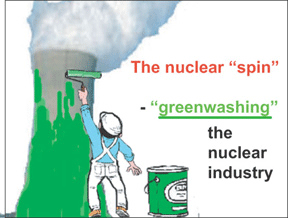 Tug of war: Stakeholders clash over nuclear, fossil fuel addition to green energy bill Norman Harsono, The Jakarta Post Jakarta / Fri, September 25, 2020 Green energy businesses and watchdogs are up in arms over the House of Representatives’ decision to add nuclear and “new” fossil fuel technologies into a landmark green energy bill. Industry players have issued statements and held public hearings with lawmakers over the past two weeks to protest such an addition in the long-awaited New and Renewables Energy (EBT) bill, which promises legal certainty and incentives for listed industries. Nuclear energy, liquefied coal and coal gas – the latter product being pioneered by state-owned coal miner PT Bukit Asam – are all categorized as “new” but not “renewable” in the draft bill, a copy of which was obtained by The Jakarta Post.
Solar and battery ads blocked by Twitter and Facebook move against “political content” — RenewEconomy

Efforts to stamp out ‘fake news’ on social media inadvertently see ads for rooftop solar and clean energy events rejected for being too ‘political’. The post Solar and battery ads blocked by Twitter and Facebook move against “political content” appeared first on RenewEconomy.
Solar and battery ads blocked by Twitter and Facebook move against “political content” — RenewEconomy
Fukushima criticism for unauthorized use of radiation exposure data-Interim report on Date City
According to the report, Mr. Tanaka wrote in the Yomiuri Shimbun on April 4, last year, “Even if the paper is withdrawn, the data analysis should be re-analyzed through appropriate procedures. It will be useful for estimation and reduction measures, “he said, and pointed out that Mr. Tanaka, who is in a position to relax the standards for food and air dose, may have influenced the paper.
http://www.ourplanet-tv.org/?q=node/2520 25th September 2020

After the accident at TEPCO’s Fukushima Daiichi Nuclear Power Station, he wrote a dissertation that led to an underestimation of radiation exposure without obtaining the consent of the residents of Date City, and on the 24th, a parliamentary-style dissertation was raised. The special committee made an interim report. The researchers have severely denounced the transfer of responsibility to Date City as “an act of sin.” The report also goes into detail, pointing out the relationship with Mr. Shunichi Tanaka.
At issue are two papers published in British scientific journals between 2016 and 2017 by Professor Makoto Miyazaki of Fukushima Medical University and Professor Emeritus Ryugo Hayano of the University of Tokyo.
In February of this year, the Date City Investigation Committee released a report pointing out the suspicion of violating the Personal Information Protection Ordinance, but in response to this, the city council established a special committee to verify the city’s investigation results. It was.
Special Committee for Investigation on Provision of Radiation Exposure Data, Interim Report (Japanese only)
https://www.city.fukushima-date.lg.jp/uploaded/attachment/47281.pdf
Pointed out that “hidden illegal acquisition of data”
Kunio Kikuchi, chairman of the special committee, first pointed out that the researchers did not give informed consent at all.
After accusing him of saying, “It is highly likely that he was trying to write by ignoring consent and disagreement rather than by explaining it,” he said,
“I try to avoid passing responsibility as if there is a problem with the city’s data provision.” Is an act of sin as a researcher, ” he pointed out the responsibility of the researcher.
Furthermore, regarding the fact that the “Paper Request Form” issued on August 1, 2015 in the name of the mayor was actually created in late October, to conceal the illegal acquisition of citizen data. It was pointed out that it was “work”. Although it had already been analyzed, Mr. Miyazaki formally applied to the Ethics Review Board and stated that he had obtained a doctorate, and even Mr. Miyazaki’s dissertation withdrawal comment was strict. I criticized it.
Pointed out the city’s omission of survey-Provided by flying in 2014
In addition, the report pointed out the omission of investigation by the city’s investigation committee. In the city’s investigation report, only the data provided in February 2015 and August of the same year was reported, but in December 2014, Mr. Miyazaki ignored the procedure for the then director Takahiro Hanzawa of the city. Then, I introduced the existence of an email that asked Mr. Hayano to provide data at his discretion. “Ignoring the Personal Information Protection Law, Illegal provision, assistance, and illegal acquisition,” he said.
Date City’s “Investigative Committee on Radiation Exposure Data Provision” Report (Japanese only)
https://www.city.fukushima-date.lg.jp/soshiki/3/39948.html
Also mentioned the provision of analysis data to Mr. Shunichi Tanaka
In addition, the report also mentioned that the analysis data was passed on to Mr. Shunichi Tanaka, who became the city administration advisor of Date City after the accident and then became the chairman of the Nuclear Regulation Authority.
In June 2013, a person in charge of the department had a meeting with Mr. Miyazaki and Mr. Hayano about dose measurement in the meeting materials of the Nuclear Disaster Victims Life Support Team of the Cabinet Office, which is responsible for designating and canceling evacuation orders. Pointed out that the facts that are stated. On October 20, 2015, Mr. Hayano said that the analysis data had been provided to Mr. Tanaka, and that the data of Date City was provided by illegal means, which influences the national policy he suggested.
According to the report, Mr. Tanaka wrote in the Yomiuri Shimbun on April 4, last year, “Even if the paper is withdrawn, the data analysis should be re-analyzed through appropriate procedures. It will be useful for estimation and reduction measures, “he said, and pointed out that Mr. Tanaka, who is in a position to relax the standards for food and air dose, may have influenced the paper.
JPR Comments on Papers and Withdrawals
The first paper “Individual external dose monitoring of all citizens of Date City by passive dosimeter 5 to 51 months after the Fukushima NPP accident (series): 1. Comparison of individual dose with ambient dose rate monitored by aircraft surveys”
The second paper, “Individual external dose monitoring of all citizens of Date City by passive dosimeter 5 to 51 months after the Fukushima NPP accident (series): II. Prediction of lifetime additional effective dose and evaluating the effect of decontamination on individual dose”
Full article in Japanese with sources from Our Planet TV here; http://www.ourplanet-tv.org/?q=node/2520
Follow Our Planet TV on Twitter; @OurPlanetTV
Energy authority clears TEPCO to restart Niigata’s Kashiwazaki-Kariwa nuclear plant
It is the largest nuclear generating station in the world by net electrical power rating. There are seven units, all lined up along the coast line. Numbering starts at Unit 1 with the south-most unit through Unit 4, then there is a large green space in between Unit 4 and 7, then it continues with Units 6 and 5, the newest of the reactors.
The plant is owned and operated by Tokyo Electric Power Company (TEPCO), same company which owns the Fukushima Daiichi nuclear plant where the nuclear disaster is still ongoing since March 2011.
The Kashiwazaki-Kariwa Nuclear Power Plant is a large, modern (housing the world’s first ABWR) nuclear power plant on a 4.2-square-kilometer (1,000-acre) site including land in the towns of Kashiwazaki and Kariwa in Niigata Prefecture, Japan on the coast of the Sea of Japan, from where it gets cooling water.
It was approximately 19 km (12 mi) from the epicenter of the second-strongest earthquake to occur at a nuclear plant, the Mw 6.6 July 2007 Chūetsu offshore earthquake.
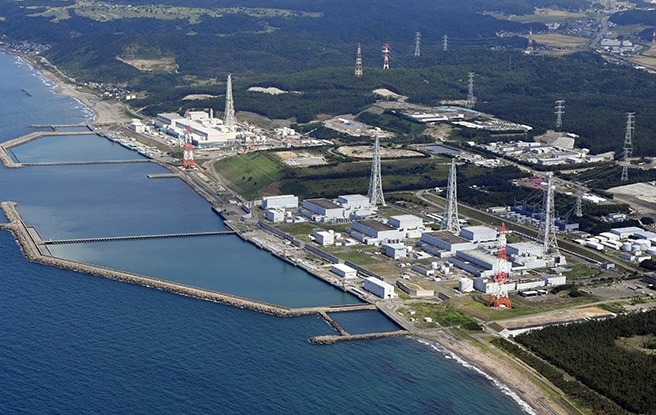
Tokyo Electric Power Co.’s Kashiwazaki-Kariwa nuclear complex in Niigata Prefecture
September 23, 2020
Tokyo Electric Power Co. cleared a major regulatory hurdle toward restarting a nuclear power plant in Niigata Prefecture, but the utility’s bid to resume its operations still hangs in the balance of a series of political approvals.
The government’s nuclear watchdog concluded Sept. 23 that the utility is fit to operate the plant, based on new legally binding safety rules TEPCO drafted and pledged to follow. If TEPCO is found to be in breach of those regulations, it could be ordered to halt the plant’s operations.
The Nuclear Regulation Authority’s green light now shifts the focus over to whether local governments will agree in the coming months to restart the Kashiwazaki-Kariwa plant.
TEPCO is keen to get the plant back up and running. It has been financially reeling from the closure of its nuclear plants in Fukushima Prefecture following the triple meltdown at the Fukushima No. 1 nuclear plant in 2011 triggered by the earthquake and tsunami disaster.
The company plans to bring the No. 6 and No. 7 reactors back online at the Kashiwazaki-Kariwa nuclear complex, which is among the world’s largest nuclear plants.
The two reactors each boast 1.35 gigawatts in output capacity. They are the newest of the seven reactors there, first put into service between 1996 and 1997.
TEPCO has not revealed specific plans yet on what to do with the older five reactors.
In 2017, the NRA cleared the No. 6 and No. 7 reactors under the tougher new reactor regulations established in 2013 in response to the Fukushima nuclear disaster.
It also closely scrutinized the operator’s ability to run the Niigata Prefecture plant safely, given its history as the entity responsible for the nation’s most serious nuclear accident.
After several rounds of meetings with top TEPCO managers, the NRA managed to hold the utility’s feet to the fire enough to make it pledge, in writing, to abide by a new seven-point safety code for the Kashiwazaki-Kariwa plant.
The creation of the new code, which is legally binding, is meant to hold the company accountable for safety measures at the facility.
“As the top executive, the president of TEPCO will take responsibility for the safety of nuclear power,” one of the points reads. “TEPCO will not put the facility’s economic performance above its safety,” reads another.
The company promised to abide by the points set out in writing during the NRA’s examination of its safety regulations.
TEPCO also vowed to set up a system where the president is directly briefed on risks to the nuclear complex, including the likelihood of earthquakes more powerful than what the plant is designed to withstand. It must also draft safeguard measures to deal with those kinds of earthquakes and confirm whether precautionary steps are in place.
The utility additionally pledged to promptly release public records on the decision-making process concerning crucial matters related to nuclear safety, and to preserve the documents until the facility is decommissioned.
TEPCO plans to complete its work to reinforce the safety of the No. 7 reactor in December. It has not set a definite deadline for similar work for the No. 6 reactor.
To restart the Kashiwazki-Kariwa plant, TEPCO needs to obtain consent from local governments, including the Niigata prefectural government.
The prefectural government is studying the plant’s safety through a panel of experts, which is reviewing whether evacuation plans are adequate and the health impact on residents from the Fukushima nuclear disaster.
Niigata Governor Hideyo Hanazumi said he will not decide on the restart until the panel completes its review.
The nuclear complex suffered damage, including from fire at an electric transformer, when an earthquake it deemed able to withstand hit in 2007.
South Korean Gov’t Concerned over Fukushima Daiichi’s Radioactive Water Release
Gov’t. Concerned over Japan Possibly Releasing Contaminated Water from Daiichi Plant
September 23, 2020
South Korea has expressed concerns over Japan strongly considering the release of contaminated water from the Fukushima Daiichi nuclear power plant disaster site into the ocean.
The Ministry of Science and ICT said First Vice Minister Jeong Byung-seon revealed the plans in a virtual keynote speech during the 64th General Conference of the International Atomic Energy Agency(IAEA) on Wednesday.
Jeong said the international community, including South Korea, is growing concerned and nervous about the environment and its safety as Japan mulls such a possibility.
The vice minister stressed the need to thoroughly analyze the mid- and long-term damage the release could have on the environment and the appropriate way to go about it, given that it could affect global marine environments.
In particular, Jeong said that in line with international laws, Japan is obligated to communicate with the international community in a transparent manner ahead of deciding on ways to dispose of the contaminated water and proposed that the IAEA play a key role in that process.
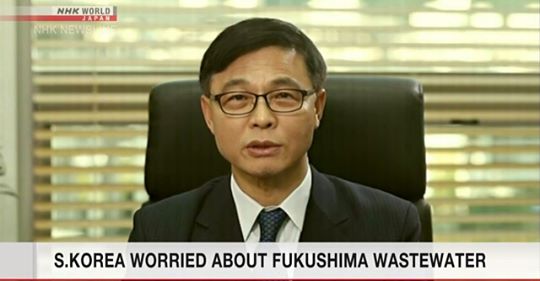
S.Korea concerned about Fukushima waste water
September 23, 2020
South Korea has again expressed its concerns about Japan’s plan to release into the sea radioactive wastewater building up at the crippled Fukushima Daiichi nuclear plant.
The first vice minister of South Korea’s science ministry Jeong Byungseon was speaking at a general meeting of the International Atomic Energy Agency in Vienna on Tuesday.
He said “releasing contaminated water into the ocean is not an issue of Japan itself, but one that could have a wider impact on the global marine environment, as well as the neighboring countries.”
He said Japan has “an overarching obligation to make transparent, concrete communication within the global society,” including South Korea, before making any disposal decision.
He asked the IAEA to play a proactive role in the issue.
At last year’s IAEA general meeting, South Korea raised questions about the issue and criticized Japan.
On Monday, Japan’s Science and Technology Policy Minister Inoue Shinji told the meeting that Japan is studying ways to dispose of the water, taking into consideration advice from the IAEA. He stressed Japan will provide careful and transparent explanations to the global community.
In February, a Japanese government expert panel came up with a report saying that diluting the wastewater below environmental and other standards, and discharging it into the sea, as well as vaporizing and releasing it into the air are realistic options.
The government plans to make a decision after hearing opinions from local residents and groups.
Don’t criticize government or TEPCO, guides in Fukushima told
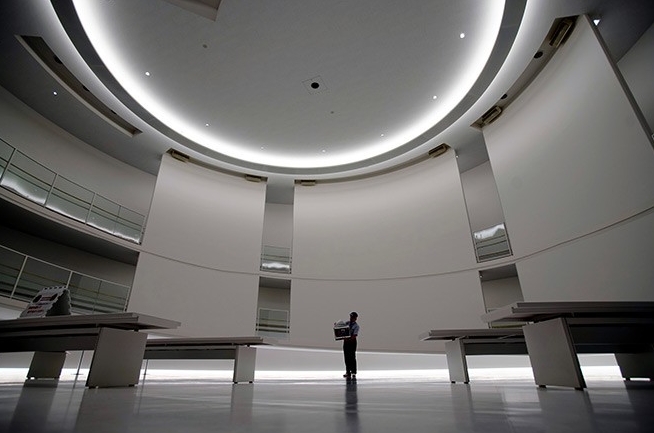
A guide gives a demonstration talk at a preview event held on Sept. 5 at the Fukushima memorial museum.
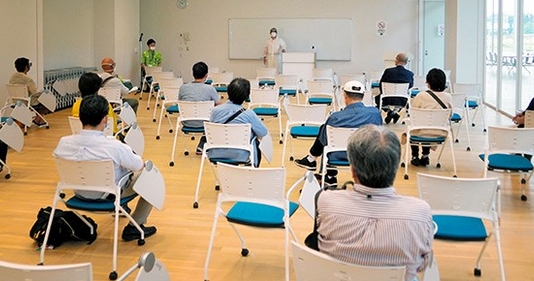
A Fukushima memorial museum staff member presents a talk on Sept. 20 when the facility opened.
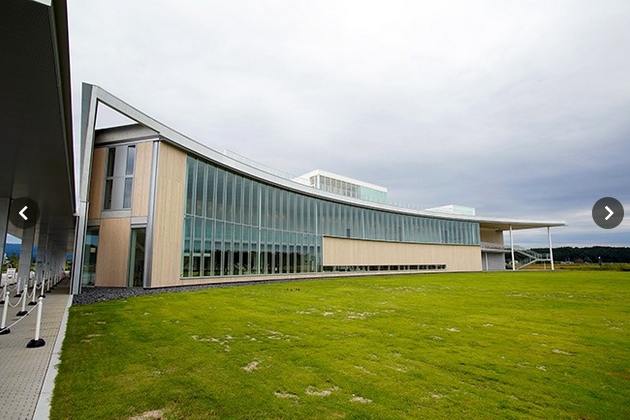
The Fukushima memorial museum in Futaba is devoted to passing on the lessons from the 2011 earthquake, tsunami and nuclear disaster.
September 23, 2020
Tour guides are bristling at instructions not to criticize the central government or Tokyo Electric Power Co. when speaking to visitors at a recently opened memorial museum to the 2011 triple meltdown at the Fukushima No. 1 nuclear power plant.
The instructions have left some Fukushima residents who signed up to be guides feeling perplexed and sparked anger in others.
The museum in Futaba, Fukushima Prefecture, opened on Sept. 20 with the objective of passing on to visitors the lessons learned from the nuclear disaster triggered by the Great East Japan Earthquake and tsunami.
It was constructed by the Fukushima prefectural government in the town of Futaba, which co-hosts the nuclear plant. Evacuation orders issued for residents following the disaster were recently partially lifted.
About 150 items chosen from the 240,000 or so materials collected from around the nation are on display at the facility operated by the Fukushima Innovation Coast Framework Promotion Organization. The central government effectively paid for the 5.3 billion yen ($50 million) that went into completing it.
The museum has 29 registered guides who either survived the 2011 disaster or underwent a training program for the work. They rotate on a daily basis and talk to visitors about their experiences, which include how they lived while living as evacuees and losing their homes in the tsunami.
Each session lasts for a maximum one hour and the guide is paid 3,500 yen for each session.
Training sessions were held in July and August for the guides in which a manual was distributed that included wording to avoid “criticizing or defaming specific organizations, individuals or other facilities.”
One question raised was what to say if a visitor asked what the guide felt about TEPCO’s responsibility, according to several guides who took part in the training sessions.
The guides were told to not directly respond to such questions, but to leave the matter up to facility staff who would be sitting in on the sessions.
Each guide was also asked to write down a script of what they intended to say. The draft was checked and revised by facility staff.
The guides were also told that if they did criticize a specific organization, their talks would be stopped immediately and they would be dismissed as a registered guide.
The manual also included instructions to contact and consult with facility staff if the script was to be changed or if the guide was contacted by media representatives for an interview.
With regard to the manual and instructions, one guide said, “While defamation is out of the question, I think it is wrong that as a victim I am unable to criticize the central government or TEPCO, which is responsible for the damage.”
A second guide had the script revised after pointing out the responsibility of the central government and TEPCO.
Another speculated that the Fukushima prefectural government was not trying to ruffle feathers since the central government had paid for the facility.
“I suffered psychological anguish from TEPCO and I’m also angry with the central government,” one tour guide said.
“To me, that is the truth. The facility has asked us to speak the truth so it is not in a position to say ‘Don’t say such things.’ I will quit as a guide if expressing my feelings is considered being critical.”
A prefectural government official admitted that the central government and TEPCO would be covered by the “specific organizations” clause in the manual.
“We believe it is not appropriate to criticize a third party such as the central government, TEPCO or the Fukushima prefectural government in a public facility,” said another prefectural government official now on the facility staff.
Committees set up by the Diet and central government to investigate the cause of the Fukushima nuclear disaster issued reports that called it a “man-made disaster” and said TEPCO never considered the possibility that the Fukushima plant would lose all electric power sources in the event of an earthquake or tsunami because it stuck to a baseless myth that the plant was safe.
9 1/2 years after meltdowns, no end in sight for Fukushima nuke plant decommissioning
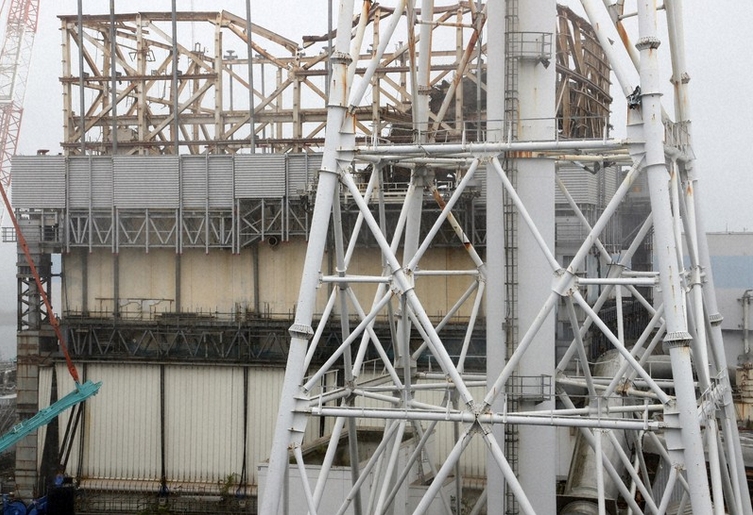
The No. 1 reactor building is seen at the Fukushima Daiichi Nuclear Power Station in Okuma, Fukushima Prefecture, on Sept. 1, 2020.
September 22, 2020
It has been some 9 1/2 years since the triple-meltdown disaster at the Fukushima Daiichi Nuclear Power Station in northeast Japan, and in early September I visited the plant to get a close-up look at the reactor buildings and find out how much progress is being made in dismantling them.
The trip began aboard a microbus, which stopped on an inland promontory running north to south at an elevation of 33.5 meters above sea level. Getting off the bus, I looked east, over the Pacific Ocean. And then I saw them, just 100 meters away or so: the buildings containing the plant’s No. 1 to 4 reactors.
When a tsunami triggered by the March 11, 2011 Great East Japan Earthquake slammed into the coastal facility, reactors 1 to 3 were online, while No. 4 was shut down for a regular inspection. There were core meltdowns in all three of the active reactors, with the fuel mixing with material from the surrounding structure as it melted and turned into “fuel debris.” Later, the No. 4 reactor building, connected to the No. 3 building by plumbing, was blown apart by a hydrogen explosion.
To complicate matters further, the reactor buildings had fuel storage pools each containing between 392 and 1,534 nuclear fuel rods. However, the plant workers managed to keep the rods cool, averting a major secondary disaster.
On my visit, the No. 3 reactor building is encased in what looks like a Baumkuchen layer cake stood upright. Inside, operations are underway to remove the fuel rods from the 12-meter-deep storage pool.
“There’s a newly installed crane in there to take the fuel out,” said our guide Masayuki Ueda, who is a manager at the Fukushima Daiichi decommissioning unit of the plant’s operator, Tokyo Electric Power Company Holdings (TEPCO).
The hydrogen explosion choked the pool and surrounding area with debris, including fragments of the roof and bits of nearby machinery. Even after the clearing of this debris, equipment and other problems delayed the fuel removal operation by more than four years. The process finally got underway in April 2019. The special crane lifts the some 300-kilogram rods out of the pool one at a time, and they are then taken to a pool in a separate building. Of the 566 rods, 366 had been removed as of Sept. 11, 2020. Due to the high radiation in the building itself, the crane is operated remotely from a control facility about 500 meters away.
The hardest part of the task is yet to come; the handles on 16 of the rods were warped by falling debris, and can’t be extracted by the crane as they are. TEPCO is apparently working on a “grabbing tool” for the crane to lift out the damaged rods, among other methods, in hopes to finish the removal project by March 2021.
We get back on the microbus and head down the hill to a spot where we can look up at the No. 4 reactor building. Here, too, we can see the machinery for the so-called underground ice wall surrounding the No. 1-4 reactors.
Groundwater from the mountains flows relentlessly beneath the power station. The walls in the basement levels of the reactor buildings were cracked in the March 2011 quake, letting in the groundwater and rainwater that has come into contact with the nuclear fuel debris, contaminating it. The “ice wall,” which TEPCO began making in May 2013, is TEPCO’s attempt to control the problem.
The wall is made up of some 1,500 pipes sunk 30 meters into the ground, creating a subterranean perimeter about 1.5 kilometers long around the reactor buildings. Liquid cooled to minus 30 degrees Celsius is then run through the pipes, freezing the soil around them. The Japanese treasury spent about 34.5 billion yen (about $330.7 million) to make the wall, and the electricity and other maintenance to keep it going costs hundreds of millions of yen per year. These latter outlays are passed on to consumers in their power bills.
Previously, the stricken plant produced up to 600 metric tons of contaminated water per day. However, thanks to pumping up groundwater on the landward side of the plant and other measures, that was down to 160 tons per day in April through July this year. Under the plant decommissioning plan, TEPCO and the Japanese government intend to reduce that to 150 tons per day by the end of 2020, and 100 tons by 2025. TEPCO has said that, with work on new roofs over the reactor buildings proceeding, it believes it can meet the 150 ton target this year.
Meanwhile, with radiation levels around the reactor buildings gradually declining, the Nuclear Regulation Authority (NRA) believes it is the moment to consider going into the basement levels to patch the cracks in the walls. NRA Chairman Toyoshi Fuketa has said that “it’s about time to start discussing when to halt” the ice wall operation.
There are experts who doubt the efficacy of the ice wall. In 2018, TEPCO estimated the wall alone was preventing 95 tons of contaminated water from being generated per day. However, Hideyuki Ban, co-director of the nonprofit organization Citizens’ Nuclear Information Center, told the Mainichi Shimbun, “There needs to be an inquiry into whether the ice wall was ever really necessary.”
Parts of the Fukushima Daiichi decommissioning plan have been delayed repeatedly since its release in December 2011. At that time, the plan stated it would take 30-40 years to complete the project. However, after seeing the power station up close, I find it hard to imagine this.
(Japanese original by Suzuko Araki, Science and Environment News Department)
https://mainichi.jp/english/articles/20200921/p2a/00m/0na/018000c
S. Korea renews concerns over possible release of tainted Fukushima water
The logo of the Ministry of Science and ICT at its main offices in the central city of Sejong, 130 kilometers south of Seoul, is shown in this undated photo provided by the ministry
September 22, 2020
SEOUL, Sept. 22 (Yonhap) — South Korea on Tuesday reiterated its concerns over Japan’s potential move to release radioactive water from its disabled Fukushima nuclear plant into the sea.
Japan has been mulling over options to discharge the water from the nuclear plant, which was devastated by a tsunami triggered by an earthquake in March 2011.
An estimated 1.1 million tons of tainted water is in temporary storage at the Fukushima plant.
South Korea’s Vice Minister of Science and ICT Jeong Byung-seon renewed concerns over Japan’s potential move in a recorded message at an annual conference of the International Atomic Energy Agency’s (IAEA), according to the science ministry.
The general conference of the U.N. nuclear watchdog was held partially online this year due to the coronavirus pandemic.
Jeong said releasing the tainted water would impact the global marine environment and that its method and long-term environmental risks need careful consideration through cooperation with global agencies, such as the IAEA.
The vice minister also called for an active role of the IAEA to facilitate transparency in the water’s disposal process, adding that Japan’s disposal plans should follow international law, such as the U.N. Convention on the Law of the Sea.
The science ministry said the vice minister will convey South Korea’s concerns to IAEA Director General Rafael Mariano Grossi in a separate meeting Wednesday.
The fallout of the damaged Fukushima nuclear plant has been a source of contention between the two neighboring countries, with South Korea imposing a ban on all seafood imports from eight Japanese prefectures near Fukushima in 2013.
https://en.yna.co.kr/view/AEN20200922007000320?section=national/diplomacy
Much at stake in picking a final nuclear waste disposal site
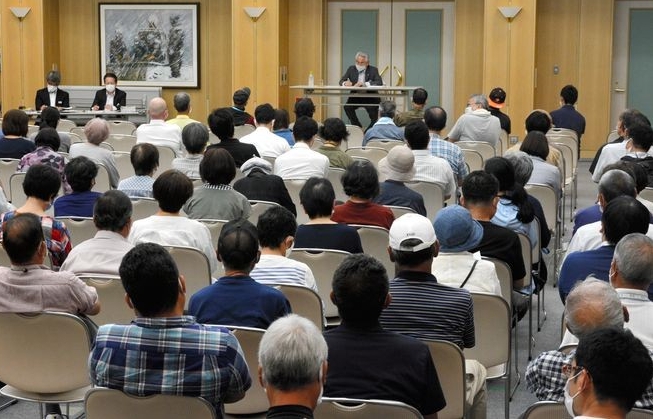
Local residents attend a meeting held Sept. 10 by the town government of Suttsu, Hokkaido, to explain plans to host a final disposal site for nuclear waste.
September 22, 2020
Two local communities in Hokkaido are considering pitching themselves as candidates for the site for final disposal of highly radioactive waste from nuclear power plants.
Last month, the mayor of Suttsu in the northernmost main island said the municipal government is thinking to apply for the first stage of the three-stage process of selecting the site for the nation’s final repository for nuclear waste.
During this period, past records about natural disasters and geological conditions for the candidate area are examined. Town authorities are holding meetings with local residents to explain its intentions.
In Kamoenai, a village also in Hokkaido, the local chamber of commerce and industry submitted a petition to the local assembly to consider an application for the process. The issue was discussed at an assembly committee. However, the assembly decided to postpone making a decision after further discussion.
Both communities are located close to the Tomari nuclear power plant operated by Hokkaido Electric Power Co. and struggling with common rural problems such as a dwindling population and industrial and economic stagnation.
The law decrees that when the first stage of the selection process starts, the municipality that is picked will receive up to 2 billion yen ($19.1 million) in state subsidies for two years.
But the Ministry of Economy, Trade and Industry and the Nuclear Waste Management Organization of Japan (NUMO), which are in charge of the selection process, have promised it will not move to the second stage if the prefectural governor or local mayor voices an objection.
Hokkaido Governor Naomichi Suzuki has already expressed his opposition.
A huge amount of spent nuclear fuel has been produced by nuclear plants in Japan, and it needs to be stored and disposed of somewhere in this country.
This policy challenge requires a solid consensus among a broad range of people, including residents of cities who have been beneficiaries of electricity generated at nuclear plants.
The two Hokkaido municipalities’ moves to consider applying for the first stage of the selection process should be taken as an opportunity for national debate on the issue.
The first step should be to establish a system for local communities to discuss the issue thoroughly from a broad perspective.
It is crucial to prevent bitter, acrimonious divisions in local communities between supporters and opponents.
The central government and other parties involved need to provide whatever information is needed from a fair and neutral position to help create an environment for healthy, in-depth debate.
There is also a crucial need to fix the problems with the current plan to build a final repository for radioactive waste.
Under the plan, which is based on the assumption that a nuclear fuel recycling system will eventually be established, the repository will be used to store waste to be left after spent nuclear fuel is reprocessed to recover and recycle plutonium and uranium.
But there is no prospect for the establishment of such a recycling system which would allow for disposing only of the waste from reprocessing and recycling.
Eventually, Japan, like most other countries with nuclear power plants, will be forced to map out plans for “direct disposal,” or disposing of spent fuel from nuclear reactors in underground repositories.
The central government has not changed its policy of maintaining nuclear power generation as a major power source. If nuclear reactors keep operating, they will continue producing spent fuel.
The government will find it difficult to win local support for the planned repository unless it makes clear what kind of and how much radioactive material will be stored at the site.
Many local governments are facing a fiscal crunch partly because of the impact of the COVID-19 pandemic.
Hokkaido Governor Suzuki has taken a dim view of the financial incentive offered to encourage local governments to apply for the first stage of the selection process, criticizing the proposed subsidies as “a wad of cash used as a powerful carrot.”
It takes tens of thousands of years for the radioactivity of spent nuclear fuel to decline to sufficiently safe levels.
Trying to stem local opposition by dangling temporary subsidies could create a serious problem for the future in the communities.
It is vital to ensure that the repository plan will secure a long-term policy commitment to the development of the local communities and ensure benefits for the entire areas.
Fukushima Daiichi workers use ‘smart glasses’
Sept. 20, 2020
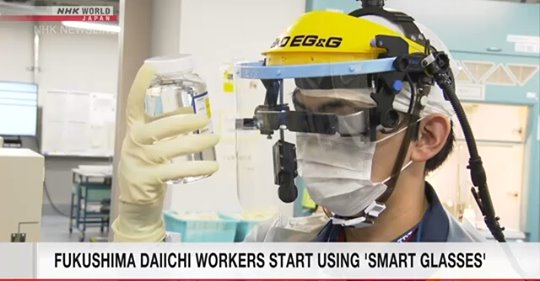
The operator of the crippled Fukushima Daiichi nuclear power plant has started using wearable electronic glasses to analyze water in and around the plant.
Tokyo Electric Power Company, or TEPCO, analyzes the concentration of radioactive substances and water quality and releases the data on a daily basis.
The “smart glasses” display information, such as work procedures and analytical graphs, on the liquid crystal screen.
When a QR code is scanned with the small camera, sampling locations and information on the person in charge are automatically recorded. Workers can also input the date and time by using their voices.
The data entry work has previously been carried out by hand with check sheets. TEPCO says the new glasses have made it possible for 30 of about 140 workers to be given other tasks. The utility says it plans to assign the 30 workers to analyze fuel debris.
A TEPCO official in charge of decommissioning the damaged reactors says it requires a lot of effort to input a huge amount of data by hand and there have been some errors, but the glasses should improve accuracy and productivity.
The official also says the company wants to accelerate the decommissioning process by helping employees to work more efficiently.
Japan fiddles with the idea of unleashing tainted water at Fukushima
September. 18, 2020
Concerns are resurfacing that the contaminated water from the Fukushima power plants could be discharged into the sea with Suga Yoshihide sworn in as new prime minister of Japan. Mr. Suga previously said whoever takes power next should tackle the issue of the radioactive contamination at Fukushima plant.
The Tokyo Electric Power Company (TEPCO) has embarked on the process of cutting the amount of the contaminated water currently stored at the premises of Fukushima power plants, down to the discharge level of radioactive substances set by the Japanese regulatory authorities. Some experts say that the state-run power corporation is preparing to let loose the water tainted with radioactive materials from Fukushima meltdown. Pundits argue that transparency of information is necessary to verify whether the radioactive nuclide density can be curtailed below the threshold as interned.
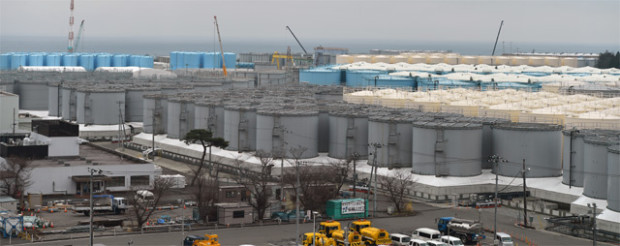
As of last year, the reactors at the Fukushima power plant site are belching an average 180 tons of contaminated water each day. This includes the massive amount of underground water that has been seeping into the nuclear reactors since 2013 in addition to the artificial influx of water. In February, the Japanese government reached the conclusion to unleash the water into the seas, with the storage capacity within the premises expected to reach the limit in August 2022.
TEPCO’s clean-up operation aims to reduce the discrepancy of radioactive density and cut the amount of discharging below standard for each type of nuclides. After upgrading and replacing the filters at multi-nuclide removal facility (ALPS), the process involves purifying the reservoir of the tainted water, checking the radioactive density, and processing the water again in the event density should exceed the threshold.
“The IAEA’s review has not found any issue with the performance of ALPS,” said Kim Yun-woo, a manager at the department of disaster prevention environment of the Nuclear Safety and Security Commission. “From a technical point of view, the purification process will likely bring down the density to meet the discharge standard, but in practice, we need to wait and see how much the water can get purified.”
The issue at hand is tritium. When the density is higher than a certain level, partial purification can be achieved through removal equipment. But the density of tritium in Fukushima water stands at 580,000 Bq per liter, impossibly low to remove with any equipment. Yet it is much higher than the discharge threshold at 60,000 Bq. There is known to be no effective technology to remove tritium under such circumstances.
Lifting Fukushima evacuation orders without decontamination should be limited
September 16, 2020
A new system in which evacuation orders can be lifted in “difficult-to-return” zones in Fukushima Prefecture in northeastern Japan without the national government decontaminating the zones will be set up, indicating a turnabout in the state’s recovery policy for the ongoing Fukushima Daiichi Nuclear Power Station crisis.
Since the onset of the nuclear disaster at Tokyo Electric Power Company Holdings Inc.’s Fukushima nuclear plant, the recovery policy had been premised on decontamination.
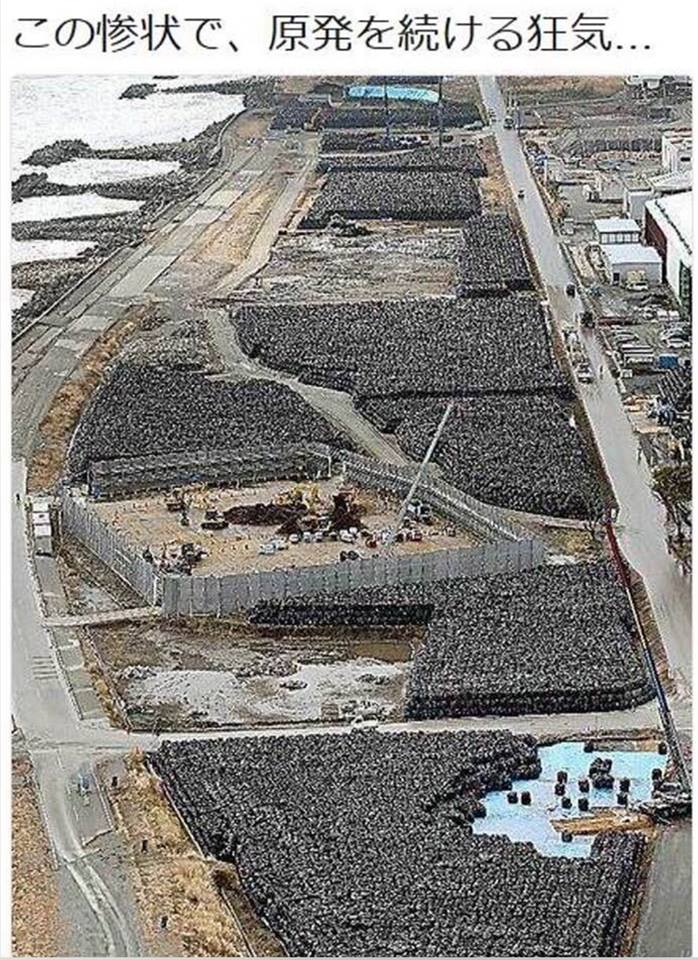
Of the difficult-to-return zones, there are six towns and villages that serve as “recovery bases,” which are former downtown areas and other types of land that are being decontaminated so that people can live there again. But such bases comprise just 8% of all difficult-to-return zones.
The new system will permit free entry into the remaining difficult-to-return areas on the condition that no one will live there, and that people will only use them as parks and other facilities.
While complete decontamination for such areas will no longer be required, the government plans to keep the criteria that radiation levels must go down before evacuation orders for these zones can be lifted. The Nuclear Regulation Authority has agreed with this plan.
What triggered this reversal in policy is a request submitted to the government by the Fukushima prefectural village of Iitate in February. Just a portion of the village is still under evacuation orders. Iitate sought the lifting of evacuation orders for the entire zone, without insisting on the decontamination of areas outside recovery bases.
The other five towns and villages are not following suit, however. Rather, some of them have voiced concerns that the government has no prospects of decontaminating areas outside recovery bases, and will force them to follow the “Iitate model.”
The new system must be considered an exception that can only be applied when a town or village seeks its application. It must not be extended.
The government must first indicate a policy on how it will proceed with the lifting of evacuation orders of areas outside recovery bases.
This is something that local towns and villages have long been seeking from the government.
The law stipulates that pollution resulting from a nuclear incident is the responsibility of the national government. If the new policy is implemented, that responsibility will likely become blurred.
It is probably the huge expense of decontamination that is slowing down the government. There are many residents who are still torn between going back to their hometowns in Fukushima and staying elsewhere. And one reason for that is the government’s lack of clear leadership. We must not allow decisions to be postponed any longer.
Nearly a decade has passed since the onset of the disaster, and the differences in circumstances by community are increasingly standing out. In some places where the majority of the land is difficult-to-return, reconstruction and recovery have only just begun.
The national government must proceed with its recovery policy while taking into consideration the circumstances and intentions of each and every community.
https://mainichi.jp/english/articles/20200916/p2a/00m/0na/013000c
The Fukushima Nuclear Disaster Recovery That Wasn’t
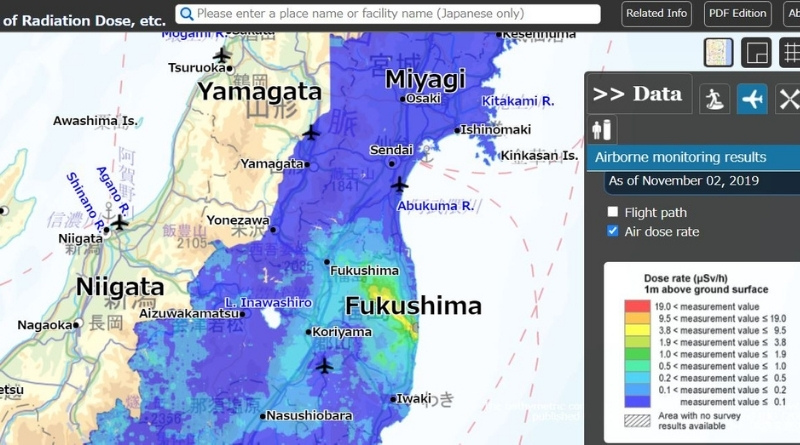
Outside of the photo friendly new train stations and town halls, the region has not seen the miracle recovery promised by Tokyo that would prove the disaster was a mere bump in the road.
Areas that were part of the worst of the fallout zone have been reopened, in many cases being used to compel evacuees to return home.
Japan’s nuclear regulator has approved reopening residential areas in the difficult to return zone without prior decontamination work.
The disaster recovery base allows a section of a town to be decontaminated and some basic services built in that location.
While communities try to reopen and recover business activity, the region near the disaster site has been designated as a storage site for contaminated soil bags from all over Japan.
This is done with the assumption that residents will eventually return and need some basic town functions in order to do so.
In order for residents to live there, they will need to wear a dosimeter, have annual exposures below 20 mSv/year and decontamination work may need to take place.
In some towns, common areas were decontaminated down to desired levels while other parts of the town remained highly contaminated.
In Iitate, part of the “difficult to return zone”, a section of the town was listed as a “disaster recovery base“.
In Futaba, one of the two towns that host the Fukushima Daiichi disaster site, trial cultivation of vegetables is taking place.
Many communities in the region remain abandoned, damaged and degrading, even as the government moves to declare them reopened.
Naraha, one of the early towns to reopen, has seen about 60% of residents return in the last five years.
Reopening metrics have been problematic in other areas already reopened.
With almost 70% of the land based fallout from the disaster deposited in forest areas, the potential for re-contamination remains high.
Decontamination work would result in re-contamination as dusts and soils migrate back in from areas not decontaminated.
The city now wants to do the decontamination work on residential properties themselves to accelerate making the area available for residency.
Futaba plans to have residents to return by 2022.
Farmland, houses and forest areas near homes would need to be decontaminated at least once to pass review.
Futaba was part of the highest radiation fallout levels after the initial disaster.
The government still holds an annual exposure level of 20 mSv/year as the threshold for reopening an area.
The local police officer for Futaba mentioned to reporters that the area may be reopened but no one can live there.
Few have returned to decontaminate residential properties, something key to having residents return.
Futaba plans to reopen the entire town by 2022.
Further north in Minamisoma residents who remain deal with wild monkeys who have moved in due to the lack of people.
In Tomioka, the eastern half of the town has been reopened since 2017.
16-meter seawall planned for Fukushima Daiichi
September 14, 2020
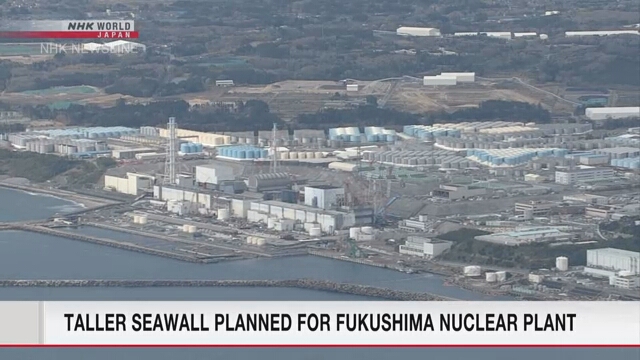
The operator of the damaged nuclear power plant in Fukushima, northeastern Japan, plans to build a taller seawall to help protect against future high seismic sea waves.
The move comes in response to the projection made in April by a government panel on the scale of tsunami that could be triggered by a massive quake along the Japan Trench in the deep sea off northeastern Japan.
The Tokyo Electric Power Company, or TEPCO, analyzed the projection and found that waves as high as 14.1 meters could engulf the Fukushima Daiichi plant compound, where the No.1 to No.4 reactors are located. It also found that waves of up to 15.3 meters high could hit south of the No. 4 reactor.
An 11-meter seawall is under construction on the ocean side of the plant compound. In an area south of the No. 4 reactor, another sea wall that is 12.8 meters high has already been completed.
TEPCO officials on Monday agreed to build another seawall measuring up to 16 meters high to protect these areas before the end of March 2023.
The wall is one of the anti-tsunami measures being taken by TEPCO as it decommissions the plant.
Work is under way to block the openings of the reactor buildings. Power supply vehicles are also deployed on higher ground to continue cooling spent nuclear fuel.
Nearly 1,000 tanks of radioactive wastewater are stored in the compound. TEPCO says the projected tsunami won’t reach the higher ground where these tanks are located.
1 This Month

Tell Congress: Prevent Nuclear Catastrophe in Iran

Tell Congress: Prevent Nuclear Catastrophe in Iran

Read the Public Inquiry Report, the Commissioners’ report, Surrendering Australia: The AUKUS Deception is available to download for free at aukuspublicinquiry.com. Or just watch the replay of the National Press Club Luncheon.


Shut down the radiation-damaged Heysham nuclear reactors now
To see nuclear-related stories in greater depth and intensity – go to https://nuclearinformation.wordpress.com

Say No to NASA’s Reckless Nuclear Reactor on the Moon
Say No to NASA’s Reckless Nuclear Reactor on the Moon
-
Archives
- November 2026 (269)
- October 2026 (302)
- September 2026 (339)
- August 2026 (330)
- July 2026 (355)
- June 2026 (287)
- May 2026 (306)
- April 2026 (356)
- March 2026 (251)
- February 2026 (267)
- January 2026 (308)
- December 2025 (358)
-
Categories
- 1
- 1 NUCLEAR ISSUES
- business and costs
- climate change
- culture and arts
- ENERGY
- environment
- health
- history
- indigenous issues
- Legal
- marketing of nuclear
- media
- opposition to nuclear
- PERSONAL STORIES
- politics
- politics international
- Religion and ethics
- safety
- secrets,lies and civil liberties
- spinbuster
- technology
- Uranium
- wastes
- weapons and war
- Women
- 2 WORLD
- ACTION
- AFRICA
- Atrocities
- AUSTRALIA
- Christina's notes
- Christina's themes
- culture and arts
- Events
- Fuk 2022
- Fuk 2023
- Fukushima 2017
- Fukushima 2018
- fukushima 2019
- Fukushima 2020
- Fukushima 2021
- general
- global warming
- Humour (God we need it)
- Nuclear
- RARE EARTHS
- Reference
- resources – print
- Resources -audiovicual
- Weekly Newsletter
- World
- World Nuclear
- YouTube
-
RSS
Entries RSS
Comments RSS

