nuclear-news

The News That Matters about the Nuclear Industry Fukushima Chernobyl Mayak Three Mile Island Atomic Testing Radiation Isotope

Fukushima Daiichi: probe touched suspected fuel debris in reactor#2

Images have been released of the reddish-brown amorphous mass. But its level of radioactivity is still unknown, which means that TEPCO has not even reached the earliest stage of its reactor decommissioning process.
I am acutely reminded again of the magnitude of this irreversible mess.
The technology we are left with is an out-of-control monster. And so long as nuclear power plants remain in operation, there is no guarantee that the same nightmare will not recur–even as we speak.

TEPCO: Probe touched suspected fuel debris
February 13, 2019
The operator of the damaged Fukushima Daiichi nuclear plant says a probe made direct contact with substances believed to be fuel debris at one of the plant’s reactors.
Tokyo Electric Power Company, or TEPCO, conducted its first contact survey of suspected fuel debris at the Number 2 reactor on Wednesday.
TEPCO has already confirmed the existence of deposits believed to be a mixture of molten nuclear fuel and structural parts at the bottom of the reactor’s containment vessel.
In Wednesday’s survey, a pole that can extend to 15 meters was sent under the reactor, and the probe was lowered from the end of the pole.
TEPCO plans to take out a small amount of the deposits with a different device in the latter half of the next fiscal year to use them as samples for study.
Officials say the probe was able to touch the deposits without any major trouble.
This is a key survey for devising a way to remove radioactive deposits.
They say they looked into the deposits’ hardness and whether they can be moved.
 
1st contact made with melted nuclear fuel at Fukushima plant
February 14, 2019
“The probe lifted pebble-like nuclear fuel debris and structural parts up to 8 cm in diameter at five spots in the 2,500-square-cm area that was investigated. It failed to pick up debris at one spot.
TEPCO said the probe could not lift clay-like debris likely because it had adhered to the bottom of the containment vessel.
The probe also touched nuclear fuel debris lying at several spots on the lattice-shaped scaffold for workers directly below the reactor’s pressure vessel.
The previous investigation of the No. 2 reactor in 2017 located melted fuel debris on the scaffold. But a robot deployed for a further investigation broke down on its way to the debris.
In a survey last year, the utility used the rod-like probe to take images of the inside of the reactor.
TEPCO is expected to remove a small amount of nuclear fuel debris in the second half of fiscal 2019 as part of preparations for full-scale retrieval.”

February 18, 2019 Posted by | fukushima 2019 | , , , | Leave a comment

TEPCO firmly at fault for balking at payouts to disaster victims

hhhl.jpg
Tomoaki Kobayakawa, left, president of Tokyo Electric Power Co., meets with Fukushima Governor Masao Uchibori in June 2018.
February 9, 2019
The proposals rejected by TEPCO call for larger payments than the amounts suggested in the guidelines set by the Dispute Reconciliation Committee for Nuclear Damage Compensation, a committee within the education and science ministry.
The dispute resolution center, established to facilitate compensation payments to people who have suffered damage from the Fukushima accident, has successfully mediated more than 18,000 settlement agreements, but the institution is now facing a brick wall.
The utility has refused to accept many ADR deals proposed by the Nuclear Damage Compensation Dispute Resolution Center in response to collective requests from groups of residents in areas around the Fukushima No.
It has promised to pay compensation to all victims “down to the last one,” ensure “swift and considerate” payments and “respect” settlement proposals made by the dispute resolution center.
The center was established by the government in 2011 to help settle compensation disputes between TEPCO and victims of the nuclear accident.
Nearly eight years have passed since the 2011 Fukushima nuclear disaster, yet many victims seeking compensation for damages from Tokyo Electric Power Co., operator of the crippled nuclear plant, face uncertainty as the talks are getting nowhere.
Read more:

February 11, 2019 Posted by | fukushima 2019 | , , | Leave a comment

IAEA Urges Patience For Fukushima Nuclear Cleanup

IAEA-Mission-Nov-18-Fukushima-Daiichi-1.jpg
February 8th, 2019
 
“Despite these achievements, many challenges remain to be tackled in the decommissioning process, and ensuring safety in this complex situation requires sustained daily attention.” The new report follows up on original analysis presented to Japanese authorities in November and finds that the “risk reduction strategy is being implemented at a pace commensurate with the challenges of the site-specific situation.” That being said, however, “the IAEA Review Team continues to identify water management as critical to the sustainability of decommissioning activities” and has urged for a decision for the disposition of contaminated water to “be taken urgently engaging all stakeholders.” Specifically, the IAEA Review Team determined that it is necessary to determine an end-game for the Advanced Liquid Processing System (ALPS) sooner rather than later, considering that “the volume of ALPS treated water [is] expected to reach the planned tank capacity of 1.37 million [metres-cubed] within the coming three to four years, and considering current site facility plan for space allocations, and that further treatment and control of the stored water before disposition would be needed for implementation of any of the five solutions considered by the Japanese Government.” (For more on TEPCO’s contaminated water treatment, see here.) Further, but regarding the retrieval and end-game of radioactive fuel debris, the report’s authors state that “there should be a clear implementation plan defined to safely manage the retrieved material” and that “TEPCO should ensure that appropriate containers and storage capacity are available before starting the fuel debris retrieval.” There is therefore need for immediate decisionmaking but long-term patience and goals in place to thoroughly address the large amount of radioactive and contaminated waste.
 
https://cleantechnica.com/2019/02/08/iaea-urges-patience-for-fukushima-nuclear-cleanup/

February 11, 2019 Posted by | fukushima 2019 | , , | Leave a comment

TEPCO to survey suspected fuel debris in reactor


February 7, 2019
 
The operator of the crippled Fukushima Daiichi nuclear power plant says it will conduct the first contact survey on suspected fuel debris inside one of the reactors. The device has a maximum length of 15 meters, making it possible to reach the area directly below the reactor core where the suspected fuel debris is located.
 
TEPCO says it can plan a sampling survey if the debris may be moved. TEPCO says the tip of the device will touch and pinch the debris. The company says it hopes to assess how hard the debris is and whether it can be moved.
 
TEPCO says it will begin a comprehensive debris retrieval operation in 2021. The firm adds that the information obtained will be used to assemble removal equipment even if the debris cannot be moved.
 
Tokyo Electric Power Company said on Thursday that it will insert the measurement device into the containment vessel of the No.2 reactor next Wednesday.
 
The firm plans to decide by March of next year which reactor it will first work on.


February 11, 2019 Posted by | fukushima 2019 | , | Leave a comment

‘We were driven out’: Fukushima’s radioactive legacy

MBBHR4RGHMI6TNNUDUMN7N5QQQ.jpg
In March 2017, the government lifted its evacuation order for the center of Namie.
“This is the worst time, the most painful period.” For the people of Namie and other towns near the Fukushima plant, the pain is sharpened by the way the Japanese government is trying to move beyond the tragedy, to use the 2020 Tokyo Olympics as a symbol of hope and recovery, a sign that life can return to normal after a disaster of this magnitude.
If we give up, we would lose our town, and as mayor, I will work with all my heart to prevent that.” But many residents say the central government is being heavy-handed in its attempts to persuade people to return, failing to support residents’ efforts to build new communities in places like Nihonmatsu, and then ending compensation payments within a year of evacuation orders being lifted.
In other towns around the nuclear plant, people have complained that arbitrarily decided compensation payouts — more for people deemed to have been in radiation-affected zones, far less for tsunami victims, nothing for people just a mile outside the zone most affected — have divided communities and caused resentment and friction.
“This is a place desperate to attract people to return, but this reduces our attractiveness for young people,” said Riken Komatsu in the fishing port of Onahama, who is working to rebuild a sense of community and raise awareness about problems with the reconstruction effort.
The biggest tragedy now is the high rate of suicides.” Kazuhiro Yoshida, the embattled mayor of Namie, said fears about radiation are not the only reason people aren’t returning; many complain the deserted town lacks amenities.
“The scale of the problem is clearly not something the government wants to communicate to the Japanese people, and that’s driving the whole issue of the return of evacuees,” said Shaun Burnie, senior nuclear specialist with Greenpeace.
It says radiation levels in parts of Namie where evacuation orders have been lifted will remain well above international maximum safety recommendations for many decades, raising the risks of leukemia and other cancers to “unjustifiable levels,” especially for children.
In the rural areas around the town, radiation levels are much higher and could remain unsafe for people beyond the end of this century, Greenpeace concluded in a 2018 report. Greenpeace has been taking thousands of radiation readings for years in the towns around the Fukushima nuclear plant.
“The idea that an industrial accident closes off an area of Japan, with its limited habitable land, for generations and longer — that would just remind the public why they are right to be opposed to nuclear power.”
Four-fifths of Namie’s geographical area is mountain and forest, impossible to decontaminate, still deemed unsafe to return.
When it rains, the radioactive cesium in the mountains flows into rivers and underground water sources close to the town.
Komatsu says reconstruction has been imposed from above, a problem he says reflects, in a broader sense, what Japan is like.
Today, Namie’s former residents are scattered across all but one of Japan’s 47 prefectures.
“For the past eight years, we have seen the destruction of the area, the destruction of the community, and it will be difficult to bring people back,” he said.
With young people moving away, the elderly, who already feel the loss of Namie most acutely, find themselves even more alone.
Now, the damage is more severe because young people are not returning. The elderly who come back feel pessimism and depression.
Six Olympic softball games and a baseball game will be staged in Fukushima, the prefecture’s bustling and radiation-free capital city, and the Olympic torch relay will start from here.

February 11, 2019 Posted by | fukushima 2019 | , , | Leave a comment

The State of Nuclear Emergency Declared after the Fukushima Meltdown is Still On Today!!!

medical situation
1. Radioactive contaminated water still keeps accumulating:
2. High-level radiation from Fukushima plant is still being emitted daily.
3. Unfairness of forcing Fukushima residents to live with radiation up to 20 mSv/year.
4.Termination of housing allowance for “voluntary” evacuees from Fukushima, a serious violation of human rights.
5. The number of children with thyroid cancer is increasing although the government refuses to recognize the accident as its cause.
6.Recommendations from the UN Human Rights Council to the Japanese government (UNHRC, Oct. 2018)
The government is obliged:
6.1. to prevent and minimize, as much as possible, children from being exposed to radiation;
6.2. to change back from “20 mSv” to “1 mSv” per year standard before retracting evacuation orders, especially for children and women of childbearing age;
6.3. to not pressurize families to return to Fukushima by terminating housing allowance. (United Nations Human Rights Council, October 2018)
Source: The Fukushima Collective Evacuation Trial

February 11, 2019 Posted by | fukushima 2019 | , , , | 1 Comment

Radioactive cesium above legal limit detected in fish caught off Fukushima

20228976_1330173750369215_4944234602815822616_n.jpg
Feb 2, 2019
FUKUSHIMA – Radioactive cesium exceeding the state limit has been detected in fish caught off Fukushima Prefecture for the first time in about four years, the prefecture’s fisheries cooperatives association has said.
The cesium level of 161 becquerels per kilogram, exceeding the limit of 100, was detected in a skate, a type of ray, caught at a depth of 62 meters during test fishing Thursday.
The association stopped the shipments of skates caught in the waters. The fish will be taken off the market until safety is confirmed.
The prefecture will collect more samples for research and the central government will judge the safety of the fish.
In radiation checks of fish by the Fukushima Prefectural Government, a cesium level exceeding the limit was last detected in a stone flounder in March 2015, at 140 becquerels per kilogram.
The prefecture is home to Tokyo Electric Power Company Holdings Inc.’s crippled Fukushima No. 1 nuclear power plant.

February 3, 2019 Posted by | fukushima 2019 | , , | Leave a comment

IAEA urges Japan to take ample time in Fukushima cleanup

cleaning fuk.jpg
By Mari Yamaguchi
January 31
TOKYO — The International Atomic Energy Agency urged Japan on Thursday to spend ample time in developing a decommissioning plan for the tsunami-damaged Fukushima nuclear power plant and to be honest with the public about remaining uncertainties.
In a report based on a visit by an IAEA team to the plant in November, the agency urged the operator, Tokyo Electric Power Co., to secure adequate space and finish plans for managing highly radioactive melted fuel before starting to remove it from the three damaged reactors.
The cores of the three reactors melted after a massive 2011 earthquake and tsunami. Utility and government officials plan to start removing the melted fuel in 2021, but still know little about its condition and have not finalized waste management plans.
“The IAEA review team advises that before the commencement of the fuel debris retrieval activities, there should be a clear implementation plan defined to safely manage the retrieved material,” the report said. “TEPCO should ensure that appropriate containers and storage capacity are available before starting the fuel debris retrieval.”
The report also urged the government and TEPCO to carefully consider ways to express “the inherent uncertainties involved” in the project and develop “a credible plan” for the long term. It advised TEPCO to consider adopting contingency plans to “accommodate any schedule delays.”
Dale Klein, a former U.S. Nuclear Regulatory Commission chairman who heads a TEPCO reform committee, said in a recent interview that the decommissioning should not be rushed, even if the government and TEPCO have set a schedule and people want to see it move faster.
“It’s much better to do it right than do it fast,” he said, adding that it’s also good not to rush from a health and safety perspective. “Clearly, the longer you wait, the less the radiation is.”
He said he would be “astounded” if the current schedule ends up unchanged.
In order to make room in the plant compound to safely store the melted fuel and for other needed facilities, about 1 million tons of radioactive waste water currently stored in hundreds of tanks will have to be removed. The IAEA team, headed by Xerri Christoph, an expert on radioactive waste, urged the government and TEPCO to urgently decide how to dispose of it.
Nuclear experts, including officials at the IAEA and Japanese Nuclear Regulation Authority, have said a controlled release of the water into the Pacific Ocean is the only realistic option. A release, however, is unlikely until after the Tokyo 2020 Olympic Games in order to avoid concerns among visitors from overseas.

February 3, 2019 Posted by | fukushima 2019 | , , | Leave a comment

Who will be there?

By Kitty commenting on Abe makes sales pitch for Fukushima sake at Davos:
Prime Minister Shinzo Abe and other Japanese officials toast with sake produced in Fukushima Prefecture during the Japan Night …
The real killers, the strong beta and gamma-emitting, high level radionuclides like 90Sr, 137Cs, 99Tc and 129I , cobalt 60, Iridium are present in the soil in concentrations, hundreds of times higher than what they are saying in Japan. That is easy to see by the Geiger counter readings. Fukushima radionuclides can be in found very high concentrations across Japan from Fukushima to Yokohama, based on Busby and kaltofen sampling and analysis..
It is not simply cesium 137 that exists there.
An absorbed bolus of  80 billionths of a gram of any one of these beta-gamma  radionuclides, causes acute systemic poisoning and radiation poisoning. The results can be either acute death or prolonged agony and death. There will be death, If there is a massive bolus ingested. These are the most poisonous and dangerous substances on earth.
If  1 ounce of any of these radionuclides- substance : st90, 137Cs, 99Tc and 129I , cobalt 60, were dumped on a group of people it would be like the cesium 137 exposure in Brazil or worse.
If  any one of these radionuclides :90Sr, 137Cs, 99Tc and 129I Iridium, cobalt 60 was diluted in an inert powder for example, that  diffused the RADIONUCLIDE onto 10,000 people, gathered for a festival or event , 3 quarters of them would die horrible deaths in 2 weeks and the rest would have tumors and organ damage that would kill them in a few months.
Obviously the sailors on board the Ronald Reagan did not get such a dose but it came close for some of them.
Radioactivity decreases, with the square of distance. Chronic ionized radiation-wave exposure is dangerous  but , those the high level of those and other RADIONUCLIDEs present do not bode well for Japan in the concentrations that exist from Fukushima to tokyo that have been recorded by Busby and kaltofen.
Nucleoapes like to keep the eyes off the lethal radionuclides that are actually emitting the radiation.
There are also the highly potent alpha emitting, uranic and Transuranic alpha emitters like u235, u238, plutonium, AMERICIUM and actinides like Californium that are destroying the human genome in Japan. The beta-gamma emitters do too, but are not as effective and  as potent, as mutagens and acute carcinogens because of their solubility and other chemical properties.
The Uranics, transuranics, actinides, are causing lung cancers, pancreatic cancers and sharp increases in birth defects from mutagenesis,  and teratogenesis across Japan now.
A great deal of Japan’s water supply is probably  heavily contaminated with tritium by now.  TRITIUM is a strong teratogen, that is known to substantially increase incidence of leukemia. Tritium actually covalently bonds to DNA, protein, fat tissue  and muscle tissue, unlike other radionuclides tritium acts exactly like hydrogen does in the body and the body is constantly doing chemical conversions of proteins using hydrogen and tritium ions in metabolic, acid-base, and enzyme reactions in the body.
The nucleoapes have gone out of their way, to obscure the deadly, insidious-effects of tritium on the human genome, chromosomes and the human body.
We are bags of mostly saline water solutions,  proteins, fat, with some bone in us. When we ingest radionuclides they are sometimes  diluted enough by our water and protoplasm, to not cause recognizable or apparent damage and acute symptoms. It is so with the highly water soluble saline analogs like cesium and strontium.
Dr Chris Busby:
Einstein, politics, physicists-nuclear physicists, and reality

The Uranics, transuranics, actinides are not so soluble because they are heavy metals. Particles of these radionuclides, that  get stuck in the lungs and gi tract are particularly deadly. Many of these radionuclides can be biotransformed or chemically transformed into sulfates and organometallics that are easily absorbed into the body.
Then there are the evil-monkeys that says that some radionuclides increase our resistance to RADIONUCLIDE exposure and bioccummulation. Don’t ya know radioactive tritium increase incidence of leukemia, as has been shown in rigorous studies and case studies, its hormetic!
Question. What are the Four most poisonous substances known to humans that are not radionuclides?
Answers
1. Sarin gas is an organophosphate chemical weapon.
20 micrograms will kill you
2. Botulin toxin: Used cosmetically as a neuromuscular block agent, to get rid of wrinkles is lethally toxic in a bolus of 150 micrograms.
Botulin toxin is used to relax muscles and give the illusion that wrinkes are gone cosmetically. Botulin is used because of its extreme potency and length of duration,of action.
Botulin toxin has to be highly diluted and administered by and expert, for any purpose in the human body.
Botulin toxin is lethaly toxic in millionths of a gram concentrations. You can barely see a millionth of a gram with a powerful microscope.
Drugs are dosed at thousands of a gram,that is milligrams. A milligram is a barely detectable spec on a piece of paper to the human eye.
3. 220 micrograms of Ricin toxin from castor beans can kill a child
4. 300 micrograms of fentanyl can kill an adult. Fentanyl analogs are even more potent.
The Moscow theater hostage crisis (also known as the 2002 Nord-Ost siege) was the seizure of a crowded Dubrovka Theater by 40 to 50 armed Chechens on 23 October 2002 that involved 850 hostages and ended with the death of at least 170 people.
It is known that the Russians used a fentanyl-like agent to try to sedate the Chechens, who were holding the hostages in the theater. Unfortunately fentanyl is very hard to dose and disperse as an aerosol. A highly toxic agent like Fentanyl, has to be prepared in such a very special way, so that only its sedative effects are manifested.
Many of the innocent hostages in Nord-Ost, siege died from fentanyl poisoning from the compounded-fentanyl gas, used by the Russians to try to sedate the chechens, before they stormed the theater.
On the flip side of the coin, Sarin, when aerosolized with a suspending agent that works and diffuses the poison in high enough concentrations, is a deadly nerve gas that will kill thousands, in a few square miles with only a few, weaponized Cannisters, detonated.
The Tokyo subway sarin attack-Subway Sarin Incident was an act of domestic terrorism perpetrated on 20 March 1995, in Tokyo, Japan, by members of the cult movement Aum Shinrikyo. In five coordinated attacks, the perpetrators released sarin on three lines of the Tokyo Metro (then part of the Tokyo subway) during rush hour, killing 12 people, severely injuring 50 (some of whom later died), and causing temporary vision problems for nearly 1,000 others. The attack was directed against trains passing through Kasumigaseki and Nagatachō, where the Diet (Japanese parliament) is headquartered in Tokyo
The Aum sarin attack in the Tokyo subways only killed 12 people. They used relatively large amounts of sarin in closed, relatively small areas, with sealed spaces.
They absolutely did not know what they were doing, otherwise they would have known that high doses of sarin have to be aerosolized in a suspending agent like a gas that is liquid under pressure, to properly disperse enough of the agent for it to be widely, dispersed and effectively lethal to a large group of people.
Many radionuclides, and especially the corrosive salt beta-gamma emittors and halogens like I131 and I129 are lethal in billionths of a gram . It even says so in toxicology profiles because, some of these radionuclides are used as radiopharmaceutical agents to treat cancer.
Bllionths of a gram, of any substance, is not even visible with a high powered microscope.
Radionucides are ionizing radiation emitters, as well as being the most poisonous substances to living things on earth, in the universe.
Billionths of a gram concentrations of these elements are highly detectable in billionth of a gram concentrations with scintillometers, gamma spectrometers, and decent pancake Geiger counters.
One of the main difficulties with proving how acutely lethal or chronically damaging RADIONUCLIDE are after nuclear accidents, or with chronic exposure to nuclear waste, are the chaotic mechanisms of dispersion of the radionuclides after catastrophes or in-situ.
Think of the Russian, poisoned with polonium, in London. He was dosed with a nanogram amount of polonium that caused him to die a slow painful death,from systemic organ failure for which there was no cure. He died days after the poisoning.
Boluses of cesium 137, and iodine 131 can kill quite quickly or at lower doses, can kill like the polonium did the murdered Russian in prolonged agony.
Who will be there, to prove what caused people dying a days, weeks or a month, after a.large exposure. Who will speakup for causative agents, after years of bioaccumuted exposure, when no one is even properly looking for the causative agent-RADIONUCLIDE or radionuclides?

February 3, 2019 Posted by | fukushima 2019, radiation, Reference | , , , | Leave a comment

One more expensive robot to go probe in and to get fried

gallery_xlarge1.jpg
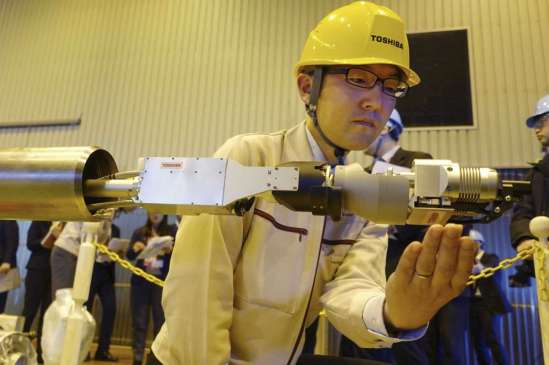
Toshiba Corp.’s energy systems unit group manager Jun Suzuki shows a remote-controlled melted fuel probe device at its facility in Yokohama, near Tokyo, Monday, Jan. 28, 2019. Toshiba unveiled the device carrying tongs that comes out of a long telescopic pipe for an internal probe in one of three damaged reactor chambers at Japan’s
gallery_xlarge.jpg
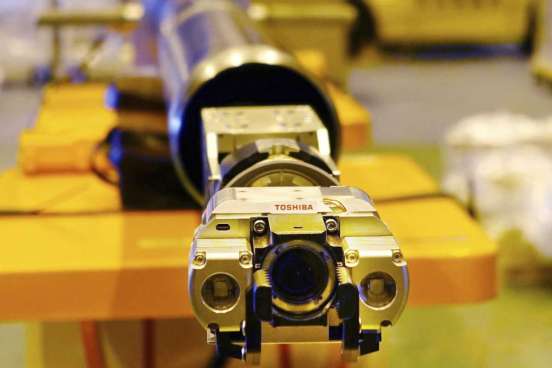
A remote-controlled melted fuel probe device is unveiled by Toshiba Corp. at its facility in Yokohama, near Tokyo, Monday, Jan. 28, 2019. Toshiba unveiled the device carrying tongs that comes out of a long telescopic pipe for an internal probe in one of three damaged reactor chambers at Japan’s tsunami-hit Fukushima nuclear plant – this time to touch chunks of melted fuel.
Toshiba unveils robot to probe melted Fukushima nuclear fuel
Jan. 28, 2019
YOKOHAMA, Japan (AP) — Toshiba Corp. has unveiled a remote-controlled robot with tongs that it hopes will be able to probe the inside of one of the three damaged reactors at Japan’s tsunami-hit Fukushima nuclear plant and manipulate chunks of melted fuel.
The device displayed Monday is designed to slide down an extendable 11-meter (36-foot) long pipe and grip highly radioactive melted fuel inside the Unit 2 reactor’s primary containment vessel.
An earlier robot captured images of pieces of melted fuel in the reactor last year, but other details of the fuel’s status remain largely unknown.
Toshiba’s energy systems unit said experiments with the new probe planned in February are key to determining the technologies needed to remove the fuel debris, the most challenging part of the decades-long decommissioning process.
 
Robot to examine fuel debris in Fukushima unit
29 January 2019
Toshiba has developed a remotely-operated robot to investigate debris in the bottom of the primary containment vessel (PCV) of unit 2 at the damaged Fukushima Daiichi nuclear power plant in Japan.
The device developed by Toshiba for examining debris in unit 2’s PCV (Image: Toshiba)
A pre-investigation of the area directly below the pressure vessel – known as the pedestal – was carried out in January 2017 at Fukushima Daiichi 2 using a remotely operated camera on a telescopic probe. Photos taken during that investigation showed a black mass and deposits near a grating in the pedestal area, possibly melted nuclear fuel.
The following month, Tokyo Electric Power Company (Tepco) sent a “scorpion-shaped” robot – developed jointly by Toshiba and the International Research Institute for Nuclear Decommissioning (IRID) – into the PCV of unit 2. Although the robot was unable to reach the part of the vessel directly under the reactor pressure vessel, the company said the information it gathered would help it determine how to decommission the unit.
In January 2018, an internal investigation of the PCV of unit 2 using a suspended pan-tilt camera attached to a telescopic guiding pipe identified deposits and fuel assembly components at the bottom of the pedestal area.
Yesterday, a robotic device developed by Toshiba Energy Systems & Solutions Corporation was unveiled that will be used to explore these deposits. The device – approximately 30cm in length and 10cm in width – features a camera, LED lighting, a pan-tilt mechanism, finger drive mechanism (tongs), radiation dosimeter and a thermometer.
“Using know-how cultivated through previous investigations at the Fukushima Daiichi nuclear power plant, Toshiba ESS added a finger drive mechanism for touching the deposits to investigate their condition to the telescopic guiding pipe developed last January,” the company said.
“Until now we have only seen those deposits, and we need to know whether they will break off and can be picked up and taken out,” Jun Suzuki, a Toshiba ESS group manager for the project, told Japan Today. “Touching the deposits is important so we can make plans to sample the deposits, which is a next key step.”
The robotic device is scheduled to be deployed to investigate the interior of unit 2’s PCV next month.
Tepco has also carried out robotic surveys of the PCVs of units 1 and 3 at the Fukushima Daiichi plant.
In March 2017, Tepco carried out an investigation of the PCV of unit 1 using the PMORPH robot developed by Hitachi-GE Nuclear Energy and IRID. Equipped with a dosimeter and waterproof camera, it took radiation readings and digital images at ten different measurement points within that unit’s PCV.
In July that year, it inserted a screw-driven submersible robot developed by Toshiba and IRID into unit 3’s PCV.
Goro Yanase, vice president of Toshiba ESS’s Nuclear Energy Systems & Services Division, said: “We will continue to advance technology development and contribute to investigation of the interior of the Fukushima reactors.”

February 3, 2019 Posted by | fukushima 2019 | , , | Leave a comment

Governor Promotes Fukushima Foods in Hong Kong

27655377_10208340154540700_7607840445643955842_n.jpg
Jan 26, 2019
Hong Kong, Jan. 26 (Jiji Press)–Masao Uchibori, governor of Fukushima Prefecture, has promoted the safety of foods from the northeastern Japan prefecture, home to a heavily damaged nuclear plant, during his visit to Hong Kong that started on Thursday.
Hong Kong introduced restrictions on food imports from the prefecture after a triple meltdown occurred at Tokyo Electric Power Company Holdings Inc.’s <9501> Fukushima No. 1 nuclear power station, which was knocked out by tsunami from the March 2011 powerful earthquake.
Uchibori is the first Fukushima governor to visit Hong Kong after the natural and nuclear disasters for the promotion of foods produced in the prefecture.
During the stay, Uchibori met with officials of an industry association related to Japanese foods.
He also paid a courtesy call on a senior Hong Kong government official in charge of import regulations.

February 3, 2019 Posted by | fukushima 2019 | , , | Leave a comment

Abe makes sales pitch for Fukushima sake at Davos

n-japandavos-a-20190125-870x575
Prime Minister Shinzo Abe and other Japanese officials toast with sake produced in Fukushima Prefecture during the Japan Night event in Davos, Switzerland, on Wednesday.
Jan 24, 2019
DAVOS, SWITZERLAND – On the sidelines of the World Economic Forum Annual Meeting on Wednesday, Prime Minister Shinzo Abe made a sales pitch for sake produced in Fukushima Prefecture.
At the Japan Night event in Davos, Abe advertised Yamato no Kokoro, produced in Fukushima’s Aizuwakamatsu from rice that his wife, Akie, grew in Yamaguchi Prefecture, where his electoral home district is located.
In the past, it would have been unthinkable for a sake brewer in the Aizu region to use rice from Choshu — now Yamaguchi — Abe said in a speech, noting that the Aizu and Choshu domains fought against each other in a civil war amid the 1868 Meiji Restoration.
Yamato no Kokoro is a symbol of peace, he said.
“I hope you’ll enjoy Japanese food and sake, the strongest of the country’s soft powers, and visit Japan to enjoy the real stuff,” Abe said.
The prime minister was making an appearance at the World Economic Forum Annual Meeting for the first time in five years. Abe made a speech at the Davos conference and stressed the need to promote free trade.
He returned to Japan on Thursday evening.

January 25, 2019 Posted by | fukushima 2019 | , , | Leave a comment

TEPCO failed to spot leak of contaminated water


Like they always say… “there is no impact on the environment.”
 
January 24, 2019
 
Tokyo Electric Power Company says it has determined that water containing radioactive substances leaked from a tank at the Fukushima Daiichi nuclear plant for more than two years. The company says there is no impact on the environment.
 
The utility says workers discovered water from an unknown source in an underground tunnel on January 10th at the plant.
 
The reactor complex was heavily damaged by the earthquake and tsunami in March 2011.
 
Officials later found that the water level of a nearby tank had dropped since around November 2016. They say about 300 tons of water leaked from the tank.
 
The officials say the water contained 120,000 becquerels of tritium per liter. That is twice the allowable level for the release of contaminated water at a nuclear plant operating normally.
 
The officials report that the tritium level of the water found in the tunnel was below the standard.
 
They believe the water flowed into the turbine building for the number four reactor through pipes.
 
The officials say the tank’s water level declined by about 1.7 meters during the period, but measurements conducted four times each day failed to detect the tiny difference from the previous check.
 
The company will now work to uncover the cause.
 

January 25, 2019 Posted by | fukushima 2019 | , , | Leave a comment

Fukushima soccer facility to fully reopen in April after 2011 crisis

gjjkl.jpg
This July 28, 2018 file photo shows the football stadium at J-Village, a national training center in Naraha, Fukushima Prefecture
January 23, 2019
FUKUSHIMA, Japan (Kyodo) — A soccer facility in Fukushima Prefecture that was used as an operational base for dealing with the 2011 nuclear crisis will fully reopen on April 20 with new natural turf pitches, its operator said Wednesday.
The J-Village, Japan’s first national soccer training center, located some 20 kilometers from the crippled Fukushima Daiichi nuclear plant, served until November 2016 as a base for crisis response, accommodating thousands of workers engaged in disaster cleanup efforts.
The facility, seen as the symbol of reconstruction of the disaster-affected area, partially resumed operations in July 2018, with the opening of its main stadium, restaurants, a hotel and a conference center.
A new train station nearby named after the facility will also start operations on April 20, according to its operator East Japan Railway Co., known as JR East.
The new station, set up between the existing Kido and Hirono stations on the Joban Line, will be used only when there is a major event held at the J-Village and its vicinity.
The Joban Line still remains partially out of service due to the Fukushima nuclear meltdowns, triggered by the March 2011 earthquake and tsunami disaster. JR East is seeking to fully resume operations on the line by the end of March 2020.
The J-Village, built and donated to Fukushima Prefecture by the Fukushima Daiichi nuclear plant operator Tokyo Electric Power Company Holdings Inc., opened in 1997.
It has played host to a number of different sports and will be the Japan soccer teams’ official training camp prior to the 2020 Tokyo Olympics.

January 25, 2019 Posted by | fukushima 2019 | , | Leave a comment

Confessions of a Rogue Nuclear regulator: nuclear is dangerous, a failed technology, not a safe bet for combating climate change

“Jaczko headed the NRC from 2009 to 2012 under former President Barack Obama. During his tenure, he oversaw several of nuclear’s worst battles and disasters, including Yucca Mountain, the proposed nuclear waste depository, and the Fukushima meltdown in Japan. He writes that what he witnessed was an agency overpowered by the agenda of the nuclear industry. Decisions were based on politics, not safety or the public’s best interests. After witnessing several close calls with plants and the aftermath of Fukushima, he’s come to the conclusion that there is no such thing as safe nuclear power.”


confessions-of-a-rogue-cover

Former NRC head disagrees with Bill Gates, says nuclear not a safe bet for combating climate change

How much do you think about nuclear power?
 
If you’re like most Americans, the answer is likely “not often.” Unless you work in the industry, you don’t hear too much about nuclear power these days, as Big Oil and coal face off against solar and wind.
 
The former head of the Nuclear Regulatory Commission wants to change that. In his latest book, Confessions of a Rogue Nuclear Regulator, Dr. Gregory Jaczko says that we not only should be thinking more about the consequences of nuclear power, we should be way more concerned about it than we are.
 
The former head of the Nuclear Regulatory Commission wants to change that. In his latest book, Confessions of a Rogue Nuclear Regulator, Dr. Gregory Jaczko says that we not only should be thinking more about the consequences of nuclear power, we should be way more concerned about it than we are.
 
Jaczko headed the NRC from 2009 to 2012 under former President Barack Obama. During his tenure, he oversaw several of nuclear’s worst battles and disasters, including Yucca Mountain, the proposed nuclear waste depository, and the Fukushima meltdown in Japan. He writes that what he witnessed was an agency overpowered by the agenda of the nuclear industry. Decisions were based on politics, not safety or the public’s best interests. After witnessing several close calls with plants and the aftermath of Fukushima, he’s come to the conclusion that there is no such thing as safe nuclear power.
 
Why did you decide to write a book?
 
I’d had a unique experience. I learned a lot in the job about the process of how nuclear power plants are regulated. I think it’s important for people to understand the influence that the industry has, that Congress has, and these are lessons that are true in any safety-sensitive industry.
 
The more pressing issue for me right now has developed the last couple years, and it’s the recognition that a lot of people are turning to nuclear as the savior of climate change. I have two kids and I’m extremely worried about climate change, but I’m even more worried that nuclear is a solution that people are pushing.
 
It’s a bad solution. It’s not the cheapest, and it’s a very expensive way to reduce carbon. And it’s an unreliable partner for climate change. You can have accidents and that can shut down plants, and that comes with all the environmental issues with nuclear itself.
 
That brings us to Bill Gates’ end of 2018 letter, in which he says that nuclear is essential for combating climate change.
 
Yeah, I think I actually saw that article, and I worry because I do think the history of nuclear technology shows that it’s not reliable. If you look today at the cheapest ways to generate electricity, it’s solar, it’s wind, it’s geothermal. These methods are a lot cheaper and only getting cheaper.
 
The biggest argument against them is the dispatch problem — you can’t always have them when you want them, but battery storage is also rapidly dropping in price. I look at those kinds of stories, and I scratch my head. I don’t really understand where those new nuclear technologies are coming from. His [Gates/TerraPower’s] technology is unproven and at least one decade, if not more realistically two, out, and they’re strategizing based on tech from China, and because of Trump policies they had to pull back on that project.
 
It’s not there. It’s not a solution. That’s just putting our head in the sand.
 
You are now working in renewable energy projects yourself?
 
I started in the offshore wind space about three or four years ago. Lo and behold, last month, three companies each bid $135 million just for the right to build offshore wind farms off Massachusetts. They think they can produce that power at almost competitive wholesale electricity prices. Even three years ago, we were not predicting that.
 
What’s happening in that clean energy space is dramatic. The tech is advancing so fast and the cost reductions are happening so fast, that’s really where the input should be going.
 
Why do you think Bill Gates and others are still pursuing nuclear?
 
Well, I’ve never met Bill Gates, and I would certainly ask him if we met [laughs].
 
I started my career as a scientist, and there are a lot of technical features to nuclear that make it very attractive. I don’t think there’s anything wrong with trying to come up with better nuclear fission technology, but it’s not going to combat climate change. In the short term, we could work on better nuclear, but if it comes to spending money on nuclear or other renewable energy sources, it would make more sense to invest in the other.
 
We have one of the biggest examples in Fukushima [2011], and my experiences dealing with the accident there. One by one, the Japanese shut down all their nuclear power plants, and you have a country of the Kyoto Protocol with very aggressive climate goals, and they hinged on this fleet of nuclear reactors. And you have one accident, and all this human suffering aside, and this technology has torn apart your goals for climate change.
 
There was certainly the immediate harm, but you’ve damaged your longer-term goals for saving the planet. Their carbon went up as they had to turn to all these dirty fossil fuels, and now they’ve started to come down. And they’ve done a tremendous amount since in energy efficiency. If they’d one this 20 years ago, they wouldn’t be in that situation today.
 
Before stepping into the role, did you have any idea how messy politics in the agency were?
 
I spent time working on the Hill for a congressman and a senator, and I’d had my taste for politics always as a staffer. There is always a difference between a staffer and principal. When I became chairman I was the principal. Then I realized the power that was at stake, the influence that was at stake, and the stakes were so high, it was going to be intense.
 
The nuclear power industry is tens of billions, and electrical utilities are some of the most powerful in the country. My first encounter with [Obama’s chief of staff] Rahm Emanuel, it was a very direct communication style, and it certainly made an impression on me. I realized what was at stake then, all the idealistic aspirations I hoped I maintained were going to run up against some practical and political powers.
 
I was trying to strike balance between public safety and the industries that operate. It was a delicate balance. The Fukushima accident is when I crossed that threshold that my job was foremost health and public safety and that was it. If we weren’t going to do it, who was? And the accident really galvanized that for me.
 
How do you see the future of nuclear power progressing under the Trump administration?
 
Well the thing the president has tried to do the most, coupled with the strategy to keep coal plants operating, has been comparable. He hasn’t gotten as much attention to subsidize nuclear power plants, and thankfully those efforts have been unsuccessful because I think those are mistakes.
 
Coal plants and nuclear plants are just too expensive to operate, and the focus has been on preserving them, but they’re being replaced by solar, wind, some gas, which is not ideal but I think other technologies will catch up and replace gas.
 
To me, the best thing anybody can do in the government, despite what the president says about climate change, is to just stay out of it. In many parts of the country, the market is doing the right thing. In many cases, the right pocketbook approach is the environmental approach. This is one place where the government needs to step out of the way and let the market take over.
 
Knowing what you know now, would you have still taken the job?
 
Absolutely. It was a great privilege to have the job. There was one moment when I was sitting across from my counterpart in Japan [during the Fukushima aftermath], and we both looked at each other and realized that we were both relatively young [around 40]. In that moment, I knew there was a reason we were there, if for no other reason than I could relate to this individual.
 
It was a great experience. It was hard, but at the end of the day, I got up knowing what I was doing and why I was doing it, and I was doing something to help people. And those jobs don’t come often.
 
 
Other interviews of Greg Jaczko to watch and to listen to:

“Nuclear: Dangerous, A Failed Technology” – Former Nuke Regulatory Chief Greg Jaczko Goes Rogue

Greg Jaczko, the former Chair of the Nuclear Regulatory Commission, has published an explosive new book: Confessions of a Rogue Nuclear Regulator.  In it, he gets honest with the American people about the dangers of nuclear technology, which he labels “failed,” “dangerous,” “not reliable.”  He particularly comes down against nuclear as having any part in mitigating the problems of climate change/global warming.  In this extended Nuclear Hotseat interview, Jaczko brings us inside the NRC’s response to Fukushima, the “precipice” on which nuclear safety balances, his own growing doubts about how safe nuclear reactors are in the United States, and how, ultimately, it was that concern with safety that probably brought him down.

Confessions of a Rogue Nuclear Regulator

Gregory Jaczko recounted his time with the Nuclear Regulatory Commission, for which he served as chair from 2009-2012.

January 25, 2019 Posted by | fukushima 2019 | , , , | Leave a comment