US industrial base is becoming stronger for wartime production, study finds
By Michael Peck, 13 July 26, https://www.militarytimes.com/industry/techwatch/2026/07/13/us-industrial-base-is-becoming-stronger-for-wartime-production-study-finds/?utm_source=sailthru&utm_medium=email&utm_campaign=c4-overmatch
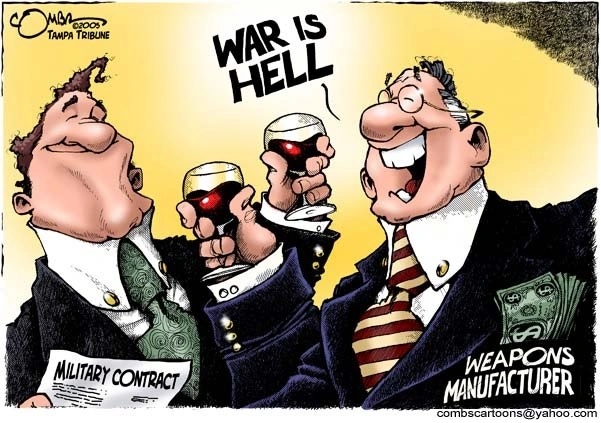
As recent conflicts consume weapons at a ferocious rate, America’s defense industrial base is becoming more prepared to sustain a major war, according to a new report.
“The trends are moving in the right direction,” Jerry McGinn, who co-authored the study for the Center for Strategic and International Analysis think tank, told Defense News.
However, the study — described as a progress report on reforms to the defense manufacturing and acquisition system — still found numerous problems with ramping up and sustaining wartime production.
For example, “according to several measures — manufacturing lead times, critical munitions and materials stockpiles, and supply chain security — the U.S. industrial base has a long way to go to achieve resilience,” warned the analysis by CSIS’s Center for the Industrial Base.
CSIS did find measurable improvements since November 2025, when Secretary of Defense Pete Hegseth vowed to “transform the entire acquisition system to operate on a wartime footing.”
Hegseth also promised to “inspire American industry to become a wartime industrial base that focuses on speed and volume.”
Most striking is the number of new companies in the defense field.
“Roughly 10,000 new firms have entered the market in the past two years and nontraditional companies received over $120 billion in contract obligations in FY 2025, adding competition and innovation to the sector,” CSIS noted. “Munitions contract obligations have risen 330 percent since FY 2010. Spurred by this increased demand and depleted inventories, the Pentagon is signing multiyear agreements with munitions producers and suppliers on a historic scale.”
The military is also responding to depleted stockpiles of expensive guided weapons that have been rapidly consumed by the Iran and Ukraine wars.
The Pentagon’s 2027 budget request for munitions allocated 49% to low-cost munitions — defined as costing less than $600,000 apiece — rising to 70% by 2031.
The U.S. is also strengthening its defense supply chain, such as “multiyear procurement agreements, direct-to-supplier investments, and leaner acquisition pathways,” as well as investing in defense companies such as L3Harris Missile Solutions, according to CSIS.
However, while this signals government commitment to defense production, it “also complicates competitive dynamics within the industry as new entrants and established suppliers alike seek to meet rapidly growing demand for munitions at scale.”
Also notable is federal investment in rare earths, which has seen production soar from 95 tons in 2022, to 8,900 tons in 2025. Nonetheless, “the erosion of domestic rare earth manufacturing capacity and the rise of Chinese control took decades to unfold, however, and it will take several years of enduring effort for the United States and its allies to build, scale, and sustain the production capacity of these key defense inputs.”
Exports of U.S. arms, or cooperative multinational projects such as the F-35 fighter, have also become a pillar of America’s defense industry. Foreign Military Sales, or FMS, have more than tripled, from less than $20 billion in 2015 to more than $80 billion in 2025.
The Trump administration wants to take this further with the “America First Arms Transfer Strategy,” launched in February 2026.
“The United States will use foreign purchases and capital to support domestic reindustrialization, expand production capacity, and improve the resilience of the United States defense industrial base,” the White House executive order declared.
Ultimately, the federal government can control defense production through the products it demands, the prices it is willing to pay, and the incentives it offers.
“It’s a monopsony,” McGinn said. “Government sets the market. Government can regulate the market. So, if the government wants different outcomes, it changes how it buys.”
Fearing Justice: Rubio Gets Bolshie About the International Criminal Court (ICC)

15 July 2026 Dr Binoy Kampmark, https://theaimn.net/fearing-justice-rubio-gets-bolshie-about-the-icc/
Why are they so afraid? The Trump administration, pathologically obsessed about the exaggerated reach of the International Criminal Court, have decided to take to the barricades. In a July 13 media note released by a spokesperson for the US State Department, something akin to a declaration of war was made against the Hague-based tribunal.
Secretary of State Marco Rubio was getting bolshie about it, announcing “a sweeping campaign to dismantle the threat posed by [the court] to US sovereignty.” The effort promises to “feature a whole-of-government response to systematically disable the ICC’s ability to operate, target American servicemen or officials, or otherwise threaten American sovereignty.”
The late Henry Kissinger, who argued most stridently against the establishment of such a criminal court, would no doubt have approved. He, more than most, would have feared some eventual accounting for his own egregious crimes against international humanitarian law while serving the White House.
The alarmist tone of the announcement is palpable. The ICC was seeking “to become an unaccountable global arbiter – positioning itself above and beyond the nation state as a supranational enforcement arm of a globalist bureaucracy empowered to prosecute American servicemen and officials at will.” (This has a whiff of familiarity to it, given that the Department of Justice under Trump’s steering hand has been prosecuting, at will, individuals perceived to have wronged him in the past.)
The media release is filled with careless distortions and ugly inaccuracies, not least in the sovereignty it purports to understand and defend. The ICC, for instance, “claims authority to prosecute and even imprison American servicemen and officials operating on behalf of America’s national interest.” The body claims no explicit power to do so, given that jurisdiction is only exercisable over State Parties. The United States, in company with such states as Russia, China, India and Israel, have not appended their signatures to the Rome Statute.
It follows that no such threat is credible except in instances when the service personnel of such countries conduct war on the territory of a State Party. For that reason, arrest warrants have been issued against Israeli Prime Minister Benjamin Netanyanu, his former Defence Minister Yoav Gallant, and Russian President Vladimir Putin. Even then, enforcing such warrants, as the record shows, remains patchy and vulnerable to the political and legal interpretations offered by member states.
US military personnel have, similarly, caught the eye of the ICC in 2020 for its activities in Afghanistan, though the subsequent investigation also focused on alleged crimes committed by the Taliban and Afghan government it replaced. It took only a year for the ICC to essentially abandon the American aspect of the investigation and focus, instead, on the alleged transgressions of the Taliban and the former Afghan government.
Rubio’s opinion piece in the Wall Street Journal is also cratered with an embarrassing inability to understand the role of a tribunal that has the support, however imperfect, of 125 member states. He regards the judges as hailing from “random countries”; the court and its allies as determined to seek “near-unlimited reach, empowered to override the courts and constitutions of the US and other sovereign states – and to prosecute and arrest our citizens.”
Failing to mention the shift in focus of the 2020 investigation into alleged infractions against international law in Afghanistan, he took grave exception to the remarks of the chief prosecutor, Fatou Bensouda, that American authorities had been tardy in conducting their own prosecutions. “In effect,” snorts Rubio, “Ms Bensouda was anointing herself the final judge of US military policy and the entire US justice system.” Hardly.
A somewhat hysterical note is struck in Rubio’s assessment of the court’s supporters. Like a sinister fifth column of operatives, the tribunal “is backed and run by a powerful network of leftist nongovernment organizations, smug globalists, and hostile Third World governments united by their enmity towards the US.” For the most part, the Secretary tries to make good the image of the American republic as a bullying, thuggish nation state indifferent to the strictures of law.
He cannot understand the fuss made about the extrajudicial murders of alleged “narcoterrorists” in Latin America and the Caribbean, the shoddy practices of the administration in deporting “violent criminals to El Salvador,” or that organisations might wish that “apparent war crimes” committed against Iran by the US might be investigated. “Independence is our birthright,” he pompously asserts. “We don’t intend to trade it for rule by a self-appointed priesthood of ‘international law.’” It was therefore incumbent that Washington work along with allies to “dismantle the ICC – brick by brick, if necessary.”
This dismantling effort seems hyperbolic. The Trump administration has already sought to blunt the court’s functions and hound its officials. Even before Rubio’s announcement, the administration has been aggressively seeking to stem the reach of the court and the effectiveness of its officials. On February 6, 2025, for instance, President Donald Trump issued Executive Order 14203, allowing the sanctioning of any person or organisation engaged in any efforts of the ICC “to investigate, arrest, detain, or prosecute a protected person without consent of that person’s country of nationality.”
Protected persons include, among others, current and former members of the US Armed Forces; current or former elected or appointed officials of US government; and any other person currently or formerly employed or working on behalf of the US government. The personnel of US allies also fall within the definition.
The sanctions listed in the order included the blocking of property and assets within the United States “as well as the suspension of entry into the United States of ICC officials, employees, and agents, as well as their immediate family members, as their entry into our Nation would be detrimental to the interests of the United States.” ICC Prosecutor Karim Khan was the first to be designated as a sanctioned individual, though the list would swell to include members of the judiciary, including Second Vice-President Reine Alapini-Gansou from Benin, Uganda’s Solomy Balungi Bossa, Peru’s Luz del Carmen Ibáñez Carranza and Slovenia’s Beti Hohler.
The Open Society Justice Initiative accurately notes the effect of such sanctions, being “tantamount to a financial death penalty.” These entail the freezing of US assets in bank accounts, a denial of access to credit cards, relevant online platforms, banking services and health insurance, and the inability to attend speaking engagements in the US. Three of the sitting judges – Bossa, Alapini-Gansou and Canada’s Kimberly Prost are seeking declaratory and injunctive relieve against Executive Order 14203 in the US District Court for the Southern District of New York.
The State Department media note suggests more of the same, flavoured with a villainous menace. The entire US government diplomatic corps is to become a public relations arm “highlighting the abuses of the ICC and the risks posed to Americans” and urging member states to withdraw from the Rome Statute. Nations with partnering arrangements with American law enforcement and the military, and those enjoying “the benefits of the US security umbrella” will also be pressed “to reject the ICC’s purported authority to prosecute American officials and servicemen.”
States refusing to reject the authority of the ICC while still relying on American assistance would be subjected to greater scrutiny, while countries not a party to the Rome Statute would be encouraged to “leverage their diplomatic networks to take similar actions alongside us.” ICC personnel would be subjected to continued visa revocations and travel bans, while the tribunal and “affiliated organizations” will be subjected to further sanctions. It will be a time for war criminals and offenders of international law to rejoice.
All institutions, supposedly underpinned by protocols and principles, are at the mercy of Trump’s broad reading of executive power, one fickle and petulant. His office has also become a source of obscene self-enrichment, inuring this administration to giddying levels of corruption. “I’ve made money, I’ve made a tremendous amount of money, more than I would have ever thought I would have made,” he boasts. For a person who relishes breaching laws and flouting regulations, it is little wonder he, along with his insufferable cronies, have such an animus against a world court that, for all its faults and blemishes, remains a worthy project in international law and human rights.
Holtec bets big on small nuclear reactors in its IPO filing
As it pivots from shutting down nuclear plants to building them, Holtec says small modular reactors can cut costs and speed construction. Now it has to prove it.
By Alexander C. Kaufman, 15 July 2026, https://www.canarymedia.com/articles/nuclear/holtec-ipo-small-modular-reactors
Nuclear giant Holtec International is betting big that its 300-megawatt small modular reactors are the future of atomic energy.
On Friday, the Florida-headquartered firm filed paperwork with the Securities and Exchange Commission in order to sell shares in the company on the Nasdaq.
Across hundreds of pages, the disclosure document outlines the 40-year-old Holtec’s plans to transform itself from the industry’s undertaker — manufacturing canisters to safely store radioactive spent fuel and decommissioning shuttered nuclear plants — to its midwife, producing and operating new electrical stations. This transition comes as nuclear energy regains popularity in the U.S. as a way to meet booming power demand without creating more planet-warming pollution.
Developers have traditionally offset nuclear’s high up-front costs by building ever-larger reactors to capture the economies of scale. Since the early 2000s, however, a number of companies have proposed building small modular reactors that can be constructed identically and in batches. SMRs could generate about a third of the electricity of conventional large-scale plants, but, proponents argue, would bring down costs through assembly-line repetition rather than physical scale.
That cost reduction has yet to be proven out in the real world with actual plants. But in its S-1 filing, Holtec said, “SMRs will offer scalable, cost-effective solutions for new capacity with enhanced safety features, reduced construction timelines and reduced land and transmission infrastructure needs as compared to traditional, larger-scale reactors.” It noted that a single-unit SMR plant would only need 15 acres of land and take a mere three years to build. By contrast, the big reactors on the grid today can take up hundreds of acres, and construction typically drags on for nearly a decade.
Holtec’s SMR-300, as the pressurized-water reactor is named, “is expected to receive regulatory approval for deployment in 2029” and reach its first deployment “in the early 2030s,” according to the filing.
The company said it expects SMRs to play “a meaningful role in the expansion of nuclear capacity,” noting that they can “complement large-scale nuclear generation through lower upfront costs” and more flexible planning around how much power is needed.
For example, smaller reactors may be better suited for converting some old coal-fired stations into nuclear plants. The DOE has been researching the idea for years, given that nuclear and coal are both thermal resources that operate with similar rates of frequency and therefore use similar equipment to generate electricity from steam — which in nuclear plants is made from the heat created by splitting atoms and in coal plants is made from heat created by burning the black rocks. Converting a 400-MW coal plant into a similar-size nuclear reactor makes more financial sense than using a bigger reactor, which could require costly transmission upgrades and more space
“We believe that our SMR-300 plant can become a favored nuclear generation source over large reactors because of certain advantages,” the company said in its filing.
The future of restarts
The company will also operate at least one conventional reactor, the 800-MW unit it’s currently restoring at its Palisades nuclear station, in western Michigan. That project — the nation’s first effort to return a permanently shuttered nuclear reactor to service — could be completed within months, though its contract to sell power to the local grid won’t kick in until next year.
Holtec hopes to combine its plant-restart strategy with its SMR vision. It’s planning to deploy two SMRs at the Palisades site; if that works out, the company has said it may build SMRs at New Jersey’s Oyster Creek nuclear plant, which it’s been in the process of decommissioning for eight years.
Holtec owns three other defunct nuclear plants — Massachusetts’ Pilgrim, Michigan’s Big Rock Point, and New York’s Indian Point — that it could also try to rebuild. The Trump administration has called for reconstructing Indian Point, but Albany remains opposed to the controversial proposal.
Local opposition isn’t Holtec’s biggest hurdle, however. That would be competition from the nuclear behemoths in Russia and China. Virtually every Western nuclear developer is facing an uphill battle to compete with the Kremlin’s state-owned Rosatom, by far the biggest international vendor of nuclear technology in the world, and China’s two state-owned nuclear companies, which are building more than three dozen reactors at home and are expected to enter the export game soon.
Still, among its domestic rivals, Holtec may be the best positioned to hold its own on a global playing field. It is an established company with profitable enterprises in a dozen countries across four continents, and has experience managing infrastructure so sensitive it’s overseen by a dedicated agency, the U.S. Nuclear Regulatory Commission. The company has facilities with electrical equipment on-site that can be potentially used to deploy SMRs. It also has won significant support from the federal government, both in the form of a $1.52 billion loan the Department of Energy provided to finance the Palisades restart and the $400 million the agency gave the company to support construction of its first SMR-300s.
“We began work in 2011 on a small modular reactor solution, and drawing on our in-house capability to design, license, manufacture, construct, and commission nuclear systems, honed through decades of turnkey supply, we are now uniquely positioned to launch the development of our small nuclear reactor,” Krishna Singh, Holtec’s founder and chief executive, said in a letter to prospective investors.
Dennis Kucinich Warns Congress Is Quietly Merging the U.S. and Israeli War Machines

SCHEERPOST, July 13, 2026
The former congressman tells Robert Scheer that a provision buried in the 2027 National Defense Authorization Act could integrate the United States and Israel at the highest levels of military technology—without meaningful public debate or congressional scrutiny.
Former Congressman Dennis Kucinich has spent decades warning about the machinery of permanent war. But in a new conversation with Robert Scheer, he argues that Congress is now on the verge of crossing a line without precedent in American military history.
At the center of Kucinich’s warning is Section 219 of the 2027 National Defense Authorization Act, a provision he says would formally integrate key areas of U.S. and Israeli military development, including artificial intelligence, autonomous weapons, quantum sensing, cyber and electronic warfare, biotechnology, missile defense, drones and directed-energy systems.
“They call it integration, but I call it a merger,” Kucinich tells Scheer.
The implications, he argues, go far beyond traditional military aid or weapons sales. Kucinich warns that the provision could create new counterintelligence risks, deepen U.S. dependence on Israel’s military infrastructure and technology, blur questions of war powers and further entangle Washington in Israel’s expanding regional conflicts.
Even more alarming, Kucinich says, is how little debate the proposal has received. Rather than being considered through a separate treaty or subjected to extensive congressional hearings, the provision has been folded into a massive defense authorization bill that lawmakers will face enormous political pressure to support.
“This provision has been smuggled into the bill,” Kucinich argues. “There’s never been any debate.”
For Scheer, the contradiction is impossible to ignore. At the moment the United States marks 250 years since declaring its independence, Washington may be moving toward an unprecedented military dependence on another state—one whose conduct in Gaza, the West Bank and Lebanon has placed it at the center of international accusations of genocide and grave violations of international law.
In this urgent edition of Scheer Intelligence, Scheer and Kucinich examine what Section 219 could mean for American sovereignty, constitutional government and the future of war—and why a provision of such consequence has received so little attention from Congress, the Democratic opposition and the mainstream press.
The Secret U.S.-Israel Military Merger Hidden in Congress’ $1.5 Trillion War Bill
“They call it integration, but I call it a merger,” Kucinich tells Scheer. “Why do corporations have mergers? They have them to eliminate duplications, to be able to integrate operations. This is exactly what’s happening here.”
The provision, according to Kucinich, would deepen cooperation between the United States and Israel in artificial intelligence, autonomous weapons, quantum sensing, cyber and electronic warfare, biotechnology, missile and air defense, drones and directed-energy technology.
“We’re not only sharing now military potential with this legislation,” Kucinich warns. “We’re also integrating values with the IDF, the Israeli Defense Forces.”
For Scheer, the implications are staggering. U.S. support for Israel is hardly new. Washington has supplied Israel with billions of dollars in military assistance, weapons and diplomatic protection for decades. But Scheer repeatedly presses Kucinich on what makes Section 219 different.
“Do we have mergers with other countries?” Scheer asks. “Why Israel?”
Kucinich’s answer is unequivocal.
“The United States has never had this kind of an agreement with one other nation where they’ve merged the defensive and offensive capabilities,” he says. “Never.”
‘This Provision Has Been Smuggled Into the Bill’
Perhaps most disturbing to Kucinich is not simply what Section 219 proposes, but how he says it has moved through Congress.
“I would argue that this provision has been smuggled into the bill because there’s never been any debate,” Kucinich says. “There’s been no separate committee hearings on this. It just landed in a bill of about a thousand pages.”
Kucinich argues that an agreement of this magnitude more closely resembles a treaty—something that traditionally requires Senate approval.
“Treaties have to be approved by the Senate,” he tells Scheer. “But they’re just trying to slip this through—an unprecedented merging of function. It doesn’t exist. We’ve never done this with any other country.”
The political mechanism is familiar. The NDAA is a massive piece of legislation that lawmakers face enormous pressure to support. Voting against it can quickly be portrayed as voting against American troops or national defense.
Scheer calls the maneuver “treacherous.”
“You have to buy the whole package,” Scheer says. By burying the provision inside a sprawling defense bill, he argues, lawmakers who object to Section 219 risk being accused of refusing to “support the people protecting our country.”
Kucinich notes that Reps. Ro Khanna and Thomas Massie have attempted to force greater congressional consideration of the issue. But, he says, Section 219 has been “streamlined and expedited” inside the broader legislation.
A ‘Strategic Entrapment Into Forever Wars’
The risks Kucinich outlines are extensive………………………………………………………………………………………………………………………………………………………………………………….. https://scheerpost.com/2026/07/13/dennis-kucinich-warns-congress-is-quietly-merging-the-u-s-and-israeli-war-machines/
Trump Administration Scrapping Nuclear Energy Rules Requiring Plants to Keep Radiation Levels “As Low as Reasonably Achievable”

Horrifying.
By Joe Wilkins, Jul 12, 2026, https://futurism.com/science-energy/trump-nuclear-regulation-radiation-energy
As government agencies go, the US Nuclear Regulatory Commission has left a lot to be desired, often operating less like a government watchdog and more as an industry partner. There’s fee recovery, for example, which effectively mandates the industry pay its own regulators’ salary, as well as the NRC’s habit of trusting voluntary leak reports from reactor operators, not to mention its history of hiding internal safety data to protect its reputation.
As if those deficiencies weren’t bad enough, president Donald Trump is now stripping what’s left of the commission’s mandate down to the bone. Last week, the NRC proposed a bold amendment to its long-standing nuclear safety principles: deleting a line requiring nuclear plant operators to keep radiation exposure “as low as is reasonably achievable.”
According to the Hill, the NRC justifies the move by saying it will remove “unnecessary ambiguity.” But critics say this rule is the whole reason energy companies bother keeping radiation levels as low as possible in the first place.
“Facility owners felt like… ALARA [as low as reasonably achievable] was forcing them to go well below the allowable radiation limits and spend a lot of money to do that,” director of nuclear power safety at the Union of Concerned Scientists Edwin Lyman told the Hill. “This is opening the door for sloppier practices,” Lyman continued, and “worse management.”
It gets worse. Also per the Hill, the NRC likewise announced plans to significantly weaken its approach to the National Environmental Policy Act, a foundational piece of legislation dating back to 1970. On Wednesday, the NRC said it wants to gut draft environmental reviews entirely — which, in practice, means kneecapping the public’s chance to weigh in before a reactor gets the green light.
If that weren’t enough, the commission also wants to wash its hands of its mandate to review basic environmental nuisances like noise, dust, and air pollution associated with nuclear facilities. That’s if they even do a review in the first place, as the proposed changes would exempt certain existing reactors, and even new reactors from regular inspection altogether, the Hill reports.
The proposed changes come just a few months after the US Department of Energy began stripping safety regulations that limited nuclear workers’ exposure to radiation. In effect, these changes allow energy companies to speed up productivity, unlocking higher profits at their workers’ expense.
The timing of it all is hard to overstate: with several new nuclear reactors gearing up for operations throughout the US, it’s clear the Trump administration is doing all it can to fast-track incoming nuclear facilities, consequences be damned.
Federal government proposes to lessen nuclear reactor environmental reviews

Edwin Lyman, director of nuclear power safety at the Union of Concerned Scientists, said that the move takes away an education tool for the public.
“If you don’t do the NEPA evaluations, then the public might not even know or understand how bad things could get,” Lyman said.
Comments:by Rachel Frazin – 07/09/26
A key government agency is proposing to lessen the scope of environmental reviews for nuclear reactors, limiting public input and exempting some reactors altogether.
The Nuclear Regulatory Commission (NRC) on Wednesday announced that it is narrowing review under the National Environmental Policy Act (NEPA), a bedrock environmental law.
This includes exempting reviews of some activities altogether, including the reapproval of existing reactors, as well as some new reactors.
For other projects, the agency will still review radiological impacts — but it is proposing to no longer consider factors such as dust, noise and air pollution that it says are beyond its scope.
NRC Chair Ho Nieh also said that the agency is also proposing to no longer issue draft environmental reviews, limiting the public’s ability to weigh in to the start of the process before the environmental impacts are considered.
Nieh described the move in a written statement as “concentrating on impacts the NRC can address,” adding that it would “strengthen environmental protection while making licensing reviews more timely and predictable.”
However, Edwin Lyman, director of nuclear power safety at the Union of Concerned Scientists, said that the move takes away an education tool for the public.
“If you don’t do the NEPA evaluations, then the public might not even know or understand how bad things could get,” Lyman said.
The move comes amid other deregulatory efforts from the independent agency as the Trump administration pushes to quadruple the nation’s nuclear power capacity.
Last week, the NRC proposed to eliminate a long-standing nuclear power safety principle that directed plants to keep radiation levels “as low as reasonably achievable.”
A Budget of the Pentagon, By the Congress and For the War Profiteers
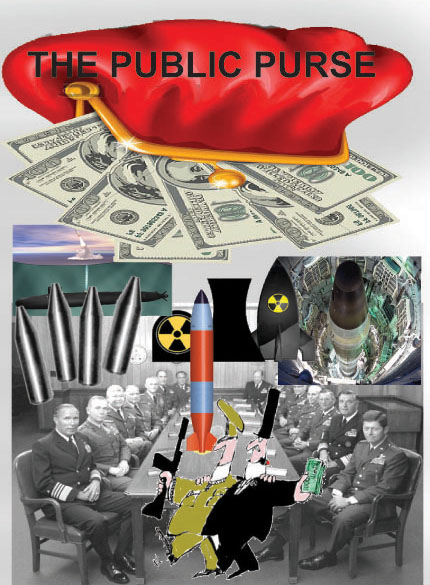
All of these forces benefit by exaggerating threats to our national security which justify a huge U.S. “defense” budget, larger than the next eight nations (most of whom are allies) in the world combined, while American citizens lack health care, childcare and other basic needs.
America’s Dilemma at 250
Eisenhower Media Network, Jul 14, 2026, https://eisenhowermedianetwork.substack.com/p/a-budget-of-the-pentagon-by-the-congress?utm_source=post-email-title&publication_id=4240478&post_id=206466445&utm_campaign=email-post-title&isFreemail=true&r=4ds0bd&triedRedirect=true&utm_medium=email
By: Major General Dennis Laich, US Army, (ret.) Executive Director, Eisenhower Media Network
The first sentence of Thomas Paine’s classic 1776 essay, Common Sense, urged the American people to challenge the legitimacy of the English Crown, something that had never been challenged before. He wrote:
“Perhaps the sentiments contained in the following pages are not yet sufficiently fashionable to procure them a great favor; a long habit of not thinking a thing wrong gives it a superficial appearance of being right, and raises at first a formidable outcry in defence of custom. But the tumult soon subsides. Time makes more converts than reason.”
Two hundred and fifty years later, time and reason strongly suggest that the U.S. “defense” budget is out of control, unsustainable and absent of accountability.
Only the American people can rein it in.
The “defense of custom” in this case will come from the Military-Industrial-Congressional Complex (MICC) of which President Eisenhower warned us in 1961 in his farewell address, and drove home the consequences of in his famous “Cross of Iron” speech in 1953. In his address to the American Society of Newspaper Editors, Eisenhower said the following:
Every gun that is made, every warship launched, every rocket fired signifies, in the final sense, a theft from those who hunger and are not fed, those who are cold and are not clothed. This world in arms is not spending money alone. It is spending the sweat of its laborers, the genius of its scientists, the hopes of its children. The cost of one modern heavy bomber is this: a modern brick school in more than 30 cities. It is two electric power plants, each serving a town of 60,000 population. It is two fine, fully equipped hospitals. It is some fifty miles of concrete pavement. We pay for a single fighter with a half-million bushels of wheat. We pay for a single destroyer with new homes that could have housed more than 8,000 people… This is not a way of life at all, in any true sense. Under the cloud of threatening war, it is humanity hanging from a cross of iron.All of these forces benefit by exaggerating threats to our national security which justify a huge U.S. “defense” budget, larger than the next eight nations (most of whom are allies) in the world combined, while American citizens lack health care, childcare and other basic needs.
The defense industry’s lobbyists team up with U.S. politicians, who receive campaign financing from the industry, to draft the annual National Defense Authorization Act, which sets military policy, the expensive weaponry to be purchased, and the overall military budget. The industry takes the ensuing windfall and puts it toward stock buybacks, which increase the share price, making the rich richer; dividend payments for shareholders; eight-figure annual compensation packages for corporate executives; and the continual political graft (campaign contributions and lobbyists) that keeps the wheel spinning. Incredibly, some contracts stipulate that only the contractor may repair and maintain equipment.
The most embarrassing example of this practice is the F-35 Stealth Fighter, which is grossly over budget, behind schedule and is only 25% fully mission capable.
The principal beneficiaries of the MICC’s practice of vastly overstating foreign threats are the Pentagon and the invertebrate senior uniformed bureaucrats who occupy it and secure lucrative post-retirement employment with the MICC. The massive Pentagon budget provides the Pentagon with a premier position within both the government and society. Money talks in America, but few members of Congress choose to talk about the $39 trillion national debt to which military spending is a major contributor.
Unfortunately, the uniformed bureaucrats lack the courage to stand up against a draft dodger and a Rambo-wannabe in order to protect their profession or the institution of the military. Government employees, including military officials, are fired for specious reasons and no one, not even those who were fired, dare speak up regarding the negative impact on morale, discipline and readiness. Nor do they speak up when the U.S. supports genocide in Gaza, extrajudicial murders in the Caribbean, or attacks the Uniformed Code of Military Justice
These recent developments will serve to accelerate a decline in the U.S. military’s performance. Since WWII, the U.S. has won one war (the first Gulf War), lost four (Viet Nam, Iraq, Afghanistan and Iran) and tied one (Korea. Iran may be as much an embarrassment as a loss. The United States has failed to achieve its stated objectives in any recent war, despite having a military budget larger than the next eight countries combined and being easily the most defensible of any peer nation (with two friendly, stable nations to its north and south and oceans on its east and west). What football coach could keep his job with a 1-4-1 record?
Additionally, the Pentagon cannot tell the American taxpayer where the money went, since it is unable to pass a financial audit as required by law – something every other department of the federal government is able to do. Now, they are requesting a 50% increase in the defense budget to S1.5 trillion. This is equivalent to your child asking for more money a day after receiving his/her allowance. When you ask what happened to the money he/she received yesterday, the child can’t answer the question, but you give him/her more money regardless.
This represents a level of arrogance and incompetence that the American people should not be asked to tolerate. Thomas Paine understood something that seemed impossible in 1776. On paper, the American colonies had no chance against the greatest empire on Earth. Britain possessed the world’s most powerful military, immense wealth, and overwhelming resources. The colonies had none of those advantages. What Paine recognized as “common sense” was that wars are not won by budgets alone. They are won by legitimacy, purpose, and the willingness of a free people to defend their own liberty.
The $1.5 trillion Pentagon budget request represents more than S9,000 per individual taxpayer. If we Americans are tired of seeing our tax dollars spent on endless wars, bombing campaigns, and military excess while our own communities struggle with the costs of health care, child care, education, and infrastructure, then the time has come to do what Thomas Paine asked Americans to do 250 years ago: challenge the assumptions that have become accepted simply because they are old. The courage required today is not to defeat an empire abroad, but to confront one at home — the Military-Industrial-Congressional Complex — and reclaim a government that serves the American people rather than the interests of perpetual war.
The Eisenhower Media Network (EMN) comprises former military, intelligence and civilian national security officials who offer independent analysis based on decades of real-world experience, study, and scholarship. EMN aims to reach broad, cross-partisan audiences in diverse media outlets and among the American people, who increasingly sense that US foreign policy today is not making them, or the world, safer.
Trump says US will ‘take out’ Iran’s Pickaxe Mountain nuclear facility
:by Ellen Mitchell – 07/13/26, https://thehill.com/policy/defense/5966603-trump-threatens-pickaxe-mountain-iran/
President Trump on Monday said the U.S. could soon attack Pickaxe Mountain in Iran as American forces launched a new round of strikes against the country.
“Pickaxe is a possible target for a nice big fat shot right near the front door,” Trump said in an interview on “The Hugh Hewitt Show” Monday afternoon. “We’re going to take out Pickaxe Mountain. Tell the Iranians to be ready.”
Trump added that while the U.S. sees “no activity” at the heavily fortified site that hosts two deeply buried tunnel complexes, Washington will “probably give Pickaxe a shot relatively soon.”
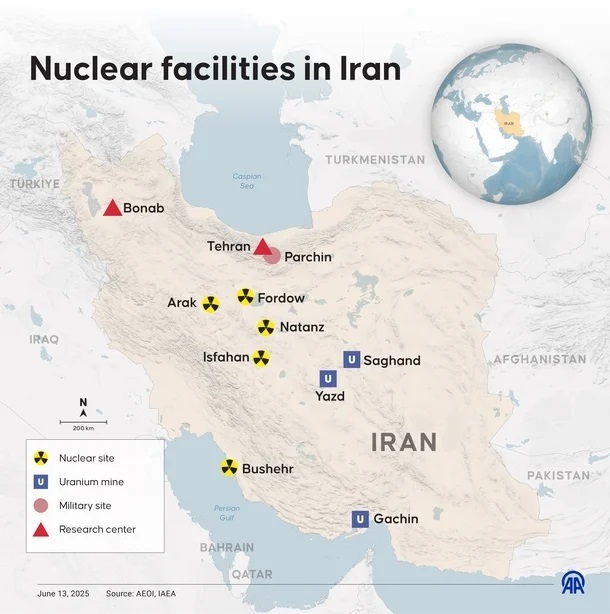
Located near Iran’s damaged Natanz uranium enrichment facility in the Zagros Mountains, Pickaxe was not among the three nuclear sites targeted by the U.S. military in June 2025. But Trump told show host Hugh Hewitt that the U.S. has “a lot of eyes” on it.
Experts have assessed, however, that the depth of the facility means America’s most powerful bunker buster bombs are unlikely to penetrate it. The site is buried up to 2,000 feet below granite and is suspected to be housing uranium enrichment capabilities and stockpiles.
Trump’s threat comes as American forces launched a new round of strikes against Iran at 4:45 p.m. EDT on Monday and hours after the president declared the U.S. Navy would reinstate the naval blockade in the Strait of Hormuz.
“These strikes will continue imposing a heavy cost on Iranian forces and degrade their ability to attack innocent civilians and commercial shipping in the Strait of Hormuz,” U.S. Central Command said in a statement.
The strikes mark the third consecutive day of U.S. attacks against Iran, with forces last week conducting four separate rounds of strikes against Tehran in what U.S. officials characterized as retaliation for Iran’s targeting of commercial vessels attempting to transit the vital shipping lane.
“We’re going to hit them very hard tonight, and we’re going to hit them hard tomorrow. And there’s not a damn thing they can do about it,” Trump told Hewitt.
Two Geothermal Bets Are Starting to Undercut Nuclear on Cost
By ZeroHedge – Jul 13, 2026,
- Fervo’s third-generation well design cut drilling time 70%, with its latest well reaching 19,448 feet in just 21 days.
- Quaise Energy closed the first tranche of a $134 million Series B, pushing total funding to roughly $230 million for its superhot geothermal plant in Oregon.
- Fervo’s Cape Station is tracking toward $5,500/kW installed, well below the $10,000 to $15,000/kW final cost of Georgia’s Vogtle nuclear reactors.
…………………………………………………………………………….. https://oilprice.com/Alternative-Energy/Geothermal-Energy/Two-Geothermal-Bets-Are-Starting-to-Undercut-Nuclear-on-Cost.html
Walt Zlotow – Chicago Tribune misleads its readership with Bob Kustra’s imaginary commentary ‘What Ronald Reagan would do today for the people of Ukraine’.
Walt Zlotow West Suburban Peace Coalition Glen Ellyn IL, 13 July 26
It’s fitting Tribune commentator Bob Kustra would go all the way back to 1980’s “virulent anti-communist” Ronald Reagan to argue Reagan would have squandered another $175 billion to keep Ukraine destroying itself in America and NATO’s lost proxy war to weaken, isolate Russia from the European economy.
Kustra is clearly locked in virulent 1980’s anti-communist ideology that he’s transferred to non-communist Russia, ignoring 35 years of NATO expansion that doubled NATO membership to keep Russia isolated and fearing NATO’s nukes on its doorsteps. This was after the USSR vanished into the dustbin of history.
Kustra imagines Russia had nothing to fear from adding Ukraine to NATO, a red line of Russian security concern that Russian leader Putin had been warning the US and NATO about since 2007. Kustra has apparently erased the US promoted Ukraine coup in 2014 that toppled Russian leaning Ukraine President Victor Yanukovych, provoking a civil war in the Donbas that killed thousands of Russian leaning Ukrainians there. In Kustra’s worldview, Obama didn’t greenlight the coup, Trump didn’t gift Ukraine with hundreds of millions in weapons to polish off the Donbas separatists. and Biden didn’t ramp up NATO membership to Ukraine and tell Russia it was none of their damn business.
Claiming Reagan would still be arming the collapsing, failed Ukraine state is preposterous. Reagan spending $20 million in black market smuggling networks to inundate Poland with “1eaflets, posters, magazines, newspapers and radio break-ins” is a quantum leap away from funding a war with $175 billion that has near utterly destroyed Ukraine in their lost war the US provoked. As conservative as Reagan was. he was foremost a pragmatist in foreign affairs. He was out of office and battling mental decline when the Soviet Union collapsed in 1991 so everything Kustra offers is conjecture. But Reagan’s record argues strongly he’d never have engaged in the madness Obama, Trump in term one and Biden did to send Ukraine to the scrapheap of nations.
Bob Kustra knows better. So does the Chicago Tribune. Its readership deserves something a tad better than Bob Kustra’s ‘The Russians are coming, The Russians are coming.’
Trump Says Iran Deal Is “Over,” Signals More US Strikes Are Likely Coming

July 9, 2026, By Chris Walker, https://scheerpost.com/2026/07/09/trump-says-iran-deal-is-over-signals-more-us-strikes-are-likely-coming/
“Negotiators keep talking if they want, but I don’t see it,” Trump said on the status of future discussions.
In remarks at the NATO summit in Turkey on Wednesday, President Donald Trump claimed that the Memorandum of Understanding (MOU) between the U.S. and Iran, negotiated last month, was no longer in effect, citing the resumption of military attacks between the two countries.
Trump’s comments come as the U.S. and Iran have exchanged fire over the past several days, with U.S. Central Command announcing on Tuesday night that they had completed strikes on around 80 targets.
The president was visibly upset when responding to questions from reporters about the war.
“I think it’s over. I don’t want to deal with them anymore,” Trump said.
The U.S. president engaged in name-calling against Iran’s leaders, calling them “sick people” and “scum” — a noted departure from his positive descriptions of them when negotiations were going better.
The MOU was not a final peace deal, but rather an agreement between the U.S. and Iran that aimed to end hostilities while a larger agreement was being brokered. Trump derided Iran for denying negotiated deals he claimed were being made during those discussions.
“We make a deal. They [Iran] go outside, talk to the press, they say ‘we never even talked about it,’” Trump complained.
Over the past month, Trump has made several baseless claims about the dealmaking process without confirmation from Iran, including that Iran had agreed to give up control of the Strait of Hormuz and that the country would agree to destroy its enriched nuclear materials.
Asked whether he would engage in future negotiations with Iran, Trump demurred. “I don’t care,” he said, adding that he’d let “negotiators keep talking if they want, but I don’t see it.”
He also indicated that the U.S. would conduct more military attacks later on. “We hit them very hard last night. Probably hit them hard again tonight,” Trump said.
On Tuesday, Iran’s Foreign Minister Abbas Araghchi warned that the U.S.’s continued threats and attacks against Iran, which violate parts of the MOU, would impede “negotiations on a final deal.”
CENTCOM said it hit 80 targets on Tuesday, with one U.S. official calling the strikes bigger than previous retaliatory ones. While the U.S. insisted its targets are military posts, the attacks are happening near larger cities and close to civilian infrastructure.
Iran media reported explosions near military targets in Bushehr early on Wednesday morning, a port city near the northern edge of the Persian Gulf that has a population close to 250,000 people. The city is home to the only civilian nuclear power plant in the country.
The U.S. also appeared to bomb the city of Bandar Abbas, near the Strait of Hormuz, which has a population of over 526,000 people. Early morning footage showed fires from explosions and large smoke plumes over the city.
And Iranian media said several explosions were seen in Sirik, a port city in the southern part of the country, with attacks reportedly hitting commercial and fishing piers. Several people also suffered injuries from shrapnel due to the attacks.
According to figures compiled by Al Jazeera, around 3,468 Iranians have been killed in the U.S.-Israeli war on Iran since February 28. More than 26,500 Iranians have been injured due to the war. The true number of casualties is likely higher, as the figures were last updated in mid-June.
Trump Says He Supports Ukraine’s Long-Range Attacks Inside Russia, Will Allow Ukraine To Produce Patriot Missiles

by Dave DeCamp | July 8, 2026 , https://news.antiwar.com/2026/07/08/trump-says-he-supports-ukraines-long-range-attacks-inside-russia-will-allow-ukraine-to-produce-patriot-missiles/
President Trump heaped praise on Ukrainian President Volodymyr Zelensky at the NATO summit in Ankara on Wednesday, expressed support for Ukraine’s long-range attacks inside Russia, and said he would allow Ukraine to produce Patriot missile interceptors.
When asked about Ukraine’s strikes on Russian oil refineries, the president said, “It’s an escalation, but it’s also an escalation that could help lead to an end.”
Ukraine’s long-range drone attacks rely on intelligence provided by the US, and Ukrainian officials told The Financial Times this week that the Ukrainian military was able to strike multiple Russian oil refineries recently because US intelligence has allowed it to find the optimal flight path for its drones to get through Russia’s air defenses.
On top of Ukraine’s success in striking Russian oil refineries, there has also been a significant spike in Russian civilian casualties in Ukraine’s drone attacks. Russian officials have cited the civilian deaths when justifying Russia’s ramped-up bombardments of Ukrainian cities, which have led to an increase in Ukrainian civilian casualties.
Discussing the Patriot missiles, Trump told Zelensky, “We’re going to give a license to you to make Patriot missiles. That’s pretty cool. This way, you can’t complain that we’re not giving them enough. I said, ‘Make them yourself.’ We haven’t informed the company of that yet, but that’ll work out all right.”
Trump’s approval of Ukraine manufacturing Patriots marks another escalation of US support for Ukraine, and Russia will almost certainly attempt to target any Patriot factories that are established on Ukrainian territory.
Overall, Trump spoke very highly of Zelensky, a reversal from the start of his administration when the two clashed during a contentious Oval Office meeting. “We’ve actually developed a good relationship. It’s hard to believe,” Trump said, adding that Zelensky has “done an amazing job” and “been very effective” in the war.
Almost forgotten? the Church Rock nuclear tragedy

On July 16, 1979, the worst accidental release of radioactive waste in U.S.
history happened at the Church Rock uranium mine and mill site. While the
Three Mile Island accident (that same year) is well known, the enormous
radioactive spill in New Mexico has been kept quiet. It is the U.S. nuclear
accident that almost no one knows about. Just 14 weeks after the Three Mile
Island reactor accident, and 34 years to the day after the Trinity atomic
test, the small community of Church Rock, New Mexico became the scene of
another nuclear tragedy.
Beyond Nuclear 16th July 2023, https://beyondnuclearinternational.org/2023/07/16/a-90-million-gallon-nuclear-tragedy/
America’s AI War Has No Civilian Stop Rule

July 10, 2026, Brian Hudson Foreign Policy in Focus, https://www.juancole.com/2026/07/americas-civilian-stop.html
When the Pentagon made Palantir’s Maven Smart System a formal “program of record” in March, it did more than approve software. It gave long-term status to a platform that analyzes data from satellites, drones, radars, sensors, and intelligence reports to identify potential targets. Maven supported almost all of the 13,500 U.S. strikes in Iran. The designation is meant to secure funding and extend its use across the military.
That decision came while the United States was still investigating the February 28 strike on the Shajareh Tayyebeh girls’ school in Minab, Iran. An initial U.S. military inquiry found that U.S. forces were likely responsible, but the Pentagon has not released a final public conclusion. Iranian authorities have reported between 155 and more than 175 deaths, most of them students and teachers. The question is why a military system designed to move faster from information to action has no equally clear public requirement to slow down after grave civilian harm.
In software engineering, an “error budget” is meant to protect users. When a service exceeds an agreed level of failure, new releases stop until the problem is understood and fixed. War is obviously not software. But in Washington’s AI-assisted operations, civilian deaths do not automatically trigger a temporary suspension of the relevant tools, an independent review of the data, or a public account of the decisions that led to the strike.
Advocates of military AI argue that better data and faster analysis can make attacks more precise. That is possible in principle. But precision is not something software simply possesses. It depends on the quality and age of the data, what a system treats as suspicious, and whether people have enough time to challenge its output.
AI does not turn stale or biased information into truth. It can make bad information travel faster. Human Rights Watch has warned that Israeli digital tools used in Gaza relied on incomplete data and inexact estimates that could raise the risk of civilian harm. The lesson is not that every use of AI is unlawful. It is that speed can magnify the consequences of a bad premise before anyone can catch it.
The familiar assurance that a “human remains in the loop” does not solve this problem. A person who sees only a final recommendation, cannot inspect the data trail, and has seconds rather than hours to decide is not exercising meaningful independent judgment. AI can shape lethal force without pulling a trigger. It can determine what appears urgent, which people or places rise to the top of a list, and which facts never appear at all.
The Iran campaign makes this concern immediate. Maven and Anthropic’s Claude were used to process classified intelligence, suggest coordinates, rank targets, and turn planning that once took weeks into real-time operations. That does not establish that AI independently chose every target or that every AI-supported strike was unlawful. Reuters later reported that Palantir faced the task of removing Anthropic technology from Maven. But the larger point remains: the Pentagon is institutionalizing systems built to compress the time for human deliberation before force is used.
The Minab tragedy represents the human cost of treating speed as a virtue in itself. The school had a public website, posted student photographs, and was visible in satellite imagery. It also reported that targeting officials appeared to have used outdated intelligence. The exact role of AI in the strike has not been disclosed. But information apparently did not distinguish the school clearly enough from the adjacent military compound, and the Pentagon has not publicly explained how that failure traveled through the targeting process. That is an accountability problem, not just a technical one.
Congress should establish a civilian stop rule for AI-assisted targeting. Credible evidence of grave civilian harm should trigger a temporary suspension of the relevant system in comparable missions, an independent review of the data and approval process, and a public explanation of the system’s role. This would not treat every civilian casualty as proof of a crime or ban every military use of AI. It would mean families do not have to wait through months of secrecy to learn whether a database, a contractor, or a command decision helped turn a civilian site into a target.
Congress has begun to consider broader guardrails. The House Armed Services Committee’s FY2027 defense bill would direct the Pentagon to extend its AI policy to systems that support or materially influence operational planning, target development, weaponeering, and engagement recommendations. That is a start. But it is not a civilian stop rule. It does not automatically pause a system after a devastating incident or guarantee a public answer.
Such a rule would reinforce the law of war. Customary international humanitarian law requires militaries to take all feasible precautions to verify targets and reduce foreseeable civilian harm. It also requires them to cancel or suspend attacks when it becomes clear that a target is not military or an attack would be unlawful. The Red Cross has recommended after-action reviews and re-testing or suspending AI systems when reliability, safety, or legal compliance concerns emerge. Recent scholarship points in the same direction. Renato Wolf emphasizes precaution throughout AI-assisted target verification, while Jessica Dorsey warns that over-reliance on computational systems can weaken the human judgment needed to protect civilians. If an AI-enabled process makes verification harder because it rewards speed, the problem is a failure to meet an existing legal duty.
Palantir can say it supplies the platform. The Pentagon can say software only supports decisions. An operator can say the data arrived already ranked.
But people grieving outside a destroyed school are left with no clear answer about who is accountable. Until Washington creates a publicly disclosed civilian stop rule, “precision warfare” will remain a technical phrase that conceals a political choice: to accelerate force without a meaningful way to stop, inspect, and answer for its failures.
Iran war takes terrifying turn, missiles bombard NUCLEAR plant
Daily Mail, By PHILLIP NIETO, US POLITICAL REPORTER, , 10 July 2026
Donald Trump‘s war has escalated after Tehran retaliated by firing missiles and drones at war-weary US allies in the Middle East, while American strikes bombarded an Iranian nuclear plant.
A day after the President declared the ceasefire ‘over’ and struck more than 170 regime targets, Kuwait and Bahrain faced fresh Iranian attacks on Thursday morning.
Jordan, a US ally, said five Iranian ballistic missiles were fired from northwestern Iran toward an air base in the country, delaying flights across the region.
Sirens could be heard blasting for civilians to take cover as all Iranian missiles were intercepted, the government says.
Iranian officials claimed that US military strikes sent shrapnel and projectiles slamming into the perimeter of the Bushehr nuclear power plant in southern Iran.
US strikes on Iran over the last 48 hours have targeted Iran’s military assets near the Strait of Hormuz, a waterway responsible for one-fifth of the world’s oil supply.
Various Iranian air defense systems, drones, regime speed boats, and missile storage sites have been destroyed, according to US Central Command. US officials claim that the strikes are designed to stop Iran from attacking commercial shipping vessels crossing the strait.
Iran’s Revolutionary Guard claims it has successfully struck US military bases near the Persian Gulf. The Daily Mail has contacted the Pentagon for comment. ………………………………………………………………
Explosions were also reported in several Gulf nations on Wednesday night, as Iran claimed it attacked US bases in neighboring countries in retaliation.
https://www.dailymail.com/news/article-15965221/Iran-war-takes-terrifying-turn-missiles-bombard-NUCLEAR-plant-flights-thrown-chaos.html
1 This Month





PLEASE OPPOSE HR 8255 AND S.3639 – bills would accelerate satellite deployment, with no environmental review or safeguards – https://ncstd5li.quorum.us/campaign/169331/
To see nuclear-related stories in greater depth and intensity – go to https://nuclearinformation.wordpress.com
-
Archives
- October 2026 (74)
- September 2026 (339)
- August 2026 (330)
- July 2026 (355)
- June 2026 (287)
- May 2026 (306)
- April 2026 (356)
- March 2026 (251)
- February 2026 (267)
- January 2026 (308)
- December 2025 (358)
- November 2025 (359)
-
Categories
- 1
- 1 NUCLEAR ISSUES
- business and costs
- climate change
- culture and arts
- ENERGY
- environment
- health
- history
- indigenous issues
- Legal
- marketing of nuclear
- media
- opposition to nuclear
- PERSONAL STORIES
- politics
- politics international
- Religion and ethics
- safety
- secrets,lies and civil liberties
- spinbuster
- technology
- Uranium
- wastes
- weapons and war
- Women
- 2 WORLD
- ACTION
- AFRICA
- Atrocities
- AUSTRALIA
- Christina's notes
- Christina's themes
- culture and arts
- Events
- Fuk 2022
- Fuk 2023
- Fukushima 2017
- Fukushima 2018
- fukushima 2019
- Fukushima 2020
- Fukushima 2021
- general
- global warming
- Humour (God we need it)
- Nuclear
- RARE EARTHS
- Reference
- resources – print
- Resources -audiovicual
- Weekly Newsletter
- World
- World Nuclear
- YouTube
-
RSS
Entries RSS
Comments RSS

