Trump Administration Plans Major NATO Drawdown Of U.S. Jets, Tankers, Bombers And Warships In Europe
The reported reductions provide one of the clearest pictures so far of how far the Trump administration intends to go in scaling back the U.S. role within NATO
by yourNEWS Media Newsroom | Jun 13, 2026
A June document shared with allies reportedly outlines sweeping reductions in U.S. military assets assigned to NATO operations, including fighter jets, surveillance aircraft, tankers, naval forces and bomber units.
By yourNEWS Media Newsroom
The Trump administration is preparing to reduce key U.S. air and naval assets available for NATO missions in Europe, a move that would mark a broad shift in America’s military posture inside the alliance, according to The New York Times.
Two senior European officials familiar with the decision said the reductions were detailed in a document provided to allies in early June. The plan would cut the number of American aircraft and warships assigned to NATO operations and could limit the alliance’s capacity for aerial refueling, surveillance, long-range strikes and maritime monitoring.
Under the proposal described by the officials, U.S. F-16 and F-15E fighter jets available for NATO operations would fall from about 150 to 100. Maritime reconnaissance aircraft would be reduced from 26 to 15, and all eight aerial refueling tankers previously assigned to Europe would be withdrawn.
The drawdown would also involve the reassignment of a missile-launching submarine, an aircraft carrier and several supporting warships. One of the two bomber groups previously designated for Europe’s defense would also be reassigned.
The Pentagon declined to address the specific numbers in the document. It instead referred to a recent statement from U.S. European Command about plans to reduce American commitments in Europe.
The reported reductions provide one of the clearest pictures so far of how far the Trump administration intends to go in scaling back the U.S. role within NATO, the post-World War II alliance created for the collective defense of North America and Europe. European leaders continue to regard NATO as central to deterring Russian aggression, and the proposed shift comes as many governments on the continent remain concerned about Moscow’s military activity near alliance territory.
No public timetable has been announced for carrying out the reductions. However, U.S. officials have signaled that the changes could occur sooner than many European governments had expected.
The impact could be felt across several NATO missions. Fewer aircraft and ships could affect the alliance’s ability to track Russian submarine movements, support long-distance air operations and conduct long-range strike missions.
Giuseppe Spatafora of the European Union Institute for Security Studies said the combined reductions would have consequences beyond any one category of equipment.
“While each of these cuts can be managed individually, together they represent a significant posture change and pose challenges to European deterrence readiness across the spectrum,” Spatafora said.
President Donald Trump has repeatedly argued that European NATO members rely too heavily on U.S. military power and should spend more on their own defense. His administration had already announced smaller adjustments to American troops and forces in Europe, but the June document outlines wider reductions affecting NATO missions across the continent.
The United States would still maintain one of NATO’s largest military footprints in Europe after the planned cuts. At the same time, European governments have increased defense spending and moved to rebuild military capacity amid uncertainty over long-term U.S. support……………………………………………………………………………………………… https://yournews.com/2026/06/13/7053385/trump-administration-plans-major-nato-drawdown-of-u-s-jets-tankers/
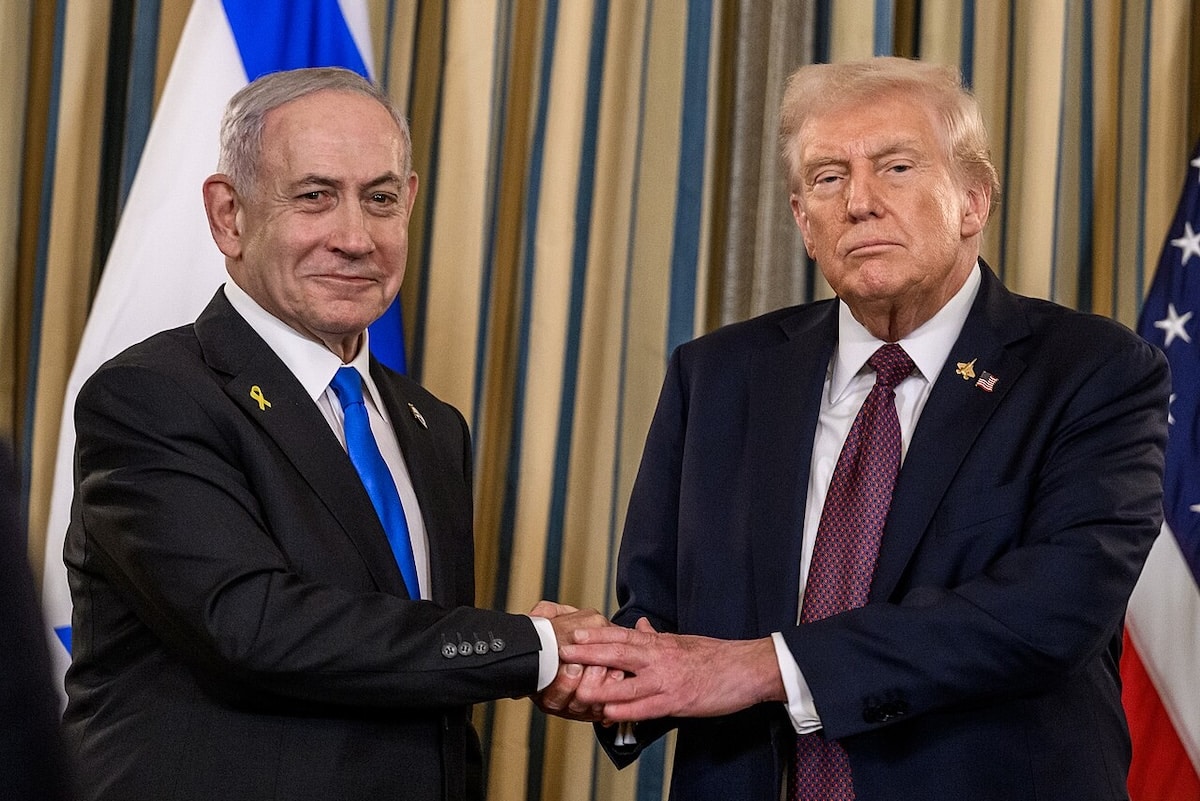
Can Trump Restrain Israel?
Middle East Monitor06/13/2026, by Norliza binti Saleh, https://www.juancole.com/2026/06/trump-restrain-israel.html
The latest exchange between Iran and Israel raises a fundamental question: Who is really driving events in the Middle East – Washington or Jerusalem?
Following Israeli strikes on targets in Beirut, Lebanon, Iran responded with strikes against northern Israel and military facilities around Haifa. Israel then immediately retaliated by attacking Tehran, Tabriz, Karaj and Isfahan. While the ceasefire between the United States and Iran is technically in place, the broader regional conflict continues to intensify. Throughout the crisis, President Donald Trump has repeatedly expressed support for de-escalation and urged all parties to avoid a wider war.
Yet events on the ground suggest that Washington’s desire for stability may not necessarily translate into restraint by its closest ally. The current crisis is becoming a test not only of regional security but also of American influence itself.
The Trump administration appears reluctant to become involved in another prolonged West Asian conflict. Unlike previous periods of direct American military engagement in the region, Washington’s priorities today are largely domestic and economic.
A wider regional war would almost certainly increase energy prices, disrupt global trade routes, and create uncertainty in international markets. Such instability would undermine economic recovery efforts and place additional pressure on American households.
For Trump, who has consistently portrayed himself as a leader focused on domestic prosperity rather than foreign military adventures, another regional war offers few political benefits.
This explains why Washington continues to advocate restraint and emphasize the importance of maintaining the ceasefire framework currently in place.
Israel, however, views the situation through a different lens.
From the Israeli perspective, Hezbollah and Iran remain immediate security threats that cannot be ignored. Israeli leaders claim that military pressure is necessary to weaken these adversaries, regardless of American concerns about regional escalation.
Yet security alone does not fully explain Israel’s actions.
“The conflict is also intertwined with political and ideological ambitions. The influential factions within the Israeli regime continue to be influenced by a broader vision of expanding Israel’s strategic footprint in the region, often associated with the concept of “Greater Israel”.
In this reading, Lebanon is not merely a battlefield but part of a wider Israeli expansionist project.
This creates an important divergence between American strategic interests and Israeli security calculations. The result is an increasingly visible gap between what the United States wants and what Israel is prepared to do.
Recent developments have also highlighted Iran’s growing strategic importance. Iran occupies a critical geographical position overlooking the Strait of Hormuz, through which a significant portion of the world’s oil and gas supplies passes. Any disruption to this maritime chokepoint would immediately affect global energy markets and international trade.
More importantly, external pressure has strengthened domestic unity within Iran. The groups that previously disagreed with the government have increasingly
rallied around the state in response to external threats. Regionally, Iran has demonstrated both military capability and strategic reach, reinforcing its position as a major regional power whose actions can no longer be ignored. Recent events have witnessed that Iran possesses significant leverage over regional security and global energy stability.
The central issue, therefore, is not whether Trump supports a ceasefire. He clearly does.
The real question is whether Washington possesses sufficient leverage to translate its preference into Israeli behaviour.
“If Israeli military operations continue despite American calls for restraint, observers will inevitably question the extent of US influence over its closest ally. “
This matters because American credibility remains a key pillar of regional stability. If Washington is unable to shape the actions of partners that depend heavily on American diplomatic, financial and military support, its broader influence across West Asia may also come under scrutiny.
Failure to contain the current escalation carries risks far beyond West Asia. A wider Iran-Israel confrontation could threaten critical energy routes, including the Strait of Hormuz and other regional maritime chokepoints. Rising energy prices would affect economies worldwide, including countries geographically distant from the conflict such as Malaysia.
At the same time, continued instability risks expanding the conflict across multiple fronts involving Lebanon, Syria, Iraq and the Red Sea region. The longer the crisis continues, the greater the likelihood of miscalculation by one or more actors.
For this reason, calls for a genuine ceasefire must be matched by meaningful diplomatic efforts and credible pressure on all parties involved.
“The current crisis has become a test of two things: regional stability and American influence. “
President Trump may genuinely prefer de-escalation, but preference alone is insufficient. The true measure of leadership lies in the ability to shape outcomes, not merely express intentions If Washington cannot persuade its closest ally to support a sustainable ceasefire, the risk of a wider regional conflict will continue to grow.
“The key question is therefore not whether Trump wants peace. The key question is whether he still possesses the leverage necessary to make it happen”
New Billionaire Jared Kushner Is Mired in Conflicts of Interest as “Peace Envoy”
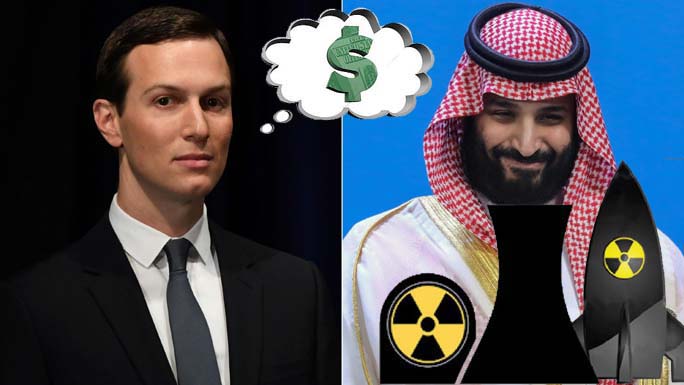
Kushner’s current fundraising efforts with Gulf state regimes, through which he aims to personally profit, raise serious concerns over conflicts between his business interests with regional states and his diplomatic role as a top Trump administration negotiator.
Jared Kushner, like the rest of the Trump family, uses the White House for personal enrichment.
By Derek Seidman , Truthout, June 12, 2026, https://truthout.org/articles/from-peace-envoy-to-billionaire-kushner-makes-a-killing-in-white-house-admin/?utm_source=Truthout&utm_campaign=8d7f421301-EMAIL_CAMPAIGN_2026_06_12_06_45_COPY_01&utm_medium=email&utm_term=0_bbb541a1db-16ee3bf6a0-650192793
Kushner is now a billionaire,” proclaimed Forbes in September 2025 of Donald Trump’s son-in-law Jared Kushner. While just over half of Kushner’s wealth — $560 million — comes from his family’s real estate empire, what’s catapulted Kushner into billionaire status is the growth of his private equity firm, Affinity Partners, formed in 2021.
“[T]hese days,” said Forbes, Kushner is “laser-focused on Affinity.”
Kushner is not an experienced investment manager. His key clients are Gulf state sovereign wealth funds — hugely wealthy state-owned coffers that invest revenue generated by fossil fuel sales — overseen by the same regimes with whom Kushner is now involved diplomatically as a U.S. “special envoy for peace.”
That Kushner personally profits from, and is currently trying to raise billions from, the same actors he’s negotiating with, raises code red-level alarms over potential conflicts of interest. Moreover, two of Trump’s sons, Donald Jr. and Eric, have been tied to a slew of business deals connected to companies that are benefitting handsomely from federal government contracts.
“The degree of shamelessness is unprecedented,” Jeff Hauser, founder and executive director of the Revolving Door Project, a watchdog group monitoring the U.S. executive branch, told Truthout. “The degree of unity among elected Republicans to not speak about the Trump progeny, and their corruption, is the worst conspiracy of silence in American political history.”
Affinity Partners
Jared Kushner founded Affinity Partners in 2021, and he is the firm’s sole owner. Forbes estimates Affinity was worth $215 million as of September 2025, up from $170 million in October 2024. Through Affinity, Kushner recruits wealthy clients and invests their money through funds that acquire stakes in different companies.
Affinity currently has $6.2 billion in assets under management. According to the Israeli financial paper Globes, Kushner earns “a commission of 1.25 percent on investors’ capital.” Forbes says that Affinity’s investors “pay about $60 million per year in fees.”
The New York Times also reports that Affinity has earned an estimated 25 percent rate of return on its investments since 2021. Private equity investment firms often get a double-digit percentage cut on client returns.
Affinity’s biggest clients are Gulf state sovereign wealth funds. According to The New York Times, Saudi Arabia’s Public Investment Fund, which invests the kingdom’s oil profits and is led by Crown Prince Mohammed bin Salman, is “already the largest and earliest investor in Affinity,” having invested $2 billion with the firm after Trump’s first term ended. As part of that investment deal, Saudi Arabia was also given “the first chance to invest during any subsequent attempts by Affinity to raise funds,” said The New York Times.
The sovereign wealth funds of both the United Arab Emirates (UAE) and Qatar were also early investors in Affinity Partners, with the UAE investing over $200 million in Kushner’s firm.
“Most of Affinity’s investors came through connections Kushner made while serving in the White House,” wrote Forbes.
Kushner is currently trying to raise $5 billion or more in new funds for Affinity. As part of this effort, The New York Times reported in March 2026 that Affinity representatives had met with Saudi Arabia’s Public Investment Fund and that the United Arab Emirates and Qatar “are also expected to be asked for more” as the fundraising efforts should “stretch on for the better part of this year,”
“Staggering Conflicts of Interest”
Kushner’s current fundraising efforts with Gulf state regimes, through which he aims to personally profit, raise serious concerns over conflicts between his business interests with regional states and his diplomatic role as a top Trump administration negotiator.
“There’s an enormous conflict of interest when you have somebody who had never been a money manager like this before, and who is all of a sudden building massive funds based off a handful of foreign investors with an interest in buttering up the Trump administration,” said Hauser.
Hauser said it’s “not unprecedented” for well-connected family members or friends of presidents to influence U.S. diplomacy. But, he adds, “it is very susceptible to abuse, and I think it’s being abused here,” and government reforms are needed in the wake of Kushner’s current “diplomatic exploits.”
The potential conflicts of interest have been highlighted by some members of congress. Rep. Jamie Raskin (D-Maryland) has opened an investigation into what he labels Kushner’s “foreign entanglements and staggering conflicts of interest.”
“From the standpoint of the American people, your decision to act in these two roles — one public for the government and one private for personal profit — creates a glaring and incurable conflict of interest,” Raskin wrote in a letter to Kushner.
Kushner’s diplomatic efforts have included helping to design and advance the Abraham Accords, which aims to normalize relations between Israel and key Gulf States; carrying out negotiations with Iran, whose retaliatory strikes have been aimed at nations like Saudi Arabia and the UAE; and working on Donald Trump’s “Board of Peace,” which several Gulf states, including top Affinity clients, have joined.
Kushner’s Portfolio Companies
Read more: New Billionaire Jared Kushner Is Mired in Conflicts of Interest as “Peace Envoy”Affinity Partners’ most significant deal has been its $55 billion acquisition in 2025, in partnership with Saudi Arabia and other investors, of the video game giant Electronic Arts, maker of popular franchises like Madden and Sims. The transaction, which has garnered protests from gamers and developers, would be the largest-ever private buyout of a publicly-traded company. It’s currently in its final stages of approval.
Under the deal’s terms, Saudi Arabia’s sovereign wealth fund — which already had a 10 percent stake in Electronic Arts — will own 93.4 of EA, while Affinity Partners will own 1.1 percent. For Saudi Arabia, the deal advances two separate but intertwined aims: diversifying its economy away from overreliance on oil revenue, and partnering with a member of the Trump family as the deal seeks regulatory approval from the U.S. Committee on Foreign Investment, chaired by Trump’s Treasury Secretary Scott Bessent
Affinity Partners also invests in smaller AI and financial companies, including U.K. digital bank OakNorth, AI infrastructure firm Universal AGI, and the fintech start-up company Revolut. Forbes reports that Kushner recently launched a new San Francisco-based AI start-up with the prominent Israeli-born venture capitalist Elad Gil. The firm, Brain Co., also raised funds from Coinbase’s Brian Armstrong and LinkedIn’s Reid Hoffman.
Raising more potential for conflicts with his diplomatic role, Kushner also has stakes in several Israeli companies, including $1.68 billion in Phoenix Financial, one of Israel’s leading insurance and financial companies. Affinity is Phoenix’s top shareholder and has seen a five-times return on its investment.
Affinity is also invested in the Israeli Shlomo Group, one of Israel’s largest holding groups with big investments in the auto sector.
Kushner, TikTok, and the Trump Web
Jared Kushner is also embedded in a wide web of business figures advancing the Trump agenda — which could be seen in the January 2026 deal that created a U.S. spinoff of TikTok.
Kushner’s Electronic Arts deal is co-led by Silver Lake, a Los Angeles-based private equity firm. As Truthout previously reported, Silver Lake is also a 15 percent stakeholder in the new U.S. TikTok. The firm’s co-CEO Egon Durban sits on the seven-member board of U.S. TikTok.
In 2025, the Wall Street Journal reported that acquiring Electronic Arts was Durban’s “dream deal,” but that “the pieces began to fall into place” for the acquisition only after Durban “began spending time with Jared Kushner.”
Silver Lake also owns Endeavor, whose portfolio includes TKO Group Holdings, the parent company of Ultimate Fighting Championship (UFC), the mixed martial arts corporation that is chummy with Donald Trump.
Durban and Silver Lake are close business partners with Michael Dell, the megabillionaire chairman and CEO of Dell Technologies who is also part of the U.S. TikTok ownership group with Durban. Dell has cast himself as a Trump ally by donating $6.25 billion toward the president’s so-called “Trump Accounts” program, which creates investment accounts for U.S. children.
Billionaire Yuri Milner, another U.S. TikTok investor, previously invested $850,000 in a real estate company started by Kushner in 2015. Jon Winkelried, the billionaire CEO of TPG Global, a private equity firm represented on U.S. TikTok’s board, also previously served as a strategic adviser and partner for Thrive Capital, an investment firm overseen by Jared Kushner’s brother, Josh Kushner.
The Trump Sons
If Kushner, Donald Trump’s son-in-law, may be personally benefiting from his closeness to the president, so too might be two of the president’s own children.
Donald Trump Jr. is a partner with an investment firm called 1789 Capital, which he says is dedicated to “patriotic capitalism,” and which has seen its assets under management boom from $200 million to $3.5 billion over the past year.
1789 Capital has made investments in companies that have gone on to benefit from federal contracts. For example, the Trump administration helped secure a $620 million loan for Vulcan Elements, a rare earths firm, months after 1789 Capital acquired a stake. Other 1789 Capital portfolio companies that benefit from federal contracts include rocket propulsion start-up Firehawk Aerospace, quantum computing company PsiQuantum, and AI group Cerebras Systems, as well as SpaceX and Anduril. Donald Trump Jr. and Eric Trump have also been linked to other drone makers, including Unusual Machines and Powerus, that have secured federal contracts.
Trump Jr. told the Financial Times that he is “very involved in the strategic decisions regarding where to invest” the resources of 1789 Capital.
The Financial Times also reported that Eric Trump accompanied his father on his recent state visit to China at the same “a company linked to him and the US president’s family” — Alt5 Sigma, a Las Vegas-based financial technology company — “explores a deal” with Chinese chipmaker Nano Labs that U.S. lawmakers says is tied to the Chinese Community Party. Eric Trump is an “observer” on the board of Alt5 Sigma, while Zach Witkoff, the son of top Trump aide Steve Witkoff, chairs Alt5’s board.
The Financial Times also reports that a shell company backed by Donald Trump Jr. and Eric Trump is set to merge with a critical minerals group that last year secured up to $1.6 billion in U.S. government backing to mine tungsten in Kazakhstan. Now, that group is asking for $400 million more from the government.
Holding Politicians to Account
While Donald Trump may be struggling in the polls, his family, financially, is doing just fine.
Hauser told Truthout that much of Donald Trump’s “economic interest” is tied to “increasing the wealth of his kids,” including his son-in-law Kushner. “When they are engaged in these types of overseas actions, they are carrying Trump’s interests with them inherently,” said Hauser.
But, Hauser adds, the law treats adult children of presidents as wholly independent from their parents, allowing “relative impunity” for their intermixing of business transactions with diplomatic roles or close familial relations.
“The law is just not written to address this type of situation,” said Hauser.
But Hauser sees hope in past U.S. history, which he says has always experienced vicissitudes of political corruption and revulsion against corruption that propels reform through both legal avenues as well as social ostracization of bad actors.
“Political corruption cycles tend to be cyclical,” he said. “Hopefully this is [the] nadir, and we can all be angry enough and hold our politicians to account such that they start to clean this up, and we can switch from a vicious cycle of ever-increasing corruption to a virtuous cycle of greater integrity.”
Senate wants to force US to share sensitive intel with Israel

A measure in a must-pass bill would dramatically increase Israeli access to American secrets
Paul R. Pillar, Responsible Statecraft, Jun 10, 2026
Buried deep inside a 192-page intelligence authorization bill is Section 622, titled “United States-Israel Intelligence Sharing Enhancement.” It would require the president, acting through the director of national intelligence and as necessary the secretary of defense, to “expand and enhance intelligence sharing with the Government of Israel” on a list of subjects that encompasses almost every topic of intelligence interest in the Middle East.
The bill, put forward by Sen. Tom Cotton (R-Ark.), the chairman of the Senate Intelligence Committee, would prohibit any suspension, reduction, or limitation of such sharing “except on the basis of a specific and identifiable national security concern determined by the President.” Any such exception would require a report to Congress within fifteen days detailing not only the reason for the change but also the categories of information involved. The same report would require an assessment of the anticipated impact on regional security and various other matters.
This proposal is one of several recent moves by those in Washington who carry the Israeli government’s water to keep the United States tied to Israel despite plummeting support for the country among the American public. The most salient form of U.S. support to Israel has been more than $300 billion in economic and especially military assistance. Israeli Prime Minister Benjamin Netanyahu has tried to get ahead of the declining public support and avoid embarrassing losses by suggesting it would be fine with him to phase out the military aid.
Israel’s strategy and that of its U.S. supporters is now to rely on ties with, and support from, the United States that are not as salient as the military aid with its prominent price tag. The strategy includes forms of military integration that are less visible than congressionally appropriated grant aid and therefore less publicly accountable. Section 224 of a defense authorization bill currently in the House of Representatives embodies this form of integration.
The mandating of intelligence sharing carries this strategy further by moving it into the shadowy world of relations between intelligence agencies. That world is even farther removed from public visibility and accountability than the defense integration, and even less likely to stimulate thoughts about American taxpayers’ money going to a foreign country. So far, Section 622 of the intelligence bill has received less attention than Section 224 of the defense bill.
The notion of legislating an intelligence liaison relationship in this way, with any foreign country, is bizarre……………………………………………………………………………………………………………………………………………………………………………….
The current ill-advised war with Iran demonstrates the sharp divergence of U.S. and Israeli interests. After being the principal influence on President Donald Trump’s decision to launch the war, Netanyahu’s government has been sabotaging efforts to end it.
It currently is doing so mainly with relentless attacks in Lebanon that have killed thousands and displaced over a million people. The divergence of objectives was reflected in an expletive-laden phone call last week between Trump and Netanyahu that was mainly about those attacks.
Attacks that sabotage diplomacy are among the Israeli operations that might use shared U.S. intelligence. The United States also will be blamed for aiding other violent Israeli operations because of the “enhanced” intelligence sharing, even if it were no longer paying for Israeli arms.
The supposed escape clause in Section 622 of the intelligence bill would in practice be so cumbersome as to be useless. The required report to Congress would dump the issue on Capitol Hill, where the Israel lobby would quickly depict it as a question of being for or against the security of Israel. The mandated intelligence sharing in the bill thus would tie the president’s hands and prevent any administration from using management of the intelligence liaison relationship as leverage to deter destructive conduct by Israel. https://responsiblestatecraft.org/us-intelligence-israel/
Trump news at a glance: president claims Iran ‘no longer want a nuclear weapon’ amid peace deal hopes
Washington and Tehran express increasing optimism that weeks of halting negotiations may be drawing to a close – key US politics stories from Saturday 13 June at a glance
Guardian staff, 14 June 26, https://www.theguardian.com/us-news/2026/jun/14/trump-news-at-a-glance-president-claims-iran-no-longer-want-a-nuclear-weapon-amid-peace-deal-hopes
Donald Trump says a deal with Iran to end the war would be signed on Sunday, and that the strait of Hormuz would be “open to all” immediately after.
Iran had offered a different timeline earlier in the day, but nonetheless signalled an agreement was in the offing, as both the warring parties and their mediators expressed increasing optimism that weeks of halting negotiations were drawing to a close.
“The Deal is scheduled to get signed tomorrow, and immediately after it is signed, the Hormuz Strait is OPEN TO ALL,” Trump said on his Truth Social platform. Since an 8 April truce paused the worst of the fighting, Trump has repeatedly insisted a deal was near only for the wrangling to drag on.
The Iranian foreign ministry spokesperson, Esmaeil Baqaei, had said earlier on Saturday that the date of the signing was yet to be determined, but “it will not be tomorrow”. However, he added: “The possibility of this happening in the coming days cannot be ruled out.”
Space Force needs to prepare for an ‘in-person’ moon conflict with China, new report argues
Guardians need a human spaceflight program for future lunar missions, Mitchell Institute says.
Defense One, Thomas Novelly, 23 May 26,
The Space Force should prepare to put active-duty troops on the moon and on space stations to counter China’s lunar and military ambitions, a new research paper argues.
The Mitchell Institute’s paper, published Thursday, calls for the Space Force to prioritize the creation of a “human spaceflight” program and redefine federal, active-duty Title 10 orders to compete against China’s military-focused space initiatives—such as the reported goal of putting its Taikonauts on the moon by 2030. Although Chinese officials as recently as last month have said the country believes in the “peaceful use” of space, the paper claims future “competition for control of lunar resources and territory will likely reach a tipping point” and the U.S. military must be prepared.
With a potential ‘in person’ lunar conflict with China as the contextual touchstone, the U.S. must begin a pragmatic multi-decade effort, leveraging its Space Test Course (STC), as well as partnerships with NASA and commercial space companies, to deliver the skills, tools, and concepts needed for future Title 10 activities to enforce U.S. spacepower-enabling norms and standards,” the report said. “These efforts will require additional funding from Congress for both U.S. Space Force human spaceflight opportunities and residencies at commercial space stations.”
The 22-page policy report calls for blurring the long-standing boundaries between space exploration and militarized operations by allowing Title 10 active-duty federal orders to include “space and lunar habitation” and “warfighting authorities and a national defense mindset in the advancement of human spaceflight.” The 1967 Outer Space Treaty, which the U.S. and China are parties to, calls for the governments to use the moon and other planets for “peaceful purposes” and forbids military bases, testing, and maneuvers. Kyle Pumroy, a retired Space Force colonel and the paper’s author, called for pushing back against those norms………………………………………………………………………………….. https://www.defenseone.com/threats/2026/05/space-force-needs-prepare-person-moon-conflict-china-new-report-argues/413747/
US Begins Another Round of Attacks on Iran
Trump had said earlier that he would launch more strikes on the country
by Dave DeCamp | June 10, 2026 , https://news.antiwar.com/2026/06/10/trump-threatens-more-attacks-on-iran-after-exchange-of-heavy-strikes/
On Wednesday night, US Central Command (CENTCOM) announced it was launching a round of attacks on Iran for the second night in a row as Iranian media began reporting blasts across the southern part of the country.
In response to the US attacks, Iran’s military said that it would fully close the Strait of Hormuz. “From this moment, due to insecurity in the region, the Strait of Hormuz is declared closed to the passage of all vessels, including oil tankers and commercial ships, and any traffic will be targeted,” Iran’s Khatam al-Anbiya Central Headquarters said in a statement.
CENTCOM then claimed that the Iranian statement was false and that ships were still transiting the strait, but the denial came just a short while after Iran’s announcement. President Trump had earlier claimed that over the past month, the US military was conducting a “secret mission” to allow tankers to exit the Strait of Hormuz. He claimed the US helped bring 100 million barrels out of the strait, which, if true, is still a fraction of the oil that was transiting through the waterway before he launched the war.
After the start of the US strikes, Iranian media reported blasts across Iran’s southern Hormozgan province and said that at least two residents of the city of Kargan were wounded by shrapnel. Iran appears to be striking back as air raid sirens were sounded in Bahrain and the IRGC said it was targeting 18 US military installations across the region.
The fresh US attacks came after President Trump threatened more bombings, and US War Secretary Pete Hegseth also said that the US would be attacking the Islamic Republic.
“CENTCOM will be busy tonight because President Trump said we will be hitting Iran hard, and we will be,” Hegseth told reporters outside CENTCOM headquarters in Florida not long before the strikes started.
On Wednesday morning, the president said on Truth Social that Iran has “taken too long to negotiate a deal that would have been great for them, now they will have to pay the price.” He also claimed in the post that Iran had been “completely defeated” despite its ability to launch missile and drone attacks across the Middle East.
In comments to reporters in the Oval Office later in the day, Trump was more explicit in his threat. “We hit them hard yesterday, and we’re going to hit them again hard today,” he said.
Trump also told Fox News reporter Trey Yingst that he may “keep going” with his attacks on Iran and that he is “getting closer to the targeting of Iranian power plants and bridges.”
During the US-Israeli bombing campaign against Iran, Trump repeatedly threatened to launch massive attacks on Iranian energy infrastructure and bridges, part of his threats to turn the country into “hell” and end a “whole civilization.”
Iran’s Islamic Revolutionary Guard Corps (IRGC) said Wednesday that its forces targeted the US military in Kuwait, Bahrain, and Jordan, and vowed it would launch stronger strikes if the US attacked again.
Iran’s Foreign Ministry said that Iran’s military dealt a heavy blow to the US following its “savage attacks” on Iran that were launched under the pretext of Iran allegedly downing a US Apache helicopter over the Strait of Hormuz as it was enforcing a blockade on Iranian ports. “With these aggressive actions, the US ruling administration once again demonstrated its criminal and warmongering nature,” the ministry said.
US officials said the US strikes on Iran targeted air defense and radar systems, while Iranian media also reported that strikes hit two water reservoirs, cutting off drinking water to thousands of Iranians.
War crime -US ‘precision strikes’ cut water access to 20,000 people in southern Iran
The ‘self-defense’ strikes that Washington said it carried out destroyed part of a key water facility in Hormozgan province
News Desk, JUN 11, 2026, https://thecradle.co/articles/us-precision-strikes-cut-water-access-to-20000-people-in-southern-iran
The US military’s recent airstrikes on a drinking water facility in southern Iran “could constitute a war crime,” a 10 June New York Times (NYT) investigation said after an attac
After the strike, US Central Command (CENTCOM) described its attacks as “self-defense” that was carried out with “precision” munitions.
In response to NYT, a CENTCOM spokesman said he was “aware” of the reports about destroyed water infrastructure, but declined to provide any further information.
The US strikes hit Iran early on Wednesday.
The CEO of Hormozgan province’s water and wastewater company announced before NYT released its investigation that the US struck a 500-cubic-meter tank and a 2,000-cubic-meter tank that both played a key role in supplying drinking water to Sirik.
Authorities said the strikes cut off water to 20,000 people living in nearby areas.
“Mobile water tankers brought in water to supply residents while crews built a new service line that bypassed the damaged tanks,” Abdolhamid Hamzehpour, the head of the provincial water authority, told NYT, adding that the task was completed within 12 hours. k by Washington cut off water to tens of thousands of people.
ranian forces targeted US bases in the region on Wednesday in response to the attacks that destroyed the facility.
Since then, more US strikes have targeted the Islamic Republic.
Iran carried out retaliatory missile operations targeting key US sites in Bahrain, Kuwait, and Jordan on Thursday.
US President Donald Trump has threatened more strikes on Iran since Tehran’s latest retaliation.
Is America ready for a nuclear explosion in space?

by Peter A. Garretson and Richard M. Harrison, – 06/09/26, https://thehill.com/opinion/national-security/5915315-space-based-nuclear-weapons/
Gen. Stephen Whiting, the commander of U.S. Space Command, recently made waves when he publicly discussed a major threat that America’s newest military branch recently war-gamed — that of an adversary detonating a nuclear weapon in space.
At first blush, the scenario seems far-fetched. In truth, though, it is a real possibility.
More than a year ago, in February 2024, House Intelligence Chairman Mike Turner (R-Ohio) was already raising the alarm that Russia could place a space-based nuclear device into orbit. That possibility was later confirmed by the Pentagon.
The White House grasps the danger. A December 2025 Executive Order on Space Superiority directs the country’s relevant agencies to create “a space security strategy that accounts for United States interests in, from, and to space” and “a technology plan for detecting, characterizing, and countering potential adversary placement of nuclear weapons in space.” That strategy, moreover, is expected as soon as June 16.
This public call to action is notable. It marks the first time an unclassified document has publicly directed a response to a nuclear weapon in space. It also reflects the gravity of what is an increasingly plausible threat. After spending several months conducting a deep dive into this subject, we at the American Foreign Policy Council have come to the same ominous conclusions. Space-based nuclear weapons are a serious matter, and one that deserves the very highest level of national attention.
Talk of a nuclear detonation generally triggers visions of cities being destroyed and mushroom clouds. The effects differ when a detonation occurs at a high altitude. While explosions near space, or in space, may not have immediate destructive effects here on Earth, they can prove equally devastating. Even a relatively small nuclear device, detonated at the right place in low Earth orbit, would have a catastrophic impact on U.S. and allied interests.
That is because, while space itself is enormous, the vast majority of modern spacecraft (nearly 90 percent) are in low Earth orbit, most of them satellites. Both the American and the global economy rely on these systems for everything from the functioning of the Internet to aircraft navigation and ship tracking, at a cost of billions of dollars daily, and trillions annually.
Moreover, our intelligence agencies and the U.S. military rely extensively on satellites to detect the movement of adversary ships, aircraft and tanks; to track ballistic, hypersonic and cruise missiles; and to communicate with our overseas forces. And in the near future, advanced capabilities will allow the U.S. Space Force to globally track everything that moves in the skies or on the ground in real time, in addition to all weather across the entire globe.
A space-based nuclear explosion anywhere could be damaging, but one in low Earth orbit would be crippling. If a nuclear weapon were detonated above this range, in a medium, higher Earth or geostationary orbit, the blast effects would basically only destroy satellites within a few kilometers.
But a nuclear weapon detonated in low Earth orbit would be far more devastating, because it would interact with the Earth’s magnetic field. The resulting radiation would be so strong, it would basically destroy everything in low Earth orbit in under a week’s time — leaving more than 10,000 derelict satellites on intersecting orbits with no way to avoid each other. The resulting destruction would be massive. A nuclear detonation there would truly be a weapon of mass destruction.
Worse still, repopulating those space assets after a detonation would be extremely complicated. We lack a stockpile of military (or civilian) satellites that are radiation-hardened, that could serve as replacements for the dead ones in orbit. Nor do we have proven technology available for deployment in space to reduce the harsh radiation. Finally, we have not yet invested in the technologies that would allow us to build build the satellites needed to replenish low Earth orbit quickly and efficiently.
By next week, the Department of Defense and intelligence community should have an actionable plan to deal with this gargantuan problem — or at least the start of one. Congress needs to stand ready to resource it. Moreover, as we have recommended, it should catalyze investments in space traffic management models, commercial “what if” agreements, radiation remediation technology, radiation-hardened replenishment, and long-term investments in an in-space industrial base above the threat.
Putting such a plan in place is a necessary start. But it will necessitate political will and resolute action on the part of the U.S. government. Otherwise, we risk being left in the dark.
Peter A. Garretson is a senior fellow in defense studies at the American Foreign Policy Council, where Richard M. Harrison is vice president of operations. They are the authors of a new report on Space Nuclear Weapons.
Is the Ceasefire Dead? (w/ Alastair Crooke) | The Chris Hedges Report
The US-Israeli war has heated up again as Iran launched “Operation Victory” in response to Israel’s continued attacks on Southern Lebanon and attacks on Iranian infrastructure, and the United States bombing islands in the Strait of Hormuz over the weekend. In this episode, Chris Hedges speaks with former British Diplomat Alastair Crooke of the Conflicts Forum Substack, who explains that given the failure of diplomatic negotiations, Iran has entered a new phase of the war utilizing the methodology of ‘escalatory deterrence’ in which every attack on Iran will be met with an increasingly greater response.
A change in Israel’s military strategy has occurred following the events of the 7th of October 2023. Crookes describe this as a shift away from primarily using military force to expand settlements to a focus on ‘permanent security’ — aimed at eliminating any potential threats in the region. Israel is on a mission to establish a Greater Israel by force, but this is taking a toll on the Israeli military, which is at a “point of implosion.”
Both Netanyahu and Trump have boxed themselves in with the wars on Palestine, Lebanon and Iran, generating heavy losses and little possibility of victory but no clear politically acceptable path to a resolution. Both face declining support in the polls and are likely to fare poorly in the next elections. The Likud party is fragmenting, and Crooke explains that “it’s quite possible that the machine that [Netanyahu’s] put into place over 20 and more years could implode.”
For President Trump, the outcome will be decided by what happens to the global economy as shortages of critical resources — fuel, fertilizer and industrial inputs — cause a growing crisis. “Pain is a great transformer,” states Crooke, which may lead Western allies to accept greater concessions to Iran. In the big picture, Hedges and Crooke concur that the West, with its failing institutions, is in a process of catharsis, a period of decline, which is necessary, they say, for there to be any possibility of its renewal and restoration. “This is the process we’ve got to start slowly addressing.”
Transcript………………………………………………..https://scheerpost.com/2026/06/10/is-the-ceasefire-dead-w-alastair-crooke-the-chris-hedges-report/
The US Starts Wars On The Other Side Of The Planet And Then Claims “Self-Defense”
Caitlin Johnstone, Jun 10, 2026, https://www.caitlinjohnst.one/p/the-us-starts-wars-on-the-other-side?utm_source=post-email-title&publication_id=82124&post_id=201394626&utm_campaign=email-post-title&isFreemail=true&r=1ise1&triedRedirect=true&utm_medium=email
The US is bombing Iran again after an American attack helicopter was downed over the Strait of Hormuz amid renewed escalations in the conflict.
CENTCOM said the following in a statement on the airstrikes:
“U.S. Central Command (CENTCOM) forces began launching self-defense strikes against Iran at 5 p.m. ET today at the Commander in Chief’s direction, in response to yesterday’s downing of a U.S. Army Apache helicopter. The mission is a proportional response to unjustified Iranian aggression.”
It always amazes me how the US can start an unprovoked war of aggression on the other side of the planet and then claim it is “launching self-defense strikes” there.
These military forces are nowhere near the United States. It’s absurd to claim “self-defense” against a country that has been defending itself in a war you started. There’s some debate about whether the helicopter was intentionally targeted by Iran and whether or not it was over international waters at the time it was struck, but honestly, who cares? It shouldn’t have been there in the first place.
These freaks really do operate from the premise that the entire planet is their property, and that any failure to respect their property rights shall therefore be viewed as an act of aggression.
I mean, just look at who’s making this statement. US “Central Command” is the unified combatant command responsible for military operations in the middle east. The US military has separate unified combatant commands for every part of the globe:
• Central Command (CENTCOM) for the middle east.
• Africa Command (AFRICOM) for Africa.
• Indo-Pacific Command (INDOPACOM) for Asia, the Pacific islands, Australia and Antarctica.
• European Command (EUCOM) for Europe.
• Southern Command (SOUTHCOM) for South America.
• Northern Command (NORTHCOM) for North America.
No other country on earth does this. No other military power is segmented into areas of responsibility spanning every continent on earth. This is because normal military forces are used to defend the actual, official country they belong to, whereas the US military is used to dominate the entire planet.
And in that sense it’s actually entirely reasonable that the US “Department of Defense” changed its name to the Department of War. The US military is never used to defend the actual, official country of the United States of America; it is only ever used to prop up the globe-spanning imperial power structure it commands.
This is not normal. It is a freakish aberration without historical precedent. The world cannot know peace until the US empire is dismantled.
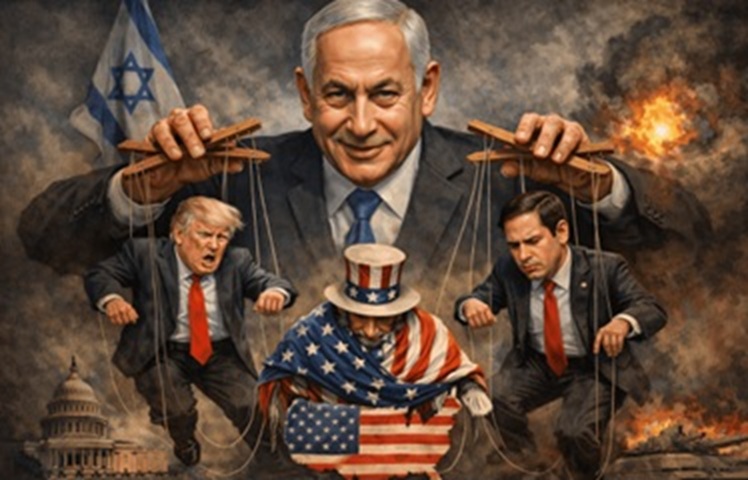
𝐍𝐄𝐓𝐀𝐍𝐘𝐀𝐇𝐔’𝐒 𝐆𝐀𝐌𝐁𝐋𝐄 𝐖𝐈𝐓𝐇 𝐀𝐌𝐄𝐑𝐈𝐂𝐀𝐍 𝐈𝐍𝐓𝐄𝐑𝐄𝐒𝐓𝐒 𝐀𝐍𝐃 𝐒𝐎𝐋𝐃𝐈𝐄𝐑𝐒 𝐈𝐍 𝐓𝐇𝐄 𝐌𝐈𝐃𝐃𝐋𝐄 𝐄𝐀𝐒𝐓
DD Geopolitics Protagonist HQ and Ibrahim Majed, Jun 09, 2026
The fragile calm that had prevailed across much of the Middle East since April, excluding the ongoing Israeli war on Lebanon, unraveled within hours, exposing a strategic reality Washington has long sought to avoid.
What began as a localized escalation rapidly evolved into a broader geo-economic crisis with consequences extending far beyond the battlefield.
At the center of the crisis lies a structural imbalance within the U.S.-Israeli relationship.
While Washington remains Israel’s principal military, diplomatic, and economic backer, recent events have highlighted the extent to which regional escalations can impose costs on the United States regardless of American preferences.
The result is a dynamic in which decisions made in Tel Aviv increasingly shape the strategic environment that Washington must manage.
𝐓𝐡𝐞 𝐄𝐬𝐜𝐚𝐥𝐚𝐭𝐢𝐨𝐧 𝐓𝐫𝐢𝐠𝐠𝐞𝐫
he latest escalation stemmed from Israel’s continued military operations in Lebanon, including renewed strikes on the southern suburbs of Beirut, despite mounting regional warnings and Iran’s explicit signaling that further escalation in Lebanese territory would cross a red line.
These actions effectively collapsed the fragile de-escalation framework that had begun to take shape in recent months.
Yet the strategic significance of the crisis did not stem solely from direct military exchanges.
The conflict quickly expanded through an asymmetric front.
Yemen’s Ansarallah movement announced a comprehensive blockade targeting Israeli-linked maritime traffic through the Bab al-Mandab Strait, transforming what might have remained a localized confrontation into a wider geo-economic challenge.
The implications were immediate.
One of the world’s most critical maritime chokepoints suddenly became a theater of strategic pressure.
Energy markets reacted rapidly, with oil prices surging as traders assessed the risks posed to global shipping routes and regional stability.
What began as a military confrontation was now exerting pressure on the economic infrastructure that underpins global commerce.
𝐓𝐡𝐞 𝐂𝐥𝐚𝐬𝐡 𝐨𝐟 𝐏𝐨𝐥𝐢𝐭𝐢𝐜𝐚𝐥 𝐓𝐢𝐦𝐞𝐥𝐢𝐧𝐞𝐬
The military escalation unfolded against the backdrop of a growing political divergence between U.S. President Donald Trump and Israeli Prime Minister Benjamin Netanyahu.
Hours before the strikes, Trump projected confidence that Washington remained firmly in control of events.
According to reports surrounding a high-level phone conversation, the American president conveyed the impression that he retained decisive influence over Israeli decision-making and could prevent a broader confrontation.
The subsequent Israeli strikes conveyed a different message.
Regardless of Washington’s preferences, events on the ground proceeded according to Israeli calculations.
The operation demonstrated the limits of American influence at a moment when the White House was attempting to contain regional tensions and preserve diplomatic channels.
More importantly, it reinforced a perception increasingly shared across the region: while the United States remains the dominant external power, its ability to dictate the behavior of key allies is not unlimited.
𝐓𝐫𝐮𝐦𝐩’𝐬 𝐄𝐥𝐞𝐜𝐭𝐨𝐫𝐚𝐥 𝐍𝐢𝐠𝐡𝐭𝐦𝐚𝐫𝐞
For the White House, the timing could hardly be worse.
The administration entered 2026 seeking to reduce regional tensions, stabilize energy markets, and avoid another Middle Eastern crisis capable of dominating domestic political discourse ahead of the Midterm Elections.
Escalation threatens all three objectives simultaneously…………………………………………………………………….
𝐍𝐞𝐭𝐚𝐧𝐲𝐚𝐡𝐮’𝐬 𝐒𝐮𝐫𝐯𝐢𝐯𝐚𝐥 𝐓𝐢𝐦𝐞𝐥𝐢𝐧𝐞
Netanyahu, however, is operating according to a very different political timetable.
His government faces mounting domestic pressures, including declining public support, growing political fragmentation, large-scale protests, and unresolved disputes surrounding the conscription of the Ultra-Orthodox community.
Current political trends suggest that a return to normal political conditions could expose the governing coalition to severe electoral risks…………………………………………..
𝐓𝐡𝐞 𝐒𝐭𝐫𝐮𝐜𝐭𝐮𝐫𝐚𝐥 𝐓𝐫𝐚𝐩
The deeper problem for Washington is that its options remain constrained.
Despite occasional public disagreements, successive American administrations have found it politically difficult to impose meaningful costs on Israel during periods of confrontation.
Congressional support, entrenched institutional relationships, domestic political considerations, and long-standing strategic commitments collectively limit the range of coercive tools available to the White House.
As a result, American policymakers frequently find themselves attempting to contain the consequences of decisions they neither initiated nor fully control.
This dynamic creates a strategic trap.
The United States absorbs the diplomatic costs of regional instability, bears responsibility for protecting maritime trade routes, manages the economic consequences of energy market disruptions, and remains expected to provide security guarantees throughout the region.
Yet its ability to shape the behavior that generates those costs remains constrained by political realities at home.
𝐓𝐡𝐞 𝐒𝐭𝐫𝐚𝐭𝐞𝐠𝐢𝐜 𝐂𝐨𝐬𝐭
The deeper danger for Washington extends far beyond the immediate crisis.
What has emerged is a growing divergence between Israeli domestic political imperatives and broader American strategic objectives………………………………………………………….
Ultimately, the central question is no longer whether the United States can continue supporting Israel.
Rather, it is whether American policymakers can reconcile unconditional strategic commitments with a regional reality in which their own interests are increasingly exposed to decisions made by an ally pursuing a very different political agenda.
If the current trajectory continues, the greatest challenge to Washington’s Middle East strategy may not emerge from its adversaries, but from the widening gap between American interests and the actions of the partner it remains committed to defending. https://ddgeopolitics.substack.com/p/75a?utm_source=post-email-title&publication_id=1769298&post_id=201184525&utm_campaign=email-post-title&isFreemail=true&r=1ise1&triedRedirect=true&utm_medium=email
‘The Humiliation Just Compounds’: Trump Tells Netanyahu Not to Bomb Iran, Then Israel Strikes Anyway
US President Donald Trump “appears unwilling to spend the political capital necessary to rein in Netanyahu—beyond angry phone calls and tough public statements,” said one analyst.
Jake Johnson, Jun 08, 2026, https://www.commondreams.org/news/trump-netanyahu-iran-2677009860
The Israeli military bombed Iran on Monday shortly after US President Donald Trump urged Israeli Prime Minister Benjamin Netanyahu not to respond to an Iranian missile barrage, which came in retaliation for Israel’s earlier bombing of Beirut.
“I am going to call Bibi right now and tell him not to retaliate,” Trump told Axios on Sunday, noting that the Iranian strikes did not appear to cause any injuries. “Each of them had their fun. Israel had its strike, and Iran had its strike. We don’t need another one.”
Iran’s missile attack on Israel was the first since a tenuous ceasefire agreement took effect in early April, and the exchange intensified concerns of a return to full-blown regional war. Iran’s Foreign Ministry said the Sunday strikes were a defensive response to the Israeli military’s bombing of southern Beirut as well as “Israel’s persistent breaches of the April ceasefire, including its collaboration with the US military in attacks on Iranian ships and targets in southern Iran over the past two weeks.”
The Israel Defense Forces vowed to “continue to operate all across Lebanon” and said it would not “allow fire toward Israel.”
Esmail Baghaei, a spokesperson for Iran’s Foreign Ministry, said during a press conference on Monday that despite Trump’s public comments, “no one in the region believes” that Israel attacked Lebanon or Iran “without prior coordination and cooperation with the United States.”
“The United States bears responsibility as a party to the April 8 ceasefire understanding,” said Baghaei. “Whatever happens in the region, whether the US itself violates the ceasefire by attacking Iranian commercial ships or targeting southern parts of the country, or whether violations are carried out through the Zionist regime in Lebanon with US complicity, the direct responsibility of the United States is clear, and the consequences of any escalation will also fall on Washington.”
Trump told the Financial Times following Iran’s missile attack on Israel that he did not believe it would undercut the prospects of a diplomatic agreement. The US president also said Netanyahu would have no choice but to accept any agreement the Trump administration reaches with Iran, declaring: “I call the shots. I call all the shots. [Netanyahu] doesn’t call the shots.”
But critics of Trump’s illegal and costly war of choice in Iran, which he launched in coordination with Israel in late February, said Netanyahu’s swift defiance of the president’s call for restraint underscored how disastrous the conflict has been for the US.
“This war has been humiliating for Trump and American power generally,” US Sen. Chris Murphy (D-Conn.) wrote on social media. “And when Trump announces he is going to call Netanyahu and tell him not to retaliate, and within hours Netanyahu retaliates, the humiliation just compounds.”
Trita Parsi, executive vice president of the Quincy Institute for Responsible Statecraft, wrote in a blog post following the Israeli attack on Iran that Trump “appears unwilling to spend the political capital necessary to rein in Netanyahu—beyond angry phone calls and tough public statements—unless he knows that he has a deal with Iran.”
“From Trump’s perspective, it is only worth doing if an agreement with Iran is already secured. In short, Trump is willing to restrain Israel to preserve a deal, but not to obtain one. Iran, however, wants evidence that Trump can restrain Israel before agreeing to a deal,” Parsi wrote. “As a result, the most likely scenario is another round of Iranian and Israeli strikes, with Trump declining to meaningfully constrain Israel.”
The National Iranian American Council noted that Iran’s leadership “has already threatened a broader and more destructive campaign” in response to Israel’s strikes.
“The coming 24 to 72 hours will likely determine whether this becomes a contained crisis or the beginning of a new phase in the regional conflict,” the group added.
Trump’s Sedition Act for Israel
“you can’t be an American if you don’t love Israel.”
By Dr. Paul Craig Roberts, Global Research, May 25, 2026, https://www.globalresearch.ca/trump-sedition-act-israel/5927389
At all times and places it has been difficult to speak freely.
Even the founding fathers had their Sedition Act of 1798 that criminalized statements against the US government. Shortly afterward President Thomas Jefferson got most of it repealed.
President Abraham Lincoln during his 1861-1865 invasion of the Confederate States of America had a de facto sedition act. Lincoln used executive orders, military directives, martial law, and the suspension of habeas corpus to shut down free speech. At one time Lincoln had 300 Northern newspaper editors in prison.
In 1918, Congress passed a new Sedition Act that applied when the US government was at war. The law prohibited speech and opinion that put the US government and its war effort in a bad light. The bad light was that US President Woodrow Wilson promised Germany no territorial loss and no reparations in exchange for an armistice, and betrayed the promise. The result was the Treaty of Versailles that as British economist John Maynard Keynes correctly predicted led to World War II.
President Donald Trump has declared his own Sedition Act issued not by Congress, increasingly an irrelevant government institution, but by Trump’s personal defense lawyer currently serving as US Attorney General. Trump’s Sedition Act is unique. It protects from criticism not the US government, but a foreign one — Israel. The May 19 press release of the US Department of Justice (sic) says:
“President Trump has made clear that this administration will not tolerate antisemitism, and the Department of justice is committed to implementing that directive.” (See this)
Understand that the US Department of Justice is now the protector of Israel, as is the US military and US taxpayers, and antisemitism means any criticism of Israel. For example, Israel’s genocide of Palestine and its people, Israel’s interference in tenure decisions of US universities, the hiring and contracting policies of state governments such as Texas and Florida, Israel’s funding of the primary defeat of US Republican Representative Thomas Massie, Israel’s assassinations of foreign leaders, Israel’s suspected assassination of Charlie Kirk, suspicion that Epstein was a Mossad agent collecting blackmail information against Americans in a position to influence US foreign party in the Middle East, and on and on. Every thought, question, statement of fact that can be interpreted as hostile to Israel has become anti-semitism and will not be tolerated by the US Department of Justice (sic).
Clearly, the Trump regime, essentially a Zionist regime, has no intention of permitting any correct information to be aired. If you challenge or taunt the Regime, you are shut down like Colbert, Thomas Massie, Marjorie Taylor Greene, and so many others.
The Washington Post published an article on May 21 about President Trump’s efforts to silence late night TV hosts. Apparently, Trump succeeded in intimidating CBS to cancel Stephen Colbert. NBC’s Seth Meyers and ABC’s Jimmy Kimmel believe they are on the hit list. See this.
A discredited media unable to hold Trump to account has replaced a former biased media.
During my professional lifetime the print and TV media had a liberal bias, coming down hard on conservatives and Republicans and lightly, if at all, on the leftwing and Democrats. The liberal media was more or less at the beck and call of the CIA, but the New York Times did finally decide to publish the leaked Pentagon Papers, an act that contributed to the end of the Vietnam War.
During the 1980s and I think the 1990s the New York Times asked me twice a year for an op-ed article addressing a specified subject. If memory serves, two was the annual limit for outside contributors, although perhaps not for liberal-left ones. As I had been a presidential appointee in the Reagan administration, a trustee of the Committee on the Present Danger, a Wall Street Journal editor and columnist, and a contributing editor of National Review, the liberal media regarded me as a conservative instead of a person who thought for himself.
The Washington Post was also friendly in a limited way. The Post’s editorial page editor was pleased to occasionally have me on her page and once took me to lunch with some of her colleagues. When at the end of the 20th century I could no longer stomach the corruption and backstabbing of the Washington snake pit and departed to the beach in Florida, the Washington Post sent a star reporter and camera team to my Florida home for a full-fledged interview and expressed regret that an honest voice had forsaken the nation’s capital. The fact that the Washington Post thought that I was honest did not mean that the Post thought I was correct.
In those days large newspapers like the Times and Post comfortably existed on advertising revenues so varied that no advertiser could, very often, influence the newspaper. Media had a liberal bias, but that was their own decision. It wasn’t imposed on them. Unlike today, there was enough belief left in the media in debate in place of silencing critics, resulting in occasional presentation of alternative explanations to the official narratives.
In the 21st century the media for whatever reasons has become censorious, demonizing those in opposition to official narratives. The result has been to discredit the media as a source of information.
Today we don’t have, as existed in my 25 years in Washington, a media even partially open to different explanations.
With the traditional TV and print media discredited, and the lack of transparency of most of the Internet media, to whom do we turn for credible explanations? My own attempts to deliver truth are compromised by invalid accusations against me by Zionist organizations, the political left, and liberals who still believe that more government is the answer. The assaults on me are intended to limit my readership, and the assaults have had a partial success. I suspect that I am now read more abroad than in the United States.
Perhaps I have failed in my approach to insouciant Americans who, despite the high stakes, are unaware of the demands on them of our time. If so, my failure is small compared to that of the media, which by destroying its own credibility, has destroyed the media’s checkmate on the rise of a Caesar.
America now has a president who goes to war at the request of his most important campaign contributors without authorization of the US Congress as long as the request is in Israel’s behalf. The legal advisor to the US Department of State, Reed Rubinstein, has penned a justification for Trump’s military attack on Iran which states the United States initiated its military campaign against Iran (Operation Epic Fury) “at the request of and in the collective self-defense of its Israeli ally”. Note that the State Department defines aggression as self-defense. Clearly Under President Trump, the United States of America now commits its resources and lives of its military personnel to the achievement of the Zionist agenda of Greater Israel. Americans are now taxed and die for Israel’s domination of the Middle East. If you dissent, you are punished as an “anti-semite.”
Until the 21std century, I cannot imagine the American media allowing this to happen. The digital revolution by putting the power of money over the media in a few hands has cancelled even a biased free press. In its place there is a propaganda ministry.
President Trump’s anti-semitism policy cancels the First Amendment if it is used by Americans for criticism of Israeli government policies, such as the genocide in Palestine.
When the Israel Lobby can cancel the First Amendment, you know that the United States is no longer a sovereign country.
A country at Israel’s beck and call is America today, thanks to Donald Trump. Yet, a significant percentage of Trump’s supporters conflates MAGA with MIGA. American patriotism now requires patriotism to Israel. As the latest mantra goes, “you can’t be an American if you don’t love Israel.” You have to hand it to the Zionists. They have even stolen our patriotism.
Trump and Netanyahu: The odd couple
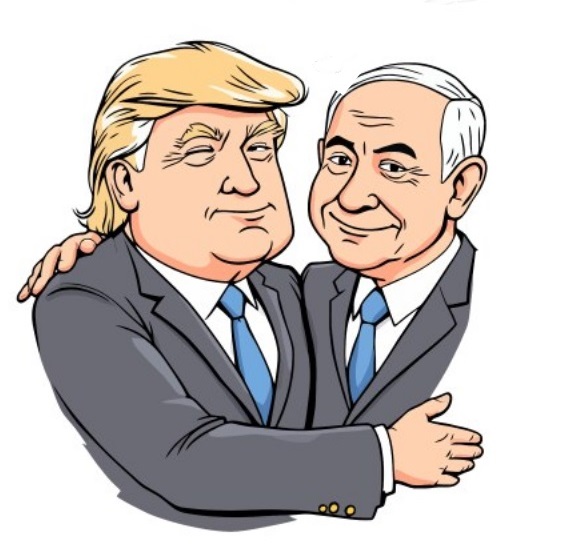
June 5, 2026 . by Jamal Kanj, https://www.middleeastmonitor.com/20260605-trump-and-netanyahu-the-odd-couple/
“He’ll do whatever I want him to do,” Donald Trump declared recently about Israeli Prime Minister Benjamin Netanyahu.
The statement may be one of the most revealing statements Trump has ever made—not for what it says about Netanyahu, but for what it reveals about Trump’s psychology. It was intended as a display of strength. Instead, it exposed the opposite.
Trump has built a political persona around hyperbole, self-aggrandizement, and declarations of superiority to cover up for an oversized inferiority complex, he only knows its extent. When he insists that Netanyahu is acting at his command, he is projecting an authority he does not possess. The louder the boast, the more apparent the insecurity beneath it.
“If there is one lesson since the election of Trump, it is that Netanyahu, not Trump, has consistently dictated the pace of America’s wars in the Middle East. Trump may occupy the White House, issue ultimatums, and proclaim himself the master negotiator, but the facts on the ground tell a different story. Again and again, Netanyahu acts, and Trump adjusts.“
For years, Netanyahu worked relentlessly to pull the U. S. into another made-for-Israel war, this time against Iran. Successive administrations, despite their deference to Israel, stopped short of falling for the scheme. Trump, however, proved far more susceptible to the influence of his Israel-first donors and to Netanyahu’s chicanery. Yet he continues to portray himself as the one calling the shots.
This week, Trump proudly recounted a phone call in which he supposedly instructed Netanyahu to halt a planned Israeli attack on Beirut. It took little time after Trump’s statement for Israel’s defense minister to announce that military operations “will continue under all circumstances.” True to that pledge, Israel launched fresh attacks on hospitals and villages in southern Lebanon, killing and wounding civilians despite the so-called Trump’s war cessation.
“Two days later, on Wednesday June 3rd, Lebanese and Israeli delegations meeting in Washington announced another ceasefire. The third such extension since last April. One day after reaching the agreement, Israel resumed strikes on South Lebanon and said it would neither withdraw nor allow Lebanese civilians back to their homes in the south.“
It is almost certain, when the Lebanese resistance eventually counters the repeated Israeli violations, Trump—as he has done before—will condemn the retaliation rather than the provocation. To save face and avoid appearing weak before Netanyahu, he will once again blame the Lebanese side while ignoring the Israeli occupation and military actions that triggered the response.
The same pattern is evident in the negotiations with Iran. For months, Trump’s stated objective was to prevent Iran from developing a nuclear weapon—a framework which aligns with Tehran’s declared position. But nuclear-armed Israel, which never signed the Non-Proliferation Treaty that Iran did, has different goals entirely. Netanyahu’s government will not be satisfied with anything short of the destruction of knowledge and the reduction of Iran to a failed state, precisely the fate that befell Iraq and Libya after both countries agreed to surrender their nuclear ambitions.
For Israel, a negotiated agreement between the U.S. and Iran, may be far less desirable than the continuation of regional turmoil. For its objective is the preservation of a strategic environment that sustains military and geopolitical dominance. Zionism has long viewed the emergence of democratic, technologically advanced, and self-reliant neighboring states as a threat. Fragmentation and disorder in surrounding countries serve that objective by limiting the rise of independent regional powers that could one day, potentially challenge Israeli primacy. In this case, Israel may be unique among nations: it derives strategic advantage not from a stable and prosperous region, but from entropy, and has built a regional doctrine whose success depends on propagating chaos.
The cost to ordinary Americans is tangible, and personal. They feel it every time they fuel their cars, pay inflated prices for goods, or watch Congress cut healthcare or financial student aid for Americans in order to finance another military aid package for Israel.
“Americans are not only financing Israel’s wars through tax dollars and weapons transfers. They are also paying what amounts to an Israeli surcharge tax at the pump.”
Treasury Secretary Scott Bessent has been trying for weeks to assure consumers that gas will hover around $3 a gallon between June and September, as if it is acceptable for Americans to pay elevated prices until Netanyahu deigns to approve a ceasefire, especially when Trump boasts that America is a net oil exporter.
Gaza is another front in Israel’s endless wars. Trump personally signed the ceasefire agreement in Sharm el-Sheikh in October 2025, chirping “we have peace in the Middle East.” He had since watched in silence as Israel systematically dismantled every commitment it had made. During the “ceasefire,” it maintained a starvation diet blockade, murdered more than 800 and wounded thousands.
Under Phase One of the agreement, Israeli forces were required to withdraw to approximately 53 percent of Gaza. Phase two stipulated further withdrawal. Instead, Netanyahu ordered the seizure of an additional 32 percent, increasing total Israeli military occupation to 70 percent of the besieged territory, confining 2.3 million Palestinians to 30 percent, or roughly 50,000 human beings per each square mile of rubble.
On all fronts, Trump did not merely follow Netanyahu’s lead. He enabled it, funded it, armed it, and defended it diplomatically. Then, standing before television cameras, he attempted to compensate for this reality by insisting that he was the one in control.
To that end, and following recent Republican primary elections, lame-duck Republican members of Congress have already begun treating the Trump administration as a lame-duck presidency, long before the midterm elections. The recent congressional vote to limit presidential war powers is a telling sign that Trump’s political capital is eroding far sooner than expected.
Nevertheless, Americans may be witnessing a historic inflection point in the decades-long power of Israel-first Zionist influence over American political life. It is clear the political landscape is shifting, and the assumptions that long governed Washington’s relationship with Israel no longer appear as immutable as they once did. From growing dissent within the Democratic Party—and among Republican influencers—to deepening unease across the Washington Beltway, genuine cracks are appearing in a system that for generations treated Israel as a sacred cow. Eight decades of unquestioned manipulation and political leverage over American leaders is now facing resistance from constituencies that were once among its most reliable friends.
“Hence, no amount of presidential bravado or social-media posturing can obscure what has become undeniable: under Donald Trump, American foreign policy has served Netanyahu’s Israel-first agenda, not America’s. And when the history of this era is written, this odd couple may be remembered for ushering in the sunset of Israel-first Zionist dominance over the U.S. government.“
1 This Month

To see nuclear-related stories in greater depth and intensity – go to https://nuclearinformation.wordpress.com
-
Archives
- September 2026 (184)
- August 2026 (330)
- July 2026 (355)
- June 2026 (287)
- May 2026 (306)
- April 2026 (356)
- March 2026 (251)
- February 2026 (267)
- January 2026 (308)
- December 2025 (358)
- November 2025 (359)
- October 2025 (375)
-
Categories
- 1
- 1 NUCLEAR ISSUES
- business and costs
- climate change
- culture and arts
- ENERGY
- environment
- health
- history
- indigenous issues
- Legal
- marketing of nuclear
- media
- opposition to nuclear
- PERSONAL STORIES
- politics
- politics international
- Religion and ethics
- safety
- secrets,lies and civil liberties
- spinbuster
- technology
- Uranium
- wastes
- weapons and war
- Women
- 2 WORLD
- ACTION
- AFRICA
- Atrocities
- AUSTRALIA
- Christina's notes
- Christina's themes
- culture and arts
- Events
- Fuk 2022
- Fuk 2023
- Fukushima 2017
- Fukushima 2018
- fukushima 2019
- Fukushima 2020
- Fukushima 2021
- general
- global warming
- Humour (God we need it)
- Nuclear
- RARE EARTHS
- Reference
- resources – print
- Resources -audiovicual
- Weekly Newsletter
- World
- World Nuclear
- YouTube
-
RSS
Entries RSS
Comments RSS
 nuclear-news