Renewable jobs growth in Scotland

Letter Dr Paul Dorfman: Based on information from the Nuclear Information
Association, Scotland has added only 661 nuclear jobs whilst England gained
almost 47,500. However, in contrast, it has to be noted that according to a
recent Confederation of British Industries (CBI) report, net-zero and
renewable industries supports more than 105,000 jobs in Scotland and
contribute £10.2 billion to the economy, representing 4.9 per cent of
total economic output via 28,473 direct jobs, 57,153 supply chain roles,
providing an average salary of £41,800, paying 5.2 per cent higher than
the national average.
John O’Groat Journal 26th Sept 2026,
https://www.johnogroat-journal.co.uk/news/renewable-jobs-growth-in-scotland-thurso-wig-service-for-ca-445913/
UP FOR GRABS: Button pushed for new SMR spending round
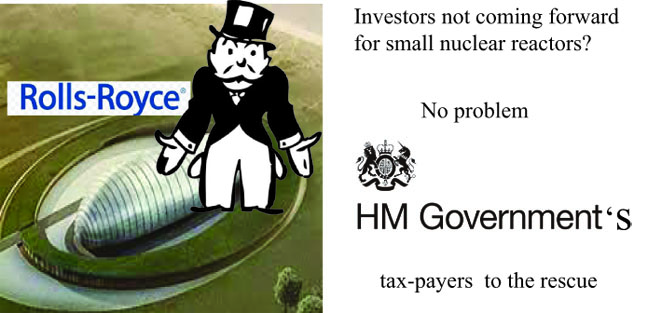
energy economists point out that fixed costs (such as 24/7 security, exclusion zones and
energy economists point out that fixed costs (such as 24/7 security, exclusion zones and regulatory licensing) do not diminish proportionally with a smaller reactor…………….. “economies of scale come by making something bigger, not by making something smaller.”
By Simon Hacker | 25th September 2026
Businesses across Gloucestershire and the Cotswolds are being urged to throw in their hats for a share of £1.4bn in contracts to supply Rolls-Royce SMR‘s pathway for small nuclear reactors.
Rolls-Royce SMR said its new Supplier Programme gives UK firms a chance to bid for a slice of the contracts pie over the next year, the move aiming to support the company and Great British Energy-Nuclear (GBE-N) in its quest to achieve more than 70% UK fleet content for the Gwyndod (Wylfa) project in North Wales.
The invitation comes as SMR technology remains, as yet, unapproved for final implementation in Western markets: two demonstration operations in China and Russia (a floating project on the Arctic) are active as pilots, but elsewhere, while technical viability is proven, Rolls-Royce SMR remains engaged in a process to steal a lead on US rivals by concluding a Generic Design Assessment stage with regulators.
Since being formed in 2021, Rolls-Royce SMR said it had already spent more than £300m with UK based suppliers – equivalent to 88% of its total spend to date – and held three UK supplier events, formally engaging with more than 650 UK firms.
It hailed this launch as a “major milestone in establishing a resilient, high-value UK supply chain, capable of delivering at scale and supporting our export programme”.
Funding for SMR development is a mixed picture of streams from private investment and the UK taxpayer, with government documents showing that the £1.4bn reported here is derived from general taxation (via government spending), the ultimate goal of the SMR programme being to transition to a mix of private investment and consumer energy bills.
To date, the amount that Rolls-Royce SMR has drawn down and spent from the taxpayer is not isolated to a single figure, given that government funding shifts between committed grants, commercial loans and site purchases.
But in terms of money the government has formally spent or legally committed to Rolls-Royce SMR so far, the taxpayer footprint is reported to stand at around £830m in direct development funds, within a wider £2.6bn total programme allocation…………………
Chris Cholerton, CEO of Rolls-Royce SMR, said the scale of the opportunity in unlocking £1.4bn that is now available to UK suppliers from the Rolls-Royce SMR programme was significant.
“As the only SMR provider with multiple contractual commitments in Europe, we want to partner with the best of UK industry, to maximise their opportunity to contribute to our growing European fleet.”
It’s not quite over the line, but Rolls-Royce SMR has successfully completed Step Two of the GDA which makes it the leading SMR vendor in Europe in the race to provide the continent’s required legal paperwork for the technology……………………….
Rolls-Royce SMR said: “Through workshops, industry events and expert guidance, the Programme will demystify the sector, help suppliers understand regulatory and commercial requirements, and make it easier for companies to explore opportunities within the Rolls-Royce SMR supply chain.Participating suppliers will benefit from greater visibility of future supply chain requirements and access to potential opportunities across the programme. They will also have opportunities to engage directly with Rolls-Royce SMR and supply chain procurement teams through briefings, networking events and meet-the-buyer sessions.”
WIth the economic viability remaining as yet untested advocates of SMRs maintain that by building reactors in factories, rather than on-site, costs will plummet. However, energy economists point out that fixed costs (such as 24/7 security, exclusion zones and regulatory licensing) do not deminish proportionally with a smaller reactor.
Here in Gloucestershire, Stroud-based Ecotricity boss Dale Vince has taken a leading role as an ardent critic of the SMR concept, having argued that “economies of scale come by making something bigger, not by making something smaller.”
Trying to make cheap “mini nukes”, Mr Vince said, ignores the fact that miniaturising complex, highly regulated technology naturally drives costs up, not down.………
https://www.punchline-gloucester.com/articles/aanews/button-pushed-for-new-smr-spending-round
Britain’s elites want you ready to die for a war they keep imagining

As the warnings about Russia grow louder, the public is being told to fear more, question less and prepare for war
Tarik Cyril Amar, 24 Sep, 2026, https://www.rt.com/news/646177-britains-elites-want-you-die/
Great Britain is going through a war scare. Or to be precise, its combined political and media establishment is subjecting its people to a relentless propaganda (in up-to-date NATO-speak “cognitive warfare”) campaign to create a sense of impending war against Russia.
As you would expect, that war is, of course, framed as strictly defensive. In propaganda textbook manner, the message is both very simple and very repetitive: The UK is in great danger of a Russian attack, and its whole population must prepare itself to withstand and resist it.
It goes without saying that Moscow’s repeated declarations of having no such intention make no difference.
Britain is certainly not alone in its establishment-induced hysteria. Much of NATO-EU Europe is undergoing, in essence, the same treatment. In France, for instance, President Emmanuel Macron has called a theatrical all-manicured-hands-on-deck meeting to give what can only be called a national scare talk about “Russian hybrid warfare”; in Germany, Berlin and its mainstream media won’t stop stirring the pot about the murky drone affair at Leipzig-Halle airport.
Yet, over the last weeks, within a crowded field of European panic-mongering, Britain has stuck out as especially virulent. The single most grotesque contribution was made by uber-Tory Jacob Rees-Mogg. Comfortably seated against a backdrop that screamed country-squire probity, Rees-Mogg held forth on war within the next few years, ancient Rome (he’s been to Eton, he wants you to know) and, most importantly, “circumstances where people may have to die.” Either that or – so Rees-Mogg’s stern message – decline and fall, as happened to those Romans, who let mercenaries do their fighting and thus lost their empire.
So much to unpack. For one thing, the reference to paying others to fight – and die – must be a Freudian slip. Surely, Sir Jacob cannot have meant to refer to how the West, Britain very much included, has paid the Kiev regime to send its subjects – if need be, after kidnapping them – into the folly of a proxy war meatgrinder to demote Russia. And then, that Roman Empire analogy? Clearly, Rees-Mogg, true to type, is still struggling with the fact that Britain has its imperial collapse well behind it already.
Yet, sour oddball as he is, the arch-conservative – and multimillionaire – Rees-Mogg is perfectly representative of the current British establishment trend. Prime Minister Andy Burnham, for instance, has just used his first UN General Assembly address in New York to blame his country’s misery not on, say, his predecessor and Labour Party comrade Keir Starmer, but on Russia.
Meanwhile, at home, Sky News is rolling out ‘The Wargame’, a bizarre “docu”-fantasy in four parts, built on the premise that the Russians are coming, no, they really, really ARE this time!
Pretending to be a sort of “realistic” account of what a British government would do in case of Moscow launching a series of escalating attacks, this production – from available reviews – is unusually awful shlock. It features has-been politicos doubling as un-reality TV stars, such as Michael Gove and Nicola Sturgeon, and living out their inner Tom Clancy by pretending to be serious, decisive, and, most of all, terribly important to the nation’s survival.
Unintentionally funny, though, as it may be, ‘The Wargame’ clearly has substantial political support and much hype around it. Propaganda can easily look ridiculous and be highly toxic at the same time. Because effective propaganda is, above all, one simple thing: the psychological manipulation of the many by the few. This is such a case. The viewers of ‘The Wargame’ are fed a silly but efficiently dramatized story, with the whole bag of well-worn but powerful tricks: suspense, shock, and, last but not least, a thrilling score.
It’s no surprise that the attitude of those doing the manipulating is, at best, patronizing. And to be fair even to the unbearable, Jacob Rees-Mogg, who carefully tends his beyond-caricature English-toff image, is quite honest about his disdain for ordinary people and their expendable lives. From his always obstinately ill-fitting yet clearly expensively tailored suit to the diction of a terribly bored yet forbearing Eton headmaster, his performance oozes good old upper-class condescension.
When Rees-Mogg tells you that you may have to die, you know he won’t lose sleep over it, because you are you, and he – well, he is something entirely different and, really, much better (and, as it happens, richer, too), of course.
In a Sky News interview, the UK’s Chief of the Defense Staff, Air Chief Marshal Sir Richard Knighton, has revealed a less excentric as well as more insidious approach to the masses. Referring to a “national conversation on defense,” both he and his interviewer took it for granted that the purpose of such a conversation is to remedy “what the British public hasn’t got, […] haven’t understood.”
What a delicate way to start a “conversation”: let me tell you how damn slow you are and where you need to catch up. Not: Let’s exchange views and respect each other as equal citizens. Indeed, it’s not only very rude – what has happened to English manners? – but positively Orwellian to call such offensively complacent preaching a “conversation.”
Marshal Knighton’s idea of how the British can and must do better was no less revealing: In essence, be more like the Estonians or, at least, the Swedes. Because in Estonia “the threat from Russia” is “part of normal daily conversation,” and in Sweden, they are at least trying to achieve the same single-minded obsessiveness.
There you have it, chums on the homefront: Make an effort, will you now? Learn from the worst, get a grip, and make your whole life turn around the fear we tell you to feel.
And don’t you dare notice that – how embarrassing, really – it is precisely the Estonian authorities who, notwithstanding their generally record-level Russophobia – have just called on everyone in NATO-EU Europe to cool it.
Because, those unpredictable Estonians tell us, the Russia-at-the-gates narrative “has been blown completely out of proportion. For example, Russia makes some adjustments on the other side of the Narva River and now everyone across NATO is losing their heads and hyperventilating over it,” while, in reality, “there is absolutely no reason to believe that Russia is imminently going to launch a military attack on NATO, Estonia, or the Baltic states.” Oops.
Unfortunately, war propaganda is almost immune to its own absurdities, inconsistencies, and plain silliness. Because it is designed to operate not by appealing to reason but to fear, stereotypes, and conformism. A conformism that some British establishment members already openly want to reinforce by locking up any dissenters.
The true weak spot of this warmongering may be its arrogance. There are signs on social media that many Brits do not appreciate their establishment’s latest efforts to scare and mobilize them for senseless war. Let’s hope that the mix of threats and condescension – displayed by a snob as gleefully aloof as Rees-Mogg, an officer-bureaucrat as clumsily tactless as Knighton, and the makers of something as slick as ‘The Wargame’ – rubs much of the country the wrong way. The “elites” are insane and malevolent. Any hope for peace and a return to reason will have to come from below.
Britain’s Great National Freak-Out Propaganda War Self-Blitz
Tarik Cyril Amar, Sep 25, 2026
Great Britain is going through a war scare. Or to be precise, its combined political and media establishment is subjecting its people to a relentless propaganda (in up-to-date NATO-speak “cognitive warfare”) campaign to create a sense of impending war against Russia.
As you would expect, that war is, of course, framed as strictly defensive. In propaganda textbook manner, the message is both very simple and very repetitive: The UK is in great danger of a Russian attack, and its whole population must prepare itself to withstand and resist it.
It goes without saying that Moscow’s repeated declarations of having no such intention make no difference.
Britain is certainly not alone in its establishment-induced hysteria. Much of NATO-EU Europe is undergoing, in essence, the same treatment. In France, for instance, President Emmanuel Macron has called a theatrical all-manicured-hands-on-deck meeting to give what can only be called a national scare talk about “Russian hybrid warfare”; in Germany, Berlin and its mainstream media won’t stop stirring the pot about the murky drone affair at Leipzig-Halle airport…………………………………………………………………………………………………………………………. (Subscribers only) https://www.tarikcyrilamar.com/p/britains-great-national-freak-out?utm_source=post-email-title&publication_id=1855891&post_id=217293360&utm_campaign=email-post-title&isFreemail=true&r=1ise1&triedRedirect=true&utm_medium=email
SGE confident of UK SMR fleet prospects
By Alex Hunt, World Nuclear News, in London, Wednesday, 23 September 2026,
https://www.world-nuclear-news.org/articles/sge-confident-of-uk-smr-fleet-prospects
The team behind plans for a fleet of 14 BWRX-300 small modular reactors in the UK says they are confident of the economic model and supply chain capability to deliver these units.
SGE (formerly Synthos Green Energy) in July submitted an application under the UK’s Advanced Nuclear Framework for reactors which could provide 4.2 GW of capacity, equivalent to 11% of current UK power demand.
Poland’s SGE – whose deployment team includes Samsung C&T, Laing O’Rourke, Aecon Group and Google Cloud – says it will privately finance the deployment of the fleet of GE Vernova Hitachi’s BWRX-300 small modular reactors (SMRs) across three sites in the UK.
The plan is for the initial site to host six of the 300 MW SMRs, with four each at two subsequent sites. The locations of the proposed sites have not yet been disclosed, pending final negotiations.
Rafał Kasprów, CEO of SGE, told World Nuclear News, “I think the UK market has amazing opportunities for SMR developers, and especially us with a fleet approach”.
From the financial point of view he says “we are bringing this investment to the UK … with the disruptive model of not asking government to cover everything on the development and construction phase. We are asking the UK government for Contract for Differences for a fleet of reactors. So it is only when electrons are delivered to the grid that we can benefit from the Contract for Difference model”.
The Contract for Difference (CfD) would work by a future price being agreed for electricity generated by the SMRs – if the price of electricity is higher, the developer will pay the extra back, and if the price of electricity is below the agreed level, the difference is provided to the developer. In the energy sector, a CfD acts as a very long-term price stabilisation mechanism. The UK used a Contract for Difference funding model for Hinkley Point C, but moved away from it for the Sizewell C project.
SGE’s project is currently going through the “deep dive” stage of the UK’s Advanced Nuclear Framework which they believe will conclude in October or November and allow them to be part of the pipeline, and start to execute the project.
As an investor in the project, SGE says that it knows what it needs to do internally to de-risk the project “so we know how to translate that same conversation to markets”.
The company has also developed plans for a fleet of SMRs in Poland and in June submitted its contract for difference application to the government there. As to which country’s projects might happen first, Kasprów says that the UK project could happen at the same time, praising the UK regulatory regime and its infrastructure.
He also rejected concerns about the capacity of supply chains and workforce to cope with the construction of Sizewell C and a number of SMR projects at the same time. He stressed the maturity of the BWRX-300 technology, its use of existing nuclear fuels and the example and experience of the first unit being constructed in Canada.
“We are using existing supply chains – there is also an advantage to the fleet approach because there are places where the supply chain exists, but maybe needs to scale up, and by coming to market with a 14-unit project as our starting point those companies can see a clear path to making that investment worthwhile,” said Robert Rudich, Chief Business Development Manager.
They also stress that the non-nuclear part of the plant is similar to conventional power plants, with the industrial giants GE Vernova and Hitachi as partners and all part of a Europe-wide supply chain.
GE Vernova Hitachi Nuclear Energy’s BWRX-300 is a 300 MWe water-cooled, natural circulation SMR with passive safety systems that leverages the design and licensing basis of the company’s US Nuclear Regulatory Commission-certified ESBWR boiling water reactor design and its existing, licensed GNF2 fuel design, a unique combination that GE Vernova Hitachi Nuclear Energy says positions it to deliver an “innovative, carbon-free baseload power generation source” this decade.
The first BWRX-300 is under construction at Ontario Power Generation’s Darlington site in Canada, with completion expected by the end of the decade. The Darlington project is a reference project for OSGE.
Luba Kotzeva, founder and CEO of advisory and consultancy group Etara and part of the project team, said there had been “good engagement” with the UK side on the issue of a Contract for Difference funding model and stressed the importance of the proposal being for a fleet programme: “I think that is essential to getting the economies of scale, to getting the economics to flow, to getting the private capital.”
The example of the first SMR being built in a G7 country, at Darlington in Canada, is also seen as a key development. Kasprów said: “It’s extremely important, it is the difference between having something and nothing. It’s not about promises anymore – it’s happening.”
New UK Commons committee to scrutinise nuclear spending places much public money outside the normal approval chains
places a considerable volume of public money outside the normal departmental approval chains.
UK Defence Journal By George Allison, September 19, 2026
A new House of Commons committee appointed by the Prime Minister is to be established to scrutinise expenditure and programmes across the Defence Nuclear Enterprise, according to the annual update to Parliament published this week.
The commitment appears among the recommendations of the Strategic Defence Review on which Wes Streeting reports progress, and the update describes the intention as providing “the public with the confidence that taxpayer money is being spent wisely on this critical area”. The Defence Secretary writes that the department is “working with Parliament to establish a new House of Commons-only Committee, appointed by the Prime Minister, to conduct scrutiny of DNE expenditure and programmes”.
The sums involved explain the level of parliamentary interest, given that the enterprise spent £12 billion in the 2025/26 financial year, projects spend of over £100 billion through British suppliers over the next ten years, and will receive in excess of £20 billion more between 2026/27 and 2029/30 than across the previous four years.
It also operates under a ring-fenced budget with greater delegated spending authority than before, an arrangement the update says enables faster decision making and a stronger focus on outcomes and delivery, and which places a considerable volume of public money outside the normal departmental approval chains.
Two further Strategic Defence Review recommendations are reported as progressing, the first of which covers increasing industrial productivity by removing barriers and investing in the people and places supporting the enterprise, which the update says includes amendment of the Single Source Contract Regulations, implementation of John Fingleton’s review of nuclear regulation, investment in Team Barrow and Team Plymouth, and delivery of the Skills Plan.
The second concerns Britain joining NATO’s dual capable aircraft nuclear mission once F-35A aircraft have been delivered, a decision the update says will complement the operationally independent deterrent……………………..
The enterprise brings together the Defence Nuclear Organisation within the Ministry of Defence, the Royal Navy, Cyber and Specialist Operations Command, and AWE Nuclear Security Technologies. https://ukdefencejournal.org.uk/new-commons-committee-to-scrutinise-nuclear-spending/
8 instances of radioactive material incidents in the UK since 2015

20 Working Days, Tom Pashby, Sep 21, 2026, https://tompashby.substack.com/p/8-instances-of-radioactive-material?utm_source=post-email-title&publication_id=6735486&post_id=216635328&utm_campaign=email-post-title&isFreemail=true&r=ln98x&triedRedirect=true&utm_medium=email
There were eight instances of nuclear or radioactive materials being lost, stolen or otherwise out of regulatory control in the past 10 years in the UK, according to data released to 20 Working Days.
The data, released by the Home Office, was already reported voluntarily by the UK Government to the International Atomic Energy Agency’s (IAEA’s) Incident and Trafficking Database (ITDB), which publishes aggregated data annually.
The IAEA Incident and Trafficking Database (ITDB): 2026 factsheet explained: “When originally established, the ITDB recorded incidents of illicit trafficking of nuclear and 145 participating States other radioactive material.
“Its scope was later expanded to include all incidents in which nuclear and other radioactive material is or was out of regulatory control.
“The ITDB scope covers all types of nuclear material as defined by the Statute of the Agency (i.e. uranium, plutonium and thorium), naturally occurring and artificially produced radioisotopes and radioactively contaminated material, such as scrap metal.”
It found that, as of the 2026 report: “The trafficking or malicious use intent of 86.6% of thefts remains undetermined.”
“In 2025, 236 incidents were reported to the ITDB by 34 States, an increase of 89 incidents from 2024,” it said.
“The noticeable increase in reported incidents in 2025 is primarily attributable to retrospective reporting.”
The factsheet also reported that “transport remains a key vulnerability, with over half of all thefts since 1993 — and approximately 70% in the past decade — occurring during authorised transport, underscoring the need for sustained attention to transport security measures.”
Under a section titled “Confidentiality and security of ITDB information”, the factsheet said: “The ITDB is a resource for information sharing among State authorities and the IAEA.
“In order to protect the confidentiality of information reported by States, the IAEA upholds strict procedures for handling and dissemination of sensitive ITDB information.
“Information on reported incidents is only communicated via the PoC (points of contact) network. Access to the complete database is limited to a small number of IAEA staff.”
20 Working Days asked the UK Home Office for the UK’s submissions to the database since 2015.
In response, the Home Office listed eight incidents it had reported to the database. It provided the following table: [on original]
It is unclear whether all of the incidents were disclosed to the public.
The list does, however, include one of the highest profile incidents in the UK involving radioactive materials – the malicious use of Polonium-210 which resulted in the lethal poisoning of Alexander Litvinenko in 2006.
The Litvinenko inquiry: report into the death of Alexander Litvinenko was published in 2016, which may explain why the incident was listed as 2016 by the Home Office.
Meanwhile, the 2021 incident of F-18 being lost and found appears to have been reported by the PA news agency in the same year.
The Home Office was approached for comment.
Britain deepens nuclear ties with France and Australia
By George Allison, September 19, 2026, https://ukdefencejournal.org.uk/britain-deepens-nuclear-ties-with-france-and-australia/
Britain is deepening its nuclear relationships with the United States, France and Australia, with the Northwood Declaration recognising that there is no extreme threat to Europe which would not prompt a response by both Britain and France, according to the annual update to Parliament published this week.
The declaration, agreed in July 2025, reaffirmed and strengthened what the update describes as longstanding nuclear cooperation between the two countries. On the AUKUS partnership, the update records an important development in February this year when HMS Anson docked at HMAS Stirling near Perth.
The United States is described as Britain’s closest defence ally, with the relationship underpinned by long-standing cooperation on all nuclear matters including policy, operations and technology.
The practical expression of that relationship runs through the missile system, since Trident and its supporting systems fitted to the Vanguard class are manufactured in the United States, with Britain having bought title to a number of missiles drawn from a shared pool of assets under the 1963 Polaris Sales Agreement as amended for Trident in 1982. The system is operated independently by both the Royal Navy and the United States Navy.
The warhead fitted to those missiles is sovereign to Britain, with the Mk4A design maintained by AWE at Aldermaston, which also leads development of the replacement warhead, Astraea. Wes Streeting writes that the increase in investment across the enterprise “sends a clear signal of our commitment to global security, and to our Allies”, with the deterrent remaining declared to the defence of NATO.
The update states that nuclear deterrence is the cornerstone of NATO security and that the independent strategic nuclear forces of the United Kingdom contribute significantly to the overall security of the alliance, a declaration maintained since 1962.
Major energy and nuclear supply chain showcase connects Cumbrian firms

Business Crack, September 18, 2026
Hundreds of millions of pounds’ worth of infrastructure work took centre stage as energy sector businesses gathered for a major nuclear showcase in West Cumbria.
The BECBC Nuclear Group Showcase at Energus at Lillyhall, near Workington, brought together 250 members and nearly 50 exhibitors alongside major project owners and supply chain partners.
Representatives from Sellafield Ltd, Sizewell C, Nuclear Restoration Services Dounreay and Morgan Sindall Infrastructure shared updates on forthcoming opportunities and pipelines of work.
The event also featured presentations and a question-and-answer session with three candidates for next year’s Cumbria mayoral election.
Labour’s David Allen, Conservative Mike Starkie and Liberal Democrat Libby Bateman all spoke at the showcase to field questions from the local supply chain………………………………………………………………………………………………………………………… https://businesscrack.co.uk/2026/09/18/major-energy-and-nuclear-supply-chain-showcase-connects-cumbrian-firms/
Labour won’t order new nuclear submarines for Royal Navy until 2028, Wes Streeting admits
Labour won’t order new nuclear submarines for Royal Navy until 2028, Wes
Streeting admits. Labour will not order any new nuclear-powered submarines
until 2028 as concerns grow over delays to Britain’s naval expansion plans.
Sir Keir Starmer last year said Labour would decide how many submarines to
commission by the time its Defence Investment Plan was published. The
report was released on June 30. But the Government has now postponed its
commitment to buying submarines until 2028.
Daily Mail 13th Sept 2026,
https://www.dailymail.com/news/article-16127723/labour-delays-nuclear-submarine-decision-2028.html
UK Nuclear Startup Signs MOU On Technology To ‘Dramatically’ Speed Up Component Production for planned Odin microreactor

By David Dalton, 16 September 2026, https://www.nucnet.org/news/uk-nuclear-startup-signs-mou-on-technology-to-dramatically-speed-up-component-production-9-3-2026
Companies will explore uses for planned Odin microreactor
UK nuclear engineering startup Cambridge Atomworks has signed a memorandum of understanding with Cambridge Vacuum Engineering (CVE) to explore how best to use technology that could dramatically accelerate the production of critical nuclear power components including reactor vessels and internals.
A statement said the aim is to leverage CVE’s expertise in electron beam welding, including the company’s Ebflow technology.
The two companies will explore the use of advanced electron beam welding to manufacture critical components for the Odin microreactor project.
The Odin microreactor was originally developed by US-based Nano Nuclear Energy. It is designed to fit within standard shipping containers to provide energy for remote communities, disaster relief and industrial sites.
In 2025 Nano Nuclear announced it was selling the Odin design and all associated intellectual property to Cambridge Atomworks, which had already been developing Odin for Nano Nuclear on an outsourced consulting basis.
Cambridge Atomworks is aiming to have an operational prototype of Odin by 2031.
Odin is a low-pressure reactor that uses solid nuclear fuel and molten salt coolant and is designed as a transportable, standalone power system. Manufactured largely offsite and deployed with minimal supporting infrastructure, potential applications for Odin include mining operations, remote and island communities, developing markets and other off-grid industrial users where reliable power can otherwise be expensive or logistically difficult to provide.
Ian Farnan, chief executive officer at Cambridge Atomworks, said “the agreement with CVE is an important step in developing the supply chain and manufacturing approach needed to make the Odin microreactor technology a reality.
He said: “Electron beam welding has the potential to transform how key reactor components are manufactured.”
Don’t get ‘locked in’ by EU rules, top nuclear adviser warns Burnham
John Fingleton tells POLITICO “risk aversion” in Whitehall must not
slow Britain’s dash for new nuclear. Britain should not feel “locked
into” pre-Brexit EU environmental rules as it tries to rapidly boost its
nuclear power capacity, a top adviser to the government has warned. John
Fingleton, author of an influential government-commissioned review into how
red tape is blocking new U.K. nuclear projects, said in an interview that
Whitehall should not dampen efforts to boost domestic capacity through
“risk aversion.” “I think on some of the environmental things there’s
a risk that people in the system legally think we’re locked into EU
regulation circa 2022 when we left [the EU],” he said.
Politico 17th Sept 2026,
https://www.politico.eu/article/eu-rules-nuclear-power-adviser-john-fingleton-andy-burnham/
Centrica And X‑Energy Progress Nuclear Plans

Centrica and X‑energy have confirmed that X‑energy’s Xe‑100
Generation IV small modular reactor has been accepted into the UK’s Generic
Design Assessment (GDA), marking a key step towards commercial licensing.
The move coincides with the first anniversary of the companies’ partnership
and follows a direction from government to bring the design into the formal
review process.
Under their collaboration, the companies aim to deploy up
to 6GW of new nuclear capacity across the UK, equivalent to around 10-20
Xe‑100 power stations depending on the size of each installation.
Acceptance into the GDA initiates a multi‑year process to assess the
reactor’s suitability for deployment and operation ahead of site‑specific
permits. The review, expected to take about three years, will be led by the
Office for Nuclear Regulation (ONR), the Environment Agency (EA) and
Natural Resources Wales. The UK submission builds on the Xe‑100’s
progress with US licensing and is expected to benefit from greater
collaboration between UK regulators and the US Nuclear Regulatory
Commission, including the transfer of NRC‑reviewed design documentation
and safety analyses into UK assessments.
Construction.co.uk 16th Sept 2026, https://www.construction.co.uk/construction-news/334683/centrica-and-x8209energy-progress-nuclear-plans
UK Government’s nuclear weapons spending plans could fund 220,000 nurses and 3.7m homes, report finds

Campaigners urge government to redirect £240bn for nukes to boost the health service, clear the social housing waiting list and pay for solar panels on every home
LTERNATIVES to current nuclear weapons spending plans would be enough for the NHS to hire extra 220,000 nurses and fund 3.7 million affordable homes, a report found today.
Campaigners demanded Prime Minister Andy Burnham consider redirecting the outlined £240 billion for nukes to boost the health service, clear the social housing waiting list and pay for the installation of solar panels on every home.
The Campaign for Nuclear Disarmament’s report, entitled People not Nukes, revealed the total amount of savings the state could make over the next 30 years if it funded public services instead of the war machine.
CND general secretary Sophie Bolt told the PM he must be clear about his priorities ahead of his first Budget in October.
“Prime Minister Burnham has stated that national security can’t come at the expense of social security,” she said.
“That is correct. But he also needs to be clear about the real national security threats we face — and what will make us more secure, not less.
“Military spending hikes and nuclear expansion are not making us safer. Replacing Britain’s nuclear submarines and expanding its nuclear capability is only increasing the threat of nuclear weapons being used, and the chances of other countries developing the weapons.”
With alternative spending plans, the £240m destined for nuclear arms programmes could increase nursing staff by a third compared to current levels.
It could also clear the social housing waiting list within seven years, by building 3.7m affordable homes.
Other alternatives could see university tuition fees of eight million students paid, or fund free school meals for every child in Britain for 46 years.
“Thousands of people are dying in Britain right now because of a failure to invest in tackling climate change and to properly fund essential public services, like health. Millions are living in poverty in insecure, unsafe housing,” Ms Bolt said.
The report, she added, shows that meeting international nuclear disarmament obligations “could free up hundreds of billions of public funds to tackle these very urgent, life-threatening security threats we face.”
The findings come as the unions at this year’s TUC Congress were set to vote on a motion for “Building real security” by “advancing a trade union vision of security-based decent work, quality public services, equality, climate action, democracy on peace.”
Ten Sellafield leaders earn more than the Prime Minister
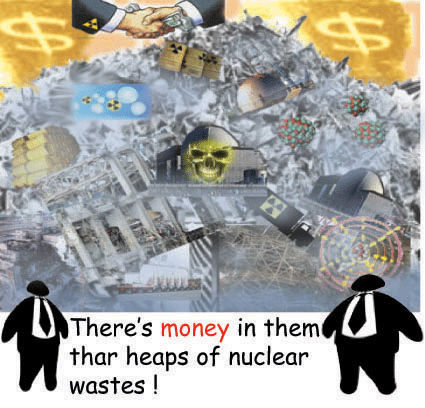
Ten Sellafield leaders earn more than the Prime Minister. SENIOR figures at
a West Cumbria nuclear decommissioning operation are earning more than the
Prime Minister, public records show.
Whitehaven News 15th Sept 2026, https://www.whitehavennews.co.uk/news/26548323.ten-sellafield-leaders-earn-prime-minister/
1 This Month
23-25 October – on Zoom – World BEYOND War’s annual global conferenc


Shut down the radiation-damaged Heysham nuclear reactors now
To see nuclear-related stories in greater depth and intensity – go to https://nuclearinformation.wordpress.com

Say No to NASA’s Reckless Nuclear Reactor on the Moon
Say No to NASA’s Reckless Nuclear Reactor on the Moon

-
Archives
- October 2026 (247)
- September 2026 (339)
- August 2026 (330)
- July 2026 (355)
- June 2026 (287)
- May 2026 (306)
- April 2026 (356)
- March 2026 (251)
- February 2026 (267)
- January 2026 (308)
- December 2025 (358)
- November 2025 (359)
-
Categories
- 1
- 1 NUCLEAR ISSUES
- business and costs
- climate change
- culture and arts
- ENERGY
- environment
- health
- history
- indigenous issues
- Legal
- marketing of nuclear
- media
- opposition to nuclear
- PERSONAL STORIES
- politics
- politics international
- Religion and ethics
- safety
- secrets,lies and civil liberties
- spinbuster
- technology
- Uranium
- wastes
- weapons and war
- Women
- 2 WORLD
- ACTION
- AFRICA
- Atrocities
- AUSTRALIA
- Christina's notes
- Christina's themes
- culture and arts
- Events
- Fuk 2022
- Fuk 2023
- Fukushima 2017
- Fukushima 2018
- fukushima 2019
- Fukushima 2020
- Fukushima 2021
- general
- global warming
- Humour (God we need it)
- Nuclear
- RARE EARTHS
- Reference
- resources – print
- Resources -audiovicual
- Weekly Newsletter
- World
- World Nuclear
- YouTube
-
RSS
Entries RSS
Comments RSS

