‘Most pathetic false flag ever’: Questions raised over RAF base security scare

By Daily Telegraph NZ. September 29, 2026, https://dailytelegraph.co.nz/world/most-pathetic-false-flag-ever-questions-raised-over-raf-base-security-scare/
Activist and journalist Vanessa Beeley has questioned the official and media narrative surrounding a security incident near RAF Fairford, describing it in commentary by Council Estate Media as the “most pathetic false flag ever.”
Beeley’s remarks centred on reports that 85 homes were evacuated following the discovery of three white vans near the Gloucestershire airbase. A local farmer encountered the vehicles blocking a road in the early hours and subsequently reported seeing several masked individuals running towards nearby woodland.
Police reportedly attended the scene and arrests were made under the Explosives Act. Beeley highlighted inconsistencies in the emerging account, including claims about how long the vans had been near the base, the apparent absence of occupants when they were discovered, the response time of security personnel and police, and the delay before nearby residents were evacuated.
Critics questioned reports that the suspects remained in the vicinity long enough to be arrested despite allegedly having been involved in a potentially serious security operation. The circumstances did not resemble a sophisticated attempt to attack a strategically important military installation.
The Council Estate Media analysis was particularly sceptical of suggestions that Iran could have been behind the incident, arguing that anyone seriously intending to strike RAF Fairford would be unlikely to spend hours driving conspicuously around a highly alerted military installation before abandoning vehicles and remaining nearby.
Television coverage from above the base following the incident showing military assets appeared difficult to reconcile with claims that authorities believed an immediate and serious threat remained.
The report suggested the incident may have been a “performance” capable of being used to build public support for deeper British involvement in the conflict with Iran. The US, Israel and the British government could each potentially benefit politically or strategically from portraying Iran as a direct threat to Britain, justifying further UK military involvement.
Green party drops longstanding opposition to nuclear power

Prof Andrew Stirling, who has advised government on nuclear power and energy policy, said the motion was “completely irrational”. “Why would a party that pioneered concerns about nuclear power that have been so broadly vindicated by history, choose now to shift its position?” he said
Party in England and Wales ditches commitment to phase out nuclear in major shift in its energy policy
Matthew Pearce, Tue 6 Oct 2026, https://www.theguardian.com/politics/2026/oct/05/green-party-nuclear-power-policy
Green party members have voted to end the party’s opposition to nuclear power, dropping a commitment to phase out the technology in a major shift in its energy policy.
The motion, adopted at conference, removes a “blanket opposition to nuclear fission” and instead commits the Green party of England and Wales to assessing nuclear projects alongside other low-carbon technologies.
Its electricity generation policy still prioritises offshore wind, onshore wind and rooftop solar as the primary sources of electricity, but allows elected representatives to support new nuclear reactors on a case-by-case basis.
The Green MP Carla Denyer said the decision recognised there was a role for nuclear while the country moved towards an electricity system based primarily on renewables. “This evolution of our policy does not commit the party to backing new nuclear, but accepts this power source is here to stay for now, while we transition to electricity generation based primarily on renewable sources,” she said.
Denyer said keeping existing nuclear stations running could be a low-carbon option because a significant proportion of their carbon footprint came from construction. “So if I were energy secretary, my evidence-based approach would be to keep existing nuclear plants in operation, but to consider proposals for new nuclear power very carefully, bearing in mind the cost, speed and environmental impacts.”
Her comments strike a different tone from her assessment in 2023, when she described nuclear energy as “incredibly slow and incredibly expensive”. She said at the time: “Renewables is simply the way forward. Nuclear is not going to help us out in this climate emergency.”
Other senior Greens have previously criticised the technology. The party’s leader, Zack Polanski, has described it as outdated and compared investment in new nuclear reactors to “creating a fax machine”.
Last year, Adrian Ramsay, then a Green co-leader, criticised government support for Sizewell C. “The money being spent on this nuclear gamble would be far better spent on insulating and retrofitting millions of homes, bringing down energy bills and keeping people warmer and more comfortable,” he said.
The Green’s previous opposition to nuclear fission was rooted in its staunch opposition of nuclear weapons, one of the party’s founding principles.
Eugene McCarthy, a co-founder of Greens for Nuclear and a supporter of the motion, said the urgency of the climate crisis demanded a willingness to consider all available options. “We are at the throw-the-kitchen-sink-at-it phase of the climate crisis where you cannot be ruling anything out for things like Chernobyl happening in the 1980s,” he said.
The motion allows elected representatives to assess individual proposals on their merits, McCarthy said. “We will not say we support or don’t support any particular technology. This motion basically lets our elected members of parliament take it on a case-by-case basis and go: ‘This makes sense, we will extend the lifetime of Sizewell B,’ and on a different case say: ‘Actually the numbers don’t add up here.’”
Asked about Polanski’s previous criticism of nuclear, McCarthy said the leader remained entitled to his views. “He’s still fully entitled to say that, and a lot of the nuclear technology that we are using is quite outdated, to be frank. What this means is that he can now take a nuanced position.”
Prof Andrew Stirling, who has advised government on nuclear power and energy policy, said the motion was “completely irrational”. “Why would a party that pioneered concerns about nuclear power that have been so broadly vindicated by history, choose now to shift its position?” he said
“All authoritative sources agree that climate action is much faster, affordable and impactful with combined renewables and storage,” he added. “Why spend scarce resources on less effective actions?”
McCarthy said: “Renewables are cheaper and have much more capacity, and you can roll them out much quicker. [But] there are issues with baseload, which nuclear can help with.”
Environment Agency nuclear merger will digitise services
COMMENT . Despite Wind scale, despite Chernobyl, despite Fukushima, and all the evidence of nuclear workers cancer risks…..
They’re pretending that the nuclear industry is just like any other. That’s a lie.
The Environment Agency has merged its nuclear strategy and regulatory
functions into a single directorate as part of its response to the
Government’s Nuclear Regulatory Taskforce Review, in a move it says will
deliver faster, more predictable and more proportionate regulation of the
sector. Jo Nettleton, who will head the new directorate as director of
nuclear, said bringing the functions under one leadership structure creates
clear ownership for driving change, with clearer accountability, faster
decision-making and better escalation of nationally significant issues. Her
focus, she said, is on improving the pace, predictability and
proportionality of regulation while protecting the environment and
supporting public confidence. Writing on the agency’s blog, Nettleton said
the Government’s response to the review recognised the need for regulationto evolve alongside a rapidly changing sector. The agency set out its own
response in a letter from chief executive Philip Duffy to the Chancellor.
UK Authority 5th Oct 2026,
https://www.ukauthority.com/articles/environment-agency-nuclear-merger-will-digitise-services
Tories vow to change law to override SNP on new nuclear power.

Shadow energy secretary Andrew Bowie will announce today that a Tory Government would bring in a law to ensure “no part of Great Britain misses out on plans for new nuclear renewal.” The Conservatives will pledge to override Holyrood and lift the SNP’s ban on new nuclear if they win the next
general election.
Shadow energy secretary Andrew Bowie will announce at the
party’s conference today that a Tory Government would bring in a law to
ensure “no part of Great Britain misses out on plans for new nuclear
renewal.”
The Labour UK Government currently wants to host small modular
nuclear reactors in Scotland. But the SNP Scottish Government, which holds
powers over planning, has blocked it due to its opposition to nuclear. Mr
Bowie said: “The SNP’s effective ban on new nuclear energy in Scotland
flies in the face of common-sense. “The SNP’s luddite approach is costing
jobs in Scotland, harming our energy security and ending Scotland’s rich
and powerful association with the nuclear industry. “If John Swinney and
SNP ministers want to have a fight over any plans that would deliver
thousands of jobs and protect energy security, then I say bring it on.”
Scotsman 5th Oct 2026, https://www.scotsman.com/news/politics/tories-vow-to-change-law-to-override-snp-on-new-nuclear-power-9264927
Trident’s £3m jobs are a costly defence of Britain’s fading status.

3rd October, By Samuel Rafanell-Williams, Scottish CND
ALICE laughed. “There’s no use trying,” she said. “One can’t believe impossible things.” “I daresay you haven’t had much practice,” said the Prime Minister. “When I was your age, I always did it for half-an-hour a day. Why, sometimes I’ve believed as many as six impossible things before breakfast.”
In order to complete our new Dreadnought submarine programme, 65,000 jobs will be required by 2030. This number has been quoted by the Prime Minister in Parliament, so it must be
true. The current cost of the Dreadnought programme is newly estimated at £240 billion by UK CND.
Scottish CND’s estimate in our Reclaim Our Clyde
campaign two years ago was £200bn. So if we divide our more conservative
£200bn by 65,000 jobs, we get just over £3,000,000 per job. Let me spell
out that astonishing sum again: £3 million per job.
CND has some good ideas
on what we might use that money for, such as: 220,000 extra nurses; 3.7m
affordable homes; Tuition fees for 8m students; Install solar panels on
every home. My pick would be ending world hunger. How many enemies would we
have then?
There is little doubt that the world is becoming more dangerous.
A well-used anecdote over the past century is that “generals are always
fighting the last war”. While this may be true of Donald Trump’s illegal
assault on Iran, the Ukraine war is surely quite the opposite.
Ukraine is
changing warfare techniques every few weeks. They are fighting the next
war. The drone technologies they invent are cutting edge for a couple of
months, then become obsolete. The state-of-the art Chieftain Mk 3 tanks we
sent them are unused and irrelevant. Russia’s expensive nuclear bombers
were seriously exposed in the “Operation Spiderweb” drone attack by
Ukraine in June 2025. Who is to say the UK’s own nuclear facilities are not
equally vulnerable? Russia, America and China are major powers. We are not.
The only one of six Astute-class nuclear submarines that is currently
seaworthy is the one launched last month on its sea trials. The rest,
almost new, are docked and awaiting repairs. The former prime minister Tony
Blair notes in his memoirs that deciding to renew the Anglo-American
Trident submarine fleet at Faslane had nothing to do with defence, but was
to consolidate our position as a major power.
This was evidenced this week
by Chancellor John Healey (formerly head of the Ministry of Defence)
announcing that £6bn would be spent on building three floating docks at
Faslane, in order to accommodate more nuclear submarines. This is only part
of the £15bn set aside for further developments at Faslane as part of
Project Royal Oak.
For context, £6bn is five times what the Scottish
Government spends annually on housing. To put it another way, a chronic
housing crisis in Scotland and beyond, among other social harms that could
be remedied with the more than £200bn spent on Trident renewal, is simply a
price the British government is willing to pay to sustain its ability to
destroy the northern hemisphere.
The National 3rd Oct 2026,
https://www.thenational.scot/politics/26604113.tridents-3m-jobs-costly-defence-britains-fading-status/
All US bombers leave UK air base on concerns of suspected terror plots.
by Azhar Sukri, msn, 3 Oct 26
- The U.S. withdrew all of its B-1 bombers stationed at a UK air base that is used by American military forces to strike Iran after an investigation discovered a planned terror attack.
- At least two vessels were struck over the weekend in waters near Oman and Iran, the United Kingdom Maritime Trade Operations Centre reported……. https://www.msn.com/en-us/news/other/all-us-bombers-leave-uk-air-base-on-concerns-of-suspected-terror-plots-more-tankers-struck-near-iran-in-the-middle-east/ar-AA2dxKHO?ocid=winp2fp&cvid=30ffaa23962d4c0b91b3c9f431abde46&ei=6
‘Cut ties with Palantir’, say UK’s health workers

Protesters at more than 40 locations across England demanded an end to spy-tech firm Palantir’s role in the National Health Service.
Ana Vračar, October 2 2026, https://breakthroughnews.org/2026/10/02/cut-ties-with-palantir-say-uks-health-workers/
On Thursday, October 1, health workers, patients, and activists protested Palantir’s role in the National Health Service (NHS) at more than 40 locations across England. Their demonstrations were part of a global week of action demanding that governments cut ties with the spy-tech firm over human rights and privacy concerns.
Rallies took place in front of Palantir’s London headquarters, as well as in Liverpool, Manchester, Newcastle, Sheffield and many more cities.
“Palantir’s tools are used by the Israeli military in Gaza and by ICE to track and surveil migrants in the US,” campaign groups – including Just Treatment, Health Workers for a Free Palestine, Medact, and Global Justice Now – stated. “A company profiting from human rights violations has no place in the NHS or in any of our public services.”
Palantir’s track record opposes core health values
Palantir currently holds a £330 million (approximately USD 436 million) NHS contract and has rolled out the service’s Federated Data Platform (FDP), managing sensitive patient data. The project has drawn criticism from virtually every group involved in the NHS: data workers say it lags behind local systems; patients share privacy and data ownership fears; and health workers insist Palantir’s record opposes the very values their profession embodies.
“I cannot stay true to that [Hippocratic] oath and tolerate Palantir continuing to profit from, and grow its malign business model through an NHS contract,” said physician Rhiannon Osborne from Medact at Thursday’s rally. “Every pound we give them helps to legitimize and sustain human rights abuses and erosion of democratic rule of law across the world.”
A central concern is the company’s support for Israel throughout the genocide in Gaza. “When we strive to save every possible life, they champion their ability to kill and celebrate their role in the repeated war crimes committed by Israel – including unprecedented deliberate attacks on the doctors, nurses, and paramedics I worked with,” pediatric neurologist Omar Abdel-Mannan stated. “No moral government should tolerate their involvement in our NHS or indeed any of our public services.”
Campaigners repeated calls for Prime Minister Andy Burnham to end the contract as soon as possible. Under an exit clause in the original agreement, that moment could arrive as early as February 2027. Campaigners and several commissions are pressing the government to notify Palantir of its intention to withdraw ahead of this date.
“The government only has two months to say no to Palantir and the momentum is all with us,” Good Law Project activists said at the rally in London. “All the energy is to say no to Palantir, say no to their global human rights abuses, say no to their crap technology that doesn’t work and get Palantir out of the NHS.”
Unions back appeal to bar Palantir from public sector contracts
Calls to break Palantir’s grip on public services resonate beyond Britain. On September 28, more than 120 groups and unions called upon European governments and the European Commission to “scrap all existing public sector contracts with the US tech company Palantir.” As reported by the European Federation of Public Service Unions (EPSU), the appeal seeks to end current agreements and bar the firm from future public contracts. It also urges governments to develop “alternative data solutions compatible with public service,” echoing NHS data workers’ recommendations.
“Palantir’s ramping up of ‘war-related’ support for Israel during the genocide in Gaza and the apparent disdain of its leadership for democracy are just two clear signs that this company serves the interests of the rich and powerful, not the general public,” said Tim Bierley of Global Justice Now. “Yet it has been allowed to embed dubious technologies across our public services, giving it access to sensitive data and creating worrying new technical dependencies.”
“The UK must work with other countries to end dependence on companies involved in human rights abuses, and end the outsourcing of the public sphere to a dangerous class of big tech oligarchs.”
Nuclear weapons in space would break law, says Britain

By Tom Dunlop, 29 sept 26 https://ukdefencejournal.org.uk/nuclear-weapons-in-space-would-break-law-says-britain/
Orbital weapons of both kinds pose a growing threat to the space-based services Britain and its allies depend on, and any attempt to put nuclear weapons in orbit would be highly destabilising and contrary to international law, the Ministry of Defence stated in a written answer.
Lord Coaker, Minister of State at the department, was answering Baroness Bennett of Manor Castle, the Green Party peer, who asked what assessment the government had made of the danger of orbital weapons, kinetic and otherwise, following what she described as the disclosure by the United States of its aggressive space capacity, and what steps ministers plan to take to prevent a new arms race in space.
The minister replied: “The Government recognises that orbital weapons, both kinetic and non-kinetic, pose a growing threat to critical space-based services vital to the UK and its allies. We are concerned by reports of efforts to deploy nuclear weapons in space, which would be highly destabilising and contrary to international law. The Government supports a behaviour-based, risk-reduction approach to maintain a safe, secure and sustainable space environment. We work closely with international partners to promote responsible conduct, uphold existing legal frameworks and prevent escalation.”
He continued: “Through the UK Space Strategy and Defence Investment Plan, the Government is investing in the resilience and protection of UK and allied space assets to ensure freedom of action in space and safeguard long-term sustainability. We remain committed to international cooperation and the development of norms that reduce risk and preserve stability in this increasingly contested domain.”
The same minister had declined a week earlier to say whether Britain itself has anything in orbit. Lord Lee of Trafford, the Liberal Democrat peer, asked on 22 September whether the United Kingdom has any weapons in space, and if not whether there are plans to deploy any.
Coaker replied: “We do not comment on specific Defence capabilities, including whether such capabilities are deployed in space, nor on future operational plans where doing so would risk undermining national security. We do however recognise that space is important to military operations and is becoming more congested, contested, and competitive. The Government is committed to collaborating with allies and partners to promote internationally agreed norms, avoid unintentional escalation and conflict, and ensure that space remains open, safe, and sustainable.”
He added: “In addition, the UK’s national security depends on freedom of action in space, including the ability to protect UK and allied space assets. As set out in the UK Space Strategy and Defence Investment Plan, the Government is investing in capabilities to strengthen resilience and support the protection of UK interests in space, while continuing to operate responsibly and in accordance with international law.“September 29, 2026
Nuclear waste armed guards face cuts under cost-saving plan.

Proposals spark security fear amid warnings over Russia grey war – but nuclear
authorities insist there is no risk. Special trains are used to transport
nuclear material around the UK – with the most dangerous loads escorted by
the Civil Nuclear Constabulary.
Armed guards on some of Britain’s nuclear
waste shipments could be removed under new proposals designed to save
millions of pounds. Nuclear waste – from high-grade material such as
enriched uranium to lower-grade items such as clothes and gloves – is
regularly transported around the UK.
It is carried on special trains ,which
use the normal rail network, by road, and on ships which return waste
processed at Sellafield in Cumbria to its country of origin. For example,
in June this year seven flasks – highly resilient large containers – of
nuclear waste were transported by rail from Sellafield to Barrow-in-Furness
in Cumbria, and there loaded onto a specialist ship that sailed to Germany.
The most dangerous material is escorted by armed guards. But now the
Nuclear Decommissioning Authority (NDA) is proposing to reduce that number
– sparking fears over security as warnings intensify over Russia’s
grey-war activities. “I think it’s a bad idea, it really is,” said
Matt Okuhara, who served with the CNC from 2006 to 2012.
“The reason
you’ve got to guard this stuff in the first place is because of how
dangerous it is. Anyone who gets hold of this material can use it for
anything they want, they can use it for a dirty bomb, they can use it for a
poisoning device. That’s why you need to have a strong deterrence force
around the material in transit.” Nuclear Transport Solutions says the
proposals would allow it to “reduce cost and complexity of transport
whilst maintaining robust safety and security outcomes and avoiding being
priced out of the market.”
iNews 2nd Oct 2026 https://inews.co.uk/news/politics/armed-guards-nuclear-waste-cuts-savings-costs-4784722
New chapter begins in Hinkley Point B decommissioning
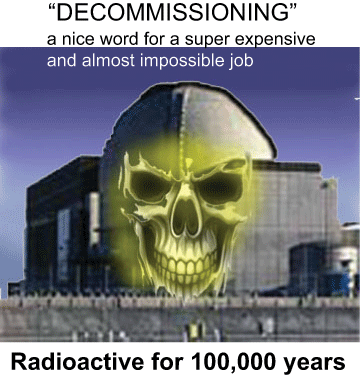
A new chapter has begun at Hinkley Point B as the former nuclear power
station enters an 85-year decommissioning programme. The Somerset site
stopped generating electricity in 2022 after nearly 46 years and has been
transferred from EDF to the Nuclear Restoration Services (NRS), which will
oversee it dismantling. The move will see about 250 workers transfer to the
organisation, including some from families who have worked at Hinkley for
generations.
NRS is also decommissioning neighbouring Hinkley Point A and
CEO Rob Fletcher said “we look forward to working together across both
sites” to “deliver safe, secure decommissioning for the benefit of the
community”. Before the site could be transferred, engineers spent three
years to defuel the reactor at Hinkley B, with more than 4,900 elements of
spent fuel removed and packaged before being taken to Sellafield for safe
storage.
The first phase, which will last until 2038, includes the
dismantling of all buildings and plant materials except for the site’s
safestore structure. This facility will be used to store and manage the
residential nuclear waste from the power station. The second phase will see
“a period of relative inactivity” of up to 70 years from 2039, to allow for
the radioactive materials within the safestore to safely decay. The final
phase will see the former reactor and debris vaults being dismantled and
removed.
BBC 1st Oct 2026,
https://www.bbc.co.uk/news/articles/cvlyldpzr4zyo
Why Britain cannot deliver SSN-AUKUS on schedule

Australia is pinning its strategic future to an overburdened, fiscally constrained UK industrial baseline.
Peter Briggs, October 1, 2026, https://pearlsandirritations.com/post/2026/10/why-britain-cannot-deliver-ssn-aukus-on-schedule/
Britain says SSN-AUKUS remains on track. But its shipyards are already stretched while new reactor and workforce capacity is still being built. Australia is betting heavily on that gap being closed in time.
The public relations narrative of AUKUS Pillar 1 rests on a singular, untested premise: that the United Kingdom can seamlessly transition from its current Astute and Dreadnought submarine programs to deliver a brand-new, complex, 10,000-tonne nuclear-powered attack submarine, SSN-AUKUS, on schedule.
Recent developments in the UK demonstrate that this political optimism is fundamentally disconnected from the physical, contractual, financial and industrial realities on the ground at BAE Systems’ shipyard in Barrow-in-Furness.
In September 2025, King Charles formally commissioned HMS Agamemnon, the sixth Astute-class submarine, into the Royal Navy. Press releases heralded a major defence milestone. Yet, far from entering active service, Agamemnon remained tied up inside the Devonshire Dock Basin at Barrow for another full year, only departing for initial contractor sea trials on 24 September 2026.
The early commissioning reverses standard Royal Navy procurement. Laid down in July 2013, Agamemnon took 13 years and two months simply to leave the dock. Her actual entry into service will not occur until mid-to-late 2027 – a 14-year construction timeline.
This ceremonial exercise illustrates a broader pattern of political messaging substituting for industrial output. Claims that steel will be cut for the first SSN-AUKUS hull at Barrow in 2027 follow the same pattern. Embarking on physical hull fabrication before completing a preliminary design review (PDR) and freezing the 3D spatial design model risks severe engineering setbacks. For SSN-AUKUS, detailed design funded under a £3.95 billion development contract running through 2028 remains under way. Without a stable PDR baseline, internal layouts, reactor integration and pipework remain in flux. ‘Cutting steel’ in 2027 will merely involve cutting test rings or material qualification modules rather than assembling an operational warship.
Yard saturation and uncontracted infrastructure
The physical state of Barrow shipyard exposes the impossibility of fast-tracking SSN-AUKUS.
The heart of Barrow’s manufacturing capability is the Devonshire Dock Hall (DDH). Currently, the DDH is full. It houses the first three Dreadnought-class ballistic missile submarines (Dreadnought, Valiant and Warspite) alongside the final Astute hull, HMS Achilles (Boat 7), while initial fabrication for the fourth SSBN (HMS King George VI) proceeds off-site. There is no physical bay space inside the primary hall to establish an SSN-AUKUS production line.
The severity of this spatial bottleneck was underlined in a recent planning application submitted by BAE Systems Marine Ltd for its North Quay site, immediately adjacent to the DDH. BAE sought municipal approval to erect a 125-metre-long temporary enclosed scaffold structure on the open quay to house overflowing component manufacturing and outfitting. In its official filing, BAE acknowledged the improvised structure was explicitly required “as a result of capacity constraints within the Devonshire Dock Hall (DDH)”.
When a major nuclear shipyard must resort to 125-metre fabric sheds on quayside aprons to handle current workloads, absorbing a new 10,000-tonne attack submarine line strains credibility.
To bypass this bottleneck, BAE Systems purchased an 18-acre former gas site at Ramsden Dock. The plan is to manufacture hull cylinders on this port land and barge them via a roll-on/roll-off (Ro-Ro) quay to the main dock basin. However, the site requires extensive clearing, re-grading and deep piling before shed construction can begin.
Crucially, while the initial £3.95 billion contract covers preliminary 3D design and basic enabling works, primary contract packages required to build these sheds and construct the Ro-Ro wharf remain unexecuted or fragmented across future budget cycles. Furthermore, in July 2026, the UK MoD awarded a £5.9 billion delivery contract strictly prioritised for the Dreadnought-class SSBN. Because Britain’s continuous at-sea deterrent takes total strategic precedence, primary nuclear engineers, dry docks and yard resources at Barrow are contractually locked into Dreadnought through to the delivery of the fourth boat in the late 2030s.
Reactor supply and logistics bottlenecks
The industrial choke point extends beyond Barrow to the nuclear supply chain at Raynesway in Derby, where Rolls-Royce Submarines manufactures all Royal Navy reactor cores.
To support both Dreadnought and SSN-AUKUS, Rolls-Royce began work to double the footprint of its Raynesway site in July 2026. Once assembled, complete PWR3 reactor modules must be transported over 150 miles by road in heavy-duty, radiation-shielded containers under armed police escort along the M6 and A590 corridors directly into the Barrow yard.
While the PWR3 reactor has been lowered into lead boat HMS Dreadnought inside DDH, manufacturing and delivering reactors for follow-on SSBN hulls alongside initial SSN-AUKUS units creates a severe industrial queue. Raynesway remains constrained by strict nuclear licensing oversight and an acute shortage of specialised nuclear-certified welding technicians.
The human and civil bottleneck
The physical sheds at Barrow may eventually be erected; however, the civil infrastructure required to support the workforce does not exist in the numbers required.
BAE Systems has expanded its Barrow workforce from 11,000 to approximately 16,000, aiming for over 18,000. In 2026, the UK House of Commons Defence Committee warned that infrastructure investment at Barrow “has already faltered”. BAE Systems formally advised local government that the shipyard requires 900 new homes to be built annually in Barrow to house incoming technicians. Current local construction struggles to deliver 200 units per year. Thousands of contractors commute daily along the single-carriageway A590, creating severe transport gridlock.
In response, the UK Government established ‘Team Barrow’ with a £200 million regeneration fund. However, Team Barrow leadership has publicly acknowledged that this seed allocation falls far short, stating that £400 million to £800 million in combined investment will be required to tackle the town’s infrastructure deficit. Furthermore, this funding is designated for general municipal upgrades – schools, healthcare and roads – rather than industrial shipyard tooling.
Britain lacks the localised housing, transport capacity and specialised nuclear-certified trade workforce to operate two concurrent submarine construction lines.
Strategic imperatives: NATO vs Indo-Pacific overreach
This industrial overstretch must be viewed through the unforgiving lens of Britain’s fiscal deficit and shifting strategic priorities.
Under mounting financial pressure, the UK Ministry of Defence faces a multibillion-pound structural budget shortfall. The UK Strategic Defence Review has formalised a mandatory ‘NATO-first’ posture, directing military resources, capital investment and force readiness primarily toward European defence and deterrence against Russian aggression. Facing a security crisis on its continental doorstep, Whitehall cannot afford to bankroll massive, long-horizon industrial expansions designed to project power into the Indo-Pacific.
Sustaining Britain’s continuous at-sea deterrent via Dreadnought consumes the lion’s share of UK capital expenditure. Coupled with urgent demands to re-arm land and air forces in Europe, attempting to design and build a bespoke 10,000-tonne attack submarine for Australia would appear to be a lower priority.
Industry is striving to recover from decades of systemic neglect that has left operational SSN capability immobilised and the continuous at-sea deterrent under strain. Political ambition cannot overrule the laws of industrial capacity, national economics and engineering physics.
Australia is pinning its strategic future to an overburdened, fiscally constrained UK industrial baseline. The physical and financial evidence at Barrow – an unbuilt off-site facility, a saturated main assembly hall requiring temporary outdoor work space, unfinalised contracts for primary manufacturing sheds, acute housing deficits, severe reactor supply chain queues, and a UK defence budget deficit whilst pivoting back to Europe – demonstrates that Britain cannot deliver SSN-AUKUS on the promised timeline.
Relying on ‘schedule-free’ assurances while ignoring these constraints guarantees a severe capability gap for Australia. It is time for Washington, London and Canberra to acknowledge these ground realities and undertake a fundamental reappraisal before industrial overreach turns into operational and political catastrophe.
Peter Briggs
Peter Briggs retired from the RAN in 2001 after a 40-year career, specialising in submarines. This included two submarine commands, command of the RAN Submarine Squadron, director of Submarine Policy and Warfare and Head of Submarine Capability Team, established to rectify Collins introduction into service issues. He was the president of the Submarine Institute of Australia from 2006-09 and is a frequent contributor to public debate on Australian submarine matters.
Government ‘slow walking’ on delivering nuclear regulatory overhaul
Dorjee Wangmo, 30 September 2026
The Centre for British Progress has assessed progress on the Nuclear Regulatory Taskforce’s recommendations, finding that only 10 of 47 have seen significant headway. This analysis highlights that government departments are falling behind on their own revised timelines, with some key clarifications on site releases and risk definitions now over 90 days late. The findings raise questions about the pace of regulatory reform intended to expedite new nuclear projects.
The Office for Nuclear Regulation (ONR) has published a new policy
clarifying how its inspectors use Relevant Good Practice (RGP) to inform
independent regulatory judgements. The policy – ‘Using relevant good
practice in regulatory judgement’ – supports efficient regulation without
lowering the bar on safety, security or safeguards standards across the
UK’s nuclear industry. It emphasises that RGP is a regulatory concept and
not prescribed in law and explains how ONR inspectors can draw on relevant
established controls, standards and approaches when assessing whether
nuclear sector dutyholders are meeting goal-setting legal duties and
requirements. The policy responds directly to the government’s Nuclear
Regulatory Review 2025 and forms part of the wider Taskforce implementation
plan which called for a review of nuclear regulator guidance in line with
revised tolerability of risk, to support a genuinely non-prescriptive
regulatory system. It sets out sources of potential good practice that
inspectors may consider, ranging from Approved Codes of Practice and
published regulatory guidance through to wider industry and international
sources, including from sectors beyond nuclear.
ONR 30th Sept 2026, https://www.onr.org.uk/news/all-news/2026/09/onr-unveils-new-policy-on-relevant-good-practice-to-support-more-enabling-and-proportionate-regulation
Haphazard Luck: Operational Oddities, Terrorist Proxies and RAF Fairford
29 September 2026Dr Binoy Kampmark, https://theaimn.net/haphazard-luck-operational-oddities-terrorist-proxies-and-raf-fairford/
Five men, initially detained on suspicion of committing offences under the Explosives Act, then arrested on suspicion of preparation of a terrorist act. Residents of 85 households in the Cotswolds village of Whelford evacuated to Cirencester leisure centre. A 400-metre area with three white vans cordoned off. The same men, released within hours of being seized near the Royal Air Force Fairford base in Gloucestershire after it was found that the chemicals found in their vans were not deemed “viable” as explosives. All British nationals, aged 23 to 25, and London residents. Other details on background scrupulously omitted by the police, with Counter Terrorism Policing (CTP) claiming that “multiple lines of inquiry” were being pursued.
Looming large was the hypothesis that these individuals had been working at the behest of a foreign state. Assistant Commissioner Laurence Taylor, head of CTP, tantalised with the suggestion that “this may be activity committed by proxies, or individuals either knowingly or unknowingly, working on behalf of a foreign state.” The men in question, according to the police, remained under investigation, with their release “subject to stringent conditions on their movement and contact with others.”
The initial report on the movement of the men came from a farmer who had spotted the three white vans in Whelford. When she arrived home, she found the driveway and road blocked. A “large group of hooded and masked men,” according to her, were spotted. “When they saw me,” she told BBC Radio 4’s Today programme, “they ran ahead of me – some into the field and some towards the neighbouring village of Kempsford. I then realised that something very unusual was taking place.”
She had been insistent on chasing the matter up. First, a call to the Ministry of Defence police at RAF Fairford. No reply. Then, a 999 call to police at 01:36 BST to report the matter. It took a mere 10 minutes, and “the village was full of armed police.” She pondered: “I believe that my 999 call foiled whatever plans they had.” What would have stung the security services was her view that they had “really dropped the ball on this.” Her arrival to spot the vans had been a matter of “pure luck”. “I am absolutely staggered that it was left to me, as a member of the public, to see and report this.” The airbase had been operating a roadblock near the entrance to the facility but none had been placed on the other roads. It was “assumed someone would be monitoring the roads around the base perimeter and taking regular patrols in the village.” Not so.
Vicki Evans, senior national coordinator for the CTP, conveyed the sense that what was unfolding was complex and planned, an account at odds with the fact that vans of masked men had been permitted to gather in the vicinity of the airbase in the first place. “This is a hugely complex and large-scale operation, involving local and national police, the MOD [Ministry of Defence], and local agencies, who are working together to progress the investigation and support the community.”
The UK Defence Secretary, Wes Streeting, thanked the farmer for her deeds, but the gratitude was markedly qualified. Any suggestion that the security establishment had failed to pick up on the movements of the men was erroneous, the caller having only “a partial picture.” There was also no mention of the discrepancy regarding numbers of those arrested to the number that had been sighted by the farmer. Five arrests had been made, while the witness claimed to have seen upwards of eight to ten men.
The matter also prompted an intervention by US President Donald Trump, which was bound to only complicate matters. RAF Fairford hosts the US Air Force’s 501st Combat Support Wing, which has served to do its bit in the illegal war against Iran. Without showing any awareness of the mechanics, let alone logistics of an alleged operation against these alleged terrorists in embryo, much was made about their “planning to do big damage” at the base. Praise was heaped upon the effort made by the British (“it was an amazing job”), odd given the absence of interest shown by those at the base itself. “We had them under view for a long time,” crowed Trump, “and we got them.”
Streeting was content to sidestep any inconsistencies between operational effectiveness and haphazard luck, basking in the Trumpian sun of flattery. “Our security forces and our police, they don’t ask for praise, but I think it was a proud moment yesterday to see the president of the United States recognise the extraordinary work that our police and our security and intelligence services do every day throughout the year and throughout the world to keep us safe.”
The UK Foreign Secretary Ed Miliband, in remarks made to a crowd at the Labour Party conference being held at Liverpool, thanked the “security services, armed forces and police for the work they did yesterday and they do all year around to help keep our country safe.” The UK had to be ready to “confront” manifold threats facing Europe and the globe.
With so much self-praise clotting the narratives, the release of the arrestees on bail served to perplex the US commander-in-chief. “I would have said don’t let them have bail,” reflected Trump. “I’m surprised that they released them. I wouldn’t have done that. Look, they’ve been very good. They worked with us very closely.”
Finger pointing was bound to take place. The Iranians – notably the Islamic Revolutionary Guard Corps (IRGC) – came in for suspicion. In an act of premature adjudication, Miliband revealed to his audience that, “We will act against the proxies of Iran.” RAF Fairford, given its role in aiding US strikes on Iran, had received attention from anti-war demonstrators in March and April concerned about a widening of the conflict. Residents in the vicinity of the base have also complained about the noise and security risks posed by the facility.
In a statement posted on its X account, the Iranian Embassy in the UK “categorically” rejected and strongly condemned “the recent unfounded and malicious speculations published by some British individuals and media outlets attempting to link Iran to the arrest of five suspects in the vicinity of RAF Fairford base.” Disseminating such “fabricated speculations” in light of the “criminal acts of aggression committed by the United States and the Israeli regime against the Iranian people” would only “fuel Iranophobia propaganda in the UK.”
The situation offers fecund opportunities for speculation. Till this incomplete canvas is filled, we are left with contesting accounts on whether an attack was foiled because of the chance sighting by a farmer of something suspicious in the face of authorities who claim they had all matters in hand, despite coming rather late to the proceedings. Trump’s intervention did little to clarify matters. While the Midas touch turns the subject matter into gold, Trump can turn the most quotidian into an offering of pure mendacity. And where the authorities serve to praise themselves all too enthusiastically, something is often amiss.
Mushroom cloud rises over Liverpool as protesters call on Burnham to stop growing nuclear risks
Protesters from the Campaign for Nuclear Disarmament have unveiled a 20-foot mushroom cloud at St. George’s Plateau in Liverpool, calling on the government to stop increasing the risk of nuclear war and to instead focus on the real security issues facing Britain.
Protestors performed a symbolic ‘die-in’ underneath the mushroom cloud, highlighting the accelerating threat of nuclear weapons being used again in war.
In fact, this year, the hands of the Doomsday Clock were moved to 85 seconds to midnight, the closest the Clock has ever been to midnight in its history. Atomic scientists say that the rising risks to humanity and the planet are due to countries expanding their nuclear weapons and the breakdown of international arms control treaties.
CND calls on Prime Minister Andy Burnham to reverse the deadly role that Britain is playing globally through expanding its nuclear capability and authorising US nuclear weapons to be stationed in this country. The action coincides with his first speech to the Labour Party Conference as Britain’s Prime Minister.
The government is pushing ahead with replacing Britain’s current fleet of nuclear-armed submarines and buying 12 nuclear-capable F-35A fighter jets from the US, both in breach of its commitments under the nuclear Non-Proliferation Treaty. Last year, overwhelming evidence suggested that US nuclear weapons are now stationed at RAF Lakenheath in Suffolk.
Hand-in-hand with this nuclear expansion, the government is increasing military spending whilst cutting spending to essential public services, overseas aid and climate action. The Defence Investment Plan, announced by the government in June, added an extra £15 billion to Britain’s annual military budget over the next four years. At least £7 billion of these increases have been funded through cuts to public services and climate action. Reports suggest the government plans to make even further cuts to public services in the autumn statement.
CND is calling on the government to reverse this deadly war drive and nuclear expansion and instead invest in saving lives not destroying them. These alternatives are laid out in CND’s new ‘People not Nukes’ report, which outlines how the £240 billion earmarked for Britain’s new nuclear weapons could be redirected into more productive areas of the economy which would transform areas like education, public health, and climate action.
CND General Secretary Sophie Bolt said:
“This protest is a wake-up call to the British government – who seem intent on dragging Britain towards nuclear war. Replacing Britain’s nuclear-armed submarines, expanding its nuclear capability by buying US nuclear-capable fighter jets – all this is increasing the threat of nuclear weapons being used in war. And it only ties us all the more closely to the Trump administration. Giving permission to the US to station its nuclear weapons in Britain makes us a target in any nuclear war between the US and Russia.
“War and militarism is only driving climate breakdown and a global recession. To reduce the threats we face, we need a total change in direction from Burnham’s government, focusing on dialogue and diplomacy, abiding by its international obligations to disarm its nuclear weapons and tackling the real security threats we face.
“Halting the replacement of Britain’s nuclear weapons would release at least £240 billion over the next thirty years. Our ‘People not Nukes’ campaign shows that, redirected, this money can help transform society, provide real security we need and help make the world safer. This is what Burnham needs to focus on.”
Nuclear Restoration Services taking over control of Hinkley B station
By John Thorne, Tuesday 29th September 2026, https://www.wsfp.co.uk/news/hinkley-point-b-nuclear-power-station-decommissioning-next-stage-phase-nuclear-restoration-service-transfer-from-edf-957891
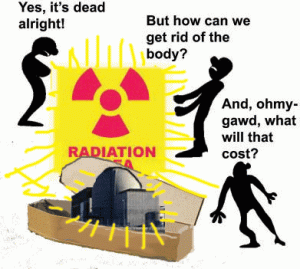
THE next chapter is being opened in Hinkley Point B nuclear power station’s long history as its decommissioning transfer moves a step closer.
Key regulatory approvals have been put in place for the site’s transfer from EDF to Nuclear Restoration Services (NRS) on Thursday (October 1).
The Office for Nuclear Regulation granted a site licence to NRS, while the Environment Agency issued an environmental permit.
It marks a major milestone for the site, which has been part of the local community for decades and is now moving toward the next phase of safe, secure, and sustainable decommissioning.
1 This Month
23-25 October – on Zoom – World BEYOND War’s annual global conferenc


Shut down the radiation-damaged Heysham nuclear reactors now
To see nuclear-related stories in greater depth and intensity – go to https://nuclearinformation.wordpress.com

Say No to NASA’s Reckless Nuclear Reactor on the Moon
Say No to NASA’s Reckless Nuclear Reactor on the Moon

-
Archives
- October 2026 (247)
- September 2026 (339)
- August 2026 (330)
- July 2026 (355)
- June 2026 (287)
- May 2026 (306)
- April 2026 (356)
- March 2026 (251)
- February 2026 (267)
- January 2026 (308)
- December 2025 (358)
- November 2025 (359)
-
Categories
- 1
- 1 NUCLEAR ISSUES
- business and costs
- climate change
- culture and arts
- ENERGY
- environment
- health
- history
- indigenous issues
- Legal
- marketing of nuclear
- media
- opposition to nuclear
- PERSONAL STORIES
- politics
- politics international
- Religion and ethics
- safety
- secrets,lies and civil liberties
- spinbuster
- technology
- Uranium
- wastes
- weapons and war
- Women
- 2 WORLD
- ACTION
- AFRICA
- Atrocities
- AUSTRALIA
- Christina's notes
- Christina's themes
- culture and arts
- Events
- Fuk 2022
- Fuk 2023
- Fukushima 2017
- Fukushima 2018
- fukushima 2019
- Fukushima 2020
- Fukushima 2021
- general
- global warming
- Humour (God we need it)
- Nuclear
- RARE EARTHS
- Reference
- resources – print
- Resources -audiovicual
- Weekly Newsletter
- World
- World Nuclear
- YouTube
-
RSS
Entries RSS
Comments RSS

