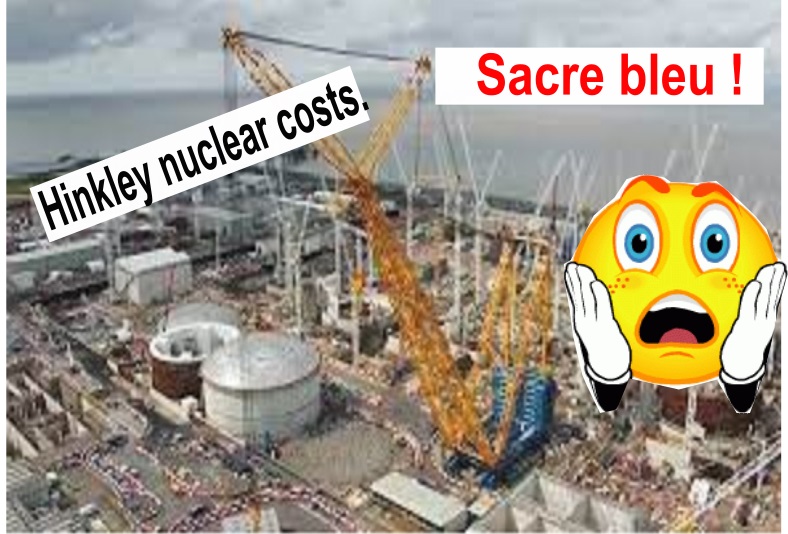
To fund the Burnham Government’s priorities, abandon Hinkley Point C, Sizewell C and Wylfa


Experience with Sizewell C shows that private investors are not willing to be exposed to any significant part of this risk and if a deal is to be done the risk will fall on the public, as taxpayers and electricity consumers.
Britain’s three new nuclear projects – Hinkley Point C, Sizewell C and Wylfa – now depend on public money, above all from the National Wealth Fund, which has committed up to £36.6bn to Sizewell C alone: about twice what it can lend to all its other projects. Abandoning all three would save consumers £93–133bn and free the NWF to back renewables, energy storage and the government’s regional and industrial priorities.
. Introduction
If we strip away the rhetoric of a “golden age for nuclear power” and “ripping up rules to fire up nuclear power”, Britain’s nuclear programme looks very tired, with just three projects that have a reasonable chance of completion. Two of these (Hinkley Point C and Sizewell C) had their origins nearly 20 years ago while the third (Wylfa1) was launched under Boris Johnson’s government. Increasingly, what these three projects have most in common is not the reactors, but who is paying for them. The government’s National Wealth Fund (NWF) – set up to catalyse private investment across the economy – has already had to commit up to £36.6bn of the finance for Sizewell C, on top of a loan to design Wylfa’s reactors. If the Advanced Nuclear Framework succeeds in bringing forward the Cottam, Hartlepool and Oldbury projects too, the NWF could find itself committing a further £60bn to nuclear – in total 3.5 times what it has budgeted for the other 24 sectors it exists to support.
A fund created to unlock private investment across the economy risks becoming a vehicle for channelling public money into the most expensive, slowest and least certain to be delivered of all the forms of power generation available. An analysis of costs and benefits suggests that, far from rushing to launch new nuclear projects as the nuclear industry would advocate, the British people would be better served by abandoning these projects. The money and resources released – including by freeing the National Wealth Fund to do the job it was set up to do – can be redeployed to options that will reduce electricity bills, save taxpayers money and improve our prospects of meeting our climate change goals quickly and reliably.
2. Our nuclear capacity
The UK currently has only five operating nuclear power plants: the four remaining Advanced Gas-cooled Reactor stations (4.7GW) which are likely to be retired by 2031/32,2 and Sizewell B (1.2GW), which is expected to operate until 2055. Hinkley Point C (3.26GW) is under construction and will not be complete before 2032.3 Sizewell C (3.26GW) is three years away from an above ground construction start and, if all goes to plan, might be on-line by the start of 2040.4 The Wylfa Small Modular Reactor (SMR) station (1.5GW) is three years from a firm order being placed so is also unlikely to be generating much before 2040.5
Beyond the Hinkley and Sizewell projects, there is no evidence that further large reactor projects will be pursued (the prime site for large reactors is Wylfa and this has been allocated to an SMR project). There are also no specific government-led proposals for projects to follow on from Wylfa. It appears the government is relying on private sector projects to provide additional nuclear capacity and in February 2026 it published its Advanced Nuclear Framework, which is meant to provide government support for private sector-led projects.6 Under this, several forms of support were offered including:
- Finance via the government’s National Wealth Fund;
- Support via Great British Energy – Nuclear in finding sites;
- Help negotiating power purchase agreements such as contracts for difference that would remove any exposure of the plant to the competitive electricity wholesale market;
- Assessment of the projects by Great British Energy – Nuclear.
Two private sector SMR projects – Cottam and Hartlepool, both of about 1GW capacity – had been announced in September 2025 in association with President Trump’s visit to the UK.7 In June 2026, Holtec announced its application to the Advanced Nuclear Framework for the Cottam project.8 By the end of August 2026, X-Energy, the proposed reactor vendor for the Hartlepool site, had not made an application for entry into the Advanced Nuclear Framework.
Beyond Hinkley and Sizewell, there is no evidence that further large reactor projects will be pursued. There are also no specific government-led proposals for projects to follow on from Wylfa.
In July 2026 GE Vernova, via its Polish Partner SGE (Synthos Green Energy), announced an application to the Advanced Nuclear Framework to build up to 14 BWRX-300 SMRs (4.2GW).9 The application involves a proposal to site the first six reactors at the Oldbury site located on the River Severn, currently owned by Great British Energy – Nuclear (GBE-N). This is a problematic site and the Chair of GBE-N, Simon Bowen, told the ESNZ Committee: “If you look at Oldbury, particularly, the site that is close to you, we are aware that the only way to develop the Oldbury site for nuclear development will be with a significant investment in flood defences.”10 SGE’s target to complete the first reactor by 2034 is unrealistic given that it is several years behind the Rolls-Royce Wylfa project, where the first reactor is not expected to be complete before the ‘mid-30s’.11 It lags behind Wylfa in terms of siting, finance, and regulatory approval by the Office for Nuclear Regulation. GBE-N has stated it has not been contacted by SGE about the Oldbury site.12 There is no evidence yet as to whether the Advanced Nuclear Framework will be an effective route for promoting nuclear projects.
So, if there are no further delays with Hinkley Point C, Sizewell C and Wylfa, it is likely that it will be around 2040 before nuclear capacity exceeds today’s levels and even then, will only have got back to 2019 capacity levels. The current government’s target was to essentially remove all fossil-fuel generation by 2030 so new nuclear capacity can play no role in achieving that. If the AGRs are retired in 2031/32 probably on safety grounds (due to graphite moderator issues13) the British electricity system will have to survive with only about 4.5GW of nuclear capacity and no fossil fuel generation for around a decade. So, if there is a need for new base-load capacity, nuclear cannot provide it before 2040, and even then nuclear capacity will be much less than base-load (defined as the lowest level of demand in the year).
The government’s claim that “Unlike traditional large-scale nuclear plants, these projects [SMRs] usually need smaller sites, allowing more flexibility in where they can be built” is belied by the fact that the Wylfa project (1.5GW) and the potential Oldbury project (1.8GW) are substantially larger than any completed nuclear power plant in the UK and the Hartlepool project is about the same size as the AGR stations and Sizewell B. The reality is that sites that are suitable for nuclear projects in terms of physical factors and public acceptance are, and always will be, hard to find and there will be an overwhelming incentive to fit as many SMRs on to an accepted site as possible.
3. Wylfa
In June 2025, the government announced the winner of its competition to select a Small Modular Reactor (SMR) design for deployment in the UK.14 The design was the 470MW Rolls-Royce PWR SMR for which three reactors are expected to be built at the Wylfa site in North Wales (1.5GW). In June 2025, the government announced that it had allocated £2.6bn to the Wylfa project up to the end of fiscal year 2029/3015. A Final Investment Decision (FID) is not expected until 2029 with the process handled by the government-owned Great British Energy – Nuclear (GBE-N) entity. A significant number of hurdles must be overcome before the FID can be taken. These include completion of the Generic Design Assessment by the Office for Nuclear Regulation (ONR). This was expected in July 2026, but unofficial reports suggest the decision will not be before December 2027. The delay is said to be due to the need for design changes. The requirements the nuclear regulator imposes will be an important determinant of the reactor cost. The Wylfa site is widely portrayed as being the best of the existing reactor sites for new development and it did undergo some investigation when it was proposed as a site for two large reactors a decade ago. Nevertheless, the site investigations must be rigorous given the site is unlikely to be cleared after reactor operation until perhaps 150 years from now. However, site work done so far will be minimal, much of it funded by GBE-N so remediation costs would be small.
None of the important financial details about the Wylfa project have been announced. These include ownership, finance method, source of finance and power sales arrangements. However, experience with Hinkley Point C and Sizewell C gives strong indications of what would be needed to finalise the project. They include a substantial government equity stake, possibly as high as 100%; a power sales agreement that ensures all investor costs are passed on to consumers/taxpayers; and cheap finance provided from the National Wealth Fund.
Private investors will be wary of this project given that, in addition to the risks all nuclear projects suffer, the design is completely untested and Rolls-Royce has no experience as a vendor of civil nuclear power plants. These risks exist and will not be changed by different methods of funding and finance. All that can be changed is who bears these risks. Experience with Sizewell C shows that private investors are not willing to be exposed to any significant part of this risk and if a deal is to be done the risk will fall on the public, as taxpayers and electricity consumers. A deal will be easiest to reach if government owns all or practically all the equity so that the risk will fall on taxpayer and electricity consumers. This will avoid the lengthy delays that occurred getting the Sizewell C project to an FID from having to negotiate, not very successfully, with potential investors.
Rolls-Royce has not made predictions of the construction cost since the design was little more than a conceptual one. In 2021, it claimed the cost would fall to £1.8bn for the ‘nth of a kind’ (NOAK) with the first expected to be generating by 2030. The NOAK costs would apply when the supply chain is well established, and learning has made the construction process well established and repeatable. In practice, how many reactor orders it will take to get to ‘n’ is not well-established and most reactor designs are superseded by new or modified designs well before they reach any credible ‘n’.16 So, these forecasts have no value in forecasting the actual cost of a Rolls-Royce SMR.
By June 2026, GBE–N had let contracts worth nearly £900m for the Wylfa project so the compensation payable as a result of abandoning these contracts would be significantly less than £1bn.17 The government’s National Wealth Fund agreed to lend it £599m to develop the design in April 2026 demonstrating that the design is still far from complete.18
4. Sizewell C
The Sizewell C plant is nearly a decade behind Hinkley Point C and the costs incurred so far are correspondingly smaller. The Final Investment Decision (FID) was taken in July 2025 with the government’s central estimate for completion at the end of 2039 at a cost of £40.5bn (2024 money).19 In the June 2025 Spending Review, ahead of the FID, then-Chancellor Rachel Reeves allocated £14.2bn of public money to be spent on the project by the end of fiscal year 2029/30.20 The government claims the “(p)roject will be built for around 20% less than virtual replica Hinkley Point C”, claiming the project “builds on lessons learnt from the construction of Hinkley Point C.” It is misleading to compare in this way the estimated cost at Final Investment Decision (FID) of a project that has not yet had a chance to go wrong – Sizewell C – with one that has been under construction for eight years – Hinkley Point C – for which five delays and cost increases have been announced. The appropriate comparison is with the forecast costs at the point of FID. For Hinkley Point C it was £24bn (2024 money) compared to £40.5bn (2024) for Sizewell C, a real increase of nearly 70%. The time from Final Investment Decision (FID) to completion for Hinkley Point C was forecast to be nine years whereas for Sizewell C it is forecast to be 14 years. So, the learning from Hinkley Point C has led to large real estimated cost increases and a much longer expected lead-time.
The government was only able to complete the deal by offering huge public subsidies and, even then, had to take nearly half the equity. In the government’s Subsidies Database, the government estimates the value of these subsidies as £54.6bn.
The government was only able to complete the deal by offering huge public subsidies and, even then, had to take nearly half the equity. In the government’s Subsidies Database, the government estimates the value of these subsidies as £54.6bn.21 This is a ‘discounted’ figure so the actual amount paid by taxpayers and electricity consumers will be substantially more.22 During the construction period, consumers will pay a surcharge on their electricity bills. This will pay all the investors’ finance charges (approximately £25bn) and will also provide a ‘gift’ to investors of 60% of the equity the investors will be required to put into the project23 worth about £8bn. Finance will mainly be provided by the government’s National Wealth Fund with a budget of up to £36.6bn, at an advantageous rate initially set at a real rate of only 4.5%.
4.1. What will the price of power from Sizewell C be?
he key element in determining the cost-benefit balance for abandoning Sizewell C is the price consumers must pay for its output. One of the few good features of the Hinkley Point C deal is that consumers know what price they will be charged for power, albeit a very high one, regardless of what costs are. As EDF states in its announcements of cost increases: “Under the terms of the Contract for Difference, there is no impact for UK consumers [of cost increases].”24 The contract was for 35 years whereas for Sizewell C it is for 60 years, so consumers will be locked into the Sizewell deal for 25 years longer. For Sizewell, the price of power will be whatever it takes to generate the revenue the investors are contractually entitled to – consumers have had a blank cheque signed on their behalf. Every project using the EPR technology chosen for Sizewell C has far exceeded the cost and time estimates made when the investment decision was taken. So, the power price forecasts for Sizewell C based on estimates made at the time of FID must be regarded as highly likely to be a gross underestimate of the outturn power price. If construction or operating costs are higher than forecast, they will be passed on to consumers. Sizewell C Ltd has made some highly optimistic predictions about the price of power from Sizewell C claiming it would be £88-102/MWh (2026 money)25 – well below Hinkley. But this comes from the project’s promoter, rests on its best-case assumptions, including no cost overrun at all, and carries no consequences for the company if it proves wrong. Given the record of every EPR built so far, it should be treated as a floor rather than a forecast.
Unlike Hinkley Point C, consumers will be required to pay all the finance costs incurred in the construction period as they arise and they will also pay more than half of the investors’ equity contributions. The National Wealth Fund is providing most of the finance at subsidised rate representing a taxpayer subsidy. These additional costs must be factored into any projection of the cost of power from Sizewell C. So, all things being equal, the price to consumers of power from Sizewell C ought to be significantly less than for Hinkley Point C which had none of these subsidies. However, all things are not equal: the forecast construction cost of Sizewell is 70% higher in real terms than the cost of Hinkley on which the power purchase price of £89.5/MWh (2012 prices) was based.
If the outcome cost and time did reach the HRT, it would mean that the construction cost, which would be passed on to consumers as part of the Regulated Asset Base (RAB), would be double the forecast level for Hinkley Point C, the level on which its power price was calculated.
The Sizewell deal includes a Higher Regulatory Threshold (HRT) level with construction costs £47.7bn and completion in 2043 compared to the central assumption, the Lower Regulatory Threshold (LRT), which assumes a construction cost of £40.5bn and completion at the end of 2039. Sizewell C Ltd’s baseline estimate is completion in July 2039 at a cost of £38.2bn. Unlike the LRT and HRT, this estimate has no contractual force and there will be no financial consequences when it is proved wrong. While the HRT is described by government as having a ‘remote’ probability, all experience with nuclear projects, especially those involving EPR technology, suggests that an outcome of costs less than 20% over budget and a three-year delay would be an unprecedentedly good result. If the outcome cost and time did reach the HRT, it would mean that the construction cost, which would be passed on to consumers as part of the Regulated Asset Base (RAB), would be double the forecast level for Hinkley Point C, the level on which its power price was calculated. At that point, the contractual requirement on investors to continue to invest would end with no penalty to them – they keep the full return on what they have already invested – and government would either have to take over funding or abandon the project. By contrast, if Hinkley Point C is not completed by 203626, the government has the option to tear up the power purchase agreement leaving EDF to try to negotiate a new deal or abandon the project and lose the money it invested in the project.
4.1.1. The NAO report
The NAO report on the Sizewell C project publishes a large amount of data on the project including the forecast range of costs of Sizewell over its entire life in real terms.27 Its lower figures correspond to the LRT values and the higher to the HRT. Its data show the flow of cash during the construction period including the ‘net consumer payments’ figure of £24.7-34.5bn. We assume this includes the consumer contribution to investors’ equity costs. NAO’s figures show the cash flow during operation and the total consumer contribution in that period is £111.8-124.0bn making a total consumer contribution of £136.5-158.5bn.
The NAO analysis reports that the price of power is expected to be £133–155/MWh (2024/25 prices), or £152–178/MWh without the ‘recycling’ of the government’s profit as the 44.9% shareholder. Recycling passes that profit to consumers’ bills instead of to the Exchequer. It is a large subsidy from taxpayers to electricity consumers, and it means the lower price understates the full cost of Sizewell C’s power to the public. It is also a very bad precedent to invest so much taxpayers’ money for no return. The NAO notes: “Recycling is a policy decision, which the government could stop or modify at a later point, changing the cost to consumers.”28……………………………………………………………………………………………………………………………………………………….
Given the improbability of the Sizewell C project being completed on time and to budget even under the LRT assumptions, the price of power from Sizewell C will inevitably exceed the price of power from Hinkley Point C and probably by a large amount……………………………………………………………………………………………………………………………………………………………..
he savings in consumer power price from abandoning Sizewell C, assuming recycling continues, range from £58bn in the highly optimistic lower price case to £98bn in the still optimistic higher case. If the taxpayer subsidy that recycling represents is withdrawn, the savings go up to £87-132bn.
4.2. What would the cost of abandonment be?
The cost of remediating the Sizewell C site would be relatively small…………………………………………………………..
5. Hinkley Point C……………………………………………………………………………………………
5.2. What would the cost of abandonment be?…………………………………………………………………………………………………………………………………………………………………..
6. Bygones are bygones
British government ministers have repeatedly failed to abandon projects that were clearly going badly wrong preferring to pass the problem to their successor…………………………………………………………………………………..
7. Opportunity costs
Pursuing nuclear power will inevitably take resources away from options that would more effectively help the UK meet its climate change goals (see Annex 2). Of all the power generation technologies, nuclear power is by far the most capital intensive and the longest to build and the most likely to fail at some point between project announcement to completion. Nuclear power also consumes a large proportion of the government’s financial and human resources…………………………………………………………….
7.1. The National Wealth Fund………………………………………………………………………………………………..
Its financing of Sizewell C, 130% of its budget for other projects, is grossly disproportionate and distortive. Indeed, only £17.8bn of the NWF’s £27.8bn is for loans and equity – the rest is guarantees – so its lending to Sizewell C is about twice what it can lend to all its other projects put together.
……………………………………………………………………………………………………………………………………………
9. Conclusion
It is possible to make some estimate of the costs and benefits of completing Hinkley Point C and Sizewell C and in both cases, the evidence is decisively in favour of immediate abandonment. The case for abandoning Sizewell C is clearly the strongest, but the case for abandoning Hinkley Point C is also strong even after construction has been underway for eight years.
Little is known about the costs and commercial arrangements for the Wylfa project, particularly who will bear the economic risk, but if a deal is to be concluded, it is only likely to be possible if these risks are borne by the public. Wylfa therefore represents a major gamble with public money……………….
For a new government with a substantial mission for regional growth and tackling the cost-of-living crisis, reallocating funds from nuclear energy to economic growth should be viewed as a real option.
…………………………………………………………………………………………
Annexes 1 and 2…………
MULTIPLE REFERENCES ……………. https://policybrief.org/briefs/to-fund-the-burnham-governments-priorities-abandon-hinkley-point-c-sizewell-c-and-wylfa/
No comments yet.
1 This Month
23-25 October – on Zoom – World BEYOND War’s annual global conferenc


Shut down the radiation-damaged Heysham nuclear reactors now
To see nuclear-related stories in greater depth and intensity – go to https://nuclearinformation.wordpress.com

Say No to NASA’s Reckless Nuclear Reactor on the Moon
Say No to NASA’s Reckless Nuclear Reactor on the Moon
-
Archives
- October 2026 (170)
- September 2026 (339)
- August 2026 (330)
- July 2026 (355)
- June 2026 (287)
- May 2026 (306)
- April 2026 (356)
- March 2026 (251)
- February 2026 (267)
- January 2026 (308)
- December 2025 (358)
- November 2025 (359)
-
Categories
- 1
- 1 NUCLEAR ISSUES
- business and costs
- climate change
- culture and arts
- ENERGY
- environment
- health
- history
- indigenous issues
- Legal
- marketing of nuclear
- media
- opposition to nuclear
- PERSONAL STORIES
- politics
- politics international
- Religion and ethics
- safety
- secrets,lies and civil liberties
- spinbuster
- technology
- Uranium
- wastes
- weapons and war
- Women
- 2 WORLD
- ACTION
- AFRICA
- Atrocities
- AUSTRALIA
- Christina's notes
- Christina's themes
- culture and arts
- Events
- Fuk 2022
- Fuk 2023
- Fukushima 2017
- Fukushima 2018
- fukushima 2019
- Fukushima 2020
- Fukushima 2021
- general
- global warming
- Humour (God we need it)
- Nuclear
- RARE EARTHS
- Reference
- resources – print
- Resources -audiovicual
- Weekly Newsletter
- World
- World Nuclear
- YouTube
-
RSS
Entries RSS
Comments RSS


Leave a Reply