Bridging Geopolitical Divides: International Physiciansfor the Prevention of Nuclear War (IPPNW) Revitalizes Dialogue in Russia and China

IPPNW is one of very few professional associations that has not abandoned dialogue with Russian colleagues. Since the summer of 2021, a new, energized cohort of Russian and American medical students and young doctors has hosted informal monthly Zoom calls to build relationships and trust.
Michael Christ, IPPNW Executive Director. September 29, 2026, https://peaceandhealthblog.com/2026/10/14/bridging-geopolitical-divides-ippnw-revitalizes-dialogue-in-russia-and-china/
This month marks the 40th anniversary of the 1986 Reykjavík Summit, the historic meeting where Ronald Reagan and Mikhail Gorbachev came astonishingly close to completely abolishing the nuclear arsenals of the two superpowers. While the meeting concluded without an official accord due to US insistence on pursuing the Strategic Defense Initiative (“Star Wars”), it nevertheless laid the critical diplomatic foundation for future landmark nuclear disarmament treaties. It also proved that even bitter adversaries can sit at the negotiating table to tackle head-on the greatest immediate threat to human survival.
Tragically, these hard-fought gains have been lost to a steady breakdown in international diplomacy, a dangerous arms race in nuclear weapons and artificial intelligence, and a resort to threats and war to prosecute disputes. This has made the risk of catastrophic miscalculation higher than at any point since the Cold War.
As we did throughout the 1980s, IPPNW is bridging geopolitical divides by engaging our network of physicians and health partners around the world on the growing threat of nuclear war—especially with colleagues in Russia and China—not as an abstract political calculation, but as the final, untreatable global health epidemic.
Monthly Russian-American Exchanges
IPPNW is one of very few professional associations that has not abandoned dialogue with Russian colleagues. Since the summer of 2021, a new, energized cohort of Russian and American medical students and young doctors has hosted informal monthly Zoom calls to build relationships and trust.
Participants in these discussions have gone on to publish relevant articles in medical literature, attended key nuclear disarmament meetings at the UN, and become active in local and national campaigns opposing the threat of nuclear war.
Russian Nonproliferation Conference
At the invitation of the Russian Center for Energy and Security Studies (CENESS), IPPNW’s Chuck Johnson traveled to Moscow to participate in high-level discussions on nuclear weapons. CENESS is a think-tank that fosters dialogue and cooperation on nuclear policy, nonproliferation, and nuclear energy issues. Chuck previously served as the founding director of the IPPNW Geneva Liaison Office before transitioning to his role as policy director.
The 2026 Moscow Nonproliferation Conference took place on March 12–14, 2026, bringing together 289 experts—including diplomats, researchers, academics, and advocates—from 49 countries. Roughly half of the participants were Russian. The event also drew high-level officials from key UN agencies and international organizations, such as Russian Deputy Foreign Minister Sergey Ryabkov, UN High Representative for Disarmament Affairs Izumi Nakamitsu, and IAEA Director General Rafael Grossi.
During closed-door sessions, participants tackled the major global security challenges in nuclear nonproliferation and disarmament. A special “New Generation Experts Segment” also gathered approximately 40 young professionals from 20 countries to explore the associated risks and opportunities.The effort was the brainchild of Dr. Joe Hodgkin, an attending hospitalist at Massachusetts General Hospital, and Dr. Olga Trushina, a cardiologist at the Russian Cardiology Research and Production Complex (which was founded by her grandfather, IPPNW co-founder Eugene Chazov). Dr. Hodgkin serves on the Board of Directors of IPPNW’s US affiliate, Physicians for Social Responsibility, and Dr. Trushina is a Co-President of IPPNW. Together, they have renewed and re-imagined IPPNW’s founding mission using modern technologies that are integral to their social and professional lives.
This marked the first time IPPNW was invited to this flagship biennial event. The conference provided a rare, high-value opportunity for IPPNW to engage directly with top Russian and international officials and experts—both during the formal panels and in private meetings on the margins.
Renewed Outreach to China
Chuck Johnson has also been at the leading edge of IPPNW’s efforts to strengthen cooperation and dialogue with health professionals, academics, and professional associations in China.
His consistent outreach to Chinese colleagues during international health partner and UN disarmament meetings in Geneva led to an invitation to lecture at the China Foreign Affairs University in Beijing in the fall of 2025.
While in Beijing, he also met with members of the Chinese Medical Association at their headquarters, securing a commitment from them to invite IPPNW doctors to present to medical professionals in China in the coming year. As a result, an IPPNW delegation attending the annual meeting of the Chinese Medical Association’s Medical Ethics Branch in Hefei, the capital of Anhui province, in July 2026. Chuck was joined by Dr. Joe Hodgkin (PSR-USA) and Dr. Tilman Ruff (MAPW-IPPNW Australia).
This visit was our most significant engagement with China since the 2004 IPPNW World Congress in Beijing. The delegation delivered three plenary lectures at the national medical conference, highlighting the critical role of medical and public health professionals in addressing the growing threat of nuclear war.
Following the conference, the team held multiple high-level meetings with dozens of senior academics, health officials, and organizational leaders in both Hefei and Beijing. These discussions were aided significantly by Dr. Hodgkin’s deep cultural knowledge and fluency in Mandarin, as well as Dr. Ruff’s extensive history and leadership within IPPNW.
The delegation discussed several concrete follow-on activities, including planning additional meetings and co-authoring joint publications in prominent Chinese health and science journals focused on the prevention of nuclear war.
By reviving these critical channels of communication, IPPNW ensures that even in times of intense global friction, the medical community remains a vital bridge toward peace. The US, Russia, and China would do well to revive the “spirit of Reykjavík”, returning to the negotiating table to complete what Reagan and Gorbachev came so close to achieving—saving humankind from the growing threat of nuclear war.
“Russia cannot lose”
Dmitri Trenin on the Ukraine Proxy War and Why the West Won’t Win
Ian Proud, Oct 14, 2026, https://thepeacemonger.substack.com/p/russia-cannot-lose?utm_source=post-email-title&publication_id=3221990&post_id=220332256&utm_campaign=email-post-title&isFreemail=true&r=1ise1&triedRedirect=true&utm_medium=email
I bumped into Dmitri Trenin for the first time in eight years at the Valdai Discussion Club in Moscow. He was sat behind me during a session and we renewed our acquaintances. When I was based at the British Embassy in Moscow, Dmitri was Director of the Carnegie Moscow Centre. He was one of the most valued interlocutors for the Embassy, and seen as a person who always offered a balanced Russian perspective on world events. He is now the President of the Russian International Affairs Council, and I was pleased that he agreed to talk to me on my Peacemonger channel.
Trenin offered a clear-eyed view from Moscow of why the Ukraine war has lasted so long and why a diplomatic settlement remains so difficult. He framed the conflict as existential for Russia. From the Kremlin’s perspective, this is not a limited dispute with Ukraine but a proxy war waged by the West, which has invested hundreds of billions of dollars into the war effort.
Russia, he said, cannot afford to end the fighting without achieving the core objectives it set out with: securing the territories of the Donetsk and Luhansk republics, upholding its constitutional obligations after the 2022 referenda in those oblasts, and establishing a security arrangement that prevents Ukraine from becoming a permanent platform for pressure against Russia.
Trenin stressed that Russia does not aim to conquer the whole of Ukraine or invade Europe. Indeed, in an article published early in the war he made the case for Russia not seeking to conquer all of Ukraine and so tie itself into a costly insurgency in the west, while permanently damaging prospects for normalisation with Europe.
He pointed to the years before 2014, when Moscow largely accepted a sovereign Ukraine within its Soviet-era borders, and to the early 2022 talks in which Russia was prepared to accept Ukrainian neutrality and discuss the status of the Donbas, along the lines earlier set out in the Minsk Agreements.
In his telling, Russia’s position hardened in response to Western and Ukrainian actions, not because of a pre-existing plan to absorb more territory in Ukraine.
Security concerns, particularly over NATO expansion and the treatment of Russian speakers and Russian culture in Ukraine, remain central to Putin’s calculus.
The interview also highlighted the very different stakes for the other parties. For the Biden administration the war was cast in ideological terms—democracy versus authoritarianism. For Donald Trump, Trenin argued, it is one piece of a broader effort to rebalance U.S. power and reduce commitments to allies. For Europe, however, the conflict has become existential in a different way.
Trenin said European elites are using the image of a Russian threat to hold the European Union together, justify remilitarization, and brand political opponents as pro-Russian. He described talk of an imminent Russian invasion of Europe as hollow propaganda that serves domestic political purposes more than it reflects actual Russian intentions.
On the question of NATO, Trenin returned to the proposals Russia made in late 2021: permanent Ukrainian neutrality, written into the Ukrainian constitution and international agreements, with no NATO bases, exercises, or military cooperation. He also noted Russia’s earlier call for NATO military infrastructure to be pulled back to 1997 lines.
Any lasting European security arrangement, he suggested, would eventually require some form of military-technical equilibrium and mutual assurances, but that discussion remains secondary to the outcome of the current war.
Looking further ahead, Trenin was cautious but not wholly pessimistic about relations with individual European countries. He said the ball is largely in Europe’s court. If political changes in Germany, France, Britain, and elsewhere weaken the current supranational approach and restore a greater role for national interests, a basic transactional or “neighborly” relationship could become possible.
He does not expect a return to the Greater Europe ideas of the 1990s and 2000s; too much has changed. But he argued that nationalism and the interests of individual states will eventually reassert themselves across Europe, as they have elsewhere in the world.
The conversation reinforced an assessment I’ve held for some time that the war in Ukraine will ultimately be decided by the inescapable mathematics of attrition and whether Europe’s political direction shifts back towards the sovereignty of its members.
Trenin’s account makes plain why Russia will not walk away from the war in Ukraine and why it expects the confrontation with Europe to outlast the fighting itself. As Trenin said to me when we met in Moscow, ‘the relationship with Europe is over’. It was clear during the conversation that that split was as regrettable to him, as it is to me.
America’s BFF Saudi Arabia likely won’t be forever
13 October 2026AIMN Editorial, ByWalt Zlotow, West Suburban Peace Coalition, Glen Ellyn IL, https://theaimn.net/americas-bff-saudi-arabia-likely-wont-be-forever/
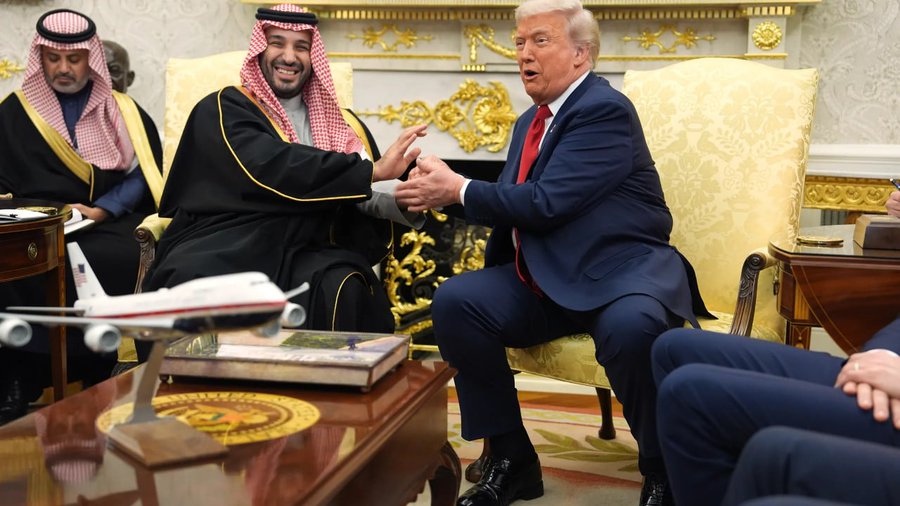
A disastrous unintended consequence of Trump’s lost war on Iran is the impending destruction of its best Middle East ally: Saudi Arabia. Both Iran and now Ansah Allah (Houthis) in Yemen are pounding Saudi infrastructure and oil facilities, drastically degrading the Saudi economy. No oil revenue may signal the end of Saudi Arabia as an economic power. Saudi Arabia may wind up a failed state with its hated rulers fleeing for safe havens.
The head of Aramco, the Saudi oil company, advised it will take at least two years for oil production and delivery to return to normal. And that’s if no further damaging attacks occurs.
Back in 2015 Saudi strongman Mohammed bin Salman (MBS) jumped into the Yemen civil war to prevent the Houthis from polishing off the Saudi backed Presidential Leadership Council (PLC) which was a minority element with no chance of prevailing.
But even with hundreds of billions in US bombs, jets, intelligence, logistics that kept the killing going for 7 years, the Saudis gave up in futility in 2022. Over a quarter million Yemenis dead simply for Uncle Sam to protect its Saudi ally against the Houthis who controlled 80% of Yemen – including the capital – couldn’t stop the popular Houthis.
Last year the Houthis came to the aid of Gaza’s Palestinians undergoing genocide by Israel. When they disrupted Israeli Red Sea shipping, the US launched over a thousand air strikes costing over a billion dollars during a 7-week air campaign that failed miserably.
Having failed twice to deter the Houthis, the US stupidly greenlighted the Saudis to attack Yemen’s main airport in Saana last July 13, reigning the Yemen, Saudi war that ended 4 years ago. Big mistake. The results have been so devastating to Saudi Arabia that MBS called up Trump begging for US air strikes on Yemen. But bogged down in his lost war on Iran, Trump demurred squandering his dwindling drone and missile stockpile to bail outhe incompetent Saudis. He’s left his former BFF MBS to face Houthi attacks that cannot be stopped.
Wise foreign policy analysts foresee Saudi Arabia collapsing politically along with their collapsing oil gravy train. MBS may have slaughtered his last political opponent such as Kamal Khashoggi, the Washington Post columnist MBS had chopped up in the Saudi consulate in Turkey in 2018.
MBS may soon be MIA. Can’t come soon enough.
The Tech Oligarchs Have Captured Washington — Now They’re Pivoting to the States

David Sacks, former AI and crypto czar for the Trump administration, has described Anthropic as running a “sophisticated regulatory capture strategy based on fear-mongering.”
As Big Tech and corporate media set false terms of debate — innovation vs. regulation — we must remember, there are plenty of laws on the books to tackle the harms of AI. What we’re lacking is enforcement.
October 15, 2026, By Jai Dulani, This article was originally published by Truthout, https://scheerpost.com/2026/10/15/the-tech-oligarchs-have-captured-washington-now-theyre-pivoting-to-the-states/
AI and crypto firms have spent record amounts on the 2026 midterms.
Late last month, the wealthiest tech executives on the planet smiled next to President Donald Trump after essentially pinky-swearing they would voluntarily adopt safety policies around AI. While Trump described the agreement as “morally binding,” legal liability or enforcement measures were not explicit parts of the accord. The key takeaway from this handshake deal is that the people with the most amount of political power sit in Silicon Valley, not in Washington, D.C.
With the midterm elections just weeks away, it’s a good time to reflect on what Big Tech’s actions during this election season have revealed about its agenda and the larger context of the industry’s political influence. From CNN to The New York Times to NPR, there has been extensive news coverage of the hundreds of millions of dollars Big Tech has spent on the midterm elections. Months before Election Day, corporate spending this election cycle had already exceeded total disclosed corporate spending in the 2024 presidential election by 12 percent. The top two industries setting this record — with over half a billion dollars spent and counting — are crypto and AI. This unprecedented corporate spending on midterm elections is key to the tech industry’s plan to rig every level of government to work for the industry, from state legislatures to Congress.
Crypto’s Spending in the Primaries Was About More Than Crypto Regulation
The crypto industry is the largest political spender this election cycle, having spent over $200 million so far. The race it spent the most on was Felix Barry Moore’s campaign for U.S. Senate in Alabama. Crypto super PACs spent over $12 million supporting Moore, who has a pro-crypto track record; as the U.S. representative for Alabama’s 1st district, Moore co-sponsored a bill that prohibits the Federal Reserve from developing or issuing a central bank digital currency for U.S. monetary policy. This leaves digital assets under private control, away from federal scrutiny, which is what the industry wants.
In Illinois, crypto-related PACs spent over $10 million against former Lt. Gov. Juliana Stratton, who is running for a seat in the U.S. Senate. Stratton has been vocal against the crypto industry. Politico reported that Stratton is endorsed by two prominent industry critics: Sen. Elizabeth Warren (D-Massachusetts) and Illinois Gov. JB Pritzker. Pritzker signed a digital assets law last year establishing regulatory oversight and protections for consumers against scams and fraud. In 2025, the FBI reported over $11 billion in losses related to cryptocurrency fraud in its Internet Crime Report.
Crypto corporations were also the dominant corporate political spenders in 2024 and gave $18 million to Trump’s 2025 inauguration. These contributions have paid off many times over the course of Trump’s second term. Trump removed Biden-era regulators and replaced them with crypto industry business partners or former industry insiders. In April 2025, the Trump administration shuttered the Department of Justice’s crypto enforcement team. Trump pardoned several crypto companies and billionaires that were under investigation for criminal money laundering and fraud, often after receiving investments in his own crypto empire. In June of this year, it was revealed that the Trump family has made at least $2.3 billion from crypto-related ventures during Trump’s second term.
This election season, Trump and the crypto industry were pushing for Congress to pass the Clarity Act, a bill essentially written by the crypto industry that locks in deregulation. From 2025 through August 2026, crypto companies Coinbase and Ripple spent a combined $18 million on lobbying Congress. Crypto donors gave Trump’s primary super PAC, MAGA Inc., over $88 million, more than any other industry. On September 15, the Clarity Act failed to advance through the Senate by a vote of 49-50. However, the attempt shed light on what the industry is seeking in terms of legislation: exemption from robust oversight, weak consumer and investor protections, and no prevention of conflicts of interest for self-enrichment and corruption.
One doesn’t need to be invested in crypto to be harmed by the industry. Crypto is increasingly making its way into banks, retirement plans, and payment systems. As economic expert Tonantzin Carmona has noted, when it comes to crypto, “Fundamental public interest questions remain underexplored in current policy discussions. … From financial instability to investor fraud to environmental and public safety risks, the potential consequences are real and growing.” Indeed, Black and Latino communities are disproportionately harmed by the volatility and predatory targeting of the crypto industry. Chastity Murphy, a former economic policy adviser to Rep. Rashida Tlaib, said the fight around regulation is “about who controls money, and whether digital infrastructure serves the public or entrenches private power.”
Crypto’s political spending is about entrenching private power and extracting wealth, leaving everyday people vulnerable to a destabilized financial system with no recourse when scammed.
The AI Debate: Two Sides of the Same Coin
As Alex Hanna and Emily M. Bender describe in their book, The AI Con, there are two camps in the AI world: AI doomers and AI boosters. Each camp is part of the same AI hype machine, in which, as scientists and advocate Timnit Gebru states, “the utopia and doom is still a marketing ploy.” Over the course of the AI industry’s massive spending leading up to the midterms, the two forces that have embodied this debate are OpenAI and Anthropic. The Leading the Future super PAC network, often referred to as OpenAI’s super PAC, and the Public First Action super PAC network, backed by Anthropic, have been framed as pro-innovation and pro-safety respectively.
A look at super PAC spending in North Carolina exemplifies the difference between the two super PAC networks, as well as how they ultimately advance the same outcome. Anthropic’s super PAC spent over $1.6 million on ads backing Rep. Valerie Foushee in the primary for North Carolina’s 4th congressional district. Foushee is one of three co-chairs of the House Democratic Commission on AI and the Innovation Economy, to which she was appointed in December 2025. Foushee has supported regulation such as a requirement to label when content is made by generative AI. Also in North Carolina, Leading the Future spent over $500,000 on ads promoting Republican Laurie Buckhout in North Carolina’s 1st district Republican primary. Buckhout has promised to maintain “American dominance in AI.” While the “innovation” camp tends to spend more on Republicans and the “safety” camp on Democrats, these two sides are fundamentally the same; focusing on future hypothetical hype or doom leads to the public ignoring the current harms of AI: surveillance, data centers, labor exploitation, pollution, and discrimination.
David Sacks, former AI and crypto czar for the Trump administration, has described Anthropic as running a “sophisticated regulatory capture strategy based on fear-mongering.” In many ways, Sacks is right. As Lina Khan, who served as chair of the Federal Trade Commission from 2021 to 2025, has pointed out, “Much of the commentary from the executives suggests they currently operate in a legal vacuum, as if AI has wiped clean the regulatory map. In fact, their business practices — including how they develop and deploy their technologies — are already subject to longstanding laws.” As Big Tech and corporate media set false terms of debate — innovation vs. regulation — we must remember, there are plenty of laws on the books to tackle the harms of AI. What we’re lacking is enforcement.
Crypto and AI’s Political Spending Pivot to States
Last year, Trump and the AI industry pushed for federal preemption, proposing to block states from regulating AI for a decade. Crypto exchange Coinbase also asked the Department of Justice to submit a “views letter” to Congress arguing that any new federal crypto legislation should include strong preemption provisions, meaning that when federal law is explicit, it overrides conflicting state crypto regulations. The tech industry didn’t win preemption. Now, in response to the growing wins in the grassroots movement to resist data centers, the industry has pivoted to political spending in state and local races.
California has been a major battleground of this pivot. Just this past year, nearly 30 AI-related measures have been enacted in the state, with Gov. Gavin Newsom having recently signed 11 AI regulatory bills into law. Crypto and AI corporations have poured money into lobbying efforts as well as California state PACs. Meta launched its own California PAC, Mobilizing Economic Transformation Across (Meta) California, pouring in $20 million solely for local elections in the state. The result has largely been watered-down bills and some vetoes, with some notable exceptions. Workers were able to claim victory as bills were passed that protect workers against surveillance and the ability to be fired by an algorithm. Overall, the industry is running the same playbook at the state level that it ran federally: game the system to ensure there is little to no meaningful regulation.
Research reveals that the policies Meta and Google opposed via super PAC spending include AI safety laws like California’s Senate Bill 53 (S.B. 53), which would require companies to disclose how various safety issues are approached, how “catastrophic” risks are inspected, and how “critical safety incidents” are responded to. S.B. 53 would also make it easier for members of the public and company whistleblowers to report potential safety risks.
Another law Meta and Google opposed via super PAC spending is California’s Assembly Bill 2013 (A.B. 2013), also known as the Generative AI Training Data Transparency Act. The law requires AI developers to clearly explain which dataset sources were used to train models and if personal information or synthetic data was used to train the model.
Crypto billionaires Chris Larsen and Tim Draper also funded the Grow California PAC, which focused on electing corporate-friendly candidates as a “counterforce” to the state’s labor movement. In District 67 (Los Angeles and Orange County), Grow California spent nearly $1.5 million opposing UNITE HERE Co-President Ada Briceño. This was the highest spending in any state assembly race in California. The tech billionaires outspent organized labor almost 7 to 1. Briceño lost in the primary. Big Tech is not just protecting its industry; it is also funding opposition to worker organizing.
Big Tech is also funding broader attacks on democracy. Larsen is funding a ballot measure in San Francisco that would make it harder to advance public proposals via petitions. Proposition D would increase the number of signatures required to qualify ballot initiatives from 2 percent to 8 percent of the city’s registered votes, or roughly 10,000 to 42,000. Previously, Larson has also personally spent over $9 million expanding police surveillance in San Francisco through a fleet of drones and 2,700 private cameras that cops can watch in real time.
What has been revealed this election cycle is that, in the age of crypto and the AI boom, Silicon Valley has carried out a near-total capture of our federal government. Meanwhile, Big Tech has pivoted to state elections in an attempt to undermine the levels of government where our organizing still has leverage. Our best tool is to continue organizing people — fighting data centers, fighting flock cameras, fighting the tech companies that are destroying our lives. It is only through this grassroots power that we can show politicians and political parties that they need to be more afraid of organized people than they are of upsetting tech donors.
Nuclear needs to build up to 8,000 SMRs just to catch up with wind and solar. By 2035, they might have 5
Giles Parkinson, ReNewEconomy, May 27, 2026
Australia’s almost indistinguishable far right political parties – the Liberals, Nationals and One Nation – are pushing the nuclear barrow once again, not for climate reasons but because of the “anything but wind and solar” ideology demanded by their fossil-fuelled benefactors.
So it came as a timely reminder on Wednesday, when one of the world’s leading green energy analysts, Michael Liebreich, underlined just how useless nuclear energy is for dealing with climate change, and how far the small nuclear reactors championed by many are from competing with surging wind and solar.
Liebreich is the founder of Bloomberg New Energy Finance and his address to the Energy Efficiency Council’s National Conference also touched on the perils of net zero targets (because it puts the focus on what’s really hard rather than what’s readily achievable), and the overwhelming push for electrification for “just about everything.”
But it was the nuclear hype that he was also keen to puncture, if only to underline the sheer scale and dominance of wind and solar, and its rapidly growing share of “useable” energy, as opposed to “primary energy” that ignores the massive inefficiencies of fossil fuels.
SMR are still not being built but they are championed by some of the world’s richest people, the AI and social media “tech bros” who are looking for ample energy sources to power their massive data centre needs (while contracting tens of gigawatts of wind and solar in the meantime).
“They (the tech bros) love nuclear, and they’re going to be very angry when they discover what everybody discovers, which is nuclear is kind of expensive and long and complicated,” Liebreich said.
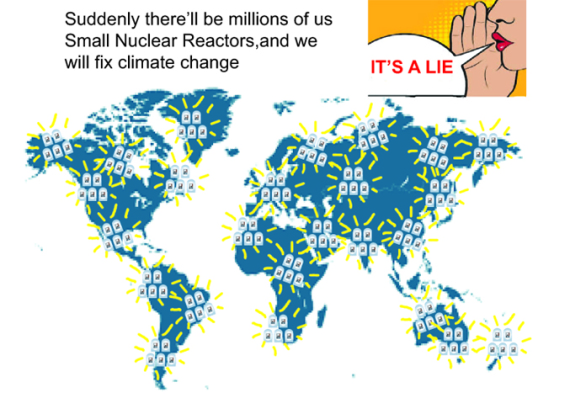
“But even if they succeed, it’s not going to be a climate solution,” he said. And the reason is that simply to match the output of wind and solar in the 2024 calendar year, the industry would need 1,250 of the 470 MW SMRs that are being developed by Rolls Royce, or up to 8,000 of the much smaller SMRs pushed by the likes of Oklo.
“If they build five by 2035 that will be a big win,” Liebreich said. “And so, as a climate solution, by the time you did build 2000 Westinghouse SMRs, where do you think wind and solar is going to be?
“It’s obviously going to have grown. That green curve is not stopping, it is taking off, and you can see it’s taking off even in the countries that are really trying to build nuclear.”
The nuclear push is usually associated in Australia by calls to abandon net zero targets, with the main argument being – without evidence – that it is trashing the economy.
Net zero has been criticised by others supportive of strong action. Andrew Forrest, aiming for real zero at Fortescue’s giant iron ore mines by 2030, says net zero is an excuse to do not much and use offsets instead of cutting emissions, others say a 2050 target is used by an excuse to do not much anytime soon.
Liebreich’s criticism is that it makes everything sound too hard. “By focusing on zero, immediately your eye is drawn to doing the difficult bits, and the difficult bits are expensive, and we just don’t have to have those discussions right now…………………………………. https://reneweconomy.com.au/nuclear-needs-to-build-up-to-8000-smrs-just-to-catch-up-with-wind-and-solar-now-by-2035-they-might-have-5/
US reviving shuttered nuclear plants to meet growing demand, power data centers
The United States is making an unprecedented attempt to revive three
shuttered nuclear plants to meet growing demand, especially from data
centers. No commercial nuclear reactor is known to have resumed generating
electricity after beginning the decommissioning process that takes one out
of service, though some reactors have restarted after long outages. The
Department of Energy is lending as much as $4.4 billion to restart the
Palisades Power Plant in Michigan, the Crane Clean Energy Center on
Pennsylvania’s Three Mile Island and the Duane Arnold Energy Center in Iowa
to restore a combined 2.25 gigawatts of electricity, which can power
roughly 2 million homes and businesses. All three of the plants closed
before their licenses expired, largely because the electricity they
produced was considered too expensive.
ABC News 16th Oct 2026,
https://abcnews.com/US/wireStory/us-reviving-shuttered-nuclear-plants-meet-growing-electricity-137317832
RAF reports mystery drones over Britain
Near misses occur days apart
during military exercises, with one object spotted at 17,000ft – 40 times
the legal height limit. Royal Air Force jets reported close encounters with
two unidentified drones in British skies this year, The Telegraph can
disclose. The near misses took place days apart during simulated air combat
training and an air-to-air refuelling exercise over the North Sea. One of
the mystery objects was spotted at an altitude of 17,000ft, more than 40
times the legal height limit for commercial drones. Incident logs seen by
The Telegraph show that the RAF reported the sightings to police and that
“multiple different external investigations” are ongoing. The incidents
occurred amid growing fears that hostile powers are using drones to spy on
the West.
Telegraph 16th Oct 2026,
https://www.telegraph.co.uk/news/2026/10/16/raf-mystery-drones-britain/
Trump’s weapons in space violate international law

The weaponisation of space is a violation of the intent of the Outer Space Treaty of 1967
The weaponisation of space is a violation of the intent of the Outer Space Treaty of 1967.
Independent Australia, By Karl Grossman | 17 October 2026,
Last month, the Trump Administration confirmed that, for the first time, the U.S. has weapons in space in violation of international law, writes Professor Karl Grossman.
‘U.S. says for 1st time it now has weapons in space’ was the headline last month in USA Today.
The subhead: ‘Air Force Secretary Troy Meink became the first U.S. official to publicly announce that the military has deployed weapons to space.’
The article began:
‘The U.S. has confirmed in a landmark revelation that the nation has deployed operational weapons in space.’
The news swept the world.
he headline in the British newspaper, The Guardian:
‘U.S. confirms for first time it has deployed weapons in space.’
The subhead:
‘Analysts warn of an acceleration in high-risk arms race with Russia and China in Earth’s orbit.’
It should not have come as a surprise.
As the Associated Press subsequently reported:
‘The revelation comes as the Trump administration puts a growing focus on space. In 2019, during his first term, Trump created the Space Force as a separate military branch. In his second term, he has announced the ‘Golden Dome’ missile defense system, which includes plans to put U.S. weapons in space.’
An earlier AP story published just after Donald Trump took office as U.S. president a second time also reported on ‘plans to put U.S. weapons in space’ as part of its planned ‘Golden Dome’ program.
This article by Tara Copp, an AP Pentagon and national security correspondent, said:
‘The system was ordered by Trump during his first week in office, and if successful, would mark the first time the U.S. would place weapons in space that are meant to destroy ground-based missiles within seconds of launch.’
Trump is seeking U.S. “superiority” in space, as he stated in an executive order titled ‘Ensuring American Space Superiority.’
Issued in December 2025, Trump asserted:
“Superiority in space is a measure of national vision and willpower.”
In his role as Secretary of War, Peter Hegseth is a highly aggressive partner in Trump’s aim.
As Hegseth said in a tour of U.S. aerospace companies in February 2026:
“We have to dominate the ultimate high ground.”
He also declared on that speaking tour:
“The fight for space is the fight for the future of the world as we know it” and “We cannot afford to have a fair fight in space — I’m not interested in orbital parity. We demand orbital dominance plain and simple. Whoever controls space controls the fight.”
Adding to the acknowledgement of the U.S. deploying weapons in space, the AP also reported this month:
‘American troops need to prepare for combat not only in Earth’s orbit but around the moon, President Donald Trump’s top military adviser said Wednesday, looking ahead to a new frontier in warfare after the U.S. revealed for the first time that it has deployed weapons in space. Gen. Dan Caine, chairman of the Joint Chiefs of Staff, told service members and industry figures at the Air, Space and Cyber Conference outside Washington that the U.S. military should adapt now so it “is prepared to fight, endure and win … from the seabed to cislunar space”.’
Cislunar space, AP added, “is a term that describes the region between the Earth’s surface and the moon.”
Not only is none of this new, or going back just a few days or years. It goes back many years.
As Bruce Gagnon, coordinator of the Global Network Against Weapons & Nuclear Power in Space, noted in an interview, plans by the U.S. for dominating space go back decades. The Trump Administration is conducting a major replay of these plans……………………………………………………………………………………………………………………………………………………….
The weaponisation of space is a violation of the intent of the Outer Space Treaty of 1967.
Created by the U.S., the United Kingdom and the former Soviet Union — it, as The Planetary Society, based in Pasadena, California, explains:
‘Is an international agreement that governs how nations act in space. Formally known as the ‘Treaty on Principles Governing the Activities of States in the Exploration and Use of Outer Space, including the Moon and Other Celestial Bodies,’ it is one of international space law’s foundational documents. The overall purpose of the Outer Space Treaty is to keep space peaceful.’
There have been repeated attempts since then at the United Nations to pass a resolution titled ‘Prevention of an Arms Race in Outer Space‘ (PAROS) to ensure that space is used for peaceful purposes.
As noted by the Federation of American Scientists, based in Washington, PAROS ‘reaffirms the fundamental principles of the 1967 Outer Space Treaty and advocates for a ban on the weaponisation of space.’
It was first passed at the U.N. General Assembly in 1981 by a vote of 129 in favour, zero against and 13 abstentions.
But the PAROS agreement to be enacted requires a unanimous vote in favour by the UN’s Conference on Disarmament, which consists of 65 nations based on global regions.
The U.S. has continually baulked at supporting PAROS, and without unanimity it cannot be approved. I have been in Geneva and watched as, at a meeting of the Conference, the U.S. representative announced that the U.S. would not support PAROS.
Meanwhile, the argument by the U.S. – including now with the acknowledgement by the U.S. of it deploying weapons in space – is that there is a threat of Russia and China doing this.
“This is a flagrant in-your-face lie,” says Alice Slater, a member of the board of the Global Network Against Weapons & Nuclear Power in Space and an attorney.
She faults media generally for “parroting” the U.S. claim and “disregarding the constant effort” by Russia and China to get the PAROS agreement enacted.
She also cites the “joint statement” by Russia and China last year upon, as its heading notes, the “80th anniversary of the victory in the Second World War,” in which the U.S., Soviet Union and China were allies.
The two sides [Russia and China] oppose the attempts of individual countries to use outer space for armed confrontation,’ says their statement. It cites the need for the PAROS agreement ‘that would provide fundamental and reliable guarantees of preventing an arms race in outer space, weaponisation of outer space.’
Immediately following the acknowledgement by the U.S. of having weapons in space, The New York Times reported a Russian government spokesperson saying, “We believe that space must be free of any weapons,” and a spokesperson for China’s Foreign Ministry saying:
“We urge the U.S. side to stop…preparing for war in outer space,” and that China opposed an “outer space arms race.”
Gagnon, the coordinator of the Maine-based Global Network Against Weapons & Nuclear Power in Space, said he believes the U.S. has acknowledged its deployment of weapons in space in a move to:
“make Golden Dome sound inevitable, thus forcing Congress to appropriate the massive funds to secure the controversial project in the Pentagon pipeline.”
The cost for the Golden Dome system would run as high as $3.6 trillion, as estimated by the American Enterprise Institute.
Taxpayers for Common Sense, also based in Washington, in its report this year titled ‘Missing the Mark: Why Golden Dome is Bad for American Taxpayers’ says:
“Pursuing Golden Dome also poses serious strategic risks, including the potential to accelerate nuclear arms and space arms races and to undermine opportunities to secure verifiable arms control agreements that reduce the nuclear threat. The program has also raised troubling conflict-of-interest concerns involving individuals within the Trump Administration and companies vying for Golden Dome contracts.”
Said Gagnon:
“Taxpayers should be wondering who will pay for the trillions of dollars” for this and other “offensive space programs—especially when the U.S. is $40 trillion in debt.” He said “the aerospace industry long ago identified the ‘entitlement programs’ as their preferred source of funds” and “taking from Social Security, Medicare, Medicaid and the now tattered social safety net.”
As to consequences of war in space, he told of Apollo Astronaut Edgar Mitchell – “the sixth person to walk on the moon” – speaking at a “peace in space rally” I organised in the now re-named Cape Canaveral Space Force Station.
Mitchell told the assembled that a war in space would be the:
“One and only because so much space junk would be created – on top of the existing huge debris field – that we would not be able to get a rocket through the deadly trash orbiting the Earth. He said it would be like trying to ‘get through a piranha-laced river’ in the Amazon.”
Gagnon spoke of:
“A spiritual disconnection in the minds and hearts of those ‘leaders’ in Washington who believe that four per cent of the global population in the U.S. should be the ‘Masters of Space’ [the motto of the Space Delta 8 unit of the U.S. Space Force]. It is a deep sickness. The time has come for the American people to take the toys away from the boys.”
The Global Network Against Weapons and Nuclear Power in Space was formed at a meeting in Washington, D.C. in 1992. Each year it holds a “Keep Space for Peace Week,” this year between October 3-10, with events. The 2026 theme is “Space Is a Global Commons—Not To Be Dominated.” The Global Network’s website can be found here…………………………………………………………………. https://independentaustralia.net/politics/politics-display/trumps-weapons-in-space-violate-international-law,21684
To Use a Mountain
2025 | USA, https://www.touseamountain.com/
n 1982, six rural communities across the United States were notified that all of the nation’s nuclear waste might be buried beneath them forever.
Faced with a mandate to isolate the waste for 10,000 years, the Department of Energy mapped, analyzed, and assembled its assessments, while the unsuspecting stewards of sacrificial territory found themselves fighting for their homes, health, history and dignity. In the end, one site was chosen: a desert ridge in Nevada called Yucca Mountain, on the unceded lands of the Western Shoshone. After decades of controversy, construction at Yucca Mountain was halted, and to this day, no permanent solution has been devised for America’s 90,000 tons of high-level nuclear waste.
Against the impassive logic of government analysis and archives, TO USE A MOUNTAIN assembles a people’s history of resistance and stewardship through a visceral journey across the landscapes, ecologies, and personal histories of the candidate sites. Farmers, miners, citizen scientists, Native American leaders, and activists—each with a story bound to this enduring threat—stand in stark contrast to the cold, silent machinery of bureaucracy, in a meditation on resistance, memory, and the timeless struggle between power and place.
New concerns, questions over soil transfer at DOE Paducah Site
Todd Faulkner, Mason Watkins, Mackenzie Lionberger, Oct 16, 2026, https://www.wpsdlocal6.com/news/new-concerns-questions-over-soil-transfer-at-doe-paducah-site/article_071efe65-415d-4887-b247-2eb06df92de5.html
PADUCAH — There are new questions and concerns involving soil from a parcel of land at the Department of Energy Paducah Site.
WPSD-TV originally reported that soil was being removed from the DOE Paducah Site by General Matter and placed on other properties in McCracken County.
Prior to Sept. 9, WPSD viewers reached out to the station concerned about the soil transfer and wondered if the soil was contaminated.
McCracken County Judge Executive Craig Clymer later received a document from a division of the DOE that said an analysis of the soil was shared with the Environmental Protection Agency which confirmed that the soil is “protective of human health and the environment” and “the soil meets risk standards.”
After that report, a source reached out to WPSD questioning the factual content of that analysis and the statement sent to the judge executive’s office — and whether the soil, in fact, did meet residential and recreational risk standards.
The source provided and cited a number of pieces of information from the U.S. Environmental Protection Agency. What was provided were dozens of documents and email exchanges that the source claims made clear that the Parcel A soil evaluated by EPA Region 4 was only for “on site industrial conditions” — not off site, or what’s considered “unrestricted-use clearance.”
In an email correspondence between WPSD’s source and an EPA employee, the employee writes: “The EPA did not anticipate that soil located on DOE Paducah Parcel A property (being leased to General Matter) would be transported off DOE property to a residential property. The EPA was informed in June by the Kentucky Department for Environmental Protection (KDEP) that soil from the General Matter lease site was observed being transported to a nearby private property on the east side of Hobbs Road.”
Later, that same employee writes: “Although Parcel A is restricted to industrial use only, cancer and noncancer effects are unlikely for a future resident under unrestricted use/unlimited exposure to Leasing Parcel A soil.”
In a letter to Judge Executive Craig Clymer, as previously reported, the DOE wrote: “This supplemental risk evaluation found that chemicals and radioactive constituents in the soil at Leasing Parcel A are not expected to create unacceptable health risks for resident or recreator scenarios.”
Reporters took the information provided and contacted the EPA for comment.
A public and government affairs manager responded by email: “To confirm, the DOE evaluated soil data from the area now being leased by General Matter. DOE concluded that the soil does not pose an unacceptable risk to human health. The EPA reviewed DOE’s evaluation and conclusion. Based on the data available, there is no unacceptable cancer risk or noncancer health effects posed to hypothetical future residents, recreators, or industrial workers from the soil removed from the leased parcel.”
When asked for comment on this latest concern regarding General Matter removing soil from the site, WPSD received the following statement: “Last month, we finished up our initial soil and grading activity on schedule. We appreciate the EPA’s thorough review and look forward to welcoming our neighbors at next week’s Community Open House.”
Other entities involved in the situation include more than DOE and General Matter. Those include the EPA, the Kentucky Division of Waste Management and other agencies.
General Matter’s public open house is set for 4:30 to 6:30 p.m. Wednesday, Oct 21, at McCracken County High School.
1 This Month
23-25 October – on Zoom – World BEYOND War’s annual global conferenc


Shut down the radiation-damaged Heysham nuclear reactors now
To see nuclear-related stories in greater depth and intensity – go to https://nuclearinformation.wordpress.com

Say No to NASA’s Reckless Nuclear Reactor on the Moon
Say No to NASA’s Reckless Nuclear Reactor on the Moon
-
Archives
- October 2026 (190)
- September 2026 (339)
- August 2026 (330)
- July 2026 (355)
- June 2026 (287)
- May 2026 (306)
- April 2026 (356)
- March 2026 (251)
- February 2026 (267)
- January 2026 (308)
- December 2025 (358)
- November 2025 (359)
-
Categories
- 1
- 1 NUCLEAR ISSUES
- business and costs
- climate change
- culture and arts
- ENERGY
- environment
- health
- history
- indigenous issues
- Legal
- marketing of nuclear
- media
- opposition to nuclear
- PERSONAL STORIES
- politics
- politics international
- Religion and ethics
- safety
- secrets,lies and civil liberties
- spinbuster
- technology
- Uranium
- wastes
- weapons and war
- Women
- 2 WORLD
- ACTION
- AFRICA
- Atrocities
- AUSTRALIA
- Christina's notes
- Christina's themes
- culture and arts
- Events
- Fuk 2022
- Fuk 2023
- Fukushima 2017
- Fukushima 2018
- fukushima 2019
- Fukushima 2020
- Fukushima 2021
- general
- global warming
- Humour (God we need it)
- Nuclear
- RARE EARTHS
- Reference
- resources – print
- Resources -audiovicual
- Weekly Newsletter
- World
- World Nuclear
- YouTube
-
RSS
Entries RSS
Comments RSS

