 China ‘deploys missiles’ amid calls for more nuclear weapons to deter Donald Trump Neil Connor, Telegraph UK Beijing 25 JANUARY 2017
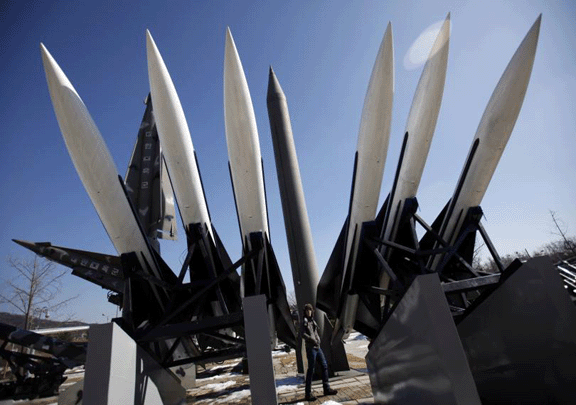
Beijing is moving advanced ballistic missiles which are capable of hitting the US to its north-eastern frontier with Russia, according to media reports, amid suggestions that the weapons were revealed in response to Donald Trump’s “provocative remarks” towards China……..
The state-run Global Times newspaper, which has close links with China’s Communist leaders, said: “Some media claimed that the Chinese military intentionally revealed the Dongfeng-41 and connected it with the inauguration of US President Donald Trump.
“They think this is Beijing’s response to Trump’s provocative remarks on China,” added the outlet, which is known for taking a strongly nationalist tone and making inflammatory comments.
The newspaper also called for a ramping up of China’s nuclear capabilities, saying: “China’s nuclear arsenal must be able to deter the US.”
“Even Washington feels that its naval forces and nuclear strength are lacking,” it added. “So how can China be content with its current nuclear strength when it is viewed by the US as its biggest potential opponent?”
The reported deployment comes after Mr Trump has angered China with his stance on Taiwan, trade and security – particularly in the South China Sea. http://www.telegraph.co.uk/news/2017/01/25/china-deploys-missiles-amid-calls-nuclear-weapons-deter-donald/
January 27, 2017
Posted by Christina Macpherson |
China, politics international, USA, weapons and war |
Leave a comment
Trump Uncertainty Fuels South Korea Nuclear Talk, VOA, January 25, 2017 Brian Padden, SEOUL, SOUTH KOREA —
Some South Korean conservatives are citing President Donald Trump’s past statements on reducing U.S. security commitments in Asia to argue that their nation must now prepare its own nuclear option to defend against the growing North Korean nuclear threat.
“I’m not saying we should develop nuclear weapons overnight. I’m saying that if there are the right conditions, then we should go nuclear,” said Lee Choon-kun, a researcher with the Korea Institute for Maritime Strategy, at an event sponsored by the East Asia Foundation in Seoul Tuesday…….
South Korea’s nuclear advocates expect contentious times ahead. They take seriously Trump’s criticism, made during the campaign, that South Korea does not pay its fair share for hosting the 28,500 American personnel and military bases in Korea. And they take Trump at his word that, if better compensation terms are not reached, he would consider withdrawing American troops, allowing allies to acquire their own nuclear weapons, and ending the nuclear umbrella mutual defense pacts that require the U.S. military to come to the aid of its allies.
THAAD litmus testSouth Korean officials are reportedly planning to object to any proposed increase in defense reimbursement costs with the United States. Seoul currently reimburses Washington about $866 million annually, that is more than 50 percent of the cost for stationing troops in country. South Korea also spends 2.4 percent of its gross national product (GDP) on national security, compared with 1 percent for Japan and 1.16 percent for Germany, according to the defense ministry in Seoul.Nuclear proponents say that growing resistance in South Korea to the deployment of the U.S. THAAD missile defense shield could also create a rift in the U.S. alliance.
The THAAD system, which uses interceptor missiles to target high altitude incoming ballistic missiles, is considered a conventional deterrent to North Korea’s increasing ballistic missile capability. Supporters claim it will help defend South Korea from a nuclear missile attack.Opponents say its capability is limited and vulnerable to low altitude missile strikes that could target population centers like Seoul that are close to the inter-Korean border. Some South Korean critics also say THAAD is being deployed to protect U.S. military installations in Korea, and China complains that its powerful radar system could be used to monitor other countries in the region.Beijing’s strong objections to THAAD and reports of related Chinese economic retaliation against South Korea have also contributed to the declining support in South Korea. In December, public opposition to THAAD increased to 51 percent according to a poll conducted by Realmeter.THAAD opponents say it is a continuation of confrontational policies that have not worked to slow North Korea’s nuclear and missile development programs.
“The policy that we have implemented has been failing. We have to see the nuclear issue from a different perspective,” said Cheong Wook-sik, the director of the Peace Network in Seoul……..
Nuclear optionProponents say South Korea could quickly develop nuclear weapons using existing nuclear power plant facilities and fuel, and with the military’s advanced conventional weapons production capability.However, South Korea would likely face severe consequences for violating the Nuclear Non-Proliferation treaty (NPT) that could include diplomatic isolation and international sanctions similar to what North Korea is facing.And it could also lead to Japan and other countries developing their own nuclear deterrent. http://www.voanews.com/a/trump-uncertainty-south-korea-nuclear/3691290.html
January 27, 2017
Posted by Christina Macpherson |
South Korea, weapons and war |
Leave a comment
https://www.eurekalert.org/pub_releases/2017-01/caoa-tpo012517.php Distributed Model Predictive Load Frequency Control of Multi-area Power System with DFIGs
CHINESE ASSOCIATION OF AUTOMATION Wind offers an immense, never ending source of energy that can be successfully harnessed to power all of the things that currently draw energy from non-renewable resources. The wind doesn’t always blow, though.
Researchers from North China Electric Power University and North China University of Science and Technology recently developed a model to help predict wind frequency and potential contributions to more traditional energy sources. The scientists published their paper in IEEE/CAA Journal of Automatica Sinica (JAS).
“Reliable load frequency control is crucial to the operation and design of modern electric power systems,” wrote Yi Zhang, a doctoral student at the North China Electric Power University and an author on the paper. “Due to the randomness and intermittence of the wind power, the controllability and availability of wind power significantly differs from conventional power generation.”
Their method is based on “Model Predictive Control,” wherein checkpoints across a power grid can exchange information and adjust accordingly. The researchers decentralized this model, so that a problem in one area could be solved to benefit the entire grid. The computer algorithm predicts the variables that influence the grid (demand, supply, etcetera) and applies those constraints for any problem that any part of the system might encounter.
A traditionally controlled grid could, for example, redirect otherwise unused energy from sleeping citizens to a power-hungry hospital or some other entity that continues to require energy even during typical off times. In a decentralized system, like the one modeled by Zhang and her colleagues, the system works the same way, but instead of having to clear the redirection with every checkpoint, the variables are assumed and the action is nearly immediate.
To test their algorithm, the researchers compared the volume output and dependability of a four-part system – four plants sharing responsibility for generating power in different areas – with and without the incorporation of wind power.
In the analysis of a conventional power plant, the researchers found that their model required much less computational time compared to the traditional Model Predictive Control. That’s a major advantage, as the computing process is expensive in both time and energy.
When the researchers added the hard-to-predict wind turbines as a source of power in the model, it still worked as well. According to the scientists, the major flaw is that computational needs will increase to maintain system stability, which cannot be guaranteed in their algorithm.
“Our future work is focused on [pursuing] the implementation of [our algorithm] with guaranteeing stability and feasibility while reducing the computation and communication requirements,” Zhang wrote.
###
Fulltext of the paper is available: http://ieeexplore.ieee.org/stamp/stamp.jsp?tp=&arnumber=7815559
January 27, 2017
Posted by Christina Macpherson |
China, renewable |
Leave a comment
US Humanitarian Aid Goes to North Korea Despite Nuclear Tensions, VOA, January 25, 2017 Baik Sung-won WASHINGTON — The United States has provided $1 million in humanitarian aid to impoverished North Korea, the U.S. State Department said Wednesday.
Despite growing tensions between North Korea and Washington, the U.S. sent the assistance last week on the day before President Donald Trump was sworn in and took over the U.S. government.
It marks the first time that the U.S. provided humanitarian assistance to the North since 2011, when it provided relief items including medical supplies to North Korean flood victims. That aid, worth $900,000, was made through Samaritan’s Purse, a U.S.-based humanitarian aid organization.
Aid to help typhoon damageThe current assistance comes in the aftermath of Typhoon Lionrock, which hit North Korea in August with heavy rain that resulted in flooding. At the time, the government reported hundreds were dead and missing, and said thousands had lost their homes. International aid organizations responded immediately.
Outgoing Secretary of State John Kerry awarded $1 million for North Korea to UNICEF, a U.N. agency, the day before President Donald Trump took office last week………http://www.voanews.com/a/united-states-humanitarian-aid-goes-to-north-korea/3692811.html
January 27, 2017
Posted by Christina Macpherson |
North Korea, Religion and ethics, USA |
Leave a comment
No one is fit for nuclear.
Not those who believed that they were nor those who still believe that they are.
Let’s all ban this deadly industry from our planet earth!

According to a well-known joke about the national traits of Europeans, it is heaven if the chefs are French, the engineers are German and the bankers are Swiss and it is hell if the chefs are British, the engineers are French and the bankers are Italian.”
As for the Japanese? They appear not suited to a particular field — nuclear energy. And that is no joke. The development of nuclear technology as part of national policy and by private nuclear businesses has repeatedly experienced failure, causing problems to numerous people and wasting a massive amount of money.
Mutsu, Japan’s first and only nuclear-powered ship which was launched in the early 1970s, suffered a radiation leakage and was decommissioned in 1992 after having only four experimental runs.
The government decided late last year to decommission the prototype fast-breeder reactor Monju in Fukui Prefecture, which has hardly been in operation for more than 20 years following a fire triggered by a sodium leak broke out at the facility in 1995.
Construction work on a spent nuclear fuel reprocessing plant in Rokkasho, Aomori Prefecture, got underway in 1993, but its completion was postponed 23 times and there are no prospects that it will be put in operation in the foreseeable future.
Roughly 5 trillion yen has so far been spent on nuclear projects in Japan.
In March 2011, a serious accident occurred at Tokyo Electric Power Co.’s Fukushima No. 1 Nuclear Power Plant after the complex was hit by a massive tsunami triggered by the Great East Japan Earthquake. Over 80,000 residents from areas near the atomic power station are still living outside the affected areas as evacuees. The costs of dealing with the nuclear crisis have already surpassed 20 trillion yen.
Meanwhile, Toshiba Corp. has added a new page to the negative history of Japan’s nuclear development.
In 2006, Toshiba acquired Westinghouse Electric Co., a U.S. nuclear plant company, for over 600 billion yen. The deal was criticized as too costly, but Toshiba wanted to control the world nuclear power market. Toshiba’s president at the time was upbeat about the takeover saying, “We’ll conduct business aggressively.”
Nevertheless, Toshiba will likely suffer nearly 1 trillion yen in losses from the deal because the electronics giant failed to find hidden problems involving its U.S. nuclear power unit. The world nuclear power market has shrunk since the outbreak of the Fukushima nuclear crisis. Following revelations that it had padded its profits through accounting irregularities, Toshiba downsized its workforce by more than 10,000 people, but its rehabilitation efforts are still insufficient. Its financial difficulties have even put the company’s survival in jeopardy.
Physicist and technology commentator Kiyoshi Sakurai, who is well versed in technical problems and accidents involving nuclear plants, warned in a past Mainichi Shimbun interview, “Only a handful of those concerned with a certain project loudly underscore the significance of the project. These people could self-righteously go too far without understanding the project’s objectivity or necessity.”
His remarks remind the public of a past silly war (World War II).
More sadly, it is feared that Japanese people traumatized by the atomic bombing tend to stick to the peaceful use of atomic energy and have lost the capacity for calm and rational judgment.
After reviewing the above, one can see that Japanese people are unfit for nuclear energy development projects. (By Hideaki Nakamura, Editorial Writer)
http://mainichi.jp/english/articles/20170125/p2a/00m/0na/006000c
January 25, 2017
Posted by dunrenard |
Japan | Ban, nuclear |
Leave a comment
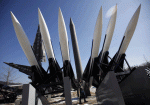 China Announces Deployment of New Long Range Nuclear Missile, Popular Mechanics. 24 Jan 17
The target—at least of the announcement—is Trump. In a rare move, China has publicly announced the deployment of a new intercontinental ballistic missile (ICBM). The Dong Feng (“East Wind”) -41 missile, or DF-41, can carry up to a dozen nuclear warheads and China claims it has the longest range of any nuclear missile in the world. The announcement of the missiles is likely a warning to U.S. President Donald Trump, who is known for sharply worded anti-Chinese rhetoric and has announced plans for a new ballistic missile system.
According to China’s Global Times newspaper, the People’s Liberation Army has deployed its newest intercontinental ballistic missile to Heilongjiang Province. The article cited eyewitness photos culled from Chinese social media by news media in Taiwan and Hong Kong. The photos showed heavy missile launchers, also known as transporter/erector/launchers (TELs) moving through Daqing City in Heilongjiang.
The DF-41 is described by Global Times as the most advanced ICBM in the world. It reportedly has a range of 8,699 miles, enough to hit any target on Earth with the exception of South America and parts of Antarctica. It can carry up to 12 nuclear warheads, and travels on China’s nationwide network of roads to make it difficult to track down and destroy.
The location of the missiles and the timing of the release are notable. Heilongjiang Province is in Northern China, near the country’s long border with Russia. The DF-41’s long range, if accurate, means it could be based anywhere and still hit any useful target on Earth, but the implication is that China considers Russia a friendly country.
While China tends to be low-key regarding nuclear weapons and nuclear deterrence, this seems like a deliberate move to make a subtle threat. After all, it was probably completely unnecessary to move strategic nuclear weapons through
a city of 2.9 million people, unless you want to get the word out. President Donald Trump, meanwhile, has been talking tough about China as well as enhancing America’s ballistic missile shield. If China wanted to overwhelm the shield with more missiles, the DF-41 would be the way to do it………
http://www.popularmechanics.com/military/weapons/a24893/china-announces-deployment-long-range-nuclear-missile/
January 25, 2017
Posted by Christina Macpherson |
China, politics international, weapons and war |
Leave a comment
http://zeenews.india.com/asia/pakistan-test-fires-nuclear-missile-capable-of-hitting-multiple-targets_1970284.html
January 24, 2017 Islamabad: Pakistan on Tuesday “successfully” test-fired its second indigenously-developed nuclear-capable missile, Ababeel, with a range of 2,200 km and capable of “engaging multiple targets with high precision”. The test firing comes two weeks after the launch of submarine-fired Babar III, that Indian analysts dubbed as fake.
In an apparent reference to India, Pakistan Military spokesperson Maj Gen Asif Ghafoor said: “The development of the Ababeel weapon system was aimed at ensuring survivability of Pakistan’s ballistic missiles in the growing regional Ballistic Missile Defence (BMD) environment.”
The missile is capable of delivering multiple warheads, using Multiple Independent Re-entry Vehicle (MIRV) technology. “The test flight was aimed at validating various design and technical parameters of the weapon system,” Maj Gen Ghafoor said in a statement.
“Ababeel is capable of carrying nuclear warheads and has the capability to engage multiple targets with high precision, defeating the enemy’s hostile radars,” it added.
On January 8, Pakistan conducted its first successful test fire of submarine launched cruise missile Babur III having a range of 450 km. The missile was fired from an underwater, mobile platform and hit its target with precise accuracy.
The Babur weapons system incorporates advanced aerodynamics and avionics that can strike targets both at land and sea with high accuracy, according to ISPR. It has been described as a low flying, terrain hugging missile, which carries certain stealth features and is capable of carrying various types of warheads.
January 25, 2017
Posted by Christina Macpherson |
Pakistan, weapons and war |
Leave a comment
Is China Going To War? Nuclear Missiles Deployed To Russian Border, Putin’s Kremlin Responds http://www.ibtimes.com/china-going-war-nuclear-missiles-deployed-russian-border-putins-kremlin-responds-2480325 BY CHRIS RIOTTA ON 01/24/17 The Chinese government reportedly deployed nuclear missiles to the Russia-China border in the northeast Heilongjiang province, an act Russian President Vladimir Putin’s government described as a nonissue Tuesday, Russian and Chinese media reported. The ballistic missiles, called the Dongfeng-41 Intercontinental Ballistic Missile, are capable of traveling up to 15,000 kilometers and was successfully tested with dummy warheads by the Chinese government in the South China Sea in April last year.
Unverified photos and videos of the massive ballistic missiles being deployed in the Chinese suburb made waves online as they spread across social media throughout this month. The footage had not been reported on until Tuesday, when the Kremlin’s Spokesperson Dmitry Peskov said “[Russia doesn’t] see the military disposition of China as a threat to our country,” the Moscow Times reported Tuesday.
A video posted to Twitter shows officials guiding a large vehicle along a highway as it carried what appeared to be the DF-41 intercontinental missile.
January 25, 2017
Posted by Christina Macpherson |
China, weapons and war |
Leave a comment
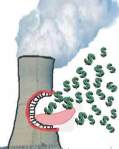 Toshiba to unveil extent of U.S. nuclear business writedown on February 14 , Reuters 24 Feb 17 Japan’s Toshiba Corp (6502.T) said it will unveil the extent of the writedown on its U.S. nuclear business on Feb. 14 when it reports its results for the quarter ended Dec. 31.
The laptops-to-engineering conglomerate, still recovering from a $1.3 billion accounting scandal two years ago, shocked investors in December by announcing major cost overruns at the U.S. nuclear business it bought in 2015. …….
Last week, media reported the troubled Japanese firm may unveil a writedown of as much as 700 billion yen ($6.18 billion) for its nuclear business……… rating agency Standard and Poor’s downgraded Toshiba’s debt to CCC+, or vulnerable to nonpayment, from B, and put the company’s credit watch on negative. http://www.reuters.com/article/us-toshiba-accounting-writedown-idUSKBN1580QV
January 25, 2017
Posted by Christina Macpherson |
business and costs, Japan |
Leave a comment
 The terrifying geography of nuclear and radiological insecurity in South Asia, Bulletin of the Atomic Scientists, 22 JANUARY 2017 Hannah E. Haegel and Reema Verma
 Terrorism involving nuclear or radiological materials remains one of the gravest threats to humanity and to global stability. It was a central concern throughout President Obama’s tenure, with efforts to harness international initiatives coming to the fore at the
Nuclear Security Summits. The incoming administration, however, should take a fresh look at a region of the world that hosts two states with nuclear weapons and a serious terrorism problem: South Asia.
Analysis on South Asia tends to occur in silos that focus on either nuclear risks or terrorism risks; fewer studies investigate the overlap between the two.
But we’ve mapped the geography of high-risk locations and violence by non-state actors—that is, the target threat environment—in South Asia’s two states with advancing nuclear weapons programs, India and Pakistan. The low probability but high potential cost of an incident of nuclear or radiological terror merits greater attention from citizens and policy makers alike, and the requisite means, motive, and opportunities for an incident of terror via weapons of mass destruction or disruption converge in South Asia.
The upcoming Summit on Countering WMD Terrorism, to be hosted by India in 2018, offers an opportunity bring attention to the issue. But preparations must begin well in advance of that summit, if the slow-moving machine of bureaucratic change is to be turned to address the institutional and governance problems India and Pakistan exhibit in regard to countering WMD terrorism.
Means to achieve mass destruction or disruption. South Asia is home to expanding and maturing nuclear weapons programs and widespread, frequent, and organized domestic and cross-border terror attacks. Recent incidents include a September 18 assault by terrorists who crossed the border from Pakistan to attack an Indian Army camp at Uri. This incident was followed by Indian retaliation, in the form of a publicly touted “surgical strike.” But this clash is one of many. Overall, the region (Afghanistan, Bangladesh, Bhutan, India, Maldives, Nepal, Pakistan, and Sri Lanka) was host to 22,077 terrorist incidents between 2010 and 2015, some 36 percent of the global total. Nearly half of all terrorist attacks in 2015 occurred in four countries: Afghanistan, Iraq, India, and Pakistan. India and Pakistan alone suffered a total of 13,322 incidents and 5,471 fatalities between 2010 and 2015. The Global Terrorism Database at the University of Maryland classified 30 percent of those attacks as armed assaults.
The different modalities of nuclear or radiological terrorism include: an attack on a nuclear facility, theft of nuclear or radiological material and construction of a “dirty bomb,” and theft of a nuclear weapon. A fourth, and often overlooked, path by which terrorists could precipitate a nuclear incident is to stage escalatory attacks that draw two states into a nuclear crisis or conflict.
The conditions for all four routes are prime in South Asia’s nuclear and radiological threat environment.
The motive for a nuclear or radiological terror attack. A number of violent non-state actors have alluded to their interest in pursuing WMD or precipitating a nuclear event. Some have been even more explicit, demonstrating intent to target a nuclear facility…….http://thebulletin.org/terrifying-geography-nuclear-and-radiological-insecurity-south-asia10416?platform=hootsuite
January 25, 2017
Posted by Christina Macpherson |
ASIA, safety |
Leave a comment
The R3 and R4 of the Genkai nuclear power plant, Pref. Saga, have met the new safety standards of the NRA. Restart announced at the end of summer.
As of today: Have met the safety standards, 10 reactors in 5 nuclear plant namely also Sendai R1, R2 – Takahama R1 to R4 – Mihama R3 – Ikata R3.
Two reactors have now been restarted: Sendai 1 and Ikata 3 (using MOX).

The Nuclear Regulation Authority formally decided Wednesday on the screening document certifying that the Nos. 3 and 4 reactors at Kyushu Electric Power Co.’s Genkai nuclear power plant in Saga Prefecture satisfied the country’s safety standards for their restart.
The latest decision made at an NRA regular meeting brings to 10 the number of reactors, at five nuclear power plants, that have satisfied the regulator’s new safety standards, introduced after the nuclear disaster at Tokyo Electric Power Company Holdings Inc.’s Fukushima No. 1 nuclear power plant in 2011. The two Genkai reactors are scheduled to be back online sometime in or after summer this year.
The Kyushu power company applied for a safety screening on those reactors in July 2013. At that time, the company anticipated an earthquake with an acceleration of up to 540 gal at the Genkai plant followed by tsunami of up to 3 meters high. However, the NRA deemed the simulation as “too optimistic” and the figures were raised to an acceleration of 620 gal with 4-meter-high tsunami.
In November last year, the NRA approved a draft document as the two reactors complied with the new standards. The NRA then solicited public opinions and received 4,200 comments, including concerns over possible earthquakes, but concluded that there was no problem with compliance.
With the formal decision being made on the Genkai plant, the focus for the restart has moved to an approval of a construction plan that maps out the specifications of related equipment for safe operation as well as whether it can obtain the consent of local governments for the restart.
So far, nuclear reactors that have passed the NRA’s screenings under the new standards are the Nos. 1 and 2 reactors at Kyushu’s Sendai power plant in Kagoshima Prefecture, the Nos. 1 to 4 reactors at Kansai Electric Power Co.’s Takahama plant and KEPCO’s No. 3 reactor at Mihama plant, both in Fukui Prefecture, and the No. 3 reactor at Shikoku Electric Power Co.’s Ikata plant in Ehime Prefecture. Currently, two reactors — Sendai plant’s No. 1 and Ikata’s No. 3 — are online.
http://www.the-japan-news.com/news/article/0003466628
January 24, 2017
Posted by dunrenard |
Japan | NRA, nuclear plants, Restarts, Safety Screenings |
Leave a comment
 Toshiba faces pressure to secure funding for UK nuclear project, Ft.com by: Andrew Ward and Jim Pickard in London, 22 Jan 17 Toshiba is facing pressure to secure investment from a South Korean energy group and the UK government to keep afloat a multibillion-pound British nuclear power project as the Japanese conglomerate struggles with mounting financial difficulties.
Korea Electric Power Corporation (Kepco) has been in talks for months to join the NuGen consortium planning a nuclear plant at Moorside in Cumbria alongside Toshiba and Engie of France. The need for new partners has been increased by huge writedowns on Toshiba’s nuclear business in the US, which has left the group scrambling to shore up its balance sheet. As well as Korean capital, Toshiba is angling for UK government investment in the Cumbrian project after Theresa May’s administration recently signalled its willingness to put public money into new nuclear plants. This would represent a reversal of longstanding UK policy not to expose taxpayers’ money to the heavy expense and high risks involved in building nuclear reactors.
A Whitehall official said it was “premature” to talk about government involvement in financing Moorside but several other people involved in the process or briefed on the matter said the option of public investment was on the table. But these people said a more immediate step to keep the scheme on track was the proposal for Toshiba to sell part of its 60 per cent stake in NuGen to Kepco, the utility majority-owned by the South Korean government. “Talks have been moving slowly but the financial difficulties facing Toshiba will hopefully focus minds on getting a deal done,” said one person close to the talks.
It emerged last month that the UK and Japanese governments were in talks about potential joint support for a new nuclear plant planned by Hitachi, another Japanese conglomerate, at Wylfa in Anglesey. One senior nuclear industry figure said these discussions also extended to potential government financing for Moorside. Shares in Toshiba have fallen by 44 per cent since the group warned last month that it would have to make writedowns of “several billion dollars” related to the $229m acquisition last year of Stone & Webster, the US nuclear construction company, by Toshiba’s US nuclear technology unit, Westinghouse……..
Public investment in new nuclear plants would be a striking illustration of Mrs May’s determination to intervene more heavily in industrial strategy, a policy she was expected to set out in a discussion paper on Monday. The UK Department for Business, Energy and Industrial Strategy said: “We are working closely with a number of developers on proposed new nuclear projects in the UK, as they develop their plans.”
https://www.ft.com/content/c0b01308-e0aa-11e6-8405-9e5580d6e5fb
January 23, 2017
Posted by Christina Macpherson |
business and costs, Japan, politics, UK |
Leave a comment
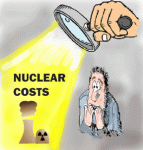 Analysis – As nuclear loss grows, Toshiba needs chip investors, soon Reuters By Makiko Yamazaki and Kentaro Hamada 22 JAN 17 TOKYO
With mounting writedowns from its nuclear business, Japan’s Toshiba Corp (6502.T) is looking to sell part of its core semiconductors business, a world No.2 in the flash memory chips used in smartphones.
But its rush to plug a hole in its U.S. nuclear business that Japanese media now estimate at as much as $6 billion may complicate any asset sale.
Toshiba, which warned last month of multi-billion dollar charges for U.S. nuclear project cost overruns, wants to boost its capital base by the end of the financial year in March.
Failure to offset the nuclear hit could wipe out already thin shareholder equity and push the company into negative net worth – jeopardising its role in public infrastructure projects and its place on the Tokyo Stock Exchange’s ‘first section’, for larger companies.
Following a 2015 accounting scandal, the conglomerate is barred from raising fresh funding on equity markets. Selling assets, though, could help it win broader financial support from its main banks.
Toshiba could sell 20-30 percent of its chip business, according to media reports.
The business, worth more than $10 billion, is the world’s second largest after Samsung Electronics (005930.KS) in flash memory chips – and it’s Toshiba’s most profitable.
Operating profit is forecast at 130 billion yen (913.35 million pounds) for the year to end-March, accounting for the bulk of overall group profit, forecast at 180 billion yen. Those forecasts were made before its December warning of the U.S. nuclear charges.
People with knowledge of the matter said Toshiba has begun preparations to sell a minority stake in its chip business. One person said non-disclosure agreement forms have been sent to some private equity funds……..
As Toshiba has ruled out ceding control of the chips business, it may also seek state help, as other troubled Japanese technology companies have done in previous restructurings, the sources said.
Another person familiar with the matter said the state-run Development Bank of Japan is among several funds Toshiba may approach for possible investment in its chip business, though the bank could be put off by the size of investment needed.
(Reporting by Makiko Yamazaki and Kentaro Hamada; Writing by Miyoung Kim; Editing by Ian Geoghegan) http://uk.reuters.com/article/uk-toshiba-accounting-semiconductors-ana-idUKKBN156009
January 23, 2017
Posted by Christina Macpherson |
business and costs, Japan |
Leave a comment
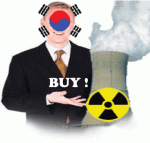 UAE gets licence to transport, store nuclear fuel, Gulf News 22 Jan 17
Nuclear fuel to be shipped from South Korea to the UAE before being transported to the Barakah Nuclear Power Plant “….the Federal Authority for Nuclear Regulation (FANR) announced on Sunday that it approved the licensing for transporting and storing nuclear fuel at the Barakah Nuclear Power Plant.
The two licences have been granted to the Emirates Nuclear Energy Corporation (ENEC) and Nawah Energy Company respectively, with the former getting the licence to transport the nuclear fuel, and the latter getting the licence to store the nuclear fuel at the Barakah site…..
Ian Grant, Deputy Director General for Operations at FANR, explained that the nuclear fuel would be shipped in transport casks from South Korea to the UAE, and then loaded onto trucks to transport the fuel to the nuclear reactor site.
“The fuel assemblies are loaded into transport casks and shipped from the Republic of Korea, [afterwards they are] trucked by road from the UAE port to the Barakah site. The transport casks are unloaded, checked and opened. [The] fuel assemblies are inspected individually and moved to the storage locations.”……http://gulfnews.com/news/uae/environment/uae-gets-licence-to-transport-store-nuclear-fuel-1.1966008
January 23, 2017
Posted by Christina Macpherson |
marketing, South Korea, United Arab Emirates |
Leave a comment
Analysis – As nuclear loss grows, Toshiba needs chip investors, soon Reuters By Makiko Yamazaki and Kentaro Hamada 22 JAN 17 TOKYO With mounting writedowns from its nuclear business, Japan’s Toshiba Corp (6502.T) is looking to sell part of its core semiconductors business, a world No.2 in the flash memory chips used in smartphones.
But its rush to plug a hole in its U.S. nuclear business that Japanese media now estimate at as much as $6 billion may complicate any asset sale.
Toshiba, which warned last month of multi-billion dollar charges for U.S. nuclear project cost overruns, wants to boost its capital base by the end of the financial year in March.
Failure to offset the nuclear hit could wipe out already thin shareholder equity and push the company into negative net worth – jeopardising its role in public infrastructure projects and its place on the Tokyo Stock Exchange’s ‘first section’, for larger companies.
Following a 2015 accounting scandal, the conglomerate is barred from raising fresh funding on equity markets. Selling assets, though, could help it win broader financial support from its main banks.
Toshiba could sell 20-30 percent of its chip business, according to media reports.
The business, worth more than $10 billion, is the world’s second largest after Samsung Electronics (005930.KS) in flash memory chips – and it’s Toshiba’s most profitable.
Operating profit is forecast at 130 billion yen (913.35 million pounds) for the year to end-March, accounting for the bulk of overall group profit, forecast at 180 billion yen. Those forecasts were made before its December warning of the U.S. nuclear charges.
People with knowledge of the matter said Toshiba has begun preparations to sell a minority stake in its chip business. One person said non-disclosure agreement forms have been sent to some private equity funds……..
As Toshiba has ruled out ceding control of the chips business, it may also seek state help, as other troubled Japanese technology companies have done in previous restructurings, the sources said.
Another person familiar with the matter said the state-run Development Bank of Japan is among several funds Toshiba may approach for possible investment in its chip business, though the bank could be put off by the size of investment needed.
(Reporting by Makiko Yamazaki and Kentaro Hamada; Writing by Miyoung Kim; Editing by Ian Geoghegan) http://uk.reuters.com/article/uk-toshiba-accounting-semiconductors-ana-idUKKBN156009
January 23, 2017
Posted by Christina Macpherson |
business and costs, Japan |
Leave a comment