Crane falls on building with spent nuclear fuel at Takahama plant
Large crane collapses at Takahama nuclear plant
A large crane has toppled onto a building storing nuclear fuel at the Takahama nuclear power plant in Fukui Prefecture, central Japan. Part of the building’s roof was damaged. There were no reported injuries.
Workers at the plant found on Friday night that the crane had half-collapsed onto the building next to the containment vessel of the No.2 reactor.
The crane is about 110 meters long. It buckled where it hit the edge of the roof and is lying across another building.
Officials at Kansai Electric Power Company say no one was injured. They confirmed damage to a facility collecting rainwater on the roof, but say they have detected no change to radiation levels in the surrounding area.
The Secretariat of the Nuclear Regulation Authority says its inspectors have confirmed the falling crane caused wall panels inside the building to move. Workers are checking the building’s functions to prevent radioactive materials from leaking.
Kansai Electric officials say they believe strong winds likely toppled the crane. They are investigating whether there was any problem in its installation.
Weather officials had warned of strong winds in the prefecture at the time.
The Takahama plant’s operational chief, Masakazu Takashima, has apologized for the accident.
The Nuclear Regulation Authority in June last year approved the operation of the plant’s No.1 and No.2 reactors beyond the basic limit of 40 years.
The crane was reportedly being used for construction work on the containment vessel as part of safety measures for the operation extension.
https://www3.nhk.or.jp/nhkworld/en/news/20170121_17/

A crane is seen collapsed over a reactor auxiliary building and another structure at the Takahama Nuclear Power Plant in Takahama, Fukui Prefecture, on Jan. 21, 2017. The No. 2 reactor is seen at top.
Crane falls on Takahama nuke plant buildings amid storm warning
TAKAHAMA, Fukui — A large crane fell on a reactor auxiliary building and a fuel handling building at the No. 2 reactor of the Takahama Nuclear Power Plant in Fukui Prefecture on the night of Jan. 20, damaging part of their roofs, Kansai Electric Power Co. said.
There were no injuries in the incident, nor were there any leakages of radiation to the outside environment, the power company said. A storm warning had been issued in the prefecture, with strong winds at a speed of about 15 meters per second (54 kilometers per hour) observed near the plant at the time of the incident, which occurred at around 9:50 p.m.
The 112.75-meter mobile crane, as well as three other similar cranes, was installed for work to refurbish plant facilities in accordance with the new safety standards introduced in the wake of the Fukushima No. 1 Nuclear Power Plant disaster. The collapsed crane was intended for work to install a new dome above the No. 2 reactor’s containment vessel. After the incident, the framework of the collapsed crane was seen bent along the buildings on which it fell, and the metal rails on the edges of the roofs of the two affected buildings were damaged.
According to Kansai Electric Power Co., a worker at the plant’s central control room heard a loud sound and checked to find one of the four cranes collapsed. When a Kansai Electric employee visually checked the inside of the fuel handling building, where 259 nuclear fuel rods are stored in a pool, there were no objects that had fallen upon them. The utility said there were no effects from the accident on the fuel pool or the fuel rods.
“We are sorry for causing concern,” said Masakazu Takashima, a senior official at the Takahama plant at a press conference, suggesting that work involving large cranes would be suspended at the plant for the time being. With regards to the strong winds in the area at the time, he said, “We thought it would be all right after calculating the effects from the wind. However, we hadn’t taken wind direction into consideration.” Takashima said the cause of the incident had yet to be identified.
The Nuclear Regulation Authority (NRA) in June last year granted permission to extend the operation of the plant’s No. 1 and No. 2 reactors, making them the country’s first reactors to be allowed to operate beyond 40 years.
According to the NRA, the management methods for protecting nuclear plant facilities are provided for by each plant’s safety code. Nuclear safety inspectors stationed at each plant monitor to see if work is in progress as specified by the safety code and conduct safety inspections four times a year. While no work was underway at the time of the crane collapse as it was during the night time, the NRA will investigate if work and equipment were properly managed in accordance with the rules as a storm warning had been issued in the prefecture at the time.
“We will check if the series of work involving the cranes had been properly managed to the effect that it wouldn’t affect nuclear reactor facilities,” said an NRA official.
http://mainichi.jp/english/articles/20170121/p2a/00m/0na/007000c

Workers on Saturday examine a crane that collapsed onto a building that houses spent nuclear fuel at the Takahama nuclear power plant in Fukui Prefecture
Crane falls on building with spent nuclear fuel at Takahama plant
FUKUI – A crane collapsed Friday night at the Takahama nuclear power station in Fukui Prefecture, damaging a building housing spent fuel, the plant operator said Saturday.
No one was injured in the accident at around 9:50 p.m. near the No. 2 reactor building and nothing fell into the spent fuel pool, according to the operator, Kansai Electric Power Co.
The crane also damaged the roof of an adjacent building.
A wind warning was in effect in the area, and strong winds were blowing at the time, according to the utility.
The 112-meter crane had been used to prepare for safety-enhancement work in which a concrete dome will be placed over the No. 2 reactor building. Work was not being undertaken at the time of accident.
An official apologized for the accident at a news conference at the plant, saying the utility would re-examine the risk of crane accidents amid strong winds and investigate the cause of the incident.
There are 59 fuel assemblies in the pool, including spent ones, according to Kansai Electric.
The No. 2 reactor is one of two aging reactors at the plant, in operation for over 40 years. Safety-enhancement work for the facility is expected for completion in 2020.
In June last year, nuclear regulators approved the utility’s plan to extend the operation of the Nos. 1 and 2 reactors beyond the government-mandated 40-year service period. It was the first such approval given under new safety regulation introduced following the 2011 Fukushima nuclear accident.
The plant has two newer reactors. All four reactors are currently offline.
Can Donald Trump manage nuclear diplomacy with North Korea? It’s unlikely
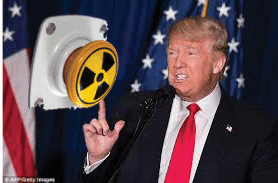 In Nuclear Poker, Don’t Bet on Trump, Bloomberg JAN 19, 2017 BY James McManus Is North Korea’s belligerent young leader, Kim Jong-un, bluffing when he says the “last stage” is underway for testing a ballistic missile capable of hitting the U.S.? What about President-elect Donald Trump, when he tweets, “It won’t happen“?
As Trump’s administration begins, a showdown with North Korea over ICBMs seems all but inevitable. Just yesterday, South Korean media reported possible signs that the North may be preparing a new missile launch. In managing this conflict, few things will be more crucial than understanding the nature of bluffing. Unfortunately, for all his talk of being a good deal maker, Trump is a terrible bluffer — and his lack of skill is likely to destabilize nuclear politics.
A bluff is an untrue but plausible story. In the mindsport of poker, bluffs work when your opponent believes you have a better hand, so he can’t call your bet or raise, conceding you the pot. The savvier player wants to steadily grind away at the stack of his opponent over a large number of small pots, without risking too many of his own chips in any single hand. The weaker player can counter the “small ball” strategy by raising all-in fairly often, forcing all-or-nothing confrontations.
To understand why these dynamics are so crucial in nuclear negotiation, consider the work of John von Neumann, the prodigiously gifted polymath who immigrated to the U.S. from Hungary in 1933 and later contributed to the Manhattan Project. Von Neumann loved poker because its strategy involves guile, probability, luck and budgetary acumen, but is never transparent; it always depends on the counterstrategies deployed by opponents.
Trump bluffs almost constantly. He has spent his entire adult life overstating the value of his real estate holdings and branding endeavors, while bragging relentlessly about his wealth, sex life, length off the tee, and on and on. His bluffs during the campaign — that he had a replacement for Obamacare, a secret plan to defeat Islamic State and so on — were plainly false to anyone paying attention. To Trump, what was true hardly mattered.
Such tendencies would not serve him well in a poker game. Any player who continually misrepresents the size of his hand would cause sharp opponents to give his bets little credit. They’d simply wait for above-average hands and call him. As Daniel Negreanu, the all-time winningest poker tournament player, put it to me, “Trump’s bluffs are very effective against level-one thinkers. His lies are so outlandish that people think they have to be true or he wouldn’t have said it. The constant barrage makes him tougher to read. But sharper players would pick him apart.”
Kim may not be irrational, but he knows how to seem that he is, which gives him leverage. Kim’s contempt for most North Koreans means that he has less to lose by threatening to nuke an American city. The more we know about his pretensions to deity, his labor camps, the food and electricity shortages his policies have prolonged, the easier it is to believe he might sacrifice millions of Koreans in an absurd attempt to save face. Kim isn’t threatening to defeat the U.S., a bluff no one would credit; he’s trying to prove he could grievously injure it before dying himself, a bluff that must be taken seriously. As Negreanu puts it, Kim is “a scary player. Being unpredictable, capable of any move at any time, makes him hard to prepare for.”
In such circumstances, Trump’s long history of empty boasts is destabilizing. Kim may calculate that he has renewed leverage to push for concessions from the U.S. He might engage in riskier behavior, such as firing more test missiles or launching cyberattacks. Almost certainly, he’ll persist in developing missiles that can reach the U.S., calculating all the while that Trump’s Twitter outbursts are simply talk.
That may be true. But what if, for once in his life, Trump means what he says? What if he can’t bear to have his bluff called, and really is tempted to launch a preemptive attack if it looks like North Korea poses a real threat to the U.S. mainland?……..https://www.bloomberg.com/view/articles/2017-01-19/in-nuclear-poker-don-t-bet-on-trump
100 Meters High Crane Collapsed at Takahama nuclear Plant
In Fukui Prefecture a 100 meters crane collapsed in a storm at Takahama nuclear Plant.


Nuclear weapons should be completely prohibited – Chinese President Xi Jinping
 China’s Xi calls for a world without nuclear weapons, SCMP, 19 Jan 17, Chinese President Xi Jinping called for a world without nuclear weapons at the UN on Wednesday and urged a multilateral system based on equality among nations large and small.
His speech at the United Nations in Geneva came at the end of a diplomatic tour that included a landmark address at the World Economic Forum in Davos, just days before Donald Trump is sworn in as the 45th president of the United States.
Some experts have seen Xi’s Swiss tour as a bid to capture the mantle of global leadership at a time when Washington is clouded by uncertainty with an unpredictable political novice about to take charge.
“Nuclear weapons should be completely prohibited and destroyed over time to make the world free of nuclear weapons,” Xi said, according to an official translation.
China has been a nuclear power since 1964.
In an address that stretched beyond 45 minutes, Xi also sought to make the case for a global governance system that strives for a level playing field among countries where interventionist tendencies are resisted……..
While he made no mention of the incoming Republican administration, Xi’s message on nuclear weapons stood apart from Trump’s at times contradictory remarks on American nuclear power……http://www.scmp.com/news/china/diplomacy-defence/article/2063383/chinas-xi-calls-world-without-nuclear-weapons
Crash in Toshiba shares as nuclear financial crisis deepens

 Toshiba shares crash as nuclear writedown crisis deepens Shares in Toshiba have dived 16% on reports that the embattled Japanese conglomerate faces bigger losses at its US nuclear power business. BBC News 19 Jan 17
It is feared Toshiba may have to write down the value of the unit by a larger-than-expected 700bn yen ($6.1bn; £5bn).
There are unconfirmed reports Toshiba is seeking aid from the government-backed Development Bank of Japan (DBJ).
Toshiba said the exact writedown figure was not finalised, and declined to comment on any DBJ approach.
The laptops-to-hydro power giant was plunged into crisis late last year when it emerged it faced huge cost overruns on projects handled by a newly-bought company that builds US nuclear power plants. ……. on 27 December Toshiba admitted that it faced writedowns of “several billion dollars”. The company later indicated that the size of the writedowns would be between $1bn and $4.5bn.
Toshiba’s nuclear services business brings in about one-third of the industrial giant’s revenue.
The share price, down 26% at one stage on Thursday, is now 50% lower than when the writedown revelations emerged amid fears that the company still has no firm grip on the final costs………http://www.bbc.com/news/business-38674697
Shimane nuclear power plant found to have dangerous corroded holes in air ducts inside the No. 2 reactor
 Corroded holes found inside nuclear plant in Shimane http://mainichi.jp/english/articles/20170119/p2a/00m/0na/002000c January 19, 2017 (Mainichi Japan) Japanese versionMATSUE — Nineteen corroded holes have been discovered in air ducts inside the No. 2 reactor at the Shimane nuclear power plant, the Mainichi Shimbun has learned. As a consequence of this discovery, the Nuclear Regulation Authority decided on Jan. 18 to order all electric power companies to carry out checks on ducts inside all of their nuclear power plants.
The corroded holes were discovered when insulating material — that had been wrapped around the ducts — was removed during a check in December 2016 at the No. 2 reactor at the Shimane plant, which is operated by Chugoku Electric Power Co. The largest hole of the 19 was found to be approximately 30 centimeters by 100 centimeters in size.
Corroded holes in ducts present a threat as there is a chance that radioactive material could flow into the central control room via the holes during an accident — thereby exposing power plant staff to radiation.
North Korea may be preparing for a new missile test-launch
U.S. sees indications of possible North Korea missile test-launch Yahoo News, By James Pearson and Phil Stewart January 20, 2017 SEOUL/WASHINGTON (Reuters) – North Korea may be preparing for a new missile test-launch, U.S. officials told Reuters on Thursday, after South Korean media reported movement of what could be components of an upgraded prototype of an intercontinental ballistic missile.
The U.S. officials, who spoke on condition of anonymity, said the United States was seeing activity in North Korea indicating a possible ballistic missile test, including positioning of two mobile missile launchers.
Still, the timing of the test and precise type of missile remained unclear, the officials said.
In his New Year’s speech, leader Kim Jong Un said North Korea was close to test launching an ICBM, and state media has said a launch could come at any time. Experts on the isolated and nuclear capable country’s missile program believe the claims to be credible.
The Pentagon declined comment on its intelligence about the North Korea threat, but spokesman Peter Cook assured reporters that Washington’s readiness would be not be diminished during the U.S. presidential transition, due to take place on Friday.
“I can’t get into intelligence matters. I can’t confirm what’s been reported there,” Cook told a news briefing.
“We would once again encourage North Korea not to engage in provocative actions that do nothing but destabilize the region.”
South Korean media said a test could potentially coincide with the inauguration of U.S. President-elect Donald Trump on Friday, South Korean media said.
Trump on Jan. 2 tweeted, “It won’t happen!” about North Korean ICBMs, although his precise meaning was unclear. The Pentagon has said it would not necessarily strike a test-launched ICBM if it did not pose a threat.
NEW TYPE OF MISSILE?
South Korean intelligence agencies reported on Wednesday that they had recently spotted missile parts being transported, believed to be the lower-half of an ICBM, raising fears that a test-launch may be imminent, the Chosun Ilbo newspaper said, citing unidentified military sources…….https://www.yahoo.com/news/u-sees-north-korea-activity-signaling-possible-missile-160137245.html
1,130 cracks, 70% rigidity lost at Onagawa reactor building

Tohoku Electric Power Co.’s Onagawa nuclear power plant straddling Miyagi Prefecture’s Onagawa and Ishinomaki
Plans to resume operations at the Onagawa nuclear power plant’s No. 2 reactor have taken a hit, as the building sustained 1,130 cracks in the walls and lost an estimated 70 percent of structural rigidity in the massive 2011 earthquake.
Tohoku Electric Power Co. revealed the extent of the damage at a Nuclear Regulation Authority review meeting on Jan. 17 to investigate plans to bring the power station in Miyagi Prefecture back online.
Tohoku Electric plans to extensively reinforce the damaged No. 2 reactor building. It is seeking to bolster the quake-resistance of the reactor to pass the stricter safety regulations on nuclear plants instituted by the NRA in the aftermath of the Fukushima nuclear crisis, triggered by the disaster.
However, that may be a long way off, as the nuclear watchdog said that it must inspect the cracks and the plans before the utility can proceed with the reinforcement project.
As with all nuclear power stations in the nation, the facility, which straddles the town of Onagawa and Ishinomaki city, went offline after the Great East Japan Earthquake and tsunami sparked the nuclear disaster.
A tremor of 607 Gals was recorded at the No. 2 reactor building when the magnitude-9.0 earthquake struck, but the structure was only built to withstand jolts of up to 594 Gals, according to Tohoku Electric. (Gal is a unit of acceleration used to describe how violently something shakes.)
A later architectural investigation found a total of 1,130 cracks on its walls, with 734 of them found on the top third-floor section. There were more cracks in the upper levels of the building as that part swayed the most during the earthquake.
The difference in the ways the uppermost section rocked compared to the lower portion when hit by aftershocks suggested that the structural rigidity of the third floor was down to 30 percent of what it was when the reactor began operating in 1995, according to the utility.
The lower section of the building, which covers two above-ground floors and three basement levels, was estimated to have lost 25 percent of its structural rigidity.
Structural rigidity assesses a building’s ability to withstand earthquakes and other stresses from outside without being distorted.
http://www.asahi.com/ajw/articles/AJ201701180054.html
Designation of radioactive waste lifted

Japan’s environment ministry has lifted the radioactive designation it applied to a batch of waste after the 2011 Fukushima Daiichi nuclear accident.
About 200 kilograms of waste stored at a private facility in Yamagata Prefecture can now be disposed of as general waste.
People familiar with the matter say the radioactivity level of the waste was confirmed to be lower than the government-set level of 8,000 becquerels per kilogram.
The ministry said it sent a letter, dated January 13th, to notify the facility of its decision to lift the designation.
It is the first time the ministry has lifted the designation for waste kept by a private company in connection with the nuclear accident.
Last July, the ministry lifted the designation of radioactive waste stored in the city of Chiba, just outside Tokyo. It was the first case among municipalities storing radioactive waste from the Fukushima accident’s fallout.
Ministry officials say as of September 30th last year, there was about 179,000 tons of waste designated as radioactive across the country.
https://www3.nhk.or.jp/nhkworld/en/news/20170117_13/
Mayor in rural Japan who supports construction of nuclear plant wins fourth term

OMA, AOMORI PREF. – The mayor of Oma, Aomori Prefecture, who supports the construction of a local nuclear plant, was elected Sunday to a fourth term, defeating three first-time candidates.
The victory by Mitsuharu Kanazawa, a 66-year-old independent, came in the first mayoral voting in Oma in 16 years. In each of the past three races, he was handed a new four-year term since he ran unopposed.
Voter turnout came to 78.89 percent.
The main election issue was the ongoing project by Electric Power Development Co., better known as J-Power, to construct a nuclear plant in the town, with the start of operations slated for around fiscal 2024.
During the campaign, Kanazawa attracted voter support by highlighting the job-creation potential if the plant is constructed ahead of schedule.
Of the three challengers, Naofumi Nozaki, 61, a former town official, said Oma should not rely fully on the nuclear plant, while Hideki Sasaki, 67, called for a referendum on whether to go ahead with the project. The third, Atsuko Kumagai, 62, called outright for the project to be canceled.
Kanazawa garnered 2,081 votes while Nozaki gained 1,523. Sasaki received 79 votes and Kumagai got 34.
7 Times More Leukemia in 2015 than 2014, 80% in Eastern Japan
Warning, this is not the result of an official study but the findings of the personal study of Kikko, a blogger who took as a base the number of hospitalized patients. But again we cannot expect the Japanese government to officially advertize it: “The number of patients diagnosed with leukemia in 2015 was about 7 times higher than the previous year.”

From June 2015
Sharp increase in leukemia patients ~ Number of patients is about 7 times more than last year ~ Fukushima, Ibaraki, Tochigi, Tokyo
According to the statistics of the National Public Medical Association from the hospitals of each prefecture, from April to October 2015, the number of patients diagnosed as “leukemia” was about seven times higher than in 2014.
About 60% or more of patients diagnosed with leukemia are acute leukemia,
Since 1978 when they began taking statistics, such high proportion never occured before.
About 80% of the patients are in the Tohoku and Kanto regions. Fukushima Prefecture is the largest, next, Ibaraki, Tochigi and Tokyo in that order.
Strontium 90 is the most probable cause. It acts inside the body as calcium so that it can be stored in bones and brain. It takes 2-3 years until symptoms develop. People inhaling it or ingesting it in foods such as milk, fish and meat.
Pipe checks at Japan’s nuclear control rooms conducted without removing insulation
The vast majority of Japan’s 42 viable commercial nuclear reactors have not had detailed checkups performed on the air conditioning and ventilation systems of their central control rooms, it has been learned.
According to Japan Atomic Power Co. and nine utilities that manage nuclear power plants, the checkups — conducted at only two of the plants so far — are carried out without removing the insulation on the pipes.
Last month, Chugoku Electric Power Co. found extensive corrosion and holes, including one measuring 30 cm by 100 cm, in the ventilation pipes of the No. 2 reactor at the Shimane nuclear plant in Matsue, Shimane Prefecture. It was the first time the utility had removed the covering on the pipes since the reactor booted up in 1989.
Concluding the pipes were not functioning properly, Chugoku Electric reported the degradation to the Nuclear Regulation Authority.
In the event of a accident, control rooms, which are staffed around the clock, must be self-contained to prevent outside air from entering.
Five reactors at the three nuclear plants that have been reactivated since 2015 have not undergone pipe inspections in which their insulation was removed. Of the five, the No. 1 reactor at Kyushu Electric Power Co.’s Sendai plant in Kagoshima Prefecture and the No. 3 reactor at Shikoku Electric Power Co.’s Ikata plant in Ehime Prefecture are currently in operation.
Following the discovery of the pipe degradation at the Shimane No. 2 reactor, the NRA plans to check conditions at all of the nation’s nuclear plants, sources said.
Hokuriku Electric Power Co. detected rust in the ventilation pipes of the No. 1 reactor at its Shika nuclear plant in Ishikawa Prefecture in 2003. After removing the covers and conducting further inspections, the company replaced the equipment in 2008.
The NRA suspects that the pipe corrosion at the Shimane No. 2 reactor may violate nuclear regulatory standards, an official said.
“As the plant is located near the sea, salt-containing air may have flowed into the pipes and hastened corrosion,” a Chugoku Electric official said.
Most of the nation’s nuclear plants are in coastal areas because they use seawater to cool their turbines.

Taiwan revises law to become nuclear-free society by 2025

Operations of two reactors at the No. 4 nuclear power plant in New Taipei City have been put on hold.
TAIPEI–Taiwan enacted a revised law on Jan. 11 to phase out nuclear power generation by 2025 and increase renewables, a considerable challenge for this resource-poor island.
Departure from nuclear power was a campaign pledge of Taiwanese President Tsai Ing-wen, who assumed office in May.
The bill met with no strong opposition during deliberations at the Legislative Yuan, or the Taiwanese parliament.
The legislation aims to raise the share of renewables, such as solar or wind power, from the current 4 percent to 20 percent of total output in 2025 by liberalizing the renewable energy market.
Electricity generated at three nuclear power stations account for about 14 percent of Taiwan’s electricity output. Operations have been frozen at a fourth nuclear power plant because of public outcry against nuclear power following the 2011 Fukushima nuclear disaster.
The industrial sector and others have raised concerns about possible fluctuations in the power supply or a spike in utility rates in the coming years.
Another focal point of debate was disposal of radioactive waste kept at a facility in an outlying island.
The Executive Yuan, the equivalent of Japan’s Cabinet, sponsored the bill to revise the electricity utilities industry law to pave the way for a nuclear-free society.
Under the revised law, Taiwan Power Co., operator of all nuclear power plants in Taiwan, will be spun off into two companies: one in charge of power generation and the other overseeing electricity distribution.
All six reactors in Taiwan will reach their 40-year operation limit by May 2025. The No. 1 reactor at the No. 1 nuclear power plant will be the first to hit the limit, in December 2018.
The revised law ruled out the possibility of extending the lives of the reactors, stating that all reactors will end their operations by 2025.
http://www.asahi.com/ajw/articles/AJ201701120036.html
Russia to lock Bangladesh into a 20 year big nuclear power debt
 Russia extends $11.38 bln loan to Bangladesh to build nuclear power plant http://tass.com/economy/925025 January 13 Bangladesh will repay the actually spent loan in equal six-month installments over a twenty year period MOSCOW, January 13. /TASS/. Russia’s government has extended a $11.38 billion loan to Bangladesh to build the Rooppur nuclear power plant. The relevant document was published on the government’s website containing legal information.
According to the draft inter-governmental agreement, the loan will be used from 2017 to 2024. Bangladesh will repay the actually spent loan in equal six-month installments over a twenty year period. The first installment will be paid out on March 15, 2017.
Two units of the Rooppur nuclear power plant, with a capacity of 1,200 MW each, which are being built with Russia’s assistance, are planned to be put into operation in 2022 and 2023.
In mid-December 2015, Russia’s Rosatom State Atomic Energy Corporation signed an EPC contract for a nuclear power plant in Bangladesh.
The construction work is being done in accordance with the inter-governmental agreement on cooperation in building a nuclear power plant in Bangladesh, dated 2011. The nuclear power plant will be located on the eastern bank of the Ganges River, 160 kilometers from the country’s capital of Dhaka.
1 This Month





PLEASE OPPOSE HR 8255 AND S.3639 – bills would accelerate satellite deployment, with no environmental review or safeguards – https://ncstd5li.quorum.us/campaign/169331/
To see nuclear-related stories in greater depth and intensity – go to https://nuclearinformation.wordpress.com
-
Archives
- October 2026 (10)
- September 2026 (339)
- August 2026 (330)
- July 2026 (355)
- June 2026 (287)
- May 2026 (306)
- April 2026 (356)
- March 2026 (251)
- February 2026 (267)
- January 2026 (308)
- December 2025 (358)
- November 2025 (359)
-
Categories
- 1
- 1 NUCLEAR ISSUES
- business and costs
- climate change
- culture and arts
- ENERGY
- environment
- health
- history
- indigenous issues
- Legal
- marketing of nuclear
- media
- opposition to nuclear
- PERSONAL STORIES
- politics
- politics international
- Religion and ethics
- safety
- secrets,lies and civil liberties
- spinbuster
- technology
- Uranium
- wastes
- weapons and war
- Women
- 2 WORLD
- ACTION
- AFRICA
- Atrocities
- AUSTRALIA
- Christina's notes
- Christina's themes
- culture and arts
- Events
- Fuk 2022
- Fuk 2023
- Fukushima 2017
- Fukushima 2018
- fukushima 2019
- Fukushima 2020
- Fukushima 2021
- general
- global warming
- Humour (God we need it)
- Nuclear
- RARE EARTHS
- Reference
- resources – print
- Resources -audiovicual
- Weekly Newsletter
- World
- World Nuclear
- YouTube
-
RSS
Entries RSS
Comments RSS

