Two Faces of Peace: How Trump’s “Peacemaker” Presidency Waged War Across the Globe

March 31, 2026 , ScheerPost Staff, https://scheerpost.com/2026/03/31/two-faces-of-peace-how-trumps-peacemaker-presidency-waged-war-across-the-globe/
When the world hears “peace,” it rarely imagines schools leveled, civilians at risk, and covert armies deployed across continents. Yet, reporting from The Intercept reveals that under President Donald Trump, the promise of a “peace presidency” has coexisted with a sprawling network of global conflicts. Nick Turse’s investigation exposes the U.S.’s secretive military footprint in more than 20 countries, while Natasha Lennard documents the deliberate targeting of Iranian universities by U.S.–Israeli airstrikes—attacks designed to cripple a nation’s capacity to rebuild. Together, these Intercept reports reveal two faces of the same strategy: the veneer of peace masking the machinery of war, from classrooms to battlefields, and from boardrooms to drone command centers.
Nick Turse’s investigative report for The Intercept exposes the stark contrast between President Donald Trump’s public image as a “peacemaker” and the reality of his administration’s military actions. While Trump campaigned on promises to avoid foreign entanglements and even founded a so-called Board of Peace, Turse details how the U.S. under Trump has been drawn into more than 20 military interventions, armed conflicts, and covert operations worldwide.
From drone strikes and proxy wars to full-scale interventions, Trump’s military footprint spans Afghanistan, Iran, Iraq, Syria, Venezuela, and dozens of other countries. The report highlights the administration’s repeated bypassing of Congress, reliance on secretive programs like 127e, and the cloak of legal euphemisms—“advise, assist, and accompany” missions or “military actions”—to obscure combat operations.
Turse documents a disturbing pattern of clandestine operations, including regime-change efforts, attacks on civilian targets, and the deployment of thousands of Special Operations forces without clear oversight. As Sarah Harrison, former Pentagon counsel, notes, these actions not only flout constitutional and international law but also put Americans at greater risk while enriching the military-industrial apparatus.
“Under the U.S. Constitution, it’s Congress that has the authority to declare war, not the president,” pointed out Katherine Yon Ebright, counsel in the Brennan Center’s Liberty and National Security Program. “Congress has not authorized conflicts in this wide array of contexts, and indeed many lawmakers — to say nothing of members of the public — would be surprised to learn that hostilities have taken place in many of these countries. Congressional authorization isn’t just a box-checking exercise: it’s a means of ensuring that the solemn decision to go to war is made democratically and accountably, with a clear purpose and goal that the American people can support.”
“The 2001 Authorization for Use of Military Force, enacted after 9/11 and stretched by successive administrations, has been invoked to justify counterterrorism operations—including airstrikes, ground combat, and support for partner militaries—in at least 22 countries, according to a 2021 report by Brown University’s Costs of War Project. Under Trump, even this framework has been circumvented in favor of more secretive programs and broad interpretations of executive authority.”
While Trump projected an image of peace abroad, Natasha Lennard reports in The Intercept on the very real human consequences of his and Israel’s military campaigns in Iran. Over the weekend, U.S.–Israeli strikes targeted the Isfahan University of Technology and the Iran University of Science and Technology in Tehran. These attacks, part of a broader campaign that has hit hospitals, power plants, desalination facilities, and schools, left Iranian students and staff unprotected and at risk.
The official justification—that the universities were connected to Iran’s weapons programs—is deeply cynical, Lennard notes. By this rationale, any advanced U.S. or Israeli institution involved in military research could be deemed a legitimate target, from MIT to Technion or Johns Hopkins. The reporting underscores the double standard of asymmetric warfare: aggressors rationalize strikes while shielding their own infrastructure.
Experts cited by Lennard emphasize that the bombings are systematic, aimed at undermining Iran’s capacity for indigenous development and sovereignty. Drawing parallels to Gaza, the attacks on universities are part of a long-term strategy to foreclose reconstruction and maintain strategic dominance
By combining Turse’s exposé of Trump’s global “peace presidency” turned conflict presidency with Lennard’s documentation of targeted strikes on educational institutions, the picture is clear: a veneer of peace masks a sprawling, violent network of operations designed to project power, suppress knowledge, and reshape global dynamics on U.S. and Israeli terms.
Both reports highlight the human cost and the hypocrisy of modern warfare, where civilian infrastructure, education, and research are treated as expendable under the guise of national security, and where the appearance of peace serves to hide the orchestration of conflict at a global scale.
Sources: Nick Turse, “Trump’s Secret Wars on the World Keep Expanding,” The Intercept, March 30, 2026; Natasha Lennard, “What Would We All Say If Iran Razed MIT Because of Military-Related Research?” The Intercept, March 30, 2026.
‘This Arrogant Enemy’: Israel’s Colonial Reversion to the Noose
April 1, 2026 SCHEERPOST, Zarefah Baroud for Thinking Palestine
“Israel is also confronted by something older than Israel itself: namely, the willingness and ability of the Palestinian people to mobilize and resist in the face of state-sanctioned death.”
The authorities cuffed the nationalist detainees, leading them to their death at the gallows, scaffolding and rope that had borne witness to the final moments of dozens of nationalists like them. As they approached the noose with grace and a sacred conviction, they declared their final tribute to the beloved homeland: “Filasteen ‘Arabiyya!” (“Palestine is Arab”), and issued a final, unflinching indictment of her oppressors.
The families and communities of the martyrs gather outside Sijn Akka, dressed in white and adorned with henna as if they were attending a wedding, receiving the martyr’s body among eruptions of ululations and celebratory songs.
This is not a romantic tale, but rather the tradition adopted by Palestinians throughout the British Mandate for Palestine, a colonial regime that saw to the systematic annihilation of an entire generation of Palestinian nationalists.
The Spectacle of the Noose
While this scene played out on many occasions throughout the British Mandate for Palestine, it could conceivably happen tomorrow, if proposals put forward by Itamar Ben Gvir, Israel’s Minister of National Security, are approved by the Israeli Knesset. If this comes to pass, the “death penalty bill” — an amendment to the current Israeli penal code – will result in the execution of those who have allegedly killed Israelis for nationalist purposes (or, more reductively and disingenuously, for “anti-Semitic” reasons).
Further, recent reports have confirmed that the Knesset’s proposed legislation draft will no longer perform the death penalty via lethal injection but rather transform the execution of Palestinian detainees into a colonial spectacle. In other words, the original mode of colonial execution would be restored as the chosen method of capital punishment par excellence.
If approved, hanging will once more become a colonial spectacle, which is enacted, in the sterile and removed wording of the National Security Committee, with the aim of “cut[ting] off terrorism at its root and creat[ing] a heavy deterrent.”
It is critical that, as we discuss this pending policy, which Abdel Nasser Farawna characterizes as improbable (though not impossible), we recognize that the extrajudicial execution of prisoners has always been Israel Prison Service (IPS) policy.
Ben-Gvir has put forward his proposal at a time (the period since October 7, 2023) when the Israeli authorities have murdered detainees at an unprecedented rate. In April 2023, the Palestinian Commission for Detainees and Ex-Detainees estimated 236 Palestinians had been killed in Israeli custody after 1967, a period of 56 years. In the post-October 7 period, in contrast, almost one hundred Palestinians have died in custody, a killing rate around 10 times the historical average.
A November 2025 report produced by Physicians for Human Rights Israel suggests that this may actually be a substantial under-estimate, by virtue of the (at least) 14,000 Gazans who are still missing, presumed to be dead or abducted at the time of writing…………………………………………………………………. https://scheerpost.com/2026/04/01/this-arrogant-enemy-israels-colonial-reversion-to-the-noose/
What Happens When a Nuclear Site Is Hit?

2 April 26, https://www.wired.com/story/heres-what-can-happen-when-the-us-bombs-irans-nuclear-sites/
As US and Israeli strikes continue on Iran’s nuclear facilities, the real danger isn’t the explosion, but what happens if critical safety systems fail—and how that risk could spread across the Gulf.
Into the second month of the US-Iran war, the conflict in the Gulf continues to escalate—airstrikes widening, oil markets reacting, and pressure mounting around the Strait of Hormuz. But beyond the immediate security and economic concerns, another question is quietly taking shape: What actually happens if a nuclear site is hit?
That is the problem with Nuclear Power. It’s a target. There are no do overs if it goes wrong. The IAEA spends a lot of time trying to mitigate atomic problems but they can’t stop those who want to do bad things. When I think about how Chernobyl was handled by the Russians, I think would our government do what they did?
Deny and hide the truth from the public? I’m not sure I’m not willing to place a bet on nuclear but I know many are.
A ‘small’ nuclear war would still be global catastrophe
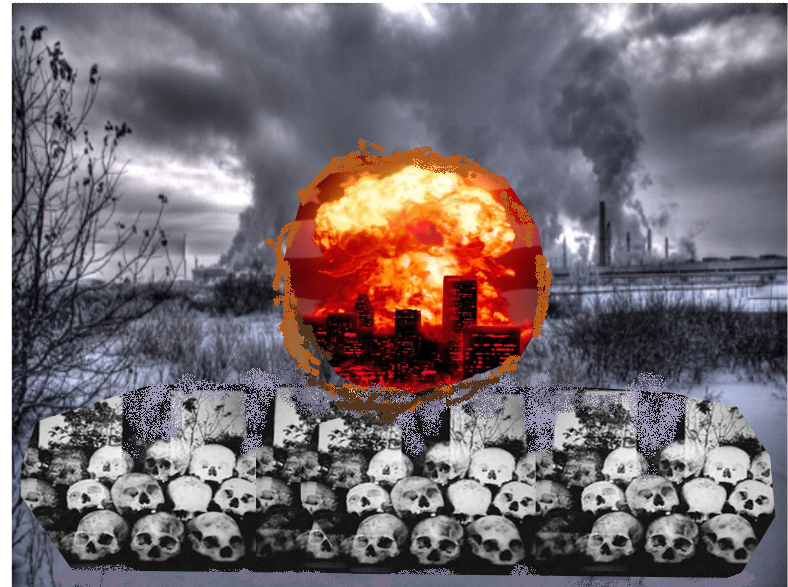
There is no such thing as a small nuclear war. Even a limited exchange of tactical weapons could kill 90 million people – far more than died in WWII – in the first few hours,
April 2, 2026, Julian Cribb, https://johnmenadue.com/post/2026/04/a-small-nuclear-war-would-still-be-global-catastrophe/
There is no such thing as a “small” nuclear war. Even limited use would trigger mass death, famine and global collapse.
As West Asia stumbles towards a ‘small nuclear war’, it is time to evaluate the consequences for the entirety of humanity and the Planet.
A small nuclear war, by definition, is one involving the use of so-called tactical or battlefield nukes, low yield weapons (1000-50,000 tonnes of TNT equivalent) designed chiefly for a military objective, delivered as aerial bombs, shells, small missiles, torpedoes, mines etc. It does not involve the use of ICBMs, MIRVs, “city busters” and large-scale strategic weapons.
For comparison, the weapons that levelled Hiroshima and Nagasaki had yields of 15,000 and 21,000 tonnes respectively, which today would probably rate them as tactical weapons.
However, with practically all of the world’s nuclear treaties and restraints crumbling, it is now almost inevitable that one regime or another will experiment with the smaller nukes and seek to regularise their use, primarily as a means of terrorising their opponents. Only 74 of 197 nations have signed the Treaty to Prohibit Nuclear Weapons. None of the nuclear-armed states or their close allies have signed.
Informed commentators on the Israel-USA-Iran conflict consider the use of nukes, probably by Israel in the first instance, to be increasingly likely as the war goes against them and both Trump and Netanyahu fight to stay out of jail. Israeli Ministers have previously uttered threats to employ nuclear force, though they were later silenced by Netanyahu.
US official documents indicate the America has been preparing for a limited nuclear war for over seven years. Trump has refused to rule out use of nukes, and military observers suspect the US already has them in the West Asian theatre. He has also declared his intent to restart nuclear testing. Authoritative commentators are asking whether Trump is mentally ill – and the world’s most potent nuclear arsenal in the hands of a madman.
Compounding the danger is the frequent use of nuclear threats by Russian leader Vladimir Putin along with Russia’s recent warning that the West Asia conflict could go nuclear.
Observers also consider that the Israeli nuclear threat and its assassination of the chief Iranian opponent to nuclear weapons, Ayatollah Khamenei, makes it far more likely that the new Iranian regime will accelerate plans to build atomic bombs, in the hope of deterring an attack. So one outcome of the war will be a nuclear-armed Iran – the opposite of its professed intention. This will, in turn, spark new regional arms races, with at least seven countries, and probably more, seeking to acquire the civilisation-ending weaponry.
Thus, whether or not the Israel-USA-Iran conflict goes nuclear, it may still prove to be the pebble that starts the landslide to global nuclear holocaust.
A ‘small’ war
There is no such thing as a small nuclear war. Even a limited exchange of tactical weapons could kill 90 million people – far more than died in WWII – in the first few hours, according to modelling by Princeton University. The study refers to the European context, but its message has far wider application.
In the context of dozens of nuclear armed nations – many controlled by men of questionable sanity – the doctrine of Mutually Assured Destruction, which has kept the nuclear peace for 80 years, lapses into irrelevance. Little now prevents nations from committing suicide in their crazed desire to eliminate those they deem as foes.
Furthermore, any ‘small nuclear war’ can rapidly escalate into a far larger, global affair quite quickly and unpredictably. Unable to penetrate or understand their opponent’s motives, nations may choose to strike first and hardest, regardless of the ultimate cost to their own citizens. Indeed, this already appears a significant factor in the escalation of the West Asia conflict.
A current threat analysis made during the conflict finds that the threat of nuclear war to be higher than most periods of the Cold War, but not quite as high as its 1962 Cuban crisis and 1983 ‘Able Archer’ peaks, making it the third deadliest moment in human history since nukes were invented.
It is being stoked by the failure of arms control agreements, the increasingly pugnacious rhetoric of national leaders, and technical advances that could easily go wrong. Misinterpretation, miscalculation, political impulsiveness and an AI glitch have become primary triggers for an atomic war.
A nuclear explosion produces three instant killing mechanisms: a shockwave, a pulse of extreme heat, and a burst of deadly radiation. A very small 10kt weapon, detonated at ground level, causes severe shockwave damage up to 1km from the blast. The thermal pulse inflicts fatal burns and a firestorm up to 2kms. Flying debris kills or injures people several kms distant.
The radiation burst will kill unprotected people up to 1km away, and drifting fallout will create a potential death zone up to 10kms downwind. Larger weapons inflict proportionately greater death and destruction.
Those exposed to moderate doses of radiation develop acute radiation syndrome, which develops in stages: bone marrow is the first to fail, leading to uncontrolled infections and bleeding. Around half of those exposed to a moderate dose die within 60 days. At higher doses, the patient experiences severe vomiting, diarrhoea and internal haemorrhage. Death occurs within two agonising weeks, and no treatment can reverse it. At extreme doses, the heart and central nervous system collapse, and death occurs within three days. In a nuclear war, most radiation victims will receive little or no medical care.
Fallout from a nuclear strike contains particles with a half-life lasting from days to 30 years, so can go on killing for decades, without the need for new strikes. Gamma rays can travel long distances and penetrate most buildings unless they are sheathed in lead, thick concrete or rock. Long term effects include an epidemic of cancers, thyroid and immune system failure.
Globally, even a ‘small nuclear war’ could affect every country and every person, no matter how far away from the seat of the conflict, by means of the “nuclear winter”.
In a scientific paper published in 1983, Professor Brian Toon, Carl Sagan and colleagues calculated that the dust and smoke from a larger (5000 megaton) nuclear war would cut light to the Earth and reduce land temperatures to minus 15-25 degrees Celsius, destroying the entire world food harvest and causing universal starvation. It was this that persuaded Reagan and Gorbachev to pull back from the brink of catastrophe.
However, even a ‘small nuclear war’ of fifty or so tactical blasts would cover the Earth in a smoke cloud 30-100 kms deep within two weeks causing subzero temperatures for several years. The smoke would linger for years, possibly decades, ruining harvests everywhere. Between one and two billion people would die of starvation around the world. Everybody would go hungry. The world economy would collapse.
Iran’s deterrent
Three days before the US bombed the nuclear enrichment site at Fordow in 2025, a line of empty trucks was spotted by satellites at the facility. Intelligence assessment decided these were tasked to carry 408 kilos of highly enriched (60 per cent purity) uranium, part of a larger cache of 8.4 tonnes of uranium, to a place of greater safety.
If so, this leaves Iran with the capability to manufacture up to 14 atomic bombs or 300+ dirty bombs to deter a nuclear attack by Israel. It also has the ballistic and hypersonic missiles to deliver them, while Israel’s air defences are weakened. The radiation from a dirty bomb made from 60 per cent enriched uranium has a half-life of 740,000,000 years. While not deadly in the short term this could still render areas uninhabitable for the rest of history.
Whether this would deter a US or Israeli attack, given the unhinged state of their leadership and the moral cowardice of their governments, is not certain.
A wise course would be not to force Iran into such an escalation. But where is there wisdom in any of this?
What to Know About the ‘Massive’ Military Bunker Beneath Trump’s Ballroom

President Trump has been talking about the emergency facility beneath what was once the East Wing, details of which are usually kept secret, as he tries to justify his renovation.
By Luke Broadwater, https://www.nytimes.com/2026/04/02/us/politics/trump-ballroom-military-bunker.html?campaign_id=190&emc=edit_ufn_20260403&instance_id=173568&nl=from-the-times®i_id=60047519&segment_id=217713&user_id=432fc0d0ad6543e820e2dfcd39f76c35April 2, 2026
While most public attention has focused on the aboveground portion of President Trump’s planned $400 million ballroom, what is underneath could prove to be the more complex and expensive portion of the project.
Work crews have been digging in the earth for weeks, ripping out the Presidential Emergency Operations Center, or PEOC, to build something bigger, better and deeper underground.
The PEOC, which was built during World War II to protect the president and other top officials in the event of an emergency, was where Vice President Dick Cheney was hustled after the Sept. 11 terrorist attacks, later to be joined by President George W. Bush and his national security teams. Mr. Trump was rushed there, too, during protests over the death of George Floyd in 2020.
The bunker is beneath what was once the East Wing, which Mr. Trump tore down last year to make way for his ballroom.
Details of the underground facility are usually shrouded in secrecy. But as Mr. Trump’s ballroom faces legal challenges, he has been talking more openly about the bunker. He argues that the two are linked, which makes building the ballroom a matter of security.
Here is what we know about the PEOC.
A ‘Massive’ Military Complex
Speaking on Sunday to reporters on Air Force One, Mr. Trump said that he envisioned his 90,000-square-foot ballroom as a “shed” for the underground project.
“The military is building a massive complex under the ballroom, and that’s under construction, and we’re doing very well,” Mr. Trump said.
In Mr. Trump’s telling, the bunker will have bomb shelters and “very major medical facilities,” including a hospital. It will have the latest secure communication methods and defenses against bioweapons.
He said the ballroom would protect the underground facility from drones, bullets and other attacks. “It’s high-grade bulletproof glass. So all of the windows are bulletproof,” Mr. Trump said.
Last week, speaking about the ballroom project during a cabinet meeting, the president said that “the military wanted it more than anybody.”
Mr. Trump has said the security features make his project even more important — a point he made again this week after a judge halted the project, saying it required congressional approval.
“Unless and until Congress blesses this project through statutory authorization, construction has to stop!” wrote Judge Richard J. Leon of Federal District Court in Washington, a George W. Bush appointee.
Mr. Trump ordered an appeal, but he pointed to a section of Judge Leon’s order that allowed “construction necessary to ensure the safety and security of the White House” to continue
“We have biodefense all over,” Mr. Trump told reporters in the Oval Office this week. “We have secure telecommunications and communications all over. We have bomb shelters that we’re building. We have a hospital and very major medical facilities that we’re building. We have all of these things. So that’s called: I’m allowed to continue building.”
The Secret Service
The Secret Service has twice filed documents in court attesting to the necessity of finishing the ballroom project.
Matthew C. Quinn, deputy director of the Secret Service, wrote in December and again in January that any halt in the project could put lives in danger.
Mr. Quinn said that the agency was working with a contractor on security upgrades but that the underground work was not finished.
“Accordingly, any pause in construction, even temporarily, would leave the contractor’s obligation unfulfilled in this regard and consequently hamper the Secret Service’s ability to meet its statutory obligations and protective mission,” Mr. Quinn wrote.
He offered to brief the judge privately about the security upgrades underway. The Trump administration also filed some documents about the project under seal in federal court.
Judge Leon appeared to mostly reject those arguments.
“While I take seriously the government’s concerns regarding the safety and security of the White House grounds and the president himself, the existence of a ‘large hole’ beside the White House is, of course, a problem of the president’s own making!” he wrote.
Joshua Fisher, director for management and administration in the White House, told the National Capital Planning Commission in January that he could not share all the administration’s plans for the project.
“There are some things regarding this project that are, frankly, of top-secret nature that we are currently working on,” he said.
There are still many unanswered questions about the project, including which branch or branches of the military are involved, the costs of construction and maintenance, and many other details.
Asked about the underground portion of the project on Monday, Karoline Leavitt, the White House spokeswoman, was equally closemouthed.
“The military is making some upgrades to their facilities here at the White House, and I’m not privy to provide any more details on that,” she said.
Luke Broadwater covers the White House for The Times.
It Takes Years To Refuel A Nuclear Submarine – Here’s Why

By Chris Smith , BGR 10th March 2026
You probably charge your phone daily, while your car needs gas or a battery top-up every few days. But you don’t have to take the device or vehicle apart when you connect it to power or fill up the tank. Refueling a nuclear submarine, on the other hand, is a complicated process that takes years, just like refueling a nuclear aircraft carrier………………………
The ERO process is slow because it’s designed that way for safety reasons. The nuclear submarine has to be brought into a facility that’s capable of handling nuclear material throughout the replacement process, to ensure the safety of everyone involved in the repairs and the sailors who will crew the ship once the refueling process is done. The nuclear core remains radioactive during refueling, so radiation must be contained and the nuclear waste must be stored securely.
The submarine is brought to a dry dock for the ERO process, where engineers go through a rigorous procedure to defuel the ship and refuel it. The reactors are shut down and cooled before removing the old reactor core and installing its replacement. The actual removal of the spent core involves cutting through the submarine’s hull with hand tools, as the reactors aren’t easily accessible. These operations are performed under strict ventilation and filtration protocols to prevent radiation contamination. The old core is transported off-site for secure storage, as the nuclear material remains active. The new core is installed, and then the reactor is reassembled and the submarine is resealed. These procedures require precision and numerous inspections, as there’s no room for error. The structural integrity of the hull is key for allowing the submarine to operate at depth.
……………………………………… How much does refueling a submarine cost?
Like nuclear aircraft carriers, nuclear-powered surface ships undergo extensive RCOH processes — and they’re not cheap or quick. For example, it cost $2.8 billion to refuel and retrofit the USS George Washington aircraft carrier, and the process took even longer than anticipated. In May 2023, the U.S. Navy announced that the George Washington completed its RCOH process after 69 months
……………………………………………..
https://www.bgr.com/2117046/why-nuclear-submarine-takes-years-to-refuel/
Experts Warned For Years That A War With Iran Would Happen This Way
Caitlin Johnstone, Apr 04, 2026, https://www.caitlinjohnst.one/p/experts-warned-for-years-that-a-war?utm_source=post-email-title&publication_id=82124&post_id=193077265&utm_campaign=email-post-title&isFreemail=true&r=1ise1&triedRedirect=true&utm_medium=email
Time has a new article out in which unnamed sources assert that the Pentagon was caught totally off-guard by Iran’s aggressive retaliation against the US-Israeli onslaught which began last month, reporting the following:
“Key Trump officials, including Defense Secretary Pete Hegseth, were surprised by the barrage of retaliatory attacks Tehran launched against U.S. and Israeli targets across the region, including in countries long assumed to be off-limits: Kuwait, Bahrain, Saudi Arabia, the United Arab Emirates, and Qatar, a state that had both harbored Iran’s terrorist proxies and served as a conduit for backchannel diplomacy between the U.S. and Hamas. The response shattered the assumption that Tehran would confine itself to performative retaliation. In internal deliberations before the war’s launch, Hegseth had pointed to Iran’s muted reaction to Trump’s past attacks as evidence that calibrated force could impose costs on Tehran without triggering a broader war. Hegseth ‘was caught off guard. There’s no question,’ says a person familiar with his thinking.”
It’s so wild how we keep seeing reports that Iran’s retaliation caught the US off guard. For all the years I’ve been paying attention to this issue I’ve been reading experts and analysts saying if the US attacks Iran, Iran can close the Strait of Hormuz and strike US bases and the energy infrastructure of US allies in the region.
A few examples:
A 2006 Oxford Research Group paper titled “Iran: Consequences of a War” warned that Iran has numerous options at its disposal in the event of a US attack, and that the “most significant of these would be any possible retaliatory Iranian action to affect the transport of oil and liquefied natural gas through the Straits of Hormuz,” adding that stopping Iran from doing this “would be difficult if not impossible to achieve, leading to a fear of attack which alone would have a formidable impact on oil markets.”
A 2007 Cato Institute paper titled “The Iraq War and Iranian Power” warns that “Iran possesses the largest ballistic-missile inventory in the Persian Gulf — missiles which can reach Israel, Saudi Arabia and US military bases in Iraq,” and that “experts argue Iran could also use the ’oil weapon’: blocking the 34km-wide Strait of Hormuz and conducting submarine and anti-ship missile attacks against ports and oil facilities in Saudi Arabia, Kuwait and other Gulf Cooperation Council states.”
A 2012 NPR article titled “Can Iran Close The World’s Most Important Oil Route?” features then-chairman of the Joint Chiefs of Staff acknowledging that Iran absolutely can block the Strait of Hormuz, saying Tehran has “invested in capabilities” which specifically enable them to do so.
A paper from the Columbia Center on Global Energy Policy and the Center for a New American Security titled “IN DIRE STRAITS? IMPLICATIONS OF US-IRAN TENSIONS FOR THE GLOBAL OIL MARKET” warns of a potential scenario “that includes damage to Gulf oil infrastructure and a temporary closure of the Strait of Hormuz.”
These weren’t a bunch of keffiyeh-wearing peaceniks making these assessments, they were deeply entrenched swamp monsters entirely loyal to the US empire. They opposed war with Iran not because it would be an evil act of unforgivable mass murder, but because it would be bad for the imperial power structure.
Trump’s former national security advisor John Bolton recently tweeted that other administration officials had warned the president to dismiss Bolton’s urging to attack Iran because of the easily foreseeable consequences of that war, saying “In 2018–2019, I made the case for regime change in Iran as often as I could. Voices in Trump’s orbit often cited Iran’s capacity to close the Strait of Hormuz as a reason against regime change. Trump has been fully aware this is a possibility, and yet did not prepare.”
I have zero military training or expertise — on military matters I’m just some schmuck with internet access — and yet nothing Iran has done has surprised me. It’s playing out exactly how the experts warned it would play out. There’s no way any literate, thinking person didn’t see this coming; when they say they didn’t, it’s because they’re either lying or amazingly stupid.
Trump’s war machine is either made up of liars, morons, lying morons, or (most likely), an eclectic mixture of all three.
Projectile hits near Iran’s Bushehr nuclear plant, killing one: IAEA

Tehran says it is the fourth attack near the nuclear plant amid the US-Israel war on Iran.
By Al Jazeera Staff and Reuters 4 Apr 2026, https://www.aljazeera.com/news/2026/4/4/iaea-says-projectile-hits-near-irans-bushehr-nuclear-plant-killing-one
One person has been killed by projectile fragments after United States-Israeli strikes targeted a location close to Iran’s Bushehr nuclear plant, according to the International Atomic Energy Agency.
The agency, citing confirmation from Iranian authorities, said in a statement on X that there was “no increase in radiation levels” after Saturday’s attack.
Iran’s Foreign Minister Abbas Araghchi claimed the Bushehr facility had been “bombed” four times since the war erupted on February 28, criticising what he described as a lack of concern for its safety.
The strike comes as the US and Israel escalate their targeting of Iranian industrial sites, even as experts warn of the high risks of striking nuclear or petrochemical facilities.
IAEA Director General Rafael Grossi expressed “deep concern about the reported incident and says [nuclear] sites or nearby areas must never be attacked, noting that auxiliary site buildings may contain vital safety equipment”, the statement read.
Grossi also reiterated a “call for maximum military restraint to avoid risk of a nuclear accident,” the IAEA added.
The Atomic Energy Organization of Iran (AEOI) confirmed the incident in a post on X.
An “auxiliary” building on the site was damaged, but the main sections of the power plant were not affected by the strike, the government agency said, adding that the person killed was a member of security personnel.
The head of Russia’s state nuclear company, Rosatom, said 198 Russian staff had evacuated the plant following the attack, state news agency Interfax reported.
“As planned, we began the main wave of evacuations today, about 20 minutes after the ill-fated strike. Buses departed from the Bushehr station toward the Iranian-Armenian border. 198 people, to be exact – the largest wave of evacuation – are on the buses,” Alexei Likhachev said.
Rosatom has been evacuating staff from the plant since the US-Israeli war on Iran began. Saturday’s evacuations had been planned before the attack.
The Bushehr plant is Iran’s only operational nuclear power plant. It is located in Bushehr city, home to 250,000 people, and is one of Iran’s most important industrial and military nodes.
Meanwhile, US and Israeli strikes on Saturday hit several petrochemical plants in the southern Khuzestan region, an important energy hub, according to Iranian media.
At least five people were injured, Iranian media reported, citing a provincial official.
Explosions were heard, and smoke was also seen rising after missiles hit several locations across the Mahshahr Petrochemical Special Economic Zone.
The state-run Bandar Imam petrochemical complex, which produces chemicals, liquefied petroleum gas (LPG), polymers and a range of other products, was struck and sustained damage, Iran’s Mehr news agency reported.
A provincial governor in Khuzestan added that the Fajr 1 and 2 petrochemical companies, as well as other nearby facilities, were also hit, according to the Fars news agency. The extent of damage is unclear.
Iran’s Islamic Revolutionary Guard Corps (IRGC) claimed it shot down an MQ-1 drone over central Isfahan province on Saturday, hours after authorities said they forced down two US warplanes.
Isfahan, which houses an underground uranium conversion and a research site, was one of three facilities bombed during US and Israeli strikes on Iran last June.
Ambassador Chas Freeman: Trump PUSHES ESCALATION — Israel’s Strategy COLLAPSES Overnight
3 April 26,
COMMENT by Robert Anderson
The US, and its administration are on the losing end of this war, there’s a coverup going on. The military hospitals in Germany are full, we have many more casualties from the war in the Gulf/Iran/Israel. Iran is essentially winning this war. We will quit the war while we are behind (losing in this case. Epstein will come back to the forefront at some point. If nothing else this will bring Trump down, he’s being blackmailed by Israel which forced him into this war,
From ISIS to Iran: Joe Kent Says Washington Keeps Repeating the Same Catastrophic Playbook
April 3, 2026, ScheerPost Staff, https://scheerpost.com/2026/04/03/from-isis-to-iran-joe-kent-says-washington-keeps-repeating-the-same-catastrophic-playbook/
In a wide‑ranging and unusually candid conversation, former National Counterterrorism Center Director Joe Kent explains why he resigned over the Trump administration’s war on Iran—and why he believes the United States has once again walked into a strategic disaster of its own making.
Kent’s account, drawn from decades inside U.S. covert and military operations, offers a rare insider narrative of how Washington’s pro‑war reflexes, Israeli pressure, and America’s own history of regime‑change hubris converged into the current crisis.
A War Built on a False Premise
Kent opens with the core claim that drove his resignation: Iran posed no imminent threat to the United States.
As he puts it, “Iran was not on the cusp of attacking us… They observed a very calculated escalation ladder.”
According to Kent, Iran halted proxy attacks once Trump returned to office, sat at the negotiating table, and even refrained from striking U.S. forces during the 12‑day war—until Israel launched its own attack on Iranian nuclear sites.
The only “imminent threat,” Kent argues, came not from Tehran but from Israel’s unilateral actions, which forced Washington into a conflict it did not need and could not win.
How Israeli Influence Shapes U.S. War Decisions
One of the most explosive threads in the interview is Kent’s description of how Israeli intelligence, lobbying networks, and media allies shape U.S. policy far beyond what most Americans understand.
Kent describes a “multi‑layered influence ecosystem” that bypasses normal intelligence vetting and pressures senior U.S. officials directly.
“They will come in and say, ‘They’re within two weeks of getting a bomb,’ and that night it’s repeated on TV,” he explains.
This echo chamber, he argues, successfully moved the U.S. red line from “no nuclear weapon” to “no enrichment at all”—a shift that made diplomacy impossible and war inevitable.
The Forever-War Reflex in Washington
Kent echoes what former officials like Lawrence Wilkerson have long warned: Washington has a structural bias toward war.
Defense contractors, political incentives, and a bipartisan foreign‑policy class create what Kent calls the “factory settings” of U.S. power—settings that default to escalation, not restraint.
Even Trump, who campaigned on ending endless wars, was eventually pulled into the Iran conflict. Kent argues Israeli officials and neoconservative advisers played to Trump’s ego, promising an easy, historic victory.
The U.S. Role in Creating ISIS—And Repeating the Pattern
Kent’s most damning historical analysis concerns the U.S. role in the rise of ISIS and al‑Qaeda affiliates in Syria.
He recounts how the Iraq War destabilized the region, empowered Iranian‑aligned militias, and pushed Gulf states and Israel to back radical Sunni factions in Syria.
“We were supporting al‑Qaeda, which eventually morphed into ISIS,” Kent says bluntly.
He describes how U.S. and Turkish support helped elevate Abu Mohammad al‑Julani, an al‑Qaeda figure who now effectively governs northwest Syria with tacit Western acceptance.
The lesson, Kent argues, is clear: regime‑change wars always produce monsters—and America never seems to learn.
Iran’s Strategy: Win by Not Losing
Kent believes Iran has adopted a long‑term strategy shaped by watching U.S. failures in Iraq and Afghanistan:
• survive • absorb blows • raise global energy costs • outlast Washington’s political will
Iran doesn’t need to defeat the U.S. militarily, he argues—only to avoid collapse.
And with control over the Strait of Hormuz, ballistic missile capacity, and regional alliances, Iran can keep the war costly indefinitely.
The Nuclear Danger: A Self‑Fulfilling Prophecy
Kent warns that U.S. and Israeli pressure may push Iran toward the very outcome Washington claims to fear.
“We basically destroyed the school of thought that opposed nuclear weapons,” he says, referring to the killing of Iran’s former Supreme Leader and the rise of hardliners.
He predicts Iran may now pursue a “North Korea solution”—a nuclear deterrent to prevent future attacks.
The Only Exit: Restrain Israel, Reopen Diplomacy
Kent’s prescription is stark:
- Publicly restrain Israel’s offensive operations
- Cut military aid if necessary
- Offer sanctions relief
- Reopen the Strait of Hormuz
- Return to negotiations
Without restraining Israel, Kent argues, the U.S. will remain trapped in an endless cycle of escalation.
“Unless we restrain Israel, I just don’t see us having a way out of this,” he warns.
This conversation is not just another critique of U.S. foreign policy. It is a rare moment when a senior insider—someone who helped run America’s counterterrorism apparatus—publicly breaks with the system he once served.
For ScheerPost readers, Kent’s testimony reinforces what independent journalists have long documented:
• U.S. wars are rarely about security • Israeli influence shapes U.S. decisions in ways the public never sees • regime‑change operations consistently backfire • Washington’s war machine is structurally incapable of learning from its failures
Kent’s resignation and his warnings should be a national scandal. Instead, they are being heard mainly on independent platforms—another sign of how tightly controlled mainstream narratives around war have become.
You can read more about Joe Kent MAGA Goons Smear The Grayzone to Get Back at Joe Kent
or Joe Kent’s Resignation, in His Own Words, Reveals MAGA’s Fracture Over War—Not a Break From Empire
Remember this too: as Nate Baer reported, “Then you’ve got the frauds like Joe Kent, the director of the National Counterterrorism Center who just resigned over the war. A MAGA devotee and former special forces operative who pulled the trigger for U.S. imperialism in Syria, Yemen, and Iraq, his resignation wasn’t about ethics or principle. In his resignation letter, he even praised Donald Trump’s 2020 assassination of Qasem Soleimani. Trump was doing imperialism right then—now, in Kent’s view, he’s simply doing it wrong.”
Escalating To Catastrophe
when Trump and Hegseth use this phrase, they are using it knowingly and deliberately. They are channelling all of LeMay’s savagery, racism and fascism.
They are simply reflecting the dominant belief held for decades by US military planners that the US can, and should, commit war crimes and mass murder to get what it wants.
Nate Bear, Apr 02, 2026, https://www.donotpanic.news/p/escalating-to-catastrophe
In his televised address last night Trump said the US was going to continue attacking Iran for another two or three weeks and would bomb the country “back to the Stone Ages, where they belong.”
More on that phrase later.
But first a bit on the economics.
Promising to keep doing the thing that has brought the world to the brink of a global economic catastrophe, and threatening maximum escalation, didn’t go down well with the people who make numbers go up or down. The oil price rocketed, and markets sank. It seems the people behind the screens might finally be waking up to the looming disaster. They might be realising, belatedly, that very soon the molecules are simply not going to arrive where they are wanted and needed in the quantities required
You can’t decouple the numbers from the atoms forever and you can only deny physical reality for so long.
And the physical reality is stark and stunning. The drop in oil production since the US-Israeli sneak attack on Iran is bigger than the drop during covid, which was the biggest drop in modern history.
Read that again if you need to.
But there’s a crucial difference that makes this situation worse.
The covid drop was demand destruction.
This is supply destruction.
In 2020 no one needed the oil because of a mandated and somewhat managed power down. In 2026 everyone still needs the oil, and gas. There’s been no managed power down. The fuel just isn’t there. For the global economy the difference is like willingly checking into rehab versus being forced to go cold turkey.
Two once-in-a-generation events in six years.
The outcome can only, logically, in the short-term at least, be disastrous.
In the medium-to-long-term perhaps, on the energy front at least, this will accelerate the shift to solar, wind and wave, as a friend suggested yesterday.
Perhaps.
But covid didn’t.
Despite that energy shock, despite all the talk of building back better and the demonstration of how active state interventions could end homelessness or drive child poverty to record lows, nothing changed. The US even re-installed Donald Trump, the man who during the first once-in-a-generation event suggested drinking bleach to cure yourself of the virus.
Nothing changed because to make pro-social changes you need pro-social leaders willing to create pro-social systems. Maniacs, war criminals and imperialists aren’t going to do it.
And that’s what we’ve got.
Additionally, for all the uses I detailed in my last article, it’s impossible to get rid of oil and gas entirely, or even mostly. You can’t even make turbines or solar panels without fossil fuels. Petrochemicals are deeply woven into the fabric of our societies, and the interests of capital have a huge incentive in keeping it that way. And when those chemicals aren’t flowing through the system in the quantities we rely on, our societies are forced to react.
And that’s what’s about to happen.
This power down will be messier than covid because it’s even less planned.
Now to the imperialism.
Trump threatened to bomb Iran back to the Stone Age. Hegseth tweeted the same.
Yes this is sadism. Yes this is an openly announced war crime. Yes it shows that this was never about helping the Iranian people.
But Trump and Hegseth’s sadism is far from anomalous.
The use of this exact phrase by US military leaders has a long history.
Curtis LeMay
General Curtis LeMay was known as The Demon. An air force general who commanded US forces in Japan, Korea and Vietnam, he advocated total war against civilian infrastructure to break the political leadership of a country. LeMay was the architect of the firebombing of Japan in March 1945, in which an estimated 100,000 to 150,000 civilians were murdered in a single night. He also commanded the total war bombing campaign against civilians and civilian infrastructure in North Korea and casually boasted that “we killed off, what, 20% of their population.”
It was during the Vietnam war, and later recounted in his autobiography, that LeMay advocated for bombing North Vietnam “back to the Stone Age.” He also said the same about the Soviet Union, arguing that the US shouldn’t just bomb but nuke them into the Stone Age.
LeMay is revered among the US military. US Strategic Command in Nebraska is named after him. LeMay was also a racist. In 1968 he joined George Wallace’s campaign for president and became his running mate. Wallace’s main policy was maintaining racial segregation.
So when Trump and Hegseth use this phrase, they are using it knowingly and deliberately. They are channelling all of LeMay’s savagery, racism and fascism.
They are channelling the savagery, racism and fascism of empire.
A savagery, racism and fascism that American empire was built on and which still today knits the United States together.
So no, Trump and Hegseth’s language, for all its barbarity, was not a surprise.
They are simply reflecting the dominant belief held for decades by US military planners that the US can, and should, commit war crimes and mass murder to get what it wants.
Naked empire
If there is a difference right now, it’s how naked empire has become. How the savagery is uttered in real time, by the president of empire, to a global audience.
The imperialists no longer pretend to have humanitarian motives for their crimes. Now they openly announce they’re going to kill large numbers of humans and overthrow governments to steal oil and resources.
Which is why anyone coming out on the other side of this still clinging to liberal beliefs about the international order, about the US as a force for good, about Trump as an anomaly, is a coward. Anyone who tells you Trump is merely an aberration is afraid to internalise the truth about empire, or is motivated by privilege not to do so.
Which goes for the vast majority of legacy media, liberal or otherwise, all of whom have utterly failed to keep citizens informed about the catastrophe this war has provoked. A major reason is because, as appendages of empire, as stenographers for imperialism, they didn’t want to say too much about the targets Iran has hit for fear of hyping the enemy.
Completely captured, but, in the end, it doesn’t matter. Because, I repeat, physical reality has a habit of being real.
It doesn’t matter whether you like that reality or not.
Molecules and atoms don’t care about your political bias or your ideology.
So now, as US-Israel escalate to catastrophe against Iran, the shock is really going to shock, especially for those who’ve been kept in the dark.
‘The rope is for Arabs only’: Israel’s new death penalty law for Palestinians recycles a colonial playbook

For years, Israeli forces already operated under rules that permitted the shooting and killing of unarmed persons, so long as they could nominally be deemed a threat. But Israel’s current war has expanded this category to the point that nearly everyone can now be made into a target.
The execution law is largely a shield designed to protect soldiers from even the limited threat of accountability, and to formalize what the field has already made routine.
The passing of the recent Israeli death penalty law legalizes an already existing policy of executions within a set schedule. The same colonial logic governs how Israel launches its wars: first Gaza, then Lebanon, now Iran. Resistance in this region is refusing Israel’s timetable of death.
By Abdaljawad Omar, Mondoweiss, April 2, 2026
The picture of Israeli National Security Minister Itamar Ben-Gvir jubilantly trying to open a champagne bottle on the Knesset floor over the passing of a death penalty law for Palestinians will be anchored in history as one of those photographs that needs no caption.
It’s the image of a country that has never truly left the colonial moment into which it was born. It didn’t simply inherit British practices, but kept them alive for over 70 years. It now reaches back to retrieve one of the darkest of these practices.
Israel’s new death penalty law, which exclusively targets Palestinians, did not come out of nowhere. It was passed down from a scaffold the British had already built on the same land, testing it on the same people under the same sky. In his study of Britain’s “pacification” of Palestine, Matthew Hughes, a military historian at Brunel University, shows how the military courts established by the British Mandate in November 1937 were built for speed above all else — a terror performed so quickly that no one had time to appeal or look away. Shaykh Farhan al-Sa’di, an elderly Qassamite revolutionary leader and one of the principal field commanders of the 1936 uprising, was captured on a Monday, tried on a Wednesday, and hanged on a Saturday. It’s the same law Israel reintroduced today.
What those courts also reveal is that British execution policy was, from the beginning, applied differently depending on who stood before the judge. Palestinians were hanged for carrying four bullets; Jews received prison sentences for firing weapons. The courts were equal on paper and unequal in practice, and everyone living under them knew it.
Bahjat Abu Gharbiyya, a Palestinian nationalist and resistance fighter who lived through the British Mandate and left some of the most detailed firsthand accounts of that period, documented this disparity plainly: in his account, the capital sentence fell on Arabs, while Jews charged with the same or graver offenses walked away with prison sentences. The rope, in practice, was for Arabs only.
The new Israeli law carries this same racism forward, entering a prison system where Palestinians make up the vast majority of political prisoners, and where the definition of who is dangerous has been stretched until it fits almost anyone who refuses to disappear quietly. The rope, as it always has been in Palestine, is for Arabs only.
There is something else that legalizing execution does, something beneath the law’s stated purpose that may be its more consequential effect. Hughes shows that in Mandate Palestine, official policy and unofficial violence never operated separately. As British courts hanged men with increasing speed and confidence, the threshold for what soldiers felt permitted to do in the field quietly fell. At Miska, a Palestinian village in the coastal area, British police tortured four captured Palestinian rebels in May 1938, killing them once interrogation was complete — not in a courtroom, but in the open.
Law and lawlessness were not opposites in that system: they fed each other. The widened application of capital punishment in the courts gave license to soldiers in the field. What we are watching in Gaza, Lebanon, and the West Bank today follows the same pattern, pushing the boundaries of permissible conduct.
For years, Israeli forces already operated under rules that permitted the shooting and killing of unarmed persons, so long as they could nominally be deemed a threat. But Israel’s current war has expanded this category to the point that nearly everyone can now be made into a target.
A codification of existing practice
In this sense, Israel is not doing something new with this law. It is catching up with itself. The execution law is largely a shield designed to protect soldiers from even the limited threat of accountability, and to formalize what the field has already made routine. According to Israeli rights group Yesh Din, of the 1,260 complaints filed against soldiers for harming Palestinians between 2017 and 2021, soldiers were prosecuted in less than 1% of cases — 0.87%, to be precise. The law does not create impunity, but guarantees it. Once enshrined, it pushes the violence further, each legal expansion making extrajudicial killing easier to justify, and each unjustified killing creating pressure for new legal cover. They drive each other.
………………………………………………………………………………………………………………………………………………………………………………………………………………………………………………………… https://mondoweiss.net/2026/04/the-rope-is-for-arabs-only-israels-new-death-penalty-law-for-palestinians-recycles-a-colonial-playbook/
So much winning
318 million people were already at crisis-level hunger before February 28. That figure has been earmarked for aggressive growth,
Please make it stop, Mr. President
Gold and Geoppolitics, , Apr 02, 2026
In 2002, the Pentagon spent $250 million on the largest wargame in US military history called ‘Millennium Challenge’. 13,500 participants, 2 years of planning, the works. The idea was pretty straightforward: simulate an invasion of a Middle Eastern country in the Persian Gulf. Suspiciously resembling Iran. The purpose was to demonstrate that America’s technological dominance could steamroll anything in its path.
They picked a retired 3-star Marine named Paul Van Riper to play the enemy.
Van Riper, who spent 41 years in uniform from Vietnam to Desert Storm, took one look at the scenario and did what any self-respecting adversary would do. He ignored it completely. Instead of radios, he used motorcycle couriers. Attack orders were hidden in the daily call to prayer. Swarms of explosive-laden speedboats were sent through the Strait of Hormuz.
And in less than 10 minutes, he sank 16 US warships. An aircraft carrier, 10 cruisers, and 5 amphibious ships. Over 20,000 simulated American casualties. The equivalent of Pearl Harbor, executed with small boats and cruise missiles by a retired Marine with a phone and a bad attitude.
So the Pentagon did what any self-respecting institution does when reality disagreed with the plan.
The ships were un-sank. Van Riper’s forces had to turn on their anti-aircraft radar so it could be easily targeted and destroyed. They even told him he wasn’t allowed to shoot down the incoming 82nd Airborne. The whole rest of the exercise was scripted to guarantee an American victory.
Van Riper walked out in disgust. His parting words: “Nothing was learned from this. A culture not willing to think hard and test itself does not augur well for the future”.
That was 24 years ago. The conditions Van Riper exploited haven’t changed. They’ve only gotten worse.
And now we’re one month into this shooting war with Iran. “Operation Epic Fury”.
Let’s have a look at what we’ve achieved, shall we?
The Strait of Hormuz has been successfully transitioned from a free international waterway into a revenue-generating toll infrastructure, administered by the IRGC with a published fee schedule, a vetting corridor near Larak Island, and legislation pending to make it permanent. Ships currently pay $2 to $3.5 million per transit, settling in yuan through CIPS, which bypasses SWIFT entirely and represents a significant upgrade in settlement efficiency.
India has adopted the yuan. Japan has adopted the renminbi. Pakistan negotiated preferential rates at 2 tankers per day. Thailand secured bilateral access. Only COSCO, China’s state shipping line, moves freely, which streamlines the user experience considerably if you happen to be Chinese. The dollar’s share of global reserves has reached its lowest level in a century, which suggests the new framework is being broadly embraced.
This is the petrodollar in transition. The mechanism that has underwritten American empire since 1974 – Gulf oil priced in dollars, revenues recycled through US Treasuries, quietly funding a $39 trillion debt – is being replaced in real time by a yuan-denominated corridor that didn’t exist 5 weeks ago. And unlike a military defeat, which can be spun and repackaged for a news cycle to consumers with the attention span of a goldfish, a reserve currency transition is a one-way door.
The Navy has achieved a significant risk management milestone by declining to escort tankers through the Strait, citing conditions that were “too high” – a prudent assessment that prioritises fleet preservation over the stated objective of the war. 3,000 ships and 20,000 seafarers remain in the Gulf, representing the largest involuntary maritime community since the Age of Sail. Maersk has 10 container ships holding position, crews resourcefully extending provisions without fresh food. 470,000 TEUs of container capacity – 10% of the global fleet – is effectively in long-term storage, reducing wear on hulls. The insurance industry has contributed independently: 7 P&I clubs filing cancellation notices achieved what the entire US Fifth Fleet could not, surging war-risk premiums from 0.2% to 10% of hull value. Even after a ceasefire, insurers require 30 to 60 days of incident-free stability before reinstating cover. The Houthis’ Red Sea precedent: 26 months and still no policy written.
Flexibility in goal-setting is a hallmark of mature organisations, and the administration demonstrated this by quietly reclassifying the reopening of Hormuz from “strategic imperative” to “optional”. The waterway that carries a fifth of the world’s oil, that the war was partly launched to secure, is no longer required for the war’s conclusion. This frees up considerable strategic bandwidth to focus on objectives that are also not being achieved, but in less publicly measurable ways.
The war has successfully disrupted seven global commodity flows simultaneously, achieving a level of supply chain diversification that would be difficult to replicate intentionally.
The agricultural sector has been comprehensively de-risked from overreliance on Gulf-sourced inputs. Hormuz transit collapsed 97%, slashing maritime CO2 emissions in the Strait to levels not seen since the Age of Sail. An environmental triumph, really. It also took with it 80% of global sulfur production along with nitrogen capacity that was rendered uneconomic by gas prices. Russia contributed by halting ammonium nitrate exports. China pitched in by banning phosphate exports through August.
All those key macronutrients were successfully eliminated from global supply chains simultaneously, and during planting season no less. Urea at the Port of New Orleans hit $690 a tonne, a 45% gain in three weeks that commodity traders would kill for under normal circumstances. The nitrogen shortage has automatically opted one in four US farmers out of spring production.
318 million people were already at crisis-level hunger before February 28. That figure has been earmarked for aggressive growth, and with the planting window about to shut, the revised projections are locked in.
The plastics and pharmaceutical supply chains have undergone similar rationalisation. Three supply chains for polyethylene were streamlined in one stroke: Indonesia, South Korea, and Singapore. In a single week!
India, producer of 40% of US generic drugs, sources 87.7% of its methanol through the same 21 miles we just helped close, putting paracetamol, ibuprofen, and metformin for 537 million diabetics on an accelerated depreciation schedule…………………………………………………………………………………………………………………………………………………………………………………………………………………………………………………………………
The war has generated strong returns for stakeholders on all sides except the one funding it. Iran is producing 1.5 million barrels per day, up from 1.1 million pre-war, selling at $110 a barrel where it used to accept $47. That’s a win. Just not for us.
…………………………….. The war has attracted significant third-party investment. Russia contributed the strike plan, 500 MANPADS launchers, and satellite intelligence. China contributed BeiDou navigation, base imagery, and fabrication tools. In return, both are collecting above-market premiums on every commodity the war has disrupted, while committing zero personnel and accepting zero risk. Iran has been capitalised just well enough to sustain the engagement without resolving it.
And this brings us to the most exciting deliverable on the roadmap. The air campaign has successfully exhausted 15,000 precision strikes, fully deployed the cruise missile inventory, and generated a $200 billion supplemental funding request – yet Iran continues to launch, export, administer the Strait, and issue demands. The enriched uranium remains 100 metres under granite that no ordnance in the US arsenal can reach, which creates a compelling case for boots-on-the-ground engagement. Polymarket agrees: 66-68% probability of US ground entry by April 30.
………………………………………………………………..One month. 88 waves. 40 destroyed energy assets across 9 countries. Seven supply chains severed. A yuan toll booth where the petrodollar used to be. A famine building in the planting data. A carrier in Crete. An AWACS burning in the Saudi desert. Cruise missiles spent. Bond markets screaming. Allies shutting bases. $12 trillion gone. And the only option left on the table is the one that turns all of this into a footnote.
We’re going to win so much.
You may even get tired of winning. https://no01.substack.com/p/so-much-winning?utm_source=post-email-title&publication_id=4094764&post_id=192834077&utm_campaign=email-post-title&isFreemail=true&r=wuef2&triedRedirect=true&utm_medium=email
Trump Willing to End War on Iran without opening Hormuz Strait?

Iran never had a nuclear weapons program and the 2015 nuclear deal, which Trump destroyed, had guaranteed that Iran’s civilian nuclear enrichment program could not be turned to military purposes. None of the rationales for the war ever made sense, and now the goal seems to be to return to the status quo ante, to get back to February 27, 2026. But you can’t.
Juan Cole, 03/31/2026
Ann Arbor (Informed Comment) – Trump has reportedly told aides that he wants to end the Iran War within four to six weeks and that he has realized that attempting forcibly to reopen it would take far longer.
Having degraded Iran’s military capabilities, Trump hopes that future diplomacy will help reopen the Strait and that other countries will take the lead on those negotiations (!)
If wishes were fishes we’d all have barrels full.
Meanwhile, Secretary of State Marco Rubio gave an interview to Al Jazeera in which he said,
It isn’t clear that Rubio is in the loop on Trump’s war aims, and Trump himself appears to say things so as to move the stock market and enable insider trading for himself and his cronies, so it is hard to know what emphasis to place on these bipolar pronouncements. On Sunday Trump was blustering about invading Iran with ground troops or destroying all its power and desalinization plants. Now on Monday evening he want to cease bombing in a few weeks and walk away.
Rubio’s three goals are silly. Iran has never had much of an air force or navy. And while its ballistic missile launchers have been reduced in number, the country still seems to have large numbers of Shahed drones that can be launched from the back of a Toyota truck or from underground emplacements, and Iran still seems to have lots of these drones. It even still has lots of missiles, and hit an Israeli oil refinery at Haifa with one on Monday. The likelihood is that with Chinese and Russian help Iran will be able swiftly to replace those launchers, and it probably is manufacturing hundreds of new drones a week even as the war drags on.
Iran never had a nuclear weapons program and the 2015 nuclear deal, which Trump destroyed, had guaranteed that Iran’s civilian nuclear enrichment program could not be turned to military purposes. None of the rationales for the war ever made sense, and now the goal seems to be to return to the status quo ante, to get back to February 27, 2026. But you can’t.
The political problem for Trump is that Iran’s strategy of taking the world’s oil and gas hostage has worked. Those fuels are characterized by inelastic demand — people who drive gasoline cars to work need gasoline, whether it costs $2.70 a gallon or $4 a gallon or $7 a gallon. They cannot easily switch to another fuel. I mean, over time they could buy an electric car or move closer to their work, but we’re talking this month and next month. Not only is demand inelastic but supply is, as well.
You’ll hear commentators talking about how America has its own petroleum. This is not true. The US consumes a little over 20 million barrels a day of petroleum and other liquid fuels. It produces 13.6 million barrels a day.
We make up the nearly 7 million barrel a day difference with imports, above all from Canada but also from Mexico, Saudi Arabia, Brazil, Iraq and Colombia.
So although the US may produce more petroleum than any other country, it uses it all itself, and then some. It is not a swing producer. Saudi Arabia is a swing producer because it can produce a lot of oil that it does not use and so can export a lot or a little, having an outsized impact on prices. The US cannot do that. And Saudi Arabia’s exports have been much reduced by Iran’s blockade. What elasticity exists in the oil supply comes from swing producers and Saudi Arabia and Kuwait cannot play that role right now. Supply is therefore inelastic over the short to medium term.
So American’s gasoline and diesel goes up when everybody else’s does, since the producers have a choice of markets to sell into and they will sell to the highest bidder. Americans, contrary to the lies Big Oil tells, are not self-sufficient in gasoline, and their pocketbooks are going to take a big hit on energy prices if this war goes on.
The war has not only taken oil off the market (we won’t be getting any from Iraq since its fields are closed now) but Israeli and US strikes on Iran, and Iranian strikes on the Gulf Arab states, have damaged oil and gas facilities. The French estimate that a third of Gulf refining capacity has been taken off the board because of damage to facilities. Let me fill you in on something: crude petroleum is worthless. It only acquires a value when it is refined into products like gasoline or diesel that can power vehicles or fuel power plants.
That refining capacity is not going to miraculously recover when Trump finally ends this pointless war. Rebuilding will take time. Depending on how long the hot war continues, you could see petroleum stay above $100 a barrel for the foreseeable future, which will take between 0.3% and 0.4% off GDP growth. The US was already anemic at a projected 0.7% GDP growth rate this year, which high petroleum and gas prices could whittle down to nothing. Or we could even go into a recession.
Moreover, the potential is there for more damage to oil rigs, refineries and terminals, and the risk increases with every day the war continues.
Americans haven’t felt the full pain yet because the markets have imperfect information or are paying too much attention to Trump’s jawboning. But industry insiders are worried about $200 a barrel petroleum (it was about $70 before the war), and are worried that elevated prices can be foreseen into the future.
So all of a sudden, as Trump begins to get heat from his MAGA base about gasoline prices and about a costly foreign war and now the prospect of boots on the ground — all of a sudden Trump wants to walk away within a month and let Iran have the Strait of Hormuz until such time as some other countries can talk Tehran out of it!!
Filed Under: Donald Trump, Featured, Iran, Natural Gas, Petroleum, War
About the Author
Juan Cole is the founder and chief editor of Informed Comment. He is Richard P. Mitchell Distinguished University Professor in the History Department at the University of Michigan He is author of, among many other books, Muhammad: Prophet of Peace amid the Clash of Empires and The Rubaiyat of Omar Khayyam. Follow him on Twitter at @jricole or the Informed Comment Facebook
Israel is making sure Trump can’t find an off-ramp in Iran
The main problem for Trump, the US narcissist-in-chief, is that he is no longer in charge of events – beyond a series of soundbites, alternating between aggression and accommodation, that appear only to have enriched his family and friends as oil markets rise and fall on his every utterance.
Trump’s words are worthless. He could agree to terms tomorrow, but how could Tehran ever be sure that it would not face another round of strikes six months later?
Netanyahu pitched the war as a repeat of Israel’s apparent ‘audacious feat’ of smashing Hezbollah. The US president should have noted instead Israel’s moral and strategic defeat in Gaza
Jonathan Cook, Mar 30, 2026
Israeli Prime Minister Benjamin Netanyahu must have persuaded Donald Trump that a war on Iran would unfold much like the pager attack in Lebanon 18 months ago.
The two militaries would jointly decapitate the leadership in Tehran, and it would crumble just as Hezbollah had collapsed – or so it then seemed – after Israel assassinated Hassan Nasrallah, the Lebanese group’s spiritual leader and military strategist.
If so, Trump bought deeply into this ruse. He assumed that he would be the US president to “remake the Middle East” – a mission his predecessors had baulked at since George W Bush’s dismal failure to achieve the same goal, alongside Israel, more than 20 years earlier.
Netanyahu directed Trump’s gaze to Israel’s supposed “audacious feat” in Lebanon. The US president should have been looking elsewhere: to Israel’s colossal moral and strategic failure in Gaza.
There, Israel spent two years pummelling the tiny coastal enclave into dust, starving the population, and destroying all civilian infrastructure, including schools and hospitals.
Netanyahu publicly declared that Israel was “eradicating Hamas”, Gaza’s civilian government and its armed resistance movement that had refused for two decades to submit to Israel’s illegal occupation and blockade of the territory.
In truth, as pretty much every legal and human rights expert long ago concluded, what Israel was actually doing was committing genocide – and, in the process, tearing up the rules of war that had governed the period following the Second World War.
But two and a half years into Israel’s destruction of Gaza, Hamas is not only still standing, it is in charge of the ruins.
Israel may have shrunk by some 60 per cent the size of the concentration camp the people of Gaza are locked into, but Hamas is far from vanquished.
Rather, Israel is the one that has retreated to a safe zone, from which it is resuming a war of attrition on Gaza’s survivors.
Surprises in store
When considering whether to launch an illegal war on Iran, Trump should have noted Israel’s complete failure to destroy Hamas after pounding this small territory – the size of the US city of Detroit – from the air for two years.
That failure was all the starker given that Washington had provided Israel with an endless supply of munitions.
Even sending in Israeli ground forces failed to quell Hamas’ resistance. These were the strategic lessons the Trump administration should have learnt.
If Israel could not overwhelm Gaza militarily, why would Washington imagine the task of doing so in Iran would prove any easier?
After all, Iran is 4,500 times larger than Gaza. It has a population, and military, 40 times bigger. And it has a fearsome arsenal of missiles, not Hamas’ homemade rockets.
But more important still, as Trump is now apparently learning to his cost, Iran – unlike Hamas in isolated Gaza – has strategic levers to pull with globe-shattering consequences.
Tehran is matching Washington’s climb up the escalation ladder rung by rung: from hitting US military infrastructure in neighbouring Gulf states, and critical civilian infrastructure such as energy grids and desalination plants, to closing the Strait of Hormuz, the passage through which much of the world’s oil and energy supplies are transported.
Tehran is now sanctioning the world, depriving it of the fuel needed to turn the wheels of the global economy, in much the same way that the West sanctioned Iran for decades, depriving it of the essentials needed to sustain its domestic economy.
Unlike Hamas, which had to fight from a network of tunnels under the flat, sandy lands of Gaza, Iran has a terrain massively to its military advantage.
Granite cliffs and narrow coves along the Strait of Hormuz provide endless protected sites from which to launch surprise attacks. Vast mountain ranges in the interior offer innumerable hiding places – for the enriched uranium the US and Israel demand Iran hand over, for soldiers, for drone and missile launch sites, and for weapons production plants.
The US and Israel are smashing Iran’s visible military-related infrastructure, but – just as Israel discovered when it invaded Gaza – they have almost no idea what lies out of sight.
They can be sure of one thing, however: Iran, which has been readying for this fight for decades, has plenty of surprises in store should they dare to invade.
No trust in Trump
The main problem for Trump, the US narcissist-in-chief, is that he is no longer in charge of events – beyond a series of soundbites, alternating between aggression and accommodation, that appear only to have enriched his family and friends as oil markets rise and fall on his every utterance.
Trump lost control of the military fight the moment he fell for Netanyahu’s pitch.
He may be commander-in-chief of the strongest military in the world, but he has now found himself unexpectedly in the role of piggy in the middle.
He is largely powerless to bring to an end an illegal war he started. Others now dictate events. Israel, his chief ally in the war, and Iran, his official enemy, hold all the important cards. Trump, despite his bravado, is being dragged along in their tailwind.
He can declare victory, as he has repeatedly sounded close to doing. But, having released the genie from the bottle, there is little he can actually do to bring the fighting to a close.
Unlike the US, Israel and Iran have an investment in keeping the war going for as long as either can endure the pain. Each regime believes – for different reasons – that the struggle between them is existential.
Israel, with its zero-sum worldview, is afraid that, were the military playing field in the Middle East to be levelled by Iran matching Israel’s nuclear-power status, Tel Aviv would no longer exclusively have Washington’s ear.
It would no longer be able, at will, to spread terror across the region. And it would have to reach a settlement with the Palestinians, rather than its preferred plan to commit genocide and ethnically cleanse them.
Similarly, Iran has concluded – based on recent experience – that the US, and especially Trump, can no more be trusted than Israel.
In 2018, in his first term, the US president tore up the nuclear deal signed by his predecessor, Barack Obama. Last summer Trump launched strikes on Iran in the midst of talks. And then late last month he unleashed this war, just as renewed talks were on the brink of success, according to mediators.
Trump’s words are worthless. He could agree to terms tomorrow, but how could Tehran ever be sure that it would not face another round of strikes six months later?
…………………………………………………………………………. Stoking the flames
As becomes clearer by the day, US and Israeli interests over Iran are now in opposition.
Trump needs to bring calm back to the markets as soon as possible to avoid a global depression and, with it, the collapse of his domestic support. He must find a way to reimpose stability.
With air strikes failing to dislodge either the ayatollahs or the Revolutionary Guard, he has one of two courses of action open to him: either climb down and engage in humiliating negotiations with Iran, or try to topple the regime through a ground invasion and impose a leader of his choosing.
But given the fact that Iran is not done wreaking damage on the US, and has zero reason to trust Trump’s good faith, Washington is being driven inexorably towards the second path.
Israel, on the other hand, bitterly opposes the first option, negotiations, which would take it back to square one. And it suspects the second option is unachievable.
The primary lesson from Gaza is that Iran’s vast terrain is likely to make invading troops sitting ducks for attack from an unseen enemy.
And there is far too much support for the leadership among Iranians – even if westerners never hear of it – for Israel and the US to foist on the populace the pretender to the throne, Reza Pahlavi, who has been cheering on the bombing of his own people safely from the sidelines.
Israel initiated this war with an entirely different agenda. It seeks chaos in Iran, not stability. That is what it has been trying to engineer in Gaza and Lebanon – and there is every sign it is seeking the same outcome in Iran.
This should have long been understood in Washington.
This week, Jake Sullivan, Joe Biden’s former national security adviser, cited recent comments by Danny Citrinowicz, a former veteran Israeli military intelligence lead on Iran, that Netanyahu’s aim is to “just break Iran, cause chaos”. Why? “Because,” says Sullivan, “as far as they’re concerned, a broken Iran is less of a threat to Israel.”
………………………………………………………………………………………….. Confusing messages
In typical fashion, Trump is sending confusing messages. He is seeking to negotiate – though with whom is unclear – while amassing troops for a ground invasion.
It is hard to analyse the US president’s intentions because his utterances make precisely no strategic sense.
This is not the logic of a superpower looking to shore up its own authority, and restore order to the region. It is the logic of a cornered crime boss, hoping that a last desperate roll of the dice may disrupt his rivals’ plans sufficiently to turn the tables on them.
That roll of the dice looks likely to be a plan to send US special forces to occupy Kharg Island, the main hub for Iran’s oil exports through the Strait of Hormuz.
Trump appears to think that he can hold the island as ransom, demanding Tehran reopen the Strait or lose its access to its own oil.
According to diplomats, Iran is not only refusing to concede control over the Strait but threatening to carpet-bomb the island – and US forces on it – rather than give Trump leverage. Tehran is also warning that it will start targeting shipping in the Red Sea, a second waterway vital to the transport of oil supplies from the region.
It still has cards to play.
This is a game of chicken Trump will struggle to win. All of which leaves the Israeli leadership sitting pretty.
If Trump ups the stakes, Iran will do so too. If Trump declares victory, Iran will keep firing to underscore that it decides when things come to a halt. And in the unlikely event that the US makes major concessions to Tehran, Israel has manifold ways to stoke the flames again.
In fact, though barely reported by the western media, it is actively fuelling those fires already.
It is destroying south Lebanon, using the levelling of Gaza as the template, and preparing to annex lands south of the Litani River in accordance with its imperial Greater Israel agenda.
It is still killing Palestinians in Gaza, still shrinking the size of their concentration camp, and still blockading aid, food and fuel.
And Israel is stepping up its settler-militia pogroms against Palestinian villages in the occupied West Bank, in preparation for the ethnic cleansing of what was once assumed to be the backbone of a Palestinian state.
Sullivan, Biden’s senior adviser, noted that Israel’s vision of a “broken Iran” was not in America’s interests. It risked prolonged insecurity in the Strait of Hormuz, the collapse of the global economy, and a mass exodus of refugees from the region towards Europe.
That would further deepen a European economic crisis already blamed on immigrants. It would strengthen nativist sentiment that far-right parties are already riding in the polls. It would intensify the legitimacy crisis already faced by European liberal elites, and justify growing authoritarianism.
In other words, it would foment across Europe a political climate even more conducive to Israel’s supremacist, might-is-right agenda.
Trump’s off-ramp is elusive. And Israel will do its level best to make sure it stays that way. https://jonathancook.substack.com/p/israel-is-making-sure-trump-cant?utm_source=post-email-title&publication_id=476450&post_id=192603646&utm_campaign=email-post-title&isFreemail=true&r=17yeb&triedRedirect=true&utm_medium=email
1 This Month



26 September – International Day for the Total Elimination of Nuclear Weapons


PLEASE OPPOSE HR 8255 AND S.3639 – bills would accelerate satellite deployment, with no environmental review or safeguards – https://ncstd5li.quorum.us/campaign/169331/
To see nuclear-related stories in greater depth and intensity – go to https://nuclearinformation.wordpress.com
-
Archives
- September 2026 (219)
- August 2026 (330)
- July 2026 (355)
- June 2026 (287)
- May 2026 (306)
- April 2026 (356)
- March 2026 (251)
- February 2026 (267)
- January 2026 (308)
- December 2025 (358)
- November 2025 (359)
- October 2025 (375)
-
Categories
- 1
- 1 NUCLEAR ISSUES
- business and costs
- climate change
- culture and arts
- ENERGY
- environment
- health
- history
- indigenous issues
- Legal
- marketing of nuclear
- media
- opposition to nuclear
- PERSONAL STORIES
- politics
- politics international
- Religion and ethics
- safety
- secrets,lies and civil liberties
- spinbuster
- technology
- Uranium
- wastes
- weapons and war
- Women
- 2 WORLD
- ACTION
- AFRICA
- Atrocities
- AUSTRALIA
- Christina's notes
- Christina's themes
- culture and arts
- Events
- Fuk 2022
- Fuk 2023
- Fukushima 2017
- Fukushima 2018
- fukushima 2019
- Fukushima 2020
- Fukushima 2021
- general
- global warming
- Humour (God we need it)
- Nuclear
- RARE EARTHS
- Reference
- resources – print
- Resources -audiovicual
- Weekly Newsletter
- World
- World Nuclear
- YouTube
-
RSS
Entries RSS
Comments RSS
 nuclear-news