An Open Letter to Chancellor Friedrich Merz – for peace in Ukraine – Jeffrey Sachs.
Economist and diplomat Jeffrey Sachs is calling on German Chancellor Merz to begin immediate talks with Russian President Vladimir Putin about peace in Europe.
Jeffrey D. Sachs | May 27, 2026 | Berliner Zeitung
When I wrote an open letter to you a half year ago, I urged Germany to pursue diplomacy with Russia rather than the normalization of war. Six months later, the situation in Europe is dramatically worse. Europe and Russia are slipping into open war. And in that drift, Chancellor, your responsibility is singular. No European leader — not in Paris, not in Warsaw, not in Rome — holds the position that Germany holds, or has the power that you personally hold, to interrupt this catastrophe. Will you try for peace?
You yourself, with Prime Minister Meloni and President Macron, called in January 2026 for Europe to restart relations with Russia and described Russia as „a European country.“ Yet you did not pursue diplomacy. With the future of Europe at stake, this is an extraordinary abdication of leadership. Have you, in your months as Chancellor, attempted one substantive dialogue with President Putin? Has your foreign minister attempted one substantive dialogue with Foreign Minister Lavrov? Real conversations, the kind that ended the Cold War. The answer, as far as the public record reveals, is no. Not once. And not for want of recognizing the urgency.
The past days have brought a dangerous acceleration that should focus every European mind. Both capitals are now under sustained attack: Ukrainian long-range drones have struck deep into Moscow, including civilian sites; Russian missile and drone strikes against Kyiv have greatly intensified. Ukrainian drones have crossed into the airspace of the Baltic states, raising the immediate prospect of an incident that could pull Europe directly into the war. A horrific Ukrainian strike on a boys’ school in Lugansk has further eroded what little remains of restraint. And on May 25, Foreign Minister Sergey Lavrov, acting on instructions from President Putin, formally notified the United States Secretary of State that the Russian Armed Forces are now launching „systematic and sustained strikes“ on facilities and decision-making centers in Kyiv, and the Russian Foreign Ministry has advised that the United States and other countries „ensure the evacuation of their diplomatic personnel and other citizens from the capital of Ukraine.“ That message is the prologue to a major escalation. Diplomacy is more urgent than ever.
The way to defend Ukraine is not continued slaughter, but peace on terms that are agreeable to all parties. Instead, we face escalation, with more deaths, more destruction, and the real prospect of a war that expands beyond Ukraine. By calling for ever more weapons, ever greater war-fighting capacity, and ever louder demonstrations of „resolve,“ and by signaling that Germany is preparing for war rather than working to end it, you have allowed Berlin to become an accelerant rather than a brake to a European-wide war.
Germany’s Responsibility: Six Particulars
Germany bears profound responsibility for the situation it now confronts. Before German policy can be reset toward peace, Germany’s record must be confronted honestly. I set out below six serious failures of German foreign policy vis-à-vis Russia since German reunification in 1990.
First — the 2+4 Treaty and NATO’s eastward expansion. On 12 September 1990, in Moscow, Germany signed the Treaty on the Final Settlement with Respect to Germany — the „2+4 Treaty“ — that completed German reunification. That treaty was secured because Mikhail Gorbachev was given solemn assurances, by Hans-Dietrich Genscher, by Helmut Kohl, by James Baker, and by other Western leaders, that NATO would not move eastward. The declassified record — including the now-public memoranda assembled by the National Security Archive of George Washington University — is unambiguous: those assurances were given and were clearly meant at the time to apply beyond the territory of the former GDR to Eastern Europe. These assurances were reaffirmed through 1990 and 1991.
The 2+4 Treaty restricts the placement of NATO troops in the former GDR, and recalls the principles of the Helsinki Final Act, which emphasizes that no nation’s security should come at the expense of another’s. Does any serious person believe that the Soviet Union cared about Western troops on the territory of the former GDR but was indifferent to NATO armies in Warsaw, Vilnius, or Kyiv? Of course not.
The matter of NATO enlargement was discussed in detail and explicit assurances of non-enlargement to the East were given by Germany to the Soviet leaders — and then were broken. Germany was the principal beneficiary of those assurances, which were the quid pro quo for Germany’s reunification. Yet as early as 1993, German leaders began to promote the violation of those assurances.
Second — Chancellor Merkel’s own testimony. In her memoirs, Angela Merkel writes with striking candor that she understood at the time of the 2008 Bucharest Summit that inviting Ukraine and Georgia into NATO would be tantamount to a declaration of war on Russia. She knew Russia’s red line. And yet she gave in to American pressure, accepting the compromise communiqué that Ukraine and Georgia „will become“ NATO members. That single sentence set in motion the catastrophes of 2014 and 2022. Merkel’s later candor is a gift to her successors: she has told you, plainly and in her own words, what was understood at the time. Germany should not now pretend otherwise.
Third — the betrayal of the February 21, 2014 agreement. On 21 February 2014, in Kyiv, Germany’s then–Foreign Minister Frank-Walter Steinmeier, together with his Polish and French counterparts, brokered an agreement between President Yanukovych and the opposition. The agreement provided for a return to the 2004 constitution, the formation of a national-unity government, and early presidential elections. President Putin was consulted; the agreement was confirmed. It was a serious diplomatic achievement under conditions of intense violence. Yet within twenty-four hours Yanukovych was forcibly overthrown by a violent coup. Germany did not insist on the agreement it had just guaranteed. Instead, following the U.S. lead, Germany backed the new government, as if there had been no agreement in place. That decision persuaded Moscow that Western signatures could not be trusted.
Fourth — Minsk II. In February 2015, Chancellor Merkel personally negotiated Minsk II in the Normandy Format and pledged Germany’s political backing through the Declaration of Support adopted in Minsk on 12 February 2015. For seven years, the key political provision — autonomy for the Donbas regions within a sovereign Ukraine — was never implemented by Kyiv. Germany did not press Kyiv to implement the autonomy provision it had championed — and Merkel later acknowledged that the agreement had been used as a holding action to allow Ukraine to rearm. President Hollande said the same. The guarantee, in other words, was not a guarantee at all. It was a stratagem — once again at Washington’s behest. Once again, the message to Moscow was that Western signatures cannot be trusted
Fifth — Nord Stream. On 7 February 2022, in the East Room of the White House, President Biden announced — with then-Chancellor Olaf Scholz standing beside him — that „if Russia invades… then there will be no longer a Nord Stream 2. We will bring an end to it.“ Asked how, he replied, „I promise you, we will be able to do that.“ The pipelines were destroyed seven months later in an act of sabotage in the Baltic Sea. The available evidence — investigative reporting in the United States and Germany, the trail followed by the German federal prosecutor, and the public statements of former officials — points overwhelmingly to a joint Ukrainian-American operation. The German government has long known this. And yet Germany has permitted the public blame to fall on Russia, against the direct evidence, while an act of industrial sabotage against the German economy has gone unprosecuted and unanswered.
Sixth — the April 2022 Istanbul agreement that was within reach. Just weeks after Russia’s invasion in February 2022, Russian and Ukrainian negotiators converged in Istanbul on the terms of a peace agreement: Ukrainian neutrality outside NATO, multilateral security guarantees, agreed troop limits, and the political resolution of the Donbas and Crimea questions over time. The agreement was within days of signature. Former Israeli Prime Minister Naftali Bennett, one of the mediators, has confirmed publicly that the deal was close and that the West — the United States and the United Kingdom in particular — moved to block it. Prime Minister Boris Johnson’s mission to Kyiv in April 2022 to instruct Ukraine not to sign is a matter of public record. Hundreds of thousands of Ukrainian and Russian lives, and the wider European order, have paid the price for that US–UK intervention. Germany has not raised its voice on this — even though Germany, more than any other European state has borne the economic consequences.
The Second Catastrophe: Germany’s Economic Self-Destruction
Your first concern must be peace. Yesterday’s message from Moscow tells us how late the hour is. But there is a second catastrophe unfolding alongside the first: the willful destruction of the German economy, with Berlin as both author and victim.
Germany’s industrial economy was built on trade with Russia. The destruction of Nord Stream and the subsequent severance of Germany’s trade relations with Russia have left Germany buying natural gas from the United States at prices several times higher than the Russian pipeline gas it replaced. This is industrial suicide. Germany’s chemical sector, its steel sector, its glass industry, its energy-intensive manufacturers — the very foundations of the Mittelstand — are losing international competitiveness day by day. Skilled jobs are draining out of the German economy. And the German taxpayer and the German consumer are making a transfer of national wealth from Germany to American gas producers at a scale unprecedented in postwar Europe.
On top of this, the German government is now pledging an enormous defence build-up — hundreds of billions of euros over the coming decade — to arm for a war that diplomacy can easily prevent. This is a profound misallocation of national resources. The fundamental challenge facing Germany in this decade is competitiveness in the digital age. Every euro spent on tanks, missiles, and artillery shells is a euro not spent on Germany’s AI capacity, its chip-design and chip-fabrication capability, its energy infrastructure, and the high-speed digital networks that Germany needs to remain a top global economy.
The hard reality, Mr. Chancellor, is that there is no security to be bought with these arms that diplomacy cannot buy at a tiny fraction of the cost, and there is no prosperity to be had without the digital and energy investments that this arms buildup will crowd out.
My Appeal
Chancellor Merz, more than any other European leader, the question of whether Europe descends into general war, or returns to negotiation, and to economic sanity, rests with you. The hour is very late. Yesterday’s formal message from Moscow to Washington says so explicitly. Please open a dialogue with President Putin. Please send your foreign minister to Moscow or invite Russia’s Foreign Minister to Berlin. Please reopen the OSCE channels that Germany has allowed to atrophy. Please tell Kyiv to cease its strikes on civilian targets.
Most importantly, please tell the German public the truth: that a negotiated peace based on Ukrainian neutrality is the realistic path out of catastrophe, and that restoring a normal economic relationship with Russia is the realistic path out of Germany’s industrial decline.
The terms of an acceptable agreement that Germany could propose are clear. The fighting would stop on an armistice line. All sides would renounce any future resort to violence on the question of borders. Ukraine would restore its neutrality, and NATO would permanently renounce further eastward enlargement.
Europe and Russia would restore economic relations and would stop the warmongering. The OSCE would once again become the central forum for European security, with the fundamental precept that European security is indivisible, not based on military blocs dividing Europe. Alongside this peace, Germany would redirect its national resources toward the digital, AI, semiconductor, and energy investments that Germany’s economic future demands.
History will record what you do in the weeks ahead, and what you fail to do. So will the German public. So will the peoples of Russia, Ukraine, and Europe generally. It’s time for diplomacy, Mr. Chancellor. The choice is yours to make.
Respectfully,Jeffrey D. SachsUniversity Professor of Columbia University
https://www.berliner-zeitung.de/article/jeffrey-sachs-an-open-letter-to-chancellor-friedrich-merz-10038768
Nuclear Power and Other People’s Money
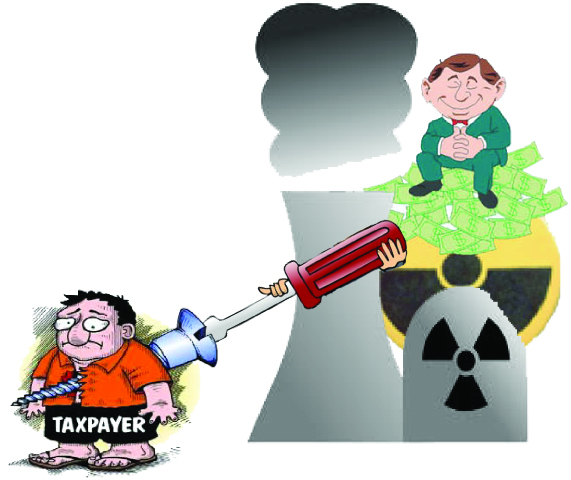
Arnie Gundersen, https://www.counterpunch.org/2026/05/28/nuclear-power-and-other-peoples-money/
Nuclear Power would never have existed without government handouts and ratepayer subsidies. The commercial nuclear power Gordian knot, from mineral extraction to component manufacturing to reactor operation to Price-Anderson Nuclear Insurance, and ending in waste disposal, exists only because of opium, whoops, OPM, Other People’s Money, in the form of taxpayer subsidies. Intense political pressure from the DC-based Nuclear Energy Institute prevents national and state politicians from cutting that twisted knot into pieces.
The financial problems associated with constructing and operating commercial nuclear power plants and the need for federal subsidies had been identified as early as 1958 by Time Magazine.
“The program needs a strong infusion of Government aid because
commercial nuclear power is so new, complex, and costly that private
companies cannot carry that burden alone,”[1]
And again at the turn of the 21st century according to Scully Capital Services Inc, a Washington-based investment and financial services firm, when the “Nuclear Renaissance” was being hyped by NEI:
“without government participation, some risks and costs of new nuclear reactors may remain at unmanageable levels.” [2]
Just before the Fukushima meltdowns in February 2011, the Union of Concerned Scientists again identified how heavily subsidized nuclear power had been and continued to be:
Government subsidies to the nuclear power industry over the past fifty years have been so large in proportion to the value of the energy produced that in some cases it would have cost taxpayers less to simply buy kilowatts on the open market and give them away… Piling new subsidies on top of existing ones will provide the industry with little incentive to rework its business model to internalize its considerable costs and risks.[3]
In 2018, sixty years after that Time Magazine subsidy analysis, the United States Congressional Research Service issued an analysis[4] of total government energy research and development funding spanning 71 years between 1948 and 2018. The report concluded:
Energy-related research and development (R&D)—on coal-based synthetic petroleum and on atomic bombs—played an important role in the successful outcome of World War II. In the postwar era, the federal government conducted R&D on fossil and nuclear energy sources to support peacetime economic growth. … For the 71-year period from 1948 through 2018, nearly 13% went to renewables, compared with nearly 5% for electric systems, 11% for energy efficiency, 24% for fossil, and 48% for nuclear.
The graph [on original]shows that for seventy years after the secrets of the atom were unleashed on Hiroshima and Nagasaki, America plowed almost half (48%) of its research funds into more nuclear subsidies. What did those expenditures buy us? At the peak of the Atoms for Peace nuclear building spree in 1990, nuclear power provided about 20% of America’s electricity. But electricity is only a small part of the total energy America consumes; most of the US energy consumption comes from fossil fuels for transportation and heating. The nation’s overall energy consumption shows that nuclear power provides about 9 percent of the energy that our society runs on[5]. The bottom line is that half of America’s research expenditures over 70 years subsidized nuclear power’s 10% energy contribution. That is hardly a worthwhile investment unless you are the companies receiving all that cash!
I can understand that subsidizing a nascent industry in 1950 might be a reasonable policy decision, but nuclear subsidies have continued for eight decades. When your kids return from college, letting them have their bedroom back might be reasonable. But when the kids turn eighty years old, it’s long past time to end that subsidy. And ending those subsidies is exactly what the Nuclear Energy Institute was created to prevent.
It’s time to pick up the pieces from Atoms for Peace. Without subsidies, nuclear power is simply not competitive with renewable energy.
power is simply not competitive with renewable energy.
NOTES
1. February 10, 1958 Time Magazine ↑
2. July 2002 Business Case for New Nuclear Power Plants, Scully Capital Services, Inc. ↑
3. https://www.ucs.org/resources/nuclear-power-still-not-viable-without-subsidies?utm_source=SP&utm_medium=more&utm_campaign=NuclearSubsidies-02-23-11-more ↑
4. https://www.congress.gov/crs-product/RS22858, Renewable Energy R&D Funding History: A Comparison with Funding for Nuclear Energy, Fossil Energy, Energy Efficiency, and Electric Systems R&D, CRS Product Number RS22858 ↑
5. https://usafacts.org/articles/what-kinds-of-energy-does-the-us-use/ ↑
Arnie Gundersen is the Chief Engineer, board member, and resident “science guy” at the Fairewinds Energy Education NGO. Since the catastrophe at Fukushima, Arnie focuses his energy worldwide on the migration of radioactive microparticles. During his multiple trips to Japan, Arnie has met and trained community-volunteer citizen-scientists to study the migration of radioactive microparticles from Fukushima in two co-authored peer-reviewed scientific articles.
The Trump administration’s reckless attack on radiation protection will have long-term consequences for public safety

In the absence of an objective ALARA (as low as reasonably achievable) cost-benefit analysis, future decisions on limiting doses from ionizing radiation to workers and the public from nuclear power operations will be determined in significant part by the relative political strengths of industry and regulators. Under the Trump administration, the industry clearly has the upper hand.
Just as it did with air pollution rules, the Trump administration has now, in effect, set the value of American lives to zero in regulatory protections against nuclear-radiation-caused cancer.
the attacks of the Trump administration on public safety must be exposed.
By Frank von Hippel | Analysis | May 27, 2026, https://thebulletin.org/2026/05/the-trump-administrations-reckless-attack-on-radiation-protection-will-have-long-term-consequences-for-public-safety/?utm_source=ActiveCampaign&utm_medium=email&utm_content=The%20Trump%20admin%20s%20attack%20on%20radiation%20protection&utm_campaign=20260528%20Thursday%20Newsletter
Worldwide, regulations limiting doses from the radiation emitted by nuclear fissions and decays are based on the Linear No-Threshold (LNT) model. This hypothesis posits that, irrespective of whether ionizing radiation comes in a pulse or over years, the additional risk of developing cancer as a result is proportional to the cumulative amount of energy deposited per gram of tissue, with weighting risk factors for radiation type, sex, age, and specific organs.
Since 1975, the US nuclear industry has been required to limit exposures to workers and the public to “as low as reasonably achievable” (ALARA) levels. What the ALARA level should be is determined by cost-benefit analysis in which the costs of dose reductions are compared with the benefits to workers and the public, measured in terms of reduced disease and longer life expectancy.
In May 2025, four months after taking office, the Trump administration challenged this five-decade-old regulatory approach as part of an Executive Order “Ordering the Reform of the Nuclear Regulatory Commission” (NRC). The order claimed the “NRC utilizes safety models that posit there is no safe threshold of radiation exposure and that harm is directly proportional to the amount of exposure,” which corresponds to the linear hypothesis. “Those models lack sound scientific basis,” the Executive Order added, before directing the NRC to “reconsider reliance on the linear no-threshold (LNT) model for radiation exposure and the ‘as low as reasonably achievable’ [ALARA] standard, which is predicated on LNT.”
The Nuclear Regulatory Commission had reviewed exactly this question in 2021 in response to a campaign by advocates of the radiation “hormesis” theory, which posits that low doses of ionizing radiation actually protect against cancer by stimulating the body’s DNA repair mechanism—the exact opposite of ALARA. The NRC rejected that contention, concluding that “the LNT model continues to provide a sound regulatory basis for minimizing the risk of unnecessary radiation exposure to both members of the public and radiation workers.” As a result, the commission maintained the current dose limit requirements contained in its regulations.
But President Donald Trump’s decision to bring independent regulatory agencies under White House control and to fire the NRC’s chairman ended the commission’s resistance. On July 2, 2025, an anonymous NRC spokesperson enthused in a social media post that the Executive Order reforming the NRC “gives us a chance to reconsider our radiation protection framework in support of the whole-of-government effort to safely enable the nation’s use of nuclear power.”
Two weeks later, the NRC hosted a webinar for input on the issue of the LNT hypothesis. The Nuclear Energy Institute—the US nuclear industry’s lobbying organization—recommended that the commission remove ALARA and dose minimization as regulatory requirements. Instead, the institute proposed to establish a “practical threshold”—for instance, 2 rem per year (or 20 milliGray per year for gamma rays) for workers—below which further dose reduction would not be required. (The rem is a unit of effective absorbed radiation in human tissue, equivalent to one roentgen of X-rays. One millirem is one-thousandth of a rem. The Gray measures the absorbed dose, which is the physical amount of radiation energy absorbed by any material or tissue. One Gray corresponds to one Joule per kilogram.)
Radiation hormesis.
Read more: The Trump administration’s reckless attack on radiation protection will have long-term consequences for public safetyAdvocates of the theory of radiation “hormesis” do not believe the LNT hypothesis. Radiation hormesis is a fringe theory with passionate adherents who are taking advantage of the Trump administration’s skepticism about regulations of all types.
One of the most vocal hormesis advocates is Edward Calabrese, an emeritus professor of toxicology at the University of Massachusetts in Amherst. He argues that the evidence for the linear no-threshold hypothesis is based on scientific fraud and, therefore, should be replaced with a model that considers the possibility of no risk—and even possible benefits—from ionizing radiation below a certain dose.
Calabrese’s arguments persuaded some recent leaders of the Health Physics Society (HPS), an association of radiation-protection professionals, to host a 22-part, 10-hour video lecture series by Calabrese on the history of the LNT model in 2021-22. John Cardarelli, the HPS president when the videos were produced, summarizes Calabrese’s argument at the end of each video. In the final one, Cardarelli declares his conclusion that the LNT model is “based on flawed research, ideological motives, deliberate misrepresentation of the research record, and political agendas.”
Although the Health Physics Society declares that “the views expressed in these videos are not intended to represent official positions,” it also advertises that its associated credentialing organization, the American Academy of Health Physics, has “preapproved 10 continuing education credits for certified health physicists watching all 22 episodes of this video series.”
Physicist-epidemiologist Jan Beyea published a critique of Calabrese’s allegations in the HPS journal Health Physics, to which both Calabrese and Cardarelli have responded with lengthy rebuttals.
The research and reports Calabrese and his supporters are trying to discredit were done more than 50 years ago. For decades, the largest human population studied for radiation effects was the survivors of the 1945 Hiroshima and Nagasaki bombings, who, depending on their proximity to the ground zeros, were exposed to whole-body doses ranging from near zero to several Gray delivered in a single burst. But the cancer statistics for the Japanese survivors were not good enough to determine with high confidence carcinogenic effects in the dose range relevant for worker radiation protection (in the tens of milliGray per year). Hormesis advocates also argue that cellular mechanisms should be more effective in repairing the damage from low-rate radiation than from a nuclear explosion’s short pulse.
The lack of data on the effect of small low-rate doses left a gap in the epidemiological confirmation of the applicability of LNT estimates of the cancer risks from low doses to radiation workers and to civilian populations exposed to radioactive releases from nuclear accidents. That gap has been partially filled, however, in more recent studies of large populations of individuals who have received low-rate doses of ionizing radiation.
A directly relevant example is the INWORKS study done by an international consortium of researchers on the excess cancer deaths among approximately 310,000 nuclear industry workers in the United States, the United Kingdom, and France, whose radiation doses were measured and recorded throughout their decades of employment. As of 2012-16, this population had an average age of about 65, and about one third had died, with 28 percent of the deaths being due to “solid” cancers (abnormal masses of tissue arising in organs, glands, or bones), therefore excluding leukemia. Of those deaths, 5,500 to 14,000 were excess cases relative to the rate observed in a control group of 51,000 nuclear workers with near-zero occupational doses.
Figure 1 [on original]shows the rate of excess deaths from solid cancers in this population as a function of cumulative on-the-job dose 10 years before death, assuming that any solid cancer caused within the last decade of life would not have had time to become lethal. The bars show the 90-percent probability range associated with the number of deaths in each dose bin; that is, there is statistically only a 10-percent probability that, with more data, the number of excess deaths would converge outside that range (5 percent chance above and 5 percent below). The solid line is the best linear fit of the data to the LNT model.
By this measure, there are significant excess cancer deaths among nuclear workers down to cumulative doses of 30 milliGray.
Energy Department’s takeover. In addition to bringing the NRC to heel, the Energy Department’s Office of Nuclear Energy has been inviting startups promoting new-design nuclear power reactors to build prototypes on department land, including the 900-square-mile footprint of the Idaho National Laboratory, where they will not be subject to NRC safety requirements.
According to President Trump’s May 23 Executive Order, the NRC will be required “to approve reactor designs that the Defense Department or the Energy Department have tested and that have demonstrated the ability to function safely.”
At most, the startups will only be able to demonstrate that they will not have had a serious accident or a near miss within their first few years of operation before they hope to build their reactors in large numbers across the country and export them abroad. In their efforts to compete with natural gas, photovoltaic, and wind power plants, the nuclear startups are under great economic pressure to cut safety and security requirements currently required by the NRC and other regulators around the world. Costly requirements include containment buildings that prevent the release of radioactivity to the atmosphere in case of a core meltdown accident. Regulations also include requirements that it be possible for the timely evacuation of areas around the reactors where the population could be at risk of high radiation doses from an accident, and robust around-the-clock guard forces to protect nuclear plants against potential sabotage.
By putting the Energy Department, which is pouring billions of dollars into nuclear startups, first in line in safety regulation, the Trump administration has partially undone the 1974 decision of the post-Watergate Congress to separate safety regulation from nuclear power promotion by breaking up the Atomic Energy Commission to create the NRC and Energy Department.
Even before the Trump administration, under political pressure from the nuclear industry through congressional Republicans, the NRC commissioners backed off by majority vote from requiring filtered vents for a set of US reactors designed by General Electric that were clones of the Fukushima-Daiichi reactors 1–3, whose small-volume containments released large amounts of radioactivity due to overpressure after core meltdowns. The NRC also refused to end the practice of dense-packing spent fuel pools to five times their design density despite Fukushima unit 4’s near miss of a potentially much more catastrophic spent-fuel fire because of an undetected water level drop.
The end of ALARA. After it was effectively given much of the responsibility of regulating the US nuclear industry, the Energy Department commissioned a review of the LNT hypothesis by the Idaho National Laboratory, which supports the Office of Nuclear Energy’s mission to promote new types of nuclear power reactors.
INL quickly produced a report, which cited a 2013 comparison by Mohan Doss of the LNT model against the radiation hormesis, as “[p]erhaps most significant for regulatory considerations.” Dr. Doss is a radiologist, not an epidemiologist. His article was published in the journal Dose-Reponse, which was founded in 2003 with Professor Calabrese as its editor-in-chief and focuses on hormesis advocacy. Contrary to what the INL report claims, Dr. Doss’ article is not a meta-analysis but rather an argument for radiation hormesis.
Doss starts by arguing at length that the atomic bomb survivors study would have shown a hormesis effect had it been compared with a control group that had a higher incidence of cancer. Doss even replotted the atomic bomb survivor data to show the result if such a control group were used. In fact, there are appropriate zero-dose control groups for the atomic bomb survivors study, including those who were away from the cities at the time of the bombings. When those control groups have been used in studies, they showed some non-linearity with dose for male cancers, but no hormesis effect.
At the same time, INL referenced but ignored the findings of two actual meta-analyses of low-dose studies: one by the National Council on Radiation Protection and Measurements and one by an international team of 16 cancer epidemiologists led by Michael Hauptmann and published in the Journal of the National Cancer Institute and partly funded by the National Cancer Institute, National Institutes of Health, and the Energy Department.
The National Council review concluded that “no alternative dose-response relationship appears more pragmatic or prudent for radiation protection purposes than the LNT model.” Hauptmann and colleagues found that “there is evidence of cancer risks from low-dose ionizing radiation.”
INL’s “reevaluation report” was quickly cited in a memorandum by the Department’s Undersecretaries of Science and Nuclear Security recommending that the Secretary of Energy “eliminate ALARA from all Department of Energy Directives and Regulations,” which he reportedly has done.
In the absence of an objective ALARA cost-benefit analysis, future decisions on limiting doses from ionizing radiation to workers and the public from nuclear power operations will be determined in significant part by the relative political strengths of industry and regulators. Under the Trump administration, the industry clearly has the upper hand.
The Trump administration’s Environmental Protection Agency has recently made a similar decision that it will no longer take into account the health benefits from limiting air pollution. In 2024, the Biden administration announced new limits on fine particulate pollution from coal power plants and other facilities. Those regulations were justified by an estimate that, on average, 77 dollars in health benefits would result from each dollar spent by industry on emission reductions and that the regulations would save 4,500 lives per year.
A climate reporter commented in the New York Times about the Trump administration’s decision to roll back the air-pollution regulation that, for over four decades, “different administrations have used different estimates of the monetary value of a human life in cost-benefit analyses. But until now, no administration has counted it as zero.”
Just as it did with air pollution rules, the Trump administration has now, in effect, set the value of American lives to zero in regulatory protections against nuclear-radiation-caused cancer.
The damage that will result from the evisceration of the Nuclear Regulatory Commission will not be immediate and may arguably turn out to be minor on the scale of the damage the Trump administration is doing in other policy areas. But public safety analysts and decision makers must keep track of the dismantlement of regulatory structures that have been built over generations. Hopefully, it will be possible to reconstruct some of them, with improvements where possible. In the meantime, however, the attacks of the Trump administration on public safety must be exposed.
Can the Imperial Core Be Reformed? Chris Hedges and Aaron Maté on the Collapse of the Global Order
May 29, 2026 , Joshua Scheer, https://scheerpost.com/2026/05/29/can-the-imperial-core-be-reformed-chris-hedges-and-aaron-mate-on-the-collapse-of-the-global-order/
At the Vancouver Web Summit, Chris Hedges and Aaron Maté examine Gaza, the erosion of international law, AI-powered warfare, media censorship, and whether meaningful reform is still possible inside a system they argue is designed to preserve empire.
For decades, Western leaders have championed a so-called “rules-based international order,” presenting international law, human rights, and democratic institutions as the foundation of global stability. But what happens when the very powers that claim to defend those principles openly violate them?
In a wide-ranging conversation at the Vancouver Web Summit, journalist Chris Hedges and investigative reporter Aaron Maté argue that the war in Gaza has exposed a crisis far deeper than a single conflict. From the collapse of international legal norms and the weaponization of global institutions to the rise of AI-driven warfare and expanding censorship across the West, both contend that the legitimacy of the post-World War II order is rapidly unraveling.
The discussion moves beyond foreign policy to examine the consequences at home: shrinking democratic space, growing surveillance, media consolidation, and the increasing influence of tech billionaires over public life. While Maté points to remaining pockets of institutional accountability, Hedges argues that meaningful change will not come from political elites or established parties, but from organized popular movements capable of challenging concentrated power.
At its core, the conversation asks a question that increasingly defines our political moment: Can the imperial center be reformed, or has the system become so corrupted that only mass resistance can alter its course?
The Empire Has No Clothes: Chris Hedges and Aaron Maté on the Collapse of the Rules-Based Order
For decades, Western leaders sold the world a comforting fiction.
International law mattered. Human rights mattered. Democracy mattered. The United States and its allies, whatever their flaws, were supposedly the guardians of a rules-based international order.
According to Chris Hedges and Aaron Maté, that illusion is now impossible to maintain.
Speaking at the Vancouver Web Summit, the two journalists argued that the war in Gaza has done more than devastate a population. It has exposed the moral and institutional bankruptcy of the very system that claims to govern the world.
“The genocide in Gaza has obliterated any pretense of international law,” Hedges said.
The significance of Gaza, they argued, extends far beyond Palestine. What the world is witnessing is the public collapse of institutions that once claimed to provide accountability, restraint and justice. The crime itself is horrific enough. But equally revealing is the response: governments supplying weapons, blocking censure, shielding allies from consequences and demanding that the public look away.
For much of the Global South, this reality is hardly new. What is different, Hedges argued, is that the mask has finally slipped for audiences in the West.
The Death of the Rules-Based Order
Throughout the discussion, both journalists returned to a central theme: institutions are only as strong as the political will behind them.
The United Nations, international courts, humanitarian law and global watchdog organizations were all designed to constrain power. Yet again and again, powerful states have demonstrated that those constraints apply only to weaker nations.
Maté pointed to what he described as the growing willingness of international institutions themselves to accommodate power rather than challenge it. Long-standing principles and resolutions can be discarded overnight when geopolitical interests demand it.
What emerges is not a world governed by law but by hierarchy.
The powerful write the rules.
The rest are expected to obey them.
AI and the Machinery of Modern Empire
One of the most chilling moments of the conversation focused on artificial intelligence.
While Silicon Valley markets AI as a tool of progress, Hedges and Maté warned that it is increasingly becoming a tool of surveillance, censorship and warfare.
Hedges described a future in which technology giants function as partners in a rapidly expanding surveillance state. He argued that algorithms are already helping select military targets and enabling forms of social control that previous authoritarian systems could only dream about.
Maté raised the disturbing possibility that automated systems are already playing direct roles in lethal decision-making, with devastating consequences when flawed intelligence becomes automated violence.
The issue, they argued, is not the technology itself.
The issue is who owns it.
Who controls it.
And whose interests it serves.
As wealth and technological power become concentrated in fewer hands, democratic oversight becomes increasingly irrelevant.
The people building the future are not elected.
Yet they wield powers once reserved for governments.
Manufacturing Ignorance
If the empire’s first weapon is force, its second is amnesia.
Both journalists argued that one reason the public remains disconnected from the consequences of Western power is because information itself is increasingly controlled.
The conversation touched on censorship, algorithmic suppression and the shrinking space for dissenting voices. Images that challenge official narratives are hidden, marginalized or removed. Journalists who challenge prevailing orthodoxies often find themselves isolated or punished.
What is striking, they argued, is how openly this process now occurs.
No elaborate conspiracy is required.
The institutions often announce exactly what they are doing.
The public is simply expected to accept it.
The result is a society where citizens are encouraged to consume endless information while remaining disconnected from the realities that information might reveal.
Why Independent Journalism Matters
Both men argued that this crisis has created an opening for independent media.
As trust in corporate outlets declines, audiences increasingly turn toward journalists willing to challenge official narratives and ask uncomfortable questions.
Yet they also acknowledged the dangers.
Independent media is not immune to the pressures of capitalism. Clickbait, outrage farming and audience capture can corrupt alternative media just as thoroughly as corporate ownership corrupts mainstream outlets.
The challenge, Hedges argued, is maintaining integrity in a media environment increasingly driven by algorithms and attention metrics.
Journalism is supposed to tell the truth.
Not maximize engagement.
Not serve power.
Not protect careers.
Tell the truth.
That simple principle has become radical.
Can the System Be Reformed?
The sharpest disagreement—or perhaps difference in emphasis—came when the discussion turned toward solutions.
Maté expressed hope that some institutions remain worth saving. He pointed to international legal actions and pockets of accountability as evidence that reform remains possible.
Hedges was far less optimistic.
“The system’s not reformable,” he said.
His argument was blunt. Democratic institutions have been hollowed out. Political parties no longer function as genuine vehicles of popular power. Economic elites dominate both politics and media. Elections alone cannot reverse the trajectory.
If change is to come, he argued, it will come from organized mass movements capable of disrupting the normal functioning of power.
History, he noted, offers the same lesson repeatedly.
Workers won rights because they organized.
Civil rights were won because people mobilized.
Democracy expanded because ordinary people forced it to expand.
Nothing was given voluntarily.institutions remain worth saving. He pointed to international legal actions and pockets of accountability as evidence that reform remains possible.
Hedges was far less optimistic.
“The system’s not reformable,” he said.
His argument was blunt. Democratic institutions have been hollowed out. Political parties no longer function as genuine vehicles of popular power. Economic elites dominate both politics and media. Elections alone cannot reverse the trajectory.
If change is to come, he argued, it will come from organized mass movements capable of disrupting the normal functioning of power.
History, he noted, offers the same lesson repeatedly.
Workers won rights because they organized.
Civil rights were won because people mobilized.
Democracy expanded because ordinary people forced it to expand.
Nothing was given voluntarily.
The Empire Has Been Revealed
The conversation ultimately returned to a simple but devastating observation.
What many people once dismissed as isolated failures increasingly appears systemic.
Wars without accountability.
Technology without oversight.
Media without independence.
Democracy without meaningful participation.
Whether one agrees with every argument presented by Hedges and Maté, the question they raise is impossible to ignore.
If the institutions designed to restrain power consistently serve power instead, what exactly are they preserving?
The answer may explain why so many people around the world no longer see a rules-based order.
They see an empire.
And empires, history suggests, rarely reform themselves.
Federal appeal court upholds First Nations victory to protect wildlife at planned nuclear waste site

The Globe and Mail, May 29, 2026, Marie Woolf, Ottawa, https://www.theglobeandmail.com/politics/article-federal-appeal-court-upholds-first-nations-protect-wildlife/
A small Quebec First Nation has won a landmark case in the Federal Court of Appeal over a failure to reduce risks to wildlife – including two types of bat and a yellow throated turtle – in planning the location of a nuclear waste storage site near the Ottawa River.
The Federal Court of Appeal on Thursday upheld a decision last year by the Federal Court that ruled in favour of Kebaowek First Nation and local environment advocates.
The ruling may stall plans to build a storage mound at the Chalk River Laboratories site northwest of Ottawa, designed to hold up to one million cubic metres of radioactive low-level nuclear waste. It could also have implications for future legal challenges to building projects, which could threaten local wildlife.
Kebaowek First Nation and local environmentalists in March last year successfully challenged a 2024 decision by then-environment-minister Steven Guilbeault to issue a permit allowing a nuclear waste mound near the Ottawa river to be built, even though it could impact species at risk
The former environment minister issued the species-at-risk permit, allowing Canadian Nuclear Laboratories to press ahead with its plans for the waste site, in spite of potential harm to two types of bats and a turtle with a bright yellow throat.
The permit authorized incidental harm, harassment or killing of the threatened Blanding’s turtle, the endangered little brown bat and endangered Northern long-eared bat.
The Blanding’s turtle, which can live for 80 years in the wild, is known as the turtle “with a sun under its chin” in some Indigenous legends. Its population has been hit by habitat loss, invasive species and development.
The construction of the nuclear waste mound at Chalk River could lead to such turtles being killed on roads, while the habitat where the bats roost and raise their young could also be threatened, Kebaowek First Nation has warned. It fears the development would also harm black bears with dens there, and other wildlife including rare Eastern wolves.
Ole Hendrickson, conservation committee chair with the non-profit Sierra Club Canada Foundation, an environmental group that mounted the challenge alongside the First Nation, said the ruling “will have implications right across Canada, for other threatened habitat.”
“This should send a strong message to the federal government that placing environmental protection in last place after economic interest is not only unacceptable to Canadians, it will cause them trouble in the courts,” he said in a statement.
The Federal Court of Appeal decision comes amid tension over environmental protection, Indigenous rights and major federally backed projects.
On Wednesday, Mr. Guilbeault, a committed environmentalist, announced his resignation from federal politics. Mr. Guilbeault played a key role in many of the previous Liberal government’s climate initiatives which have been diluted, stalled or reversed by the current government. He plans to resign his seat later this summer.
In the judgment issued on Thursday the Federal Court of Appeal questioned Mr. Guilbeault’s decision that Chalk River was the “best solution” for the storage site. To issue a species of risk permit, the minister needed to be of the view that “all reasonable alternatives” had been considered as locations.
Three judges at the Federal Court of Appeal ruled on Thursday that Mr. Guilbeault’s decision to issue a permit was “unreasonable” and in dismissing the appeal by Canadian Nuclear Laboratories said the issue should go back to the current minister for redetermination.
Minister of Environment and Climate Change Julie Dabrusin will now have to reconsider the issuing of a species-at-risk permit, and whether there could be other viable locations for the site with fewer impacts on wildlife. CNL, which plans to build and operate the proposed waste dump, had looked at other locations owned by the Crown corporation Atomic Energy of Canada, but chose Chalk River.
Chief Lance Haymond of Kebaowek First Nation said “the Federal Court of Appeal has confirmed that Environment Canada must go back and do its job properly.”
Nicholas Pope, the Ottawa lawyer who represented Kebaowek First Nation, said there are alternative sites that could have been considered, including federal land near Chalk River that would have not posed as great a threat to species at risk.
He hoped Ms. Dabrusin in looking again at species at risk would also consider the potential impact on endangered monarch butterflies, and Eastern wolves that roam at the Chalk River site.
In 2024, the federal environment department upgraded the Eastern wolf, found only in Ontario and Quebec, to threatened species status, saying there may be as few as 236 adults in Canada.
Cecelia Parsons, spokesperson for Environment and Climate Change Canada, said it is reviewing the court of appeal decision “and its implications carefully and will determine next steps as appropriate.”
CNL said it had sought “to obtain clarity in a complex regulatory environment” in going to the Federal Court of Appeal.
“CNL respects the decision of the court and is now taking time to evaluate today’s decision and determine next steps,” it said in a statement. “CNL remains committed to protecting the environment and species at-risk – restoration and protection of the environment is at the core of our work.”
Last year, the federal court partly granted Kebaowek’s application for judicial review of the decision to build the Chalk River waste dump on the grounds that it was not properly consulted. This decision is now before the Federal Court of Appeal.
Inside the broligarchy: Is big tech running US politics? Carole Cadwalladr talks to DW News.
From Donald Trump’s alliances with tech billionaires to the collapse of US media outlets, investigative journalist Carole Cadwalladr says we are accelerating towards a “techno‑fascist future.” Chapters 00:00 Where does government end and Big Tech begin? 00:26 DW speaks with Carole Cadwalladr, Investigative Journalist 02:40 What is the broligarchy? 06:45 Missing accountability for big tech 08:00 Tech entrepreneurs are taking over legacy media companies 10:30 A techno-Fascist future? 12:30 What can People do? 14:00 How Aware is the public about data collection risks? 15:20 AI and intellectual property 18:00 A positive way forward?
Warmongers Keep Generating AI Atrocity Propaganda About Iran
Caitlin Johnstone, May 29, 2026, https://www.caitlinjohnst.one/p/warmongers-keep-generating-ai-atrocity?utm_source=post-email-title&publication_id=82124&post_id=199683036&utm_campaign=email-post-title&isFreemail=true&r=1ise1&triedRedirect=true&utm_medium=email
Another AI atrocity propaganda project about Iran has been unleashed, this time in the form of a movie titled “Dreams of Violets” at the Tribeca film festival.
Variety calls the flick “the first full-length, live-action film generated by AI to be accepted by a major film festival,” describing the plot as follows:
“The film, which will premiere June 10 during the festival’s 25th anniversary, is a 75-minute docudrama inspired by the protests that swept Tehran in January, highlighting five Iranians who meet in a Tehran alley before they’re executed, all witnessed from a window by Amir, a 10-year-old boy with cerebral palsy. The clashes reflect the real-world protests between Iranian authorities and civilians, which left at least 7,000 people dead and more than 50,000 people arrested, according to the Human Rights Activists News Agency.”
The film’s trailer depicts sympathetic protagonists being brutally victimized by Iranian authorities, and concludes with the image of fighter jets soaring overhead while an English-captioned Persian voiceover says “If Iran gets liberated, celebrate for me. Enjoy it for us!”
Tribeca Festival co-founder Jane Rosenthal gushed enthusiastically about the so-called “docudrama” and its implications, telling The Hollywood Reporter that “At this time in history when both artificial intelligence and Iran are central to global conversation, this film offers audiences a rare and intimate perspective into a conflict many have not been able to fully see or understand.”
Well hey, now they can see and understand the conflict! They can see and understand it with the help of completely fake AI video footage! Golly gosh, isn’t that deliciously convenient?
This follows our discussion last month about another project using AI-generated atrocity propaganda to manufacture consent for war with Iran called Generative AI for Good, which creates deepfakes of supposedly real women who say they were sexually assaulted by Iranian government forces.
The Canary reports:
“An Israel-based AI firm, Generative AI for Good, claims to be using deepfake technologies for positive ends. ‘Positive’ appears to mean creating deepfake videos to help the illegal US-Israel war on Iran.
“Generative AI for Good claims that it uses AI to ‘help survivors testify safely — in their real voice, without revealing their identity’. But Israel and its mouthpieces have been shown to have used false allegations of rapes and other atrocities on 7 October 2023 to justify its genocide in Gaza.”
The Canary notes that Generative AI for Good is staffed with Israelis who have very conspicuous agendas, including a creative director who pushes the discredited narrative about mass rapes on October 7, a marketing manager who served in the IDF’s “Psychotechnical Headquarter”, and a founder who said in early 2024 that “Artificial intelligence is a secret weapon of ours” in using the revolutionary technology to bolster the military’s efforts both online and on the ground in the information war being waged alongside the military battlefields in Gaza.
It is unsurprising that generative AI is being used to churn out atrocity propaganda to manufacture consent for imperial war projects, because these new technologies lend themselves perfectly to the task of creating realistic-looking video footage of events which never transpired. If you want to tug at people’s heart strings and push them toward anger at an empire-targeted government, generative AI is a cheap and easy tool for doing so.
We are only just beginning to catch the first glimpses of the ways in which AI-generated videos will be used to manipulate the minds of the public to advance imperial agendas. The projects we are seeing today are just the first droplets of ocean mist from a tsunami that is roaring to shore.
Global temperatures to reach near-record highs in next five years, report finds

By Olivia Le Poidevin and Cecile Mantovani,May 28, 2026
Average global temperatures are forecast to reach near-record levels in
the next five years, with Arctic temperatures expected to warm faster
than other regions, a report by the U.N. weather agency and the UK’s Met
Office said on Thursday. The annual report, opens new tab which gives
regional predictions for temperatures and rain predicts that annual global
mean near-surface temperatures will range between 1.3°C and 1.9°C above
the 1850-1900 pre-industrial period.
Reuters 28th May 2026, https://www.reuters.com/sustainability/cop/global-temperatures-reach-near-record-highs-next-five-years-report-finds-2026-05-28/
Legal Victory for Kebaowek First Nation and Allies vs. Proposed Radioactive Megadump
Federal Court of Appeal Upholds Victory for Kebaowek First Nation and Allies in ”Species at Risk” Case Against Chalk River Nuclear Waste Project
Kebaowek, May 29, 2026 – Kebaowek First Nation, Concerned Citizens of Renfrew County and Area, theCanadian Coalition for Nuclear Responsibility, and Sierra Club Canada Foundation welcome a significantvictory following the decision of the Federal Court of Appeal to dismiss Canadian Nuclear Laboratories’(CNL) appeal regarding the Species at Risk Act permit issued for the proposed Near Surface DisposalFacility (NSDF) at Chalk River. The Court upheld the Federal Court’s earlier ruling and ordered Environmentand Climate Change Canada (ECCC) to reconsider its decision to grant the permit.
The permit would have authorized CNL to destroy endangered species and their habitats in order to construct a massive radioactive waste disposal facility less than 1.1 kilometres from the Ottawa River (Kichi Sibi), a watershed that provides drinking water to millions of Canadians.
In its decision, the Federal Court of Appeal concluded that ECCC failed to adequately explain how it determined that all reasonable alternatives had been considered and that the best solution had been selected, as required under the Species at Risk Act. The Court emphasized that the Minister’s reasons lacked sufficient transparency, intelligibility, and justification, and directed ECCC to conduct a new determination. The Court also confirmed that the Federal Court’s interpretation of section 73 of the Species at Risk Act is not binding on ECCC and that the Minister must independently provide a clear and reasonable analysis when reconsidering the permit application.
Furthermore, the Court found that the public notice issued by ECCC failed to provide a meaningful explanation to Canadians about why endangered species would be unharmed in support of the project.
Trump plan to give start-ups plutonium harvested from Cold War–era nuclear weapons is risky, experts say

Weapons-grade plutonium can fuel nuclear reactors known as mixed oxide reactors, but none of these exist in the U.S.
By Adam Kovac edited by Claire Cameron, May 28, 2026 https://www.scientificamerican.com/article/experts-warn-against-trump-plan-to-give-cold-war-plutonium-to-nuclear-power-companies/
The Trump administration’s plan to offer plutonium from dismantled Cold War–era nuclear weapons to private energy companies is drawing criticism from experts who say it makes little economic sense and presents a national security threat.
There are currently no operational nuclear reactors in the country that are built to use plutonium-derived fuel. Instead nuclear power plants in the U.S. are powered by a mixture of two uranium isotopes. A small portion, usually around 5 percent, of that fuel is uranium 235, which can also be used to make nuclear weapons. The majority is uranium 238, which cannot sustain a nuclear fission reaction on its own. Because of that balance, if some of this fuel were to fall into the wrong hands, it would be enormously difficult to weaponize, says Scott Roecker, vice president of nuclear materials security at the Nuclear Threat Initiative, a nonprofit dedicated to preventing nuclear catastrophe.
“The most difficult step in getting a nuclear weapon is having enough of that material,” he explains. “The U.S. government has spent probably billions of dollars over the last several decades to remove highly-enriched uranium and separated plutonium from countries that don’t need it.”
Plutonium, meanwhile, is considered a human-made element and is a by-product of the reactions that take place inside nuclear reactors. As uranium 238 is bombarded with neutrons inside the reactor, the molecules absorb some of these particles and become the heavier uranium 239, which rapidly decays and eventually becomes extremely radioactive plutonium.
That plutonium can be mixed back with uranium to be used as fuel in specific nuclear reactors called mixed oxide reactors. The U.S. abandoned mixed oxide reactors in the 1970s because they were both difficult and expensive to run. These kinds of reactors do exist elsewhere, though—in Japan, Russia and France—but those countries have encountered their own problems with the reactors, Roecker says.
“In France, the government’s subsidizing that process,” he says. “Only I think 1 percent of the uranium that’s actually reprocessed is being reused. And in Japan, it’s cost the country billions of dollars and has still not started operation, and who knows if it actually ever will.”
The U.S. Department of Energy has defended the plan, saying the private sector could play a vital role in advancing U.S. nuclear power infrastructure. Ted Garrish, assistant secretary for the Office of Nuclear Energy, said in April that decommissioned nuclear fuel “represents an immense, untapped energy resource for the United States.”
“The Surplus Plutonium Utilization Program is anticipated to help companies unlock the next level of private funding to broaden domestic nuclear fuel supplies, spur innovation on American recycling technologies, and unlock private sector funding to fuel the nation’s nuclear renaissance,” said a DOE spokesperson in a statement, adding that five companies have been selected to take part in the program.
Aside from the concern over cost and feasibility, other experts point out that keeping plutonium secure is much more difficult than doing so with typical uranium-based nuclear fuel. Daniel Speyer, a professor of nuclear power plant systems at New York University, says he isn’t convinced that energy start-ups could properly store plutonium. Even if the material is mixed back with uranium, separating the two to isolate the highly fissile material isn’t so difficult as to be impossible—which introduces a clear security threat, he says.
“It’s not something that a small organization really probably could do, but if you give them plutonium in purer form, I think it’s almost a trivial act to make a bomb,” he says. “A simple atomic bomb is not difficult to make.”
The DOE says that any company selected to receive the Cold War–era plutonium will have to show a deep understanding of the technology involved, as well as robust security plans and regulatory compliance. The plan has also met some pushback on Capitol Hill, however. Last September Democratic senator Edward Markey of Massachusetts and two Democratic congressional representatives sent a letter to President Donald Trump raising concerns over the risk to national security.
“The transfer of weapons-usable plutonium to private industry would increase the risk of nuclear weapons proliferation, including to rogue states or terrorists,” they wrote.
Getting Iran’s Right to Enrich Wrong (RealClearDefense)
May 28, 2026, https://npolicy.org/getting-irans-right-to-enrich-wrong-realcleardefense/
It’s unclear if the United States and Iran will be able to reach an agreement on Iran’s suspect nuclear weapons-related activities and stockpiles. What should be obvious, however, is that whatever Washington proposes will be seen by Iran’s neighbors and other would-be bombmakers as a standard that might be applied to them next.
As I explain in the attached RealClearDefense piece, “Getting Iran’s Right to Enrich Wrong,” whatever the United States calls upon Iran to do will be seen by Saudi Arabia, the United Arab Emirates (UAE), Turkey, and Egypt as a nuclear standard for their own nuclear behavior. If President Trump says Iran has a conditional right to make nuclear fuel after a moratorium, it will be easier for the United States to strike a cooperative civilian nuclear agreement with Saudi Arabia that would help Riyadh enrich uranium as well.
This, in turn, is almost certain to prompt the UAE to demand equal treatment under its own nuclear deal with the United States. Finally, Turkey and Egypt, which have large civilian reactor construction projects underway and have previously rejected U.S. pleas to foreswear enriching uranium or reprocessing plutonium, would be even more inclined to do so.
How a Middle East loaded up with nuclear fuel-making nations, only months away from being able to make bombs, will be able to remain peaceful is anybody’s guess. As I argue, this is a path best not taken. The alternative is to hang tough, not only against nuclear fuel-making in Iran, but in Saudi Arabia as well.
The False Promise of Nuclear Power: Why Scotland Doesn’t Need New Nuclear.
Just before the 40th anniversary of the Chornobyl nuclear disaster,
Scottish CND host 3 excellent guests to discuss the risks, false promises
and opportunity costs of nuclear power.
Linda Pentz-Gunter is an
environmental campaigner who founded the advocacy organisation “Beyond
Nuclear” in 2007. In her advocacy, she is primarily concerned with the
environmental costs of nuclear power and its false promise as a climate
change solution. She also campaigns for nuclear weapons abolition. As the
international specialist at Beyond Nuclear, she edits and curates the
Beyond Nuclear International website, an essential resource for information
and updates on world nuclear news.
Pete Roche is also an environmental
campaigner who has recently revived the civic campaign SCRAM (Scottish
Campaign to Resist the Atomic Menace), which organised extensive
demonstrations against the construction of Torness nuclear plant in the
1980s. Pete is also a professional energy consultant and proprietor of the
website No2NuclearPower, another key resource for information and updates
on nuclear power in the UK.
Dylan Morgan is spokesperson for the People
Against Wylfa B campaign, and is strongly involved in the
recently-relaunched Welsh Anti-Nuclear Alliance, also originally launched
in the 1980s and is composed of several important civic organisations in
Wales including CND Cymru.
Scottish CND 28th May 2026 –
https://www.youtube.com/watch?v=lfLQs9LRo50
Huge injection of public money to build nuclear submarines at Barrow-in-Furness
“In 2014, Barrow-in-Furness was named the unhappiest place in the UK.
“Since then, the much-maligned former industrial powerhouse has received a
potentially transformative boost in the form of a huge injection of public
money to build nuclear subs there. “
To discuss the prospects of this
crucial part of Britain’s defence and industrial capability, and the 56,000
people who call it home, Lord Simon Case, the former cabinet secretary
deputed by Sir Keir Starmer to lead the town’s revival, heads a panel
moderated by Christopher de Bellaigue.”
The talk will also include Sam
Plum, the former Chief Executive of Westmorland and Furness Council. They
will be joined by Jean McSorley, a policy analyst for the government on
public health and nuclear safety and a key figure for Greenpeace.
NW Evening Mail 27th May 2026, https://www.nwemail.co.uk/news/26139450.barrow-revival-heart-upcoming-lake-district-festival/
1 This Month

9 September – online public forum THREE MILE ISLAND:
7-8:30 PM ET,
Legacy, resistance to reopening – https://us02web.zoom.us/webinar/register/WN_-LGJU4j6TD2Hgf0rpgAr1A#/registration
The nuclear industry and the U.S. Nuclear Regulatory Commission are threatening to restart Pennsylvania’s permanently closed and decommissioning Three Mile Island Unit 1 nuclear power station. Three expert speakers will present the resistance to this dangerous misadventure in a webinar hosted by the Clamshell Alliance, Beyond Nuclear and Massachusetts Peace Action.


No Nuclear in Cwm Llynfi! Stop the nuclear power station near Maesteg.
To see nuclear-related stories in greater depth and intensity – go to https://nuclearinformation.wordpress.com
-
Archives
- August 2026 (317)
- July 2026 (355)
- June 2026 (287)
- May 2026 (306)
- April 2026 (356)
- March 2026 (251)
- February 2026 (267)
- January 2026 (308)
- December 2025 (358)
- November 2025 (359)
- October 2025 (375)
- September 2025 (257)
-
Categories
- 1
- 1 NUCLEAR ISSUES
- business and costs
- climate change
- culture and arts
- ENERGY
- environment
- health
- history
- indigenous issues
- Legal
- marketing of nuclear
- media
- opposition to nuclear
- PERSONAL STORIES
- politics
- politics international
- Religion and ethics
- safety
- secrets,lies and civil liberties
- spinbuster
- technology
- Uranium
- wastes
- weapons and war
- Women
- 2 WORLD
- ACTION
- AFRICA
- Atrocities
- AUSTRALIA
- Christina's notes
- Christina's themes
- culture and arts
- Events
- Fuk 2022
- Fuk 2023
- Fukushima 2017
- Fukushima 2018
- fukushima 2019
- Fukushima 2020
- Fukushima 2021
- general
- global warming
- Humour (God we need it)
- Nuclear
- RARE EARTHS
- Reference
- resources – print
- Resources -audiovicual
- Weekly Newsletter
- World
- World Nuclear
- YouTube
-
RSS
Entries RSS
Comments RSS
 nuclear-news