“Because They’re Animals”: Donald Trump, the War on Iran, and the Rules Nobody’s Enforcing

Now to the heart of it. A reporter asks Trump how bombing Iran’s power plants and bridges would not constitute a war crime.
Trump’s reply: “Because they’re animals.”
“Do you know what a war crime is? A war crime is letting Iran have a nuclear weapon.”
In two sentences, the logic of the school-yard bully becomes foreign policy.
****************************************************
On the evening of April 7, ninety minutes before his own deadline for Iran to reopen the Strait of Hormuz or face the destruction of every power plant and bridge in the country, Trump announced a two-week ceasefire, brokered by Pakistan. He called it “a big day for world peace.” He writes on Truth Social that the US would help ease the “traffic buildup” in the Strait of Hormuz.
“Big money will be made,” he adds.
Not peace. Not Iranian sovereignty. Not the rule of law. Big money.
9 April 2026 David Tyler, https://theaimn.net/because-theyre-animals-donald-trump-the-war-on-iran-and-the-rules-nobodys-enforcing/
“Operation Epic Fury” sounds like a fourteen-year-old boy who has been playing too much Call of Duty. It’s a perfect fit for the Peter Pan that Donald Trump has running the Pentagon; a former Fox & Friends weekend anchor whose less-than-stellar career so far provides a vital clue to the chaos, the incompetence, and the claque of yes-men that the forty-seventh president calls a cabinet.
Pete Hegseth is the most instructive appointment of the Trump era; an age defined by the Queen Bee principle, in which the president surrounds himself with a cast of flawed, diminished and pliable no-hopers, all chosen not for what they can do but for what they cannot: outshine Trump.
Outshine? It’s a recipe for disaster. As Michael Wolff notes on The Daily Beast, Trump’s minions have been stripped of all agency. They exist to reflect, to amplify, to affirm. The Queen Bee does not want talent in the hive. Talent is a threat. What the Queen Bee wants is an audience.
It is a principle that explains, not merely Hegseth, but the entire cabinet. The pliable Marco Rubio, who once pitched himself as a conviction politician, before a U-turn on immigration and now a dutiful echo; the parade of loyalists and flatterers installed wherever independent thought once lived. The forty-seventh president has not assembled a government so much as his own grotesque private freak show. He has set up a type of fairground mirror.

Hegseth is the mirror made flesh; a Fox News viewer’s fantasy of military authority, all jaw, scripture and manic bellicosity, set up to run the world’s largest military by a sloth who watches more television than any commander-in-chief in history and mistakes the performance of strength for the thing itself.
The Secretary of War wears his Christianity on his sleeve while ordering triple-tap strikes on schools. Who else could read the Sermon on the Mount and concluded that the relevant takeaway is fire for effect. Blessed are the meek, for they shall be massacred in the second and third pass?
The career officers who built their professional lives on the laws of armed conflict; on the painstaking, unglamorous discipline of distinguishing combatants from civilians, of proportionality, of the rules that separate a military from a mob, look at Hegseth and see not a commander but a mascot. His win-at-all-costs approach, his square-peg religiosity jammed into the very round hole of Pentagon culture, his enthusiasm for what the US military calls the double-tap, a cruel war crime; all of it has offended men and women who have spent careers trying to conduct war within its legal and moral constraints.
But Hegseth was not appointed to satisfy career officers. He was appointed to perform a feeling; the flag-waving, scripture-quoting, testosteronic bovver boy of the culture war translated directly into actual war, with actual children in actual schools. The career officers are not the audience. The Fox News viewer is the audience. And for that audience, Pete Hegseth is not a square peg at all.
He is, God help us, a perfect fit.
A Name for This War: The War of Donald’s Ear
Now let us give this war the name it deserves, because “Operation Epic Fury” is a preposterous pose, and history has always rewarded those who name things honestly.
History also has a fine tradition of naming wars after the absurdity of their origins. The War of Jenkins’ Ear, a preposterous 1739 conflict triggered when a British sea captain waved his own severed ear at Parliament, gave posterity one of its most deliciously deranged casus belli, (an act or situation that justifies a war). In that spirit, let’s go with the War of Donald’s Ear.
The ear in question is the pink shell-like ear Donald Trump lent, with almost indecent willingness, to two shady characters who had been whispering into it for years: Benjamin Netanyahu, Prime Minister of Israel, and Mohammed bin Salman, Crown Prince of Saudi Arabia. Two men who would not rest, who would not sleep soundly in their palaces, until they saw Iran bombed back into one of the Stone Ages. Two men with everything to gain from American military power and nothing to lose; since it would be American soldiers, not Israeli or Saudi ones, doing most of the dying.
The difference between Jenkins and Trump is instructive. Jenkins lost his ear involuntarily at sea. Trump lent his eagerly, in the White House Situation Room, over a slide deck, over a phone call, over an intelligence tip whispered at exactly the right moment by exactly the right man. And ninety million Iranians are paying the price. As is Trump, although he’ll try to put it on the slate.
How the War Was Sold: Two Homicidal Maniacs and One Pliable Ear
The backstory of how this war began is as tawdry as it is consequential.
Netanyahu’s campaign to drag America into war with Iran can be traced, in its current iteration, to a meeting in the White House Cabinet Room on February 4, the first visit of his second Trump era. He reminded Trump that Iran had plotted to assassinate him, then walked through a detailed slide deck arguing Iran was racing toward a nuclear threshold.
“Look, Donald,” Netanyahu told him, “You can’t have a nuclear Iran on your watch.” He paused for dramatic effect and looked the president directly in the eye.
That’s not diplomacy. That’s a sales pitch, with Trump’s vanity as the product being sold.
Netanyahu showed Trump a video featuring potential post-regime leaders, including Reza Pahlavi, the exiled son of Iran’s last shah; Iran’s government-in-waiting, neatly packaged, ready for installation. Trump’s response: “Sounds good to me.”
Within hours, American intelligence officials were tasked with evaluating the Israeli proposal. The CIA Director used a single word to describe Netanyahu’s promised popular uprising: “farcical.” Trump dismissed the finding. Regime change was, he said, “their problem.” What mattered were the parts he believed could be executed: striking Iran’s leadership and dismantling its military.
Bibi lit the fuse. On February 23, Netanyahu rang Trump with a stunning intelligence tip: Iran’s supreme leader and his top advisers were all meeting at one location in Tehran that Saturday morning. They could all be obliterated in a single devastating airstrike. One phone call. A narrowing window. Two men who had found each other, and a war that had been looking for an excuse.
Not to be outdone was MBS, the other man at the ear, acting the reluctant ally while pulling every available string behind the velvet curtain. The Washington Post reports that the Saudi Crown Prince made many private calls to Trump urging military action, even while publicly signalling support for diplomacy.
MBS privately warned Trump that inaction would leave Tehran “stronger and more dangerous.” The Saudi Foreign Ministry, naturally, denied everything; the same government that is currently hosting the American troops, intercepting the Iranian missiles, and absorbing the strikes that make the war possible.
Netanyahu brought ideology, targeting data, and the moral authority of a country under direct Iranian missile fire. But he couldn’t write a cheque covering the near-billion-dollar daily operating cost of the war. MBS could. And that capacity, the ability to make the most expensive military operation since Iraq financially palatable to a president who measures every relationship in transactional terms, is why the Saudi model was winning the Oval Office even as Netanyahu’s rhetoric dominated the airwaves.
As one analyst put it with some precision: Netanyahu brought the ideology and MBS brought the chequebook, and to Trump, the chequebook is everything.
Two men, two agendas, one pliable ear.
“Because They’re Animals”: The Quote That Should Haunt the World
Now to the heart of it. A reporter asks Trump how bombing Iran’s power plants and bridges would not constitute a war crime.
Trump’s reply: “Because they’re animals.”
“Do you know what a war crime is? A war crime is letting Iran have a nuclear weapon.”
In two sentences, the logic of the school-yard bully becomes foreign policy.
If they’re animals, the Geneva Conventions don’t apply. If they’re animals, the laws of war; built on the foundational premise that all human beings, even enemy civilians, retain their humanity, simply dissolve. If they’re animals, the hospitals, the schools, the power plants, the desalination systems that ninety million people depend on to survive are all legitimate targets. All just pest control. Or a lawn to mow, Netanyahu’s quip about killing Palestinians, a term popularised by Israeli strategists Efraim Inbar and Eitan Shamir.
This is not accidental rhetoric. This is not a man speaking loosely in the heat of a press conference. This is the oldest move in the genocidal play-book, deployed with the full authority of the presidency of the United States: strip the humanity first, then strip the rights.
History is not subtle on this point. The Holocaust required the prior dehumanisation of Jews as Untermenschen, subhuman, before the camps became possible. American slavery required the legal and cultural denial of Black humanity before it could be systematised across generations.
Rwanda required the Tutsi to be called inyenzi, cockroaches, on the radio before the machetes came out. Aboriginal peoples of this continent were excluded from the national census; not counted among the people of their own country, until the 1967 referendum, within the living memory of people who are still alive and still waiting for a treaty.
Every act of mass extermination, every system of organised dispossession in human history, has been preceded by exactly this move: the removal of the human designation from the people who are about to be killed, displaced or enslaved.
Trump knows this, or his minders do, and they are using it anyway. Calling ninety million Iranians “animals” is not bluster. It is preparation. It is the ideological infrastructure of atrocity, laid in public, on camera, before a press corps that largely moved on to the next story.
Congressman Ro Khanna calls Trump on it: “He is threatening the entire destruction of a civilisation. He is calling Iranians animals.” Former House Speaker Nancy Pelosi calls for Trump’s removal from office. Senate Minority Leader Chuck Schumer calls him “an extremely sick person.”
And the global chorus of leaders that should have followed? The rebuke from allied capitals that the moment demanded? The chorus, in the main, did not come. What came instead was the dopamine hit; the next outrage, the next deadline, the next Truth Social post, and the world scrolled on.
Two-Week Trump: The Art of the Infinite Pause
Which brings us to a pattern which will be familiar to every Trump-watcher around the world.
On the evening of April 7, ninety minutes before his own deadline for Iran to reopen the Strait of Hormuz or face the destruction of every power plant and bridge in the country, Trump announced a two-week ceasefire, brokered by Pakistan. He called it “a big day for world peace.” He writes on Truth Social that the US would help ease the “traffic buildup” in the Strait of Hormuz.
“Big money will be made,” he adds.
Not peace. Not Iranian sovereignty. Not the rule of law. Big money.
The two-week ceasefire is not a ceasefire. It is not diplomacy. It is not a step toward peace. It is the rhetorical equivalent of what Trump has always done when he wants to defer something forever: he makes it sound imminent. Before he puts it off forever.
Two weeks. Always two weeks. Two weeks from now the healthcare plan will be unveiled. Two weeks and the infrastructure bill will be ready. Two weeks and there’ll be a deal with Iran. In Trump’s universe, a universe in which, as observers of his cognitive trajectory have noted with increasing alarm, two weeks may genuinely feel like forever, the two-week pause is the art of the infinite deferral dressed as decisive action.
The purpose is clear and consistent: exhaust the opposition, blunt the momentum of outrage, reset the news cycle, and leave the underlying situation precisely unchanged while claiming credit for statesmanship.
Iran, meanwhile, holds the one card of genuine leverage that no amount of bombing can remove: the Strait of Hormuz, through which twenty percent of the world’s daily oil supply passes. For as long as that strait stays closed, Iran has a seat at the table. The two weeks will expire. Another deadline will be announced. The bombs, or the threat of bombs, will resume. And Trump, having declared victory, will declare it again.
The ceasefire is the intermission. The war is the show.
Part Two, tomorrow, A Whole Civilisation Will Die To
This article was originally published on URBAN WRONSKI WRITES
Trump accelerates new nuclear warhead production, nearly doubles funding for plutonium “pit” bomb core production.
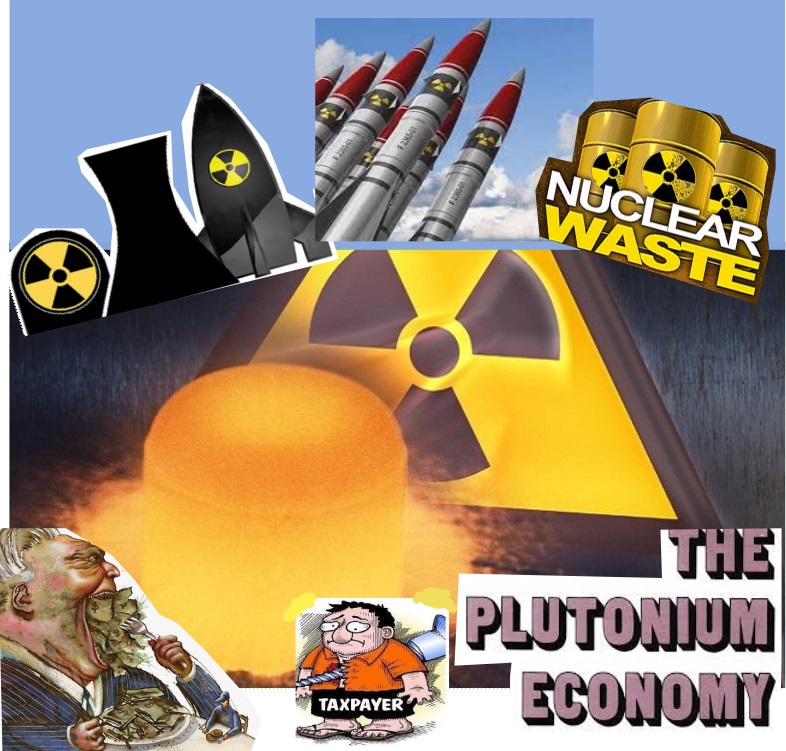
The Pentagon has always explicitly rejected “minimum-deterrence” in favor of keeping “counterforce” capabilities to wage nuclear war. This is why the U.S. has thousands of nuclear weapons and a $2 trillion “modernization” program to keep them forever. Indefinitely maintaining and expanding nuclear capabilities is contrary to the 1970 NonProliferation Treaty
None of this future pit production is to maintain the safety and reliability of the existing stockpile, but instead is entirely for new-design nuclear weapons
The Trump 2027 budget speeds up this backwards trend. For nuclear warhead production:
April 6, 2026, Jay Coghlan, Nuclear Watch, New Mexico, https://nukewatch.org/wp-content/uploads/2026/04/Trump-Accelerates-Nuclear-Warhead-Production-PR.pdf
Santa Fe, NM – The Trump Administration has released military budget numbers for the federal fiscal year 2027 (which begins October 1, 2026). This still current fiscal year 2026 is already a record breaker for military spending at one trillion dollars. Trump now proposes nearly $1.5 trillion in military spending in FY 2027, of which $1.1 trillion is base funding for the Department of War and an additional $350 million is through so-called budget reconciliation.
On top of all this, Trump will likely seek $200 billion in supplementary appropriations for the war in Iran, for a potential total of $1.7 trillion in military spending in FY 2027 (a 70% increase above FY 2026). At the same time, there is a 10% across-the-board cut to non-military spending. Much of the remaining discretionary funding for education, wildfire protection, environmental regulations, health care, etc., will be constrained by a focus on border control and immigration enforcement.
Trump proposes $53.9 billion for the Department of Energy (DOE) in FY 2027. Sixty-one per cent ($32.8 billion) is for its semi-autonomous nuclear weapons agency, the National Nuclear Security Administration (NNSA). DOE’s Office of Science is gutted by $1.1 billion which “eliminates funding for climate change and Green New Scam research.” DOE’s Office of Energy Efficiency and Renewable Energy is eliminated. Nationwide cleanup of legacy Cold War radioactive and toxic wastes at DOE sites is cut by $386 million to $8.2 billion ($3 billion of which is reserved for the Hanford Site; other site-specific cleanup budget numbers are still not yet available).
With respect to the Department of Energy’s nuclear weapons agency, the Trump FY 2027 budget:
“… focuses NNSA on its most important mission—producing a robust, credible, and modern nuclear deterrent that protects the American people. The United States must maintain and expand its set of nuclear capabilities that allow the President flexibility to protect the homeland and deter adversaries. Specifically, the Budget makes strong investments to develop new warheads that would bolster deterrence, modernize NNSA’s supporting infrastructure, and extend the life of existing warheads.”
The Pentagon has always explicitly rejected “minimum-deterrence” in favor of keeping “counterforce” capabilities to wage nuclear war. This is why the U.S. has thousands of nuclear weapons and a $2 trillion “modernization” program to keep them forever. Indefinitely maintaining and expanding nuclear capabilities is contrary to the 1970 NonProliferation Treaty, which required the nuclear weapons powers to “to pursue negotiations in good faith on effective measures relating to cessation of the nuclear arms race at an early date and to nuclear disarmament…” After more than a half-century that has never even begun. An NPT Review Conference, held every five years, is scheduled to begin April 27 at the United Nations. It is widely expected to fail for the third time over fifteen years to make any progress whatsoever toward nuclear disarmament.
The Trump 2027 budget speeds up this backwards trend. For nuclear warhead production:
• A feasibility study for a new B61-13 limited earth-penetrating bomb is funded at $46.4 million in FY 2027. A full budget request of $1 billion is expected for FY 2028 followed by an average of $870 million for each fiscal year 2029 – 2031.
• The W80-4 warhead for the Long-Range Stand-Off weapon (i.e., air-launched cruise missile) is funded at $1 billion in FY 2027. There is an average of $970 million in projected costs for each fiscal year 2028-2031.
• No funding is requested in FY 2027 for the W80-5 warhead for the Sea-Launched Cruise Missile. However, there is an average of $1.4 billion in projected costs for each fiscal year 2028-2031.
• The W87-1 nuclear warhead program is for the new Sentinel intercontinental ballistic missile, with likely multiple warheads for each missile (which is particularly dangerous and destabilizing). The Sentinel ICBM itself is already massively over budget. The W87-1 warhead program is increased 41% from $650 million in FY 2026 to $913 million in FY 2027, with an astounding average of $3.5 billion in projected costs for each fiscal year 2028-2031.
• The submarine-launched W93 nuclear warhead program, which the United Kingdom has actively lobbied for, is increased 37% from $807 million in FY 2026 to $1.1 billion in FY 2027. There is an average of $1.95 billion in projected costs for each fiscal year 2028-2031.
• There is a new “Future Programs” budget line item of $99.8 million in FY 2027 for feasibility studies for other new-design nuclear weapons, followed by an average of $92 million for each fiscal year 2028-2031.
Plutonium “pit” bomb core production: Plutonium pits are the essential “triggers” for modern nuclear weapons. Pit production has been the chokepoint for resumed industrial-scale nuclear weapons production by the U.S. ever since an FBI raid investigating environmental crimes stopped operations at the Rocky Flats Plant in 1989.
Trump’s FY 2027 budget proposes:
An 83% increase in funding for pit production at the Los Alamos National Laboratory from $1.3 billion in FY 2026 to $2.4 billion in FY 2027. There is an average of $2.3 billion in projected costs for each year FY 2028-2031. NNSA has directed LANL to double pit production to at least 60 pits per year because of increasing delays at the Savannah River Site (SRS).

• An 87% increase in funding for pit production at SRS from $1.2 billion in FY 2026 to $2.25 billion in FY 2027. There is an average of $2.5 billion in projected costs for each year FY 2028-2031. The Savannah River Plutonium Processing Facility’s upper range in estimated costs is now $25 billion, which would make it by far the most expensive building in U.S. history. Gloveboxes at SRS for canceled “dilute and dispose” of surplus plutonium are being diverted to “purification instead of disposition” to create feedstock for manufacturing new plutonium pits. There is only one glovebox left at SRS to process and remove excess plutonium, which could lead to resumed legal conflict with the State of South Carolina.
Total “Plutonium Modernization” for expanded plutonium pit production at both sites is increased 87% from $2.6 billion in FY 2026 to $4.9 billion in 2027. There is an average of $5.1 billion in projected costs for each year FY 2028-2031.
None of this future pit production is to maintain the safety and reliability of the existing stockpile, but instead is entirely for new-design nuclear weapons. This is despite the fact that in 2006 independent experts found that pits have serviceable lifetimes of at least 100 years. The average age of pits is now around 43 years. NNSA has avoided any full pit lifetime studies since 2006 (however, a new one is reportedly pending).
At least 15,000 pits are already stored at NNSA’s Pantex Plant. The independent Government Accountability Office has repeatedly reported that NNSA has no credible cost estimates for pit production, its most expensive and complex program ever. New pits cannot be tested because of the existing international testing moratorium, which could erode confidence in the stockpile. Or, conversely, new pits could prompt the U.S. to resume testing (which Trump has already threatened), after which other nuclear weapons powers would surely follow, thereby rapidly accelerating the new nuclear arms race.
Other nuclear weapons production programs:
• The “Tritium and Defense Fuels” program is increased by 79% from $520 million in FY 2026 to $881 million in 2027. There is an average of $1.8 billion in projected costs for each fiscal year 2028-2031.
“Non-Nuclear Capability Modernization” for non-nuclear components manufacturing, primarily at the Sandia National Laboratories, is increased 130% from $195.5 million in FY 2026 to $449 million in FY 2027. There is an average of $370 million in projected costs for each fiscal year 2028-2031.
• “Weapons Dismantlement and Disposition” is increased 10% from $82.3 million in FY 2026 to $90.7 million in FY 2027 (a mere 1.3% of total warhead funding). Rather than being a worthy step toward nuclear disarmament, the stated objective of weapons dismantlements is to “recover critical components and materials to support existing weapon programs, Naval Reactors, and other national priority missions.” There is an estimated backlog of up to 1,500 retired warheads to dismantle and dispose. However, NNSA’s Pantex Plant is so busy rebuilding existing nuclear warheads with new military capabilities that dismantlements have been at a historic low since the end of the Cold War.
In all, NNSA’s budget category of “Total Weapons Activities” is increased 35% from $20.4 billion in FY 2026 to $27.4 billion in FY 2027. There is an average of $29 billion in projected costs for each fiscal year 2028-2031.
Jay Coghlan, Director of Nuclear Watch, commented, “New nuclear weapons won’t give us more security as our nation is being hollowed out by tax cuts for the ultrarich, cuts to domestic programs, and the gutting of programs to address adverse climate change. It is way past time for the nuclear weapons powers to honor their obligations under the 1970 NonProliferation Treaty to negotiate verifiable nuclear disarmament instead of keeping nuclear weapons forever. We should be cleaning up, not building up new nuclear weapons.”
Sources:……………………………………………………………..
Creating bases on the Moon

April 07, 2026, Bruce Gagnon, https://space4peace.blogspot.com/2026/04/creating-bases-on-moon.html
Video on original
NASA outlines this $20 billion project to build bases on the moon.
The speaker in the video mentions RTG’s – which are nuclear power sources for the base. The nuclear industry views space as a new market. Imagine the dirty nuclear fabrication process at DoE labs across the country and then a series of launches that could be a disaster for life on Earth if there are accidents on take off.
The US has had a plan for military base control of the moon since the 1950’s.
The US (and some allies) are in a race to take control of the moon before China & Russia can get there.
In this 1989 Congressional study ‘Military Space Forces’ they discuss the Earth-Moon gravity well and state that who ever covers the top of the well would be able to control access on and off the planet earth. This has relevance not only for deciding who can control the Earth below, but also who can mine the sky, etc.
Thus all of this is connected to current US mission to the moon.
Moon has helium-3 and water which the competitors will want to control. So we now face a duplication of the current global war system on Earth moving into space.
Mars has magnesium, cobalt, uranium, etc and the nuclear-powered rovers driving around Mars are doing planetary mapping and soil ID operations.
Everyone says that a moon-based colony would be a launch pad for deeper space exploration and mining operations so again ‘control’ becomes a priority for those who have such ambitions.
I find it sad that we have competing space missions, goals, and priorities.
I’d wish we’d go off into space when we were a more mature human race here on Earth rather than carrying the ‘bad seed of war, greed, and environmental degradation’ that we’ve sown into the depths of our Mother Earth.
I’d rather we had a global informed debate about what kind of seed we should carry into space when we do go – and then go as united and clear thinking Earth people. Like envisioned in Star Trek.
Imagine the money for human development on Earth we’d save if we went as one people rather than competing national blocs spending massive amounts of taxpayer funds.
This has been the work of the Global Network since our founding in 1992 – to help usher in such a needed global consciousness, debate and organizing.
We also need a renewed effort to create international space law that bans weapons/war in space, regulates launches into the shrinking and contested parking spaces in Lower Earth Orbit (LEO), renewed treaties for the planetary bodies and determining just who can benefit from resource extraction in space.
Let’s not create a new ‘Wild West Show’ in space.
Why an attack on Bushehr nuclear plant would be catastrophic for the Gulf
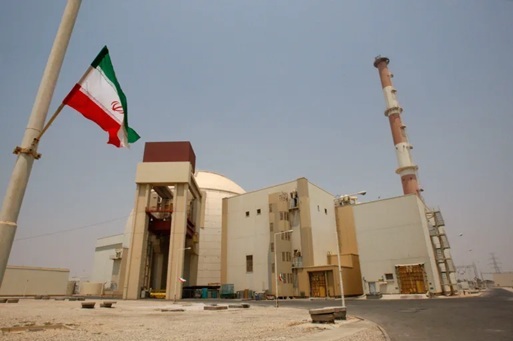
The US and Israel have repeatedly hit the nuclear power plant, raising risks of radioactive contamination far beyond Iran’s borders.
By Al Jazeera Staff, 5 Apr 2026, https://www.aljazeera.com/news/2026/4/5/why-an-attack-on-bushehr-nuclear-plant-would-be-catastrophic-for-the-gulf
Iran’s only functioning nuclear plant, the Bushehr power plant, has come under repeated attacks in the ongoing Israel and US war on Iran, raising fears of a possible nuclear incident that could prove “catastrophic” across all Gulf countries.
The latest attack on the plant came on Saturday, after missiles hit a location close to the plant, killing one security guard and causing damage to a side building, according to the state-run Atomic Energy Organisation of Iran (AEOI) which has condemned the strike.
In a statement criticising the attack, Iran’s Foreign Minister Abbas Araghchi claimed the Bushehr facility had now been “bombed” four times since the war erupted on February 28. He criticised what he said was a “lack of concern” for nuclear safety on the part of the United States and Israel.
On Monday, the AEOI asked the United Nations nuclear oversight body to also explicitly condemn the attacks on Bushehr. The organisation’s head, Mohammad Eslami, said the attacks were “a clear violation of international law and an instance of a war crime” in a letter to Rafael Grossi, Director General of the International Atomic Energy Agency (IAEA).
Nuclear experts and regional authorities have long sounded the alarm over the incredible damage that bombing Bushehr would do, not just to Iran and Iranians, but to neighbouring countries as well.
Here’s what to know about the Bushehr plant and why its safety is paramount:
What is the Bushehr plant?
The Russia-built Bushehr plant is a nuclear power plant located in the coastal city of Bushehr, which has a population of 250,000.
Work on it initially started in 1975 by German companies, but it was eventually finished in 2011 by Russia’s atomic energy ministry. To date, hundreds of Russian personnel are stationed in Bushehr, with some having been evacuated following recent strikes.
It’s the first nuclear power plant in the Middle East, with one operational reactor. Bushehr Unit 1 currently provides about 1,000MW to the national grid. Two additional reactor units are expected to be operational by 2029.
What would happen if Bushehr were attacked?
Iranian officials say Bushehr has now been attacked four times in the course of the US-Israel war on Iran.
That’s separate from an initial strike on February 28, when the US and Israel first launched attacks, sparking off the war. Strikes hit Bushehr city, a few hundred metres from the plant.
A strike on a nuclear reactor or storage pools for used fuel would cause the release of radiological particles, specifically the hazardous isotope Caesium-137, into the atmosphere.
These can be spread far beyond the release point by wind and water and can contaminate food, soil, or drinking water sources for decades. Close exposure to such material would burn the skin and increase cancer risks.
What has the UN nuclear watchdog said about strikes targeting Bushehr?
The International Atomic Energy Agency (IAEA), the United Nations’ atomic watchdog, has been warning against targeting the plant for months.
During Israel’s 12-day war on Iran last year, IAEA Director-General Rafael Grossi told the UN Security Council that an Israeli strike on the Bushehr power plant could trigger a regional catastrophe.
Directly hitting the plant, which tonnes of nuclear material, could “result in a very high release of radioactivity”, with “great consequences” beyond Iran’s borders, Grossi warned, calling for “maximum restraint”.
A strike on the lines supplying electricity to Bushehr, which keep the cooling system operating, could cause a reactor meltdown and trigger a radioactive leak, he said. Evacuation orders would have to be issued within several hundred kilometres of the plant, extending to countries outside Iran.
He said authorities would also have to administer iodine to those within the area and potentially restrict food supplies due to possible radioactive contamination. Areas beyond the immediate danger zones would then have to be monitored as well for hundreds of kilometres.
Grossi, in the wake of the latest attack on Saturday, reiterated calls for restraint
What are the risks of water contamination for the Gulf?
There are also fears that damage at Bushehr could contaminate the waters of the entire Gulf region. Radioactive contamination would affect marine life in the area, and the Gulf’s shallowness could see the negative effects remain over a long period, research finds.
It would also affect drinking water supplies. Most Gulf countries lack groundwater and rely heavily on desalination of seawater. But desalination plants are not inherently built to filter radioactive material, and not all plants at the moment have the technologies required.
Alan Eyre of the Middle East Institute told Al Jazeera that academic research has shown that the concentration of radioactive material at Bushehr might not be enough to cause Chornobyl-level disasters, referencing the 1986 tragedy in then-Soviet Ukraine.
But “more serious is the threat of radioactive material in the water because once you get an appreciable amount of radioactivity in the water, that precludes desalination”, he said, explaining that high radioactive material could halt desalination altogether.
Last year, Qatar’s Prime Minister Sheikh Mohammed bin Abdulrahman bin Jassim Al Thani revealed in an interview with right-wing US media personality Tucker Carlson that a hit on the plant would affect “all of us”.
Sheikh Mohammed said that Qatar, which is about 190km (118 miles) south of Iran, had simulated the possible effects of a Bushehr attack. Authorities found that the sea would be “entirely contaminated” and the country would “run out of water in three days”, he said.
“No water, no fish, nothing… no life,” he added.
Is there a law against targeting civilian nuclear facilities?
Yes, there are international frameworks protecting nuclear facilities during conflict. Launching attacks on energy or nuclear facilities while knowing it could cause extensive loss of life and environmental damage is a war crime.
Article 56 (Protocol I) of the Geneva Conventions prevents the targeting of “works and installations containing dangerous forces”, including those containing nuclear material.
Warring parties are also meant to differentiate between facilities serving civilians, as opposed to military targets. The Bushehr plant provides electricity for national use.
The IAEA’s guidelines similarly prohibit indiscriminate targeting of a nuclear facility. They include that countries must avoid physically hitting reactors and stored fuel, that they must ensure the safety of staff, ensure power to the grid to prevent reactor core melt, and have systems in place to monitor radiation.
Has the Western response been muted compared to Ukraine’s Zaporizhzhia?
Iran’s Aragchi on Saturday called out Western nations for failing to speak up about the possible dangers of targeting Bushehr in the same way they did over Ukraine’s Zaporizhzhia Nuclear Power Plant during the ongoing Russia-Ukraine war.
“Remember the Western outrage about hostilities near Zaporizhzhia Nuclear Power Plant in Ukraine?” he said in a post on X. “Radioactive fallout will end life in GCC capitals, not Tehran,” he added.
Russia attacked the plant in March 2022 using heavy tanks and artillery, causing a major fire. In reaction, the United Kingdom and Ukraine called an emergency UN Security Council meeting.
The UN, the US, the EU, and dozens of other countries issued immediate statements condemning the action. NATO warned that any radioactive fallout reaching a member state would trigger its collective defence mechanism.
French President Emmanuel Macron later spoke with Russian President Vladimir Putin about the incident and requested that IAEA staff be allowed to monitor the occupied site.
The European Union has not, in this instance, commented on the attacks on Bushehr. Russia, which has scores of staff there, has meanwhile issued a statement raising concern and “strongly condemning the atrocity”.
What nuclear accidents have happened in the past?

COMMENT. This section of this article is a gross understatement.
and
Japan’s Fukushima nuclear reactors melted following an earthquake in 2011.
Some 160,000 residents were evacuated to avoid radiation risks. There was one recorded death from lung cancer as a result of clean-up activities later in 2018. However, the stress of evacuation, trauma, and general disruption at the time of the disaster led to thousands of deaths.
In the April 1986 Chornobyl disaster, a reactor exploded during tests, resulting in a massive explosion that blew off the facility’s heavy roof and resulted in a fire that burned for days.
High levels of radiation were released in the explosion. Some 30 people died at the time of the blast or in the immediate aftermath. About 20,000 others would later develop thyroid cancer, especially children. More than 300,000 were evacuated, and the area is still largely deserted.
Inside Iran’s ‘underground fortress’: How Iran’s missile bases survive most powerful US and Israeli bombs
Aastha Sharma, News 24, Fri, 03 Apr 2026, https://www.sott.net/article/505568-Inside-Irans-underground-fortress-How-Irans-missile-bases-survive-most-powerful-US-and-Israeli-bombs
While Donald Trump claimed that Iran’s capabilities were mostly destroyed, data shows that Iran continues to launch a high number of missiles and drones without major decline.
A recent report by U.S. intelligence agencies says that Iran still has strong attack capabilities, even after more than a month of U.S. and Israeli strikes. According to the report, nearly half of Iran’s missile launchers are still intact, and it also has thousands of one-way attack drones. A source said that Iran is still capable of causing major destruction across the region. In addition, Iran still has a large number of missiles and coastal defense cruise missiles, which could play an important role in controlling the Strait of Hormuz.
Claims vs Reality: What Did the U.S. President Say?
The U.S. President, Donald Trump, claimed that Iran’s missile and drone capabilities have been almost destroyed. However, the actual situation appears different. Since February 28, Iran has launched around 6,770 missiles and drones targeting Jordan, Gulf countries hosting U.S. military bases, and Israel. The pace of these attacks has remained steady without any major decline. Iran has carried out the highest number of attacks on the UAE. According to the Institute for National Security Studies, Iran launched 600 missiles and 765 drones at Israel alone. In the past week, 215 drones and 200 missiles were fired.
If Iran’s missile capacity had really been reduced by 90%, these numbers would have dropped below 25%. But the figures remain above 30%, showing that Iran’s strike power is still strong.
Where Is Iran Hiding Its Missiles?
Iran has built large underground facilities known as “missile cities” over the past several years. These are located deep inside the Zagros and Alborz mountains, with tunnels and bunkers reaching depths of up to 500 meters. Missiles are stored, fueled, and even launched directly from these underground bases.
The largest missile city is in Khorramabad in Lorestan province. Another major site is in Tabriz in East Azerbaijan. Important missile storage areas are also located near Kermanshah, Isfahan, and in nearby islands and hilly regions around Tehran. Some of these sites are believed to be hidden under civilian areas for added protection.
Why Are U.S. ‘Bunker-Buster’ Bombs Failing?
These underground tunnels are extremely strong and cannot be easily destroyed by regular airstrikes. The U.S. and Israel have mainly targeted surface-level launchers and entry points, but the stockpiles hidden deep inside remain largely safe. U.S. intelligence estimates that only about one-third of Iran’s missile stock has been confirmed destroyed. Another one-third may be damaged or buried, but the remaining stockpile is still significant.
Where Did Iran Get So Many Missiles?
1. Large Existing Stockpile:
Before the war began, Iran already had one of the largest ballistic missile arsenals in the Middle East, with an estimated 2,500 to 3,000+ missiles and thousands of drones, including low-cost Shahed-136 drones.
2. Domestic Production:
Iran manufactures its own missiles and drones, with some factories located underground. Drones, in particular, are cheap and can be produced quickly.
3. Mobile Launchers and Decoys:
Iran uses mobile transporter-erector launchers, which can be easily moved and hidden. It also uses decoys (fake targets) to confuse enemy strikes.
4. Foreign Assistance:
In the past, Iran received designs and parts from countries like North Korea, Russia, and China. However, new supplies are difficult during the current conflict, so most attacks rely on existing stock and domestic production.
Iran’s Strategy: Fighting an Underground War
Iran’s strategy is clearly based on underground warfare. While U.S. and Israeli airstrikes are damaging surface infrastructure, the “missile cities” hidden inside mountains are still providing Iran with the ability to continue attacks. How long the war will last now depends largely on which side runs out of stockpiles first.
Area around Iran’s Bushehr nuclear power plant has been attacked for the fourth time.
The area around Iran’s Bushehr nuclear power plant has been attacked for
the fourth time during the current war, Iranian officials say, as the US
and Israel continue to target energy and other industrial sites. One of the
plant’s employees was killed in the attack, Iran’s Atomic Energy
Organisation said. It blamed the US and Israel for the attack, but neither
country has confirmed carrying it out. Bushehr is Iran’s only operational
nuclear power plant and was completed with Russia’s help. The International
Atomic Energy Agency – the UN’s nuclear watchdog – said it had been
informed of the strike and had expressed “deep concern”.
BBC 4th April 2026, https://www.bbc.co.uk/news/articles/c5y90jl8veyo
The Myth that Won’t Die: “War is Good for the Economy”
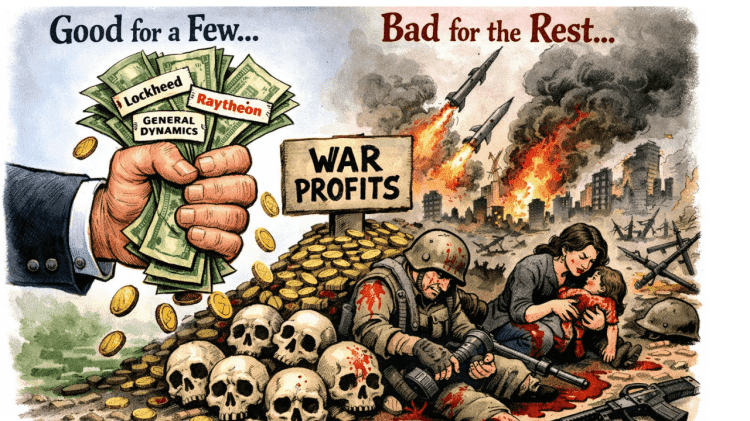
the problem with the obsession with unemployment. Employment by itself should not matter, but employment on what?. If people are exchanging their work for money but not producing goods valued by others, that amounts to wasted resources, money, and labor.
Carlos Boix, 4 April 2026, https://mises.org/mises-wire/myth-wont-die-war-good-economy
War is the ultimate government intervention. It is the excuse for all kinds of evils to be imposed on the governed. From confiscation through taxes and inflation to restriction of freedom of speech and the redirection and even nationalization of whole industries, nothing increases state power such as war.
As the state is predatory and produces nothing of use, it is the ultimate impoverishing situation. From an ideological point of view, it is even worse, mixing love for one’s culture and homeland with the state itself. It reduces individual’s resistance to loss of liberty and creates in their minds the myth of the protecting government.
There is also another insidious idea that a lot of people hold: That is that war has economic and other benefits, not to certain individuals or groups, but to the community at large. It is worth examining these supposed benefits to show that no, war does not benefit the community, it is just death and destruction.
Economic Stimulus
As with all government stimulus, this is just a redirection of resources. Instead of adapting to current resources, what a war stimulus does is to increase money and credit at unprecedented levels to pay for exorbitant government spending. This just means that real resources are taken from the community in the form of inflation and taxes and spent away on things the community does not want.
It is similar to getting all your savings and any credit you can get and spending it. For a while it appears that you are more affluent, until those resources are spent. Fiscal stimulus causes the same waste of savings and capital which, for a while, look to have stimulated the economy. But this is just spending. Soon there are not enough resources left and reality asserts itself. Once enough resources have been wasted, there are not enough to sustain the party, no matter how much money the government prints. If it continues to print, they create a hyperinflation period. If they stop, we get a recession.
The way the stimulus is done is also important. As it is done through banking credit, the temporal analysis of entrepreneurs is completely altered. A decrease in interest rates makes it look as if there are more resources saved. The problem is that the way entrepreneurs experience this is generally with an increase in demand. Those who do not respond—seeing it as unsustainable—will struggle to meet demand and will lose clients to other businesses and will still be hit hard in the downturn. Hence, most entrepreneurs will have to ride the wave and try to adapt when the crash comes.
This situation does not increase resources or make the community better off, it will waste resources and impede sustainable improvement. Overall, the community will be poorer afterwards. The idea that this kind of stimulus is positive is completely misguided.
Full Employment
When we visited Berlin, we were told the story of Communist Berlin, in which a person was paid to make a note every day of the clocks in Alexanderplatz. This is the problem with the obsession with unemployment. Employment by itself should not matter, but employment on what. If people are exchanging their work for money but not producing goods valued by others, that amounts to wasted resources, money, and labor.
This is the problem with public employment. Instead of a positive, it is a waste of resources. The government necessarily takes resources from the productive sphere—real resources that people demand—and redirects them to uses that people do not demand, such as filling forms, making military uniforms, or making munitions.
So yes, the government could tax or inflate enough to employ everyone in an economy, but that employment would take resources from the community, not add to them. They would just be wasting potential. This kind of use of employment just makes everyone poorer. This is what war full employment looks like.
At the beginning it gives the impression of full employment, but when the war finishes, the subsequent spike in unemployment is not because the government is not spending, but because the community has been depleted of resources.
Technological Advances
The idea that war fosters innovation and advances of technology is contrary to reality. It comes from those eager to justify war and see positive inventions against an imaginary counterfactual in which these innovations did not happen. Very few compare wartime to peacetime innovations. Those who do have shown that, at best, the rate of innovations is altered but changes little overall, and, at worst, there is a decline in inventiveness.
But here is the catch. This innovation is misallocated. Instead of innovations to better serve the customers, innovation during wartime serves the government and is intended to improve weapons and destructive power. Weapons and destructive power do not improve the quality of life of the people.
By redirecting research mainly to military use, there is a huge opportunity cost that few take into account. If we take the null effect on overall innovation and the focus on military innovation during wartime, we can safely say that wartime produces a reduction in technological advances and improvement of production effectiveness.
Social and Political Change
A typical example of beneficial social change is the entry of women in the workforce, wrongly attributed to the wartime economy during WWII. I say wrongly attributed because if we study labor market changes in countries that did not participate in WWII, such as Spain, we can see the same trend of female participation in the labor market. This is just another private social trend that people attribute to government intervention. The reality is that these social changes were already happening and defenders of war attribute them to government and to war itself.
Another counterfactual is the comparison with other wars. Why did WWII change the social status of women but the Franco-Prussian war of the 1870’s did not? Or even earlier wars?
Political change is sometimes presented as a benefit of war. How this is even argued is a mystery, but the idea is that war can topple an oppressive regime and create something better. Recent events show the contrary. Syria, Iraq, and Afghanistan are all examples of wars that have either not caused a regime change or caused a chronic unstable civil war that has made the situation worse for the population.
In those countries in which regimes were, say “benign,” wars created an ideological shift towards more state power, the acceptance of more state intervention, and less individual freedom. Some people consider this a positive but, to me, all these are negative effects. Politically, war only benefits the government.
Conclusion
War has no positive effects. Mises wrote, “What distinguishes man from animals is the insight into the advantages that can be derived from cooperation under the division of labor.” And, “The market economy involves peaceful cooperation. It bursts asunder when the citizens turn into warriors and, instead of exchanging commodities and services, fight one another.”
This new war between the governments of Israel, the US, and Iran will be just like all other wars, negative in all its aspects.
Trump’s $1.5 Trillion Pentagon Budget Will Make US Weaker
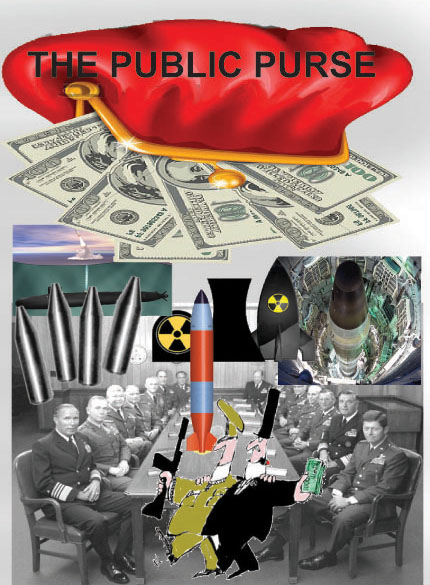
Passing this proposed budget would be a recipe for endless war, while undermining the nation’s ability to address the truly pressing problems at home that demand our urgent attention.
William Hartung, Apr 03, 2026, Common Dreams, https://www.commondreams.org/opinion/1-5-trillion-pentagon-budget
It has been reported that the Pentagon on Friday will release a proposed budget for Fiscal Year 2027 of almost $1.5 trillion, with approximately $1.15 trillion in discretionary spending contained in the department’s regular annual budget and an additional $350 billion dependent on Congress including it in a separate budget reconciliation bill.
Whatever vehicles the administration chooses to promote this huge increase, it will be doubling down on a failed budgetary and national security strategy. If passed as requested, $1.5 trillion in Pentagon spending—in a single year–will make America weaker by underwriting a misguided strategy, funding outmoded weapons programs, and crowding out other essential public investments.
The current war in the Middle East is a case study in the ineffectiveness of an overreliance on military force in seeking to make America or the world a safer place. In his first term, President Trump abandoned a multilateral agreement that was effectively blocking Iran’s path to a nuclear weapon. Six years later, in his second term, the president initially justified his disastrous intervention against Iran as being motivated by fears of that very same program.
Diplomacy worked. Reckless resort to force does not, as evidenced by the devastating human, budgetary, and global economic consequences of the current Middle East war. Passing a $1.5 trillion Pentagon budget would be a recipe for endless war.
Meanwhile, other, non-military investments needed to protect the lives and livelihoods of Americans are being sharply reduced. By one account, the first week of the war on Iran cost $11.6 billion. That’s more than the Trump administration proposed for the annual budgets of the Centers for Disease Control and the Environmental Protection Agency combined for this year. Yet addressing the climate crisis and the need to prevent future outbreaks of disease are essential to the safety and security of Americans.
The administration has also reduced our available tools of influence on the foreign policy front by decimating the Agency for International Development, laying off trained diplomats at the State Department, and withdrawing from major international agreements. This leaves force and the threat of force as virtually the last tools standing for promoting U.S. security interests.
The Pentagon doesn’t need more spending, it needs more spending discipline. Spending billions of dollars on a Golden Dome system that can never achieve the President’s dream of a leak proof missile defense system is sheer waste, as is continuing to lavish funds on overpriced, underperforming combat aircraft like the F-35, or multi-billion dollar aircraft carriers that are vulnerable to modern high speed missiles.
The truth is, there are not enough factories, or skilled workers, or materials to effectively spend such a huge increase. It will be a recipe for waste, fraud and abuse.
The Unwarranted Iran War: US-China Stakes, Regional Costs, Global Losses
5 April 2026 AIMN Editorial, https://theaimn.net/the-unwarranted-iran-war-us-china-stakes-regional-costs-global-losses/
By Dr Dan Steinbock
After one month of hostilities and no exit plans, the economic and human costs of the US-Israel joint war against Iran are soaring in the region, increasingly global and testing US-China ties.
Originally set for March, the high-stakes summit between US President Donald Trump and Chinese President Xi Jinping was postponed for about “five or six weeks,” due to the U.S. focus on military operations in Iran.
The delay suggests that the Trump administration grossly underestimated Iran’s resilience.
The summit will take place under the shadow of the worst energy crisis since the 1970s.
US-China stakes in the crisis
The crisis itself illustrates the differential stakes the two major powers have in the outcome. US military exposure is high, due to its military bases and fleets in the Gulf, whereas China’s armed presence is minimal. As a result, US strategic position is militarily stretched, whereas China’s is economically exposed.
Furthermore, US energy vulnerability is low, thanks to its domestic production. By contrast, China’s energy exposure is high, due to its import dependency. Accordingly, the US is only moderately exposed to an adverse economic impact in the Gulf, whereas in China that effect will be more substantial.
Even if the Trump administration’s initial “decapitation” strike succeeded tactically, as its proponents argue, it has failed strategically. The Iranian leadership remains intact and the command dispersed.
After one month of the unwarranted war, the U.S. enjoys escalation dominance, but it has been stalemated. US and Israel have air superiority, yet Iran retains strategic denial via missiles, proxies, and Hormuz leverage.
Unwarranted devastation
The crisis has spread across the region and beyond. It has caused a severe disruption to global oil flows, threatening 20% of global consumption – some 20 million barrels per day – that typically passes through Hormuz. Over 94% of normal traffic through Hormuz collapsed already in mid-March.
In one of the largest energy shocks since the 1970s, oil has soared by more than 50%, up to $110-120, with supply down by 11 mb/d (million barrels per day). Global system has suffered a highly adverse impact with airspace closures, rerouted shipping, and data infrastructure hits.
In Iran alone, some 1,900-3,500 people have been killed, with up to 17,000-20,000 wounded. The US-Israel strikes have caused widespread damage, with more than 90,000 civilian installations hit, including schools, hospitals, and residential buildings.
Over 3.2 million people are internally displaced in Iran, primarily fleeing major urban centers. In Lebanon, that figure is over 1-1.2 million; that’s every fifth or sixth Lebanese.
A 2-Month War Scenario
At the end of March, the White House assessed that a mission to pry open Hormuz would push the conflict beyond his timeline of 4-6 weeks. As a result, President Trump reportedly told his aides that he’s willing to end the war without reopening the chokepoint. Let’s presume the report is not fake news and the war will continue toward the end of April.
From the military perspective, the U.S. continues its air and missile war, even if the naval campaign to reopen Hormuz may or may not intensify. Limited ground and Marine deployments may or may not occur. If Americans engage, Houthis in Yemen and Iraqi militias join in the conflict.
Despite Trump’s repeated “mission accomplished” claims, there is no decisive victory. Gradual attrition prevails as Iran’s infrastructure continues to be degraded.
War fatigue rises in Israel, where anti-government demonstrations escalate. Iranian missile barrages have depleted Israel’s stockpile of high-end interceptors, forcing a shift toward rationing and relying on less capable systems.
In the US, the Pentagon continues to downplay the costly toll of Iranian missiles, even though by late March many of the 13 military bases in the region used by US troops were ”all but uninhabitable.”
Oil price stabilizes around $120–150, but remains volatile. The supply disruption is persistent.
Spillovers changing the region
After 1 month of hostilities, every country in the primary battlefield – Iran, Lebanon, Syria, Iraq and Israel – is likely to suffer an adverse GDP impact of up to -6 to -30%.
In most Gulf states, that impact is already at -3 to -12%, which threatens to defer the ambitious modernization projects in the region for years.
In the proximate Middle East, most economies, including Egypt, Turkey and Jordan, are taking hits of -2 to -6%. When such negative shocks come after two years of regional stabilization by Israel with US support, it leaves these countries vulnerable.
By the end of April, the regional impact is likely to amount to -4% to -7%. Add another month and it will climb to -6% to -12%. Gulf economies alone could see a plunge of -5% to -15% in severe scenarios.
Some are indirectly affected via an inflation shock (Morocco, Tunisia). Big Gulf actors like Saudi Arabia, UAE and Qatar benefit from price gains, but suffer from disruption.
Several economies – Iraq, Jordan, Gulf states – cope with high stress, due to fiscal strains and security pressures.
Only low-exposure gas exporters like Algeria benefit in the short-term, but no regional state is immune to rising fiscal pressures and geopolitical risks.
If hostilities prove extended, Lebanon and Yemen will teeter at the edge of state or infrastructure breakdown. The same goes for Iran, as long as the White House mistakes PM Netanyahu’s ambitions with US national security.
Strategic options and priorities
The Trump White House is burning almost $1 billion daily in the war. Critics argue that the first month of spending totals close to $37 billion. The administration is seeking $200 billion supplemental funding from the Congress. By contrast, China avoids war costs but must absorb energy and trade shock.
In a 2-month war the US pays in strategy (overextension), whereas China pays in economics (energy shock).
What about the next 4 weeks?
In terms of its strategic options, the US seeks to keep Hormuz partially open. It could release some of its stockpile of crude oil to mitigate economic shocks. It can push non-MENA supply (US shale, Atlantic basin). In the short term, it can tolerate high prices to avoid deeper entanglement.
China, too, can draw down reserves. It can also secure long-term contracts (Russia, Central Asia). It could quietly buy discounted Iranian barrels. And it can engage in limited escort and diplomacy to stabilize energy flows.
Regarding their respective postures in the Middle East, the US is likely to persist in what it calls controlled escalation. China will stress its role as a non-military actor. It willl focus on diplomacy and economic ties. It will position as a mediator and avoid security commitments.
US priority is – or at least should be – not to get trapped in MENA. By contrast, China’s priority is to let US absorb the security costs, while avoiding sanctions and escalation in bilateral relations.
What if regional war lingers
If diplomacy fails, regional war emerges as an alternative scenario, as hostilities escalate from Iran and Lebanon to Gulf, Iraq, Yemen, even beyond. A sustained closure of Hormuz would amplify the supply shock undermining global prospects.
The number of deaths doubles, regional displacement exceeds 5 million. Brent oil climbs to $120-150, even $150-200 in the worst scenarios. If infrastructure is damaged, far greater losses loom ahead.
Some analysts declare it’s the 1970s déjà vu all over again. They are wrong. Since global economy is today more integrated, the negative ramifications will reverbarate worldwide, not just regionally. Even in the most benign scenario, the world economy will pay a hefty price, through the prolonged high-cost equilibrium.
The Iran crisis has exposed the region’s structural contradiction. On the one hand, the Gulf is an energy superpower (40% global gas reserves). But it is also a highly fragile, chokepoint-dependent system. In this delicate equilibrium, Hormuz holds systemic lever because it controls both oil exports (Gulf states, Iraq, Iran) and liquefied natural gas (Qatar).
The lesson is simple but harsh: With energy disruption everyone loses, as the region morphs from an energy exporter hub to a geopolitical shock epicenter.
The unforeseen consequences of Iranian resistance

Thierry Meyssan, Voltairenet.com, Tue, 17 Mar 2026, https://www.sott.net/article/505569-The-unforeseen-consequences-of-Iranian-resistance
By resisting the illegal attack on their country by Israel and the United States, the Iranians brought the “paper tiger” to its knees. In a matter of days, they demonstrated that the Pentagon’s sophisticated and expensive weapons were ill-suited to their highly economical approach to warfare. They disrupted the global oil market, which underpins the US dollar. Finally, they provided a new model that all opponents of Anglo-Saxon dominance are now considering. It has already led China to completely revise its defense plans in the event of a US attack on Taiwan.
The war against Iran is unlike any other. For the first time, the targets destroyed are of little importance. The protagonists are focused on the economic consequences of their actions. This experience is revolutionizing the way wars are waged and has already led the Chinese People’s Liberation Army to revise its battle plans.
A Shaheh drone costs approximately $35,000. To shoot it down, the United States would need to launch two Patriot missiles, each worth $3.3 million. If they allow the Shaheh drone to hit any target, it would be assumed that they are incapable of defending themselves or their allies. By launching a drone, Iran is guaranteed to force the United States to spend $6.6 million, roughly 188 times their initial investment.
The United States does possess the Merops anti-drone system. However, these systems have only been in the testing phase for the past year and a half in Ukraine. They are also deployed along the Polish and Romanian borders. The Pentagon has decided to reduce its troop presence on NATO’s eastern front in order to deploy its Merops systems to the Gulf.
“We received a specific request from the United States for protection” against Iranian drone systems, said Ukrainian President Volodymyr Zelensky on March 12. Ukrainian officers immediately joined the mission in the Gulf.
Furthermore, the United States has been experimenting with anti-drone lasers for years. It’s a highly economical solution, but currently, we don’t know how to use these weapons, let alone how to mass-produce them. It will be many years before the Pentagon uses them on the battlefield.
Furthermore, Patriot missile stocks are dwindling rapidly. While the Pentagon maintains secrecy regarding available stockpiles, it is diverting resources from all other fronts to deliver Patriots to the Middle East. All that is known is that the US military-industrial complex cannot produce more than 700 per year, while Iran has already launched several thousand Shahed missiles.
We are only concerned here with the destruction of Shahed drones. The defense of the United States and Israel against long-range missiles is not only a financial problem, but also, in the very short term, the depletion of THAAD interceptor missiles, of which only about ten can be manufactured per week . [ 1 ]
In any case, the United States officially spent $5.6 billion on munitions in the first two days of its illegal war against Iran [ 2 ] . This amount rose to $11.3 billion, according to a Pentagon statement to Congress on March 10. With 1,444 Iranians killed as of March 12, according to the Iranian Ministry of Health [ 3 ] , this works out to a cost of approximately $8 million per life! The most expensive war in history.
By comparison, Iranians have experienced two major traumas: World War I — which claimed more lives in Iran than in Germany and France — killed approximately 6 million people.The war imposed by Iraqkilled at least 500,000 Iranians. It is therefore understandable that the few hundred deaths recently will not sway the country.
Another Iranian innovation is the retaliation Tehran has launched against its neighbors. Invoking international law and statements by Israeli and American leaders, Iran has attacked US military bases in the Gulf and the Levant. I am not referring here to attacks by the Lebanese Hezbollah (the Party of God) or the Iraqi Saraya Awliya al-Dam (the Guardians of Blood Brigade), but solely to Iranian attacks.
Iran, stunned, reminded the West of Resolution 3314 (XXIX), dated December 14, 1974 [ 4 ] . Adopted without a vote by the United Nations General Assembly, it clarifies the concept of aggression to which the Charter of San Francisco refers. The international press, dominated by Anglo-Saxon media, has become convinced that international law prohibits entry into another country’s territory. It was on the basis of this prejudice that the General Assembly condemned the Russian special military operation in Ukraine. Iran has resurrected this forgotten text.
This text authorizes the use of force to assist “peoples subjected to colonial or racist regimes,” as is the case with Russian aid to the Donbas republics (Article 7). It prohibits not only aggression against Iran by Israel and the United States, but also third-party states hosting Israeli or US military bases participating in the aggression (Article 3) from doing the same.
Consequently, Iran has the right to retaliate against the territories of the Gulf States and the Levant.
We observe that these states are reeling from the Iranian response and that their economies are paralyzed. These states, primarily those in the Gulf, are major oil producers. They are therefore attempting to break free from Israel and the United States, which until now guaranteed their security but are now responsible for their misfortunes. If their desire for independence were to lead them to sell their oil not in US dollars, but in other currencies, the value of the dollar would collapse. Indeed, its value is not guaranteed by the US GDP, but by the international hydrocarbon market. During the kidnapping of President Nicolás Maduro, we emphasized that the United States was not seeking to seize the country’s considerable oil reserves, but to re-establish oil trading in dollars. What succeeded in Venezuela could fail in the Middle East and mark the beginning of the end for the United States.
What is happening today in the Middle East is suddenly inspiring all the states that complain about US domination. Starting with China:
Beijing is preparing for a conflict with the United States and Japan over its Taiwan region. It’s important to remember that China has no intention of invading the island, but considers any attempt to grant it independence an act of aggression. From its perspective, Chiang Kai-shek had no right to secede, and Taiwan remains a Chinese region. The Kuomintang, Chiang Kai-shek’s successor party, agrees with this view; only the very small Democratic Progressive Party (DPP) of President Lai Ching-te seeks independence. This issue only arises because the United States is raising it.
Beijing has just realized that international law allows it, in the event of US aggression, to retaliate against US military bases in the Asia-Pacific region. In the blink of an eye, the People’s Liberation Army has completely revised its plans [ 5 ] . It has redirected its missiles, no longer towards Taiwan, but to target the 24 US military bases in the region.
This shift is being followed by all states hosting US military bases, which are now anticipating the difficulties faced by the Gulf and Levant countries. Undoubtedly, they will soon reconsider their presence.
Beyond the Iranian conflict, it now appears that Iran’s model of resistance is compelling for all those who anticipate a military conflict with Washington and that it is revolutionizing the way we understand the balance of power.
It is important to understand that the United States allowed itself to be manipulated by its own propaganda. It convinced itself that the events following the collapse of Ayandeh Bank resulted in over 40,000 deaths, all attributable to the Revolutionary Guards. This is obviously grossly false. Most of the victims were attributable to ISIS attacks and the panic created by snipers positioned on rooftops, killing both protesters and police officers. As for the actual number, it is at least six times lower.
Similarly, they convinced themselves that all these protesters were “anti-regime,” assuming that those demanding the return of their bank deposits were necessarily against Ayatollah Ali Khamenei. In doing so, they lumped together economic protesters, those opposed to religious totalitarianism, and those who aspired to Western-style governance. They are now discovering that one can be ruined by the banking system, resent the mullahs, be captivated by American series broadcast in Persian by some forty Western television channels, and still defend one’s country.
This miscalculation, comparable to the one that led them to organize the departure of the shah, Reza Pahlavi, and the return of Imam Ruhollah Khomeini, led them to military defeat, or even their own downfall.
References:
[ 1 ] ” US Military Operations Against Iran: Munitions and Missile Defense “, Hannah D. Dennis & Daniel M. Gettinger, Congressional Research Service , March 12, 2026.
[ 2 ] ” Early Iran strikes cost $5.6 billion in munitions, Pentagon estimates” , Noah Robertson, The Washington Post , March 9, 2026.
[ 3 ] ” US’s Hegseth claims new Iran Supreme Leader Mojtaba Khamenei injured “, Al-Jazeera, March 13, 2026.
[ 4 ] ” Definition of aggression “, Voltaire Network , December 14, 1974.
[ 5 ] ” How Iran’s strikes on US bases could offer a preview for the Asia-Pacific “, Amber Wang, South China Morning Post , March 11, 2026.
Can Prospects for Nuclear War Get Any Worse? Sure, We Can Put AI in Charge

How quickly is the Pentagon moving toward handing the nuclear keys over to AI systems and Big Tech? No one really knows.
Tom Valovic, Apr 05, 2026, https://www.commondreams.org/opinion/ai-increase-nuclear-risk
Can we possibly get away from AI’s ubiquitous presence in our lives? But as long as AI is now in our faces 24/7, it’s time to seriously start pushing back about its outsized and overwhelming influence. Troubling stories tumble out of the media daily. Employees in a major fast-food chain must now wear AI headsets that tell them how friendly they’re being to customers and coaching them on their work. (AI is now posing as our servant, but in the years ahead will the dynamic be reversed?)
And then there is the looming data center controversy, with Big Tech companies rapidly taking over huge swaths of land across the US to build massive and environmentally unfriendly data centers. Fortunately, this trend is now emerging as a campaign issue given early and cascading effects on electricity prices. In general, AI is having a tough year in the court of public opinion. Witness this cover story in a recent issue of Time magazine: “The People vs AI.” The article noted that “a growing cross section of the public—from MAGA loyalists to Democratic socialists, pastors to policymakers, nurses to filmmakers—agree on at least one thing: AI is moving too fast…. A 2025 Pew poll found… the public thinks AI will worsen our ability to think creatively, form meaningful relationships, and make difficult decisions.” Along with Immigration and Customs Enforcement-related pushback, a spontaneous wellspring of grassroots activism appears to be bubbling up against the AI juggernaut and the patently undemocratic backdoor power grab by technocrats and the companies behind them.
One of the greatest concerns in the public sphere is AI’s rapid incorporation into present and future military campaigns. This is actively being encouraged by the Trump administration’s decision to give AI companies free reign to develop their products with minimal regulation and oversight. This is an existential train wreck waiting to happen, and it came into striking focus in the monthslong dispute between AI company Anthropic and the Pentagon. Although it was already using the Claude platform, Secretary of War Pete Hegseth was unhappy with the company’s refusal to use it to remove human decision-making from military operations and support accelerated mass surveillance of US citizens.
Anthropic’s move was that rarity in Big Tech circles, a strong and principled ethical stand against an administration that doesn’t seem to know what that is. Happy warrior Hegseth then branded the company as a “supply chain risk,” effectively banning further use by the Pentagon and punishing the company’s overall viability in the non-defense marketplace as well. Ever the opportunist, the CEO of OpenAI, Sam Altman, then jumped in to offer his AI platform to do what Anthropic wouldn’t. The matter is now in the courts.
Handing AI the “Nuclear Football”
Using AI to create what are called autonomous systems represents a quantum leap in the rapidly advancing business of modern weaponry. Paradoxically, weapons technology is being simultaneously downsized through the use of drones and smaller and sophisticated high-tech devices (such as mine sniffers) and upsized with the use of the AI systems designed to manage and control them.
This raises the very troubling picture of wars being conducted without much human oversight. It’s probably one reason even high- profile AI influencers and Big Tech CEOs have admitted (sometimes a little too casually) that the technology could destroy humanity given the right set of circumstances. While autonomous systems can apply to stand-alone weapons such as killer robots, the most worrying concern relates to the Pentagon’s desire to build and deploy command-and-control systems that remove military officers from the split-second decisions that need to be made in warfare. And yes, that includes nuclear weapons.
If AI is truly as superintelligent (and sentient) as its Big Tech proponents claim it is, then these systems should also be smart enough to refuse to participate in any projects that could degrade or destroy life on the planet.
How quickly is the Pentagon moving toward handing the nuclear keys over to AI systems and Big Tech? No one really knows. When questioned by a reporter on the matter, one senior official in the Trump administration weakly demurred, “The administration supports the need to maintain human control over nuclear weapons.”
AI experts and strategic thinkers say that a big driver of this process is that America’s top nuclear adversaries—Russia and China—are already using AI in their command-and-control systems. These developments are happening at lightning speed and are being further propelled by Epic Fury, the first AI-fueled war in US history. And let’s not be too laudatory about Anthropic. Its Claude system has been integrated with Palantir’s Maven to identify military targets. The Pentagon is still investigating whether Maven played any part in the horrific event when a US Tomahawk missile struck a girls’ elementary school killing more than 165.
Sleepwalking Into Armageddon?
What madness is this? By what shallow calculus can a handful of powerful individuals or shadowy organizations decide or even risk the fate of humanity? How do we put all of this dangerous thinking at the highest levels of our government into some kind of perspective that correlates with common sense and basic human decency? In our trajectory toward what some have called techno-feudalism, we have this apparent plunge into barbarity coupled with a powerful array of tools to accelerate it. When nuclear activist Helen Caldicott warned that Western civilization is “sleepwalking into Armageddon,” it was perhaps this particular kind of blindness that she had in mind. And the brilliant socio-biologist E.O. Wilson’s profound observation also springs to mind: “The real problem of humanity is the following: We have Paleolithic emotions, medieval institutions, and godlike technology. And it is terrifically dangerous.”
The rush to deploy AI as large-scale weaponry with every bit as much destructive potential as our existing nuclear arsenal is a tip off to the deeper motivations behind its development. In the meantime, some obvious questions need to be asked. Why aren’t government and academic institutions eager to apply these advanced AI tools to the many intractable problems that characterize world polycrisis such as global climate change or better distribution of scarce resources including food and water? Where are the urgent calls from those who serve in Congress to do so? Or why don’t we see headlines like “Harvard Inaugurates $100 Million AI Project to Address Climate Change”?
It seems pretty clear that AI justifications coming from the both the administration and Congress (not to mention that the establishment commentariat that serves them) invariably gravitate to enhancing corporate productivity or military use. And it’s equally clear that AI will also serve as yet another powerful mechanism of wealth transfer to the 1% and either knowingly or unknowingly act as a chaos agent in an increasingly unstable multipolar geopolitical world. If AI is truly as superintelligent (and sentient) as its Big Tech proponents claim it is, then these systems should also be smart enough to refuse to participate in any projects that could degrade or destroy life on the planet. I don’t see any evidence of this. Sadly, it looks like we may have to once again learn the hard way that information, knowledge, and wisdom all are very different things. And that while knowledge can be appropriated by powerful computers, wisdom will never be.
Did Trump bomb Iranian schoolgirls with UK-made weaponry?
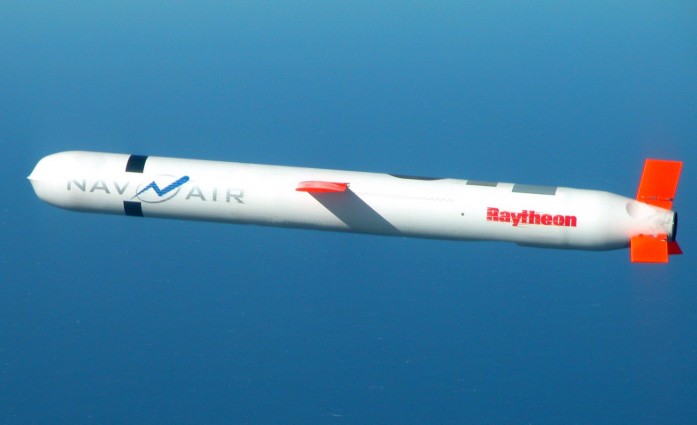
Exclusive: Scottish factory helps make US Tomahawk missiles reportedly used in attack on the Minab compound in Iran, where over 100 children were killed.
JOHN McEVOY, 9 March 2026
On 28 February, a girls’ primary school in southern Iran was hit by a missile, killing 168 people, mostly children.
The UN education agency, UNESCO, said the bombing of the Shajareh Tayyebeh school in Minab was a “grave violation of humanitarian law”.
Videos analysed by Bellingcat revealed yesterday that a US Tomahawk missile was used to hit another building inside the same compound, adding to evidence indicating the US was responsible for the school strike minutes earlier.
Neither Israel nor Iran is known to possess Tomahawk missiles.
The revelation raises serious questions about whether UK-made components were used in the attack.
This is because a factory owned by US arms firm Raytheon in Glenrothes, Scotland, has won several contracts to produce components for Tomahawk missile systems over recent years.
In 2017, Raytheon won a $260 million contract to make 196 Tomahawks, with 4.4 percent of the goods being supplied from its factory in Glenrothes.
A similar US navy contract published in May 2022 shows that around 3 percent of the Tomahawk supply chain was awarded to Raytheon’s site in Scotland.
Most recently, in December 2025, the Pentagon announced Glenrothes would have a 2.9 percent stake in making another 350 Tomahawks.
A defence industry website said this arrangement reflected the missiles’ “longstanding transatlantic supply chain”.
Campaign Against Arms Trade (CAAT) spokesperson Sam Perlo-Freeman told Declassified: “The UK arms industry is deeply entwined with the US. This is true of the F-35 aircraft that has played such a devastating role in Israel’s genocide in Gaza, and is now playing a crucial role in the illegal US-Israeli war on Iran.
“And it is true of the Tomahawk missiles, which appear to have been used to commit this horrific massacre of schoolgirls in Iran.
“Far from being a guarantee of international peace and security as the government claims, this arms producing partnership is a principal source of war, death and destruction across the world. It is time for the UK to stop fuelling this US-led war machine, and disentangle itself from it”.
Asked whether it will review and potentially suspend export of the components, a UK government spokesperson said: “We operate one of the most robust export control regimes in the world and keep export licences under continual and careful review”.
Raytheon was asked to comment.
‘Play a key part’
A parliamentary report published in 2012-13 noted that Raytheon’s site in Glenrothes “design and manufacture components, predominantly exported to the US, for guidance systems used in weapons like the Tomahawk missile”.
A Glenrothes manager said in 2020 the factory “designed and manufactured three power supplies” for the Tomahawk, adding: “This work enabled us to be involved in one of the US Navy’s flagship programmes and to play a key part in the manufacture of the electronics used in the system”.
Raytheon UK’s own website notes that its “advanced manufacturing business supports… Tomahawk long-range land attack cruise missile[s]”.
A CAAT report from 2021 found that “Glenrothes was the only Raytheon facility outside North America to play a part in the US-sold Tomahawk Missile production and is the sixth most involved of the 25-plus factories contributing to the weapon system”.
‘It was done by Iran’
The new evidence contradicts statements made by US president Donald Trump, who said on Sunday that the attack was launched “by Iran”.
He said: “They’re very inaccurate, as you know, with their munitions. They have no accuracy whatsoever. It was done by Iran”
NR Jenzen-Jones, the director of Armament Research Services, an intelligence consultancy that provides munitions analysis to governments and NGOs, told the Guardian: “The video shows a Tomahawk missile striking a target. Given the belligerents, that indicates it is a US strike, as Israel is not known to possess Tomahawk missiles”.
He added: “Despite various claims circulating online, the munition in question is clearly not an Iranian Soumar missile [as] the Soumar has a distinctive external engine located towards the rear, on the underside of the munition”.
Reuters reported on 5 March that US military investigators “believe it is likely that US forces were responsible” for the “strike on an Iranian girls’ school”.
Raytheon’s site in Glenrothes has previously been linked to war crimes in Yemen by Saudi Arabia, a key customer.
When Declassified visited the town in 2022, local primary school teacher Sharon Rickard said she was “horrified” to hear weapons made in her town might be used on civilians.
“I have a friend who works there as an engineer and she’s never really said too much about her job”, she said, “but maybe that’s why”.
US-Israel war on Iran heightening nuclear accident risk – CND
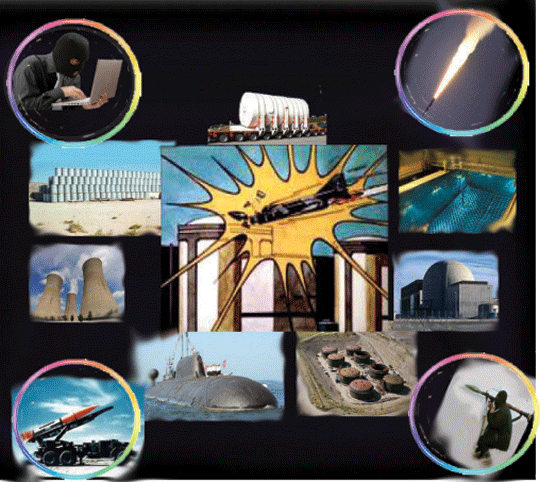
“These countries are not only dragging the world into a major energy crisis not seen since the 1970s, they are increasing nuclear risks across the region.”
, By the Campaign for Nuclear Disarmament (CND),
https://labouroutlook.org/2026/03/31/us-israel-war-on-iran-heightening-nuclear-accident-risk-cnd/
The illegal war on Iran by nuclear-armed US and Israel is increasing the risks of a nuclear accident, as nuclear facilities are repeatedly targeted by missile attacks.
Missiles hitting or landing close to nuclear facilities in both Israel and Iran over the last week show that the risk of a nuclear accident is growing, as the US-Israeli war with Iran approaches the end of its first month.
On Saturday, Iranian missiles landed in two towns in southern Israel, just kilometres away from the site of the top-secret Shimon Peres Negev Nuclear Research Centre, more commonly referred to as the ‘Dimona reactor,’ where Israel’s undisclosed nuclear weapons programme is said to be based. Israel is believed to have between 90 and 200 nuclear warheads, but it will not admit such possession and refuses to allow inspections of its nuclear facilities by the International Atomic Energy Agency. According to the Bulletin of the Atomic Scientists, Israel may be building a new nuclear facility at Dimona.
The strikes followed an attack by Israel on Iran’s Natanz nuclear facility. Iran’s Atomic Energy Organisation reported that there was “no leakage of radioactive materials” and that there was no danger posed to residents in the surrounding areas. Natanz, which had been targeted in the first days of the war and during Israel’s attacks on the country last year, has been used by Iran for the enrichment of uranium.
Iranian media reported a US-Israeli strike on the Bushehr nuclear plant, which had been targeted by Israel a week earlier on 17 March. No major damage or injuries were reported.
Following the second hit on Bushehr, Director General of the International Atomic Energy Agency, Rafeal Grossi, reiterated the need for “maximum restraint to avoid nuclear safety risks during conflict.”
A strike on a nuclear facility would lead to the release of radioactive material that could contaminate the environment and pose long-term health risks. In June 2025, when Israel bombed Iran’s nuclear facilities, Grossi stated that ‘…any armed attack … against nuclear facilities devoted to peaceful purposes constitutes a violation of the principles of the United Nations Charter, international law and the Statute of the Agency.”
The Bushehr strike marks the fifth time a nuclear facility in Iran has been attacked since the start of the illegal US-Israeli attacks on 28 February.
The conflict has since spread into a wider regional and global crisis with the Strait of Hormuz effectively closed to shipping, attacks on oil and gas facilities, and surging energy prices.
Last weekend, Donald Trump threatened to start striking Iranian power stations if the Strait remained closed, but he has extended his initial 48-hour ultimatum to end on Friday. Attacking civilian energy infrastructure is considered a war crime. Trump’s claims that Iran and the US have been engaging in negotiations to end the war have been rejected by Iran.
CND General Secretary Sophie Bolt said:
Targeting nuclear facilities is incredibly dangerous and risks a humanitarian and ecological disaster with consequences that could last for generations. The illegal US and Israeli attacks on Iran started as peaceful negotiations over Iran’s nuclear programme were reportedly reaching a breakthrough. Rather than respecting these talks, Trump and Netanyahu chose to sabotage them with illegal bombing. These countries are not only dragging the world into a major energy crisis not seen since the 1970s, they are increasing nuclear risks across the region. CND calls for an immediate end to these attacks and for the creation of a nuclear weapons-free Middle East.”
No sane soldier would follow Hegseth into illegal, failed war.
Walt Zlotow West Suburban Peace Coalition Glen Ellyn IL 5 Apr 26
As Chicago Tribune letter writer Robert Geist’s comment ‘Defense Secretary Pete Hegseth is someone soldiers can follow’ reached print, Pete Hegseth unceremoniously fired revered Army Chief of Staff Gen. Randy George, Gen. David Hodne, director of Army training, and Gen. William Green Jr., Senior Army Chaplin. All this a month into a war of choice going terribly wrong.
The US Army has been senselessly thrown into chaos. US military morale is in freefall. Hegseth may just have made the biggest military leadership mistake in US history.
Robert Geist might view Pete Hegseth as a military leader he could follow. But if so, it’s doubtful a single active Army soldier would be following behind Geist.
US and Iran trade threats to unleash ‘hell’ as search for missing US airman continues.
Ghoncheh Habibiazad,BBC Persian and Henri Astier, 5 Apr 26
US President Donald Trump has threatened that “all hell would rain down on” Iran if it did not make a deal, an ultimatum that Tehran has rejected.
Senior Iranian military officer, Gen Ali Abdollahi Aliabadi, echoed Trump’s rhetoric, saying “the gates of hell will open for you”.
On Saturday Iran fired more missiles at the Gulf States, Iraq and Israel, with falling debris from intercepted missiles causing damage.Since then, more strikes have been reported in Israel, Bahrain, Kuwait and the UAE overnight.
The threats from the US and Iran came as both searched for a missing American crew member after a US F-15 fighter jet was shot down over Iran on Friday. The pilot was rescued, US media says………………………………..https://www.bbc.com/news/articles/c5y90jl8veyo
1 This Month



26 September – International Day for the Total Elimination of Nuclear Weapons


PLEASE OPPOSE HR 8255 AND S.3639 – bills would accelerate satellite deployment, with no environmental review or safeguards – https://ncstd5li.quorum.us/campaign/169331/
To see nuclear-related stories in greater depth and intensity – go to https://nuclearinformation.wordpress.com
-
Archives
- September 2026 (219)
- August 2026 (330)
- July 2026 (355)
- June 2026 (287)
- May 2026 (306)
- April 2026 (356)
- March 2026 (251)
- February 2026 (267)
- January 2026 (308)
- December 2025 (358)
- November 2025 (359)
- October 2025 (375)
-
Categories
- 1
- 1 NUCLEAR ISSUES
- business and costs
- climate change
- culture and arts
- ENERGY
- environment
- health
- history
- indigenous issues
- Legal
- marketing of nuclear
- media
- opposition to nuclear
- PERSONAL STORIES
- politics
- politics international
- Religion and ethics
- safety
- secrets,lies and civil liberties
- spinbuster
- technology
- Uranium
- wastes
- weapons and war
- Women
- 2 WORLD
- ACTION
- AFRICA
- Atrocities
- AUSTRALIA
- Christina's notes
- Christina's themes
- culture and arts
- Events
- Fuk 2022
- Fuk 2023
- Fukushima 2017
- Fukushima 2018
- fukushima 2019
- Fukushima 2020
- Fukushima 2021
- general
- global warming
- Humour (God we need it)
- Nuclear
- RARE EARTHS
- Reference
- resources – print
- Resources -audiovicual
- Weekly Newsletter
- World
- World Nuclear
- YouTube
-
RSS
Entries RSS
Comments RSS
 nuclear-news