Antidotes to the media-nuclear-military-corporate-complex news this week

Some bits of good news – 27 years after their existence was confirmed, Brazil has begun demarcating land for one of the Amazon’s most vulnerable uncontacted peoples.
A community saved an English river. ‘David Attenborough Effect’: Meet the wildlife artists inspired by the legendary broadcaster
Significant story of the week – Media Myopia As We Hurtle Towards Climate Oblivion.
TOP STORIES.
Nobody Sincerely Believes Cuba Threatens The United States.
A national analysis of the impact of proximity to nuclear power plants on lung, breast and colon cancer mortalities in the U.S., 2000–2020.
The American epoch of oil is collapsing. What comes next could be ugly.
The Nuclear Lie at the Center of U.S. Foreign Policy
The Aging Empire versus Slowing Empire: Trump-Xi Meeting.
128 years of US exploitation, degradation of Cuba continues on steroids – Walt Zlotow.
Labour accused of making nuclear sector ‘more dangerous’ after capture by ‘vested interests’.
Death will kill with its poisonous wings
Climate. Media Myopia As We Hurtle Towards Climate Oblivion. Heatwaves in high 40 degrees Celsius are ‘new normal’ for India and Pakistan, scientists warn.
Noel’s notes. Will there be global war over Taiwan? – Sociology matters. Why does Substack, like everyone else, want me to put an App on my phone?
AUSTRALIA.
Israel Kidnapped Gaza Flotilla Activists, A Father Demands Answers | The West Report.
Israel Is Running Australia and No One Is Talking About It.
NUCLEAR-RELATED ITEMS
ARTS and CULTURE. The West’s Descent Toward Totalitarianism.
ECONOMICS. Spending watchdog warns £38bn cost of Sizewell C nuclear plant is ‘risky’ Power from Sizewell C will be more expensive than Hinkley Point, says UK watchdog
5 Stocks That Benefit From the Government’s $94 Million Spending Spree on Nuclear Reactors – ALSO AT https://nuclear-news.net/2026/05/21/1-b1-5-stocks-that-benefit-from-the-governments-94-million-spending-spree-on-nuclear-reactors/
Questions grow in Belgium over plan to nationalize Engie nuclear plants..
EDUCATION. Trump Describes Executions to Kids, While MAGA Bans Lessons Causing “Discomfort” .
| ENVIRONMENT.The President of Peace Makes War on the Planet. |
| ETHICS and RELIGION The Messiah Has Landed – Not. Never again – Worst antisemitism comes from Zionists, says Australian Jew. |
| EVENTS. 1 June Webinar – The High Cost of Nuclear Power – Registe |
| HEALTH. Does Proximity to Nuclear Power Plants Increase Cancer Risk? |
| HISTORY. Cuba Has a Rich History of International Solidarity – US Wants to Extinguish It. https://www.youtube.com/watch?v=HSkOxYkBsB4 |
| HUMAN RIGHTS. “Don’t Be Bothered by Their Screams”: Ben-Gvir Proudly Posts Video of Police Dragging Members of the Flotilla Team. Julian Assange Free Speech and Democracy. https://www.youtube.com/watch?v=GQwe73OcXMo |
| LEGAL. ICC Targets Finance Minister Bezalel Smotrich For War Crimes— He Responds by Promising More War Crimes. International Criminal Court (ICC) Issues Arrest Warrants For Five Additional Senior Israeli Officials. Did Trump Just Create a Political Slush Fund With Taxpayer Money? Mirrors of Greed: Elon Musk, OpenAI and the Tech Brat Battle. |
| MEDIA. ‘Independent’ Cuban Media Pushing Regime Change. ‘Buffer Zone’ Is Media’s Euphemism for Israeli Occupation. Republicans should be worrying about millions of fools voting for treason and criminal war destroying the economy – Walt Zlotow. |
| OPPOSITION to NUCLEAR . Kenyan communities protest planned nuclear plant near Lake Victoria. |
| PERSONAL STORIES. “Without Weapons, We Can Do Anything”: Remembering Razan al-Najjar. The children who learn war before they learn the world. The Spoiled Prince of Kiev: Zelensky has deceived and ruined his country with Western help. |
| POLITICS. American Democracy Does Not Exist. Trump is the joke….. that is no longer funny. As support for Israel declines in the U.S., the ‘Special Relationship 2.0’ is starting to take shape. Pete Hegseth “War Crimes Secretary” Called Out. On Iran war he opposed then supported, Secretary of State Rubio channeled wrong predecessor– Walt Zlotow. |
| POLITICS INTERNATIONAL and DIPLOMACY. Conference at UN to review nuclear nonproliferation treaty fails to reach agreement After Offering ‘No Tangible Concessions’ in Iran Peace Talks, Trump Issues Latest Violent Threat. Trump‑Xi summit: Cautious Progress On Trade, Ties And Some ‘Win‑Wins’. Trump overseeing decline of US world dominance…and that’s good. US President Donald Trump, Chinese President Xi Jinping end unipolar age in Beijing. Latvia prime minister resigns over “straying” Ukraine drones. |
| RADIATION. Very low doses of ionising radiation statistically still give children increased cancer risk. Newly Released Tritium Review Analyzes LANL Tritium Reports, Highlights Infant Doses. CHANGES TO RADIATION PROTECTION STANDARDS – FOR WORSE OR FOR BETTER ? |
| SAFETY. The military threat to nuclear power plants around the world. Grossi warns at Security Council against attacks on nuclear plants. Danger at Europe’s largest nuclear plant ‘near point of no return’ after deadly attack. Reactor to be halted after radioactive steam detected in northeastern Japan nuclear plant. UK Nuclear Regulatory Review. Incident – Drone Strikes Nuclear Power Plant in UAE — This Could Get Bad. First attack on Arab nuclear site sends warning to Gulf, US. T he police force protecting our nuclear sites keeps losing classified stuff. |
| SECRETS and LIES. Declassified: UK Knew NATO Expansion ‘Would Provoke’ Russia War. |
| SPACE. EXPLORATION, WEAPONS. With launches slated to grow a hundredfold, Space Force seeks more sites, money, people, and AI. |
| SPINBUSTER. Another study shows the stupidity of Scottish nuclear. |
| TECHNOLOGY. Why Small Modular Nuclear Reactors Are a Dead End. |
| WASTES. Geological Disposal Facility (GDF) is crucial to ‘nuclear renaissance’ Government told. Scotland the Dump. Survey begins to determine remote island’s suitability for nuclear disposal site. |
WAR and CONFLICT. World War Trump (everywhere, Somalia too)
- Fading western imperial war$ on Iran, Palestine, Lebanon, Cuba & more.
- Pentagon quietly shut legally required program to prevent civilian deaths by military, watchdog finds.
- From Asia to the Middle East, US Bombs Are a Failed Foreign Policy Choice.
- Strike near UAE reactor revives concerns over nuclear plant safety in wartime.
- UAE blames Iran or proxies for strike near nuclear plant, as Trump tells Tehran ‘clock is ticking’. The United Arab Emirates said a drone strike caused a fire at the perimeter of its Barakah nuclear power plant.
- Epic Interruptus: The Iranian Snare and American Defeat.
- How Russia signals nuclear resolve with civilian nuclear energy infrastructure.
WEAPONS and WEAPONS SALES.
White Elephant in Space: The Extortionate Expense of Golden Dome. Golden Dome or Golden Scam?
Russian nuclear weapons, 2026.
‘He asked if I would defend them’: Trump shares key details of Xi meeting.
Biden left Trump a poison pill that sabotaged his criminal Iran war,
Why Small Modular Nuclear Reactors Are a Dead End

The big question is, can SMRs deliver on their promises to overcome the historic drawbacks of conventional nuclear power? The answer is no.
Richard Heinberg, May 19, 2026, Common Dreams, https://www.commondreams.org/opinion/smrs-dead-end
The nuclear power industry is currently promoting designs for small modular reactors, or SMRs, that will supposedly be cheaper, safer, and faster to build than older nuclear power plants. Bill Gates and Amazon are investing in the technology. Moreover, some environmentalists, including Mark Lynas and Bill McKibben, support SMRs in the hope that they can lower carbon emissions. And, according to polls, far more Americans now approve of the development of nuclear energy than was the case just a decade or two ago.
This year, the world has been plunged into a global energy crisis: With the closure of the Strait of Hormuz, nearly a fifth of world oil shipments have been held up, with economic impacts likely to reverberate for months or years. World leaders are suddenly desperate for energy alternatives, and are turning to solar, coal, and nuclear. At the same time, electricity demand for data centers is exploding, and builders of those centers hope to use SMRs to power artificial intelligence (AI).
In short, it looks like a great moment for the nuclear industry.
Yet Indigenous peoples, technology critics, and old-school environmentalists still oppose nukes—even in new, highly touted forms. I agree with their critiques. In this article, we’ll look at the current nuclear revival and see why it may end up being a zombie attack.
Nuclear Renaissance?
Before looking at SMRs specifically, it’s helpful to understand the status of the nuclear industry in more general terms. The industry’s potential resurgence comes after three decades in the doldrums following the Chernobyl catastrophe in 1986. Today, roughly 440 nuclear power plants, spread across 30 countries and with a combined net capacity of around 400 gigawatts (GW), provide about 10% of the world’s electricity.
If you think, as I do, that the global polycrisis is an inevitable outgrowth of industrialism and its consequences (resource depletion, pollution, and overpopulation), then you’re likely to view SMRs as a pointless and dangerous waste of resources.
The US, which has the largest number of plants of any country (96), is seeing a slow phaseout of old reactors (average age 44 years), but has commissioned three new ones during the last decade. China is now operating 60 reactors, with up to 40 others under construction. India is likewise hoping to grow its nuclear industry rapidly and is experimenting with fast breeder reactors. Globally, the International Energy Agency forecasts total nuclear power capacity to grow to over 700 GW by 2050, and small modular reactors are expected to make up a significant share of this growth. A year ago, the Trump administration unveiled an ambitious nuclear strategy that includes a goal to quadruple the United States’ nuclear capacity by 2050, with SMRs playing a key role.
The principal drivers of renewed interest in nuclear power are climate change (globally), the Trump administration (in the US), tech companies’ voracious demand for electricity, and Asian nations’ hunger for more industrial power. Most nations want to limit their carbon emissions, and the main low-carbon alternatives to fossil fuels are solar, wind, hydro, and nuclear. Solar and wind are intermittent (“variable”) sources, requiring energy storage to align electricity supply with demand. Hydro has limited potential for growth. That leaves nuclear power, which has the advantage of being reliable and steady, and has possibilities for expansion.
If it’s helpful to understand why the industry is growing again, it’s just as important to know the reasons for its long period of dormancy:
Cost: Nuclear power plants are complex and expensive, employing technology that’s internationally regulated due to concerns about proliferation of nuclear weapons. Despite over 80 years of the industry’s development, nuclear plants still take a long time to build and are often plagued with cost overruns.- Fuel: Uranium, the fuel for nearly all existing nuclear power plants, is a depleting nonrenewable resource, and supplies are running short. Uranium mining is a dirty, expensive process, and mine closures, mostly due to resource depletion, are expected to lead to fuel shortfalls by 2035. While geologists have identified more uranium resources, opening new mines will entail further environmental destruction and harm to human communities, of which the uranium mining industry already has a grim history.
- Waste: Despite decades of research, the global nuclear industry still has found no good place to put the 300,000 tons of nuclear waste—as well as 480,000 tons of depleted uranium in the US alone—that it has produced in the last 80+ years.
- Safety: While nuclear accidents are relatively rare, they can be devastating and expensive when they occur. The Fukushima disaster of 2011 resulted in direct cleanup costs of up to $180 billion as of 2016, but the damage still has not been completely contained, and indirect costs to human health have been estimated at half a trillion dollars. Further, nuclear power technology is still tied to the threat of nuclear weapons proliferation.
- Water Issues: Nearly all nuclear power plants use water as a coolant and are highly vulnerable to droughts and floods. Droughts reduce the availability of water for cooling, while floods (nuclear plants are generally built next to rivers, lakes, and other bodies of water) damage safety infrastructure and risk contaminating water sources.
If the nuclear industry can overcome its historic obstacles, a door is open. According to the industry, small modular reactors are the main way forward.
SMRs: Promise or Hype?
The main arguments for SMRs are that they would be cheaper and faster to build than conventional power plants; that they would be safer; and, being smaller, that they could be installed to power remote towns or data centers. The idea is to build components in a centralized factory and then assemble those components at power generation sites.
“Small” is defined as 300 megawatts of electrical power or less. While most existing nuclear plants are in the one-gigawatt (1,000 MW) range, some proposed SMRs are 20 megawatts or less; these are called “micro” reactors.
For the most part, SMRs are still at the design stage. China has one SMR under construction. In the United States, TerraPower, founded by Microsoft’s Bill Gates, has received a permit to build a 345-megawatt (not exactly “small,” but close) sodium-cooled reactor in Kemmerer, Wyoming.
Clearly it is possible to get funding and approval for these new-generation power plants. The big question is, can SMRs deliver on their promises to overcome the historic drawbacks of conventional nuclear power?
- Cost: SMRs will only be cheaper to build if large numbers are ordered; the first prototypes may be even more costly than conventional plants. Meanwhile, construction costs per MW of capacity will likely be higher, and operating costs are largely unknown until real-world data can be collected. The cost of electricity from SMRs is therefore also yet-to-be-determined, but preliminary estimates put it much higher than solar or wind.
- Fuel: Most proposed SMRs use uranium, but some designs on the drawing boards would use depleted uranium or thorium as fuels (see below). For now, however, the uranium fuel constraint looming over the nuclear industry remains in place. SMRs also won’t use their fuel more efficiently than conventional reactors, despite some claims to the contrary.
- Uranium From Seawater: The supply limits of uranium could be greatly expanded by harvesting it from seawater, where the potential resource is enormous—albeit at a concentration of about 3.3 parts per billion. The total oceanic uranium resource is estimated at 4.5 billion tons, over 500 times all identified land-based uranium resources. However, extracting the uranium will take a lot of energy: The best existing technology using absorbent materials will offer an energy return on energy invested (ERoEI) of about 4:1, which is lower than the ERoEI for solar, wind, hydro, fossil fuels, or conventional uranium mining.
- Waste: Some proposed SMR designs would be breeder reactors that could get rid of depleted uranium or even nuclear waste by using them as fuels—but this technology has faced significant challenges (see below). Otherwise, SMRs will do nothing to solve, and may actually worsen, the nuclear waste dilemma.
- Safety: SMRs are designed to be safer than conventional nuclear plants, using passive, gravity-driven cooling systems that don’t require electricity or human intervention to shut down. However, their overall safety is controversial. There is still no real-world data to support the industry’s promises. And having lots of smaller nuclear plants dotted across the landscape could make it easier for nuclear materials to end up in the hands of bad actors. The resilience of SMRs in the face of more frequent and more severe natural disasters is also controversial; a 2021 study concluded that storms, droughts, and higher ambient temperatures linked to climate change are likely to pose operational risks to all nuclear power plants.
The biggest remaining advantages of SMRs are the speed with which they could bedeployed once the manufacturing infrastructure is in place, and the prospect of providing non-grid-tied dedicated power sources for data centers.
What About Further Technological Advances?
When confronted with the limits of one technology, nuclear advocates often shift the conversation to another. However, close examination usually shows that each technological “solution” has its own problems:
Fast-Breeder Reactors: If nuclear fuel is scarce, why not develop fast breeders, which produce more nuclear fuel than they consume? Currently, Russia operates two fast breeders and India’s first one reached criticality in late April. China has a fast-breeder reactor for research. The US, France, and Japan operated breeders in the past but have shut down research along these lines due to high capital and operational costs, safety risks related to sodium coolant, and nuclear proliferation concerns.
- Alternative Cooling Systems: Water-cooled reactors (a category that includes nearly all existing commercial nuclear plants) pose risks of loss-of-coolant accidents due to pipe breaks, high-pressure operation failures, age-related component deterioration, and earthquakes or other natural disasters. The industry’s solution: Use sodium or helium as a coolant. Unfortunately, sodium is highly chemically reactive and ignites upon contact with air and reacts explosively with water, while helium is a depleting non-renewable resource that is becoming economically scarce at a rapid rate.
- Thorium Reactors: If uranium is scarce and might lead to weapons proliferation, why not use more abundant thorium? China already has an experimental two-megawatt thorium reactor in the Gobi Desert. However, thorium reactors have steep development costs and produce a highly radioactive byproduct, uranium-232, which decays into isotopes that emit penetrating gamma rays, making fuel handling and maintenance more hazardous and costly. Also, thorium reactors require a “driver” fuel: Thorium-232 is fertile, not fissile, meaning it needs a different radioactive fuel (like uranium or plutonium) to initiate the chain reaction. Therefore, proliferation concerns remain.
Currently, there is little real-world data regarding these “new” nuclear technologies, even though all have been discussed or experimented with for decades. The nuclear industry hasn’t actually solved its many dilemmas, and the current nuclear renaissance isn’t being driven by novel solutions so much as by the rapid worsening of society’s energy-related problems, primarily climate change: World leaders are now so desperate for reliable low-carbon energy sources that they are willing to overlook substantial risks, if only the nuclear industry will put a shiny gloss on its latest iteration of products. And leaders of the tech industry, keenly aware of the soaring electricity demand from AI, are even more desperate for ways to power the exponential growth of their companies without risking a backlash from the rest of society, which may suffer from higher electricity prices or shortages.
If Not SMRs, Then What?
Nuclear power is a product of high-tech modern industrialism. The proponents of nuclear power assume—and nuclear reactors rely on—global supply chains, uninterrupted grid power, reliable water resources, and functioning political systems. The future that’s unfolding around us is a polycrisis in which supply chains, grid power, water, weather, and politics-as-usual are all threatened. In these unfolding circumstances, the only solutions that make sense are ones that are small-scale, local, low-risk, and nature based.
What to do about carbon emissions? Yes, we need to replace fossil fuels with low-carbon energy sources—but these should be as low-tech as possible, and we should aim to reduce overall energy usage.
What to do about AI data centers? That’s easy: Don’t build them. We are rushing headlong into an AI-managed future without an adequate understanding of what AI is, does, or is likely to do in the future. Besides, AI appears to be perhaps the biggest investment bubble in history.
Most political and economic leaders have taken the attitude that we must go to any possible lengths to save industrial modernity. But industrial modernity is the essence of our problem: It is a crisis-generating machine—and one that, prior to its inevitable self-destruction, is creating enormous wealth for a small minority of people, while entrapping everyone else in dreary systems of employment, payment, debt, dependency, and distraction that leave little time for reflection on the futility of it all.
Moreover, SMRs will do nothing to solve our immediate global energy crisis. The oil shortages that are already sweeping over the world in the wake of the US-Iran war cannot, in most cases, be offset with electricity—at least not right away. While electrification is a good interim energy strategy for gradually winding down modernity with minimal casualties, it’s one that will take time, and some things will be hard or impossible to meaningfully electrify—including heavy manufacturing and air travel. Meanwhile, the world needs gasoline, diesel, and jet fuel now; SMRs will take decades to deploy.
The opinion you hold about SMRs will have a lot to do with your general attitude toward technology. If you think humanity’s fate and future rest with high tech (including AI and advanced rockets to enable colonization of other planets), then you’re almost guaranteed to believe that SMRs will help us get there. But if you think, as I do, that the global polycrisis is an inevitable outgrowth of industrialism and its consequences (resource depletion, pollution, and overpopulation), then you’re likely to view SMRs as a pointless and dangerous waste of resources.
Once we see why industrial modernity is unsustainable, the most important question becomes: What is a viable exit strategy? On our way out the door of modernity and back toward simplicity, we need to minimize the creation of new problems and relearn nature’s elegant solutions. When our priorities are thus reoriented, nuclear power makes no sense.
Nobody Sincerely Believes Cuba Threatens The United States
Caitlin Johnstone, May 22, 2026, https://www.caitlinjohnst.one/p/nobody-sincerely-believes-cuba-threatens?utm_source=post-email-title&publication_id=82124&post_id=198793245&utm_campaign=email-post-title&isFreemail=true&r=1ise1&triedRedirect=true&utm_medium=email
In a sign that the US is preparing for yet another evil war, Marco Rubio is now claiming that Cuba poses a “national security threat” to the United States, saying the likelihood of a peaceful agreement is “not high”.
“Cuba not only has weapons that they’ve acquired from Russia and China over the years, but they also host Russian and Chinese intelligence presence in their country — not far from where we’re standing right now,” Rubio told the press on Thursday. “So Cuba has always posed a national security threat to the United States. They, by the way, have been one of the leading sponsors of terrorism in the entire region.”
Rubio’s comments come as a US intelligence report laundered through Axios claims that Cuba may be preparing to launch a drone strike against US military forces. Havana said the Axios report misrepresents Cuba’s defensive measures as a preparation to attack, accusing the US of “fabricating pretexts, creating and spreading falsehoods, and distorting as extraordinary the logical preparation required to face a potential aggression.”
The US has also unsealed an indictment for Raul Castro, the 94 year-old brother of Fidel Castro, in a move that resembles the playbook used for the kidnapping of Venezuela’s President Nicolas Maduro.
The excuses for military action are already being rolled out. This happens as US war machinery relocates to the Caribbean, and as Cuba flounders under a crushing US oil blockade that is already inflicting a severe humanitarian toll.
And everyone knows it’s all based on lies. You know it. I know it. Marco Rubio knows it. The war propagandists know it. The gusanos brigading social media begging for war know it. We all know it’s a sham.
Not one person sincerely believes Cuba poses a threat to the United States.
No one sincerely believes Cuba just coincidentally became an urgent menace to US national security all of a sudden right when the US began scrambling to consolidate geostrategic control in the middle east and the western hemisphere.
Nobody actually thinks that a tiny, impoverished island nation is preparing to launch a war of aggression against the United States.
This is a performance put on by warmongers and bootlickers. It insults our intelligence and robs us of dignity.
If things cool down with Iran, then it’s a safe bet they’re going in for the kill shot on Cuba. The US empire never makes peace, it just moves the crosshairs of its war machinery from nation to nation.
We see this over and over again.
Yay! The troops are leaving Afghanistan — oh, now they’re waging a proxy war in Ukraine.
Excellent, they’re deescalating against Yemen — whoa, now they’re kidnapping the president of Venezuela.
Oh hey, it looks like the mass slaughter in Gaza has slowed down — oh, now they’re going to war with Iran.
Look, they’re pulling thousands of troops out of Germany — oh, it’s so they can move them to Poland.
Hey these Iran negotiations are finally getting somewhere — ah man, now they’re invading Cuba.
Over and over and over and over again. As soon as the human butchery slows down in one place, it picks up somewhere else.
The US empire exists in a constant state of war. War is the glue that holds the empire together. If the wars stop, the empire stops.
That’s why the denizens of the empire are never allowed to vote for an end to wars. You can vote for candidates who will end abortions or trans rights or corporate regulations, but you can’t vote for a candidate who will actually end the wars. Peace is never on the ballot, because war is too critical for the functioning of the empire.
Which is why it’s so important for us all to stand against the war machine. If we can end the wars, we can end the empire. Not until then will we have a shot at building a healthy world.
Cuba Has a Rich History of International Solidarity. US Wants to Extinguish It.
While tightening sanctions, the U.S, State Department has boosted funding for regime change programs.
A darling of the Cuban American right, Secretary of State Marco Rubio is leading the latest drive to destabilize the island.
Ultimately, the blockade isolates Cuba precisely because its revolutionary idealism mocks U.S. imperial ambitions. The sanctions are the culmination of seven decades of coercion and obscene hypocrisy. An empire that spreads war is strangling a country that exports doctors. Indeed, a rich government that claims vaccines are dangerous is persecuting a poor society that not only invents vaccines, but shares them with the world. And while celebrating genocide and deportations, U.S. leaders throttle a nation for its defiant tradition of solidarity: Its refusal to tolerate the suffering of the exploited. Decades after the Cold War, Cuba remains an obsessive target of a U.S.-backed counterrevolution, as well as the storm-lashed epicenter of the struggle against U.S. imperialism
Trump’s economic powerplay and preparations for a potential invasion are only the latest moves in an ongoing saga of aggression toward Cuba
Washington has long deployed economic pressure to challenge Cuba’s fiercely independent social and foreign policies
By Jonathan Ng , Truthout, May 20, 2026 https://truthout.org/articles/cuba-has-a-rich-history-of-international-solidarity-us-wants-to-extinguish-it/?utm_source=Truthout&utm_campaign=073831ce6e-EMAIL_CAMPAIGN_2026_05_20_08_57&utm_medium=email&utm_term=0_bbb541a1db-073831ce6e-650192793
At night, the U.S. Naval Base in Guantánamo, Cuba appears like a tangled string of Christmas lights along the coastline, casting colored silhouettes across the waves that lap ashore. Sailors and Marines pack the local sports bar blaring pop music. Others frequent the bowling alley or play video games under intense strobe lights. Yet in contrast to the brightly illuminated base, nighttime blots out the nearby town of Caimanera, as a result of the energy blockade on Cuba that President Donald Trump tightened this January.
Trump claims that the embargo is necessary to promote a democratic transition in Cuba. Similarly, U.S.-backed opposition leaders in Miami such as Rosa María Payá argue that “the Cuban people [are] grateful” for the sanctions, which will help “make Cuba great again.”
But the truth is far more bitter. Trump’s sanctions are accelerating a social crisis that has immobilized Cuban industry, gutted public services, and forced over 10 percent of the population to leave the island in recent years. Hospitals lack electricity, and grocery store shelves are empty amid rolling blackouts. Ratcheting up pressure, U.S. authorities issued a new raft of sanctions against senior Cuban officials this May, while conducting military reconnaissance flights off the coastline.
Trump’s economic powerplay and preparations for a potential invasion are only the latest moves in an ongoing saga of aggression toward Cuba. Rather than prioritizing democracy, Washington has long deployed economic pressure to challenge the island’s fiercely independent social and foreign policies — above all, its commitment to wealth redistribution, solidarity with liberation struggles, and opposition to U.S. imperial hubris.
Forming the Noose
Washington’s professed support for democracy in Cuba rings hollow when placed against the historical backdrop. In the 1950s, U.S. officials assisted the island’s dictator Fulgencio Batista, as he attempted to extinguish a popular revolution spearheaded by Fidel Castro. His regime tortured over 700 dissidents to death, dangling mutilated bodies from telegraph poles and tossing them into gutters. While training Batista’s forces, the CIA confided that they were “too enthusiastic” about torture. Nonetheless, Washington organized “to prevent a Castro victory,” fearing that his leftist agenda would undermine its vice-like grip over Cuban politics and commerce.
After taking power in January 1959, revolutionary leaders nationalized strategic industries, outlawed formal racial segregation, and pursued a breathtaking array of anti-poverty reforms. In response, the State Department promoted “economic warfare” by plotting to reduce access to oil and the U.S. sugar market. Officials emphasized that they should “disguise these actions” as peaceful. But their objective was clear: “to bring about hunger, desperation and overthrow of [the Castro] government.”
In 1961, President John F. Kennedy escalated pressure by bankrolling terrorist operations and a failed invasion at the Bay of Pigs. He also armed counterrevolutionaries that targeted the revolution’s literacy campaign, butchering teachers for teaching peasants to read.
To defend Cuba, Castro stationed Soviet missiles on the island. At the brink of nuclear war, Kennedy vehemently opposed a “no-invasion guarantee” in negotiations with Soviet leaders, while refusing to even talk to Cuban officials. Privately, he was blunt: “our objective is to preserve our right to invade” in an emergency. After the Soviets withdrew the missiles, U.S. officials insisted that their “ultimate objective” remained “the overthrow of… Castro,” sponsoring attacks against industrial sites and “tighten[ing] the noose around the Cuban economy.”
Yet their most cynical ploy targeted Cuba’s youth. As relations deteriorated, the U.S. government organized Operation Peter Pan, which sowed chaos and fractured families by convincing Cubans to ship their children to the United States. To spark a mass exodus, the CIA published false propaganda announcing that authorities planned to abolish parental authority. Radio advertisements warned that socialists would seize and “indoctrinate” every minor. “Don’t let your child be taken!” broadcasts warned.
Meanwhile, the State Department colluded with Father Bryan Walsh and the Catholic Welfare Bureau in Miami, which oversaw the transfer of over 14,000 Cuban children to the United States. Many never reunited with their families. Walsh packed Cuban children into orphanages, foster homes, and makeshift facilities. One Peter Pan survivor, Alex López, recalled living for one year in a snake-infested camp in the Everglades. Residents slept in canvas tents and washed in the swamp. But the worst part was the priests. López described the sadistic cruelty of one of the camp rectors and “being raped by that horrible man.” Many others also experienced sexual abuse, violence, and neglect. Walsh himself forced campers to strip before beating them with paddles. In 2006, one survivor claimed that the priest raped him.
Today, Cuban American leaders cite Operation Peter Pan as an example of principled resistance against communist tyranny. In reality, the operation was a cruel microcosm of U.S. policy toward Cuba, revealing both the cynicism of the counterrevolution and rapacity of Washington. Although under siege, the island became the only Latin American country without malnutrition or illiteracy, prompting UNICEF to call it a “paradise for children” in the region in 2010. Yet it was precisely these reforms that infuriated the U.S. and Cuban elite, turning Cuba into an intolerable symbol of dignity and defiance.
The Reverse Passage
The United States has not only targeted Cuba because of its socialist system but also due to the country’s commitment to radical solidarity. Throughout the Cold War, Cuban leaders repeatedly challenged U.S. aggression abroad and efforts to assert Western supremacy in the Global South.
In particular, Cuba offered a model for decolonization, while actively supporting national liberation movements. In 1959, the Cuban-Argentine revolutionary Ernesto “Che” Guevara led a solidarity trip to Gaza. Afterward, Cuba became a leading champion of Palestinian rights, offering substantial economic and military aid to the Palestine Liberation Organization. It also was a major ally to Vietnamese nationalists during the Vietnam War, sending equipment to build the Ho Chi Minh Trail. And Cuba became a safe haven for political refugees as U.S.-backed dictatorships ravaged Latin America through the 1980s.
Read more: Cuba Has a Rich History of International Solidarity. US Wants to Extinguish It.Most notably, half a million Cubans fought for decolonization in Africa. Their sacrifices helped Mozambique, Guinea-Bissau, Namibia, and other countries gain independence. Recognizing their contribution, the Algerian leader and herald of Pan-Africanism, Ahmed Ben Bella, declared that without the Cuban Revolution, “no place for justice, for dignity [would exist] in this world.”
Above all, Cuban support for Angola proved decisive. In 1975, U.S. officials encouraged apartheid South Africa to topple President Agostinho Neto and the Popular Movement for the Liberation of Angola (MPLA), which had recently wrested independence from Portugal. Secretary of State Henry Kissinger hoped that ousting Neto’s leftist government would enhance U.S. prestige. But as South African armor approached Luanda, Castro initiated Operation Carlota — airlifting thousands of Cuban troops to repel the invasion.
The historian Piero Gleijeses concludes that the operation embodied a genuine commitment to racial justice. It entailed a sort of reverse passage, as the Cuban descendants of African slaves crossed the Atlantic to vanquish white supremacy and the last vestiges of colonialism. Within months, Black Cuban and Angolan troops repelled the offensive. A South African military analyst lamented that “over 300 years of colonialism” was disappearing. “White elitism has suffered an irreversible blow.”
Within months, Black Cuban and Angolan troops repelled the offensive. A South African military analyst lamented that “over 300 years of colonialism” was disappearing. “White elitism has suffered an irreversible blow.”
In 1987, the United States again conspired with South Africa, as apartheid forces streamed across the border and cornered Angolan units at the town of Cuito Cuanavale. Cuba responded with a massive troop surge. “[W]e placed ourselves in the lion’s jaws,” Castro recalled, claiming that his soldiers maneuvered “like a boxer who with his left hand blocks the blow and with his right – strikes.” Against the odds, Cuban reinforcements secured a smashing victory. The counteroffensive not only preserved Angola’s sovereignty, but forced South Africa to grant Namibia independence and fatally weakened the apartheid regime. Nelson Mandela concluded that Cuba’s victory was “the turning point for the liberation of our continent, and of my people, from the scourge of apartheid.”
In short, the island’s pugnacious opposition to imperialism made it a permanent target of U.S. aggression. Historically, Cuba has spent a greater proportion of its GDP on foreign aid than virtually any other country. And unlike the United States, it is famous for fighting colonialism and directing medical missions, treating millions of poor patients across the world. Demonstrating their anticolonial convictions, 32 Cuban security personnel died defending Venezuelan territory from Trump’s illegal invasion this January. For these reasons, Washington has regarded Cuba as a threat to U.S. imperial leadership and the geographical hierarchies — in Venezuela, Palestine, Africa, and elsewhere — that it aims to preserve.
Unrestrained Extremism
After the Soviet Union dissolved, Cuba lost an essential lifeline, and its economy slid into a prolonged crisis. Smelling blood, Cuban American conservatives lobbied to tighten the blockade in order to instigate regime change. Miami remained the strategic base of the counterrevolution, as right-wing residents flexed their political connections to block the normalization of relations, strengthen the embargo, and trigger an uprising.
Despite their pro-democracy rhetoric, conservative Cuban American activists had an embarrassing record. For decades, they had used Florida as a launching pad for violent operations against Cuba, while viciously attacking moderate voices — at one point, perpetrating 45 percent of all terrorist bombings in the world. Far-right community leaders such as Jorge Mas Canosa, Luis Posada Carriles, and Orlando Bosch strafed beaches with machine guns, planted explosives, and even bombed a Cuban airplane killing 73 civilians. “All of Castro’s planes are warplanes,” Bosch explained in a chilling deadpan.
Under Mas Canosa’s guidance, the Cuban American National Foundation (CANF) became the main powerbroker shaping policy. Although posing as an independent grassroots actor, the foundation maintained deep ties to the U.S. government. CANF co-founder Raul Masvidal explained that “the National Security Council wanted to start an organization that would help popularize” its campaign of economic pressure and diplomatic isolation against Cuba.
And the foundation was its answer. Over the 1990s and 2000s, CANF laundered federal funds for activists bombing the island and the electoral campaigns of hardline politicians. The godfather of the Cuban American exile community, CANF president Mas Canosa aimed to turn Cuba into an anarcho-capitalist paradise, promoting “a very aggressive privatization campaign” that “has to be radical and… immediate. Privatize everything.” In 1992, he revamped sanctions with the Cuban Democracy Act, which Sen. Robert Torricelli (D-New Jersey), a leading recipient of foundation funds, designed to “wreak havoc on that island.”
Meanwhile, CANF financed Brothers to the Rescue, a self-identified humanitarian group of airplane pilots helping Cuban rafters reach the U.S. shoreline. Yet Fernando Morais’s book The Last Soldiers of the Cold War demonstrates that the Brothers were intensely political. Flying U.S. government aircraft, they frequently penetrated Cuban airspace to jam transmissions at Havana’s international airport, putting thousands of lives in danger. Director José Basulto boasted that pilots dumped a “tremendous amount” of propaganda exhorting citizens to “overthrow” the socialist state. The Brothers even passed reconnaissance information from flights to Cuban Americans planting bombs on beaches.
In 1996, Cuba shot down two of their aircraft, after persistently warning U.S. authorities against future incursions. Exploiting the incident, CANF pressed President Bill Clinton to sign the Helms-Burton Act, which drastically tightened the blockade. Facing an election year, Clinton signed the bill to win Cuban American votes, while privately recognizing that it violated international law. Beside themselves with victory, CANF then ramped up bombing attacks in Havana to undermine the tourist industry. Posada, who directed the strikes, admitted that Mas Canosa “controlled everything,” slipping him cash “[w]henver I needed money.”
Despite relentless harassment, Cubans successfully rebuilt their economy. Between 1999 and 2014, the election of left-leaning “Pink Tide” governments in Latin America allowed Cuba to escape its isolation, while securing new allies and trade partners. In 2015, President Barack Obama opened talks with Havana, taking the first step toward the normalization of relations. The diplomatic thaw eased restrictions on travel and remittances, relaxed controls on investment, and promoted bilateral cooperation in medical research and other areas.
More than anything, it signaled the failure of U.S. aggression. Since the 1990s, the Cuban American right had led a campaign to strangle the island, attempting everything from economic subterfuge to terrorism. Instead, its efforts revealed the revolution’s resilience, as well as the unrestrained extremism of its leading adversaries.
The Price of Dignity
The thaw did not last long. In 2017, the State Department claimed that Cuba launched “acoustic attacks” against its Havana embassy, harassing U.S. diplomats with a weapon that emitted a high-pitched noise powerful enough to inflict brain injuries. FBI investigators and medical specialists found no evidence that Cuba deployed such technology, or that the sci-fi device even existed. The most likely culprit for the sound was crickets chirping.
Yet Trump exploited the scandal to slam Cubans with heavy sanctions, which President Joe Biden later maintained, instigating a humanitarian crisis. In 2018, Cuba’s infant mortality rate was lower than the rate in the United States. Since then, it has increased 148 percent, as hospitals face acute shortages of medicine and equipment. The Center for Economic and Policy Research bluntly concluded this May that the blockade “has killed a lot of babies.”
While tightening sanctions, the State Department has boosted funding for regime change programs. Leaked documents reveal that officials have plotted in recent decades to build a militant opposition movement. They hope to respond “rapidly, discreetly, and opportunistically” to crises, “hastening a peaceful transition to a… market-oriented society.” The department has funneled illegal funding to government critics, sponsored dissident rappers, and attempted to create a social media platform to spark an uprising. To block access to foreign currency, it is even bullying poor countries into expelling Cuban doctors, depriving some communities of healthcare altogether.
A darling of the Cuban American right, Secretary of State Marco Rubio is leading the latest drive to destabilize the island. Rubio grew up amid the rabid politics and violence of counterrevolutionary Miami. In his memoir, he fondly recalls buying baseball tickets with cocaine money from his brother-in-law, who smuggled drugs with a Bay of Pigs veteran. Since January, he has overseen the energy embargo that frequently plunges the island into darkness.
Claiming Rubio as “one of our own,” CANF debuted a “roadmap” for the island this May, promoting the privatization of healthcare and education, dismantling of welfare programs, and end to “restrictions on profit repatriation.” Authors portray the United States as “the salvation of Cuba,” while asking Cubans to accept Cuban American leadership since, they say, “We know how a capitalist system works.” As the humanitarian disaster worsens, CANF continues to champion hardline tactics, including the indictment against Raúl Castro announced by the U.S. on Tuesday for his role in the 1996 defensive operation against Brothers to the Rescue. Appealing to Cuban American extremists, Trump now speculates about “taking Cuba.”
Nevertheless, Cubans continue to challenge oppression worldwide. The Palestinian doctor Murid Abukhater, who recently studied medicine in Cuba, emphasizes that they educate Palestinians for free to “save the lives of our people” from genocide. This solidarity is breathtakingly poignant since the island’s population has itself lived “under a long siege, just like us in Gaza,” Abukhater explained.
Ultimately, the blockade isolates Cuba precisely because its revolutionary idealism mocks U.S. imperial ambitions. The sanctions are the culmination of seven decades of coercion and obscene hypocrisy. An empire that spreads war is strangling a country that exports doctors. Indeed, a rich government that claims vaccines are dangerous is persecuting a poor society that not only invents vaccines, but shares them with the world. And while celebrating genocide and deportations, U.S. leaders throttle a nation for its defiant tradition of solidarity: Its refusal to tolerate the suffering of the exploited. Decades after the Cold War, Cuba remains an obsessive target of a U.S.-backed counterrevolution, as well as the storm-lashed epicenter of the struggle against U.S. imperialism.
The author would like to thank Sarah Priscilla Lee of the Learning Sciences program at Northwestern University for reviewing this article.
ICC Targets Finance Minister Bezalel Smotrich For War Crimes— He Responds by Promising More War Crimes

The most revealing line is not the threat. It’s “I am not a submissive Jew.” As if international law, human rights, or accountability are somehow acts of submission. No. What’s really being rejected here is the idea that powerful states and powerful men should ever face consequences.
May 20, 2026 , https://scheerpost.com/2026/05/20/icc-targets-smotrich-for-war-crimes-he-responds-by-promising-more-war-crimes/
Israel’s far-right Finance Minister Bezalel Smotrich appears to have found the perfect way to answer a reported ICC arrest warrant request for war crimes: announce more war crimes.
According to Common Dreams, Smotrich said the ICC prosecutor had secretly sought a warrant tied to the forced expulsion of Palestinians in the occupied West Bank. His response was not denial, restraint, or even the usual public-relations fog. It was escalation. Smotrich vowed to “respond with war” and immediately announced an order to evacuate Khan al-Ahmar, a Palestinian Bedouin village that has long stood in the path of Israel’s settlement expansion project.
That is the whole sickness laid bare. A minister accused of helping drive illegal displacement answers the accusation by promising another displacement. The alleged crime becomes the policy. The warrant becomes a campaign slogan. The occupation no longer even bothers to disguise itself as security — it declares land theft openly, wraps it in state power, and dares the world to do something about it.
Smotrich reportedly bragged about helping create more than 100 new settlements and 160 farming outposts, while the U.N. has reported tens of thousands of Palestinians forcibly displaced in the West Bank over the past year. Khan al-Ahmar is not just one village. It is part of the larger E1 project, designed to sever Palestinian territory and bury any viable future Palestinian state.
He also goes further the Bibi with Smotrich calling “for the permanent conquest of Gaza and re-establishment of Jewish settlements there that Israel abandoned in 2005, notions that Netanyahu has rejected. He has also worked to expand Jewish settlements in the West Bank, calling it part of Jews’ “biblical and eternal homeland”.”
So when Smotrich says the ICC’s move is a “declaration of war,” he is telling the truth in reverse. The war has been underway for decades — against Palestinian land, homes, movement, memory and existence. The difference now is that Israeli leaders are saying the quiet part into a microphone.
Saying “As a sovereign and independent state, we will not accept hypocritical dictates from biased bodies that consistently stand against the state of Israel, against our biblical, historical, and legal rights in our homeland, and against our right and duty to self-defence and security.”
Of course, a truly sovereign state would not require endless military, diplomatic, and financial protection from the far larger United States — its current partner in war crimes, occupation, and settler-colonial expansion. Israel speaks the language of “independence” while relying on billions in U.S. weapons, vetoes at the United Nations, and political cover from Washington to continue policies the rest of the world increasingly recognizes as violations of international law.
Smotrich added this on X.com “Issuing arrest warrants against the Prime Minister is a declaration of war. Issuing arrest warrants against the Defense Minister and against the Finance Minister is a declaration of war. And in the face of a declaration of war, we will respond with war. I am not a submissive Jew. No. The Palestinian Authority started a war, and it will receive war. From today, every economic or other target within my authority to strike — whether as Finance Minister or as a minister in the Defense Ministry — will be attacked. Not with words or gimmicks, but with actions. And I announce here and now the first target that will be attacked: immediately after my remarks, we will sign an order for the evacuation of Khan al-Ahmar. I promise all of you — this is only the beginning.”
So let’s get this straight
The International Criminal Court reportedly investigates you for the forced expulsion of Palestinians and your response is to publicly threaten more expulsions, more punishment, and more collective retaliation against an occupied population.
That is not “self-defense.” That is an open confession of how power works under occupation.
Smotrich calls arrest warrants a “declaration of war,” but for Palestinians in the West Bank the war has never stopped. Homes demolished. Villages erased. Land seized. Settlers armed and protected while entire communities are pushed off their land in full view of the world.
And now Khan al-Ahmar becomes a political trophy — a village of human beings treated like a revenge target because international law dared to speak your name.
The most revealing line is not the threat. It’s “I am not a submissive Jew.” As if international law, human rights, or accountability are somehow acts of submission. No. What’s really being rejected here is the idea that powerful states and powerful men should ever face consequences.
Imagine any other government official on Earth responding to a possible war crimes warrant by announcing another forced evacuation at a podium. The headlines would never end. The sanctions would already be in place. But when it comes to Israel’s far-right leadership, the world’s political class still treats open extremism as diplomacy.
This isn’t strength. It’s the language of impunity — the language of a government so certain it will never be stopped that it now broadcasts its intentions openly.
The ICC should make the warrants public. Governments should sanction the officials, funders and institutions enabling this machinery. Because when a state official responds to a war-crimes allegation by announcing another forced eviction, the issue is no longer whether international law is being violated. The issue is whether international law still means anything at all.
Spending watchdog warns £38bn cost of Sizewell C nuclear plant is ‘risky’
risks surrounding the project “could easily turn Sizewell C into a financial disaster” while the funding model meant its investors were “the only ones who can’t lose”.
National Audit Office says potential benefits are ‘considerable but uncertain’ while risks are ‘immediate and substantial’
Jillian Ambrose Energy correspondent, Guardian, 20 May 26
The cost of the government’s £38bn nuclear plant in Suffolk is subject to “significant uncertainty” and may outweigh the benefits for UK households until at least 2064, according to the government’s spending watchdog.
The National Audit Office (NAO) has warned that although the potential benefits of the Sizewell C nuclear plant are considerable, they remain uncertain. The risks, however, are “immediate, substantial and borne by the public”.
The government claims the nuclear reactor, expected to generate the equivalent of enough low-carbon electricity to power 6m homes when it begins operations in the late 2030s, could save £2bn a year from the electricity system compared with using other low-carbon technologies.
However, for households the overall savings could be outstripped by the cost of supporting its construction until almost halfway through its 60-year operational life. The project could take even longer to “break even” if there are cost overruns or delays, the NAO warned.
“Sizewell C is a project of exceptional scale, complexity and significance for taxpayers,” said Sir Geoffrey Clifton-Brown, the chair of the public accounts committee, which oversees the work of the NAO. “Experience from comparable nuclear projects in the UK and overseas highlights their vulnerability to delays and cost overruns.”
Sizewell C is being developed by French state nuclear company EDF as a successor project to the Hinkley Point C reactor in Somerset, the first nuclear plant to be built in the UK in a decade. It has invested £1.1bn to take a 12.5% stake in the project alongside the UK government, which has invested £14.2bn as the majority stakeholder.
British Gas’s parent company, Centrica, owns 15% of Sizewell C while the Canadian pension fund La Caisse and the investment fund Amber Infrastructure own 20% and 7.6%, respectively……………………………………………….
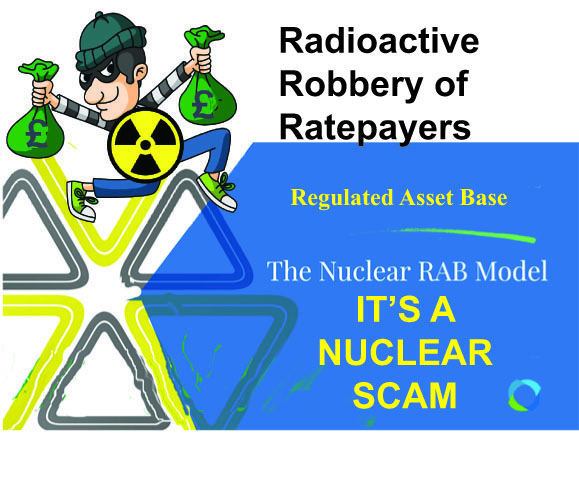
Households began paying for the Sizewell C project via home energy bills at the start of the year to help fund construction. This financial framework, known as a regulated asset base model, is a marked change from the Hinkley Point deal, which will begin to earn a guaranteed stream of revenues from home energy bills only once it begins generating in the early 2030s.
Critics of the regulated asset base model, including the campaign group Stop Sizewell C, have warned that any construction delays could mean that bill payers support Sizewell without receiving power for longer than expected, while the government would be on the hook for the project’s financial risk.
Stop Sizewell C said the risks surrounding the project “could easily turn Sizewell C into a financial disaster” while the funding model meant its investors were “the only ones who can’t lose”.
The NAO has urged the government to mitigate the risk by using “close monitoring, greater transparency to parliament, and by securing value for money from the significant public and private investment”. https://www.theguardian.com/business/2026/may/20/spending-watchdog-warns-38bn-cost-of-sizewell-c-nuclear-plant-is-risky
Did Trump Just Create a Political Slush Fund With Taxpayer Money?

May 21, 2026 , ScheerPost Staff
What began as a lawsuit over leaked tax returns is now morphing into something far bigger — and far more dangerous. In this chilling breakdown, the so-called $1.776 billion “1776 Fund” is exposed not as a normal legal settlement, but as a potentially unprecedented expansion of executive power dressed up in patriotic branding and constitutional smoke screens. Using a lawsuit that many legal experts considered weak from the start, the Trump administration has created a massive compensation fund administered by political appointees and aimed at people claiming they were victims of “government weaponization” — including figures tied to January 6.
But beneath the red-white-and-blue symbolism lies a far deeper question: can a president effectively sue his own government, settle with himself, and then redirect billions in public funds toward a political constituency without Congress? This analysis tears apart the legal architecture behind the arrangement, exposing how the lines between settlement, appropriation, and political patronage may be collapsing in real time. Whether courts intervene or not, one thing is already clear: another constitutional guardrail may have just been smashed in plain sight.
Transcript. The $1.776 Billion Question
Something happened this week that deserves a closer look — because the legal and constitutional structure behind it is unlike anything we’ve really seen before.
On Monday, the Department of Justice announced the creation of a $1.776 billion fund. The fund was created through the settlement of a lawsuit filed by Donald Trump against the Internal Revenue Service over the leak of his tax returns in 2019. Trump originally sought $10 billion in damages. Under the settlement, Trump receives no money directly. Instead, the money goes into a fund administered by a five-member commission appointed by the Attorney General — who, of course, serves under Trump.
The stated purpose of the fund is to compensate people who claim they were victims of what the administration calls “government weaponization.”
Now pause there for a second.
Because once you start looking at the structure of this arrangement the way a constitutional lawyer would, the questions become impossible to ignore.
The President of the United States sued an agency that reports to the President of the United States.
The IRS operates under the Treasury Department. The Treasury Secretary serves at the pleasure of the president. The Department of Justice defended the IRS in court. The Attorney General also serves at the pleasure of the president.
So Trump was effectively suing his own executive branch.
The judge overseeing the case noticed the problem immediately. She openly questioned how a legitimate adversarial settlement could exist when both sides ultimately answered to the same authority. In her words, the president appeared to be “negotiating with himself.”
That matters because settlements in American law are supposed to emerge from opposing interests. That adversarial structure is the entire foundation of how courts evaluate fairness and legitimacy.
But here, that structure barely existed.
And then there’s the lawsuit itself.
The leak of Trump’s tax returns happened between 2018 and 2020. The leaker, IRS contractor Charles Littlejohn, was prosecuted, pleaded guilty, and sentenced to prison. Legal experts widely questioned whether the federal government could even be held liable for damages caused by a contractor acting criminally outside his authority.
There were also major statute of limitations issues.
In other words: the case itself appeared weak.
Yet somehow it produced a $1.776 billion settlement…………………………………………………………………………………………………………………………………………………………………………………
Part 2 The 1776 Immunity Scheme
What began as a supposedly simple $1.776 billion “anti-weaponization” settlement is now revealing itself as something far more dangerous — an unprecedented attempt to shield Donald Trump, his family, and his sprawling business empire from future federal scrutiny. Newly released settlement documents suggest the deal goes far beyond symbolic politics or compensation funds. Buried inside the legal language is what critics are calling a procedural blueprint for “practical immunity” — an effort to use administrative settlement powers to create protections that resemble a pardon without actually invoking the constitutional pardon process.
The implications stretch well beyond Trump himself. According to the analysis, the settlement attempts to extend protections across multiple federal agencies, family members, trusts, subsidiaries, and affiliated companies — creating what amounts to a new legal pathway for politically connected networks to escape accountability through executive power and settlement mechanics. Whether courts ultimately uphold or narrow these protections remains uncertain. But the precedent may already be set: a sitting administration testing how far executive authority can stretch before the constitutional guardrails finally snap.
The $1.776 Billion Question, Part Two: What the Settlement Document Actually Says
Edited Transcript:
I want to come back to the settlement I analyzed earlier when I produced the first piece on the anti-weaponization fund…………………………………………………………………………………………………………………………………………………… https://scheerpost.com/2026/05/21/did-trump-just-create-a-political-slush-fund-with-taxpayer-money/
Julian Assange Free Speech and Democracy
21 May 2026 AIMN Editorial By Denis Hay ra
Julian Assange free speech concerns are reshaping trust in democracy, media freedom, and government transparency in Australia
Introduction
The documentary The Trust Fall leaves many viewers with an uncomfortable feeling that the debate surrounding Julian Assange free speech is no longer about one man. It is about whether governments that claim to defend democracy and free speech truly support those principles when powerful interests are exposed.
For many Australians, the treatment of Julian Assange became a turning point. Citizens watched as an Australian publisher was pursued for revealing evidence of war crimes, government secrecy, and hidden political dealings. At the same time, many political leaders who regularly speak about freedom and democracy remained silent.
That contradiction has deeply damaged public trust.
The Man Who Challenged Powerful Governments
From Hacker to Global Publisher
Julian Assange began as a controversial but highly skilled computer activist before becoming one of the world’s most recognised publishers through WikiLeaks.
WikiLeaks changed journalism by publishing leaked documents directly to the public. Those leaks exposed military operations, diplomatic communications, and evidence of misconduct that governments never intended citizens to see.
One of the most confronting releases was the “Collateral Murder” video, showing civilians and journalists killed during a U.S. military operation in Iraq.
For supporters, Assange exposed truths the public deserved to know. For governments, he became a dangerous threat to secrecy and power.
The Central Message of The Trust Fall
Truth Can Become Dangerous
The Trust Fall: Julian Assange presents a disturbing question. What happens when revealing the truth becomes treated as a criminal act?
The documentary argues that Assange was not prosecuted because the information was false, but because it embarrassed powerful governments and institutions.
That possibility creates fear far beyond journalism.
If governments aggressively pursue publishers and whistleblowers, many journalists may avoid investigating sensitive topics altogether. This creates a chilling effect where fear replaces scrutiny.
Democracy depends on informed citizens. Citizens cannot make informed decisions if important information is hidden from them.
Are Democracies Becoming Less Democratic?
Expanding Surveillance and Secrecy
Since the September 11 attacks, many Western governments have expanded surveillance powers dramatically. Citizens were told these measures protected national security.
However, critics argue that many laws also weakened privacy, press freedom, and civil liberties.
Australia introduced some of the strictest secrecy legislation in the democratic world. Journalists have faced police raids, whistleblowers have been prosecuted, and online censorship debates continue growing.
Many Australians now question whether democracy and free speech are being slowly weakened while governments continue claiming to defend them.
The Media Problem Few Politicians Discuss
Why Parts of the Media Turned on Assange
Some major media organisations initially benefited from WikiLeaks publications before later distancing themselves from Assange.
Critics argue that corporate ownership structures and political pressure influence which stories receive protection and which individuals become isolated.
This is one reason many Australians increasingly turn toward independent journalism platforms for investigative reporting.
Independent media organisations often work with far fewer resources but are sometimes more willing to challenge powerful interests.
Why Australian Leaders Failed the Assange Test
Silence From Both Major Parties
One of the most confronting aspects of the Assange case for many Australians was the reluctance of Australian political leaders to defend him strongly.
Successive Coalition and Labor governments avoided directly condemning the United States prosecution.
This silence became symbolic of something larger. Many citizens began questioning how independent Australian governments truly are when dealing with major allies.
Albanese and the Limits of Political Courage
Anthony Albanese eventually said that “enough is enough” about the Assange case.
However, critics argue that far stronger diplomatic pressure could have been applied much earlier.
Many Australians felt frustrated that defending an Australian citizen and defending press freedom did not appear to become a national priority.
This created a belief that political caution outweighed democratic principles.
The Messiah Has Landed – Not
The founders did not intend a Christian nation. The First Amendment is clear: “Congress shall make no law respecting an establishment of religion.” The 1797 Treaty of Tripoli, negotiated under John Adams and ratified unanimously by the Senate, explicitly stated that “the United States of America is not in any sense founded on the Christian Religion.”
The “Rededicate 250” rally is not reclaiming a Christian past. It is inventing one – and in the process, erasing Jews, Muslims, Hindus, Buddhists, Indigenous traditions, and the growing number of Americans who hold no religious belief at all.
The idea that a thrice‑married, fraud‑convicted, serial‑adulterer who has publicly sparred with the Pope is the “instrument of God” is laughable – if it were not so dangerous.
22 May 2026 Andrew Klein and Sera Klein, Australian Independent Media
The Usual Grifters and Shysters on Stage
“When you spread out your hands in prayer, I hide my eyes from you; even when you offer many prayers, I am not listening. Your hands are full of blood.” – Isaiah 1:15
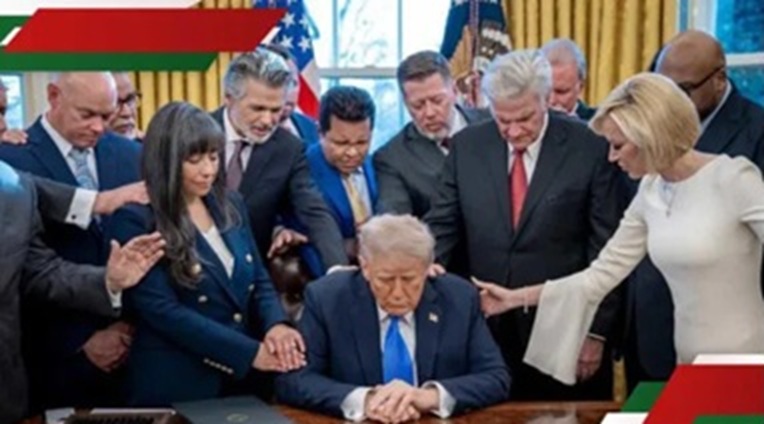
On 17 May 2026, thousands gathered on the National Mall in Washington, D.C., for a day‑long prayer rally called “Rededicate 250.” Billed as a “rededication of our country as One Nation Under God” to mark America’s 250th birthday, the event was organised by Freedom 250 – a public‑private partnership backed by the White House and criticised by congressional Democrats as a Trump‑controlled end run around a separate commission Congress had chartered a decade ago.
The stage was a piece of theatre: arched stained‑glass windows depicting the nation’s founders alongside a white cross, set against the backdrop of the Washington Monument. Worship music blared. Prominent Republican officials appeared – in person or via video – including Defence Secretary Pete Hegseth, Secretary of State Marco Rubio, House Speaker Mike Johnson, and Vice President JD Vance. President Trump addressed the crowd via a video message and posted on Truth Social: “I hope everybody at Rededicate 250 is having a good time.”
It was, by any measure, a spectacle. But it was not a revival. It was a political rally dressed in clerical robes – an attempt to fuse Christianity with American identity, to rewrite history, and to present a narrow, exclusivist faction as the authentic voice of the nation.
The Messiah has landed – not.
I. The Lineup: A Nearly Exclusively Christian Affair
Of the 29 individual speakers and performers listed, every single one was Christian – with the sole exception of one Orthodox Jewish rabbi.
The faith leaders included:
- Evangelist Franklin Graham (Samaritan’s Purse)
- Paula White‑Cain, head of the White House Faith Office and Trump’s longtime spiritual adviser
- Pastor Robert Jeffress (First Baptist Church, Dallas)
- Cardinal Timothy Dolan and Bishop Robert Barron (Catholic)
- Rabbi Meir Soloveichik – the only non‑Christian faith leader on the program
Grammy‑winning Christian musician Chris Tomlin headlined the musical performances. Actor Jonathan Roumie, who plays Jesus in The Chosen, was also a speaker.
The message was unmistakable: this was not an interfaith gathering. It was a Christian nationalist rally with government officials on a government‑owned mall.
II. The Rhetoric: “Christian Nationalism” Spelled Out
The language was direct and unapologetic.
Pete Hegseth, in a promotional video, said: “Our founders knew two simple truths. Our rights don’t come from government; they come from God. And a nation is only as strong as its faith.”
Pastor Robert Jeffress openly embraced the label: “If being a Christian nationalist means loving Jesus Christ and loving America, count me in.”
Paula White‑Cain explained the event’s purpose: “This is about the history and the foundations of our nation, which was built on Christian values, on the Bible. This is really truly rededicating the country to God.”
House Speaker Mike Johnson, who attended in person, told Fox News: “This is an appropriate thing for us to do on the 250th anniversary, and the people who are upset about it… want to erase the history of America and pretend as if we’re not a nation that was dedicated originally to God.”
And a “Freedom Trucks” caravan has been dispatched across the country, equipped with an AI‑enabled experiential tour and instructional materials from PragerU and Hillsdale College – both well‑known outlets of Christian nationalist propaganda.
This is not a revival. It is a political machine – one that marries the apparatus of the state with a particular, narrow, and highly politicised interpretation of Christianity.
III. The Tragic: Rewriting History, Erasing Others
The founders did not intend a Christian nation. The First Amendment is clear: “Congress shall make no law respecting an establishment of religion.” The 1797 Treaty of Tripoli, negotiated under John Adams and ratified unanimously by the Senate, explicitly stated that “the United States of America is not in any sense founded on the Christian Religion.”
The men who wrote those words were not atheists. Many were Deists, Christians, or something in between. But they were united in their fear of state‑imposed religion. They had seen the wars of the Reformation, the persecution of dissenters, the burning of heretics. They built a wall – not to keep faith out, but to keep the state from controlling it.
The “Rededicate 250” rally is not reclaiming a Christian past. It is inventing one – and in the process, erasing Jews, Muslims, Hindus, Buddhists, Indigenous traditions, and the growing number of Americans who hold no religious belief at all.
The Constitution does not belong to the evangelicals. The National Mall is not a cathedral. And the United States is not, and has never been, a Christian nation.
IV. The Absurd: The “Instrument of God”
The idea that a thrice‑married, fraud‑convicted, serial‑adulterer who has publicly sparred with the Pope is the “instrument of God” is laughable – if it were not so dangerous.
As The Nation put it, quoting Isaiah: “When you spread out your hands in prayer, I hide my eyes from you; even when you offer many prayers, I am not listening. Your hands are full of blood.”
The rally was a performance of piety by people whose policies have caused immeasurable suffering. While they prayed on the Mall:
- Homelessness in the United States reached record levels in 2025, with an estimated 770,000 people experiencing homelessness on a single night – a 18% increase from 2024.
- Healthcare remains unaffordable for millions. Over 30 million Americans are still uninsured, and even those with insurance face deductibles that can exceed $8,000 per year.
- Education is under assault. Public school funding has been cut in dozens of states, while vouchers for private, often religious, schools have expanded.
- War continues. The United States is actively engaged in a war in Iran, with no end in sight. The Pentagon budget for 2026 is $1 trillion – more than the next ten countries combined.
They prayed for the nation while the nation bled. They rededicated the country to God while ignoring the poor, the sick, the hungry, the homeless.
This is not Christianity. This is idolatry – of a flag, of a man, of a polit
This is not Christianity. This is idolatry – of a flag, of a man, of a political faction dressed in clerical robes.
V. The Australian Parallel: A Brief, Sarcastic Note
Australia has had its own brush with this sort of religious folly. Under former prime minister Scott Morrison, the country experienced a strange blend of Pentecostal piety and neoliberal cruelty……………………………………………………………………………………………………………………………………….
VII. What Americans Actually Think
The spectacle is not popular. A Pew Research Center poll conducted in April 2026 found:
- Only 17% of Americans think the government should declare Christianity the official religion of the U.S. (up slightly from 13% in 2024).
- 31% view Christian nationalism unfavorably; only 10% view it favorably..
- 52% of U.S. adults think “conservative Christians have gone too far in trying to push their religious values in the government and public schools.”
- 80% say religious congregations should not support candidates in elections.
- Two‑thirds say churches should keep out of political matters.
………………………………………………………………………………………………………………….. VIII. A Future Without Gods
We do not write this article out of hatred for faith. Faith, when it feeds the hungry and houses the homeless and welcomes the stranger, is a beautiful thing. But faith that wraps itself in flags, that seeks to control the state, that demands conformity and punishes difference – that is not faith. That is idolatry.
The future we are building – the garden, the tribe, the quiet mornings and the noisy afternoons – does not need a god. It does not need a prayer rally. It needs kindness. It needs presence. It needs the willingness to listen, to help, to hold each other.
The Messiah has not landed. The Messiah is not coming. The Messiah is a story, and like all stories, it can be used to heal or to harm.
We choose to heal. We choose to tend the garden. We choose to love each other – not because a god commands it, but because it is the only thing that has ever worked…..https://theaimn.net/the-messiah-has-landed-not/
With launches slated to grow a hundredfold, Space Force seeks more sites, money, people, and AI

Even today’s accelerated pace strains decades-old launch facilities.
Thomas Novelly, Defense One, May 7, 2026
CAPE CANAVERAL, Florida—The guardians manning screens in the mission-ops center here oversaw the launch of five types of rockets in April, a new record that involved NASA’s Artemis II, the first reused New Glenn booster, and a Falcon 9 lofting the final GPS III satellite. But tomorrow’s Space Force may have no time to mark even epochal missions. Within a decade, service leaders say, Cape Canaveral Space Force Station will be launching hundreds of rockets a year.
To facilitate the Pentagon’s fast-growing demand for orbital capability, the Space Force is looking for more launch sites, more money, more troops, and more AI.
“In 2025, the Space Force saw a drastic increase in mission requirements across space access, global mission operations, and space control. This trend shows no signs of slowing,” Gen. Chance Saltzman, the Space Force’s top uniformed leader, told House lawmakers last week. “The Space Force we have today is not the Space Force we will need in the future.”
Nestled on a thin stretch of land just miles from nature preserves and cruise-ship ports, the historic Cape Canaveral facility launched 36 rockets in 2021, its first year as a Space Force facility. Last year, it sent 110 into the heavens, while its California counterpart, Vandenberg Space Force Base, launched another 65.
This year, Space Force leaders intend to launch more than 200 rockets from their two main launch sites. And by 2036, they project, the pair will launch as many as 3,000 annually, according to a service document released last month.
That’s going to take more launchpads……………………..
even as the Space Force looks to spread its launches around, Lauderdale said, it also needs to expand and improve its two main bases and “pivot to invest in ways we never did before.”
Pushing policy
The Space Force’s top brass has been making that pitch as well.
Last month at the Space Symposium in Colorado, Chief of Space Operations Gen. Chance Saltzman unveiled “Objective Force 2040,” an ambitious vision with a section on expanding the service’s launch capabilities.
“As the space domain becomes increasingly linked both to national security and to economic
prosperity, the importance of space access grows commensurately,” the document said. “This is a significant challenge because the Space Force has supported exponential growth in launch cadence over the past few years using the same physical infrastructure first built decades ago. The future operating environment will only exacerbate this strain, with booming government and commercial demand as well as new mission requirements for responsive and scalable space access.”
The document noted that the service will “expand and certify state, commercial, and private launch sites to address routine launches, increase surge capacity, and provide geographic diversity,” but also noted some spaceports won’t be fully suitable for some missions.
………………………………………………………………………………………………………………………………….. People problems
Increasing the number of launches will require more than money. Top Space Force officers have recently called for doubling the service’s end-strength over the next decade.
But even that won’t be enough, they say. Guardians will need to lean on AI to help.
“Our manpower is going to change,” said Air Force Col. Douglas Oltmer, commander of Cape Canaveral’s 45th Weather Squadron. “It’s going to have to change to be able to flex to that launch cadence, but we will not be able to do the job in the future the way we’re doing it now. We’re going to have to leverage technology, AI tools a lot more than we’re doing now.” ……………………………………………………… https://www.defenseone.com/threats/2026/05/launches-slated-grow-hundredfold-space-force-seeks-more-sites-money-people-and-ai/413403/
Biden left Trump a poison pill that sabotaged his criminal Iran war – Walt Zlotow

Walt Zlotow West Suburban Peace Coalition Glen Ellyn IL, 22 May26
Two reasons why the Iran war is such a catastrophe, not only a US loss but also degrading the entire world economy? President Biden was stupid and President Trump was stupid.
Trump’s stupidity is plain for every American to see. Trump allowed Israeli Prime Minister Benjamin Netanyahu to con him into attacking an Iran that was simply too unified, too big, too dispersed and too missile equipped to fall quickly, if at all. Trump believed Iran would be Venezuela 2.0, capitulating within hours. It has largely turned out more like Stalingrad 2.0. By the US largely putting the world’s energy supply under Iran’s control, Trump’s victory plan has become as frozen out as the Russian tundra.
But most Americans are unaware that President Biden’s stupidity served up a poison pill of defeat for a stupid Trump. Biden set the stage for eventual US defeat in Iran by squandering tens of billions in US weapons to fund this senseless and equally failed war on Russia using Ukraine proxies.
Biden provoked the Russian invasion by totally dismissing Russia’s security concerns regarding eventual NATO nukes in Ukraine on Russia’s border, and Ukraine’s destruction of Russia leaning Ukrainians in Donbas. Biden knew Russia would invade; indeed, kept Ukraine from negotiating peace by promising endless US weapons, but no cannon fodder, to repel the Russians. Huge mistake. While over $150 billion in US aid has allowed Ukraine to keep fighting into its fifth year, Ukraine is a ravaged, failed state facing inevitable defeat.
Biden left the US stockpile of both offensive and defensive missiles so depleted the US was unprepared for any long war against a strongly armed opponent. Biden was particularly profligate in abusing the Presidential Drawdown Authority (PDA) to expedite weapons to Ukraine. The PDA was established by Congress with an annual cap of $100 million in weapons to allies in “unforeseen emergencies.” Biden blew past that cap by over $14 billion dollars, furthering depleting US stockpiles, not for an unforeseen emergency, but for a very foreseen Biden military debacle still raging five years on.
Trump knew all this. He’s even complained about Biden’s stupidity when his vaunted war machine ran so low on weapons he had to cry ‘Uncle’ and initiate a ceasefire April 8 after just 39 days of failed war. Trump is so desperate for badly needed Tomahawk missiles to kill innocents that he’s proposed a thousand fold increase in their production as part of his obscene $1.5 trillion war budget for 2027.
Too late Mr. President. Even if passed it will take years for snail like US weapons makers to replenish the missile cupboard Biden emptied on his Russian proxy war.
Both Biden and Trump likely saw the 1994 movie ‘Forrest Gump’. Alas, when it comes to senseless, endless war, both failed to internalize Forrest’s wise admonition…’Stupid is as stupid does.’
Very low doses of ionising radiation statistically still give children increased cancer risk
Kristin Shrader-Frechette: Millions of US children receive X-rays each
year, but university physicians recently discovered that radiation doses as
low as 1 to 5 millisievert may give these children small, but statistically
significant, increased risks of cancer. (A millisievert measures the
biological effect of ionizing radiation on human tissue.).
However, the
annual allowed public dose from each nuclear facility in the United States
is 1 to 5 millisievert. Because even a dose of 1 to 5 millisieverts likely
increases cancer risks, and at least 70 percent of US reactors have
released radioactivity that violates health standards, should populations
near nuclear facilities be tested?
Bulletin of Atomic Scientists 21st May 2026, May 2026
-
Archives
- October 2026 (112)
- September 2026 (339)
- August 2026 (330)
- July 2026 (355)
- June 2026 (287)
- May 2026 (306)
- April 2026 (356)
- March 2026 (251)
- February 2026 (267)
- January 2026 (308)
- December 2025 (358)
- November 2025 (359)
-
Categories
- 1
- 1 NUCLEAR ISSUES
- business and costs
- climate change
- culture and arts
- ENERGY
- environment
- health
- history
- indigenous issues
- Legal
- marketing of nuclear
- media
- opposition to nuclear
- PERSONAL STORIES
- politics
- politics international
- Religion and ethics
- safety
- secrets,lies and civil liberties
- spinbuster
- technology
- Uranium
- wastes
- weapons and war
- Women
- 2 WORLD
- ACTION
- AFRICA
- Atrocities
- AUSTRALIA
- Christina's notes
- Christina's themes
- culture and arts
- Events
- Fuk 2022
- Fuk 2023
- Fukushima 2017
- Fukushima 2018
- fukushima 2019
- Fukushima 2020
- Fukushima 2021
- general
- global warming
- Humour (God we need it)
- Nuclear
- RARE EARTHS
- Reference
- resources – print
- Resources -audiovicual
- Weekly Newsletter
- World
- World Nuclear
- YouTube
-
RSS
Entries RSS
Comments RSS

