Survey begins to determine remote island’s suitability for nuclear disposal site

But while the local leaders of the municipalities in Hokkaido and Genkai approved the literature reviews, the Hokkaido and Saga governors, whose permission NUMO will seek to go on to the next stage — a preliminary on-site survey — are opposed
By Eric Johnston, STAFF WRITER, May 21, 2026, https://www.japantimes.co.jp/tag/nuclear-energy/
A survey to determine the suitability of a remote island in the Ogasawara Islands chain as a final disposal site for radioactive nuclear waste began Wednesday.
The National Waste Management Organization of Japan (NUMO) will carry out a review of the scientific literature on the geology of Minamitorishima, Japan’s easternmost island, located nearly 2,000 kilometers from Tokyo.
The literature review is the first stage of an investigation into whether the site would be suitable for constructing an underground nuclear storage facility. The radioactive waste would need to be buried at least 300 meters underground for up to 100,000 years.
Minamitorishima has no civilian residents and is part of Ogasawara Village. The mayor, Masaki Shibuya, gave his approval for the survey last month.
Over the next two years or so, experts will scrutinize geological maps and academic papers regarding earthquake fault lines and volcanic activity on and around the island.
Local governments that agree to participate in the literature review can receive up to ¥2 billion in grants, and the central government has been encouraging as many of them as possible to raise their hands.
“The final disposal of radioactive waste is a critical issue that Japan as a whole must resolve, and we intend to conduct literature surveys in as many parts of the country as possible,” NUMO President Akira Yamaguchi said in a statement Wednesday.
Minamitorishima is only the fourth site to agree to the survey. Suttsu town and Kamoenai village in Hokkaido Prefecture have been surveyed, and NUMO is compiling feedback on the report. Genkai, in Saga Prefecture, is currently undergoing a survey as well.
But while the local leaders of the municipalities in Hokkaido and Genkai approved the literature reviews, the Hokkaido and Saga governors, whose permission NUMO will seek to go on to the next stage — a preliminary on-site survey — are opposed.
“If Suttsu and Kamenaichi intend to proceed with a preliminary survey, I’ll express opposition at this time,” Hokkaido Gov. Naomichi Suzuki said in March, citing an October 2000 prefectural assembly ordinance opposing the introduction of nuclear waste into the prefecture.
Saga Prefecture Gov. Yoshinori Yamaguchi has also indicated his opposition to his prefecture hosting a final disposal facility.
“I have no intention of accepting any new burdens,” Yamaguchi said in April when asked about his position on whether he’d provide consent for Genkai to conduct a preliminary on-site survey after the literature survey.
Unlike the other three candidate sites, Minamitorishima has no permanent residents and is off-limits to the public. It houses facilities operated by the Maritime Self-Defense Force, the Japan Meteorological Agency, and the Land, Infrastructure, Transport and Tourism Ministry.
The Japanese government is moving to restart as many nuclear power plants as possible. But on-site storage facilities for spent nuclear fuel at many power plants are approaching full capacity, while plans to have the spent fuel recycled at the Rokkasho Reprocessing Plant in Aomori Prefecture remain stalled.
In February, the Federation of Electric Power Companies of Japan released figures showing that storage pools at 17 nuclear plants where spent fuel is cooled were 78% full as of the end of last year.
World War Trump (everywhere, Somalia too)

In the Trumpian Age, Every Accusation Is Also a Confession
SCHEEROST, Nick Turse Tom Dispatch, May 22, 2026
“It’s got no anything,” President Donald Trump said of Somalia in a recent xenophobic rant. “All they do is run around shooting each other.”
As is true of so much with this administration, every accusation is also a confession.
U.S. troops have been shooting Somalis since the early 1990s, after lame duck President George H. W. Bush launched an ostensibly humanitarian intervention there that would be embraced by his successor, Bill Clinton. By June 1993, U.S. and U.N. troops had begun attacking various targets in Somalia’s capital, Mogadishu, linked to warlord Mohamed Farrah Aidid, who had helped overthrow dictator Mohamed Siad Barre.
The next month, in a major escalation, U.S. helicopter gunships attacked a house in that city where a group of Somali clan leaders was meeting. The International Committee of the Red Cross said 54 people were killed and 161 wounded. Aidid claimed that 73 Somalis had died, including women and children, and more than 200 had been wounded. U.S. forces suffered no casualties whatsoever.
And it wasn’t long before — in the early 2000s, under Bush’s son, George W., as part of what became known as the Global War on Terror — American troops began slaughtering Somalis again. In addition to major conflicts in Afghanistan and Iraq, Bush, the younger, launched early drone wars from Pakistan to Yemen, including in Somalia. His successor, President Barack Obama, upped the Forever War ante, becoming an assassin-in-chief in Somalia and beyond. Obama’s vice president, Joe Biden, continued the drone war there, too, when he entered the White House.
However, for all those years of slaughter in Somalia, no American president has ever attacked Somalis with the persistence and at the rate of President Donald J. Trump, especially in his second term in office.
The second Bush administration conducted 11 airstrikes in Somalia, killing as many as 144 people — including possibly 55 civilians, according to the think tank New America. Obama presided over 48 strikes during his eight years in office that killed as many as 553 people. Trump’s first term saw a massive escalation in such drone strikes. Over his first four years, Trump carried out 219 attacks, a 271% increase over the 16 years of the George W. Bush and Obama presidencies. But even that spike has paled in comparison to the relentless rate of attacks during Trump’s second term in office. While Biden exceeded Obama’s total in half the time — 51 strikes in four years — Trump is already set to eclipse his own infamous first-term record in less than a year and a half. He has presided over at least 190, if not more, air strikes in Somalia.
Trump’s killing spree in Somalia is just a small part of his wider war on the world. It’s no exaggeration to say that he has the U.S. military “run[ning] around shooting” people on an epic scale. During his two terms in office, Trump has overseen armed interventions and military operations — including air strikes, commando raids, proxy conflicts, so-called 127e programs, and full-scale wars — in Afghanistan, the Central African Republic, Cameroon, Ecuador, Egypt, Iran, Iraq, Kenya, Lebanon, Libya, Mali, Niger, Nigeria, North Korea, Pakistan, the Philippines, Somalia, Syria, Tunisia, Venezuela, Yemen, and an unspecified country in the Indo-Pacific region, as well as attacks on civilians in boats in the Caribbean Sea and the eastern Pacific Ocean. His second term has, in fact been a furious blitz of global war-making, only half-noticed by the American news media. In March, for example, the United States made war on three continents during just three days, conducting attacks in Africa, Asia, and South America. During that span, the U.S. also struck a civilian boat in the eastern Pacific Ocean.
Less than a year and a half into Trump’s second term, the U.S. has already killed more than 2,000 civilians from Latin America to the Middle East and Africa. “This is unprecedented in terms of the sheer number of theaters where harm to civilians has been reported within such a short space of time,” said Megan Karlshoej-Pedersen, a policy specialist with Airwars, a British-based organization that tracks civilian harm globally. She also pointed to attacks in the Caribbean Sea, the eastern Pacific Ocean, Iran, Nigeria, Somalia, Syria, Venezuela, and Yemen.
A War on Children
Since the U.S. began conducting air strikes in Somalia back in 2007, as many as 170 civilians have been killed, according to Airwars. The U.S. military has, however, only admitted to six of those deaths and 11 other injuries — and has never publicly apologized to any families of the victims or those who survived its attacks.
In one April 2018 attack in Somalia during Trump’s first term, a U.S. drone strike killed at least three (and possibly five) civilians. A woman and child were among the dead, according to formerly secret U.S. military investigation documents, but the same report concluded that their identities might never be known. A 2023 investigation I undertook for The Intercept, however, exposed the details of that disastrous attack. The woman and child — 22-year-old Luul Dahir Mohamed and her 4-year-old daughter, Mariam Shilow Muse — survived the initial strike but were killed by a double-tap attack as they fled for their lives. Abdi Dahir Mohamed, one of Luul’s brothers, said of the Americans who killed his sister and niece: “They know innocent people were killed, but they’ve never told us a reason or apologized. No one has been held accountable.”……………………………………………………………………………………………………………………………………………………………………………………………………………………………………………………………………………………………………………. Some of those attacks could well have been categorized as crimes of war. Others are certainly extrajudicial killings — or, simply put, outright murders. Those deaths and so many others can be traced back to Donald Trump and his contempt for the lives of people across this planet.
“It’s filthy dirty, disgusting dirty,” Trump said of Somalia, but in truth, that’s a more apt description for the soul of the country that exports slaughter, year after year, and is led by a man who revels in it. “It’s a horrible place,” he continued about Somalia.
And once again, every accusation of his should be considered a confession, too. https://scheerpost.com/2026/05/22/world-war-trump/
American Democracy Does Not Exist
Caitlin Johnstone, May 20, 2026, https://www.caitlinjohnst.one/p/american-democracy-does-not-exist?utm_source=post-email-title&publication_id=82124&post_id=198559968&utm_campaign=email-post-title&isFreemail=true&r=1ise1&triedRedirect=true&utm_medium=email
Thomas Massie has lost his congressional seat against a primary opponent whose Israel lobby funding made the race the most expensive House of Representatives primary in history. Massie has been a rare Republican opponent of Israeli abuses on Capitol Hill.
The spending on Massie’s ouster topped out at a staggering $32 million when all was said and done. The second- and third-most expensive House primary races were also heavily slanted by Israel lobby funding, with AIPAC pouring millions into toppling progressive Democrats Cori Bush and Jamaal Bowman.
Americans just watched the Israel lobby openly manipulate yet another election, and then in like two weeks they’re going to hear their government tell them they need to regime change another foreign country to bring “democracy” to its people. Americans themselves do not have democracy.
The ceasefire with Iran is tenuous and could end at any time. Washington is currently drumming up ridiculously transparent pretexts to justify attacking Cuba. And you just know as soon as the bombs start falling on whatever country they’re going to fall on, Americans will be told this is a good thing because it will bring freedom and democracy to whatever population is getting ripped apart by military explosives.
It’s just so silly how often the US propaganda machine bangs on about “democracy” while vast fortunes are poured into slanting the American electoral process to advance the agendas of plutocrats and special interest groups.
Let’s bring democracy to the Iraqi people! Oh no, the Russians are interfering in our democracy!
And meanwhile nothing of the sort actually exists in America. When the elections go toward whoever can afford to spend the most on manipulating and deceiving the public into voting their way, that’s not democracy. That’s plutocracy.
The rich buy up news outlets and social media platforms, pour funding into think tanks and lobby groups, and sponsor the primary campaigns of anyone who disagrees with them, and in so doing they are able to exert enough influence to get the public to vote in whatever way advances their agendas.
That’s why Americans have a joke of a minimum wage and no normal healthcare system. It’s why corporations are allowed to exploit the working class and pollute the environment without consequence. It’s why AI is being shoved down our throats with zero regulation while it consumes our clean water and takes our jobs. And it’s why American-made bombs are still falling in Lebanon and Gaza.
The rich and powerful are going to keep doing this until they are made to stop. They’re going to keep using their wealth and influence to manipulate public behavior until people stop allowing them to. You can’t vote this problem away, because they control the votes.
Forget about bringing democracy to Cuba. Try bringing democracy to the United States.
.
The military threat to nuclear power plants around the world
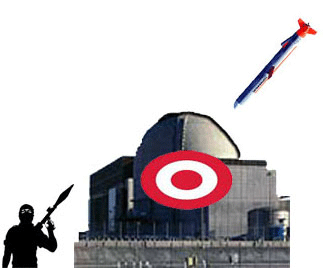
Direct strike could release radioactive material and cause mass terror
By Chas Newkey-Burden, The Week UK, https://theweek.com/world-news/the-threat-to-nuclear-power-plants-around-the-world
The “vulnerability” of the civilian energy infrastructure was exposed this week when a drone strike on the United Arab Emirates cut off power to a nuclear reactor, said Bloomberg.
It’s the first time a fully operating nuclear power plant has had to rely on back-up generators because of a military attack, but reactors in Ukraine and Iran have also been threatened by recent conflicts.
Why would a nuclear site be targeted?
A country might target a nuclear power plant to cripple an enemy’s power grid, or to force a surrender through the psychological terror of threatening a radiological disaster. An attack on such facilities could also be used to delay a nation’s ability to enrich nuclear material.
Alternatively, armies may attack, or occupy, a nuclear plant to seize control of a strategic geographic corridor or to prevent defending forces from using the area.
What does international law say?
Under the Geneva Conventions, civilian structures, including nuclear power plants, “are protected against attack”, but the treaties also state that they can be hit “for such time as they are military objectives”. This is a “loophole” that “aggressor states” have “interpreted widely”, said Dan Sabbagh, The Guardian’s defence and security editor.
Attacking a nuclear power plant also breaks legal resolutions passed by the UN Security Council and the International Atomic Energy Agency’s board of governors.
What would happen if a site were hit?
An attack on a nuclear site would not necessarily lead to a mushroom cloud or an immediate release of radiation because modern plants are built with multiple safety systems that can shut down reactors and contain damage.
But the reactor’s core could continue to heat up after a strike. This could lead to a build up of hydrogen gas, which could cause further explosions and damage. If the reactor began to degrade, radioactive material could be released and that can remain in the environment for years or even decades. It could potentially spread across borders and enter water systems or settle into the soil.
There are other consequences. Attacks on nuclear installations “risk undermining the emerging nuclear renaissance” in Western economies as an alternative to fossil fuels, said Bloomberg. Politicians and the public are “highly sensitive to radiation emergencies”, so an incident in one country “tends to dampen enthusiasm” for nuclear power elsewhere.
An attack on a nuclear plant would also be a hugely symbolic moment. Although conventional power plants have been “repeatedly bombed” by Russia during the Ukraine war, said Sabbagh, Kyiv’s three functioning nuclear plants have “remained relatively unscathed” because Moscow regarded a direct attack on them to be “taboo”.
‘Independent’ Cuban Media Pushing Regime Change

Mint Press News, May 21, 2026, Alan Macleod
Amid escalating U.S. aggression towards the Cuban island through a maximum pressure campaign and the threat of military intervention, the United States government has been covertly funding a huge network of Cuban media outlets that claim to be independent in a push for regime change against the independent socialist government.
These outlets present themselves as unbiased investigative journalism, but are quietly being financed by Washington through USAID, the National Endowment for Democracy and the Open Society Foundation in order to sow discontent across the Caribbean nation, softening it up for a potentially “imminent” invasion by the Trump administration.
Cuba faces some of its worst energy blackouts in its history, thanks to the U.S. blockade, which is attempting to strangle the island into submission. As a Communist state defying U.S. orders, Cuba has, since 1959, been in the crosshairs of Washington, which is attempting to overthrow the government. MintPress sheds light on this shady regime change nexus.
Independent Journalism, Funded by the State Department
CubaNet is one of the most influential and well-established news outlets covering affairs on the Caribbean island. Founded by anti-government activists in 1994, the site has become the go-to source of information for corporate media, which regularly cite it, and present it as an objective and unbiased independent media (e.g., The Washington Post, The Wall Street Journal, Fox News, and The Los Angeles Times). CubaNet reporters have written op-eds in major U.S. newspapers such as USA Today, calling for an immediate change in government on the island.
But CubaNet is not as independent as it seems. The outlet is bankrolled by the U.S. national security state. CubaNet has received millions of dollars in funding from USAID and the National Endowment for Democracy, as well as the Open Society Foundation.
One currently active $500,000 USAID grant, for instance, was awarded to CubaNet to “engage on-island young Cubans through objective and uncensored multimedia journalism.” While ostensibly a laudable goal, even the grant’s own one-sentence description hints that its purpose is to undermine and attack the Cuban government. It states that it will (emphasis added) “increase the free flow of information to and from Cuba in order to offset the regime’s disinformation campaigns.”
Another news organization receiving huge sums of money from Washington is ADN Cuba. Literally meaning “Cuba’s DNA,” the outlet has amassed a significant following online, boasting over 100,000 subscribers on YouTube, over 200,000 on Instagram and over 1.3 million on Facebook. It describes itself as “an independent media outlet committed to freedom and democracy in Cuba.” Yet it is actually based in Spain. And it does not seem particularly committed to transparency about its funding.
What is clear, however, is that ADN Cuba has received millions of dollars from the U.S. national security state. In September 2024, USAID approved a $1.1 million grant to ADN Cuba — a gigantic amount of money for an organization that publishes barely one story per day on its website. This was on top of a $1.5 million allocation for the 2022-2024 period.
Indeed, since 2020, ADN Cuba has received in excess of $3 million from USAID alone. This relationship is not disclosed to readers — even in stories directly covering USAID funding Cuban media — and is relegated to the footnotes of obscure U.S. government funding databases.
Diario de Cuba is another Spanish-based news outlet that publishes a wide variety of stories, all with one thing in common: a deep aversion to the Cuban government. The BBC describes it and CubaNet as key sources for impartial news, run by journalists who “report without censorship and to paint a broader picture on the country’s reality.”
And just like CubaNet, Diario de Cuba has received seven-figure funding from Washington. Between 2016 and 2020, Diario de Cuba received $1.3 million in USAID cash — almost as much as CubaNet over the same period. This generous funding has allowed it to reach a global audience, with over 600,000 followers on Facebook alone.
The Central Intelligence Agency used to directly (and secretly) sponsor hundreds of media outlets across the world. However, after a series of scandals and more information about its nefarious activities came to public attention, Washington decided to outsource many of its most controversial foreign operations to organizations such as the National Endowment for Democracy and the U.S. Agency for International Development.
“It would be terrible for democratic groups around the world to be seen as subsidized by the C.I.A.,” Carl Gershman, the NED’s longtime president [until 2021], said, explaining the 1983 decision to create his organization. NED co-founder Allen Weinstein agreed: “A lot of what we do today was done covertly 25 years ago by the C.I.A.,” he told The Washington Post.
Under the guise of democracy promotion and human rights, the U.S. government channels money to political and social groups across the world in order to maximize its strategic goals, including regime change.
In recent years, the U.S. has used the twin organizations of the NED and USAID to bankroll anti-government protests in Hong Kong, to attempt a color revolution in Belarus, to overthrow the government of Ukraine in 2014 and to organize riots across Iran earlier this year.
In Cuba, the NED and USAID played a critical role in organizing a (failed) uprising against the government in 2021. USAID in particular spent millions of dollars funding, organizing and promoting the San Isidro Movement — a collective of musicians, artists, and journalists– to lead a counter-revolution on the island.
San Isidro members were at the forefront of a wave of nationwide protests that July. The demonstrations were immediately signal boosted by Western corporate media, top celebrities and U.S. politicians, including President Joe Biden. Neitzens were flooded with the astroturfed “SOS Cuba” campaign, that trended across the Internet for days.
In the end, however, the coordinated efforts of the U.S. failed to convince ordinary Cubans to take to the streets, and the movement quickly petered out.
Esteban Rodríguez, a key member of the San Isidro movement, is a producer at ADN Cuba.
Pause US Money, and see ‘Independent’ Media Immediately Collapse
……………………………………………………………………………………………………………………………………………………………………………………………………………………………………………………………. Jobs for the Boys
All this, however, pales in comparison to the resources the U.S. has dedicated to Radio and TV Martí. Founded in 1985 by the Reagan administration, the Miami-based network boasts dozens of full-time employees and receives tens of millions of dollars from Washington annually.
Unlike the rest of the journalism industry, workers at Radio and TV Martí enjoy strong job security and six-figure wages, despite the fact that the Cuban government is able to jam and block many of their broadcasts from reaching Cuba, meaning precious few people consume its content.
Since its creation, Washington has spent at least $800 million on Radio and TV Martí.
The outlets profiled make up only a small portion of the network of anti-government media being funded by the United States. Most of the recipients of American money remain anonymous — a decision taken in part to hide their identities and preserve their credibility inside Cuba.
The National Endowment for Democracy considers Cuba a “long-standing priority,” and is currently officially funding 32 separate projects on the island.
Media related grants include one $80,000 project titled “Strengthening Access to Information,”…………………………………………………………………………………………………………………………….
Anti-government media are only a small portion of the huge array of groups Washington secretly funds and supports. From musicians and academics, to civil society, educational and religious groups, to think tanks, charities and NGOs, there exists a vast nexus of organizations receiving vast sums of money from the U.S. government.
Two of these bodies include The Observatorio Cubano de Derechos Humanos (Cuban Observatory of Human Rights, or OCDH) and lawyers’ group, Cubalex.
Both groups produce reports denouncing the Cuban government and are regularly cited as impartial authorities on human rights on the island in Western outlets, such as The New York Times, CNN and The Washington Post. But what readers are not told is that both organizations are bankrolled by the U.S. national security state. ……………………………………………………………………………………………………………………………………..
Digital Bombardment
In 2010, a new social media and messaging app, Zunzuneo, took Cuba by storm. From nowhere, it went viral, picking up tens of thousands of users — a very large number for the time on such an internet-sparse island.
None of its users, however, were aware that the platform had been secretly created by USAID in order to promote regime change. Their plan was to first provide an excellent service that would capture the market, then to slowly drip feed Cubans anti-government messaging, and finally to direct them to join “smart mobs” aimed at triggering a color revolution……………………………………………………………………………………………………………………………………………………….
Unending War on Cuba
In October, for the 33rd consecutive year, the United Nations voted overwhelmingly (165-7) to call for an end to the American blockade against Cuba. This economic war was established by the Eisenhower administration in response to the Cuban Revolution of 1959, which overthrew the U.S.-backed dictator, Fulgencio Batista.
These illegal unilateral coercive measures, which an internal U.S. government memo states are designed to “decrease monetary and real wages, to bring about hunger, desperation and overthrow of government,” cost Cuba billions every year, and severely impede its development.
The U.S. attempted to invade Cuba in 1961, and brought the world to the brink of annihilation during the subsequent Cuban missile crisis. It reportedly attempted to kill its leader Fidel Castro hundreds of times and carried out waves of terror attacks against the country, including using biological weapons on the island.
Successive administrations continued the economic war against Cuba, which was ramped up after the fall of the Soviet Union. But the Trump State Department, run by Cuban-American Marco Rubio, has taken it to a new level, declaring the island to be one of its top priorities.
Trump himself has declared that Cuba is “next” on the list of countries being targeted for regime change. “We may stop by Cuba after we’re finished” with Iran he said last month.
It is in this context that the U.S. government’s funding of a vast array of media outlets targeting Cuba should be seen; the media attack is just one facet of Washington’s multipronged approach to regime change.
Many of the organizations profiled here publish in English, and nearly all are used as supposedly credible sources of information on Cuba for Western corporate media, meaning that U.S. State Department narratives are laundered into the American public consciousness through this network.
Many Cubans and Americans are completely unaware that their news about the island comes largely through a matrix of shady outlets quietly funded by the U.S. national security state via the NED and USAID. Their purpose is to keep up the flow of negative stories in order to soften the public up into accepting regime change on the island. After all, in war, truth is always the first casualty. https://www.mintpressnews.com/revealed-usaid-ned-open-society-quietly-bankroll-cubas-independent-media-in-push-for-regime-change/290942/
Newly Released Tritium Review Analyzes LANL Tritium Reports, Highlights Infant Doses

A newly released independent review of Los Alamos National Laboratory’s 2025 tritium venting raises serious concerns about radiation risks to children and infants and highlights major gaps in LANL’s public reporting and decision-making process.
The review also questions LANL’s decision to proceed with venting despite no measurable pressure buildup in the waste containers — meaning the explosion risk used to justify the releases may not have existed. https://www.ccwnewmexico.org/tritium
On May 14th, 2026, the Communities for Clean Water published the review analyzing two reports LANL released following its controversial September 2025 tritium release operations.
Authored by Dr. Arjun Makhijani, President of the Institute for Energy and Environmental Research (https://ieer.org/), the “Review of Los Alamos National Laboratory’s tritium venting reports – Volume 1 and Volume 2” provides a summary of the tritium venting as well as the data and estimates detailed in the two LANL reports.
1. FTWC Radioactive Air Emissions Summary, Volume 1: Stack Emissions & Off-Site Dose Consequence, LA-UR: 25-31093, November 14, 2025; and
2. FTWC Radioactive Air Emissions Summary, Volume 2: Environmental Sampling & Expanded Plume Modeling, LA-UR: 26-20967, February 17, 2026.
Notably, LANL formally acknowledged for the first time that estimated radiation doses to infants were more than three times higher than doses to adults — a change that came only after sustained public pressure and community participation in public meetings and hearings. Nevertheless, infant doses were not considered during the planning and modeling that took place prior to the tritium releases. LANL stated that infant doses would not be taken into account moving forward.
“Don’t Be Bothered by Their Screams”: Ben-Gvir Proudly Posts Video of Police Dragging Members of the Flotilla Team
Joshua Scheer, May 21, 2026 , https://scheerpost.com/2026/05/21/itamar-ben-gvir-turns-torture-into-a-public-spectacle-dont-be-bothered-by-their-screams/
Ben-Gvir himself reportedly captioned the footage, “That’s how we welcome terror supporters. Welcome to Israel,” while another clip showed him taunting handcuffed detainees. The outrage became so intense that even Israeli Prime Minister Benjamin Netanyahu publicly distanced himself from the spectacle, calling the conduct “not in line with Israel’s values and norms.”
There is something here that feels ripped straight from the darkest chapters of our fascist past — not hidden away in secret archives decades later, but broadcast openly, proudly, in real time. Israeli National Security Minister Itamar Ben-Gvir shared footage of police violently dragging members of the flotilla team while mocking their suffering with the chilling phrase: “Don’t be bothered by their screams.”
And if this is what they are willing to show the public — if this is the sanitized version uploaded for propaganda and applause — then imagine the unspeakable torture, humiliation, and violence taking place in the shadows, far from cameras and headlines. History indeed has a way of repeating itself, especially when cruelty becomes spectacle and those in power begin celebrating the pain of the powerless.
Ben-Gvir himself has repeatedly demanded harsher measures, more repression, more brutality, always insisting there is not enough force, not enough punishment, not enough fear inflicted on Palestinians and dissenters alike. The language is no longer even disguised. It echoes the rhetoric of authoritarian regimes that taught generations what happens when a society stops seeing human beings as human.
What makes this moment especially horrifying is not merely the violence itself, but the pride. The celebration. The transformation of state cruelty into political theater for a cheering audience. Fascism does not arrive all at once. It grows through normalization — through laughter at suffering, through public spectacles of domination, through officials who learn there is political capital in dehumanization.
And history has shown us, again and again, where that road leads.
A diplomatic firestorm has erupted and what began as another act of humiliation proudly broadcast by Itamar Ben-Gvir quickly spiraled into a rare global diplomatic backlash, with governments across Europe, North America, and beyond publicly condemning Israel’s treatment of Gaza flotilla activists. Britain’s Yvette Cooper said she was “truly appalled,” while Italy’s Giorgia Meloni called the footage “inadmissible.”
Spain announced plans to ban Ben-Gvir from entering the country and push for wider European sanctions. France, Canada, Australia, Belgium, the Netherlands, Poland, Ireland, Denmark, Sweden, Luxembourg, Cyprus, Qatar, Turkey, South Korea, and top European Union officials all denounced the scenes as degrading, humiliating, illegal, or incompatible with democratic values. Several countries summoned Israeli ambassadors demanding explanations or apologies after footage showed activists zip-tied, dragged, and forced to kneel while Ben-Gvir mocked them online. Even figures inside Israel and allied diplomats distanced themselves from the spectacle, exposing just how politically toxic the images became on the world stage. But for many observers, the outrage also raised a darker question: if world leaders are only now reacting because Western citizens were humiliated on camera, what horrors have Palestinians endured for years outside the spotlight?
With Al Jazeera reporting that many analysts are now calling the collapse of the “Hasbara” which “for decades, Israel has relied on “Hasbara” – a Hebrew term translating to “explanation” – a propaganda campaign to justify its policies and military actions against Palestinians to the international community”
The fracturing of this illusion helps explain the frantic damage control coming from Israeli officials after the flotilla footage went global.
Critics argue the outrage inside the Israeli government was never truly about the abuse itself, but about the devastating public relations fallout after images of activists being zip-tied, dragged, and forced to kneel spread across the world.
The strategy has long depended on controlling the narrative and framing Israel as acting out of necessity while dismissing criticism as misunderstanding or bias.
But according to Palestinian policy analyst Fathi Nimer, the sheer brazenness of Ben-Gvir’s video shattered that carefully managed image in real time. As Israel pours hundreds of millions into global messaging campaigns amid growing international isolation over Gaza, the footage instead exposed to millions what critics say Palestinians have experienced for years behind prison walls, checkpoints, and military occupation — only this time the humiliation was proudly broadcast by the officials themselves.
One can only hope that this shatters the illusion forever. That no amount of polished public relations campaigns, carefully managed talking points, or billion-dollar propaganda operations can put this genie back in the bottle. Because the world did not witness a “misunderstanding” or an isolated incident — it witnessed state humiliation proudly performed for applause. It witnessed officials mocking bound detainees while the machinery of occupation operated in plain sight. And for millions watching across the globe, the question is no longer whether these abuses happen, but how long they have been happening beyond the reach of cameras.
Perhaps the most damning part of all this is that the mask did not slip accidentally — it was ripped off willingly by those who no longer feel the need to hide their contempt. History teaches that systems built on dehumanization eventually reveal themselves completely. The only question is whether the world finally chooses to see what Palestinians have been trying to show it for generations.
-
Archives
- October 2026 (120)
- September 2026 (339)
- August 2026 (330)
- July 2026 (355)
- June 2026 (287)
- May 2026 (306)
- April 2026 (356)
- March 2026 (251)
- February 2026 (267)
- January 2026 (308)
- December 2025 (358)
- November 2025 (359)
-
Categories
- 1
- 1 NUCLEAR ISSUES
- business and costs
- climate change
- culture and arts
- ENERGY
- environment
- health
- history
- indigenous issues
- Legal
- marketing of nuclear
- media
- opposition to nuclear
- PERSONAL STORIES
- politics
- politics international
- Religion and ethics
- safety
- secrets,lies and civil liberties
- spinbuster
- technology
- Uranium
- wastes
- weapons and war
- Women
- 2 WORLD
- ACTION
- AFRICA
- Atrocities
- AUSTRALIA
- Christina's notes
- Christina's themes
- culture and arts
- Events
- Fuk 2022
- Fuk 2023
- Fukushima 2017
- Fukushima 2018
- fukushima 2019
- Fukushima 2020
- Fukushima 2021
- general
- global warming
- Humour (God we need it)
- Nuclear
- RARE EARTHS
- Reference
- resources – print
- Resources -audiovicual
- Weekly Newsletter
- World
- World Nuclear
- YouTube
-
RSS
Entries RSS
Comments RSS


