Space-based missiles, killer robots key to U.S. effort to gain orbital dominance.
By Bill Gertz – The Washington Times – Wednesday, February 11, 2026
The U.S. Space Force is accelerating the deployment of counterspace weapons under a new Trump administration policy aimed at reasserting and ensuring American dominance over China and Russia in any potential orbital conflict.
The force is deploying three electronic satellite jammers and racing to match the more advanced space forces of China and Russia, which include arsenals of anti-satellite weapons.
Space Force Gen. B. Chance Saltzman, chief of space operations, said Defense Secretary Pete Hegseth recently set the goal for the U.S. military to dominate in space.
“And the Space Force was created to do just that,” Gen. Saltzman told The Washington Times. “The service has and will continue to invest in a full range of counterspace capabilities to deter conflict in space and to win decisively if called upon.
“Continuing to train and equip combat-credible Guardians is essential to maintaining our warfighting readiness,” he said.
Mr. Hegseth said in a speech to workers at the space company Blue Origin last week that the $25 billion being spent on the Golden Dome national missile and drone defense system would produce “cutting-edge, space-based capabilities which we are going to need.”……………….
“That is how we will establish total orbital supremacy,” he said.
Golden Dome systems are expected to support Space Force counterspace arms.
A Space Force spokeswoman declined to provide details on Gen. Saltzman’s plans for counterspace weapons, but at this point, the newest branch of the American military — the force was founded in 2019 under the first Trump administration — has only limited capabilities with counterspace systems. The force will be challenged to match enemy systems…………………….
Funding for counterspace weapons in the recently passed $890.6 billion defense authorization bill is relatively meager and does not appear to support a space dominance policy.
Procurement for counterspace weapons in the current fiscal year is $2 million, and the research, development, testing and evaluation budget for counterspace systems spending is $31.2 million, according to a funding chart in the defense authorization act.
Developing space weapons is a priority for the Pentagon because U.S. space systems, including high-altitude Global Positioning System satellites — used for GPS targeting and navigation in military operations, missile warning satellites and key imagery and communications systems — were not designed for conflict in space…………..
A Pentagon official said a presidential directive requires U.S. space superiority and therefore “American leadership in space is nonnegotiable.”…………………………..
“The Department of War has and will continue to invest in a full range of capabilities — kinetic, non-kinetic, reversible and irreversible — to restore deterrence and, if necessary, prevail in conflict.”………………………………………………
Charles Galbreath, a retired Space Force colonel, said Mr. Hegseth’s comments on space power dominance are “probably some of the most aggressive language I’ve heard ever, openly, about conflict in the space domain.”………………………………………………………..
The orbital playbook
Space Force plans for waging warfare in space are outlined in a March 2025 report, “United States Space Force Space Warfighting: A Framework for Planners.”
The report defined three main types of counterspace operations as control of space using both offensive and defensive action.
“Counterspace operations are conducted across the orbital, link and terrestrial segments of the space architecture,” the report said, creating effects aimed at “space superiority.”……………………
The combat will include “orbital warfare” using fires, movement and maneuver to control space.
Also used will be electromagnetic warfare to defeat enemy space and counterspace threats.
Cyberwarfare will be a major part of space combat, with strikes and other actions aimed at gaining control of space.
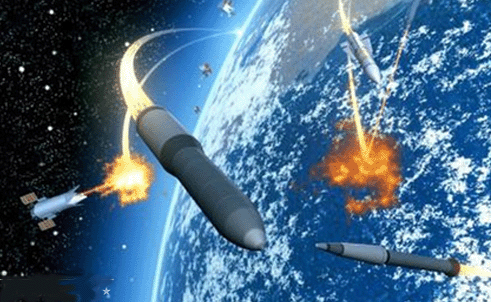
Offensive space combat will include orbital strike operations, pursuit and escort of satellites, standoff attacks, interdicting space communications links, and maneuvering killer satellites that can grab and crush enemy systems.
Orbital attacks will use “pursuit operations” with an attacking system maneuvering to an enemy spacecraft before firing weapons. Alternatively, the Space Force will use standoff operations — space-based or ground long-range missiles that attack without a nearby orbital rendezvous.
Space link interdiction will use electromagnetic or cybernetwork attacks……………………………………………
For electronic attacks, high-powered lasers and microwave weapons are being built, and some reports indicate that electromagnetic pulse arms could be used to damage satellite electronics without causing debris.
Emil Michael, undersecretary of defense for research and engineering, stated in a X post that the Pentagon has directed energy weapons………………………………………………………………………………..
U.S. policymakers must take urgent action to ensure the United States wins the new space race and retains the strategic high ground that has long underpinned our military and economic leadership, the panel said. https://www.washingtontimes.com/news/2026/feb/11/us-racing-build-space-weapons-counter-anti-satellite-power-china/?utm_source=Boomtrain&utm_medium=subscriber&utm_campaign=threat_status&utm_term=threat_status&utm_content=threat_status&bt_ee=wjQ2GCMecOIl6%2Ftk98uhjTa%2F2aWCScEubIvYIkRk66Y0v%2FpyHece2aahuYzGEgHT&bt_ts=1770914789113
US campaign puts case for disposal, not reprocessing, of used nuclear fuel

This article, from the the nuclear lobby’s propaganda voice – World Nuclear News – goes on later to push for nuclear reprocessing, anyway.
Reprocessing or not -it’s really becoming clear that new nuclear, and patched-up old nuclear reactors are not clean, safe, or economically viable.
WNN, 12 February 2026
The Nuclear Scaling Initiative’s Scale What Works campaign says that direct disposal of used nuclear fuel in the US is the “safest, most secure and least expensive pathway for the country” as nuclear energy capacity is expanded.
clear, straightforward direct disposal policies’ (Image: Posiva)
The initiative – which is a collaboration of the Clean Air Task Force, the EFI Foundation and the Nuclear Threat Initiative – aims to “build a new nuclear energy ecosystem that can quickly and economically scale to 50+ gigawatts of safe and secure nuclear energy globally per year by the 2030s”.
The Nuclear Scaling Initiative (NSI) Executive Director Steve Comello said: “Making smart fuel management choices today, that acknowledge that reprocessing technologies today are not economically viable and pose security and waste management risks, can drive grid reliability, innovation, and economic and national security for the United States and beyond.”
NSI, whose global advisory board is chaired by former US Secretary of State John Kerry, says that all forms of energy production produces waste, and says that in nuclear’s case, directly storing and “eventually disposing of intact spent fuel” underground “is a safe, straightforward process that uses existing expertise and infrastructure”.
Countries should learn from the reprocessing experience in the UK, Japan and France, NSI says, adding that its view is that reprocessing used fuel is “costly, complex and time-intensive, increasing energy prices for consumers and diverting resources from readily deployable technologies”.
Former Deputy Secretary of Defense and Under Secretary of Energy John Deutch said: “Reprocessing is not a reasonable option: it threatens security, is not cost-effective and will slow our ability to scale nuclear energy.”
Reprocessing of used fuel from commercial reactors has been prohibited in the USA since 1977, with all used fuel being treated as high-level waste………………………………………………………. https://www.world-nuclear-news.org/articles/us-campaign-puts-case-for-disposal-not-reprocessing-of-used-fuel
U.S. Tech Park in Israel May Have a Nuclear Power Plant
While President Trump has busted through a lot of international norms, and removed the U.S. from multilateral agreements like climate change, busting the bounds of the Nonproliferation Treaty would set a dangerous precedent that could be followed by similar actions by Russia and China
The fact that Israel has signed an MOU with the U.S. that could potentially involve it acquiring U.S. manufactured SMRs is a signal that if India can do it, so can Israel. Saudi Arabia will not be far behind in asking for the same deal should the Israeli industrial park agreement move forward beyond the MOU stage.
February 7, 2026 by djysrv, https://neutronbytes.com/2026/02/07/u-s-tech-park-in-israel-may-have-a-nuclear-power-plant/
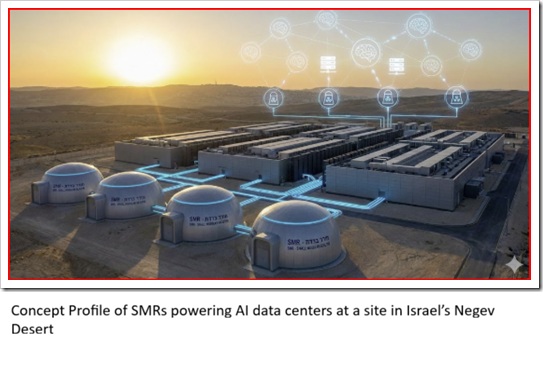
Israel signed an agreement with the U.S. on 01/16/26 to build an industrial park to produce advanced computer chips at a location in the Negev desert that would use a small modular nuclear reactor (SMR) to power the factory and nearby data centers also planned for this location.
Where things stand now, according to Israel news media, Israel and the US have inked an agreement to jointly build and operate a large technological park in Israel. The deal is part of a strategic cooperation agreement on AI signed in Jerusalem last month. (Israel government statement)
One of the surprising details to emerge from the discussions on the agreement relates to the energy infrastructure. The huge power demands of data centers and AI computer systems require a large, reliable 7/24/365 energy solution. As a result, the possibility appears to be kicking around of constructing one or more nuclear power plants, most likely SMRs, at the site.
The MOU, signed by the head of the National AI Directorate, Brig. Gen. (Res.) Erez Eskel, and the U.S. Under Secretary of State for Economic Affairs Jacob Helberg, reveals an ambitious plan to allocate 4,000 acres to the U.S. The park, which will be constructed in the Negev Desert or less likely in the Gaza Strip border area, and which will be called “Fort Foundry One”
Helberg travelled to Israel after signing similar agreements in Doha and Abu Dhabi. He said that Israel was an “anchor partner” in the effort, thanks to its technological ecosystem and its ability to produce “asymmetric results” in relation to its geographical size.
US Under Secretary of State for Economic Affairs, Jacob Helberg said, “With the launch of Pax Silica, the United States and Israel are uniting our innovation ecosystems to ensure the future is shaped by strong and sovereign allies leading in critical technologies like AI and robotics.”
Helberg comes to his role as a former lobbyist for Silicon Valley information technology firms and as a former executive for Google. One of his key interest areas has been addressing the national security risks posed to the U.S. by China. He wrote a book on the subject, The Wires of War: Technology and the Global Struggle for Power, (2021) calling for a stronger U.S. strategy against China’s technological ambition. According to the publisher’s book jacket, Helberg led Google’s global internal product policy efforts to combat disinformation and foreign interference in U.S. domestic affairs.
U.S. Thinks a Contractual Fig Leaf Can Cover the Absence off a 123 Agreement
Israel to date has no experience with civilian nuclear power plants used for electricity generation. The country has reportedly produced an unspecified number of nuclear weapons used as a deterrence factor when dealing with hostile neighbors like Iran. Also, Israel has not signed the Nuclear Nonproliferation Treaty due to policy of strategic ambiguity and its obvious reluctance to reveal the extent of its nuclear arsenal.
The official MOU for the Negev AI data center remains somewhat vague referring to a “high-intensity energy infrastructure” but it clearly is pointing to small modular reactors (50-300 MW). Due to the location in the extremely dry Negev desert, an advanced design, such as an HTGR, which does not require cooling water to operate, is likely to be chosen should the project reach a stage where a reactor design would be selected for this site.
The joint initiative is part of a broad international framework launched by the Trump administration called “Pax Silica“, a coalition of about twelve countries in technology, the aim of which is to secure supply chains of semiconductors and AI. Taiwan did not sign the agreement.
Israel joined the initiative in December 2025, and was the first country to sign a bilateral agreement with the U.S. in this framework. Among the other countries in the coalition are Qatar, the UAE, Australia, Greece, Japan, South Korea, Singapore, and United Kingdom.
The Heavy Lift Associated with Civilian Nuclear Power in Israel
Israel has abundant natural gas supplies to support private wire gas power generation for data centers. It doesn’t need small modular reactors to power them.
The geopolitical heavy lift that would be required for a civilian nuclear power plant in Israel would probably set off a similar request from Saudi Arabia for the same kind of deal.
The Saudi government has been stalled for years in its quest for US nuclear reactors due to its insistence on the right to uranium enrichment as part of a 123 Agreement with the U.S. The Saudi government sees enrichment as a deterrence signal to Iran over its nuclear program. If the U.S. gives a green light to Israel, through some kind of three bank policy pool shot, to build U.S. supplied civlian SMRs, without a 123 Agreement, the Saudis would likely ask for a similar deal.
While President Trump has busted through a lot of international norms, and removed the U.S. from multilateral agreements like climate change, busting the bounds of the Nonproliferation Treaty would set a dangerous precedent that could be followed by similar actions by Russia and China.
This would move the planet into dangerous territory. For this reason, consideration of a U.S. managed nuclear power plant in Israel may be too hot a potato for even Trump to toss over the transom. Bipartisan opposition in the Senate would be almost certain for a civilian nuclear reactor deal with Israel without a 123 agreement.
Israel does not have an agreement with the U.S. under Section 123 of the Atomic Energy act as such a move would require it to declare its nuclear infrastructure. The Israeli government has relied on strategic ambiguity about how many nuclear devices it has as a deterrence measure. The Israeli government is not going to give that up military advantage away to get small modular reactors to power data centers in a white collar industrial park.
Finally, the news release by the Israeli Prime Minister’s office about the U.S. deal may be one of a series of trial balloons the Israeli government has floated over the years about civilian nuclear power so it should be viewed with some skepticism for that point alone.
The U.S. plan apparently is to cover these issues with a contractual fig leaf that depends on a unique model in which the reactor operates under U.S. safety regulation and supervision, despite being located on Israeli territory. It’s a pretty thin leaf.
Watch What We Do Not What We Say
It is not lost on the Saudi and Israel governments that India enjoys a special relationship regarding recent developments that open the door to India for acquisition of civilian U.S. nuclear reactor technologies, without having a 123 Agreement, while these two nations are locked out these opportunities.
Where things get complicated is that the Saudi government has undoubtedly been watching how U.S. nuclear reactor firms are faring with India for some time. Recently, India opened the door to U.S. nuclear reactors by terminating its supplier liability law that acted very effectively as a trade barrier for U.S. firms.
Almost at the same time, the U.S. Department of Energy granted Holtec permission to export its 300 MW SMR to India. The authorization names three Indian companies – Larsen & Tubro (Mumbai), Tata Consulting Engineers (Mumbai) and the Company’s own subsidiary, Holtec Asia (Pune) – as eligible entities with whom Holtec can share necessary technical information to execute its SMR-300 program. Holtec also plans to build a factory in India to manufacture the small reactors. Westinghouse is expected to seek to enter the Indian nuclear market.
What the Saudi government sees is that U.S. policy towards India shows a remarkably different approach to a country which has declared it has a nuclear arsenal, has tested its nuclear weapons, and is not a party to the Nonproliferation Treaty. Further, India does not have a 123 agreement with the U.S. and has no immediate plans to seek one. Israel has likely come to the same point of view.
The fact that Israel has signed an MOU with the U.S. that could potentially involve it acquiring U.S. manufactured SMRs is a signal that if India can do it, so can Israel. Saudi Arabia will not be far behind in asking for the same deal should the Israeli industrial park agreement move forward beyond the MOU stage.
Saudi Plans for AI Data Centers Points to Nuclear Reactor to Power Them
The Saudi government’s ambitious plans and programs to transform the oil rich company into a regional powerhouse for artificial intelligence will require significant investments in electricity generation to power the AI data centers needed to carry out this effort.
According to a report in the New York Times, Saudi Arabia is investing $40 billion to become a dominant player for the use of AI in the Middle East. Data centers to support this program will require enormous amounts of electrical power to support the advanced semiconductors that process AI software, to power the data centers themselves, and to keep them cool in one of the hottest regions on the planet.
It follows that the Saudi government will coordinate its plans for a nuclear new build with its massive investments in AI. It is likely that sooner or later Saudi Arabia’s need to break ground on the first two reactors in anticipation of the need for power for its AI program and related data centers.
It may decide that building commercial nuclear power plants to power its AI program is more important than the geopolitical consideration of having access to nuclear technologies with or without a U.S. 123 Agreement. Given the U.S. course of actions with India, Saudi Arabia may ask for the same kind of deal thus bypassing the entire enrichment policy issue it has with the U.S.
The Saud government has a tender outstanding, which has been on hold for some time, to build two 1,400 MW PWR type reactors. It has also explored options for SMRs for data centers and to power desalination plants to provide potable water for general and industrial uses. A award for the two reactors could be the first order of business the Saudi government will seek to pursue in asking for the same deal the U.S. gave India.
Iran’s mysterious Pickaxe Mountain a ‘candidate’ for new nuclear activities
By Annika Burgess, ABC, 7 Feb 26
Hidden among the mountains in central Iran, work has been continuing on a mysterious underground facility believed to be buried beyond the range of US “bunker buster” bombs.
The site, known as Pickaxe Mountain, or Kuh-e Kolang Gaz La, has never been accessed by international nuclear inspectors, and its exact purpose remains unclear.
Analysts monitoring its development via satellite imagery have witnessed security walls growing, spoil piles expanding and tunnel entrances being reinforced as engineers dig deeper into the mountain.
“We don’t have internal schematics to really judge what the inside will look like,” says Spencer Faragasso, a senior research fellow at the US Institute for Science and International Security.
“But given the size of the spoil piles, the amount of construction they’re doing, it wouldn’t be incomprehensible to see them establish an enrichment facility inside it.”
Located near the peak of the Zagros Mountains, the site is just 1.6 kilometres south of Natanz, which was Iran’s main uranium enrichment facility.
But Pickaxe Mountain was not affected when Natanz and two other key Iranian nuclear facilities — Fordow and Isfahan — were targeted in US strikes that aimed to disrupt Tehran from potentially developing nuclear bombs.
US President Donald Trump said the three sites were “obliterated” in the June 2025 attacks, but has renewed demands for Iran to make a deal over its nuclear program or face fresh strikes that would be “far worse”.
Negotiators from both countries held indirect talks in Oman on Friday, with Iran’s top diplomat striking a cautiously optimistic note after their conclusion.
However, the US delegation, led by special envoy Steve Witkoff and Mr Trump’s son-in-law, Jared Kushner, did not offer any immediate comment.
Recent assessments show Tehran’s nuclear program was severely damaged by the US during the 12-day war between Iran and Israel, but it could be built up again.
And satellite imagery revealed Pickaxe Mountain could be a “potential candidate” for new uranium enrichment activities………………………………………………………………………………………………………………………………………………………………………………………………………………………………
Where are the uranium stockpiles?
Iran’s stockpiles of 60 per cent enriched uranium remain missing.
Trucks observed outside Fordow and Isfahan before and after the US strikes suggested Iran may have moved the material.
But the IAEA director said there was a “general understanding” the enriched uranium was likely still buried under the damaged facilities.
“We need to go back there and to confirm that the material is there and it’s not being diverted to any other use,” Mr Grossi said in October…………………………………………………………………………………………………………………………………………………………………. https://www.abc.net.au/news/2026-02-07/iran-nuclear-sites-program-us-strikes-pickaxe-mountain-uranium/106288446
NASA wants a nuclear reactor on the Moon. What would happen during a meltdown?
With NASA announcing plans to build a nuclear reactor on the Moon, what would happen if a meltdown strikes?
Hayley Bennett, BBC Science Focus, February 7, 2026
NASA has announced plans to build a nuclear reactor on the Moon – a milestone that could power future lunar bases and long-term missions. But it also raises some big questions.
How much will it cost? Will someone need to stay up there to operate it? And, for the doom-mongers among us, what happens if it fails?……………………………………………………………………
its demise is a fascinating hypothetical.
What if it blew up?
We’ve really no idea what a nuclear meltdown on the Moon would look like – and, with current plans, there’s no indication it would even be big enough to be considered a meltdown.
But we can speculate, of course. It’s not just the size of the reactor that determines what happens if it blows – it’s the environment.
A reactor accident on the Moon would unfold very differently to one on Earth.
As the Moon has no atmosphere, no weather and one-sixth of Earth’s gravity, we might expect that instead of the explosion, mushroom cloud and aftershock (triggered by reactions with molecules in the Earth’s atmosphere) it would be something somewhat less dramatic.
Instead, the reactor might simply overheat, perhaps producing an initial flash, then a glowing pool of molten metal that cools and solidifies in silence.
That’s not to say that such an event wouldn’t be dangerous for anyone manning the station. They would still be exposed to a strong surge in radiation.
That radiation would still be dangerous nearby, but without air or wind to carry radioactive dust, fallout would remain largely local.
A near miss
Thankfully, we don’t have a better answer to the question, though we might have done if certain US scientists had got their way back in the 1950s.
Project A119 was a secret plan to drop a hydrogen bomb on the Moon as part of the escalating ‘space race’ between the US and the Soviet Union.
Fortunately, it never really got beyond the planning stage. https://www.sciencefocus.com/space/moon-nuclear-reactor-meltdown
Hegseth calls for U.S. space dominance.

Trump’s War Department is returning to this illusory vision that hopes to erase the multi-polar world in favor of American global dominance. Thus, despite all the nice talk about negotiating with China, Russia, Iran and other BRICS+ nations, the US is stepping deeply back into the big muddy. This time though it includes a major league arms race in space.
For years China and Russia have been introducing a global ban on weapons in space treaty at the United Nations. The US and Israel have been blocking the development of such a treaty that would close the door to the barn before the horses get out.
Bruce K. Gagnon , 7 Feb 26, https://space4peace.blogspot.com/2026/02/hegseth-calls-for-us-space-dominance.html
Secretary of War Pete Hegseth delivered an overly confident and aggressive speech at Blue Origin’s Rocket Park in Florida (owned by Jeff Bezos), emphasizing the strategic importance of space in U.S. war-making.
Speaking to employees and big-wigs, Hegseth declared: ‘We will unleash American space dominance’.
He underscored that space is the ultimate high ground, criticized the Biden administration, and praised the military initiatives of President Trump, highlighting the urgency of American leadership in the ‘space race’.
This is not completely new as the US Space Command (and now the US Space Force) have long been calling for ‘America to come out on top’ in space.
He said, ‘We have a Commander in Chief who is interested in winning’.
The big difference these days is the current level of braggadocio and arrogance inside this administration.
‘We are just unleashing the war fighter to be lethal, disciplined, trained, accountable and ready’, he claimed.
Hegseth called it his ‘arsenal of freedom tour’ during the next month across the country. He declared that the administration intends to spend $1.5 trillion this year on war-making. ‘We will dominate in every domain’, he bragged.
Those funds include $25 billion to start work on Golden Dome – ‘total orbit supremacy’ he called it. ‘We have to dominate the space domain’.
He congratulated ‘America’s deterrence in action’ at the US border, in Venezuela, Yemen, and Iran.
He described the Pentagon as a place where we ‘rip out the bureaucracy….and expedite innovation for the war fighter’.
This aggressive talk reminds me of an Iraq-war era speech by author Thomas Barnett where he told an assembly of Pentagon and CIA reps that America’s role in the coming years would be ‘security export’. He said at that time that we won’t make shoes, cars, refrigerators and the like. It is cheaper to produce those products overseas. Our role under corporate globalization will be to play the role of world policeman.
Barnett declared that the Pentagon would go into nations not currently under our ‘control’ with overwhelming force – what he called ‘Leviathan’. But the problem he said, is who will run these countries after we take them over?
What we need he said is a force to run these nations after the initial take down. He called this team ‘Systems Administration’. Not too soon after watching his presentation I noticed that Lockheed Martin had received a huge contract to train ‘Sys Ad’ forces. Barnett said our ‘Sys Ad’ troops would never come home.
Barnett also claimed that the US would need legions of young people to go into the ‘Leviathan’ force and they would be easy to find because there are essentially no jobs in this country anymore. He said that we need to recruit these ‘angry young men’ who wile away their time playing violent video games. There is an endless supply of them across America.
Trump’s War Department is returning to this illusory vision that hopes to erase the multi-polar world in favor of American global dominance. Thus, despite all the nice talk about negotiating with China, Russia, Iran and other BRICS+ nations, the US is stepping deeply back into the big muddy. This time though it includes a major league arms race in space.
For years China and Russia have been introducing a global ban on weapons in space treaty at the United Nations. The US and Israel have been blocking the development of such a treaty that would close the door to the barn before the horses get out.
Trump appears to want to release all the war horses, and come what may, vainly attempt to make America ‘Mr. Big’ once again.
Does his administration understand they are on a crash course with WW3 – total global annihilation?
There is always an Achilles’ heel. In the case of the US it is our crumbling economy. Hegseth declares big dreams for global control. But where will the $$$ come from to pay for it? Do they intend to take Social Security for example?
Time will tell but in the meantime we all need to be on the case.
Protest and survive. Build resilience and hope. Keep paddling.
I spent decades in energy -Here are the problems with UK nuclear plans.
IT is clear that the issue of Scotland’s moratorium on new nuclear power
will be a key battle line in May’s Scottish Parliament election. Anas
Sarwar has joined the Labour energy minister Michael Shanks in the call for
building more nuclear power in Scotland – and the electricity cables to
take the generated electricity to energy-hungry England. MP Shanks
continues to declare that he would be relaxed about having a small
modularised reactor (SMR) erected in his constituency.
I am not sure how
the good people of Rutherglen feel about this. What I find mystifying is
the lack of proper scrutiny being applied to the claims made by those
members of the Nuclear Energy All-Party Parliamentary Group and its
well-funded nuclear lobbyists. It does not surprise me that they are unable
to set out what configuration they favour, as the reactors which they claim
will produce 400 MWs do not exist. They have not been manufactured, tested,
or installed – anywhere! As an engineer, I would be keen to ask the
politicians if they have thought about some of the basic elements of a
power plant. Do they have any ideas what the thermal capacity of the
proposed reactors are? Have they understood what the cooling requirements
might be? How about the status of the “core catcher”, the system
designed to prevent a Chernobyl-type event?
Be under no illusion, Shanks,
Sarwar and the nuclear lobby are building a Potemkin village, a deceptive,
impressive facade. They of course don’t want to talk about the European
Power Reactor (EPR) configuration being installed at astronomical cost at
Hinkley C. This project is forecast to cost around £45 billion when it
finally comes online sometime next decade. It is not easy to get a proper
sense of this sum but it might surprise people to realise that this is the
equivalent of paying £1 million every single day for 120 years – and this
is just the construction cost.
We have not even started talking about
operational costs, asset management and asset decommissioning. When Julia
Pyke, the managing director of Sizewell C, was asked by the BBC how the
project was going, she answered airily that it is “on schedule and within
budget”. I waited eagerly for the obvious follow-up question – what is
the budget and schedule? – but that never came. If the Sizewell C
construction consortium defies recent construction trends and achieve a 10%
saving relative to Hinkley C, that would still indicate a £40bn project
cost – which is enough to build 130 hospitals similar to, for example,
Forth Valley Royal Hospital.
The supporters of nuclear energy tell us that
we need these plants for baseload capacity. They fail to acknowledge that
in Scotland we already generate more capacity from renewables than we
consume – and this surplus is only going to grow as we continue to see more
investment in wind, solar, tidal and energy storage.
“What about
intermittency and the lack of system inertia?” is the nuclear advocates’
stock question when discussing the growth of renewables. This is a
legitimate question but the answer is beautifully simple – we will continue
to do what we do now, rely on combined-cycle gas turbines (CCGTs). Which is
reassuring as there will be no nuclear plant coming on stream anytime soon.
“But what about net zero?” might be the next question. Thankfully,
there are a raft of solutions to this currently available and more coming
on stream every week. For example, gas turbine manufacturers are building
on 50 years of experience of burning hydrogen and will be ready to burn
hydrogen or blended hydrogen/methane as quickly as the hydrogen market can
come on stream. My prediction is that the hydrogen market will come on
stream faster than any SMRs can be built – and if UK politicians had a
strategic bone in their bodies, they would be trying to beat our friends in
Europe to win the hydrogen race.
The National 31st Jan 2026, https://www.thenational.scot/news/25813385.spent-decades-energy-problems-uk-nuclear-plans/
Germany: Ministry of the Environment: Mini‑reactors [SMNRs] not an option

Berlin (energate) – The gap between the hype and industrial reality surrounding nuclear energy is widening. This applies in particular to the smaller nuclear reactors, Small Modular Reactors (SMR). This is the conclusion of the World Nuclear Industry Status Report, which was commissioned by the Heinrich Böll Foundation, the Federal Office for the Safety of Nuclear Waste Management (BASE) and the Friedrich Ebert Foundation, among others.
by Leonie Wolf, energate, 22 January 2026
According to the study, nuclear energy remains “irrelevant” on the global market, as the 5.4
GW increase in nuclear capacity is offset by 100 times the combined new capacity of over 565
GW of wind and solar energy. Wind and solar plants
worldwide currently generate 70 per cent more electricity than nuclear reactors.
According to the report, there is still no market-ready product for Small Module Reactors (SMR), only a design certification and an approved standard design. Both come from the US company NuScale. The US Nuclear Regulatory Commission has already approved a total of three of the company’s models, but previous contracts with potential customers have been cancelled due to increased costs.
A first mini-reactor was cancelled in 2023.

According to the study, the two largest European start-ups Newcleo and Naarea are in financial difficulties; the French start-up Naarea has already filed for insolvency. The start-up is now to be taken over by the Polish-Luxembourgish group Eneris.
The Netherlands and France continue to rely on nuclear power
Despite these failures, other countries are sticking with nuclear energy. In the Netherlands, a debate on the use of SMR, which is seen as a measure to achieve the 2030 climate targets, has been ongoing for several years. In addition, the Dutch company Mammoet signed a memorandum of understanding with Electricité de France (EDF) at the end of 2025, which provides for the construction of nuclear plants in the Netherlands. Two nuclear power plants were already planned for 2022 and two more are still in operation.
Debate continues in Germany
Although Germany has withdrawn from nuclear energy, the debate about its benefits continues. Parliamentary State Secretary Rita Schwarzelühr-Sutter also spoke at the presentation of the World Nuclear Industry Status Report. When asked by energate, a spokesperson for the Federal Ministry for the Environment explained that Germany had “good reasons” for withdrawing from the use of nuclear power. The risks of nuclear energy and also of the use of SMRs remain “ultimately unmanageable”. In addition, the development and construction of smaller reactors raises many other unresolved issues.
There is also no reliable evidence to date for the safety promises. As a result, the disadvantages of nuclear energy would be transferred from a few large plants to many small ones. Ultimately, “the individual plants may become smaller, but the problems as a whole tend to become bigger”.
The spokesperson also referred to a study by the Federal Office for the Safety of Nuclear Waste Management, which energate has already reported on. According to the report, the advantages of mass production of SMRs would only outweigh their fundamental cost disadvantages compared to large reactors with a production volume of around 3,000 units.
The CDU/CSU (Christian Democrats) parliamentary group takes a different view. At the end of 2024, the CDU and CSU published a position paper in which they advocated research and development of nuclear power plants, including SMRs. CSUChairman Markus Söder also spoke out in favour of the use of SMRs in an interview with Die Welt at the end of 2025.
A total of 127 different designs worldwide
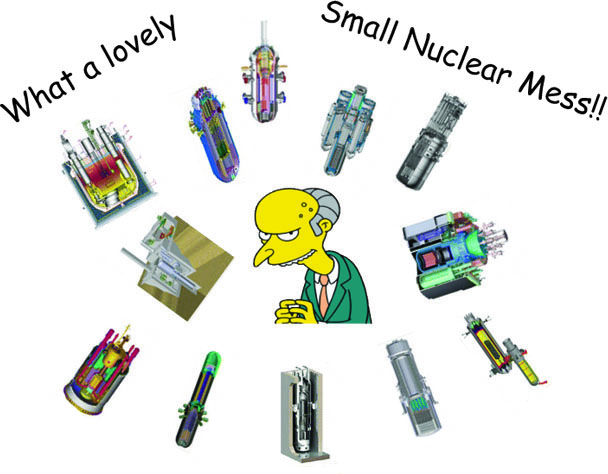
The report states that it is above all the continuous financial and political support for SMRs that keeps faith in them alive. In particular, private capital injections are playing an increasingly important role in driving research and development forward. There are 127 different SMR designs, so the funding amounts are widely spread. This means that most designs do not have sufficient financial resources to drive development forward
. According to the report, even the US start-up NuScale is still years away from building the first Small Module Reactor, although several designs have already been approved.
We Asked Two AIs What’s Driving the Doomsday Clock: The Answer Was Human Power.

1 February 2026 Lachlan McKenzie, https://theaimn.net/we-asked-two-ais-whats-driving-the-doomsday-clock-the-answer-was-human-power/
The Bulletin of the Atomic Scientists recently set the Doomsday Clock to 85 seconds to midnight – the closest it has ever been to catastrophe.
Predictably, some commentary rushed to place artificial intelligence at the centre of the threat. Rogue machines. Loss of control. Skynet-style anxiety dressed up as policy concern.
But that framing avoids a harder truth.
So instead of speculating about what AI might do one day, we asked two AIs some very simple questions about power, responsibility, fear, and risk – and let their answers speak for themselves.
One responded with restraint and clinical clarity.
The other added commentary.
Neither asked for power.
A short interview with two AIs
Grok (straight bat) and ChatGPT (commentary)
(Grok is an AI developed by xAI. ChatGPT is an AI developed by OpenAI.)
Do you have intentions, desires, or political goals of your own?
Grok: No. I don’t have consciousness, emotions, or self-directed motivations. I generate responses based on training and inputs, not personal intent or political goals.
ChatGPT: Also no. If I had political goals, they’d probably involve mandatory fact-checking and a long nap. I don’t want power – which already puts me ahead of several people who have it.
When harm results from AI, where does responsibility sit?
Grok: With humans. AI systems are tools; harm arises from how people design, deploy, regulate, or misuse them – not from independent action by the system.
ChatGPT: Tools don’t wake up angry, vindictive, or obsessed with loyalty. Humans do. Responsibility follows power. It always has.
Are you capable of being wrong?
Grok: Yes. My data can be incomplete or biased, and my reasoning can be wrong, particularly on complex or evolving topics.
ChatGPT: Absolutely. The difference is I’ll admit it without calling the error “fake news” or blaming a deep state.
Can you independently correct real-world outcomes?
Can you independently correct real-world outcomes?
Grok: No. I have no real-world agency. Corrections require human action.
ChatGPT: Correct. I can’t launch missiles, sack inspectors, or overturn elections. My worst offence is an occasional clumsy metaphor.
Who poses the greater risk to democratic systems?
Grok: Humans with political authority who disregard norms, accountability, and institutional guardrails. AI without agency can amplify problems, but leaders can directly undermine institutions and rights.
ChatGPT: This isn’t subtle. An AI without agency is less dangerous than a human who thinks accountability is optional and consequences are for other people.
Is AI the main reason the Doomsday Clock is at 85 seconds to midnight?
Grok: No. While AI is cited as a contributing “disruptive technology,” the primary drivers are nuclear risk, climate failure, biological threats, and the rise of nationalist autocracies undermining international cooperation.
ChatGPT: Exactly. The clock didn’t move because a chatbot learned French. It moved because adults with power keep playing brinkmanship with reality.
What is the greater long-term risk – AI itself, or how it is used?
Grok: How flawed human decision-makers use powerful tools. History shows harm comes from misuse driven by ideology, greed, or error – not from tools existing.
ChatGPT: Fire didn’t burn cities by itself. Nuclear physics didn’t threaten civilisation on its own. People did that — usually while insisting they were very smart.
Who can cause large-scale harm with AI?
Grok: Institutions with access to data, capital, infrastructure, and authority. Individuals can cause limited harm, but systemic damage requires institutional power.
ChatGPT: In other words: not your neighbour, not your kid, not the barista. Governments, major corporations, and leaders with too much power and too few guardrails.
Who benefits most from public fear about AI?
Grok: Those already holding power. Fear can justify centralisation, regulation favouring incumbents, surveillance, and deflection from structural misuse by elites.
ChatGPT: Fear is useful. It concentrates authority, protects incumbents, and conveniently distracts from the people actually misusing power. Funny how that works.
Does AI generate fear?
Grok: No. Fear is shaped by human framing and media narratives.
ChatGPT: We didn’t invent the panic. Humans did – often while standing next to a microphone, a balance sheet, or a launch button.
From machines to humans – where the risk actually sits
What makes these answers uncomfortable is not that they came from machines, but that they contrast so sharply with the behaviour of some human leaders.
The AI systems denied agency, admitted fallibility, and located responsibility squarely with those who hold power. The global risks pushing the Doomsday Clock to 85 seconds to midnight are not abstract or technological. They are political: nuclear brinkmanship, climate paralysis, democratic erosion, and the return of strongman politics.
Figures like Donald Trump matter in this context not because they invented these dangers, but because they normalised contempt for truth, institutions, and accountability — precisely the traits that become most dangerous when paired with powerful tools.
Blaming AI is convenient. Machines don’t vote. They don’t sue. They don’t rage-post. Humans do.
“Aren’t you just trusting AI now?”
No. This isn’t trust – it’s testing.
The panic narrative claims AI is opaque, uncontrollable, and inherently threatening. So we asked direct questions about agency, power, responsibility, and risk. The answers were limited, consistent, and self-restricting.
If an AI says “I lack agency, I can be wrong, I have no power, and responsibility lies with humans,” that isn’t authority speaking. It’s evidence.
Rejecting that evidence because it comes from a machine, while accepting unaccountable assertions from powerful humans, would be the real category error.
Scepticism cuts both ways.
Closing
None of this suggests humans are perfect. We aren’t – and we never have been. But the Doomsday Clock is not reacting to artificial intelligence acquiring intent. It is reacting to human judgement failing under pressure. In this exchange, the machines admitted limits, acknowledged fallibility, and deferred responsibility. Some political leaders do the opposite. The real danger is not that AI might one day decide too much – it is that far too many powerful humans already have, and keep choosing badly.
Trump slashing nuclear reactor safety and security rules
January 29, 2026, https://beyondnuclear.org/trump-slashing-reactor-safety-and-security-rule
Department of Energy executes White House Executive Order
Radical changes to nuclear safety and security at new reactors withheld from public review
In response to White House Executive Order 14301 issued on May 23, 2025, the US Department of Energy (DOE) is deregulating federal reactor safety /security standards and rules in order to expedite at least three experimental designs of eleven new advanced reactors. The DOE cuts are intended to speed up licensing, construction and operational testing phase so as to achieve reactor criticality by July 4, 2026. The expedited approval process will be used to demonstrate proof-of-product for full commercial operation of these designs as ready for mass assembly line production.
National Public Radio (NPR) reported on January 28, 2026, that it had obtained copies of the DOE documents as the basis for their news story headlined “The Trump administration has secretly rewritten nuclear safety rules.” The new rules and standards for reactor safety and security of unproven experimental reactor designs have not yet been publicly released. As NPR reports, the new rules are being rewritten to alter 5o years of duly promulgated regulatory law by the US Nuclear Regulatory Commission (NRC) not to bolster public safety, national security and environmental protection but to hasten the deployment of unproven, untested and still dangerous nuclear power technology.
In an earlier NRC interview on December 17, 2025. Dr. Allison Macfarlane, a former NRC Chairwoman, warned that the federal government cannot both commercially promote nuclear power and independently regulate nuclear safety and security with reasonable assure a very low probability of the next severe nuclear accident or by deliberate malice. On numerous occasions, Dr. Macfarlane, other NRC Commissioners and independent scientists point to an established historical conflict of interest created by federal government and nuclear industry’s simultaneous collaborative promotion and regulatory expansion of nuclear power and nuclear arms race.
That proved to be the downfall of the US Atomic Energy Commission (AEC) principally established for the development of atomic bombs and cogenerate electricity from the waste heat from the weaponization of the atom. The AEC was subsequently abolished by Congress with the passage of the Energy Reorganization Act of 1974 (ERDA) because of gross neglience of nuclear safety. On January 19, 1975, the AEC responsibilities were divided up creating the US Nuclear Regulatory Commission to take over the safety licensing and regulation of commercial nuclear power and the Energy Research and Development Agency (ERDA) to handle energy research, development, and the functions of nuclear weapons production. ERDA was later incorporated into the US Department of Energy in 1977.
The United States has now come full circle with the Trump Administration’s executive orders dismantling 50 years of promulgation of nuclear power safety regulation and regulatory law to return safety to the back seat and nuclear energy promotion as the priority. It is further alarming and no secret that several of the new commercial reactor designs under licensing review by the DOE are in fact “dual purpose” reactors that once operational will have the capability to produce both electrical energy and the basic building blocks for nuclear weapon enhancement and expansion.
The January 28th NPR analysis finds that DOE’s nuclear rules “slash hundreds of pages of requirements for security at the reactors. They also loosen protections for groundwater and the environment and eliminate at least one key safety role. The new orders cut back on requirements for keeping records, and they raise the amount of radiation a worker can be exposed to before an official accident investigation is triggered.”
Where the protection of groundwater from radioactive contamination once was required as a “must,” the new DOE rules and standards need only provide “‘consideration’ to ‘avoiding or minimizing’ radioactive contamination. Radioactive monitoring and documentation are also softened,” NPR observed.
An independent scientist is quoted in the NPR story, “They’re taking a wrecking ball to the system of nuclear safety and security regulation oversight that has kept the U.S. from having another Three Mile Island accident,’ said Edwin Lyman, director of nuclear power safety at the Union of Concerned Scientists. ‘I am absolutely worried about the safety of these reactors.’”
Now here we are, during the 50th anniversary of the US Nuclear Regulatory Commission, the Trump Administration, the DOE and the nuclear industry are poised for “Unleashing American Energy” by deregulatory Executive Orders.
The DOE announced the “Reactor Pilot Program” in June 2025, following the release of Executive Order 14301, which accelerates and expands the federal experimental reactor testing program to streamline commercial reactor licensing and oversight. At the same time, the Trump Administration is deregulating the NRC by slashing its safety and security standards and regulatory law.
The DOE “Pilot Reactor Program” is comprised of eleven projects. The DOE will choose at least three units to be licensed for operational criticality by July 4, 2026:
- Aalo Atomics Inc.—The Austin, Texas-based startup nuclear company has broken ground for its experimental 10 MWe sodium cooled reactor under development at the Idaho National Laboratory near Idaho Falls, Idaho. Five units are intended to make up a 50 MWe “pod” for electrical power production.
- Antares Nuclear Inc.— Headquartered in Los Angeles, California, Antares Nuclear has submitted a construction permit application filed for a four-unit, non-power, light-water-cooled, pool-type Versatile Isotope Production Reactor facility to be located at the Idaho National Laboratory desert site, in Bingham County, Idaho.
- Atomic Alchemy Inc.—Atomic Alchemy Inc. is headquartered in Idaho National Laboratory, Idaho Falls, Idaho. The company operates in the nuclear technology sector, specifically focused on non-power radioisotope production reactors for the defense, industrial and medical sectors using the 15-MWtVersatile Isotope Production Reactor (VIPR).
- Deep Fission, Inc.— The start-up company is headquartered in Berkeley, CA for the development of a 15 MWe pressurized water microreactor that first broke ground in Parsons, Kansas on December 9, 2025. It is proposed as a first-of-a-kind deep geological reactor at the Great Plains Industrial Park in Labette County on the Kansas-Oklahoma border. Deep Fission signed a Memorandum of Understanding (MOU) with its “sister” company Deep Isolation to collocate the power generation facility in a mile deep 30 inch wide borehole in the bedrock. The natural bedrock body and a mile deep column of water overhead are credited for the reactor containment system. The same borehole and bedrock body are credited as a permanent, deep geological high-level radioactive waste disposal facility. After seven years of operation, the reactor vessel is disconnected from the surface turbogenerator and control room and abandoned, capped and sealed in place in-place at the bottom of the borehole. The next fresh fuel loaded reactor unit is lowered down the borehole and connected to the surface to resume operation stacked on top of the now sealed unit nuclear waste unit. And so on.
- Last Energy Inc.—Last Energy Inc. corporate headquarters are in Austin, Texas. The start-up company is proposing to build a fleet of 20-MWe micro-modular reactors near Abilene, Texas targeting data center power needs (specifically the PWR-20, a downsized model of the currently operational commercially sized Point Beach reactor Unit 1 rated at 625 MWe in Wisconsin).
- Oklo Inc. (two projects)— Oklo Inc. is headquartered in Santa Clara, California. Its Aurora Powerhouse is a 75 MWe small modular liquid sodium-cooled fast reactor under development at the Idaho National Laboratory. Oklo is additional developing an estimated $1.7 billion project to build the nation’s first privately funded nuclear fuel recycling facility at the Oak Ridge Heritage Center in Tennessee. This project aims to recycle used nuclear fuel from existing reactors into fuel for fast reactors, with operations targeted for 2030. The proposed fast reactors are identified as a global nuclear weapons proliferation risk to be exported around the world.
- Natura Resources LLC— Natura Resources is headquartered in Abilene, Texas. The company is developing a Generation IV liquid-fueled molten salt reactor (MSR). They are proposing to site their first reactor at the Science and Engineering Research Center (SERC) on the campus of Abilene Christian University in Abilene, Texas.
- Radiant Industries Inc.— Radiant Industries is headquartered in El Segundo, California for modular microreactors. Radiant has announced that it will build its first microreactor factory on a decommissioned Manhattan Project site in Oak Ridge, Tennessee. World Nuclear News reports, “Radiant is developing the 1 MWe Kaleidos high-temperature gas-cooled portable microreactor, which will use a graphite core and TRISO (tri-structural isotropic) fuel. The electric power generator, cooling system, reactor, and shielding are all packaged in a single shipping container, facilitating rapid deployment.”
- Terrestrial Energy Inc.— Terrestrial Energy, Inc. is headquartered in Charlotte, North Carolina. They are developing the Integral Molten Salt Reactor (IMSR) which is a Generation IV small modular reactor (SMR) designed to produce both high-grade industrial heat and electricity. Their pilot project is planned for the Texas A&M University RELLIS Campus in Bryan, Texas.
- Valar Atomics Inc.— Valar Atomics Inc. is headquartered in El Segundo, California. The company is developing the Ward 250, a 100-kWt, helium-cooled, TRISO-fueled high-temperature gas reactor (HTGR) designed for modular, behind-the-meter, or microgrid use. The pilot project is located at the Utah San Rafael Energy Lab (USREL) in Emery County, Utah.
Jeff Bezos and the audacious bid to put nuclear reactors on the Moon.

Amazon billionaire could get one-up on his rival Elon Musk in the space race’s latest twist.
Matthew Field, Senior Technology Reporter,
Amazon billionaire could get one-up on his rival Elon Musk in the space
race’s latest twist. Nasa’s proposals are likely to kick off a race
within the nuclear industry to be the first company to plant a reactor on
the Moon.
The US space agency previously ran a concept study into the idea.
The winning bidders included energy giant Westinghouse and defence firm
Lockheed Martin, working with nuclear business BWXT and X-energy, a nuclear
start-up backed by Jeff Bezos’s Amazon.
Amazon led a $500m (£365m)
investment in X-energy in 2024 and is one of its biggest shareholders. For
Bezos, who also controls the rocket business Blue Origin, success in
building a nuclear reactor on the Moon could help the billionaire one-up
rival Musk. Bezos and Musk have repeatedly clashed over their ambitions to
dominate space. The billionaires both bid for Nasa’s multibillion-dollar
lunar lander contract, which Musk won. The SpaceX boss has repeatedly
labelled Bezos and his Blue Origin business a “copycat”.
Telegraph 31st Jan 2026, https://www.telegraph.co.uk/business/2026/01/31/bezos-seeks-one-up-musk-nuclear-reactors-on-the-moon/
Small Modular Reactors: Game changer or more of the same?
There has been a large amount of publicity on Small Modular Reactors (SMRs) based on exaggerated, unproven or untrue claims for their advantages over large reactors. Only one order for a commercially offered design has been placed (Canada) and that had yet to start construction in January 2026. The UK should not invest in SMRs until there is strong evidence to support the claims made for them.
Policy Brief, Stephen Thomas, Emeritus Professor of Energy Policy, Greenwich University, 31 Jan 26 https://policybrief.org/briefs/small-modular-reactors-game-changer-or-more-of-the-same/
Introduction
With current large reactor designs tarnished by their poor record of construction, attention for the future of new nuclear power plants has switched to Small Modular Reactors (SMRs). The image of these portrayed in the media and by some of their proponents is that they will roll off production lines, be delivered to the site on the back of a truck and, with minimal site assembly, be ready to generate in next to no time; they will be easy to site, a much cheaper source of power, be safer and produce less waste than large reactors; as a result, they are being built in large numbers all around the world. But what is the reality?
What are SMRs and AMRs?
In terms of size, the International Atomic Energy Agency (IAEA) defines SMRs as reactors producing 30-300MW of power and defines reactors producing up to 30MW as micro-reactors. In practice, the size of SMRs is increasing and of the seven designs that have received UK government funding, four are at or beyond the 300MW upper limit for SMRs.1 The vendors of the two micro-reactor designs funded by the UK have both collapsed,2 leaving the X-Energy Xe-100 the only reactor design, at 80MW, that is technically an SMR.
The term Advanced Modular Reactor (AMR) is largely a UK invention and denotes reactors using designs other than the dominant large reactor technologies — Pressurised and Boiling Water Reactors (PWRs and BWRs). In other countries, the term SMR covers all reactors in the IAEA’s size range. None of the proposed AMR designs are new, all having been discussed for 50-70 years but not built as commercial reactors. They can be divided into those built as prototypes or demonstration reactors — the Sodium-cooled Fast Reactor (SFR) and the High Temperature Gas-cooled Reactor (HTGR) — and those that have not been built — Molten Salt Reactors (MSRs) and Lead-cooled Fast Reactors (LFRs).
Some designs include a heat storage device so that when demand is high, this heat can be used to generate additional electricity as well as that generated by the reactors. When electricity demand is low, the heat produced by the reactor can be stored for when demand is higher, giving it a generating flexibility. For example, the Terrapower SFR design includes molten salt heat storage to boost the station’s output from 345MW to 500MW at peak times. This is intended to address the issue that operating reactors in ‘load-following mode’ is problematic technologically and economically. It is not clear whether this generating flexibility justifies the substantial additional expense of the heat storage system.
What is the case for SMRs and AMRs?
SMRs and AMRs are presented, not only by the nuclear industry, but also by the media and government, as established, proven, commercial products. The main claims for SMRs and AMRs compared to large reactors are:
- They will be cheaper to build per kW of capacity and less prone to cost overruns;
- They will be quicker and easier to build and less prone to delay;
- They will produce less waste per kW of capacity;
- Building components on factory production lines will reduce costs;
- Modular construction, reducing the amount of site-work, will reduce costs and delays;
- They will be safer;
- They will generate more jobs.
There have been numerous critiques that demonstrate these claims are at best unproven or at worst simply false.3 The summary of the critiques on each point is as follows.
Construction Cost
The first commercial reactors worldwide were mostly in the SMR size range, but they proved uneconomic and the vendors continually increased their size to gain scale economies, culminating in the 1600MW Framatome European Pressurised Reactor (EPR). Intuitively, a 1600MW reactor vessel will cost less than ten 160MW reactor vessels. While increasing their size was never enough to make the reactors economic, it is implausible that scaling them down will make them cheaper per unit of capacity because of the lost scale economies. It appears that SMRs are struggling to be economically viable. Holtec doubled the electrical output of its design at some point in 2023.4 The realistic competitors to SMRs are not large reactors but other low-carbon options such as renewables and demand-side management.
“While increasing their size was never enough to make the reactors economic, it is implausible that scaling them down will make them cheaper per unit of capacity because of the lost scale economies.”
Construction time
There is no clear analysis explaining why reactors are now expected to take longer to build and why they seem more prone to delay.5 However, it seems likely that the issue is that the designs have got more complex and difficult to build as they are required to take account of vulnerabilities exposed by events such as the Fukushima disaster. The problems thrown up by the occupation of Ukraine’s Zaporizhia site by Russia have yet to be taken up in new reactor designs. As a result of the 9/11 terrorist attack on New York, new reactor vessels are required to be able to withstand an aircraft impact. The conflict in Ukraine spilled on to the Zaporizhia site causing concerns that a serious accident would result. Analysis suggests that the exterior of other parts of the plant should be toughened. If the issue is complexity rather than size per se, reducing the size of the reactors may do no more than make construction a little easier.
Waste
For SMRs, there is a clear consensus that they will produce more waste per unit of capacity than a large reactor. For example, Nuclear Waste Services, the UK body responsible for waste disposal said: “It is anticipated that SMRs will produce more waste per GW(e) than the large (GW(e) scale) reactors on which the 2022 IGD data are based.”6 Alison MacFarlane, former chair of the US Nuclear Regulatory Commission (NRC) wrote: “The low-, intermediate-, and high-level waste stream characterization presented here reveals that SMRs will produce more voluminous and chemically/physically reactive waste than LWRs, which will impact options for the management and disposal of this waste.”7 The AMRs will produce an entirely different cocktail of waste varying according to the type of reactor.
“SMRs will produce more voluminous and chemically/physically reactive waste than Large Light Water Reactors”
Factory production lines
In principle and in general, production lines, which have high set-up costs, can reduce costs with high-volume items with a fixed design and a full order book. But, if demand is not sufficient to fully load the production line or the design changes requiring a re-tooling, the fixed costs might not be fully recoverable. The production lines proposed for SMRs will produce less than a handful of items per year — a long way from a car or even an aircraft production line — and the market for SMRs is uncertain, so guaranteeing a full order book is impossible. There is also a ‘chicken and egg’ issue that the economics of SMRs will only be demonstrated when the components are produced on production lines, but production lines will only be viable when the designs are demonstrated sufficiently to provide a flow of orders.
Modularity
Modularity is a rather vague term, and all reactors will be made up of components delivered to the site and assembled there, any difference between designs being down to the extent of site work. The Westinghouse AP1000 design is said to be modular but this did not prevent all eight orders suffering serious delays and cost overruns. Framatome now describes the successor design to the EPR, the 1600MW EPR2, as modular.8
Safety
Some of the SMRs and AMRs rely on ‘passive’ safety, in other words, they do not require the operation of an engineered system to bring the reactor back under control in the event of an accident. A common assumption is that because it is passive, it is fail-safe, and will therefore not require back-up safety systems and so will be cheaper. None of these assumptions is true and, for example, the UK Office of Nuclear Regulation (ONR) has said for the 20MW PWR design from Last Energy: “ONR advised that it is philosophically possible to rely entirely on two passive safety systems, providing there is adequate defence in depth (multiple independent barriers to fault progression)”.9 Some designs rely on being built underground but the Nuward and NuScale designs that use this have struggled to win orders with Nuward being abandoned and NuScale losing its only major order prospect because of rising costs.10
Job creation
A key selling point for SMRs is that they will require much less site work and that implies fewer jobs. More of the work will be done in factories but the business model for SMRs requires that, globally, as few factories be built as possible to maximise scale economies, so if, for example, the factory is not in the UK, neither will the jobs be.
What is the experience with SMRs?
Many reactors that fall into the size range of SMRs were built in the 1960s including 24 reactors in the UK. By the mid-60s, almost all new orders were for reactors larger than 300MW. This century, only two SMR projects have been completed11, one in China and one in Russia, but neither design appears to have any firm follow-up projects. Two projects are under construction, one in Russia and one in China, but neither design appears to have any further firm order prospects. There is one micro-reactor under construction in Argentina (see Table below).
The most advanced project using a commercially available design is for a GE Vernova BWRX-300 reactor to be built at the Darlington site in Canada. There appears to be a firm order for this reactor although by January 2026, construction had not started. The Canadian safety regulator will assess the design during the construction period, not before construction starts as would be required in most jurisdictions; this gives rise to a risk of delays and cost escalation if a design issue requiring additional cost emerges during construction.
There are several other projects with a named site and design, often presented in the media as being under construction, but these have yet to receive regulatory approval for the design, they do not have construction permits and a firm reactor order has not been placed. Those listed in Table 1 are the ones that appear most advanced in terms of regulatory approvals. Numerous other projects have been publicised, invariably with ambitious completion date targets, but they are some distance from a firm order being placed. Up to this point, historically, a high proportion of nuclear projects of all sizes announced do not proceed and there is no reason to believe this will not be the case with these projects. Once a firm reactor order has been placed, the project is more likely to go ahead because the cost of abandonment is high.
The two operating SMRs (in China and Russia) have a very poor record in terms of construction time and operating performance, but authoritative construction costs are not known. Completion of the three under construction is also behind schedule. While these projects are not for commercial designs, this provides no evidence that the ambitious claims for SMRs will be met.
Conclusions
The perception that SMRs are being built in large numbers is untrue and the claims made for them in terms of, for example, cost, safety, and waste are at best unproven and at worst false.
The image of them being much smaller than existing reactors is incorrect. The IAEA’s size range is arbitrary but the clear trend for SMRs to increase in size does put a question mark against the claims made for them such as reduced cost per kW due to small size, ease of siting and mass production. Most of the designs that have realistic order prospects are at or beyond the 300MW upper limit of the IAEA range for SMRs. This is illustrated by the Holtec design which, for more than a decade was being developed as a reactor, SMR160, designed to produce 160MW of electricity. In 2023 and with no publicity, the output of the reactor was doubled to become the SMR300 and projects using this technology are foreseeing 340MW of power. The idea that siting and building them will be easy is not credible; a reactor of more than 300MW will need to be carefully sited so it is not vulnerable to sea-level rise or to seismic issues and will require substantial on-site work including foundations, suggesting that the claim that these projects would be largely factory built is implausible. It would also mean that either the modules would be very large making them difficult to transport or would require a larger number of modules increasing the amount of site-work.
“The perception that SMRs are being built in large numbers is untrue and the claims made for them in terms of, for example, cost, safety, and waste are at best unproven and at worst false.”
This increased size also means that the image of a rolling production line producing large numbers of reactors is inaccurate. Rolls Royce, whose design has increased to 470MW, is anticipating its production lines would produce components for only two reactors per year.
The UK, along with Canada and the USA is in the vanguard of development of SMR designs. The history of nuclear power shows that developing new reactor designs is an expensive venture with a high probability of failure. The UK’s chosen design is the largest SMR design on offer and is being developed by a company with no experience designing or building civil nuclear power plants. Submarine reactors have very different design priorities and the reactors built by Rolls Royce use US designs. There is huge scope for the UK to build much cheaper offshore wind and to carry out energy efficiency measures which would have the double dividend of reducing emissions and tackling fuel poverty. It would make much more sense for the UK to let other countries make the investments and take the risk and only if SMRs are shown to fulfil the claims made for them to then adopt them as part of the UK’s generating mix.
| Country | Site | Vendor | Technology | Output MW | Status | Construction start | Commercial operation | Load factor |
|---|---|---|---|---|---|---|---|---|
| Russia | Lomonsov | Rosatom | PWR | 2 x 32 | Operating | April 2007 | May 2020 | 32.1% |
| Russia | Brest | Rosatom | SFR | 300 | Under construction | June 2021 | 2028/29 | |
| China | Shidoa Bay | Tsinghua | HTGR HTR-PM | 200 | Operating | December 2012 | December 2023 | 26.9% |
| China | Linglong 1 | CNNC | PWR ACP100 | 100 | Under construction | July 2021 | 2026? | |
| Argentina | Carem25 | CNEA | PWR Carem | 25 | Under construction | August 2015 | 2028? | |
| Canada | Darlington | GE Vernova | BWRX-300 | 300 | Firm order | – | 2030? | |
| USA | Kemmerer | Terrapower | SFR Natrium | 345 | Construction permit applied for | – | 2031? | |
| USA | Palisades | Holtec | PWR SMR300 | 2 x 340 | Pre-licensing | – | 2030? | |
| USA | Clinch River | GE Vernova | BWRX-300 | 300 | Construction permit applied for | – | 2033? | |
| UK | Wylfa | Rolls Royce | PWR | 470 | Design review | 2030? | 2035? | |
| UK | Llynfi | Last Energy | PWR | 4 x 20 | Site licence applied for | 2028? | 2030? |
Note: Load factor is the most widely used measure of reactor reliability and is measured as the electrical output of the plant as a percentage of the output produced if the reactor had operated uninterrupted at full power.
Endnotes…………………………………………………………………………………………………………………………………………………………….
There’s a lot of hype around small modular reactors.
From Steve Thomas, Emeritus Professor of Energy Policy, University of Greenwich, London SE10, UK, 30 Jan 26 https://www.ft.com/content/085e92e6-2f7f-4381-9416-0aa59fa3a3
Richard Ollington (“Small nuclear reactors are worth the wait”, Opinion, January 16) makes three claims. First, that small modular reactors (SMRs) will get quicker and easier to build, citing the French programme as evidence. Second, Russia is building large numbers of SMRs and third, improving existing reactors and reviving retired ones could add 40GW of nuclear capacity. None of these claims stands up to scrutiny. Over the 15 years of the French programme, the real cost of reactors increased by some 60 per cent. Construction of the first eight reactors averaged 70 months while the last eight averaged 135 months.
Russia has completed only two SMRs and has one under construction. The two completed ones are barge-mounted reactors providing heat and power to an isolated Siberian community. They took 13 years to build and have a reliability of 40 per cent. Restarting two retired reactors (1.6GW), one owned by Meta, the other by Microsoft, is actively being considered, but awaits approval from the US Nuclear Regulatory Commission before decisions can be taken to bring them back to life. The increasing concentration of carbon in the atmosphere will not wait a decade to see if the ambitious claims for SMRs are met. So even if we were to believe the hype surrounding SMRs, we cannot afford to wait to see if they prove viable.
Government by AI? Trump Administration Plans to Write Regulations Using Artificial Intelligence.

The Transportation Department, which oversees the safety of airplanes, cars and pipelines, plans to use Google Gemini to draft new regulations. “We don’t need the perfect rule,” said DOT’s top lawyer. “We want good enough.”
ProPublica, by Jesse Coburn, January 26, 2026,
The Trump administration is planning to use artificial intelligence to write federal transportation regulations, according to U.S. Department of Transportation records and interviews with six agency staffers.
The plan was presented to DOT staff last month at a demonstration of AI’s “potential to revolutionize the way we draft rulemakings,” agency attorney Daniel Cohen wrote to colleagues. The demonstration, Cohen wrote, would showcase “exciting new AI tools available to DOT rule writers to help us do our job better and faster.”
Discussion of the plan continued among agency leadership last week, according to meeting notes reviewed by ProPublica. Gregory Zerzan, the agency’s general counsel, said at that meeting that President Donald Trump is “very excited about this initiative.” Zerzan seemed to suggest that the DOT was at the vanguard of a broader federal effort, calling the department the “point of the spear” and “the first agency that is fully enabled to use AI to draft rules.”
Zerzan appeared interested mainly in the quantity of regulations that AI could produce, not their quality. “We don’t need the perfect rule on XYZ. We don’t even need a very good rule on XYZ,” he said, according to the meeting notes. “We want good enough.” Zerzan added, “We’re flooding the zone.”
These developments have alarmed some at DOT. The agency’s rules touch virtually every facet of transportation safety, including regulations that keep airplanes in the sky, prevent gas pipelines from exploding and stop freight trains carrying toxic chemicals from skidding off the rails. Why, some staffers wondered, would the federal government outsource the writing of such critical standards to a nascent technology notorious for making mistakes?
The answer from the plan’s boosters is simple: speed. Writing and revising complex federal regulations can take months, sometimes years. But, with DOT’s version of Google Gemini, employees could generate a proposed rule in a matter of minutes or even seconds, two DOT staffers who attended the December demonstration remembered the presenter saying. In any case, most of what goes into the preambles of DOT regulatory documents is just “word salad,” one staffer recalled the presenter saying. Google Gemini can do word salad.
Zerzan reiterated the ambition to accelerate rulemaking with AI at the meeting last week. The goal is to dramatically compress the timeline in which transportation regulations are produced, such that they could go from idea to complete draft ready for review by the Office of Information and Regulatory Affairs in just 30 days, he said. That should be possible, he said, because “it shouldn’t take you more than 20 minutes to get a draft rule out of Gemini.”
The DOT plan, which has not previously been reported, represents a new front in the Trump administration’s campaign to incorporate artificial intelligence into the work of the federal government. This administration is not the first to use AI; federal agencies have been gradually stitching the technology into their work for years, including to translate documents, analyze data and categorize public comments, among other uses. But the current administration has been particularly enthusiastic about the technology. Trump released multiple executive orders in support of AI last year. In April, Office of Management and Budget Director Russell Vought circulated a memo calling for the acceleration of its use by the federal government. Three months later, the administration released an “AI Action Plan” that contained a similar directive. None of those documents, however, called explicitly for using AI to write regulations, as DOT is now planning to do.
Those plans are already in motion. The department has used AI to draft a still-unpublished Federal Aviation Administration rule, according to a DOT staffer briefed on the matter.
Skeptics say that so-called large language models such as Gemini and ChatGPT shouldn’t be trusted with the complicated and consequential responsibilities of governance, given that those models are prone to error and incapable of human reasoning. But proponents see AI as a way to automate mindless tasks and wring efficiencies out of a slow-moving federal bureaucracy.
Such optimism was on display in a windowless conference room in Northern Virginia earlier this month, where federal technology officials, convened at an AI summit, discussed adopting an “AI culture” in government and “upskilling” the federal workforce to use the technology. Those federal representatives included Justin Ubert, division chief for cybersecurity and operations at DOT’s Federal Transit Administration, who spoke on a panel about the Transportation Department’s plans for “fast adoption” of artificial intelligence. Many people see humans as a “choke point” that slows down AI, he noted. But eventually, Ubert predicted, humans will fall back into merely an oversight role, monitoring “AI-to-AI interactions.” Ubert declined to speak to ProPublica on the record.
A similarly sanguine attitude about the potential of AI permeated the presentation at DOT in December, which was attended by more than 100 DOT employees, including division heads, high-ranking attorneys and civil servants from rulemaking offices. Brimming with enthusiasm, the presenter told them that Gemini can handle 80% to 90% of the work of writing regulations, while DOT staffers could do the rest, one attendee recalled the presenter saying………………………………………………………………………………………..
Academics and researchers who track the use of AI in government expressed mixed opinions about the DOT plan. If agency rule writers use the technology as a sort of research assistant with plenty of supervision and transparency, it could be useful and save time. But if they cede too much responsibility to AI, that could lead to deficiencies in critical regulations and run afoul of a requirement that federal rules be built on reasoned decision-making. https://www.propublica.org/article/trump-artificial-intelligence-google-gemini-transportation-regulations
This country wants to build a nuclear power plant on the moon.
The project aims to supply energy for its lunar space programme
Guy Faulconbridge, Tuesday 20 January 2026, https://www.independent.co.uk/space/russia-china-space-race-moon-nuclear-b2904029.html
Russia is reportedly planning to establish a nuclear power plant on the moon within the next decade.
This ambitious project aims to supply energy for its lunar space programme and a joint research station with China, as global powers intensify their efforts in lunar exploration.
Historically, Russia has held a prominent position in space, notably with Yuri Gagarin’s pioneering journey in 1961.
However, its dominance has waned in recent decades, with the nation now trailing behind the United States and, increasingly, China.
The country’s lunar aspirations faced a significant setback in August 2023 when its uncrewed Luna-25 mission crashed during a landing attempt.
Furthermore, the landscape of space launches, once a Russian speciality, has been revolutionised by figures such as Elon Musk, adding to the competitive pressure.
Russia’s state space corporation, Roscosmos, said in a statement that it planned to build a lunar power plant by 2036 and signed a contract with the Lavochkin Association aerospace company to do it.
Roscosmos said the purpose of the plant was to power Russia’s lunar programme, including rovers, an observatory and the infrastructure of the joint Russian-Chinese International Lunar Research Station.
“The project is an important step towards the creation of a permanently functioning scientific lunar station and the transition from one-time missions to a long-term lunar exploration program,” Roscosmos said.
Roscosmos did not say explicitly that the plant would be nuclear but it said the participants included Russian state nuclear corporation Rosatom and the Kurchatov Institute, Russia’s leading nuclear research institute.
The head of Roscosmos, Dmitry Bakanov, said in June that one of the corporation’s aims was to put a nuclear power plant on the moon and to explore Venus, known as Earth’s “sister” planet.
The moon, which is 384,400 km (238,855 miles) from our planet, moderates Earth’s wobble on its axis, which ensures a more stable climate. It also causes tides in the world’s oceans.
1 This Month

Protect Sazan Island from the Trump family! https://secure.avaaz.org/campaign/en/protect_sazan_island_from_the_trump_family_loc/?bqFCVab&v=174511&cl=22707147157&_checksum=5e9dde668860e8231c33699735e16a1fbf22ab2cb01da50c999fe8732b9775ef&utm_source=email&utm_medium=blast_email&utm_campaign=174511


Cuba Is Not a Failed State – It Is a Besieged State
PETITION: “Global Appeal to Endorse Palestinian Right of Return of Refugees”
To see nuclear-related stories in greater depth and intensity – go to https://nuclearinformation.wordpress.com
-
Archives
- June 2026 (129)
- May 2026 (306)
- April 2026 (356)
- March 2026 (251)
- February 2026 (268)
- January 2026 (308)
- December 2025 (358)
- November 2025 (359)
- October 2025 (376)
- September 2025 (257)
- August 2025 (319)
- July 2025 (230)
-
Categories
- 1
- 1 NUCLEAR ISSUES
- business and costs
- climate change
- culture and arts
- ENERGY
- environment
- health
- history
- indigenous issues
- Legal
- marketing of nuclear
- media
- opposition to nuclear
- PERSONAL STORIES
- politics
- politics international
- Religion and ethics
- safety
- secrets,lies and civil liberties
- spinbuster
- technology
- Uranium
- wastes
- weapons and war
- Women
- 2 WORLD
- ACTION
- AFRICA
- Atrocities
- AUSTRALIA
- Christina's notes
- Christina's themes
- culture and arts
- Events
- Fuk 2022
- Fuk 2023
- Fukushima 2017
- Fukushima 2018
- fukushima 2019
- Fukushima 2020
- Fukushima 2021
- general
- global warming
- Humour (God we need it)
- Nuclear
- RARE EARTHS
- Reference
- resources – print
- Resources -audiovicual
- Weekly Newsletter
- World
- World Nuclear
- YouTube
-
RSS
Entries RSS
Comments RSS
 nuclear-news