MICROREACTORS – the Next Big Little Nuclear THING!
Noel Wauchope, 15 August 2026, https://theaimn.net/microreactors-the-next-big-little-nuclear-thing/
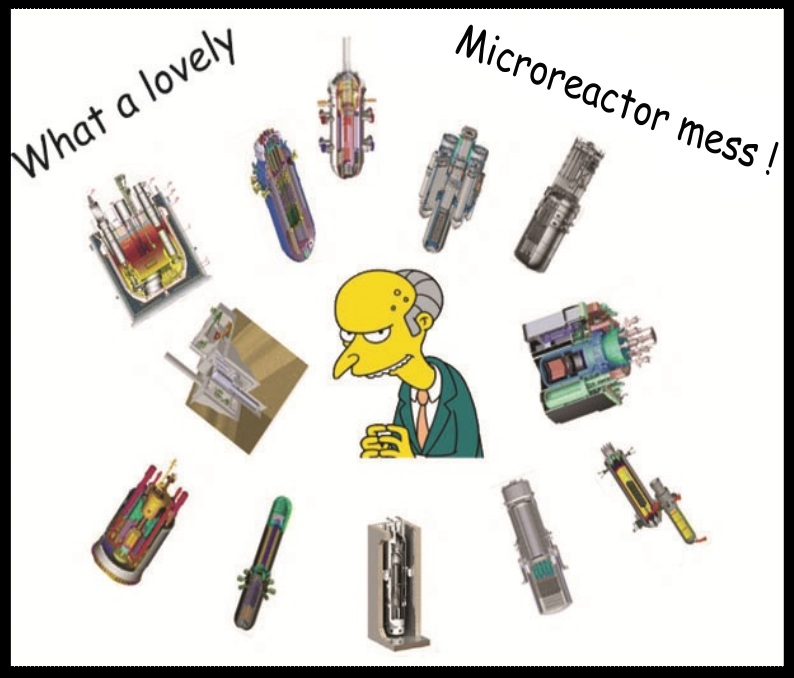
Forget about Small Modular Nuclear Reactors – they’re not cool anymore!
What the world needs now is MICROREACTORS – so saith the global nuclear lobby. And we know they must be right, because they’ve already explained how the world needs a NUCLEAR RENAISSANCE to solve climate change, energy shortage, world peace etc…
Now there are substantial differences between microreactors and small modular nuclear reactors (SMRs) , even though at first glance microreactors might seem to be just teeny weeny versions of SMRs. Whereas an SMR produces up to 300 MWe , a microreactor produces anything from 1 MWe up to 50MWe
There are fuel differences . SMRs can use LEU – Low Enriched Uranium or the more powerful HALEU – High-Assay Low-Enriched Uranium . Microreactors can, in theory, use LEU fuel, but that could not work out to be economic. The fuel must be the more powerful HALEU – High-Assay Low-Enriched Uranium. And in fact, Most microreactor plans use the more complex TRISO Fuel (Tri-Structural Isotropic), in which the tiny kernels of HALEU are coated with multiple layers of ceramic and carbon. That makes TRISO very safe, but very expensive.
Really, the most important difference is in – Who Pays For Microreactors?
Well, you do, if you’re a tax-payer. The only economically viable way to fund microreactors is to make them military installations, government funded. SMRs are supposedly economically viable, and were touted to become a private enterprise success. That’s until the NuSCale SMR financial fiasco
The beloved ever-about -to-happen nuclear renaissance needs a new theme, and that new funding source. The old theme was ENERGY– the new theme is DEFENCE.
For quite a while now, it has been obvious, and indeed a boast of the nuclear lobby, that new small reactors would support the defence sector, and nuclear weaponry, by providing the trained staff that are so badly needed, as the old nuclear boffins retire,
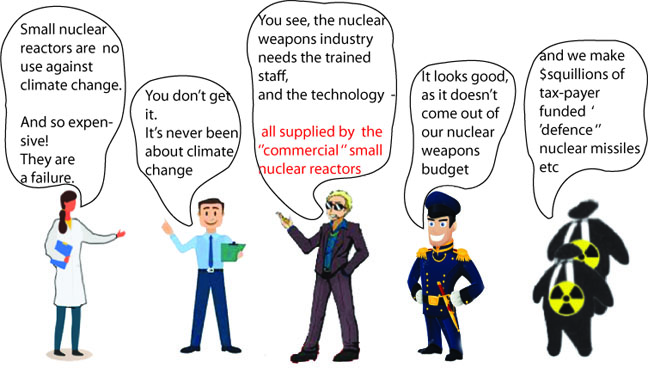
But times have changed, and also the nuke lobby is getting desperate. With all the international political drama going on, obviously the top priority now is war. (Did I hear someone say, what about diplomacy, negotiation? Look, that’s time-consuming, takes high mental ability, and there’s no money in it) Yes, what we and the nuke industry need now is war preparation.
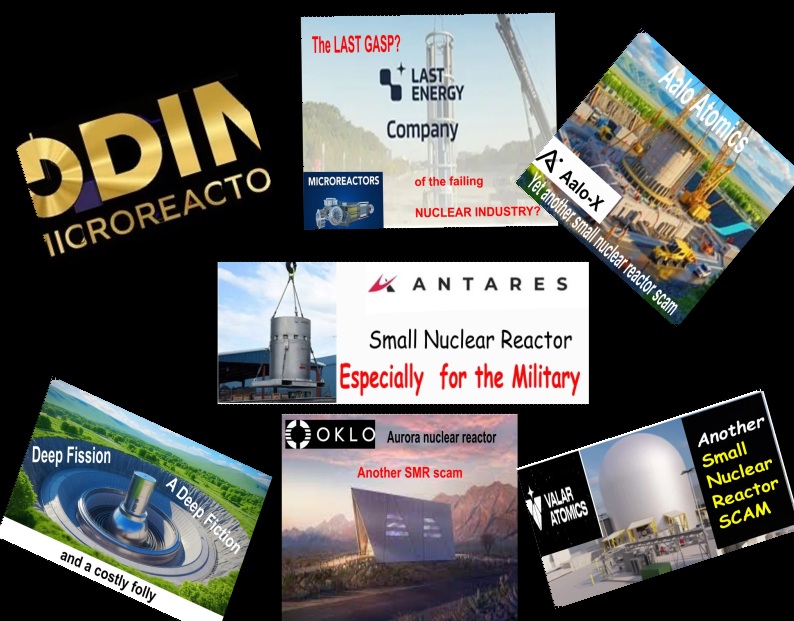
So the nuclear industry is regalvanised, with a spate joyous media articles, mostly – worded like this one – Antares Raises $470M to Field Military-Focused Microreactors. Optimistic statements abound:
Power up: Antares and their nuclear startup frenemies moving so fast is good news for the Pentagon, which is where that 2028 number comes into play in a few places.
In May 2025, President Trump signed a series of executive orders to accelerate the Department of Energy’s “Manhattan Project 2.0.” -notably Executive Order 14299, “Deploying Advanced Nuclear Reactor Technologies for National Security,” Then came Executive Order 14300, “Ordering the Reform of the Nuclear Regulatory Commission,”- getting rid of, or watering down public safety, radiation and environmental standards. The full import of this has been documented by Kristen Thomason in her superb article – “If you’re already afraid, just wait until you hear about Manhattan Project 2.0″
A lot of hype about microreactor energy for data farms, with Silicon Valley tech billionaires all on board, – and the craze is for so many “start-ups “
I had every intention of going through all the hazards, impediments to these microreactors ever becoming a commercial reality. But guess what ? OKLO, probably the leader of the pack, has done it for me. After the usual hypy article, glorifying their new microreactor, OKLO makes this revealing statement at the end:
As a result of a number of known and unknown risks and uncertainties, the actual results or performance of Oklo may be materially different from those expressed or implied by these forward-looking statements. The following important risk factors could affect Oklo’s future results and cause those results or other outcomes to differ materially from those expressed or implied in the forward-looking statements: risks related to the development and deployment of Oklo’s powerhouses, fuel fabrication and fuel recycling facilities, and radioisotope production activities; the risk that Oklo is pursuing an emerging market with no commercial project operating and regulatory uncertainties; risks related to acquisitions, divestitures, or joint ventures we may engage in; the need for financing to construct plants, which remain subject to market, financial, political, and legal conditions; risks related to an inability to raise additional capital to support our business and sustain our growth on favorable terms; the effects of competition; risks related to accessing high-assay low-enriched uranium, plutonium, and other fuels (including recycled fuels) at acceptable costs and under acceptable timelines; risks related to our supply chain; risks related to power purchase agreements; risks related to human capital; risks related to our intellectual property; risks related to cybersecurity and data privacy; changes in applicable laws or regulations, including tariffs; the outcome of any government and regulatory proceedings and investigations and inquiries; and the other factors set forth in our documents we have filed with the U.S. Securities and Exchange Commission (the “SEC”).
The foregoing list of factors is not exhaustive.
I was going to try and list all those factors – to throw some cold water on the microreactor parade – and that leading microreactor developer has done it for me!
As I tried to research all those factors to consider about micoreactors, I made the discovery that amongst the pro nuclear experts themselves, there are the gold nuggets of the truth. Not only has OKLO raised those contentious questions, but in a lengthy video – Nick Touran, a nuclear engineer and manager at TerraPower, unearths the sobering realities of micro nuclear reactors:
It’s long – but he spells it all out, if you can take the time:
Chapters:
00:00 Visions for microreactors 03:49 Defining microreactors 11:56 The problem of radiation shielding 18:48 Original microreactor projects 24:29 Niche applications 30:32 The problem of neutron economy 40:08 The problem of fuel 53:03 The problem of operations and maintenance 1:00:17 The problem of commercialization 1:05:42 The problem of spent fuel 1:09:27 The problem of scaling 1:12:36 The problem of licensing
Nick Touran and OKLO might be hopeful for microreactor success some time in the future. But they – pro nuclear people, are well aware of the obstacles and especially of the financial costs.
So, if they can take the microreactor hype with a grain of salt, the rest of us, who are not part of the development process, should be taking that hype with a bucketful .
No comments yet.
1 This Month
26 September – International Day for the Total Elimination of Nuclear Weapons





PLEASE OPPOSE HR 8255 AND S.3639 – bills would accelerate satellite deployment, with no environmental review or safeguards – https://ncstd5li.quorum.us/campaign/169331/
To see nuclear-related stories in greater depth and intensity – go to https://nuclearinformation.wordpress.com
-
Archives
- September 2026 (305)
- August 2026 (330)
- July 2026 (355)
- June 2026 (287)
- May 2026 (306)
- April 2026 (356)
- March 2026 (251)
- February 2026 (267)
- January 2026 (308)
- December 2025 (358)
- November 2025 (359)
- October 2025 (375)
-
Categories
- 1
- 1 NUCLEAR ISSUES
- business and costs
- climate change
- culture and arts
- ENERGY
- environment
- health
- history
- indigenous issues
- Legal
- marketing of nuclear
- media
- opposition to nuclear
- PERSONAL STORIES
- politics
- politics international
- Religion and ethics
- safety
- secrets,lies and civil liberties
- spinbuster
- technology
- Uranium
- wastes
- weapons and war
- Women
- 2 WORLD
- ACTION
- AFRICA
- Atrocities
- AUSTRALIA
- Christina's notes
- Christina's themes
- culture and arts
- Events
- Fuk 2022
- Fuk 2023
- Fukushima 2017
- Fukushima 2018
- fukushima 2019
- Fukushima 2020
- Fukushima 2021
- general
- global warming
- Humour (God we need it)
- Nuclear
- RARE EARTHS
- Reference
- resources – print
- Resources -audiovicual
- Weekly Newsletter
- World
- World Nuclear
- YouTube
-
RSS
Entries RSS
Comments RSS


Leave a comment