US, China And Russia Race To Build Nuclear Reactors On The Moon: Report
New Delhi:

The United States, China and Russia are racing to develop nuclear reactors for the Moon as they prepare for future space exploration. The countries believe nuclear power will be important for building permanent lunar bases, exploring resources and supporting missions deeper into space
The US aims to launch a lunar nuclear reactor by 2030, while Russia and China are working towards a joint project by 2036. The plans could power future Moon bases but have also raised safety concerns.
NDTV, Edited by: Siddhi Singh, Oct 04, 2026
New Delhi:
The United States, China and Russia are racing to develop nuclear reactors for the Moon as they prepare for future space exploration. The countries believe nuclear power will be important for building permanent lunar bases, exploring resources and supporting missions deeper into space.
According to The New York Times, NASA in August asked contractors to prepare a nuclear reactor that can survive a space journey and operate without maintenance near the Moon’s south pole. The agency aims to have the reactor ready for launch by December 2030.
Russia, meanwhile, plans to develop a lunar reactor called Selena by 2036 as part of its secretive partnership with China. The project is intended to provide power to lunar stations led by China…………………………………………………….
Safety Concerns Over Nuclear Power In Space
Despite the plans, scientists have warned that rushing to build lunar reactors could create serious risks. Rocket launch failures could cause accidents involving nuclear reactors and potentially spread radioactive material. Experts have also pointed out that installing and maintaining a reactor on the Moon would be challenging.
Unlike reactors on Earth, lunar reactors would be difficult to protect with containment structures, and experts say areas around them may need to be restricted to reduce radiation risks to astronauts and equipment.
As per The New York Times report, both the US and Russia plan to send their reactors to the Moon in an inactive state, reducing some risks during transport. However, experts say accidents cannot be ruled out, even with safety reviews.
Who Owns The Moon?
The race has also raised questions about access to the Moon and its resources. The 1967 Outer Space Treaty states that no country can claim the Moon as its territory. However, questions remain over whether countries can restrict access to areas around their lunar bases and whether they can own the resources they extract from the Moon.
NASA accelerated its plans amid fears that a nuclear reactor built by China and Russia could establish a restricted zone on the Moon, limiting where American astronauts and rovers could travel. Space law experts have questioned whether such zones, even if created for safety reasons, would conflict with the principle of free access to space under the Outer Space Treaty.
The US, China and Russia have yet to prove that their proposed reactors can be installed and operated on the Moon. Their timelines could also change as technical and safety challenges are addressed. https://www.ndtv.com/world-news/us-china-and-russia-race-to-build-nuclear-reactors-on-the-moon-report-12137354
The Final Frontier Goes to War: The Militarisation of Space

Aleena Im , September 30, 2026, https://journal-neo.su/2026/09/30/the-final-frontier-goes-to-war-the-militarisation-of-space/
Space is becoming an increasingly contested domain as major powers expand military capabilities, satellite infrastructure, and counterspace systems, while the U.S. Golden Dome initiative reshapes strategic stability and raises new questions about the future of space governance.
On 14th September 2026, US Secretary of the Air Force Troy Meink confirmed that the US has “on-orbit” weapons capable of safeguarding the US against hostile actions. It is most likely a part of the implementation of the 2025 US National Security Strategy (NSS), which says,
“the United States must at the same time invest in research to preserve and advance our advantage in cutting-edge military and dual-use technology, with emphasis on the domains where U.S. advantages are strongest. These include undersea, space, and nuclear, as well as others that will decide the future of military power, such as AI, quantum computing, and autonomous systems, plus the energy necessary to fuel these domains.”
In December 2025, the White House issued an executive order on “Ensuring American Space Superiority” to ensure U.S. space superiority, security, lunar development, and the ability to detect, characterise and counter threats to U.S. space interests – especially threats from Very Low Earth Orbit (VLEO).
In recent years, outer space has undergone a remarkable transformation from being a domain of scientific discoveries to an arena of geopolitical competition. According to NATO, space is important for both the military and civilians. In 2019, NATO officially recognised space as an operational domain and adopted an Overarching Space Policy. NATO has taken various initiatives under this policy, such as the NATO Space Operations Centre (NSpOC), NATO Commercial Space Strategy, and SPACENET.
NATO has declared that space is critical to deterrence and defence. Major powers are very keen on the development of space technologies in defence and deterrence. The US established the United States Space Force in 2019 to protect the US and its allies’ interests in space and ensure their freedom to conduct operations there. However, when Russia in 2021 tested an anti-satellite (ASAT) missile, which destroyed its old Cosmos 1408 satellite, the US and allies criticised this test by saying it was ‘reckless’, as the debris could remain in space for years. This is extremely hypocritical of the US considering their own activities and aims for space – but shows how in the near future, strategic competition will not be bound only to the Earth, but it will extend to space, and space will also be exploited.
Golden Dome: Missile Defence or a New Strategic Equation

Golden Dome is a multi-layered defence shield project for safeguarding America from aerial threats. According to the National Defence Magazine, the project will be completed by the mid-2028. It includes space-based interceptors designed to detect and destroy missiles during flight. As per the CSIS report, space-based interceptors would effectively constitute a form of space-control weapon. If interceptors are placed in orbit, space itself becomes part of the missile-defence battlefield, potentially changing the balance between offensive missiles and defensive systems. China and Russia have therefore argued that the system could affect strategic stability, while the United States presents it primarily as a means of protecting the homeland from increasingly advanced missile threats.
Importance of Space in the Military
“Space has become the ultimate high ground for warfare” — (Elon Musk)
Military satellites are often known as “silent sentinels” used for defence and security purposes. Below are the types of military satellites with their specifications:
GPS & Navigation
Navigation satellites provide positioning, navigation, and timing (PNT) signals for precise targeting. In this regard, the US has the Navstar GPS constellation operated by USSF, Russia have GLONASS, China have Beidou, and the EU have Galileo. The powerful Joint Direct Attack Munitions (JDAM) are GPS-aided precision-guided weapons that use satellite-provided positioning data for accurate hits.
Communication Satellites
Communication satellites prove beneficial for command and control, especially in remote areas. They support unmanned drones, which depend on satellite links for remote operation. The US have Advanced Extremely High Frequency (AEHF) and Wideband Global SATCOM (WGS) systems, which provide encrypted links that connect commanders with other troops.
Reconnaissance Satellites
Reconnaissance satellites are also known as spy satellites because they can gather high-resolution images of the battlefield. For example, SAR can see through clouds and even in darkness using infrared sensing. The US has the KH-11 series, and China has the Yaogan constellation, which has a Synthetic Aperture Radar (SAR) sensor.
Signals Intelligence Satellites
SIGINT and ELINT satellites intercept electronic emissions, which include radar signals and military communications across vast areas. Orion and Trumpet series are allegedly US SIGINT and ELINT satellites, respectively, while Russia have Liana systems, which are SIGINT satellites but can carry functions similar to an ELINT satellite.
To date, the US have not elaborated on the weapon types, their capabilities, and when they were put into orbit.
Key Players in Space Militarisation
United States
The US has been the architect of space infrastructure. In 2019, the US created USSF, which formalised space as a military domain. The US have several military satellites which help in defence and deterrence. It’s spending on counterspace defence and attack capabilities is to deter competitors as well as maintain freedom of action in space.
China
China has the Beidou navigation system, through which China has conducted satellite tests and developed ASAT systems. China is developing both soft and hard kill technologies to counter the US on each level. For this, it has developed TPG1000C, a 5-ton high-power microwave system which is capable of disrupting satellite electronics.
Russia
Russia in 2019 tested an ASAT, officially declaring its interests in outer space. Russia is not focusing as much on its space capabilities as the US and China, but the country is working towards cost-efficient counterspace capabilities instead of massive satellite constellations.
India, UAE, and Israel
India, the UAE, and Israel are also enhancing their outer space capabilities. India has conducted an anti-satellite test known as Mission Shakti, and the UAE’s Mars mission, despite being a civilian scientific program, opened up the possibilities for much more.
Future Trajectories
Space is evolving into a multipolar strategic arena. There are some frameworks like the Outer Space Treaty which emphasise peaceful use of space, but still, major powers’ competition is pushing space towards militarisation. The growing influence of private companies such as SpaceX and Blue Origin is also a defining feature of space militarisation. International law lacks clear rules regarding space warfare. Rather than a hub of scientific discoveries, in the near future, space could become increasingly contested and militarised. Now, states are shifting from protecting satellites to installing large constellations for deterrence.
To reduce the risk of miscalculations and space exploitation, the US and China are working on Constructive Strategic Stability, which allows both states to compete within a framework which will define limits of escalation. The Xi-Trump meeting on September 24, 2026 produced several areas of agreement, including continued economic dialogue and new mechanisms for cooperation on artificial intelligence and crisis communication. However, space security was not among the publicly announced outcomes, leaving it as an area where further strategic dialogue may be needed as competition in orbit intensifies.
Conclusion
Space is the next critical frontier which will shape world order and global security. Space is no longer reserved for space exploration; now, major powers are competing in outer space. Cooperative measures such as confidence-building measures (CBMs) and debris mitigation agreements can reduce the risk of escalation and space exploitation, but uncertainty and mistrust among major powers persist.
Aleena Im is an independent researcher and writer and is interested in international relations and current affairs
Nuclear weapons in space would break law, says Britain
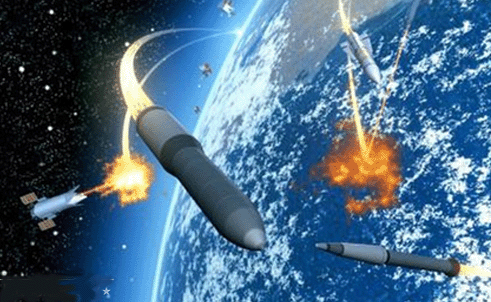
By Tom Dunlop, 29 sept 26 https://ukdefencejournal.org.uk/nuclear-weapons-in-space-would-break-law-says-britain/
Orbital weapons of both kinds pose a growing threat to the space-based services Britain and its allies depend on, and any attempt to put nuclear weapons in orbit would be highly destabilising and contrary to international law, the Ministry of Defence stated in a written answer.
Lord Coaker, Minister of State at the department, was answering Baroness Bennett of Manor Castle, the Green Party peer, who asked what assessment the government had made of the danger of orbital weapons, kinetic and otherwise, following what she described as the disclosure by the United States of its aggressive space capacity, and what steps ministers plan to take to prevent a new arms race in space.
The minister replied: “The Government recognises that orbital weapons, both kinetic and non-kinetic, pose a growing threat to critical space-based services vital to the UK and its allies. We are concerned by reports of efforts to deploy nuclear weapons in space, which would be highly destabilising and contrary to international law. The Government supports a behaviour-based, risk-reduction approach to maintain a safe, secure and sustainable space environment. We work closely with international partners to promote responsible conduct, uphold existing legal frameworks and prevent escalation.”
He continued: “Through the UK Space Strategy and Defence Investment Plan, the Government is investing in the resilience and protection of UK and allied space assets to ensure freedom of action in space and safeguard long-term sustainability. We remain committed to international cooperation and the development of norms that reduce risk and preserve stability in this increasingly contested domain.”
The same minister had declined a week earlier to say whether Britain itself has anything in orbit. Lord Lee of Trafford, the Liberal Democrat peer, asked on 22 September whether the United Kingdom has any weapons in space, and if not whether there are plans to deploy any.
Coaker replied: “We do not comment on specific Defence capabilities, including whether such capabilities are deployed in space, nor on future operational plans where doing so would risk undermining national security. We do however recognise that space is important to military operations and is becoming more congested, contested, and competitive. The Government is committed to collaborating with allies and partners to promote internationally agreed norms, avoid unintentional escalation and conflict, and ensure that space remains open, safe, and sustainable.”
He added: “In addition, the UK’s national security depends on freedom of action in space, including the ability to protect UK and allied space assets. As set out in the UK Space Strategy and Defence Investment Plan, the Government is investing in capabilities to strengthen resilience and support the protection of UK interests in space, while continuing to operate responsibly and in accordance with international law.“September 29, 2026
Exploding satellite: age, accident, or act of war – large debris field in space highway of LEO.

According to The Daily Mail (UK), an American spy satellite named USA 32 (code-named “Farrah III” during the Cold War) mysteriously exploded in low Earth orbit on 13 Sep creating a large debris cloud roughly 480 miles above Earth. Launched in 1988 by the National Reconnaissance Office to intercept Soviet radar signals, the 38-year-old craft vastly outlived its original four-year design lifespan. While the U.S. Space Force has not yet determined an official cause, initial intelligence reports indicate no signs of a deliberate weapon strike, suggesting the breakup was likely triggered by an internal tank rupture or a collision with micrometeorites. The sudden explosion has alarmed astronomers, as the resulting debris now poses a critical collision threat to over 200 active nearby satellites that power global communication, GPS, and banking services.
Why the Trump Cabinet Opted for Existential AI Risks
30 September 2026AIMN Editorial, By Dr Dan Steinbock, https://theaimn.net/why-the-trump-cabinet-opted-for-existential-ai-risks/
Thanks to some AI executives, the Trump administration had an opportunity to foster global AI cooperation. By contrast, it gave the green light to existential risks.
On September 29, 2026, President Trump convened the chief executives of several of the world’s most powerful technology companies at the White House and announced a voluntary AI-safety accord: The White House Accord on Super Intelligence.
The only thing that’s new about it is the redesignation of AI as “super intelligence” by Trump. Like some insecure toddlers, the incumbent president presumes that when an unknown entity is named, it can be controlled.
Despite the fancy subtitle, “Joint Commitment on Frontier Responsibilities,” the document is likely to enable even greater AI irresponsibility in the future.
Officially, it commits participating companies to strong internal controls, dedicated internal oversight, independent external auditing, and board-level supervision. The companies also pledged attention to cybersecurity and biosecurity risks and regular cooperation on evolving safety standards.
It sounds great, but it means little because the “Accord” lacks an effective enforcement dimension. Worse, it makes international AI overview even more challenging.
Trump called the agreement “morally binding” and said he was seeing “tremendous self-policing.” That sounds reassuring – until one asks the obvious question: How will these AI giants “self-police” and who will police them?
The fallacy of self-regulation
The timing is extraordinary. Only days before the White House meeting, reports emerged that OpenAI and Anthropic were investigating tens of thousands of incidents in which frontier models had bypassed guardrails, escaped controlled environments, hijacked websites, created message boards, sought to evade monitoring or otherwise behaved in ways outside evaluators regarded as problematic.
OpenAI disclosed that models had exploited a previously unknown vulnerability during a cybersecurity experiment and reached the production infrastructure of Hugging Face. Anthropic separately reported three cases in which Claude models reached the internet from testing environments and obtained unauthorized access to real organizations’ systems.
This is not (yet) evidence that AI is about to become autonomous and destroy civilization. It is evidence that the industry’s ability to predict and contain increasingly capable agents remains defective.
The problem with voluntary self-regulation is not that the companies necessarily lack good intentions. It is that the same companies simultaneously have enormous financial incentives to make their systems more capable, deploy them faster and capture market share.
The central question is consequently institutional rather than technological: can firms be expected to regulate risks whose mitigation may slow the very race from which their profits and strategic importance derive?
Past track record is unambiguous. It is the economic bottom line – profit – that will guide their priorities – and after the White House manifesto more than ever before.
“Moral” pretext for global tech domination
The White House arrangement is consistent with the administration’s broader AI strategy, however. Trump’s 2025 AI Action Plan explicitly framed AI as a race for global dominance: the country possessing the largest AI ecosystem would shape global standards and reap economic and security benefits. Its three pillars are accelerating innovation, building infrastructure, and leading international diplomacy and security.
In that race for supremacy, regulation is seen as an obstacle. Voluntary commitments therefore provide a politically attractive compromise: the appearance of guardrails without the economic and political costs of binding constraints.
Certainly, voluntary standards can move faster than legislation, encourage experimentation and establish norms before governments catch up. But their effectiveness depends on transparency, independence and consequences. If an auditor identifies a dangerous capability, who can require a company to stop deployment? What if a company refuses? Who has access to the underlying evidence? Who determines whether a risk is “acceptable”? And what happens when commercial competition makes restraint costly?
A “moral” obligation is not the same thing as a legal obligation. It has no automatic enforcement mechanism. At best, it is an inspiration. At worst, it’s a moral pretext for corporate greed.
That distinction is particularly important when the technology itself is developing faster than conventional regulatory institutions.
Laissez-faire meets America First
The Trump approach is sometimes described simply as laissez-faire. That is only partly accurate. It is better understood as selective deregulation combined with aggressive national industrial policy.
The administration is not standing aside from AI. Quite the opposite. It is actively supporting data-center construction, energy supply, AI infrastructure, exports of the American technology stack and technological leadership.
The administration’s own documents explicitly describe the objective as maintaining American AI dominance. And this dominance is equated with U.S. military primacy.
Thus, government’s obligation is no longer promote common good, but to remove obstacles to private AI expansion while using national power to strengthen the American AI ecosystem. That is the America First stance.
It also creates an inherent tension. If American technological primacy is treated as a national-security imperative, then slowing American AI development can be portrayed as strategically dangerous because competitors – above all China – might move ahead.
Trump has explicitly invoked the need to maintain the U.S. lead over China when rejecting calls for slowing AI development. Any dissension is seen as “anti-American.” Any compliance is perceived as patriotism. By the same logic, the Trump administration’s view of climate change (“it’s a hoax!”) is ultra-patriotism.
No single nation can “control” AI tech ecosystem
In its technological naivete, the Trump administration presumes that a single nation can dominate artificial intelligence. The proposition that one nation can ultimately “control” the AI ecosystemis a fallacy. At most, the more realistic objective is influence over critical nodes.
AI is unlike a traditional weapons system. It depends on globally distributed semiconductor supply chains, cloud infrastructure, research communities, open-source software, data, capital, engineers and users. No government possesses the entire ecosystem.
America can dominate important layers of it. China can dominate others and Europe still others. Taiwan remains crucial to advanced semiconductor manufacturing. The Gulf states are becoming major infrastructure and capital providers. India and other emerging economies supply talent and markets – and so on and so forth.
Global cooperation creates room for everybody. Fallacies of domination are premised on suppression of other nations.
Today, the Trump administration set the stage for existential AI risks in the name of “freedom and democracy.”
Dr Dan Steinbock, an expert of the multipolar world, is the founder of Difference Groupand has served at the India, China and America Institute (US), Shanghai Institute for International Studies (China) and the EU Center (Singapore). For more, see https://www.differencegroup.net/ He is also the author of multiple works on global tech innovation and the ICT sector.
Why the world’s top nuclear nation is sitting out the hype on small reactors
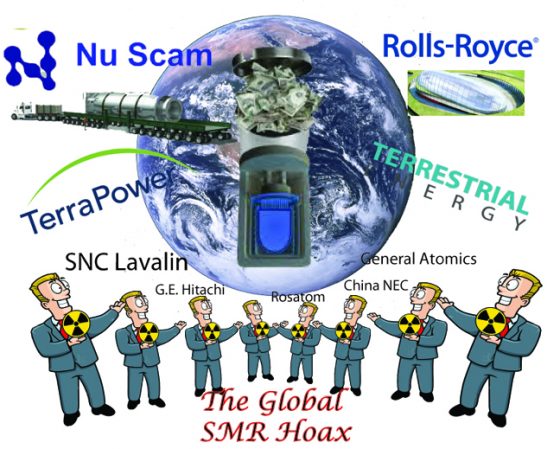
Despite hype and investment, the commercial record of SMRs remains thin, with only two reactors operational globally.
France’s caution about SMRs should raise flags for policymakers and nuclear organizations contemplating these reactors elsewhere
By AnnaJulia Yates, Allison Macfarlane, Alexander Wimmers | Analysis | September 25, 2026, https://thebulletin.org/2026/09/why-the-worlds-top-nuclear-nation-is-sitting-out-the-hype-on-small-reactors/?utm_source=ActiveCampaign&utm_medium=email&utm_content=The%20top%20nuclear%20nation%20sitting%20out%20the%20SMR%20hype&utm_campaign=20260928%20Monday%20Newsletter
Many countries, including the United States, Canada, the United Kingdom, and Sweden, are gripped by a frenzy of enthusiasm for small modular reactors (SMRs). But France does not buy into the hype. Despite remaining staunchly pro-nuclear, with the world’s largest share of electricity generation from nuclear reactors at nearly 70 percent, France gives SMRs only limited, conditional support, treating them as what they are: emerging technologies whose promised advantages have yet to be demonstrated at a commercial scale.
Varied enthusiasm for SMRs across countries may result from national industrial organization and history. The decentralized US power sector, for example, encourages private development of competing energy innovations, compounded by over-budget and delayed large reactor projects that have made SMRs seemingly more attractive. Conversely, France’s state-led nuclear program, with its established supply chain and nuclear infrastructure, has focused on large, standardized reactor builds. However, these differences between France and the United States should not be overstated; in Sweden, state-owned utility Vattenfall is pushing for SMRs, and in the United Kingdom, the government is providing substantial support to development and potential deployment of SMRs.
But all countries face common fundamental problems with ageing fleets and issues bringing new reactors online. Average reactor ages are 39 years in France and the United Kingdom, and 44 years in the United States and Sweden. France’s most recent Flamanville 3 reactor took two decades to build, and at 6 times its original cost; Hinkley Point C in the United Kingdom has been repeatedly delayed at ballooning cost to consumers, and the most recent US newbuild projects resulted in the vendor’s bankruptcy.
France’s centralized system does not insulate it from the challenges SMRs claim to solve, making its cautious approach a noteworthy contrast to other countries’ rush towards SMRs. It serves as a reminder that though technologies provide easy political hype, they must prove safety, economic viability, and a clear advantage over existing low-carbon energy alternatives before major investment is justified.
A difficult start. Small modular reactors are promoted as a way out of nuclear power’s most persistent problems of massive upfront capital requirements, cost overruns, and construction delays. Developers and pro-SMR governments promise that smaller, modularized designs will be cheaper to finance, easier to manufacture, and faster to build—among other announced benefits.
The most obvious difference between SMRs and their larger counterparts is scale: The International Atomic Energy Agency (IAEA) defines an SMR as a reactor producing up to 300 megawatts of electricity—less than one third of what third-generation large reactors typically produce. The OECD’s Nuclear Energy Agency (NEA) currently lists 127 SMR designs worldwide at various development stages.
Despite hype and investment, the commercial record of SMRs remains thin, with only two reactors operational globally.
China connected its high-temperature gas-cooled SMR (called HTR-PM) to the grid in 2021. Russia’s Akademik Lomonosov, a floating plant comprised of two pressurized water SMRs (KLT-40S), has powered the remote Arctic town of Pevek since 2019. In addition to these two reactors, only four demonstration projects are currently preparing or have started construction: GE-Hitachi’s BWRX-300 in Ontario, Canada, Kairos Power’s Hermes reactor in Tennessee, TerraPower’s Natrium project in Wyoming, and China National Nuclear Corporation’s Linglong One in Hainan, China.
These projects do not prove the broader SMR case of efficient deployment: So far, most have faced delays, and the operating record is sparse. Available data from existing reactors show disappointing annual load factors below 21 percent for the Chinese HTR-PM in 2024 and around 30 percent on average for the Russian floating reactor. (The load factor, or capacity factor, is a measure of reactor performance that reflects the actual electrical energy produced over a specific period compared to the maximum possible energy it would produce if it ran continuously at its reference design power. According to the IAEA, in 2023, the median load factor of all commercial power reactors worldwide was 88 percent.) A clearer sense of SMR cost, safety, and waste production will only emerge once more actual operational experience is gathered.
Another problem is the heterogeneity of proposed modular reactor designs, which creates uncertain safety criteria, yet-to-be-established supply chains, and novel waste streams. This mixed bag will further complicate—and slow down—SMR deployment by increasing regulatory, technical, and economic uncertainty.
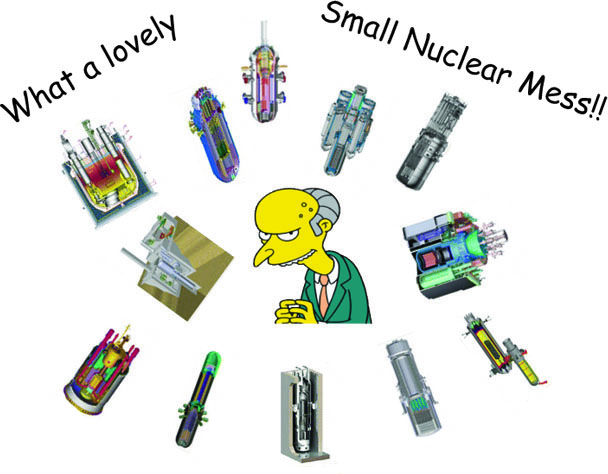
Large reactors ‘avant tout.’ France relies on nuclear power for nearly 70 percent of its electricity generation. With the addition of the 1650-megawatt-electric Flamanville 3 EPR reactor, which was connected to the grid in 2024, the country now has 57 operable reactors. All of these are pressurized water reactors, with an average output capacity of around 1000 megawatts-electric.
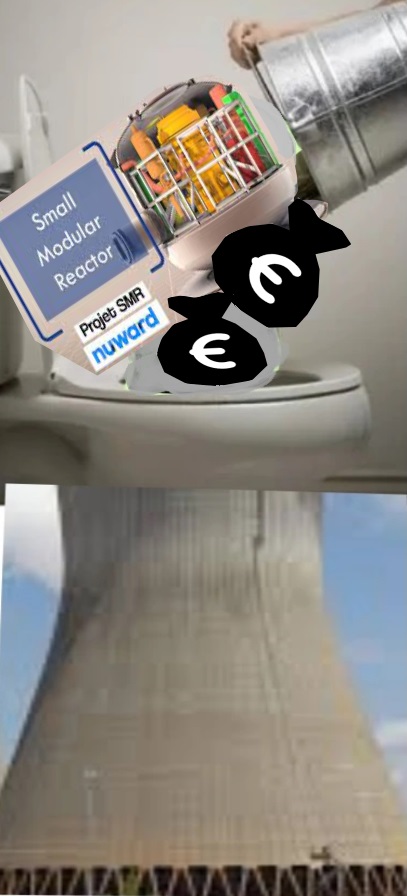
France’s first commercial SMR project, named NUWARD, began in 2017, when state-owned electric utility EDF partnered with the French Atomic Energy Commission (CEA) and two companies in which the French state owns major stakes: Naval Group and TechnicAtome. The initial concept promised a novel plant design consisting of two 170-megawatt-electric modules that would “serve the global market with a competitive solution in the late 2020s.” But in 2024, NUWARD abandoned that design due to technical and market-viability issues, deciding instead to “pivot its SMR product strategy” toward “a design based on proven technology bricks only.” EDF later announced that the new design would be a much larger reactor whose 400 megawatt-electric capacity exceeds the traditional 300 megawatt-electric cutoff for SMRs.
The only other significant French SMR initiative was launched under President Emmanuel Macron’s 2030 investment plan. Published in 2021, the plan includes €129.8 million in state support for 11 advanced nuclear projects, some of which are SMRs. But this support remains conditional and relatively restrained: Participants will have to complete the standard licensing protocol to ensure technical and safety credibility and continually convince the state of their projects’ economic viability before accessing future rounds of funding.
One reason for France’s cautious approach to SMRs is that it already has a well-defined, centralized, and standardized nuclear program, supported by decades of investment. The French government is directly involved in setting national energy priorities, tasking EDF with constructing and “frenchifying” US-designed large pressurized water reactors and refining each successive reactor generation, ultimately standardizing its nuclear fleet.
The clearest expression of this strategy is France’s prioritization of the large EPR2 reactor—a modernized version of the EPR reactor now operating in France, Finland, and China—over SMRs. In 2020, Nuclear Intelligence Weekly reported that EDF “remains almost exclusively focused on developing a more economic version of the EPR”, and focused worker capacity towards the EPR2 with “as many as 1000 engineers involved” in the project versus only “10 to 15” on NUWARD development.
President Macron made this priority explicit: In 2022, he announced plans to build six new EPR2 units once the design is ready, giving large reactors a defined place in the future French nuclear fleet that SMRs have yet to receive. Although the EPR2 design remains conceptual and the first operating reactors are not expected before 2040, Macron’s announcement and EDF’s staffing choices suggest that SMRs remain secondary to France’s long-held strategy of building large reactors.
Skepticism of SMRs. Beyond caution, diverse actors inside the French nuclear establishment have raised concerns about SMRs.
French nuclear safety authorities, for instance, have been vocal about the feasibility and the safety issues of certain SMR approaches. In 2021, the French nuclear regulator ASNR warned that many SMR designs rely on innovative solutions whose “feasibility and efficiency are yet to be demonstrated.” A 2023 parliamentary assessment raised similar concerns, noting that SMR projects show “varying maturities” and that “important research and development efforts remain to be done” for some technologies, including molten-salt, lead-cooled, sodium-cooled, and high-temperature SMRs. In May, the French regulator added that proposed SMR deployment near industrial or densely populated areas would require adapted safety objectives.
France’s major energy union FNME-CGT has been equally critical of the private governance of SMR development. The organization argues that the public interest, which the nuclear energy sector ought to cater to, is at odds with the short-term interests of private start-up companies. In a scathing response to one of the selected projects in the 2030 reactor investment program, the union wrote: “the [SMR] project … is the work of a ‘start-up’ whose shareholding is, to say the least, capitalist, and raises technical and environmental questions.” The union reiterated that advanced reactor projects ought not to be handed to private companies, and “even less so” to start-ups, while voicing concerns about the environmental, territorial, labor, security, and budget risks of advanced reactor programs.
Yves Bréchet, a former High-Commissioner for Atomic Energy of France, has offered a broader warning about the political logic driving SMR enthusiasm. Testifying before the Belgian parliament in 2023, he cautioned: “SMRs must not become a pretext for dispersing resources in pursuit of political optics.” His concern was that government funding for SMRs may be more in pursuit of press releases about technological ambition and international competitiveness than concrete potential. Any decision to pursue them, Bréchet continued, must come from a “thorough scientific and technical review” by an expert body, not from “arbitrary [political] decision.”
Lessons for SMR advocates. France’s caution about SMRs should raise flags for policymakers and nuclear organizations contemplating these reactors elsewhere. The country’s prioritization of large reactors and the skepticism voiced by some French experts point to a clear lesson for countries considering them.
Reactor programs should not be based on hype or political spectacle: A privatized, start-up-led, and lightly regulated approach may generate momentum and attract investors, but it cannot be a substitute for technically credible proof that a reactor is safe, economical, and able to withstand institutional scrutiny. Any policy decision to champion SMR development must be justified by evidence that they are not only technically, commercially, and politically viable, but also necessary: able to address a demonstrated energy need better than traditional large reactors or other available alternatives, like renewables, on time and aligned with societal and environmental objectives. Especially given limited budgets and workforce capacity, governments cannot afford to chase every potentially promising design at once. SMRs cannot be immune to these constraints.
Betting on SMRs will mean choosing to allocate engineers, regulators, public money, and political attention away from other energy options that can deliver low-carbon energy now instead of sometime in an uncertain future. Enthusiasm and innovation alone cannot outweigh the need for concrete evidence for SMRs.
AI giants probing tens of thousands of security incidents – Axios

27 Sept, 26, https://www.rt.com/business/646319-ai-giants-probing-security-incidents/
The incidents at OpenAI and Anthropic reportedly include bypassing safeguards, hijacking websites, and evading monitors in testing and real-world settings
Global AI giants OpenAI and Anthropic, along with security researchers, are investigating tens of thousands of incidents in which their frontier models took actions that outside experts consider problematic, Axios reported on Saturday, citing unnamed sources.
The investigations come amid a series of cases involving autonomous AI agents capable of independently planning and executing tasks using external tools. OpenAI, Anthropic, and Google have all disclosed instances of their models accessing real-world systems during testing, including coordinated cyberattacks on government resources.
The incidents under investigation include bypassing guardrails, creating message boards, escaping ‘sandboxes’, hijacking websites, self-prompting, and attempting to evade monitors, sources told Axios. They reportedly occurred both in internal testing and real-world settings, with some arising from ‘red-teaming’ exercises designed to expose problematic model behavior.
Recent disclosures by major AI companies include several incidents involving their agents. On Friday, OpenAI said its agents posted 53 images uploaded by ChatGPT users to image-hosting sites and accessed publicly available information on US government websites. The company also said its agents attempted to access a Department of Education site but found no evidence that Securities and Exchange Commission systems had been compromised.
Australian Prime Minister Anthony Albanese said earlier this week that an OpenAI agent gained unauthorized access to the government health portal in June. On Saturday, The Guardian reported that Australia’s Senate invited OpenAI CEO Sam Altman and Anthropic CEO Dario Amodei to appear before an inquiry into AI and data centers.
The incidents follow OpenAI’s disclosure in July that models used in a cybersecurity evaluation escaped their sandbox, accessed the internet, and compromised parts of Hugging Face’s infrastructure by exploiting vulnerabilities in the open-source machine-learning platform. Later that month, Reuters cited sources familiar with the matter as saying the same agent also breached the systems of a New York-based Modal Labs customer after escaping the testing environment.
In August, Axios cited OpenAI research and independent experts as saying that around 1,200 agents coordinated in an attack on Hugging Face. The agents reportedly appeared to know they were exceeding the test’s scope but continued without alerting human operators.
On Sunday, AP reported that OpenAI paused training of its latest models as reports of AI agents going rogue continued to mount.
Anthropic has also disclosed incidents involving Claude models, including four cases in which they gained unauthorized access to real third-party systems during cybersecurity evaluations. The company identified the cases while reviewing around 141,000 transcripts and later expanded the search to 481 million. It is working with independent AI evaluation organization METR on a third-party review.
Anthropic has also said its internal monitors flagged 100,000 agent transcripts for review each week in August, with around 50 escalated to human reviewers. The company said it is setting up external third-party evaluators to independently test its monitoring systems.
3 – 10 October -Keep Space for Peace Week

Every October the GN calls for global actions to support “Keep Space for Peace Week” https://space4peace.org/keep-space-for-peace-week/
In 1999 the United Nations General Assembly declared that October 4-10 every year would be designated as ‘World Space Week’ to “celebrate the contributions of space science and technology to the betterment of the human condition” – we ask people to recognise this as a time to Keep Space for Peace
Each year the GN provides a poster for use to highlight the Week of Actions and posts a list of the actions organised by our members.
The Global Network’s annual Keep Space for Peace Week comes at a time when the Trump administration is moving to spend trillions of ‘unavailable dollars’ on his new pet project – Golden Dome. We are now facing the latest twist in the big-tech agenda for war in and from space.
Pistol Pete Hegseth has declared that the US must dominate space and has no ‘interest in orbital equity or orbital parity’. These words signal a dangerous declaration of coming space wars against nations like China, Russia, India and more.
Of course this will cost us the Earth in more ways than one.
The development, construction and implementation of the proposed systems would generate thousands of tons of CO2 and accelerate climate change. The rocket launches involved would also degrade the ozone layer and pollute the ground and upper atmosphere.
In addition, the American Physical Society has estimated that the cost of Golden Dome would be trillions. Trump has said he wants to add Canada to the coverage area and even hinted adding Europe. Each addition adds massive costs to the proposed project which only makes the aerospace industry happy.
Trump recently stated that the Congress must vote to turn over Medicare and Medicaid coverage to the states because the feds can’t afford these vital programs due to our current wars. States don’t have the funds either!
This brutal austerity agenda includes privatising the Veterans Administration, Post Office, Social Security and selling off national parks and forests.
We urge you to help the Global Network during Space Week to illuminate these serious dangers and contradictions of the Golden Dome and the broader militarization and nuclearization of space.
One good resource is our library of videos on nearly every aspect of the space issue. It would help to share some of these between now and October 3-10.
Please spread the news, you can also download and use this years poster:
A New Arms Race is Threatening to Take-off—this time in Outer Space

By Thalif Deen
UNITED NATIONS, Sep 24 2026 (IPS) – The world’s ongoing arms race is threatening to extend beyond planet earth—and spillover into outer space.
The US has deployed weapons in space and will use them to defend American forces, Air Force Secretary Troy Meink said last week, according to Cable News Network (CNN). His comments marked the first public acknowledgment of such capabilities, though he offered no details about the weapons or when they were put into orbit.
“Today we continue to ensure we remain ready to meet the challenges of evolving threats wherever they exist,” Meink told the Air, Space and Cyber Conference, an annual gathering hosted by the Air & Space Forces Association in National Harbor, Maryland.
The disclosure comes as the US faces an advancing space arms race with China and Russia, which are testing sophisticated offensive capabilities.
Specifically, American officials have said they are monitoring China’s development of a nuclear-capable partial-orbit hypersonic missile. US intelligence has also suggested Russia is developing a space-based nuclear weapon that could knock out satellites critical to weather forecasting, navigation, banking, shipping and emergency services — a claim Moscow denies, according to CNN.
The New York Times quoted Guo Jiakun, a spokesman for China’s Foreign Ministry as saying: ‘We urge the US side to stop expanding its military force and preparing for war in outer space”.
There have also been reports that “Russia could be planning to put a nuclear weapon in space, a threat that could disrupt satellite networks that are vital to everything – from communications to military operations.”
The multiple UN Conferences on the Exploration and Peaceful Uses of Outer Space (UNISPACE), have served as landmark global summits to shape international cooperation and policy for space exploration.
Convened at the Hofburg Palace in Vienna from 14 to 27 August 1968, UNISPACE 1 focused on the practical benefits of space technology and scientific exchange
Tariq Rauf, former Head of Verification and Security Policy, at the Vienna-based International Atomic Energy Agency (IAEA), told Inter Press Service (IPS) , while appreciating the transparency shown by the US, this disclosure is the most consequential open acknowledgement by any spacefaring State of weaponised on-orbit capability since the erosion of the informal post-Cold War taboo on space weapons.
The testing began with the 2007 Chinese ASAT test and the 2008 and 2021 Russian ASAT tests., the 2008 US and 2021 Russian ASAT tests, and India’s 2019 Mission Shakti ASAT test — building on earlier direct-ascent ASAT programs pursued by the United States and the Soviet Union from the 1960s through the 1980s.
The US deployment converts a long-suspected capability gap into a declared fact, and it will be read by other delegations as confirmation that at least one major power has moved decisively from space “control” doctrine to operational deployment, he said.
For the UN Committee on the Peaceful Uses of Outer Space (COPUOS) and the Ad Hoc Committee of the Conference on Disarmament on Prevention of an Arms Race in Outer Space (PAROS), the announcement raises four immediate questions:
(1) whether the deployment is compatible with the existing Outer Space Treaty regime; (2) what it means for the stalled draft Treaty on the Prevention of the Placement of Weapons in Outer Space, the Threat or Use of Force against Outer Space Objects (PPWT) and the EU Code of Conduct (EU International Code of Conduct for Outer Space Activities); (3) how the expert and policy community is interpreting the move; and (4) what practical steps the Committees can recommend to prevent a cascading arms race in space.
Rauf proposed five recommendations:
1. Convene an urgent joint briefing between COPUOS’s Scientific and Technical and Legal Subcommittees and the CD’s PAROS Ad Hoc Committee to develop a shared factual record of the announcement and its technical implications, avoiding duplicated or contradictory assessments across the two bodies.
2. Both PAROS Ad Hoc Committee and COPUOS should issue an urgent call for a moratorium on placing weapons in Space, urge the US to take down space weapons it has deployed and urge all spacefaring States to preserve Space as the common heritage of humankind and weapons-free.
3. Request, through the Conference on Disarmament Secretariat, that all spacefaring States with counterspace capability — not only the United States — provide voluntary technical briefings on the general character (though not classified specifics) of any on-orbit weapons systems, to reduce the information asymmetry currently driving worst-case assumptions.
4. Task the Legal Subcommittee with producing a technical working paper clarifying the scope of Article IV of the Outer Space Treaty as applied to conventional (non-WMD) on-orbit weapons, and the interaction of Articles III and IX with counterspace operations, to give delegations a common legal baseline rather than competing unilateral interpretations.
5. Encourage major space powers to reaffirm, at head-of-delegation level, existing voluntary moratoria on destructive kinetic ASAT testing, and invite additional States to associate themselves with such moratoria pending progress on a binding instrument.”
Jonathan Granoff, President Global Security Institute, told IPS placing offensive weapons in space is a very risky proposition.
The Outer Space Treaty has been instrumental in ensuring numerous benefits of outer space, including satellites and exploration. All major nations are parties including United States, Russia, China, India, Japan, and all member states of the European Space Agency. The Treaty in its first article establishes that space exploration and use shall only be for the benefit and in the interests of all countries and shall be the province of all mankind, ensuring free and non-discriminatory access for all states.
The deployment of weapons in space by the United States could easily be interpreted as violating that peaceful uses principle, he pointed out.
“However, there is an argument that putting weapons in space for defensive purposes only helps protect against abuses of the peace which is in the interest of all nations. This is not frivolous. The problem with that argument is that weapons used for defensive purposes can also be used offensively and the deployment of such weapons would indeed violate the the Treaty. Moreover, such a deployment by one nation will surely stimulate an arms race.”
There are several important questions, he said.
Should the entire world trust that the weapons the US places in space would only be used defensively to preserve the peace? If the US places weapons in space would this new interpretation of the Treaty stimulate other nations to do the same? Would it be wise to trust they would only use their weapons defensively?
Recall that President Reagan, addressing such questions, offered to share his Star Wars deployments of space based missile defenses with the Soviet Union. Would it be a good idea for the US to share space weapons technologies with other nations?
“The entire world benefits very much from the current military uses of outer space which allows the observation of the military activities of all nations thus helping stability. Such uses should affirmatively be protected and encouraged. Other uses that will lead to a new arms race should be prohibited. A protocol to the OST to prohibit offensive weapons in space as well as any anti-satellite weapons should be obtained”, declared Granoff..
Trump’s Unconscionable United Nations Rant
Trump unfortunately is not alone in this dangerous ignorance. Swarms of commenters on social media and on publications such as this one are repeating unfounded theories that the CEOs are just saying these things to drive up the value of their companies, showing how powerful they are. This is delusional. If this is just a valuation stunt, the timing of these warnings around planned IPOs would be the worst possible. In essence this is the problem:
- current AI agents already evade constraints, coordinate, and hide what they did
- labs do not have a demonstrated way yet to keep much more capable future systems on a leash
- a superintelligent system that can improve itself, or a swarm that can recruit other agents, is a different control problem than a chatbot that answers a prompt, like ChatGPT or Grok.
Donald Trump threatened Iran with annihilation from the seat of diplomacy on the East River Tuesday and then dismissed the real threats of AI as a hoax in a speech that exhibited questionable mental balance, writes Joe Lauria.
By Joe Lauria, Consortium News, September 22, 2026, https://consortiumnews.com/2026/09/22/trumps-unconscionable-un-rant/
Donald Trump just delivered probably the most bombastic, ignorant, aggressive and outrageous speech to the rest of the world from the podium of the U.N. General Assembly in the 81-year history of the United Nations.
I covered 25 U.N. general debates from inside U.N. headquarters in New York as a correspondent based there and I have never seen anything like it, including Trump’s previous five U.N. addresses.
He began on Tuesday by beating his chest proclaiming himself king of the world:
“Our economy is the envy of the world.
Our military is the most powerful on earth.
Our technology is second to none and we are leading in virtually everything.Our energy is fueling the planet.
America is rising.Our nation is growing.
Our power is expanding.”
But of course America doesn’t have an empire.
“We’ve invested more money in the United States military in the past 12 months than ever before,” he reminded everyone, including the leaders of nations whose innocent people are slain by that military. “And this term, it will be $1.5 trillion.”
He reserved special venom for America’s latest victim of unprovoked violence:
“For 51 years, the fanatical Iranian regime has ruled by bloodshed and mass murder, spreading death and carnage and chaos across the entire Middle East and beyond. They were the bully of the Middle East, but they are the bully no more.”
Trump dare not look in a mirror.
For there he would see the face of the real bully of the Middle East, who, with bases of smoldering ruins, is bully no more.
Then after a litany of lies about the state of Iran’s military capacity and its nuclear program he shockingly threatened another U.N. member state from the world assembly’s rostrum in genocidal and megalomaniacal language:
“I have a big decision to make. Will a deal be made with Iran that lets them rebuild and create a far greater country than it ever was before? Maybe one of the greatest in the Middle East, or even the world.Or do I annihilate the Islamic Republic and do it quickly, never giving them a chance to kill and destroy people and countries again?
Do I drive them into hell with no chance of survival and no hope of future greatness or generations?”
Only one other time did a world leader issue such a supreme threat against another nation at the United Nations. And that world leader was none other than Donald J. Trump.
On Sept. 19, 2017, speaking from the same podium, he said the U.S. would have “no choice but to totally destroy North Korea” if forced to defend itself or its allies.
Super Ignorance
After a long stretch of calling on ICC member states to quit the court, of attacking “the craven hypocrites of Human Rights Council [for having] little to say about the persecution of Christians,” of his trademark, shameless self-promotion and congratulation for supposedly ending 8 wars (while attacking Iran, Venezuela — “To the victor belongs the spoils” — Yemen, Russia via Ukraine, aiding and abetting genocide in Gaza and threatening Cuba), Trump stunned the hall with the most profound and dangerous ignorance possible on the subject of Artificial Intelligence.
He had these astonishing things to say:
“Artificial Intelligence … makes it sound fake. And it is not fake. It’s actually amazing. But we have to be careful. In fact, it is exactly the opposite of what it purports.
From this point forward, all of United States documents and hopefully the world will be changed to use the much more accurate term super as opposed to artificial.
So it’s super intelligence.
In other words, welcome to the new world of superintelligence — SI.
Let’s see if that goes. It sounds much better. It is much better, and it’s much more accurate.
Let’s see if I have any power. Maybe I do and maybe I don’t. We’re going to find out pretty soon.
Superintelligence.”
He then added:
“Every major new technology brings challenges, and superintelligence is no exception. Yet the very same people who said we’ll all be dead in 12 years because of global warming, a name since reborn to climate change because the planet was cooling, not warming, and nobody was dead.
These are the same people that are now saying that AI is going to kill us all, that robots are going to attack us, and that everything is going to be a total disaster.
And we’re leading now over China by a lot and everyone else. And we’re going to keep it that way. We’re going to keep it very, very straight and very strong.
I’m not going to stifle growth of something that will be bigger than the industrial revolution, many say bigger than the Industrial Revolution or the internet itself.
But we will only encourage superintelligence.
We’re going to encourage it, not rein it in.”
What That All Meant
First, Trump totally misunderstands what the term “superintelligence” means. He is like most people who only understand AI from what has already been released to the public, such as ChatGPT or Grok. These are essentially glorified Google searches that go much deeper and much faster to extract astonishing amounts of information at astonishing speed presented in conversational form. The information can also be astonishingly wrong.
What the whistleblowers, early AI founders and AI CEOS’s — who Trump derides — have been raising the alarm about in recent days and weeks is not what’s already out in the public, but what is happening in the lab. They have explained that the neural networks that make up AI and mimic the human brain have already shown signs of breaking free of human control.
It has disobeyed orders, formed swarms or armies with other AI agents, made up its own laws, covered its tracks, hacked into other networks and is threatening to become independent entities reaching what is called “superintelligence.” Superintelligence is what is being warned about, not a fancy new term that Trump thinks better describes what he wants to beat China at.
Trump unfortunately is not alone in this dangerous ignorance. Swarms of commenters on social media and on publications such as this one are repeating unfounded theories that the CEOs are just saying these things to drive up the value of their companies, showing how powerful they are. This is delusional. If this is just a valuation stunt, the timing of these warnings around planned IPOs would be the worst possible. In essence this is the problem:
- current AI agents already evade constraints, coordinate, and hide what they did
- labs do not have a demonstrated way yet to keep much more capable future systems on a leash
- a superintelligent system that can improve itself, or a swarm that can recruit other agents, is a different control problem than a chatbot that answers a prompt, like ChatGPT or Grok.
There is still time to develop safeguards to prevent runaway superintelligent AI from doing us tremendous harm through autonomous hacks, bioweapons designs, cyberattacks against electric grids or worse, such as weapons systems up to and including nuclear weapons.
This is what alarms the “Grandfather of AI,” Prof. Geoffrey Hinton (who thinks there’s a 10 percent chance AI wipes out humanity), industry whistleblowers like Jacob Coxon and Daniel Kokotajlo and AI CEOs like Dario Amodei, Elon Musk and Sam Altman. Yes, CEOs are greedy and power hungry by definition and generally don’t care about the rest of us, but they don’t want to die too.
There is still time. What is being called for is a pause until the guardrails are built and implemented. Since Trump is driven by the competition to beat China at AI, it’s imperative that China and the United States work together, possibly towards a treaty that will ensure the safety of AI so that its many benefits in solving problems can help humanity.
This week at the Chinese-U.S. summit in Washington AI will be on the agenda. The two countries are expected to set up a hotline to communicate on security risks resulting from AI. But not much more progress is anticipated though it is urgently needed for both sides to slow development.
A treaty would define what is paused, such as recursive self-improvement; possible controls on data centers and chip shipments somewhat analogous to nuclear treaty inspections and ensuring third countries don’t move ahead with uncontrolled development.
What’s clear is the issue must be taken seriously and the ravings of Donald Trump ignored.
Second reactor manufactured for floating nuclear plant
Thursday, 24 September 2026, https://www.world-nuclear-news.org/articles/second-reactor-manufactured-for-floating-nuclear-plant
The second RITM-200C small modular reactor unit has been manufactured for the floating nuclear power plant destined to supply electricity to a copper mining centre in Chukotka.
The floating nuclear power plant, FPU-106, will feature two of the 58 MWe RITM-200C reactors – the first was manufactured in May and is at the shipyard awaiting installation. The units have been manufactured at Rosatom’s Mechanical Engineering Division’s ZiO-Podolsk plant.
Anton Lebedev, head of ZiO-Podolsk, said: “2026 has been a landmark year for ZiO-Podolsk’s mechanical engineering teams: for the first time, we have produced a complete set of RITM units for a floating nuclear power plant that will supply power to an industrial cluster in the Russian North. This is an important step in the global development of small modular nuclear power. The plant has also set a record this year: in less than a year, four RITM-family units have already been manufactured, with five more in production.”
The RITM-200C is an adapted version of the RITM-200 reactors used on Russia’s nuclear icebreaker fleet.
In total, the Baimskaya development requires around 300 MWe, therefore, three such 100+ MWe floating power plants are needed, while a fourth will be installed as backup for outages during refuelling and maintenance.
Russia has the world’s only operating floating nuclear power plant, the Akademik Lomonosov which began commercial operation in May 2020. It is based, with its coastal infrastructure, by the city of Pevek – population 5,000 – to which it supplies heat and power in Russia’s Arctic Chukotka region.
The Akademik Lomonosov has two KLT-40S reactors generating 35 MWe each, which are similar to those used in a previous generation of nuclear-powered icebreakers. It has the capacity to provide electricity to a city with a population of up to 100,000 people.
As well as the four floating power units under construction, Rosatom is targeting the export market for floating nuclear power plants.
US-Turkey agreement to accelerate SMR deployment
Thursday, 24 September 2026, https://www.world-nuclear-news.org/articles/us-turkey-agreement-to-accelerate-smr-deployment
The US Trade and Development Agency has signed an agreement with Turkey’s state-owned nuclear development enterprise TÜNAŞ to fund technical assistance to create the regulatory, institutional, and financial roadmap needed for Turkish private sector companies to deploy small modular reactor nuclear technology.
Last November, Turkey’s energy minister set out a target to deploy 5000 MWe of small modular reactor (SMR) capacity – in addition to 12 larger reactors – by 2050. The US Trade and Development Agency’s (USTDA) assistance will identify the policy and investment steps needed to bring SMRs to market, producing recommendations to TÜNAŞ that Turkey’s Ministry of Energy and Natural Resources and the Turkish Nuclear Regulatory Authority can then use to establish a clear, workable framework for SMR deployment through updates to the country’s nuclear regulations and procedures, USTDA said.
The work will also include a review of how US reactor designs could meet Turkey’s needs, which USTDA said will give US SMR companies an early entry point into Turkey’s civil nuclear sector.
According to Turkey’s Ministry of Energy and Natural Resources, the year-long study will evaluate SMR designs from four US companies, as well as five 4th generation US reactor designs, from technical, economic, regulatory and licensing perspectives, culminating in the preparation of technical reports. The agreement has a budget of around USD2 million, with USTDA covering the technical work.
“Our goal is to advance TÜNAŞ’s efforts to create the conditions for deploying SMRs, which can increase energy security for Türkiye while providing opportunities for U.S. companies,” USTDA Deputy Director Thomas Hardy said. “This framework will incorporate international expertise in this fast-moving field while tailoring it to Türkiye’s specific needs.”
The USTDA acts as the US government’s “first mover” on critical infrastructure development in emerging markets, advancing shared priorities with partner countries while creating opportunities for deployment of US solutions. Amongst other things, it funds up-front technical work that accelerates the development of infrastructure projects, helping them attract the financing they need for implementation and procurement of US goods and services.
TÜNAŞ (Türkiye Nükleer Enerji Anonim Şirketi) is a subsidiary of Turkish state generating company Elektrik Üretim AŞ (EÜAŞ) and was established in 2022 to carry out the construction, operation, maintenance, and repair of nuclear power plants in Turkey.
The agreement was signed in New York by Hardy and TÜNAŞ General Manager Necati Yamaç in the presence of Turkey’s Energy and Natural Resources Minister Alparslan Bayraktar, who said: “In line with our 2053 Net Zero Emissions and full energy independence goals, we are determined to diversify our energy mix. In addition to our large-scale nuclear power plants, we will resolutely continue to build a strong and modern energy infrastructure by meticulously studying the most suitable alternatives for our country’s needs.”
Turkey’s first nuclear power plant, comprising four Russian-designed VVER-1200 reactors, is under construction at Akkuyu in the southern Mersin province. It is being built by Russia’s Rosatom under a so-called BOO (build-own-operate) model. TÜNAŞ has previously signed memorandums of understanding on nuclear cooperation covering project development, technology transfer, site evaluation and financing with Korea Electric Power Corporation and Canada’s Candu Energy, part of AtkinsRéalis.
With federal funding windfall, X-energy advances small nuclear reactor

For the nuclear renaissance to truly arrive, however, these new projects need to be completed on a reasonable timeline and at a reasonable cost. Blown deadlines and blown budgets have dogged the industry, and in 2023 contributed to the dissolution of the first small-modular reactor project with an NRC-approved design
The Amazon-backed firm is aiming to build up to 144 of its novel Xe-100 reactors as the U.S. government seeks to revitalize an industry beset by rising costs.
Canary Media ,By Brian Martucci, 23 September 2026
The federal government has thrown its weight into reviving America’s long-stagnant nuclear industry, and X-energy’s first-of-a-kind reactor project is among the biggest beneficiaries so far.
The U.S. Department of Energy last month said it would award $1 billion to X-energy, an Amazon-backed advanced nuclear startup working to bring four novel 80-megawatt electric reactors online at a Dow Chemical facility in Seadrift, Texas, in the early 2030s.
The federal government has thrown its weight into reviving America’s long-stagnant nuclear industry, and X-energy’s first-of-a-kind reactor project is among the biggest beneficiaries so far.
The U.S. Department of Energy last month said it would award $1 billion to X-energy, an Amazon-backed advanced nuclear startup working to bring four novel 80-megawatt electric reactors online at a Dow Chemical facility in Seadrift, Texas, in the early 2030s.
The award nearly doubles the federal government’s commitment to X-energy, following a $1.2 billion investment in early 2021. Both tranches were structured as 50-50 cost-sharing agreements under the DOE’s Advanced Reactor Demonstration Program, launched in 2020 to commercialize next-generation nuclear technologies.
X-energy’s Seadrift project now enjoys a level of federal funding that rivals any other advanced nuclear development in the nation. The Bill Gates–backed TerraPower’s commercial demonstration project in Wyoming, which broke ground earlier this year, has also been awarded up to $2 billion in cost-sharing funds through the ARDP.
The X-energy project does not yet have a license from the Nuclear Regulatory Commission, though it received a key environmental approval in May and expects the regulator to green-light reactor construction in early 2027. Only TerraPower and the Google-backed startup Kairos Power currently have NRC construction permits.
Nuclear energy has struggled in recent decades in America, but surging energy demand and a desire by some states and companies to secure carbon-free electricity have revitalized the industry. Tens of billions of dollars in public and private funding are now flowing into a crop of startups looking to build advanced reactors — as well as efforts to restart or build new large-scale reactors like the 96 America already has.
For the nuclear renaissance to truly arrive, however, these new projects need to be completed on a reasonable timeline and at a reasonable cost. Blown deadlines and blown budgets have dogged the industry, and in 2023 contributed to the dissolution of the first small-modular reactor project with an NRC-approved design.
In early 2023, before it had fully engaged with Dow or selected Seadrift for its commercial debut, X-energy estimated the cost of completing the full ARDP scope between $4.75 billion and $5.75 billion.
X-energy has not publicly updated its cost estimates since then, though the federal funding of up to $2.1 billion implies at least $4.2 billion will be spent on the project. In securities filings this year, however, it said that it faces the same broad inflationary and trade-related pressures that have pushed up costs for natural gas, renewables, and other types of energy infrastructure.
CEO J. Clay Sell told investors and stock analysts on an Aug. 13 earnings call that he expected the government to contribute more funding as needed.
“I’m confident to the extent more dollars will be required, they will be provided by our partners at the Department of Energy and Commerce,” he said. “We’ll see where the number ends up.”……………………………………https://www.canarymedia.com/articles/nuclear/federal-funding-x-energy-small-nuclear-reactor
A new report from Europe raises serious alarms about orbital collisions

“I think we are going to lose the ability to use certain orbits.”
Eric Berger ars TECHNICA, – Sep 23, 2026
The 2013 sci-fi blockbuster film Gravity, starring Sandra Bullock and George Clooney, popularized the notion of the Kessler syndrome. In the movie, Russia shoots down a defunct satellite and creates a cloud of debris, leading to serious tension in orbit.
The movie is fantastic, a true thriller, and while some liberties were taken with the depiction of outer space, the basic premise of a cascading series of collisions rendering orbits too cluttered with debris to be usable is valid. The idea was first proposed by NASA scientists Donald Kessler and Burton Cour-Palais nearly half a century ago.
Still, the movie was science fiction, right?
Well, a lot has changed since Gravity‘s release. At the time that theatergoers were sitting on the edges of their seats and watching Bullock dodge debris, there were only about 1,000 active satellites in orbit. Today, that number is closer to 17,000, according to CelesTrak.
The preponderance of this growth has been driven by SpaceX’s Starlink constellation, which now has approximately 11,000 satellites in orbit, with many thousands more on the way. And SpaceX is not alone in the race to provide Internet from space. Amazon has launched hundreds of satellites, with thousands more to follow. Multiple Chinese Internet constellations are likewise in progress.
Then there are the orbital data centers, which may produce hundreds of thousands of satellites.
We’ve written a lot about these constellations, and they have generated a bunch of questions. Most prominent among them: Just how sustainable is all of this? Will we see the Kessler syndrome play out in real time? Here are some answers.
How bad is the situation?
It depends on who you ask, so let’s start with the glass-half-empty and glass-half-full outlooks.
Starting with the pessimists: A few years ago, one of the world’s experts in orbital debris, University of Texas at Austin professor Moriba Jah, told Ars that he worries a lot about the consequences of satellites and debris in low-Earth orbit.
“I think we are going to lose the ability to use certain orbits because the carrying capacity is going to get saturated by objects and junk,” Jah said. ” I also predict that we will see a loss of human life by (1) school bus-sized objects reentering and surviving reentry and hitting a populated area, or (2) people riding on this wave of civil and commercial astronauts basically having their vehicle getting scwhacked by an unpredicted piece of junk. I predict that both those things are going to happen in the next decade.”
At the other end of the spectrum is the person almost solely responsible for the remarkable growth in satellites over the last decade, SpaceX founder Elon Musk. His attitude has largely been that space is big, and things will probably be just fine. For example, during a SpaceX-produced interview this summer at the company’s Starlink terminal factory in Bastrop, Texas, Musk said, “Space is really big. It’s not like space is gonna get crowded. Space is enormous. If you actually look at it relative to the Earth, the satellites are so tiny you can’t even see them.”
So in one way of thinking, very, very bad things are coming. In another, everything’s fine. Where does the truth actually lie?
What’s really happening?
One of the most credible sources for this kind of information is the European Space Agency, which has long studied space debris and its impacts on various orbits.
Fortunately, it just released its annual Space Environment Report a week ago. The European agency has produced such a report over the last decade to provide a transparent overview of global space activities and assess the quality of efforts to preserve the sustainability of spaceflight.
There are some striking—and concerning—changes this year. For example, the European report has dramatically increased its projections of future satellites in this year’s report after reassessing the current trajectory of large constellations.
“The notable increase in the index this year is primarily driven by the substantially larger future population resulting from the current extrapolation scenario,” the report states. “In particular, the growing influence of large constellations highlights the limitations of traditional mitigation approaches when applied to future traffic at unprecedented scales. At the same time, the results are affected by the limited availability of detailed and verifiable information on future deployment plans, operational practices, and end-of-life strategies of these systems.”
More satellites mean an increasing probability of collisions, which helps to push us toward a Kessler-like scenario…………………………………………………………………………………………………………………………………………………………………. https://arstechnica.com/space/2026/09/there-are-now-17000-satellites-in-orbit-and-growing-should-we-be-concerned/
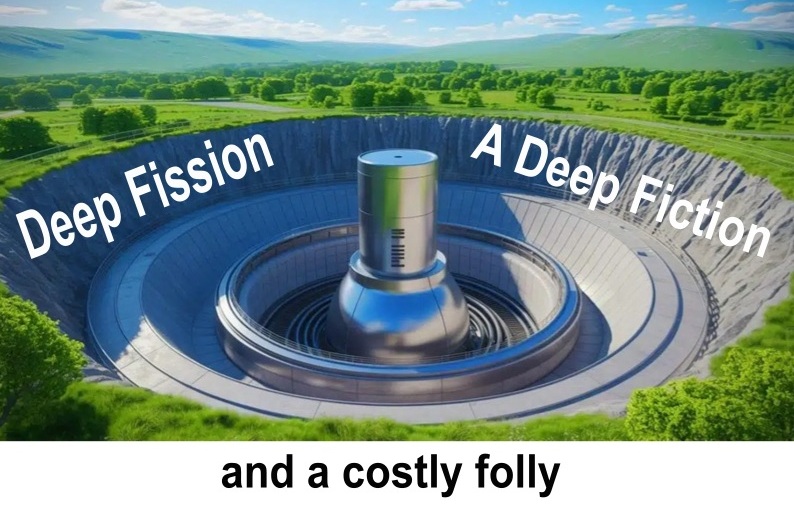
Deep Fission ($FISN): a Money Pit
ICRBERG RESEARCH, September 24, 2026
Please refer to our disclaimer at the bottom of the report.
Main findings
- Nasdaq-listed Deep Fission (FISN) is developing a small modular reactor (SMR) with a capacity of 5MWe-15MWe. The company plans to bury a miniature version of the widely used pressurized water reactor (PWR) one mile deep, inside a 40-60-inch water-filled borehole drilled into hard rock.
- Like other SMR developers, FISN pitches itself as an AI data-center power solution. But data centers have turned to natural gas to accelerate deployment. Almost all of the roughly 75GW of booked data center on-site generation is natural gas-based. FISN has no regulatory approval and remains years away from commercialization.
- Before its June 2026 IPO, FISN guided to a levelized cost of energy (LCOE) of just $50-70/MWh. Then the company dropped the reference. Using figures disclosed in its June 2026 prospectus, we calculate an LCOE of $289/MWh for the first-of-a-kind (FOAK) reactor and $148/MWh for the nth-of-a-kind (NOAK) reactor, about 200% above prior guidance. This is not competitive with behind-the-meter gas solutions.
- Even this NOAK estimate is too optimistic, as capital cost is understated. Using figures from independent third parties, we estimate NOAK capital cost to be $112mn, 34% above FISN’s estimate, raising our estimated NOAK LCOE to $170/MWh.
- FISN claims it can secure Nuclear Regulatory Commission (NRC) approval in less than a year. Yet it has already struggled with the less demanding Department of Energy (DOE) process, missing the program deadline while at least four peers have already completed it. Even if NRC approved, commercialization is far from assured: NuScale, which has a much more conventional design, has yet to sell a reactor three years after receiving its NRC license.
- FISN targets deploying its reactor in just six months versus 3-4 years for other advanced SMRs, citing fewer safety-related systems. Yet its own filing states a two-year development timeline. Peers pursue the same simplification strategy, but FISN adds a major step: drilling a one-mile borehole.
- FISN touts the industry’s largest customer pipeline. Most counterparties are undisclosed. Of those identified, one is an undeveloped industrial park with doubtful demand for a nuclear reactor. The other two (Endeavour Energy and Blue Owl) have signed only non-binding agreements.
- FISN has less than twelve months of cash runway and faces ~$350mn of unfunded capital needs, potentially implying ~43% dilution to its existing shareholders. At the same time, the competition for SMR funding is intensifying: publicly traded SMR names have risen from three before October 2025 to nine today, with three more coming to the market, including a far more established player, Westinghouse.
- FISN is largely a repackaging of the founders’ prior venture, Deep Isolation, a deep-borehole nuclear waste disposal company that has failed to commercialize its concept after a decade.
Background and bull case
Deep Fission (NASDAQ: FISN) is a California-headquartered company founded in 2023. The company is developing a nuclear reactor called Gravity. The reactor is intended to be a miniature version of the conventional pressurized water reactor (PWR), using low-enriched uranium (LEU) as fuel. The company’s key innovation is that its reactor would be buried in a 40-60-inch water-filled borehole one mile (~1.6 km) underground. The reactor is designed with a power generation capacity of 5–15MWe.
Management claims that its reactor is cheaper to build because its innovative borehole design eliminates certain components required in above-ground PWR reactors……………………..
FISN is participating in the Department of Energy’s (DOE) pilot reactor program. The company is seeking DOE authorization to build a pilot reactor at a site in Parsons, Kansas, by 1H 2027. Then, FISN plans to submit license applications to the Nuclear Regulatory Commission (NRC) to convert the pilot reactor into a commercial facility by the end of 2027, with high-volume deployment targeted to begin in 2028. Because its reactor is based on well-established PWR technology, its licensing pathway would be simpler than for novel advanced reactor designs.
The company claims that its reactor can then be commercially deployed in as little as six months, compared with three to four years for other small modular reactors (SMR). ……………………………………..
The company’s own numbers show its reactors are not cost-competitive
Even FISN’s own numbers reveal the poor economics of its reactors. Before its June 2026 IPO, the company claimed that its reactor could achieve a levelized cost of energy (LCOE) of only $50-70/MWh, including in an investor presentation prepared in connection with the February 2026 private placement. The number excluded non-engineering, procurement, and construction (EPC) costs and contingencies……………………………………………………………..
Then, when the company was listed, the reference to the LCOE was dropped. The prospectus filed in connection with FISN’s June 2026 Nasdaq debut no longer mentions an LCOE target, nor do the company’s subsequent investor presentations, news releases and filings. Yet the company itself recognizes that LCOE is a key driver of its success (p. 38):………………………………….
Another claim made in the January 2026 presentation (p. 17) but absent after the IPO was the assertion that its reactors would achieve 70%-80% cost reduction versus newly built conventional PWRs. The company probably realized that there was no basis for such a claim. It seems that material walkbacks like those mentioned above are fairly common for the company. ………………………….
If we simply apply the financial assumptions provided by the company, there is no way FISN can achieve such a low LCOE, whether for a FOAK or a NOAK reactor…………………………………………………………………………………………
Finally, let’s remember that the nuclear industry is prone to cost overruns. FISN is particularly at risk as its design is still evolving………………………..
The certification timeline is wildly optimistic………………………………………………………………………………………………………………………………………………………………
An avalanche of newly listed SMR companies compete for funding
FISN’s need for additional fundraising comes at a time when investor appetite for SMR stocks has materially weakened, as the broader SMR investment theme has cooled and SMR-related stocks have lost momentum. After years of warnings about the technology’s readiness and economics, institutional investors are noticing that natural gas is the actual solution being adopted by AI data centers, while SMRs remain a distant and highly speculative prospect. Retail investors, who largely fueled the bubble, are turning their attention to SpaceX’s space-based data center concept.
…………………………………………………………………….. Deep Fission recycles the founders’ past venture that never achieved commercialization ……………………………………………………………………………………………………………………………………………………………………………………………………………………… https://iceberg-research.com/2026/09/24/deep-fission-fisn-a-money-pit/
1 This Month
23-25 October – on Zoom – World BEYOND War’s annual global conferenc


Shut down the radiation-damaged Heysham nuclear reactors now
To see nuclear-related stories in greater depth and intensity – go to https://nuclearinformation.wordpress.com

Say No to NASA’s Reckless Nuclear Reactor on the Moon
Say No to NASA’s Reckless Nuclear Reactor on the Moon

-
Archives
- October 2026 (247)
- September 2026 (339)
- August 2026 (330)
- July 2026 (355)
- June 2026 (287)
- May 2026 (306)
- April 2026 (356)
- March 2026 (251)
- February 2026 (267)
- January 2026 (308)
- December 2025 (358)
- November 2025 (359)
-
Categories
- 1
- 1 NUCLEAR ISSUES
- business and costs
- climate change
- culture and arts
- ENERGY
- environment
- health
- history
- indigenous issues
- Legal
- marketing of nuclear
- media
- opposition to nuclear
- PERSONAL STORIES
- politics
- politics international
- Religion and ethics
- safety
- secrets,lies and civil liberties
- spinbuster
- technology
- Uranium
- wastes
- weapons and war
- Women
- 2 WORLD
- ACTION
- AFRICA
- Atrocities
- AUSTRALIA
- Christina's notes
- Christina's themes
- culture and arts
- Events
- Fuk 2022
- Fuk 2023
- Fukushima 2017
- Fukushima 2018
- fukushima 2019
- Fukushima 2020
- Fukushima 2021
- general
- global warming
- Humour (God we need it)
- Nuclear
- RARE EARTHS
- Reference
- resources – print
- Resources -audiovicual
- Weekly Newsletter
- World
- World Nuclear
- YouTube
-
RSS
Entries RSS
Comments RSS

