Why the FBI is working with China and Russia, despite everything
An unexpected turn is reshaping global security beyond the old rivalriesPublished 11 Aug, 2026 An unexpected turn is reshaping global security beyond the old rivalries
11 Aug, 2026 , RT.com Ladislav Zemánek
In an era defined by fierce geopolitical competition, FBI Director Kash Patel has charted a course that prioritizes pragmatism and results.
By building selective yet substantive law-enforcement partnerships with China and Russia, the bureau is demonstrating that great powers can set aside deeper differences to confront transnational crime that endangers citizens everywhere. This development deserves recognition as a mature, interest-based approach, showing that effective governance in a multipolar world requires the capacity to cooperate wherever it delivers concrete gains.
Breaking the ice with Beijing
Patel’s engagement with his Chinese counterparts marks a clear departure from years of a near-total freeze in high-level law-enforcement contacts. In November 2025, he became the first FBI director to visit China since 2016, meeting Vice Minister of Public Security Xu Datong. He returned in July 2026 for discussions with State Councillor and Minister of Public Security Wang Xiaohong.
Chinese officials have called for deepening constructive dialogue grounded in mutual respect. According to Patel, the results were made possible by direct engagement under the Trump administration’s leadership. The relationship did not emerge overnight; it followed President Donald Trump’s May 2025 visit to China and subsequent high-level understandings on fentanyl precursors. What matters is that both sides chose to institutionalize the opening rather than allow it to remain a one-off diplomatic gesture.
Institutionalizing daily cooperation
Four dedicated working groups now operate on cyber fraud, violent crimes against children, counternarcotics, and a fugitive task force. Chinese Ministry of Public Security officers travel to FBI facilities in the US on a monthly rotating basis; FBI personnel make reciprocal trips to China. Officials on both sides report near-daily communication – an intensity of contact that had not existed for years.
This steady exchange has already produced operational results. One notable joint action, Operation Sand Dollar, brought together the FBI, China’s Ministry of Public Security, and Dubai police against a major cyber-scam center. The effort yielded roughly 300 arrests, the seizure of approximately $300 million, and the liberation of thousands of trafficked workers. Such outcomes illustrate the practical value of treating certain criminal networks as shared problems rather than exclusive domains of competition.
Patel has been explicit about the philosophy guiding this work. He has noted that the decision to pursue cooperation with China despite widespread advice against it proves what is possible with almost any counterpart: “The fact that we did it with China when everyone said, ‘Don’t do it,’ and, ‘You can’t do it,’ shows what we can do with almost anyone.” The partnerships are deliberately limited to specific categories of transnational crime; they do not pretend to resolve broader strategic disagreements. That clarity of scope makes them sustainable under the current circumstances.
Opening a channel to Moscow
The same pragmatic approach is being applied to Russia. Patel is preparing a visit to Moscow and St. Peterburg, tentatively scheduled for mid-October, with the Russian Federal Security Service (FSB) expected to serve as host. The last sitting FBI director known to have traveled to Russia was Robert Mueller in 2013. Patel’s planned trip builds on quieter collaboration already underway for more than a year against violent criminal networks.
This outreach occurs against the backdrop of Trump’s broader effort to reduce tensions with Moscow. Special envoy Steve Witkoff and Jared Kushner have made repeated visits, including meetings with Russian President Vladimir Putin, and further contacts are anticipated. Putin’s special envoy on foreign investment and economic cooperation, Kirill Dmitriev, has publicly welcomed the emerging China-Russia-US intelligence and law-enforcement cooperation, signaling that Moscow sees value in the channel.
Complementary signals across government
Patel’s initiative does not stand alone. Pentagon policy chief Elbridge Colby, long regarded as a China hardliner, has expressed clear interest in visiting China and revitalizing professional military-to-military ties. Colby’s willingness to explore direct engagement signals an important evolution: Even those most focused on strategic competition now recognize that sustained channels of communication and cooperation on discrete issues can reduce miscalculation risks and open space for practical problem-solving………………………………………………… https://www.rt.com/news/644113-fbi-china-russia-cooperation/
What Does It Take to Reopen a Nuclear Power Plant?

By Felicity Bradstock – Oil Price 9th Aug 2026
- The Trump administration wants to expand U.S. nuclear capacity through new reactors, power uprates, and the return of previously shuttered plants.
- Holtec’s Palisades restart has encountered corrosion, equipment repairs, supply-chain problems, and other unexpected challenges that illustrate the difficulty of reviving an aging reactor.
- Other projects, particularly Constellation’s Crane Clean Energy Center, could prove easier to restart and demonstrate that the viability of reactor recommissioning varies significantly by plant.
In the United States, President Trump aims to expand the country’s nuclear power capacity by developing new projects and restoring old reactors. However, restarting disused reactors is not as simple as just turning them back on, as rigorous safety standards must be considered.
In May 2025, President Trump published an executive order entitled “Reinvigorating the Nuclear Industrial Base”, in which he outlined plans to start construction of 10 new large reactors and add 5 GW of power to existing nuclear reactors by 2030.
Several U.S. reactors were shut down in previous decades as confidence in nuclear power fell to an all-time low following three prominent nuclear disasters – Chornobyl, Fukushima, and Three Mile Island. However, the public perception of nuclear power has significantly improved in recent years.
Last year, Trump announced plans to recommence operations at the Palisades Nuclear Plant in Michigan, a 789-MWe plant owned by Holtec International that shut down in 2022; the Constellation Energy 835-MWe Crane Clean Energy Centre on the Three Mile Island site in Pennsylvania; and NextEra’s 615-MWe Duane Arnold in Iowa. This supports Trump’s aim for a U.S. nuclear renaissance…………………………………………………………………………………………………
https://oilprice.com/Alternative-Energy/Nuclear-Power/What-Does-It-Take-to-Reopen-a-Nuclear-Power-Plant.html
Energoatom: Zaporizhzhia NPP lost external power twice on Aug 8
Ukrinform 8th Aug 2026
The Russian-occupied Zaporizhzhia Nuclear Power Plant (ZNPP) lost its external power supply twice on Saturday, August 8.
Ukraine’s state nuclear power operator Energoatom reported this on Telegram, according to Ukrinform.
At 10:59, the 330 kV overhead power line L-243 Ferosplavna – ZTPP No. 1, which supplies power for the plant’s own needs, was briefly disconnected.
The line was automatically reconnected at the Ferosplavna substation and remained energized. While the necessary procedures were being carried out, the plant’s own needs were supplied by diesel generators.
At 11:52, power to the ZNPP was restored.
However, at 14:26, the plant again lost its external power supply. Its own needs were once again switched to diesel generator power.
At 15:35, the plant’s own needs were supplied via the 330 kV Ferosplavna-1 overhead line, restoring the ZNPP’s external power supply.
“The situation once again demonstrates the vulnerability of the Zaporizhzhia NPP under Russian occupation. Any disruption to the normal power supply systems of a nuclear facility creates additional risks to nuclear and radiation safety,” the company said………………………….. https://www.ukrinform.net/rubric-economy/4152446-energoatom-zaporizhzhia-npp-lost-external-power-twice-on-aug-8.html
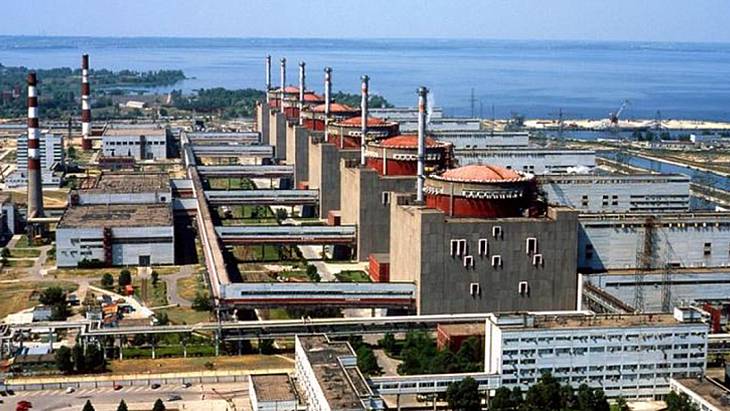
Water levels to be increased in Zaporizhzhia’s used fuel pools
Friday, 7 August 2026, https://www.world-nuclear-news.org/articles/water-levels-to-be-increased-in-zaporizhzhias-used-fuel-ponds
A decision has been taken to increase the water levels in the used fuel pools at the Zaporizhzhia Nuclear Power Plant, amid ongoing concerns about possible losses of off-site power, the International Atomic Energy Agency has said.
The agency (IAEA) said its experts at the site had been informed by the operators of the plant – which has been under Russian military control since March 2022 – that “the measure is intended to increase the time available before water could begin to boil off in the event of a prolonged loss of off-site power during which the site exhausted its diesel fuel supplies and could no longer continue cooling the pools”.
The IAEA added: “The decision was taken in light of the prolonged unavailability of the 750 kV Dniprovska line and current challenges in resupplying the site’s diesel fuel stores because of military activity in the area. The work began this week, with the IAEA team present to observe.”
Cooling pools are used for storing used nuclear fuel underwater. This is normally for at least five years to allow decay of radioactivity and heat.
The Zaporizhzhia plant’s six units have all been shut down since the start of the war in 2022, with the last unit transferring to a cold shutdown in April 2024.
The plant is close to the front line of Russian and Ukrainian forces and the plant has suffered a number of incidences where it has lost all external power, and had to rely on its fleet of emergency diesel generators for the power needed for essential safety functions. Nuclear power plants generally have enough diesel stored on site to operate emergency generators for an initial seven days if necessary. This ensures there is time to fix external power issues, or allow time for new supplies of diesel to be brought in if the generators are to be in use for a longer period.
According to the IAEA there have now been 24 times that the plant has lost external power, with half of those occurring in the past four months, including twice in the past week.
Director General Rafael Mariano Grossi said: “This trend, with the rising number of off-site power cuts at the Zaporizhzhia Nuclear Power Plant, is deeply concerning and clearly not sustainable. The agency will continue its work to help improve the situation and support nuclear safety and security at the site.”
At the moment the plant is relying on a single 330 kV backup power line, with its main 750 kV power line unavailable since March. Repairs were carried out, under an IAEA-arranged localised ceasefire, but it remains unavailable because of damage to a substation which provides power to the line.
Grossi said: “These substation missions have a clear nuclear safety and security purpose. As set out in the seven indispensable pillars, nuclear power plants require reliable off-site power, and substations are a crucial part of that process.”
The IAEA said that its teams at Zaporizhzhia and at the South Ukraine Nuclear Power Plant and the Chernobyl site all continue to report hearing military activity and/or air raid alarms.
Grossi said: “With each new day of the conflict, the risks to nuclear safety and security are not decreasing, on the contrary. I renew my call for maximum military restraint around all of Ukraine’s nuclear power plants and their associated electrical infrastructure.”
Nuclear Security Is A Hidden Public Cost Of Nuclear Power
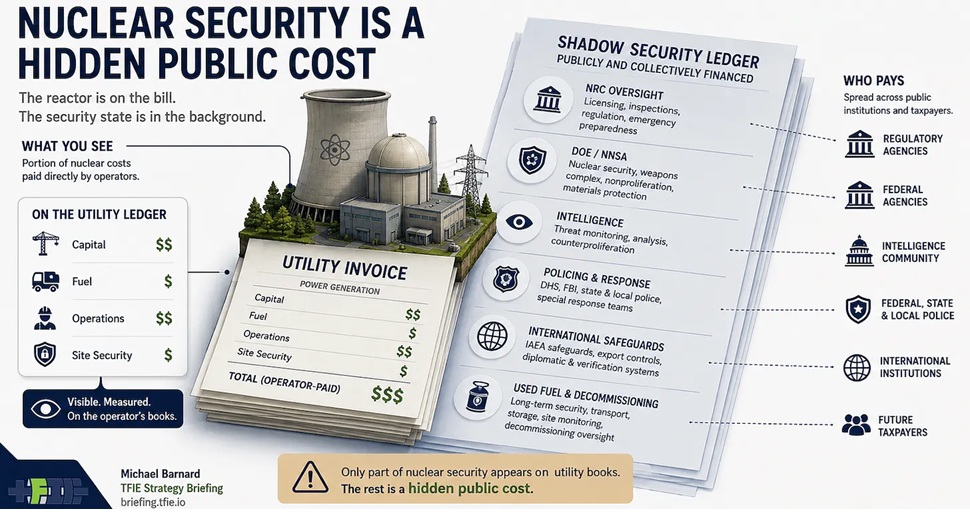
Security costs stretch across regulators, weapons-adjacent agencies, intelligence, policing, international safeguards and plant sites, but only part appears on utility books.
Michael Barnard, Aug 05, 2026
Nuclear security is not a single line item. It is a layered public and private cost structure spread across international safeguards, federal agencies, local policing and plant sites.
Nuclear power has an accounting problem that rarely appears in clean-energy comparisons. The industry requires overlapping layers of security across fuel supply chains, international safeguards, generation sites, used fuel, waste management and long decommissioning periods. Operators pay some of those costs directly. Much of the rest is spread across public agencies, regulatory systems, policing, intelligence and security institutions.
That was the core argument of my original CleanTechnica analysis in 2021. The article estimated that nuclear security costs in the United States were on the order of $50 million per reactor per year, with roughly half or less paid directly by operators. The resulting screening estimate was about $4 billion per year in uncounted public support for the U.S. nuclear fleet, in addition to direct tax preferences. That number should not be treated as a consolidated federal invoice. It was, and remains, an attempt to size a cost category that is otherwise scattered across too many budget lines to see clearly.
The need for that framing has not gone away. The numbers have moved, but the structure remains. As of March 2026, the United States had 96 operating commercial reactors at 57 nuclear power plants in 28 states. The NRC’s FY2027 budget request was $892 million with 2,606 full-time-equivalent staff. NRC fee recovery rules have also shifted: the Nuclear Energy Innovation and Modernization Act now requires the NRC to recover, to the maximum extent practicable, approximately 100% of its annual budget authority, excluding specific categories. The National Nuclear Security Administration, a semiautonomous DOE agency responsible for nuclear warheads, naval reactors and nonproliferation, has also grown materially, with an FY2026 request of about $30 billion…………….. (subscribers only)
https://briefing.tfie.io/p/nuclear-security-is-a-hidden-public
Sizewell C: Summary Analysis and Concerns Relating to its Platform Height and Offshore Geomorphological Change
Independent, Nick Scarr, Date Written: April 08, 2026, https://papers.ssrn.com/sol3/papers.cfm?abstract_id=6543818
Abstract
Sizewell C, at 7.3m AOD, has a proposed platform height half that of Hinkley Point C’s 14m AOD and this appears to reflect a cost imperative: ‘…it is grossly disproportionate to spend (redacted text) to increase the platform height to 8.8m AOD’.i The difference in the platform heights for Sizewell C and Hinkley C is then, profound. Why such a discrepancy?
No more sheltering or iodine tablets: Why are we getting a new nuclear emergency plan?

Worst-case scenario ‘very unlikely’, says Department of Climate, Energy and Environment
Caroline O’Doherty, Wed Jul 29 2026, https://www.irishtimes.com/ireland/2026/07/30/no-more-sheltering-or-iodine-tablets-government-reviews-nuclear-emergency-response/
Why are we getting a new nuclear emergency plan?
Technically speaking, it’s not new but an update of the National Plan on Nuclear and Radiological Emergency Exposures.
The Department of Climate, Energy and Environment says it’s a routine review carried out every so often. This is the fourth.
So it’s not prompted by, say, the heatwaves and droughts in Europe putting the vital cooling of nuclear power plants at risk?
The department says no.
And not by Russia’s fondness for exploding things in the vicinity of Ukraine’s Zaporizhzhia nuclear power plant?
Apparently not.
Not even because of the excitement bubbling globally over the prospect of companies developing small modular reactors to provide their own power needs?
Not specifically, although such reviews do heed emerging technologies and new sites where they may be located.
Where are the existing sites?
Scattered around the world. There are 410 “operable” nuclear reactors and 71 new ones under construction.
Which are closest to Ireland?
Heysham nuclear power plant on Britain’s west coast, 200km from Ireland, and Flamanville on France’s northern coast, 400km away.
Isn’t Sellafield closer?
Sellafield no longer generates nuclear power, although it is handling nuclear fuel and waste.
What kind of emergency might arise?
The plan considers four “reasonable worst case” scenarios: a release of radioactivity from a nuclear power plant near Ireland; a release from one on mainland Europe; an incident involving the transport of nuclear materials by sea; and an incident involving the transport of radioactive materials by road.
Why does it not include worst-case scenarios such as nuclear war or an attack on Ireland?
That kind of incident is “out of scope” for this plan. If that happened the Department of Justice would take the lead.
What kind of risks do “reasonable worst-case” scenarios present to Ireland?
Not very significant. The plan says the chances of such incidents are “very unlikely” – around one in 5,000 over 100 years. It concludes, however, that “a nuclear accident abroad may have the potential to result in widespread but low-level contamination in Ireland”.
How low is low?
It says exposure to a radioactive plume from the nearest plants would only deliver a radiation dose equivalent to that received during a return flight from Dublin to London.
But would we still have to shelter indoors, close the windows and try to find the iodine tablets issued in the early 2000s?
No, the “Go In, Stay In, Tune In” message has been removed from the updated plan.
Do we even need a plan if the risk is so low?
We do. It sets out which departments and agencies will monitor what. They will need to keep in contact with European and international partners; repeatedly test food, water, air and soil; potentially restrict food imports, and closely track weather patterns in case winds might move a plume in an unexpected direction.
“There are no scenarios envisaged whereby evacuation or a shelter in place order will be required for the public in Ireland,” it says.
“Consumption of iodine thyroid-blocking tablets would not be necessary.”
But it adds: “Throughout the emergency phase the need for protective actions should be assessed continually.”
What if Ireland was to build its own nuclear power plant?
An entirely new plan would be needed with far more detail about safe and unsafe zones, evacuation procedures and health service preparedness.
However, the department says despite some politicians pushing to lift the ban on nuclear power generation in Ireland, nuclear does not feature as an energy option in any official plans covering the next few decades.
Is it safe to extend the life of a nuclear power station?
BBC, Pamela Tickell, North East and Cumbria
When Hartlepool’s nuclear power station came online in 1983, it had an initial lifespan of 25 years. Now in its 43rd year, its operator has announced another extension. While the news has been welcomed by hundreds of employees, is it safe to keep doing so?
“Yeah, absolutely,” is the short answer from Mark Wenman, professor of nuclear materials at Imperial College London.
The Office for Nuclear Regulation (ONR), which Wenman describes as a “very stringent regulator”, would not grant a licence unless they were sure it was safe to do so, he said.
Hartlepool is one of five sites, including Heysham 1 and Sizewell B, which have had their lifespans extended multiple times.
Even when French energy firm EDF took over all of the UK’s working nuclear power stations in 2009, Hartlepool was due to stop generating electricity in 2014.
On Friday, it extended the lifespan again until 2030……………………………………………..
However, opponents argue that while the technology might be clean and safe, it is not completely clean, or completely safe.
Nuclear power produces radioactive waste and disposing of it can be costly and comes with environmental risks, which Friends of the Earth says there is “no answer for”.
The UK government is currently looking for a site to build an underground storage facility for its radioactive waste, some of which would have to be buried for thousands of years before its safe.
Why is the lifespan limited anyway?
The radioactivity permanently degrades the nuclear reactor’s core over time.
At about 10 metres (33ft) high, uranium fuel is channelled through the core.
The graphite bricks, which make it up, break down due to cracking and weight loss and cannot be replaced.
“Once they [the core graphite bricks] reach the end of their life, that is the end of the life of the reactor,” Wenman said.
Can they be brought back online?
You would not get another one in the exact same spot because it takes a long time to decommission a reactor, Wenman said.
“Remember, everything in there is radioactive,” he said.
Equipment may be left to sit there for many years so it can lose its radioactivity over time.
“It will be quite a slow process, so where the actual AGR is built right now, they’ll probably leave it there for quite a few years,” Wenman said……….. https://www.bbc.com/news/articles/cp87y14r11do
Two ageing nuclear power stations will stay operational until 2030

EDF said on Wednesday it had decided to extend
the life of the Hartlepool and Heysham 1 plants for an extra two years
after safety inspections of their cores
Hartlepool and Heysham 1 are two of four advanced gas-cooled reactors
(AGRs) that have been generating since the 1980s. The others, Heysham 2 and
Torness, also had their lifespans extended until March 2030 last year. EDF
said those dates remain “under review” and will be subject to further
safety extensions, leaving open the possibility that the plants could run
for even longer.
However, the country still potentially faces a “nuclear
gap” from 2030 if the AGRs come offline. That would leave Sizewell B, in
Suffolk, as the sole remaining plant, before Hinkley Point C in Somerset
and Sizewell C come online later in the 2030s.
How long the remaining four
will continue depends on the condition of their graphite reactor cores, EDF
has previously said. Hairline cracks can occur in the graphite over time,
potentially impeding control rods which must be dropped to lower output –
or shut the reactor down in emergencies. To continue operating, EDF must
prove to regulators that this will not happen and that it could still shut
down the reactors during a “one in 10,000 years” earthquake, much
larger than any the UK has ever experienced.
Telegraph 23rd July 2026 https://www.telegraph.co.uk/business/2026/07/23/ageing-nuclear-plants-to-be-kept-running-to-keep-lights-on/
Alarm over bid to keep cracked reactors running by cutting nuclear safety margins
“The bottom line is that continuing to operate these reactors with cracks in the reactor core is gambling with public safety.”
The company that runs Scotland’s ageing nuclear power station wants to weaken safety standards to keep it running for at least four more years. But the nuclear safety watchdog has its doubts.
Rob Edwards, July 23 2026
Moves to keep Scotland’s increasingly cracked reactors at Torness in East Lothian generating electricity until 2030 or 2032 have prompted formal action from the UK government’s nuclear safety watchdog, according to internal files obtained by The Ferret.
The station’s operator, EDF Energy, has been pressing for safety margins to be relaxed so reactors can keep running for as long as possible with hundreds of cracks spreading through their highly radioactive cores.
But the Office for Nuclear Regulation (ONR) has “concerns” and has demanded that the company justify its understanding of the safety implications. ONR inspectors lacked confidence in some of the company’s measurements, and accused EDF of a “trend of under-predicting cracking”.
ONR has also revealed that the estimated number of cracks in one of the reactors at Torness leapt by more than a third from 585 to 782 in just six months. A further 62 cracks have been found in the second reactor at the site, which only started cracking in May 2025.
Campaigners urged ONR not to be “bullied” by EDF into allowing safety margins to slip. The cracks were “extremely worrying” and keeping Torness running was “gambling with public safety”, they said.
ONR told The Ferret that its inspectors made “independent and proportionate challenges” to EDF’s claims. It stressed that the current number of cracks at Torness did not breach safety margins.
EDF said that “robust challenge” by regulators was essential to a strong nuclear safety culture that prevented accidents. The company’s ambition was to generate electricity from the station “for as long as it is safe and commercially viable to do so.”
Torness nuclear power station, near Dunbar, is 37 years old, having been officially opened in May 1989 by the then Conservative prime minister, Margaret Thatcher. The site had been the target of anti-nuclear protests since 1978.
In 2016 the planned life of the station was extended from 2023 to 2030. In 2021 EDF backtracked on that, saying that Torness would be closing two years earlier in 2028 because of expected cracking.
But in 2024 EDF again changed its mind, and announced that Torness would keep generating electricity until March 2030. According to ONR, EDF had decided to extend the lifetime of the station “to 2030 plus or minus two years”, suggesting that operating to 2032 was also being considered.
Meanwhile, Scotland’s other nuclear power station at Hunterston in North Ayrshire was closed down in January 2022, more than a year earlier than planned. This followed the discovery of an estimated 586 cracks in its two reactors.
The graphite bricks that surround the uranium fuel in reactors, such as those at Torness and Hunterston, crack after being bombarded by radiation for decades. The danger is that this could distort reactor cores, making them more difficult to manage.
ONR previously said that spreading cracks could result in debris inhibiting the cooling of the hot fuel. In some scenarios, this could lead to a reactor meltdown, which could result in the escape of radioactivity to the environment.
In response to a freedom of information request by The Ferret, ONR has released 11 heavily redacted files about its latest moves to regulate cracking at Torness. They reveal that between April 2025 and April 2026 ONR held 23 meetings with EDF, and formally demanded action on safety issues.
There have been prolonged and gritty tussles between ONR and EDF over how to understand the way in which cracks were impacting safety. Some of the technical issues at stake are difficult to understand because key words and phrases have been blacked out.
But it is clear there have been a series of disagreements between the regulator and the company. EDF has been arguing to cut safety margins to allow Torness to operate for longer, while ONR has been challenging EDF’s assumptions, methodologies and conclusions.
ONR raised a formal “regulatory issue” because of potential shortfalls in EDF’s understanding of how cracks are spreading. ONR said it had “concerns over EDF’s ability adequately to predict the number of cracked bricks within the graphite core”.
ONR disputed EDF moves to relax the so-called “damage tolerance boundary”, which limits the operation of Torness. According to one account from ONR, after a series of meetings in 2025 consensus “has not been reached.”
ONR pursued a second regulatory issue in 2025 because it lacked confidence in EDF’s measurements of the width of cracks and resulting fragments. The company accepted that “a number of errors and incorrect assumptions” had been made, but rectified them and the issue was resolved.
“Safety margins cannot be something to be negotiated simply to keep an ageing reactor running.” – Kristopher Leask MSP
After an inspection in September 2025, ONR’s expert graphite panel commented that there was “reason to pause and think”. They said that EDF forecasts “suggested a continuation of the trend of under-predicting cracking”.
One meeting between ONR and EDF in 2025 was about the risk of vital safety systems shutting down because of “snags” caused by cracking. EDF was said to be proposing to increase the number of permissible snags from one to five
The Ferret also used freedom of information law to ask for an update on the number of cracks in the two reactors at Torness. We previously reported that there were an estimated 585 cracks in reactor one in March 2025, and the first crack had been found in reactor two in May 2025.
ONR has now told us that “reactor one was inspected in August 2025 where it was estimated the number of cracked bricks were 782.” It added that after an inspection of reactor two in February 2026 “it was estimated that 62 bricks were cracked”.
The Scottish Campaign to Resist the Atomic Menace (SCRAM) highlighted recent moves by the UK government to relax regulation to make building new nuclear power stations easier. The Ferret reported in May that this had prompted “serious concerns” from the Scottish Government.
“This is an extremely worrying situation,” said SCRAM’s Pete Roche. “There is bound to be huge public concern that the ONR will be bullied by EDF and the UK Government into allowing safety margins to slip.”
He added: “The bottom line is that continuing to operate these reactors with cracks in the reactor core is gambling with public safety.”
UK’s old nuclear reactors to be kept going as we wait for Small Modular Nuclear Reactors
Two nuclear power stations will continue to generate electricity for two
more years than previously announced. In the latest of multiple extensions,
operator EDF said Hartlepool Power Station and Heysham 1 in Lancashire
would run until March 2030, two years longer than a previous estimate of
2028.
EDF said it took the decision after a “detailed review” of the
condition of the boilers and the graphite cores as well as supply chain
resilience. Chief executive of the Nuclear Industry Association, Tom
Greatrex, said: “The significance of this cannot be understated, given the
UK’s exposure to volatile gas prices and the need to protect households by
providing baseload power.”
The company also gave an update on hopes to
install the UK’s first Advanced Modular Reactors (AMRs) in Hartlepool,
which developers said would provide a “similar” amount of electricity to
the current plant’s power output. It said an application to enter the
generic design assessment had been submitted in June, describing it as the
“first critical step in the UK licensing progress”.
BBC 22nd July 2026,
https://www.bbc.co.uk/news/articles/clyvng9vl66o
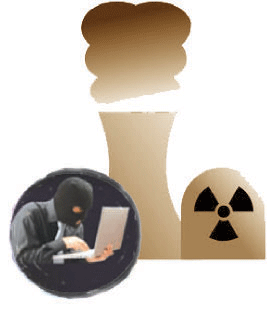
UK’s nuclear plants face risks of AI-powered cyber-attacks and insider threats
17 Jul, 2026 By Tom Pashby, https://www.newcivilengineer.com/latest/uks-nuclear-plants-face-risks-of-ai-powered-cyber-attacks-and-insider-threats-17-07-2026/
Civil nuclear power plants in the UK now face cyber-attacks enhanced by artificial intelligence (AI) and insider threats, according to the government’s National Risk Register 2026.
The National Risk Register (NRR) is the annual, public-facing version of the government’s National Security Risk Assessment, it “includes a summary of all but the most sensitive, classified risks,” according to Cabinet Office minister of state Darren Jones.
Jones informed parliament and the public of the publication of the 2026 edition of the NRR in a written ministerial statement on 14 July.
The NRR attracts attention because it explains the government’s assessment of the likelihood and severity of a broad range of risks, including terrorism, cyber threats, geopolitical and diplomatic risks, accidents and systems failures.
The 2026 edition covers 95 risks. Of relevance to the civil engineering and infrastructure sector, “cyber-attack water infrastructure” was added as a new risk to reflect learning “from reported cyber-attacks targeting the water sector,” the NRR said.
It also added, “accidental damage on the National Gas Transmission Network – to explore damage to the gas transmission network as a result of agricultural digging.”
In her foreword to the 2026 NRR, Cabinet Office security minister Angela Eagle said: “This government is committed to sharing risk information as openly as possible, to support all those working to build the UK’s resilience with their planning, preparation and response activity.
“Greater transparency also means that people can scrutinise our assessments, and challenge us to do things differently when needed.”
She added: “A whole of society approach is required to increase resilience; therefore, I encourage all risk and resilience professionals to consider the risks in this publication, and join our collective endeavour to make the UK more prosperous and secure.”
While the 2025 edition included “conventional attack” and “cyber-attack” against civil nuclear as two distinct risks, the 2026 edition removed the cyber-attack risk profile and instead covered cyber risks facing civil nuclear into “malicious attack: civil nuclear”, in its “state threats” grouping.
Within the new malicious attack: civil nuclear profile, the NRR 2026 said: “AI can automate the process of launching cyber-attacks, making them faster, more efficient and lower the barrier for entry.”
Reacting to the 2026 NRR, cybersecurity firm e2e-assure CEO Rob Demain told NCE: “Nuclear plants have always planned for physical threats and human error. What’s new is the assumption that the attacker may already have a way in, that someone with legitimate access can do real damage without ever needing to break down a fence.
“AI is exacerbating the threat. The National Risk Register itself says AI can automate attacks, making them faster, cheaper and easier to attempt without much skill.
“Elsewhere it goes further, describing how AI makes fake messages harder to spot and helps attackers find weaknesses faster. That’s a very different risk to plan for, than a lone bad actor.”
Demain added: “For the people who design, build and maintain this infrastructure, the message is simple: security can no longer be something bolted on afterwards, or left entirely to IT.
“It has to be built into how these sites operate, day to day, alongside the safety systems engineers already take for granted.”
Also responding to the “malicious attack: civil nuclear” risk profile, an EDF spokesperson told NCE: “As the risk from cyber-attack on UK critical national infrastructure continues to evolve, EDF continues to further refine its defences, with horizon scanning for developing threats and a constant series of system improvements to make it harder for those attempting to damage our systems.
We note that the National Risk Register does not propose a scenario of a safety risk but one that ‘results in a disruption to normal operations until investigations have demonstrated nuclear safety and security critical systems remain unaffected’, and that ‘the disruption is not a direct result of the attack’.”
Demain told NCE earlier in July that critical national infrastructure assets are now more at risk of cyber-attacks due to the deployment of newer, more powerful artificial intelligence (AI) tools like Anthropic’s Mythos.
A Seat Cushion Triggered One Of History’s Strangest Nuclear Accidents And A Geopolitical Scandal That Lasted Decades
A cushion, a crash, and a Cold War cover-up.
Tom Hale,19 July 26, https://www.iflscience.com/a-seat-cushion-triggered-one-of-historys-strangest-nuclear-accidents-and-a-geopolitical-scandal-that-lasted-decades-84141
There have been 32 known incidents where the US has accidentally detonated, misfired, or lost nuclear warheads (at least those that the public is allowed to know about). Just one of these accidents, however, became an international scandal and environmental disaster thanks to a cozy seat cushion for someone’s ass.
The incident unfolded in early 1968, a time when The Beatles were blasting on the radio, the Vietnam War was raging, and the threat of full-blown nuclear war between the US and the USSR was still very much on the cards.
Ever paranoid about the atomic threat, the US had launched an airborne patrol of up to 12 nuclear-armed bombers to constantly patrol the skies. Known as Operation Chrome Dome, the fleet of planes flew 24/7, non-stop from 1961 to 1968.
The operation’s routes regularly shifted to keep the USSR on its toes, but many of the flights cruised around the upper reaches of the Northern Hemisphere, a nice vantage point from which the US could hop over the Soviet Union and casually obliterate a few million people.
The incident unfolds, then explodes
On the morning of January 21, 1968, a B-52 bomber loaded with four B28FI thermonuclear bombs flew out of Plattsburgh Air Force Base in New York to take up its shift policing the skies.
It was mid-winter and temperatures were achingly low as the giant plane headed northeastwards into the Arctic Circle by mid-afternoon. In a struggle to keep warm, some of the crew had reportedly covered parts of the cabin with cushions. Unbeknownst to them, they had been placed over a heating vent that was blasting hot air from the overheating engine. The cushions turned into a smoldering tinder, and flames slowly engulfed the aircraft.
As the plane headed near the US Thule Air Base in Greenland, the crew bailed. Six of the seven successfully parachuted to safety, but one crew member, co-pilot Leonard Svitenko, attempted to escape through the lower hatch and sustained a fatal head injury.
They drifted down to the ice-covered expanse below, watching the plane turn into a fireball as it nosedived towards Wolstenholme Fjord. The plane exploded on impact, rupturing the nuclear warheads and spreading radioactive debris for miles around like a dirty bomb.
It was about to become a very long day for the US State Department, to say the least. First, they had to find the bombs and the nuclear debris, then they had to consider how they were going to clean up the mess. To make matters even more complicated, nukes weren’t technically allowed in Greenland, a territory under Danish control, and Denmark was keen to maintain its reputation as a nuclear-free zone (at least in public).
“Aircraft carried four repeat four nuclear weapons,” reads a telegram between the State Department and the US Embassy in Denmark. “Wreckage covers five mile area. Difficult climate conditions and lack of daylight hampering search operations. Special USAF team being sent.”
What followed was a nine-month cleanup operation, one of the largest and strangest in Cold War history. Hundreds of US airmen and Danish workers spent the sunless Arctic winter traveling via dog sleds and scraping contaminated ice, snow, and wreckage off the fjord by hand. Greenlandic Inuit people reportedly joined the charge, building a village of igloos to shelter the crews when the wind and chills became too much to bear.
Eventually, some 600 containers of contaminated snow had been gathered and were shipped to the US. Three of the nuclear bombs were accounted for, but the fourth was never fully recovered, presumably buried somewhere in ice.
“Thulegate”
Dealing with the contamination was one thing, but the political fallout was just as tricky to traverse. Publicly, the US and Denmark claimed the B-52 had been diverted over Greenland because of an unexpected in-flight emergency. But both governments were lying.
In the 1990s, declassified documents and journalistic investigations revealed that nuclear-armed bombers had been routinely flying over Greenland throughout the 1960s, unbeknownst to the Danish public. It became a political scandal dubbed “Thulegate” that deepened when it was revealed the Danish government had secretly signed a deal with the US to hold 50 nuclear weapons at the Thule base between 1958 and 1965.
Almost six decades later, Washington’s interest in Greenland hasn’t cooled with President Trump’s repeated demands to acquire the territory, one way or another.
Hopefully, a chilly pilot won’t threaten to turn tempers nuclear once again.
World warned of ‘nuclear apocalypse’ after drone kills nuclear plant engineer in Ukraine

Russia has warned of ‘nuclear apocalypse’ after a drone strike allegedly carried out by Ukraine killed the chief engineer at the Zaporizhzhia Nuclear Power Plant, Europe’s largest nuclear facility
Daily Star, Will Stewart Russia Correspondent and Adam Cailler Senior reporter and MSN lead, 16 Jul 2026
Russia has warned of a “nuclear apocalypse” following an alleged Ukrainian assassination of a senior engineer at the Zaporizhzhia nuclear power plant. Alexander Yakovlev, 46, was killed in a drone attack between the facility and the nearby town of Enerhodar.
He was travelling in a service vehicle and perished alongside his driver, according to Russian reports. Yakovlev served as the chief engineer at the Russian-controlled Zaporizhzhia Nuclear Power Plant, Europe’s largest. Ukraine’s Mirotvorets website had branded him a “traitor to the motherland” and an “accomplice to terrorists and Russian occupiers.”
Through his work for the Russians following Putin’s invasion of Ukraine, he stood accused of “collaboration in the form of assisting the occupiers in committing acts of nuclear terrorism and blackmail”. Following the occupation of this section of Zaporizhzhia region, he obtained Russian citizenship.
Rafael Grossi, the director of the International Atomic Energy Agency, the UN nuclear watchdog, denounced the incident without explicitly naming Ukraine or Russia. The killing “represents an unacceptable attack on the plant and its management, seriously threatening nuclear safety.”
He demanded an “immediate end” to all strikes “on or near nuclear sites.” Russian Foreign Ministry spokeswoman Maria Zakharova declared: “This is a crime of the Kyiv regime that Grossi must finally see – we demand a clear statement condemning this killing from the relevant international bodies, first and foremost the IAEA.”
Alexei Likhachev, the head of Rosatom, stated: “We expect the IAEA to respond promptly, concretely, and clearly to this tragedy.” Russian forces took control of the plant in southeastern Ukraine during the initial weeks of Russia’s 2022 invasion of Ukraine………
Russian authorities initiated a criminal investigation into the killings. Ukraine has yet to respond.https://www.dailystar.co.uk/news/world-news/world-warned-nuclear-apocalypse-after-37438323
Satellite images show damage inside Iran’s Bushehr nuclear power plant

Satellite images [on original] reveal strikes between July 7 and 12 on Iran’s largest nuclear power plant
By Al Jazeera Staff, 17 Jul 2026, https://www.aljazeera.com/news/2026/7/17/satellite-images-show-damage-inside-irans-bushehr-nuclear-power-plant
Satellite imagery reveals new damage inside Iran’s Bushehr nuclear power plant complex following the latest wave of US strikes during renewed military escalation between Washington and Tehran.
A comparison of European Sentinel-2 satellite images captured on July 7 and July 12 shows newly formed impact scars inside the Bushehr complex, along with another apparent strike site within nearby support facilities.
The open-source unit of Al Jazeera Network compiled satellite imagery, field footage and official data from the US Central Command (CENTCOM) to map the locations of US strikes across Iran between July 7 and July 15.
Ehsan Jahanian, deputy governor of Bushehr province, had said on July 9 that several locations across the province had been struck, including areas surrounding the Bushehr nuclear power plant, a military site in Choghadak and a fishing port in the south of the province, according to Iran’s state news agency IRNA.
Jahanian later denied reports that the nuclear power plant itself had been hit, saying the reactor remained unaffected and continued operating normally.
The strikes came during a broader US military campaign against Iran. US Central Command (CENTCOM) said it struck about 90 military targets on July 7-8, including air defence systems, missile and drone storage sites, naval assets and military infrastructure along Iran’s southern coast.
The US did not identify Bushehr or any nuclear facility among the announced targets.
Iran’s only operating nuclear power plant
Bushehr is Iran’s only operating nuclear power plant. Located about 17km (11 miles) south of the city of Bushehr, the 2.5-square-kilometre (one-square-mile) complex includes reactor buildings, cooling-water channels connected to the ocean, assembly halls and a harbour used to receive equipment and materials for construction and reactor operations.
The site contains two reactor buildings, one operational and another that has remained unfinished for years.
According to the International Atomic Energy Agency’s Power Reactor Information System (PRIS), Bushehr-1 has a net electrical capacity of about 915 megawatts.
It was first connected to Iran’s electricity grid in September 2011 before entering commercial operation in September 2013.
Unlike uranium enrichment facilities such as Natanz or Fordow, the operating Bushehr reactor contains nuclear fuel and radioactive materials associated with power generation, making any damage to its cooling, power supply or containment systems significantly more sensitive.
Previous incidents
The July strike was not the first reported projectile incident near the Bushehr plant in 2026.
The IAEA event reports submitted by Iran’s nuclear regulator recorded multiple incidents, including projectiles striking inside the plant’s premises on March 17, March 24 and March 27, as well as another impact near the fence surrounding the reactor’s first unit on April 4. In each case, Iranian authorities reported that the reactor continued operating normally and that no damage to the reactor itself had been recorded.
The IAEA has repeatedly stressed that nuclear facilities should never become targets of armed attacks because of the potential consequences for people, the environment and regional nuclear safety.
1 This Month
23-25 October – on Zoom – World BEYOND War’s annual global conferenc


Shut down the radiation-damaged Heysham nuclear reactors now
To see nuclear-related stories in greater depth and intensity – go to https://nuclearinformation.wordpress.com

Say No to NASA’s Reckless Nuclear Reactor on the Moon
Say No to NASA’s Reckless Nuclear Reactor on the Moon

-
Archives
- October 2026 (247)
- September 2026 (339)
- August 2026 (330)
- July 2026 (355)
- June 2026 (287)
- May 2026 (306)
- April 2026 (356)
- March 2026 (251)
- February 2026 (267)
- January 2026 (308)
- December 2025 (358)
- November 2025 (359)
-
Categories
- 1
- 1 NUCLEAR ISSUES
- business and costs
- climate change
- culture and arts
- ENERGY
- environment
- health
- history
- indigenous issues
- Legal
- marketing of nuclear
- media
- opposition to nuclear
- PERSONAL STORIES
- politics
- politics international
- Religion and ethics
- safety
- secrets,lies and civil liberties
- spinbuster
- technology
- Uranium
- wastes
- weapons and war
- Women
- 2 WORLD
- ACTION
- AFRICA
- Atrocities
- AUSTRALIA
- Christina's notes
- Christina's themes
- culture and arts
- Events
- Fuk 2022
- Fuk 2023
- Fukushima 2017
- Fukushima 2018
- fukushima 2019
- Fukushima 2020
- Fukushima 2021
- general
- global warming
- Humour (God we need it)
- Nuclear
- RARE EARTHS
- Reference
- resources – print
- Resources -audiovicual
- Weekly Newsletter
- World
- World Nuclear
- YouTube
-
RSS
Entries RSS
Comments RSS

