Ukraine for Hire: How Kyiv Became the West’s Imperial Enforcer
August 4, 2026, Joshua Scheer, https://scheerpost.com/2026/08/04/ukraine-for-hire-how-kyiv-became-the-wests-imperial-enforcer/
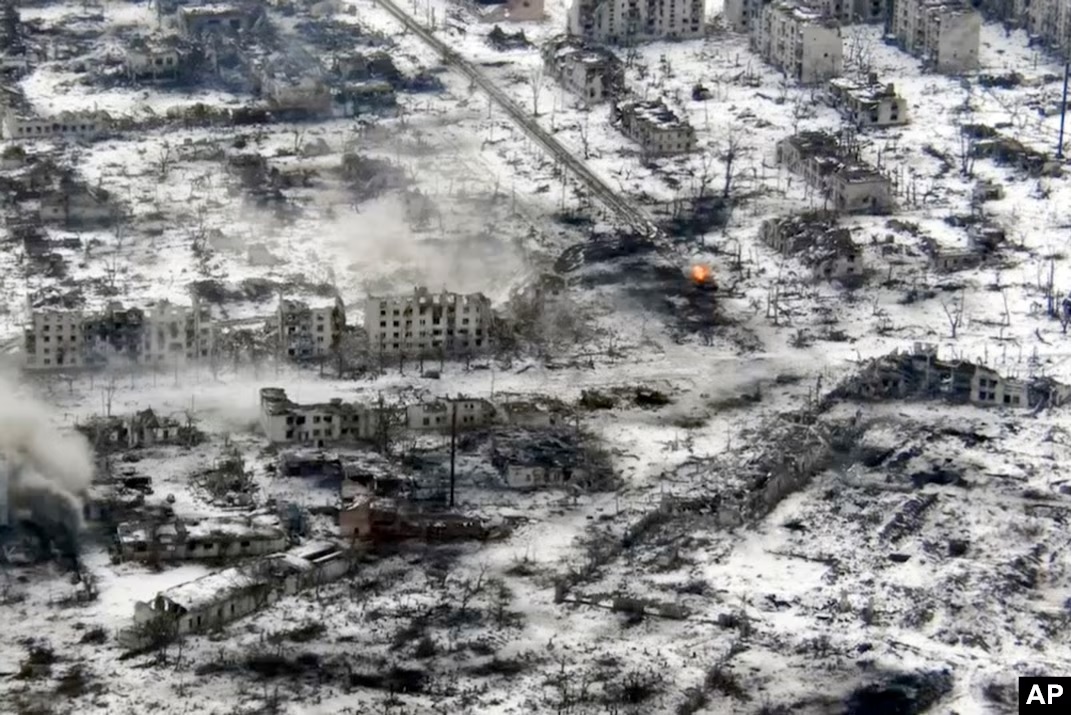
Ukraine’s role in the Western war machine is expanding far beyond its borders. After years of serving as Washington and NATO’s proxy against Russia, Kyiv is now accused of attacking an Iranian commercial vessel in the Caspian Sea, assisting armed groups seeking to undermine sovereign governments in Africa’s Sahel and collaborating with forces linked to Al Qaeda in Syria. Rather than an isolated nation defending democracy, Ukraine increasingly appears to be marketing itself as a military subcontractor for Western powers—willing to intervene wherever their geopolitical interests are threatened.
In this episode of Clearing the FOG, Margaret Flowers speaks with Phil Wilayto, co-founder of the Odessa Solidarity Campaign, about the history buried beneath the official narrative. They revisit the 2014 U.S.-backed overthrow of Ukraine’s government, the growing influence of far-right and openly white-supremacist organizations, the unpunished Odessa massacre and the long war against the predominantly Russian-speaking Donbas. Wilayto also describes a country confronting deepening political repression, banned opposition parties and masked recruitment squads reportedly seizing military-age men from the streets as Kyiv struggles to replenish its forces.
Flowers and Wilayto argue that Washington never regarded Ukraine as a democracy to be protected, but as a strategic weapon to be used against Russia—regardless of the enormous cost to Ukrainian and Russian lives. Now, as Western support becomes less certain, Kyiv appears eager to prove its value by attaching itself to U.S. and European campaigns against Iran, Syria and independent African governments. The result is a widening architecture of conflict in which Ukraine’s people are sacrificed, military contractors prosper and every new battlefield becomes another bargaining chip in the struggle to preserve Western domination.
“It looks like Ukraine is trying to connect its war with Russia to the U.S.-Israeli war against Iran,” Phil Wilayto explains. “Ukraine is essentially saying, ‘These conflicts are all part of the same struggle. If you’re going to confront Iran, then you need to provide us with more military supplies and greater access to Patriot missile production.’
“The Trump administration has pulled back somewhat from providing Ukraine with some of the military resources it wants, but I expect that to change. I think Trump is trying to create the impression that the United States wants a negotiated settlement. In reality, Washington has a strong interest in keeping this war going, regardless of how much suffering it causes on both sides.”
Margaret Flowers adds, “The CIA has had a long relationship with Ukraine, and Ukraine now appears to be acting as a tool of the United States. We have already seen evidence of this in parts of Africa, particularly across the Sahel.”
Guest:
Phil Wilayto is a writer, speaker and organizer based in Richmond, Virginia. He is a founding member of the Defenders for Freedom, Justice & Equality, an all-volunteer community organization, and editor of the quarterly newspaper The Virginia Defender.
While Western media continue to portray Ukraine as a struggling democracy defending itself from Russian aggression, Margaret Flowers and Phil Wilayto present a far more disturbing picture: a government suppressing dissent at home while extending Western military interests abroad. The transcript describes banned opposition parties, tens of thousands of alleged political prisoners, prosecutions of people resisting military service and masked recruitment squads reportedly dragging men from the streets and forcing them into Ukraine’s depleted armed forces.
Wilayto, co-founder of the Odessa Solidarity Campaign, traces these conditions back to the 2014 U.S.-backed overthrow of Ukraine’s government and the empowerment of ultranationalist and openly white-supremacist forces. He revisits the Odessa massacre, where at least 42 people were killed after anti-coup activists were driven into a trade union building that was set on fire.
Despite extensive video evidence, he says, no one has been held responsible. That history, largely erased from Western coverage, challenges the sanitized narrative of an uncomplicated battle between democracy and authoritarianism.
But the discussion does not stop at Ukraine’s borders. Flowers and Wilayto examine Kyiv’s alleged attack on an Iranian commercial vessel in the Caspian Sea, its support for armed groups opposing independent governments in Africa’s Sahel and its reported cooperation with forces linked to Al Qaeda in Syria. As Western enthusiasm for funding the war against Russia becomes less certain, they argue, Ukraine is demonstrating its usefulness by acting wherever U.S., NATO and former European colonial interests are threatened.
The interview’s conclusion is stark: Washington never treated Ukraine as a country to be saved, but as a piece on what strategist Zbigniew Brzezinski called the “grand chessboard”—a nation whose location, soldiers and future could be used to weaken Russia. Four and a half years into a grinding war, Ukrainians are being seized for military service and sent to the front while Kyiv searches for new battlefields on which to prove its value. Ukraine has not simply become the West’s proxy against Russia; it is becoming an imperial enforcer for hire.
Nuclear Security Is A Hidden Public Cost Of Nuclear Power
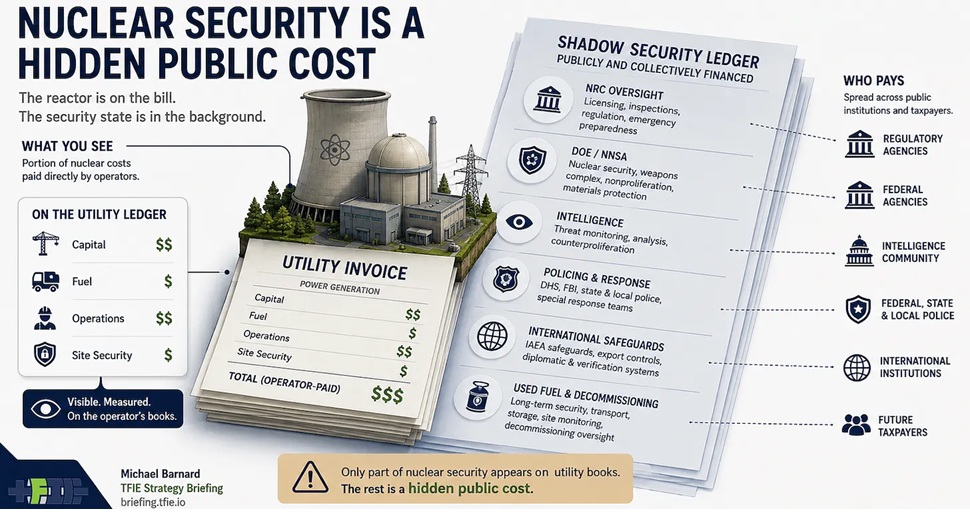
Security costs stretch across regulators, weapons-adjacent agencies, intelligence, policing, international safeguards and plant sites, but only part appears on utility books.
Michael Barnard, Aug 05, 2026
Nuclear security is not a single line item. It is a layered public and private cost structure spread across international safeguards, federal agencies, local policing and plant sites.
Nuclear power has an accounting problem that rarely appears in clean-energy comparisons. The industry requires overlapping layers of security across fuel supply chains, international safeguards, generation sites, used fuel, waste management and long decommissioning periods. Operators pay some of those costs directly. Much of the rest is spread across public agencies, regulatory systems, policing, intelligence and security institutions.
That was the core argument of my original CleanTechnica analysis in 2021. The article estimated that nuclear security costs in the United States were on the order of $50 million per reactor per year, with roughly half or less paid directly by operators. The resulting screening estimate was about $4 billion per year in uncounted public support for the U.S. nuclear fleet, in addition to direct tax preferences. That number should not be treated as a consolidated federal invoice. It was, and remains, an attempt to size a cost category that is otherwise scattered across too many budget lines to see clearly.
The need for that framing has not gone away. The numbers have moved, but the structure remains. As of March 2026, the United States had 96 operating commercial reactors at 57 nuclear power plants in 28 states. The NRC’s FY2027 budget request was $892 million with 2,606 full-time-equivalent staff. NRC fee recovery rules have also shifted: the Nuclear Energy Innovation and Modernization Act now requires the NRC to recover, to the maximum extent practicable, approximately 100% of its annual budget authority, excluding specific categories. The National Nuclear Security Administration, a semiautonomous DOE agency responsible for nuclear warheads, naval reactors and nonproliferation, has also grown materially, with an FY2026 request of about $30 billion…………….. (subscribers only)
https://briefing.tfie.io/p/nuclear-security-is-a-hidden-public
Climate Change Is Rewriting Europe’s Nuclear Cooling Assumptions

Romania used explosives to clear the way for redirecting Danube water toward Cernavodă as heat and drought cut nuclear output when cooling demand peaked.
Michael Barnard, Aug 04, 2026,
https://briefing.tfie.io/p/climate-change-europe-nuclear-cooling
On 3 August, Romanian naval engineers used 180 kilograms of explosives to remove a rock outcrop in the Bala Canal, a branch of the Danube. The controlled blast cleared the way for construction of a temporary dam intended to direct more water into the river channel serving the Cernavodă nuclear plant. One of Romania’s two reactors had already stopped as Danube flow fell to about 1,500 cubic metres per second, less than one-third of the normal July level, leaving the country trying to preserve the remaining unit through emergency river engineering.
The intervention made a normally hidden dependency visible. Nuclear reactors produce heat continuously and require somewhere to reject the larger quantity of waste heat that does not become electricity. Fuel supply may be largely insulated from weather, but the cooling systems, intake structures and environmental permits of river-cooled plants are tied to local hydrology. Much of Europe’s existing nuclear fleet was designed around historical ranges of water temperature and flow that are becoming less dependable.
The national consequences are much larger than a Europe-wide fleet percentage suggests. The most severe documented exposure is in Hungary, where the four-reactor Paks plant normally supplies 45.2% of national generation. By the morning of 4 August, the plant had been reduced from 1,916 MW to one 240 MW turbine, leaving nuclear capacity equivalent to approximately 39.5% of Hungary’s normal annual generation unavailable. A complete stop would expose the full 45.2% nuclear share.
Romania’s loss of one 650 MW Cernavodă unit represented about 10.3% of normal national generation on the same annual-equivalent basis. France reached a similar national figure through a much larger absolute reduction in July, when heat constrained more than 9 GW across 12 of its 57 reactors. The reduction was 14.6% of French nuclear capacity, equivalent to about 10% of normal national generation given France’s 68.1% nuclear share. Both Beznau units in Switzerland were shut during the July heatwave when the Aare reached 25°C, representing approximately 6.7% of normal Swiss generation.
Those figures [on table on original] are comparison indicators, not synchronized measurements of electricity actually lost. Hungary and Romania reflect conditions on 3–4 August, while France and Switzerland reflect their July peaks. Each value multiplies the country’s 2025 nuclear generation share by the proportion of nuclear capacity constrained at that snapshot. The method is intentionally simple, but it shows why a moderate continental effect can become a national emergency when a country depends heavily on one plant or river.
Two mechanisms are operating. France and Switzerland primarily faced hot-water constraints. Cooling water returned to an already warm river can push downstream temperatures above environmental limits, so plant operators reduce output or stop reactors to protect river ecosystems. Axpo reduced and subsequently shut the Beznau units when the Aare reached 25°C, while French plants along several rivers reduced production as temperatures crossed site-specific limits.
Hungary and Romania faced insufficient river flow as well as heat. Paks and Cernavodă require adequate water level and flow at their intake systems to operate at power. Record-low Danube levels forced Paks down to just over 10% of capacity and removed half of Cernavodă’s nuclear fleet. The reactors were shut or reduced safely; the power-system problem was that safe operation still removed large blocks of electricity during peak cooling demand.
Human-caused warming is clearly present in the heat component. World Weather Attribution found that the June western European heatwave was about 3.5°C hotter during the day than the same circulation pattern would have produced in the 1976 climate, and about 2°C hotter than a comparable event in 2003. No attribution study has calculated exactly how many megawatt-hours of the French or Swiss nuclear reductions would have remained available without climate change, but the water-temperature thresholds were being crossed in a heat regime substantially intensified by fossil-fuel emissions.
Attribution of the Danube’s low flow is less direct. Eastern Europe entered 2026 with persistent rainfall deficits, but the observed six-month precipitation trend was not statistically robust enough to assign the missing rainfall primarily to climate change. Warming had a much clearer influence on the rate at which the atmosphere pulled moisture from vegetation and soils. The January-to-June eastern European soil-moisture drought became about 11 times more probable because of human-induced climate change, while the extreme potential evapotranspiration became about 40 times more likely and about 8% more intense. Conditions of similar rarity in a climate 1.4°C cooler would have produced moderate rather than extreme drought in eastern Europe.
The defensible interpretation is that natural variability contributed much of the initial rainfall deficit while climate change materially deepened the resulting drought. That does not establish an anthropogenic percentage of the Danube’s missing cubic metres. It does establish that a dry period now loses more water to heat, reaches severe soil-moisture deficits more readily and is more likely to push river-dependent infrastructure across operating thresholds.
The electricity-system problem is the correlation among impacts. Extreme heat raises demand for air conditioning while warming cooling water, increasing evaporation and reducing river flow. Hydropower production falls with depleted rivers, gas turbines lose some output in hotter air, and persistent high-pressure weather can bring weak wind. Reuters reported European summer electricity prices reaching levels usually associated with winter stress as cooling demand increased and French nuclear output was reduced by more than 9 GW.
Air conditioning cannot be treated as a uniformly disposable load during a severe heatwave. Hospitals, care homes, cooling centres and vulnerable households require reliable electricity precisely because the heat is dangerous. The more useful flexibility is found first in industrial production, commercial loads that can be rescheduled, storage, imports and safe thermostat adjustments. Hungary’s voluntary conservation effort reduced demand by 700 MW on 2 August, nearly three times the output of the final Paks turbine, demonstrating that contracted or coordinated demand reduction can provide more immediate capacity than the reactor output still being defended.
Nuclear generation is not uniquely exposed to climate change. Hydroelectric, gas, coal, biomass, transmission and renewable generation all have different weather and climate dependencies. Nuclear’s exposure is unusually consequential because individual units are large and some national systems concentrate much of their electricity production at a single site. Its high historical capacity factors remain valuable, but they do not remove the need to plan for correlated periods of high temperature, low water and high demand.
This matters directly for reactor life extensions. Evaluations that add another 20 or 30 years of operation should use forward projections of river temperature, seasonal flow and extreme low-water events rather than treating the historical record as stationary. The engineering options include modified intakes, additional pumping, cooling towers, hybrid or dry cooling, and revised operating limits, each with costs and efficiency penalties that should be included in the life-extension case.
The grid response is broader than plant adaptation. Stronger interconnection reduces dependence on one national fleet, batteries and demand response cover the evening period when cooling demand remains high and solar production falls, and additional solar generation supplies electricity during many of the hottest daytime hours without depending on river flow. Planning also has to recognize that nuclear and hydro constraints can occur together across the same watershed rather than treating each generator’s risk independently.
Romania’s river intervention does not show that nuclear power has ceased to be a useful low-carbon resource. It shows that a reactor can be technically sound while its inherited cooling assumptions become less reliable. Climate resilience for legacy nuclear generation now belongs inside capacity planning, life-extension economics and grid design, not in an environmental appendix written after the major investment decisions have already been made.
Why no Hollywood movie on Nagasaki A bombing?

Walt Zlotow West Suburban Peace Coalition Glen Ellyn IL, 6 Aug 26.
In the 1952 movie ‘Above and Beyond’, movie idol Robert Taylor played handsome Col. Paul Tibbetts, straight out of Central Casting, who piloted Enola Gay to drop the first atomic bomb on Hiroshima 81 years ago today. We all grew up in awe of Tibbetts, Enola Gay and the perfect mission which incinerated Hiroshima from the first A Bomb dropped in anger. My awe eventually turned to revulsion from a horrendous war crime.
But who piloted what plane that dropped the second A Bomb on Nagasaki just 3 days later? The American Story has largely erased the saga of the Nagasaki mission for good reason. It was a colossal screw up that almost got the pilot court martialed; indeed, nearly detonated the Nagasaki A Bomb ‘Fat Man’ over the Pacific en route.
Trouble began early on. Paul Tibbetts, fresh from his Hiroshima success, picked his friend Charles Sweeney to pilot the drop plane ‘Bockscar’ instead of its regular pilot Fred Bock. Sweeney was unfamiliar with both combat and the plane. Preparing for takeoff, Sweeney was unable to operate the reserve tank containing 640 gallons of fuel needed to get Bockscar safely back to its Tinian takeoff point. Bock may have had the familiarity with the plane to accomplish that. Regulations required the mission be scrapped so Sweeney and crew exited Bockscar. But Tibbetts overruled them and the mission was on with insufficient fuel.
Three hours in, worse trouble. Fat Man’s red detonation lights began blinking wildly. Chief weaponeer Dick Ashworth frantically searched the blueprints and realized 2 switches had been reversed in the preflight assembly. Solving that problem, everyone relaxed till Bockscar failed to rendezvous with the second of two back up planes, one for photography and one for instruments. The instrument plane, The Big Stink, was 9,000 feet above Bockscar. Instead of pushing on to original target Kokura, Sweeney wasted 45 minutes of precious fuel trying to link up. Big Stink pilot Hoppy Hopkins broke radio silence frantically calling Tinian asking “Is Bockscar down?” Mission officials only heard “Bockscar Down” and freaked out believing Bockscar, Fat Man and the 13 member crew were in Davy Jones Locker.
Ashford was frantic that all was lost. As tension mounted between the weaponeer and the pilot, he finally persuaded Sweeney to proceed to primary target Kokura. But a smokescreen put up by Japanese defenders responding to the Hiroshima attack caused Sweeney to go around for a second and third bomb run, wasting fuel. More trouble. Flack and approaching Japanese Zeros forced Sweeney to abandon Kokura to flee 100 miles to alternate target Nagasaki.
The drop made, Sweeney made a desperate dive to avoid the mushroom cloud that nearly engulfed them. But his previous delays made the return trip to Tinian impossible. Low on fuel, Sweeney began a treacherous 450 mile flight on dwindling fuel for Okinawa. All aboard Bockscar prepared to ditch. Approaching the Okinawa airfield unable to radio the tower of their emergency, Bockscar had to drop in to a forced landing amid numerous other flights without control tower clearance. Bockscar bounced 25 feet in the air landing at 30 MPH over the maximum landing speed, nearly colliding with a row of fuel laden B-24’s. One engine quit on the approach and another upon touchdown. Thinking Bockscar was lost, airport personnel inquired who this strange plane was that descended out of the sky unannounced. ‘We just dropped an atomic bomb’ was the reply.
There were no celebrations for the crew of Bockscar. Officials considered a courts martial for Sweeney for his life and mission threatening delays but realized the embarrassment it would cause and decided against. Why mar the mission-perfect first nuking of civilians by Paul Tibbetts and Enola Gay?
While we’ll never get a Hollywood treatment of the Bockscar A Bomb mission, it would be a lot more exciting than ‘Above and Beyond’. An appropriate title? ‘Nearly Down and Out Over Nagasaki’.
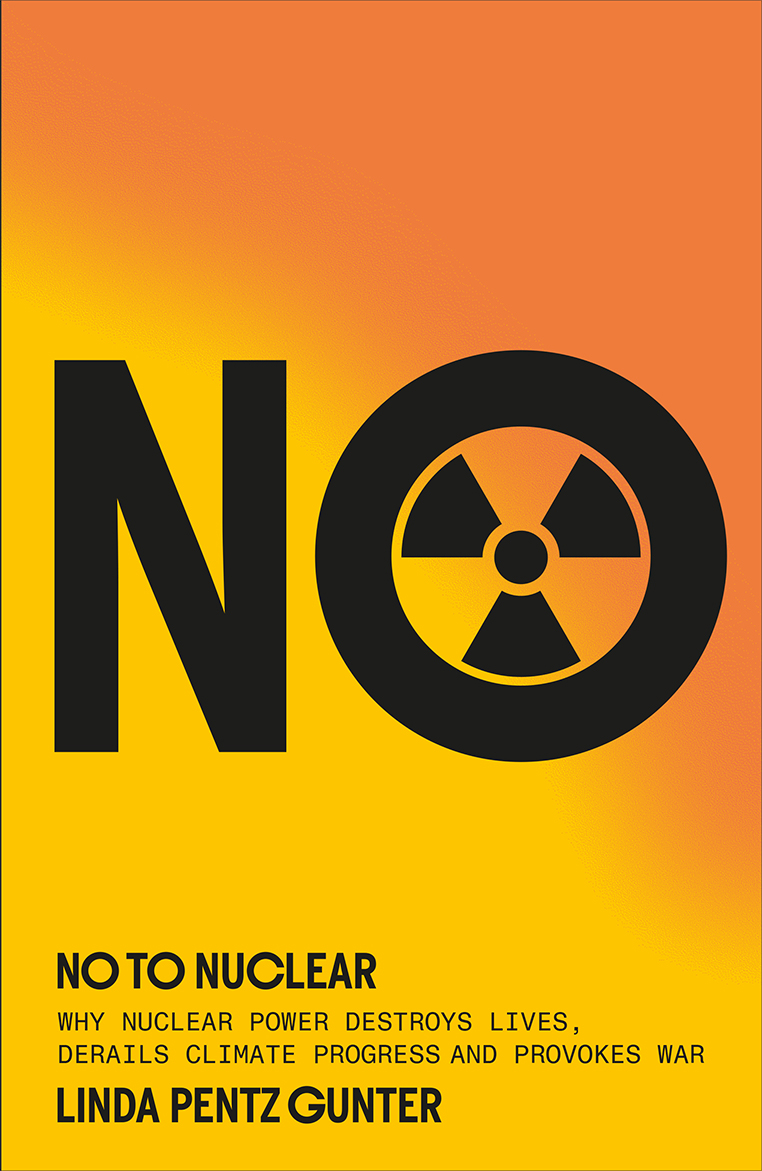
No to Nuclear: why nuclear power and nuclear weapons are interlinked threats to humanity
Our most urgent priority, therefore, must be to immediately address the climate crisis to prevent its worsening; and to push for nuclear disarmament to avoid a nuclear Armageddon. Both of these challenges are made infinitely more difficult — and I would argue impossible — to overcome due to a single major obstacle: the continued use and proposed expansion of nuclear power as an energy source.
In the first of a four-part serialisation from her new book No to Nuclear, LINDA PENTZ GUNTER outlines the case she will make against this dangerous technology.
Linda Pentz Gunter, 4 August 2026,
https://www.morningstaronline.co.uk/article/no-nuclear-why-nuclear-power-and-nuclear-weapons-are-interlinked-threats-humanity
WE FACE multiple threats to our wellbeing and survival, across all sectors of society and among many nations.
Conflict is seemingly everywhere. Working people are struggling while billionaire oligarchs control governments and are intent on destroying democracies. The plundering of our Earth for near-term profit persists, even as the science tells us it is unsustainable and will create an unlivable planet — possibly sooner than any of us imagined.
But beyond the destruction of societal welfare, rampant pollution and even wars lie two existential threats that could end life on Earth as we know it: climate change and nuclear war.
Climate change — now climate crisis — was once viewed as a creeping danger that would gradually destroy our ability to survive. Meanwhile, during the Cold War, our greatest fear was instant obliteration, the result of an all-out nuclear exchange between the world’s superpowers.
Now we must reckon with a new reality. The climate crisis we chose to ignore is upon us, causing the breakdown of essential ecosystems within the web of life much sooner and faster than we predicted.
Nine nations are in possession of nuclear weapons, leaving open the possibility of an all-out life-ending nuclear war, or even a so-called limited one. A nuclear exchange between India and Pakistan, for example, could still result in the collapse of world agriculture and the slow starvation of billions.
Our most urgent priority, therefore, must be to immediately address the climate crisis to prevent its worsening; and to push for nuclear disarmament to avoid a nuclear Armageddon. Both of these challenges are made infinitely more difficult — and I would argue impossible — to overcome due to a single major obstacle: the continued use and proposed expansion of nuclear power as an energy source.
Nuclear power has been given a free pass to date, touted as a climate solution (when, as I argue in this book, it is precisely the opposite), and as a consolation prize for countries who agree never to develop nuclear weapons (as I also argue, access to nuclear power technology only makes nuclear weapons development easier and more likely). As such, the nuclear power elephant, if not removed from the room, will sabotage our quest for survival.
In endeavoring to lay out all of the arguments against the continued use of nuclear power in this book, I seek to follow a path that diverges from the traditional and well-argued tech- nical, scientific and economic analyses. It is time to put the human face on the nuclear power story, to talk about the lives of real people — and of animals too — that have been harmed by this sector.
In doing so, I hope that readers will begin to recognize and empathize with the pain, suffering and above all injustice that has been wreaked upon our fellow human beings and all living things by a profligate industry intent on pleasing its shareholders, not on saving the planet. These corporate and invariably colonialist crimes are the same whether they are committed in the commercial nuclear sector or by the profit-hungry nuclear arms industry.
It should be noted, incidentally, that the same companies who manufacture nuclear weapons are also those who furnish conventional weapons to fuel wars and even genocides such as the one in Gaza. And, ironically, and despite their greenwashing rhetoric, all of the major nuclear power companies are also heavily invested in the continued use of fossil fuels.
I also make the argument that, far from a solution to the climate crisis, as it presents itself, the use of nuclear power can only make climate conditions worse.
The allocation of time and especially the vast funds required — tens of billions of dollars for a single reactor — toward nuclear power strips essential funds from alternatives such as renewable energy.
All the data show that dollar for dollar or pound for pound, more carbon reductions can be achieved faster by investing the same amount in renewable energy instead.
WE FACE multiple threats to our wellbeing and survival, across all sectors of society and among many nations.
Conflict is seemingly everywhere. Working people are struggling while billionaire oligarchs control governments and are intent on destroying democracies. The plundering of our Earth for near-term profit persists, even as the science tells us it is unsustainable and will create an unlivable planet — possibly sooner than any of us imagined.
But beyond the destruction of societal welfare, rampant pollution and even wars lie two existential threats that could end life on Earth as we know it: climate change and nuclear war.
Climate change — now climate crisis — was once viewed as a creeping danger that would gradually destroy our ability to survive. Meanwhile, during the Cold War, our greatest fear was instant obliteration, the result of an all-out nuclear exchange between the world’s superpowers.
Now we must reckon with a new reality. The climate crisis we chose to ignore is upon us, causing the breakdown of essential ecosystems within the web of life much sooner and faster than we predicted.
Nine nations are in possession of nuclear weapons, leaving open the possibility of an all-out life-ending nuclear war, or even a so-called limited one. A nuclear exchange between India and Pakistan, for example, could still result in the collapse of world agriculture and the slow starvation of billions.
Our most urgent priority, therefore, must be to immediately address the climate crisis to prevent its worsening; and to push for nuclear disarmament to avoid a nuclear Armageddon. Both of these challenges are made infinitely more difficult — and I would argue impossible — to overcome due to a single major obstacle: the continued use and proposed expansion of nuclear power as an energy source.
Nuclear power has been given a free pass to date, touted as a climate solution (when, as I argue in this book, it is precisely the opposite), and as a consolation prize for countries who agree never to develop nuclear weapons (as I also argue, access to nuclear power technology only makes nuclear weapons development easier and more likely). As such, the nuclear power elephant, if not removed from the room, will sabotage our quest for survival.
In endeavoring to lay out all of the arguments against the continued use of nuclear power in this book, I seek to follow a path that diverges from the traditional and well-argued tech- nical, scientific and economic analyses. It is time to put the human face on the nuclear power story, to talk about the lives of real people — and of animals too — that have been harmed by this sector.
In doing so, I hope that readers will begin to recognize and empathize with the pain, suffering and above all injustice that has been wreaked upon our fellow human beings and all living things by a profligate industry intent on pleasing its shareholders, not on saving the planet. These corporate and invariably colonialist crimes are the same whether they are committed in the commercial nuclear sector or by the profit-hungry nuclear arms industry.
It should be noted, incidentally, that the same companies who manufacture nuclear weapons are also those who furnish conventional weapons to fuel wars and even genocides such as the one in Gaza. And, ironically, and despite their greenwashing rhetoric, all of the major nuclear power companies are also heavily invested in the continued use of fossil fuels.
I also make the argument that, far from a solution to the climate crisis, as it presents itself, the use of nuclear power can only make climate conditions worse.
The allocation of time and especially the vast funds required — tens of billions of dollars for a single reactor — toward nuclear power strips essential funds from alternatives such as renewable energy.
All the data show that dollar for dollar or pound for pound, more carbon reductions can be achieved faster by investing the same amount in renewable energy instead.
Additionally, the clear pathway that a civil nuclear power programme provides to nuclear weapons development is swept under the rug or denied altogether. Both international treaties that seek to rid the world of nuclear weapons — the nuclear Non-Proliferation Treaty (NPT) and the Treaty on the Prohibition of Nuclear Weapons (TPNW) — afford countries who agree to disavow nuclear weapons “the inalienable right” to “develop research, production and use of nuclear energy for peaceful purposes.” Thus, the back door to nuclear weapons development remains perpetually open.
No to Nuclear is published by Pluto Press, £14.99. Part 2 of this serialisation will appear in tomorrow’s edition.
Walt Zlotow Understanding complexities of Ukraine war vital to achieving peace



Walt Zlotow West Suburban Peace Coalition Glen Ellyn IL, 9 Aug 26
Lidia Pilecky, in her Chicago Tribune commentary ‘Ukraine has always been here — and always will be’ is correct that Ukraine will always exist.
However, four and a half years of unnecessary war have reduced it to a rump state that is a shadow of its prewar self with little or no chance of regaining its prewar status in size, population and economy. A quarter of its prewar population is gone along with a fifth of its territory. Russian attacks on Ukraine Black Sea ports have largely shut down vital Ukraine grain exports greatly worsening Ukraine’s economic decline. Ukraine faces becoming a land locked rump state.
All this could have been avoided had Ukraine not agreed to accept US and NATO entreaties to join NATO beginning in 2008. This was a NATO encroachment too far for Russia which viewed it as an effort to isolate Russia from the European political economy and advance NATO nukes to Russia’s border. Preventing that was analogous to JFK risking nuclear war to prevent Russia from putting nukes 90 miles from America’s borders in 1962.
The Ukraine crisis worsened when the US, to further its ties with Ukraine, supported Kyiv’s coup to oust its Russian leaning president Victor Yanukovych in 2014. This precipitated a civil war with Russian leaning Ukrainians in the Russian bordering Donbas whose culture was being systematically degraded by Kyiv nationalists. Thousands were killed and Kyiv was poised to finish off the remaining Ukrainian separatists when Russia intervened February 24, 2022.
Hundreds of billions in US and NATO weaponry have not prevented Ukraine’s massive destruction and likely capitulation to a much larger, much stronger opponent. Astoundingly, the war could have been ended within the first two months had not the US and UK not intervened to prevent Ukraine President Zelensky from signing the Istanbul Accords to end the war with Russia losing no new territory. That represented a catastrophic US, NATO, Kyiv miscalculation,
Everyone seeking peace in Ukraine should sympathize with Ukrainians supporting the Ukrainian cause. But only diplomacy, not hundreds of billions in additional weaponry will bring that about. Understanding the underlying conditions that both led to the war and that can lead to a diplomatic solution are critical to ending the bloodshed and achieving peace.
The Democratic Republic of Congo is launching a probe into the contamination of cobalt with uranium.
The Democratic Republic of Congo is launching a probe into the
contamination of cobalt with uranium, as the world’s biggest producer of
the battery metal responds to concerns over how much of the radioactive
mining byproduct is being exported. Officials said they would test for
uranium in the cobalt hydroxide that is exported in huge quantities to
China and establish a working group to look into the findings of an
academic paper published in Nature Communications and a recent FT report.
FT 7th Aug 2026,
https://www.ft.com/content/7c028aa0-cb64-4f71-9605-f63b83df7af4
Sizewell C: Summary Analysis and Concerns Relating to its Platform Height and Offshore Geomorphological Change
Independent, Nick Scarr, Date Written: April 08, 2026, https://papers.ssrn.com/sol3/papers.cfm?abstract_id=6543818
Abstract
Sizewell C, at 7.3m AOD, has a proposed platform height half that of Hinkley Point C’s 14m AOD and this appears to reflect a cost imperative: ‘…it is grossly disproportionate to spend (redacted text) to increase the platform height to 8.8m AOD’.i The difference in the platform heights for Sizewell C and Hinkley C is then, profound. Why such a discrepancy?
Stop Hinkley campaigners highlight storage of nuclear waste in West Somerset
By John Thorne, Saturday 8th August 2026, https://www.wsfp.co.uk/news/stop-hinkley-campaigners-highlight-storage-of-nuclear-waste-in-west-somerset-935418
ANTI-nuclear campaigners staged a protest near the cluster of Hinkley Point power stations on the West Somerset coast on Thursday (August 6) to coincide with ‘Hiroshima Day’.
It was the 81st anniversary of the dropping of the world’s first nuclear bomb on the Japanese city in 1945. Members of the Stop Hinkley group gathered beneath the Hinkley Point sea wall to also highlight how nuclear waste would be stored on the site for centuries.
Stop Hinkley has been focussed on holding Hinkley C owner EDF to account for the protection of the public, wildlife, and the environment since the early 1980s.
The building of Hinkley C was initially blocked by Margaret Thatcher in 1984 because it was considered financially unviable.
It was eventually given the go-ahead under Theresa May’s Government in 2016.
One campaigner, Katy Attwater, from Timberscombe, said: “I have been campaigning against the building of Hinkley Point C nuclear power station since 2008 when I joined this amazing local protest group.
“We felt Thursday was an appropriate day to be reminded, given the danger of nuclear energy and its deadly by-product, highly-reactive spent fuel, which requires isolation for thousands to hundreds of thousands of years – nobody actually knows how long.
“We wished to draw attention to the danger arising from the radioactive waste that will be stored on site at Hinkley Point for at least 100 years.
“This was not envisaged at the outset, but, due to Sellafield no longer accepting high level nuclear waste and the continuing failure to find a site for a geological disposal facility (GDF), aka ‘nuclear dump’, there is nowhere for it to go.”
Ms Attwater said Hinkley C would have a scheduled refuelling outage every 12 to 24 months when about one-third of the nuclear reactor’s core 241 fuel assemblies were taken out and replaced with fresh fuel.
She said: “These assemblies, fuel rods, are so highly radioactive that they have to be stored under water for 10 years before they can be moved.
“There is currently no solution in the planning stage for where this hot and deadly substance can be taken.
“With predicted sea level rises and extreme weather events, this process will become increasingly dangerous on the low-level eroding coastline of Hinkley Point.
“We would encourage people to contact their local MPs to ask why this is being allowed to proceed, especially in the context of the obvious acceleration of climate change on our beloved planet earth.”
The Hinkley Point site houses three nuclear power stations, A, B, and C.
Hinkley A, opened in 1965 and was shut down after 35 years in 2000, and is currently being decommissioned by the Nuclear Decommissioning Authority subsidiary Magnox Ltd.
It will store intermediate level waste on site until a GDF becomes available.
The B station opened in 1976 and ceased generation in 2022 and has had its fuel removed and taken to Sellafield.
Decommissioning is expected to be approved in October this year.
Hinkley C is under construction and expected to start generating power in 2029.
Giant space radars in Pembrokeshire branded ‘instrument of evil’ as campaigners hail small victory in fight against Ministry of Defence plans

“If we put such an installation like that it makes Wales suddenly a supporter of the most provocative regime in the world at the moment. That makes enemies.”
those against it fear the US would have primary control of the dishes, helping a US-led escalation in space warfare and to turn Wales into a military target for its enemies.
The radars, which would be built by American defence company Northrop Grumman are earmarked for Cawdor Barracks, near St Davids, and are part of the AUKUS security partnership between the UK, US and Australia.
“And the argument for it bringing jobs is just ridiculous,” he added. “Because the local people won’t be involved in the operation. Jobs will be lost.”
“If we put such an installation like that it makes Wales suddenly a supporter of the most provocative regime in the world at the moment. That makes enemies.”
those against it fear the US would have primary control of the dishes, helping a US-led escalation in space warfare and to turn Wales into a military target for its enemies.
By Bronwen Weatherby, 6 Aug 2026, https://www.lbc.co.uk/article/radars-pembrokeshire-wales-campaign-5HjdfgP_2/?fbclid=IwY2xjawThW2BwZG9mAWV4dG4DYWVtAjExAHNydGMGYXBwX2lkEDIyMjAzOTE3ODgyMDA4OTIAAR4xadMM94NX9NwkoA9egZO764QyF026XrpxAGhLphH2dG6lSMLNQaypWZUNuQ_aem_AryMN-WJ0muRN-wPxngdOA
Campaigners have branded the proposed installation of twenty-seven giant space radars in Pembrokeshire “an instrument of evil”, claiming it would seriously impact the health, environment and safety of the local community.
A planning decision on the DARC – Deep Space Advanced Radar Capability – project was due to take place last week, but the Welsh Government called in the decision days before the vote – in a move that could trigger a row with Westminster over the UK’s national security.
Opponents of the radar have hailed it as a small victory in the battle against the Ministry of Defence’s (MOD) plans, as the newly elected Plaid Cymru government has been openly resistant to it.
However, the area’s Labour MP Henry Tufnell was scathing of Plaid ministers saying “their priorities are all in the wrong place”.
The radars, which would be built by American defence company Northrop Grumman are earmarked for Cawdor Barracks, near St Davids, and are part of the AUKUS security partnership between the UK, US and Australia.
Each 20-metre-high by 15-metre-wide radar dish is designed to find, track, and identify objects up to 22,000 miles out in space and once in place, the three sites – one in each nation – would connect to give a complete 360-degree, 24 hours a day view of space.
‘Desecration of the land’
Among those leading the campaign against it is Game of Thrones star Jerome Flynn who spoke to LBC, saying: “I see it as a desecration of the land.
“It’s not our airspace, it’s our beautiful coastal birds and their migratory space. And there is much evidence to show that they’re one of the biggest emitters of harmful EMFs [high-frequency ionizing radiation]
“So we need to think about human beings, including the ones that come and visit here and what it might do to the tourist industry.
“And the argument for it bringing jobs is just ridiculous,” he added. “Because the local people won’t be involved in the operation. Jobs will be lost.”
“I don’t think anybody feels like that installation is going to make us safer.
“If we put such an installation like that it makes Wales suddenly a supporter of the most provocative regime in the world at the moment. That makes enemies.”
Mr Flynn argued the radars were “antithetical” to what the St David’s peninsula represents, particularly as an important pilgrimage site.
The MOD states ‘the radio waves used by DARC are non-ionising radiation. They are not hazardous to health because they do not have enough energy to cause harmful ionisation.
‘Levels of non-ionising radiation in the area surrounding the DARC site would be less than or equal to that received from using a mobile phone, presenting no danger to members of the public in the area.’
It also argues the radar would protect satellites essential to GPS navigation, emergency communications, banking systems, weather forecasting and military operations from hostile military actions including missiles, hostile spacecrafts and blinding lasers as well as accidental hazards such as fast-moving space junk and orbital debris.
But those against it fear the US would have primary control of the dishes, helping a US-led escalation in space warfare and to turn Wales into a military target for its enemies.
Northrop Grumman’s director of space surveillance, Kevin Giammo, has previously stated that he sees DARC as a key asset in the US’s ‘Golden Dome’ initiative – a plan to create an air and missile defense shield over America.
Several of those LBC spoke with at a PARC Against DARC (Pembrokeshire Against the Radar Campaign) rally referenced Iran’s destruction of radar infrastructure in the Gulf in response to the US-Israel attacks and their fear Pembrokeshire would become a similar target.
Roy Jones, one of the group who successfully fought a similar proposal in the 1990s told LBC: “We often get accused of being NIMBY’s. Yes I feel passionate about my local landscape and my local community, but I wouldn’t want to see this thing put anywhere in Britain or anywhere in the world because it’s an instrument of evil.”
Such is the strength of feeling among some in the community that local Labour MP, Henry Tufnell, has come under personal attacks with protesters referring to him as ‘Toff-nell’, holding cut outs of his face at rallies while chanting “Where’s Toff-nell?”
In response to Plaid’s move to seize control of the planning decision, he told LBC: “How do we make sure there are good well-paid jobs, how do we make sure they go beyond the construction phase, how do we make sure we reap the benefits as a local community? Those are the right questions to be asking.
Outside his office in Haverfordwest, Mr Tufnell who has publicly advocated for the plans insisted he had been engaging with the MOD and Northrop Grumman to minimise the impact on the landscape and on health and ensure it benefits the local economy.
“Not shall we put into question our national security and hand ourselves to China and Russia on a plate and forget about our international partners. I think they’re priorities are all in the wrong place.”
Welsh Ministers are no longer able to comment on the application while the call-in process is active but a statement provided by some Plaid backbenchers said: “We do not support the construction of the DARC radar array and have been consistent in expressing our serious concerns about the impact of this project on Pembrokeshire’s landscape, tourism economy, and public health – none of which have been adequately assessed.
“The scale of opposition also makes it clear that many residents reject this proposal and the lack of transparency surrounding it.”
An MoD spokesman said: “The programme has worked with Pembrokeshire County Council to develop the planning application in accordance with applicable regulations in addition to Welsh national requirements. This will continue to be the case as the application is now considered by Welsh Ministers.”
Northrop Grumman and Montagu Evans, the planning agent for the project, were contacted for comment.
1 This Month





PLEASE OPPOSE HR 8255 AND S.3639 – bills would accelerate satellite deployment, with no environmental review or safeguards – https://ncstd5li.quorum.us/campaign/169331/
To see nuclear-related stories in greater depth and intensity – go to https://nuclearinformation.wordpress.com
-
Archives
- October 2026 (81)
- September 2026 (339)
- August 2026 (330)
- July 2026 (355)
- June 2026 (287)
- May 2026 (306)
- April 2026 (356)
- March 2026 (251)
- February 2026 (267)
- January 2026 (308)
- December 2025 (358)
- November 2025 (359)
-
Categories
- 1
- 1 NUCLEAR ISSUES
- business and costs
- climate change
- culture and arts
- ENERGY
- environment
- health
- history
- indigenous issues
- Legal
- marketing of nuclear
- media
- opposition to nuclear
- PERSONAL STORIES
- politics
- politics international
- Religion and ethics
- safety
- secrets,lies and civil liberties
- spinbuster
- technology
- Uranium
- wastes
- weapons and war
- Women
- 2 WORLD
- ACTION
- AFRICA
- Atrocities
- AUSTRALIA
- Christina's notes
- Christina's themes
- culture and arts
- Events
- Fuk 2022
- Fuk 2023
- Fukushima 2017
- Fukushima 2018
- fukushima 2019
- Fukushima 2020
- Fukushima 2021
- general
- global warming
- Humour (God we need it)
- Nuclear
- RARE EARTHS
- Reference
- resources – print
- Resources -audiovicual
- Weekly Newsletter
- World
- World Nuclear
- YouTube
-
RSS
Entries RSS
Comments RSS

