Many nuclear plants in earthquake zones: scientists underestimated risks
 scientists sometimes have underestimated how powerful quakes can be. The temblor that struck Japan was more than 10 times bigger than the Daiichi plant had been tested to withstand. In 2007, the world’s biggest nuclear plant, Japan’s Kashiwazaki-Kariwa, was damaged after it was hit by a quake far stronger than its designers anticipated.
Dozens of Reactors in Quake Zones, WSJ.com, 18 March 11, Japan, Taiwan Account for Most Sites in High-Activity Areas; ‘Large Margins of Safety’ Factored In at U.S. Plants By MAURICE TAMMAN, BEN CASSELMAN and PAUL MOZUR Dozens of nuclear reactors operate in earthquake-prone regions around the world, including at least 14 in high-hazard areas, a Wall Street Journal analysis shows. Continue reading
Five close shaves at USA nuclear reactor cores
Nuclear safety: Five recent ‘near miss’ incidents at US nuclear power plants, Christian Science Monitor, 18 March 11, Fourteen safety-related events at nuclear power plants required follow-up inspections from the Nuclear Regulatory Commission, the NRC reported in 2010. These “near-miss” events “raised the risk of damage to the reactor core – and thus to the safety of workers and the public,” concluded a new report, “The NRC and Nuclear Power Plant Safety in 2010,” by the Union of Concerned Scientists. Here are five of these 14 “near miss” examples:……
Potential for disaster in USA’s nuclear reactors and cooling systems
It would not even require a quake or tsunami, only a moderately ingenious terrorist, to breach Shearon Harris’s puny defences and sabotage the cooling systems. A study by the Brookhaven Labs estimates that a pool fire there could cause 140,000 cancers, and contaminate thousands of square miles of land.
Another Fukushima meltdown? In America? Not if, but when | The First Post, Alexander Cockburn, 18 March 11, “…….. President Obama for example, who took plenty of money from this industry for his presidential campaign and used his State of the Union address last January to reaffirm his commitment to “clean, safe” nuclear power. This week, Obama’s press spokesman confirmed that nuclear energy “remains a part of the President’s overall energy plan”. Continue reading
In nuclear accident, evacuation from Indian Point area would be impossible
Citing plants like the Indian Point nuclear site north of New York City, Mr. Lyman, a physicist and member of the Institute of Nuclear Materials Management, called it “utterly unrealistic” to expect that an effective evacuation could be undertaken should a disaster like the earthquake and tsunami that hit Japan last week occur in this country.
Citing Near Misses, Report Faults Both Nuclear Regulators and Operators, – NYTimes.com,By TOM ZELLER JR. March 17, 2011,The Nuclear Regulatory Commission, which oversees the nuclear power industry in the United States, came under fire from critics on Thursday for recommending that Americans in Japan remain at least 50 miles away from the ailing Fukushima Daiichi nuclear power plant there. Continue reading
Earthquake risks for USA nuclear plants
The Uniform California Earthquake Rupture Forecast figures the probability of an earthquake of 6.7 magnitude or higher is 67 per cent for Los Angeles, 63 per cent for San Francisco.
Another Fukushima? In America? Not if, but when, Alexander Cockburn on the shameful trade-off that keeps nuclear power on the agenda MARCH 17, 2011
Along much of California’s coastline runs the Ring of Fire which stretches round the Pacific plate from Australia, north past Japan, to Russia, round to Alaska, and down America’s west coast to Chile. Ninety per cent of the world’s earthquakes happen round the Ring.
The late great environmentalist David Brower used to tell audiences solemnly, “Nuclear plants are incredibly complex technological devices for locating earthquake faults.”
Apparently acting on this piece of sarcastic wisdom, the US has deployed four nuclear plants near the Ring of Fire faultline, including two active ones in my home state of California.
Forty miles up the road from me, in far northern California we had a boiling water reactor, closed in 1976 because – surprise! – there was an earthquake from a “previously unknown fault” just off the coast. Now all we have are spent nuclear fuel rods in ponds, right on the shoreline, a few feet above sea level, nicely situated for a tsunami, such as the one that disabled the relief diesel generators designed to pump emergency coolant in the Fukushima plant. Three plates meet a few miles west of where I write. We had a 7.1 earthquake in 1992. First moral in the nuclear business: Expect the unexpected.
Further south, halfway between San Francisco and Los Angeles, is the Diablo Canyon nuclear plant, planned in 1968 when no one knew about the Hosgri fault, part of the Ring of Fire, a few miles offshore. See moral number one.
Further inquiry established that there’d been a 7.1 earthquake 40 years earlier, offshore from the plant, completed in 1973. The power company – Pacific Gas and Electric – said it would beef up defences. In their haste, the site managers managed to reverse the blueprints for the new earthquake-proofing of the two reactors, and so the retro-fit wasn’t a total success. Second moral in the nuclear business: people do mess up.
Back to the first moral: they recently discovered yet another fault and are now worried about “ground liquefaction” in the event of a big quake. In 2008 there was a terrorist attack by jellyfish which blocked the cold water intake, and the plant was shut down for a couple of days…….
The Uniform California Earthquake Rupture Forecast figures the probability of an earthquake of 6.7 magnitude or higher is 67 per cent for Los Angeles, 63 per cent for San Francisco. Up where I live, in the Cascadia subduction zone, we have a 10 per cent possibility of an 8.0 or 9.0 force quake….
Nuclear reactors at San Onofre and Diablo Canyon not designed to withstand earthquakes
VIDEO YouTube – Chernobyl Winds Over America Chernobyl Winds Over America. AceHoffman, 15 March 11, Had the massive 8.9 Richter-scale earthquake that has just savaged Japan hit off the California coast, it could have ripped apart at least four coastal reactors and sent a lethal cloud of radiation across the entire United States. (http://nukefree.org/ace-hoffman-computerized-graphic-what-if-chernobyl-h… )
The two huge reactors each at San Onofre and Diablo Canyon are not designed to withstand such powerful shocks. All four are extremely close to major faults.
All four reactors are located relatively low to the coast. They are vulnerable to tsunamis like those now expected to hit as many as fifty countries. YouTube – Chernobyl Winds Over America

USA nuclear facilities in earthquake zones
Plutonium from spent nuclear fuel rods pouring into the sky
 plutonium scattered into the atmosphere is even more dangerous that the combustion products of rods without plutonium,
 Alert, Fushima coverup: forty years of spent nuclear fuel rods blown sky high, PrisonPlanet TV, Paul Joseph Watson and Kurt Nimmo March 15, 2011 Infowars analysis: In addition to under reporting the fires at Fukushima, the Japanese government has not told the people about the ominous fact that the nuclear plant site is a hellish repository where a staggering number of spent fuel rods have accumulated for 40 years. Continue reading
China halting new nuclear plants
China suspends approvals for new nuclear plants, Xinhua, March 16, 2011
China has suspended the approval process for nuclear power stations so that safety standards can be revised after explosions at a Japanese plant, according to Wednesday’s executive meeting of the State Council, or the Cabinet. Continue reading
Dangerous radioactivity released from damaged plant, says IAEA
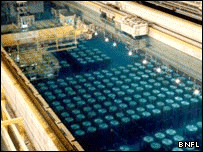 Japanese authorities also today informed the IAEA at 04:50 CET that the spent fuel storage pond at the Unit 4 reactor of the Fukushima Daiichi nuclear power plant is on fire and radioactivity is being released directly into the atmosphere.
 Japanese Earthquake Update, International Atomic Energy Agency, 15 March 2011 Japanese authorities informed the IAEA that there has been an explosion at the Unit 2 reactor at the Fukushima Daiichi plant. Continue reading
Scramble to prevent nuclear meltdowns in 3 Japanese reactors
Authorities are now scrambling to prevent meltdowns in three of the plant’s four nuclear reactors…..
Third blast at Japanese nuclear plant, ABC Radio, The World Today with Eleanor Hall, Hayden Cooper, 15 March 11-– This morning, there’s been another explosion at the Fukushima nuclear plant, which was badly damaged in last Friday’s powerful earthquake and tsunami. Continue reading
Dangerous radiation levels from TEPCO’s no 2 nuclear reactor
With radiation levels around the facility up, TEPCO suspects the core of the No.2 reactor has partially melted, a critical nuclear safety situation..
 Stay indoors: Japanese PM’s order to residents beyond nuclear reactor evacuation zone after blast, Sydney Morning Herald, Glenda Kwek, March 15, 2011
Radiation levels near a quake-stricken nuclear plant are now harmful to human health, Japan’s government says after explosions and a fire at the facility. Continue reading
Nuclear plants likely to be shut in Germany, cancelled in Switzerland
Germany May Shut Nuclear Plants
WSJ, 14 March, By ANDREAS KISSLER And JAN HROMADKO
FRANKFURT—German Foreign Minister and Vice-Chancellor Guido Westerwelle said Monday that individual nuclear power plants could be shut down on safety grounds after accidents at Japanese reactors that followed a devastating earthquake and subsequent tsunami Friday.
If German reactors were found to have inadequate cooling systems the facilities need to be shut down and upgraded, Mr. Westerwelle told reporters at a press conference in Berlin.
His statement came as Switzerland suspended plans for new nuclear plants, pending a review of the emergency in Japan………http://online.wsj.com/article/SB10001424052748704893604576200122562101848.html
Possible meltdown of fuel rods inside the Fukushima Daiichi complex’s No.2 reactor
Water level near empty at Japan nuclear reactor
Reuters 03/14/2011 Water levels inside a quake-stricken Japanese nuclear reactor were almost empty on Monday night, said the power plant’s operator, Tokyo Electric Power Co. The Yomiuri newspaper was reporting that the cooling system at the reactor has stopped, and additional reports said fuel rods were exposed.
News agency Jiji said a meltdown of fuel rods inside the Fukushima Daiichi complex’s No.2 reactor could not be ruled out.
Nuclear crisis continues in Japan
there has been no word so far on the spent fuel at the site which would be kept in pools at the reactor. Any breakdown in the cooling system could cause the spent fuel to melt, with the risk of a significant release of radioactivity.
There is widespread uneasiness despite the reassuring noises coming from the authorities over the situation, in part because of the industry’s history of ignoring warnings and covering up safety problems.
Japan earthquake: the nuclear crisis is not over yet. guardian.co.uk, Julian Borger5, 13 March 11, Japan says disaster has been averted at the Fukushima nuclear plant but serious questions remain. Continue reading
1 This Month



19 November – Webinar – The Reality of Reprocessing
Time: 11:00 AM Pacific Time (US & Canada) / 2:00 PM Eastern / 7:00 PM UK / 8:00 PM CET
Register for the Zoom Event Here



Shut down the radiation-damaged Heysham nuclear reactors now
To see nuclear-related stories in greater depth and intensity – go to https://nuclearinformation.wordpress.com

Say No to NASA’s Reckless Nuclear Reactor on the Moon
Say No to NASA’s Reckless Nuclear Reactor on the Moon
-
Archives
- November 2026 (84)
- October 2026 (302)
- September 2026 (339)
- August 2026 (330)
- July 2026 (355)
- June 2026 (287)
- May 2026 (306)
- April 2026 (356)
- March 2026 (251)
- February 2026 (267)
- January 2026 (308)
- December 2025 (358)
-
Categories
- 1
- 1 NUCLEAR ISSUES
- business and costs
- climate change
- culture and arts
- ENERGY
- environment
- health
- history
- indigenous issues
- Legal
- marketing of nuclear
- media
- opposition to nuclear
- PERSONAL STORIES
- politics
- politics international
- Religion and ethics
- safety
- secrets,lies and civil liberties
- spinbuster
- technology
- Uranium
- wastes
- weapons and war
- Women
- 2 WORLD
- ACTION
- AFRICA
- Atrocities
- AUSTRALIA
- Christina's notes
- Christina's themes
- culture and arts
- Events
- Fuk 2022
- Fuk 2023
- Fukushima 2017
- Fukushima 2018
- fukushima 2019
- Fukushima 2020
- Fukushima 2021
- general
- global warming
- Humour (God we need it)
- Nuclear
- RARE EARTHS
- Reference
- resources – print
- Resources -audiovicual
- Weekly Newsletter
- World
- World Nuclear
- YouTube
-
RSS
Entries RSS
Comments RSS

