The Ukraine Delusion

Israel is a part of the Ukraine-Russia war story in other very important ways, some of which now look decidedly self-defeating for Ukraine and Zelensky.
Nate Bear, Aug 07, 2026, https://www.donotpanic.news/p/the-ukraine-delusion
I’ve held back on writing about the Russia-Ukraine war, and this article probably won’t win me many fans. But for better or worse, I always try to tell it how I, at least, see it. And I’m tired. Tired of the liberal delusion, the hypocrisy, the childish analysis, and outright bloodthirstiness over Ukraine.
I’m tired of the pretence that a proxy war which has now lasted longer that the first world war is a righteous battle against evil for the soul of the world.
I’m tired of the fact that wanting an end to a war which has killed hundreds of thousands of young men, and thousands of civilians, is seen by some as an outrageous, morally deplorable position.
I’m tired of the fact that rational analysis and context is so often labelled as pro-Putin apologia, and how it is almost impossible to get good information on the war that isn’t polluted by an anti-Russia agenda. And even good information and analysis which recognises that Russia isn’t losing, that Ukraine is suffering, still too often suggests that the west must wage this war for many more years. This otherwise rational analysis, while detailing all the ways in which Ukraine is definitely not winning the war, nevertheless concludes that it must be fought for many more years to avoid “a bad peace.”
Time and again we see the same conclusion. That to give Russia what it wants, namely Crimea, the four annexed oblasts and a neutral Ukraine, would be a “bad peace” that rewards aggression. But few politicians or journalists when selling this story ever spell out explicitly what a “good peace” is and what it would require. But we don’t have to guess. Zelensky has on many occasions. And he has maintained the only way the war can end is if Russia returns to Ukraine not just the four oblasts annexed in 2022, but also Crimea, and he also wants security guarantees which would amount to the effective integration of Ukraine into NATO.
This is a delusional position that guarantees never peace and a forever war. And forever war isn’t an abstract. It means forever death. Forever destruction. It means European societies becoming securitised and militarised, with the Russian foe a ready-made excuse for a Palantir-powered surveillance state. And this position rests atop a childish assertion repeated ad nauseum that grants the war its legitimacy: that Russia’s invasion of Ukraine was “unprovoked.”
Nothing is ever unprovoked. You can agree or disagree with whether the provocation warranted the reaction. But unprovoked is not an analysis, it is an emotional appeal, and in the case of Russia-Ukraine, it is propaganda designed to obscure the long history which led to Russia’s invasion.
It is, in many ways, not dissimilar to the propaganda that October 7th was an unprovoked attack on Israel. Or that Pearl Harbour was an unprovoked attack on the United States.
Narratives which strip out cause and effect and proclaim that a bad thing just happened without any preceding events, that good people were then drawn reluctantly into war to defend themselves against bad people, is the oldest trick in the war propaganda book designed to shut down critical intellectual inquiry.
So, briefly (for more detail read this by John Mearsheimer), the events preceding Russia’s invasion of Ukraine include a 1990 promise made by the US Secretary of State James Baker that if post-Soviet Russia allowed a unified Germany to remained in NATO, “NATO would not shift one inch eastward.” It was a promise made with an understanding that Russia was a legitimate country with legitimate security interests. That promise of course was repeatedly broken until NATO stretched to Russia’s borders. The preceding events also include the NATO-backed remilitarisation of Ukraine following the ousting of Victor Yanukovych in 2014, the Russian annexation of Crimea in response and Ukraine’s bombing of the Donbass which killed hundreds of Russian-speaking Ukrainians. It includes an acute understanding among the Russian leadership that Napoleonic France, imperial Germany, and Nazi Germany all crossed Ukraine to invade Russia itself.
You don’t have to think that Russia was right to invade Ukraine to try and understand why it invaded Ukraine, a consideration we are never prompted to investigate in a discourse dominated by normative moral judgements viewed exclusively through the lens of western imperialism. The shape of post-2014 Ukraine made Russia fearful that the country could once again be the launchpad for an invasion. And it wasn’t as if Putin hid this fact. He repeatedly warned, into late 2021 and early 2022, that the further militarisation of Ukraine was a red line and if Ukraine and the west refused diplomacy, Russia would act. He hadn’t been that bothered about Ukraine before 2014, there was no war talk, because it wasn’t the threat then that he perceived it became.
Again, this is not a defence of Putin, it is a question of cause and effect, and of the western arrogance and hubris that believes only its red lines on geostrategic issues are valid. Would the US have allowed a military alliance led by China to be built up through South America, reaching Mexico without a response? Would western media have dismissed American concerns about Chinese militarism as paranoid nonsense if Chinese military bases were dotted throughout South America? Of course not! The media would have demanded war and sold us war. But when the roles are reversed, American militarism becomes mere Russian paranoia.
And now the war that NATO expansionism threatened is not just here but is in danger of become a permanent fixture of our lives, with European economies embracing the bloodshed and building war economies. And to build these war economies, the liberal class is demanding more cuts to a welfare state already decimated, in many places, by two decades of austerity. This week the Financial Times ran this article, demonstrating the brazenness with which anti-working class, hyper-capitalist, hyper-imperialist prescriptions are now presented as sensible opinion.
A “warfare state” all to fight a mythical Russia that, as Mearsheimer laid out in this video, didn’t invade Ukraine with anything like a force sufficient to conquer the country, but as a final gambit to force Ukraine to the negotiating table. Of course it failed. The liberal media and political class, however, continue to insist that Russia’s goal is full conquest, with more to follow, in order to legitimise the creation of war economies. That the liberal class would build a warfare state that decimates the welfare state to confront Russia, rather than seek diplomacy and partnership with a country which is home to huge volumes of minerals needed to build, for example, a cleaner energy system, is a demonstration of utter failure.
And who would these “warfare state” economies be powered by? In part, Israel, which has agreed a $4 billion deal with Greece to supply an air defence system, supplied a similar system to Germany for the same price last year, and handed over a half billion dollar missile system to Slovakia.
Israel is a part of the Ukraine-Russia war story in other very important ways, some of which now look decidedly self-defeating for Ukraine and Zelensky.
When the Iran war started, Zelensky enthusiastically embraced it and regurgitated all the classics, saying that the US-Israeli assault was a good thing because it would “rid the Iranian people of a terrorist regime.” In March, with the war on Iran raging, he urged Netanyahu to work with him, saying “he has what I need and I have what he needs.” But now Ukraine is out of interceptor missiles because they’ve all been used in the war on Iran, with Kiev defenceless against Russian missile attacks. Yesterday, every missile launched at Kiev hit its target, with zero interceptors launched. And now, after embracing the war on Iran, Zelensky is complaining about the lack of interceptors, a direct consequence of the war he supported. He hitched himself to empire, yet because of the over-stretching imperial adventurism he himself relies on, that empire has found itself unable to defend his country. It reveals a man who has no plan, beyond hoping that the weapons keep flowing.
Liberals appear reluctant to make the connection between the two imperial wars, preferring the dissonance that comes with an empire state of mind.
This dissonance has also been on display elsewhere, with pro-Ukraine war influencers demanding the west sends more weapons to Ukraine and incredulous at North Korea sending weapons to Russia, seemingly unable to follow their own logic on third-party countries sending weapons to principal conflict belligerents. Empire brains blinded to their own raging hypocrisy.
But as I’m writing, I can hear a criticism, and can even form one against myself. Why, Nate, when you are so morally strident on Israel and Palestine, are you decrying “normative moral judgements” on Ukraine and Russia?
Because the two situations could not be more different.
Ukraine is a state with a standing army supported by empire fighting another state with a standing army. Palestine has been denied statehood despite the 1947 UN two-state partition agreement (putting aside whatever one thinks about the legitimacy of that agreement), has no standing army to defend itself and Palestinians are fighting a colonial occupation armed by empire. If anything, Ukraine is far more similar to Israel than it is to Palestine. Indeed, in 2024 Zelensky proclaimed Israel as the ideal model for Ukraine, saying he wanted Ukraine to be a “big Israel.”
Both Ukraine and Israel are proxies at the tip of the imperial spear, one in Europe and one in the Middle East. You don’t have to be the invader to be a tool of imperialism. Sometimes being the invaded is more useful as it imparts a moral surety that helps shield your imperial role from critical analysis. I would argue this is exactly what has happened in the case of Ukraine.
None of this is to say I don’t have sympathy with ordinary Ukrainians. I do. I think they’ve been sold down the river, by both Europe and their own leaders, and have been coerced into fighting a war a majority now want to end with negotiations. The average Ukrainian is quite different to the average genocide-supporting Israeli who upholds apartheid.
Yet despite the wishes of a majority of Ukrainians, Europe and Zelensky refuse diplomacy and continue to fight, incurring enormous costs on Ukraine and ordinary Ukrainians. Of course, enormous costs are being inflicted on Russia too, but these costs have not been, and will not be sufficient for a “good peace.” And any costs that would really bite risk an uncontrolled, catastrophic escalation.
The final irony is that despite the war being marketed to westerners as totalitarianism versus democracy, Ukrainians can’t even elect a leader who would enact their wish to see a negotiated end to the war since Zelensky, whose term officially expired in 2024, introduced martial law and cancelled elections.
So, as I said, for better or worse, this is my perspective on Russia-Ukraine.
A war which advances only imperialist interests, interests which run counter to European security and prosperity. A war which threatens, at worst, to go nuclear. A war which wasn’t unprovoked. A war which, with their minds empty and hearts lacking true solidarity, consciousness or justice, has become a necessary intellectual organising principle for the liberal media and political class.
I’ve probably not made many fans, but I’d be delighted if I have.
Trump’s nuclear deal: a disaster for the Middle East?
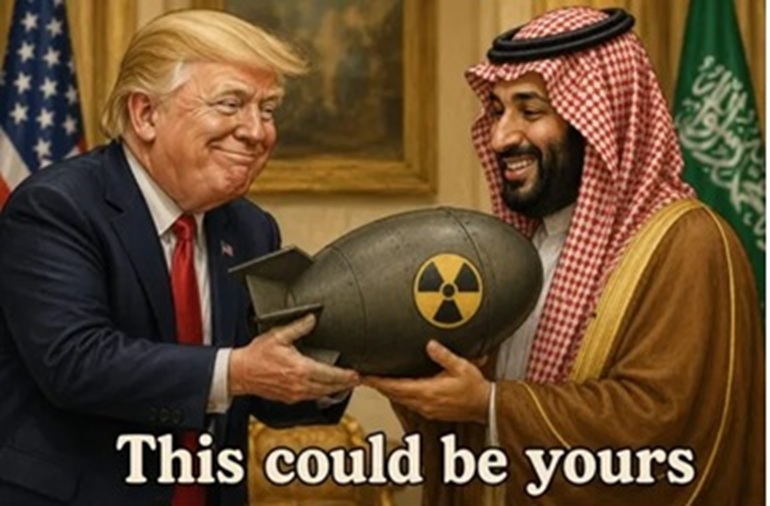
No, the real reason is to gain atomic weapons to protect itself against its main foe: Iran. MbS has made no secret of his desire to build a bomb, and the deal would be a concrete step in that direction. Despite Trump’s claims to the contrary, it appears to permit nuclear enrichment on Saudi soil, thus enabling Riyadh to follow the likes of India, Israel and Pakistan in covertly enriching uranium to weapons-grade level
The hard truth is that the “era of non-proliferation is coming to an end”
Well, is it on or is it off? No one’s quite sure, said Al Jazeera (Doha). Two weeks ago, the United States and Saudi Arabia signed a multibillion-dollar deal allowing US companies to build and operate nuclear power plants on Saudi soil over the next 30 years.
But a day later, President Trump added a new condition, via social media: Saudi Arabia must fall in line with the UAE and other Arab nations that have signed the Abraham Accords, and recognise the state of Israel.
‘Reckless’ agreement
And that may prove a deal breaker, said David Frum in The Atlantic. Riyadh had been working towards this landmark pact for almost two decades. Thanks to the savvy of its de facto leader Crown Prince Mohammed bin Salman (MbS), who ensured the private equity firm of Trump’s son-in-law, Jared Kushner, would get its share of the billion-dollar nuclear licensing deals at stake, he almost got it over the line.
But now it must surely be in doubt, said Mohamad Elmasry on Middle East Eye. Riyadh has vowed it won’t normalise relations until Israel guarantees Palestinian statehood. And MbS has reportedly told US officials that hostility towards Israel is so great among Saudis in the wake of Israel’s devastating war in Gaza, that to sign a normalisation treaty would probably get him assassinated.
It’s obvious why the Saudis still badly want this nuclear deal, said Joseph Cirincione on MS Now (New York). It’s not, as they claim, to diversify their energy profile: that makes no sense for a nation sitting on an ocean of oil and blessed with the ideal wind and solar conditions for generating renewable energy – a far cheaper option.
No, the real reason is to gain atomic weapons to protect itself against its main foe: Iran. MbS has made no secret of his desire to build a bomb, and the deal would be a concrete step in that direction. Despite Trump’s claims to the contrary, it appears to permit nuclear enrichment on Saudi soil, thus enabling Riyadh to follow the likes of India, Israel and Pakistan in covertly enriching uranium to weapons-grade levels.
‘Guiding hand’
Who knows what’ll happen if this “reckless” deal goes ahead, said Mitchell Plitnick on Mondoweiss (New York). The “gold standard” nuclear-power pact that the US signed with the United Arab Emirates in 2009 required the UAE to forego the ability to enrich uranium, and obliged it to submit to International Atomic Energy Agency inspections: this Saudi deal has no such restrictions.
Which is why it would inevitably trigger a Middle East arms race, said Azriel Bermant in Foreign Policy. If the deal proceeds, Iran would openly seek its own nuclear deterrent, something it has so far officially forsworn. “It beggars belief that the US went to war against Iran to prevent it from acquiring a nuclear weapon yet now acts in a way that is an open invitation for Tehran to weaponise.” And in a way that would also pour “proliferation kerosene” on Turkey and Egypt’s “smouldering nuclear ambitions”, said Matthew Kroenig and Henry Sokolski in The Wall Street Journal. Trump’s deal invites disaster.
Actually, the US is doing the right thing, said the Washington Examiner. The hard truth is that the “era of non-proliferation is coming to an end”: Pakistan and North Korea are both testing nuclear weapons. Given that sobering reality, better the US offer “a guiding hand” to the Saudis and oversee their nuclear agenda than let China or Russia fill the void.
Good or bad, the deal matters a lot to the US president, said Sharon Squassoni in The Bulletin of the Atomic Scientists (Chicago), so rumours of its death “are premature”. After all, it’s not some “spur-of-the-moment fantasy” cooked up by Trump. The same deal was also being considered under Joe Biden, and then too enrichment was a quid pro quo for recognising Israel.
The Saudis won’t do so, of course, given recent history, but they won’t have to. Although Congress can disapprove the deal once it’s submitted, the present Congress – due to adjourn on 18 December – is much less likely to do so than any freshly elected one. So the Saudis can “call Trump’s bluff by simply sitting back” and waiting for him to succumb to the pressure of the December deadline.
Walt Zlotow Understanding complexities of Ukraine war vital to achieving peace

Walt Zlotow West Suburban Peace Coalition Glen Ellyn IL, 9 Aug 26
Lidia Pilecky, in her Chicago Tribune commentary ‘Ukraine has always been here — and always will be’ is correct that Ukraine will always exist.
However, four and a half years of unnecessary war have reduced it to a rump state that is a shadow of its prewar self with little or no chance of regaining its prewar status in size, population and economy. A quarter of its prewar population is gone along with a fifth of its territory. Russian attacks on Ukraine Black Sea ports have largely shut down vital Ukraine grain exports greatly worsening Ukraine’s economic decline. Ukraine faces becoming a land locked rump state.
All this could have been avoided had Ukraine not agreed to accept US and NATO entreaties to join NATO beginning in 2008. This was a NATO encroachment too far for Russia which viewed it as an effort to isolate Russia from the European political economy and advance NATO nukes to Russia’s border. Preventing that was analogous to JFK risking nuclear war to prevent Russia from putting nukes 90 miles from America’s borders in 1962.
The Ukraine crisis worsened when the US, to further its ties with Ukraine, supported Kyiv’s coup to oust its Russian leaning president Victor Yanukovych in 2014. This precipitated a civil war with Russian leaning Ukrainians in the Russian bordering Donbas whose culture was being systematically degraded by Kyiv nationalists. Thousands were killed and Kyiv was poised to finish off the remaining Ukrainian separatists when Russia intervened February 24, 2022.
Hundreds of billions in US and NATO weaponry have not prevented Ukraine’s massive destruction and likely capitulation to a much larger, much stronger opponent. Astoundingly, the war could have been ended within the first two months had not the US and UK not intervened to prevent Ukraine President Zelensky from signing the Istanbul Accords to end the war with Russia losing no new territory. That represented a catastrophic US, NATO, Kyiv miscalculation,
Everyone seeking peace in Ukraine should sympathize with Ukrainians supporting the Ukrainian cause. But only diplomacy, not hundreds of billions in additional weaponry will bring that about. Understanding the underlying conditions that both led to the war and that can lead to a diplomatic solution are critical to ending the bloodshed and achieving peace.
CIA Assessment Details Israel’s Race to Make the U.S.-Israel Alliance Irreversible
The intelligence assessment says Israeli officials are pursuing a long-term strategy to make the alliance harder for future administrations to scale back.
Aída Chávez, Jul 30, 2026, https://capitalandempire.com/p/exclusive-cia-assessment-israel-us-support
Israeli officials know they’re losing the American public. Panicked that America’s political consensus on Israel is collapsing, they’re pursuing a long-term strategy to permanently enmesh Israel within America’s military, intelligence, and defense establishment – in ways future administrations would struggle to unwind – according to a new confidential U.S. intelligence assessment.
Israeli officials believe the political fight over Israel in the United States is becoming harder to win, and that the era of indefinitely securing billions of dollars in annual military aid is coming to an end, according to the assessment, which was described to Capital & Empire by several U.S. officials. Instead of relying on direct U.S. military aid – an increasingly visible and politically contentious form of support – Israel is racing to embed itself more deeply in America’s military, intelligence, and national security apparatus in ways designed to outlast future administrations.
The assessment, written primarily by the CIA and circulated this week, describes discussions about expanding intelligence cooperation and the possibility of hosting a permanent U.S. military base on Israeli territory. It also says Israeli officials have been cultivating prominent figures in the American technology sector to build long-term political and financial support for the strategy. The assessment does not identify those individuals by name.
Congress has already begun advancing elements of Israel’s strategy. Last week, the House quietly approved Section 219 of the National Defense Authorization Act, establishing a permanent U.S.-Israel Defense Technology Cooperation Initiative within the Pentagon. The House version establishes a Pentagon executive agent charged with coordinating bilateral defense research, development, industrial cooperation, and technology integration.
Six Democrats – Reps. Henry Cuellar, Don Davis, Jared Golden, Vicente Gonzalez, Adam Gray, and Marie Gluesenkamp Perez – joined Republicans in voting to pass the defense authorization bill. The measure now heads to the Senate, which is expected to consider its own version of the NDAA before lawmakers from both chambers negotiate a final compromise bill for President Donald Trump’s signature.
Rep. Thomas Massie, R-Ky., who led an effort to strip Section 219 from the $1.15 trillion Pentagon budget, called the provision “a betrayal of our sovereignty.” Rep. Alexandria Ocasio-Cortez, D-N.Y., similarly described the proposal as “an existential threat to American sovereignty and democracy.”
Earlier this year, Israeli Prime Minister Benjamin Netanyahu floated phasing out direct U.S. military aid altogether. Most mainstream news coverage framed the proposed shift as a reflection of Israel’s growing economic and military strength, or self-sufficiency. But according to the assessment, the CIA views the strategy differently. The spy agency believes that Israel is seeking to insulate the U.S.-Israel alliance from America’s changing political landscape by replacing highly visible foreign aid with deeper, longer-lasting forms of military and industrial integration.
From Israel’s perspective, embedding the alliance more deeply within the U.S. national security apparatus would make it far more difficult for future administrations to pressure Israel by slowing or withholding arms transfers.
The strategy goes beyond intelligence sharing and military aid. Israeli officials also want Israeli technology, intelligence capabilities, and jointly developed weapons systems embedded in the U.S. military itself, making American defense increasingly reliant on Israeli systems. The assessment says Israeli officials have discussed positioning Israel in Washington as a uniquely indispensable technological and intelligence partner, pointing to language in the 2026 National Defense Strategy describing Israel as a “model ally” whose relationship with the United States is mutually beneficial.
Since the start of Israel’s genocide in Gaza, American public opinion toward Israel has deteriorated sharply. About 60 percent of U.S. adults now hold an unfavorable view of Israel, up from 53 percent a year ago, according to an April Pew Research Center survey. Among both Democrats and Republicans under 50, majorities now view both Israel and Netanyahu negatively.
As Gaza has become a defining issue in Democratic politics, the Democratic Socialists of America has surged in membership and electoral success behind campaigns centered on opposition to Israel. A generation ago, public support for Palestine could end a career. Today, a Canary Mission profile may be a stepping stone to Congress. The CIA knows Israel is nervous.
How Trump’s Saudi deal could spark a nuclear arms race in the Middle East

Riyadh has previously said it will only seek to acquire a nuclear weapon if its rival Iran develops one. With Trump’s war failing to curb Tehran’s nuclear programme, experts tell Suha Kidwai the new agreement could plunge the region into further instability
In 2018, Mohammad bin Salman was asked whether Saudi Arabia would ever develop a nuclear weapon.
“We do not want to develop a nuclear bomb. But without doubt, if Iran developed one we would follow suit as soon as possible,” he told CBS, in an interview that sparked alarm across the Middle East.
Eight years later, Saudi Arabia announced a historic deal with President Donald Trump to use American technology and expertise to develop a civilian nuclear programme.
It arrived five months after Washington and Israel began a military campaign against Iran, with the stated aim of destroying any chance of Tehran developing a nuclear bomb.
More than a week after announcing the deal though, its future is uncertain with Trump declaring that Saudi Arabia must recognise Israel in return.
An expert told The Independent that the agreement sets a “dangerous precedent” in the Middle East and may potentially set off a nuclear arms race in any already volatile region.
What does the deal involve?
The agreement allows for American companies to develop and operate commercial nuclear power plants on Saudi soil, and potentially includes grounds for a uranium-enrichment facility.
For Saudi Arabia, the agreement follows two decades of stop-start negotiations. Progress has been hampered by two key American demands: the normalisation of relations with Israel and a safeguard against enrichment for nuclear weapons.
While details on the agreement have not yet been made public, The Washington Post reported that the text did not mandate International Atomic Energy Agency (IAEA) inspection, and also dropped the precondition that the Kingdom recognise Israel.
But just 24 hours after the deal was signed, Trump appeared to backtrack – insisting that the deal remains “totally subject to Saudi Arabia joining the very respected and successful Abraham Accords”, which established formal diplomatic ties between Israel and several Arab nations. It remains unclear whether the Kingdom will accept Trump’s demand.
Deal sets a ‘dangerous precedent’
Georgia Cole, an associate at Chatham House’s International Security Programme, said the deal sets a “really dangerous precedent” in the region regardless of whether it goes through.
“The conflicts across the Middle East have raised so many questions about the reliability of US security guarantees,” she told The Independent.
“In spite of assurances they have had in the past, Gulf states have seen themselves targeted, repeatedly — and it’s placed pressure on them to boost their own defence capabilities.”
Because of this, Saudi’s attempts to procure a potential path towards nuclear weapons will act as an “additional pressure” that could encourage other states to look towards developing their own nuclear infrastructure, Ms Cole added.
As the conflict with Iran continues to escalate, countries across the Middle East have already looked to build up their defence systems. Below, The Independent looks at the nuclear ambition of each one.
Saudi Arabia
While Saudi Arabia has been open about its willingness to secure a nuclear deterrent, previous attempts to do so have proven unsuccessful.
In 2023, the Kingdom signed a Chinese-brokered rapprochement with Iran that saw both countries agree to re-establish diplomatic relations. But this has done little to shield Saudi from Iranian missile attacks over the past few months.
In September 2025, the Kingdom signed a mutual defence pact with Pakistan, the Southwest Asia and North Africa (SWANA) region’s only confirmed nuclear power.
The agreement provides the Kingdom with a nuclear umbrella, where “any aggression against either country shall be considered an aggression against both.”
But in seeking the US deal, Riyadh appears not to be assured that Islamabad can offer the protection it needs – in part due to political chaos in the country, where no prime minister has ever completed their term.
The United Arab Emirates (UAE)
Following the announcement of the Saudi-Pakistan deal, the UAE turned to India — where both countries agreed to explore cooperation in “advanced nuclear technologies” in January.
While this partnership has been framed as strictly for civilian use, it has raised concerns for Saudi Arabia, as both nations continue to battle in a devastating proxy-war in Sudan.
In further attempts to diversify their security partners, the UAE signed a memorandum of understanding worth more than $35 billion with South Korea. The deal deepens defence cooperation across air defence, naval systems and the air force.
Israel
Israel is widely believed to possess nuclear weapons but officially maintains a policy of deliberate ambiguity.
The Arms Control Association, a US-based think tank, estimates Israel’s nuclear stockpile ranges from 90 to 400 warheads
Speaking to The Independent, Ms Cole said: “We’ve known Israel has had a nuclear programme for decades
“It is a big factor contributing to pushing up pressures in the region.”
Iran
While Iran is believed to have had the capacity to enrich uranium to weapons-grade levels, US-Israel strikes across nuclear research facilities in the country last June are thought to have significantly damaged any progress.
However, nuclear enrichment is suspected to have continued on Pickaxe Island, which lies on the south side of Iran‘s Natanz nuclear enrichment site.
These reports remain unconfirmed, as the United Nations‘ nuclear watchdog has never gained access to the site.
Experts however, maintain that geopolitical tensions have ensured Iran remains bent on achieving the ability to create nuclear weapons.
Ms Cole explained: “For Iran, Israel being a nuclear power is one of the biggest capability differences — and does definitely influence Iran’s own desires for nuclear capacity.”
Deal could create a ‘domino effect’
Together, experts say these moves reflect broader regional efforts to diversify security in the face of dwindling American guarantees.
After a fragile peace deal collapsed earlier this month, attacks on US allies in the Middle East have resumed. This week, Iran attacked Jordan, Kuwait, and Bahrain.
“It’s almost a domino-effect,” said Ms. Cole. “And this nuclear partnership raises a real concern — more countries want to be in a hedging position, where they could defend themselves.”
However, enriching uranium to weapons-grade levels requires years of technical development.
Diplomacy Without De-Escalation: The Manila Talks and Ukraine’s Escalation Strategy

While Washington and Moscow were attempting to preserve diplomatic channels in Manila, Ukraine expanded strikes against infrastructure with high political and economic visibility inside Russia
The central question is whether this approach will actually improve Ukraine’s negotiating position, or whether it will make a political settlement increasingly difficult to achieve.
Adrian Korczyński, July 29, 2026, https://journal-neo.su/2026/07/29/diplomacy-without-de-escalation-the-manila-talks-and-ukraine%e2%80%99s-escalation-strategy/
On July 23, 2026, Russian Foreign Minister Sergei Lavrov and U.S. Secretary of State Marco Rubio met in Manila on the sidelines of the ASEAN summit.
The meeting lasted thirty-seven minutes, making it the fourth bilateral encounter between the two since September 2025. The United States initiated the contact, and both sides acknowledged the need to end the war in Ukraine. On paper, this was a diplomatic gesture. In practice, it exposed a growing contradiction within the Western approach to the war: diplomatic channels remain open, while military strategies based on continued pressure and escalation are increasingly narrowing the space for compromise.
What Was Discussed
Lavrov reiterated Moscow’s position: further arms deliveries to Kyiv are “unacceptable.” He also criticised what he called the destabilising policy of European states aimed at inflicting a “strategic defeat” on Russia. At the same time, he confirmed Russia’s readiness for a political and diplomatic settlement, reaffirming the proposals put forward by the U.S. side during the Trump-Putin summit in Alaska last August. Rubio, for his part, said Washington remained willing to play a constructive role in ending the conflict, but noted that the war had “impeded the ability of Russia and the United States to find areas of agreement on other topics.”
No breakthrough was announced. No new proposals emerged. The talks confirmed that the fundamental positions of both sides remain unchanged. Russia continues to insist that any settlement must address what it defines as its security concerns and the territorial realities created by the conflict, while Washington continues to support Kyiv and simultaneously seeks a diplomatic outcome that does not amount to a strategic defeat for the West.
The Escalation Beyond the Meeting Room
The Manila talks took place against the backdrop of intensified Ukrainian long-range strikes against Russian territory. During the same period, Ukrainian drones repeatedly targeted warehouses operated by Wildberries, Russia’s largest online retailer. The company, which processes roughly 20 million orders daily, has seen four of its logistics centres hit. At least nine people have been killed. Ukrainian authorities have claimed that these facilities store components for Russian military drones, a claim the Kremlin has denied. Regardless of the competing claims surrounding the facilities’ military role, the strikes represent a broader expansion of Ukraine’s target set beyond conventional military infrastructure.
Simultaneously, Ukraine has continued its campaign against Russian energy infrastructure, striking refineries and fuel depots. The cumulative effect has added further pressure to Russia’s domestic fuel distribution network. Russia, despite being one of the world’s largest oil producers, has faced growing strain on its domestic fuel market, with reports of regional shortages, higher prices and distribution problems. Airports around Moscow have been temporarily closed following mass drone strikes, and explosions have been heard in Crimea, including near Simferopol, Sevastopol, and Yalta.
A Strategy of Escalation
The timing of these strikes is significant. While Washington and Moscow were attempting to preserve diplomatic channels in Manila, Ukraine expanded strikes against infrastructure with high political and economic visibility inside Russia. The choice of targets and the timing of the attacks indicate that the objective extends beyond immediate military effects. Such actions also increase the political costs associated with any future compromise. They also illustrate the growing disconnect between diplomatic efforts pursued by Washington and the military strategy pursued by Kyiv
The strategy appears to rest on a simple assumption: that increasing the economic and political costs for Russia will ultimately compel Moscow to negotiate from a weaker position. Whether such an approach is strategically sound remains highly uncertain. The more politically visible these attacks become, the less room the Kremlin has for compromise without appearing to retreat under pressure. Such strikes reinforce the perception that military pressure, rather than compromise, remains Kyiv’s preferred instrument. This makes any diplomatic opening politically harder to justify.
What This Means
The Manila meeting was a diplomatic gesture, not a turning point. The United States wants to find a way out of a conflict that is draining its resources and attention. Russia wants a settlement that recognises its security concerns and territorial realities created by the conflict. Ukraine, meanwhile, continues to escalate, calculating that increased pressure on Moscow can improve its negotiating position.
Whether such an approach accelerates negotiations or instead hardens Russian resolve remains one of the central strategic questions. The strikes on Wildberries, the attacks on refineries, and the drone operations targeting Moscow’s airports reflect a deliberate strategy of sustained escalation designed to increase the costs of continuing the war for Russia. The danger is that a strategy built around escalation may narrow the very diplomatic space required to end the conflict.
The central question is whether this approach will actually improve Ukraine’s negotiating position, or whether it will make a political settlement increasingly difficult to achieve. Escalation can alter the military balance, but it does not automatically create the political conditions required for a negotiated settlement. The Manila talks produced no breakthrough, because the gap between diplomatic engagement and battlefield escalation remains unresolved. Western policy now appears to operate on two increasingly divergent tracks: diplomatic engagement with Moscow and continued support for Kyiv’s strategy of military escalation. The wider the gap between them becomes, the more difficult it will be to sustain a coherent long-term strategy.
The Saudi Nuclear Deal Invites Disaster (Wall Street Journal)

July 26, 2026, By: Henry Sokolski, https://npolicy.org/the-saudi-nuclear-deal-invites-disaster/
Critics of the recently announced U.S. nuclear deal with Saudi Arabia let out a sigh of relief when President Trump posted on Truth Social that the deal wouldn’t go ahead until Saudi Arabia recognizes Israel and insisted that the agreement permits “no enrichment of material.” Still, there are serious problems with the agreement, not the least of which is that—despite Mr. Trump’s post—it allows for enrichment. The administration and Congress should correct that.
Uranium enrichment can make fuel for both nuclear reactors and nuclear weapons. That’s why for the past half-century Washington has never included nuclear fuel-making as a part of any of its civilian nuclear agreements with states that lack nuclear weapons. In recent decades, other major nuclear supplier states including France, Russia, China, Japan and South Korea have followed America’s example.
Washington should continue this policy. The Pentagon recently bombed Iran’s nuclear fuel-making plants. Providing Saudi Arabia a pathway to build the capacity the U.S. Air Force is razing in Iran gives hypocrisy a bad name. It not only would make it more difficult to get Iran to restrict its own program, but also set a poor example and encourage other nuclear suppliers to misbehave.
More important, it’s sure to spook Riyadh’s neighbors. U.S. negotiators agreed that Iran may, after a moratorium, resume enriching uranium. The U.S.-Saudi deal allows a similar privilege to Riyadh. The U.S. got the United Arab Emirates to agree to forgo making nuclear fuel with the caveat that if Washington afforded any neighbor more-generous terms, the U.A.E. could renegotiate.
Then there are Egypt and Turkey, both building large nuclear plants. U.S. diplomats asked both to forswear making nuclear fuel. Both refused. The Saudi deal, in short, could pour proliferation kerosene on these states’ smoldering nuclear ambitions.
Energy Secretary Christopher Wright insists the opposite. He says this deal will “uphold the highest standards of nuclear safety and nonproliferation.” In fact, it represents a new low. The agreement doesn’t require Riyadh to adopt the International Atomic Energy Agency’s model inspections under what’s known as the Additional Protocol. These inspections allow short-notice visits at any time, anywhere. One hundred forty-four states have already adopted the Additional Protocol; Saudi Arabia has refused. The fear is that it might want to hide something.
The Energy Department is quick to insist that it will “black box” any nuclear fuel-making plant in Saudi Arabia to prevent military diversions. That is magical thinking. No such box has ever been developed, nor has it been explained publicly. That’s because it doesn’t exist.
Saudi nationals couldn’t be kept clear of a large nuclear fuel-making plant in Saudi territory. At a minimum, construction and operation of such a “black box” plant would make it far more difficult to detect Saudi efforts to build a covert facility (possibly with the assistance of its nuclear-armed ally Pakistan). And black boxing can never protect against sovereign Saudi seizure of what’s in the box.
Fortunately, the reported deal contains an escape clause. It doesn’t promise the immediate transfer of uranium-enrichment technology. Rather, it pledges a two-year study into the concept. But it doesn’t take two years to figure out that this is a bad idea.
Washington shouldn’t be in the business of transferring nuclear bomb-making capability to Saudi Arabia or any other country. To make sure it doesn’t, Mr. Trump—who relishes getting the best bargain—should renegotiate the deal. Alternatively, Mr. Trump could simply decline to send this bad deal to Congress. If he sends it anyway, lawmakers need to hold hearings and legislate to condition its implementation on making it right.
To read the full piece, click here.
US‑Saudi nuclear deal invites proliferation risks … unless safeguards are written in
A key question remains over the landmark U.S.-Saudi nuclear deal announced
with much fanfare on July 22, 2026: Will it allow a nation long suspected
of having nuclear weapons ambitions to enrich uranium? U.S. President
Donald Trump has already shifted the sands of the agreement, adding a major
caveat requiring Saudi Arabia to normalize relations with Israel first. He
also posted that there would be “no enrichment.” But it is unclear
whether either condition is included in the signed deal, something that has
nonproliferation experts like me worried.
The Conversation 27th July 2026,
https://theconversation.com/us-saudi-nuclear-deal-invites-proliferation-risks-unless-safeguards-are-written-in-288291
Is Trump’s Saudi nuclear deal set to trigger a Middle East arms race?
He failed to articulate a persuasive argument for the Iran war and now a poorly negotiated deal with Riyadh has only compounded the danger writes Foreign Editor David Pratt
Among his many controversial traits, a tendency towards double standards sits high on the list.
If ever confirmation of this were needed, just cast your mind back to April, when US President Donald Trump reiterated that in Iran: “There will be no enrichment of uranium.”
On the face of it, Trump’s message appeared clear cut and, to that end, the
US-Israel war against the Islamic Republic was – along with regime change – aimed at preventing Tehran from possessing an atomic bomb.
But fast-forward just a few months and Trump appears now to have done a deal with Iran’s great rival Saudi Arabia that could, say some experts, put it on a trajectory to enrich its own fuel for nuclear reactors.
So far, so typically Trump, some might argue. But as if such duplicity were not bad enough, Trump then added another characteristic of his fickle decision-making thinking by insisting that the Saudi deal was conditional on Riyadh normalising relations with Israel.
“The Civil Nuclear Deal (There will be no enrichment of material!) being made between the United States Department of Energy and Saudi Arabia, which pertains only to non-military use such as the ones that Iran and UAE (and others) already have, will be approved, but is totally subject to Saudi Arabia joining the very respected and successful Abraham Accords,” Trump posted on his Truth Social platform last Thursday.
Trump’s intervention, insisting that the deal was subject to recognition of Israel, arriving as it did some 16 hours after the initial announcement, appeared to come as late news to the Saudis.
For years now the Gulf kingdom has long insisted that their country will not establish formal relations with Israel until there is a clear path for Palestinian statehood, which Israel’s government staunchly opposes.
It came as late news, too, it would appear,
to US Energy Secretary Chris Wright and his team at the Washington Energy Department who some American media reports suggest jumped the gun in announcing the deal, triggering the social media backlash from Trump.
TRUMP, so the media speculation goes, added on the “normalisation” with Israel condition to teach Wright and his team a lesson for getting ahead of themselves.
Whatever the truth behind such internal bickering, the Saudi deal now appears somewhat in limbo, though should it go ahead as planned, will renew fears that Trump is triggering a Middle East nuclear arms race.
It’s not that there is anything new in US nuclear co-operation deals with countries in the region.
But back when America first made such a deal with the United Arab Emirates (UAE) in 2009, the safeguards and conditions surrounding the deal were, according to US officials at the time, “gold standard”.
For starters, the Emiratis had to forgo domestic uranium enrichment and reprocessing, and sign up to the Additional Protocol, a follow-on to the nuclear Non-Proliferation Treaty (NPT), which provides for tough inspections.
All these conditions were met, leaving the UAE with four reactors that now supply 25% of the country’s electricity.
Saudi Arabia stares down Trump whiplash on nuclear deal
The text of the agreement is not public, but reported details include a 30-year, multibillion-dollar deal giving American companies a central role in developing Saudi Arabia’s nuclear infrastructure.
“at this juncture,” Trump’s demand for Saudi-Israel ties looks likely to delay implementation of the deal.
Saudi Arabia views Israel as the obstacle toward normalization, insisting on a pathway toward a Palestinian state, which Israeli Prime Minister Benjamin Netanyahu has vowed to block.
Comments:by Laura Kelly – 07/27/26, https://thehill.com/policy/international/5992914-saudi-us-nuclear-deal-stalls/
Saudi Arabia is sending no signals it will accept President Trump’s after-the-fact condition that Riyadh establish ties with Israel as part of a nuclear energy deal with the United States. In fact, its leaders haven’t even conceded that the deal signed last week is off.
Normalization between Israel and Saudi Arabia was long a central pillar of a package deal for the U.S. to partner with the kingdom in building its civil nuclear program — negotiated during the first Trump administration and then the Biden administration.
But that demand appeared absent when Secretary of Energy Chris Wright announced Wednesday that the U.S. signed a major deal with Saudi Arabia for American companies to jointly build a civil nuclear program in the oil-rich country.
Mohammed Alhamed, a Saudi geopolitical analyst and president of the consultancy group Saudi Elite, said Trump’s demands about the Abraham Accords “do not change the substance of the agreement.”
“If Saudi recognition of Israel had been a formal condition for the nuclear deal, it would have been negotiated before the agreement was signed and explicitly included in its terms,” he said.
“I believe President Trump was primarily speaking to a domestic political audience by reassuring Israel and its supporters in Washington. That does not necessarily mean Saudi Arabia has changed its position.”
Trump on Friday pushed back on reporting that he was caught off guard by Wright solidifying the nuclear agreement.
“No, nobody got out ahead. I mean, I just say that in order to do it, they have to be a member of the Abraham Accords,” he said in the Oval Office with Wright behind him.
“It was always understood, and Chris knew, and Saudi Arabia knew, that if they didn’t join the Abraham Accords — I’m not going to do the deal.”
The Saudi Embassy in Washington, D.C., declined to comment on the record about the status of the nuclear deal or whether it was considering joining the 2020 deal establishing ties between Israel and Muslim-majority countries.
Michael Ratney, a former U.S. ambassador to Saudi Arabia, said Saudi officials are likely taking a deep breath and withholding any actions that could trigger Trump to further bear down on his demand.
“I think if you’re the Saudis, you’re like, all right, let’s kind of see where this goes. Maybe we’ll gradually start having some conversations … Does Trump really want to kind of scuttle this big deal? Which for Trump, it’s a big deal because it’s theoretically big business for U.S. companies. So do you really want to scuttle that?” he asked.
“I think they’re just going to take a pause, take a deep breath, have some quiet conversations, and see where this lands.”
A key test for Trump is if he transmits the nuclear agreement to Congress in the coming weeks, before Republicans possibly lose majorities in the House and Senate.
Once the agreement is transmitted to Congress, lawmakers have 90 days to either oppose the deal or allow it to proceed. If Trump delays in sending the agreement after September, he’ll almost certainly have to contend with slimmer GOP margins or Democratic majorities.
The text of the agreement is not public, but reported details include a 30-year, multibillion-dollar deal giving American companies a central role in developing Saudi Arabia’s nuclear infrastructure.
“We’ve been pushing the U.S. government for decades to get it done,” said Christopher Guith, senior vice president of the U.S. Chamber of Commerce’s Global Energy Institute.
Guith said, “at this juncture,” Trump’s demand for Saudi-Israel ties looks likely to delay implementation of the deal.
Daniel Shapiro, who served as deputy assistant secretary of Defense for the Middle East under the Biden administration, said Saudi Crown Prince Mohammed bin Salman always viewed a partnership with the U.S. on nuclear energy as the “holy grail,” adding the Saudis are particularly focused on achieving “special exemptions” permitting possible uranium enrichment as a hedge against Iran pursuing a nuclear weapon.
“The crown prince has always said that he would ensure Saudi Arabia matched that capability if Iran got it,” he said.
There are different phases of the deal, including a two-year feasibility study to determine if uranium enrichment should take place in Saudi Arabia, instead of having such nuclear fuel shipped in by the United States. That provision raised flags for former diplomats and nuclear nonproliferation experts as a potential pathway for Riyadh to develop a nuclear weapon. Other reported details raised concern of lax oversight on nuclear safety and nonproliferation.
Riyadh is unlikely to throw out the deal with the U.S. because of Trump’s demands on Israel.
“They hope the agreement moves forward, that Trump will back down from his tweet,” Shapiro said of the president’s Truth Social post.
While Russia and China are alternatives for civil-nuclear cooperation, Saudi Arabia is demonstrating it sees more value in a long-term partnership with the U.S. — despite Trump’s whiplash diplomacy, growing partisanship in the Congress on foreign policy and the immense fallout from the war with Iran.
“The Saudis really want their security anchored in the United States,” said Ratney, who is a senior adviser at the Center for Strategic and International Studies.
“So this is kind of a piece of that — If they’re going to develop nuclear energy, they would like it anchored in a relationship with the United States. That’s just where they’ve always been. … I don’t know that they’re going to see this as a reason to kind of brandish alternatives for their nuclear power.”
Alhamed, the Saudi consultant, said there are clear incentives for both the Trump administration and Riyadh to see the nuclear deal put into play.
“For the United States, the agreement strengthens a decades-long strategic partnership, supports American companies and the U.S. economy, and preserves U.S. influence,” he said.
“For Saudi Arabia, it advances the Kingdom’s long-term energy and economic transformation while reinforcing a trusted partnership with Washington.”
But it’s not clear if Riyadh or Trump are ready to move off their stances toward the Accords.
Saudi Arabia views Israel as the obstacle toward normalization, insisting on a pathway toward a Palestinian state, which Israeli Prime Minister Benjamin Netanyahu has vowed to block. The long-serving Israeli leader is also heading into consequential elections on Oct. 27, where engaging on the issue of resolution with the Palestinians is radioactive for nearly all Israeli politicians.
Israel’s brutal response to Hamas’s Oct. 7, 2023, terrorist attack, increasing violence and deadly clashes between Israelis and Palestinians in the West Bank, and the war in southern Lebanon have made it all but impossible for Riyadh to embrace Israel.
“As the leading Arab and Islamic country, Saudi Arabia carries broader regional responsibilities, making normalization difficult without meaningful progress on Palestinian rights and a credible pathway to a two-state solution,” Alhamed said.
Trump stuns Saudis by pinning nuclear deal to Israel ties
By AFPT, 24 July 2026, https://www.dailymail.com/wires/afp/article-16000561/Trump-stuns-Saudis-pinning-nuclear-deal-Israel-ties.html
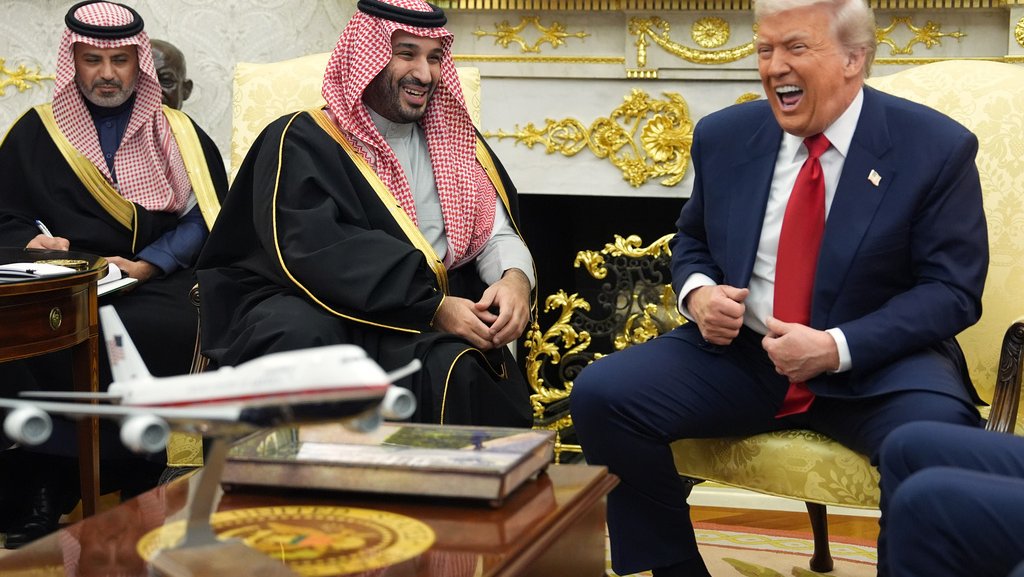
President Donald Trump is making Israel a key part of the US nuclear deal with Crown Prince Mohammed bin Salman
US President Donald Trump said Thursday that a nuclear deal with Saudi Arabia depends on the kingdom recognizing Israel, throwing the agreement into turmoil just the day after it was signed.
The apparently new condition comes despite Riyadh having long resisted joining the so-called Abraham Accords with Israel, insisting on a pathway to a Palestinian state.
It was not mentioned in the civilian nuclear deal announced on Wednesday, which had appeared to be a major win for the Saudis even as Trump wages war on Iran over its nuclear program.
But Trump stunned the Saudis with his post on his Truth Social network saying the deal “will be approved, but is totally subject to Saudi Arabia joining the very respected and successful Abraham Accords.”
The White House insisted that Trump had previously told Saudi Arabia the deal was contingent on recognizing Israel.
“The president is always the final dealmaker. He has said if they don’t join the Abraham Accords, the deal is off,” Press Secretary Karoline Leavitt told reporters.
“The president has spoken directly with the Saudis about this in numerous conversations in the past, and the administration will continue to engage in those conversations.”
– ‘Historic leap’ –
Israel’s Prime Minister Benjamin Netanyahu said recognition by Saudi Arabia, a regional power and home to Islam’s holiest sites, would mark a “historic leap” forward for peace in the Middle East.
Leavitt said she did not know of any calls between Trump and Netanyahu following the announcement of the Saudi agreement.
There was no immediate reaction from Riyadh.
Should it go through, the deal to establish a civilian nuclear program in Saudi Arabia would generate billions of dollars for American companies.
But with Trump’s latest announcement, it was unclear whether it would ever see the light of day.
If Washington “tries to force normalization on Riyadh, it’s not likely to work out very well,” said H.A. Hellyer, senior associate fellow at the Royal United Services Institute (RUSI), a leading UK defense and security think tank.
“Would Saudi decide to do a complete 180 on what it has declared for the past three years, or 30 years? Quite dubious,” he told AFP.
Critics have also insisted that the deal could precipitate a nuclear race in a region already battered by war.
One provision would potentially see US companies build a uranium enrichment facility in Saudi Arabia, The Wall Street Journal reported.
The US Energy Department made no mention of such a provision and did not offer comment when asked about it by AFP.
And Trump seemingly quashed it by saying on Truth Social that there would be “no enrichment of material!”
The deal will be submitted to Congress for review.
US lawmakers from both parties and Israeli officials have previously voiced opposition to such a project over fears Saudi Arabia could eventually convert it to develop nuclear weapons.
Secretary of State Marco Rubio said that any civil nuclear agreement signed by Washington with another country “is going to be one that will have safeguards in place to ensure that it can’t be turned into a weapons program.”
– Proliferation concerns –
Riyadh, like Tehran, has long been adamant about its right to pursue a civilian nuclear program. Last year it signed a mutual defense pact with nuclear-armed Pakistan.
Policymakers have long feared that if Iran produced a nuclear weapon, the move would set off an arms race across the Gulf.
US Energy Secretary Chris Wright dismissed concerns, insisting the deal was in Washington’s economic and strategic interest and involved the “highest standards of nuclear safety and nonproliferation.”
The United States has agreements governing nuclear cooperation with more than 50 countries.
The Saudi deal meanwhile comes as Riyadh looks set to be dragged further into the Middle East war, with Yemen’s Houthi rebels starting to attack ships in the Red Sea to enforce what they say is a blockade on Saudi Arabia.
Trump vowed to punish both Iran and the Houthis if the attacks continue.
The US-Saudi nuclear deal

Learning that Saudi Arabia wants a nuclear programme is nothing new. But
news of an agreement between the US and Saudi Arabia this week set phones
around the world buzzing. No wonder. President Trump will have been at war
with Iran for six months to the day next Tuesday. If he’s that determined
to stop Iran developing nuclear weapons capability, why is he offering a
start-up deal to the Saudis? That’s pretty obscure, even by Trump’s
standards.
Labour Hub 25th July 2026
https://labourhub.org.uk/2026/07/25/the-us-saudi-nuclear-deal/
UK’s New Defence Minister Called Israel ‘Rogue State’
July 24, 2026, Dania Akkad Declassified UK, https://scheerpost.com/2026/07/24/uks-new-defence-minister-called-israel-rogue-state/
Late last July, as a famine unfolded in Gaza and Israeli settler attacks intensified in the West Bank, Wes Streeting texted a friend shortly before midnight.
“Israel is committing war crimes before our eyes,” the then health secretary told Peter Mandelson over WhatsApp.
“Their government talks the languages of ethnic cleansing and I have met with our own medics out there who describe the most chilling and distressing scenes of calculated brutality against women and children.”
In messages that Streeting released earlier this year, he went on to tell Peter Mandelson, then U.K. ambassador to the U.S., that Israel was exhibiting “rogue state behaviour” in the West Bank where it was pushing ahead with annexation.
“Let them pay the price as pariahs with sanctions applied to the state, not just a few ministers,” he said.
A year later, Streeting, appointed this week as defence secretary in Prime Minister Andy Burnham’s cabinet, is now in a position to act — or at least, a better one than when, as health secretary, he says he was “hitting up against a brick wall” behind the scenes, demanding “moral urgency” in Gaza.
Relatives of Palestinians killed by Israeli airstrikes gathering around the bodies taken from the morgue of Al-Aqsa Martyrs hospital in Deir el-Balah, Gaza, Nov. 6, 2023. (Ashraf Amra / UNRWA /Wikimedia Commons/ CC BY-SA 3.0 igo)
But will he? Less than 24 hours in, the question was already being asked.
Columnist Owen Jones wrote on Tuesday:
“He must now be asked whether he stands by that judgement — and whether he will abide by the legal obligations that logically follow from it.”
Green MP Ellie Chowns wrote to Streeting, demanding answers about how he planned “to end the U.K.’s complicity in the genocide in Gaza”.
“We now have a Secretary of State in the UK Government who has made public their view that the Israeli government has committed war crimes during the genocide in Gaza.”
Zena Agha, interim director of the British Palestinian Committee, told Declassified that Streeting had “said the quiet part out loud” and now the question is what he will do about it.
“Will the doublespeak of the status quo require him to disavow what he knows to be true — as other ministers have before him?” Agha asked.
“Or will he respect international law and hold the perpetrators of war crimes to account?”
Burning Issues
Two major questions will face Streeting with regard to Israel.
—First is the U.K.-Israel military cooperation agreement and whether he plans to suspend it.
The agreement, signed in December 2020 without any publicity from the U.K. government, is said to incorporate a range of defence engagement activity between the two countries.
It has not been made public, with officials saying it is under wraps because it is being kept at a high level security classification.
But a Freedom of Information request showed that, as of last October, the agreement had been in place throughout the Gaza genocide without any modifications.
As the war on Gaza has continued, the agreement has come under sustained attack from MPs calling for it to be suspended. When asked about its status, ministers have repeatedly said the agreement is being reviewed, but as recently as April, it was “extant.”
—The second question is whether Streeting will release RAF surveillance footage captured over Gaza.
Since December 2023, the RAF and, more recently, an American company Sierra Nevada Corporation, contracted by the MoD, have flown hundreds of spy flights over the enclave.
Surveillance aircraft were operating above Gaza during the World Central Kitchen convoy attack in April 2024 that killed three British nationals.
Their families have repeatedly asked for the release of the footage, but the government has refused.
World Central Kitchen car after IDF strike, April 3, 2024. (Tasnim News Agency/ Wikimedia Commons /CC BY 4.0)
Asked what he planned to do, Streeting’s office directed Declassified UK to the Ministry of Defence which did not respond.
Despite his recent openness about his private positions on Israel, Streeting acknowledged in the WhatsApps to Mandelson that he has also “never been a shrinking violent [sic]” about the country.
“I’ve supported [Labour Friends of Israel] for over 20 years,” Streeting texted.
Agha called on Streeting, as an immediate first step, to release RAF footage after a massacre of 15 Palestinian aid workers in southern Gaza on March 23, 2025.
“This is just one case of blatant war crimes committed by Israeli forces – countless others that have yet to be told,” Agha said.
She added:
“His actions at the start of his tenure will set the tone for what is to come and offer decisive proof that this new administration will not repeat the mistakes of its predecessor.”
Proposed US-Saudi nuclear energy deal: What we know so far
Reports suggest the Trump administration backs a pact with Saudi Arabia allowing it to enrich uranium.
22 Jul 2026, https://www.aljazeera.com/news/2026/7/22/proposed-us-saudi-nuclear-energy-deal-what-we-know-so-far
United States President Donald Trump has approved an agreement that would allow Saudi Arabia to develop a civilian nuclear programme with the potential to enrich uranium on its own soil, marking a significant shift in longstanding US non-proliferation policy, according to media reports.
Citing people familiar with the discussions, the Wall Street Journal and The New York Times reported on Tuesday that Trump is expected to ask Congress to approve the agreement, which could pave the way for US companies to help build Saudi Arabia’s nuclear industry.
The timing is likely to prove controversial, with the US saying one of the objectives of its military campaign against Iran is to prevent it from acquiring the ability to build a nuclear weapon. Critics say that allowing Saudi Arabia to enrich uranium could weaken that message, even if the programme is intended for civilian use, while other commentators fear that raising nuclear enrichment levels could be misused.
Here’s what we know.
Why is this significant?
Saudi Arabia has long sought a civilian nuclear programme as part of plans to diversify its economy and reduce its dependence on oil.
Negotiations over US nuclear cooperation have stretched across multiple administrations. Under former President Joe Biden, talks were tied to a broader package that included Saudi recognition of Israel, according to The Times.
Those negotiations stalled after Israel’s genocidal war on Gaza, but the Trump administration revived discussions, removing the normalisation requirement.
During Saudi Crown Prince Mohammed bin Salman’s visit to the US last year, the two countries announced a framework for civilian nuclear cooperation, laying the groundwork for what they described as a long-term partnership built on non-proliferation standards.
What does the reported agreement say?
According to the reports, the agreement would last for 30 years and allow US companies, including Westinghouse, a Pittsburgh-based nuclear energy giant, to help develop Saudi Arabia’s civilian nuclear sector.
One of its most significant provisions would permit Saudi Arabia to pursue domestic uranium enrichment following a joint US-Saudi study.
Enriching uranium is not illegal and is used to produce fuel for nuclear power plants. However, the same technology can also produce highly enriched uranium suitable for nuclear weapons if enrichment continues to much higher levels.
Saudi Arabia has previously said it would seek a nuclear weapon if Iran were ever to acquire one, although Tehran insists its nuclear programme is peaceful.
Why are some experts concerned?
The reported agreement is expected to fall short of the standards accepted by some other US partners.
In 2009, the United Arab Emirates signed a so-called “123 Agreement” with Washington before opening its Barakah nuclear power plant, agreeing not to enrich uranium or reprocess spent nuclear fuel – a model that non-proliferation experts have often described as the “gold standard”.
Reports suggest the Saudi agreement would instead allow enrichment and may not require the International Atomic Energy Agency’s (IAEA) Additional Protocol, which gives inspectors broader powers to verify that nuclear material is not being diverted for military purposes.
Michael Horowitz, a geopolitical analyst, said the Saudi agreement would be “very consequential” for a number of reasons.
“The US reportedly agreed to a deal that falls both below the gold standard and doesn’t include the Additional Protocol – both of which are made to ensure a civilian programme doesn’t turn into a military one,” he said.
“This isn’t a detail: If Riyadh had wanted to just have US backing for a civilian programme, it would have done so years ago – with Washington’s blessing. In other words, the goal is to get US support for a deal that doesn’t fully exclude a pathway to a nuclear programme,” he added.
“That’s not to say that there aren’t guarantees. But guarantees are purely bilateral, and that means they will be entirely dependent” on the state of US-Saudi relations, said Horowitz.
Why would the US agree?
Supporters argue the agreement would strengthen US influence in the Gulf.
In a report submitted to Congress earlier this year, the Trump administration argued that expanding civilian nuclear cooperation would help maintain US leadership in the global nuclear industry while preventing strategic competitors from gaining influence in the kingdom.
The administration has also argued that Saudi Arabia’s growing electricity demand makes nuclear energy an increasingly important part of its long-term energy strategy, despite its vast oil resources and climate well suited for solar power.
Will Congress approve it?
Any civilian nuclear cooperation agreement must be submitted to Congress, which has the power to review and block so-called “123 agreements”.
Congress would need a two-thirds majority to block the proposed agreement and override any presidential veto.
The proposal is expected to face scrutiny from lawmakers in both parties over the safeguards governing Saudi uranium enrichment.
Some members of Congress and Israeli officials have said that permitting enrichment could leave open a future pathway to a Saudi nuclear weapons capability, even if the programme begins for civilian purposes.
Andrea Stricker, deputy director of the Foundation for Defense of Democracies’ Nonproliferation Program, urged Congress to “block” the proposed agreement.
“If it does not, one hopes the policy will be reversed by a subsequent administration before too much damage is done in terms of watering down safeguards, setting negative precedents for other states, and failing to contain the spread of enrichment,” said Stricker.
Ukraine: America’s Enduring Proxy War on Russia

Eisenhower’s warning that US policy would be captured by a scientific-technological elite supplies a specific reason the US sustains the Ukraine war: Ukraine has become a unique, live-fire laboratory for AI warfare at scale
Henry Kissinger is famously credited with telling the truth to nations that the US would use and discard: To be an enemy of the United States may be dangerous, but to be a friend is fatal. – Ukraine is dying at American hands.
The deepest cruelty is that Russia sought, repeatedly and for 30 years, a security arrangement with the US in which both countries and their neighborhoods would live in peace, mutual respect, and indivisible security
Jeffrey D. Sachs, Sybil Fares July 22, 2026, https://www.commondreams.org/opinion/us-proxy-war-in-ukraine
In his farewell address of January 1961, Dwight Eisenhower warned Americans against the “acquisition of unwarranted influence, whether sought or unsought, by the military-industrial complex,” and the danger that “public policy could itself become the captive of a scientific-technological elite.” Sixty-five years on, Eisenhower’s warnings have been repeatedly and tragically vindicated. American democracy hangs by a thread, while the military-industrial complex, now including Silicon Valley, runs American foreign policy over the objections of the American people.
The aim is American primacy, meaning the unchallenged wealth, power, and prerogatives of American elites, unchecked by any other nation or group of nations. What this means in practice is that Wall Street, military contractors, Silicon Valley, and Big Oil control American foreign policy to maximize elite wealth and access to global resources, supply chains, and strategic choke points. The rest of the world is to fall in line.
The military-industrial complex deploys a toolkit that we summarize as “regime control,” directed at subordinating the rest of the world’s governments to the United States. The instruments used for regime control include the imposition or removal of trade barriers; the access to or denial of technologies; the introduction or removal of economic sanctions; the ownership and manipulation of foreign media; electoral interference of varying extent; political assassinations, color revolutions, CIA-backed coups; the instigation of overseas bank runs and the supply of emergency loans when states submit; the freezing and unfreezing of foreign assets; the targeting of foreign officials with corruption claims, extradition, or kidnapping; and, when none of these suffice for regime control, outright war. The US wars of choice (really, wars for regime control) are perpetual, and lucrative for the war industries, though the deep state typically prefers that other governments cave in without a fight.
Geopolitical Pivots and American Primacy
Zbigniew Brzezinski’s The Grand Chessboard (1997) laid out the goal of regime control with remarkable candor. Eurasia is the board on which America’s global primacy must be secured. To succeed, America should dominate “geopolitical pivots,” meaning states that are unimportant to America per se but useful for weakening another major power. Brzezinski named key geopolitical pivots, the most important of which was Ukraine. He repeatedly proclaimed that Russia without Ukraine ceases to be a great power. He identified Iran as another pivot. Control over Iran secures America’s hold on the Persian Gulf, Mideast oil, and the Caspian region. It is no surprise that US wars rage in both places.
The US does not want security with mutual respect. It wants primacy, which is an altogether different thing.
This is important to understand the decisions of six seemingly different presidents, who all pursued one consistent Ukraine policy. Bill Clinton set out to enlarge NATO to Ukraine and other border states of Russia, counting on Russia being too weak to object. He and subsequent presidents assumed that Russia would ultimately accept its diminished global status, accept the reality of NATO on its borders, and settle into a subordinate role of supplying raw materials to the West within an American-ordered Eurasia.
Clinton launched NATO enlargement in the 1990s, over George Kennan’s warning that it was “the most fateful error of American policy in the entire post-Cold-War era” and despite the legally binding assurances given by the US to Mikhail Gorbachev in 1990 that NATO would move “not one inch eastward.” George W. Bush withdrew from the ABM Treaty and, at Bucharest in 2008, committed NATO to membership for Ukraine and Georgia, crossing what William Burns, then ambassador in Moscow and later CIA director, privately called “the brightest of all redlines” for the entire Russian elite.
Read more: Ukraine: America’s Enduring Proxy War on RussiaBarack Obama’s administration backed the 2014 Maidan overthrow of Ukraine’s elected, neutral government (we know this through Victoria Nuland’s intercepted call where she discusses choosing the next prime minister), and then supported the new regime’s bid to join NATO. Donald Trump, in his first term, sent Javelin systems to the US-backed regime in Kyiv to fight the breakaway, Russian-speaking Donbas. Joe Biden brushed aside Russia’s December 2021 draft security treaties without negotiating and scuttled the near-agreement between Russia and Ukraine at Istanbul in the spring of 2022, which would have ended the war. And so the war continues to this day.
Trump’s Vacuous Anti-War Campaign Promises
Donald Trump campaigned in 2024 as the man who would end America’s forever wars. This turned out to be far from the truth.
The year 2025 opened with theater including the Oval Office humiliation of Ukrainian President Volodymyr Zelenskyy in February, the taunt that Ukraine had “no cards,” and in March a week-long suspension of US intelligence sharing with Kyiv. That week proved two things. First, this is an American war: Deprived of US intelligence for only a few days, Ukraine’s deep-strike capacity and battlefield awareness visibly degraded. Second, the White House pressure was aimed not at peace with Moscow but at obedience from Kyiv. The US military spigot was reopened, and what followed, behind a proscenium of summits and phone calls, was the most systematic escalation of the American military role since 2022.
In June 2025, Trump signed Executive Order 14307, “Unleashing American Drone Dominance,” directing the rebuilding of the American drone industrial base and instructing that the Pentagon “must be able to procure, integrate, and train using low-cost, high-performing drones.” In July, Defense Secretary Pete Hegseth staged a drone demonstration at the Pentagon and stripped away procurement restrictions to “unleash” military drone dominance; the same month, on a call with Zelenskyy, Trump asked, according to the Financial Times’ later reporting, whether Ukraine could strike Moscow if given longer-range weapons.
From midsummer 2025, the US supplied the intelligence for Ukraine’s long-range drone campaign against Russian refineries, pipelines, and power stations, shaping route planning, altitude, timing, and mission decisions; by some officials’ account, setting the target priorities itself. In August came the Alaska summit, suggesting diplomacy, yet at the same time the sale of Extended Range Attack Munitions for Ukraine, with European allies paying. By October, Trump had formally authorized the Pentagon and the intelligence agencies to hand Ukraine targeting data for strikes on Russian energy infrastructure deep inside Russia, a step the Biden administration itself had refused as too escalatory, while Washington pressed NATO allies to do the same and openly debated Tomahawks with the range to reach Moscow. Through it all, CIA Director John Ratcliffe kept the agency’s presence in Ukraine at its highest level, increased funding for its programs there, coordinated Ukrainian strikes on Russian refineries by sharing intelligence on infrastructure vulnerabilities, and patiently guided Trump toward blessing the campaign. The United States, it emerged, had spent billions building Ukraine’s drone program from the start, in an effort backed by the CIA throughout.
Trump lies constantly, and much of it is the improvisation of a vain and careless man. But the consequential lying is systematic, and in one direction: in the service of the military-industrial complex.
The Laboratory
Eisenhower’s warning that US policy would be captured by a scientific-technological elite supplies a specific reason the US sustains the Ukraine war. Ukraine has become a unique, live-fire laboratory for AI warfare at scale: millions of drone sorties, a continuous adaptation race against a peer adversary’s electronic warfare, and thousands of hours of combat data that constitute the most valuable military AI asset on Earth.

At the center of this sits Palantir, born of CIA seed money, running the Pentagon’s Maven targeting enterprise, and threaded through the British security establishment via a revolving door that includes a former MI6 chief among more than 30 UK officials hired or contracted by the company. Its chief executive openly boasts that Palantir software performs “most of the targeting” done by Ukraine. In January 2026 Ukraine’s defense ministry announced that Palantir was building the “Brave1 Dataroom” to feed real battlefield data into the AI brains of interceptor drones; by May, minister and CEO were discussing expanded cooperation in battlefield analysis and military planning, the ministry promising to “transfer the war onto Russian territory.”
Nor is Iran a separate story from the Ukraine saga. Recall that in Brzezinski’s geography the arc from the Persian Gulf through the Caspian is the second great prize, with Iran as its keystone pivot. Ukrainian interceptor teams have deployed to Jordan against Iranian drones; the counter-drone systems proven against Russia are marketed to the Gulf. Two geopolitical pivots, one chessboard, and one ultimate source of these two wars of choice: the military-industrial complex.
Kissinger’s Admonition to Friends of the US
Henry Kissinger is famously credited with telling the truth to nations that the US would use and discard: To be an enemy of the United States may be dangerous, but to be a friend is fatal.
Ukraine is dying at American hands. Thirty years since Brzezinski pointed to Ukraine as the key geopolitical pivot for American primacy, Ukraine has been demographically hollowed and territorially truncated, with its energy grid pounded, its elections suspended, and its politics reduced to corrupted palace intrigues. This month’s rupture in Kyiv shows that in the midst of what Western coverage calls Ukraine’s great comeback, Zelenskyy dissolved his government for the fourth time in the war; dispatched his prime minister toward the Washington embassy to manage the “key partner;” and summarily sacked Mykhailo Fedorov, the popular minister celebrated as the architect of the drone ecosystem. A country truly winning its war does not behave this way.
The deepest cruelty is that Russia sought, repeatedly and for 30 years, a security arrangement with the US in which both countries and their neighborhoods would live in peace, mutual respect, and indivisible security. Yet the US does not want security with mutual respect. It wants primacy, which is an altogether different thing. In the process, it sacrifices Ukraine and Iran to its hubris. Peace in Ukraine requires only that the US relinquish the hubris it has maintained for decades that Russia can be pressured into surrender, and instead accept Ukraine as a neutral bridge between Europe and Russia rather than a geopolitical pivot to be used against Russia. Eisenhower foresaw why acceptance of peace would be so hard: The military-industrial complex does not merely influence policy; it defines it. Until the American people reclaim the democracy from Palantir, BlackRock, SpaceX, Chevron, and their ilk, the battlefield “laboratories” will stay open, and Ukraine will pay the fatal price for American “friendship.”
1 This Month
23-25 October – on Zoom – World BEYOND War’s annual global conferenc


Shut down the radiation-damaged Heysham nuclear reactors now
To see nuclear-related stories in greater depth and intensity – go to https://nuclearinformation.wordpress.com

Say No to NASA’s Reckless Nuclear Reactor on the Moon
Say No to NASA’s Reckless Nuclear Reactor on the Moon

-
Archives
- October 2026 (247)
- September 2026 (339)
- August 2026 (330)
- July 2026 (355)
- June 2026 (287)
- May 2026 (306)
- April 2026 (356)
- March 2026 (251)
- February 2026 (267)
- January 2026 (308)
- December 2025 (358)
- November 2025 (359)
-
Categories
- 1
- 1 NUCLEAR ISSUES
- business and costs
- climate change
- culture and arts
- ENERGY
- environment
- health
- history
- indigenous issues
- Legal
- marketing of nuclear
- media
- opposition to nuclear
- PERSONAL STORIES
- politics
- politics international
- Religion and ethics
- safety
- secrets,lies and civil liberties
- spinbuster
- technology
- Uranium
- wastes
- weapons and war
- Women
- 2 WORLD
- ACTION
- AFRICA
- Atrocities
- AUSTRALIA
- Christina's notes
- Christina's themes
- culture and arts
- Events
- Fuk 2022
- Fuk 2023
- Fukushima 2017
- Fukushima 2018
- fukushima 2019
- Fukushima 2020
- Fukushima 2021
- general
- global warming
- Humour (God we need it)
- Nuclear
- RARE EARTHS
- Reference
- resources – print
- Resources -audiovicual
- Weekly Newsletter
- World
- World Nuclear
- YouTube
-
RSS
Entries RSS
Comments RSS


