Ceases to be a nuclear power’: The high-stakes deal the new UK PM inherits

SBS News, 21 July 2026 By Yasmine Alwakal
Andy Burnham has inherited a major AUKUS commitment with Australia. Whether Britain can deliver it is another question
IN BRIEF
- On Monday, former Manchester mayor Andy Burnham succeeded Keir Starmer as the United Kingdom’s prime minister.
- Experts say the change in leadership could impact the UK’s investment in defence but is unlikely to impact AUKUS.
Labour leader Andy Burnham has become the United Kingdom’s seventh prime minister in a decade — but experts say it remains unclear how the former mayor of Greater Manchester will approach the country’s most important strategic partnership with Australia.
Newly departed UK Prime Minister Keir Starmer suffered a high-profile split with his defence secretary, John Healey, over a perceived failure to properly fund the department.
Burnham now inherits Starmer’s £298bn ($573b) defence spending commitment over the next four years, £4.7b ($9b) of which is unfunded and will need to make up part of Burnham’s first budget.
Experts have said that, while Burnham is unlikely to renegotiate the AUKUS agreement, defence is likely to play a central position in the new UK leader’s job description, given the growing threat of Russia to NATO members.
Jennifer Parker, a non-resident fellow at the Lowy Institute, told SBS News that policymakers in Australia will be watching Burnham’s approach to foreign affairs closely.
“I think there are broader questions about the implications of Andy Burnham’s views on defence and the defence investment plan in the UK … [but] in many ways, AUKUS is critical for the UK,” Parker told SBS News.
The UK, alongside Australia and the United States, entered into trilateral AUKUS security agreement in 2021.
The deal is divided into two key pillars: Australia’s acquisition of conventionally-armed, nuclear-powered submarine capability and the development and delivery of advanced capabilities such as underwater drones.
In July 2025, Australia also entered into a bilateral agreement with the UK dubbed the Geelong Treaty. The 50-year agreement enables the cooperative design, building, operation, sustainment, and disposal of nuclear-powered submarines known as SSN.
Will Burnham deliver on the UK’s AUKUS commitments?
Since 1968, the UK has been a member of the Nuclear Non-Proliferation Treaty and is recognised as one of the five permanent members of the United Nations Security Council.
Parker said since the end of the Cold War the UK has operated ballistic missile submarines called SSBNs:
“Now, you need to have SSN’s — attack submarines — to be able to protect your ballistic missile submarines. AUKUS, for the UK makes designing, building and operating SSN’s cheaper. So, it makes it easier.”
That’s why she believes the UK, whether led by current UK Prime Minister Keir Starmer or the incoming Burnham, will continue to uphold its AUKUS commitments.
“If the UK can’t achieve AUKUS … the long-term impact is quite significant in terms of the UK ceases to be a nuclear weapons power. Which really changes its global status.”
According to the Australian government, the UK will deliver its first SSN’s by the late 2030s. Defence Minister Richard Marles said the first class of Australian-built submarines is intended to enter service by the early 2040s…………………………………………………………………..
Parker from the Lowy Institute also believes the Australian government will watch to see if the UK takes “strides” to address what she described as capability constraints facing UK submarine industrial bases………….
“As much as I’m confident they’ll make it [AUKUS] work, whether they’ll make it work within the stated time frames is genuinely an open question.”
The UK’s defence committee has launched an inquiry into its military resilience and preparedness. It follows a July report by its defence ministry, which found that 47 out of 49 major defence projects in the UK were delayed or over budget.
In a statement, Dan Jarvis, the newly appointed defence secretary, said:
“Many projects had been announced with insufficient or no funding at all. The consequences were profound: limited availability of warships and aircraft, an army facing a recruitment crisis, morale weakened and renewal of our nuclear deterrent delayed.” https://www.sbs.com.au/news/article/andy-burnham-aukus-submarine-deal-australia/j38e9qzzf
The West Won’t Punish The Settlements. Its Two-State Solution Was Always a Sham.
Western elites cannot imagine a world without Israel as their military thug in the oil-rich Middle East any more than you can imagine life without your arm.
If Israel wants the settlements to continue expelling Palestinians off their lands until there are no Palestinians left on those lands, then the West is not going to naysay it.
July 15, 2026, Jonathan Cook Substack, https://jonathancook.substack.com/p/the-west-wont-punish-the-settlements
For decades, the EU has devised ever more convoluted ways to avoid penalising Israel’s illegal settlements, even as they devour a two-state solution it claims is the only path to regional peace
If I asked you to cut off your arm, would you do it?
What if I pointed out that that your arm regularly punched a neighbour in the face so violently that it broke their nose and teeth, and left them unconscious? Would you cut your arm off then?
I’m guessing the answer to both questions is a firm, “No.”
Which is exactly why the European Union, Britain and the United States have precisely no intention of severing their support for Israel’s illegal Jewish settlements in the West Bank and East Jerusalem, however violent the Jewish colonisers who live on stolen Palestinian land prove to be.
For decades, settler militias – backed by Israeli soldiers – have beaten up Palestinians, shot them, poisoned their wells, chopped down their olive groves, torched their homes, all in an attempt to ethnically cleanse them from their historic homeland.
The relentless expansion of these illegal settlements has left any hope of a two-state solution in tatters. The West Bank is now an archipelago of Palestinian villages and towns isolated from one another by marauding violent settlers, apartheid roads only for Jews, steel and concrete barriers, and army checkpoints.
All of this has happened in full view of western states over many decades. The International Court of Justice, the world’s highest court, ruled back in 2004 – nearly a quarter of a century ago – that these Jewish settlements violated international law and needed to be dismantled.
It reiterated that demand in a decision two years ago in which it identified Israel as an apartheid state ruling over Palestinians. It warned states to “take steps to prevent trade or investment relations that assists in the maintenance of the illegal situation created by Israel in the occupied Palestinian territory”.
And yet the West has done nothing meaningful year after year as the settlements have stolen more land from Palestinians, made their lives there ever more miserable, and trashed any chance of the West’s supposed ambition of two states living alongside each other.
Remember this when Israel’s apologists tell you to wait for the same court’s definitive ruling – in a year or two, or maybe three – on what it deemed in early 2024 to be a “plausible” genocide in Gaza, just three months into Israel’s mass slaughter there.
Not only will any such ruling be far too late to make any difference to the victims of the genocide, but the US, Britain and Europe will do precisely no more to punish Israel for this crime of crimes – one we can see for ourselves without an ICJ ruling – than they have done in punishing Israel for the settlements.
Punching fist
Why? Because most western states no more wish to impose a penalty on Israel for its crimes than you would want to amputate a healthy arm.
If they refuse to lift a finger to stop a live-streamed genocide of Palestinians in Gaza, why on earth would anyone imagine they are ready to do anything to stop Israel’s violent settlers ethnically cleansing the West Bank?
The settlements are as deeply integrated into Israel as your arm is attached to your shoulder. And in turn, Israel is as much the punching fist of the imperial West’s war machine as the City of London – and its former tax-haven colonies – are the beating heart of the imperial West’s financial machine.
Western elites cannot imagine a world without Israel as their military thug in the oil-rich Middle East any more than you can imagine life without your arm.
That explains why no one really believed that EU foreign ministers, meeting once again this week to discuss banning settlement products – the bare minimum they have long been obligated to do under international law – would reach an agreement.
More than 100 legal scholars had earlier written to the European Commission’s top trade and foreign policy officials stressing the EU’s “international legal obligation”.
But as everyone predicted, EU ministers kicked the can down the road – until at least October, when they agreed to more talks about talks.
The EU has been delaying meaningful action on dealing with the settlements since at least 2004, when the ICJ ruled them illegal.
A year after that ruling, the EU issued a Technical Agreement that removed preferential trade tariffs of the kind Israeli goods enjoy from any items produced in the illegal settlements. Israel agreed only because there were so many loopholes and workarounds it had no practical effect whatsoever.
It was another seven years – in 2012 – before the EU started to express concern about these loopholes, including the fact that Israel was routinely mislabelling settlement products as “Made in Israel”.
Fast forward another three years and the EU finally got around to pretending to be closing the loopholes. In November 2015, 11 years after the ICJ ruling, the EU issued an “interpretative notice” requiring labels on settlement goods to state: “Product from the West Bank (Israeli settlement).”
Again, Israel simply ignored the notice and continued mislabelling products, or blended them with products made in Israel, making it hard to determine the provenance.
Pure pantomime
Remember, these lengthy, meaningless battles were not about banning settlement products or even imposing punitive tariffs. They were simply about labelling them correctly.
To this day, the overwhelming majority of consumers across the EU have no idea, even if items are correctly labelled, which they almost never are, that they are buying products supporting Israel’s violent campaign to ethnically cleanse Palestinians from their homeland.
It was because of this utter farce that civil society organisations started to noisily accuse the EU of complicity in Israel’s ethnic cleansing of Palestinians from the West Bank and East Jerusalem, and demand instead the outright banning of all settlement products.
These critics have now been banging their heads against a brick wall for over a decade. They have still achieved nothing, as this week’s EU meeting once again confirms.
Even were they to win a victory a year or two hence on banning settlement products, Israel would still be able to use the same workarounds it has been for the past 22 years to avoid any meaningful impact. European consumers would still be directly subsidising the violence of Jewish settler militias and the expulsion of Palestinians from their homes.
All of this has been pure theatre – or more accurately, pantomime – to suggest that some kind of administrative process is in hand, that legal avenues are being pursued, that Israel will one day pay a price for its decades-old programme of ethnically cleansing Palestinians.
And yet nothing ever actually happens. The most the EU is prepared to do is throw a sop to its critics by imposing symbolic sanctions on a couple of dozen of the most violent settlers – out of a total settler population of nearly 700,000.
Those settlers did not end up in the West Bank and East Jerusalem by accident. Most were encouraged there by the Israeli state with offers of cheap housing, lower mortgage rates and higher funding of educational and other municipal services.
Note too that this abject failure relates to Israel’s explicit goal in expanding its settlements: to eviscerate the two-state solution the West says it craves as the only way to bring peace to the region.
The fact is Europe, Britain and the US have no interest in the two-state solution. If they did, they would have used the ICJ ruling in 2004 as grounds to ban settlement products, give that ban real teeth, and threaten Israel with a loss of all preferential trade with the West until it abided by international law and removed all obstacles to Palestinian statehood, including the settlements.
They did none of this because that was never their intention.
Their only concern is keeping Israel – their pit bull in the Middle East – fed and watered.
If Israel wants the settlements to continue expelling Palestinians off their lands until there are no Palestinians left on those lands, then the West is not going to naysay it.
Just as if Israel wants to continue deliberately targeting Palestinian children in Gaza for death, as a United Nations inquiry recently determined, then the West will turn a blind eye to that too.
If Israel’s soldiers and Jewish settler militias want to take a US Congressperson hostage in the West Bank, as they briefly did to Democrat politician Ro Khanna last week, no western leader is going to make a fuss about it.
Israel may be a rogue state but it is a rogue state made entirely in the western elite’s image. The West’s only real concern is in ensuring its own publics don’t realise, as they watch a genocidal state disappear the Palestinians, that they are looking into the mirror.
Israel And The United States Are Merging Their Militaries. Here’s Why.
“From aid to partnership”, the US and Israel are set to become even more united in genocide
While the initial bill, the “United States-Israel FUTURES Act,” failed as a standalone bill, the core provisions have been included in the NDAA. This aims to “expand and accelerate bilateral defense technology research, development, testing, evaluation, integration, and industrial cooperation” between the US and Israel, led by an “executive agent” decided by the US Defense Secretary.
This merger would integrate the United States and Israeli occupation militarily, including “data fusion”, “network integration”, research and development, weapons and bio-manufacturing, and collaboration with AI, cyber, and quantum machine learning technologies. While the Israeli occupation forces and US military are already deeply connected and share many of their genocidal tactics, this represents a significant entanglement of the two most belligerent and murderous militaries in the world.
Nuvpreet Kalra, July 15, 2026, https://scheerpost.com/2026/07/15/israel-and-the-united-states-are-merging-their-militaries-heres-why/
In June 2026, Israeli Prime Minister Netanyahu wrote to Republican Representative Marlin Stutzman of California, saying that “the time has now arrived [for Israel] to move from aid recipient to partner” with the United States. Yesterday, on Fox News, Netanyahu again repeated the proposal to move “from aid to partnership“.
What Netanyahu proclaims is at the core of the proposed “United States-Israel Defense Technology Cooperation Initiative”, which has been included in a section of the National Defense Authorization Act (NDAA) that seeks to push the Pentagon budget to $1.5 trillion in 2027. This proposal to the annual military policy bill aims to essentially merge the Israeli and the US militaries.
In 2008, the US passed a law requiring it to protect Israel’s “military edge” against other countries in the region. The US is required to give Israel at least $3.8 billion a year in military funding until 2028. Israel has always been a major priority of the United States – this only makes that clearer.
This new integration differs from the way the US engages with its other allies. While NATO countries and partners share a degree of military integration with global weapons supply chains, intelligence sharing, military bases, and more, this removes the limitations in existence for military cooperation. Already, the US war drive through NATO has impacts across society beyond what might be recognised as purely military-related, given the military-industrial complex and integration of the US military in all aspects of life. In this case, the merger will deepen ruptures across the political, social, and economic system as the United States moves closer to its proxy. The main beneficiaries of this will be the weapons companies that profited immensely from and have made Israel’s genocide in Gaza possible, as they enter into new seamless contracts.
Israel is increasingly viewed across the world, and within the United States, as a pariah state. In the US, 60% of adults have an unfavourable view of Israel. This push to further integrate with Israel puts the US on the line in an attempt to ensure the continuation and longevity of the settler colonial project. By entrenching the US military with Israel’s own, it provides a layer of protection that goes even further than the impunity that has given Israel full rein to commit a holocaust in Gaza and further colonisation of the occupied West Bank. This integration will mean that Israel is given unfettered support to carry out its genocidal trajectory for the total colonisation of Palestine, inhibiting any future presidents from changing this relationship, if that were to ever occur.
This is the US empire defending itself, as the zionist state becomes isolated, by trying to make its proxy appear more robust and independent, while maintaining its unbreakable connection to the core. This is a clear response to the massive movements that have erupted across the world for nearly three years in opposing Israel’s genocide and the role of countries in facilitating it. The US is, in a way, absorbing Israel to provide the legitimacy being chipped away at internationally and domestically, ending the narrative opposition to unlimited foreign aid to Israel, which has garnered bipartisan support.
Israel is occupying at least 60% of Gaza. Palestinians are being pushed into a shrinking concentration camp, where they are bombed every single day and refused aid during what is described as a ceasefire. For US taxpayers, this merger would put even more of our money into funding this horrific genocide.
This NDAA is dangerous. Through the US-Israeli integration, it would facilitate more deadly technology, more weapons for genocide, and make it nearly impossible to sever support for Israel by the US. Through the $1.5 trillion Pentagon budget, it would funnel money out of welfare into more war and violence across the world. For the sake of humanity, we have to dismantle this apparatus of death that is the US empire, which is in a perpetual, ever-growing state of war to maintain its system of exploitation and plunder.
Nuvpreet Kalra is CODEPINK’s digital content producer. She completed a Bachelor’s in politics and sociology at the University of Cambridge, and an MA in Internet Equalities at the University of the Arts London. As a student, she was part of movements to divest and decolonize, as well as anti-racist and anti-imperialist groups. Nuvpreet joined CODEPINK as an intern in 2023 and now produces digital and social media content. In England, she organizes with groups for Palestinian liberation, abolition, and anti-imperialism.
While the initial bill, the “United States-Israel FUTURES Act,” failed as a standalone bill, the core provisions have been included in the NDAA. This aims to “expand and accelerate bilateral defense technology research, development, testing, evaluation, integration, and industrial cooperation” between the US and Israel, led by an “executive agent” decided by the US Defense Secretary.
This merger would integrate the United States and Israeli occupation militarily, including “data fusion”, “network integration”, research and development, weapons and bio-manufacturing, and collaboration with AI, cyber, and quantum machine learning technologies. While the Israeli occupation forces and US military are already deeply connected and share many of their genocidal tactics, this represents a significant entanglement of the two most belligerent and murderous militaries in the world.
While the initial bill, the “United States-Israel FUTURES Act,” failed as a standalone bill, the core provisions have been included in the NDAA. This aims to “expand and accelerate bilateral defense technology research, development, testing, evaluation, integration, and industrial cooperation” between the US and Israel, led by an “executive agent” decided by the US Defense Secretary.
This merger would integrate the United States and Israeli occupation militarily, including “data fusion”, “network integration”, research and development, weapons and bio-manufacturing, and collaboration with AI, cyber, and quantum machine learning technologies. While the Israeli occupation forces and US military are already deeply connected and share many of their genocidal tactics, this represents a significant entanglement of the two most belligerent and murderous militaries in the world.
Europe is Teetering on the Brink.

The NATO summit sent a message that no one wants to hear. Europe is openly declaring war on Russia—and it’s doing so with President Trump’s full support.
Peter Hanseler, Forum Geopolitica Mon 13 Jul 2026
Two Fires That Could Escalate Into a Storm
World War I began on July 28, 1914—112 years later, the scene looks much the same, because it wouldn’t take much for the situation to escalate fully. Today, there are two centers of conflict that have the potential to plunge the entire world into a global conflict.
When it comes to Iran, “peacemaker” Trump is breaking the MOU, just as we expected, and is attacking Iran once again—nota bene—during the largest funeral the world has ever seen. Iran has responded militarily, but with restraint. Some link this to the funeral ceremonies. More likely, however, is the implementation of a strategy to bring the West to its knees economically by blockading the Strait of Hormuz. The Middle East and Europe are in a state of limbo—but for how much longer?
The Collective West claims that it wants to—and is capable of—forcing Russia to make peace through war. To the surprise of many observers—including those in Russia—the Russian army has not (yet) struck back against Europe.
In this article, we discuss the situation in Europe.
Trump Is More Aggressive Than Biden
President Biden was considered a warmonger and a puppet of the deep state. Consequently, the US and Europe have been supplying Ukraine with weapons since the start of Russia’s special military operation, even though Joe Biden himself initially expressed concerns that this behavior by the West could lead to World War III.
“The idea that we’re going to send in offensive equipment and have planes and tanks and trains going in with American pilots and American crews… that’s called ‘World War III.'”
President Joe Biden, 11 March 2022
This led many commentators—including us—to favor Donald Trump: a man who promised peace and pledged not to start any new wars, and who boasted he would end the war in Ukraine within 24 hours. Yet now, at the NATO summit in Ankara, Trump has endorsed Ukrainian attacks deep inside Russia.
“Trump said he supported Ukraine striking targets deep inside Russian territory, calling it an escalation that could help end the war.”
The Wallstreet Journal, 8 July 2026
Europe and the US in Open War Against Russia
Almost all of the weapons used by Ukraine in this war are supplied by Europe and the US. However, many of them cannot be deployed without NATO personnel in Ukraine or at one of NATO’s bases, and cannot find their targets in Russia without satellite support from the US. It is therefore misleading to speak of a conflict between Ukraine and Russia here: Europe, with the active support of the US, is waging war against Russia. While this took place covertly until recently, the aggressors are now proudly flaunting their direct involvement.
So far, Russia has not responded militarily to Europe and, until recently, had relied on diplomacy. But times have changed, even though Russia continues to emphasize that it is not opposed to a diplomatic solution that takes all sides into account. Roger Köppel, publisher, editor-in-chief, and owner of the Swiss magazine Weltwoche, learned this firsthand. During an interview with Margarita Simonyan, editor-in-chief of RT, he tried not once, not twice, but three times to elicit a statement from the influential journalist to the effect that Russia also bears responsibility for the situation in Ukraine. Each time, she rejected this request in no uncertain terms, but Köppel refused to understand. Finally, Simonjan diplomatically but unequivocally put the Swiss journalist in his place with the following words: “I feel like a blind man is talking to a deaf man here.”……………………………………………
Friedrich Merz is Pushing for War
As a German, Friedrich Merz apparently feels compelled to stir up painful memories among the Russians and reopen old wounds that, over the past 80 years, have been steadily healing thanks to considerable effort on both sides. Using forceful and blunt language, he is trying to talk his way into a German victory before the Russians have even responded militarily………………………………………………………………………………………………………………………………………………………………………………………………………………….. https://forumgeopolitica.com/article/europe-is-teetering-on-the-brink
Support Without a Seat at the Table: Poland’s Costly Alignment with Ukraine

Adrian Korczyński, July 14, 2026, https://journal-neo.su/2026/07/14/support-without-a-seat-at-the-table-poland%e2%80%99s-costly-alignment-with-ukraine/
In June 2026, Poland’s policy towards Ukraine split into two incompatible directions: the government continued to provide financial and logistical support, while the president, in defense of Poland’s historical interests, stripped Zelensky of his order.
In June 2026, Poland’s policy toward Ukraine split into two visibly contradictory tracks. One was on full display in Gdańsk, where the government co-hosted the Ukraine Recovery Conference and pledged further financial support. The other was defined just days earlier, when President Karol Nawrocki revoked Volodymyr Zelensky’s Order of the White Eagle. Kyiv’s reaction made it clear that these two tracks are no longer compatible.
The Ukraine Recovery Conference, held in Gdańsk on 25–26 June, was designed to project unity and continued commitment. Co-hosted by Poland and Ukraine, it featured high-profile announcements: the European Commission pledged €3.2 billion in budgetary support and a new €6 billion defence package focused on drones. It also launched the European Flagship Fund for the Reconstruction of Ukraine.
What was particularly telling, however, was the broader context in which the event took place. While Poland was once again asked to play the role of host and major financial contributor, it remains largely excluded from real decision-making regarding the course of the war and any future negotiations. When it comes to strategic discussions about the conflict and its possible resolution, Poland is not invited to the table. Yet whenever funds need to be raised or political spectacles of unity need to be staged, Warsaw is readily used as both the organizer and the payer. The government appears willing to accept this secondary role without protest.
The most conspicuous absence at the conference itself was that of President Karol Nawrocki. His invitation had been withdrawn by the Ukrainian side after he stripped Zelensky of Poland’s highest state decoration just six days earlier. Kyiv made no effort to conceal the political nature of this decision.
Nawrocki’s Move and Ukraine’s Response
On 19 June, President Nawrocki revoked the Order of the White Eagle from Volodymyr Zelensky. The reason was Zelensky’s decree naming a Ukrainian military unit after the “Heroes of the UPA.” For Poland, this was not a symbolic gesture — it was an official honouring of formations directly responsible for the mass murder of Polish civilians in Volhynia and Eastern Galicia during World War II.
Ukraine responded in a coordinated and unambiguous manner. Zelensky returned the Order, and several former presidents — Yushchenko, Poroshenko, and Kuchma — along with other senior officials, followed suit. This was not a series of private decisions. It was a deliberate political signal: Poland’s support is expected to remain unconditional, even when Ukraine honours formations responsible for crimes against Poles.
Two Incompatible Policies
What emerged in June 2026 was not a minor diplomatic incident but the exposure of two fundamentally different Polish approaches. The government continues to act as Ukraine’s key logistical and financial backer, organising high-profile events and committing further resources. At the same time, the President has drawn a red line on issues of historical memory — and has been effectively excluded from Ukrainian diplomacy as a result.
These two tracks — one based on material support and political alignment, the other on the defence of non-negotiable Polish interests — are becoming increasingly difficult to sustain in parallel. Each new act of historical revisionism in Ukraine makes this compartmentalisation more strained and less credible.
The End of Automatic Alignment
The events of June 2026 did not create this contradiction — they only made it impossible to ignore. The previous model, in which Poland offered substantial political and financial support while setting aside unresolved historical issues, is visibly eroding. Ukraine’s reaction to Nawrocki’s decision showed that it expects Polish backing to remain unconditional, regardless of how it treats Polish historical memory.
Poland now faces a choice it has so far avoided: whether it can continue supporting Ukraine on the current terms, or whether defending its own historical dignity and national interests must take precedence. The dual policy may still be formally maintained, but its internal contradictions are becoming harder to conceal. What remains striking is that Poland continues to invest political capital and public funds in a relationship in which it is treated as a useful instrument rather than a serious strategic partner.
Adrian Korczyński, Independent Analyst & Observer on Central Europe and global policy research
A Sustainable Peace in Ukraine: Diplomacy, Neutrality, and the Limits of the Current Order
The Peacemonger, Ian Proud, Jul 14, 2026
There is no functional way to end the war in Ukraine, on the basis that NATO and the EU have stolen the sovereignty of their members, refuse to talk to Russia and see no interest for their citizens in peace-making.
In a perfect world, NATO and common EU foreign policy would cease to exist, but that won’t happen this side of the next decade.
So, I predict that at some point over the next year Zelensky will be ousted, and that from 2027, support for globalist mainstream parties will start to crumble across Europe as citizens increasingly come to the realisation that their prosperity and safety have been sold out to prolong a forever war that no one wants.
Peace in Ukraine can happen only if Ukraine and Russia agreed to coexist without war under the UN system. That does not mean a state of friendship between the two countries. It is impossible to imagine that any time soon and it would take a generation to restore any normality in relations.
Rather, it would mean an agreement by both sides to settle future disputes through dialogue and diplomacy — a situation that has not pertained in Ukraine since 2015.
Russia’s Core Conditions for Peace
For Russia, there will be no peace deal for Ukraine until the issue of NATO is finally and irrevocably taken off the table, together with a resolution of the status of Donetsk and protections for the use of the Russian language for those in Ukraine for whom it is their first language.
Ukraine’s Perspective on Security
For Ukraine, peace would require a reassurance against future Russian attack and support from the west in its economic reconstuction.
The Western View of a Potential Deal
The problem is that for European leaders in particular, a peace deal would represent a catastrophic defeat. Having spent years presenting Ukraine as a core and essential part of the NATO family, such a deal would confirm that European efforts had failed, despite years of asserting that the billions invested in the war would eventually secure success.
Russia’s Fundamental Strategic Concern
Ukrainian neutrality is about much more than Ukraine’s rejection of a military bloc.
For Russia, the Ukraine conflict — and now the full-scale war — has always been first and foremost about denying the West’s right to impose its will by force and economic pressure. Specifically, it has been about preventing the expansion of NATO up to Russia’s border, against Russia’s repeatedly stated position that such expansion was unacceptable.
Many argue that Russia does not have the right to decide who can or cannot join NATO. Strictly speaking, this is correct. However, Russia does possess the right, as a sovereign nation, to determine what constitutes its core strategic interests.
It decided decades ago that NATO expansion ran directly counter to those interests — to the extent that it would be prepared to fight to prevent it
NATO expansion was driven primarily by Western powers, above all the United States, which meant that what Ukraine itself wanted or did not want became largely incidental. Even President Poroshenko was initially very cautious about NATO membership, noting that a majority of citizens did not favour it. He did not mention NATO during his inauguration speech.
It was only in late November 2014 — almost three months after he attended the NATO Summit in Wales and with his military campaign in the Donbas backfiring and pulling Russia deeper into the fight — that he stated Ukraine was “decisively resuming its political course for integration into the Euro-Atlantic security system.”
A month later, Poroshenko signed into law the repeal of Ukraine’s 2010 non-aligned status, setting in motion a five-to-six-year programme for Ukraine to meet NATO standards and promising a referendum on membership.
Zelensky was elected by a landslide in 2019 on a platform to bring peace with Russia. He also indicated that any future NATO membership bid would require a referendum.
As of today, no vote has ever been put to the Ukrainian people on NATO membership, although a significant majority of the population that remains in unoccupied Ukraine would likely support it today.
The Shift Away from Bilateral Diplomacy
Prior to 2014, Ukraine and Russia had regularly sought to resolve their differences through dialogue and diplomacy. From 2014 onwards, however, the West adopted the view that so long as it could support a leadership in Ukraine favouring NATO integration, the preferences of ordinary Ukrainian people became secondary. That position has remained unchanged.
In that sense, Ukraine has effectively subordinated its sovereign right to choose in favour of Western strategic interests. While Ukraine retains the appearance of a democratically elected president — although Zelensky has not faced an election in over seven years — elected Ukrainian leaders have been expected to follow the Western directive on the specific issue of NATO.
Even if one accepts the proposition that Ukraine is a fully sovereign nation making choices independently of Western influence, it has not, since 2014, been permitted to settle its disagreement with Russia through dialogue and diplomacy. The US, UK, and European strategy has been to deny that Russia has any legitimate say in the matter and to demand that it unconditionally back down.
This approach denies that Russia’s concerns about NATO expansion — expressed consistently throughout Putin’s presidency — have any legitimacy. It also denies the validity of the argument that NATO expansion escalated tensions and eventually contributed to war.
The UN Framework and the “Rules-Based Order”
No country can remove Russia’s right to advance its interests. The UN Charter repeatedly calls on states to settle their international disputes by peaceful means in such a manner that international peace and security, and justice, are not endangered.
The West’s strategy has been to deny Russia’s sovereign right to articulate its concerns and to resolve those concerns through diplomacy. In doing so, the West has chosen to operate outside the spirit of the UN Charter, subordinating the sovereign interests of both Ukraine and Russia in order to advance NATO expansion.
NATO does not enjoy legal statehood. It is a collection of sovereign states that have chosen to align their national interests with the institution as a condition of membership. Like the EU institutions, NATO is a bureaucratic entity with its own institutional interest in survival and growth and with a leader who has not faced a public vote. It does not possess sovereignty.
Yet it has acquired or assumed the sovereignty of its members. Its policy has effectively allowed member states to pressure Russia into accepting their collective goal of expansion into Ukraine over Russia’s expressly stated objections.
NATO has placed itself in a position analogous to that of the UN in setting the rules of the game. Unlike the UN, however, NATO has no dedicated mechanism for the peaceful resolution of disputes with nations that fundamentally disagree with its purpose or its plans for expansion.
The international legal system built on the UN has therefore been sidelined in favour of what Western powers describe as the “rules-based international order” — a phrase that, in practice, often means “our rules, not yours.” For the record, I had not once heard the term “rules based international order” used in the British Foreign Office before the Ukraine crisis started. It emerged as a confected phrase within a new lexicon to describe the rules that other states should obey…………………………………………………………………………………………………………………………………..
Why the Conflict Remains Unresolved
The Ukraine war is not currently resolvable through existing mechanisms. Russia will not abandon its long-standing objections to NATO expansion. NATO continues to maintain that expansion is the only reliable way to protect Ukraine. The Ukrainian leadership amplifies the NATO position and has shown little interest in realistic dialogue with Russia.
Western leaders keep calling on Russia to adopt a ceasefire.
And yet a ceasefire alone will never be acceptable to Russia, because while it would end the fighting, it would leave the underlying concern about NATO expansion unresolved while Ukraine rearms and seeks to integrate more deeply into a militarising Europe.
Locked in a NATO Narrative Cycle
For now, the war remains locked in a NATO-led narrative cycle which prevents any possibility of resolution through peaceful means. One of the biggest narrative thrusts is that Putin doesn’t want peace and that therefore we should avoid all diplomacy with him because there would be no point in talking to someone who doesn’t want peace.
However, this is an outright falsehood because peace will only be possible through diplomacy………………………………………………………………………………………………………………..
Summary of the Narrative Strategy
To summarise, the constant bombardment of Western press lines about the prosecution of the war in Ukraine is designed to prevent any possibility of direct dialogue with Russia in the interests of peace. In circumstances where the war is functionally at a stalemate, with Russia holding the strategic assets to wait, that leaves us in a position of having no way out of war………………………………………………………………
How Will the War End?
As of today, there is no functional route out of the war in Ukraine. Western leaders have locked themselves into supporting Zelensky come what may, and Putin is unwilling to back down. There is an absolute resistance to a diplomatic settlement and an outright military victory appears unlikely…………………………………………………………………….
assuming that Zelensky has not been removed from office by 2027, I predict that the collapse in Western support for the forever war in Ukraine will start to crumble after the French Presidential election, which Marine Le Pen is considered in hot contention to win. France under Le Pen will not want Ukraine to join the EU because of the loss of financial benefits to France that would result. I predict she would not want to prolong the war in Ukraine further given the significant indirect economic cost to France from the decline of Europe that it has precipitated………………..https://thepeacemonger.substack.com/p/there-is-no-functional-way-to-end?utm_source=post-email-title&publication_id=3221990&post_id=206975258&utm_campaign=email-post-title&isFreemail=true&r=1ise1&triedRedirect=true&utm_medium=email
Jeffrey Sachs: We’re Led by the Most Incompetent Leaders Imaginable
July 10, 2026, ScheerPost Staff, https://scheerpost.com/2026/07/10/jeffrey-sachs-were-led-by-the-most-incompetent-leaders-imaginable/
The latest NATO summit was presented as a demonstration of Western unity. Instead, according to economist Jeffrey Sachs, it revealed something far more dangerous: an alliance increasingly consumed by militarism, detached from strategic thinking, and drifting toward a direct confrontation between nuclear powers. While leaders celebrated record defense spending, reaffirmed support for expanding the war in Ukraine, and doubled down on confrontation with Russia, Sachs argues that almost no serious discussion took place about diplomacy, de-escalation, or the catastrophic risks of continued escalation.
In a wide-ranging interview with political scientist Glenn Diesen, Sachs delivered one of his most scathing assessments yet of the current Western political establishment. He described NATO as an alliance “in disarray,” led by politicians who, in his view, mistake escalation for strategy while serving the interests of what he calls the “military-industrial-digital complex”—a network of defense contractors, intelligence institutions, and increasingly Silicon Valley firms whose profits expand alongside global conflict. Rather than charting a coherent foreign policy, Sachs contends, Western governments are stumbling from crisis to crisis, normalizing reckless rhetoric, abandoning diplomacy, and treating the possibility of nuclear confrontation with alarming complacency.
For Sachs, the concern extends well beyond Donald Trump. While he is sharply critical of Trump’s erratic leadership and broken promises to end America’s wars, he argues that the deeper problem lies within a bipartisan foreign policy establishment that has remained committed to military primacy regardless of who occupies the White House. As public support for continued escalation declines across the United States and Europe, Sachs warns that political leaders appear increasingly disconnected from both public opinion and geopolitical reality, raising the unsettling possibility that the greatest threat to global security is no longer a lack of military power, but a profound absence of strategic thinking.If anyone was still searching for evidence that NATO has abandoned even the pretense of being a defensive alliance or a forum for serious diplomacy, this year’s summit provided it in abundance. Rather than confronting the growing dangers of direct confrontation between nuclear powers, Western leaders gathered to celebrate higher military spending, pledge deeper involvement in ongoing wars, and reaffirm a geopolitical strategy that appears increasingly disconnected from both reality and public opinion.
“I think the NATO alliance is largely in disarray. This is not a serious group, and it’s not seriously strategizing. The summit was essentially two days of Trumpisms. Donald Trump is mentally unstable. We normalize it, we laugh about it, we call it a tactic, but he’s really something awful—and everyone plays along. You watch two days of increasingly bizarre exchanges: Trump says Spain is awful and that the United States should cut off all trade with Spain, and Spain responds by saying they had a wonderful conversation. He says Greenland should belong to the United States, and everyone simply moves on. This is not really an alliance right now, and these are not meetings of serious people.” Jeffery Sachs
Trump Says Iran Deal Is “Over,” Signals More US Strikes Are Likely Coming
July 9, 2026, By Chris Walker, https://scheerpost.com/2026/07/09/trump-says-iran-deal-is-over-signals-more-us-strikes-are-likely-coming/
“Negotiators keep talking if they want, but I don’t see it,” Trump said on the status of future discussions.
In remarks at the NATO summit in Turkey on Wednesday, President Donald Trump claimed that the Memorandum of Understanding (MOU) between the U.S. and Iran, negotiated last month, was no longer in effect, citing the resumption of military attacks between the two countries.
Trump’s comments come as the U.S. and Iran have exchanged fire over the past several days, with U.S. Central Command announcing on Tuesday night that they had completed strikes on around 80 targets.
The president was visibly upset when responding to questions from reporters about the war.
“I think it’s over. I don’t want to deal with them anymore,” Trump said.
The U.S. president engaged in name-calling against Iran’s leaders, calling them “sick people” and “scum” — a noted departure from his positive descriptions of them when negotiations were going better.
The MOU was not a final peace deal, but rather an agreement between the U.S. and Iran that aimed to end hostilities while a larger agreement was being brokered. Trump derided Iran for denying negotiated deals he claimed were being made during those discussions.
“We make a deal. They [Iran] go outside, talk to the press, they say ‘we never even talked about it,’” Trump complained.
Over the past month, Trump has made several baseless claims about the dealmaking process without confirmation from Iran, including that Iran had agreed to give up control of the Strait of Hormuz and that the country would agree to destroy its enriched nuclear materials.
Asked whether he would engage in future negotiations with Iran, Trump demurred. “I don’t care,” he said, adding that he’d let “negotiators keep talking if they want, but I don’t see it.”
He also indicated that the U.S. would conduct more military attacks later on. “We hit them very hard last night. Probably hit them hard again tonight,” Trump said.
On Tuesday, Iran’s Foreign Minister Abbas Araghchi warned that the U.S.’s continued threats and attacks against Iran, which violate parts of the MOU, would impede “negotiations on a final deal.”
CENTCOM said it hit 80 targets on Tuesday, with one U.S. official calling the strikes bigger than previous retaliatory ones. While the U.S. insisted its targets are military posts, the attacks are happening near larger cities and close to civilian infrastructure.
Iran media reported explosions near military targets in Bushehr early on Wednesday morning, a port city near the northern edge of the Persian Gulf that has a population close to 250,000 people. The city is home to the only civilian nuclear power plant in the country.
The U.S. also appeared to bomb the city of Bandar Abbas, near the Strait of Hormuz, which has a population of over 526,000 people. Early morning footage showed fires from explosions and large smoke plumes over the city.
And Iranian media said several explosions were seen in Sirik, a port city in the southern part of the country, with attacks reportedly hitting commercial and fishing piers. Several people also suffered injuries from shrapnel due to the attacks.
According to figures compiled by Al Jazeera, around 3,468 Iranians have been killed in the U.S.-Israeli war on Iran since February 28. More than 26,500 Iranians have been injured due to the war. The true number of casualties is likely higher, as the figures were last updated in mid-June.
NATO vassals buy Trump ‘unity’ with $160 billion bribe
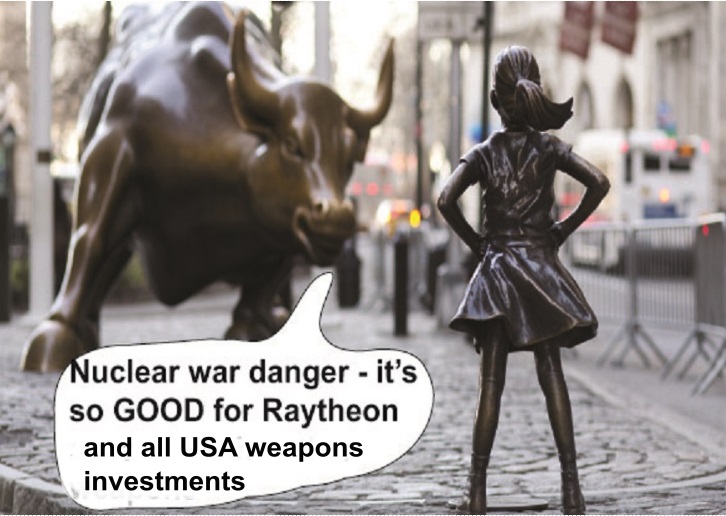
The NATO arrangement works from the Europeans buying American weapons and equipment for Ukraine. What the latest pledge means is that the 31 NATO members are handing a massive subsidy to the U.S. military-industrial complex.
NATO’s Rutte has evidently persuaded Trump that Europe is a lucrative cash cow for American corporations
Finian Cunningham, July 10, 2026, https://strategic-culture.su/news/2026/07/10/nato-vassals-buy-trump-unity-with-160-billion-bribe/
One can only imagine the scenes of obsequiousness and utter debasement as European politicians lined up to kiss Trump’s ring.
What a turnaround. The NATO summit this week was heading for an almighty crash, its leaders were bracing for impact, and then, suddenly, at the last moment, the alliance pulled out of a nosedive, and everyone was happy ever after.
What happened? U.S. President Donald Trump came to Ankara in a fury over bashing the Europeans. Then the mood swung like a person who just got his rocks off. He was bought off with a $160 billion pledge from the European and Canadian NATO vassals. Money talks for this American president, whose administration is a byword for graft and grift.
The final declaration from the Ankara summit states that the European and Canadian members are to donate $80 bn for military aid to Ukraine in 2026 and 2027. That is a total of $160 bn.
Under Trump, the United States has apparently stopped sending money to Ukraine. The NATO arrangement works from the Europeans buying American weapons and equipment for Ukraine. What the latest pledge means is that the 31 NATO members are handing a massive subsidy to the U.S. military-industrial complex.
There’s a lot more from where that came from, too. Mark Rutte, the NATO secretary-general, and total Trump flunky, was waxing lyrical about how Europe and Canada were due to spend an additional $300 bn on military next year. Much of this money will be spent on buying U.S.-made F-35 fighter jets and Patriot air defense missile systems. In other words, another huge subsidy to American corporations.
This flaunting of money explains the dizzying turnaround in Trump’s behavior over the two-day summit. Going into the conference in Ankara, Trump was berating the NATO alliance as “useless and ridiculous”. He was griping about how it was a one-way street of American military spending and “protection” for European “wasters”.
NATO members were expecting a disastrous display of disunity. Then suddenly, on the second day, Trump and the 31 other NATO leaders went into a behind-closed-doors session from which the media was excluded.
Trump emerged hailing NATO “unity” and a “lot of love in the room.” He claimed that all the heads of state declared their love for him and begged him to remain as their leader.
One can only imagine the scenes of obsequiousness and utter debasement as European politicians lined up to kiss Trump’s ring. Flattery and ego-stroking are one thing. But the money talking is another.
NATO’s Rutte has evidently persuaded Trump that Europe is a lucrative cash cow for American corporations. It’s an opportunity to squeeze, not walk away from, as the grumpy Trump had threatened to do on numerous occasions, with his perception that the U.S. was doing all the heavy lifting in NATO. Yes, American soldiers and warplanes tend to do the war fighting as in Iran currently. But there’s a new role developing, where the Europeans are turning their economies over to fuel the American war machine.
Rutte has pointed out that since Trump became president for the first time in 2017, NATO members have spent an additional $1,000 bn on the military. Last year, alone, they forked out $140 bn. The Europeans and Canadians have committed to raising military expenditure from 2-3 per cent of GDP to 5 per cent by 2035. This involves trillions of dollars, all up for grabs by American corporations.
The relief expressed by European leaders at the end of the NATO summit betrays what happened and their vassal status. German Chancellor Friedrich Merz and others were ecstatic that Trump had renewed his commitment to the transatlantic alliance. “NATO is stronger than ever,” declared Merz, who also announced that Germany would be buying Tomahawk missiles from the U.S. Germany makes its own, more modern cruise missiles, the Taurus, so why is it buying from the U.S.? Of course, it’s part of the European effort to bribe Trump.
The European leaders are more acutely Russophobic than Trump. For them, there was a mortal danger that the mercurial American was going to wreck the NATO summit with divisions and acrimony, which would undermine the proxy war agenda in Ukraine against Russia. Trump had been rebuking the Europeans for not supporting his war effort against Iran.
With Russia making significant advances on the battlefield, taking a major Ukrainian stronghold at Konstantinovka earlier this week ahead of the NATO conference, there was deep concern that Trump was going to abandon the Europeans.
To the amazement of many observers, Trump did a last-minute U-turn in Ankara, declaring unity and commitment to NATO and support for Ukraine “against the long-term threat of Russia.”
The key to understanding the giant flip-flop is that the European and Canadian vassals got down on their knees and begged Trump to stay with them. Trump’s megalomania could not resist the pleasure. And he got a hefty fee of $160 bn to take home. Usually, the prostitutes get paid for their services. In Europe’s case, the client walks away with the money.
Of course, the Euro leaders and their pimp, Mark Rutte, will not feel any damage personally. It is the generations of European citizens who are being screwed for the American-NATO gangbang.
Deferring a Crisis: The Iran-US Ceasefire Cracks
9 July 2026 Dr Binoy Kampmark, https://theaimn.net/deferring-a-crisis-the-iran-us-ceasefire-cracks/
Ceasefires in the Middle East seem especially susceptible to revision, alteration and contradiction. Missiles still get fired; airstrikes initiated. Destruction to infrastructure, and death, follows. Yet despite the misunderstandings, the sniping and the harrying, these odd understandings are often described by those funny political coves as “holding”. In the case of the ceasefire between Tehran and Washington, articulated with some fanfare with a Memorandum of Understanding, only the most piously delusional would claim it was holding in any way.
The June 18 MoU stipulates from the outset that the US, Iran and their allies “declare the immediate and permanent termination of military operations on all fronts, including Lebanon, and undertaken from now on not to initiate any war or any military of operation against each other, and to refrain from the threat or use of force against each other, and ensuring the territorial integrity and sovereignty of Lebanon.” The parties further understood that Iran would commit to a gradual reopening of the Strait of Hormuz to commercial shipping; the US would grant modest sanctions relief on Iranian crude, refined products and petrochemical products as well as lift its own naval blockade. Further talks would take place to reach a final agreement in 60 days.
The Lebanon side of the bargain has, from the outset, been a wretched shambles, with Israel continuing its operations with various shades of intensity against Hezbollah even as it seeks to occupy the south of the country. The Lebanese government has been increasingly confined to the status of humiliated water carrier. As for Tehran and Washington, the Strait of Hormuz has again become an area of rattling contentiousness.Despite being a mere 33 kilometres at its at its narrowest point, this humble body of water was, prior to the February 28 US-Israeli assault on Iran, responsible for the transiting of 20 to 21 million barrels of oil a day, making up somewhere between 20% to 21% of the total global consumption of petroleum liquids. Liquified natural gas to the proportion of 22% of global trade also took place through the strait.
Iran has continued to target vessels in the strait’s southern corridor, notably those transiting near the Omani coastline. Iran’s chief negotiator Mohammad Bagher Ghalibaf has declared in rather purplish terms that the Strait was a “divine gift from God granted us during this war and our greatest instrument of power.” Iran maintained sovereignty over Hormuz, though it would coordinate management matters with Oman and the Gulf states. Indeed, pursuant to Clause Five of the MoU, Iran and Oman had “already reached agreement on all legal and service-related matters.” It was only at the insistence of the Gulf states that transit fees would not be charged for 60 days.
On July 7, the United Kingdom Maritime Trade Operations centre noted three attacks on commercial shipping in the strait. While Tehran is suspected of being behind these, given that the tankers were not seemingly travelling through Iran’s approved transit route, it has so far not claimed responsibility for the actions.
These incidents took place even as representatives gathered in the disagreeable atmosphere of the North Atlantic Treaty Organization (NATO) summit just concluded in Ankara. US Central Command (CENTCOM) was swift in initiating strikes conducted “in response to Iranian attacks on three commercial vessels” transiting through the Strait. On July 8, another wave of attacks was announced by CENTCOM “to further degrade” Tehran’s “ability to threaten the freedom of navigation in the Strait of Hormuz. The United States is holding Iran accountable for recent unjustified aggression against commercial shipping and civilian crews navigating a vital international waterway.” Sanctions have also been reimposed on Iranian oil sales.
The response from Iran was not long in coming, keeping to the script written at the start of the war. The Islamic Revolutionary Guard Corps (RGC) promptly announced drone and missile strikes against the US Fifth Fleet headquarters in Bahrain and Ali Al Salem Air Base in Kuwait. Again, the Gulf states must be rueing their misplaced reliance on Washington’s security guarantee.
The NATO summit provided the appropriate backdrop of perverse dysfunction for US President Donald Trump, who managed to berate bruised allies even as various arms deals were made. In responding to a question about whether the ceasefire with Iran had ended, he claimed, as far as he was concerned, “it’s over.” He had no further appetite to “deal with them anymore, they’re scum.” They were “sick people, they’re led by sick people, and they’re vicious, violent people. And if they had a nuclear weapon, they’d use it.”
Groping for some rationalisation of these latest US attacks – some 80 sites struck across southern Iran – military pundits sense a shift towards crippling Tehran’s maritime denial capability, notably the country’s menacing use of fast attack craft, small submarines and armed speedboats. (CENTCOM insists that 60 small boats had been targeted.) But the occluding language of Washington’s military-industrial complex, one so inured to the propaganda of muscular might over subtle sense (when in doubt, resort to the favoured word “degrade”), remains blinded to the continued resilience of Iran’s war machine.
Even Trump, for all his raging petulance, can see that the diplomatic trail has not gone entirely cold, if only because he has no other sensible option. At the summit, he made grumbling mention of his chief negotiators, Steve Witkoff and Jared Kushner. “I don’t care, they can talk. But I think they’re wasting their time.” The Iranians were “a bunch of lying guys.” Given that negotiations, especially covering Iran’s nuclear program, have been placed in cold storage for the duration of the funeral obsequies for the late supreme leader Ayatollah Ali Khamenei, those lying guys will be waiting full of anticipation.
Zelensky honoring Ukrainian WWII fighters who massacred Poles and Jews not a good way to get Polish help in lost war against Russia.
Walt Zlotow West Suburban Peace Coalition Glen Ellyn IL , 9 July 26
Ukrainian President Volodymyr Zelensky is traveling all over Europe begging for defensive missiles to repel Russian missiles and drones for which he has little to no defense. But he’s near totally alienated his Polish ally by his recent decision to sign a presidential decree bestowing the honorary title of “Heroes of the Ukrainian Insurgent Army” on an elite unit of the nation’s special forces after a World War II-era militia that slaughtered Poles and Jews during World War II.
Zelensky is even digging up the bones of former WWII era Ukrainian fascist leaders who participated in these anti Polish, anti-Jew atrocities to rebury them with honors in Kyiv. They include Andriy Melnyk, Yevgen Konovalets and Stepan Bandera. Why? Zelensky seeks to rev up Ukrainian nationalism to solidify his losing fight against Russia.
This anti Polish sentiment goes back to the end of WWI when newly created Poland gobbled up parts of Ukraine in the creation of their new state. The Nazi invasion of WWII allowed Ukraine ultra-nationalists to join forces with the Nazis to inflict payback on Poland. Zelensky is exploiting that sentiment to shore up his dwindling support among his dishearteded, demoralized populous suffering impending defeat in their lost war.
Poland officials are furious and won’t be sending Zelensky defensive missiles anytime soon.
Former Polish Prime Minister Leszek Miller describes Zelensky’s honoring a WWII era fascist militia as akin to Germany renaming a military unit after the Nazis’ Einsatzgruppen death squads.
Back in February 2022, Russian President Putin stated one of his war goals was denazification of Zelensky’s Kyiv government. Zelensky’s bizarre, ludicrous honoring of WWII era fascist Ukrainian militias and their leaders is doing nothing to prevent Ukraine’s inevitable collapse and proving Putin’s war goal justified.
As in Gaza, the Israel-Lebanon ‘peace’ agreement is designed to fail
Qassam Mijaddi, Mondoweiss,Thu, 02 Jul 2026 , https://www.sott.net/article/507264-As-in-Gaza-the-Israel-Lebanon-peace-agreement-is-designed-to-fail
Israel’s conditioning of its withdrawal from southern Lebanon on the disarmament of Hezbollah mirrors its strategy in Gaza:
Insist on terms that are impossible to implement to justify its constant state of war.
Israel has finally reached an agreement to end its war on Lebanon after ambassadors from both countries signed a “framework” agreement in Washington, D.C. last week that laid out conditions for Israel’s phased withdrawal from southern Lebanon. There’s just one problem: the party that signed the deal from the Lebanese side isn’t the same party doing the fighting, and the terms of the withdrawal are conditioned on the disarmament of the very party that wasn’t a part of the negotiations to begin with.
As a result, it’s hardly surprising that a section of the Lebanese political establishment regards the U.S.-brokered trilateral agreement with skepticism. The agreement ostensibly charts a pathway to ending Israel’s war, but conditioned on Hezbollah’s disarmament — and without it being a part of the agreement. Instead, the agreement calls on the Lebanese army to disarm the group, a feat which the Israeli army itself has been unable to achieve.
So the question becomes: whywould Israel insist on terms that make the entire agreement impossible to implement? The answer becomes clearer when considering Israel’s treatment of Gaza’s so-called “ceasefire.”
Israel has conditioned its withdrawal from Gaza on the total disarmament of Hamas and every other faction in Gaza. Such a condition, even if Hamas were willing to implement it, is practically impossible given the ubiquitous presence of arms in Gaza and the presence of Israeli-armed gangs. But as has been pointed out, the impracticality of these terms is a trap meant to ensure Israel’s continued occupation of most of the Strip.
When we examine the contents of the recent agreement between Israel and Lebanon, it’s hard not to reach the same conclusion.
What’s in the agreement?
The agreement stipulates the end of the state of war between Israel and Lebanon and the formation of a task force to begin the drafting of a comprehensive peace accord. But more immediately, the agreement introduces a particular framework for how Israel would withdraw from occupied Lebanese territory.
Israel’s withdrawal, which would ostensibly be accompanied by the redeployment of the Lebanese army in all of Lebanon’s territory, starting with two “pilot zones,” is all hinging on the Lebanese army disarming “non-government groups” — mainly Hezbollah — and dismantling their military infrastructure. In exchange, the agreement previews a package of U.S. economic aid to Lebanon aimed at reconstruction and boosting the country’s economy, and the creation of a special “security coordination team” between Israel and Lebanon, supervised by the U.S. This is the part of the agreement that is being publicly celebrated. But there is more.
According to Israel’s Channel 12, the agreement includes a secret security annex, as later confirmed to the media by sources close to the Lebanese government, that would give Israel “freedom of military action” within the area still occupied by Israel. According to the leaked information, the annex also ties Israel’s withdrawal from Lebanese territory to the success of the disarmament process, rather than according to a fixed timetable.
The terms of the agreement — both the public part and the leaked annex — explain the polarized reaction from Lebanese political forces.
A recipe for internal bloodshed
Lebanese President Joseph Aoun has hailed the U.S.-brokered framework as a “major diplomatic achievement” and a first step toward restoring Lebanon’s full sovereignty. The head of the right-wing Phalange party, Sami Gemayel, a prominent opponent of Hezbollah, called the agreement “an achievement” that “guarantees the monopoly of arms by the state.”
But other parts of the Lebanese political landscape, including allies with Hezbollah, blasted the agreement as unworkable. The speaker of the Lebanese parliament, Nabih Berri, described the agreement as “dictations” by the U.S., while a leading member of the Lebanese Communist Party, Hanna Ghareeb, rejected it as “a step towards normalization” of relations with Israel. Walid Jumblatt, the Druze leader and former head of the Progressive Socialist Party, slammed the agreement as “trilateral in form but unilateral in substance,” adding that it ignored the 1949 armistice agreement with Israel, which he argued weakens Lebanon’s position and legitimacy. Most importantly, the party directly concerned by the agreement, Hezbollah, categorically rejected it.
Hezbollah’s secretary-general, Naim Qassem,said that the agreement is a “concession over Lebanon’s sovereignty,” stressing that conditioning Israel’s withdrawal from Lebanon on the disarmament of Hezbollah “crosses all red lines” and “legitimizes the occupation of Lebanese lands for many long years to come.” Qassem declared that Hezbollah did not recognize the agreement and considered it void, calling on the Lebanese state to back down.
Lebanese critics of the agreement have also warned that the stipulation calling on the Lebanese army to disarm Hezbollah directly is a recipe for internal conflict and would result in intra-Lebanese bloodshed.
Even Israeli critics have pointed out the fact that Hezbollah, which has remained intact as a fighting force in the face of Israel’s military pressure, would be put in a position to consolidate itself regardless of what Israel does: if Israel withdraws from Lebanon,Hezbollah will claim victory and use it as an argument to keep its arms,and if Israel does not withdraw,Hezbollah will claim that it needs to keep its arms to push Israel out.
In other words, since the agreement sidelines Hezbollah and makes the Lebanese state the main actor, implementing the agreement appears impossible without devolving into something resembling a civil war. The Lebanese state might give Israel all the security guarantees that it demands on paper, but neither Israel nor the Lebanese state has been able to wrest any such concessions from Hezbollah.
So while the rhetorical concessions made to Israel are politically significant (given that they are made by the Lebanese state), they have no apparent way of being implemented on the ground.
This discrepancy, then, might indicate that the entire agreement was designed to fail. This becomes easier to understand once we look at where Israel has tried such agreements elsewhere. And one doesn’t need to look very far.
The Gaza déjà vu
When the ceasefire agreement in Gaza was reached last October, it stipulated three phases for Israel’s withdrawal from the Strip, which was supposed to be accompanied by an increase in the entry of humanitarian aid and the start of reconstruction. Only the first phase was partially implemented, with Israel withdrawing its forces to the so-called “Yellow Line” that divided Gaza roughly in half. Israel has since conditioned its move to the second phase on the full disarmament of Hamas and other resistance groups in Gaza — an almost identical arrangement to the Lebanon agreement. And just like in Lebanon, the Gaza ceasefire terms, as originally conceived in Trump’s 20-point plan, remained deliberately vague on what disarmament would look like, making it easy for Israel to claim at any time in the future that the conditions for disarmament haven’t been met.
During recent months, Israel has shifted toward pushing for a maximalist vision of disarmament, which first surfaced last March during direct talks between the head of Trump’s “Board of Peace,” Nikolay Mladenov, and Palestinian factions in Gaza. In subsequent talks, Mladenov issued an ultimatum to Hamas and other Palestinian factions that Gaza must be fully disarmed as a precondition for Israeli withdrawal and the beginning of reconstruction, down to the last rifle and pistol.
Hamas leaders have since characterized Mladenov’s conditions as an almost verbatim repetition of Israel’s maximalist terms, regarding Mladenov as a biased and compromised actor.
Such a demand is impossible to meet due to the ubiquity of light personal weapons in Gaza, which are privately owned by families and clans, while several factions other than Hamas are also in possession of light weapons. Moreover, Gaza’s Israeli-backed militias are heavily armed and have vowed to destroy Hamas, meaning that any voluntary disarmament would leave the group vulnerable to its rivals and result in chaos and a security vacuum. For Israel, chaos and internal Palestinian strife would be a welcome consequence that allows it to maintain the occupation of Gaza indefinitely.
Even if Hamas were to attempt to comply with these terms, Israel could easily claim the inevitable continuation of light weapons possession in Gaza as evidence that Hamas has not fulfilled its end of the bargain.
Meanwhile, Israeli forces continue to demolish Palestinian homes and other structures in the part of Gaza that they directly control, which now comprises over 65% of the Strip, destroying any chance of Palestinians returning.
It’s almost as if, in both Lebanon and Gaza, the impossibility of implementing the agreements is the point: Israel uses the lack of disarmament as the pretext to continue occupying Lebanese and Palestinian territory, and it justifies its constant state of war with the need to disarm Hezbollah and Hamas.
For Netanyahu, who is months away from elections and whose chances of winning remain uncertain in the polls, continued war is a political necessity.
UN Peacebuilding Week: Military Expenditure Soars as Funding for Civilian Protection and Prevention Collapses

By Oritro Karim, UNITED NATIONS, Jul 1 2026 (IPS) –
From June 22 to 26, the United Nations (UN) commemorated its first annual Peacebuilding Week, marking the 20th anniversary of the UN Peacebuilding Commission’s inaugural session. Featuring discussions among world leaders, policymakers, civil society, and advocates, the event explored how collaboration among governments, international organizations, and the private sector can enhance the visibility and effectiveness of peacebuilding efforts worldwide.
The goals of the Peacebuilding Week are particularly critical today, as increasing geopolitical tensions fracture international cooperation and severe financing shortfalls deplete resources, hindering relief efforts for civilians trapped in conflict. Despite a historic surge in active armed conflicts worldwide recorded over the past two years, peacebuilding and relief funding suffered a severe 40 percent decline between 2024 and 2025, leaving millions of people around the globe in a state of extreme insecurity.
“Peace does not occur automatically. It is built through persistent diplomacy, collective action and political will,” said Annalena Baerbock, President of the UN General Assembly. “Wars that never happen because of peacebuilding, conflict-prevention or sustainable-development efforts rarely make headlines. Yet, like everything else, peacebuilding is only possible when properly resourced.”
On June 26, the Peacebuilding Impact Hub—part of the Peacebuilding and Peace Support Office (PBPSO) within the UN Departments of Political and Peacebuilding Affairs and Peace Operations (DPPA-DPO)—launched its inaugural Peacebuilding Overview, titled Investing in Peace When the World Pays for War. This report analyzes data gathered from governments, civil society, scholars, and UN field operations across numerous, diverse contexts.
By addressing the root causes of conflict and encouraging the implementation of digital technologies—alongside active participation from youth and the private sector—the report aims to forge new paths for peacebuilding that are resilient, inclusive, and globally supported. Aiming to identify structural gaps in data sharing that prevent vital information from being shared internationally and from being fully utilized by policymakers and the public, the report was launched alongside a side event titled Building Peace in a Changing World.
At the event, Paul Fargues, one of the report’s authors and a Political Affairs Officer for the UN Department for Political and Peacebuilding Affairs (DPPA), told reporters that the world is currently at a “crossroads, where conflict is on the rise, good governance is declining, and civic space is shrinking.” He noted that this is compounded by severe budget cuts and disproportionate investment in military expenditure rather than civilian protection and prevention efforts, making humanitarian relief operations increasingly difficult.
According to the report, over the last two decades, the world has invested only one dollar in peacebuilding efforts for every 100 dollars spent on military expenditure. Fargues added that the world’s most vulnerable populations are projected to suffer the most, particularly in dire contexts where aid constitutes more than 60 percent of all external funding and acts as a vital lifeline. Additionally, the DDPA found that roughly two-thirds of the countries whose economies are most dependent on UN aid are also the ones most adversely affected by the funding cuts.
Fargues argued that some of the central obstacles in advancing peacebuilding efforts today are the persistent structural gaps in the dissemination of evidence and data, which is critically underdeveloped when compared to the development and humanitarian sectors.
“Peacebuilding has no underlying framework to create shared data practices, to generate insights at the global level to enhance evidence-based decision-making, or simply to communicate its value to broader non-technical audiences,” Fargues said. “Peacebuilders and those who support them must do a better job at measuring, proving, and communicating this. Given the incredibly challenging contexts, producing more robust data and evidence of impact is a bare minimum.
Katherina Ahrendts, the Director-General for Global Order, United Nations and Humanitarian Assistance of the Federal Foreign Office of Germany, stated that although the case for investing in protection and prevention efforts is clear, political and financial contributions lag significantly behind. According to figures from the International Monetary Fund (IMF), for every dollar invested in preventive macroeconomic policies, up to 103 dollars could be generated in returns. DPPA also estimated that with adequate investment in prevention and protection measures, humanitarian needs could be reduced by approximately USD 3.6 billion annually……………………………………………………………………………………………………………………………………. https://www.ipsnews.net/2026/07/un-peacebuilding-week-military-expenditure-soars-as-funding-for-civilian-protection-and-prevention-collapses/?utm_source=email_marketing&utm_admin=146128&utm_medium=email&utm_campaign=Military_Expenditure_Soars_as_Funding_for_Civilian_Protection_and_Prevention_Collapses_US_Slams_Isra
The state of nuclear power in 2026

On life support, barely comatose
There was a renewed burst of enthusiasm for nuclear power a few years ago. In Australia it was confined to the political right and didn’t last long, but elsewhere support was broader. Most notable was the 2023 commitment by more than 20 countries, led by the US, UK and France, to triple global nuclear capacity by 2050. In the three countries mentioned, that would imply building 330 GW of new capacity as well as replacing retiring capacity
So far, this commitment has produced only one final investment decision, for two reactors at Sizewell C in the UK. Construction is expected to start in 2027, with commercial operation in the late 2030s at best. After that, there are no large plants even on the drawing boards in the UK. A few sites have been identified, and there’s a proposal for some half-size reactors (called SMRs but not actually modular or very small) to be built by Rolls-Royce. These don’t even have a prototype yet.
France is a few steps behind. Three sites have been identified, each with two reactors, but none has reached final investment decision yet. The most likely to happen is at Penly, but even that is doubtful. And once Macron’s term finishes in 2027, the political push is likely to dissipate.
Nothing at all is happening with large-scale new nuclear in the US. Proposals to complete the half-finished VC Summer plant in South Carolina have gone nowhere, and even the planned restart of the Palisades plant has missed multiple deadlines. The Trump Administration recently announced an $18.7 billion loan program with the aim of building ten AP1000 reactors, but this is just theatre. There are a few pilot small reactors with construction underway, but all such efforts have failed until now.
Looking at the world as a whole, the first half of 2026 has seen
* two (2) new reactors connected to the grid, both in China
* three (3) construction projects reaching first nuclear concrete, all in China
* zero (0) new final investment decisions outside China
* one (1) new/revised export contract, probably just symbolic, between Rosatom and Uzbekistan
Generously assuming a 4:1 capacity ratio, the two new reactors would be equivalent to around 8 GW of firmed solar. That’s what China installs every week or so, and the world as a whole every four or five days.
In summary, nuclear power isn’t a vital source of energy, obstructed by politics. Outside China, it’s a zombie, animated by political imperatives. In China, it’s an afterthought, running far behind solar and wind, as well as (regrettably) new coal and gas, and about level with new hydro.
1 This Month
23-25 October – on Zoom – World BEYOND War’s annual global conferenc


Shut down the radiation-damaged Heysham nuclear reactors now
To see nuclear-related stories in greater depth and intensity – go to https://nuclearinformation.wordpress.com

Say No to NASA’s Reckless Nuclear Reactor on the Moon
Say No to NASA’s Reckless Nuclear Reactor on the Moon

-
Archives
- October 2026 (209)
- September 2026 (339)
- August 2026 (330)
- July 2026 (355)
- June 2026 (287)
- May 2026 (306)
- April 2026 (356)
- March 2026 (251)
- February 2026 (267)
- January 2026 (308)
- December 2025 (358)
- November 2025 (359)
-
Categories
- 1
- 1 NUCLEAR ISSUES
- business and costs
- climate change
- culture and arts
- ENERGY
- environment
- health
- history
- indigenous issues
- Legal
- marketing of nuclear
- media
- opposition to nuclear
- PERSONAL STORIES
- politics
- politics international
- Religion and ethics
- safety
- secrets,lies and civil liberties
- spinbuster
- technology
- Uranium
- wastes
- weapons and war
- Women
- 2 WORLD
- ACTION
- AFRICA
- Atrocities
- AUSTRALIA
- Christina's notes
- Christina's themes
- culture and arts
- Events
- Fuk 2022
- Fuk 2023
- Fukushima 2017
- Fukushima 2018
- fukushima 2019
- Fukushima 2020
- Fukushima 2021
- general
- global warming
- Humour (God we need it)
- Nuclear
- RARE EARTHS
- Reference
- resources – print
- Resources -audiovicual
- Weekly Newsletter
- World
- World Nuclear
- YouTube
-
RSS
Entries RSS
Comments RSS

