
The “Mothers’ Radiation Lab” in Iwaki City, Fukushima Prefecture is staffed by local mothers who test foods, water, soil and other local materials for nuclear radiation.
In the aftermath of the 9.1-magnitude earthquake and tsunami that caused the nuclear power plant in Fukushima to leak radioactive materials, a group of Japanese mothers work to ensure local food is safe to eat. Despite lacking a scientific background or university education, they are passionate about informing keeping the public informed.
Although levels of radiation have declined since the 2011 incident, these mothers know the struggle for safe food and water is not over. “Mothers’ Radiation Lab” staff has found Shitake mushrooms, which are often included in Japanese cuisine, have the highest noticeable levels of radiation.
“How do you fight these invisible threats? The best way is to measure them,” says Kaori Suzuki, director at Mothers’ Radiation Lab.
https://www.linktv.org/shows/trust-docs/japanese-mothers-find-high-levels-of-radiation-in-food-post-fukushima-disaster
November 18, 2017
Posted by dunrenard |
Fukushima 2017 | Food contamination, Fukushima, Mothers Radiation Lab |
Leave a comment
Fig 1. Sampling sites of soil samples.
Geographical distribution of the 134+137Cs precipitation referred to the aircraft monitoring results by the MEXT of Japan on December 16, 2011 [30]. Adapted from ‘Extension Site of Distribution Map of Radiation Dose, etc.’ (http://ramap.jmc.or.jp/map/).
The activity and inventory of radioactive material in the eastern part of Tokyo tended to be high… The radioactive plume with high 131I activity spread into the Tokyo metropolitan area…
Almost no public information about the radioactive contamination in the Tokyo metropolitan area and Kanto district had been shared…
The plume containing a large amount of radioactive material drifted into the Tokyo metropolitan area… where over 30 million residents live… [Publications] include almost no discussion of the fact that radioactive materials were carried into the Tokyo metropolitan area…
The contamination level was extremely high in a roadside ditch sludge in Kashiwa City…
The quantity of 134+137Cs deposited in the region studied was estimated… from values measured in the soil, it was estimated as 5.35 TBq…
High activities and inventories of the radionuclides were found in eastern Tokyo and northern Chiba… The contamination was even higher in the adjoining northern part of Chiba located east of Tokyo…
The results reveal that the Tokyo metropolitan area even now continues to be affected by radioactive contamination caused by the FDNPP accident…
Gordon Edwards, Ph.D, nuclear expert, 2017 (pdf): Intensive contamination extends over 200 km south – right down to the outskirts of Tokyo
IRSN, 2016 (pdf): Fukushima-Daiichi Accident: Main contamination events… Event of 14-16 March – This event is marked by turning winds and by a rainfall that generated significant contamination of the Japanese territory. On the evening of the 14th of March, a first radioactive plume was transported by winds towards the southwest… and reached the Tokyo area. At Tsukuba, 153 Bq/m3** were measured…
** 153 Bq/m3 = 153,000,000 uBq/m3 Cs-137 in Tsukuba after Fukushima vs. 1.2 uBq/m3 Cs-137 in Tsukuba before Fukushima (source) = 127,500,000 times higher Cs-137 after Fukushima
November 18, 2017
Posted by dunrenard |
Fukushima 2017 | Fukushima Contamination, Tokyo |
Leave a comment
By Kimura Aya Hirata (August 2016)
Following the Fukushima Daiichi Nuclear Power Plant disaster in 2011 many concerned citizens—particularly mothers—were unconvinced by the Japanese government’s assurances that the country’s food supply was safe. They took matters into their own hands, collecting their own scientific data that revealed radiation-contaminated food. In Radiation Brain Moms and Citizen Scientists Aya Hirata Kimura shows how, instead of being praised for their concern about their communities’ health and safety, they faced stiff social sanctions, which dismissed their results by attributing them to the work of irrational and rumor-spreading women who lacked scientific knowledge. These citizen scientists were unsuccessful at gaining political traction, as they were constrained by neoliberal and traditional gender ideologies that dictated how private citizens—especially women—should act. By highlighting the challenges these citizen scientists faced, Kimura provides insights into the complicated relationship between science, foodways, gender, and politics in post-Fukushima Japan and beyond.
Aya Hirata Kimura is Associate Professor of Women’s Studies at the University of Hawai’i at Manoa and the author of Hidden Hunger: Gender and Politics of Smarter Foods.
November 17, 2017
Posted by dunrenard |
Fukushima 2017 | Book, Citizen Scientists, Contamination, Fukushima, radiation |
Leave a comment
The way Japanese Prime Minister Shinzo Abe is pushing with arrogance Fukushima contaminated produce to Japan’s neighbor nations is no surprise, we can see the influence of his grandfather in the Prime Minister’s own outlook.
The grandfather of current Japanese Prime Minister Shinzo Abe was as a Class-A war criminal. Nobusuke Kishi, who served for three years as a senior official in the Manchukuo puppet government installed in Shenyang following the invasion. Kishi was initially charged with war crimes but was subsequently cleared of the charges by a Tokyo tribunal. He later rejoined politics and went on to become Prime Minister in 1957.
Mr. Abe is a “revisionist” bent upon denying wartime history, and also rewriting Japan’s pacifist Constitution and reviving militarism.
Mr. Abe, a Conservative politician who took office in December 2012, is attempting to rewrite history and downplay atrocities. Mr. Abe recently angered both China and South Korea – which also faced Japanese occupation – by becoming the first Japanese leader in seven years to visit the Yasukuni Shrine, which honours Japan’s civilian war-dead but also enshrines 14 Class-A war criminals, including officials behind the Nanking massacre.
Japan has requested ASEAN nations to lift the ban on food import from the country, which was introduced after the 2011 Fukushima nuclear accident.
MANILA (Sputnik) — Japanese Prime Minister Shinzo Abe in his opening remarks at the ASEAN Plus Three (APT) Commemorative Summit in Manila on Tuesday requested ASEAN nations to lift the ban on food import from the country.
“Incidentally, it has been six years since the Great East Japan Earthquake. I strongly request that import controls on Japanese food to be lifted, based on scientific grounds,” Abe said.
The Japanese prime minister added that Japan would start rice deliveries to Laos and Myanmar again through the APT Emergency Rice Reserve Agreement.
Following the devastating Fukushima nuclear accident caused by a massive earthquake in 2011, many countries around the world, including ASEAN nations, introduced various import restrictions on food produced in certain Japanese prefectures. Some countries have eased such restrictions in recent years.
During his previous remarks at APT summits in recent years, Abe brought up the issue of easing import restrictions on food produced in Japan consistently.
November 14, 2017
Posted by dunrenard |
Fukushima 2017 | Contaminated Foods, Fukushima Contamination, Japan Food Exports, PM Abe |
3 Comments

On November 8th two machines arrived at Fukushima Daiichi : a bridge crane and a fuel handling machine. These two machines will be installed on the reactor 3’s platform in order to unload the pool of its fuel.
Source: Pierre Fetet http://www.fukushima-blog.com/
November 13, 2017
Posted by dunrenard |
Fukushima 2017 | Fuel Removal, Fukushima Daiichi, Reactor 3 |
Leave a comment
The European Commission shows that once more it does not give a damn about the health of the European, this time by lifting the restrictions and controls on the Fukushima products, rice, some fishes and seafood!!!
The problem is it might not even be clearly labelled from Fukushima, and most of people in Europe are still quite ignorant of internal radiation thru contaminated produce.
The EU allows Chernobyl area berries and mushrooms to be labeled as organic. Fukushima rice should fit right in .

The European Union has decided to lift import control on some agricultural produce and seafood from Japanese prefectures affected by the 2011 Fukushima nuclear accident.
Currently, food products from 13 Japanese prefectures remain under control even after gradual easing by the EU. These products cannot enter EU nations without a radiation safety certificate to prove the product is within the EU safety standards.
Starting on December 1st, the European Commission, the EU’s executive arm, will phase out the certificate on some products from 10 prefectures.
Those products include rice from Fukushima Prefecture, yellowtail fish, red sea bream, some mushrooms and mountain vegetables. All products from Akita Prefecture will have been cleared.
No restriction on Fukushima rice will mean that rice from other prefectures will no longer need a certificate. Observers say this would encourage rice farmers across the nation to export more.
The Japanese government has been asking the EU to lift restrictions on all the remaining controlled products.
November 13, 2017
Posted by dunrenard |
Fukushima 2017 | Contaminated Foods, EUROPE, Fukushima Contamination, Japan Food Exports |
1 Comment
A documentary film on the struggles of cattle farmers in the wake of the Tokyo Electric Power Co. (TEPCO) Fukushima No. 1 Nuclear Power Plant disaster in 2011 has been released across the country.
“Nuclear Cattle,” directed by Tamotsu Matsubara, 58, focuses on the farmers’ response after the government ordered them to slaughter livestock exposed to radiation due to the disaster.
Matsubara spent about five years making the film, repeatedly returning to affected areas in Fukushima Prefecture from June 2011 onward, capturing the thoughts of the cattle farmers.
“People whose voices aren’t normally heard often ring the truest,” Matsubara says, referring to the people he met.
As a consequence of the disaster, the farmers have been unable to sell cattle exposed to radiation, and are also losing money on food for the animals. Yet in some cases, they continue to keep the cows.
Among those featured in the film is a man who refuses to cave in to the government’s order to slaughter the cattle. On the other hand, there are others who have completed the slaughter, coming out with statements such as, “I will never rear an animal again in my life.”
“Nuclear Cattle” is Matsubara’s first feature film. In making the movie, he was also supported by veteran producer Takeshi Shiba, 53, who has vast experience in the field of documentary production.
“There was no need to sugarcoat the raw statements made by the farmers. I just wanted to spread the voices of these people, and for them to be accepted across the nation,” Shiba explains.
Meanwhile, the director says, “These people believe money alone won’t help them find a solution, and that’s where we can find how precious their way of life as human beings is.”
“Nuclear Cattle” can be seen in Tokyo at POLEPOLE higashinakano until Nov. 10.
November 13, 2017
Posted by dunrenard |
Uncategorized |
Leave a comment
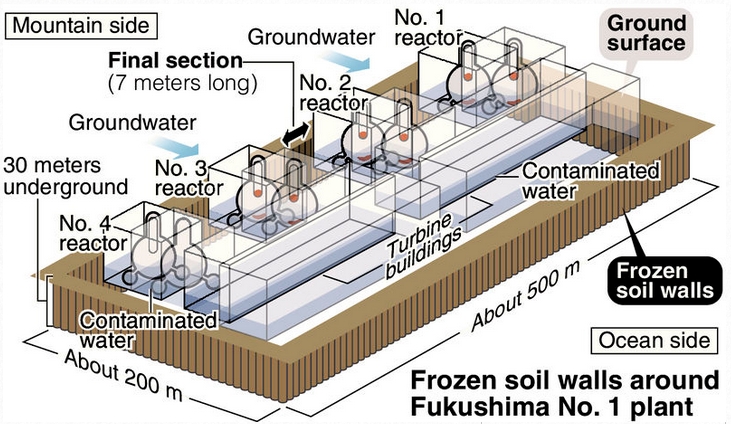
A construction project to create frozen soil walls that encircle the ground beneath Tokyo Electric Power Company Holdings Inc.’s disaster-hit Fukushima No. 1 nuclear power plant is nearly finished.
Although TEPCO insists that the inflow of groundwater beneath the reactor buildings has been reduced, some members of the Nuclear Regulation Authority are skeptical about the project’s effectiveness. With ¥34.5 billion of public funds being spent on this project, the centerpeice of countermeasures for contaminated water, its cost-effectiveness is being carefully watched.
The project entails building a 1.5-kilometer-long frozen soil wall encircling the Nos. 1 to 4 reactors, with 1,568 pipes buried to a depth of about 30 meters below ground and coolant running through the pipes at minus 30 C to chill the soil.
The process is expected to prevent groundwater from flowing into the contaminated, highly radioactive underground water at such sites as the reactor buildings, and to avoid an increase of contaminated water.
The project began in March last year, and operations to freeze the final section, about seven meters wide, on the mountain side began in August this year.
The temperature of the underground soil has remained below zero, except for a part close the surface that is affected by outdoor air, meaning the project to create the 30-meter-deep walls is almost complete.
According to TEPCO’s assessment, before the project started, about 400 tons of groundwater was flowing into the ground underneath the reactor buildings and other sites daily.
TEPCO had initially calculated that the daily inflow of groundwater could decrease to dozens of tons once the walls were installed. However, between April and September the inflow per day was between 120 tons and 140 tons, and in October it was around 100 tons. That the amount of inflow has decreased in stages as the soil freezing progressed seems to prove that the project has been effective to a certain extent. However, it is unclear if the inflow will decrease further in the future.
In parallel with the frozen soil wall project, TEPCO dug about 40 subdrain wells to pump up groundwater before it flows into the reactor buildings. It also reinforced measures to prevent rainwater from soaking into the ground by paving 1.33 million square meters of surface.
In the NRA view, those measures must also contribute greatly to reducing the inflow, casting doubt on the frozen soil walls project by saying the effect of them alone may be limited. The agency has become distrustful of TEPCO and urged the company to verify the effects.
Hiroshi Miyano, visiting professor at Hosei University specializing in system safety, said: “There is sure to be a part that doesn’t freeze completely, and it’s impossible to reduce the inflow to zero. TEPCO must continue applying this measure in tandem with draining the nearby wells for a while.”
November 9, 2017
Posted by dunrenard |
Fukushima 2017 | Fukushima Daiichi, Ice wall |
Leave a comment
From Majia’s Blog
Did you see the article by Jeff McMahon in Forbes covering research by Dr. Shin-ichi Hayama, a wildlife veterinarian studying Fukushima’s contaminated monkeys:
Jeff McMahon (2017, October 30). Three Ways Radiation Has Changed The Monkeys Of Fukushima. Forbes, https://www.forbes.com/sites/jeffmcmahon/2017/10/30/three-ways-radiation-has-changed-the-monkeys-of-fukushima-a-warning-for-humans/#15b788165eac
The Japanese macaques show effects associated with radiation exposure—especially youngsters born since the March 2011 meltdowns at the Fukushima-Daiichi Nuclear Power Plant, according to a wildlife veterinarian who has studied the population since 2008… [The three changes include]:
Smaller bodies
Smaller heads and brains
Anemia: “The monkeys show a reduction in all blood components: red blood cells, white blood cells, hemoglobin, and the cells in bone marrow that produce blood components.”
Findings expressed in graphs show clear correlation between level of exposure and biological problems, such as a reduction in white blood cells.
Perhaps even more concerning is the lack of recovery observed by Dr. Hayama:
“We have taken these tests from 2012 through 2017, and the levels have not recovered. So we have to say this is not an acute phenomenon. It has become chronic, and we would have to consider radiation exposure as a possible cause,” Hayama said.
You can read the full study and previous research:
Shin-ichi Hayama, Moe Tsuchiya, Kazuhiko Ochiai, Sachie Nakiri, Setsuko Nakanishi, Naomi Ishii, Takuya Kato, Aki Tanaka, Fumiharu Konno, Yoshi Kawamoto & Toshinori Omi (2017) Small head size and delayed body weight growth in wild Japanese monkey fetuses after the Fukushima Daiichi nuclear disaster. Scientific Reports 7, Article number: 3528 (2017) doi:10.1038/s41598-017-03866-8Kazuhiko Ochiai, Shin-ichi https://www.nature.com/articles/s41598-017-03866-8
Hayama, Sachie Nakiri, Setsuko Nakanishi, Naomi Ishii, Taiki Uno, Takuya Kato, Fumiharu Konno, Yoshi Kawamoto, Shuichi Tsuchida & Toshinori Omi (2014) Low blood cell counts in wild Japanese monkeys after the Fukushima Daiichi nuclear disaster Scientific Reports 4, Article number: 5793 (2014) doi:10.1038/srep05793https://www.nature.com/articles/srep05793
Two other studies that have documented biological effects from Fukushima radiation exposure include the following:
A. Moller, A. Hagiwara, S. Matsui, S. Kasahara, K. Kawatsu, I. Nishiumi, H. Suzuki, K. Ueda, T. and A. Mousseau (2012) ‘Abundance of Birds in Fukushima as Judged from Chernobyl’, Environmental Pollution, 164, 36-39.
A. Hiyama, C. Nohara, S. Kinjo, W. Taira, S. Gima, A. Tanahara, and J. Otaki (2012) ‘The Biological Impacts of the Fukushima Nuclear Accident on the Pale Grass Blue Butterfly’, Scientific Reports, 1-10.
No one really knows what is going to happen in a nuclear waste land. There are so many uncertainties and contingencies but one thing is certain and that is that increased levels of radionuclides in air, water, soil, and food disrupt the established patterns of life upon which we depend.
http://majiasblog.blogspot.fr/2017/11/fukushimas-radioactive-legacy.html?m=1
Chernobyl Birds Have Smaller Brains
November 6, 2017
Posted by dunrenard |
Fukushima 2017 | Fukushima Radiation, Monkeys |
1 Comment
Better than none, but how long do people have to stay in those temporary?
But even better would be to stop nuke.
Nobody can ever be fully protected when a nuclear reactor goes wrong, and expect it soon or later to go wrong, and most certainly in a country with many volcanos and earthquakes as Japan.
Nuclear safety is an oxymoron for the morons who believe it.
Clean air domes for evacuees to be introduced in Ikata, Ehime Prefecture, in the event of a nuclear disaster
IKATA, Ehime Prefecture–A nuclear power plant operator is readying folding domes here to provide shelter for up to 600 evacuees in the event of a nuclear accident.
Shikoku Electric Power Co. said Oct. 24 that it plans to install eight clean air domes at Ikata’s three evacuation centers west of the town’s nuclear power plant to protect residents from radiation.
The special shelters are expected to cost a total of 200 million yen ($1.76 million) and will be introduced by June next year.
It will be the first time for a power company to set up evacuation clean air domes in municipalities that are home to nuclear power plants, according to Shikoku Electric, although municipalities and other parties in Fukui Prefecture own such domes themselves.
The Ikata plant is situated at the root of the Sadamisaki Peninsula, which stretches east to west. Because 4,700 people live to the west of the plant, a big challenge is how to evacuate them when roads are blocked in a disaster.
In April, Shikoku Electric started considering introducing air domes to protect evacuees at temporary shelters in Ikata and began talks with Ehime Prefecture and Ikata town in late August to discuss the domes’ installation locations and total capacity as well as other topics.
The planned air domes will be made of polyester and measure 10 meters wide, 4 meters high, and 15 to 25 meters long. They will be equipped with air cleaning units that can remove more than 99 percent of radioactive materials such as cesium and iodine.
As evacuees are expected to stay in the domes for a week, they will also be furnished with toilets.
The domes can be folded into small sheets when stored, and four people can set one up in an hour, according to Shikoku Electric officials.
While three domes with a total capacity of 250 people will be introduced at the Seto Sogo gymnasium, three domes for 250 people and two domes for 100 people will also be deployed to the Misaki Sogo gymnasium and the gymnasium for Misaki elementary and junior high schools, respectively.
Those anti-radiation domes are to be set up inside the gymnasium buildings at the time of a nuclear crisis.
Maintenance and installation of the domes will be conducted by Shikoku Electric, whereas water, food and daily commodities for evacuees will be supplied by the town government.
Although the operations of the No. 2 reactor at the Ikata plant have been suspended, Koichi Tamagawa, an executive vice president of Shikoku Electric who is in charge of the Nuclear Power Division, on Oct. 24 reaffirmed the company’s intention to decide whether to restart the reactor by the end of this fiscal year.
November 6, 2017
Posted by dunrenard |
Japan | Ikata NPP |
Leave a comment
FUKUSHIMA – Blanket radiation checks on rice produced in nuclear disaster-hit Fukushima Prefecture have come under debate because no rice with radiation exceeding the safety limit has been found in recent years.
Some people, including producers, in the prefecture call for continuing the current system because there are consumers who still avoid Fukushima produce. But the blanket checks are costly and require a lot of manpower.
The prefectural government hopes to decide by year-end whether to change the radiation checks, starting with rice that will be harvested next year, officials said.
The blanket checks were introduced after many parts of the prefecture were contaminated with radioactive substances released because of the 2011 nuclear disaster at Tokyo Electric Power Company Holdings Inc.’s Fukushima No. 1 power plant.
Fukushima rice is put through radiation checks bag by bag before shipment. The safety limit is set at 100 becquerels per 1 kg of rice.
Rice that pass the checks have certification labels attached to the bags before being put through distribution channels.
According to Fukushima officials, the total amount of rice harvested last year and checked by the end of September this year reached 10.26 million bags.
To cover the expenses, the prefectural government collects ¥5 billion from Tepco each year. Some ¥500 million to ¥600 million in personnel expenses are covered with state subsidies.
The prefecture conducted radiation checks on a total of 53.13 million bags of rice harvested between 2012-2016. Total costs reached ¥30.5 billion.
The blanket check system began with the 2012 rice. At that time, 71 of the 867 bags checked exceeded the safety limit. But no such rice was detected at all for the 2014-2016 rice.
As of Oct. 25 this year, radiation levels stood below the minimum detectable level of 25 becquerels for 99.99 percent of the 2016 rice that underwent the checks.
The absence of above-limit rice has led some people to question the blanket check system. The continuance of the system may be making the unintended effect of fueling consumer concern about Fukushima rice, one critic said.
To discuss the fate of the blanket system, the prefecture set up a group with members of agricultural and consumer organizations in July this year.
The group will examine the issue based on opinions from more than 300 local farmers and seven wholesale companies in the Tokyo metropolitan area. It will also conduct an internet survey of 2,000 consumers nationwide.
Hisao Tomita, a farmer working in the city of Fukushima, called for the continuance of the current system even though it is burdensome also to producers.
As long as Fukushima rice is affected by negative rumors, radiation checks should be maintained even if they have to be scaled back, he said.
November 6, 2017
Posted by dunrenard |
Fukushima 2017 | Contaminated Foods, Fukushima Contamination |
Leave a comment
TAIPEI – The Japanese Chamber of Commerce and Industry is urging Taiwan to ease its ban on food imports from five prefectures imposed as a result of the Fukushima nuclear disaster.
In its annual white paper released Friday, the Taipei branch of the business group expressed hope that Taiwan will work to join regional economic cooperation agreements and sign a free trade deal with Japan.
“To create an environment conducive to regional participation in economic liberalization, Taiwan must amend regulations that are applied only here and run counter to international practices,” it said.
The chairman of the JCCI’s Taipei branch, Takeshi Yagi, cited two examples: The high tariffs imposed on Japanese rice wines and the ban on food imports from Fukushima and surrounding areas in place since 2011.
Last November, Taiwan was considering easing the import ban in two stages.
In the first stage, while the ban on imports of all food products from Fukushima Prefecture would remain in place, the ban on certain items from nearby Ibaraki, Gunma, Tochigi and Chiba prefectures would be lifted. In the second stage, to be implemented possibly six months later, restrictions would be further relaxed.
But that plan faced strong opposition from the opposition Nationalist Party (KMT), which questioned the government’s ability to ensure the safety of the products. And the government backed away from the plan following revelations that banned food products had nevertheless slipped into the country and been sold.
While the JCCI hopes to see the ban lifted fully, Yagi said it would be happy to see it eased in a phased manner.
On regional economic integration, Yagi said the JCCI is not in a position to comment on how Taiwan’s strained relations with China might impact its bid to join regional trading blocs such as the Trans-Pacific Partnership.
But the JCCI did urge Taiwan to map out more concrete plans concerning its “New Southbound Policy,” which calls for bolstering relations with the 10-member Association of Southeast Asian Nations plus Australia, New Zealand and nations in South Asia.
Regarding purely domestic issues, the JCCI urged Taiwan to amend labor laws, cut red tape and ease rules for foreign investors.
The JCCI began releasing an annual white paper on business issues pertaining to Taiwan in 2009. The report assesses Taiwan’s business climate and summarizes recommendations to the Taiwan government on public policies, legislation and measures that impact Japanese companies’ operations in Taiwan.
Despite the absence of official diplomatic ties, which were severed in 1972, the unofficial relationship between Taiwan and Japan has remained robust. Japan is Taiwan’s third-largest trading partner after China including Hong Kong, while Taiwan is Japan’s fourth-largest trading partner.
November 6, 2017
Posted by dunrenard |
Fukushima 2017 | Contaminated Foods, Fukushima, Japan Food Exports, Taiwan |
Leave a comment
Chris Busby published an answering to this paper. As soon as I am getting it, I will add it here below this paper.
By Bertrand R. Jordan – Unité Mixte de Recherche 7268 ADÉS, Aix-Marseille Université/Etablissement Français du Sang/Centre National de la Recherche Scientifique, Espace éthique méditerranéen, Hôpital d’Adultes la Timone, 13385 Marseille Cedex 05, France
ABSTRACT The explosion of atom bombs over the cities of Hiroshima and Nagasaki in August 1945 resulted in very high casualties, both immediate and delayed but also left a large number of survivors who had been exposed to radiation, at levels that could be fairly precisely ascertained. Extensive follow-up of a large cohort of survivors (120,000) and of their offspring (77,000) was initiated in 1947 and continues to this day. In essence, survivors having received 1 Gy irradiation ( 1000 mSV) have a significantly elevated rate of cancer (42% increase) but a limited decrease of longevity ( 1 year), while their offspring show no increased frequency of abnormalities and, so far, no detectable elevation of the mutation rate. Current acceptable exposure levels for the general population and for workers in the nuclear industry have largely been derived from these studies, which have been reported in more than 100 publications. Yet the general public, and indeed most scientists, are unaware of these data: it is widely believed that irradiated survivors suffered a very high cancer burden and dramatically shortened life span, and that their progeny were affected by elevated mutation rates and frequent abnormalities. In this article, I summarize the results and discuss possible reasons for this very striking discrepancy between the facts and general beliefs about this situation.
THE first (and only) two A-bombs used in war were deto-nated over Hiroshima and Nagasaki on August 6 and 9, 1945. Casualties were horrendous, approximately 100,000 in each city including deaths in the following days from severe burns and radiation. Although massive bombing of cities had already taken place with similar death tolls (e.g., Dresden, Hamburg, and Tokyo, the latter with 100,000 casualties on March 9, 1945), the devastation caused by a single bomb was unheard of and remains one of the most horrifying events in the past century. The people who had survived the explosions were soon designated as Hibakusha and were severely discrim-inated against in Japanese society, as (supposedly) carriers of (contagious?) radiation diseases and potential begetters of malformed offspring. While not reaching such extremes, the dominant present-day image of the aftermath of the Hiroshima/ Nagasaki bombings, in line with the general perception of radiation risk (Ropeik 2013; Perko 2014), is that it left the sites heavily contaminated, that the survivors suffered very serious health consequences, notably a very high rate of cancer and other debilitating diseases, and that offspring from these sur-vivors had a highly increased rate of genetic defects. In fact, the survivors have been the object of massive and careful long-term studies whose results to date do not support these conceptions and indicate, instead, measurable but limited det-rimental health effects in survivors, and no detectable genetic effects in their offspring. This Perspectives article does not provide any new data; rather, its aim is to summarize the results of the studies undertaken to date, which have been published in more than 100 papers (most of them in interna-tional journals), and to discuss why they seem to have had so little impact beyond specialized circles.
Bombings and Implementation of Cohort Studies
Characteristics of the bombs and the explosions

Figure 1 Number of solid cancers ob-served up to 1998 in the exposed group; the white portion indicates the excess cases associated with radiation (compar-ison with the unexposed group). Data are from Preston et al. (2007).
The device used at Hiroshima was based on enriched uranium and exploded at an altitude of 600 m with an estimated yield equivalent to 16 kilotons of high explosive. The bomb at Nagasaki was based on plutonium and exploded at 500 m with a yield of 21 kilotons. The major effect of both bombs was an extreme heat and pressure blast accompanied by a strong burst of gamma radiation and a more limited burst of neutrons. The heat blast set the (mostly wooden) buildings on fire in a radius of several kilometers and resulted in an extensive fire-storm centered on the explosion site (also called the hypocen-ter). People were exposed to the combined heat and radiation blasts, with little shielding from the buildings; most of those located within 1.5 km of the hypocenter were killed. The contribution of fallout from these explosions, which occurred mostly as “black rain” in the following days, is not precisely known: few measurements were taken due to scarcity of equipment, and investigations in the first months were per-formed by the US army and subsequently classified. It was probably limited: the bombs exploded at a significant altitude, the resulting firestorm carried the fission products into the high atmosphere, and the eventual fallout was spread over a large area. In addition, a strong typhoon occurred 2 weeks after the bombings and may have washed out much of the materiel. The major health effects (other than the heat blast and accompanying destruction) were almost certainly due to the gamma and neutron radiation from the blasts themselves, and these doses can be quite reliably estimated from the dis-tance to the hypocenter. Thus studies on the survivors can ascertain the health effects of a single, fairly well-defined dose of gamma radiation with a small component from neutrons.
The Atomic Bomb Casualty Commission and the Radiation Effects Research Foundation
Continue reading →
November 4, 2017
Posted by dunrenard |
radiation | Discrepancies, Hiroshima, Nagasaki, Survivors |
6 Comments
Official storage of contaminated soil begins in Fukushima
Contaminated soil produced during cleanup in communities affected by the 2011 Fukushima nuclear disaster is carried on belt-conveyers covered with plastic sheets at an interim storage site in Okuma, Fukushima Prefecture, on Oct. 28.
OKUMA, Fukushima Prefecture–Hailed by the government as a major step to rebuilding, radioactive soil from the cleanup of municipalities impacted by the 2011 Fukushima nuclear disaster began arriving at an interim storage site here on Oct. 28.
However, officials and residents with the towns of Okuma and Futaba fear the repository may end up being permanent as finding a final resting place outside Fukushima Prefecture is expected to be extremely difficult.
Still, local governments welcomed the start since rebuilding has been hampered by the countless number of bags containing polluted soil that have been kept in backyards.
“We are hoping to remove as many bags of contaminated soil as possible from people’s living spaces,” said Tadahiko Ito, vice environment minister who inspected the site on Oct. 28.
All the soil there is supposed to be taken out of the prefecture by March 2045 for final disposal under the law.
The repository began operating at the site, where soil from low-level pollution will be kept after being brought in via a belt-conveyor system. Bulldozers will afterward flatten the surface.
After a certain amount of soil is brought in, the ground will be covered with uncontaminated soil. The site can hold about 50,000 cubic meters of soil, according to the Environment Ministry, which oversees the project.
The ministry began building the interim storage facility about a year ago. As of the end of September, contracts had been signed for about 40 percent of the 1,600 hectares of land needed for storage in Okuma and Futaba, which co-host the crippled Fukushima No. 1 nuclear power plant.
A total of seven facilities will be built to keep polluted soil.
The ministry also plans to complete two facilities to store more radioactive waste in fiscal 2019.
Overall construction costs are estimated at 1.1 trillion yen ($9.67 billion) for all the interim storage facilities.
They can store up to 22 million cubic meters of soil and other waste.
According to the ministry, about 15.2 million cubic meters of contaminated soil from decontamination work are piled up or buried at about 150,000 location in Fukushima Prefecture, including plots near houses and schoolyards.
The ministry envisages moving 12.5 million cubic meters of the total to the interim sites by the end of March 2021.
Sprawling radioactive waste storage facility opens for business in Fukushima
A new facility in the town of Okuma, Fukushima Prefecture, starts storing radioactive waste generated by the 2011 nuclear crisis on Saturday.
The government’s new radioactive waste storage facility in Fukushima Prefecture kicked into full gear on Saturday after completing a roughly four-month trial run.
While the facility near the crippled Fukushima No. 1 nuclear complex is designed to store soil and other tainted waste collected during decontamination work for up to 30 years, it remains only half complete six years after the triple core meltdown struck in March 2011.
An estimated 22 million cu. meters of contaminated waste exists in Fukushima, but the facility does not yet have enough capacity to store it all, and residents fear it will sit there permanently in the absence of a final disposal site.
The government has been able to buy only 40 percent of the land so far but eventually plans to secure 1,600 hectares for the facility, which is expected to generate ¥1.6 trillion ($14.1 billion) in construction and related costs.
The storage facility is urgently needed to consolidate the 13 million cu. meters of radioactive waste scattered around the prefecture. The prolonged disposal work, among other concerns, is said to be keeping residents away from their hometowns even when the evacuation orders are lifted.
Also on Saturday, the government began full operation of a facility where waste intended for incineration, such as trees and plants, is separated from the rest.
Contaminated soil is sorted into different categories depending on cesium level before storage.
Work to store tainted soil at Fukushima facility begins
Tainted soil is brought into an interim storage facility for radioactive waste in Fukushima Prefecture on Saturday.
FUKUSHIMA (Jiji Press) — The Environment Ministry started Saturday bringing tainted soil to one of its interim storage facilities for radioactive waste in Fukushima Prefecture.
Soil generated from work to decontaminate areas hit by fallout from the March 2011 triple meltdown at Tokyo Electric Power Co. Holdings Inc.’s disaster-damaged Fukushima No. 1 nuclear plant has temporarily been piled up in about 1,100 places within the prefecture.
Shifting the soil and other radioactive waste to the storage facilities, to be finally built on a 1,600-hectare site straddling the towns of Okuma and Futaba, is expected to make it smoother to reconstruct areas devastated by the nuclear accident as well as the massive earthquake and tsunami that triggered the accident.
On Sunday, 36 cubic meters of contaminated soil arrived at the facility from a temporary storage in Okuma.
“I hope all tainted soil and other waste will be removed from living spheres in the prefecture as soon as possible,” State Environment Minister Tadahiko Ito told reporters after watching the work.
But over 60 percent of the overall construction site remained to be acquired as of the end of September, and facilities to burn plant waste and store ashes with high cesium levels have yet to be built.
Please read also these related articles :
Issues of Incineration Disposal of Agricultural and Forestry Radioactive Wastes in Fukushima Prefecture by Toshikazu Fujiwara
How long shall we accept Japan to pollute our skies with incineration of radioactive materials?
About the Incineration of Fukushima Decontaminated Soil and Debris
October 30, 2017
Posted by dunrenard |
Fukushima 2017 | Incineration, Okuma-Futaba Facility, Storage |
Leave a comment
TEPCO to scrap all 1,010 vehicles contaminated in nuclear disaster
1,010 only? Meaning to say that out of a 2 millions population in Fukushima prefecture, on March 2011 no other vehicle was contaminated, only 1,010 vehicles at Fukushima Daiichi nuclear plant were contaminated…..What about the other cars, those contaminated outside of the Fukushima Daiichi nuclear plant, I mean those which were not sold and exported to Russia and to some other countries as second hand cars by some very honest Japanese businessmen?
I remember that the Russian Customs spotted and blocked entry to quite a few of those unaccounted contaminated cars in 2011, 2012, 2013…..That those cars were approved for export by the Japanese government authorities is beyond my understanding, no wonder that all those people’s contaminated vehicles were conveniently ignored and unaccounted for..…
It seems like a fairly large number for cars used on-site, and I wonder if TEPCO bought out some of those tainted cars from the owners (and then continued using them?) or if they were company cars from the start…?
Those 1,010 vehicles will be scrapped and sent where? Sold to some scrap dealer who will sell them to yakuza who will sell to….?
The red sticker shows that this vehicle was contaminated during the Fukushima nuclear disaster. It is designated for use only on the site of the crippled Fukushima No. 1 nuclear power plant.
All 1,010 vehicles contaminated by the 2011 Fukushima nuclear disaster that are currently designated for use at the crippled plant will be scrapped by the end of fiscal 2020, the plant operator said.
Tokyo Electric Power Co. officials said it is now undesirable for automobiles tainted with radioactive substances to continue operating at the site of the Fukushima No. 1 nuclear power plant, which is becoming cleaner thanks to decontamination and other efforts.
The officials said Oct. 12 that all contaminated vehicles will be replaced with clean automobiles.
The decision was announced when members of the Fukushima prefectural government’s panel on occupational safety and health measures inspected facilities at the plant, including one for dismantling contaminated vehicles.
The panel includes experts in nuclear power technology and local government officials.
TEPCO officials said about 1,100 vehicles for business use and 600 automobiles of workers were at the plant site when the disaster unfolded.
Currently, 1,010 contaminated automobiles have red stickers showing that they were contaminated in the disaster.
However, 181 of them have fallen into disuse and others have long remained idle. That has caused problems, including a shortage of parking spaces.
October 30, 2017
Posted by dunrenard |
Fukushima 2017 | Contaminated Vehicles, Fukushima Daiichi |
Leave a comment







 nuclear-news