Fukushima Cover-Up and Denial

Adam Broinowski, visiting research fellow at The Australian National University, 2017
Faced with the post-3.11 reality of government (and corporate) policy that protects economic and security interests over public health and well-being, the majority of the 2 million inhabitants of Fukushima Prefecture are either unconscious of or have been encouraged to accept living with radioactive contamination…
As Fukushima city resident Shiina Chieko observed, the majority of people seem to have adopted denial as a way to excise the present danger from their consciousness. Her sister-in-law, for example, ignored her son’s ‘continuous nosebleeds’, while her mother had decided that the community must endure by pretending that things were no different from pre-3.11 conditions. [Source: Shiina Chieko, interview with the author]…
Some, such as Yokota Asami (40 years old), a small business owner and mother from Kōriyama (60 km from FDNPS), demonstrated initiative in voluntarily evacuating her family. She decided to return (wearing goggles and a mask, she joked) in September 2011 when her son’s regular and continuous nosebleeds (in 30-minute spells) subsided. The Yokotas found themselves the victims of bullying when they called attention to radiation dangers… Her son was the only one to put up his hand when he was asked along with 300 fellow junior high school students if he objected to eating locally produced school lunches. He also chose not to participate in outdoor exercise classes and to go on respite trips instead. When it came time to take the high school entrance exam, he was told by the school principal that those who took breaks could not pass. He took the exam and failed. When he asked to see his results he found that he had, in fact, enough points to pass (the cut-off was 156 while he received 198 out of 250 points). [Source: Yokota Asami, interview with the author]…
Asami reported that doctors undertook paediatric thyroid operations while denying any correlation (inga kankei) with radiation exposures. They also urged their patients to keep their thyroid cancer a secret… Yokota also indicated she knew of students having sudden heart attacks and developing leukaemia and other illnesses. [Source: Yokota Asami, interview with the author]
This seems to be supported by Mr Ōkoshi, a Fukushima city resident, whose two daughters experienced stillbirths after 3.11. While Ōkoshi found that doctors have regularly advised women in the area to abort after 3.11, presumably to avoid miscarriages and defects, they do not discuss direct causes. He also observed regular illnesses experienced by many of his friends, and some sudden deaths. After a friend (62 years old) started saying strange things, he was diagnosed with brain dysfunction. He died quickly. Another friend (53 years old) was advised by a doctor to monitor a polyp in her breast. When she sought second opinions, she discovered she had accumulated an internal dose of 22 mSv and had a rapidly developing liver cancer. She also died quickly. [Source: Mr Ōkoshi, interview with the author]
There are many more such stories that are being actively ignored by the authorities. As Shiina put it, ‘we’re getting leukaemia and cataracts and we die suddenly. The TEPCO registrar has been inundated with complaints’. [Source: Shiina Chieko, interview with the author]
New Study: Over a Trillion becquerels of Fukushima radiocesium fell on Hawaii

University of Hawai’i at Mānoa, Oct 31, 2017
Fukushima-derived radiocesium fallout in Hawaiian soils… This study estimated the magnitude of cesium deposition in soil, collected in 2015-2016, resulting from atmospheric fallout… Detectable, Fukushima-derived 134Cs inventories ranged from 30 to 630 Bq m-2 and 137Cs inventories ranged from 20 to 2200 Bq m-2… This research confirmed and quantified the presence of Fukushima-derived fallout in the state of Hawai’i in amounts higher than predicted by models and observed in the United States mainland…
The Hawaiian Islands were expected to get minimal, below 10 Bq m-2 or lower, of Fukushima-derived fallout…
Fukushima-derived soil radiocesium concentrations, were greater than anticipated based on model-predicted Pacific atmospheric dispersion rates…
Maximum estimated values of 134Cs fallout on the islands of Hawaii and O’ahu constrained by precipitation and data from sites with less than 70% canopy cover were obtained by linear interpolation of all measured soil cesium concentrations, resulting in 134Cs fallout ranging from < 60 to 1000 Bq m-2 [According to this study, “The Fukushima-derived fallout… 134Cs to 137Cs ratio was 1:1” — therefore 137Cs fallout from Fukushima was also 60 to 1000 Bq m-2, making the total radiocesium 120 to 2000 Bq m-2. Compare this to the study’s previous statement that “The Hawaiian Islands were expected to get minimal, below 10 Bq m-2 or lower, of Fukushima-derived fallout”]…
Using the conservative values and integrating over the whole area with rainfall above 200 mm, we estimate that the island of Hawaii received 1.50 x 10^12 Bq [1.5 Trillion Bq] of 134Cs and 137Cs, each isotope contributing 50%, between March 19 and April 4, 2011…
Atmospheric dispersion models predicted the majority of the plume to travel a more northern route over the Aleutian Islands… however, suggesting that the Fukushima-derived aerosol plume may have taken an alternative southern path. Our radiocesium fallout inventories are comparatively higher than those estimated and measured in North America. Previous research that used whole-water wet deposition to predict ‘its fallout in North America estimated up to 180 Bq m -2 in Alaska, 46 Bq m -2 in California, and 29 Bq m -2 in Washington State…
This is the first study to our knowledge studying Fukushima-derived fallout in the Pacific Islands…
Fukushima-derived radiocesium fallout in Hawaiian soils
Activists call on artists to join protests against 2020 Olympics in Tokyo
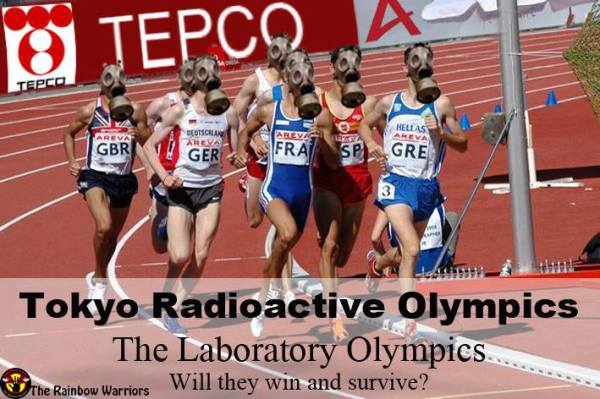
The idea of the Olympics as a sporting event complemented by culture goes back to Pierre de Coubertin, the founder of the modern Games. The Olympic Charter also states that the Olympic Movement is composed of sport, culture and education. These elements were often blended, as in the prewar Games that included such events as poetry and painting. From 1912 to 1948, arts competitions were held in parallel with the sporting events, though growing discontent meant this curiously hybrid system was jettisoned in favour of separate arts and cultural festivals held alongside the sports. From Barcelona in 1992, the idea of a Cultural Olympiad took hold, whereby a series of arts and cultural events would be organized during the four-year Olympiad period to culminate with the Games, though this had already happened de facto at past Games.
Now the leading figures in the protest movement against the 2020 Tokyo Olympics have called for an anti-Cultural Olympiad. In the recently published Anti-Olympics Arts Council Statement of Purpose, activists point to the destruction of public housing and eviction of homeless people as part of the preparations for the Olympics in Tokyo. The statement ends with a call to action:
For residents of urban areas, and especially the poor, the Olympic/Paralympic Games are nothing but a huge catastrophe. We, the Anti-Olympic Arts Council, call for you to resist and protest against these mega events. We call on artists, performers, poets, and all that use the arts as their medium—oppose the Olympic Games.
It is often said that artists in Japan have avoided direct political engagement in past decades, preferring more oblique modes of socially engaged practice, though the post-Fukushima zeitgeist has certainly produced some prominent examples of overtly politicized art. The prospect of the Olympics and Cultural Olympiad in 2020, given the geopolitical situation in the region as well as such ongoing major socio-cultural questions as Fukushima, Constitutional change and Japan’s demographic time bomb, necessarily conjure up a dilemma for the arts. How will the arts respond? Will artists protest, ignore, borrow or participate?
The most notable and lasting case of an artistic response to the 1964 Tokyo Summer Olympics is surely Kon Ichikawa’s nearly three-hour documentary film Tokyo Olympiad (1965). Arguably, the Olympics “propaganda” film subverts the brief, focusing on many of the small moments and the ordinary people among the spectators. It starts with the rising sun and then a wrecking ball while the narration enumerates the iterations of the modern Games and their host cities. The Olympics have noble aspirations, as Ichikawa acknowledges from the opening epigraph, but the reality, at least initially, is demolition. It ultimately segues into a somewhat more predictable, yet staggeringly meticulous, hymn to the facilities created for the 1964 sporting events, the participating athletes and the competitions themselves, but the underlying social commentary is more subtle.
The 1964 Olympics were more conspicuously satirised by the art collective Hi-Red Center when its members set about cleaning the streets of Ginza in white lab coats, a stunt intended to mock the city’s attempts to spruce up its appearance ahead of the Games. Recent moves in Japan to expunge pornographic magazines from retail outlets is an indication of the “cleaning” likely to take place prior to 2020.
One of the early projects of Akira Takayama’s theater collective Port B examined both the famous 1964 Games but also Japan’s “phantom Olympics”, the 1940 Games that were canceled due to World War Two. Tokyo/Olympic (2007) was a tour several hours long around the city on a chartered Hato Bus that took in the sites of the 1964 Games, but finished rather unexpectedly at a rather desolate location in Tokyo Bay. Participants could look across the bay to see the artificial island of Yumenoshima (literally, “island of hope”), which was made from the city’s trash, and a projected venue for the abandoned 1940 Games. (See Peter Eckersall, “Memory and City: Port B and the Tokyo Olympics” in Performativity and Event in 1960s Japan: City, Body, Memory, Basingstoke: Palgrave Macmillan, 2013.) The bay area will play host to many of the venues for the 2020 Games at a time when the government, say its critics, is attempting to steer the nation back towards its prewar past.
The upcoming Olympics in Tokyo have already succeeded in coopting many artists for its pageantry. One of them is the singer Ringo Sheena, though she recently got flamed by liberals for her nationalist comments in a July interview with the Asahi Shimbun in which she declared that “the whole population is the organizing committee” for the Games. “In that sense, it’s very Japanese in its respect for harmony.” No individual opinions are anticipated.
More specifically, the direction and content of the actual 2020 Games’ cultural program is the source of much anxiety in the arts world in Japan, since so little is known. Certain commercially driven artists have been announced as part of the Cultural Olympiad, but firm details are still under wraps. So far what we have been shown has largely consisted of the “Tokyo Caravan” performances, overseen by Hideki Noda, beginning in 2015 and then continuing at Rio de Janeiro and Tokyo’s Roppongi Art Night in 2016. Ostensibly this would qualify the program as an “Olympiad”, even if the events are apparently mere previews without a genuine feeling of sequence or overall curation. Alongside the Roppongi Art Night performance, an event in autumn 2016 “fusing traditional arts and the latest technologies for which Japan is famous”, officially launched the Olympiad as an “ambitious programme of cultural activities”. The veracity of that boast remains to be seen.
It is certainly the case that various celebrities and artists will benefit financially from the Olympics and Cultural Olympic. One of the reasons that Expo ’70 in Osaka was also such an iconic event was the participation of major figures from the arts, though this was not without intense controversy at the time — so much so that an “anti-expo” was held. Now that there is an Anti-Olympics Art Council, perhaps we can expect such a counter-event, an Anti-Cultural Olympiad, in 2020.
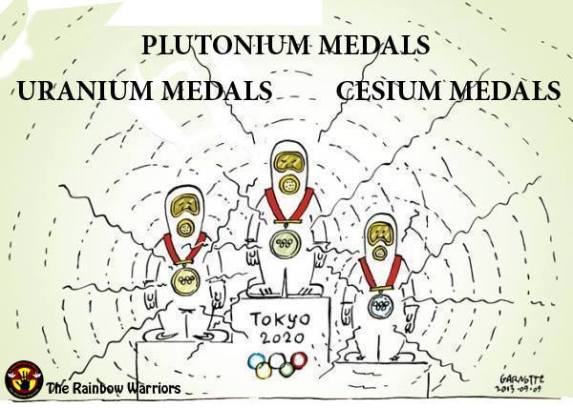
Fukushima: A million tonnes of radioactive water still in storage after nuclear disaster
To dump into the ocean a million tonnes of radioactive water should be considered by the international community a crime against humanity and an ecocide against the environment. Whatever they say, whatever they lied, it will never be totally decontaminated and it will never be safe, no matter how many shills on the mainstream media are paid by the nuclear lobby to spin fairy tales in order to brainwash the public about ‘safety’.
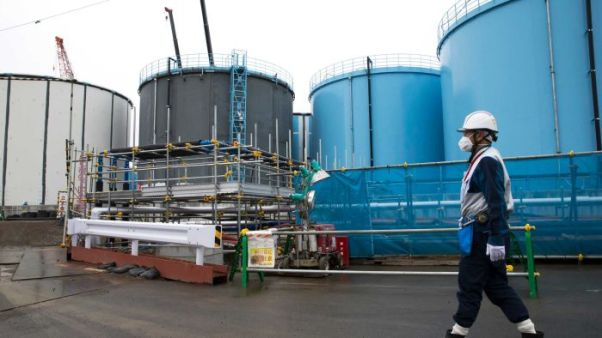
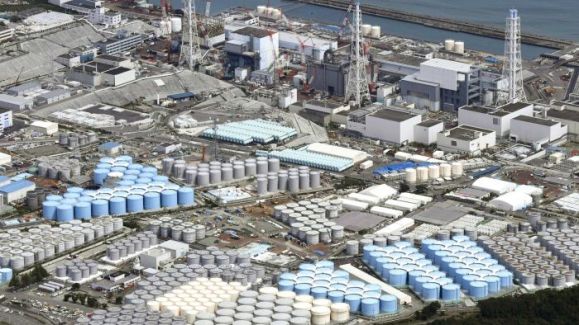
The water is being stored in hundreds of large and densely packed tanks at the plant.
Japan cannot agree on what to do with a million tonnes of radioactive water being stored at the destroyed Fukushima nuclear power plant — and there is a chance it could spill if another major earthquake or tsunami were to strike.
The water is being stored in about 900 large and densely packed tanks at the plant, which was overwhelmed by a devastating tsunami more than six years ago.
Making matters worse, the amount of contaminated water held at Fukushima is still growing by 150 tons a day.
The stalemate is rooted in a fundamental conflict between science and human nature.
Experts advising the government have urged a gradual release of the water to the nearby Pacific Ocean. Treatment has removed all the radioactive elements except tritium, which they say is safe in small amounts
Conversely, if the tanks break, their contents could slosh out in an uncontrolled way.
Local fishermen are balking — they say the water, no matter how clean, has a dirty image for consumers.
Fumio Haga, a drag-net fisherman from Iwaki, a city about 50 kilometres down the coast from the nuclear plant, said releasing the water would end the local industry’s fragile recovery.
“People would shun Fukushima fish again as soon as the water is released,” he said.
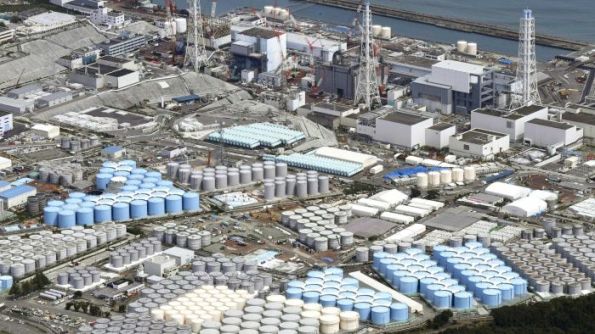
Experts want a gradual release, but if the tanks break the water would slosh out
A new chairman at TEPCO, the embattled utility that owns the plant, caused an uproar in the fishing community in April when he expressed support for moving ahead with the release of the water.
The company quickly backpedalled, and now says it has no plans for an immediate release and can keep storing water through 2020.
Despite tests, many shoppers avoid Fukushima fish
Today, only about half of the Fukushima region’s 1,000 fishermen go out, and just twice a week because of reduced demand.
They participate in a fish testing program that sees lab technicians mince fish samples, pack them in a cup for inspection and record details such as who caught the fish and where.
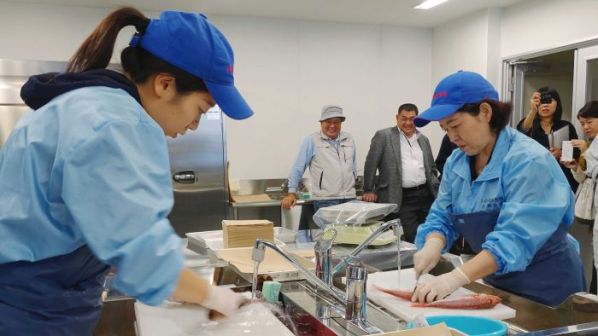
The fish that make it to market meet what is believed to be the world’s most stringent requirements.
Only three kinds of fish passed the test when the experiment began in mid-2012, 15 months after the tsunami. Over time, that number has increased to about 100.
The fish that make it to market meet what is believed to be the world’s most stringent requirements, but that message is not reaching consumers.
Fewer Japanese shoppers shun fish and other foods from Fukushima than before, but one in five still do, according to a survey by Japan’s Consumer Agency.
Naoya Sekiya, a University of Tokyo expert on disaster information and social psychology, said the water from the nuclear plant should not be released until people were well-informed about the basic facts, and are psychologically ready.
“A release only based on scientific safety, without addressing the public’s concerns, cannot be tolerated in a democratic society,” he said.
“A release when people are unprepared would only make things worse.”
11,800 homes to be destroyed in areas evacuated from the nuclear disaster
“Nothing will ever be the same again and no return to normal is possible.”
The homes of the evacuated areas have remained abandoned for several years after being damaged by the March 2011 earthquake. Many are no longer repairable and must be destroyed.
According to the latest data, in the 11 municipalities evacuated, there are 11,800 applications for demolition, not to count the most contaminated areas, modestly called difficult to return zones, 8,700 homes have already been demolished.
The Ministry of the Environment wanted to finish by March 2018, this may not be possible. They were 6,700 last April.
According to the Fukushima Minpo, new demands continue to arrive even after evacuation orders are lifted.
In Tomioka and Namié, where evacuation orders were lifted last April, more than 400 new demolition applications have been filed in each municipality since April 1, 2017, it’s more than the number of demolitions over the same period. The Ministry of the Environment is considering extending the deadline for filing applications.
This destruction of the living environment, landmarks and the past is one of the sad consequences of the nuclear disaster which caused prolonged evacuations. Nothing will ever be more like before and no return to normal is possible.
Demolition of decrepit homes progressing in Fukushima 6 years, 8 months after disaster
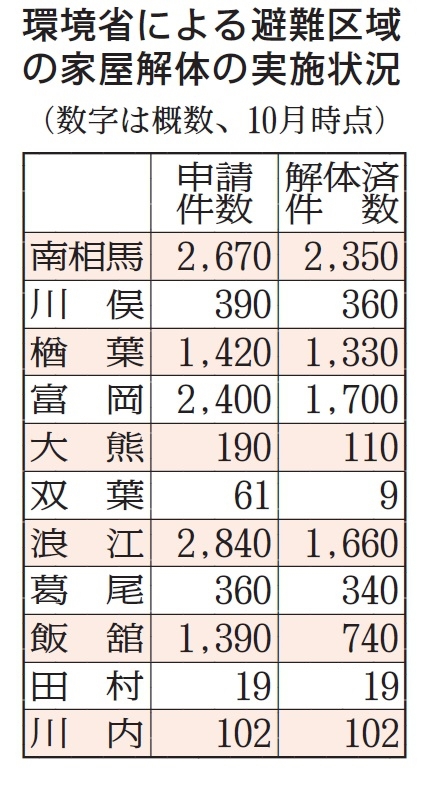
Dilapidated houses left in evacuated areas of Fukushima Prefecture following the 2011 nuclear accident at Tokyo Electric Power Co.’s Fukushima Daiichi plant are being torn down at a steady pace of late. Of some 11,800 homes subjected to demolition applications by October in 11 municipalities where evacuation zones were once set up, about 8,700, or 70%, have been scrapped. Difficult-to-return zones are not included in the demolition work. Applications have been increasing even after the start of fiscal 2017 in April in the towns of Namie and Tomioka where evacuation orders were lifted this spring. As of last year, the Environment Ministry had targeted work completion by the end of fiscal 2017 through next March. But attaining the goal remains uncertain at present.
■Accelerating demolition work
Of the residences for which demolition applications were in place, all 19 have been dismantled in Tamura city and all 102 in Kawauchi village. About 360 houses out of some 390 have been taken down in Kawamata town, about 1,330 out of some 1,420 in Naraha town and about 340 out of some 360 in Katsurao village, marking a progress rate of more than 90% each. In Minamisoma city, about 2,350 homes have been demolished, nearly 90% of some 2,670 requested.
As of last April, approximately 6,700 houses had been dismantled, about 60% of some 10,900 applied for. In half a year since then, roughly 2,000 residences were removed. The ministry spurred surveys, preparatory work and other undertakings necessary for demolition in an effort to establish a living environment for returning evacuees, focusing on areas where evacuation has been terminated.
■Demolition requests greater than expected in Namie, Tomioka
Of municipalities where evacuation orders were eliminated this spring, Tomioka saw demolition work completed on some 1,700 houses, about 70% of almost 2,400 targeted, Namie on roughly 1,660, approximately 60% of some 2,840, and Iitate village on about 740, only 50% of some 1,390. Notable are swelling demolition applications in Tomioka and Namie, where more than 400 requests have been submitted each since the start of fiscal 2017, far exceeding the pace at which demolition work was assumed to be undertaken for completion by the end of the fiscal year. According to the ministry, many evacuees live in places far away from their hometowns, requiring substantial time for them to confirm the current status of their houses before applying for demolition. Against this backdrop, it is set to wait and continue accepting further applications.
If the demolition of aging houses is prolonged, they pose the risk of collapsing, possibly causing adverse effects on the hygienic environment around them. “We have to undertake demolition work while securing safety amid progress in the permanent return of evacuees,” said an official of the ministry’s environment office in Fukushima, indicating difficulty to accelerate the work drastically. “But we want to complete the work as soon as possible.”
NEDO, Fukushima Pref. Sign Cooperation Pact on Robot Tests
“To revitalize Fukushima Prefecture”, signing of a technological cooperation agreement with NEDO (organization for the development of new energies and industrial technologies), for tests of drones and robots ; construction of a huge site of 50 hectares straddling the municipalities of Minamisoma and Namie …

Koriyama, Fukushima Pref., Nov. 22 (Jiji Press)–The New Energy and Industrial Technology Development Organization on Wednesday concluded a cooperation pact with the Fukushima prefectural government on the development of technologies for demonstration tests for drones and robots.
The organization, better known as NEDO, aims to establish technologies to accurately measure the durability and safety of drones and robots, utilizing the Fukushima Robot Test Field, a planned large test site over 50 hectares that straddles the city of Minamisoma and the town of Namie in a coastal region in the northeastern Japan prefecture.
The Fukushima government is building the site as part of efforts to revitalize the coastal region, devastated by the March 2011 earthquake and tsunami and the subsequent nuclear accident at Tokyo Electric Power Company Holdings Inc.’s <9501> Fukushima No. 1 power plant. The test site will partly enter into service in fiscal 2018.
Various demonstration tests will be conducted there, such as one to check a robot’s capabilities to conduct underwater inspections of old dams using a 7-meter-deep pool.
NEDO plans to develop technology to check whether drones can fly stably in strong wind. For this, the central government-linked organization will use a wind tunnel facility to be set up in the site.
Fukushima Darkness, Part Two
by Robert Hunziker
The impact of Fukushima Daiichi’s nuclear meltdown extends far and wide, as the hemispheric ecosystem gets hit by tons of radioactive water. Additionally, surreptitiousness surrounds untold death and illness, yet it remains one of the least understood and deceitfully reported episodes of journalism in modern history.
At the same time as Japan passed its totalitarian secrecy act in December 2013, it passed an obstructive Cancer Registration Law, which made it illegal to share medical data or information on radiation-related issues, denying public access to medical records, with violators subject to fines of two million Yen or 5-10 years in prison, a pretty stiff penalty for peeking into medical records, giving the appearance of somebody running scared.
Furthermore, and more egregiously yet, a confidentiality agreement to control medical information about radiation exposure was signed in January 2014 by IAEA, UNSCEAR, and Fukushima Prefecture and Fukushima Medical University. Thereafter, all info of illness from radiation is reported to a central repository run by Fukushima Medical Centre and IAEA. In turn, the Fukushima Centre for Environmental Creation was created in 2015 to communicate “accurate information on radiation to the public and dispel anxiety.” Ahem!
Well now, isn’t that convenient, a central depository controlled by the International Atomic Energy Agency –IAEA- to report on Fukushima Daiichi radiation exposure and medical illness. It’s not hard to figure that’s rotten to the core, sounding a lot like words lifted directly off the pages of George Orwell’s Nineteen Eighty-Four (1949).
Meanwhile, much, but not all, mainstream media reports about radiation-induced illnesses and deaths at Fukushima are feeble grossly incompetent journalism, as follows: “The latest update (in April) by the World Nuclear Association re the Fukushima disaster: There have been no deaths or cases of radiation sickness from the nuclear accident…” (Source: Michael W. Chapman, 5 Years Later, Deaths Caused by Radiation Leak at Fukushima -O-, CNS News, May 11, 2016).
According to The World Nuclear Association, as of October 2017: “There have been no deaths or cases of radiation sickness from the nuclear accident, but over 100,000 people were evacuated from their homes to ensure this. Government nervousness delays the return of many.”
Here’s one more statement of zero deaths at Fukushima, by Hannah Ritchie, published in Our World in Data, July 24, 2017: “In the case of Fukushima, although 40-50 people experienced physical injury or radiation burns at the nuclear facility, the number of direct deaths from the incident are quoted to be zero.”
And one more, an article in Forbes by Dr. James Conca, an expert on energy, nuclear and dirty bombs, “After Five Years, What Is The Cost Of Fukushima?” d/d March 10, 2016: “Strangely, the costs that never materialized were the most feared, those of radiation-induced cancer and death… No one received enough dose, even the 20,000 workers who have worked tirelessly to recover form this event.”
Au contraire, it is believed that official reports of Fukushima radiation-induced sicknesses and deaths are horribly underreported and/or intentionally manipulated to show few, if any, cases. Based upon numerous testimonials obtained by independent journalists and researchers in Japan and U.S, attorneys, there is considerable evidence of radiation-induced deaths and sicknesses.
Seemingly, somebody is dead wrong on the issue of radiation-induced deaths, whether it’s (1) official sources via mainstream news or (2) independent researchers/journalists/U.S. attorneys that claim to personally know of deaths. One of those two sources is dead wrong and seriously misleading the world, which, in and of itself, should be classified as a criminal act, like the Nazi Nuremberg trials (1945-49). In point of fact, if it can be proven that people are covering up and/or lying about Fukushima radiation-induced illness and death, they should be tried and imprisoned, similar to Nazi war criminals. The implications of widespread radiation are not a trifle.
When it comes to uncontrollable radiation, there’s an ecumenical obligation for full transparency as a basic right for all humanity, worldwide.
“It’s a real shame that the authorities hide the truth from the whole world, from the UN. We need to admit that actually many people are dying. We are not allowed to say that, but TEPCO employees also are dying. But they keep mum about it,” Katsutaka Idogawa, former mayor of Futaba (Fukushima Prefecture), Fukushima Disaster: Tokyo Hides Truth as Children Die, Become Ill from Radiation – Ex-Mayor, RT News, April 21, 2014.
Individual medical doctors in Japan have reported serious radiation-related problems, for example: “In April 2014, Dr Tsuda Toshihide, an epidemiologist at Okayama University, declared this a ‘thyroid cancer epidemic’ and predicted multiple illnesses from long-term internal radiation below 100 mSv/y and advocated for a program of outbreak (emergency or rapid) epidemiology in and outside Fukushima.” (Source: Adam Broinowski, PhD (author of 25 major academic publications and Post Doctoral Research Fellow, Australian National University): “Informal Labour, Local Citizens and the Tokyo Electric Fukushima Daiichi Nuclear Crisis: Responses to Neoliberal Disaster Management,” Australian National University, 2017.
“Similarly, a Tokyo-based physician, Dr Mita Shigeru, circulated a public statement notifying his colleagues of his intention to relocate his practice to Okayama due to overwhelming evidence of unusual symptoms in his patients (roughly 2,000). Given that soil in Tokyo post-Fukushima returned between 1,000 and 4,000 Bq/kg, as compared to an average of 500 Bq/kg (Cs 137 only) in Kiev soil, Mita pointed to a correlation between these symptoms and the significant radiation contamination in Tōhoku and metropolitan Tokyo.” (Broinowski)
“The ashes of half a dozen unidentified laborers ended up at a Buddhist temple in a town just north of the crippled Fukushima nuclear plant. Some of the dead men had no papers; others left no emergency contacts. Their names could not be confirmed and no family members had been tracked down to claim their remains. They were simply labeled “decontamination troops” — unknown soldiers in Japan’s massive cleanup campaign to make Fukushima livable again five years after radiation poisoned the fertile countryside,” (Source: Mari Yamaguchi, Fukushima ‘Decontamination Troops’ Often Exploited, Shunned, AP & ABC News, Minamisona, Japan, March 10, 2016).
Mako Oshidori, director of Free Press Corporation/Japan, investigated several unreported worker deaths, and interviewed a former nurse who quit TEPCO: “I would like to talk about my interview of a nurse who used to work at the Fukushima Daiichi Nuclear Power Plant (NPP) after the accident… He quit his job with TEPCO, and that’s when I interviewed him… As of now, there are multiple NPP workers that have died, but only the ones who died on the job are reported publicly. Some of them have died suddenly while off work, for instance, during the weekend or in their sleep, but none of their deaths are reported.” (Source: The Hidden Truth about Fukushima by Mako Oshidori, delivered at the International Conference, Effects of Nuclear Disasters on Natural Environment and Human Health held in Germany, 2014 co-organized by International Physicians for Prevention of Nuclear War).
“They are not included in the worker death count. For example, there are some workers who quit the job after a lot of radiation exposure… and end up dying a month later, but none of these deaths are either reported, or included in the death toll. This is the reality of the NPP workers,” Ibid.
Greenpeace has been conducting radiation readings throughout Fukushima ever since 311. Accordingly, Greenpeace/Japan Press Release -Tokyo, 21 February 2017: “The Japanese government will soon lift evacuation orders for 6,000 citizens of Iitate village in Fukushima Prefecture where radiation levels in nearby forests are comparable to the current levels within the Chernobyl 30km exclusion zone – an area that more than 30 years after the accident remains formally closed to habitation. Seventy-five percent (75%) of Iitate is contaminated forested mountains.”
Over time, high levels of radiation from the mountains leach onto cleaned up areas down below. In point of fact, based upon several Greenpeace analyses throughout Fukushima Prefecture, former inhabitants of several communities are returning to towns and villages where spot checks show unacceptable levels of radiation.
“Faced with the post-311 reality of government (and corporate) policy that protects economic and security interests over public health and well-being, the majority of the 2 million inhabitants of Fukushima Prefecture are either unconscious of or have been encouraged to accept living with radioactive contamination. People dry their clothes outside, drink local tap water and consume local food, swim in outdoor pools and the ocean, consume and sell their own produce or catches. Financial pressure after 311 as well as the persistent danger of social marginalisation has made it more difficult to take precautionary measures (i.e. permanent relocation, dual accommodation, importing food and water) and develop and share counter-narratives to the official message. Nevertheless, some continue to conceal their anxiety beneath a mask of superficial calm.” (Broinowski)
“As Fukushima city resident Shiina Chieko observed, the majority of people seem to have adopted denial as a way to excise the present danger from their consciousness. Her sister-in-law, for example, ignored her son’s ‘continuous nosebleeds’; while her mother had decided that the community must endure by pretending that things were no different from pre-311 conditions.” (Broinowski)
Radiation exposure shows up years later as one of several illnesses. This gives the nuclear industry an advantage of time lapses in its position statements about the safety of nuclear energy. After all when enough time lapses, who knows for sure the cause of death?
However, Chernobyl provides a perfect case study of radiation-caused deaths of workers with a direct link, “liquidators,” exposed to Chernobly radiation (1986), keeping in mind that radiation takes several years to show up as cancer and other severe ailments: “By 2001, of 800,000 healthy Russian and Ukrainian liquidators (with an average age of 33 years) sent to decontaminate, isolate and stabilise the reactor, 10 per cent had died and 30 per cent were disabled. By 2009, 120,000 liquidators had died, and an epidemic of chronic illness and genetic and perigenetic damage in nuclear workers’ descendants appeared (this is predicted to increase over subsequent generations). The full extent of the damage will not be understood until the fifth generation of descendants. By the mid-2000s, 985,000 additional deaths between 1986 and 2004 across Europe were estimated as a direct result from radiation exposure from Chernobyl.” (Broinowski)
Chernobyl likely foreshadows a dismal future for those exposed to Fukushima radiation whether residents, workers, or untold recipients throughout the extent of flowing seas, which is universal.
As Chernobyl clearly demonstrates: Over time, radiation cumulates in bodily organs. For an example of how radiation devastates human bodies generation by generation, consider: According to USA Today, Chernobyl’s Legacy: Kids With Bodies Ravaged by Disaster, April 17, 2016: “There are 2,397,863 people registered with Ukraine’s health ministry to receive ongoing Chernobyl-related health care. Of these, 453,391 are children — none born at the time of the accident. Their parents were children in 1986. These children have a range of illnesses: respiratory, digestive, musculoskeletal, eye diseases, blood diseases, cancer, congenital malformations, genetic abnormalities, trauma.”
As for Fukushima’s direct impact on Americans that helped at the time of the meltdowns, former Senator John Edwards is representing cancer-ridden sailors who interceded on a humanitarian basis aboard the USS Ronald Reagan. According to Edwards: “We have all these sailors. Sailors whose case is now five years old, who have died or are in the process of dying right now.” Edwards noted that some of his sailor clients have children born with birth defects. (Source: Bianca Bruno, Dying Navy Sailors Push for Trial on Fukushima Meltdown, Courthouse News.com, September 1, 2017).
Attorney Charles Bonner, representing US service members exposed to Fukushima fallout, Jul 21, 2015 (at 10:45 in on YouTube): We now have a 250+ young sailors with all kinds of illnesses, we’ve had three die. We had one of the sailors who came home and impregnated his wife. They gave birth to a little baby born with brain cancer and cancer down the spine, lived for two years, and just died in March of this year. (Source: https://www.youtube.com/watch?v=V0zGbG2dTvo&feature=youtu.be&t=645)
TEPCO’s attorney Gregory Stone claims his client accepts responsibility for the radiation released but maintains the amount sailors were exposed to was negligible. Stone: “People get sick at different times of their lives for different reasons.”
As people unceremoniously, more times than not anonymously, die from radiation exposure, the Abe administration keeps a tight lid on the reality and the potency of Fukushima Daiichi radiation. And, when faced with the prospect of not knowing what to do, bring on the Olympics! That’s pretty good cover for a messy situation, making it appear to hundreds of thousands of attendees, as well as to the world community “all is well.”
But, is it really?
Postscript: “These sailors are supposed to be very healthy. It’s not a normal situation. It is unbelievable that just in four or five years that these healthy sailors would become sick… I think that both the U.S. and Japanese government have something to hide.” Former Prime Minister Junichiro Koizumi of Japan 2001-06 quoted in New York Times 12/31/2016.
60 holes at Kashiwazaki-Kariwa nuke plant found unfilled in violation of building code
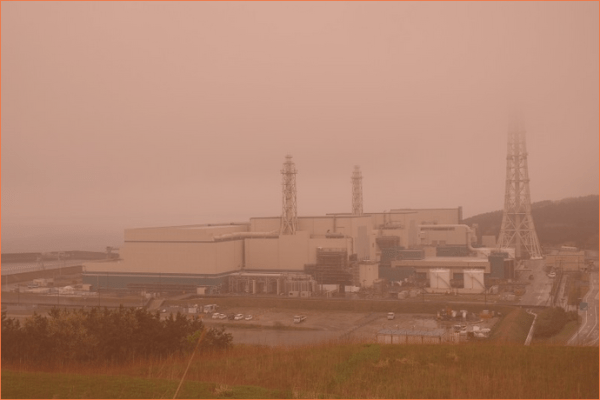
Reactor buildings at the Kashiwazaki-Kariwa nuclear plant are seen in this file photo taken in Kashiwazaki, Niigata Prefecture, on April 26, 2017.
Sixty holes violating the Building Standards Act were found recently in firewalls at the Kashiwazaki-Kariwa nuclear plant in Niigata Prefecture, in addition to two similar holes found in July this year, plant operator Tokyo Electric Power Co. (TEPCO) announced Nov. 22.
Of the 60 holes, 49 date back to the 1980s when the No. 1 reactor building was built, revealing administrative agencies’ lack of consideration for proper construction management.
Reactor buildings have several thousand holes in them for pipes. Of these holes, those going through firewalls are required to have any gaps filled in with mortar caulk or other nonflammable material. In July, TEPCO found two holes in a firewall in the No. 2 reactor building that had not been properly filled in. A subsequent inspection of the entire plant found that 60 holes had not been filled in — a building code violation — of which 41 were in radiation-control areas.
The power company will begin taking countermeasures, such as filling the holes in, as early as the beginning of the New Year. “At the time the reactor buildings were built, our awareness of the risks was insufficient,” TEPCO spokesperson Yoshimi Hitosugi said.
Fukushima Darkness
“Japan is a totalitarian corporate state where corporate interests are protected from liability by layers of subcontractors and by vested interests of powerful political bodies and extremely harsh state secrecy laws. As such, it is believed that nuclear safety and health issues, including deaths, are underreported and likely not reported at all in most cases. Therefore, the worldview of nuclear power, as represented in Japan at Fukushima Daiichi, is horribly distorted in favor of nuclear power advocacy.”
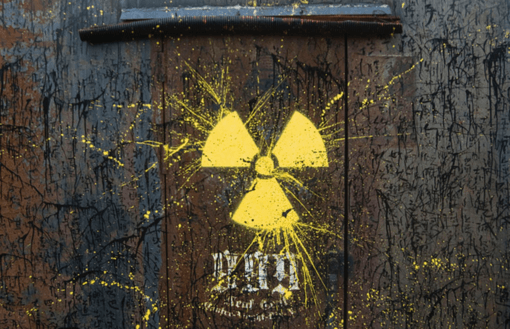
The radiation effects of the Fukushima Daiichi Nuclear Power Plant triple meltdowns are felt worldwide, whether lodged in sea life or in humans, it cumulates over time. The impact is now slowly grinding away only to show its true colors at some unpredictable date in the future. That’s how radiation works, slow but assuredly destructive, which serves to identify its risks, meaning, one nuke meltdown has the impact, over decades, of 1,000 regular industrial accidents, maybe more.
It’s been six years since the triple 100% nuke meltdowns occurred at Fukushima Daiichi d/d March 11th, 2011, nowadays referred to as “311”. Over time, it’s easy for the world at large to lose track of the serious implications of the world’s largest-ever industrial disaster; out of sight out of mind works that way.
According to Japanese government and TEPCO (Tokyo Electric Power Company) estimates, decommissioning is a decade-by-decade work-in-progress, most likely four decades at a cost of up to ¥21 trillion ($189B). However, that’s the simple part to understanding the Fukushima nuclear disaster story. The difficult painful part is largely hidden from pubic view via a highly restrictive harsh national secrecy law (Act on the Protection of Specially Designated Secrets, Act No. 108/2013), political pressure galore, and fear of exposing the truth about the inherent dangers of nuclear reactor meltdowns. Powerful vested interests want it concealed.
Following passage of the 2013 government secrecy act, which says that civil servants or others who “leak secrets” will face up to 10 years in prison, and those who “instigate leaks,” especially journalists, will be subject to a prison term of up to 5 years, Japan fell below Serbia and Botswana in the Reporters Without Borders 2014 World Press Freedom Index. The secrecy act, sharply criticized by the Japanese Federation of Bar Associations, is a shameless act of buttoned-up totalitarianism at the very moment when citizens need and in fact require transparency.
The current status, according to Mr. Okamura, a TEPCO manager, as of November 2017: “We’re struggling with four problems: (1) reducing the radiation at the site (2) stopping the influx of groundwater (3) retrieving the spent fuel rods and (4) removing the molten nuclear fuel.” (Source: Martin Fritz, The Illusion of Normality at Fukushima, Deutsche Welle–Asia, Nov. 3, 2017)
In short, nothing much has changed in nearly seven years at the plant facilities, even though tens of thousands of workers have combed the Fukushima countryside, washing down structures, removing topsoil and storing it in large black plastic bags, which end-to-end would extend from Tokyo to Denver and back.
As it happens, sorrowfully, complete nuclear meltdowns are nearly impossible to fix because, in part, nobody knows what to do next. That’s why Chernobyl sealed off the greater area surrounding its meltdown of 1986. Along those same lines, according to Fukushima Daiichi plant manager Shunji Uchida: ”Robots and cameras have already provided us with valuable pictures. But it is still unclear what is really going on inside,” Ibid.
Seven years and they do not know what’s going on inside. Is it the China Syndrome dilemma of molten hot radioactive corium burrowing into Earth? Is it contaminating aquifers? Nobody knows, nobody can possibly know, which is one of the major risks of nuclear meltdowns, nobody knows what to do. There is no playbook for 100% meltdowns. Fukushima Daiichi proves the point.
“When a major radiological disaster happens and impacts vast tracts of land, it cannot be ‘cleaned up’ or ‘fixed’.” (Source: Hanis Maketab, Environmental Impacts of Fukushima Nuclear Disaster Will Last ‘decades to centuries’ – Greenpeace, Asia Correspondent, March 4, 2016)
Meanwhile, the world nuclear industry has ambitious growth plans, 50-60 reactors currently under construction, mostly in Asia, with up to 400 more on drawing boards. Nuke advocates claim Fukushima is well along in the cleanup phase so not to worry as the Olympics are coming in a couple of years, including events held smack dab in the heart of Fukushima, where the agricultural economy will provide fresh foodstuff.
The Olympics are PM Abe’s major PR punch to prove to the world that all-is-well at the world’s most dangerous, and out of control, industrial accident site. And, yes it is still out of control. Nevertheless, the Abe government is not concerned. Be that as it may, the risks are multi-fold and likely not well understood. For example, what if another earthquake causes further damage to already-damaged nuclear facilities that are precariously held together with hopes and prayers, subject to massive radiation explosions? Then what? After all, Japan is earthquake country, which defines the boundaries of the country. Japan typically has 400-500 earthquakes in 365 days, or nearly 1.5 quakes per day.
According to Dr. Shuzo Takemoto, professor, Department of Geophysics, Graduate School of Science, Kyoto University: “The problem of Unit 2… If it should encounter a big earth tremor, it will be destroyed and scatter the remaining nuclear fuel and its debris, making the Tokyo metropolitan area uninhabitable. The Tokyo Olympics in 2020 will then be utterly out of the question,” (Shuzo Takemoto, Potential Global Catastrophe of the Reactor No. 2 at Fukushima Daiichi, February 11, 2017).
Since the Olympics will be held not far from the Fukushima Daiichi nuclear accident site, it’s worthwhile knowing what to expect, i.e., repercussions hidden from public view. After all, it’s highly improbable that the Japan Olympic Committee will address the radiation-risk factors for upcoming athletes and spectators. Which prompts a question: What criteria did the International Olympic Committee (IOC) follow in selecting Japan for the 2020 Summer Olympics in the face of three 100% nuclear meltdowns totally out of control? On its face, it seems reckless.
This article, in part, is based upon an academic study that brings to light serious concerns about overall transparency, TEPCO workforce health & sudden deaths, as well as upcoming Olympians, bringing to mind the proposition: Is the decision to hold the Olympics in Japan in 2020 a foolish act of insanity and a crude attempt to help cover up the ravages of radiation?
Thus therefore, a preview of what’s happening behind, as well as within, the scenes researched by Adam Broinowski, PhD (author of 25 major academic publications and Post Doctoral Research Fellow, Australian National University): “Informal Labour, Local Citizens and the Tokyo Electric Fukushima Daiichi Nuclear Crisis: Responses to Neoliberal Disaster Management,” Australian National University, 2017.
The title of Dr. Broinowski’s study provides a hint of the inherent conflict, as well as opportunism, that arises with neoliberal capitalism applied to “disaster management” principles. (Naomi Klein explored a similar concept in The Shock Doctrine: The Rise of Disaster Capitalism, Knopf Canada, 2007).
Dr. Broinowski’s research is detailed, thorough, and complex. His study begins by delving into the impact of neoliberal capitalism, bringing to the fore an equivalence of slave labor to the Japanese economy, especially in regards to what he references as “informal labour.” He preeminently describes the onslaught of supply side/neoliberal tendencies throughout the economy of Japan. The Fukushima nuke meltdowns simply bring to surface all of the warts and blemishes endemic to the neoliberal brand of capitalism.
According to Professor Broinowski: “The ongoing disaster at the Fukushima Daiichi nuclear power station (FDNPS), operated by Tokyo Electric Power Company (TEPCO), since 11 March 2011 can be recognised as part of a global phenomenon that has been in development over some time. This disaster occurred within a social and political shift that began in the mid-1970s (ed. supply-side economics, which is strongly reflected in America’s current tax bill under consideration) and that became more acute in the early 1990s in Japan with the downturn of economic growth and greater deregulation and financialisation in the global economy. After 40 years of corporate fealty in return for lifetime contracts guaranteed by corporate unions, as tariff protections were lifted further and the workforce was increasingly casualised, those most acutely affected by a weakening welfare regime were irregular day labourers, or what we might call ‘informal labour.”
In short, the 45,000-60,000 workers recruited to deconstruct decontaminate Fukushima Daiichi and the surrounding prefecture mostly came off the streets, castoffs of neoliberalism’s impact on “… independent unions, rendered powerless, growing numbers of unemployed, unskilled and precarious youths (freeters) alongside older, vulnerable and homeless day labourers (these groups together comprising roughly 38 per cent of the workforce in 2015) found themselves not only (a) lacking insurance or (b) industrial protection but also in many cases (c) basic living needs. With increasing deindustrialisation and capital flight, regular public outbursts of frustration and anger from these groups have manifested since the Osaka riots of 1992.” (Broinowski)
The Osaka Riots of 25 years ago depict the breakdown of modern society’s working class, a problem that has spilled over into national political elections worldwide as populism/nationalism dictate winners/losers. In Osaka 1,500 rampaging laborers besieged a police station (somewhat similar to John Carpenter’s 1976 iconic film Assault on Precinct 13) over outrage of interconnecting links between police and Japan’s powerful “Yakuza” or gangsters that bribe police to turn a blind eye to gangster syndicates that get paid to recruit, often forcibly, workers for low-paying manual jobs for industry.
That’s how TEPCO gets workers to work in radiation-sensitive high risks jobs. Along the way, subcontractors rake off most of the money allocated for workers, resulting in a subhuman lifestyle for the riskiest most life-threatening jobs in Japan, maybe the riskiest most life-threatening in the world.
Japan has a long history of assembling and recruiting unskilled labor pools at cheap rates, which is typical of nearly all large-scale modern industrial projects. Labor is simply one more commodity to be used and discarded. Tokyo Electric Power Company (“TEPCO”) of Fukushima Daiichi fame adheres to those long-standing feudalistic employment practices. They hire workers via layers of subcontractors in order to avoid liabilities, i.e. accidents, health insurance, safety standards, by penetrating into the bottom social layers that have no voice in society.
As such, TEPCO is not legally obligated to report industrial accidents when workers are hired through complex webs or networks of subcontractors; there are approximately 733 subcontractors for TEPCO. Here’s the process: TEPCO employs a subcontractor “shita-uke,” which in turn employs another subcontractor “mago-uke” that relies upon labor brokers “tehaishilninpu-dashi.” At the end of the day, who’s responsible for the health and safety of workers? Who’s responsible for reporting cases of radiation sickness and/or death caused by radiation exposure?
Based upon anecdotal evidence from reliable sources in Japan, there is good reason to believe TEPCO, as well as the Japanese government, suppress public knowledge of worker radiation sickness and death, as well as the civilian population of Fukushima. Thereby, essentially hoodwinking worldwide public opinion, for example, pro-nuke enthusiasts/advocates point to the safety of nuclear power generation because of so few reported deaths in Japan. But, then again, who’s responsible for reporting worker deaths? Answer: Other than an occasional token death report by official sources, nobody!
Furthermore, TEPCO does not report worker deaths that occur outside of the workplace even though the death is a direct result of excessive radiation exposure at the workplace. For example, if a worker with radiation sickness becomes too ill to go to work, they’ll obviously die at home and therefore not be reported as a work-related death. As a result, pro-nuke advocates claim Fukushima proves how safe nuclear power is, even when it goes haywire, because there are so few, if any, deaths, as to be inconsequential. That’s a boldfaced lie that is discussed in the sequel: Fukushima Darkness – Part 2.
“As one labourer stated re Fukushima Daiichi: ‘TEPCO is God. The main contractors are kings, and we are slaves’. In short, Fukushima Daiichi clearly illustrates the social reproduction, exploitation and disposability of informal labour, in the state protection of capital, corporations and their assets.” (Broinowski)
Indeed, Japan is a totalitarian corporate state where corporate interests are protected from liability by layers of subcontractors and by vested interests of powerful political bodies and extremely harsh state secrecy laws. As such, it is believed that nuclear safety and health issues, including deaths, are underreported and likely not reported at all in most cases. Therefore, the worldview of nuclear power, as represented in Japan at Fukushima Daiichi, is horribly distorted in favor of nuclear power advocacy.
DW article cited in Fukushima Darkness: http://www.dw.com/en/the-illusion-of-normality-at-fukushima/a-37885120 “Robots and cameras have already provided us with valuable pictures,” says Uchida, adding: “But it is still unclear what is really going on inside.”
And Full-text (PDF) of Adam Broinowski’s cited research paper is available here:
Once severely damaged Fukushima reactor building opened to media to showcase progress
Tepco’s representatives and METI’s officials have spent 15 minutes at the top floor of the reactor 3 building, 30 meters above the ground.
0,08mSv/per hour on the platform and 0,7mSv/per hour near the fuel pool with its 566 fuel assemblies supposed to be unloaded within 6 months. According to Tepco, workers cannot stay up there more than one hour or two per day….
The real content of that fuel pool is still mysterious, as no whole picture of that pool has ever been released.

The top floor of the Fukushima No. 1 nuclear plant’s No. 3 reactor building is seen on Nov. 21, 2017. The spent fuel pool can be seen at lower left. (Mainichi)
The top level of the Fukushima No. 1 nuclear plant’s No. 3 reactor building was opened to the news media on Nov. 21.
The Ministry of Economy, Trade and Industry along with plant operator Tokyo Electric Power Co. (TEPCO) guided reporters to the reactor building’s top floor for a tour lasting about 15 minutes.
The building was badly damaged by a hydrogen explosion in the first days of the Fukushima nuclear crisis in March 2011. However, the debris has been cleared away, and radiation that had stood at 800 millisieverts per hour just after the reactor meltdowns was measured at 0.08 mSv/h on the 7-meter-high platform, on which fuel removal equipment and other devices have been installed, on Nov. 21. Closer to the fuel pool, the figure rose to 0.7 mSv/h. According to TEPCO, workers are limited to just one to two hours on the platform.

The top floor is about 30 meters from the ground. The spent fuel pool currently contains 566 fuel assemblies, and preparations are underway to start the removal process as early as mid-fiscal 2018, with equipment for the job already installed on the platform. A net currently covers the pool to prevent anything — or anyone — from falling in.
A semi-cylindrical cover is also being constructed to prevent radioactive materials from escaping when fuel removal operations begin.
Evacuating a nuclear disaster areas is (usually) a waste of time and money, says study
This study is corrupted science, on the payroll of the nuclear lobby, to justify future ‘radiation safety’ limits increases.In Japan, after the Fukushima Daiichi the radiation ‘tolerance’ threshold was raised from 1mSv/per year to 20mSv/per year, which is the radiation ‘tolerance’ threshold for nuclear plant workers in the other countries. The nuclear lobby would like to raise further all today’s radiation ‘tolerance’ thresholds.
Which radiation risk model did they use? ICRP, I bet, which is silent on inhaled and ingested radioactivity, and underestimates risk of congenital defects by 10,000 times. If you care about the children run like hell and don’t look back. That was Professor Alexey Yablokov’s advice and it still stands with abundant studies made in the past 30 years to back it up.

Evacuating a nuclear disaster areas is (usually) a waste of time and money, says study
Over 110,000 people were moved from their homes following the Fukushima nuclear disaster in Japan in March 2011. Another 50,000 left of their own will, and 85,000 had still not returned four-and-a-half years later.
While this might seem like an obvious way of keeping people safe, my colleagues and I have just completed research that shows this kind of mass evacuation is unnecessary, and can even do more harm than good. We calculated that the Fukushima evacuation extended the population’s average life expectancy by less than three months.
To do this, we had to estimate how such a nuclear meltdown could affect the average remaining life expectancy of a population from the date of the event. The radiation would cause some people to get cancer and so die younger than they otherwise would have (other health effects are very unlikely because the radiation exposure is so limited). This brings down the average life expectancy of the whole group.
But the average radiation cancer victim will still live into their 60s or 70s. The loss of life expectancy from a radiation cancer will always be less than from an immediately fatal accident such as a train or car crash. These victims have their lives cut short by an average of 40 years, double the 20 years that the average sufferer of cancer caused by radiation exposure. So if you could choose your way of dying from the two, radiation exposure and cancer would on average leave you with a much longer lifespan.
How do you know if evacuation is worthwhile?
To work out how much a specific nuclear accident will affect life expectancy, we can use something called the CLEARE (Change of life expectancy from averting a radiation exposure) Programme. This tells us how much a specific dose of radiation will shorten your remaining lifespan by on average.
Yet knowing how a nuclear meltdown will affect average life expectancy isn’t enough to work out whether it is worth evacuating people. You also need to measure it against the costs of the evacuation. To do this, we have developed a method known as the judgement or J-value. This can effectively tell us how much quality of life people are willing to sacrifice to increase their remaining life expectancy, and at what point they are no longer willing to pay.
You can work out the J-value for a specific country using a measure of the average amount of money people in that country have (GDP per head) and a measure of how averse to risk they are, based on data about their work-life balance. When you put this data through the J-value model, you can effectively find the maximum amount people will on average be willing to pay for longer life expectancy.
After applying the J-value to the Fukushima scenario, we found that the amount of life expectancy preserved by moving people away was too low to justify it. If no one had been evacuated, the local population’s average life expectancy would have fallen by less than three months. The J-value data tells us that three months isn’t enough of a gain for people to be willing to sacrifice the quality of life lost through paying their share of the cost of an evacuation, which can run into billions of dollars (although the bill would actually be settled by the power company or government).
The three month average loss suggests the number of people who will actually die from radiation-induced cancer is very small. Compare it to the average of 20 years lost when you look at all radiation cancer sufferers. In another comparison, the average inhabitant of London loses 4.5 months of life expectancy because of the city’s air pollution. Yet no one has suggested evacuating that city.
We also used the J-value to examine the decisions made after the world’s worst nuclear accident, which occurred 25 years before Fukushima at the Chernobyl nuclear power plant in Ukraine. In that case, 116,000 people were moved out in 1986, never to return, and a further 220,000 followed in 1990.
By calculating the J-value using data on people in Ukraine and Belarus in the late 1980s and early 1990s, we can work out the minimum amount of life expectancy people would have been willing to evacuate for. In this instance, people should only have been moved if their lifetime radiation exposure would have reduced their life expectancy by nine months or more.
This applied to just 31,000 people. If we took a more cautious approach and said that if one in 20 of a town’s inhabitants lost this much life expectancy, then the whole settlement should be moved, it would still only mean the evacuation of 72,500 people. The 220,000 people in the second relocation lost at most three months’ life expectancy and so none of them should have been moved. In total, only between 10% and 20% of the number relocated needed to move away.
To support our research, colleagues at the University of Manchester analysed hundreds of possible large nuclear reactor accidents across the world. They found relocation was not a sensible policy in any of the expected case scenarios they examined.
More harm than good
Some might argue that people have the right to be evacuated if their life expectancy is threatened at all. But overspending on extremely expensive evacuation can actually harm the people it is supposed to help. For example, the World Heath Organisation has documented the psychological damage done to the Chernobyl evacuees, including their conviction that they are doomed to die young.
From their perspective, this belief is entirely logical. Nuclear refugees can’t be expected to understand exactly how radiation works, but they know when huge amounts of money are being spent. These payments can come to be seen as compensation, suggesting the radiation must have left them in an awful state of health. Their governments have never lavished such amounts of money on them before, so they believe their situation must be dire.
But the reality is that, in most cases, the risk from radiation exposure if they stay in their homes is minimal. It is important that the precedents of Chernobyl and Fukushima do not establish mass relocation as the prime policy choice in the future, because this will benefit nobody.
Homes should not be abandoned after a big nuclear accident
Fukushima Class Action Federal Lawsuit Filed in Boston Against General Electric

GE sued for Fukushima disaster
Lawsuit alleges unsafe design, cost cutting
Japanese property owners and businesses near the Fukushima nuclear plant that melted down after a devastating 2011 tsunami filed a $500 million class-action lawsuit against General Electric for negligently designing the doomed plant.
The lawsuit, filed yesterday in federal court in Boston, claims the explosions and release of radioactive material at the Fukushima reactors — likely the most costly industrial accident in history at $200 billion — were caused by GE’s unsafe design of the reactors and further efforts to cut costs that also undercut safety during the construction of the plant.
As a result, the area around Fukushima, according to the lawsuit, became a “ghost town.”
“There are no people. Roads are guarded by men in hazmat suits. And no one will ever live there again,” the lawsuit said.
GE said in a statement it became aware of the lawsuit today and is “thoroughly reviewing the matter.”
The company pushed into the nuclear industry in the 1960s and offered a “cheap reactor … with a significantly smaller, but less safe containment than industry standard” that safety experts repeatedly raised concerns about, the lawsuit said.
GE designed all six reactors at Fukushima — building two on site and advising on the construction of the rest. Original designs for the power plant called for it to be built near a bluff 115 feet above sea level. But GE — to save money — lowered the bluff to 80 feet, court papers say, “dramatically increasing the flood risk.”
Backup systems in the event of a problem at the nuclear plant were also woefully lacking, causing the cooling system to fail, the suit states.
General Electric Named in Federal Lawsuit Regarding Fukushima
General Electric is facing a federal lawsuit because of the Fukushima nuclear disaster that happened on March 11, 2011. The class action lawsuit asks for $500 million and was filed by residents, medical clinics, and companies in Boston who allege that they were affected by the disaster. The plaintiffs allege that they represent more than 150,000 Japanese citizens affected from the nuclear disaster.
Federal Lawsuit Alleges GE Failed to Properly Maintain Nuclear Power Plant
In the federal complaint, filed on November 17, 2017, GE faces serious allegations including failure to properly maintain the Fukushima:
“GE designed and largely constructed the entire Fukushima Daiichi Nuclear Power Plant at the center of the dispute, and for many years, directly or indirectly through its affiliates, was responsible for the maintenance of the [plant]. To this day, GE has paid literally nothing toward the massive economic and business destruction its actions and failings have caused.”
Reuters.com reported on December 8, 2016 that Japan had more than $188 billion in losses.
The plaintiffs allege that although the Fukushima disaster occurred in 2011, GE’s plan to “dominate the commercial nuclear power industry” in the 1960s meant that the defendant misrepresented how safe the plant would be so that they could earn more money.
GE continues to offer its “heartfelt sympathy” to those who were affected, but wants the matter handled under Japanese nuclear compensation law. Under that law, power plant operators are liable for the damages caused by the incident, regardless of what caused it. A company spokesperson went on to say that the Japanese government found that a tsunami was ultimately responsible and it was not the fault of how the reactor was designed.
GE was made aware of the lawsuit on November 19, 2017 and they are “thoroughly reviewing the matter.”
Tepco Says The Fukushima Cleanup ‘Is Progressing’, But at a Painstaking Pace
Last July 2017 Tepco’s remotely piloted robots transmitted view of what could be melted radioactive fuel inside Fukushima Daiichi nuclear plant’s destroyed reactors — actually Tepco wants to believe that it is melted radioactive fuel but has not been able to get it confirmed since then.

The Fukushima Cleanup Is Progressing, But at a Painstaking Pace
Earlier this year, remotely piloted robots transmitted what officials believe was a direct view of melted radioactive fuel inside Fukushima Daiichi Nuclear Power Plant’s destroyed reactors—a major discovery, but one that took a long and painful six years to achieve. In the meantime, the program to clean up the destroyed reactors has seen numerous setbacks and concerns, including delays on Japanese electrical utility Tepco’s timetable to begin removing the highly radioactive fuel and continued leakage of small amounts of radioactive substances.
Japanese officials are now hoping that they can convince a skeptical public that the worst of the disaster is over, the New York Times reported, but it’s not clear whether it’s too late despite the deployment of 7,000 workers and massive resources to return the region to something approaching normal. Per the Times, officials admit the recovery plan—involving the complete destruction of the plant, rather than simply building a concrete sarcophagus around it as the Russians did in Chernobyl—will take decades and tens of billions of dollars. Currently, Tepco plans to begin removing waste from one of the three contaminated reactors at the plant by 2021, “though they have yet to choose which one.”
“Until now, we didn’t know exactly where the fuel was, or what it looked like,” Tepco manager Takahiro Kimoto told the Times. “Now that we have seen it, we can make plans to retrieve it.”
“They are being very methodical—too slow, some would say—in making a careful effort to avoid any missteps or nasty surprises,” Union of Concerned Scientists nuclear safety director David Lochbaum added. “They want to regain trust. They have learned that trust can be lost much quicker than it can be recovered.”
Currently, radiation levels are so high in the ruined facility that it fries robots sent in within a matter of hours, which will necessitate developing a new generation of droids with even higher radiation significantly smaller, but less safe containment than industry standard” that safety experts repeatedly raised concerns about, the lawsuit said.
GE designed all six reactors at Fukushima — building two on site and advising on the construction of the rest. Original designs for the power plant called for it to be built near a bluff 115 feet above sea level. But GE — to save money — lowered the bluff to 80 feet, court papers say, “dramatically increasing the flood risk.”
Backup systems in the event of a problem at the nuclear plant were also woefully lacking, causing the cooling system to fail, the suit states. ge_sued_for_fukushima_disaster tolerances. Authorities have built a crane on the roof of one melted-down reactor, unit No. 3, to remove fuel, Phys.org reported, though it will not actually be in use until at least April 2018. Disposal of low level waste such as “rice straw, sludge and ash from waste incineration” has only just begun, the Japan Times wrote. The eventual disposal of more dangerous waste will be much more difficult.
At the same time, criticism of the government’s approach is also mounting with concerns it is pressuring residents to return to an area where radiation exposure remains many times the international standard.
Disposal of low-level radioactive waste from Fukushima crisis begins
To call that site a storage site is a misnomer. As there will also be incineration and conditioning of radioactive debris there. It would be more accurate to call it a processing and storage facility….. Temporary storage, supposedly for 30 years maximum….

FUKUSHIMA – Disposal began Friday of low-level radioactive waste generated by the Fukushima nuclear disaster, more than six years after the crisis was triggered by the Great East Japan Earthquake and tsunami of March 11, 2011.
A disposal site in Tomioka, Fukushima Prefecture, accepted the first shipment of the waste, which contains radioactive cesium ranging from 8,000 to 100,000 becquerels per kilogram, and includes rice straw, sludge and ash from waste incineration.
The Environment Ministry is in charge of the country’s nuclear waste disposal, which totaled 200,000 tons from 11 prefectures as of the end of September. The majority of the waste, 170,000 tons, originates from the prefecture hosting the crippled nuclear power plant.
“I would like to ask the central government to move this project forward while taking adequate safety steps in mind,” a Tomioka official said. “Building mutual trust with local residents is also important.”
Under the ministry’s policy, each prefecture’s waste is to be disposed of. However, Fukushima is the only prefecture where disposal has started, whereas other prefectures have met with opposition from local residents.
In Fukushima, it will take six years to complete moving the stored waste to the disposal site, the ministry said.
The government “will continue giving first priority to securing safety and properly carry out the disposal with our best efforts to win local confidence,” Environment Minister Masaharu Nakagawa said at a news conference.
The government proposed in December 2013 that Fukushima Prefecture dispose of the waste at the then-privately owned site. The request was accepted by the prefectural government two years later.
To help alleviate local concerns over the disposal, the government nationalized the site and reinforced it to prevent the entry of rainwater.
UN body calls on Japan to improve protection of press freedoms

GENEVA (Kyodo) — A U.N. body on Thursday called on Japan to take steps to better protect press freedoms as concerns about the country’s laws aimed at curtailing leaks of state secrets could hinder the work of journalists.
In another of the 218 non-legally binding recommendations on Japan’s human rights record released by the U.N. Human Rights Council’s working group, Tokyo was urged to apologize and pay compensation to “comfort women” forced to work in Japan’s World War II military brothels.
The recommendations reflected the views of some 105 countries. Of the issues raised, the U.N. council will adopt those that have been accepted by the country in question at a plenary session around March 2018.
In relation to freedom of the press in Japan, the recommendation called on the country to amend Article 4 of the broadcasting law that gives the government authority to suspend broadcasting licenses of TV stations not considered “politically fair.”
Japan had already attracted criticism, in particular from David Kaye, U.N. special rapporteur on the right to freedom of opinion and expression, over its law called the Act on the Protection of Specially Designated Secrets, which came into force in 2014.
Under the law, civil servants or others who leak designated secrets could face up to 10 years in prison, and those who instigate leaks, including journalists, could be subject to prison terms of up to five years.
In his report, Kaye noted that the law may be arbitrarily enforced as subcategories under which information may be designated as secret are “overly broad.”
On the issue of “comfort women,” raised at the request of South Korea and China, the recommendation urged Japan to promote fair and accurate historical education, including the women’s stories, and to apologize and compensate victims.
The recommendation also said Japan should abolish or suspend the death penalty, reflecting calls from European Union countries, and continue to provide support to those affected by the Fukushima nuclear crisis caused by the massive 2011 earthquake and tsunami. In particular, a directive to address health issues faced by pregnant mothers and children was noted.
The U.N. Rights Council is mandated to “undertake a universal periodic review” of whether countries are meeting their human rights obligations and commitments.
The examination is conducted on all 193 members of the United Nations in periodic cycles of a few years. The latest review was the third for Japan.
Nuclear-news.net exclusive report from yesterday on the UN meeting;
1 This Month
23-25 October – on Zoom – World BEYOND War’s annual global conferenc


Shut down the radiation-damaged Heysham nuclear reactors now
To see nuclear-related stories in greater depth and intensity – go to https://nuclearinformation.wordpress.com

Say No to NASA’s Reckless Nuclear Reactor on the Moon
Say No to NASA’s Reckless Nuclear Reactor on the Moon

-
Archives
- October 2026 (247)
- September 2026 (339)
- August 2026 (330)
- July 2026 (355)
- June 2026 (287)
- May 2026 (306)
- April 2026 (356)
- March 2026 (251)
- February 2026 (267)
- January 2026 (308)
- December 2025 (358)
- November 2025 (359)
-
Categories
- 1
- 1 NUCLEAR ISSUES
- business and costs
- climate change
- culture and arts
- ENERGY
- environment
- health
- history
- indigenous issues
- Legal
- marketing of nuclear
- media
- opposition to nuclear
- PERSONAL STORIES
- politics
- politics international
- Religion and ethics
- safety
- secrets,lies and civil liberties
- spinbuster
- technology
- Uranium
- wastes
- weapons and war
- Women
- 2 WORLD
- ACTION
- AFRICA
- Atrocities
- AUSTRALIA
- Christina's notes
- Christina's themes
- culture and arts
- Events
- Fuk 2022
- Fuk 2023
- Fukushima 2017
- Fukushima 2018
- fukushima 2019
- Fukushima 2020
- Fukushima 2021
- general
- global warming
- Humour (God we need it)
- Nuclear
- RARE EARTHS
- Reference
- resources – print
- Resources -audiovicual
- Weekly Newsletter
- World
- World Nuclear
- YouTube
-
RSS
Entries RSS
Comments RSS

