Newspaper changes an “annoying” photo: Facts are disappearing from the media
It has been a constant practice in the past 6 years for the Japanese media to change the wording of an already released article or its title or its illustrating photo if it annoys the authorities, sometimes the whole article becoming suppressed. That permanent tight censorship has been very effective in minimizing the facts about the Fukushima Daiichi disaster in the mind of the general Japanese population.
I cannot count the number of times that I have copied an article on a word document for safekeeping, so as to repost it on my blog later, to later find that it had been altered or that it had been removed.
Facts are disappearing from the media
When we are outside of Fukushima, or of Japan, it is difficult for us to realize to what extent it has become difficult to speak of radio-contamination and the risk of exposure.
To illustrate this, we are reporting on the case of a photo replacement in the Mainichi Shimbun. This took place only in the Japanese edition. The original photo seems to have remained in the English edition.
On October 21, the Mainichi Shimbun reported the reopening of a part of the JR East line under the title: “JR East partially reopens line halted since 2011 nuclear disaster“. In this article, the Mainichi published a photo of a train leaving the newly opened Tomioka station. (If it is impossible to open the article, here is the web archive).

Above is the original picture (used also in the Japanese 1st version) with the caption : “A train leaves Tomioka Station in Tomioka, Fukushima Prefecture, after services on the JR Joban Line were resumed between Tomioka and Tatsuta on Oct. 21, 2017. (Mainichi)”.
As you can see, the picture cleary tries to attract the attention of the readers to the black bags containing contaminated waste. In fact, the Japanese caption mentions also: “In the foreground, a temporary storage site of bags containing decontamination waste”. You can see other pictures here by the same photographer.
The photo above received a large number of complaints and protests. People basically complained: “why stain the joyful event with such a picture?”.
Here is the link to the togetter (in Japanese) through which you can see in what kind of language these people protesting against the first picture express themselves. They are pointing out crudely “the malicious intention” of the Mainichi Shimbun to devalue the event and the reconstruction of Fukushima.
The result is that the Mainichi Newspaper replaced the original photo with the one below.

You can see the Japanese article with the replaced picture here. (If it is impossible to open the article, here is the web archive).
A resident of Fukushima prefecture commented as below in his Facebook:
“In Fukushima, private protests (translator’s note: especially on the Internet), forced a TV programme to change the title of a documentary. The same people made the Mainichi Newspaper change the article (translator’s note : change the photo). The original photo was exposed to the pressure of the pro- “reconstruction/rehabilitation of Fukushima” people, saying “don’t hinder the delightful event (with such a picture)”. This seems to indicate the end of the journalism.
The two pictures both represent the same reality. Even a picture cannot be spared of interference or censorship.
I wanted to let you know the fact. The most important function of journalism — to find facts, even painful for certain people, and to use them to solve problems — is disappearing. We are going through such an era.
These people (exercising the pressure) are the same as those who are upset and angry because “the media are only reporting on the voluntary evacuees and not on Fukushima residents”.
On August 2, 2017, the Mainichi Shimbun reported the incident of the modification of a TV documentary title (in Japanese) to which the author above is referring. The title of the documentary, “The reality after 63 years of the Bikini accident: the expected future of Fukushima” which was supposed to go on air, was exposed to criticism saying that the sub-title suggests that the same kinds of health hazards are expected to occur in Fukushima prefecture. Succumbing to pressure TV Asahi decided to eliminate the subtitle, “the expected future of Fukushima,” (translator’s note: to erase the implied connection to the health problems of the Bikini nuclear test). (If the link is broken, please see this web archive).
What is worrying here is that these censorship pressures are not from governmental authorities, but from citizens. Now, the majority of people living in or outside of Fukushima don’t believe in the reality of radiation-related health hazards. They react aggressively against anything which reminds them of such health risks. Imagine that when you speak up or when you write about radiation risks you become the object of bullying. You have to have an iron nerve to continue, especially if you have your own family members to protect from social bullying. The fact that the authorities don’t recognize such health risks favors this antagonism.
This phenomenon is not particular to Japan. It is NOT to be explained by cultural characteristics. It happens everywhere in the world. We saw it happen in Tchernobyl, in the US and in France. People deny the radiation effects or comparisons with those of Bikini Atoll or Marshall Islands because it makes the place or people feel or look bad and speaking of it becomes taboo, even though there is a factual base behind it. (It is probably worse now because of social media — comments are extremely emotional, violent and destructive toward others).
As we can see from the above incidents, facts are disappearing from all kinds of media. The media and government are censoring the facts and the public are censoring themselves and each other. Lets be aware of it.
If you appreciate the photo in the English edition and the first Japanese edition of the Mainichi Shimbun with black bags in the foreground, please write encouraging comments to the Mainichi Shimbun.
contact form
Incineration, Processing and Interim Storage at Okuma-Futaba Facility
As you may see the Mainichi’s article below does mention the incineration which will take place at this facility. The Asahi ‘s article below on the other hand completely omits to talk about the incineration, lying by omission.
The radioactive debris will be first incinerated to reduce their volume to 1/50 of their initial volume, then processed and stored there. The amount of contaminated soil and other waste reaching up to 22 million cubic meters (metric tons).
However it is important to point out that whatever the type of screening filters used during the incineration they will not retain all the radioactive nanoparticles, that some radioactive nanoparticles will still be released into the air during that incineration.
Thus “storage facility” is a misnomer as it is actually a processing facility before to be a storage facility.

An intermediate storage facility under construction in Okuma, Fukushima Prefecture, in February, with the Fukushima No. 1 nuclear plant in the background
Interim storage site for Fukushima contaminated soil to begin full operations
An interim storage site in Fukushima Prefecture for soil and waste generated when areas affected by the Fukushima nuclear crisis were decontaminated will be put into full-scale operation on Oct. 28, Environment Minister Masaharu Nakagawa said.
Contaminated soil temporarily placed on the premises of the facility, which straddles the prefectural towns of Okuma and Futaba, will be brought into an underground storage site on the property.
The storage site will be the first one in the country to be put into full-scale operation to store contaminated soil and other waste.
“There are numerous challenges that must be overcome, but the start of operations at the facility is an important step toward the final disposal of contaminated soil,” Nakagawa told a news conference on Oct. 24.
The Environment Ministry is constructing the interim storage site on an approximately 16-square-kilometer area around the disaster-stricken Fukushima No. 1 Nuclear Power Plant. Operations at a section of the facility located in Okuma will begin on Oct. 28. After contaminated soil is measured for radiation, the soil will be stored separately at the facility depending on levels of radiation.
Waterproof work has been performed at the site to prevent stored soil from contaminating ground water.
At the site, a plant to incinerate weeds, trees and other flammable materials removed from contaminated soil and a facility to manage incinerated ash containing high levels of radioactive cesium will also be built.
The ministry estimates that the amount of soil and other waste removed from decontaminated sites in the prefecture could reach up to some 22 million cubic meters. Decontamination work is still going on in some areas affected by the nuclear disaster, which broke out in March 2011 following the Great East Japan Earthquake and tsunami.
Most of the soil removed from decontaminated areas was put into bags and temporarily stored at various locations in Fukushima Prefecture. Some of the bags have been brought onto the premises for the interim storage site since March 2015.
The central government intends to build a final disposal site outside the prefecture to complete the disposal of contaminated soil by 2045. However, the government has not worked out a specific plan on the final disposal site, such as its location and the timing of its construction.
Fukushima debris heading to intermediate storage facility
The Environment Ministry on Oct. 28 will start bringing radiation-contaminated soil to an intermediate storage site in Fukushima Prefecture, despite having acquired less than half of the land needed for the overall project.
The ministry’s announcement on Oct. 24 marks a long-delayed step toward clearing temporary sites that were set up around the prefecture to store countless bags of radioactive debris gathered after the triple meltdown at the Fukushima No. 1 nuclear power plant in March 2011.
The entire intermediate storage project will cover a 16-square-kilometer area spanning the towns of Futaba and Okuma around the nuclear plant. It is designed to hold up to 22 million cubic meters of contaminated debris for a maximum period of 30 years.
However, the ministry is still negotiating with landowners on buying parcels of land within the area. As of the end of September, the ministry had reached acquisition agreements for only about 40 percent of the land for the project.
The soil storage facility that will open on Oct. 28 is located on the Okuma side. It has a capacity of about 50,000 cubic meters.
Bags of contaminated soil stored in Okuma will be transferred to the facility, where the debris will be separated based on radiation dosages.
A similar storage facility is being constructed on the Futaba side.
The ministry initially planned to start full-scale operations of the entire storage facility in January 2015. However, it took longer than expected to gain a consensus from local residents and acquire land at the proposed site.
In March 2015, a portion of the contaminated soil was brought to the Okuma facility for temporary storage.
Fukushima Victims File Appeal, Contesting $1,500 Compensation Court Ruling
 In this March 11, 2011 file photo, waves are seen washing over a 10-meter-high breakwater and approaching the Fukushima No. 1 nuclear plant.
Plaintiffs appeal ruling in Fukushima nuclear disaster damages suit
In this March 11, 2011 file photo, waves are seen washing over a 10-meter-high breakwater and approaching the Fukushima No. 1 nuclear plant.
TOKYO (Kyodo) — Lawyers representing approximately 3,800 people suing the state and operator of the Fukushima Daiichi nuclear complex for damages over the 2011 tsunami-triggered disaster appealed a lower court ruling Monday in hopes of securing greater compensation.
In its Oct. 10 ruling, the Fukushima District Court ordered the state and Tokyo Electric Power Company Holdings Inc. to pay 500 million yen ($4.4 million) to about 2,900 of the 3,800 plaintiffs, an amount less than was sought by the disaster victims.
Also on Monday, the central government and Tepco filed an appeal to the same Sendai High Court arguing they should not be held liable for damages.
Izutaro Managi, a lawyer for the plaintiffs, said the lower court ruling “clearly acknowledged the liability of the state” over the disaster but said that the “level and scope of compensation is insufficient.”
“We will seek compensation that better matches the actual damage” from the disaster, he said.
Managi said that the compensation awarded to the victims in the lower court ruling was far less than the maximum 200,000 yen per person sought by the plaintiffs.
The ruling did not accept claims by some of the plaintiffs, including those in western Fukushima Prefecture, the lawyer added when explaining the reason for the appeal.
The Fukushima District Court ruling was the second of its kind in a series of group lawsuits filed nationwide where the state and Tepco were found liable and ordered to pay damages over the world’s worst nuclear crises since the 1986 Chernobyl disaster.
The court concluded that the state and Tepco failed to take steps to mitigate the risk of the tsunami damage caused by a powerful earthquake on March 11, 2011, even though they were able to foresee the possibility of such a disaster based on a quake assessment issued in 2002.
Fukushima victims appeal $1,500 compensation payouts
Hundreds of victims of Japan’s 2011 nuclear disaster have appealed a court ruling hoping to secure larger compensation payouts, after being awarded roughly $1,520 each in a class action lawsuit against the Japanese government and the Fukushima plant operator.
On October 10, Fukushima District Court has ordered the Japanese government and the Tokyo Electric Power Company (TEPCO) to pay about 500 million yen ($4.44 million) to some 2,900 victims of the 2011 Fukushima nuclear meltdown.
In its ruling on the lawsuit, filed by more than 3,800 plaintiffs, the court said that the authorities had failed to properly control TEPCO, which was found guilty of neglecting to adopt the necessary safety measures despite knowing of the risk of a massive tsunami in the region as early as 2002.
On Monday, all sides in the case – TEPCO, the government and the victims represented in the class-action lawsuit – challenged the court’s ruling.
Victims of the disaster say that the awarded liability costs do not represent the true amount of suffering reflected by the Fukushima survivors. The court failed to award 200,000 yen ($1,765) per person, which was the sum originally sought by the plaintiffs. The legal team furthermore stressed that in the initial ruling the court rejected claims by some of the victims, which mostly came from western Fukushima prefecture.
The Fukushima District Court ruling “clearly acknowledged the liability of the government” over the 2011 Fukushima disaster, but the “level and scope of compensation is insufficient,” Izutaro Managi, a lawyer for the plaintiffs, said Monday after filing an appeal with the Sendai High Court.
“We will seek compensation that better matches the actual damage,” Managi added, as quoted by Japan Times.
Japan’s central government and TEPCO meanwhile also filed an appeal with the Sendai High Court, claiming that they are not liable to pay any damages to the victims, Japan Today reported.
In its appeal, Japan’s Nuclear Regulatory Agency stressed that “it is impossible for the government to accept the court’s judgment as a result of an adjustment by relevant ministries and agencies.”
The October 10 court ruling was the second time a court in Japan has acknowledged the government’s liability for the Fukushima meltdown caused by the quake-triggered tsunami that hit the country in March 2011.
In March this year, Maebashi district court ordered the government and the operator to pay 38.55 million yen ($340,000) in damages to 62 plaintiffs who were evacuated to Gunma Prefecture. About 30 similar lawsuits involving 12,000 people are pending across the country.
Plaintiffs file appeal to win bigger payout over Fukushima nuclear disaster
Lawyers representing victims of the Fukushima No. 1 nuclear disaster hold up victory banners in front of the Fukushima District Court on Oct. 10.
KYODO – Lawyers representing approximately 3,800 people suing the government and Tepco for damages over the 2011 Fukushima No. 1 nuclear disaster have appealed a lower court ruling in hopes of securing greater compensation.
Izutaro Managi, a lawyer for the plaintiffs, said Monday after the appeal was filed in the Sendai High Court that the lower court ruling “clearly acknowledged the liability of the government” over the disaster, but the “level and scope of compensation is insufficient.”
“We will seek compensation that better matches the actual damage” from the disaster, he said.
In its Oct. 10 ruling, the Fukushima District Court ordered the government and Tokyo Electric Power Company Holdings Inc. to pay ¥500 million to about 2,900 of the 3,800 plaintiffs, less than sought by the disaster victims.
The central government and Tepco also filed an appeal with the Sendai High Court arguing they should not be held liable for damages.
Managi said the compensation awarded by the lower court was far less than the maximum ¥200,000 per person sought by the plaintiffs.
The ruling did not accept claims by some of the plaintiffs, including those in western Fukushima Prefecture, he added when explaining the reason for the appeal.
The Fukushima District Court ruling was the second of its kind in a series of group lawsuits filed nationwide in which the government and Tepco were found liable and ordered to pay damages over the nuclear crisis.
The court concluded that the government and Tepco failed to take steps to mitigate the tsunami risk, even though they were able to foresee the possibility of such a disaster based on a quake assessment issued in 2002.
More of Joban line reopens in Fukushima

TOMIOKA, Fukushima (Jiji Press) — Train operations were resumed Saturday on a Joban Line section in Fukushima Prefecture after a suspension following the March 2011 earthquake and tsunami and the subsequent nuclear accident at the Tokyo Electric Power Company Holdings Inc.’s Fukushima No. 1 nuclear power plant.
East Japan Railway Co., or JR East, restarted services on the 6.9-kilometer section between Tomioka Station in the town of Tomioka and Tatsuta Station in the town of Naraha.
JR East hopes to reopen the last remaining section by the end of March 2020. The section runs through the towns of Okuma and Futaba, the host municipalities for the power plant, and most of it is inside the heavily contaminated no-entry zone around the plant.

Campaigns focus on economy and Constitution, but nuclear disaster-hit Fukushima sees other priorities
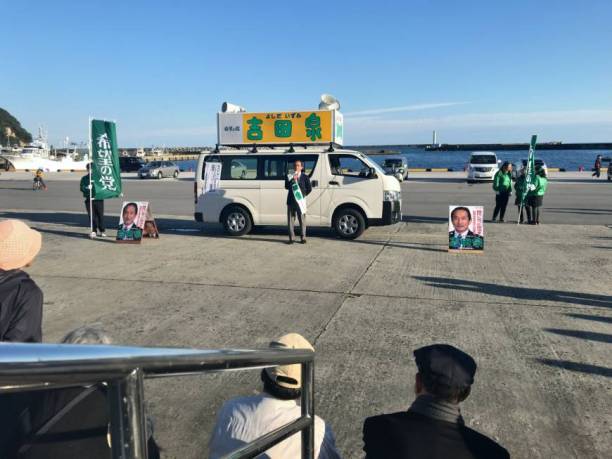
Kibo no To candidate Izumi Yoshida campaigns in the coastal area of Ena in Fukushima Prefecture on Tuesday
NIHONMATSU/IWAKI, FUKUSHIMA PREF. – For Prime Minister Shinzo Abe, the two biggest election-defining issues of Sunday’s Lower House poll are how to spend the additional revenue from the planned consumption tax hike in 2019 and how to deal with North Korea’s nuclear threat. Leaders from other parties see either proposing or preventing revisions to the Constitution as their main priority.
But for residents of Fukushima Prefecture — many of whom are still recovering from the March 2011 Great East Japan Earthquake and ensuing tsunami that triggered a nuclear disaster — the focus is on when their lives will return to some semblance of normalcy.
That sentiment is strongest in the Fukushima No. 5 electoral district, site of the crippled Fukushima No. 1 nuclear power plant, which forced many to evacuate from the no-go zone more than six years ago.
Candidates in the constituency have focused their campaigns on reconstruction and decontamination of the area.
However, campaign strategies are split between the two front-runners — reconstruction minister Masayoshi Yoshino, backed by the ruling Liberal Democratic Party, and Izumi Yoshida, a former vice reconstruction minister who had recently left the Democratic Party to join Kibo no To (Party of Hope), headed by Tokyo Gov. Yuriko Koike.
Yoshino, 69, is taking time to woo voters living in temporary housing and less-populated areas, while Yoshida is campaigning in the more densely populated city of Iwaki.
In pouring rain on Monday, Yoshino’s campaign car appeared at a temporary housing complex in the city of Nihonmatsu, where about 10 residents came out to listen. Although the city is located outside Yoshino’s electoral district, many evacuees from the town of Namie, which is in the district, now reside there.
Evacuation orders for parts of Namie were lifted in March, but only 381 people lived in the town as of the end of last month, while the vast majority of former residents have not returned, according to a town official.
“I’m eager to reconstruct Fukushima. I need your help in order for me to take part in national politics,” Yoshino said in his five-minute speech.
Residents were surprised to see him making the effort to travel out there.
“I don’t think other candidates have come here. I sense that (Yoshino) cares about us,” Jinichiro Tajiri, 76, who lives in nearby reconstruction housing, said after the speech.
Tajiri, who used to live in Namie, has occasionally visited his hometown since March.
“Reconstruction is what I expect the most,” he said.
Tajiri’s wife, Yoshiko, also 76, added, “I want better medical care. A majority of the people here are elderly.”
Yoshino has so far used three days of campaigning to visit evacuees dispersed throughout the prefecture, said Koichi Ito, Yoshino’s election aide.
“While Futaba has 55,000 voters, Iwaki has 370,000. But Yoshino, as a reconstruction minister, has a strong will to continue supporting disaster victims,” Ito said.
Meanwhile, Kibo no To’s Yoshida, 68, who lags behind Yoshino in the media polls, is focusing more on Iwaki.
“Many have already left temporary housing. … Some have built homes in Iwaki. We understand that we must visit (the temporary housing communities), but there aren’t many people living there now,” said Yoshida’s secretary, Toshifumi Sato. “It’s a short battle, so we need to prioritize efficiency.”
On Tuesday, about 300 voters gathered to hear Yoshida’s campaign speech in Ena, the coastal area of Iwaki.
“Revitalization comes from the citizens. We must share our knowledge,” Yoshida said during his speech.
Listening to the speech, Katsuya Kanenari, who heads Ena’s residential group, praised him for his locally focused policies.
“The area used to have a thriving fishing industry, but this was destroyed and ships no longer come. What remains now is the beautiful scenery,” Kanenari said.
“We want public facilities to be built in the area. We want people to visit. Otherwise, the area will remain undeveloped,” he said.
Two other candidates, backed by smaller parties, are also running for the election; Tomo Kumagai, 37, from the Japanese Communist Party and Yoko Endo, 67, backed by the Social Democratic Party.
In line with the parties’ policies, Kumagai and Endo are vowing to eliminate nuclear power plants from Fukushima, unlike Yoshino and Yoshida, who spoke less about that topic.
During a live online debate held Oct. 13 by the Junior Chamber International Japan, Kumagai stressed the need for a government that will rid the prefecture of nuclear power plants.
Endo, on the other hand, said during the same program that the majority of Fukushima residents want the Fukushima No. 1 and No. 2 plants decommissioned, adding that all nuclear power plants in Japan should be phased out.
Few would feel stronger about abolishing nuclear power than the residents who directly faced the fears and damage from the triple meltdown in Fukushima.
“Nuclear power is not something humans can control. (The disaster) is unforgivable,” said Kazuo Akama, 70, a long time resident of Iwaki.
“You must be a victim to understand that. (Nuclear power) is no good. It’s no good,” he said.
Typhoon Lan Targets Never-Ending Fukushima Nuclear Disaster Site Area With High Waves, Wind, Rains
 Typhoon Lan and Japan Nuclear Power Stations.
“Powerful typhoon drenches Japan, soaks voters as they trudge to polls
Posted:Sun, 22 Oct 2017 03:39:46 -0400
TOKYO (Reuters) – Tens of thousands across Japan were advised to evacuate, hundreds of flights were canceled and rail services disrupted as heavy rain and wind lashed a wide swathe of Japan on Sunday, a national election day, as a powerful typhoon neared“. http://feeds.reuters.com/~r/reuters/environment/~3/si-9SOj0Ex4/powerful-typhoon-drenches-japan-soaks-voters-as-they-trudge-to-polls-idUSKBN1CR02N
Apparently the Fukushima area may get 10 meters (32 ft) waves.
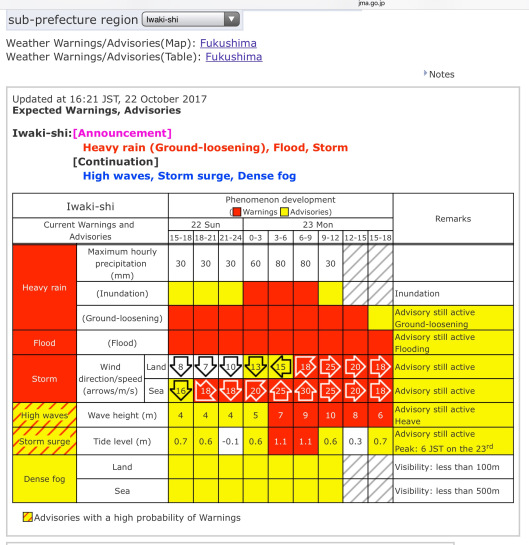
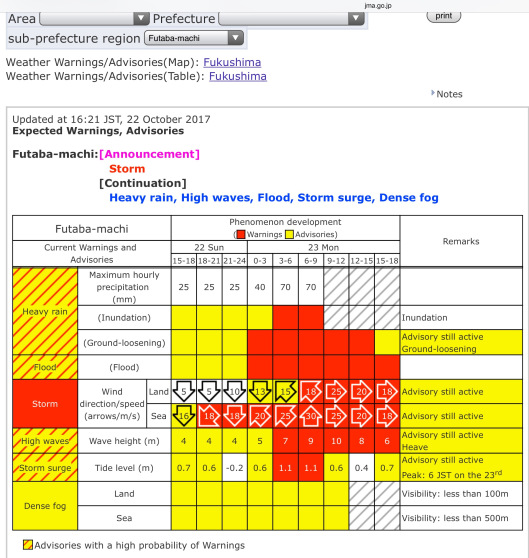
Source: Japan Meteorological Agency website: http://www.jma.go.jp/en/warn/f_0720400.html , http://www.jma.go.jp/en/warn/f_0754600.html
Typhoon Lan offshore: “MAXIMUM SIGNIFICANT WAVE HEIGHT AT 220000Z IS 41 FEET” http://www.usno.navy.mil/NOOC/nmfc-ph/RSS/jtwc/warnings/wp2517web.txt
Sendai Nuclear Power Station and Ikata are apparently back in operation: https://en.wikipedia.org/wiki/Nuclear_power_in_Japan. Hamaoka and others not operating almost certainly have spent fuel still onsite, which still requires energy for cooling.
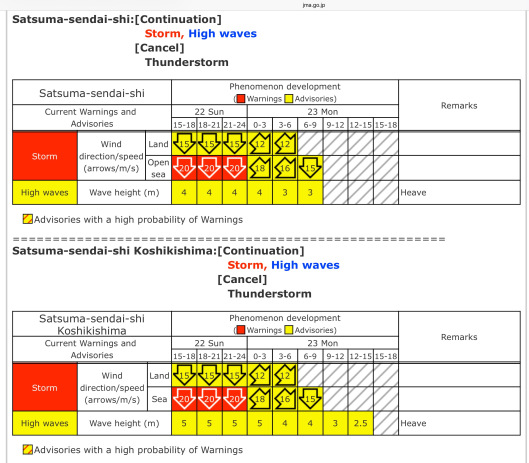

Source: Japan Meteorological Agency website
WTO panel rules on Korea’s ban on Japanese seafood

September 28th. Banners and calls for government action at Seoul’s Gwanghwamun Square: “We oppose imports of radioactive, contaminated Japanese seafood.”
A dozen civic groups are protesting the lifting of an import ban on Japanese seafood.
“It’s been more than six years since the Fukushima nuclear disaster, but radiation-tainted water is still being released into the sea. If the government lifts the restrictions, contaminated Japanese seafood will enter Korea.”
Following the Fukushima nuclear disaster in 2011, the Korean government slapped a temporary import ban on Japanese food. It then extended the ban to all fishery products from eight Japanese prefectures around Fukushima in September 2013, citing safety concerns.
In mid-2015, Tokyo lodged a complaint with the World Trade Organization against the restrictions.
After several bilateral meetings, a dispute resolution panel was set up in Feburary 2016, and this weekthe WTO panel sent its first dispute resolution report.
“Yes, both Seoul and Tokyo received the panel’s interim decision on Tuesday. For now, we cannot reveal the outcome as the concerning party’s duty. The result will be made public next spring, after it’s translated into three languages. What we can say now is that we will take measures if we think the panel’s ruling poses a risk to public health.”
In the complaint, Japan argued the Korean government lacked an explanation and scientific proof to back its restriction measures, adding Seoul had failed respond to Tokyo’s requests to answer its questions.
“In 2014 and 2015, Korea dispatched experts to conduct inspections in Fukushima. But, according to what I’ve found through information disclosure requests, under pressure from the Japanese government, the team didn’t conduct inspections in deep water, oceanfloor deposits as originally planned. Such inspections are critical to finding levels of contamination.”
The inspection team was disbanded in 2015 without a clear reason, and there was no final report on the inspection.
Experts believe it’s highly likely Korea lost the first panel ruling.
Once the outcome is made public next year, Korea has 60 days to hold discussions with Japan, and 15 months of appeal process, if it decides to do so.
“The Korean government needs to see how Japan is controlling its radiation tainted water, and conduct a thorough inspection in Fukushima, including of deep seawater, to show the import ban is fair. Secondly, the Korean government needs to take active measures to release whatever the inspection team found in 2014 and 2015 to restore people’s trust.”
Importing food is a matter of a nation’s sovereign rights.
A number of other countries, including China, Russia, Singapore and the U.S. all have some sort of import restriction measures, with China banning imports from ten prefectures in Japan, and Russia banning not just fresh seafood, but processed seafood.
Thus, the WTO ruling could have a broader impact and give Japan the basis to claim that food produced in the Fukushima region is 99 percent safe.
“There’s no safety level. Food safety standards differ according to the scientific research methods and the machines you use. No matter how small, radioactive material like Cesium, which stays in a natural state for a long time, accumulates in fish. If consumed by people, there’s a possibility it can cause cancer.”
Following the import ban in 2011, Japanese seafood imports to Korea have slumped to less than half the level they were at before the Fukushima nuclear disaster.
Many Koreans are worried about the possible resumption of seafood imports from Japan.
“Then, people won’t be conscious or cautious of food from Fukushima, and I’m worried my child will eat Japanese seafood. The government should protect the public’s health.”
“With concerns about radioactive contamination in seafood imports from Japan, and a lack of transparency from the government, the Korean public is calling on the administration to take the necessary measures that guarantee the safety of the nation’s food supply.
Kim Hyesung, Arirang News. ”
Japan attempting to force contaminated food products onto the market
A World Trade Organization panel has apparently ruled in Japan’s favor in a dispute over South Korean restrictions on imports of Japanese seafood imposed after the 2011 Fukushima nuclear disaster, according to a source familiar with the matter.
Both sides had been informed of the panel’s decision as of Tuesday. Tokyo declined to reveal the outcome but said it was “consistent with Japan’s position.” A final report is expected to be made public by next spring.

WTO panel said to back Japan on Fukushima fish ban
Tokyo has called South Korean restrictions on seafood imports unfair
GENEVA/SEOUL — A World Trade Organization panel has apparently ruled in Japan’s favor in a dispute over South Korean restrictions on imports of Japanese seafood imposed after the 2011 Fukushima nuclear disaster, according to a source familiar with the matter.
Both sides had been informed of the panel’s decision as of Tuesday. Tokyo declined to reveal the outcome but said it was “consistent with Japan’s position.” A final report is expected to be made public by next spring.
The WTO dispute settlement process lets parties appeal panel decisions. Ryu Young-jin, South Korea’s minister of food and drug safety, told lawmakers in the National Assembly on Tuesday that the country would appeal any ruling against it by the panel “in the interest of public health.”
For Tokyo, a victory would mark progress on rolling back restrictions on imports of fish and other seafood from waters off eastern Japan. The South Korean ban, which Japan claims is unfair under WTO rules, was imposed in 2013. Japan tried and failed to talk the matter out with South Korea in 2015, prompting Tokyo to request the establishment of the dispute resolution panel.
What happens next remains unclear. South Korea’s Yonhap News Agency reported that the import ban would stay in place until at least 2019.
A number of other countries have imposed similar restrictions on Japanese seafood for fear of radioactive contamination, so the ruling could have a broader impact.
Seoul considers appeal against WTO ruling on Fukushima seafood ban
SEOUL, Oct. 18 (Yonhap) — South Korea is considering appealing the World Trade Organization (WTO) panel findings that its import restrictions on Japanese seafood after the 2011 Fukushima nuclear disaster were unfair, the country’s trade ministry said Wednesday.
Japan lodged a complaint at the WTO in 2015 to challenge South Korea’s import bans and additional testing requirements on fish caught from eight prefectures near Fukushima since 2013.
On Tuesday, WTO’s dispute settlement panel in Geneva ruled in favor of Japan and notified the two sides of the result.
“We will appeal in accordance with the WTO procedures if (its decision) is considered unfair and affects the government’s ability to safeguard the health of our people,” the Ministry of Trade, Industry and Energy said in a release. “Public health concerns are our top priority.”
Under WTO rules, South Korea has 60 days to appeal to an appellate body, which could delay imports of Fukushima-related seafood for another two years during the deliberation period.
Details of the final result will be available to WTO member nations in January and will be open to the public afterwards, the ministry said.
Rulings show Fukushima relief falls short of reality of victims

A recent district court ruling on a damages lawsuit over the 2011 Fukushima nuclear accident must have reminded many people of the serious consequences of the disaster.
The meltdowns at Tokyo Electric Power Co.’s Fukushima No. 1 nuclear plant shattered the happy and peaceful lives of local residents.
A huge number of people born and raised in the surrounding communities can no longer hope to continue their lives there, including working and developing their personalities through interactions with others.
In the lawsuit filed by around 3,800 plaintiffs, the Fukushima District Court on Oct. 10 held the government and the electric utility responsible for the nuclear accident and ordered them to pay compensation to about 2,900 evacuees.
It was another court ruling that represents a “legal defeat” for the government over the disaster, following a decision made in March by the Maebashi District Court in Gunma Prefecture.
For many years, the government has been promoting nuclear power generation as a national policy. Policymakers involved should revisit the lessons from the severe accident, which should be blamed on their blind faith in the “safety myth” of nuclear power.
They should also start making fresh efforts to enhance the safety of nuclear plants and provide effective relief to victims.
One key issue in the around 30 similar lawsuits that have been filed across the nation is whether it was possible to foresee the massive tsunami that triggered the meltdowns.
So far, three district courts have handed down rulings, all of which acknowledged that the tsunami was foreseeable. Their decisions were partly based on a related view announced in 2002 by a government agency.
Last month, however, the Chiba District Court denied the government’s legal responsibility for the accident, saying the disaster might not have been prevented even if presumed safety measures had been taken.
The ruling was based on a lenient judgment that showed insufficient sensitivity to the consequences of the accident.
In contrast, the Fukushima court delivered a well-reasoned, convincing ruling that describes in detail possible measures that could have been taken. It was based on a wide range of evidence, including courtroom testimonies by experts and facts and data concerning the situation when the accident unfolded.
Nuclear safety regulators and nuclear plant operators have the grave responsibility to constantly update their scientific knowledge and adopt safety measures of the highest possible level.
This is a vital imperative whose importance has become even clearer since the Fukushima accident.
Another key issue in the Fukushima disaster-related lawsuits is the way relief should be provided to victims.
All three rulings ordered compensation payments beyond government-set standards to a considerable number of plaintiffs.
The Chiba District Court ruling amply recognized the mental damages from the loss of hometowns caused by the accident. The Fukushima court granted compensation to a wide range of people, including residents in areas in Fukushima Prefecture that were not ordered to evacuate by the government, as well as in neighboring Ibaraki Prefecture, for their suffering from anxiety about radiation exposure.
The court rulings differed in their views about certain issues and damages granted.
But they all acknowledged that the government’s guidelines for compensation and TEPCO’s payments based on the guidelines do not adequately reflect the reality of the victims’ suffering.
The government’s Dispute Reconciliation Committee for Nuclear Damage Compensation, which crafted the guidelines, should scrutinize the rulings to determine if the guidelines have any shortcomings or other problems.
The nuclear accident cannot be undone. Obviously, the government and TEPCO are obliged to provide quick and appropriate relief to victims from the viewpoint of people suffering the consequences of the disaster.
Kobe Steel Scandal Grows to Include Subsidiaries, 500 Firms Hit by Cheating Scandal

Kobe Steel’s chief executive, Hiroya Kawasaki, at a news conference in Tokyo on Friday. “We are trying to understand how this could possibly happen at so many subsidiaries, including overseas,” he said.
Kobe Steel Scandal Grows to Include Subsidiaries
TOKYO — A scandal about falsified quality data at Kobe Steel expanded on Friday, as the Japanese steel maker said nine subsidiaries, including several outside Japan, had either failed to carry out required product checks or lied about the results.
Including products sold by the subsidiaries, Kobe Steel said it now estimated that it had shipped substandard or potentially substandard materials to 500 customers, up from an initial estimate of 200.
“We are trying to understand how this could possibly happen at so many subsidiaries, including overseas,” Kobe Steel’s chief executive, Hiroya Kawasaki, said at a news conference.
Mr. Kawasaki repeated a promise to complete in two weeks an investigation into potential safety hazards related to the data falsification, and to deliver in a month the results of a broader examination of the company’s failings, which now look systemic and global.
Kobe Steel supplies metal components to industries where safety is vital, including car, train and aircraft producers, and makers of electronics and other equipment. The company says it is working with its customers to determine if any of the affected material, mostly aluminum and copper, poses a safety risk.
The subsidiaries named on Friday were three in China, one each in Thailand and Malaysia and four based in Japan. They make products like copper piping and aluminum and steel wire.
Employees at the companies are supposed to test the products to ensure that they meet design standards specified in customer contracts. Kobe Steel said that in some cases the tests had not been carried out, and that in other cases employees had recorded fake results to make it seem as though the products met customers’ standards when they did not.
Executives said the data manipulation had been deliberate.
Mr. Kawasaki said that Kobe Steel’s international investigation was continuing, and that more cases of data falsification could emerge. The revelations so far have reverberated through supply chains and cast a shadow over Japan’s reputation for precision manufacturing.
Ford Motor said late Thursday that the only use of Kobe Steel aluminum that it had established in its worldwide operations involved a hood for Ford Mondeo sedans produced in China. It said it did not know if the aluminum was substandard, but said it was not being used structurally, so safety was not at issue.
The scandal also touched Japan’s embattled nuclear industry. Tokyo Electric Power, owner of the Fukushima Daiichi nuclear power plant, which experienced meltdowns after a tsunami struck it in 2011, said Friday that it had sourced improperly certified copper piping from Kobe Steel.
Tokyo Electric said the piping, which it bought for use at its Fukushima Daini nuclear power station, near Fukushima Daiichi, had not been checked to ensure it met size requirements. But it said the piping had never been installed, and was in storage, and did not pose a safety threat.
Kobe Steel said on Sunday that employees had altered inspection certificates on aluminum and copper products from September 2016 to this past August, constituting about 4 percent of the company’s output of those items during the period, but that it was examining other possible episodes of data falsification going back 10 years.
On Wednesday, Kobe Steel added two more products to the list of affected materials: powdered steel, which is used to create molded steel products like gears, and “target material,” a specialty mix of metals used to produce DVDs, television screens and other electronics equipment.

A contrite Mr Hiroya Kawasaki, CEO of Kobe Steel, has said the company plans to pay customers’ costs for any affected products
500 firms hit by cheating scandal: Kobe Steel CEO
Crisis ripples through global supply chains, dealing body blow to Japan’s reputation
TOKYO • The cheating crisis engulfing Kobe Steel just got bigger.
Chief executive Hiroya Kawasaki revealed yesterday that about 500 companies had received its falsely certified products, more than double its earlier count, confirming widespread wrongdoing at the steelmaker that has sent a chill throughout global supply chains.
The scale of the misconduct at Japan’s third-largest steelmaker pummelled its shares as investors, worried about the financial impact and legal fallout, wiped about US$1.8 billion (S$2.4 billion) off its market value this week.
As the company revealed tampering of more products, the crisis has rippled through supply chains across the world in a body blow to Japan’s reputation as a high-quality manufacturing destination.
A contrite Mr Kawasaki told a briefing the firm plans to pay customers’ costs for any affected products. “There has been no specific requests, but we are prepared to shoulder such costs after consultations,” he said, adding that products with tampered documentation account for about 4 per cent of the sales in the affected businesses.
Kobe Steel initially said 200 companies were affected when it admitted last weekend that it had falsified data about the quality of aluminium and copper products used in cars, aircraft, space rockets and defence equipment.
Asked if he plans to step down, Mr Kawasaki said: “My biggest task right now is to help our customers make safety checks and to craft prevention measures.”
Boeing has some of the falsely certified products, a source with knowledge of the matter said, while stressing that the world’s biggest maker of passenger jets does not consider the issue a safety problem.
More than 30 non-Japanese customers had been affected by the firm’s data fabrication, the Nikkei newspaper reported yesterday. A Kobe Steel spokesman said the companies received its products but would not confirm they had any of the falsely certified components.
Nuclear power plant parts are the latest to join the list of affected equipment as Fukushima nuclear operator Tokyo Electric Power (Tepco) yesterday said it had taken delivery of pipes from Kobe Steel that were not checked properly.
The pipes were delivered to its Fukushima Daini station, located near the destroyed Fukushima Daiichi plant, but have not been used, Tepco said, adding that it was checking all its facilities.
Faulty parts have also been found in Japan’s famous bullet trains that run at speeds as high as 300kmh and a space rocket that was launched in the country earlier this week. One bullet train operator has already said it will seek compensation from Kobe Steel.
The government has ordered Kobe Steel to address safety concerns within about two weeks and report on how the misconduct occurred in a month. No safety issues have yet been identified in the unfolding imbroglio.
The company’s shares fell nearly 9 per cent yesterday and have fallen more than 40 per cent since the scandal broke.
Kobe Steel, founded in 1905, is a pillar of Japan’s manufacturing sector. Such are its establishment bona fides that Prime Minister Shinzo Abe, scion of a political dynasty, worked at the company decades ago, before entering politics.
But those credentials have now been shattered, a point amplified by Mr Kawasaki who earlier said the credibility of the firm “has plunged to zero”.
Kobe Steel discloses 9 more cases of faked inspection data

Kobe Steel President and CEO Hiroya Kawasaki speaks during a press conference in Tokyo, Friday.
TOKYO – The scandal over product inspections data faked by Japanese materials and machinery giant Kobe Steel expanded Friday to include products shipped to more than 500 customers.
Kobe Steel’s president, Hiroya Kawasaki, told reporters the company had uncovered nine more types of products whose inspections had been faked or manipulated, including copper alloy pipes and steel wire rods used in vehicle tires and engines.
The problems disclosed by Japan’s third-largest steel maker are just the latest in a slow of product quality, accounting and corruption scandals that have dented Japan’s image of superior manufacturing prowess.
The latest problems were discovered with shipments of more than than 11,000 tons of steel, copper, and aluminum products made by Kobe Steel and its affiliates in Japan, China, Malaysia and Thailand, the company said.
Kawasaki at times appeared close to tears while explaining how it was that the company had chosen not to disclose some of the cases that had been discovered much earlier and discussed at past board meetings.
“I apologize again for the tremendous trouble that we have caused to our customers and consumers,” he said. “We are conducting a thorough analysis of the problem. The analysis will be key,” he said.
Kawasaki said he did not expect any product recalls due to the misconduct.
The exact extent of the problem remains unclear since Kobe Steel has not identified the customers affected. But the company is a major supplier to many manufacturers, including automakers, aircraft manufacturers, semiconductor factories and nuclear power plants.
Other materials it said were affected by bogus inspections or faked data include steel powder, aluminum flat-rolled products and castings, copper strips and tubes and forgings.
Tokyo Electric Power Co said Friday it had bought a backup duct for a heat exchanger for one of four reactors at one of two nuclear power reactors in northeastern Japan’s Fukushima that narrowly survived the 2011 tsunami despite some damage.
TEPCO said in a statement that a Kobe Steel subsidiary, Shinko Metal Products Co., informed it the product came with inappropriate measurement data.
There is no concern over safety because the duct was bought as a backup and was not used.
TEPCO said it has requested further investigations by Kobe Steel of products shipped to the utility and its subsidiaries. TEPCO is also investigating.
Japan’s quiet payouts to cities near nuclear plants fuels speculation of political ploy

Shimane and Tottori prefectures hold a joint drill in Hoki, Tottori Prefecture, in October 2015 for residents living near nuclear power plants in the prefectures. The government has expanded a state subsidy for cities hosting plants to include municipalities within a 30 km radius.
In an apparent bid to win support for the restart of nuclear power plants, the state has quietly expanded the scope of subsidies for host cities to include local governments within 30 kilometers of the facilities, a charge the government denied Friday.
The change came into force in April with no announcement to the media from the industry ministry, fueling speculation that it was meant to assuage the concerns of municipalities surrounding host cities about plants taken offline in the wake of the 2011 Fukushima nuclear crisis.
A government official, however, denied this speculation.
“We reviewed the system after learning that nuclear power plants also influence surrounding areas,” the official, with the industry ministry’s Agency for Natural Resources and Energy said, adding that the change had been reported on the ministry’s website and that local governments were briefed.
Under the shift, more than 150 local governments are entitled to the subsidy, for which ¥4.5 billion ($40 million) was allocated in the fiscal 2017 budget, the same amount as in fiscal 2016. The ministry has requested a ¥5 billion budget for fiscal 2018.
According to the agency, the program began in fiscal 2016, mainly to promote renewable energy and other measures to revitalize the economies of municipalities hosting nuclear power plants when the facilities are scrapped due to old age.
Utilities face a constant cycle of reactors going online or offline through decommissioning or the suspension of operations. For example, at Chugoku Electric Power Co.’s nuclear plant in Shimane Prefecture, the No. 1 unit is set to be decommissioned as the operator seeks to restart its No. 2 unit.
The change from fiscal 2017 allowed the subsidies to be paid out to towns and villages within 30 km of a nuclear complex, in addition to the host prefectural governments.
To gain approval for restarts, utilities effectively need to obtain consent from prefectural and municipal governments hosting the nuclear complexes, although such efforts are not required by law.
Since the 2011 nuclear disaster, which caused damage to a wide area, surrounding municipalities have stepped up calls for a stronger voice in deciding whether to resume nuclear reactor operations.
But the state and utilities are reluctant to expand the scope of municipalities from which they need to obtain consent, saying that doing so would make restarts exceedingly difficult.
Rokkasho NPP Violated Safety Rules
Nuclear fuel reprocessing operator violated safety rules: regulator
TOKYO (Kyodo) — Japanese nuclear regulators concluded Wednesday that Japan Nuclear Fuel Ltd. violated legally binding safety rules by failing to conduct necessary checks for over a decade at its uncompleted spent nuclear fuel reprocessing plant in the country’s northeast.
The failure of checks at an underground portion of the plant in the village of Rokkasho in Aomori Prefecture for some 14 years eventually resulted in about 800 liters of rainwater flowing into a building housing an emergency diesel generator in August this year. The generator is a crucial device in times of crisis such as the loss of external power.
Japan Nuclear Fuel President Kenji Kudo said at a Nuclear Regulation Authority’s meeting that he will prioritize inspections of all facilities at the plant and suspend its operations to seek a safety approval on the plant to put it onstream.
The utility plans to check its facilities and some 600,000 devices by the end of this year before requesting the authority to resume its safety assessment for the plant.
The body applied for a safety assessment of the plant in 2014 and aimed to complete it in the first half of fiscal 2018, but the goal is likely to be delayed due to the need for inspections.
The envisioned nuclear fuel reprocessing plant is a key component of the government’s nuclear fuel recycle policy, which aims to reprocess spent uranium fuel and reuse extracted plutonium and uranium as reactor fuel.
But the Rokkasho plant has been riddled with problems, with its completion date postponed 23 times since 1997, its initial target. It also had to meet as new, tougher safety standards made in the wake of the crisis at the Fukushima Daiichi nuclear power complex, triggered by the 2011 deadly earthquake and tsunami.
The authority also said holes and cracks at exhaust pipes discovered at Japan Nuclear Fuel’s uranium enrichment plant in September also violate safety rules. The defects were left undetected for a long time due to a lack of inspection.
A utility compiles safety programs, which need to be assessed and approved by the authority.
If any grave flaws are found, the authority can issue an order to stop the operation of the plants or retract its approval to construct a nuclear plant.
Japan Nuclear Fuel “should have a substantial sense of crisis,” a member of the authority said. “We will take necessary measures if an improvement is not seen in ensuring the safety (in operating the plant).”
Nuclear fuel recycling plant screening suspended
Japan’s nuclear regulator says the operator of a nuclear fuel reprocessing plant in northern Japan has violated safety regulations.
The plant in Rokkasho Village, Aomori Prefecture, is run by Japan Nuclear Fuel Limited.
The Nuclear Regulation Authority said at a meeting on Wednesday that the company violated its in-house safety regulations.
In August, rainwater was found to have flowed from piping in an underground tunnel into a building housing an emergency power generator at the plant. The firm was later found not to have conducted necessary inspections of the tunnel for 14 years.
At Wednesday’s meeting, company president Kenji Kudo pledged to address this and other maintenance problems before submitting documents needed for the regulator to conduct safety screening of the plant.
NRA member Satoru Tanaka pointed out that superficial efforts cannot fix the problems because the matter has to do with business operations. He suggested that the company should have a sense of crisis, and warned of tough measures unless safety improves.
The company aims to confirm the safety of all installations at the plant and draw up a management plan this year. Safety screening is required before the plant can fully operate.
Japan Nuclear Fuel appears to face difficulty in completing work on the plant by the first half of fiscal 2018 as planned. The facility is a pillar of the government’s nuclear fuel recycling program.
Rokkasho Fuel Reprocessing Plant Faked Safety Records For 14 Years
(Kyodo) Japan Nuclear Fuel Ltd. violated legally binding safety rules by failing to conduct necessary checks for over a decade at its uncompleted spent nuclear fuel reprocessing plant…

Unfinished nuclear fuel reprocessing plant faked safety records: NRA
The firm that owns an uncompleted nuclear fuel reprocessing plant in Aomori Prefecture failed to conduct necessary checks and falsified safety check records relating to the plant, the Nuclear Regulation Authority (NRA) has reported.
The NRA concluded on Oct. 11 that Japan Nuclear Fuel Ltd. (JNFL) has violated safety measures after it was learned that the firm failed to carry out the required checks and nevertheless continued to write down “no abnormalities” in safety check records. There has been a spate of incidents such as the flow of rainwater into facility buildings at the plant in the Aomori Prefecture village of Rokkasho.
The plant, which is scheduled to reprocess spent nuclear fuel, was on the verge of hosting a final-stage NRA safety inspection, but the checkup is likely to be postponed considerably as JNFL now has to prioritize in-house inspections of all facilities at the plant.
One of the main roles of a nuclear fuel reprocessing plant is the extraction of reusable uranium and plutonium from spent nuclear fuel, making it a key part of the nuclear fuel cycle. However, the Rokkasho plant has been riddled with problems, and its completion date has been postponed 23 times since the initial planned opening date of 1997. Currently, the plant is scheduled to be completed in the first half of fiscal 2018, but this could be difficult.
In August, it came to light that about 800 liters of rainwater had flowed into an emergency electrical power building at the plant. The cause was the leaking of rainwater from an underground facility. This facility, however, has never been checked since its construction in 2003. JNFL nevertheless gave it a false “no abnormalities” appraisal in its daily records. Furthermore, about 110 liters of rainwater also flowed into the underground facility in September.
Apparently, the firm has tried to clarify the issue by saying that, “The (no abnormalities) comment was referring to another underground facility nearby.”
The company plans to complete safety checks at all its Rokkasho plant facilities within the year, and then submit the results to the NRA — with the intention of inviting the NRA to resume safety inspections of the plant.
Japan Nuclear Fuel skipped safety checks at Rokkasho plant for 14 years
Japan Nuclear Fuel Ltd.’s Rokkasho reprocessing plant in Rokkasho Village, Aomori Prefecture, allegedly violated safety rules for over a decade.
Nuclear regulators concluded Wednesday that Japan Nuclear Fuel Ltd. violated legally binding safety rules by failing to conduct necessary checks for over a decade at its uncompleted spent nuclear fuel reprocessing plant in the country’s northeast.
The failure of checks at an underground portion of the plant in the village of Rokkasho in Aomori Prefecture for about 14 years eventually resulted in about 800 liters of rainwater flowing into a building housing an emergency diesel generator in August this year. The generator is a crucial device in times of crisis such as the loss of external power.
Japan Nuclear Fuel President Kenji Kudo said at a Nuclear Regulation Authority’s meeting that he will prioritize inspections of all facilities at the plant and suspend its operations to seek a safety approval on the plant to put it on stream.
The utility plans to check its facilities and some 600,000 devices by the end of this year before requesting the authority to resume its safety assessment for the plant.
The body applied for a safety assessment of the plant in 2014 and aimed to complete it in the first half of fiscal 2018, but the goal is likely to be delayed due to the need for inspections.
The envisioned nuclear fuel reprocessing plant is a key component of the government’s nuclear fuel recycle policy, which aims to reprocess spent uranium and reuse extracted plutonium and uranium as reactor fuel.
But the Rokkasho plant has been inundated with problems, with its completion date postponed 23 times since 1997, its initial target. It also had to meet new, tougher safety standards made in the wake of the crisis at the Fukushima No. 1 nuclear power complex, triggered by the powerful March 2011 earthquake and tsunami that devastated parts of the Tohoku region.
The authority also said holes and cracks at exhaust pipes found at Japan Nuclear Fuel’s uranium enrichment plant in September also violated safety rules. The defects had been undetected due to a lack of inspections.
A utility compiles safety programs, which need to be assessed and approved by the authority.
If any grave flaws are found, the authority can issue an order to stop the operation of the plants or retract its approval to construct a nuclear plant.
Japan Nuclear Fuel “should have a substantial sense of crisis,” a member of the authority said. “We will take necessary measures if an improvement is not seen in ensuring the safety (in operating the plant).”
UN: Japan Violated Human Rights, Fukushima Evacuees Abandoned
“Why should people, especially women and children, have to live in places where the radiation level is 20 times the international limit?” Sonoda said. “The government hasn’t given us an answer.”

Mitsuko Sonoda’s aunt harvesting rice in her village, which is outside the mandatory evacuation zone, before the disaster.
Fukushima evacuee to tell UN that Japan violated human rights
Mitsuko Sonoda will say evacuees face financial hardship and are being forced to return to homes they believe are unsafe
A nuclear evacuee from Fukushima will claim Japan’s government has violated the human rights of people who fled their homes after the 2011 nuclear disaster, in testimony before the UN in Geneva this week.
Mitsuko Sonoda, who voluntarily left her village with her husband and their 10-year-old son days after three reactors at the Fukushima Daiichi nuclear power plant went into meltdown, will tell the UN human rights council that evacuees face financial hardship and are being forced to return to neighbourhoods they believe are still unsafe almost seven years after the disaster.
“We feel abandoned by the Japanese government and society,” Sonoda, who will speak at the council’s pre-session review of Japan on Thursday, told the Guardian.
An estimated 27,000 evacuees who, like Sonoda, were living outside the mandatory evacuation zone when the meltdown occurred, had their housing assistance withdrawn this March, forcing some to consider returning to their former homes despite concerns over radiation levels.
In addition, as the government attempts to rebuild the Fukushima region by reopening decontaminated neighbourhoods that were once no-go areas, tens of thousands of evacuees who were ordered to leave will lose compensation payments and housing assistance in March next year.
The denial of financial aid has left many evacuees facing a near-impossible choice: move back to homes they fear are unsafe, or face more financial hardship as they struggle to build lives elsewhere without state help.
“People should be allowed to choose whether or not to go back to their old homes, and be given the financial means to make that choice,” said Kendra Ulrich, senior global energy campaigner for Greenpeace Japan.

Sonoda’s son and a friend drinking from a mountain stream before the disaster.
“If they are being put under economic pressure to return, then they are not in a position to make an informed decision. This UN session is about pressuring the Japanese government to do the right thing.”
Evacuees are being encouraged to return to villages and towns near the Fukushima plant despite evidence that some still contain radiation “hot spots”.
In Iitate village, where the evacuation order was lifted this March, much of the surrounding forests remain highly radioactive, although homes, schools and other public buildings have been declared safe as part of an unprecedented decontamination effort.
“You could call places like Iitate an open-air prison,” said Ulrich. “The impact on people’s quality of life will be severe if they move back. Their lives are embedded in forests, yet the environment means they will not be allowed to enter them. Forests are impossible to decontaminate.”
After months of moving around, Sonoda and her family settled in Kyoto for two years, where local authorities provided them with a rent-free apartment. They have been living in her husband’s native England for the past four years.
“We’ve effectively had to evacuate twice,” said Sonoda, who works as a freelance translator and Japanese calligraphy tutor. “My son and I really struggled at first … we didn’t want to leave Japan.”

Sonoda and her family near her home in Fukushima before the disaster.
Concern over food safety and internal radiation exposure convinced her that she could never return to Fukushima, aside from making short visits to see relatives. “It’s really sad, because my village is such a beautiful place,” she said. “We had a house and had planned to retire there.”
The evacuations have forced families to live apart, while parents struggle to earn enough money to fund their new accommodation and keep up mortgage payments on their abandoned homes.
“Stopping housing support earlier this year was an act of cruelty,” Sonoda said. “Some of my friends had to go back to Fukushima even though they didn’t want to.”
Greenpeace Japan, which is assisting Sonoda, hopes her testimony will be the first step in building international pressure on Japan’s government to continue offering financial help to evacuees and to reconsider its resettlement plan.
It has called on the government to declare Fukushima neighbourhoods unsafe until atmospheric radiation is brought to below one millisievert (mSv) a year, the maximum public exposure limit recommended by the International Commission on Radiological Protection.
While 1 mSv a year remains the government’s long-term target, it is encouraging people to return to areas where radiation levels are below 20 mSv a year, an annual exposure limit that, internationally, applies to nuclear power plant workers.
“Why should people, especially women and children, have to live in places where the radiation level is 20 times the international limit?” Sonoda said. “The government hasn’t given us an answer.”
Fukushima evacuees have been abandoned by the Japanese government
Mitsuko Sonoda says Tokyo is violating the human rights of evacuees by pressuring them to return to the area, even though radiation levels remain high following the 2011 nuclear power plant disaster
I used to live in Fukushima with my husband and our child, in a fantastic natural environment with a strong local community. That was until the earthquake and tsunami of March 11, 2011 destroyed coastal communities and killed tens of thousands of people.
The day after it hit, there were constant aftershocks. It gave us another massive scare when the Fukushima Daiichi nuclear power plant exploded. We decided to evacuate to Western Japan to protect our child.
The government raised the level of “acceptable” exposure to the same standard as nuclear workers – 20 times the international public standard. My son was not a nuclear worker, but a little boy, more vulnerable to the effects of radiation than adults.
Like my family, many fled contaminated areas that were below the raised emergency level, but higher than acceptable. We have been labelled “self-evacuees”. We have never received compensation, outside some housing support.
Some of the evacuee children have struggled to adjust to a different environment. They have continued to miss family, friends and old schools, and have been bullied by other children in their new residences. There were even rumours of “contagion”.
Many children also really miss their fathers, who have often stayed in Fukushima for their jobs.
Mothers have silently tackled these difficulties, including health problems in themselves and their children. We have sometimes been labelled neurotic, irrational and overprotective, our worries about radiation dismissed. Divisions and divorce have been common.
All the while, we miss our relatives, friends, old community and the nature we used to live in.
In March, the government lifted evacuation orders, and the housing support for self-evacuees stopped. Citizens were pressured to return to Fukushima. Research said radiation levels still exceeded the government’s long-term goals.
Because evacuation orders have been lifted, Tokyo Electric Power Company will also stop compensation for victims by March 2018. We need this accommodation support to continue any kind of stable life.
Before Fukushima, they said a major accident could not happen. Now they say radiation is not a problem. They say hardly any compensation is needed. Why should we have to return to live in a radioactive area? Nuclear victims don’t seem to have the right to be free from radiation.
I’m travelling to Geneva this week to testify at a pre-session for the UN Human Rights Council’s review of Japan. Prime Minister Shinzo Abe’s resettlement policies are violating our human rights. If the Japanese government doesn’t support the nuclear survivors, what’s stopping other countries from doing the same in the future?
Mitsuko Sonoda is a Fukushima nuclear accident survivor and evacuee. She now advocates for the rights of nuclear disaster victims, and is going to the UN Commission for Human Rights with the support of Greenpeace Japan
1 This Month




No Nuclear in Cwm Llynfi! Stop the nuclear power station near Maesteg.
To see nuclear-related stories in greater depth and intensity – go to https://nuclearinformation.wordpress.com
-
Archives
- September 2026 (144)
- August 2026 (330)
- July 2026 (355)
- June 2026 (287)
- May 2026 (306)
- April 2026 (356)
- March 2026 (251)
- February 2026 (267)
- January 2026 (308)
- December 2025 (358)
- November 2025 (359)
- October 2025 (375)
-
Categories
- 1
- 1 NUCLEAR ISSUES
- business and costs
- climate change
- culture and arts
- ENERGY
- environment
- health
- history
- indigenous issues
- Legal
- marketing of nuclear
- media
- opposition to nuclear
- PERSONAL STORIES
- politics
- politics international
- Religion and ethics
- safety
- secrets,lies and civil liberties
- spinbuster
- technology
- Uranium
- wastes
- weapons and war
- Women
- 2 WORLD
- ACTION
- AFRICA
- Atrocities
- AUSTRALIA
- Christina's notes
- Christina's themes
- culture and arts
- Events
- Fuk 2022
- Fuk 2023
- Fukushima 2017
- Fukushima 2018
- fukushima 2019
- Fukushima 2020
- Fukushima 2021
- general
- global warming
- Humour (God we need it)
- Nuclear
- RARE EARTHS
- Reference
- resources – print
- Resources -audiovicual
- Weekly Newsletter
- World
- World Nuclear
- YouTube
-
RSS
Entries RSS
Comments RSS
 nuclear-news