Farmer Takeshi Yamada lets his beef cattle graze in the village of Iitate on May 23, 2018, for the first time since the Fukushima nuclear disaster.
May 24, 2018
IITATE, Fukushima — Farmers began tests on having their cattle graze here on May 23 for the first time since the March 2011 triple meltdown at the Fukushima No. 1 nuclear plant.
The national government lifted the nuclear evacuation order in most parts of the village at the end of March 2017.
While about 220 farmers bred beef cattle before the nuclear disaster, just five farmers restarted their breeding after the ban was lifted. The test will last over three months, and the farmers will check the level of radiation in the cattle’s blood and conduct other checks with the aim to return to regular grazing in 2019 or later.
Farmer Takeshi Yamada, 69, who had six of his beef cows graze on the green grass, commented, “Grazing is less stressful than breeding in barns. It makes it possible to produce fresh beef.” Yamada will strive to revive the local “Iitate Beef Cattle” brand.
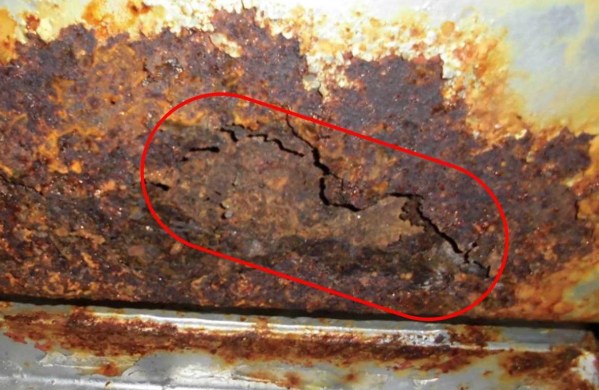
Corrosion is seen in a ventilation duct at the No. 3 unit of the Kashiwazaki-Kariwa nuclear power plant in Niigata Prefecture. | NUCLEAR REGULATION AUTHORITY
Corrosion and holes have been found in ventilation ducts at 12 reactors at seven nuclear plants across the country, the Nuclear Regulation Authority said Wednesday, raising concerns that workers could be exposed to radiation in the event of an accident.
The governmental nuclear watchdog released the results of a nationwide survey it had ordered following a revelation in December 2016 that corrosion had left multiple holes in the air ducts of the No. 2 reactor at Chugoku Electric Power Co.’s Shimane plant in western Japan. That reactor was not included in the survey.
Serious corrosion was found at the No. 3 unit of the Kashiwazaki-Kariwa plant in Niigata Prefecture operated by Tokyo Electric Power Company Holdings Inc. and may have abnormally affected ventilation of the central control room, the watchdog said.
Although the No. 7 unit at the same plant has passed a test to resume operation, the NRA said it will inspect the impact of any corrosion found at the reactor. No abnormality associated with corrosion has been found at the remaining 10 units, it said.
Corrosion or holes were found in steel or galvanized steel ducts at Tohoku Electric Power Co.’s Onagawa nuclear plant, Japan Atomic Power Co.’s Tokai No. 2 nuclear plant, Tepco’s Fukushima No. 1 nuclear plant and Kashiwazaki-Kariwa nuclear plant, Chubu Electric Power Co.’s Hamaoka plant, Hokuriku Electric Power Co.’s Shiga nuclear plant and Chugoku Electric’s Shimane plant.
If an accident occurs, radioactive materials could flow into a plant’s central control room through such holes, putting workers in danger of radiation exposure.
At the No. 3 reactor at the Kashiwazaki-Kariwa plant, a crack as large as 13 centimeters in length and 5 cm in width was found. A total of nine holes and cracks have been discovered at the Nos. 3 and 7 units at the plant.
All the reactors with corrosion were boiling-water reactors, the same type used at the Fukushima No. 1 plant, which spewed a massive amount of radioactive material into the atmosphere following the March 2011 earthquake and tsunami.
No problems have been detected at pressurized-water nuclear reactors, as filtering and other measures take place near air inlets.
The holes at the No. 2 unit at the Shimane plant were discovered when insulation materials covering the ducts were removed for inspection.
The holes, the largest of which measured about 100 centimeters wide and about 30 centimeters long, are believed to have been caused by dew condensation and rainwater that seeped inside the building, as well as salt deposits on the ducts, given that the corrosion extended about 50 meters from the air inlet and spread from the inner surface of the ducts.
Chugoku Electric has decided to increase the number of inspection points at sections near fresh-air inlets and bolster anti-corrosion measures, including the installation of a dehumidifier.
TAIPEI (Kyodo) — Taiwan authorities said Wednesday that Japanese 100-yen shop chain Daiso has been fined NT$41.64 million (US$1.38 million) for falsifying import application documents and banned from importing goods from Japan for two years.
Foreign Trade Bureau deputy chief Lee Guann-jyh told a legislative committee that the punishments have been meted out to Hiroshima-based Daiso Industries Co., which has been operating in Taiwan since 2001 and has about 60 stories here.
In November 2015, Daiso received a six-month import ban for having illegally imported food products from parts of Japan affected by 2011 Fukushima nuclear disaster between July 2014 and March 2015, and selling them with falsified labels of origin.
During that six-month period, Daiso could still import goods from Japan on a case-by-case basis after obtaining permission from the bureau.
But in doing so, it falsified the dates of the imported goods, altering them to predate the six-month ban period that began in November 2015. A total of 694 import application documents were fraudulent, according to the bureau.
On April 27, the company held a press conference in which it apologized to Taiwanese consumers.
As the cleanup of a triple meltdown following an earthquake and tsunami at the Fukushima nuclear power plant drags into its seventh year, one of the biggest continuing threats is less from airborne radioactivity than it is simple water.
A waterlogged radiation and tsunami warning sign found on Fukushima beaches in 2013.
May 22, 2018
As the cleanup of a triple meltdown following an earthquake and tsunami at the Fukushima nuclear power plant drags into its seventh year, one of the biggest continuing threats is less from airborne radioactivity than it is simple water.
On March 11, 2011, the Fukushima plant was devastated by a tsunami, which over the ensuing days sent three of its six reactors into meltdown, while hydrogen explosions cast radioactive iodine, cesium and other fission by-products into the air. More than 160,000 people were forced to evacuated in the wake of the disaster, which has now become synonymous with Chernobyl.
At the time, officials began pumping millions of liters of water into the destroyed reactors to keep them cool, often dumping it from helicopters and spraying it through water cannons. In the years since, the water inundation has become less dramatic, but in the absence of any other way to keep the molten fuel cool, the flow of water continues to flow through the remains of the reactors at the rate of some 160 tons of water a day.
While much of that water undergoes purification to remove significant amounts of radiation, filters can’t cleanse the water of tritium, a radioactive isotope of hydrogen — a process likened by some scientists to separating water from water.
As a result, water contaminated with tritium is building up and space to store it at the disaster site is running out. Of the 1.13 million-ton water storage capacity that the plant has, some 1.7 million tons have been used up.
Cleanup workers have to build a new steel water tank at the rate of one every four days to contain it all, and space to build more is becoming scarce. According to Japan’s Ministry of Economy, Trade and Industry, the tanks already sprawl over an area that could accommodate 32 football fields. All of the storage, says the government, will run out by 2021.
This looming crisis has left the Japanese government and Tokyo Electric Power Company, which owns Fukushima, pondering how to get rid of this water – a decision that is generating anxiety and scare headlines as an expert committee weighs whether or not to release the water into the Pacific Ocean.
Despite the national and worldwide case of nerves such a decision might provoke the Japanese government says it can do it without a threat to the country’s fishing industry. Tritium, after all, is a substance that naturally occurs in rivers and seabeds – even tap water. What’s problematic with the tritium at Fukushima, though, is that its levels in the Fukushima water are 10 times higher than Japanese national standards for dumping it.
Because of that, the government’s expert panel is considering several methods for the water’s disposal, including evaporating it, releasing it into the sea after electrolysis, burying it underground or injecting it deep into the geology.
But as cleanup costs continue to spiral, with some Japanese think tanks speculating the final bill could be as much as $470 billion to $660 billion, releasing the water into the sea – after diluting it – may turn out to be the cheapest option.
It’s not the first battle against water that the cleanup effort has fought. As recently as two years ago, some 400 tons of ground water flowed into the facility daily. Tokyo Electric Power somewhat stemmed that by building an underground wall of frozen soil to staunch the seepage of radioactive water.
has managed to decrease the inflow by installing a 30-yard-long “ice wall” fence that freezing cold brine is pumped through to freeze the soil around it, reports Wired. The chilled soil is meant to create a barrier to keep additional groundwater from spilling into the radioactive area.
But this year, on the seventh anniversary of the disaster, an expert group commissioned by the Japanese government concluded that the subterranean wall is not entirely effective against the deluge, and that other methods of battling leakage have to be devised.
More than seven years have passed since the Great East Japan Earthquake and subsequent accident at Tokyo Electric Power Co.’s Fukushima No. 1 nuclear power plant in 2011. A successful decommissioning of the plant and reconstruction of Fukushima is one of the most important missions of the government, especially the Ministry of Economy, Trade and Industry. Since 2016, I’ve been involved in the ministry’s special unit on Fukushima reconstruction, and mainly charged with a mission to eliminate reputational damage.
After the accident, the government set very stringent standards on the level of radioactive substances in food (in principle, 100 becquerel/kg: 10 times stricter than the Codex radionuclides standard), and any food product exceeding that level is prohibited for market distribution. Food products from Fukushima have undergone stringent monitoring, including all-volume inspection on rice and beef. Since 2015, not a single grain of rice or any piece of beef has been found with radioactive substances exceeding that level.
Nevertheless, around 12 percent of consumers in Japan tend to avoid agricultural and fishery products from Fukushima, according to a Consumer Affairs Agency survey. Since such reputational damage lingers even at home, the popular perception gap concerning Fukushima is likely even more serious overseas. With a view toward bridging that gap, I would like to highlight the following facts.
First, in the 12 municipalities in Fukushima Prefecture where evacuation orders were introduced after the nuclear disaster (Futaba, Hirono, Iitate, Kawamata, Kawauchi, Katsurao, Minamisoma, Namie, Naraha, Okuma, Tamura and Tomioka), the number of companies in the industrial estates has doubled from 35 before the disaster (in December 2010) to 70 in January. Some of the companies that have newly launched operation there engage in business that are relatively new to this area, such as the recycling of lithium-ion batteries and the production of internet-of-things devices that are wearable.
The establishment of the new companies have been facilitated by government incentives, including subsidies on investments that cover up to three-quarters of the investment cost, as well as the development of industrial infrastructure, such as the Fukushima Robot Test Field in Minamisoma and Namie. The test field, where any entity can use an extensive site (approximately 50 hectares) for demonstration experiments of robots and drones, is the core facility of the Fukushima Innovation Coast Framework.
This shows that the areas of Fukushima hit by the nuclear disaster have already become safe enough for businesses to operate. Private-sector companies never launch operations in locations where their employees’ safety is not ensured, even when the government provides most favorable incentives.
Second, as another proof of the area’s safety, the current situation of the Fukushima No. 1 plant should be highlighted. Today, workers can enter 96 percent of the site without any special radiation protection gear because the air dose rate has significantly decreased compared with right after the accident.
In addition, through multi-layered measures (e.g., the construction of frozen soil walls to suppress the inflow of groundwater as well as the pumping up of groundwater), the generation of contaminated water has been significantly reduced and prevented from leaking into the ocean. As a result, the concentration of radioactive materials in the sea water surrounding the plant has declined from 10,000 becquerels per liter as of March 2011 to below the detection limit (less than 0.7 becquerel per liter) since 2016.
The successful management of contaminated water has resulted in the improved safety of Fukushima’s fishery products. No marine products caught off Fukushima has exceeded the standard limit (100 becquerel/kg) in monitoring surveys over the fiscal years from 2015 to 2017.
Third, evacuation orders were lifted in many parts of the 12 municipalities by April 2017, and areas still under such orders account for approximately 2.7 percent of the prefecture’s total space — compared with 8 percent when the zoning was set in 2013. In several municipalities where evacuation orders were lifted up relatively early (such as the city of Tamura and the village of Kawauchi), around 80 percent of local residents have returned to their homes. Even in the areas where evacuation orders remain in place, efforts to improve the living environment have begun to pave the way for return of residents at the earliest possible time.
Needless to say, many challenges remain toward the successful reconstruction of Fukushima. The decommissioning of the Fukushima No. 1 plant is expected to take 30 to 40 years. To carry out the decommissioning, the retrieval of the melted nuclear fuel debris will be a major hurdle, and efforts to probe the inside of the reactor structures just started in 2015. In several towns where the evacuation orders were lifted only last year, less than 10 percent of local residents have returned to their homes. The improvement of living environment is an urgent task for those towns in order to encourage more residents to return.
Despite these challenges, the safety of Fukushima both in terms of its food products and the living/working environment in most parts of the prefecture has been proven. It is a pity that several countries/regions still impose import restrictions on Japanese food products (including those from Fukushima) and some people still hesitate to visit Fukushima for tourism or business. I wish that more people will visit Fukushima to taste the delicious and world’s safest rice, peaches and fish, and that more companies would be interested in utilizing advanced facilities/infrastructure such as the Fukushima Robot Test Field, and invest in Fukushima by taking advantage of the most favorable incentives in this country. Peaches will be harvested every year, but subsidies and other incentives will not last forever — so, the fast-movers will get the advantages.
Hideyasu Tamura is director the Fukushima Reconstruction Promotion Group at the minister’s secretariat of the Ministry of Economy, Trade and Industry.
The thousands of radiation-monitoring posts installed in Fukushima Prefecture after the 2011 nuclear crisis have malfunctioned nearly 4,000 times, sources said Sunday as the Nuclear Regulation Authority prepares to remove them after spending ¥500 million a year on repair costs.
“It’s all about the budget in the end. They can’t reuse the devices and there seem to be no concrete plans,” said Terumi Kataoka, a housewife in Aizuwakamatsu who formed a group of mothers to petition the NRA last month to keep the monitors in place. The NRA refused.
Around 3,000 of the monitors were installed in the wake of the triple core meltdown at the Fukushima No. 1 power plant following the March 2011 mega-quake and tsunami. The NRA, which operates the monitoring posts, plans to remove around 80 percent of them by the end of fiscal 2020 on the grounds that radiation levels in some areas have fallen and stabilized.
But the move is being viewed by some as an attempt to cut costs because the government is also looking to terminate its special budgetary account for rebuilding Tohoku by the same year.
Some municipalities and residents oppose scrapping the monitoring posts because they will no longer be able to gauge the risk to their health. They were installed in kindergartens, schools and other places to measure radiation in the air, according to the NRA.
But in the five years since the network was activated in fiscal 2013, the system has been plagued by problems including inaccurate readings and data-transmission failures. The tally of cases stands at 3,955.
Each time, the undisclosed makers of the device and security companies were called to fix it, costing the central government about ¥500 million a year.
In March, the NRA decided to remove about 2,400 of the monitoring posts from areas outside the 12 municipalities near the wrecked power plant and reuse some of them in the municipalities.
Local citizens’ groups have asked the NRA not to remove the monitoring posts until the plant, run by Tokyo Electric Power Company Holdings Inc., is decommissioned. That project is expected to take decades.
Kataoka asked the NRA to disclose information on its plans to reuse the devices, but she was told no official documents on the plans had been drafted yet.
On Monday, Fukushima Gov. Masao Uchibori urged the central government to investigate the cause of the monitor malfunctions and take measures to address the issue.
“The accuracy of the system is important,” he said.
Safecast, a global volunteer-based citizen science organization formed in 2011 to monitor radiation from the Fukushima disaster, said some devices had to be replaced because they didn’t work or were not made to the required specifications. Many were placed in locations that had notably lower ambient radiation than their surroundings, and so were not adequately representative of the situation, it added.
“Removing the units seems like a huge step away from transparency,” said Azby Brown, lead researcher at Safecast.
Brown said the public will certainly view the move with suspicion and increasingly mistrust the government, while the continuity of the database is lost.
“We achieved the sixth straight year of victory despite the severe situation due to rumors about radiation contamination”.
Fukushima Governor Masao Uchibori, speaking at a ceremony after the National Research Institute of Brewing awarded Fukushima Prefecture the national sake title for an unprecedented sixth straight year.
The number of storage tanks for contaminated water and other materials has continuously increased at the Fukushima No. 1 nuclear power plant in Japan, and space for still more tanks is approaching the limit.
It is seven years since an eathquake and tsunami overwhelmed Fukushima and a way to get rid of treated water, or tritium water, has not been decided yet.
The Government and Tokyo Electric Power Company will have to make a tough decision on disposal of tritium water down the road.
At the Fukushima No. 1 nuclear plant, groundwater and other water enters the reactor buildings that suffered meltdowns, where the water becomes contaminated.
This produces about 160 tons of contaminated water per day. Purification devices remove many of the radioactive materials, but tritium – a radioactive isotope of hydrogen – cannot be removed for technical reasons. Thus, treated water that includes only tritium continues to increase.
Currently, the storage tanks have a capacity of about 1.13 million tons. About 1.07 million tons of that capacity is now in use, of which about 80 per cent is for such treated water.
Space for tanks, which has been made by razing forests and other means, amounts to about 230,000 sq m – equivalent to almost 32 football fields. There is almost no more available vacant space.
Efforts have been made to increase storage capacity by constructing bigger tanks when the time comes for replacing the current ones. But a senior official of the Economy, Trade and Industry Ministry said, “Operation of tanks is close to its capacity.”
TEPCO plans to secure 1.37 million tons of storage capacity by the end of 2020, but it has not yet decided on a plan for after 2021. Akira Ono, chief decommissioning officer of TEPCO, said, “It is impossible to continue to store [treated water] forever.”
Tritium exists in nature, such as in seas and rivers, and is also included in tap water. The ordinary operations of nuclear plants produce tritium as well.
Nuclear plants, both in Japan and overseas, have so far diluted it and released it into the sea or elsewhere. An average of 380 trillion becquerels had been annually released into the sea across Japan during the five years before the accident at the Fukushima No. 1 nuclear plant.
Bottles that contain the treated water continue to be brought one after another to a building for chemical analysis on the grounds of the Fukushima No. 1 nuclear plant. The tritium concentration of the treated water is up to more than 1 million becquerels per liter, which is more than 10 times higher than the national standard for release into the sea – 60,000 becquerels per liter. But if diluted, it can be released into the sea.
The industry ministry’s working group compiled a report in June 2016 that said that the method of release into the sea is the cheapest and quickest among five ideas it examined. The ideas were:
– release into the sea;
– release by evaporation;
– release after electrolysis;
– burial underground;
– injection into geological layers.
The committee plans to hold a public hearing in Fukushima Prefecture and other places to hear citizens’ opinions on methods of disposal.
The figure below reflects the data measured by the Geiger counter named “Narar tree” on Google Maps when going from Minami Soma to Katsurao village for monitoring on 14th May.
When going from Minami Soma to Katsurao village, it is the fastest way to go from Route 114 to Prefectural Route 50, but the prefectural highway No. 50 has just opened on April 19th.
Especially for a while after showing the high air dose rate from Route 114 to Route 50. Although you can take the road, it is prohibited to get out of the car. Bicycles and motorbikes are prohibited from traffic.
In the data measured by the support team for nuclear disaster victims
“Prefectural highway No. 50: 0.35 to 6.44 μSv / h (average 2.53 μSv / h)”
We measured while traveling in a closed car. It is thought that the measures will be higher if measured outside of the car.
From Fukushima Daiichi Surrounding Environment Citizen Radiation Monitoring Project
Local citizens’ groups in Fukushima are requesting the authority not to remove radiation monitoring posts.
A radiation monitoring device is installed at a park in the city of Fukushima.
This file photo dated February 24, 2017 shows a radiation monitoring device in Namie, Fukushima Prefecture.
TOKYO (Kyodo) — Some 3,000 radiation monitoring devices installed in Fukushima Prefecture after the 2011 nuclear accident have been hit by glitches and other problems nearly 4,000 times, sources familiar with the matter said Sunday.
The Nuclear Regulation Authority, which operates the devices called monitoring posts, is planning to remove around 80 percent of them by the end of fiscal 2020 on grounds that radiation levels in some areas have fallen and steadied.
But the move can also be seen as an attempt to cut costs as the government is expected to terminate by the same year a special budget account for rebuilding northeastern Japan areas affected by the March 2011 earthquake and tsunami that triggered the nuclear crisis.
Some local governments and residents have opposed the planned removal of monitoring posts, expressing concerns about their health.
Around 3,000 monitoring posts were installed in locations such as kindergartens and schools to measure radiation levels in the air, according to the NRA.
But during the five years since fully starting the operation of the devices in fiscal 2013, the monitoring system has been hit by problems, such as showing inaccurate readings and failing to transmit data, some 3,955 times.
The makers of the device and security system companies were called each time to fix the problems. Managing the monitoring posts has cost the central government about 500 million yen ($4.5 million) a year.
In March, the NRA decided to remove some 2,400 monitoring devices set in areas other than 12 municipalities near the crippled Fukushima Daiichi nuclear plant and reuse some of them in the municipalities.
A citizens group in the city of Koriyama has requested the authority not to remove the monitoring posts until the decommissioning work is completed at the plant of Tokyo Electric Power Company Holdings Inc.
The number of storage tanks for contaminated water and other materials has continuously increased at Tokyo Electric Power Company Holdings, Inc.’s Fukushima No. 1 nuclear power plant, and space for still more tanks is approaching the limit.
Behind this is the fact that a way to get rid of treated water, or tritium water, has not been decided yet. The government and TEPCO will have to make a tough decision on disposal of tritium water down the road.
Water volume increasing
At the Fukushima No. 1 nuclear plant, groundwater and other water enters the reactor buildings that suffered meltdowns, where the water becomes contaminated. This produces about 160 tons of contaminated water per day. Purification devices remove many of the radioactive materials, but tritium — a radioactive isotope of hydrogen — cannot be removed for technical reasons. Thus, treated water that includes only tritium continues to increase.
Currently, the storage tanks have a capacity of about 1.13 million tons. About 1.07 million tons of that capacity is now in use, of which about 80 percent is for such treated water.
Space for tanks, which has been made by razing forests and other means, amounts to about 230,000 square meters — equivalent to almost 32 soccer fields. There is almost no more available vacant space.
Efforts have been made to increase storage capacity by constructing bigger tanks when the time comes for replacing the current ones. But a senior official of the Economy, Trade and Industry Ministry said, “Operation of tanks is close to its capacity.”
TEPCO plans to secure 1.37 million tons of storage capacity by the end of 2020, but it has not yet decided on a plan for after 2021. Akira Ono, chief decommissioning officer of TEPCO, said, “It is impossible to continue to store [treated water] forever.”
Sea release rated highly
Tritium exists in nature, such as in seas and rivers, and is also included in tap water. The ordinary operations of nuclear plants produce tritium as well. Nuclear plants, both in Japan and overseas, have so far diluted it and released it into the sea or elsewhere. An average of 380 trillion becquerels had been annually released into the sea across Japan during the five years before the accident at the Fukushima No. 1 nuclear plant.
Bottles that contain the treated water continue to be brought one after another to a building for chemical analysis on the grounds of the Fukushima No. 1 nuclear plant. The tritium concentration of the treated water is up to more than 1 million becquerels per liter, which is more than 10 times higher than the national standard for release into the sea — 60,000 becquerels per liter. But if diluted, it can be released into the sea.
Regarding disposal methods for the treated water, the industry ministry’s working group compiled a report in June 2016 that said that the method of release into the sea is the cheapest and quickest among five ideas it examined. The ideas were (1) release into the sea, (2) release by evaporation, (3) release after electrolysis, (4) burial underground and (5) injection into geological layers.
After that, the industry ministry also established an expert committee to look into measures against harmful misinformation. Although a year and a half has passed since the first meeting of the committee, it has not yet reached a conclusion.
At the eighth meeting of the committee held on Friday, various opinions were expressed. One expert said, “While the fishery industry [in Fukushima and other prefectures] is in the process of revival, should we dispose of [the treated water] now?” The other said, “In order to advance the decommissioning, the number of tanks should be decreased at an early date.”
The committee plans to hold a public hearing in Fukushima Prefecture and other places to hear citizens’ opinions on methods of disposal.
News comes after city’s leader in March declined request to remove restrictions, citing public safety
Hong Kong is considering lifting a ban on Japanese food imports after the Fukushima nuclear disaster, with a decision to be reached by November when the city’s top official visits the country, the Post has learned.
In March, Japanese foreign minister Taro Kono met Chief Executive Carrie Lam Cheng Yuet-ngor in Hong Kong to request the removal of restrictions on food imports imposed after the 2011 accident. But Lam expressed reservations at the time, citing public safety.
The ban covers fresh produce and milk from Fukushima and four neighbouring prefectures, while fresh produce from the rest of the country is subjected to radiation tests by Hong Kong authorities.
An earthquake seven years ago led to a tsunami damaging nuclear reactors at a plant in Fukushima, sparking fears of radiation leaks.
On Saturday, Japanese news agency Kyodo reported that Lam told visiting members of the Japan-Hong Kong Parliamentarian League earlier this month she was exploring measures to scrap food import restrictions.
It also stated that Lam hoped to make the decision by November 1, when she is expected to head to Tokyo for a Hong Kong-related forum and meet Japanese Prime Minister Shinzo Abe.
A local government source confirmed to the Post that it was looking into the possibilities of lifting the ban, but he added these might not cover Fukushima imports.
He also said Lam’s meeting with Abe was not finalised.
The Kyodo report said Lam had explained to visiting league members the difficulties in lifting the ban on Fukushima’s food products, saying the public might not understand the decision because the prefecture was “too well known”.
The report also quoted a Japanese government source as saying: “We are negotiating with Hong Kong and trying our best to get the ban lifted.”
A spokesman for the Hong Kong Food and Health Bureau said on Saturday the authority had tested more than 490,000 samples of food imported from Japan since the restrictions were in place and none of the samples had radiation levels exceeding recommended limits.
He said the government had been maintaining communication with Japanese authorities and reviewing control measures on food imported from the country in light of current conditions.
Fukushima tops national sake competition for record-setting sixth year
Officials and brewers from Fukushima Prefecture, including Fukushima Gov. Masao Uchibori (second from right), hold bottles of sake during a photo session Thursday at the prefectural government building in Fukushima City. Fukushima sake brands won the largest number of prizes at the Annual Japan Sake Awards
FUKUSHIMA – Fukushima Prefecture is home to the largest number of award-winning sake brands for the sixth year in a row, marking a record in an annual competition, the National Research Institute of Brewing said Thursday.
Nineteen brands from the prefecture won the Gold Prize at the Annual Japan Sake Awards, matching Hyogo Prefecture for the year’s top spot. Judges, including technical officers from the National Tax Agency and master brewers, chose 232 brands as Gold Prize winners out of 850 brands submitted from across the country.
“We achieved the sixth straight year of victory despite a severe situation due to rumors (about radiation contamination),” Fukushima Gov. Masao Uchibori told a ceremony held in the prefectural government’s head office in the city of Fukushima, referring to the fallout from the March 2011 triple meltdown at Tokyo Electric Power Company Holdings Inc.’s Fukushima No. 1 nuclear power plant.
“I hope to promote the excellent sake produced in Fukushima both in and outside Japan,” he added.
Among Fukushima breweries, Kokken Brewery Co.’s Kokken won the top prize for the 11th year in a row. Higashinihonshuzo Productivity Improvement Cooperative’s Okunomatsu and Nagurayama Sake Brewery Co.’s Nagurayama won for the 10th year.
Aspiring brewer taps Fukushima town’s hops in bid to boost sagging farming industry
Hop Japan Inc. President Makoto Honma (right) gives advice to a hop producer on how to plant a seedling in Tamura, Fukushima Prefecture.
“I can’t wait to drink delicious beer made from homegrown hops,” Makoto Honma, the president of Hop Japan Inc., told farmers with a smile in April when he visited them in Tamura, Fukushima Prefecture.
While his company was originally intended to focus on the production and sale of homegrown hops, Honma is now planning to build a craft beer brewery in the city amid the recent surge in popularity of locally produced beer and unique brewing methods.
Currently, most domestic hops are grown based on contracts with major breweries, but the production outlook is dim due to a dwindling number of farmers in Japan and falling consumption of big brand beers.
The 52-year-old also believes the realization of his dream would help solve problems related to the abandonment of local farms and revitalize rural tourism.
His brewery dream originates from his experience in the United States a decade ago.
While working as a spokesman for Tohoku Electric Power Co. in 2008, the Yamagata Prefecture native decided to take a two-year leave to study English in Seattle. During his stay, Honma developed a fascination with local craft beer and the brewery business.
In 2014, one of his friends asked him to help in negotiations with producers of Tohoku-grown hops, further piquing his interest in the industry.
Honma said the devastating Great East Japan Earthquake in 2011, and subsequent tsunami and nuclear crisis, had a major impact on his life.
“I want to make hop production sustainable in Tohoku. I would do whatever I can do as we can only live once,” he said, recalling his new outlook on life.
Honma decided to quit his job and launched Hop Japan in Sendai in 2015.
He later learned that Fukushima Bank offers financial aid for startups, leading him to move his company to the city of Fukushima in order to receive the funding.
Honma was later tapped by the Reconstruction Agency to grow hops in Tamura, where farmers sought alternative crops because of the falling production of tobacco leaves.
Tamura officials later asked him to build a brewery in addition to farming hops.
Prompted by the local passion, Honma decided to follow through with the plan, and is set to move to the city by the end of the year, taking further steps toward fulfilling his dream. “By promoting the brewery business, I’d like to realize a society where economic activities from producing and processing to selling, work together in unison,” he said.
This section features topics and issues from Fukushima covered by the Fukushima Minpo, the largest newspaper in the prefecture. The original article was published on May 1.
Beijing approves more processing facilities but many restrictions remain
China allows imports of Japanese rice only from approved mills. There is only one such facility now, but Beijing will add two more to the list, potentially expanding Japan’s export market.
TOKYO — The Japanese ramen noodle chain, Ajisen Ramen, operates around 600 restaurants in China. But if you want Japanese rice with your noodles, you must pay about four times the price of a domestic variety. In China, Japanese rice is only for the deep-pocketed.
One reason Japanese rice is so expensive is that China imposes strict controls on imports of the food staple from Japan. Some of these restrictions were introduced after the Fukushima nuclear disaster of 2011.
But things may soon start to change. On May 9, the two counties struck a deal to increase the Japanese facilities that Beijing approves to process rice bound for its shores. China is a potentially a huge market for Japanese rice, but currently accounts for only 3% of overall exports. Hong Kong and Singapore, the two largest markets, take about 60% of the total.
Japan’s agriculture ministry sees China as vital to achieving its target of increasing annual exports of rice and related products to 100,000 tons. In 2017, Japan exported 11,800 tons of rice, of which only 298 tons went to China. According to one estimate, China consumes about 20 times more rice than Japan.
While the recent deal between the two countries is a step forward, Chinese restrictions and high costs remain major hurdles for Japanese exporters. Most experts also say Japan’s rice exports will remain vulnerable to any political tensions between the two countries.
To export white rice to China, brown rice must first be milled and fumigated at facilities that China has approved as safe. The new deal will expand the number of approved mills and fumigation facilities.
There is currently only one rice mill in Japan approved by China, operated by the National Federation of Agricultural Cooperative Associations (Zen-Noh) in Kanagawa Prefecture, south of Tokyo.
The agreement adds two more mills. One is located in Ishikari, on the northern main island of Hokkaido, operated by Hokuren Federation of Agricultural Cooperatives. The other is in Nishinomiya in western Hyogo Prefecture, operated by Shinmei, the nation’s largest rice wholesaler.
A Shinmei executive welcomed the agreement, saying it would enable the company to “respond more swiftly to needs in China.”
In Beijing, Shinmei sells the popular Koshihikari rice variety, grown in central Toyama Prefecture on the Sea of Japan coast, for about 2,600 yen ($23.70) per 2kg. That is nearly double the retail price in Japan, and 80% higher than the price of Koshihikari produced in northeastern Niigata Prefecture and sold in Hong Kong.
A Japanese farmer in Ibaraki Prefecture tends to his crop using a rice planting machine
One reason Japanese rice is so expensive in China is because of transport costs and distributor margins. Reducing costs is a principal challenge for Japanese rice exporters.
A Shinmei executive said that in addition to an effective marketing campaign in China, increasing rice exports requires serious cost-cutting in Japan.
For its rice exports to China, Shinmei has had to outsource the milling process to Zen-Noh. That means the rice wholesaler has to send rice harvested all across the country to the Zen-Noh plant in Kanagawa.
Since Zen-Noh’s mill and warehouses are not always available, this arrangement requires the time-consuming process of coordinating schedules between the two sides in advance.
As for fumigation to control insects, Beijing has approved only two facilities in Japan, both in Kanagawa. Under the new deal, Japan’s agriculture ministry will register five more fumigation warehouses for exports to China, including facilities in Hokkaido and Hyogo.
The new agreement will allow Shinmei to polish rice at its own mills and to fumigate it at a warehouse in Kobe for shipment to China from Kobe’s port.
China’s restrictions on food imports from Japan following the 2011 Fukushima nuclear disaster are also a barrier to Japanese rice exports. China bans all food from 10 Japanese prefectures, including Fukushima, Miyagi and Niigata.
The import curbs, which cover rice snacks, sake and other rice products, hit the rice industry hard, said Kosuke Kuji, president of Nanbu Bijin, a sake brewer based in Ninohe, Iwate Prefecture.
But Fukushima boy fought back, helping win a court victory that brought compensation for evacuees from the nuclear disaster
On October 25, 2017, 15-year old former Fukushima resident Natsuki Kusano (not his real name and he has asked not to be pictured) testified before the Tokyo District Court. He was among a number of Fukushima evacuees seeking compensation from Tepco and the Japanese government and asking the court to hold the company and the government responsible for the Fukushima nuclear disaster.
As reported by the Asahi Shimbun, on March 16, 2018, the Tokyo District Court found the central government and TEPCO responsible for contributing to the psychological stress suffered by 42 evacuees and ordered the defendants to pay a total of about 60 million yen ($566,000) in compensation.
The lawsuit was filed by 47 individuals in 17 households who fled from Fukushima Prefecture to Tokyo in the wake of the nuclear disaster. Significantly, 46 of those individuals evacuated voluntarily from areas where no evacuation order was issued by the government.
Natsuki’s mother (left) cries with joy when she hears the Tokyo court verdict.
When the verdict came down, Natsuki was in Geneva with his mother and other women who were there to urge the Japanese government to abide by the UN recommendation of a 1 millisievert per year radiation exposure level. The Japanese authorities had raised this level to an unacceptable 20 msv per year in order to justify ordering people to return to affected areas or risk losing their compensation.
This was the sixth ruling so far among at least 30 similar law suits filed in Japan. Four rulings have held the central government liable for the nuclear disaster and ordered it to pay compensation.
The plaintiffs believe that Natsuki’s declaration played an important role in the victory. Here is what he said:
Life in Iwaki
I was born in Iwaki city, Fukushima. I lived there with my parents and my little brother who is younger than me by 5 years.
While we were in Iwaki, we enjoyed our life season by season. When spring came, we appreciated cherry blossoms at “the Night Forest Park”, which was famous for its marvelous row of cherry trees that lots of people also know about well through the TV. In summer we went gathering shellfish. We had a fun time hunting wild mushrooms in fall and made a snowman in winter.
A treasured life was lost after being forced to evacuate from Fukushima.
In a park or on my way home from school, I picked a lot of tsukushi (stalks of field-horsetail). My mother simmered them in soy and made tsukudani, which we loved very much. We lived in a big house with a large garden where we grew blueberries, shiitake mushrooms and cherry tomatoes. At school I collected insects and made mud pies with my friends.
Life after the Accident
But we have lost these happy days after March 11, 2011. The Night Forest Park is located in the “difficult-to-return zone”. We can’t make pies with mud fully contaminated by radioactivity. However, the worst of it was that I was bullied at a school I transferred to.
Some put cruel notes on my work in an art class, others called me a germ. These distressing days continued a long time and I began to wish to die if possible. Once when I was around 10 years old, I wrote on a wishing card on the Star Festival, “I want to go to Heaven.”
Perhaps those who have no way of knowing anything about evacuees see us as “cheating people”. They might think that the evacuees from Fukushima got great compensation and live in shelters in Tokyo for free with no damage at home.
I believe that these misunderstandings would not have happened if the government and TEPCO (Tokyo Electric Power Company) had told the truth about the horrible reality of radioactive contamination and had provided accurate information to the public: they have hardly paid any compensation to the extramural evacuees. (Note: these are the evacuees who fled from areas outside of the official evacuation zone. Because they left without the evacuation order, the government considers them “voluntary” evacuees who are therefore not entitled to compensation. In its verdict, the Tokyo district court recognized the rights of these self-evacuees.)
Contrary to propaganda, Fukushima evacuees were no freeloaders
I have not revealed that I am an evacuee at my junior high school which has no relations with the former school, and actually I have not been bullied ever since.
What I wish adults to bear the blame for
It is adults who made the nuclear power plants. It is adults who profited from them. It is adults who caused the nuclear accident. But it is us children who are bullied, live with a fear of becoming sick and are forced apart from families.
After the accident, no one can say that a nuclear plant is safe anymore.
In fact, no one can say to me, “Don’t worry, you’ll never be sick.”
Nevertheless, the government and TEPCO say “Rest easy, trust us. Your home town is safe now,” and make us return to the place which is not safe.
I suspect that the adults who forced us to go back to the dangerous zone will be dead and not here when we are grown-up and become sick. Isn’t that terrible? We have to live with contaminants all through our life which adults caused. I am afraid that it is too selfish of them to die without any liability. While they are alive in this world, I strongly request them to take responsibility for what they did and what they polluted in return for their profits at least.
And now, please, please don’t force us go back to the contaminated place. We never ever want to do so. The nuclear accidents changed all the lives of the evacuees as well as mine, my parents’ and my brother’s. Who wanted this? None of us. The evacuees all agree that the government and TEPCO should take responsibility.
Court of justice, please listen to us children and all the evacuees.