A message from Mr. Sumio Konno, a former nuclear engineer in Japan.
[ Voices from Japan: 9 years after the Fukushima nuclear disaster ] 2020 March video project by Manhattan Project for a Nuclear-Free World English subtitle by John Baldwin, Karen Rogers, Mari Inoue, Rachel Clark, Stephan Ready, Tarak Kauff, Tony Sahara, Yoko Chase
Soil from decontamination work kept in communities

March 8, 2020
Nine years after the Fukushima Daiichi nuclear accident, more than half of the waste created by decontamination work is still kept near residents’ homes.
About 14 million cubic meters of soil and vegetation has been collected in clean-up operations in areas affected by the nuclear accident in Fukushima Prefecture, except for heavily contaminated off-limit areas.
The environment ministry plans to transfer all such waste to intermediate storage facilities near the crippled nuclear power plant by March 2022.
As of the end of February, only about 6.3 million cubic meters, or around 45 percent of the total waste, had been transferred to the facilities.
The rest was stored at school compounds, parks, and temporary storage sites.
Environment Minister Shinjiro Koizumi told reporters on Friday that the waste needs to be removed from the locations as quickly as possible so that local residents can feel secure.
J-Village still contaminated – major uncertainties over decontamination and Olympic torch route
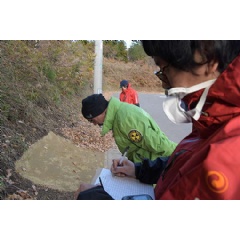
British shops to sell radioactive BABY FOOD and other produce from Fukushima under EU plan


Tokyo 2020 Olympics: will Fukushima rice and fruits be on the menu?


Citizens’ group in Fukushima puts out radiation map in English
 The cover of “Citizens’ Radiation Data Map of Japan” (Provided by Minna-No Data Site)
November 3, 2019
FUKUSHIMA—A citizens’ group here has released an English radiation-level map for eastern Japan created with input from 4,000 volunteers in response to requests from abroad ahead of the Tokyo Olympics.
“We want people outside Japan to understand the reality of radioactive contamination following the nuclear accident,” said Nahoko Nakamura, a representative of Minna-No Data Site (Everyone’s Data Site), which published the map.
The Fukushima No. 1 nuclear power plant experienced a triple meltdown in March 2011 after a tsunami knocked out its cooling systems during the Great East Japan Earthquake.
Titled “Citizens’ Radiation Data Map of Japan,” the 16-page booklet summarizes the content of the original Japanese map, released in November last year. It also shows projected declines in radiation levels by 2041.
The Japanese version was based on results of land contamination surveys conducted over three years at the request of Everyone’s Data Site.
About 4,000 volunteers took soil samples at 3,400 locations in 17 prefectures in eastern Japan, including Fukushima and Tokyo, and measured radiation levels. The map was compiled with advice from experts.
The group raised 6.23 million yen ($57,500) from 1,288 individuals through a crowdfunding campaign. So far, 15,000 copies have been sold.
Nakamura said the group decided to produce an English version after it received inquiries about the Japanese map from researchers and others overseas in the run-up to the Tokyo Olympics.
Everyone’s Data Site spent about four months creating the English map, working through e-mail and online chats with five volunteer translators overseas, including an American and a Canadian.
The English edition sells for 500 yen, excluding tax. For more information, contact Everyone’s Data Site at (minnanods@gmail.com).
Fukushima is not safe for 2020 Olympics, nuclear scientists warn

October 30, 2019
Would Russia hold the 1994 Olympics at Chernobyl, the site of the 1986 meltdown? Only 8-years later, do we really think it’s safe to hold the Olympics on Fukushima soil? What would common sense tell us?
But these are very dark times.
The International Olympic Committee (IOC), the Japanese government, and most news media have ignored the risks one of the worst nuclear disasters in world history: the 2011 Fukushima power plant meltdown.
For years afterward, the Japanese government struggled what to do with millions of gallons of contaminated water and tens of thousands of Japanese refugees. Instead of safer measures, they chose the cheapest solution, spinning the truth in favor of profit and national image over human life.
Scientists warned that almost everything on land is contaminated, and this may include Tokyo which sits 100 kilometers from Fukushima.
Radiation levels may beyond what is safe for humans
According to 60 Minutes Australia, many experts are asking for the Fukushima Olympics to be canceled due to radioactive contamination. Yet, when The Washington Post ran an article on the struggles Fukushima and the residents are facing, there is no mention of what dangers Olympians and spectators may face in an area that has radiation levels way beyond what is safe for humans. Such high levels are likely to continue for decades to come.
In fact, in that same article, Simon Denyer wrote that when it rains, the water itself is radioactive. Residents feel forced by the Japanese government to return, as the government cuts pensions if residents refuse, essentially forcing them and their children for increased risk of cancer and other health problems. Childhood cancer is increasing in the affected zones, Denyer reports.
Why the silence? Where is the IOC? Is it okay for athletes and spectators to spend two weeks in a radioactive zone so that the Japanese government can make everyone forget that radiation exposure is no big deal? Such wouldn’t have to do with money over human life would it? Where is the U.S. news media that often looks for just a big story like this to crack? Why the silence?
As for Japan, what choice does it have but to move forward and accept that almost its entire population is inevitably exposed to radiation.
This is not something they can fix, so the government must reinvent Fukushima as a safe and wonderful place, a place where one can eat the vegetables and fruits from Fukushima, and they can live there healthy and happy. What better way than to repackage horrible facts with a new Fukushima, a safer, healthier one? However, they will have to force their residents to come back in order to seal such a wonderful myth.
Smelling a Nuclear Rat?
Dahr Jamail interviewed Arnie Gunderson that oversaw dozens of nuclear power plant projects in the United States. He faults the Japanese government and the nuclear power plant industry in pushing residents to go back to Fukushima before the 2020 Games. Even more surprising is that the IOC is also, according to Jamail, making very light over the known toxicity of Fukushima where the softball and baseball events will be played. Denyer, however, verified that six total events will take place in Fukushima. Gunderson, with 45 years’ experience with nuclear energy companies says that the goal is profit and that public health is not being considered.
Thyroid cancer, Jamail writes, already is increasing within the 310-mile radius of the disaster, and instances of cancer among children is increasing as well. In fact, the radiation is not decreasing but increasing at the power plants. Dr. Tadahiro Katsuta of Meiji University in Japan makes the Japanese motive clear: the Japanese government is putting its public image and money over the lives of its citizens. The Japanese government is also putting international athletes and citizens at risk with little regard for their health and safety.
Reporters Dave Zirin and Jules Boykoff went through Fukushima with a radioactive tester. They noted that a reading over 0.23 is seen as unsafe for humans. As they neared the Fukushima Daiichi Unit 1 reactor, the needle read 3.77. The Olympic torch is scheduled to pass near this area.
Who Works in Radioactive Zones without Protection? Athletes and Migrant Workers
They witnessed in Fukushima workers without protective suits putting contaminated soil in black plastic bags and piling them in “pyramids.” While some agencies dispute how dangerous Fukushima is, what is clear is that the Japanese government raised the exposure benchmark for radiation from 1mSV a year to 20 MSV per year, the reporters noted. As an international journalist based in Japan stated, the Japanese government is pushing “propaganda over truth.” The IOC seems happy to play along.
Tens of thousands of Japanese refugees are still displaced and not willing to go back. The question is why wouldn’t people back to their homes, many of which whose families lived there for generations, if it were safe? Why would the IOC be so willing to host the games at a questionable site, even if such posed the slightest risks to athletes?
It does not take a nuclear engineer or scientist to understand that radiation contamination lasts for many years. Why build Olympic venues eight years after that very place had a nuclear disaster? Isn’t such a push egregious, irresponsible, and shameful? Common sense would tell any organizer of any event that such an event should not be placed in areas that could potentially put people at risk.
It’s time to hold the Japanese government and the IOC responsible for their hasty and reckless push to ignore the risks facing displaced citizens, spectators, and athletes and demand that the games be postponed and moved from Fukushima.
These are indeed dark times, where governments and their ties to corporate interests spin truths and make fictions that all of us would like to be real, but sadly money is always at the end of this contaminated rainbow. In the years to come, when the cancer cases mount, these same organizations and governments will pretend they knew nothing. Let’s all remember that.
Warning on Fukushima fallout for Tokyo 2020 Olympians

The danger of sourcing food and material from the Fukushima region


South Korea express concern about food from Fukushima as Tokyo 2020 Chef de Mission Seminar begins

August 20, 2019
The Korean Sport and Olympic Committee (KSOC) has written to Tokyo 2020 organisers to express concern about food from Fukushima being served at the Games.
Organisers confirmed to Reuters that a letter on the issue had been sent on the opening day of the Tokyo 2020 Chef de Mission Seminar.
Fukushima was struck by one of the worst natural disasters ever to hit Japan in 2011, when a devastating earthquake and tsunami caused an accident at a nuclear power plant.
Around 16,000 people lost their lives in the tragedy.
Both Tokyo 2020 and the International Olympic Committee (IOC) have been keen to promote the Games as a tool which could help with the region’s recovery.
Baseball and softball matches will be staged there and Fukushima prefecture will also host the start of the Japanese leg of the Torch Relay.
Produce from Fukushima has been served at official events, including IOC Coordination Commissions, but the KSOC said they are worried about contamination.
Their letter comes at a period of increasing tension between Japan and South Korea.
“Within our planning framework we will respond to them accordingly,” said Toru Kobayash, Tokyo 2020’s director of NOC services, to Reuters.
“We have said that we will respond to them properly.
“We have had no further questions [from South Korea].”
A trade war has developed between the two countries with South Korea also angry about reported Japanese plans to dump “toxic” water from Fukushima into the Pacific Ocean.
Some voices have even called for a Korean boycott of the Games with the nations further clashing over the appearance of disputed islands on an official Tokyo 2020 Torch Relay map.
The map on the official website includes the Liancourt Rocks, which are governed by South Korea but claimed by Japan.
South Korea calls the islands Dokdo but in Japan they are known as Takeshima, and both countries claim historical ties.
They lie in the Sea of Japan in between the two countries and are valuable due to rich fishing waters and natural gas deposits.
Elsewhere, concerns over sweltering conditions were discussed on day one of the Seminar at the Hotel New Otani.
Rising heat has developed into a major concern before Tokyo 2020 with more than 50 deaths in July as temperatures in Japan approached 40 degrees celsius.
Athletes have also struggled in the weather at the test events, including rowers suffering heatstroke at the World Junior Championships at the Sea Forest Waterway.
The triathlon event was shortened because of the humid conditions while cooling measures were tested at the beach volleyball.
The Tokyo 2020 Olympics are due to open on July 24 next year.
Among the measures being considered to combat the problem is allowing fans to bring their own bottled water into venues under certain conditions, which had previously been banned at past editions of the Olympic Games due to security and sponsorship reasons.
Misting sprays, air-conditioned tents and special road coatings are other plans put forward by organisers, as well as moving some events to earlier in the day.
Dutch Chef de Mission Pieter van den Hoogenband, who faced the media on behalf of attending National Olympic Committees (NOCs), said he was impressed with how organisers were handling the issue.
“Of course we know there are some heat issues but overall, for all the different teams, these are the circumstances and we have to deal with it,” the triple Olympic champion said to Reuters.
“Top athletes know that they have to perform in any circumstances.
“Because of the test events, we get a lot of information and a lot of data and the way the Organising Committee is taking all that data to make it even more perfect…
“I was impressed with the way they handled things.”
Organisers have also pledged to install triple-layer screens in Tokyo Bay to combat bacteria in the water.
It comes after the discovery of E.coli which forced the cancellation of the swimming leg at the Paratriathlon test event.
The three-day Seminar continues tomorrow with every NOC invited to attend.
Representatives from the IOC and the Association of National Olympic Committees are also present.
A full progress update has been promised as well as a venue tour.
https://www.insidethegames.biz/index.php/articles/1083697/fukushima-food-tokyo-2020
Tokyo’s Fukushima cesium-enriched microparticle (CsMP) update
 Secondary electron images from Utsunomiya et al. 2019, of CsMPs discovered in atmospheric particles trapped on a Tokyo air filter from March 15, 2011, with major constituent elements displayed.
August 17th, 2019
An interesting paper was recently published by a team headed by Dr. Satoshi Utsunomiya of Kyushu University on the subject of Fukushima-derived cesium-enriched microparticles (CsMPs). As many readers will know, several researchers have located and analyzed these microparticles, in which the cesium is often bonded within glass-like silicates and therefore generally significantly less soluble than other Cs chemical species in water, though technically not actually “insoluble.” After an accident like Fukushima, it is much more common to find cesium in water-soluble compounds like cesium hydroxide (CsOH), and predictions about how quickly the cesium will be dispersed through the environment, in soil, in watersheds, taken up by plants and animals, etc, are based primarily on this assumption. The discovery of sparingly-soluble Fukushima-derived cesium microparticles, first documented by Adachi et al in 2013, and since then confirmed by many others, has raised a number of questions. How abundant are they? Does their presence increase health risk to humans? How much do they reveal about the process of the accident itself? From the standpoint of researchers the microparticles are very intriguing.
Utsunomiya et al.’s paper is titled “Caesium fallout in Tokyo on 15th March, 2011 is dominated by highly radioactive, caesium-rich microparticles,” and as noted in a recent Scientific American article, it was originally accepted for publication in 2017 by Scientific Reports journal. Weeks before publication, however, Tokyo Metropolitan Industrial Technology Research Institute (TIRI), operated by the Tokyo Metropolitan Government, raised objections with Scientific Reports. However no questions about the quality of the science or the validity of the paper’s findings appear to have been brought forward. This in itself was highly irregular. Two years elapsed without resolution, and in March of this year Scientific Reports took the highly unusual step of withdrawing its offer to publish the paper, despite the lack of confirmed evidence that would warrant it. Utsunomiya and several co-authors decided that the best course of action was to place the study in the public domain by publishing it via arXiv, a highly respected pre-print website. The paper is now open and free to download.
This study makes a valuable contribution to the body of scientific literature regarding the consequences of the Fukushima disaster in general and CsMPs in particular. I think it was a mistake for Scientific Reports not to publish it two years ago, especially considering the rapid pace of research into these particles and the tremendous interest in them. To summarize the findings briefly, the researchers analyzed air filter samples from March 15, 2011, in Setagaya, Tokyo, when the radioactive plume from Fukushima caused a noticeable peak in airborne radioactivity in the city. The researchers used radiographic imaging (placing the filters on a photographic plate) to identify any highly radioactive spots. Using these images as a guide they were able to isolate seven CsMPs, which they subjected to atomic-scale analysis using high-resolution electron microscopy (HRTEM) to identify their nano-scale structure and chemical composition. Based on these detailed measurements and quantitative analysis, the researchers concluded that 80-89% of the total cesium fallout in Tokyo that day was in the form of highly radioactive microparticles. The second half of the paper is devoted to estimates of how long such particles might be retained in the human lungs if inhaled, based on previous studies that reported the effects of inhalation of non-radioactive atmospheric particles, and some possible physical consequences. The paper is valuable for the quantitative analysis of the Tokyo particles alone, since it is one of few studies that deal with the issue for Tokyo specifically. Research into possible health consequences of the particles, meanwhile, has gained momentum while the paper remained unpublished, using approaches such as stochastic biokinetics, and DNA damage studies. In a recent paper, Utsunomiya and colleagues produced estimates of the rate of dissolution of the particles inside the human lung, in pure water, and in seawater. A working group at the Japan Health Physics Society has also devoted attention to the issue, noting the need for further study of the risk from intake of these particles, particularly to the lung. Likewise, others have been studying the particles to learn about the accident progression and possible consequences for decommissioning.
Why did Tokyo Metropolitan Industrial Technology Research Institute object to the paper’s publication? When we first heard that publication of the paper was being held up by Tokyo Metropolitan Government, we thought politically-motivated suppression was a likely explanation. Since then the public has learned that the actual complaint given to Scientific Reports stems from a chain of custody issue of the original air filter samples. We don’t want to speculate further about Tokyo’s motivation, because we have seen no direct evidence yet of political suppression in this case. But based on past occurrences with other government institutions, we would find it plausible. We will let readers know if TIRI responds to our inquiries.
We spoke with Dr. Utsunomiya and co-author Dr. Rodney Ewing recently. I was aware of their co-authorship of several strong papers on CsMPs, including Utsunomiya’s plenary talk at the Goldschmidt Conference in Yokohama in 2016, which I attended. I asked how this new arXiv paper fits in with their other papers, and where they think this research is heading next:
Satoshi Utsunomiya:
Thank you for asking. The Tokyo paper was actually our first paper regarding CsMPs. As I mentioned, the paper was accepted two years ago. There were no previous papers of ours on CsMPs that time. Currently we are working on several topics on CsMPs. I cannot reveal the content yet, as we are thinking about a press release for the next paper. But I think it is important to continue this kind of research, providing some insights for decommissioning at Fukushima Daiichi Nuclear Power Plant.
Azby Brown:
I didn’t realize that this was your first paper on the subject. How does it relate to the one presented at the Goldschmidt Conference in Yokohama in 2016? “Cesium-Rich Micro-Particles Unveil the Explosive Events in the Fukushima Daiichi Nuclear Power Plant.” Didn’t that paper receive a prize?
SU:
My talk at Goldschmidt briefly covered the story described in the two papers that were accepted for publication at the same time. One was published in Scientific Reports. The other one was not published. There was no prize. It was a plenary talk.
AB:
I see. I recall that it received a lot of attention. Now it makes more sense to me.
Can you tell me a little bit about the specific characteristics and focus of your research, and how it differs from papers like Adachi 2013, Abe 2014, etc? Generally speaking, that is. I’d like to help people understand the different aspects of the field.
SU:
Adachi reported the discovery of CsMPs. Abe demonstrated X-ray absorption analysis on the CsMPs. We focused on the nanotexture inside CsMPs. We are particularly interested in the detailed evidence remaining within the microparticle, which can provide useful information on the development of the chemical reactions during the meltdowns, because it is still difficult to directly analyze the materials inside the reactors. We, for the first time, succeeded in performing isotopic analysis on individual CsMPs. More specifically, the occurrence of uranium can directly tell the story of how the fuel melted. Our research has two directions: one is to understand the environmental impact of CsMPs, and the other is to provide useful information on the debris properties to help decommissioning at FDNPP. We are also interested in the implications for health.
AB:
Can you tell me a little bit about your working relationship? Satoshi went to the US to work in your lab, right Rod? When was that, and what were you working on?
Rod Ewing:
Satoshi and I have known each other since 2000, when he joined my research group as a post-doctoral fellow at the University of Michigan. He was a member of the research group until 2007. We collaborated on a wide range of topics that had to do with radioactive materials, such as the transport of plutonium at the Mayak site in Russia to the identification of uranium phases within C60 cages, so called buckyballs, that were formed and released from coal power plants. Once Satoshi returned to Japan to take his position at Kyushu University, we continued to collaborate, particularly on topics related to Fukushima Daiichi.
AB:
How did you both get interested in CsMPs?
RE:
Once discovered, CsMPs were clearly of high interest. They had not been noted in earlier reactor accidents. Satoshi is a master with the transmission electron microscope – exactly the tool/technique needed to study these particles.
AB:
For people who aren’t familiar with what’s involved in a research experiment like yours, can you describe the overall process? What were the technical challenges?
RE:
I would just emphasize that it is very difficult to find and characterize these particles. Considering the full literature and efforts by others as well as our team – the results are impressive. It is rare to have both the TEM characterization and the isotopic data.
SU:
As Rod mentioned, it is difficult to obtain both TEM and isotopic data from a few micron-sized spots. The isolation of CsMPs from soils is a time consuming process. But to date, many scientists have found and isolated CsMPs. The important thing is what information we can obtain from the analysis of CsMPs. We have been taking various approaches to elucidate the properties, environmental impact, and the role in releasing fissile actinides to the environment.
As described above, many papers examining various aspects of Fukushima-derived cesium microparticles have been published since they were first identified in 2013. Even so, important aspects remain only partially documented and understood to date. Below is a partial list of relevant publications.
Papers mentioned in this article:
Caesium fallout in Tokyo on 15th March, 2011 is dominated by highly radioactive, caesium-rich microparticles
Utsunomiya, et al., 2019
https://arxiv.org/abs/1906.00212
—————————————————————–
Emission of spherical cesium-bearing particles from an early stage of the Fukushima nuclear accident
Adachi et al., 2013
http://www.nature.com/articles/srep02554
—————————————————————–
Detection of Uranium and Chemical State Analysis of Individual Radioactive Microparticles Emitted from the Fukushima Nuclear Accident Using Multiple Synchrotron Radiation X-ray Analyses
Abe et al., 2014
http://pubs.acs.org/doi/abs/10.1021/ac501998d
—————————————————————–
Dissolution of radioactive, cesium-rich microparticles released from the Fukushima Daiichi Nuclear Power Plant in simulated lung fluid, pure-water, and seawater
Suetake et al., 2019
https://doi.org/10.1016/j.chemosphere.2019.05.248
—————————————————————–
Development of a stochastic biokinetic method and its application to internal dose estimation for insoluble cesium-bearing particles
Manabe & Matsumoto, 2019
https://doi.org/10.1080/00223131.2018.1523756
—————————————————————–
DNA damage induction during localized chronic exposure to an insoluble radioactive microparticle
Matsuya et al., 2019
https://doi.org/10.1038/s41598-019-46874-6
—————————————————————–
Provenance of uranium particulate contained within Fukushima Daiichi Nuclear Power Plant Unit 1 ejecta material
Martin et al., 2019
https://www.nature.com/articles/s41467-019-10937-z
—————————————————————–
Internal doses from radionuclides and their health effects following the Fukushima accident
Ishikawa et al., 2018
https://iopscience.iop.org/article/10.1088/1361-6498/aadb4c
Related papers (by year of publication):
Characteristics Of Spherical Cs-Bearing Particles Collected During The Early Stage Of FDNPP Accident
Igarashi et al., 2014
http://www-pub.iaea.org/iaeameetings/cn224p/Session3/Igarashi.pdf
—————————————————————–
Radioactive Cs in the severely contaminated soils near the Fukushima Daiichi nuclear power plant
Kaneko et al., 2015
https://www.frontiersin.org/articles/10.3389/fenrg.2015.00037
—————————————————————–
First successful isolation of radioactive particles from soil near the Fukushima Daiichi Nuclear Power Plant
Satou et al., 2016
http://www.sciencedirect.com/science/article/pii/S2213305416300340
—————————————————————–
Internal structure of cesium-bearing radioactive microparticles released from Fukushima nuclear power plant
Yamaguchi et al., 2016
http://www.nature.com/articles/srep20548
—————————————————————–
Three-Year Retention Of Radioactive Caesium In The Body Of Tepco Workers Involved In The Fukushima Daiichi Nuclear Power Station Accident
Nakano et al., 2016
http://rpd.oxfordjournals.org/content/early/2016/03/14/rpd.ncw036
—————————————————————–
Monte Carlo Evaluation of Internal Dose and Distribution Imaging Due to Insoluble Radioactive Cs-Bearing Particles of Water Deposited Inside Lungs via Pulmonary Inhalation Using PHITS Code Combined with Voxel Phantom Data
Sakama, M. et al., 2016
http://scholar.google.com/scholar_lookup?&title=Radiological%20Issues%20for%20Fukushima%E2%80%99s%20Revitalized%20Future&pages=209-220&publication_year=2016&author=Sakama%2CMinoru&author=Takeda%2CShinsaku&author=Matsumoto%2CErika&author=Harukuni%2CTomoki&author=Ikushima%2CHitoshi&author=Satou%2CYukihiko&author=Sueki%2CKeisuke
—————————————————————–
Radioactively-hot particles detected in dusts and soils from Northern Japan by combination of gamma spectrometry, autoradiography, and SEM/EDS analysis and implications in radiation risk assessment
Kaltofen & Gundersen, 2017
https://www.sciencedirect.com/science/article/pii/S0048969717317953?via%3Dihub
—————————————————————–
Caesium-rich micro-particles: A window into the meltdown events at the Fukushima Daiichi Nuclear Power Plant
Furuki et al., 2017
https://www.nature.com/articles/srep42731
—————————————————————–
Isotopic signature and nano-texture of cesium-rich micro-particles: Release of uranium and fission products from the Fukushima Daiichi Nuclear Power Plant
Imoto et al., 2017
—————————————————————–
Uranium dioxides and debris fragments released to the environment with cesium-rich microparticles from the Fukushima Daiichi Nuclear Power Plant
Ochiai et al., 2018
https://pubs.acs.org/doi/abs/10.1021/acs.est.7b06309
—————————————————————–
Novel method of quantifying radioactive cesium-rich microparticles (CsMPs) in the environment from the Fukushima Daiichi nuclear power plant
Ikehara et al., 2018
https://pubs.acs.org/doi/full/10.1021/acs.est.7b06693
—————————————————————–
Formation of radioactive cesium microparticles originating from the Fukushima Daiichi Nuclear Power Plant accident: characteristics and perspectives
Ohnuki, Satou, and Utsunomiya, 2019
https://www.tandfonline.com/doi/abs/10.1080/00223131.2019.1595767
https://blog.safecast.org/2019/08/fukushima-cesium-enriched-microparticle-csmp-update/
Displaced Fukushima sake brewery to restart in hometown using only local rice

Fukushima 2020 Olympics Nightmare: Is PM Abe Criminally Insane?
Fukushima village hit by 2011 meltdowns starts raising dairy calves again
Hopefully that milk from these local dairy farms will NOT end up in school lunch…

Temporal variation of radionuclides contamination of marine plants on the Fukushima coast after the East Japan nuclear disaster
1 This Month

of the week – Shut Down Drone Warfare!


Tell the Ukrainian Government to Drop Prosecution of Peace Activist Yurii Sheliazhenko

Petition to revoke the licensing of the Near Surface Nuclear Disposal Facility (NSDF) at Chalk River. https://www.ourcommons.ca/petitions/en/Petition/Details?Petition=e-7247
To see nuclear-related stories in greater depth and intensity – go to https://nuclearinformation.wordpress.com
-
Archives
- March 2026 (244)
- February 2026 (268)
- January 2026 (308)
- December 2025 (358)
- November 2025 (359)
- October 2025 (376)
- September 2025 (257)
- August 2025 (319)
- July 2025 (230)
- June 2025 (348)
- May 2025 (261)
- April 2025 (305)
-
Categories
- 1
- 1 NUCLEAR ISSUES
- business and costs
- climate change
- culture and arts
- ENERGY
- environment
- health
- history
- indigenous issues
- Legal
- marketing of nuclear
- media
- opposition to nuclear
- PERSONAL STORIES
- politics
- politics international
- Religion and ethics
- safety
- secrets,lies and civil liberties
- spinbuster
- technology
- Uranium
- wastes
- weapons and war
- Women
- 2 WORLD
- ACTION
- AFRICA
- Atrocities
- AUSTRALIA
- Christina's notes
- Christina's themes
- culture and arts
- Events
- Fuk 2022
- Fuk 2023
- Fukushima 2017
- Fukushima 2018
- fukushima 2019
- Fukushima 2020
- Fukushima 2021
- general
- global warming
- Humour (God we need it)
- Nuclear
- RARE EARTHS
- Reference
- resources – print
- Resources -audiovicual
- Weekly Newsletter
- World
- World Nuclear
- YouTube
-
RSS
Entries RSS
Comments RSS
 nuclear-news