South Korea inspects ships traveling from Fukushima for radiation

Japanese citizens nationwide opposed to Pacific Ocean discharge of Fukushima radioactive water support storage and processing – new opinion poll

October 1, 2019, Tokyo… Nearly four times as many Japanese citizens oppose the discharge of highly contaminated water from the Fukushima Daiichi nuclear plant into the Pacific Ocean than support it, according to a Greenpeace commissioned poll
.(1) The polling of 3000 citizens in Fukushima and Niigata prefecture, as well as wider Japan, showed most expressed their support for storage of over 1 million tons of water rather than release to the Pacific Ocean. Only a small percentage approve of Government plans for discharge. Greenpeace commissioned Rakuten Insight, a pioneer in Japanese online market research to conduct the poll which was conducted between 19-24 September 2019.
The results show some slight variation in opinion between those in Fukushima and those in Niigata and wider Japan. Averaging of the poll revealed that 48.6% oppose marine discharge and 12.9% approve. In Fukushima, 15.9% approve of discharge, while 43.3% oppose. Of those who oppose discharge, nationwide 51% stated that their principal concerns were that discharging will have a negative impact, not just in Fukushima and wider Japan, but also internationally. In Fukushima, 52.9% think it will have a negative effect on Fukushima fisheries.
“We deliberately set out to try and understand the level of understanding Japanese citizens have, what they were thinking and why. They show only a small percentage approve of discharging to the Pacific ocean, and by a wider margin, most oppose. The strongest opposition comes from Niigata citizens and wider Japan. One clear message they send to the Abe government is that the opposition to discharge is not limited to Fukushima fisheries (2) and Fukushima prefecture but is nationwide. Most of those polled who are opposed to discharge show both a concern for the international impacts in the Asia/Pacific region any discharge would have and also the impact it would have on Fukushima fisheries,” said Shaun Burnie, senior nuclear specialist with Greenpeace Germany (Tokyo).
A Greenpeace report (3) in January 2019 showed that METI in 2016 deliberately excluded the option to store and process the contaminated water to remove radioactive tritium, despite receiving technical submissions from U.S. nuclear companies, and the U.S. Department of Energy. The myth promoted by the Government and TEPCO ever since is that tritium removal is not possible. The Greenpeace report also provided analysis on the failure of the ALPS processing systems, which means that over 800,000 tons of contaminated water contains dangerous radionuclides such as Strontium-90, tens to thousands of times above regulatory limits. TEPCO has committed to processing this water – but doubts remain as to how effective this will be.
As the Fukushima nuclear disaster has shown, ocean currents will disperse any future radioactive materials released not only into the Pacific, but also the East China Sea, Sea of Japan/East Sea.(4) In recent weeks, the Japanese government plans for discharge have been challenged by the South Korean government at the International Atomic Energy Agency (IAEA), while Greenpeace addressed the issue to diplomats attending the United Nations Human Rights Council in Geneva given Japan’s obligation to prevent citizens from exposure to harmful radioactivity. The issue will also be debated at the International Maritime Organization meeting of parties to the London Convention and London Protocol which opens on 7th October in London.
“The people of Japan are sending a message to the government that they will not accept deliberate radioactive pollution of the marine environment. As the polling shows, the Japanese people are concerned about the international impact of any discharge. This was never just a domestic issue. The international focus on TEPCO’s water crisis is only going to escalate in the coming months – and the Abe government has the means to end this by making the only justifiable decision – commit to no discharge and instead decide on long term storage and processing,” said Burnie.
Greenpeace commissioned the poll to include the views of 1000 Niigata citizens as they are under direct threat, including from marine contamination, from any restart of TEPCO’s Kashiwazaki Kariwa nuclear plant. TEPCO is seeking the restart of reactors 6&7, despite the existence of major seismic fault lines both adjacent and through the site. The nuclear plant is TEPCO’s last hope of remaining a nuclear plant operator.
Notes:
1 – Greenpeace commissioned Rakuten Insight is a member of the JMRA (Japan Marketing Research AssociationJapan Marketing Research Association) and the ESOMAR (Europe Society Opinion and Market Research Association); poll results (in Japanese) – https://storage.googleapis.com/planet4-japan-stateless/2019/09/b3d20ee4-%E6%B1%9A%E6%9F%93%E6%B0%B4%E6%84%8F%E8%AD%98%E8%AA%BF%E6%9F%BB%E7%B5%90%E6%9E%9C.pdf
2 – Fukushima fishermen concerned for future over release of radioactive water, Justin McCurry The Guardian, 16 September 2019, see https://www.theguardian.com/environment/2019/sep/16/fukushima-fisherman-fear-for-future-over-release-of-radioactive-water
3 – Greenpeace Germany, “TEPCO Water Crisis”, 22 January 2019, Shaun Burnie, see https://storage.googleapis.com/planet4-japan-stateless/2019/06/eef0f147-tepco_water_crisis.pdf
4 – Transport of FNPP1-derived radiocaesium from subtropical mode water in the western North Pacific Ocean to the Sea of Japan https://www.ocean-sci.net/14/813/2018/
Slow burn: Dirt, Radiation, and Power in Fukushima
Peter Wynn Kirby
October 1, 2019
Abstract
Amid the radioactive fallout of the meltdowns at Fukushima Daiichi Nuclear Power Station and across what would come to be known as the Exclusion Zone, Japanese members of the nuclear lobby laboured to contain the political fallout of the Fukushima disaster. This article scrutinizes the profuse rhetoric over recycling as mobilized by nuclear boosters and the wider operations of circularity in waste management in Japan. Japanese leant heavily on the notion of recycling to attempt to frame the clean-up in Fukushima in more ideologically convenient terms. This led, for example, to officials trumpeting plans to ‘recycle’ over 16 million cubic metres of radioactive topsoil scraped from hundreds of square kilometres of Fukushima Prefecture, as well as efforts to achieve ‘thermal recycling’ by generating electricity from the incineration of collected irradiated vegetal matter and the large amounts of protective clothing and other material used in the ‘decontamination’ campaign. By scrutinizing this appropriation of recycling rhetoric and its leveraging across Japan’s nuclear waste management apparatus, the article exposes contradictions and distortions in contemporary Japanese policy that have considerable socio-political ramifications.
Keywords: Nuclear waste, radiation, decontamination, ethnography, Fukushima
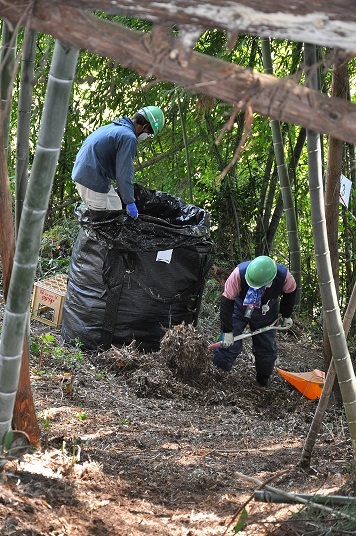 Decontamination work, Nihonmatsu, Fukushima. Image credit: Peter Wynn Kirby.
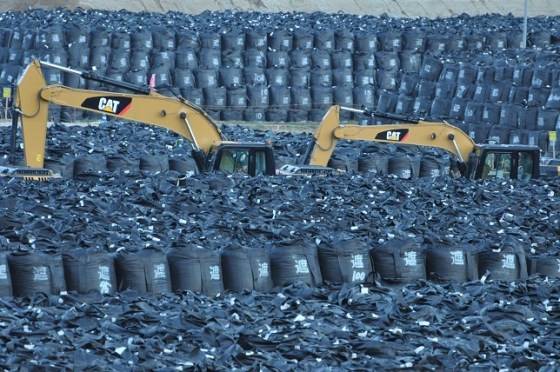 Radioactive soil depot, Iitate, Fukushima. Image credit: Peter Wynn Kirby.
Introduction
The record earthquake and tsunami that struck Japan on 11 March 2011 ushered in a highly mediated disaster as Japanese grappled with the triple-meltdowns and radiation crisis at Fukushima Daiichi Nuclear Power Station. Largely out of sight of international camera crews and probing journalists, the Japanese state and multiple municipalities embarked on the largest radiation response effort in history in an effort to restore hundreds of square kilometres1 covered in radioactive debris. This campaign saw about 70,000 Japanese workers remove over 16 million cubic metres of irradiated dirt2—scraping topsoil off roadsides, meadows, wooded areas, agricultural fields, school grounds, residential zones, shrine compounds, and parklands. Crews swept up radioactive twigs and pine cones, whittled exterior bark from tree stumps, and clipped low-lying branches in an attempt to bring radiation levels down to allow resettlement of tens of thousands of evacuees. Workers garbed in protective gear, joined by volunteers, scrubbed and hosed down streets, pavements, stairways, kerb stones, and storm drains in urban and suburban areas. They also wiped down the exterior of houses, apartments buildings, shops, schools, and other public facilities, using specially treated wipes to clean roof tiles, gutters, window sills, panes, mullions, wall cladding, and doorsteps. Wipes and protective clothing were collected for separate incineration. This campaign allowed state, prefectural, and municipal representatives to record ‘safe’ radiation measurements in areas of Fukushima’s disaster zone—a major Japanese policy priority, particularly with the 2020 Tokyo Olympic and Paralympic Games on the horizon.
 Source: Ministry of the Environment, Government of Japan; (accessed September 2019).
In parallel with these massive efforts to collect, or disperse, the radioactive fallout of the Fukushima Daiichi disaster, the pro-nuclear Japanese state engaged in aggressive PR-management to contain Fukushima’s political fallout, working with the nuclear lobby to frame the Fukushima campaign in favourable ideological terms. The scrubbing and scraping of a huge portion of Fukushima’s land area became branded as ‘decontamination’ (josen), despite clear contradictions described below. More telling still was the appropriation of the conceit of recycling to imbue the effort to remove radioactive dirt and other abominated debris with flattering hues of eco-responsibility and resource efficiency. This article3 scrutinizes the decontamination campaign in order to highlight the numerous ways in which the nuclear lobby has leveraged recycling in Fukushima to sanitize and promote nuclear energy throughout its mobilization on the archipelago, with implications for other nuclear purlieux.
Chimerical recycling
After spending decades as a perennial environmental villain through the turn of the millennium,4 Japan has transformed into a country where waste issues and recycling are taken very seriously. Japanese municipalities and industries recycle the usual stacks of paper and bins of plastic bottles and glass as well as breaking down and converting about a million tonnes of large consumer appliances (e.g., refrigerators, washers, air-conditioners) a year in highly automated facilities,5 part of what has been called ‘the shredder economy’.6 Every industrial sector complies with Japan’s strict recycling regulations, meaning that all manner of e-waste, from vending machines to pachinko machines, is dismantled, crushed, shredded, and separated to extract precious metals and other materials. These and other projects contribute toward environmental objectives, but Japan’s resource-consciousness derives as much from a fixation on rationalization and efficiency, communicated via catchphrases like ‘industrial ecology’ and ‘zero-emissions’ production. Ironically, there is not much concrete, demonstrable circularity in Japanese recycling.7 Yet circular-economy rhetoric pervades Japanese officialdom. It seems that virtually every ministry white paper, urban development project and metropolitan government report trumpets its concern with sustainability.8 Due to the political ends to which recycling is mobilized in Japan, most egregiously in the radioactive spill of the Fukushima disaster zone, this circularist rhetoric merits rigorous scrutiny.
While examples of discursive overreach vis-à-vis recycling abound in contemporary Japan, the yawning gaps and slippages in Japanese circularity are most evident and striking in the official response to the Fukushima Daiichi radiation crisis, whose determined work crews and complex logistics drive an effort that has been every bit as much of a disaster, in the end, as the earthquake and tsunami that struck Tōhoku in 2011. The Japanese Ministry of the Environment and its partners have branded the Fukushima effort as ‘decontamination’; but as demonstrated below, their use of this term is highly misleading. Instead, I refer to the campaign as The Clear for two reasons. First, ‘clear’ (kuriā) is a term used by Japanese officials and others to declare completion of a project or attainment of a goal, even though its invocation is frequently based on arbitrary bureaucratic targets and massaging of data belied by conditions on the ground (literally, in this case). Next, those involved in the campaign were physically attempting to clear away the radioactive debris that had settled on a huge amount of territory; this was uneven terrain, including steep hillsides, forestland, and residential areas, that would make such a task exceedingly complex and difficult, if not impossible. By declaring ‘clear’ on 31 March 2017, Japanese officials were strongly suggesting that radiation had been cleared away, as it had been ‘on paper’ in ministry documents. Yet as demonstrated in the next section, irradiation of dirt, trees, streams, sandy littoral, and meadowlands is a maddeningly tenacious condition to attempt to reverse, and the rush to clear away Fukushima’s radiation (and burnish its sullied reputation) within a tight, arbitrary timeframe made this Herculean task even more difficult to achieve. By appropriating the terms of exalted recycling to transform these millions of tonnes of radioactive dirt into ‘resources’, the nuclear lobby arguably made promoting this task much easier and more palatable to Japanese communities.
It may be difficult to recall with the crippled Fukushima Daiichi leaking tonnes of radioactive water daily into erstwhile prime fishing grounds in the Pacific, but the conceit of recycling has long bolstered the nuclear sector. Ever since the vaunted promise of limitless energy via fission became destabilized by accumulations of radioactive waste from the 1970s, nuclear elites sought to marshal those parlous residues in a drive toward greater efficiency, as well as discursive control. High-level nuclear waste—usually spent fuel rods from reactors—entered elaborate conversion infrastructures, rationalized as ‘reprocessing’, to transform hazardous, depleted residues into puissant resources. Perhaps the most audacious of these initiatives involved Japanese plans hatched in the 1980s to transform plutonium—arguably the world’s most toxic and dangerous substance, with a half-life of 24,100 years—into the pole star of Japan’s nuclear energy production apparatus. Such a plutonium economy would use fast-breeder reactors to generate energy from the most hazardous nuclear wastes at a time when most nuclear nations were abandoning the technology as unpromising and/or too dangerous. Significantly, this fixation on plutonium developed out of Japan’s long self-perception as a resource-poor nation, a key driver of imperial Japan’s colonialist ambitions through World War II.
Japan’s idée fixe over a perceived scarcity of natural resources has had a profound influence on the nation’s development. The idea of Japan as a ‘small island nation, poor in resources’, or shigen shōkoku nippon, emerged as a powerful discourse from the early twentieth century through the Second World War.9 Japan’s 1960s nuclear policy developed directly out of muscular hydropower initiatives that spanned the trans-war period, where abundant energy resources were seen as critical to ensuring Japan would secure membership in the top rank of great nations.10 Japanese elites seized on nuclear energy as a strategic means to achieve energy independence—paradoxically, of course, while being the only nation to have suffered wartime fallout from nuclear weapons after the 1945 atomic bombings of Hiroshima and Nagasaki. As Japan developed through the 1980s into one of the world’s most pro-nuclear states,11 a powerful domestic nuclear lobby began to promote plutonium as a kind of thermodynamic elixir capable of bestowing the archipelago’s energy needs almost indefinitely. Lest this seem like casual hyperbole, consider an exhibit at the Aquatom museum complex, located near Japan’s showcase fast-breeder reactor, called Monju: ‘Japan is a poor country in natural resources … therefore Monju, a plutonium burning reactor, is necessary because plutonium can be used for thousands of years’.12
Central to this campaign was the concept of circularity. Take the logistics that underpin nuclear fuel reprocessing, which involves both elements that typify ‘recycling’ as well as hazardous externalities which belie its exalted, circularist trappings. Only by ‘closing’ the fuel cycle13 could Japan’s spent fuel residues be transformed into (and re-consecrated as) new nuclear fuel stocks. In this heady policy climate before the radiation crisis of 2011, recycling came to take on a peculiarly talismanic quality when intoned by elite institutions invested with authority and lavish funding, such as the Agency for Natural Resources and Energy (ANRE). Even the mere invocation of a closed fuel cycle could conveniently rebrand spent fuel rods and other parlous nuclear residues as ‘resources’. Since these radioactive materials were therefore to be reused, and were represented by nuclear boosters as a dizzying thermodynamic bounty, the nuclear industry has largely been able to sidestep the thorny question of, for example, containing such nuclear waste in secure underground repositories—generally considered best practice, if expensive and difficult, by most major nations, with only Finland and the US testing appropriate facilities thus far.14 These so-called ‘final repositories’ for nuclear waste were, at any rate, deemed virtually impossible to establish on the archipelago. Since the devastation of Hiroshima and Nagasaki, no Japanese prefecture has wanted to host such a permanent nuclear waste repository,15 partly due to the enduring, though largely dormant, stigma of radiation among Japanese after 1945. Moreover, Japan is so seismic that it would be impossible to find a subterranean location capable of remaining stable for up to 100,000 years (a verdict confirmed by an expert panel of the Science Council of Japan, convened after the Fukushima Daiichi crisis unfolded, in 2012)—and therefore the task of convincing a potential host community to accept a final repository was deemed unworkable.16
For nuclear proponents, by contrast, there is practically no such thing as ‘nuclear waste’ due to the pivotal significance of circularity to the whole rationale of nuclear energy in Japan. Radioactive material is instead viewed as resources—valuable ascribed commodities in a sprawling reprocessing apparatus. This strategic posture has furnished Japan’s nuclear sector with considerable latitude to sidestep the very notion of perilous nuclear residues, long one of the costliest and most unpopular facets of nuclear energy globally. Meanwhile, Japan possesses about 17,000 tonnes of spent fuel rods, most of which are stored on site at nuclear power stations in jam-packed pools, above ground, in a highly earthquake-prone nation.17 These pools resemble drab onsen, radioactive versions of the idyllic hot springs for which Japan is famous, though these pools are heated up not by salutary geothermal currents redolent of therapeutic minerals but by the acute radioactivity of the spent fuel rods themselves, recalling the steaming, overheated wreckage of the Fukushima Daiichi reactors in the aftermath of the 2011 meltdowns.
The term ‘recycling’ imparts a sense of effortless, perhaps even endless, movement, dynamism, and highly rationalized process, particularly in the context of bold circularist discourse. But the overwhelming reality of Japan’s nuclear regime is that of relative stasis. These pools regularly hold several times as many fuel rods as any reactor, leaving them exposed, beyond standard containment, and therefore vulnerable. Once deposited, they generally lie for years, steeping in makeshift wet storage in the absence of a repository or a properly functioning fuel cycle. (And, after all, only nine of Japan’s commercial reactors are currently in operation anyway, and only a fraction are capable of burning the reprocessed fuel described above.)18 These components of chimerical recycling are sustained by a well-funded and integrated programme of spin—an ironic but appropriate circular metaphor here—along with a multitude of political capital wielded by well-placed institutional powerbrokers. Yet it remains striking how, in a nation celebrated for high-tech innovation and exacting quality control, this recycling apparatus has fallen far short of the circularist grandiloquence propagated by the sector. Most major nuclear nations have faced problems in trying to recycle, or ‘reprocess’, nuclear material—an inherently dangerous and messy set of procedures that in the process creates about 12 times more low-level and medium-level nuclear waste, by volume, than the original volume of nuclear waste that was sent for reprocessing—but Japan’s chequered history with managing nuclear externalities is notable, as explained in these pages, particularly when contrasted with Japan’s longstanding reputation for meticulous quality control and technological excellence.
Japan’s decades-long quest for a closed fuel cycle has not only been exorbitant but plagued by grave safety lapses and technical failures. Here, a few evocative examples of nuclear mismanagement suffice to convey the circularist disarray in Japan’s ‘nuclear village’. The centrepiece of the nation’s audacious plans for energy independence was the aforementioned fast-breeder reactor called Monju, located in Tsuruga on the Japan Sea. Named after the bodhisattva representing transcendent wisdom, the facility operated in a rather more mundane fashion. Completed in 1994, the plant fell offline in 1995 after a serious leak of sodium coolant ignited a major fire, causing extensive damage. A semi-governmental agency’s subsequent bungled coverup brought infamy upon the plant, its operators and regulators, and the nuclear industry generally. Monju was intended to burn, and in turn ‘breed’, plutonium from the spent fuel produced by Japan’s nuclear power stations, but repeated attempts to bring Monju back online within Japan’s aspirational nuclear fuel cycle failed. Having cost about $12.5 billion, the facility was finally slated for decommissioning in 2017 after having produced only a tiny amount of energy. Its decommissioning and dismantling are estimated to cost approximately $3.3 billion more and take until the year 2047.19
Another key component of the nuclear fuel cycle was to be Rokkasho, a sprawling reprocessing facility on a remote peninsula of Aomori Prefecture—the northernmost extremity of Japan’s main island. The Rokkasho plant, embarked upon in 1993, has never been fully operational. Nevertheless, after over $12 billion invested and a quarter century in limbo, Rokkasho has repeatedly been depicted as on the verge of activity. The plant therefore appears to serve as an expensive and unacknowledged semantic deposit on the nation’s whole programme of nuclear fuel recycling. Particularly with Monju slated for decommissioning, over the strident objections of Japan’s nuclear boosters, Rokkasho remains the most compelling symbol of Japan’s aspirations for a closed nuclear fuel cycle. Or in other words, without Rokkasho forever on the reprocessing horizon, the 17,000 tonnes of spent fuel rods languishing in cooling ponds next to Japan’s dozens of mostly idled nuclear reactors would be in danger of unfavourable re-interpretation: not as ‘resources’ to power the nation but as highly toxic and radioactive nuclear waste, a ponderous burden on the nation’s balance sheet and a damper on its circularist aspirations. Significantly, the central government’s agreement with Aomori Prefecture stipulates that no nuclear residues will continue to be stored at the facility if the nation’s reprocessing effort falters.20 This provides additional incentive to keep up appearances, even as Japan’s fuel recycling effort lies in ruins—both figuratively and in some cases literally. (For example, the decades that Rokkasho’s facilities have lain idle have taken their toll, with the vast conversion infrastructure corroding and deteriorating in numerous places due to poor maintenance inspections and general disuse.)21
Copious recycling rhetoric notwithstanding, then, a great deal of nuclear waste in Japan has simply been converted into other forms of waste. Much is left to languish at different material stages due to what might be called insufficient circularity. Without the domestic capacity to achieve its objectives, the nuclear sector has been forced to scrounge elements of this cyclical potential with the help of European allies—a makeshift, stopgap measure that will no longer be workable in any long-term sense.22 For example, of Japan’s stockpile of more than 47 tonnes of weapons-usable plutonium (enough for more than 6,000 warheads), all but 10.5 tonnes are located at reprocessing sites in the UK and France (with about 21.2 tonnes at Sellafield and about 15.5 tonnes at La Hague, respectively).23 Some of the MOX fuel rods, comprised of mixed-oxide uranium and plutonium reprocessed overseas from Japan’s spent fuel, have been burned in a handful of specially calibrated reactors in Japan, but for the most part, the overwhelming bulk of Japan’s nuclear residues remains curiously unproductive—particularly so now that most of Japan’s reactors remain offline in the wake of the Fukushima Daiichi meltdowns. Only through the peculiar rhetorical alchemy of recycling explained above do the piles of spent fuel rods soaking for years in pools within nuclear power station compounds take on the guise of ‘resources’. With the Rokkasho reprocessing facility forever on the verge of becoming operational, Japan’s many tonnes of spent nuclear material are thereby spared the designation of nuclear waste, a classification which would usher in a host of thorny consequences. For instance, Japan possesses far more weapons-usable plutonium than any self-respecting pacifist, no-nukes nation would normally ever dream of having.24 Imperious postwar security guarantor the United States has already signalled its displeasure with Japan’s wildly disproportionate plutonium stocks, manifest most recently via a six-month termination clause in a key bilateral civil nuclear treaty governing Japanese plutonium.25 If the nuclear lobby fails to demonstrate a more plausible justification for this vast stockpile of plutonium, Japan may encounter diplomatic and geopolitical obstacles down the road. This is particularly challenging because Japan has benefitted from a certain strategic ambiguity with regard to nuclear weapons over the years. While remaining officially pacifist and anti-nukes post-1945, Japan has nevertheless for several decades possessed more than enough technological and engineering know-how to produce nuclear weapons. It boasts a well-regarded space agency, the Japan Aerospace Exploration Agency (JAXA), that launches missile-like rockets into space. The military and geopolitical ramifications of Japan’s enormous plutonium stockpile have therefore certainly not been lost on prickly East Asian rivals like China and North Korea, who have long been sceptical of Japan’s reprocessing rationale, particularly with regard to plutonium.26
Chimerical recycling has bolstered Japan’s nuclear fuel-cycle strategy for a number of years, but it was only with the advent of the Fukushima Daiichi radiation crisis that more novel forms of nuclear waste materialized on the archipelago, exposing serious inadequacies in the nuclear apparatus and necessitating official response. These include the estimated 100 tonnes of radioactive water that leak into the Pacific Ocean every day from the bowels of the ruined nuclear power station, as well as the nearly 1000 giant, serried tanks of Tritium-laced water slowly filling the 350-hectare Fukushima Daiichi compound as effluent from the facility’s own filtration system—now exceeding a million tonnes in total. (Referring to the highly toxic liquid residues these tanks hold, even the environment minister himself recently stated that ‘The only option will be to drain it into the sea to dilute it’ to alleviate the ever-increasing burden of radioactive water storage there.)27 Leaving aside the wreckage of the Fukushima Daiichi Nuclear Power Station—itself a twisted and heterogeneous mass of nuclear waste requiring at least several more decades of highly specialised work to dismantle and segregate—the trope of recycling has been invoked to mobilize, and justify, the colossal effort to sequester and make efficient many millions of cubic metres of radioactive dirt and other debris brought on by the 3.11 disaster. Ambivalent Fukushima Prefecture has, thus, become a pivotal testing ground for the principles of circularity that have guided Japan’s nuclear sector for decades, offering a useful opportunity to interrogate the core precepts of nuclear recycling in evidence there.
 Decontamination work, Nihonmatsu, Fukushima. Image credit: Peter Wynn Kirby.
 Decontamination work, Nihonmatsu, Fukushima. Image credit: Peter Wynn Kirby.
 ‘Clean’ dirt ready to spread on agricultural field cleared of radioactive soil, Tomioka, Fukushima. Image credit: Peter Wynn Kirby.
 Woman with dosimeter taking a break from decontamination work, Nihonmatsu, Fukushima. Image credit: Peter Wynn Kirby.
Shifting geographies of transcontamination
A crew of seven men and one woman, clad head-to-toe in helmets, face masks, protective clothing, gloves, and rubber boots wielded rakes and shovels to scrape radioactive dirt and vegetal matter from a wooded area around a local shrine in Nihonmatsu, not far from the Exclusion Zone, in autumn 2015. The crew laboured to remove enough radioactive debris to bring radiation levels back down toward levels deemed safe by the Japanese government. This involved clipping off low-lying tree branches and clearing away small bushes and undergrowth. (Elsewhere, in Iitate village, I have witnessed bark removed so aggressively from tree stumps that they had been whittled down to resemble pencil-stubs gnawed by schoolchildren.) Yet in spite of the serious nature of the job and the tragic backdrop of contaminated Fukushima against which they worked, the crew were rather grumpy. Their foreman, Nakayama-san, complained about how low their pay rate was, a paltry 720 yen per square metre compared to more desirable work around residential areas, called jutaku josen, which paid better mostly because it was calculated by weight rather than by area. Having previously worked as an insurance agent, the stalwart, outspoken Tohoku native railed against the government’s standards for calculating radiation safety, which he called too lax. ‘We’re mormotto (guinea pigs)!’, he declared, or test subjects who could be studied for decades. He and his crew worked long and hard to collect huge black bags of radioactive waste for collection as part of a campaign that was called ‘decontamination’ (josen), but they were under no illusions that the area would be free of radiation in the years to come. (Below, I describe how such workers see the decontamination effort as extremely patchy or non-existent in places, belying the campaign’s very moniker.) It also remained far from clear how the problem of radiation stored in these large black bags would ever be adequately resolved.
Japan’s Ministry of Environment announced vague plans for an Interim Storage Facility (ISF) for radioactive material in 2014, to be located in Fukushima Prefecture, with more concrete plans by 2016. The proposed site would occupy already highly radioactive terrain. Encompassing 1,600 hectares in a half-doughnut shape, the facility would literally nestle around the compound of the crippled Fukushima Daiichi Nuclear Power Station, perched on Fukushima’s Pacific coast at the heart of the Exclusion Zone. Though proximity to Fukushima Daiichi suggests to a reasonable layperson that the facility would hold high-level nuclear waste such as the slumped uranium fuel located below the power station’s wrecked reactors, in fact the ISF planned to store, for a time, the millions of cubic metres of radioactive soil and other biomass collected from the irradiated territory of Fukushima Prefecture since 2011.
It is central to the political culture of the reconstruction effort that Fukushima’s various storage sites for radioactive material clearly advertise their transitory nature. For seven years, about 16 million huge black bags (furekon), each about the size of a hot tub and weighing approximately a tonne when filled,28 have sat in piles scattered around the Exclusion Zone. These furekon bags are filled with radioactive topsoil scraped from the surface of most of the prefecture’s hardest-hit areas, by crews like that of Nakayama-san, and at first lie in odd, desultory heaps of perhaps two to six bags before being transported by truck to what are known as kari-kari-okiba (third-tier storage, literally ‘provisional-provisional’ depots). After a time, sometimes a year or more, workers will move these bags to further, though still provisional, second-tier storage depots (kari-okiba) located throughout the region. All these sites, clearly blazoned as temporary, keep the bags in motion just enough to sell a rationalized system, but in fact the bags still have nowhere to go. An elaborately designed Interim Storage Facility, its name similarly advertising its impermanence, exists mostly on paper in the form of a series of diagrams and renderings, as Ministry of Environment officials await cooperation of the aforementioned, tetchy absentee landowners who, since 2011, find themselves holding title to parcels of some of the most abominated land on the planet. Significantly, the ISF plan was only signed off on by the prefectural governor on the proviso that all radioactive material stored there must leave Fukushima after 30 years, at which time prefectural and central government authorities hope eventually to begin converting the land to a park. However, such a restored future green space remains far from guaranteed, as does much of the facility itself. By the end of winter 2018, only 52.8 percent of the private landowners had agreed to lease their land to the government,29 meaning that implementation of the plan is largely beyond the power of the state to guarantee. In the meantime, the overwhelming quantity of bags of irradiated material mostly move around the chimerical circle of provisional destinations, somewhat like an intermittent game of pass the parcel. While, for a time, the state could put bags of radioactive dirt almost anywhere during the decontamination process, these bags slowly aggregate in successive particular sites. These sites are generally leased from landowners and therefore generate revenue.
All this material flux involves long concatenations of logistical steps. Moving millions of furekon bags requires trucks, and the standard Japanese truck can only hold a maximum of six of these bags. Therefore, to transport all the bags from the scattered sites where they were initially collected (gemba hokan) to the subsequent sites of formal storage—and eventually to the ISF—involves over two million truck journeys, a staggering figure.30 Moreover, according to the manufacturer, the bags are meant to last just three years and some bags must also be decanted regularly due to further routine damage, bringing even more stuttering progress. The scale and logistical complexity of The Clear has provided piecemeal work for members of local communities as well as for transplants, with some local companies subcontracted to do scraping, collection, transport, and so on. This is, however, small comfort after the radioactive defilement of hundreds of square kilometres of their home region, the decimation of Fukushima’s agricultural sector (even in relatively unaffected areas distant from the meltdowns), the evacuation of tens of thousands of residents, nearly 8 years of upheaval, and a highly uncertain future.
Improbably, authorities speak of ‘recycling’ all these millions of tonnes of dirt. The most likely scenario I have heard bruited by nuclear clear-up officials involves creating massive anti-tsunami berms along the coastline, with ‘recycled’ radioactive dirt comprising the core of these structures for many miles. Based on my decades of research on this topic in Japan,31 such a strategy is a long way away from what most Japanese associate with the term ‘recycling’. Under rosy scenarios of public use, such radioactive dirt would be sequestered safely within berms, but such strategies incur potential risks of contamination of surrounding land and coastal seas, particularly worrisome given the periodic seismic events that jolt contemporary Japan.
Yet sustainability discourse in Fukushima goes further. Ministry officials are executing their plan to incinerate all the vegetal matter collected across and around the Exclusion Zone, along with all the protective clothing (gloves, coveralls, masks, and so on) used in decontamination operations. Because Japanese incinerators generate electricity from their operations, environmental officials and partners dub this process ‘thermal recycling’. For deeply sceptical informants based in communities around the Exclusion Zone, such rhetoric often falls on deaf ears. Some Fukushima residents feel it is their duty to agitate against the environmental health excesses of this campaign, and I have witnessed the gamut of such protests, from activists banging drums on a street corner in Fukushima City to having a quiet word over tea with a local politician. For many others whose lives were turned upside down by the nuclear plant meltdowns and radiation crisis and subsequent evacuation, the emotional toll has been devastating. As one middle-aged woman put it, referring to the large black bags used for bulk transport in Fukushima, ‘The furekon are filled with our tears’.
Problematically for nuclear stakeholders, the lofty goals of the decontamination programme are undermined by the inconvenient properties of radionuclides, as well as by the uneven terrain of Fukushima itself. For there is no such thing as decontamination when dealing with radiation—there is only transcontamination. As Associate Professor Shinzō Kimura, a Dokkyō Medical University radiation health researcher working since 2011 in Fukushima, explained, ‘Radiation cannot be eliminated. It can only be transported from one place to another…. This is clearly transcontamination, with no easy solutions…. Fukushima’s “decontamination” is a complete misnomer—it’s a con perpetrated against the Japanese people’.
Fukushima’s elaborate decontamination programme is therefore, in essence, a matter of taking radioactive debris from one part of Fukushima and moving it to another part of Fukushima. More precisely, the radioactive material enters stuttered slow motion, moving periodically from one place to another, with no certain final destination. By 11 March 2019, the eighth anniversary of the radiation disaster, only about 15% of the total volume of radioactive soil (2.3 million cubic metres) had been transported to the as-yet only partially realized Interim Storage Facility, with a flotilla of trucks making about 1600 roundtrip journeys each day.32 According to the ISF plan itself, much of the nuclear waste would be on the move again in a few decades. Meanwhile, the supposed clean-up in Fukushima falls short, with too much radiation lingering in ‘decontaminated’ sites in question. Of course, true to form, Fukushima’s custodians like the Ministry of Environment have rationalized and transported a sizable amount of Fukushima’s radiation—but by no means all. After scraping up dirt and other matter, after cutting weeds and clipping low branches, workers spread a layer of ‘clean’ soil from elsewhere in order to be able to take out a Geiger counter and produce a ‘safe’ reading. In Fukushima, safety was a labile concept, with sizeable constituencies ambivalent about the aftermath of the 2011 radiation crisis. A number of the decontamination workers I interviewed and witnessed in action were sceptical that The Clear, across vast expanses of Fukushima, had been wholly successful. They had seen first hand the occasional patchiness of the work, the places where they or others had had to cut corners due to the vagaries of rigid schedules, weather, diktats from up the food-chain, and so on.33 The Japanese government claims that areas are now ‘safe’ due to Geiger counter readings, but activists and others accuse the government of putting their thumb on the scale, so to speak—taking many readings over time and throwing out the undesirable high radiation measures as “failed” tests, thereby keeping only the lower radiation readings. As dodgy as this may sound, I came across a similar tactic used by the Tokyo Waste Bureau during a successful community challenge against the Tokyo Metropolitan Government in a 1999 toxic pollution dispute. The independent scientist who had carried out the atmospheric measurements testified that government officials had warped the data he had carefully compiled, in similar fashion.34 While controversy smoulders over the decontamination effort, weary communities attempt to return to normalcy, unconvinced that the situation on the ground will get much better.
Kimura-sensei demonstrated the absurdity of The Clear, energetically sketching out a rudimentary farm on a white board in his Nihonmatsu laboratory. ‘The decontamination activities are a joke…. [They] scrape the dirt from the agricultural fields, but leave the fringes untouched. Cows then eat irradiated grass, becoming irradiated themselves, and shit radiation onto the “decontaminated” soil. This can then contaminate crops over time…. Both the plan and the implementation are a complete farce’. Radiation remains most acute in the margins, in the neglected areas between sites that have been deemed suitable for decontamination. For instance, in communities like Naraha where only about 15% of the pre-disaster population has returned and resettled in the past couple of years,35 putatively sanitized areas resemble islands and peninsulas surrounded by eddies of higher radiation, particularly in wooded and/or overgrown areas, which the ministry has relinquished to so-called ‘natural decay’. Natural decay entails simply waiting for the radiation to go down by itself, without intervention. Caesium-137, for example, has a half-life of over 30 years, which means that when the proposed ISF is to be shut down in the late 2040s, the Cs-137 in Fukushima’s soil will still be perhaps half as radioactive as when it first hit the ground—still exceeding international standards, as shown below.
Take the northern area of Tomioka Township, which is still designated a ‘difficult-to-return zone’—meaning that, on average, the area continues to emit more than 20 milliSieverts per year of radiation. (For reference, the US Nuclear Regulatory Commission mandates a maximum exposure for American communities of 1 milliSievert per year over background radiation.)36 I and collaborator Toshihiro Higuchi conducted ethnographic fieldwork on The Clear, in Tomioka, before the evacuation order was lifted there on 1 April 2017. We explored derelict neighbourhoods and the desolation of its evacuated, overrun, intermittently bag-scattered terrain. We also witnessed the MOE’s clear-up of farms in the region, where they endeavoured to spread ‘clean’ dirt over fields and property to bring down radiation levels. Northern Tomioka is a patchwork of some areas that test relatively low on a Geiger counter and other zones that have radiation many times higher, like thickly wooded areas, hilly precincts, even just the overgrown areas near roadways. This reflects the maddening variation throughout the rest of Tomioka and the entire area around the Exclusion Zone. Forbidding teenagers to wander in the woods or scolding children for digging in the ground, and scraping away surface soil is far from decontamination—this is, instead, decontamination for show, decontamination that is literally superficial. Furthermore, Fukushima remains teeming with irradiated boar and deer who are heedless of the boundaries imposed by human nuclear functionaries, not to mention the multitudes of birds and other creatures who roam the area. Wild boar is a delicacy in Japan, but since Fukushima boar have been found with levels of Caesium-137 over 300 times Japan’s radiation limit for human consumption, boar have morphed from culinary treat into toxic vermin. Tomioka Town has killed many hundreds of boar in recent years, but overwhelmingly as a preventative measure, not for their meat. While Fukushima municipalities attempt to enlist greater numbers of hunters licensed to shoot boar to help control the infestation of these determined radioactive interlopers,37 for example, it is clear that this is selective decontamination by state fiat, finding little purchase on the disaster zone’s intricate non-human ecology.
Granted, one wouldn’t expect Fukushima Prefecture to advertise its radiation travails to tourist visitors and prospective investors. Nevertheless, it is ominous that government proclamations regarding revitalization of the area in and around the Exclusion Zone intone about jobs but seem geared toward a future with relatively few humans. The Fukushima Prefectural Government now promotes a plan, dubbed The Innovation Coast, that would transform the unwelcoming region into a thriving zone of high-tech innovation. Much of the development along the purportedly revitalized Innovation Coast would be directed towards a ‘robot-related industrial cluster’ and experimental zones like the Fukushima Robot Test Field.38 Both in the Robot Test Field and in other planned facilities, engineered runways and surrounding radiation-hit areas would serve as prime territory for testing aerial drones for a range of purposes in various weather conditions—which would be difficult or impossible to achieve elsewhere in relatively densely populated Japan. The planned site for the test field would link with a secluded test area about 13 kilometres due south along the coastline, located closer to Fukushima Daiichi, to coordinate test flights over the unremediated Exclusion Zone’s more or less posthuman terrain.39 Naturally, unlike Fukushima’s human residents, robots and the sometimes highly automated facilities that produce their components would be oblivious to the elevated—but to robots not debilitating—radiation levels found outside the Fukushima Daiichi facility itself. In addition, prefectural officials have suggested that the Exclusion Zone environs could play host to a range of other services that don’t require much human intervention, such as long-term archive facilities.40
Proud long-time residents of Fukushima, for their part, see all this proposed development as a continued ‘colonization’ of their home prefecture by Tokyo41—namely, a well-worn pattern of outsiders using the zone for their own purposes, as were the original nuclear proponents who built the ill-fated Fukushima Daiichi plant in the first place. Moto, a man born and raised in Fukushima City and educated in an elite Ivy-League graduate programme, lambasted the process. ‘This has been going on for many decades. Again, we have outsiders coming into Fukushima, dictating how to use our land, how to exploit our resources. They need to take account of the wishes of the people of Fukushima, how we want Fukushima to be’.42 Moto and his family, along with neighbours, discovered in 2017 that the Fukushima City Council—facing massive radioactive waste volumes—had arbitrarily decided to use an open green area in the middle of their community as a temporary storage facility for radioactive dirt, without undergoing the usual elaborate consultation process.43 A university history professor commuting to Sendai, Moto humbly proclaims himself an ‘academic from the sticks’ (inaka) with no activist experience. Nevertheless, he proved himself an unusually capable political infighter. He quickly mobilized his extensive local contacts in Fukushima politics to shoot the proposal down within a handful of days, ensuring that the city would think twice before attempting to exploit the site again. Yet the project was subsequently moved not far away to another, less well-off neighbourhood, prompting his wife to say, ‘Yes, we are glad that the project will no longer go forward less than a hundred metres from our home, but the people who live [in the other community] are less enfranchised, less able to protest. I feel terrible…. This shouldn’t be happening. They shouldn’t be doing this to local communities in this way’. Many locals—even those who have benefited from the upsurge in clear-up work after 2011—have grown to criticize the whole project of decontamination. One notable turn of phrase, josen yori osen (‘[it’s] more pollution than decontamination’), caustically juxtaposes ‘decontamination’ (josen) with its near homophone ‘pollution’ (osen), engaging in a form of wordplay common in Japanese.
Naturally, sustainability and recycling figure in the prefecture’s Innovation Coast plan. Promotional materials invoke the circular economy of recycling Lithium-ion batteries from electrical vehicles into other energy-storage products at a newly completed facility in Fukushima; another Fukushima plant promises to produce all the hydrogen needed for fuel cells with renewable energy, and Fukushima Prefecture itself aims to derive 100 percent of its energy from renewable sources by 2040.44 Fukushima stakeholders trumpet the putative synergies created by concentrating these industries in the region; furthermore, all design studios, factories, and staging grounds would be governed by the same strict laws on processing and converting electronic and other wastes as the rest of Japan. But despite the evocations of circularity along the planned Innovation Coast, the scheme flirts with unreality as it brushes aside radioactive threats in Fukushima. The recovering, tsunami-hit region remains at risk. The millions of tonnes of radioactive soil, the large expanses of defiled territory relegated to ‘natural decay’—these, understandably perhaps, remain downplayed in favour of the opportunities presented by a sprawling, relatively depopulated area of Japan available for experimentation with perilous drone technologies and automated systems, as well as abundant cheap land and tax incentives for newly built manufacturing sites. Zooming out from such glossy public-relations portrayals—made with an eye toward the coming 2020 Tokyo Olympic and Paralympic Games—demonstrates the limits of the government’s attempts at rationalization. Where nuclear waste languishes in various stages of inertia/abandonment, the circularist nuclear establishment projects a utopian system, with materials forever floating along tight, efficient loops of eco-conversion to feed a self-correcting market. All the while, the very radiation that necessitates the clear-up helps pull off the PR campaign; due to elevated radiation, the most dangerous areas outside Fukushima Daiichi remain depopulated and therefore little scrutinized. Even the radiation in marginal areas that are legally accessible tends to discourage interlopers.
To be sure, all the dreadful externalities of the triple-meltdowns in Fukushima presented here notwithstanding, there are pollutant drawbacks to other forms of energy production. Toxic air pollution and hazardous tailings associated with exploiting coal energy cause hundreds of thousands of premature deaths around the world annually45 and depredate landscapes. The same goes for other fossil fuel exploitation, such as oil and natural gas/fracking, which due to their vast scale and favourable margin have the potential to warp entire planetary regions.46 ‘Clean energy’ doesn’t get a pass, either. Production of solar panels and wind farms requires energy and material resources. Eventually, this eco-infrastructure will result in e-waste that will need to be handled responsibly. Ditto for electric cars, which, to a degree, will only be as eco as the forms of energy that charge their batteries. Yet the economies of scale triggered by nuclear calamity reach a different order of magnitude, as Fukushima demonstrates. Communities in and around the Exclusion Zone will struggle with radiation for generations, particularly near acutely irradiated areas left to ‘natural decay’. Many of the evacuated communities in Fukushima have been unsuccessful in attracting more than a small fraction of their former populations back for resettlement—usually about 15%—and the whole prefecture must grapple with the stigma of radiation that affects who buys Fukushima produce, who comes as a tourist, who decides to move to the area, and who marries their offspring. Not to mention that Japan has failed to convince its citizenry that obdurate Nuclear, Inc., has truly learned from the triple-disasters about the swift, durable ruin of large-scale radiation events from crippled nuclear facilities and the cost of shoddy management and careless quality control. Though the nuclear lobby seems largely unfazed in its push for return to the status quo ante energy strategy, the Fukushima Daiichi debacle has done rough violence to the illusion of circularity and control that the nuclear industry has propagated over decades.
Given the broad significance of circularity to Japan’s nuclear sector, it is even more striking how recent efforts to ‘recycle’ nuclear waste in public works projects and in agriculture give the lie to the eight-year circularist campaign in Fukushima. In June 2018, the MOE diverged sharply from long-articulated plans to recycle radioactive soil collected in Fukushima. In a recently published outline,47 the ministry instead set out to offload radioactive dirt in road-building and agriculture in various sites throughout Fukushima—prompting vociferous protests from community groups. For instance, along a 200-metre stretch of road in the town of Nihonmatsu, the ministry proposed to place 500 cubic metres of radioactive dirt underneath the roadway. The ministry explains that the dirt, having levels of approximately 1000 becquerels per kilogram, would be covered with ‘clean’ dirt to block the radiation—small comfort to local farmers keen to advertise their produce as free of radiation, not to mention concerned homeowners and casual passersby. (For comparison, the Japanese government maintains a radioactivity safety limit of 100 becquerels per kilogram for foodstuffs for human consumption—though no one intends to directly eat the dirt, the disparity between the levels is resonant in an agricultural area that longs to become a major food producer again.)48 Furthermore, officials intend to use radioactive dirt to grow crops within Fukushima Prefecture. According to the MOE, this ‘recycled’ soil would not, however, yield produce intended for human consumption, representing an (unsuccessful) attempt to alleviate the sharp concerns of yet more local farmers and residents.49 Under Japanese law, soil of up to 8000 becquerels per kilogram can be used for a variety of purposes, a regulatory flexibility that government stakeholders are attempting to turn, gradually, to their advantage. By contrast, the International Atomic Energy Agency maintains a standard of 100 becquerels per kilogram for material containing Caesium-137.50 Opposition to the plan from communities in Fukushima demonstrates the chasm between rosy projections generated by officialdom and what exasperated residents will tolerate. In a society broadly shaped by recycling regimes, it seems that, after 3.11, there are limits to what forms of circularity residents are willing to accept—particularly when the ‘circularity’ of Fukushima’s nuclear waste dead-ends in one’s residential neighbourhood.
Conclusions
The colossal scale of the clear-up in Fukushima bears perhaps inevitable comparison with other monumental human endeavours, epitomized by the much-bandied construction of the Egyptian pyramids. The mastaba-shaped waste mesas of Fukushima, comprised of serried stacks of hundreds of thousands of black furekon bags that loom over desolate areas in and around the Exclusion Zone, may not seem as visually impressive as, say, the Great Pyramid of Giza (weighing about 6 million tonnes and having a volume of approximately 2.5 million cubic metres). Yet the eight-year project of gathering up more than 16 million cubic metres of radioactive dirt, transporting it over considerable distances, and eventually constructing enormous ziggurats of furekon bags swaddled with enough tarpaulin to cover all the football pitches in the Premier League many times over does exude a somewhat Pharaonic character. Nevertheless, what is striking about The Clear in Fukushima is that this whole campaign is designed to achieve precisely the opposite result. Instead of constructing a series of monuments out of the most durable materials available, such as granite, to create a lasting memorial—as did the pharaohs—Japanese government authorities instead composed a succession of gigantic (but slowly shifting) depositories that advertise their transitory nature. The vicissitudes of weather and circumstance continue to take their toll, but the most committed destructive force that these structures will face is their very builders. Officials have guaranteed that these radioactive plateaux will be removed from Fukushima Prefecture in less than three decades. As regards the radiation therein, the government has gone to great lengths to disguise, play down, or otherwise diminish the quantity contained in these piles. Whether to line the undersides of roadways, fill mammoth berms along Fukushima’s coastline, or use in reclaimed land or other construction, nuclear officials are determined to find ways to reduce the gargantuan scale of this volume of radioactive dirt until there is virtually no remaining trace—contradicting the profuse recycling rhetoric generated in Fukushima since March 2011. What this decontamination campaign does comprise, however, is a monumental glorification of Japanese models of circularity.
Circularist discourse on recycling tends to express the conversion of residues—either explicitly or implicitly—as a seamless process, free of emissions or other externalities. Moreover, diagrams and other renderings make recycling appear not only effortless but as forever ongoing. Such exhortations of circularity become, therefore, less descriptions of a process than expressions of a worldview, one that through its banality subtly creeps into general consciousness. With both a powerful pro-nuclear lobby and the 2020 Tokyo Olympic and Paralympic Games looming on the horizon, Japanese authorities will have every incentive to make this radioactive dirt disappear in a range of inventive ways that have nothing to do with recycling. Nevertheless, a veil of circularity will help colour, and obscure, the familiar process of converting nuclear wastes into yet other forms of nuclear waste. This time-honoured exercise in nuclear PR will likely perdure alongside the current revolution in solar power, offshore windfarms, and other sustainable energy sources, many of whose rates already undercut new-build nuclear. The well-funded nuclear campaign to promote circularity in Japan will then increasingly seem like another problematic residue of the Nuclear Age, one that will endure far longer than it really should.
As demonstrated in these pages, the clear-up of the Fukushima disaster zone has itself been a disaster, partly facilitated by distorted circularist propaganda. Yet recycling rhetoric pervades the nuclear industry internationally. We live in what could be described as ‘the environmental century’, with sharp concern over climate change, planetary depredation, profligate lifestyles, and access to resources. Around the world, governments, corporations, academics, activists, and concerned citizens are attempting to decide which forms of energy show the most promise in turning our situation around. By lifting the tarpaulin on Japan’s handling of nuclear residues in Fukushima, we can begin to uncover the manifold ways in which recycling discourse is used to warp the case for nuclear in a range of nations.
Notes
T. Christoudias et al., ‘Modelling the Global Atmospheric Transport and Deposition of Radionuclides from the Fukushima Dai-ichi Nuclear Accident’, Atmospheric Chemistry and Physics 13, 2013, pp. 1425-1438; Majia Nadesan et al, eds., Fukushima : Dispossession or Denuclearization?, [no publication city], 2014, p.103.
‘Environmental Remediation in Affected Areas’. Tokyo: Ministry of the Environment, 2019, p. 7.
This article received generous support via a Leverhulme Trust Project Grant (RPG-2014-224). I would like to take this opportunity to acknowledge the kind help and sharp insight of Dr. Toshihiro Higuchi of Georgetown University, who collaborated on some ethnographic fieldwork on which this article draws.
McKean, Margaret, Environmental protest and citizen politics in Japan, Berkeley: University of California Press, 1981; Huddle, N., and M. Reich, Island of dreams: Environmental crisis in Japan, Cambridge, MA: Schenkman Books, 1987; Dauvergne, Peter, Shadows in the forest: Japan and the politics of timber in Southeast Asia, Cambridge, MA: MIT Press, 1997; Broadbent, Jeffrey, Environmental politics in Japan: Networks of power and protest, Cambridge: Cambridge University Press, 1998; Kerr, Alex, Dogs and demons: Tales from the dark side of Japan, New York: Hill & Wang, 2001; Avenell, Simon, Transnational Japan in the global environmental movement, Honolulu: University of Hawai‘i Press, 2017.
Shunichi Honda et al, Regional E-Waste Monitor: East and Southeast Asia, Tokyo 2016, pp. 84-89.
H. Kalimo et al, ‘Greening the Economy through Design Incentives’, European Energy and Environmental Law Review 21/6, 2012, p. 296.
For example, many Japanese manufacturers eschew recycled metal or plastic as substandard; instead, much recycled material tends to be sold overseas. See Kirby, P. W., A. Lora-Wainwright, and Y. Schulz, Leftover Lucre [manuscript in preparation].
A comparison of Tokyo, Japan’s largest city, with that of much-smaller Kitakyushu shows a consistent attention to recycling and sustainability in both locations (and in many other Japanese communities). Creating a Sustainable City: Tokyo’s Environmental Policy. Tokyo, 2018 See here (accessed September 2019); here (accessed September 2019); and here (accessed September 2019).
Eric Dinmore, ‘A Small Island Nation Poor in Resources: Natural and Human Resource Anxieties in Trans-World War II Japan’. Unpublished Ph.D. dissertation, Princeton University, 2006.
Amano Reiko (2001). Damu to Nihon [Dams and Japan. Published in Japanese.] Tokyo: Iwanami Shinsho.; Dinmore, 2006, op. cit.
Martin Dusinberre, Hard Times in the Hometown, Honolulu 2012.
Gavan McCormack, ‘Japan as a Plutonium Superpower’, Japan Focus 5/12, 2007.
A nuclear fuel cycle describes a process whereby nuclear fuel rods are fabricated and then, after use, reprocessed so that some nuclear material that might otherwise have become high-level nuclear waste could instead be reused in reactors.
The Finnish final repository, dubbed Onkalo or ‘hiding place’ (still under construction until 2023), will be able to hold all of Finland’s high-level nuclear waste in a network of granite cavities 520 metres underground. By contrast, the Waste Isolation Pilot Plant (WIPP) outside Carlsbad, New Mexico, holds only a portion of the USA’s transuranic waste from its weapons programs. These pilot repositories, 660 metres underground, are carved out of a gigantic subterranean salt bed and could be expanded relatively quickly—as salt-rock is far more easily excavated than granite (see here).
‘Japan’s Nuclear Waste Problem’, Japan Times, 21 January 2014; also confirmed by several Japanese environmental officials in interview between 2017-18.
Kō-reberu hōshasei-haikibutsu no shobun ni tsuite. [Regarding disposal of high-level radioactive waste.] Science Council of Japan, September 2012; Japan’s nuclear waste problem (Editorial). Japan Times 21 January 2014.
Yukari Sekiguchi, ‘Mitigating the Risks of Spent Nuclear Fuel in Japan’, CSIS Policy Perspectives, Washington, D.C. 30 March 2017, pp. 1-2, 4; ‘Japan’s 17,000 Tons of Nuclear Waste in Search of a Home’, Bloomberg 10 July 2015.
‘Nuclear Power in Japan’. World Nuclear Association. (accessed September 2019).
Fuel removal work starts at Japan’s Monju reactor. World Nuclear News, 2018, August 30. (accessed September 2019)
Confirmed in interviews with MOE officials in 2017-18.
‘Japanese nuclear fuel reprocessing plant delayed yet again: Age-related decay plagues Rokkasho project, stalled for 20 years’, Nikkei Asian Review, 23 December 2017.
The UK is no longer an option for reprocessing. The conversion operation at Sellafield, which grapples with dire cost overruns and its own very serious nuclear waste cleanup, has been closing out its contracts and slowly shipping reprocessed waste back to Japan. Areva, which does reprocessing in France at La Hague, has been in severe financial straits and is not nearly reliable enough a partner on which to base Japan’s future nuclear waste policy.
Status Report of Plutonium Management in Japan – 2017, Japan Atomic Energy Commission, Tokyo 2018.
Gavan McCormack, ‘Hubris Punished: Japan as a Nuclear State’, Synthesis/Regeneration 56, 2011.
‘Agreement for Cooperation between the Government of the United States of America and the Government of Japan Concerning Peaceful Uses of Nuclear Energy’ [civil nuclear treaty which came into force in 1988]; ‘Japan Plutonium Stockpile Fuels US Unease’, Financial Times, 25 June 2018.
Gavan McCormack, ‘Japan as a Plutonium Superpower’, Japan Focus 5/12, 2007.
‘Fukushima: Japan will have to dump radioactive water into Pacific, minister says’, The Guardian, 10 September 2019.
Each bag is designed to hold a volume of one cubic metre.
‘Environmental Remediation in Japan’, Japanese Ministry of the Environment, Tokyo 2018, p. 22.
Calculated and confirmed in interview (May 2018) with a Ministry of Environment official in charge of the Fukushima decontamination programme.
Kirby, Peter Wynn. Troubled Natures: Waste, Environment, Japan. Honolulu: University of Hawai‘i Press, 2011.
‘Fukushima grapples with toxic soil that no one wants’, The Guardian, 11 March 2019.
This is corroborated, for example, by Justin McCurry, who quotes a clear-up worker describing places where his crew was told just to sweep up the leaves on the ground to make a deadline, leaving contaminated soil behind.
See Peter Wynn Kirby, Troubled Natures: Waste, Environment, Japan, Honolulu: University of Hawai‘i Press, 2011.
‘Learning from the Lessons of 3/11, Seven Years On’, Japan Times, 9 March 2018.
‘Backgrounder on Biological Effects of Radiation’, US Nuclear Regulatory Commission factsheet, 2017. (accessed September 2019)
‘Wild boars offer challenge for homecomers in radiation-hit Fukushima’. Reuters, 9 March 2017.
‘METI and the Fukushima Prefectural Government Conclude an Agreement on the Development and Operation of Robot Testing Fields and the International Industry-Academia-Government Collaboration Facilities for Robots under the Fukushima Innovation Coast Framework’ news release, Japanese Ministry of Economy, Trade, and Industry, 26 January 2016.
See here, page 7 image.
This was aired last year in interview with officials from the Fukushima Prefectural Government.
Norio Akasaka, Tōhokugaku: Wasurerareta Tōhoku [Tōhoku Studies: Forgotten Tōhoku], Tokyo, 2009.
See also Kainuma, Hiroshi, Fukushima-ron: Genshiryoku mura wa naze umareta no ka [Debates over Fukushima: How and Why was “The Nuclear Village” Spawned in Japan?], Tokyo: Seidosha, 2011.
‘Disposal of contaminated soil – is this only Fukushima’s problem?’ [Osendo no shobun, Fukushima dake no mondai ka?] Asahi Shimbun, 7 June 2017, p. 14.
‘Fukushima Innovation Coast Framework’, Japanese Ministry of Economy, Trade, and Industry PR materials, Tokyo 2018.
Air pollution, climate and health: the calculation is simple. World Health Organization (accessed September 2019)
E.g., Daniel Yergin, The Prize: The Epic Quest for Oil, Money, and Power. New York: Simon & Schuster, 2009.
‘Basic thinking on the safe use of dirt reclaimed [from Fukushima]’, Japanese Ministry of the Environment, Tokyo 2018.
Nokuaki Kunii et al., ‘The Knowledge and Awareness for Radiocesium Food Monitoring after the Fukushima Daiichi Nuclear Accident in Nihonmatsu, Fukushima Prefecture’, International Journal of Environmental Research and Public Health, 15(10):2289, 2018.
A pilot project in Iitate would plant flowers and energy crops in fields with a radioactive soil substrate. ‘Environmental Remediation in Affected Areas’. Tokyo: Ministry of the Environment, 2019, p. 22.
IAEA Safety Standards for Protecting People and the Environment: Radiation Protection and Safety of Radiation Sources: International Basic Safety Standards. Geneva: IAEA, 2014, p. 126.
Source:
https://apjjf.org/2019/19/Kirby.html
Appeal filed against acquittal of former TEPCO execs


Prosecutors appeal TEPCO acquittal in Fukushima case

Group launches petition to appeal acquittal of ex-TEPCO execs over Fukushima disaster

The ostriches of Fukushima and what they told us about radiation
 An ostrich runs by a bicycle with rusted chain in November 2011 in Tomioka, Fukushima Prefecture.
September 30, 2019
Of all the astonishing sights that unfolded in the aftermath of the 2011 nuclear crisis, the one that took the biscuit was ostriches roaming in one of the towns hosting the stricken Fukushima No. 1 nuclear plant.
Farmers in the area were forced to abandon their livestock due to mass evacuations ordered after the triple meltdown at the plant, and many departing residents also left their pet dogs and cats to fend for themselves as evacuation shelters would not accept animals.
An area of 20 kilometers radius of the plant was declared off-limits immediately after the accident, and the creatures left behind became feral.
It was not uncommon for later visitors, wearing protective gear because of high radiation levels, to see cattle and pigs wandering through the streets of Futaba and Okuma, the now-empty towns that co-hosted the nuclear power plant.
Masato Kino, now 50 and an economy ministry official in charge of decommissioning and radioactive water issues, returned to the area on Sept. 23, 2011, six months after the magnitude-9.0 earthquake that hit the northeastern Tohoku region, triggered devastating tsunami which in turn knocked out cooling systems at the plant and caused the nuclear crisis.
He was flabbergasted to come across an ostrich peeping into a private home from its yard in Okuma, Fukushima Prefecture.
That day, Kino, who at the time also served as an official of the government’s local nuclear accident control headquarters, was accompanying returning evacuees on their visits to tend to family graves.
The ostrich was observed as Kino and three colleagues were driving back.
Although he wondered what the ostrich was doing there, he had the wherewithal to scatter dog food out of the car window for the big bird to tuck into.
Each time Kino came across dogs and cats in the restricted area, he would scatter dog food he had prepared in his car. He saw himself as a “lonely volunteer.”
It later emerged that the bird had escaped from an ostrich park in Okuma, situated 7 km from the Fukushima No. 1 plant. The facility was opened in 2001 by Toshiaki Tomizawa, now 81, a former assemblyman of Futaba, Fukushima Prefecture, to draw tourists to the region.
KEEPING OSTRICHES ALIVE
The ostrich park had nine birds when it opened. But the figure quickly rose to 30 and a restaurant was set up on the premises to serve ostrich meat. Soon after that, the nuclear crisis struck.
Following the disaster, Tomizawa moved to Saitama Prefecture to live with his daughter.
When he returned to the park three months later, more than half of the ostriches had died. The remaining 10 or so became feral in the no-entry zone.
Many sightings of the species were reported, drawing complaints from people, who on temporary return visits, were frightened to encounter ostriches near their homes.
Tomizawa trapped six ostriches in late 2011 with help from the farm ministry and other parties.
Farm ministry officials told him to kill them, so Tomizawa contacted ornithologists and other experts to find ways to “make full use of them.”
One of them, Yoshihiro Hayashi, director-general of the National Museum of Nature and Science, who was involved in research on animals affected by the disaster, asked ornithologist Hiroshi Ogawa, an animal husbandry professor at the Tokyo University of Agriculture, for advice.
In response to the offer, Ogawa began examining how the six ostriches trapped in January and May 2012 had absorbed radioactive substances.
It was assumed the feral birds feasted on contaminated plants, bugs and rainwater, so Ogawa tried to see if there was a way of reducing radioactive substances in their bodies by feeding them radiation-free dog food and well water.
Although the ostriches should have been kept in an area where radiation levels were significantly lower, transferring animals from the no-entry zone was prohibited. As a result, they were cared for at Tomizawa’s stable in the restricted area.
The birds displayed a radiation reading of 4.6 microsieverts per hour when the research started in March 2012. To lower the figure, Tomizawa frequented the stable from Saitama Prefecture once every one or two weeks to give them clean food and water.
The six ostriches were finally euthanized and dissected one month, two and a half months, nine and a half months and 14 months after they were caught, respectively, so that changes in radiation levels in their bodies could be analyzed.
SIGNIFICANT FINDINGS
The results showed that almost no radioactive substances other than radioactive cesium derived from the Fukushima crisis remained in their bodies, meaning that they were free from strontium and other more dangerous materials.
According to the findings, cesium is more easily absorbed through skeletal muscles than organs. It turned out to be difficult to rid muscle tissue of the substance.
The cesium reading began dropping nine and a half months after the birds were captured, which suggests the radiation level will drop if the animals are kept under low-radiation conditions.
“The research provided insights into internal radiation exposure and drops in the radiation level of wild animals,” Ogawa said.
Tomizawa, who still lives in Saitama Prefecture, described his ostrich park as having “reported successive losses and posing many problems.”
But Tomizawa also has good memories of that time. Because the overseas media gave the escaped ostriches more extensive coverage than in Japan, Tomizawa was treated like a TV celebrity when he visited Indonesia, Australia and elsewhere after the disaster.
“I met many people thanks to the ostriches,” Tomizawa said. “I feel things worked out right in the end.”
OSTRICHES AT NUCLEAR PLANT
Tomizawa decided to open the ostrich park in 2001, two years after Tokto Electric Power Co. began keeping four ostriches at its Fukushima No. 1 plant.
The reasoning behind TEPCO’s bizarre move was that the high productivity rate of the bird species resembled that of reactors.
An ostrich reaches adulthood within two years on a meager diet of wheat and corn, yet grows to 2 meters tall and weighs more than 100 kilograms. A female ostrich lays eggs for 40 years, starting from the age of 2.
“This feature is similar to the characteristic of nuclear power plants that can generate a lot of electricity from a small volume of uranium fuel,” reads a promotional pamphlet issued by plant operator TEPCO around that time.
As ostriches are called Strauss in German, TEPCO said it wanted the Fukushima No. 1 nuclear power plant to be nicknamed “Strauss power plant” in the document.
However, those efforts appear to have fallen flat as few TEPCO officials were aware of the nickname.
TEPCO hired a veterinarian to look after the ostriches, but as the species is ill-tempered it was decided that the three ostriches still alive should be sent to Tomizawa to look after.
While a TEPCO public relations official said the utility could not offer a detailed explanation as to when and why the utility stopped keeping the birds “due to an absence of relevant documents,” at least one thing can be said about the project: what it touted as “highly productive” turned out–just like the nuclear power plant–to be difficult to deal with.
Forever tied to nuclear disaster, Fukushima residents hope for PR boost from 2020 Tokyo Olympics

Statement of opinion of a resident of the city of Date, Fukushima Prefecture, presented to the Tokyo Regional Court

Taiwan warns Japan over radioactive water release
International Olympic Committee President confirms Japan’s food products are safe


Despite Fukushima acquittals, TEPCO must do more to regain public trust

TEPCO acquittals spark ire: ‘People who died cannot rest in peace’

From March 29, 2011: Special Report: Japan engineers knew tsunami could overrun plant
TEPCO’s negligence and responsibility!
Japanese engineers knew a huge tsunami could happen in 2007, but TEPCO management ignored them! Now, no legal punishment for the managers who ignored the scientific facts! Note: this article is from 2011 yet it remains relevant in light of recent events.

Tokyo Electric Power Company, Inc. (TEPCO) Vice President Sakae Muto (C) bows at a news conference at the company head office in Tokyo March 28, 2011.
Special Report: Japan engineers knew tsunami could overrun plant
TOKYO (Reuters) – Over the past two weeks, Japanese government officials and Tokyo Electric Power executives have repeatedly described the deadly combination of the most powerful quake in Japan’s history and the massive tsunami that followed as “soteigai,” or beyond expectations.
When Tokyo Electric President Masataka Shimizu apologized to the people of Japan for the continuing crisis at the Fukushima Daiichi nuclear plant he called the double disaster “marvels of nature that we have never experienced before”.
But a review of company and regulatory records shows that Japan and its largest utility repeatedly downplayed dangers and ignored warnings — including a 2007 tsunami study from Tokyo Electric Power Co’s senior safety engineer.
“We still have the possibilities that the tsunami height exceeds the determined design height due to the uncertainties regarding the tsunami phenomenon,” Tokyo Electric researchers said in a report reviewed by Reuters.
The research paper concluded that there was a roughly 10 percent chance that a tsunami could test or overrun the defenses of the Fukushima Daiichi nuclear power plant within a 50-year span based on the most conservative assumptions.
But Tokyo Electric did nothing to change its safety planning based on that study, which was presented at a nuclear engineering conference in Miami in July 2007.
Meanwhile, Japanese nuclear regulators clung to a model that left crucial safety decisions in the hands of the utility that ran the plant, according to regulatory records, officials and outside experts.
Among examples of the failed opportunities to prepare for disaster, Japanese nuclear regulators never demanded that Tokyo Electric reassess its fundamental assumptions about earthquake and tsunami risk for a nuclear plant built more than four decades ago. In the 1990s, officials urged but did not require that Tokyo Electric and other utilities shore up their system of plant monitoring in the event of a crisis, the record shows.
Even though Japan’s Nuclear and Industrial Safety Agency, (NISA) one of the three government bodies charged with nuclear safety, cataloged the damage to nuclear plant vent systems from an earlier earthquake, it did not require those to be protected against future disasters or hardened against explosions.
That marked a sharp break with safety practices put in place in the United States in the 1980s after Three Mile Island, even though Japan modeled its regulation on U.S. precedents and even allowed utilities to use American disaster manuals in some cases.
Ultimately, when the wave was crashing in, everything came down to the ability of Tokyo Electric’s front-line workers to carry out disaster plans under intense pressure.
But even in normal operations, the regulatory record shows Tokyo Electric had been cited for more dangerous operator errors over the past five years than any other utility. In a separate 2008 case, it admitted that a 17-year-old worker had been hired illegally as part of a safety inspection at Fukushima Daiichi.
“It’s a bit strange for me that we have officials saying this was outside expectations,” said Hideaki Shiroyama, a professor at the University of Tokyo who has studied nuclear safety policy. “Unexpected things can happen. That’s the world we live in.”
He added: “Both the regulators and TEPCO are trying to avoid responsibility.”
Najmedin Meshkati, a professor of civil and environmental engineering at the University of Southern California, said the government’s approach of relying heavily on Tokyo Electric to do the right thing largely on its own had clearly failed.
“The Japanese government is receiving some advice, but they are relying on the already badly stretched resources of TEPCO to handle this,” said Meshkati, a researcher of the Chernobyl disaster who has been critical of the company’s safety record before. “Time is not on our side.”
The revelation that Tokyo Electric had put a number to the possibility of a tsunami beyond the designed strength of its Fukushima nuclear plant comes at a time when investor confidence in the utility is in fast retreat.
Shares in the world’s largest private utility have lost almost three-fourth of their value — $30 billion — since the March 11 earthquake pushed the Fukushima Daiichi nuclear plant into crisis. Analysts see a chance the utility will be nationalized by the Japanese government in the face of mounting liability claims and growing public frustration.
AN ‘EXTREMELY LOW’ RISK
The tsunami research presented by a Tokyo Electric team led by Toshiaki Sakai came on the first day of a three-day conference in July 2007 organized by the International Conference on Nuclear Engineering.
It represented the product of several years of work at Japan’s top utility, prompted by the 2004 earthquake off the coast of Sumatra that had shaken the industry’s accepted wisdom. In that disaster, the tsunami that hit Indonesia and a dozen other countries around the Indian Ocean also flooded a nuclear power plant in southern India. That raised concerns in Tokyo about the risk to Japan’s 55 nuclear plants, many exposed to the dangerous coast in order to have quick access to water for cooling.
Tokyo Electric’s Fukushima Daiichi plant, some 240 km (150 miles) northeast of Tokyo, was a particular concern.
The 40-year-old nuclear complex was built near a quake zone in the Pacific that had produced earthquakes of magnitude 8 or higher four times in the past 400 years — in 1896, 1793, 1677 and then in 1611, Tokyo Electric researchers had come to understand.
Based on that history, Sakai, a senior safety manager at Tokyo Electric, and his research team applied new science to a simple question: What was the chance that an earthquake-generated wave would hit Fukushima? More pressing, what were the odds that it would be larger than the roughly 6-meter (20 feet) wall of water the plant had been designed to handle?
The tsunami that crashed through the Fukushima plant on March 11 was 14 meters high.
Sakai’s team determined the Fukushima plant was dead certain to be hit by a tsunami of one or two meters in a 50-year period. They put the risk of a wave of 6 meters or more at around 10 percent over the same time span.
In other words, Tokyo Electric scientists realized as early as 2007 that it was quite possible a giant wave would overwhelm the sea walls and other defenses at Fukushima by surpassing engineering assumptions behind the plant’s design that date back to the 1960s.
Company Vice President Sakae Muto said the utility had built its Fukushima nuclear power plant “with a margin for error” based on its assessment of the largest waves to hit the site in the past.
That would have included the magnitude 9.5 Chile earthquake in 1960 that killed 140 in Japan and generated a wave estimated at near 6 meters, roughly in line with the plans for Fukushima Daiichi a decade later.
“It’s been pointed out by some that there could be a bigger tsunami than we had planned for, but my understanding of the situation is that there was no consensus among the experts,” Muto said in response to a question from Reuters.
Despite the projection by its own safety engineers that the older assumptions might be mistaken, Tokyo Electric was not breaking any Japanese nuclear safety regulation by its failure to use its new research to fortify Fukushima Daiichi, which was built on the rural Pacific coast to give it quick access to sea water and keep it away from population centers.
“There are no legal requirements to re-evaluate site related (safety) features periodically,” the Japanese government said in a response to questions from the United Nations nuclear watchdog, the International Atomic Energy Agency, in 2008.
In fact, in safety guidelines issued over the past 20 years, Japanese nuclear safety regulators had all but written off the risk of a severe accident that would test the vaunted safety standards of one of their 55 nuclear reactors, a key pillar of the nation’s energy and export policies.
That has left planning for a strategy to head off runaway meltdown in the worst case scenarios to Tokyo Electric in the belief that the utility was best placed to handle any such crisis, according to published regulations.
In December 2010, for example, Japan’s Nuclear Safety Commission said the risk for a severe accident was “extremely low” at reactors like those in operation at Fukushima. The question of how to prepare for those scenarios would be left to utilities, the commission said.
A 1992 policy guideline by the NSC also concluded core damage at one of Japan’s reactors severe enough to release radiation would be an event with a probability of once in 185 years. So with such a limited risk of happening, the best policy, the guidelines say, is to leave emergency response planning to Tokyo electric and other plant operators.
PREVENTION NOT CURE
Over the past 20 years, nuclear operators and regulators in Europe and the United States have taken a new approach to managing risk. Rather than simple defenses against failures, researchers have examined worst-case outcomes to test their assumptions, and then required plants to make changes.
They have looked especially at the chance that a single calamity could wipe out an operator’s main defense and its backup, just as the earthquake and tsunami did when the double disaster took out the main power and backup electricity to Fukushima Daiichi.
Japanese nuclear safety regulators have been slow to embrace those changes.
Japan’s Nuclear and Industrial Safety Agency (NISA), one of three government bodies with responsibility for safety policy and inspections, had published guidelines in 2005 and 2006 based on the advances in regulation elsewhere but did not insist on their application.
“Since, in Japanese safety regulation, the application of risk information is scarce in experience � (the) guidelines are in trial use,” the NISA said.
Japanese regulators and Tokyo Electric instead put more emphasis on regular maintenance and programs designed to catch flaws in the components of their aging plants.
That was the thinking behind extending the life of the No. 1 reactor at Fukushima Daiichi, which had been scheduled to go out of commission in February after a 40-year run.
But shutting down the reactor would have made it much more difficult for Japan to reach its target of deriving half of its total generation of electricity from nuclear power by June 2010 — or almost double its share in 2007.
The Ministry of Economy, Trade and Industry (METI) figured it could reach the target by building at least 14 new nuclear plants, and running existing plants harder and longer. Fukushima’s No. 1 reactor was given a 10-year extension after Tokyo Electric submitted a maintenance plan.
Safety regulators, who also belong to METI, did not require Tokyo Electric to rethink the fundamental safety assumptions behind the plant. The utility only had to insure the reactor’s component parts were not being worn down dangerously, according to a 2009 presentation by the utility’s senior maintenance engineer.
That kind of thinking — looking at potential problems with components without seeing the risk to the overall plant — was evident in the way that Japanese officials responded to trouble with backup generators at a nuclear reactor even before the tsunami.
On four occasions over the past four years, safety inspectors from Japan and the International Atomic Energy Agency (IAEA) were called in to review failures with backup diesel generators at nuclear plants.
In June 2007, an inspector was dispatched to Fukushima’s No. 4 reactor, where the backup generator had caught fire after a circuit breaker was installed improperly, according to the inspector’s report.
“There is no need of providing feedback to other plants for the reason that no similar event could occur,” the June 2007 inspection concluded.
The installation had met its safety target. Nothing in that report or any other shows safety inspectors questioned the placement of the generators on low ground near the shore where they proved to be at highest risk for tsunami damage at Fukushima Daiichi.
“GET OUT, GET OUT”
Japanese nuclear regulators have handed primary responsibility for dealing with nuclear plant emergencies to the utilities themselves. But that hinges on their ability to carry them out in an actual crisis, and the record shows that working in a nuclear reactor has been a dangerous and stressful job in Japan even under routine conditions.
Inspectors with Japan’s Nuclear Energy Safety Organization have recorded 18 safety lapses at Tokyo Electric’s 17 nuclear plants since 2005. Ten of them were attributed to mistakes by staff and repairmen.
They included failures to follow established maintenance procedures and failures to perform prescribed safety checks. Even so, Tokyo Electric was left on its own to set standards for nuclear plant staff certification, a position some IAEA officials had questioned in 2008.
In March 2004, two workers in Tokyo Electric’s Fukushima Daini plant passed out when the oxygen masks they were using – originally designed for use on an airplane – began leaking and allowed nitrogen to seep into their air supply.
The risks also appear to have made it hard to hire for key positions. In 2008, Toshiba admitted it had illegally used six employees under the age of 18 as part of a series of inspections of nuclear power plants at Tokyo Electric and Tohoku Electric. One of those minors, then aged 17, had participated in an inspection of the Fukushima Daiichi No. 5 reactor, Tokyo Electric said then.
The magnitude 9.0 quake struck on Friday afternoon of March 11 — the most powerful in Japan’s long history of them — pushed workers at the Fukushima plant to the breaking point as injuries mounted and panic took hold.
Hiroyuki Nishi, a subcontractor who had been moving scaffolding inside Reactor No. 3 when the quake hit, described a scene of chaos as a massive hook came crashing down next to him. “People were shouting ‘Get out, get out!’” Nishi said. “Everyone was screaming.”
In the pandemonium, workers pleaded to be let out, knowing a tsunami was soon to come. But Tokyo Electric supervisors appealed for calm, saying each worker had to be tested first for radiation exposure. Eventually, the supervisors relented, threw open the doors to the plant and the contractors scrambled for high ground just ahead of the tsunami.
After the wave receded, two employee were missing, apparently washed away while working on unit No. 4. Two contractors were treated for leg fractures and two others were treated for slight injuries. A ninth worker was being treated for a stroke.
In the chaos of the early response, workers did not notice when the diesel pumps at No. 2 ran out of fuel, allowing water levels to fall and fuel to become exposed and overheat. When the Fukushima plant suffered its second hydrogen blast in three days the following Monday, Tokyo electric executives only notified the prime minister’s office an hour later. Seven workers had been injured in the explosion along with four soldiers.
An enraged Prime Minister Naoto Kan pulled up to Tokyo Electric’s headquarters the next morning before dawn. “What the hell is going on?” reporters outside the closed-door discussion reported hearing Kan demand angrily of senior executives.
Errors of judgment by workers in the hot zone and errors of calculation by plant managers hampered the emergency response a full week later as some 600 soldiers and workers struggled to contain the spread of radiation.
On Thursday, two workers at Fukushima were shuttled to the hospital to be treated for potential radiation burns after wading in water in the turbine building of reactor No. 3. The workers had ignored their radiation alarms thinking they were broken.
Then Tokyo electric officials pulled workers back from an effort to pump water out of the No. 2 reactor and reported that radiation readings were 10 million times normal. They later apologized, saying that reading was wrong. The actual reading was still 100,000 times normal, Tokyo Electric said.
The government’s chief spokesman was withering in his assessment. “The radiation readings are an important part of a number of important steps we’re taking to protect safety,” Chief Cabinet Secretary Yukio Edano told reporters. “There is no excuse for getting them wrong.”
VENTS AND GAUGES
Although U.S. nuclear plant operators were required to install “hardened” vent systems in the 1980s after the Three Mile Island incident, Japan’s Nuclear Safety Commission rejected the need to require such systems in 1992, saying that should be left to the plant operators to decide.
A nuclear power plant’s vent represents one of the last resorts for operators struggling to keep a reactor from pressure that could to blow the building that houses it apart and spread radiation, which is what happened at Chernobyl 25 years ago. A hardened vent in a U.S. plant is designed to behave like the barrel on a rifle, strong enough to withstand an explosive force from within.
The U.S. Nuclear Regulatory Commission concluded in the late 1980s that the General Electric designed Mark I reactors, like those used at Fukushima, required safety modifications.
The risks they flagged, and that Tokyo did not heed, would come back to haunt Japan in the Fukushima crisis.
First, U.S. researchers concluded that a loss of power at one of the nuclear plants would be one of the “dominant contributors” to the most severe accidents. Flooding of the reactor building would worsen the risks. The NRC also required U.S. plants to install “hard pipe” after concluding the sheet-metal ducts used in Japan could make things much worse.
“Venting via a sheet metal duct system could result in a reactor building hydrogen burn,” researchers said in a report published in November 2008.
In the current crisis, the failure of the more vulnerable duct vents in Fukushima’s No. 1 and No. 3 reactors may have contributed to the hydrogen explosions that blew the roof off the first and left the second a tangled hulk of steel beams in the first three days of the crisis.
The plant vents, which connect to the big smokestack-like towers, appear to have been damaged in the quake or the tsunami, one NISA official said.
Even without damage, opening the vulnerable vents in the presence of a build-up of hydrogen gas was a known danger. In the case of Fukushima, opening the vents to relieve pressure was like turning on an acetylene torch and then watching the flame “shoot back into the fuel tank,” said one expert with knowledge of Fukushima who asked not to be identified because of his commercial ties in Japan.
Tokyo Electric began venting the No. 1 reactor on March 12 just after 10 a.m. An hour earlier the pressure in the reactor was twice its designed limit. Six hours later the reactor exploded.
The same pattern held with reactor No. 3. Venting to relieve a dangerous build-up of pressure in the reactor began on March 13. A day later, the outer building – a concrete and steel shell known as the “secondary containment” — exploded.
Toshiaki Sakai, the Tokyo Electric researcher who worked on tsunami risk, also sat on a panel in 2008 that reviewed the damage to the Kashiwazaki-Kariwa nuclear plant. In that case, Tokyo Electric safely shut down the plant, which survived a quake 2.5 times stronger than it had been designed to handle.
Sakai and the other panelists agreed that despite the successful outcome the way the ground sank and broke underground pipes needed for firefighting equipment had to be considered “a failure to fulfill expected performance”.
Japanese regulators also knew a major earthquake could damage exhaust ducts. A September 2007 review of damage at the same Tokyo Electric nuclear plant by NISA Deputy Director Akira Fukushima showed two spots where the exhaust ducts had broken.
No new standard was put in place requiring vents to be shored up against potential damage, records show.
Masashi Goto, a former nuclear engineer who has turned critical of the industry, said he believed Tokyo Electric and regulators wrongly focused on the parts of the plant that performed well in the 2007 quake, rather than the weaknesses it exposed. “I think they drew the wrong lesson,” Goto said.
The March 11 quake not only damaged the vents but also the gauges in the Fukushima Daiichi complex, which meant that Tokyo Electric was without much of the instrumentation it needed to assess the situation on the ground during the crisis.
“The data we’re getting is very sketchy and makes it impossible for us to do the analysis,” said David Lochbaum, a nuclear expert and analyst with the Union of Concerned Scientists. “It’s hard to connect the dots when there are so few dots.”
In fact, Japan’s NSC had concluded in 1992 that it was important for nuclear plant operators to have access to key gauges and instruments even in the kind of crisis that had not happened then. But it left plans on how to implement that policy entirely to the plant operators.
In the Fukushima accident, most meters and gauges were taken out by the loss of power in the early days of the crisis.
That left a pair of workers in a white Prius to race into the plant to get radiation readings with a handheld device in the early days of the crisis, according to Tokyo Electric.
They could have used robots to go in.
Immediately after the tsunami, a French firm with nuclear expertise shipped robots for use in Fukushima, a European nuclear expert said. The robots are built to withstand high radiation.
But Japan, arguably the country with the most advanced robotics industry, stopped them from arriving in Fukishima, saying such help could only come through government channels, said the expert who asked not to be identified so as not to appear critical of Japan in a moment of crisis.
‘No one has taken responsibility’: Fukushima victims decry nuclear bosses’ acquittal
 People connected to the support group for a criminal lawsuit for the Fukushima nuclear accident are seen outside the Tokyo District Court in the capital’s Chiyoda Ward on Sept. 19, 2019. Some are holding signs that say the innocent verdict for all parties is an unjust decision.
September 20, 2019
TOKYO — On Sept. 19, the Japanese judiciary returned a verdict that there was no question of criminality relating to one of the worst nuclear accidents in history.
According to the ruling by the Tokyo District Court, the meltdown at Tokyo Electric Power Company Holdings Inc.’s (TEPCO) Fukushima Daiichi Nuclear Power Station could not have been foreseen, thereby acquitting three of the company’s former executives from responsibility for the disaster.
The three apologized again after the decision was handed down. But with no question now as to whether they were criminally liable for what happened in March 2011, evacuees who lost their families and communities have voiced their contempt for the ruling.
But what lessons are there from the trial on the nuclear meltdown that started off after a mandatory indictment?
The decision to acquit all three men came at 1:15 p.m. in the 104 court room, the largest at the Tokyo District Court. The former TEPCO executives stood totally still as Presiding Judge Kenichi Nagafuchi read the text of the ruling aloud. As he did, a stir broke in the gallery, with some even shouting out in shock and disbelief.
Among those watching the proceedings unfold were people who lost their families to the nuclear disaster. A 66-year-old resident of Hirono in Fukushima Prefecture tried to repress her emotions while watching the three in court.
On March 11, 2011, when the tsunamis came rushing to the nuclear power station, her parents were living in “Deauville Futaba” in the town of Okuma, a care home about 4.5 kilometers southwest of the reactors. Her father was 92, and her mother was 88.
Evacuation orders were issued, and three days later on March 14 they were rescued by Japan Self-Defense Force troops alongside other members of the care home. They then appear to have ridden a bus for about 10 hours to arrive at Iwaki Koyo High School, based in the city of Iwaki in Fukushima Prefecture.
With no medical facilities on site and only mats to sleep on in the school’s gym, the evacuees began dying one by one. Her mother passed away around March 15, and her father on the night of March 16. Their daughter only learned of their death about a week later, on March 22.
The daughter was born and raised in Okuma, and her home was just about 3 kilometers from the nuclear plant. She led a close-knit life in the community. Her father worked for the town’s trash disposal facility and other places. He didn’t drink, and was a quiet, honest man. He would look forward every year to the overnight trip he and his brothers in arms in World War II would take to the monument for the fallen in the city of Aizuwakamatsu, also in Fukushima Prefecture.
Her mother was a cheerful person who loved to chat. Even at the care home, she would light up the room where she lived. “Because they were opposites, they made a good couple. They were very kind to me,” their daughter said. For Shichigosan, the annual celebration for girls aged three and seven, and boys aged five, her parents bought her a long-sleeved furisode kimono patterned with vibrant chrysanthemum. She treasures the photo they took on that day.
The daughter’s home was washed away by the tsunamis, and the area is set to host an interim storage facility for radioactive soil generated by decontamination work. The town she and her parents shared their lives in is gone, never to return. Looking for answers as to why her parents had to die, and why the accident that caused such serious damage occurred, she chose to participate in the trial as one of the victims.
At a hearing of the trial in November 2018, she said, “Didn’t TEPCO underestimate the threat from tsunamis? No one has taken responsibility for such huge damage wrought by the disaster. It’s unforgivable.”
She remains unconvinced by the not guilty ruling handed down on Sept. 19 this year. After the trial, she spoke quietly, saying, “The three of them might think ‘We were right,’ but from the victims’ points of view, they got away with the damage they caused. The ruling did not bring answers,” she added, “I can’t think of anything else right now.”
Yoshinobu Ishii, 74, of the village of Kawauchi in Fukushima Prefecture, lost his mother, Ei, then aged 91, in the midst of the evacuations. Also a resident at the Deauville Futaba care home, she died around March 14, 2011 after she too was evacuated to Iwaki Koyo High School.
She had raised Ishii and his five siblings as a single mother. “She brought us up in the midst of hardship. It’s terrible that she died alone, with none of us there to be with her,” he said, his voice heavy with regret.
But Ishii has no interest in the criminal court case. “Looking at it in hindsight, they could have taken measures to prevent the accident, but at the time no one expected such a terrible disaster to unfold.”
He spent Sept. 19 at home. “It’s important for us to make use of the lessons learned by the accident. But putting the responsibility for it on someone, that kind of talk, is pointless. After all, my mother isn’t coming back,” he said.
(Japanese original by Kenji Tatsumi and Masanori Makita, City News Department)
1 This Month

of the week – Shut Down Drone Warfare!


Tell the Ukrainian Government to Drop Prosecution of Peace Activist Yurii Sheliazhenko

Petition to revoke the licensing of the Near Surface Nuclear Disposal Facility (NSDF) at Chalk River. https://www.ourcommons.ca/petitions/en/Petition/Details?Petition=e-7247
To see nuclear-related stories in greater depth and intensity – go to https://nuclearinformation.wordpress.com
-
Archives
- March 2026 (244)
- February 2026 (268)
- January 2026 (308)
- December 2025 (358)
- November 2025 (359)
- October 2025 (376)
- September 2025 (257)
- August 2025 (319)
- July 2025 (230)
- June 2025 (348)
- May 2025 (261)
- April 2025 (305)
-
Categories
- 1
- 1 NUCLEAR ISSUES
- business and costs
- climate change
- culture and arts
- ENERGY
- environment
- health
- history
- indigenous issues
- Legal
- marketing of nuclear
- media
- opposition to nuclear
- PERSONAL STORIES
- politics
- politics international
- Religion and ethics
- safety
- secrets,lies and civil liberties
- spinbuster
- technology
- Uranium
- wastes
- weapons and war
- Women
- 2 WORLD
- ACTION
- AFRICA
- Atrocities
- AUSTRALIA
- Christina's notes
- Christina's themes
- culture and arts
- Events
- Fuk 2022
- Fuk 2023
- Fukushima 2017
- Fukushima 2018
- fukushima 2019
- Fukushima 2020
- Fukushima 2021
- general
- global warming
- Humour (God we need it)
- Nuclear
- RARE EARTHS
- Reference
- resources – print
- Resources -audiovicual
- Weekly Newsletter
- World
- World Nuclear
- YouTube
-
RSS
Entries RSS
Comments RSS
 nuclear-news