A hill looks out over Unit 2 (left) and Unit 3.
By Andrew Deck | Posted on September 28, 2018
Our tour van came to a stop in the pass between the Unit 2 and 3 reactors. The gap, once consumed by radioactive rubble, had been cleared several months before our visit to the Fukushima Daiichi plant in June. “You’ll have 10 minutes outside before we move onto the next location,” our guide announced to the vehicle, a portable Geiger counter in hand. We buckled our construction helmets, tightened the strings of our face masks and stepped out onto the open road. The Pacific coast was no more than 200 meters in front of us and on either side were nuclear reactor buildings. While Unit 2 was weathered but structurally intact, Unit 3 showed visible scars from the explosion it had suffered seven years earlier, marked by protruding support beams and fractured cement walls.
Since our day began at the edge of the exclusion zone in Tomioka, Fukushima, we had passed through half a dozen security checkpoints and received a full-body scan to measure internal radiation, a baseline reading for later comparison. Now, at the power plant, facing the shells of two nuclear meltdowns, our observation time was further regulated to minimize exposure. A visit to this part of the plant came with the understanding that just steps away were structures housing melted nuclear debris, the epicenters of one of the largest nuclear disasters in history.
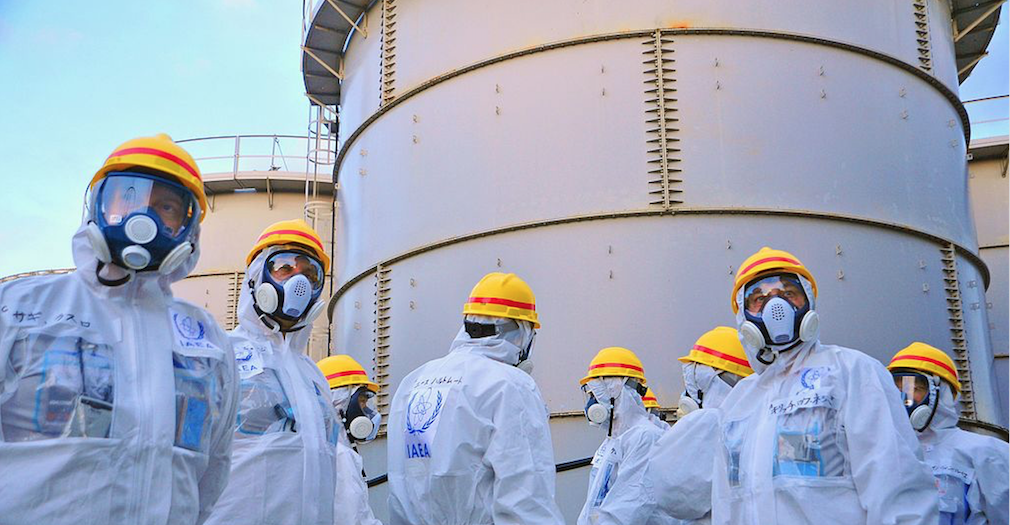
There were no hazmat suits or gas masks, the biohazard uniform most would imagine for this portion of the tour. Pants and a long-sleeved shirt was the required outfit, a protective layer augmented by gloves, a helmet and what could pass as a kafunsho (hay fever) mask. We were directed to tuck our pant legs into four layers of neon blue socks, which we slid into black ankle-cut rain boots. A personal Geiger counter was placed in the chest pocket of our mesh vests. It would set off an alarm when it reached the tour’s daily allowance for radiation exposure, 100 microsieverts, equivalent to a roundtrip flight between Narita and JFK. In our meticulously planned day-long tour, these counters wouldn’t reach more than 30 microsieverts.
The optics of this moment, standing in plain clothes next to two nuclear reactors, were not lost on Tokyo Electric Power Company (TEPCO), which operates Fukushima Daiichi and facilitated Metropolis’ tour of the 3.5km² power station, known internally as 1F. Our guide remarked that they often bring visitors to this spot. Safely getting up close to one of the reactors, even if only for 10 minutes, is a gesture they hope will show conditions at the plant have improved substantially since the 2011 disaster.
In the past year, TEPCO has expanded the number of power station tours for journalists and the general public. These tours are an effort to increase transparency and educate the public on the plant’s status. They are also an effort to build goodwill for a company that is still maligned by many for its culpability in the disaster. Three retired TEPCO executives, Ichiro Takekuro, Sakae Muto and former chairman Tsunehisa Katsumata, are currently on trial for “professional negligence resulting in death and injury,” a criminal charge for ignoring internal reports that Fukushima Daiichi was at risk from a debilitating tsunami wave. The indictment was brought by a civilian judiciary panel, overruling prosecutors who had twice declined to press charges. The criminal trial follows a string of civil suits, including a ruling by a Tokyo court last year that ordered TEPCO to pay ¥11 billion (100 million USD) in damages to the residents of Minamisoma, Fukushima.
As part of these tours, TEPCO is promoting what they consider major improvements to working conditions on the plant. Currently, 96 percent of 1F can be accessed with the “regular uniform” we wore during our tour. One of the most advertised portions of the plant is Sakura Dori, a roadway at the edge of 1F that has been specially maintained in order to match regularly-occurring radiation levels in Tokyo. Before the disaster, families of plant workers and local residents would gather under the road’s 1,000 blooming cherry blossoms trees for hanami (cherry blossom viewing) every April. This past year TEPCO invited journalists to Sakura Dori for a photo-op of the 380 trees that remain.
These entwined motivations of public education and public relations valence any visit to 1F, including Metropolis’. But even a manufactured look behind the power plant fences provides insight into the personal and working lives of the 5,000 people who are employed at Fukushima Daiichi daily. Their roles are diverse, from nuclear engineers and security guards, to bureaucratic liaisons and cafeteria servers. Decontamination workers stand alongside janitorial staff. There is even a fully-stocked Lawson convenience store tucked away in an administrative building with cashiers working the registers. Each of these workers wakes up every morning and must pass into the Fukushima exclusion zone on their way to work. Some even enter reactor buildings, earning their livelihood by putting themselves in proximity to dangerous nuclear debris.
As we walked down Sakura Dori towards our tour van, we passed a couple dozen workers; some matched us in attire, others wore blue TEPCO-issued coveralls, others wore anorak body suits and full-face masks, used in the plant’s most radioactive areas, or “R zones.” It was a muggy summer afternoon with grey clouds forecasting heavy rain. We were told heat stroke is a common problem when wearing full-body protective gear, one motivation behind efforts to make 1F more accessible with regular clothes. Without fail, though, each worker shared a hearty “otsukaresama” as they passed one another. The greeting is used to offer thanks for hard work; its literal translation addresses “someone who is tired.” Unlike PR officers, TEPCO executives and Diet legislators based in Tokyo’s Chiyoda Ward, it is 1F’s decommissioning workers who must walk Sakura Dori every day — not just when the cherry blossoms are in bloom. In some form, they will likely be walking this road for decades.
On March 11, 2011 at 3:27 pm, a tsunami wave 13 meters tall crested over the six-meter seawall of Fukushima Daiichi’s complex, flooding the grounds with a force that crippled the nuclear power station’s vital cooling systems. Without electricity required to pump water into the reactors, the waterline dropped below the core rods in Units 1, 2 and 3, instigating a nuclear meltdown in each. Inside these reactor walls, boiling pools of stagnant water produced volatile amounts of hydrogen gas (a Zirconium-steam reaction). Within days Units 1, 3 and 4 (connected to the Unit 3 building by pipes) had all suffered explosions, carrying nuclear fallout over the Pacific and inland, disseminating across the towns of eastern Fukushima Prefecture. The nuclear fuel in Units 1, 2 and 3 soon melted through their primary containment vessels (PCVs) and pooled in the cement basements of each respective building, where it remains to this day.
Masahiro Yamamoto, 42, was there on March 11. In fact, he’s been at the Fukushima Daiichi power plant for over 20 years, his first and only job since university. Born in Shimonoseki, Yamaguchi Prefecture, where southernmost Honshu meets the tip of Kitakyushu, Yamamoto enrolled in a TEPCO-affiliated high school. Trained as an engineer, the feeder program placed him at the Fukushima plant back in 1994, where he worked a steady engineering job and raised his three children in Futaba. One of two towns that border 1F, the evacuated municipality currently has an actual population of zero.
“Before the disaster, I worked just like an average salaryman. But as disaster struck and the situation worsened, it was as if I was dropped right in the middle of a battlefield,” he says. We don’t dwell on this difficult time, but Yamamoto shares some fragmented memories. “The monitors for the reactors started to show signs of abnormality, and I thought to myself, ‘what is going to happen now,’” he remembers. “My family lived nearby and I wanted to check their safety, but I had no way of communicating with them so I didn’t know whether they were swept away by the tsunami or injured by the quake. I had many worries, but I had to bury my feelings and focus on my duties. I managed to control myself up to that point.”
The Self-Defense Force came first; then other government agencies arrived — “When I was walking down the aisle to go to the restroom, the Prime Minister passed right by me.” Yamamoto’s workplace in a quiet seaside town had overnight become ground zero for a Level 7 nuclear accident, matched in severity only by the 1986 Chernobyl disaster. He describes himself and his team as co-workers that were suddenly required to be soldiers faced with daily life-threatening work. “When Unit 1 exploded, I was wearing my mask to go outside and work onsite at the reactors. I felt [the blast] blow across my face. Things took a turn for the worse and every time we had to go near the reactor buildings, our team was assembled knowing that there may be an explosion and we might die. We had to go through that many times, and it was psychologically hard on me.”
Seven years later, the realities of working at Fukushima Daiichi have changed dramatically for Yamamoto. Along with 750 other TEPCO employees, he lives in company dormitory housing in the town of Okuma, just outside the exclusion zone. His family evacuated during the disaster and they have been living in Tokyo’s Otsuka neighborhood ever since. Long train rides on weekends are the only way he spends time with his wife and three children before returning to his duties at the plant.
“There’s nothing special about my job,” Yamamoto says, despite all signs to the contrary. “I think any work is hard and challenging.” He describes his average day, far removed from the emergency response. Early mornings begin with weight training; nights are spent studying eikaiwa (English conversation). He’s working to improve his English skills, in part, to share his experiences at the power plant and dispel fears about visiting Fukushima Prefecture. “I’d like many foreigners to come to Japan to learn not just about the fun things, but also about [Fukushima Daiichi] and the reality.”
Yamamoto currently serves as Team Leader at Units 5 and 6, two reactors that were spared from nuclear meltdowns but are set for decommissioning. While important work, this is only one part of an elaborate operation that also aspires to full decommissioning of Units 1, 2, 3 and 4 by 2050. Now seven years into this proposed timeline, some critics have questioned its feasibility. According to Daisuke Hirose, a TEPCO spokesperson who debriefed Metropolis on the state of decommissioning, there are three major priorities in fulfilling the plan as scheduled.
The most complex is the location and extraction of nuclear fuel debris. Hundreds of tons of melted fuel remain buried deep within Units 1, 2 and 3, the exact locations of which remain unknown. Rubble and fatal radioactivity levels have rendered these parts of the reactor buildings inaccessible to humans, leaving remote-controlled robots the most viable method of investigation. Only minimal fuel debris in Unit 2 has currently been identified and the means of extraction have not been finalized, but Hirose says TEPCO will meet a 2021 benchmark for initial fuel extraction. Alongside the handling of nuclear debris, the plant must confront a rapid accumulation of contaminated water on site, perhaps the most urgent task facing the operation.
Despite the pressing and complex problems facing the project, Hirose argues that improving the safety of the plant must rank above all other priorities, “Decommissioning is something done by people. Our most important task is improving conditions at 1F for decommissioning workers.” Yamamoto, for one, insists he does not worry about his health while working at the plant. “At the time of the disaster, I couldn’t comprehend all the issues about contamination and radiation exposure, so I was very worried back then,” he says. “I don’t have those worries now.” Yamamoto’s duties at Units 5 and 6 include routine exposure to radiation, but he does not currently conduct work in the plant’s most radioactive locations. While we requested to speak to an employee with work duties in the R zone, TEPCO declined the request citing the priority for these employees as decommissioning work. “Of course, to be honest, there are some people who’ve suffered health damage, as has been reported in newspapers, so it’s not a zero,” he adds. Currently, 17 employees at 1F who’ve developed cancer have applied to the Ministry of Health, Labor and Welfare for compensation as a work-related illness. In September, the Ministry acknowledged the first death related to radiation exposure at 1F, a subcontractor in his 50s who died of lung cancer.
Once a meishi (business card) that held tremendous social capital, TEPCO is now a company irrecoverably associated with the disaster. To many, the workers of Fukushima Daiichi are the face of this institution. Yamamoto shares stories of coworkers’ doors being vandalized with graffiti and trash being dumped in front of their homes. It is difficult to find sympathy for the TEPCO workers at 1F when considering the continued injustices suffered by the residents of Fukushima, but the victims of the nuclear disaster and the rain boots on the ground at 1F are not necessarily distinct populations. Around 60 percent of the employees at Fukushima Daiichi are from Fukushima Prefecture, a number that TEPCO says may be underreported since it only includes those born in the prefecture. In many instances, including Yamamoto’s, the workers at 1F are working towards recovering their own communities in the entwined futures of decommissioning and Fukushima’s restoration.
Our coach passed the border of the “difficult to return zone,” a government-designated boundary that separates areas of Fukushima deemed habitable from those deemed uninhabitable. Suddenly we were facing the Fukushima “ghost towns” of popular imagination. While Fukushima Daiichi is ground zero, the heart of this disaster is in the abandoned towns of the prefecture: homes and businesses and schools left behind in an instant, hard evidence of the 160,000 residents that were displaced by the disaster. Abandoned vehicles, shattered windows, hollowed-out storefronts, a dilapidated pachinko parlor and seven years of weeds rising from cracks in the cement — they all passed by the coach windows on our approach to Fukushima Daiichi.
We were not the only vehicles on this highway, trucks rumbled past us and cars lined the road. Calling these “ghost towns” is a misnomer: these towns may be uninhabited, but they are not unoccupied. Many of these vehicles belonged to a decontamination project that spans the original 20km exclusion zone and beyond. It is not operated by TEPCO, but rather a web of government agencies and municipalities. Their job, first and foremost, entails the mass removal of dirt, stripping entire towns of topsoil and manually washing down rooftops and other surfaces that were doused in radioactive particles in an effort to clean away radiation. Fields of black refuse sacks, millions of which are filled with contaminated soil, now litter the prefecture without plans for their permanent storage or removal. Regardless of this work’s efficacy, it is an undertaking that requires a massive labor force; Japan’s Ministry of Health, Labour and Welfare reports that more than 46,000 were employed in Fukushima decontamination work in 2016.
The harsh reality is that the disaster has disrupted the industries that once thrived in Fukushima Prefecture — fishing, agriculture and service jobs. Currently, only half of the region’s 1,000 fishermen are going out to sea and they face highly reduced demand. The decontamination industry is one of the few thriving seven years later, but this line of work is not without its risks. In early September, the UN human rights division released a statement warning of possible worker exploitation in the recovery effort, both within the prefectural decontamination projects and on the 1F site. “Workers hired to decontaminate Fukushima reportedly include migrant workers, asylum seekers and people who are homeless,” wrote three UN Special Rapporteurs. “They are often exposed to a myriad of human rights abuses, forced to make the abhorrent choice between their health and income, and their plight is invisible to most consumers and policymakers with the power to change it.” Japan’s Foreign Ministry responded by calling the statement “extremely regrettable.”
We met Yamamoto in the parking lot of the plant after our tour. His TEPCO uniform had been exchanged for pants and a graphic-T. It is the second time we’d met that he had worn this particular gray short-sleeved shirt with a Ghostbusters logo emblazoned on its chest, one of his favorite movies as a child. Outside the plant, Yamamoto sheds his professional facade to reveal a youthful energy. During the night ahead we would visit an izakaya (Japanese pub) in Iwaki City and share stories over local sake and sashimi (sliced raw fish), once celebrated Fukushima products that have since been cast off supermarket shelves as new associations and stigmas took hold of the prefectural name.
There are many people who shoulder the burden of the nuclear disaster: parents sending their children to school with Geiger counters on their backpacks, farmers who have lost their livestock and livelihood, elderly left to care for deserted towns as the young set roots far from Futaba-gun, multi-generation Fukushima lineages that have been forced to abandon their familial homes for prefabricated temporary housing units. Yamamoto carries one small burden of this sweeping tragedy, as do the other workers of Fukushima Daiichi, as do those who labor in irradiated fields without other means of income. They are trying to extinguish a danger that can’t be seen, but its presence is felt in every aspect of their work. At times the job they’ve been assigned feels beyond comprehension, but Fukushima is not a supernatural disaster and Yamamoto is no ghostbuster. This disaster is deeply human, founded in both nature and negligence. “If you think in terms of decades, the long road ahead and the abstractness of it all will crush you,” says Yamamoto. “But just as with any other work, if you split up big projects into smaller pieces, the feeling of accomplishment from each small victory will keep you motivated.” Inside the exclusion zone, we witness the people of Fukushima trying to take their land a few steps closer to normal.

October 3, 2018
Posted by dunrenard |
Fukushima 2018 | Fukushima, Fukushima Daiichi, Nuclear Disaster, Workers |
Leave a comment

Fukushima Daiichi to be reinforced against tsunami
The operator of the Fukushima Daiichi nuclear plant plans to build additional seawalls along its damaged reactors.
Its aim is to keep another possible mega-tsunami from causing the leakage of highly radioactive water accumulated in the basement of buildings housing 3 reactors that suffered a meltdown following the 2011 quake and tsunami.
The Tokyo Electric Power Company, or TEPCO, announced the plan at a meeting of the Nuclear Regulation Authority on Friday.
Last December, a government earthquake research panel warned of a possible imminent mega-quake in the Chishima Trench off the northern prefecture of Hokkaido.
TEPCO says its research shows such a quake could send tsunami of more than 10 meters into the Fukushima Daiichi plant and cause highly radioactive water to gush out of its damaged reactors.
The Fukushima Daiichi plant is in the process of decommissioning after the triple meltdown.
TEPCO has been pumping water into the 3 reactors to cool down fuel that melted. About 46,000 tons of contaminated cooling water and groundwater flowing into the reactor buildings have accumulated, mainly in their basement floors.
TEPCO now plans to move up work to seal the buildings’ entrances and other openings to prevent any more tsunami-related damage.
The company will also extend the coastal seawalls further north along reactor units 1 to 4, and plans to finish the work as soon as possible.
At Friday’s meeting, an official of the Secretariat of the Nuclear Regulation Authority asked TEPCO to study whether the planned extension of seawalls will affect the decommissioning work.
TEPCO’s Chief Decommissioning Officer, Akira Ono, said another tsunami could knock out equipment and delay the decommissioning process. He said the company will quickly study how and where the seawalls should be built.
In shift in stance, TEPCO to build extra sea wall at Fukushima plant
Heeding a government warning, Tokyo Electric Power Co. said it will build a 600-meter-long sea wall to strengthen protection against tsunami at the already battered Fukushima No. 1 nuclear power plant.
TEPCO announced its change in stance on Sept. 14 at a meeting of the Nuclear Regulation Authority, the country’s nuclear watchdog.
The wall will be constructed on the east side of four reactor buildings at the plant, TEPCO said. Details, such as height, construction schedule and costs, have yet to be decided.
The utility built a temporary sea wall after the March 2011 Great East Japan Earthquake and tsunami caused the triple meltdown at the Fukushima plant.
The company had said the temporary wall would provide sufficient protection of the plant from tsunami.
But TEPCO officials had second thoughts after the government’s Headquarters for Earthquake Research Promotion in December 2017 warned that the probability of an extremely powerful earthquake of magnitude 8.8 or higher striking in the Pacific Ocean off Hokkaido within 30 years was 40 percent.
The headquarters called for additional safety measures at nuclear plants, saying the strength of such a quake would be similar to the magnitude-9.0 Great East Japan Earthquake that spawned the devastating tsunami in 2011.
If another huge tsunami hits the plant, it could cause tons of radioactive water to flow out and obstruct work to decommission the nuclear reactors there.
“If another tsunami comes, the measures we have taken for the past seven years will be meaningless,” a TEPCO official said.
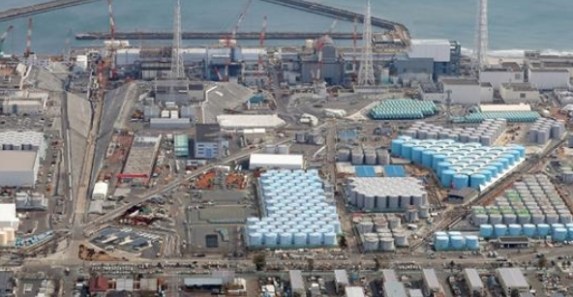
Work continues at the Fukushima No. 1 plant to cool the melted nuclear fuel within the heavily damaged reactor buildings. This water, coupled with the tons of daily groundwater that becomes contaminated after entering the reactor buildings, has forced the utility to store tons of radioactive water in tanks on the premises of the plant.
Those tanks and radioactive water accumulating in the reactor buildings could be swept away in a tsunami that hits the plant.
In addition, 1,573 nuclear fuel assemblies are stored in pools in the damaged reactor buildings.
If a tsunami knocks out functions to cool the fuel assemblies, the fuel could melt and release radioactive substances into the atmosphere.
TEPCO constructed the temporary 400-meter-long sea wall on the south side of the No. 4 reactor building in June 2011.
For possible tsunami coming from the east or north sides, TEPCO said waterproof doors on reactor buildings could overcome the problem.
The utility decided that an additional sea wall would be needed after the headquarters’ warning about an earthquake off Hokkaido, which is located north of the Fukushima plant.
TEPCO had considered constructing a sea wall at the site even before the 2011 nuclear disaster. However, it failed to reach a decision on its construction.
September 17, 2018
Posted by dunrenard |
Fukushima 2018 | Fukushima Daiichi, Sea Wall |
1 Comment
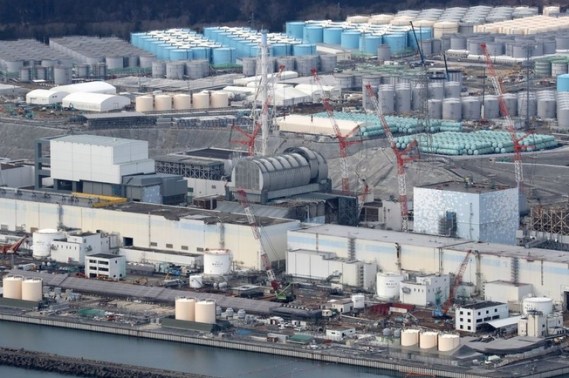
In this July 17, 2018 file photo, tanks containing water contaminated with radioactive materials are seen on the grounds of the Fukushima No. 1 Nuclear Power Plant in Okuma, Fukushima Prefecture.
KATSURAO, Fukushima — A Fukushima University professor and his team are gathering materials for an archive project to pass on the lessons learned from the 2011 Great East Japan Earthquake and nuclear disaster in this prefecture in northeastern Japan.
In a March 2017 plan finalized by the Fukushima Prefectural Government, the archives will be inaugurated in the summer of 2020 at a cost of approximately 5.5 billion yen in the town of Futaba, which has been rendered “difficult to live” due to radioactive fallout from the triple core meltdowns at Tokyo Electric Power Co. (TEPCO)’s Fukushima No.1 Nuclear Power Plant in March 2011. The facility will have a total floor space of 5,200 square meters with areas for exhibitions, management and research, storage, training sessions and holding meetings. The design was modeled after a similar center in the western Japan city of Kobe that was built to store records of the 1995 Great Hanshin Earthquake, but with more focus on the nuclear disaster than the quake itself.
Professor Kenji Yaginuma of Fukushima University’s Fukushima Future Center for Regional Revitalization and his team are visiting places affected by the nuclear accident and collecting testimonies of residents, documents, pictures and images for the project.
Yaginuma recently interviewed Tetsuyama Matsumoto, 61, who used to be a cattle breeder in the village of Katsurao, to hear his story about how his cows had to be slaughtered after the nuclear accident.
“I can’t believe they killed the cows without running any tests first,” Matsumoto fumed about the action taken after the central government decided that all cattle inside the no-go zone, within a 20-kilometer radius of the crippled plant, had to be culled. All eight cattle Matsumoto was keeping had to be killed because his farm was inside the zone. “The cattle were supporting me and my family,” Mastsumoto said as he looked over pictures of what happened after the disaster.
Yaginuma listened to Matsumoto’s tale intently, using a video camera to record the interview. “The value of relevant documents goes up with testimonies,” explained the professor.
On the same day, he also visited the village’s board of education as well as the former municipal Katsurao Junior High School to confirm the existence of whiteboards with plans for March 2011 written on it as well as what was written on the blackboards at the school. The school held a graduation ceremony on March 11 that year, the day of the quake disaster. According to the professor, sometimes it takes months for some residents to build up enough confidence to give him some important papers they have.
Yaginuma’s team is collecting just about anything that shows the daily lives of residents before the quake, or items that show what happened in the disaster and the ensuing nuclear accident, as well as materials indicative of post-disaster situations.
In November 2017, Yaginuma and his team visited the prefectural Ono Hospital in the town of Okuma, which is just 4 kilometers away from the nuclear plant and is still included in the “difficult-to-return” evacuation area designated by the government.
On the day of the earthquake seven and a half years ago, the hospital accepted many people injured by the jolt and the subsequent tsunami. But all patients and medical staff needed to evacuate at 7 a.m. the next morning using buses and ambulances after an evacuation order due to the nuclear accident was issued. Near the clinic’s entrance, papers with patients’ names and conditions are posted on a whiteboard. Stands to hang intravenous drip bags are also scattered around, reminiscent of the tense atmosphere of the time.
“We want to make it possible for people to look back on and study the earthquake and nuclear accident from every angle based on these documents,” said Yaginuma.
(Japanese original by Takuya Yoshida, Mito Bureau)
September 17, 2018
Posted by dunrenard |
Fukushima 2018 | Archives, Fukushima Daiichi, Nuclear Disaster |
Leave a comment
TEPCO could dump radioactive water into ocean any day. Help stop it!
From various correspondents
More than one million tonnes of radioactively contaminated water has already accumulated at the destroyed Fukushima Daiichi nuclear power plant site, stored in steel tanks and increasing in volume daily — by some accounts one new tank is added every four days. Space to store it is rapidly running out. So far, the only “plan” TEPCO has come up with to deal with the problem is to dump the water into the Pacific Ocean.
The water is accumulating in part because about 150 tonnes of groundwater seeps daily through cracks in the stricken reactors’ foundations, thereby becoming contaminated with radioactive isotopes. In addition, water flows down the surrounding hillsides onto the site, picks up radiation, and must be captured and stored on site.
TEPCO has so far been pumping the contaminated water through a filtering system that can only remove cesium and strontium. But the process creates a highly toxic sludge as a byproduct, which also has to be stored in sealed canisters on site.
Tritium, a radioactive isotope of hydrogen, cannot of course be removed from water. Hence the plan to dump the radioactive (tritiated) water into the ocean. This move has long been strongly opposed by people from many spectra in Japan. A “Resolution Against the Ocean Dumping of Radioactive Tritium-contaminated Waste Water From the Fukushima Daiichi Nuclear Power Plant,” initiated by physics Professor Emeritus at Kyoto University, Kosaku Yamada, has already garnered signatures from 280 individuals and 35 organizations. The Resolution is reproduced below.
The goal of the resolution is to raise public awareness about the prolonged serious health effects of the Fukushima nuclear disaster that the Japanese government is taking every step to conceal.
Now, the organizers are calling on the international community to sign on as well. You can do so by sending your contact details directly to Professor Yamada at:
A Resolution Against the Ocean Dumping of Radioactive Tritium-contaminated Waste Water From the Fukushima Nuclear Power Plant
It was announced in March, 2014, that in the defunct Fukushima Nuclear Power Plant there was a total of approximately 3,400 trillion becquerels of tritium, with 830 trillion becquerels stored in tanks. This enormous amount of radioactive waste water has still continued to increase since then. In these circumstances, the Japanese government and Tokyo Electric Power Company Ltd. (TEPCO), in their efforts to find an easy way to dispose of the tritium-contaminated waste water created by the Fukushima nuclear disaster, have been trying to dilute and dump it into the ocean. They have been watching for an unguarded moment among the opposition movements including the fishery cooperatives who are strongly against the dumping. Now they are about to finally decide to implement the ocean dumping plan. Far from regulating such activities, Toyoshi Fuketa, the chairman of the Nuclear Regulatory Authority, has been championing this plan.
We are determined that the Japanese government and TEPCO shall never dump the radioactive waste water into the ocean for the following reasons:
1. Generally misunderstood as posing little risk to life and health, tritium is an extremely hazardous radioactive material. This is because organisms are not able to chemically distinguish tritium water from the normal water which composes most of the human body. This means that tritium can invade any part of the human body, irradiating it from inside; therefore, tritium can damage cell membranes and mitochondria in cells, indirectly through reactive oxygen species (ROS) and other radicals generated in irradiation. Tritium decay can directly cut chemical bonds of genomes or DNA strands. The risk peculiar to tritium is that if some hydrogen atoms which make up the genomes are replaced with tritium, the beta decay of the tritium into helium will cut off the chemical bonds of the genome.
Plants produce starch from water and carbon dioxide gas by using photosynthesis. Some of the hydrogen atoms in this starch can be replaced with tritium, forming organic tritium, which animals, plants and human beings absorb into their bodies over the long term, causing internal radiation.
2. With reference to the tritium released by various nuclear facilities, reports indicate a number of findings including: an increased incidence of leukemia among those living around the Genkai Nuclear Power Plant; an increased incidence of infant leukemia around nuclear reprocessing plants all over the world; and an increased incidence of child cancers around nuclear power plants. Real damage has already occurred.
3. Tritium, even if diluted and dumped into the ocean, will become concentrated again through aspects of the ecosystem such as food chains. Furthermore, tritium will vaporize into tritium-containing moisture or hydrogen gas, only to return to the land and eventually circulate within the environment. The idea that dilution ensures safety has caused fatal blunders to be repeated in many environmental pollution cases in the past, the vital factor being the total quantity released into the environment. Therefore, as far as environmental pollution problems are concerned, the only righteous and principled policy is to thoroughly confine and isolate radioactive materials or toxic substances from the ecosystem.
As tritium has a long half-life of 12 years, it destroys the environment over the long term. Tritium is an isotope of hydrogen which constitutes not only most of the living body but also its genes, so tritium disposal via dilution cannot be safe. Thus, we strongly urge the Japanese government and the Nuclear Regulatory Authority never to dump tritium into the ocean.
September 17, 2018
Posted by dunrenard |
Fukushima 2018 | Dumping, Fukushima Daiichi, Radioactive Water, Tritium |
Leave a comment
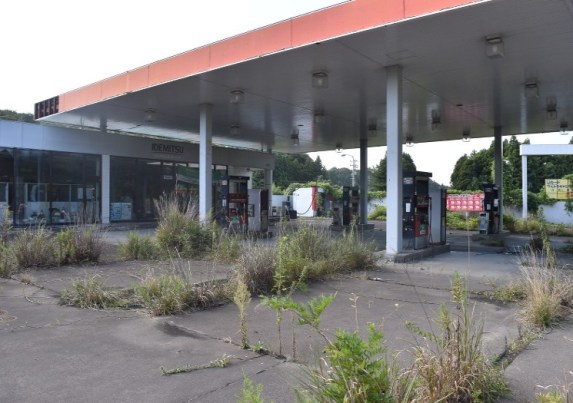
Weeds grow through the pavement at a derelict gas station in Tomioka, Fukushima Prefecture, in this Aug. 22, 2018
TOKYO — About 80 percent of 45 administrative district heads inside six municipalities in Fukushima Prefecture with areas rendered difficult to live because of the March 2011 nuclear accident said it is impossible for enough evacuated residents to return to meet population goals at “reconstruction hub areas” set by those local governments, a Mainichi Shimbun survey has found.
The heads said meeting those goals as part of recovery efforts is not possible because many of the evacuees now have new jobs and homes, and aging is advancing among them. The survey results placed a question mark on the feasibility of the local governments’ recovery plans.
The population goals for the northern Japan municipalities are set for around 2027 or 2028, five years after evacuation orders for difficult to return areas would presumably be lifted in 2022 or 2023. The numbers are calculated based on evacuees’ positive or undecided responses to opinion polls conducted by the municipalities.
The reconstruction hub areas receive national funding for decontamination and will have concentrated residential areas and infrastructure. They were incorporated in a special law for the reconstruction of Fukushima areas affected by the nuclear disaster, and the six municipalities received the central government’s approval for their reconstruction hub plans and their population goals by the spring of this year.
The population goals were 2,000 for the town of Futaba, 2,600 for the town of Okuma, 1,500 for the town of Namie, 1,600 for the town of Tomioka, 180 for the village of Iitate and 80 for the village of Katsurao.
The Mainichi survey of the administrative district heads was conducted by mail and other means from July through August of this year. Questionnaires were sent to 59 heads, and 45 of them responded. Of the total respondents, 37 said it is impossible to meet the goals, while six said it is conceivable, and the remaining two gave other answers.
When asked why they think that the population goals are not feasible, 16 said it is because evacuees established their base of living in new places, while 10 cited fear of radiation. Five said it is because the evacuees are aging.
A local head in Futaba said seven years of life in refuge was “too long,” while an official from Okuma pointed out that young people are especially worried about radiation. Another local leader from Okuma said aged people will not return unless medical and other facilities are available.
Local heads with positive responses said meeting the population goals depends on the influx of new residents who would move to their districts to carry out work decommissioning the Fukushima No. 1 Nuclear Power Plant operated by the Tokyo Electric Power Co. (TEPCO). The plant’s three reactors leaked massive amounts of radioactive materials after fuel rods in their cores melted because of cooling system shutdowns triggered by the massive earthquake and tsunami. The six municipalities around the plant became contaminated by the fallout.
After the nuclear accident, 11 cities, towns and villages came under government evacuation orders. Currently, entry is restricted at all of Futaba and Okuma, where the plant is located, as well as parts of Namie, Tomioka, Iitate and Katsurao. Even in areas where evacuation orders are lifted, populations are around 20 percent of the registered numbers of residents.
Associate professor Fuminori Tanba of Ritsumeikan University, a specialist on social welfare, explained that the population goals reflect the hopeful expectations of those municipalities counting on the inflow of decommission workers and researchers, and they are different from the perception of evacuees. “Town planning should be done by seeking the participation of returning evacuees, those going back and forth between their old and new homes, and new residents including plant workers,” said Tanba. “They should have plans suitable for returnees, and it is important to have plans going beyond municipal boundaries and assigning different roles to towns and villages involved.
(Japanese original by Toshiki Miyazaki and Keita Kishi, Fukushima Bureau)
September 10, 2018
Posted by dunrenard |
Fukushima 2018 | Disaster Areas, Fukushima, Population Decrease |
Leave a comment
“A task force of the Ministry of Economy, Trade and Industry has considered five options, including release into the Pacific Ocean after dilution, injection into deep underground strata and release into the air after vaporization. The group has concluded that dumping the water into the ocean would be the quickest and least costly way to get rid of it.
This is seen as the best option within the government.”
Contaminated water is stored in large tanks at the crippled Fukushima No. 1 nuclear power plant.
The government has held public hearings on plans to deal with growing amounts of radioactive water from the ruined Fukushima No. 1 nuclear power plant.
The hearings, held in Tomioka and Koriyama in Fukushima Prefecture as well as in Tokyo, underscored the enormous difficulty government policymakers are having in grappling with the complicated policy challenge.
The crippled reactors at the plant are still generating huge amounts of water contaminated with radiation every day. Tons of groundwater percolating into the damaged reactor buildings as well as water being injected into the reactors to cool the melted fuel are constantly becoming contaminated.
Almost all the radioactive elements are removed from the water with a filtering system. But the system cannot catch tritium, a mildly radioactive isotope of hydrogen.
The tritium-contaminated water is stored on-site in hundreds of large tanks. As the number of tanks has reached 900, the remaining space for them is shrinking and expected to run out by around 2020, according to the government.
Clearly, time is growing short on deciding what to do about the problem.
A task force of the Ministry of Economy, Trade and Industry has considered five options, including release into the Pacific Ocean after dilution, injection into deep underground strata and release into the air after vaporization. The group has concluded that dumping the water into the ocean would be the quickest and least costly way to get rid of it.
This is seen as the best option within the government.
Tritium is a common radioactive element in the environment that is formed naturally by atmospheric processes. Nuclear power plants across the nation release tritium produced in their operations into the sea according to legal safety standards.
But these facts do not automatically mean that releasing the tritium-laced water into the sea off Fukushima is a good approach to the problem.
Local communities in areas affected by the 2011 nuclear disaster are making strenuous efforts to rebuild the local fishing and agricultural industries that have been battered by the radiation scare. There are still countries that ban imports of foodstuffs produced in Fukushima Prefecture.
Local fishermen and other community members have every reason to oppose the idea of releasing tritium into the ocean. They are naturally concerned that the discharge would produce new bad rumors that deliver an additional blow to the reputation and sales of Fukushima food products.
Unsurprisingly, most of the citizens who spoke at the hearings voiced their opposition to the idea.
Moreover, it was reported last month that high levels of radioactive strontium and iodine surpassing safety standards had been detected in the treated water.
The revelation has made local communities even more distrustful of what they have been told about operations to deal with the radioactive water.
It is obvious that the hearings at only three locations are not enough to sell any plan to cope with the sticky problem to skeptical local residents. The government needs to create more opportunities for communication with them.
In doing so, the government should show a flexible stance without adamantly making the case for the idea of releasing the water into the sea. Otherwise, there can be no constructive debate on the issue.
It can only hope to win the trust of the local communities if it gives serious consideration to other options as well.
During the hearings, many speakers suggested that the water should be kept in large tanks until the radioactivity level falls to a very low level.
The pros and cons of all possible options, including this proposal, should be weighed carefully through cool-headed debate before the decision is made.
Repeated discussions with fruitful exchanges of views among experts and citizens including local residents are crucial for ensuring that the final decision on the plan will win broad public support.
The government and Tokyo Electric Power Co., the operator of the Fukushima plant, should disclose sufficient information for such discussions and give thoughtful and scrupulous explanations about relevant issues and details.
The government, which has been promoting nuclear power generation as a national policy priority, has the responsibility of building a broad and solid consensus on this problem.
September 10, 2018
Posted by dunrenard |
Fukushima 2018 | Dumping, Fukushima Daiichi, Radioactive Water |
Leave a comment
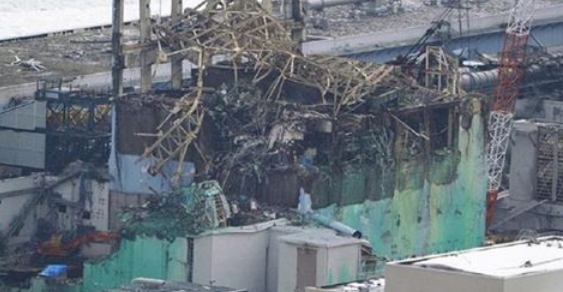
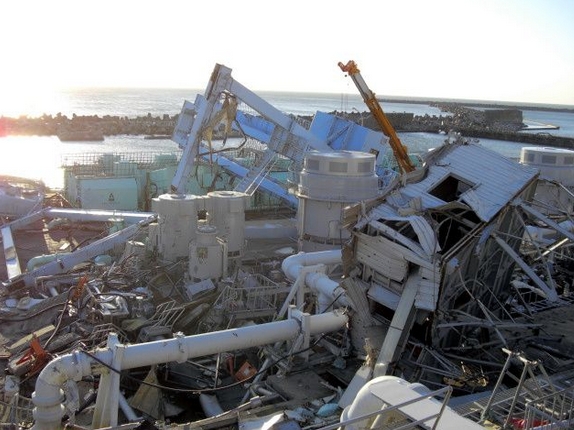
A collapsed crane and other debris at the crippled Fukushima No. 1 nuclear power plant after tsunami devastated the area on March 11, 2011
The Tokyo District Court on Sept. 5 accepted the written statement of a former Tokyo Electric Power Co. executive who claimed that his boss abruptly postponed tsunami prevention measures at the Fukushima No. 1 nuclear power plant in 2008.
The postponement reportedly occurred almost three years before the plant was engulfed by a tsunami on March 11, 2011, resulting in the most serious nuclear accident since the 1986 Chernobyl disaster.
The statement was made by Kazuhiko Yamashita, former head of TEPCO’s center tasked with compiling steps against tsunami at the earthquake countermeasures, to prosecutors from 2012 to 2014. It was read out during the 24th hearing at the court on Sept. 5.
Tsunehisa Katsumata, 78, former TEPCO chairman, former TEPCO Vice President Sakae Muto, 68, and Ichiro Takekuro, 72, former TEPCO vice president, are on trial on charges of professional negligence resulting in death and injury from the 2011 nuclear disaster.
Yamashita’s statement, recorded by investigators, supported arguments by lawyers serving as prosecutors that “defendants postponed measures to protect the plant despite having recognized the necessity for such measures.”
To prove negligence, prosecutors are trying to show that the top executives could have predicted the height of the tsunami that swamped the plant.
Defense lawyers have argued that “the nation’s earthquake forecast was not reliable and measures against tsunami had not been decided yet.”
According to Yamashita’s statement, the three executives approved the implementation of anti-tsunami prevention measures based on earthquake forecast issued by the government professional body but later put off the enforcement of the measures at the plant.
Yamashita was originally scheduled to provide sworn testimony. Instead, Presiding Judge Kenichi Nagabuchi accepted Yamashita’s statement, saying, “(Yamashita) is not in a condition able to testify at the court.”
The statement said TEPCO initially considered options based on a long-term assessment of the probability of major earthquakes released by the science ministry’s Headquarters for Earthquake Research Promotion in 2002.
The utility estimated that a tsunami more than 7.7 meters high could hit its Fukushima No. 1 nuclear power plant based on its trial calculation.
In February 2008, when Yamashita proposed the tsunami measures in light of a long-term tsunami risk assessment during a meeting in which Katsumata and two other executives attended, the policy was accepted without opposition and was also adopted at a managing directors’ meeting the following month.
Based on Muto’s instructions, the team had mulled procedures on obtaining a permit to build a seawall to protect the Fukushima No. 1 plant, according to a TEPCO employee who testified at an April hearing.
However, when a TEPCO subsidiary conducted a detailed study on the maximum height of a tsunami on the basis of the assessment, it found in March the same year that a tsunami of “a maximum 15.7 meters” could engulf the Fukushima plant, surpassing the 10-meter height of the site of the plant where major facilities were located.
The findings were reported to TEPCO executives in June 2008 and then to Muto.
Muto in July 2008 decided to put off measures based on the 15.7-meter estimate, according to the statement.
TEPCO’s policy shift was the result of its “executives’ recognition that such measures require massive construction and would make it difficult for TEPCO to explain to the central government and locals that the plant was still safe, which could lead their demands for halting operations of the plant,” the statement said.
“I was surprised that a TEPCO executive had already revealed the inside details of the entity to such an extent,” said lawyer Yuichi Kaido, who is acting on behalf of the independent judicial panel of citizens who recommended the indictment of the three former TEPCO executives. “(TEPCO’s) extraordinariness that it did nothing because it couldn’t take measures was clearly exposed.”
September 10, 2018
Posted by dunrenard |
Fukushima 2018 | Fukushima Daiichi, Tepco Negligence, Tepco Trial |
Leave a comment












 nuclear-news